EP2333992A2 - Verfahren zur Widget-Bereitstellung je nach Rundfunkdienstinformation und Rundfunkempfangsgerät damit - Google Patents
Verfahren zur Widget-Bereitstellung je nach Rundfunkdienstinformation und Rundfunkempfangsgerät damit Download PDFInfo
- Publication number
- EP2333992A2 EP2333992A2 EP10194424A EP10194424A EP2333992A2 EP 2333992 A2 EP2333992 A2 EP 2333992A2 EP 10194424 A EP10194424 A EP 10194424A EP 10194424 A EP10194424 A EP 10194424A EP 2333992 A2 EP2333992 A2 EP 2333992A2
- Authority
- EP
- European Patent Office
- Prior art keywords
- widget
- broadcast
- information
- widgets
- groups
- Prior art date
- Legal status (The legal status is an assumption and is not a legal conclusion. Google has not performed a legal analysis and makes no representation as to the accuracy of the status listed.)
- Withdrawn
Links
Images



Classifications
-
- H—ELECTRICITY
- H04—ELECTRIC COMMUNICATION TECHNIQUE
- H04N—PICTORIAL COMMUNICATION, e.g. TELEVISION
- H04N5/00—Details of television systems
- H04N5/44—Receiver circuitry for the reception of television signals according to analogue transmission standards
- H04N5/445—Receiver circuitry for the reception of television signals according to analogue transmission standards for displaying additional information
-
- H—ELECTRICITY
- H04—ELECTRIC COMMUNICATION TECHNIQUE
- H04H—BROADCAST COMMUNICATION
- H04H60/00—Arrangements for broadcast applications with a direct linking to broadcast information or broadcast space-time; Broadcast-related systems
- H04H60/76—Arrangements characterised by transmission systems other than for broadcast, e.g. the Internet
- H04H60/81—Arrangements characterised by transmission systems other than for broadcast, e.g. the Internet characterised by the transmission system itself
- H04H60/82—Arrangements characterised by transmission systems other than for broadcast, e.g. the Internet characterised by the transmission system itself the transmission system being the Internet
-
- H—ELECTRICITY
- H04—ELECTRIC COMMUNICATION TECHNIQUE
- H04H—BROADCAST COMMUNICATION
- H04H60/00—Arrangements for broadcast applications with a direct linking to broadcast information or broadcast space-time; Broadcast-related systems
- H04H60/35—Arrangements for identifying or recognising characteristics with a direct linkage to broadcast information or to broadcast space-time, e.g. for identifying broadcast stations or for identifying users
- H04H60/38—Arrangements for identifying or recognising characteristics with a direct linkage to broadcast information or to broadcast space-time, e.g. for identifying broadcast stations or for identifying users for identifying broadcast time or space
- H04H60/41—Arrangements for identifying or recognising characteristics with a direct linkage to broadcast information or to broadcast space-time, e.g. for identifying broadcast stations or for identifying users for identifying broadcast time or space for identifying broadcast space, i.e. broadcast channels, broadcast stations or broadcast areas
- H04H60/43—Arrangements for identifying or recognising characteristics with a direct linkage to broadcast information or to broadcast space-time, e.g. for identifying broadcast stations or for identifying users for identifying broadcast time or space for identifying broadcast space, i.e. broadcast channels, broadcast stations or broadcast areas for identifying broadcast channels
-
- H—ELECTRICITY
- H04—ELECTRIC COMMUNICATION TECHNIQUE
- H04H—BROADCAST COMMUNICATION
- H04H60/00—Arrangements for broadcast applications with a direct linking to broadcast information or broadcast space-time; Broadcast-related systems
- H04H60/68—Systems specially adapted for using specific information, e.g. geographical or meteorological information
- H04H60/73—Systems specially adapted for using specific information, e.g. geographical or meteorological information using meta-information
-
- H—ELECTRICITY
- H04—ELECTRIC COMMUNICATION TECHNIQUE
- H04N—PICTORIAL COMMUNICATION, e.g. TELEVISION
- H04N7/00—Television systems
- H04N7/08—Systems for the simultaneous or sequential transmission of more than one television signal, e.g. additional information signals, the signals occupying wholly or partially the same frequency band, e.g. by time division
-
- H—ELECTRICITY
- H04—ELECTRIC COMMUNICATION TECHNIQUE
- H04H—BROADCAST COMMUNICATION
- H04H2201/00—Aspects of broadcast communication
- H04H2201/40—Aspects of broadcast communication characterised in that additional data relating to the broadcast data are available via a different channel than the broadcast channel
-
- H—ELECTRICITY
- H04—ELECTRIC COMMUNICATION TECHNIQUE
- H04H—BROADCAST COMMUNICATION
- H04H60/00—Arrangements for broadcast applications with a direct linking to broadcast information or broadcast space-time; Broadcast-related systems
- H04H60/27—Arrangements for recording or accumulating broadcast information or broadcast-related information
-
- H—ELECTRICITY
- H04—ELECTRIC COMMUNICATION TECHNIQUE
- H04H—BROADCAST COMMUNICATION
- H04H60/00—Arrangements for broadcast applications with a direct linking to broadcast information or broadcast space-time; Broadcast-related systems
- H04H60/61—Arrangements for services using the result of monitoring, identification or recognition covered by groups H04H60/29-H04H60/54
- H04H60/65—Arrangements for services using the result of monitoring, identification or recognition covered by groups H04H60/29-H04H60/54 for using the result on users' side
Definitions
- Apparatuses and methods consistent with the exemplary embodiments relate to broadcast receiving apparatus, and more particularly, to a broadcast receiving apparatus which performs additional functions other than a broadcast receiving function.
- a television (TV) the most exemplary broadcasting receiving apparatus, has additional functions other than its original function of receiving broadcasts, and the additional functions have become more diverse and complex.
- Exemplary embodiments address at least the above problems and/or disadvantages and other disadvantages not described above. Also, the exemplary embodiments are not required to overcome the disadvantages described above, and an exemplary embodiment may not overcome any of the problems described above.
- the exemplary embodiments provide a method for providing a widget and a broadcast receiving apparatus using the same, which displays one of a plurality of widget groups based on broadcast information regarding a broadcast chosen by a user to provide more useful and necessary information to users.
- a widget-providing method includes: receiving and outputting a broadcast selected by a user; acquiring broadcast information of the broadcast selected by the user; and displaying one of a plurality of widget groups based on the acquired information.
- the broadcast information may be information about a broadcast station which provides the broadcast selected by the user.
- the widget group displayed in the displaying operation may be a congregation of widgets where information provided by the broadcast station is recorded.
- the broadcast information may be acquired from broadcast signals, and the information recorded on the widgets may be provided from the broadcast station through a network.
- the plurality of widget groups may be matched to a plurality of broadcast stations, respectively.
- At least one of widgets in a first widget group among the plurality of widget groups may be different from widgets in a second widget group among the plurality of widget groups.
- Arrangement of widgets in the first widget-group among the plurality of widget groups may be different from arrangement of widgets in the second widget-group among the plurality widget groups.
- a widget-providing method may further include: operating a selected widget, if one of widgets of the widget group displayed in the displaying operation is selected.
- the widget-providing method may further include: disappearing (or not displaying) the widget group if the selected-widget is operated; and displaying the widget group again if the selected widget is completed.
- the broadcast information acquiring operation may further include; acquiring broadcast information about a changed broadcast, if the selected-broadcast is changed.
- the widget group may include at least one widget.
- the widget-providing method may further include automatically operating at least one widget of the widget group displayed in the displaying operation.
- the broadcast information may include either information of a program, which is chosen by a user, or information of a channel of the program, which is chosen by a user.
- the widget-providing method may further include updating the widget group and at least one of widgets of the widget groups.
- the widget-providing method may further include adding the widget group.
- a broadcast-receiving apparatus includes: a broadcast-receiving unit which receives a user-chosen broadcast; an output unit which outputs the broadcast received at the broadcast receiving unit; and a control unit which acquires broadcast information of the broadcast which is chosen by the user and displays one of a plurality of widget groups on the output unit with the broadcast based on the broadcast information.
- the broadcast information may be information about a broadcast station, which provides the broadcast selected by the user.
- the widget group displayed on the output unit may be a congregation of widgets where information provided by the broadcast station is recorded.
- the broadcast information may be acquired from broadcast signals, and the information recorded in the widgets may be provided by the broadcast station through a network.
- the plurality of widget groups may be matched to a plurality of broadcast stations, respectively.
- At least one of widgets in a first widget-group among the plurality of widget groups may be different from widgets in a second widget-group among the plurality of widget groups.
- the arrangement of widgets in the first widget-group among the plurality of widget groups may be different from the arrangement of widgets in the second widget-group among the plurality of widget groups.
- control unit may operate the selected widget.
- control unit may control the widget group to be displayed again.
- control unit may control the widget group to disappear (or not be displayed), and if the operated widget is completed, the control unit may control the widget group to be displayed again.
- the widget group may include at least one widget.
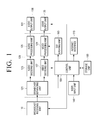
- FIG. 1 is a block diagram illustrating a digital television according to an exemplary embodiment
- FIG. 2 is a view to explain information and programs stored in a storage unit shown in FIG. 1 ;
- FIG. 3 is a flowchart illustrating a method for providing a widget according to an exemplary embodiment
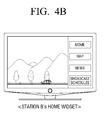
- FIGS. 4A and 4B are views showing results shown at the bottom of a TV display if a home widget is operated
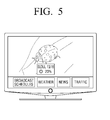
- FIG. 5 is a view showing results if a widget is selected in a home widget and the selected widget is operated.
- FIG 6 is a view showing results at the bottom of TV display showing if home widgets are operated in a home widget.
- FIG. 1 is a block diagram illustrating a digital television (DTV) according to an exemplary embodiment.
- the DTV includes a broadcast-receiving unit 110, a broadcast processing unit 120, a broadcast output unit 130, a user-input unit 140, a control unit 150, a Graphical User Interface (GUI) creating unit 160, an Internet-interface 170 and a storage unit 180.
- GUI Graphical User Interface
- the broadcast-receiving unit 110 tunes to and demodulates one broadcast in a wired or wireless way through air or cable.
- the broadcast processing unit 120 performs signal process on broadcast signals output from the broadcast-receiving unit 110.
- the processing unit 120 includes a broadcast-separating unit 121, an audio-decoding unit 123, an audio-processing unit 125, a video-decoding unit 127 and a video-processing unit 129.
- the broadcast separating unit 121 separates audio and video signals and broadcast information from broadcast signals from the broadcast-receiving unit 110 and outputs them.
- the separated audio and video signals are input into the audio-decoding unit 123 and the video-decoding unit 127, respectively, and used to provide digital broadcast programs.
- the broadcast information separated from the broadcast signals is input into the control unit 150.
- the broadcast information refers to Program and System Information Protocol (PSIP) information, Service Indicators (SI) tables and other information related to the broadcast.
- PSIP Program and System Information Protocol
- SI Service Indicators
- the audio-decoding unit 123 decodes audio signals output from the broadcast-separating unit 121. Accordingly, the audio-decoding unit 123 outputs decompressed audio signals.
- the audio-processing unit 125 converts decoded audio signals output from the audio-decoding unit 123 into audio signals of a specific format, which can be output through a speaker of the DTV.
- the video-decoding unit 127 decodes video signals output from the broadcast-separating unit 121. Accordingly, the video decoding unit 127 outputs decompressed video signals.
- the video-processing unit 129 converts decoded video signals output from the video decoding unit 127 into video signals of a format which can be output through a display of the DTV. To accomplish this, the video-processing unit 129 performs color signal processing, scaling, and Frame Rate Conversion (FRC) on the decoded video signals.
- FRC Frame Rate Conversion
- the GUI-creating unit 160 produces a GUI to be displayed on a display under the control of the control unit 150.
- the GUI created by the GUI -creating unit 160 includes a home widget and a widget, where the widget is a part of the home widget.
- the GUI-creating unit 160 is controlled by the control unit 150 to create a GUI.
- the GUI created by the GUI-creating unit 160 is applied to the video processing unit 129 and added to a video to be displayed on the display.
- the output unit 130 outputs a video and an audio corresponding to the video and audio signals output from the broadcast processing unit 120 and provides them for users.
- the output unit 130 with this function includes an audio output unit 131 and a video output unit 135.
- the audio output unit 131 outputs audio signals output from the audio processing unit 125 through a speaker.
- the video output unit 135 outputs the video signals output from the video processing unit 129 through a display.
- the internet interface 170 is communicably connected to the Internet, the outside network.
- the storage unit 180 is a recording medium where necessary information and programs are stored for the control unit 150 to function for the DTV As shown in FIG. 2 , the storage unit 180 stores a home-widget selection table 181, home widgets 183-1, 183-2, 183-3, ... and widgets 185-11, 185-12, ...,185-21, 185-22, ..., 185-31, 185-32, .
- the home-widget selection table 181 is a table where a broadcast station corresponds to a home widget on a one-on-one basis.
- the table can become a reference for the control unit 150 to decide which home widget to operate.
- the home widgets 183-1, 183-2, 183-3... are programs, which are used to display home widgets on a display as a GUI.
- the home widget consists of several widgets. Accordingly, the home widget can be understood as a widget group, a widget list or a widget frame with several widgets included.
- the widgets 185-11, 185-12..., 185-21, 183-22, ..., 185-31, 183-32, ... are included in the home widgets 183-1, 183-2, 183-3, ....
- 1) the widget-11 (185-11) and widget-12 (185-21) are included in the home widget-1 (183-1)
- 2) the widget-21 (185-21) and the widget-22 (185-22) are included in the home widget-2 (183-2)
- 3) the widget-31 (185-31) and the widget-32 (185-32) are included in the home widget-3 (183-3).
- the user-input unit 140 transmits a user command input by a function button on a remote controller or a front panel of the DTV to the control unit 150.
- the control unit 150 controls the overall operation of the DTV according to the user command received from the user-input unit 140.
- the control unit 150 controls the broadcast-receiving unit 110, the broadcast-processing unit 120 and the broadcast-output unit 130 to receive and output a program selected by users.
- control unit 150 finds a broadcast station providing current programs, operates the broadcast station's home widget and provides users with widgets. This process will be explained in detail below.
- FIG. 3 is a flowchart illustrating a method for providing a widget according to an exemplary embodiment.
- the control unit 150 controls the broadcast receiving unit 110 to provide a program of a channel chosen through the user-input unit 140 (operation S310). Broadcast signals received from the broadcast receiving unit 110 are processed in the broadcast processing unit 120, and then output through the broadcast output unit 130, thus allowing users to view the program of the user-chosen channel.
- the control unit 150 acquires information on a broadcast station from broadcast information separated from the currently received signals (operation S320). In operation S320, the control unit 150 finds which broadcast station is now providing programs which are being viewed by users.
- control unit 150 operates the home widget of the broadcast station identified in operation S320, and controls the GUI-creating unit 160 to make the operation result be shown on the display (operation S330).
- control unit 150 accesses to the home-widget selection table 181 stored in the storage unit 180.
- control unit 150 For example, 1) if a broadcast station "A" is identified in operation S320, the control unit 150 operates the home widget-1 (183-1) in operation S330. 2) If a broadcast station "B" is identified in operation S320, the control unit 150 operates the home widget-2 (183-2).
- FIG. 4A shows that the home widget-1 (183-1) is operated and overlapped with broadcast station A's broadcast at the bottom of a DTV
- FIG. 4B shows that the home widget-2 (183-2) is operated and overlapped with broadcast station B's broadcast on the right side of a DTV.
- the home widget-1 (183-1) includes a "broadcast schedule” widget, a "weather” widget, a "news” widget, and a "traffic” widget.
- the home widget-2 (183-2) includes a "movie” widget, a “map” widget, a "news” widget and a "broadcast schedules” widget.
- the home widget is a widget group made up of several widgets. Type and arrangement of widgets included in the home widget are different according to each home widget.
- the control unit 150 operates the user- selected widget (operation S350).
- the widget operated by the control unit 150 in operation S350 acquires information to be included in the widget by accessing a broadcast server through internet interface 170, and controls the GUI-creating unit 160 to display a widget window containing the information on the display
- Broadcasting servers provide information to be recorded on the widgets shown in the broadcast stations' home widget on a real time basis, and may be operated and managed by broadcast stations or a commissioned company.
- FIG. 5 shows a result where the "weather” widget is operated, after a user chooses the "weather” widget from the home widget at the bottom of a display while watching a station "A"'s broadcast.
- the widget window containing weather information is shown outside the home widget, but this is merely an example. It is possible for the widget window on containing weather information to be shown inside the home widget.
- operation S310 is re-operated. Accordingly, a home widget from the previous program's broadcast station will disappear, and a home widget from the current program's station will appear.
- the home widget and widgets are embodied as a separate program, and this is just an example.
- the home widget and the widgets included in it can be embodied as one program and be contained in a DTV.
- the widgets of the home widget are considered as being operated after a user selects a channel. However, the widgets may be automatically operated when the home widget is working.
- FIG. 6 shows a result where the home widget is displayed at the bottom of the display after the widgets are operated.
- the home widget may disappear and the chosen widget may remain on display.
- the operated widget should disappear from the display and the home widget should appear again.
- the information included in the home widget is considered to be provided from broadcast servers through the internet. However, the information may be provided from servers other than the broadcaster's server or networks other than the Internet.
- the number of widgets included in the home widget is not limited.
- the home widget includes a plurality of widgets, but the home widget may include a single widget.
- the DTV mentioned above is an example of a broadcast-receiving apparatus, which receives broadcasts and provides the broadcasts to users.
- the exemplary embodiments can be applied to digital appliances with broadcast receiving functions and other types of broadcast-receiving apparatuses other than DTV.
- the home widget is different according to broadcast stations, but it is just an example for a better explanation.
- the home widget may be different according to other factors.
- the home widget can be different according to particular broadcast programs or the selected channels.
- broadcast channels mentioned here are different from broadcast stations. Even if broadcast channels are different, broadcast stations can be the same, as a station can provide broadcast services through many channels.
- the home widget and the widgets stored in the storage unit 180 can be updated.
- the update is possible by 1) receiving update files from a broadcast station's server through Internet interface 170, and 2) using update files in broadcast information included in signals received from the broadcast-receiving unit 110.
- a home widget of other broadcast stations may be newly added to the storage unit 180, and widgets of a home widget can be newly added to the storage unit 180.
- the exemplary embodiments enable users to receive and use widget groups related to information of user-chosen broadcast.
- users can use widgets designated by a broadcast station, which provides a program currently being viewed by users.
Landscapes
- Engineering & Computer Science (AREA)
- Signal Processing (AREA)
- Multimedia (AREA)
- Two-Way Televisions, Distribution Of Moving Picture Or The Like (AREA)
- Circuits Of Receivers In General (AREA)
Applications Claiming Priority (1)
| Application Number | Priority Date | Filing Date | Title |
|---|---|---|---|
| KR1020090123242A KR20110066546A (ko) | 2009-12-11 | 2009-12-11 | 방송정보에 기초한 위젯 제공방법 및 이를 적용한 방송수신장치 |
Publications (2)
| Publication Number | Publication Date |
|---|---|
| EP2333992A2 true EP2333992A2 (de) | 2011-06-15 |
| EP2333992A3 EP2333992A3 (de) | 2013-05-29 |
Family
ID=43650019
Family Applications (1)
| Application Number | Title | Priority Date | Filing Date |
|---|---|---|---|
| EP10194424.7A Withdrawn EP2333992A3 (de) | 2009-12-11 | 2010-12-09 | Verfahren zur Widget-Bereitstellung je nach Rundfunkdienstinformation und Rundfunkempfangsgerät damit |
Country Status (3)
| Country | Link |
|---|---|
| US (1) | US20110145867A1 (de) |
| EP (1) | EP2333992A3 (de) |
| KR (1) | KR20110066546A (de) |
Families Citing this family (1)
| Publication number | Priority date | Publication date | Assignee | Title |
|---|---|---|---|---|
| US11558672B1 (en) * | 2012-11-19 | 2023-01-17 | Cox Communications, Inc. | System for providing new content related to content currently being accessed |
Citations (1)
| Publication number | Priority date | Publication date | Assignee | Title |
|---|---|---|---|---|
| KR20090123242A (ko) | 2008-05-27 | 2009-12-02 | 삼성전자주식회사 | 구동 트랜지스터를 포함하는 반도체 소자 |
Family Cites Families (6)
| Publication number | Priority date | Publication date | Assignee | Title |
|---|---|---|---|---|
| US5583560A (en) * | 1993-06-22 | 1996-12-10 | Apple Computer, Inc. | Method and apparatus for audio-visual interface for the selective display of listing information on a display |
| US6481010B2 (en) * | 1999-03-01 | 2002-11-12 | Sony Corporation | TV planner for DSS |
| US6938270B2 (en) * | 1999-04-07 | 2005-08-30 | Microsoft Corporation | Communicating scripts in a data service channel of a video signal |
| US20020078453A1 (en) * | 2000-12-15 | 2002-06-20 | Hanchang Kuo | Hub pages for set top box startup screen |
| KR101287976B1 (ko) * | 2006-09-11 | 2013-07-18 | 삼성전자주식회사 | 데이터 어플리케이션의 자동실행 조정방법 및 이를 적용한영상재생장치 |
| US8566874B2 (en) * | 2006-10-03 | 2013-10-22 | Verizon Patent And Licensing Inc. | Control tools for media content access systems and methods |
-
2009
- 2009-12-11 KR KR1020090123242A patent/KR20110066546A/ko not_active Withdrawn
-
2010
- 2010-12-09 EP EP10194424.7A patent/EP2333992A3/de not_active Withdrawn
- 2010-12-10 US US12/965,348 patent/US20110145867A1/en not_active Abandoned
Patent Citations (1)
| Publication number | Priority date | Publication date | Assignee | Title |
|---|---|---|---|---|
| KR20090123242A (ko) | 2008-05-27 | 2009-12-02 | 삼성전자주식회사 | 구동 트랜지스터를 포함하는 반도체 소자 |
Also Published As
| Publication number | Publication date |
|---|---|
| US20110145867A1 (en) | 2011-06-16 |
| EP2333992A3 (de) | 2013-05-29 |
| KR20110066546A (ko) | 2011-06-17 |
Similar Documents
| Publication | Publication Date | Title |
|---|---|---|
| KR101763593B1 (ko) | 컨텐츠 동기화 방법 및 그 방법을 채용한 사용자 단말기 | |
| JP4986438B2 (ja) | デジタル放送受信機におけるチャネル切替時の情報出力方法 | |
| EP2242260A1 (de) | Verfahren zur Einstellung von Kanälen und Rundfunkempfangsvorrichtung damit | |
| US10779030B2 (en) | Display apparatus and controlling method thereof | |
| EP1898643A2 (de) | Verfahren zur automatischen Suche nach Datenanwendungen für alle Kanäle und Videovorrichtung zur Durchführung dieses Verfahrens | |
| KR101358325B1 (ko) | 외부로부터 수신된 환경 설정 값에 따라 환경을 설정하는방송수신장치 및 그의 환경설정방법 | |
| EP2017781A1 (de) | Verfahren zur Bereitstellung von Bestandsinformation und Rundfunkempfangsvorrichtung damit | |
| KR101687611B1 (ko) | 사용자 인터페이스 제공 방법 및 그 방법을 채용한 시스템 | |
| KR20160021538A (ko) | 채널 검색 방법 | |
| EP2333992A2 (de) | Verfahren zur Widget-Bereitstellung je nach Rundfunkdienstinformation und Rundfunkempfangsgerät damit | |
| KR102040608B1 (ko) | 디지털 디바이스 및 그 신호 처리방법 | |
| CN102308574A (zh) | 显示设备及用于提供显示设备的数据广播的方法 | |
| KR20160009415A (ko) | 외부 입력장치와 컨텐츠 연동이 가능한 영상표시장치 | |
| EP2227007A2 (de) | Videosignalverarbeitungsvorrichtung, die in Bezug auf ein Informationsaktualisierungsverfahren verbessert ist, und Steuerungsverfahren für diese Vorrichtung | |
| EP2058965A2 (de) | Rundfunkempfangsvorrichtung und Verfahren mit Funktion zur Einstellung von Lieblingsprogrammen | |
| KR100727976B1 (ko) | Dmb 에서 제공되는 서비스 디스플레이 방법 및 그방법을 이용하는 dmb수신 장치 | |
| JP2013132010A (ja) | テレビ放送受信機 | |
| JP5512103B2 (ja) | 放送表示装置、制御方法 | |
| US20090158208A1 (en) | Method for providing graphical user interface and broadcast receiving apparatus applying the same | |
| KR100720322B1 (ko) | Pⅰp 화면을 이용한 데이터 서비스 제공 장치 | |
| JP6347574B2 (ja) | デジタル放送受信装置、チャンネルプリセットリスト及びチャンネル切換え方法 | |
| KR100936616B1 (ko) | 케이블 망에서의 방송 서비스 정보 제공장치 및 방법 | |
| KR20160053206A (ko) | 디지털 라디오방송 제어방법 및 장치 | |
| KR20130065487A (ko) | 디스플레이장치 및 그의 동작 제어 방법 | |
| KR20110021105A (ko) | 프로그램 정보 제공방법 및 이를 이용한 디스플레이 장치 |
Legal Events
| Date | Code | Title | Description |
|---|---|---|---|
| PUAI | Public reference made under article 153(3) epc to a published international application that has entered the european phase |
Free format text: ORIGINAL CODE: 0009012 |
|
| AK | Designated contracting states |
Kind code of ref document: A2 Designated state(s): AL AT BE BG CH CY CZ DE DK EE ES FI FR GB GR HR HU IE IS IT LI LT LU LV MC MK MT NL NO PL PT RO RS SE SI SK SM TR |
|
| AX | Request for extension of the european patent |
Extension state: BA ME |
|
| RAP1 | Party data changed (applicant data changed or rights of an application transferred) |
Owner name: SAMSUNG ELECTRONICS CO., LTD. |
|
| PUAL | Search report despatched |
Free format text: ORIGINAL CODE: 0009013 |
|
| AK | Designated contracting states |
Kind code of ref document: A3 Designated state(s): AL AT BE BG CH CY CZ DE DK EE ES FI FR GB GR HR HU IE IS IT LI LT LU LV MC MK MT NL NO PL PT RO RS SE SI SK SM TR |
|
| AX | Request for extension of the european patent |
Extension state: BA ME |
|
| RIC1 | Information provided on ipc code assigned before grant |
Ipc: H04H 60/65 20080101ALN20130425BHEP Ipc: H04H 60/27 20080101ALN20130425BHEP Ipc: H04H 60/82 20080101AFI20130425BHEP Ipc: H04H 60/43 20080101ALI20130425BHEP Ipc: H04H 60/73 20080101ALI20130425BHEP |
|
| 17P | Request for examination filed |
Effective date: 20131129 |
|
| RBV | Designated contracting states (corrected) |
Designated state(s): AL AT BE BG CH CY CZ DE DK EE ES FI FR GB GR HR HU IE IS IT LI LT LU LV MC MK MT NL NO PL PT RO RS SE SI SK SM TR |
|
| STAA | Information on the status of an ep patent application or granted ep patent |
Free format text: STATUS: THE APPLICATION IS DEEMED TO BE WITHDRAWN |
|
| 18D | Application deemed to be withdrawn |
Effective date: 20150701 |