EP2334738B1 - 2,3-anthraquinonedicarboximides n-alkoxyles pour la teinture de polymeres, preparation et application - Google Patents
2,3-anthraquinonedicarboximides n-alkoxyles pour la teinture de polymeres, preparation et application Download PDFInfo
- Publication number
- EP2334738B1 EP2334738B1 EP09782018.7A EP09782018A EP2334738B1 EP 2334738 B1 EP2334738 B1 EP 2334738B1 EP 09782018 A EP09782018 A EP 09782018A EP 2334738 B1 EP2334738 B1 EP 2334738B1
- Authority
- EP
- European Patent Office
- Prior art keywords
- alkyl
- amino
- mono
- aryl
- sulfamoyl
- Prior art date
- Legal status (The legal status is an assumption and is not a legal conclusion. Google has not performed a legal analysis and makes no representation as to the accuracy of the status listed.)
- Active
Links
- 0 *c(c(C(N(CCCOCCOCCOCCCN(C(c(c(N)c1C(c2cccc([N+]([O-])=O)c22)=O)c3c(N*)c1C2=O)=O)C3=O)C1=O)=O)c1c(N)c1C(c(c2ccc3)c3[N+]([O-])=O)=O)c1C2=O Chemical compound *c(c(C(N(CCCOCCOCCOCCCN(C(c(c(N)c1C(c2cccc([N+]([O-])=O)c22)=O)c3c(N*)c1C2=O)=O)C3=O)C1=O)=O)c1c(N)c1C(c(c2ccc3)c3[N+]([O-])=O)=O)c1C2=O 0.000 description 4
- BJNHRFBAVRDMFQ-UHFFFAOYSA-N CC(COCC(CC1)C1N(C(c(c1c(c(C(c2c3cccc2)=O)c2C3=O)N)c2N)=O)C1=O)N(C(c(c(N)c1C(c2ccccc22)=O)c3c(N)c1C2=O)=O)C3=O Chemical compound CC(COCC(CC1)C1N(C(c(c1c(c(C(c2c3cccc2)=O)c2C3=O)N)c2N)=O)C1=O)N(C(c(c(N)c1C(c2ccccc22)=O)c3c(N)c1C2=O)=O)C3=O BJNHRFBAVRDMFQ-UHFFFAOYSA-N 0.000 description 1
Classifications
-
- C—CHEMISTRY; METALLURGY
- C09—DYES; PAINTS; POLISHES; NATURAL RESINS; ADHESIVES; COMPOSITIONS NOT OTHERWISE PROVIDED FOR; APPLICATIONS OF MATERIALS NOT OTHERWISE PROVIDED FOR
- C09B—ORGANIC DYES OR CLOSELY-RELATED COMPOUNDS FOR PRODUCING DYES, e.g. PIGMENTS; MORDANTS; LAKES
- C09B5/00—Dyes with an anthracene nucleus condensed with one or more heterocyclic rings with or without carbocyclic rings
- C09B5/24—Dyes with an anthracene nucleus condensed with one or more heterocyclic rings with or without carbocyclic rings the heterocyclic rings being only condensed with an anthraquinone nucleus in 1-2 or 2-3 position
- C09B5/2409—Dyes with an anthracene nucleus condensed with one or more heterocyclic rings with or without carbocyclic rings the heterocyclic rings being only condensed with an anthraquinone nucleus in 1-2 or 2-3 position not provided for in one of the sub groups C09B5/26 - C09B5/62
- C09B5/2436—Dyes with an anthracene nucleus condensed with one or more heterocyclic rings with or without carbocyclic rings the heterocyclic rings being only condensed with an anthraquinone nucleus in 1-2 or 2-3 position not provided for in one of the sub groups C09B5/26 - C09B5/62 only nitrogen-containing hetero rings
- C09B5/2445—Phtaloyl isoindoles
- C09B5/2454—5,6 phtaloyl dihydro isoindoles
- C09B5/2463—1,3 oxo or imino derivatives
- C09B5/2472—1,3 dioxo derivatives
-
- C—CHEMISTRY; METALLURGY
- C08—ORGANIC MACROMOLECULAR COMPOUNDS; THEIR PREPARATION OR CHEMICAL WORKING-UP; COMPOSITIONS BASED THEREON
- C08J—WORKING-UP; GENERAL PROCESSES OF COMPOUNDING; AFTER-TREATMENT NOT COVERED BY SUBCLASSES C08B, C08C, C08F, C08G or C08H
- C08J3/00—Processes of treating or compounding macromolecular substances
- C08J3/20—Compounding polymers with additives, e.g. colouring
- C08J3/22—Compounding polymers with additives, e.g. colouring using masterbatch techniques
-
- C—CHEMISTRY; METALLURGY
- C09—DYES; PAINTS; POLISHES; NATURAL RESINS; ADHESIVES; COMPOSITIONS NOT OTHERWISE PROVIDED FOR; APPLICATIONS OF MATERIALS NOT OTHERWISE PROVIDED FOR
- C09B—ORGANIC DYES OR CLOSELY-RELATED COMPOUNDS FOR PRODUCING DYES, e.g. PIGMENTS; MORDANTS; LAKES
- C09B67/00—Influencing the physical, e.g. the dyeing or printing properties of dyestuffs without chemical reactions, e.g. by treating with solvents grinding or grinding assistants, coating of pigments or dyes; Process features in the making of dyestuff preparations; Dyestuff preparations of a special physical nature, e.g. tablets, films
- C09B67/0033—Blends of pigments; Mixtured crystals; Solid solutions
- C09B67/0034—Mixtures of two or more pigments or dyes of the same type
- C09B67/0038—Mixtures of anthraquinones
-
- C—CHEMISTRY; METALLURGY
- C09—DYES; PAINTS; POLISHES; NATURAL RESINS; ADHESIVES; COMPOSITIONS NOT OTHERWISE PROVIDED FOR; APPLICATIONS OF MATERIALS NOT OTHERWISE PROVIDED FOR
- C09B—ORGANIC DYES OR CLOSELY-RELATED COMPOUNDS FOR PRODUCING DYES, e.g. PIGMENTS; MORDANTS; LAKES
- C09B69/00—Dyes not provided for by a single group of this subclass
-
- C—CHEMISTRY; METALLURGY
- C08—ORGANIC MACROMOLECULAR COMPOUNDS; THEIR PREPARATION OR CHEMICAL WORKING-UP; COMPOSITIONS BASED THEREON
- C08K—Use of inorganic or non-macromolecular organic substances as compounding ingredients
- C08K5/00—Use of organic ingredients
- C08K5/0008—Organic ingredients according to more than one of the "one dot" groups of C08K5/01 - C08K5/59
- C08K5/0041—Optical brightening agents, organic pigments
Definitions
- Polymers can be colored with dyes in various ways.
- One way is mass coloration of polymers whereby for example a pigment or a dye is mixed with the polymer and the polymer is melted to transport the dye into the polymer matrix.
- Other processes involve the polymer being colored or, to be more precise, dyed by the dyes defusing into the polymer from a solution or dispersion, examples being the dyeing of polymeric fibers composed of polyether, polyacrylonitrile, polyurethane, cellulose or polyamide for example with, for example, disperse dyes, cationic dyes, acid dyes, metallized dyes or reactive dyes.
- reactive dyes results in a covalent bond being formed between the dye and the substrate, conferring particularly high fastnesses of the dyeings/colorations.
- Another way to color a polymer is to add the dye to the polymer's monomers or oligomers, before the polymer is formed or as it is being formed. Dyes capable of forming covalent bonds with the polymer scaffold may result likewise in colorations of high fastness being obtained.
- the dyes used or, to be more precise, their chromophores have to be sufficiently stable under the conditions of the polymerization. Examples are reactive dyes for polyurethane which are known and are described in DE2259435 and DE2357933 for example.
- solubility or dispersibility of the dye used can be significantly influenced through the choice of suitable substituents and be improved by means of suitable side chains such that the use of solvent or dispersant matrix can be greatly reduced or even omitted entirely. Examples thereof are to be found in the documents WO05/000913 and US2004254335 .
- dyes for polymers are usually disperse dyes or solvent dyes and produce, when used for the coloration of polyolefins, colored polyolefins in which the dye often has only low bleed fastnesses.
- many of the known dyes have poor lightfastnesses or low thermal stabilities in polyolefins. Dyes having not only good bleed fastnesses but also good lightfastnesses and high thermal stabilities in polyolefins without adversely affecting the properties of the polyolefins used are not known.
- the dyes known from WO99/24659 do meet the requirements in part, yet it is impossible to achieve dyeings/colorations of high lightfastness with the dyes mentioned.
- dyes which contain polyether chains as a substituent on cyclic imides constitute useful dyes for the coloration of polyolefins and other substrates. They have high stability under application conditions, are readily soluble in the polymer or miscible with suitable organic solvents, and afford colorations having high fastnesses.
- the present invention accordingly provides compounds of formula (I) where T represents a group of formula (1) or represents a group of formula (2) or represents a group of formula (3)
- Q 1 to Q 4 each represents a group of formula (4)
- A represents a group of formula (5) where
- alkyl groups may be straight chain or branched and are for example methyl, ethyl, n-propyl, isopropyl, n-butyl or isobutyl, but also hexyl, such as n-hexyl, heptyl, such as n-heptyl, octyl, such as n-octyl and isooctyl, nonyl, such as n-nonyl, decyl, such as n-decyl, dodecyl, such as n-dodecyl or octadecyl, such as n-octadecyl.
- Aryl preferably stands for phenyl and naphthyl and arylene for phenylene, particularly 1,2-, 1,3- and 1,4-phenylene and naphthylene, such as, in particular, 1,4-,1,5- and 1,8-naphthylene.
- Halogen is in particular fluorine, chlorine or bromine.
- Heteroaryl is preferably pyridine, pyrimidine, pyridazine, pyrazine, pyrrole, imidazole, pyrazoles, 1,2,4-thiadiazole, 1,2,4-triazole, tetrazole, thiophene, thiazole, isothiazole, 1,3,4-thiadiazole, furan, oxazole or isoxazole.
- Heterocycloalkyl is preferably pyrrolidine, piperidine, morpholine or piperazine.
- the R 25 und R 26 substituents in the group of formula (4) have different meanings within any one molecule, wherein regions of respectively identical meanings follow each other.
- R 1 , R 2 , R 7 and R 8 each independently represent amino, hydroxyl, mono-(C 1 -C 15 )-alkyl-amino or monoaryl-amino, wherein aryl is substituted by (C 1 -C 15 )-alkyl, sulfamoyl, carbamoyl, N-mono-(hydroxy-(C 1 -C 15 )-alkyl)sulfamoyl or N-mono-(hydroxy-(C 1 -C 15 )-alkyl)carbamoyl;
- R 3 , R 4 , R 5 , R 6 , R 9 , R 10 , R 11 and R 12 each independently represent hydrogen, amino, hydroxyl, nitro, mono-(C 1 -C 15 )-alkyl-amino or monoaryl-amino, wherein aryl is substituted by (C 1 -C 15 )-alkyl;
- Examples of compounds of formula (lb) are the compounds of formulae (lba) to (Ibu)
- R 1 , R 2 , R 7 , R 8 , R 13 and R 14 each independently represent amino, hydroxyl, mono-(C 1 -C 15 )-alkyl-amino or monoaryl-amino, where aryl is substituted by (C 1 -C 15 )-alkyl, sulfamoyl, carbamoyl, N-mono-(hydroxy-(C 1 -C 15 )-alkyl)sulfamoyl or N-mono-(hydroxy-(C 1 -C 15 -alkyl)carbamoyl;
- R 3 , R 4 , R 5 , R 6 , R 9 , R 10 , R 11 ,R 12 , R 15 , R 16 , R 17 and R 18 each independently represent hydrogen, amino, hydroxy, nitro, mono-(C 1 -C 15 )-alkyl-amino and monoaryl-amino, wherein aryl is
- Examples of compounds of formula (Ic) are the compounds of formulae (Ica) to (Ice)
- Examples of compounds of formula (Id) are the compounds of formulae (Ida) to (Idd)
- Preferred compounds of formula (III) are the compounds of formulae (IIIe) to (IIIh)
- Compounds of formula (lb) are preferably prepared by reacting a compound of formula (IV) wherein R 30 and R 31 , Q 1 , x and y are each as defined above, with a compound of formula (III).
- Compounds of formula (Ic) are preferably prepared by reacting a compound of formula (V) where R 30 to R 32 , Q 1 to Q 3 , x, y and z are each as defined above, with a compound of formula (III).
- Compounds of formula (Id) are preferably prepared by reacting a compound of formula (VI) where R 30 to R 33 , Q 1 to Q 4 , x, y, z and t are each as defined above, with a compound of formula (III).
- the compounds of formulae (IV), (V) and (VI) are likewise known and obtainable by methods known in the literature. They are also commercially available, for example under the brand name of Jeffamine ® from Huntsman, The Woodlands, TX, USA. Examples of such products are Jeffamine D-230, Jeffamine D-400, Jeffamine D-2000, Jeffamine D-4000, Jeffamine HK-511, Jeffamine ED-600, Jeffamine ED-900, Jeffamine ED-2003, Jeffamine ED-2001, Jeffamine EDR-148, Jeffamine EDR-176, Jeffamine T-403, Jeffamine M-3000, Jeffamine T-5000, Jeffamine XTJ-435, Jeffamine XTJ-436.
- the abovementioned reactions are preferably carried out at temperatures of 80 to 250°C, more preferably at 110 to 210°C in the presence or absence of a catalyst.
- suitable catalysts are Lewis acid catalysts, which include, for example, metal halides, metal oxides, metal carboxylates and organometallic compounds.
- the reaction can be carried out without solvent, in an inert solvent, or in a mixture of inert solvents. When no solvent is used, the reaction is advantageously carried out using an excess of the compound of formula (IV), (V) or (VI) used.
- Suitable solvents include alcohols such as, for example, n-butanol, n-pentanol, 1-methoxy-2-propanol, 2-ethylhexanol, 2-methyl-1-butanol, isoamyl alcohol, benzyl alcohol, cyclohexanol, glycols and their derivatives, such as, for example, ethylene glycol diethyl ether, ethylene glycol monomethyl ether, ethylene glycol monoethyl ether, ethylene glycol monoisopropyl ether, ethylene glycol monobutyl ether, diethylene glycol dimethyl ether, diethylene glycol diethyl ether, diethylene glycol monomethyl ether, ethylene glycol, diethylene glycol
- the compounds of formula (I) can be isolated by filtration, extraction or evaporation and, if necessary, drying. However, they can also be used without further workup.
- the compounds of formula (I) according to the present invention can be used directly for polymer coloration, or they are subjected to a finishing (conditioning) operation to convert them into a saleable dye preparation. Finishing can be effected proceeding from a single compound of formula (I) or from a mixture of two more compounds of formula (I) or mixtures of one or more of the compounds of formula (I) and dyes of other dye classes, for example pigments or solvent dyes, if appropriate with the assistance of auxiliaries, for example surface modifiers and dispersants by dispersing, suspending or dissolving in a liquid or solid carrier material and also if appropriate standardizing to a desired color strength and a desired hue and if appropriate drying the preparation thus obtained.
- auxiliaries for example surface modifiers and dispersants by dispersing, suspending or dissolving in a liquid or solid carrier material and also if appropriate standardizing to a desired color strength and a desired hue and if appropriate drying the preparation thus obtained.
- the dye preparations containing compounds of formula (I) may also contain auxiliaries for modifying the viscosity or flowability. Suitable auxiliaries of this kind are described for example in US 6,605,126 . Preferred examples are ethylene glycols, propylene glycols, polyether polyols, polyester polyols, lactones and carbonic esters.
- the present invention accordingly also provides dye preparations comprising one or more compounds of formula (I) and also one or more auxiliaries for modifying the viscosity or flowability.
- These dye preparations preferably contain one or more compounds of formula (I) in amounts of 5% to 100% by weight and one or more auxiliaries for modifying the viscosity or flowability in amounts of 0% to 95% by weight, all based on the dye preparation.
- the present invention further provides for the use of the compounds of formula (I) according to the present invention for coloring a polymer.
- a possible procedure is for the compounds of formula (I) to be admixed to the polymer.
- compounds of formula (I) according to the present invention can also be used in the form of masterbatches.
- Masterbatches are dye concentrates consisting of carrier materials and colorants, the colorants being present in higher concentration than in the final use and the carrier materials being constituted such that they have compatibility with the materials to be colored.
- the carrier materials used can be polymers, for example polyolefins, polyvinyl chloride, polyesters, polyamides, polycarbonates or polystyrene.
- Preferred polymers are polyolefins, for example polyethylene or polypropylene, and copolymers with polyolefins.
- Useful carrier materials further include paraffin oils and polyglycols.
- the dye masterbatches are characterized in particular in that they contain one or more compounds of formula (I) according to the present invention in amounts of 5% to 60% by weight and one or more carrier materials in amounts of 40% to 95% by weight.
- the compounds of formula (I) have advantages in bleed/migration fastness in polyolefin mass coloration in particular compared with commercially available solvent dyes. These advantages are particularly noticeable in the coloration of polypropylene, polypropylene copolymers and polypropylene blends. To achieve good bleed fastnesses for the colored polymer, it is preferable to use the compounds of formula (I) that have a sufficiently high molar mass.
- the Jeffamine ® products mentioned hereinafter were obtained as fine chemicals from Aldrich, Fluka or Merck or as research samples from Huntsman.
- polypropylene pellet Moplen RP340R from Basell. This mixture is mulled on a roller mill for homogenization and subsequently extruded in a twin-screw extruder (ZSE 18HP-D40 from Leistritz) and pelletized.
- the pellet obtained can be processed in an injection-molding machine (420 C 1000-100 from Arburg) to form transparent blue sample plaques.
Landscapes
- Chemical & Material Sciences (AREA)
- Organic Chemistry (AREA)
- Chemical Kinetics & Catalysis (AREA)
- Health & Medical Sciences (AREA)
- Medicinal Chemistry (AREA)
- Polymers & Plastics (AREA)
- Plural Heterocyclic Compounds (AREA)
- Pharmaceuticals Containing Other Organic And Inorganic Compounds (AREA)
- Nitrogen Condensed Heterocyclic Rings (AREA)
- Heterocyclic Carbon Compounds Containing A Hetero Ring Having Oxygen Or Sulfur (AREA)
- Macromolecular Compounds Obtained By Forming Nitrogen-Containing Linkages In General (AREA)
Claims (7)
- Composé de formule (I)

T représente un groupement de formule (1)


 r représente un nombre rationnel de 0,1 à 200 et a des significations identiques ou différentes au sein d'une molécule quelconque de formule (I) ;R25 et R26 représentent chacun indépendamment hydrogène, (C1-C15)-alkyle, (C1-C15)-alkyle interrompu par l'oxygène une ou plusieurs fois, aryle, aryloxy, (C1-C15)-alcoxy, monohydroxy-(C1-C15)-alkyle ou polyhydroxy-(C1-C15)alkyle ;et où R25 et R26 ont des significations identiques ou différentes au sein d'une molécule quelconque de formule (I) ; etoù lorsque R25 et R26 ont des significations différentes au sein d'une molécule quelconque de formule (I), ces différentes significations sont distribuées au hasard ou des zones de significations respectivement identiques se suivent ; et les groupements T, A et B étant liés à la liaison * ou à la liaison ** ;R1 à R24 représentent chacun indépendamment hydrogène ; (C1-C15)-alkyle; trifluorométhyle ; cyclo-(C3-C8)-alkyle ; aryle ; hétéroaryle ; hétérocycloalkyle ; halogène ; cyano ; nitro ; hydroxy ; (C1-C15)-alcoxy; aryloxy ; (C2-C15)-acyle; arylcarbonyle, (C2-C15)-acyloxy ; arylcarbonyloxy ; (C2-C15)-acylamino ; (C1-C15)-alkylsulfonylamino ; arylsulfonylamino ; arylcarbonylamino ; carbamoyle ; N-monocyclo-(C3-C8)-alkyl-carbamoyle ; N-mono-(C1-C15)-alkyl-carbamoyle ; N,N-dicyclo-(C3-C8)-alkyl-carbamoyle ; N,N-di-(C1-C15)-alkyl-carbamoyle; N-monoarylcarbamoyle ; N,N-diaryl-carbamoyle ; N-monocyclo-(C3-C8)-alkyl-N-monoarylcarbamoyle ; N-mono-(C1-C15)-alkyl-N-monoarylcarbamoyle ; (C1-C15)-alcoxycarbonyle; aryloxycarbonyle ; amino ; monocyclo-(C3-C8)-alkyl-amino ; mono-(C1-C15)-alkyl-amino; di(cyclo)-(C3-C8)-alkyl-amino ; di-(C1-C15)-alkyl-amino; monoaryl-amino ; diaryl-amino ; monocyclo-(C3-C8)-alkylmonoarylamino ; mono-(C1-C15)-alkylmonoaryl-amino ; aminothiocarbonylamino ; aminocarbonylamino ; sulfamoyle ; N-monocyclo-(C3-C8)-alkyl-sulfamoyle ; N-mono-(C1-C15)-alkyl-sulfamoyle ; N,N-dicyclo-(C3-C8)-alkyl-sulfamoyle ; N,N-di-(C1-C15)-alkylsulfamoyle; N-monoaryl-sulfamoyle ; N,N-diaryl-sulfamoyle ; N-monocyclo-(C3-C8)-alkyl-N-monoarylsulfamoyle ; N-mono-(C1-C15)-alkyl-N-monoarylsulfamoyle; aminosulfonylamino ; (C1-C15)-alkylthio ; arylthio ; (C1-C15)-alkylsulfonyle ou arylsulfonyle ;ou représentent chacun indépendamment (C1-C15)-alkyle, N-mono-(C1-C15)-alkylamino, N,N-di-(C1-C15)-alkylamino, N-(C1-C15)-alkyl-N-cyclo-(C3-C8)-alkylamino, N-(C1-C15)-alkyl-N-arylamino, (C1-C15)-alcoxy, (C1-C15)-alkylthio, (C2-C15)-acyle ou (C1-C15)-alkylsulfonyle, qui sont chacun substitués par un ou plusieurs substituants choisis dans le groupe constitué par hydroxyle, (C3-C8)-cycloalkyle, hétéroaryle, hétérocyclo-(C3-C8)-alkyle, aryle, aryloxy, (C1-C15)-alcoxy, (C1-C15)-alkylthio, arylthio, poly(oxy-(C1-C15)-alkylène)s, halogène, cyano, (C1-C15)-alcoxycarbonyle, (C1-C15)-alcoxythiocarbonyle, (C2-C15)-acyloxy, carbamoyle, sulfamoyle, nitro, amino, (C2-C15)-acylamino, arylcarbonylamino, (C1-C15)-alkylsulfonylamino, arylsulfonylamino, aminocarbonylamino, aminothiocarbonylamino, N-mono-(C1-C15)-alkylamino, N-mono-(hydroxy-(C1-C15)-alkyl)amino, N,N-bis-(hydroxy-(C1-C15)-alkyl)amino, N-mono-(C1-C15)-alcoxy-(C1-C15)-alkyl)amino, N,N-bis-(C1-C15)-alcoxy-(C1-C15)-alkyl)amino, N-mono-(C1-C15)-alcoxy-(C1-C15)-alkyl)amino, N-mono-(C1-C15)-alkylthio-(C1-C15)-alkyl)amino, N-bis-(C1-C15)-alkylthio-(C1-C15)-alkyl)amino, N-monocyclo-(C3-C8)-alkylamino, N-monoaryl-amino, N,N-di-(C1-C15)-alkyl-amino, N,N-dicyclo-(C3-C8)-alkylamino, N,N-diaryl-amino, N-(C1-C15)-alkyl-N-aryl-amino, N-cyclo-(C3-C8)-alkyl-N-aryl-amino ou aminosulfonylamino ;ou représentent chacun indépendamment aryle, monoaryl-amino ; diaryl-amino, aryloxy, arylthio, arylcarbonyle, arylcarbonyloxy ; arylsulfonylamino ; arylcarbonylamino, N-monoarylcarbamoyle ; N,N-diaryl-carbamoyle, N-monocyclo-(C3-C8)-alkyl-N-monoarylcarbamoyle ; N-mono-(C1-C15)-alkyl-N-monoarylcarbamoyle ; monocyclo-(C3-C8)-alkylmonoarylamino ; mono-(C1-C15)-alkylmonoaryl-amino; N-monoaryl-sulfamoyle ; N,N-diaryl-sulfamoyle ; N-monocyclo-(C3-C8)-alkyl-N-monoarylsulfamoyle ; N-mono-(C1-C15)-alkyl-N-monoarylsulfamoyle ou arylsulfonyle, le radical aryle étant substitué par un ou plusieurs substituants choisis dans le groupe constitué par hydroxyle, (C1-C15)-alkyle, (C3-C8)-cycloalkyle, hétéroaryle, hétérocyclo-(C3-C8)-alkyle, (C1-C15)-alcoxy, (C1-C15)-alkylthio, poly(oxy-(C1-C15)-alkylène), halogène, cyano, (C1-C15)-alcoxycarbonyle, (C1-C15)-alcoxythiocarbonyle, (C2-C15)-acyloxy, carbamoyle, N-monocyclo-(C3-C8)-alkyl-carbamoyle, N-mono-(C1-C15)-alkyl-carbamoyle, N,N-dicyclo-(C3-C8)-alkyl-carbamoyle, N,N-di-(C1-C15)-alkyl-carbamoyle, N-monoaryl-carbamoyle, N,N-diaryl-carbamoyle, N-monocyclo-(C3-C8)-alkyl-N-monoarylcarbamoyle, N-mono-(C1-C15)-alkyl-N-monoarylcarbamoyle, sulfamoyle, N-monocyclo-(C3-C8)-alkyl-sulfamoyle, N-mono-(C1-C15)-alkyl-sulfamoyle, N-mono-(hydroxy-(C1-C15)-alkyl)sulfamoyle, N,N-dicyclo-(C3-C8)-alkyl-sulfamoyle, N,N-di-(C1-C15)-alkylsulfamoyle, N-monoaryl-sulfamoyle, N,N-diaryl-sulfamoyle, N-monocyclo-(C3-C8)-alkyl-N-monoarylsulfamoyle, N-mono-(C1-C15)-alkyl-N-monoarylsulfamoyle, nitro, amino, (C2-C15)-acylamino, arylcarbonylamino, (C1-C15)-alkylsulfonylamino, arylsulfonylamino, aminocarbonylamino, aminothiocarbonylamino, N-mono-(C1-C15)-alkylamino, N-mono-(hydroxy-(C1-C15)-alkyl)amino, N,N-bis-(hydroxy-(C1-C15)-alkyl)amino, N-mono((C1-C15)-alcoxy-(C1-C15)-alkyl)amino, N,N-bis-((C1-C15)-alcoxy-(C1-C15)-alkyl)amino, N-mono-((C1-C15)-alcoxy-(C1-C15)-alkyl)amino, N-mono-((C1-C15)-alkylthio-(C1-C15)-alkyl)amino, N-bis-((C1-C15)-alkylthio-(C1-C15)-alkyl)amino, N-monocyclo-(C3-C8)-alkylamino, N-monoaryl-amino, N,N-di-(C1-C15)-alkyl-amino, N,N-dicyclo-(C3-C8)-alkylamino, N,N-diaryl-amino, N-(C1-C15)-alkyl-N-aryl-amino, N-cyclo-(C3-C8)-alkyl-N-aryl-amino ou aminosulfonylamino ;R30 à R33 représentent chacun indépendamment hydrogène, (C1-C15)-alkyle, (C1-C15)-alkyle interrompu par l'oxygène une ou plusieurs fois, aryle, aryl-(C1-C15)-alkyle, (C1-C15)-alkyl-aryle, aryloxy, (C1-C15)-alcoxy, monohydroxy-(C1-C15)-alkyle ou polyhydroxy-(C1-C15)-alkyle et ont des significations identiques ou différentes au sein d'une molécule quelconque de formule (I) ;x représente un nombre de 1 à 30 ;y, z et t représentent chacun indépendamment un nombre de 0 à 30 ;A représente un groupement de formule (5)
 a, b et c représentent chacun indépendamment un nombre de 0 à 15 ;R27 représente hydrogène, (C1-C15)-alkyle, (C1-C15)-alkyle interrompu par l'oxygène une ou plusieurs fois, aryloxy, (C1-C15)-alcoxy, monohydroxy-(C1-C15)alkyle ou polyhydroxy-(C1-C15)-alkyle ; etB représente un groupement de formule (6)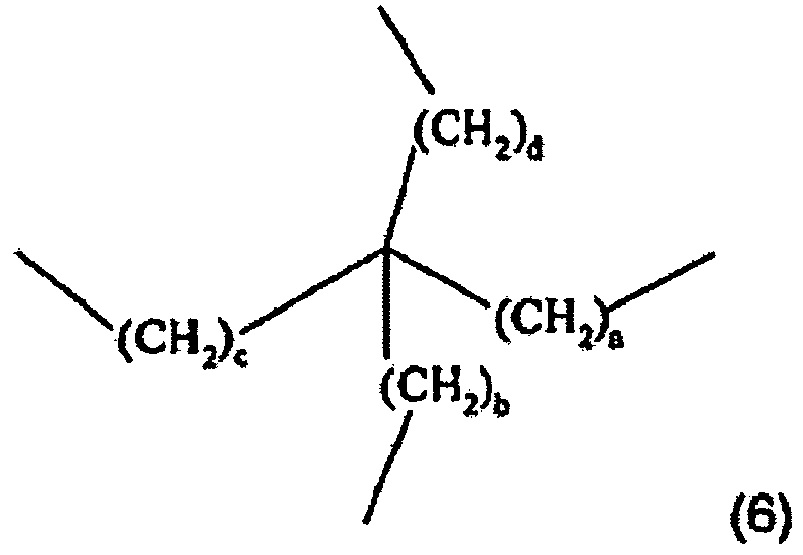
a, b, c et d représentent chacun indépendamment un nombre de 0 à 15. - Composé selon la revendication 1, de formule (Ib)
 où R1 à R12 représentent chacun indépendamment hydrogène ; (C1-C15)-alkyle ; trifluorométhyle ; aryle ; halogène ; cyano ; nitro ; hydroxy ; (C1-C5)-alcoxy; aryloxy ; arylcarbonyle, (C2-C15)-acylamino ; (C1-C15)-alkylsulfonylamino ; arylsulfonylamino ; arylcarbonylamino ; carbamoyle ; amino ; monocyclo-(C3-C8)-alkyl-amino ; mono-(C1-C5)-alkyl-amino ; di(cyclo)-(C3-C8)-alkyl-amino ; di-(C1-C15)-alkyl-amino; monoaryl-amino ; diaryl-amino ; monocyclo-(C3-C8)-alkylmonoarylamino ; mono-(C1-C15)-alkylmonoarylamino ; aminocarbonylamino ; sulfamoyle ; aminosulfonylamino ; (C1-C15)-alkylthio ; arylthio ou (C1-C15)-alkylsulfonyle ;ou représentent chacun indépendamment (C1-C15)-alkyle, N-mono-(C1-C15)-alkylamino, N-monocyclo-(C3-C8)-alkylamino, N,N-di-(C1-C15)-alkylamino, N,N-dicyclo-(C3-C8)-alkylamino, N-(C1-C15)-alkyl-N-cyclo-(C3-C8)-alkylamino, N-(C1-C15)-alkyl-N-arylamino, N-aryl-N-cyclo-(C3-C8)-alkylamino, (C1-C15)-alcoxy, (C1-C15)-alkylthio ou (C1-C15)-alkylsulfonyle, qui sont chacun substitués par un ou plusieurs substituants choisis dans le groupe constitué par hydroxyle, hétéroaryle, hétérocycloalkyle, aryle, aryloxy, (C1-C15)-alcoxy, halogène, cyano, (C1-C15)-alcoxycarbonyle, carbamoyle, sulfamoyle, nitro, amino, (C2-C15)-acylamino, arylcarbonylamino, (C1-C15)-alkylsulfonylamino, arylsulfonylamino, aminocarbonylamino et aminosulfonylamino ;ou représentent chacun indépendamment aryle, monoaryl-amino ; diaryl-amino, aryloxy, arylthio, arylcarbonyle, arylcarbonyloxy ; arylsulfonylamino ; arylcarbonylamino ; monocyclo-(C3-C8)-alkylmonoarylamino ; mono-(C1-C15)-alkylmonoaryl-amino ou arylsulfonyle, aryle étant substitué par un ou plusieurs substituants choisis dans le groupe constitué par hydroxyle, (C1-C15)-alkyle, (C1-C15)-alcoxy, (C1-C15)-alkylthio, halogène, cyano, (C1-C15)-alcoxycarbonyle, (C2-C15)-acyloxy, carbamoyle, N-mono-(C1-C15)-alkyl-carbamoyle, N-mono-(hydroxy-(C1-C15)-alkyl)carbamoyle, sulfamoyle, N-mono-(C1-C15)-alkyl-sulfamoyle, N-mono-(hydroxy-(C1-C15)-alkyl)sulfamoyle, nitro, amino, (C2-C15)-acylamino, (C1-C15)-alkylsulfonylamino, aminocarbonylamino, N-mono-(C1-C15)-alkylamino, N-mono-(hydroxy-(C1-C15)-alkyl)amino, N,N-bis-(hydroxy-(C1-C15)-alkyl)amino, N,N-di-(C1-C15)-alkyl-amino et aminosulfonylamino ;R30 et R31 représentent chacun indépendamment hydrogène, (C1-C15)-alkyle; (C1-C15)-alkyle interrompu par l'oxygène une ou plusieurs fois, aryle, aryl-(C1-C15)-alkyle, (C1-C15)-alkyl-aryle, aryloxy, (C1-C15)-alcoxy, monohydroxy-(C1-C15)-alkyle ou polyhydroxy-(C1-C15)-alkyle ;x représente un nombre de 1 à 10 ; ety représente un nombre de 0 à 10 ; etQ1 est tel que défini dans la revendication 1.
 - Composé selon la revendication 1, de formule (Ic)
 R1 à R18 représentent chacun indépendamment hydrogène ; (C1-C5)-alkyle ; trifluorométhyle ; aryle ; halogène ; cyano ; nitro ; hydroxy ; (C1-C15)-alcoxy ; aryloxy ; arylcarbonyle, (C2-C15)-acylamino ; (C1-C15)-alkylsulfonylamino ; arylsulfonylamino ; arylcarbonylamino ; carbamoyle ; amino ; monocyclo-(C3-C8)-alkyl-amino ; mono-(C1-C15)-alkyl-amino; di(cyclo)-(C3-C8)-alkyl-amino ; di-(C1-C15)-alkyl-amino; monoarylamino ; diaryl-amino ; monocyclo-(C3-C8)-alkylmonoarylamino ; mono-(C1-C15)-alkylmonoarylamino ; aminocarbonylamino ; sulfamoyle ; aminosulfonylamino ; (C1-C15)-alkylthio ; arylthio ou (C1-C4)-alkylsulfonyle ;ou représentent chacun indépendamment (C1-C15)-alkyle, N-mono-(C1-C15)-alkylamino, N-monocyclo-(C3-C8)-alkylamino, N,N-di-(C1-C15)-alkylamino, N,N-dicyclo-(C3-C8)-alkylamino, N-(C1-C15)-alkyl-N-cyclo-(C3-C8)-alkylamino, N-(C1-C15)-alkyl-N-arylamino, N-aryl-N-cyclo-(C3-C8)-alkylamino, (C1-C15)-alcoxy, (C1-C15)-alkylthio ou (C1-C15)-alkylsulfonyle, qui sont chacun substitués par un ou plusieurs substituants choisis dans le groupe constitué par hydroxyle, hétéroaryle, hétérocycloalkyle, aryle, aryloxy, (C1-C15)-alcoxy, halogène, cyano, (C1-C15)-alcoxycarbonyle, carbamoyle, sulfamoyle, nitro, amino, (C2-C15)-acylamino, arylcarbonylamino, (C1-C15)-alkylsulfonylamino, arylsulfonylamino, aminocarbonylamino et aminosulfonylamino ;ou représentent chacun indépendamment aryle, monoaryl-amino ; diaryl-amino, aryloxy, arylthio, arylcarbonyle, arylcarbonyloxy ; arylsulfonylamino ; arylcarbonylamino, monocyclo-(C3-C8)-alkylmonoarylamino ; mono-(C1-C15)-alkylmonoaryl-amino ou arylsulfonyle, aryle étant substitué par un ou plusieurs substituants choisis dans le groupe constitué par hydroxyle, (C1-C15)-alkyle, (C1-C15)-alcoxy, (C1-C15)-alkylthio, halogène, cyano, (C1-C15)-alcoxycarbonyle, (C2-C15)-acyloxy, carbamoyle, N-mono-(C1-C15)-alkyl-carbamoyle, N-mono-(hydroxy-(C1-C15)-alkyl)carbamoyle, sulfamoyle, N-mono-(C1-C15)-alkyl-sulfamoyle, N-mono-(hydroxy-(C1-C15)-alkyl)sulfamoyle, nitro, amino, (C2-C15)-acylamino, (C1-C15)-alkylsulfonylamino, aminocarbonylamino, N-mono-(C1-C15)-alkylamino, N-mono-(hydroxy-(C1-C15)-alkyl)amino, N,N-bis-(hydroxy-(C1-C15)-alkyl)amino, N,N-di-(C1-C15)-alkyl-amino et aminosulfonylamino ;R30 à R32 représentent chacun indépendamment hydrogène, (C1-C15)-alkyle; (C1-C15)-alkyle interrompu par l'oxygène une ou plusieurs fois, aryle, aryl-(C1-C15)-alkyle, (C1-C15)-alkyl-aryle, aryloxy, (C1-C15)-alcoxy, monohydroxy-(C1-C15)-alkyle ou polyhydroxy-(C1-C15)-alkyle ;x représente un nombre de 1 à 10 ;y représente un nombre de 0 à 10 ;z représente un nombre de 0 à 10 ; etQ1, Q2, Q3 et A sont chacun tels que définis dans la revendication 1.
 - Composé selon la revendication 1, de formule (Id)
 R1 à R24 représentent chacun indépendamment hydrogène ; (C1-C5)-alkyle ; trifluorométhyle ; aryle ; halogène ; cyano ; nitro ; hydroxy ; (C1-C15)-alcoxy ; aryloxy ; arylcarbonyle, (C2-C15)-acylamino ; (C1-C15)-alkylsulfonylamino ; arylsulfonylamino ; arylcarbonylamino ; carbamoyle ; amino ; monocyclo-(C3-C8)-alkyl-amino ; mono-(C1-C15)-alkyl-amino ; di(cyclo)-(C3-C8)-alkyl-amino ; di-(C1-C15)-alkyl-amino ; monoarylamino ; diaryl-amino ; monocyclo-(C3-C8)-alkylmonoarylamino ; mono-(C1-C15)-alkylmonoarylamino ; aminocarbonylamino ; sulfamoyle ; aminosulfonylamino ; (C1-C15)-alkylthio ; arylthio ou (C1-C4)-alkylsulfonyle ;ou représentent chacun indépendamment (C1-C15)-alkyle, N-mono-(C1-C15)-alkylamino, N-monocyclo-(C3-C8)-alkylamino, N,N-di-(C1-C15)-alkylamino, N,N-dicyclo-(C3-C8)-alkylamino, N-(C1-C15)-alkyl-N-cyclo-(C3-C8)-alkylamino, N-(C1-C15)-alkyl-N-arylamino, N-aryl-N-cyclo-(C3-C8)-alkylamino, (C1-C15)-alcoxy, (C1-C15)-alkylthio ou (C1-C15)-alkylsulfonyle, qui sont chacun substitués par un ou plusieurs substituants choisis dans le groupe constitué par hydroxyle, hétéroaryle, hétérocycloalkyle, aryle, aryloxy, (C1-C15)-alcoxy, halogène, cyano, (C1-C15)-alcoxycarbonyle, carbamoyle, sulfamoyle, nitro, amino, (C2-C15)-acylamino, arylcarbonylamino, (C1-C15)-alkylsulfonylamino, arylsulfonylamino, aminocarbonylamino et aminosulfonylamino ;ou représentent chacun indépendamment aryle, monoaryl-amino ; diaryl-amino, aryloxy, arylthio, arylcarbonyle, arylcarbonyloxy ; arylsulfonylamino ; arylcarbonylamino, monocyclo-(C3-C8)-alkylmonoarylamino ; mono-(C1-C15)-alkylmonoaryl-amino ou arylsulfonyle, aryle étant substitué par un ou plusieurs substituants choisis dans le groupe constitué par hydroxyle, (C1-C15)-alkyle, (C1-C15)-alcoxy, (C1-C15)-alkylthio, halogène, cyano, (C1-C15)-alcoxycarbonyle, (C2-C15)-acyloxy, carbamoyle, N-mono-(C1-C15)-alkyl-carbamoyle, N-mono-(hydroxy-(C1-C15)-alkyl)carbamoyle, sulfamoyle, N-mono-(C1-C15)-alkyl-sulfamoyle, N-mono-(hydroxy-(C1-C15)-alkyl)sulfamoyle, nitro, amino, (C2-C15)-acylamino, (C1-C15)-alkylsulfonylamino, aminocarbonylamino, N-mono-(C1-C15)-alkylamino, N-mono-(hydroxy-(C1-C15)-alkyl)amino, N,N-bis-(hydroxy-(C1-C15)-alkyl)amino, N,N-di-(C1-C15)-alkyl-amino et aminosulfonylamino ;R30 à R33 représentent chacun indépendamment hydrogène, (C1-C15)-alkyle; (C1-C15)-alkyle interrompu par l'oxygène une ou plusieurs fois, aryle, aryl-(C1-C15)-alkyle, (C1-C15)-alkyl-aryle, aryloxy, (C1-C15)-alcoxy, monohydroxy-(C1-C15)-alkyle ou polyhydroxy-(C1-C15)-alkyle;x représente un nombre de 1 à 10 ;y représente un nombre de 0 à 10 ;z représente un nombre de 0 à 10 ;t représente un nombre de 0 à 10 ; etQ1, Q2, Q3, Q4 et B sont chacun tels que définis dans la revendication 1.
 - Procédé de préparation d'un composé de formule (I) selon une ou plusieurs des revendications 1 à 4, caractérisé par la mise en réaction d'un composé de formule (II)

 R1 à R6 sont chacun tels que définis dans la revendication 1, etX1 et X2 représentent chacun -COOH ou -CN ou représentent ensemble -CO-O-OC- ou -CO-NH-OC-.
 - Utilisation des composés de formule (I) selon une ou plusieurs des revendications 1 à 4, pour la teinture d'un polymère.
- Mélange-maître comprenant un composé de formule (I) selon une ou plusieurs des revendications 1 à 4, et un matériau support.
Applications Claiming Priority (2)
| Application Number | Priority Date | Filing Date | Title |
|---|---|---|---|
| DE102008039951A DE102008039951A1 (de) | 2008-08-27 | 2008-08-27 | Farbstoffe für die Polymerfärbung, Verfahren zu deren Herstellung und deren Verwendung |
| PCT/EP2009/060758 WO2010023151A2 (fr) | 2008-08-27 | 2009-08-20 | Colorants servant à teinter les polymères, leur préparation et leur utilisation |
Publications (2)
| Publication Number | Publication Date |
|---|---|
| EP2334738A2 EP2334738A2 (fr) | 2011-06-22 |
| EP2334738B1 true EP2334738B1 (fr) | 2013-07-03 |
Family
ID=41605780
Family Applications (1)
| Application Number | Title | Priority Date | Filing Date |
|---|---|---|---|
| EP09782018.7A Active EP2334738B1 (fr) | 2008-08-27 | 2009-08-20 | 2,3-anthraquinonedicarboximides n-alkoxyles pour la teinture de polymeres, preparation et application |
Country Status (8)
| Country | Link |
|---|---|
| US (1) | US8466189B2 (fr) |
| EP (1) | EP2334738B1 (fr) |
| JP (1) | JP2012500876A (fr) |
| CN (1) | CN102144002B (fr) |
| BR (1) | BRPI0917180A8 (fr) |
| DE (1) | DE102008039951A1 (fr) |
| ES (1) | ES2427395T3 (fr) |
| WO (1) | WO2010023151A2 (fr) |
Families Citing this family (1)
| Publication number | Priority date | Publication date | Assignee | Title |
|---|---|---|---|---|
| CN120025697A (zh) * | 2025-04-23 | 2025-05-23 | 上海安诺其集团股份有限公司 | 用于超临界co2染色的翠蓝分散染料及其制备方法和聚酯纤维制品 |
Family Cites Families (14)
| Publication number | Priority date | Publication date | Assignee | Title |
|---|---|---|---|---|
| DE2259435C3 (de) | 1972-12-05 | 1975-06-19 | Bayer Ag, 5090 Leverkusen | Verfahren zur Herstellung gefärbter Polyurethanschaumstoffe |
| DE2357933A1 (de) | 1973-11-20 | 1975-05-22 | Bayer Ag | Verfahren zur herstellung gefaerbter polyurethan-schaumstoffe |
| DE2806733A1 (de) | 1978-02-17 | 1979-08-23 | Bayer Ag | Anthrachinonfarbstoffe |
| JPS5566956A (en) * | 1978-11-13 | 1980-05-20 | Mitsubishi Chem Ind Ltd | Blue anthraquinone dye for polyester fiber |
| JPS6187757A (ja) * | 1984-10-05 | 1986-05-06 | Mitsui Toatsu Chem Inc | 色素およびこれを用いた偏光フイルム |
| JPS61221264A (ja) * | 1985-03-28 | 1986-10-01 | Nippon Kayaku Co Ltd | アントラキノン化合物及びこれを含有する液晶組成物 |
| JPS61291653A (ja) * | 1985-06-19 | 1986-12-22 | Mitsui Toatsu Chem Inc | アントラキノンジカルボキシイミド系色素の製造方法 |
| EP0210135B1 (fr) | 1985-07-24 | 1992-11-25 | Ciba-Geigy Ag | Procédé de préparation de mélanges de colorants de dispersion anthraquinoniques |
| US4705567A (en) | 1986-10-17 | 1987-11-10 | Xerox Corporation | Ink jet compositions with insoluble dye complexes |
| DE69317316T2 (de) * | 1992-03-31 | 1998-10-08 | Mitsui Chemicals Inc | Verfahren zur Herstellung eines Farbfilters und fotohärtbare Harzzusammensetzung für dieses Verfahren |
| US5955523A (en) | 1997-11-07 | 1999-09-21 | Milliken Research Corporation | Polyoxalkylenated disazo colored thermoplastic resins |
| US6605126B1 (en) | 2000-06-02 | 2003-08-12 | Milliken & Co. | Low-viscosity polymeric colorants exhibiting high color strength characteristics |
| US7173101B2 (en) | 2003-06-14 | 2007-02-06 | Milliken & Company | High toluene diisocyanate-stable blue colorants |
| US7304170B2 (en) | 2003-06-14 | 2007-12-04 | Milliken & Company | Method of producing polyesterified liquid anthraquinone-based colorants |
-
2008
- 2008-08-27 DE DE102008039951A patent/DE102008039951A1/de not_active Withdrawn
-
2009
- 2009-08-20 EP EP09782018.7A patent/EP2334738B1/fr active Active
- 2009-08-20 JP JP2011524327A patent/JP2012500876A/ja active Pending
- 2009-08-20 US US13/060,023 patent/US8466189B2/en not_active Expired - Fee Related
- 2009-08-20 WO PCT/EP2009/060758 patent/WO2010023151A2/fr not_active Ceased
- 2009-08-20 ES ES09782018T patent/ES2427395T3/es active Active
- 2009-08-20 CN CN200980132881.XA patent/CN102144002B/zh not_active Expired - Fee Related
- 2009-08-20 BR BRPI0917180A patent/BRPI0917180A8/pt not_active IP Right Cessation
Also Published As
| Publication number | Publication date |
|---|---|
| DE102008039951A1 (de) | 2010-03-04 |
| BRPI0917180A8 (pt) | 2016-11-29 |
| US20110218276A1 (en) | 2011-09-08 |
| JP2012500876A (ja) | 2012-01-12 |
| EP2334738A2 (fr) | 2011-06-22 |
| CN102144002B (zh) | 2014-06-04 |
| BRPI0917180A2 (pt) | 2015-11-10 |
| WO2010023151A3 (fr) | 2010-06-10 |
| US8466189B2 (en) | 2013-06-18 |
| WO2010023151A2 (fr) | 2010-03-04 |
| CN102144002A (zh) | 2011-08-03 |
| ES2427395T3 (es) | 2013-10-30 |
Similar Documents
| Publication | Publication Date | Title |
|---|---|---|
| CN1481424A (zh) | 流变性能改进剂和具有改进的流变性能的颜料组合物 | |
| CZ173696A3 (en) | Pigment mixtures prepared from diketopyrrolopyrroles | |
| EP1366122B1 (fr) | Colorants azoiques, procede permettant leur preparation et leur utilisation dans la production de plastiques de couleur ou de particules de couleur polymeres et permettant la teinture ou l'impresssion de matieres a fibres hydrophobes | |
| EP1087005A1 (fr) | Dicétopyrrolopyrroles fluorescentes | |
| US8466189B2 (en) | N-alkoxylated 2,3-anthraquinonedicarboximides for polymer coloration, preparation and use | |
| JP2956907B2 (ja) | 新規ピグメント | |
| EP2379647B1 (fr) | Colorants pour la coloration polymère, leur procédé de fabrication et d'utilisation | |
| EP2084233B1 (fr) | Pigments encapsulés résistants à la chaleur | |
| US20120174324A1 (en) | Dyes for polymer coloration, their preparation and their use | |
| JP2012509950A (ja) | ポリマー着色のための染料、それらの調製法、及びそれらの使用 | |
| US20090069467A1 (en) | Pigment formulations | |
| EP3336147B1 (fr) | Mélanges de colorants de base pour fibres d'aramide | |
| JP2012511068A (ja) | ポリマー着色のための染料、それらの調製法、及びそれらの使用 | |
| WO2009040318A2 (fr) | Colorants pour la coloration de polymères, leur préparation et leur utilisation | |
| US20120272462A1 (en) | Dyes for polymer coloration, their preparation and their use | |
| JPH10101960A (ja) | 新規な結晶型のジケトピロロピロール顔料 | |
| US20010020432A1 (en) | Novel pigment colourants for the mass-colouring of synthetic materials | |
| CN1219558A (zh) | 卤化铜酞菁粗颜料向有用的颜料态的转化 | |
| EP3197954B1 (fr) | Composition de pigment | |
| KR20120059221A (ko) | 안료 화합물, 이를 포함하는 안료 분산액, 이를 이용한 컬러필터 및 이를 이용한 이미지센서 |
Legal Events
| Date | Code | Title | Description |
|---|---|---|---|
| PUAI | Public reference made under article 153(3) epc to a published international application that has entered the european phase |
Free format text: ORIGINAL CODE: 0009012 |
|
| 17P | Request for examination filed |
Effective date: 20110328 |
|
| AK | Designated contracting states |
Kind code of ref document: A2 Designated state(s): AT BE BG CH CY CZ DE DK EE ES FI FR GB GR HR HU IE IS IT LI LT LU LV MC MK MT NL NO PL PT RO SE SI SK SM TR |
|
| AX | Request for extension of the european patent |
Extension state: AL BA RS |
|
| RIN1 | Information on inventor provided before grant (corrected) |
Inventor name: HARFMANN, CARSTEN Inventor name: BARBIERU, ROXANA Inventor name: GOERLITZ, GUNTER |
|
| RAP1 | Party data changed (applicant data changed or rights of an application transferred) |
Owner name: DYSTAR COLOURS DISTRIBUTION GMBH |
|
| DAX | Request for extension of the european patent (deleted) | ||
| 17Q | First examination report despatched |
Effective date: 20111213 |
|
| GRAP | Despatch of communication of intention to grant a patent |
Free format text: ORIGINAL CODE: EPIDOSNIGR1 |
|
| GRAS | Grant fee paid |
Free format text: ORIGINAL CODE: EPIDOSNIGR3 |
|
| RAP1 | Party data changed (applicant data changed or rights of an application transferred) |
Owner name: CLARIANT INTERNATIONAL LTD. |
|
| RBV | Designated contracting states (corrected) |
Designated state(s): BE CH DE ES FR GB IT LI |
|
| GRAA | (expected) grant |
Free format text: ORIGINAL CODE: 0009210 |
|
| AK | Designated contracting states |
Kind code of ref document: B1 Designated state(s): BE CH DE ES FR GB IT LI |
|
| REG | Reference to a national code |
Ref country code: GB Ref legal event code: FG4D |
|
| REG | Reference to a national code |
Ref country code: CH Ref legal event code: EP |
|
| REG | Reference to a national code |
Ref country code: DE Ref legal event code: R096 Ref document number: 602009016914 Country of ref document: DE Effective date: 20130829 |
|
| REG | Reference to a national code |
Ref country code: ES Ref legal event code: FG2A Ref document number: 2427395 Country of ref document: ES Kind code of ref document: T3 Effective date: 20131030 |
|
| PLBE | No opposition filed within time limit |
Free format text: ORIGINAL CODE: 0009261 |
|
| STAA | Information on the status of an ep patent application or granted ep patent |
Free format text: STATUS: NO OPPOSITION FILED WITHIN TIME LIMIT |
|
| 26N | No opposition filed |
Effective date: 20140404 |
|
| REG | Reference to a national code |
Ref country code: DE Ref legal event code: R097 Ref document number: 602009016914 Country of ref document: DE Effective date: 20140404 |
|
| REG | Reference to a national code |
Ref country code: FR Ref legal event code: PLFP Year of fee payment: 7 |
|
| PGFP | Annual fee paid to national office [announced via postgrant information from national office to epo] |
Ref country code: GB Payment date: 20150611 Year of fee payment: 7 Ref country code: ES Payment date: 20150619 Year of fee payment: 7 |
|
| PGFP | Annual fee paid to national office [announced via postgrant information from national office to epo] |
Ref country code: BE Payment date: 20150616 Year of fee payment: 7 Ref country code: FR Payment date: 20150623 Year of fee payment: 7 |
|
| PGFP | Annual fee paid to national office [announced via postgrant information from national office to epo] |
Ref country code: IT Payment date: 20150625 Year of fee payment: 7 |
|
| PG25 | Lapsed in a contracting state [announced via postgrant information from national office to epo] |
Ref country code: BE Free format text: LAPSE BECAUSE OF NON-PAYMENT OF DUE FEES Effective date: 20160831 |
|
| GBPC | Gb: european patent ceased through non-payment of renewal fee |
Effective date: 20160820 |
|
| REG | Reference to a national code |
Ref country code: FR Ref legal event code: ST Effective date: 20170428 |
|
| PG25 | Lapsed in a contracting state [announced via postgrant information from national office to epo] |
Ref country code: GB Free format text: LAPSE BECAUSE OF NON-PAYMENT OF DUE FEES Effective date: 20160820 Ref country code: FR Free format text: LAPSE BECAUSE OF NON-PAYMENT OF DUE FEES Effective date: 20160831 |
|
| PG25 | Lapsed in a contracting state [announced via postgrant information from national office to epo] |
Ref country code: IT Free format text: LAPSE BECAUSE OF NON-PAYMENT OF DUE FEES Effective date: 20160820 |
|
| PG25 | Lapsed in a contracting state [announced via postgrant information from national office to epo] |
Ref country code: ES Free format text: LAPSE BECAUSE OF NON-PAYMENT OF DUE FEES Effective date: 20160821 |
|
| REG | Reference to a national code |
Ref country code: ES Ref legal event code: FD2A Effective date: 20181123 |
|
| P01 | Opt-out of the competence of the unified patent court (upc) registered |
Effective date: 20230524 |
|
| PGFP | Annual fee paid to national office [announced via postgrant information from national office to epo] |
Ref country code: CH Payment date: 20230902 Year of fee payment: 15 |
|
| PGFP | Annual fee paid to national office [announced via postgrant information from national office to epo] |
Ref country code: DE Payment date: 20230828 Year of fee payment: 15 |
|
| REG | Reference to a national code |
Ref country code: DE Ref legal event code: R119 Ref document number: 602009016914 Country of ref document: DE |
|
| REG | Reference to a national code |
Ref country code: CH Ref legal event code: PL |
|
| PG25 | Lapsed in a contracting state [announced via postgrant information from national office to epo] |
Ref country code: CH Free format text: LAPSE BECAUSE OF NON-PAYMENT OF DUE FEES Effective date: 20240831 |
|
| PG25 | Lapsed in a contracting state [announced via postgrant information from national office to epo] |
Ref country code: DE Free format text: LAPSE BECAUSE OF NON-PAYMENT OF DUE FEES Effective date: 20250301 |