EP2336852A2 - Gestenbasierte Wiederholung von Tastenaktivierungen auf einer virtuellen Tastatur - Google Patents
Gestenbasierte Wiederholung von Tastenaktivierungen auf einer virtuellen Tastatur Download PDFInfo
- Publication number
- EP2336852A2 EP2336852A2 EP10192007A EP10192007A EP2336852A2 EP 2336852 A2 EP2336852 A2 EP 2336852A2 EP 10192007 A EP10192007 A EP 10192007A EP 10192007 A EP10192007 A EP 10192007A EP 2336852 A2 EP2336852 A2 EP 2336852A2
- Authority
- EP
- European Patent Office
- Prior art keywords
- repetition
- gesture
- key
- repetitions
- point
- Prior art date
- Legal status (The legal status is an assumption and is not a legal conclusion. Google has not performed a legal analysis and makes no representation as to the accuracy of the status listed.)
- Withdrawn
Links
Images


Classifications
-
- G—PHYSICS
- G06—COMPUTING OR CALCULATING; COUNTING
- G06F—ELECTRIC DIGITAL DATA PROCESSING
- G06F3/00—Input arrangements for transferring data to be processed into a form capable of being handled by the computer; Output arrangements for transferring data from processing unit to output unit, e.g. interface arrangements
- G06F3/01—Input arrangements or combined input and output arrangements for interaction between user and computer
- G06F3/048—Interaction techniques based on graphical user interfaces [GUI]
- G06F3/0487—Interaction techniques based on graphical user interfaces [GUI] using specific features provided by the input device, e.g. functions controlled by the rotation of a mouse with dual sensing arrangements, or of the nature of the input device, e.g. tap gestures based on pressure sensed by a digitiser
- G06F3/0488—Interaction techniques based on graphical user interfaces [GUI] using specific features provided by the input device, e.g. functions controlled by the rotation of a mouse with dual sensing arrangements, or of the nature of the input device, e.g. tap gestures based on pressure sensed by a digitiser using a touch-screen or digitiser, e.g. input of commands through traced gestures
- G06F3/04883—Interaction techniques based on graphical user interfaces [GUI] using specific features provided by the input device, e.g. functions controlled by the rotation of a mouse with dual sensing arrangements, or of the nature of the input device, e.g. tap gestures based on pressure sensed by a digitiser using a touch-screen or digitiser, e.g. input of commands through traced gestures for inputting data by handwriting, e.g. gesture or text
-
- G—PHYSICS
- G06—COMPUTING OR CALCULATING; COUNTING
- G06F—ELECTRIC DIGITAL DATA PROCESSING
- G06F3/00—Input arrangements for transferring data to be processed into a form capable of being handled by the computer; Output arrangements for transferring data from processing unit to output unit, e.g. interface arrangements
- G06F3/01—Input arrangements or combined input and output arrangements for interaction between user and computer
- G06F3/02—Input arrangements using manually operated switches, e.g. using keyboards or dials
- G06F3/023—Arrangements for converting discrete items of information into a coded form, e.g. arrangements for interpreting keyboard generated codes as alphanumeric codes, operand codes or instruction codes
- G06F3/0233—Character input methods
-
- G—PHYSICS
- G06—COMPUTING OR CALCULATING; COUNTING
- G06F—ELECTRIC DIGITAL DATA PROCESSING
- G06F3/00—Input arrangements for transferring data to be processed into a form capable of being handled by the computer; Output arrangements for transferring data from processing unit to output unit, e.g. interface arrangements
- G06F3/01—Input arrangements or combined input and output arrangements for interaction between user and computer
- G06F3/048—Interaction techniques based on graphical user interfaces [GUI]
- G06F3/0487—Interaction techniques based on graphical user interfaces [GUI] using specific features provided by the input device, e.g. functions controlled by the rotation of a mouse with dual sensing arrangements, or of the nature of the input device, e.g. tap gestures based on pressure sensed by a digitiser
- G06F3/0488—Interaction techniques based on graphical user interfaces [GUI] using specific features provided by the input device, e.g. functions controlled by the rotation of a mouse with dual sensing arrangements, or of the nature of the input device, e.g. tap gestures based on pressure sensed by a digitiser using a touch-screen or digitiser, e.g. input of commands through traced gestures
- G06F3/04886—Interaction techniques based on graphical user interfaces [GUI] using specific features provided by the input device, e.g. functions controlled by the rotation of a mouse with dual sensing arrangements, or of the nature of the input device, e.g. tap gestures based on pressure sensed by a digitiser using a touch-screen or digitiser, e.g. input of commands through traced gestures by partitioning the display area of the touch-screen or the surface of the digitising tablet into independently controllable areas, e.g. virtual keyboards or menus
Definitions
- the invention relates to a text input system and, more specifically, to a text input system where characters are entered and functions are activated by interacting with a virtual keyboard, such as a keyboard displayed on a touch screen text input system.
- Input methods that are designed for portable touch-screen based devices may have two primary requirements that frequently conflict with each other.
- the method of input should be as fast as possible and at the same time the method of input should take as little of the display screen as possible.
- one type of input using a virtual keyboard is called "point and tap".
- a stylus or more and more commonly, a finger
- a “tap” is performed by contacting the screen on the desired key to select it. This results in the need to constantly lift the stylus from the screen and set it back down again, significantly slowing input.
- Cursive handwriting was invented to allow a better (and faster) flow from letter to letter and reduce the number of pen (or quill) lifts.
- the current invention reduces the number of taps required when inputting using an on-screen keyboard, thus speeding text entry.
- Handheld devices are designed to fit comfortably in a pocket, and are consequently limited in size.
- a virtual keyboard that must be displayed on the device's touch-screen is therefore restricted in size.
- Method 1 is undesirable because the keys tend to become too small to activate easily or reliably.
- Method 2 is undesirable because the process of navigating between alternate keyboards is inconvenient and time-consuming.
- Method 3 may require that the user learn novel ways of activating keys, but once learned, this approach is fast and effective.
- One very common way of over-loading a key with alternate functionality is to assign an alternative "tap-hald" behavior to a key, where the "base function" of a key is invoked by a "normal tap” of the key (where the key is contacted and the contact is terminated relatively quickly), and an alternative function is invoked by contacting the key and maintaining the contact past an initial time threshold.
- This approach can be extended, so that maintaining the contact past a second time threshold results in triggering a second alternative function for the key.
- Another method to overload a key with alternative functions is to define a set of one or more "gestures" that the user can perform following the initial contact with the key.
- King et al disclose tapping a key and then moving the point of contact in a particular direction to generate one of an ambiguous set of characters assigned to the key.
- Buxton disclose tapping a key and then moving the point of contact to exit from the key in a particular direction to apply a function modifier (such as Shift or Control) to the character assigned to the key.
- Another function that has been invoked based on the length of time during which contact with a key is continuously maintained is the automatic repetition of activations of the key. This is most commonly found to be useful in, for example, generating a relatively rapid sequence of a large number of activations of the backspace key to delete a relatively large piece of text. It can also be used to generate a large number of repetitions of a single character, such as simulating a horizontal line with a large number of hyphen characters. This has generally been done by providing for an initial time threshold past which contact must continue before the first repeated activation of the contacted key is generated. Additional activations are then generated at regular intervals as long as the contact with the key is continued. In some implementations, these regular intervals also become shorter over time so that additional repetitions occur more rapidly.
- the present invention provides systems and methods for gesture repetition that is easy to repeat quickly.
- a user is able to quickly repeat any activation of a key, including any of the alternate, overloaded functions that are associated with the key.
- a large number of these repetitions can be quickly generated.
- These repeated activations can be generated much faster than a key can be repeatedly tapped with sufficient accuracy, and far faster than an alternative function can be repeatedly generated when each repetition would require again waiting past an initial time threshold.
- the number of repetitions can be easily and precisely controlled by the user. As the desired number of repetitions is approached, the user simply begins to repeat the gesture at a slower pace until precisely the desired number of repetitions is achieved.
- FIGURE 1 shows a structural system block diagram showing the typical hardware components of a system that embodies the methods of the text editing and menu selection systems of the present invention.
- FIGURES 2 and 3 show examples of contact actions on a menu that are structured in one way that takes advantage of the method of the present invention.
- FIGURE 1 shows a simplified block diagram of the hardware components of a typical device 100 in which the present invention is implemented.
- the device 100 includes one or more input devices 120 that provide input to the CPU (processor) 110 notifying it of actions performed by a user, typically mediated by a hardware controller that interprets the raw signals received from the input device and communicates the information to the CPU 110 using a known communication protocol via an available data port.
- One example of an input device 120 is a touch-screen that provides input to the CPU 110 notifying it of contact events when the touch-screen is touched by a user.
- the CPU 110 communicates with a hardware controller for a display 130 to draw on the display 130.
- the display 130 is a touch-screen display that provides graphical and textual visual feedback to a user.
- a speaker 140 is also coupled to the CPU 110 so that any appropriate auditory signals can be passed on to the user as guidance (predominantly for error signals), and a microphone 141 is also coupled to the CPU 110 so that any spoken input can be received from the user (predominantly for input action recognition systems implementing speech recognition as a method of text input by the user).
- the CPU 110 has access to a memory 150, which may include a combination of temporary and/or permanent storage, and both read-only and writable memory (random access memory or RAM), read-only memory (ROM), writable non-volatile memory such as FLASH memory, hard drives, floppy disks, and so forth.
- the memory 150 includes program memory 160 that contains all programs and software such as an operating system 161, an input action recognition system software 162, and any other application programs 163.
- the program memory 160 also contains at least one of a text editing system software 164 for recording and restoring the location of a text insertion position according to the method of the present invention, and a menu selection system software 165 for graphically displaying two or more choices to a user and determining a selection by a user of one of said graphically displayed choices according to the method of the present invention.
- the memory 150 also includes data memory 170 that includes any textual object database(s) 171 required by the input action recognition system software 162, optional storage for maintaining a record of user options and preferences 172, and any other data 173 required by any element of the device 100.
- the present invention introduces a "repetition gesture" that is easy to repeat quickly.
- the CPU 110 allows a user to quickly repeat any activation of a key, including any of the alternate, overloaded functions that are associated with the key.
- a large number of these repetitions can be quickly generated. These repeated activations can be generated much faster than a key can be repeatedly tapped with sufficient accuracy, and far faster than an alternative function can be repeatedly generated when each repetition would require again waiting past an initial time threshold.
- the number of repetitions can be easily and precisely controlled by the user. As the desired number of repetitions is approached, the user simply begins to repeat the gesture at a slower pace until precisely the desired number of repetitions is achieved.
- the repetition gesture can be defined in such a way that it does "collide” (become easily confused with) other gestures that may be in use on the system such that it becomes a potential source of recognition errors.
- the keyboard may be displayed on a touch-sensitive display screen (herein referred to as a touch-screen) and the user contacts the display by means of a stylus or finger. It should be understood, however, that the method can be applied to any system where the user can trace out a continuous path on a displayed keyboard, for example, a standard computer display monitor (not a touch-sensitive screen) where the point of "contact” is the location of an on-screen cursor whose location on the display is controlled by a mouse (or equivalent positional control device) and where the acts of "contacting” and “breaking contact with” the screen are indicated by closing and opening a switch.
- a touch-sensitive display screen herein referred to as a touch-screen
- the method can be applied to any system where the user can trace out a continuous path on a displayed keyboard, for example, a standard computer display monitor (not a touch-sensitive screen) where the point of "contact” is the location of an on-screen cursor whose location on the display is controlled by a mouse (or equivalent positional control
- the beginning and end of a "contact action” is indicated by performing some other equivalent control action, such as “dwelling" near a location (maintaining the position of the mouse cursor within a defined region for a period of time longer than a selected threshold).
- the beginning and end of a repetition gesture is defined by one or more recognizable features of a longer contact action which includes the key activation and repetition gesture.
- a key activation is indicated by starting with the displayed cursor outside the area defined by the displayed keyboard, and moving the cursor into the keyboard area to the location of an intended key, performing a repetition gesture to effect a desired number of repetitions, then moving the cursor back outside the keyboard area.
- Such approaches enable the use of other positional control devices such as joysticks, eye-gaze control systems, etc., to control the movement of the displayed cursor over the keyboard, without requiring a separate control mechanism to effect the actions of "contacting" and "breaking contact with” screen.
- the method simply processes a user-generated stream of location data, which begin at a known point (in the touch-screen model, the point where the stylus first contacts the screen), proceed through a sequence of data point locations which have a known relationship to a defined virtual keyboard area (in the touch-screen model, the sequence of points detected where the stylus is moved while in contact with the screen), and which end at a known point (in the touch-screen model, the point where the stylus last contacts the screen).
- the keyboard and stream of data points exist in the same two-dimensional space, but the present invention is equally applicable to a system that can track movement in a three-dimensional space, wherein aspects of the repetition gesture are defined with respect to movement in the third dimension.
- the times when the data points are generated, or equivalently for these embodiments, the time intervals between the data points are also processed, and can also be provided by various equivalent technologies.
- the repetition gesture includes moving the point of contact back and forth on the touch-screen of the device, wherein an activation of the initially contacted key is repeated for each time the movement of the point of contact changes direction.
- the function that is repeated is the function determined according to the time elapsed prior to initiating the repetition gesture.
- the repetition gesture can be performed on or near the region associated with the key being repeated.
- one or more alternate secondary repetition gestures are also defined, each repetition of which results in a pre-defined fixed number of repetitions of the key function.
- an alternate repetition gesture includes moving the point of contact in a circular movement, where each time the point of contact moves through a complete 360-degree circle, the key function is repeated ten times.
- specific gestures and other numbers of repetitions can be defined without changing the scope or spirit of the invention.
- the specific nature of each alternate repetition gesture, and the number of repetitions to be triggered for each performance of an alternate repetition gesture may also be implemented as options selectable by the user.
- the repetition gesture includes an initial component that is performed so that the gesture as a whole is distinct from other gestures that may be meaningful in the system. For example, following the initial key contact (which hereinafter will implicitly include any pause or distinguishing gesture that may be used to specify an alternate function for the contacted key), the point of contact is moved to a designated region of the screen where one or more repetition gestures are them performed. Thus, the repetition gesture can be performed at a location that is distinct from the region associated with the key being repeated. As an example, in the system disclosed by Kushler et al (US Patent 7,098,896 ), virtually any path traced on the keyboard can be interpreted as an action intended to output a word. This and other patents referenced here are incorporated by reference in their entirety.
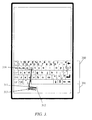
- FIGURE 2 shows a representative touch-screen device with a displayed virtual keyboard in region 200.
- FIGURE 2 shows the path trace of a contact action beginning at a location 210 and ending at a location 215, wherein a user intends to enter the word "retreat” according to the system disclosed by Kushler et al (US Patent 7,098,896 ), by passing through each of the letters of the word “retreat” in sequence, terminating the path at the location of the final letter "t.”
- the repetition gesture is defined as simple back-and-forth movement following a key contact
- the path trace shown in FIGURE 2 would be ambiguous as to whether the path was intended to specify the entry of the word "retreat," or as the activation of the "r” key four times: the initial activation followed by a repetition gesture in which the traced path changes direction three times (at locations 211, 212 and 213) to generate three additional repeated activations of the "r” key.
- an initial component beginning at a location 210 and ending at a location 21
- FIGURE 3 shows one example of an initial component of a repetition gesture that includes moving off of the keyboard (in the example of FIGURE 3 , to an area 301 beneath the displayed keyboard 300) following the initial key contact.
- this initial gesture component is performed, then any number of primary or secondary repetition gestures can be performed without being ambiguous with any of the other input paths that the system is designed to process.
- the path trace shown begins at location 310 on the "r" key, moves to region 301 below the keyboard region 300, and changes direction three times at locations 311, 312 and 313 to similarly generate a total of four activations of the "r" key.
- the path trace shown in FIGURE 3 can be easily distinguished from any that would be intended to generate the output of a word according to the system disclosed by Kushler et al (US Patent 7,098,896 ).
- an appropriate initial component can be defined for virtually any system that recognizes a set of gestures so that the key repetition gesture can be reliably recognized and distinguished from any other gesture used by the system.
- the initial component of the repetition gesture can also include time-based aspects, such as one or more pauses or other changes in the velocity of the movement of the point of contact.
Landscapes
- Engineering & Computer Science (AREA)
- General Engineering & Computer Science (AREA)
- Theoretical Computer Science (AREA)
- Human Computer Interaction (AREA)
- Physics & Mathematics (AREA)
- General Physics & Mathematics (AREA)
- Input From Keyboards Or The Like (AREA)
- User Interface Of Digital Computer (AREA)
Applications Claiming Priority (2)
| Application Number | Priority Date | Filing Date | Title |
|---|---|---|---|
| US26310009P | 2009-11-20 | 2009-11-20 | |
| US12/950,835 US8884872B2 (en) | 2009-11-20 | 2010-11-19 | Gesture-based repetition of key activations on a virtual keyboard |
Publications (2)
| Publication Number | Publication Date |
|---|---|
| EP2336852A2 true EP2336852A2 (de) | 2011-06-22 |
| EP2336852A3 EP2336852A3 (de) | 2012-11-14 |
Family
ID=43640218
Family Applications (1)
| Application Number | Title | Priority Date | Filing Date |
|---|---|---|---|
| EP10192007A Withdrawn EP2336852A3 (de) | 2009-11-20 | 2010-11-22 | Gestenbasierte Wiederholung von Tastenaktivierungen auf einer virtuellen Tastatur |
Country Status (2)
| Country | Link |
|---|---|
| US (2) | US8884872B2 (de) |
| EP (1) | EP2336852A3 (de) |
Cited By (6)
| Publication number | Priority date | Publication date | Assignee | Title |
|---|---|---|---|---|
| CN102778952A (zh) * | 2012-06-20 | 2012-11-14 | 深圳Tcl新技术有限公司 | 手势控制加速的方法及装置 |
| US8884872B2 (en) | 2009-11-20 | 2014-11-11 | Nuance Communications, Inc. | Gesture-based repetition of key activations on a virtual keyboard |
| CN104252310A (zh) * | 2013-06-26 | 2014-12-31 | 纬创资通股份有限公司 | 手持触控装置以及其输入方法 |
| US10254953B2 (en) | 2013-01-21 | 2019-04-09 | Keypoint Technologies India Pvt. Ltd. | Text input method using continuous trace across two or more clusters of candidate words to select two or more words to form a sequence, wherein the candidate words are arranged based on selection probabilities |
| WO2019077279A1 (fr) * | 2017-10-20 | 2019-04-25 | Inria Institut National De Recherche En Informatique Et En Automatique | Dispositif informatique a interface tactile améliorée et procédé correspondant |
| US10474355B2 (en) | 2013-01-21 | 2019-11-12 | Keypoint Technologies India Pvt. Ltd. | Input pattern detection over virtual keyboard for candidate word identification |
Families Citing this family (71)
| Publication number | Priority date | Publication date | Assignee | Title |
|---|---|---|---|---|
| US20070157105A1 (en) * | 2006-01-04 | 2007-07-05 | Stephen Owens | Network user database for a sidebar |
| US8482859B2 (en) | 2010-02-28 | 2013-07-09 | Osterhout Group, Inc. | See-through near-eye display glasses wherein image light is transmitted to and reflected from an optically flat film |
| US9128281B2 (en) | 2010-09-14 | 2015-09-08 | Microsoft Technology Licensing, Llc | Eyepiece with uniformly illuminated reflective display |
| US9341843B2 (en) | 2010-02-28 | 2016-05-17 | Microsoft Technology Licensing, Llc | See-through near-eye display glasses with a small scale image source |
| US9229227B2 (en) | 2010-02-28 | 2016-01-05 | Microsoft Technology Licensing, Llc | See-through near-eye display glasses with a light transmissive wedge shaped illumination system |
| US9097890B2 (en) | 2010-02-28 | 2015-08-04 | Microsoft Technology Licensing, Llc | Grating in a light transmissive illumination system for see-through near-eye display glasses |
| WO2011106797A1 (en) | 2010-02-28 | 2011-09-01 | Osterhout Group, Inc. | Projection triggering through an external marker in an augmented reality eyepiece |
| US9366862B2 (en) | 2010-02-28 | 2016-06-14 | Microsoft Technology Licensing, Llc | System and method for delivering content to a group of see-through near eye display eyepieces |
| US9134534B2 (en) | 2010-02-28 | 2015-09-15 | Microsoft Technology Licensing, Llc | See-through near-eye display glasses including a modular image source |
| US8472120B2 (en) | 2010-02-28 | 2013-06-25 | Osterhout Group, Inc. | See-through near-eye display glasses with a small scale image source |
| US9091851B2 (en) | 2010-02-28 | 2015-07-28 | Microsoft Technology Licensing, Llc | Light control in head mounted displays |
| US9097891B2 (en) | 2010-02-28 | 2015-08-04 | Microsoft Technology Licensing, Llc | See-through near-eye display glasses including an auto-brightness control for the display brightness based on the brightness in the environment |
| US10180572B2 (en) | 2010-02-28 | 2019-01-15 | Microsoft Technology Licensing, Llc | AR glasses with event and user action control of external applications |
| US8477425B2 (en) | 2010-02-28 | 2013-07-02 | Osterhout Group, Inc. | See-through near-eye display glasses including a partially reflective, partially transmitting optical element |
| US20120249797A1 (en) | 2010-02-28 | 2012-10-04 | Osterhout Group, Inc. | Head-worn adaptive display |
| US8467133B2 (en) | 2010-02-28 | 2013-06-18 | Osterhout Group, Inc. | See-through display with an optical assembly including a wedge-shaped illumination system |
| US8488246B2 (en) | 2010-02-28 | 2013-07-16 | Osterhout Group, Inc. | See-through near-eye display glasses including a curved polarizing film in the image source, a partially reflective, partially transmitting optical element and an optically flat film |
| US9223134B2 (en) | 2010-02-28 | 2015-12-29 | Microsoft Technology Licensing, Llc | Optical imperfections in a light transmissive illumination system for see-through near-eye display glasses |
| US9129295B2 (en) | 2010-02-28 | 2015-09-08 | Microsoft Technology Licensing, Llc | See-through near-eye display glasses with a fast response photochromic film system for quick transition from dark to clear |
| US9182596B2 (en) | 2010-02-28 | 2015-11-10 | Microsoft Technology Licensing, Llc | See-through near-eye display glasses with the optical assembly including absorptive polarizers or anti-reflective coatings to reduce stray light |
| US20150309316A1 (en) | 2011-04-06 | 2015-10-29 | Microsoft Technology Licensing, Llc | Ar glasses with predictive control of external device based on event input |
| US9759917B2 (en) | 2010-02-28 | 2017-09-12 | Microsoft Technology Licensing, Llc | AR glasses with event and sensor triggered AR eyepiece interface to external devices |
| US9285589B2 (en) | 2010-02-28 | 2016-03-15 | Microsoft Technology Licensing, Llc | AR glasses with event and sensor triggered control of AR eyepiece applications |
| US9285988B2 (en) * | 2010-04-20 | 2016-03-15 | Blackberry Limited | Portable electronic device having touch-sensitive display with variable repeat rate |
| US20110291964A1 (en) | 2010-06-01 | 2011-12-01 | Kno, Inc. | Apparatus and Method for Gesture Control of a Dual Panel Electronic Device |
| GB201200643D0 (en) * | 2012-01-16 | 2012-02-29 | Touchtype Ltd | System and method for inputting text |
| US20120179967A1 (en) * | 2011-01-06 | 2012-07-12 | Tivo Inc. | Method and Apparatus for Gesture-Based Controls |
| US9430128B2 (en) | 2011-01-06 | 2016-08-30 | Tivo, Inc. | Method and apparatus for controls based on concurrent gestures |
| DE102011106129A1 (de) * | 2011-06-10 | 2012-12-13 | Deutsche Telekom Ag | Eingabe von Befehlen auf einer berührungssensitiven Oberfläche eines elektronischen Gerätes |
| US20130067411A1 (en) * | 2011-09-08 | 2013-03-14 | Google Inc. | User gestures indicating rates of execution of functions |
| WO2013130682A1 (en) * | 2012-02-27 | 2013-09-06 | 5 Examples, Inc. | Date entry system controllers for receiving user input line traces relative to user interfaces to determine ordered actions, and related systems and methods |
| US8667414B2 (en) | 2012-03-23 | 2014-03-04 | Google Inc. | Gestural input at a virtual keyboard |
| US20130285927A1 (en) * | 2012-04-30 | 2013-10-31 | Research In Motion Limited | Touchscreen keyboard with correction of previously input text |
| US8484573B1 (en) * | 2012-05-23 | 2013-07-09 | Google Inc. | Predictive virtual keyboard |
| US9098196B2 (en) * | 2012-06-11 | 2015-08-04 | Lenovo (Singapore) Pte. Ltd. | Touch system inadvertent input elimination |
| US8464180B1 (en) * | 2012-06-15 | 2013-06-11 | Google Inc. | Organizing graphical representations on computing devices |
| US8782549B2 (en) | 2012-10-05 | 2014-07-15 | Google Inc. | Incremental feature-based gesture-keyboard decoding |
| US9021380B2 (en) * | 2012-10-05 | 2015-04-28 | Google Inc. | Incremental multi-touch gesture recognition |
| US8701032B1 (en) | 2012-10-16 | 2014-04-15 | Google Inc. | Incremental multi-word recognition |
| US8843845B2 (en) | 2012-10-16 | 2014-09-23 | Google Inc. | Multi-gesture text input prediction |
| US8850350B2 (en) | 2012-10-16 | 2014-09-30 | Google Inc. | Partial gesture text entry |
| US9557818B2 (en) * | 2012-10-16 | 2017-01-31 | Google Inc. | Contextually-specific automatic separators |
| US9569107B2 (en) * | 2012-10-16 | 2017-02-14 | Google Inc. | Gesture keyboard with gesture cancellation |
| US8704792B1 (en) | 2012-10-19 | 2014-04-22 | Google Inc. | Density-based filtering of gesture events associated with a user interface of a computing device |
| US8819574B2 (en) | 2012-10-22 | 2014-08-26 | Google Inc. | Space prediction for text input |
| US20140123049A1 (en) * | 2012-10-30 | 2014-05-01 | Microsoft Corporation | Keyboard with gesture-redundant keys removed |
| US20140188606A1 (en) * | 2013-01-03 | 2014-07-03 | Brian Moore | Systems and methods for advertising on virtual keyboards |
| US8832589B2 (en) | 2013-01-15 | 2014-09-09 | Google Inc. | Touch keyboard using language and spatial models |
| US9690476B2 (en) * | 2013-03-14 | 2017-06-27 | Blackberry Limited | Electronic device and method of displaying information in response to a gesture |
| US20140278219A1 (en) * | 2013-03-15 | 2014-09-18 | Focus Ventures, Inc. | System and Method For Monitoring Movements of a User |
| US8887103B1 (en) | 2013-04-22 | 2014-11-11 | Google Inc. | Dynamically-positioned character string suggestions for gesture typing |
| US9081500B2 (en) | 2013-05-03 | 2015-07-14 | Google Inc. | Alternative hypothesis error correction for gesture typing |
| CN103294222B (zh) * | 2013-05-22 | 2017-06-16 | 小米科技有限责任公司 | 一种输入方法和系统 |
| US8997013B2 (en) * | 2013-05-31 | 2015-03-31 | Google Inc. | Multiple graphical keyboards for continuous gesture input |
| US20140365878A1 (en) * | 2013-06-10 | 2014-12-11 | Microsoft Corporation | Shape writing ink trace prediction |
| JP5830506B2 (ja) * | 2013-09-25 | 2015-12-09 | 京セラドキュメントソリューションズ株式会社 | 入力装置および電子機器 |
| US20150100911A1 (en) * | 2013-10-08 | 2015-04-09 | Dao Yin | Gesture responsive keyboard and interface |
| US20150205523A1 (en) * | 2014-01-17 | 2015-07-23 | Charles Albert Morris | Sliding Magnified Selector for Touch Screen Keyboards |
| US20220171530A1 (en) * | 2014-06-11 | 2022-06-02 | Lenovo (Singapore) Pte. Ltd. | Displaying a user input modality |
| US9940016B2 (en) | 2014-09-13 | 2018-04-10 | Microsoft Technology Licensing, Llc | Disambiguation of keyboard input |
| KR102449601B1 (ko) | 2014-09-15 | 2022-10-04 | 오티스 엘리베이터 컴파니 | 엘리베이터 호출을 입력하는 것에 의해 엘리베이터 서비스를 개시하는 시스템 및 방법 |
| KR20160034685A (ko) * | 2014-09-22 | 2016-03-30 | 삼성전자주식회사 | 전자장치에서 객체 입력 방법 및 장치 |
| US10843896B2 (en) | 2014-12-16 | 2020-11-24 | Otis Elevator Company | System and method of initiating elevator service by entering an elevator call |
| CN104571585B (zh) * | 2014-12-30 | 2017-07-28 | 北京奇虎科技有限公司 | 输入法光标操作方法和装置 |
| CN105260113B (zh) * | 2015-09-18 | 2018-09-21 | 科大讯飞股份有限公司 | 滑行输入方法、装置及终端设备 |
| US10126827B2 (en) * | 2016-08-11 | 2018-11-13 | Chi Fai Ho | Apparatus and method to navigate media content using repetitive 3D gestures |
| US10409487B2 (en) | 2016-08-23 | 2019-09-10 | Microsoft Technology Licensing, Llc | Application processing based on gesture input |
| CN107015637B (zh) * | 2016-10-27 | 2020-05-05 | 阿里巴巴集团控股有限公司 | 虚拟现实场景下的输入方法和装置 |
| US10884610B2 (en) | 2016-11-04 | 2021-01-05 | Myscript | System and method for recognizing handwritten stroke input |
| US11455094B2 (en) | 2017-07-11 | 2022-09-27 | Thumba Inc. | Interactive virtual keyboard configured for gesture based word selection and having a plurality of keys arranged approximately radially about at least one center point |
| KR20210124439A (ko) * | 2019-02-11 | 2021-10-14 | 피피지 인더스트리즈 오하이오 인코포레이티드 | 밀봉 캡의 3차원 인쇄 |
Citations (3)
| Publication number | Priority date | Publication date | Assignee | Title |
|---|---|---|---|---|
| US5953541A (en) | 1997-01-24 | 1999-09-14 | Tegic Communications, Inc. | Disambiguating system for disambiguating ambiguous input sequences by displaying objects associated with the generated input sequences in the order of decreasing frequency of use |
| US6094197A (en) | 1993-12-21 | 2000-07-25 | Xerox Corporation | Graphical keyboard |
| US7098896B2 (en) | 2003-01-16 | 2006-08-29 | Forword Input Inc. | System and method for continuous stroke word-based text input |
Family Cites Families (9)
| Publication number | Priority date | Publication date | Assignee | Title |
|---|---|---|---|---|
| US7750891B2 (en) * | 2003-04-09 | 2010-07-06 | Tegic Communications, Inc. | Selective input system based on tracking of motion parameters of an input device |
| WO2002050636A2 (en) * | 2000-12-21 | 2002-06-27 | Cirque Corporation | Touchpad code entry system |
| US7382358B2 (en) * | 2003-01-16 | 2008-06-03 | Forword Input, Inc. | System and method for continuous stroke word-based text input |
| US7250938B2 (en) | 2004-01-06 | 2007-07-31 | Lenovo (Singapore) Pte. Ltd. | System and method for improved user input on personal computing devices |
| US20060176283A1 (en) * | 2004-08-06 | 2006-08-10 | Daniel Suraqui | Finger activated reduced keyboard and a method for performing text input |
| US20070262951A1 (en) * | 2006-05-09 | 2007-11-15 | Synaptics Incorporated | Proximity sensor device and method with improved indication of adjustment |
| US7825797B2 (en) * | 2006-06-02 | 2010-11-02 | Synaptics Incorporated | Proximity sensor device and method with adjustment selection tabs |
| US8627233B2 (en) * | 2009-03-27 | 2014-01-07 | International Business Machines Corporation | Radial menu with overshoot, fade away, and undo capabilities |
| US8884872B2 (en) | 2009-11-20 | 2014-11-11 | Nuance Communications, Inc. | Gesture-based repetition of key activations on a virtual keyboard |
-
2010
- 2010-11-19 US US12/950,835 patent/US8884872B2/en active Active
- 2010-11-22 EP EP10192007A patent/EP2336852A3/de not_active Withdrawn
-
2014
- 2014-10-06 US US14/507,732 patent/US20150026629A1/en not_active Abandoned
Patent Citations (3)
| Publication number | Priority date | Publication date | Assignee | Title |
|---|---|---|---|---|
| US6094197A (en) | 1993-12-21 | 2000-07-25 | Xerox Corporation | Graphical keyboard |
| US5953541A (en) | 1997-01-24 | 1999-09-14 | Tegic Communications, Inc. | Disambiguating system for disambiguating ambiguous input sequences by displaying objects associated with the generated input sequences in the order of decreasing frequency of use |
| US7098896B2 (en) | 2003-01-16 | 2006-08-29 | Forword Input Inc. | System and method for continuous stroke word-based text input |
Cited By (8)
| Publication number | Priority date | Publication date | Assignee | Title |
|---|---|---|---|---|
| US8884872B2 (en) | 2009-11-20 | 2014-11-11 | Nuance Communications, Inc. | Gesture-based repetition of key activations on a virtual keyboard |
| CN102778952A (zh) * | 2012-06-20 | 2012-11-14 | 深圳Tcl新技术有限公司 | 手势控制加速的方法及装置 |
| US10254953B2 (en) | 2013-01-21 | 2019-04-09 | Keypoint Technologies India Pvt. Ltd. | Text input method using continuous trace across two or more clusters of candidate words to select two or more words to form a sequence, wherein the candidate words are arranged based on selection probabilities |
| US10474355B2 (en) | 2013-01-21 | 2019-11-12 | Keypoint Technologies India Pvt. Ltd. | Input pattern detection over virtual keyboard for candidate word identification |
| CN104252310A (zh) * | 2013-06-26 | 2014-12-31 | 纬创资通股份有限公司 | 手持触控装置以及其输入方法 |
| WO2019077279A1 (fr) * | 2017-10-20 | 2019-04-25 | Inria Institut National De Recherche En Informatique Et En Automatique | Dispositif informatique a interface tactile améliorée et procédé correspondant |
| FR3072804A1 (fr) * | 2017-10-20 | 2019-04-26 | Inria Institut National De Recherche En Informatique Et En Automatique | Dispositif informatique a interface tactile amelioree et procede correspondant |
| US12147663B2 (en) | 2017-10-20 | 2024-11-19 | Inria Institut National De Recherche En Informatique Et En Automatique | Computer device with improved touch interface and corresponding method |
Also Published As
| Publication number | Publication date |
|---|---|
| US8884872B2 (en) | 2014-11-11 |
| US20150026629A1 (en) | 2015-01-22 |
| EP2336852A3 (de) | 2012-11-14 |
| US20110122081A1 (en) | 2011-05-26 |
Similar Documents
| Publication | Publication Date | Title |
|---|---|---|
| US8884872B2 (en) | Gesture-based repetition of key activations on a virtual keyboard | |
| US10908815B2 (en) | Systems and methods for distinguishing between a gesture tracing out a word and a wiping motion on a touch-sensitive keyboard | |
| CN100437739C (zh) | 基于连续笔划字词的文本输入系统和方法 | |
| US7542029B2 (en) | System and method for a user interface for text editing and menu selection | |
| US9176668B2 (en) | User interface for text input and virtual keyboard manipulation | |
| US8125440B2 (en) | Method and device for controlling and inputting data | |
| CN101529494B (zh) | 文本编辑和菜单选择用户界面的系统和方法 | |
| JP6453246B2 (ja) | 連続スライド操作によるテキスト入力方法及びそのシステム | |
| US7453439B1 (en) | System and method for continuous stroke word-based text input | |
| JP6208718B2 (ja) | 動的配置オンスクリーンキーボード | |
| Bee et al. | Writing with your eye: A dwell time free writing system adapted to the nature of human eye gaze | |
| KR102402397B1 (ko) | 다중 입력 관리를 위한 시스템 및 방법 | |
| JP2006524955A (ja) | タッチスクリーン及び縮小型キーボードのための曖昧でないテキスト入力方法 | |
| CN103870192B (zh) | 一种基于触摸屏的输入方法和装置、汉语拼音输入法和系统 | |
| JP2013527539A5 (de) | ||
| US11209976B2 (en) | System and method for editing input management | |
| Zhang et al. | Gedit: Keyboard gestures for mobile text editing | |
| WO2013071198A2 (en) | Finger-mapped character entry systems | |
| CN101601050A (zh) | 对字进行预览和选择的系统及方法 | |
| Udapola et al. | Braille messenger: Adaptive learning based non-visual touch screen text input for the blind community using braille | |
| Demski et al. | Context Sensitive Gestures | |
| HK1091023B (en) | System and method for continuous stroke word-based text input |
Legal Events
| Date | Code | Title | Description |
|---|---|---|---|
| PUAI | Public reference made under article 153(3) epc to a published international application that has entered the european phase |
Free format text: ORIGINAL CODE: 0009012 |
|
| AK | Designated contracting states |
Kind code of ref document: A2 Designated state(s): AL AT BE BG CH CY CZ DE DK EE ES FI FR GB GR HR HU IE IS IT LI LT LU LV MC MK MT NL NO PL PT RO RS SE SI SK SM TR |
|
| AX | Request for extension of the european patent |
Extension state: BA ME |
|
| PUAL | Search report despatched |
Free format text: ORIGINAL CODE: 0009013 |
|
| AK | Designated contracting states |
Kind code of ref document: A3 Designated state(s): AL AT BE BG CH CY CZ DE DK EE ES FI FR GB GR HR HU IE IS IT LI LT LU LV MC MK MT NL NO PL PT RO RS SE SI SK SM TR |
|
| AX | Request for extension of the european patent |
Extension state: BA ME |
|
| RIC1 | Information provided on ipc code assigned before grant |
Ipc: G06F 3/048 20060101ALI20121008BHEP Ipc: G06F 3/023 20060101AFI20121008BHEP |
|
| 17P | Request for examination filed |
Effective date: 20130514 |
|
| 17Q | First examination report despatched |
Effective date: 20130715 |
|
| 17Q | First examination report despatched |
Effective date: 20130719 |
|
| STAA | Information on the status of an ep patent application or granted ep patent |
Free format text: STATUS: THE APPLICATION IS DEEMED TO BE WITHDRAWN |
|
| 18D | Application deemed to be withdrawn |
Effective date: 20180515 |