EP2338363A1 - Bande antidérapante et produit textile - Google Patents
Bande antidérapante et produit textile Download PDFInfo
- Publication number
- EP2338363A1 EP2338363A1 EP09821848A EP09821848A EP2338363A1 EP 2338363 A1 EP2338363 A1 EP 2338363A1 EP 09821848 A EP09821848 A EP 09821848A EP 09821848 A EP09821848 A EP 09821848A EP 2338363 A1 EP2338363 A1 EP 2338363A1
- Authority
- EP
- European Patent Office
- Prior art keywords
- antislipping
- filament yarn
- yarn
- cloth
- filament
- Prior art date
- Legal status (The legal status is an assumption and is not a legal conclusion. Google has not performed a legal analysis and makes no representation as to the accuracy of the status listed.)
- Withdrawn
Links
Images

Classifications
-
- A—HUMAN NECESSITIES
- A41—WEARING APPAREL
- A41D—OUTERWEAR; PROTECTIVE GARMENTS; ACCESSORIES
- A41D27/00—Details of garments or of their making
- A41D27/24—Hems; Seams
-
- A—HUMAN NECESSITIES
- A41—WEARING APPAREL
- A41D—OUTERWEAR; PROTECTIVE GARMENTS; ACCESSORIES
- A41D27/00—Details of garments or of their making
-
- A—HUMAN NECESSITIES
- A41—WEARING APPAREL
- A41F—GARMENT FASTENINGS; SUSPENDERS
- A41F15/00—Shoulder or like straps
- A41F15/005—Tapes for shoulder straps
-
- D—TEXTILES; PAPER
- D02—YARNS; MECHANICAL FINISHING OF YARNS OR ROPES; WARPING OR BEAMING
- D02G—CRIMPING OR CURLING FIBRES, FILAMENTS, THREADS, OR YARNS; YARNS OR THREADS
- D02G3/00—Yarns or threads, e.g. fancy yarns; Processes or apparatus for the production thereof, not otherwise provided for
- D02G3/22—Yarns or threads characterised by constructional features, e.g. blending, filament/fibre
- D02G3/32—Elastic yarns or threads ; Production of plied or cored yarns, one of which is elastic
-
- D—TEXTILES; PAPER
- D02—YARNS; MECHANICAL FINISHING OF YARNS OR ROPES; WARPING OR BEAMING
- D02G—CRIMPING OR CURLING FIBRES, FILAMENTS, THREADS, OR YARNS; YARNS OR THREADS
- D02G3/00—Yarns or threads, e.g. fancy yarns; Processes or apparatus for the production thereof, not otherwise provided for
- D02G3/22—Yarns or threads characterised by constructional features, e.g. blending, filament/fibre
- D02G3/40—Yarns in which fibres are united by adhesives; Impregnated yarns or threads
- D02G3/404—Yarns or threads coated with polymeric solutions
- D02G3/406—Yarns or threads coated with polymeric solutions where the polymeric solution is removable at a later stage, e.g. by washing
-
- D—TEXTILES; PAPER
- D03—WEAVING
- D03D—WOVEN FABRICS; METHODS OF WEAVING; LOOMS
- D03D15/00—Woven fabrics characterised by the material, structure or properties of the fibres, filaments, yarns, threads or other warp or weft elements used
-
- D—TEXTILES; PAPER
- D03—WEAVING
- D03D—WOVEN FABRICS; METHODS OF WEAVING; LOOMS
- D03D15/00—Woven fabrics characterised by the material, structure or properties of the fibres, filaments, yarns, threads or other warp or weft elements used
- D03D15/20—Woven fabrics characterised by the material, structure or properties of the fibres, filaments, yarns, threads or other warp or weft elements used characterised by the material of the fibres or filaments constituting the yarns or threads
- D03D15/292—Conjugate, i.e. bi- or multicomponent, fibres or filaments
-
- D—TEXTILES; PAPER
- D03—WEAVING
- D03D—WOVEN FABRICS; METHODS OF WEAVING; LOOMS
- D03D15/00—Woven fabrics characterised by the material, structure or properties of the fibres, filaments, yarns, threads or other warp or weft elements used
- D03D15/30—Woven fabrics characterised by the material, structure or properties of the fibres, filaments, yarns, threads or other warp or weft elements used characterised by the structure of the fibres or filaments
- D03D15/33—Ultrafine fibres, e.g. microfibres or nanofibres
-
- D—TEXTILES; PAPER
- D03—WEAVING
- D03D—WOVEN FABRICS; METHODS OF WEAVING; LOOMS
- D03D15/00—Woven fabrics characterised by the material, structure or properties of the fibres, filaments, yarns, threads or other warp or weft elements used
- D03D15/50—Woven fabrics characterised by the material, structure or properties of the fibres, filaments, yarns, threads or other warp or weft elements used characterised by the properties of the yarns or threads
- D03D15/56—Woven fabrics characterised by the material, structure or properties of the fibres, filaments, yarns, threads or other warp or weft elements used characterised by the properties of the yarns or threads elastic
-
- D—TEXTILES; PAPER
- D03—WEAVING
- D03D—WOVEN FABRICS; METHODS OF WEAVING; LOOMS
- D03D15/00—Woven fabrics characterised by the material, structure or properties of the fibres, filaments, yarns, threads or other warp or weft elements used
- D03D15/50—Woven fabrics characterised by the material, structure or properties of the fibres, filaments, yarns, threads or other warp or weft elements used characterised by the properties of the yarns or threads
- D03D15/58—Woven fabrics characterised by the material, structure or properties of the fibres, filaments, yarns, threads or other warp or weft elements used characterised by the properties of the yarns or threads characterised by the coefficients of friction
-
- D—TEXTILES; PAPER
- D03—WEAVING
- D03D—WOVEN FABRICS; METHODS OF WEAVING; LOOMS
- D03D3/00—Woven fabrics characterised by their shape
- D03D3/005—Tapes or ribbons not otherwise provided for
-
- D—TEXTILES; PAPER
- D04—BRAIDING; LACE-MAKING; KNITTING; TRIMMINGS; NON-WOVEN FABRICS
- D04B—KNITTING
- D04B1/00—Weft knitting processes for the production of fabrics or articles not dependent on the use of particular machines; Fabrics or articles defined by such processes
- D04B1/14—Other fabrics or articles characterised primarily by the use of particular thread materials
- D04B1/18—Other fabrics or articles characterised primarily by the use of particular thread materials elastic threads
-
- A—HUMAN NECESSITIES
- A41—WEARING APPAREL
- A41B—SHIRTS; UNDERWEAR; BABY LINEN; HANDKERCHIEFS
- A41B2400/00—Functions or special features of shirts, underwear, baby linen or handkerchiefs not provided for in other groups of this subclass
- A41B2400/80—Friction or grip reinforcement
- A41B2400/82—Friction or grip reinforcement with the body of the user
-
- D—TEXTILES; PAPER
- D10—INDEXING SCHEME ASSOCIATED WITH SUBLASSES OF SECTION D, RELATING TO TEXTILES
- D10B—INDEXING SCHEME ASSOCIATED WITH SUBLASSES OF SECTION D, RELATING TO TEXTILES
- D10B2331/00—Fibres made from polymers obtained otherwise than by reactions only involving carbon-to-carbon unsaturated bonds, e.g. polycondensation products
- D10B2331/04—Fibres made from polymers obtained otherwise than by reactions only involving carbon-to-carbon unsaturated bonds, e.g. polycondensation products polyesters, e.g. polyethylene terephthalate [PET]
-
- D—TEXTILES; PAPER
- D10—INDEXING SCHEME ASSOCIATED WITH SUBLASSES OF SECTION D, RELATING TO TEXTILES
- D10B—INDEXING SCHEME ASSOCIATED WITH SUBLASSES OF SECTION D, RELATING TO TEXTILES
- D10B2403/00—Details of fabric structure established in the fabric forming process
- D10B2403/03—Shape features
- D10B2403/031—Narrow fabric of constant width
- D10B2403/0311—Small thickness fabric, e.g. ribbons, tapes or straps
-
- Y—GENERAL TAGGING OF NEW TECHNOLOGICAL DEVELOPMENTS; GENERAL TAGGING OF CROSS-SECTIONAL TECHNOLOGIES SPANNING OVER SEVERAL SECTIONS OF THE IPC; TECHNICAL SUBJECTS COVERED BY FORMER USPC CROSS-REFERENCE ART COLLECTIONS [XRACs] AND DIGESTS
- Y10—TECHNICAL SUBJECTS COVERED BY FORMER USPC
- Y10T—TECHNICAL SUBJECTS COVERED BY FORMER US CLASSIFICATION
- Y10T442/00—Fabric [woven, knitted, or nonwoven textile or cloth, etc.]
- Y10T442/30—Woven fabric [i.e., woven strand or strip material]
- Y10T442/3008—Woven fabric has an elastic quality
- Y10T442/3024—Including elastic strand or strip
-
- Y—GENERAL TAGGING OF NEW TECHNOLOGICAL DEVELOPMENTS; GENERAL TAGGING OF CROSS-SECTIONAL TECHNOLOGIES SPANNING OVER SEVERAL SECTIONS OF THE IPC; TECHNICAL SUBJECTS COVERED BY FORMER USPC CROSS-REFERENCE ART COLLECTIONS [XRACs] AND DIGESTS
- Y10—TECHNICAL SUBJECTS COVERED BY FORMER USPC
- Y10T—TECHNICAL SUBJECTS COVERED BY FORMER US CLASSIFICATION
- Y10T442/00—Fabric [woven, knitted, or nonwoven textile or cloth, etc.]
- Y10T442/30—Woven fabric [i.e., woven strand or strip material]
- Y10T442/3065—Including strand which is of specific structural definition
-
- Y—GENERAL TAGGING OF NEW TECHNOLOGICAL DEVELOPMENTS; GENERAL TAGGING OF CROSS-SECTIONAL TECHNOLOGIES SPANNING OVER SEVERAL SECTIONS OF THE IPC; TECHNICAL SUBJECTS COVERED BY FORMER USPC CROSS-REFERENCE ART COLLECTIONS [XRACs] AND DIGESTS
- Y10—TECHNICAL SUBJECTS COVERED BY FORMER USPC
- Y10T—TECHNICAL SUBJECTS COVERED BY FORMER US CLASSIFICATION
- Y10T442/00—Fabric [woven, knitted, or nonwoven textile or cloth, etc.]
- Y10T442/40—Knit fabric [i.e., knit strand or strip material]
- Y10T442/413—Including an elastic strand
-
- Y—GENERAL TAGGING OF NEW TECHNOLOGICAL DEVELOPMENTS; GENERAL TAGGING OF CROSS-SECTIONAL TECHNOLOGIES SPANNING OVER SEVERAL SECTIONS OF THE IPC; TECHNICAL SUBJECTS COVERED BY FORMER USPC CROSS-REFERENCE ART COLLECTIONS [XRACs] AND DIGESTS
- Y10—TECHNICAL SUBJECTS COVERED BY FORMER USPC
- Y10T—TECHNICAL SUBJECTS COVERED BY FORMER US CLASSIFICATION
- Y10T442/00—Fabric [woven, knitted, or nonwoven textile or cloth, etc.]
- Y10T442/40—Knit fabric [i.e., knit strand or strip material]
- Y10T442/425—Including strand which is of specific structural definition
- Y10T442/431—Cross-sectional configuration of strand material is specified
Definitions
- the present invention relates to an antislipping tape capable of being attached to the inner sides of trousers, skirts, inner wear products, and the like, and having an excellent antislipping effect, and comfortable to the skin, and textile products.
- the antislipping tapes there are known those using elastic materials such as a polyurethane fiber and rubber, those obtained by processing a silicone resin into a tape, and the like (e.g., see Patent Document 1, and Patent Document 2).
- the present invention was completed in view of the foregoing background. It is an object thereof to provide an antislipping tape having an excellent antislipping effect, and comfortable to the skin, and textile products.
- the present inventors conducted a close study in order to attain the foregoing problem. As a result, they found as follows: when an antislipping tape is formed using a fiber with a very small single filament diameter, it is possible to obtain an antislipping tape having a more excellent antislipping effect as compared with a conventional antislipping tape, and comfortable to the skin. A further continued close study has led to the completion of the present invention.
- an antislipping tape containing a cloth having a woven fabric structure or a knitted fabric structure, characterized in that the cloth comprises a filament yarn A with a single filament diameter of 10 to 1000 nm.
- the filament yarn A is exposed at the surface of the cloth. Further, it is preferable that the number of filaments of the filament yarn A is 500 or more. Still further, it is preferable that the filament yarn A is a yarn obtained by dissolving and removing a sea component of a sea-island type composite fiber including the sea component and an island component. Furthermore, it is preferable that the filament yarn A includes polyester.
- the cloth contains therein a filament yarn B with a single filament diameter of more than 1000 nm as another fiber. Further, it is preferable that the number of filaments of the filament yarn B falls within the range of 1 to 500. Furthermore, it is also acceptable that the filament yarn B is an elastic yarn.
- the frictional resistance value is 40 cN or more, provided that the frictional resistance value is a resistance value (cN) measured in the following manner. Namely, silicone rubber is put on a smooth stage under environment of a temperature of 20°C and a humidity of 65 %RH. Then, on the silicone rubber, there is placed a head with dimensions of a bottom of 5 cm ⁇ 4 cm, a height of 3 cm, and a weight of 35 cN (36 gr), the head including a sample attached on the underside thereof. Then, the resistance value (cN) when the head has been pulled by means of a tensile tester at a rate of 100 mm/min is referred to as the frictional resistance value.
- the width of the antislipping tape falls within the range of 3 to 100 mm.
- a textile product which includes the antislipping tape, and is any selected from the group consisting of trousers, skirts, socks, stockings, brassieres, short panties, lingerie, girdles, men's pants, women's pants, sport undershirts, sport underpants, jersey, hats, gloves, underwear, sporting goods, and sporting materials.
- an antislipping tape having an excellent antislipping effect, and comfortable to the skin, and textile products.
- An antislipping tape of the invention is an antislipping tape containing a cloth having a woven fabric structure or a knitted fabric structure, wherein the cloth contains therein a filament A with a single filament diameter of 10 to 1000 nm.
- the single filament diameter (the diameter of the single filament) falls within the range of 10 to 1000 nm (preferably 250 to 800 nm, and in particular preferably 510 to 800 nm).
- a single filament diameter corresponds to 0. 000001 to 0.01 dtex in terms of the single filament fineness.
- the single filament diameter is smaller than 10 nm, the fiber strength is reduced, and hence such a case is practically undesirable.
- the single filament diameter is larger than 1000 nm, a sufficient antislipping effect may not be obtained, which is undesirable.
- the cross-sectional shape of the filament is a modified cross-section other than a round cross-section, the diameter of the circumcircle is assumed to be the single filament diameter.
- the single filament diameter can be measured by photographing the cross-section of the fiber by a transmission electron microscope.
- the number of filaments has no particular restriction.
- the number is preferably 500 or more (more preferably 2000 to 50000).
- the total fineness of the filament yarn A preferably falls within the range of 30 to 800 dtex.
- the fiber form of the filament yarn A has no particular restriction, but is preferably a long filament (multifilament yarn).
- the cross-sectional shape of the single filament also has no particular restriction, and known cross-sectional shapes such as round, triangle, flat, and hollow shapes are acceptable. Further, general air processing or false twisting and crimping may have been performed thereon.
- polyester type polymers or nylon type polymers are preferred.
- polyethylene terephthalate polytrimethylene terephthalate, polybutylene terephthalate, polylactic acid, and a third component-copolymerized polyester.
- Such polyesters may be polyesters subjected to material recycling or chemical recycling. Further, they may also be polyesters obtained by using catalysts containing specific phosphorus compounds and titanium compounds as described in JP-A-2004-270097 and JP-A-2004-211268 , polylactic acid, and stereocomplex polylactic acid.
- the polyester polymers may contain therein one or two or more of a micropore forming agent, a cationic dye mordant, a coloring inhibitor, a thermal stabilizer, a fluorescent brightening agent, a matting agent, a coloring agent, a moisture absorbent, and inorganic fine particles.
- the cloth contained in the antislipping tape of the invention may include only the filament yarn A.
- the cloth includes the filament yarn A and a filament B with a single filament diameter of more than 1000 nm as another fiber, the shape retentivity of the antislipping tape is preferably improved.
- the filament yarn B preferably has a single filament diameter of more than 1000 nm (preferably 2 to 33 ⁇ m).
- 33 ⁇ m is about 10 dtex in terms of the fineness.
- the shape retentivity of the tape may be damaged.
- the cross-sectional shape of the single filament is a modified cross-section other than a round cross-section, the diameter of the circumcircle is assumed to be the single filament diameter.
- the single filament diameter can be measured by photographing the cross-section of the fiber by a transmission electron microscope as with the foregoing.
- the number of filaments has no particular restriction, but preferably falls within the range of 1 to 300.
- the fiber form of such a filament yarn B has no particular restriction, and a spun yarn is also acceptable.
- a long filament (multifilament yarn), a polyurethane fiber, or the like, or both are preferably used.
- the cross-sectional shape of the filament also has no particular restriction, and known cross-sectional shapes such as round, triangle, flat, and hollow shapes are acceptable. Further, general air processing or false twisting and crimping may have been performed thereon.
- the filament yarn B may come in one kind, or a plurality of kinds such as a filament yarn B1, a filament yarn B2, a filament yarn B3, and the like.
- the type of the polymer forming the filament yarn B has no particular restriction.
- polyethylene terephthalate polytrimethylene terephthalate, polybutylene terephthalate, polylactic acid, stereocomplex polylactic acid, a third component-copolymerized polyester, polyether ester, urethane, and the like.
- Such polyesters may be polyesters subjected to material recycling or chemical recycling. Further, they may also be polyesters obtained by using catalysts containing specific phosphorus compounds and titanium compounds as described in JP-A-2004-270097 and JP-A-2004-211268 , polylactic acid, and stereocomplex polylactic acid.
- the polymer forming the filament yarn B may contain therein one or two or more of a micropore forming agent, a cationic dye mordant, a coloring inhibitor, a thermal stabilizer, a fluorescent brightening agent, a matting agent, a coloring agent, a moisture absorbent, and inorganic fine particles.
- the filament yarn B may be a composite yarn.
- a composite yarn obtained by air-mixing an elastomer fiber yarn including a polyurethane fiber, a polyether ester type fiber, or the like, and a polyester type fiber yarn by an interlace air nozzle or the like a composite yarn obtained by covering the periphery of the elastomer fiber yarn with a polyester type yarn, a composite yarn using a spun yarn, and the like.
- the filament A is exposed at either one surface of the front and back.
- the fabric surface is photographed at a magnification of 50 times by means of an electron microscope.
- the value of the area ratio (%) of the filament yarn A is preferably 30% or more (preferably 100%).
- it is preferable that only the filament yarn A is exposed at either one surface of the front and back of the cloth.
- the antislipping tape of the invention can be manufactured by, for example, the following manufacturing method.
- a sea-island type composite fiber fiber for filament yarn A
- an island component with a diameter of 10 to 1000 nm is prepared.
- the sea-island type composite fiber multifilament (number of islands 100 to 1500) disclosed in JP-A-2007-2364 is preferably used.
- an alkaline aqueous solution-easily soluble polymer is used as the sea component polymer.
- an alkaline aqueous solution-easily soluble polymer preferred are polylactic acid, ultrahigh molecular weight polyalkylene oxide condensation type polymers, polyethylene glycol type compound copolymerized polyester, copolymerized polyesters of a polyethylene glycol type compound and 5-sodium sulfonate isophthalate.
- polyethylene terephthalate type copolymerized polyester with an intrinsic viscosity of 0.4 to 0.6 resulting from copolymerization of 6 to 12 mol% 5-sodium sulfoisophthalic acid and 3 to 10 wt% polyethylene glycol with a molecular weight of 4000 to 12000.
- polyesters such as fiber-formable polyethylene terephthalate, polytrimethylene terephthalate, polybutylene terephthalate, polylactic acid, and a third component-copolymerized polyester.
- the polymer may contain therein, if required, within such a range as not to impair the object of the invention, one or two or more of a micropore forming agent, a cationic dye mordant, a coloring inhibitor, a thermal stabilizer, a fluorescent brightening agent, a matting agent, a coloring agent, a moisture absorbent, and inorganic fine particles.
- the melt viscosity of the sea component during melt spinning is larger than the melt viscosity of the island component polymer.
- the diameter of the island component is required to be within the range of 10 to 1000 nm. In that case, when the shape of the island component is not a perfect circle, the diameter of the circumcircle is determined.
- the sea-island composite weight ratio (sea : island) is preferably within the range of 40 : 60 to 5 : 95, and in particular preferably within the range of 30 : 70 to 10 : 90.
- Such a sea-island type composite fiber can be manufactured with, for example, the following method with ease. Namely, the sea component polymer and the island component polymer are used to be melt spun. As the spinnerets for use in melt spinning, there can be used given ones such as the one having a hollow pin group and a micropore group for forming the island component.
- the discharged sea-island type composite fiber is solidified by cooling air, and is melt spun at preferably 400 to 6000 m/min, followed by winding.
- the resulting undrawn yarn is preferably formed into a composite fiber having desirable strength/elasticity/thermal shrinking characteristics through an additional drawing step.
- the discharged sea-island type composite fiber is taken up with a roller at a constant rate without being once wound, and subsequently is subjected to a drawing step, followed by winding.
- sea-island type composite fiber multifilament
- the single filament fineness is 0.5 to 10.0 dtex
- the number of filaments is 5 to 75
- the total fineness is 30 to 170 dtex, respectively.
- the boiling water shrinkage of such a sea-island type composite fiber preferably falls within the range of 5 to 30 %.
- a filament yarn B with a single filament diameter of larger than 1000 nm is prepared.
- the single filament fineness of such a filament yarn B is preferably 0.1 dtex or more (preferably 0.1 to 50 dtex).
- the number of filaments, and the total fineness preferably, the number of filaments is 1 to 300 and the total fineness is 10 to 800 dtex, respectively.
- the filament yarn B is preferably high shrinkage polyester with a boiling water shrinkage of 10% or more (more preferably 20 to 40%), or an elastic yarn (a polyurethane elastic yarn or a polyether ester elastic yarn).
- a high boiling water shrinkage as described above, it is desirable that spinning and drawing are performed using a copolymerized polyester with an ordinary method.
- the main constituent monomers of the copolymerized polyester are terephthalic acid and ethylene glycol
- the third component to be copolymerized with the main constituent monomers is any selected from the group consisting of isophthalic acid, naphthalene dicarboxylic acid, adipic acid, sebacic acid, diethylene glycol, polyethylene glycol, bisphenol A, and bisphenol sulfone.
- the copolymerized polyester is preferably a copolymerized polyester in which the acid components include terephthalic acid and isophthalic acid with a mole ratio (terephthalic acid/isophthalic acid) of 90/5 to 85/15, and the glycol component includes ethylene glycol.
- the acid components include terephthalic acid and isophthalic acid with a mole ratio (terephthalic acid/isophthalic acid) of 90/5 to 85/15
- the glycol component includes ethylene glycol.
- sea-island type composite fiber and if required, the filament yarn B, a cloth is woven or knitted with an ordinary method.
- the sea-island type composite fiber is exposed at either one surface of the front or back of the cloth.
- the sea-island type composite fiber and the filament yarn B may be contained as the combined filament yarn in the cloth.
- the filament yarn A and the filament B are interknitted or interwoven, thereby to weave or knit a cloth (knitted fabric or woven fabric).
- a known weaving machine for ribbons e.g. , needle weaving machine, manufactured by Jacob Muller Co., (Germany), or NJK machine manufactured by TOMINAGA MACHINE MANUFACTURING Co., Ltd).
- the total fineness ratio of the sea-island type composite fiber and the filament yarn B preferably falls within the range of 90 : 10 to 20 : 80.
- the construction of the cloth has no particular restriction.
- weft knit constructions mention may be made of plain stitch, rib stitch, interlock stitch, purl stitch, tuck stitch, float stitch, half cardigan stitch, lace stitch, and plated stitch.
- warp knit constructions mention may be made of single denbigh stitch, single atlas stitch, double cord stitch, half stitch, half base stitch, satin stitch, half tricot stitch, fleecy stitch, jacquard stitch, and the like.
- the woven fabric structures mention may be made of three foundation weaves such as plain weave, twill weave, and sateen weave, derivative weave, partial backed weaves such as warp backed weave and weft backed weave, warp velvet, and the like. It is naturally understood that these are non-limiting.
- a monolayer is acceptable, or a multilayer of two layers or more is also acceptable.
- the cloth is subjected to an alkaline aqueous solution treatment, so that the sea component of the sea-island type composite fiber is dissolved in an alkaline aqueous solution and removed. Then, the sea-island type composite fiber is formed into a filament yarn A with a single filament diameter of 10 to 1000 nm. As a result, a cloth containing the a filament yarn A with a single filament diameter of 10 to 1000 nm is obtained.
- the fabric may be subjected to dyeing and finishing. Calendering (heating and pressurizing processing) and embossing may be performed.
- the antislipping tape of the invention may include only the cloth, but may include the cloth and another cloth.
- a multilayer structure may be adopted by disposing the cloth on the skin side, and, on the other hand, for example, disposing a general polyester woven or knitted fabric on the outside air side.
- the width thereof preferably falls within the range of 3 to 100 mm (more preferably 5 to 50 mm).
- the antislipping tape of the invention includes a cloth containing a filament yarn A with a single filament diameter of 10 to 1000 nm, and hence has an excellent antislipping effect and is comfortable to the skin.
- the frictional resistance value is preferably 40 cN or more (preferably 40 to 50 cN) in a dry state (under environment of a temperature of 20°C and a humidity of 65 %RH).
- the value is preferably 45 cN or more (preferably 45 to 100 cN).
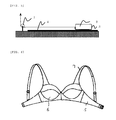
- the frictional resistance value is the resistance value (cN) measured in the following manner. Namely, as schematically shown in FIG. 5 , silicone rubber is put on a smooth stage.
- the head with dimensions of a bottom of 5 cm ⁇ 4 cm, a height of 3 cm, and a weight of 36 gr (35 cN), the head including a sample attached on the underside thereof.
- the resistance value (cN) when the head has been pulled by means of a tensile tester at a rate of 100 mm/min is referred to as the frictional resistance value.
- the wet state includes two levels of the state of the sample added with 0.1 cc of water, and the state of the sample after 30 seconds from pulling up from the state in which the sample was fully immersed in water to sufficiently contain water.
- the antislipping tape of the invention contains a filament yarn B with a single filament diameter of larger than 1000 nm, the shape retentivity of the tape is improved.
- the textile products of the invention are any textile products which include the antislipping tape, and are selected from the group consisting of trousers, skirts, socks, stockings, brassieres, short panties, lingerie, girdles, men's pants, women's pants, sport undershirts, sport underpants, jersey, and hats, and gloves.
- Use of the antislipping tape in such a textile product so that the surface at which the filament A is exposed is in contact with the skin provides an excellent antislipping effect. Further, the product is also excellent in water absorption, and is also comfortable to the skin.
- a polymer after a drying treatment is set in an orifice set at the ruder melting temperature for spinning, and is molten and held for 5 minutes, and then, is extruded under loads at several levels.
- the shear rate and the melt viscosity at that step are plotted. The plots are gently connected to form a shear rate - melt viscosity curve. Then, the melt viscosity at a shear rate of 1000 sec -1 is observed.
- a yarn is wound at a spinning rate of 1000 to 2000 m/min through respective 0.3-dia-0.6 L ⁇ 24 H spinnerets of the sea/island components, and further is drawn so that the residual elasticity falls within the range of 30 to 60 %, thereby to manufacture a multifilament of 84 dtex/24 fil.
- the reduction rate was calculated from the dissolution time and the dissolution amount.
- the cloth was photographed by an electron microscope, and then, the single filament diameters of samples, the number n of which is 5, were measured, and the mean value thereof was determined.
- a ⁇ r ⁇ e ⁇ a ⁇ r ⁇ a ⁇ t ⁇ i ⁇ o ⁇ o ⁇ f ⁇ f ⁇ i ⁇ l ⁇ a ⁇ m ⁇ e ⁇ n ⁇ t ⁇ y ⁇ a ⁇ r ⁇ n ⁇ A % A ⁇ A / A ⁇ A + B ⁇ A ⁇ 100
- the frictional resistance value (cN) was measured in the following manner. Namely, under environment of a temperature of 20°C and a humidity of 65 %RH, as schematically shown in FIG. 5 , silicone rubber was put on a smooth stage. Then, on the silicone rubber, there was placed a head with dimensions of a bottom of 5 cm ⁇ 4 cm, a height of 3 cm, and a weight of 36 gr (35 cN), the head including a sample attached on the underside thereof. Then, the resistance value (cN) when the head had been pulled by means of a tensile tester at a rate of 100 mm/min was measured. Further, the wet state includes two levels of the state of the sample added with 0.1 cc of water, and the state of the sample after 30 seconds from pulling up from the state in which the sample was fully immersed in water to sufficiently contain water.
- a hand test was performed simultaneously with the antislipping property test with the skin, and the texture was rated on the following scale of 3 grades.
- Grade 3 comfortable to the skin and causing no uncomfortable feeling; grade 2: slightly causing uncomfortable feeling; and grade 1: remarkably causing uncomfortable feeling.
- polyethylene terephthalate (with a melt viscosity at 280°C of 1200 poise, and a matting agent content:0 wt%) as the island component
- the resulting undrawn yarn was roller drawn at a drawing temperature of 80°C, and at a draw ratio of 2.5 times, and then, was heat set at 150°C, and was wound.
- the resulting sea-island type composite fiber (drawn yarn for the filament yarn A) had 56 dtex/10 fil.
- the fiber cross-section was observed by a transmission electron microscope TEM. As a result, the shape of the island was a round shape, and the diameter of the island was 710 nm.
- the filament yarn B1 there was prepared a stretchable composite yarn obtained by covering a commercially available polyurethane elastic yarn (fineness 470 dtex/1 fil, manufactured by Asahi Kasei Corporation Ltd.,) with a commercially available polyester false twisted and crimped textured yarn of 167 dtex/72 fil. Further, as the filament yarn B2, a commercially available polyester false twisted and crimped textured yarn of 167 dtex/48 fil was prepared. Furthermore, as the filament yarn B3, a commercially available non-crimped polyester drawn yarn of 110 dtex/48 fil was prepared.
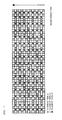
- the woven weave diagram shown in FIG. 7 was used.
- the filament yarn B3 is a weft
- the woven weave diagram shows the arrangement of respective yarns as seen from the surface, and hence the blank portion of the diagram is the filament yarn B3.
- the cloth was subjected to 30 % alkali peeling in a 3.5 %NaOH aqueous solution at 70°C. Thereafter, high-pressure dyeing at 130°C and for 30 minutes was performed. Then, as the final setting, 170°C dry heat setting was performed, resulting in a cloth (antislipping tape) containing the filament yarn A.
- the filament diameter of the single filament yarn A (39 dtex/8360 fil) was 710 nm.
- the single filament diameter of the polyurethane fiber was 160 ⁇ m
- the single filament diameter of 167 dtex/72 fil used for covering was 16 ⁇ m.
- the single filament diameter of the filament yarn B2 was 19 ⁇ m.
- the single filament diameter of the filament yarn B3 was 16 ⁇ m.
- 90% or more of the filament yarn A was exposed.
- the frictional resistance value of the back side surface of the cloth was 1.5 times or more that of the cloth obtained in Comparative Example 1 either in a dray state or in a wet state.
- a wear test was performed using the cloth for a strap for brassiere (shoulder strap) as an antislipping tape in place of a commercially available strap for brassiere.
- the tape was superior in antislipping property with the skin to Comparative Example 1.
- the tape was attached by sewing so that the tape back side (on which 90 % or more of the filament yarn A was exposed) was situated on the skin side.
- Example 1 in place of the sea-island type composite fiber, a common polyethylene terephthalate multifilament drawn yarn (total fineness 168 dtex/48 fil, manufactured by TEIJIN FIBERS LIMITED) was used. Further, alkali peeling was not performed. Except for this, a tape was obtained in the same manner as in Example 1. In the resulting tape, the single filament diameter of the polyethylene terephthalate multifilament drawn yarn was 19 ⁇ m.
- polyethylene terephthalate (with a melt viscosity at 280°C of 1200 poise, and a matting agent content: 0 wt%) as the island component
- the resulting undrawn yarn was roller drawn at a drawing temperature of 80°C, and at a draw ratio of 2.5 times, and then, was heat set at 150°C, and was wound.
- the resulting sea-island type composite fiber (drawn yarn for polyester filament yarn A) had 56 dtex/10 fil.
- the fiber cross-section was observed by a transmission electron microscope TEM. As a result, the shape of the island was a round shape, and the diameter of the island was 710 nm.
- the filament yarn B1 there was prepared a stretchable textured yarn obtained by covering a commercially available polyurethane elastic yarn (fineness 470 dtex/1 fil, manufactured by Asahi Kasei Corporation Ltd.,) with a commercially available polyester false twisted and crimped textured yarn of 167 dtex/72 fil. Further, as the filament yarn B2, a commercially available polyester false twisted and crimped textured yarn of 167 dtex/48 fil was prepared. Furthermore, as the filament yarn B3, a commercially available non-crimped polyester drawn yarn of 110 dtex/48 fil was prepared.
- the woven weave diagram shown in FIG. 8 was used.
- the filament yarn B3 is a weft
- the woven weave diagram shows the arrangement of respective yarns as seen from the surface, and hence the blank portion of the diagram is the filament yarn B3.
- the tape was subjected to 30 % alkali peeling in a 3.5 % NaOH aqueous solution at 70°C. Thereafter, high-pressure dyeing at 130°C and for 30 minutes was performed, and as the final setting, 170°C dry heat setting was performed, resulting in a cloth containing the filament yarn A.
- the filament diameter of the single filament yarn A (39 dtex/8360 fil) was 710 nm.
- the single filament diameter of the polyurethane fiber was 220 ⁇ m, and the single filament diameter of 167 dtex/72 fil used for covering was 16 ⁇ m.
- the single filament diameter of the filament yarn B2 was 19 ⁇ m.
- the single filament diameter of the filament yarn B3 was 16 ⁇ m.
- 90% or more of the polyester filament yarn A was exposed.
- the frictional resistance value of the back side (skin side) surface of the cloth was 1.5 times or more that of the cloth obtained in Comparative Example 2 either in a dry state or in a wet state.
- a wear test was performed using the cloth as an antislipping tape in place of a commercially available upper or lower side tape for brassiere (tapes attached to the upper side and the lower side of the skin side surface of the cup part).
- the tape was superior in antislipping property with the skin to Comparative Example 2.
- the antislipping tape was attached by sewing so that the tape back side was on the skin side.
- Example 2 in place of the sea-island type composite fiber, a common polyethylene terephthalate multifilament drawn yarn (total fineness 168 dtex/48 fil, manufactured by TEIJIN FIBERS LIMITED) was used. Further, alkali peeling was not performed. Except for this, a tape was obtained in the same manner as in Example 2. In the resulting tape, the single filament diameter of the polyethylene terephthalate multifilament drawn yarn was 19 ⁇ m.
- an antislipping tape having an excellent antislipping effect, and comfortable to the skin, and textile products including the antislipping tape, the industrial values of which are very large.
Landscapes
- Engineering & Computer Science (AREA)
- Textile Engineering (AREA)
- Mechanical Engineering (AREA)
- Chemical & Material Sciences (AREA)
- Nanotechnology (AREA)
- Woven Fabrics (AREA)
- Chemical Or Physical Treatment Of Fibers (AREA)
- Details Of Garments (AREA)
- Yarns And Mechanical Finishing Of Yarns Or Ropes (AREA)
- Treatments For Attaching Organic Compounds To Fibrous Goods (AREA)
Applications Claiming Priority (2)
| Application Number | Priority Date | Filing Date | Title |
|---|---|---|---|
| JP2008271875 | 2008-10-22 | ||
| PCT/JP2009/060520 WO2010047148A1 (fr) | 2008-10-22 | 2009-06-09 | Bande antidérapante et produit textile |
Publications (2)
| Publication Number | Publication Date |
|---|---|
| EP2338363A1 true EP2338363A1 (fr) | 2011-06-29 |
| EP2338363A4 EP2338363A4 (fr) | 2014-05-28 |
Family
ID=42119198
Family Applications (1)
| Application Number | Title | Priority Date | Filing Date |
|---|---|---|---|
| EP09821848.0A Withdrawn EP2338363A4 (fr) | 2008-10-22 | 2009-06-09 | Bande antidérapante et produit textile |
Country Status (8)
| Country | Link |
|---|---|
| US (1) | US20110111673A1 (fr) |
| EP (1) | EP2338363A4 (fr) |
| JP (1) | JP5395088B2 (fr) |
| KR (1) | KR20110091653A (fr) |
| CN (1) | CN102098935A (fr) |
| CA (1) | CA2736001A1 (fr) |
| TW (1) | TW201016916A (fr) |
| WO (1) | WO2010047148A1 (fr) |
Cited By (1)
| Publication number | Priority date | Publication date | Assignee | Title |
|---|---|---|---|---|
| EP3305956A4 (fr) * | 2015-05-27 | 2019-01-16 | Toray Industries, Inc. | Tissu |
Families Citing this family (21)
| Publication number | Priority date | Publication date | Assignee | Title |
|---|---|---|---|---|
| FR2966701B1 (fr) * | 2010-10-27 | 2013-08-23 | Dbapparel Operations | Article de lingerie tricote elastique a culotte remodelante |
| USD652611S1 (en) * | 2011-06-09 | 2012-01-24 | York Tiffany C | Underwear |
| JP5357929B2 (ja) * | 2011-06-27 | 2013-12-04 | 株式会社デサント | 帽子 |
| JP5211210B2 (ja) * | 2011-06-30 | 2013-06-12 | 株式会社デサント | 水着 |
| USD692208S1 (en) * | 2012-03-20 | 2013-10-29 | Anita LaCour-Phillippi | Tight fitting sanitary absorbent under shorts |
| JP5296901B1 (ja) * | 2012-03-30 | 2013-09-25 | 株式会社ワコール | 編地 |
| USD716020S1 (en) * | 2013-08-02 | 2014-10-28 | Thinx, LLC | Undergarment |
| CN106455835A (zh) * | 2014-04-16 | 2017-02-22 | 帝人株式会社 | 被罩 |
| JP6449036B2 (ja) * | 2015-02-02 | 2019-01-09 | 岡本株式会社 | レッグウェア |
| US9883702B2 (en) * | 2015-10-07 | 2018-02-06 | Mast Industries (Far East) Limited | Portion of bra and bra having zones of varying elastic moduli |
| KR102071521B1 (ko) * | 2016-09-26 | 2020-01-30 | 정인순 | 사이즈 조절이 가능한 한복치마의 착용방법 |
| USD838468S1 (en) | 2017-05-15 | 2019-01-22 | Okamoto Corporation | Sock with nonslip parts |
| USD855305S1 (en) | 2017-12-04 | 2019-08-06 | Okamoto Corporation | Sock with nonslip part |
| US20190216149A1 (en) * | 2018-01-12 | 2019-07-18 | Nike, Inc. | Woven Trim Piece |
| DE202018101168U1 (de) * | 2018-03-02 | 2018-03-09 | Certoplast Technische Klebebänder Gmbh | Klebeband |
| US10694788B2 (en) | 2018-04-20 | 2020-06-30 | Victoria Profeta | Non-slip undergarment |
| US11313056B2 (en) * | 2018-05-30 | 2022-04-26 | Nike, Inc. | Woven garment with grip yarns |
| JP2020081693A (ja) * | 2018-11-30 | 2020-06-04 | セダージャパン株式会社 | 中敷き |
| TWI686144B (zh) * | 2019-03-05 | 2020-03-01 | 衣衫衣舞股份有限公司 | 具有阻止衣服移位功能之內褲 |
| CN111304824A (zh) * | 2020-03-20 | 2020-06-19 | 李宁(中国)体育用品有限公司 | 一种织带的制备方法、织带及其应用 |
| KR102924913B1 (ko) * | 2024-03-15 | 2026-02-10 | 온도 인코포레이티드 | 바지 |
Family Cites Families (20)
| Publication number | Priority date | Publication date | Assignee | Title |
|---|---|---|---|---|
| JPS6118064A (ja) | 1984-07-03 | 1986-01-25 | Canon Inc | 電子機器 |
| JPS63211308A (ja) * | 1987-02-26 | 1988-09-02 | 東レ株式会社 | 高密着性を有する手袋 |
| JPS63264943A (ja) * | 1987-04-22 | 1988-11-01 | 東レ株式会社 | 特殊密着性テ−プ |
| US5098973A (en) | 1989-05-24 | 1992-03-24 | Sumitomo Rubber Industries Ltd. | Hardening resin composition |
| JPH04308245A (ja) * | 1991-04-04 | 1992-10-30 | Toyobo Co Ltd | 着用感に優れた寝衣及びその製造方法 |
| CN1077019C (zh) * | 1995-01-24 | 2002-01-02 | 东丽株式会社 | 聚酯制品的制造方法 |
| NL1003240C2 (nl) * | 1996-05-31 | 1997-12-03 | Dsm Nv | Elastische vezel. |
| JP3077907U (ja) * | 2000-11-24 | 2001-06-12 | 吉田産業株式会社 | すべり止め用細幅編地およびこれを用いた衣類 |
| JP2003119607A (ja) * | 2002-07-23 | 2003-04-23 | Toyo Rubber Shokufu Kk | 滑り止め体、それを使用した下衣及び帯状物 |
| JP2004270097A (ja) | 2003-03-11 | 2004-09-30 | Teijin Fibers Ltd | ポリエステル織物 |
| JP2004211268A (ja) | 2003-01-09 | 2004-07-29 | Teijin Fibers Ltd | ポリエステル織物 |
| JP2005206994A (ja) * | 2004-01-26 | 2005-08-04 | Asahi Kasei Fibers Corp | 裏材 |
| EP1725128B1 (fr) * | 2004-03-19 | 2010-03-10 | Joeun Protech Co. Ltd | Protege-talon |
| TWI341339B (en) * | 2004-03-30 | 2011-05-01 | Teijin Fibers Ltd | Island-in-sea type composite fibers and process for producing same |
| JP4571541B2 (ja) | 2005-06-24 | 2010-10-27 | 帝人ファイバー株式会社 | 透湿防水性ポリエステル織物の製造方法 |
| JP4676857B2 (ja) * | 2005-10-04 | 2011-04-27 | 帝人ファイバー株式会社 | 高タフネス極細繊維用海島型複合繊維 |
| JP2008240184A (ja) * | 2007-03-27 | 2008-10-09 | Toray Ind Inc | 布帛の製造方法 |
| JP5216970B2 (ja) * | 2007-03-30 | 2013-06-19 | 帝人株式会社 | ポリエステル編地およびその製造方法および繊維製品 |
| JP5178076B2 (ja) * | 2007-07-19 | 2013-04-10 | 帝人ファイバー株式会社 | 下着 |
| GB0817926D0 (en) * | 2008-10-01 | 2008-11-05 | Quantum Clothing Ltd | Articles of clothiing |
-
2009
- 2009-06-09 CA CA 2736001 patent/CA2736001A1/fr not_active Abandoned
- 2009-06-09 US US13/003,274 patent/US20110111673A1/en not_active Abandoned
- 2009-06-09 JP JP2010534735A patent/JP5395088B2/ja active Active
- 2009-06-09 CN CN2009801276660A patent/CN102098935A/zh active Pending
- 2009-06-09 EP EP09821848.0A patent/EP2338363A4/fr not_active Withdrawn
- 2009-06-09 WO PCT/JP2009/060520 patent/WO2010047148A1/fr not_active Ceased
- 2009-06-09 KR KR1020117009177A patent/KR20110091653A/ko not_active Ceased
- 2009-07-22 TW TW98124710A patent/TW201016916A/zh unknown
Cited By (1)
| Publication number | Priority date | Publication date | Assignee | Title |
|---|---|---|---|---|
| EP3305956A4 (fr) * | 2015-05-27 | 2019-01-16 | Toray Industries, Inc. | Tissu |
Also Published As
| Publication number | Publication date |
|---|---|
| JP5395088B2 (ja) | 2014-01-22 |
| CN102098935A (zh) | 2011-06-15 |
| WO2010047148A1 (fr) | 2010-04-29 |
| CA2736001A1 (fr) | 2010-04-29 |
| US20110111673A1 (en) | 2011-05-12 |
| KR20110091653A (ko) | 2011-08-12 |
| TW201016916A (en) | 2010-05-01 |
| EP2338363A4 (fr) | 2014-05-28 |
| JPWO2010047148A1 (ja) | 2012-03-22 |
Similar Documents
| Publication | Publication Date | Title |
|---|---|---|
| EP2338363A1 (fr) | Bande antidérapante et produit textile | |
| JP5178076B2 (ja) | 下着 | |
| TWI723152B (zh) | 紗線及布帛及纖維製品 | |
| JP5692958B2 (ja) | 面ファスナーおよび繊維製品 | |
| JP2010163712A (ja) | 靴下 | |
| JP5229890B2 (ja) | 多層構造織編物および繊維製品 | |
| JP2009024272A (ja) | 冷感に優れた編地および繊維製品 | |
| JP5584297B2 (ja) | 多層構造布帛および繊維製品 | |
| JP5356771B2 (ja) | グローブ用布帛および繊維製品 | |
| JP2009167565A (ja) | ストレッチ性編地およびその製造方法および繊維製品 | |
| JP5216970B2 (ja) | ポリエステル編地およびその製造方法および繊維製品 | |
| JP2019173224A (ja) | 靴下 | |
| JP5495286B2 (ja) | 有毛編物の製造方法および有毛編物および繊維製品 | |
| JP2010007186A (ja) | 衣料用布帛および衣料 | |
| JP5495290B2 (ja) | 衣料側地および衣料品 | |
| JP5420879B2 (ja) | 靴材 | |
| JP5945622B2 (ja) | 布団カバー | |
| JP6967419B2 (ja) | 糸条および布帛および繊維製品 | |
| US20170035225A1 (en) | Quilt cover | |
| JP6773575B2 (ja) | 布団カバー | |
| HK1157586A (en) | Slippage prevention tape and textile product | |
| JP3191753U (ja) | 布団カバー | |
| HK1141412A (en) | Underwear |
Legal Events
| Date | Code | Title | Description |
|---|---|---|---|
| PUAI | Public reference made under article 153(3) epc to a published international application that has entered the european phase |
Free format text: ORIGINAL CODE: 0009012 |
|
| 17P | Request for examination filed |
Effective date: 20110126 |
|
| AK | Designated contracting states |
Kind code of ref document: A1 Designated state(s): AT BE BG CH CY CZ DE DK EE ES FI FR GB GR HR HU IE IS IT LI LT LU LV MC MK MT NL NO PL PT RO SE SI SK TR |
|
| AX | Request for extension of the european patent |
Extension state: AL BA RS |
|
| DAX | Request for extension of the european patent (deleted) | ||
| RAP1 | Party data changed (applicant data changed or rights of an application transferred) |
Owner name: TEIJIN LIMITED |
|
| A4 | Supplementary search report drawn up and despatched |
Effective date: 20140430 |
|
| RIC1 | Information provided on ipc code assigned before grant |
Ipc: A41F 15/00 20060101ALN20140424BHEP Ipc: A41D 27/24 20060101ALI20140424BHEP Ipc: D03D 15/10 20060101ALI20140424BHEP Ipc: D04B 1/16 20060101ALI20140424BHEP Ipc: D03D 15/08 20060101ALI20140424BHEP Ipc: D04B 1/18 20060101ALI20140424BHEP Ipc: D04B 21/16 20060101ALI20140424BHEP Ipc: A41D 27/00 20060101AFI20140424BHEP Ipc: D03D 15/00 20060101ALI20140424BHEP Ipc: D03D 3/00 20060101ALI20140424BHEP |
|
| STAA | Information on the status of an ep patent application or granted ep patent |
Free format text: STATUS: THE APPLICATION IS DEEMED TO BE WITHDRAWN |
|
| 18D | Application deemed to be withdrawn |
Effective date: 20141127 |