EP2339507B1 - Procédé de détection et localisation de tête - Google Patents
Procédé de détection et localisation de tête Download PDFInfo
- Publication number
- EP2339507B1 EP2339507B1 EP20090180783 EP09180783A EP2339507B1 EP 2339507 B1 EP2339507 B1 EP 2339507B1 EP 20090180783 EP20090180783 EP 20090180783 EP 09180783 A EP09180783 A EP 09180783A EP 2339507 B1 EP2339507 B1 EP 2339507B1
- Authority
- EP
- European Patent Office
- Prior art keywords
- computer
- depth
- head
- image
- contour
- Prior art date
- Legal status (The legal status is an assumption and is not a legal conclusion. Google has not performed a legal analysis and makes no representation as to the accuracy of the status listed.)
- Active
Links
Images





Classifications
-
- G—PHYSICS
- G06—COMPUTING OR CALCULATING; COUNTING
- G06T—IMAGE DATA PROCESSING OR GENERATION, IN GENERAL
- G06T7/00—Image analysis
- G06T7/60—Analysis of geometric attributes
-
- G—PHYSICS
- G06—COMPUTING OR CALCULATING; COUNTING
- G06V—IMAGE OR VIDEO RECOGNITION OR UNDERSTANDING
- G06V10/00—Arrangements for image or video recognition or understanding
- G06V10/40—Extraction of image or video features
-
- G—PHYSICS
- G06—COMPUTING OR CALCULATING; COUNTING
- G06V—IMAGE OR VIDEO RECOGNITION OR UNDERSTANDING
- G06V20/00—Scenes; Scene-specific elements
- G06V20/60—Type of objects
- G06V20/64—Three-dimensional [3D] objects
-
- G—PHYSICS
- G06—COMPUTING OR CALCULATING; COUNTING
- G06V—IMAGE OR VIDEO RECOGNITION OR UNDERSTANDING
- G06V40/00—Recognition of biometric, human-related or animal-related patterns in image or video data
- G06V40/10—Human or animal bodies, e.g. vehicle occupants or pedestrians; Body parts, e.g. hands
- G06V40/16—Human faces, e.g. facial parts, sketches or expressions
- G06V40/161—Detection; Localisation; Normalisation
- G06V40/162—Detection; Localisation; Normalisation using pixel segmentation or colour matching
Definitions
- the present invention relates to a computer-implemented method and a computer system for the recognition of a human head in a source image.
- the present invention relates to a method of using depth information for predicting the most probable perceived size of the human head so as to assist in its recognition.
- a user may interact with a program running in a computer system, for example a videogame program, by moving his head within the range of an imaging device.
- a head recognition method may also be used in an imaging device for adjusting parameters such as aperture, exposure time, focus depth, etc. so as to optimize them for portraiture.
- 3D imaging systems offers the possibility to develop shape recognition methods and devices allowing, for instance, better user gesture recognition.
- One such 3D imaging system was disclosed in G. Yahav, G. J. Iddam and D. Mandelboum, "3D Imaging Camera for Gaming Application”.
- the 3D imaging system disclosed in this paper is of the so-called "Time-Of-Flight" or TOF type, in which a depth perception is obtained from the shape of a wavefront of light reflected from objects in range of the 3D imaging system.
- TOF Time-Of-Flight
- other types of imaging systems such as stereo cameras, LIDAR, radar, sonar, etc. have also been proposed.
- a Hough transform is a method for finding in an image an imperfect instance of an object within a certain class by a voting procedure.
- This voting procedure is carried out in a so-called accumulator array, from which object candidates are obtained as local intensity maxima.
- the accumulator array is populated by generating, in positions corresponding to that of individual points in the image, instances of the object which is being sought.
- the object is an ellipse.
- the local intensity maxima in the accumulator array that is, the positions where a plurality of ellipses intersect, represent candidate positions for a similar ellipse in the image.
- the accumulator array is populated with only representative segments of these ellipses.
- fuzzy ellipses are used, with, for example, a decreasing intensity distribution around the ideal elliptical shape.
- the object of the present invention is to provide a rapid, yet precise computer-implemented method for detecting a human head and determining its position in a source depth image.
- an embodiment of a computer-implemented method according to the present invention comprises the steps of:
- the most important variable for determining its apparent size in an image is the distance to the human head, that is, the head's depth within the image.
- the major and minor radius sizes of an ellipse framing the head in the image will be substantially proportional to this depth.
- the depth data may be obtained in a variety of different manners, such as, for example, a Time-Of-Flight camera, a stereo camera, LIDAR, radar, sonar, etc.
- said depth may be an average depth of the human body in the source image at a given moment.
- said depth and said major and minor radius sizes may be individually calculated for each contour pixel.
- a morphological dilation of said contour may advantageously be carried out before generating said at least one segment of an ellipse in said accumulator array.
- said at least one segment of an ellipse may be fuzzy.
- fuzzy it is understood that, instead of a clearly defined line, the at least one segment of an ellipse is projected in the accumulator array as a blurred line with an intensity distribution, for example a Gaussian intensity distribution, around the ideal elliptical line.
- the contour detection step may also comprise the detection of a local contour orientation for each pixel in said contour.
- applying the Shen-Castan algorithm for contour detection also provides this additional information, which may be used to further increase the speed and accuracy of the head recognition method of the invention.
- said at least one segment of an ellipse may be oriented according to the local contour orientation of the corresponding contour pixel.
- Such false positives may be due, among others, to the contours of arms and legs. Such contours usually form pairs of parallel lines which are apt to generate, when the elliptical Hough transform is carried out, intensity ridges in the accumulator array.
- the following steps may be carried out on each one of a plurality of local intensity maxima in said accumulator array:
- the intensity of each one of a plurality of local intensity maxima in the accumulator array may additionally be weighted on the basis of the output of at least one additional head recognition method selected from among a group comprising skin tone recognition, pattern matching, hair recognition, chin detection, hole detection, detection of a connection with a centre of mass or an extremity of said human body, distance to a virtual backbone, distance to upper body axis, and/or distance to previous head position in a video sequence.
- said source image is a current frame of a video sequence
- a position selected in a precedent frame is occluded in the current frame, disregarding any local intensity maximum and maintaining the position selected in the precedent frame as corresponding to the head position in the current frame.
- a computer system for head recognition in a source image.
- a computer system is thus programmed to carry out a method according to the invention.
- said computer system may comprise an imaging device, preferably a 3D imaging device, for capturing said source image and possibly said depth.
- a computer-readable data storage medium containing computer-executable instructions for carrying out a computer-implemented method according to the invention.
- computer-readable data storage medium any computer-readable support containing digital data, including, but not restricted to, a solid state memory such as a random access memory, a flash memory, or a read-only memory, but also a magnetic data storage medium such as a hard disk drive or a magnetic tape, an optical data storage medium such as an optical disk, etc.
- FIG. 1 One of the possible uses of an embodiment of the computer-implemented head recognition method and computer system according to the invention is illustrated in Fig. 1 .
- this system and method are used for the recognition of the gestures of an object of interest, in this case a human user 1, in order to interact with a computer system 2 generating a virtual environment displayed to the human user 1.
- the volume recognition system comprises a 3D imaging system, in this particular embodiment a time-of-flight (TOF) 3D camera 3.
- This TOF 3D camera 3 is connected to the computer system 2 with which the human user 1 is to interact.
- this computer system 2 is itself programmed to carry out, in cooperation with the TOF 3D camera 3, the volume recognition method of the invention.
- a separate data processing device programmed to carry out said method could be connected between the TOF 3D camera and the computer system 2 so as to enable the human user to interact with said computer system 2.
- the TOF 3D camera 3 captures 3D image data of the room 4 in which the human user 1 stands, comprising a 2D source image of the room with a plurality of pixels and a depth value for each pixel corresponding the distance to the TOF 3D camera 3 of the point imaged by that pixel. Since the X and Y positions of the pixels in the 2D image themselves correspond to zenith and azimuth angles of the points they represent with respect to the TOF 3D camera 3, these 3D image data can be illustrated as in Fig. 2 by a three-dimensional cloud of points 5 corresponding to visible points of the objects in range of the TOF 3D camera 3.
- This depth map (I ndg ) is subsequently binarized in order to obtain a bitmap image (I b ) in which the body of the human user 1 is marked by "1" pixels, and the background by "0" pixels.
- a bitmap image (I b ) is illustrated in Fig. 3 .
- an edge detector such as the Shen-Castan edge detector in the form described described in “Transformée de Hough elliptique floueless”, or the Canny edge detector as originally disclosed by J. Canny in “A Computational Approach To Edge Detection", IEEE Trans. Pattern Analysis and Machine Intelligence, 8:679-714, 1986 , may then be used to detect the contour of the body of the user 1 so as to generate a contour image (I c ) as illustrated in Fig. 4 .
- the contour line may be broadened by applying, to this contour image (I c ), a morphological dilation, obtaining a dilated contour image (I d ) as illustrated in Fig. 5 .
- the depth of the three-dimensional cloud of points 5 corresponding to the body of the user 1 is then averaged. This may be carried out in at least two alternative manners:
- the depth of the points 5 representing the user 1 in the depth map (I ndg ) can be averaged.
- d av is the arithmetic mean depth
- n and m are the dimensions of the depth map image.
- a different type of average such as, for instance, the median, may be considered instead by the skilled person according to the circumstances.
- These expected actual head dimensions A and B may be stored in a memory of the computer system 2 as absolute dimensions or relative dimensions with respect to the actual size of the user 1 (which can itself be calculated on the basis of the size of the user 1 in the source image, the focal length and the depth).
- an elliptical Hough transform is then carried out on the dilated contour image (I d ).
- an ellipse (or at least a segment thereof) with said major and minor radius sizes a and b is generated centered on a corresponding position in an accumulator array (I e ).
- Each position in such an ellipse has an intensity value, and these values are added where the ellipses overlap in the accumulator array.
- the ellipse generated in the accumulator array (I h ) is a fuzzy ellipse, resulting from a convolution T of the pixel 6 from the dilated contour image (I d ) with an elliptical mask 7 with the dimensions a,b and with a blurring mask 8 with a gradually decreasing intensity distribution around its center.
- This intensity distribution may be, for instance, Gaussian.
- the contour image (I c ) was generated using an edge detector, such as the Shen-Castan edge detector, which also provides information about the local orientation of the contour line
- this information may also be employed to modify the elliptical mask 7.
- the elliptical mask 7 may be oriented with the major radius direction following the local orientation of the contour line, or as illustrated in Fig. 6B , the elliptical mask 7 may be truncated at its bottom to reflect the potential non-appearance of the chin in the dilated contour image (I d ).
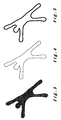
- the final result is an accumulator array as depicted in Fig. 7 , wherein the intensity peaks 8 are in the positions where the possibility of the occurrence of a human head in the source image is highest.
- Fig. 7 may also present, apart said intensity peaks 8, intensity ridges 9 corresponding to these extremities.
- a weighting factor W may be introduced for discriminating the intensity ridges 9.
- a first position 12 with the highest intensity in this circumference is then located and its intensity value stored as m c1 .
- the computer system 2 locates a second position 13, which has the highest intensity in a segment 14 of this circumference 10 (typically a half-circumference) opposite to the first position 12, and stores its intensity value stored as m c2 .
- the remaining set of candidates among the highest local intensity maxima may also be weighted using the outputs of at least one supplementary head detection method.
- the candidates may be weighted with a weighting factor appropriate for each supplementary method.
- a voting procedure may then be used to select one or a set of candidates corresponding to human heads in the source image.
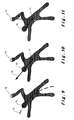
- One of these supplementary methods involves the calculation of a virtual backbone 15 in the form of a second- or third-degree function going through the maximum length of the body of the human user 1 as represented in the bitmap image (I b ), as illustrated in Fig. 9 .
- the probability that a candidate ellipse 16 represents the head of the human user 1 will decrease with the distance between this virtual backbone and the candidate ellipse 16.
- a similar complementary method is based on the calculation of a main upper body axis 18 centred on the center of mass of the human user 1 as represented in the bitmap image (I b ). This is illustrated in Fig. 10 .
- the head of the human user 1 should be closely aligned with this axis, and therefore, the probability that a candidate ellipse 16 represents the head of the human user 1 will also decrease with the distance between this axis and the candidate ellipse 16.
- Another one of these supplementary methods is that of testing the continuity of the bitmap image (I b ) of the body of the human user between its center of mass 17 and a candidate ellipse 16, as illustrated in Fig. 11 .
- a Brezenham algorithm may be used. If the test output is negative, the probability that the candidate ellipse 16 represents the head of the human user 1 will be lower.
- colour transformation algorithms may be used to transform colour data, such as RGB data, captured by the 3D camera, into a colour space more appropriate for skin tone recognition, such as, for instance, a device independent CIE 1931 XYZ colour space, or a perceptually uniform CIE 1976 L*a*b or CIECAM02 colour space.
- Yet another one of these supplementary methods is that of hair detection.
- the 3D camera is a TOF camera with an infrared telemetry detector, and since hair largely absorbs any incident infrared radiation, the probability that a candidate ellipse represents the head of a human user will be higher if there is an area within a predetermined distance of the edge, and in particular the upper edge, of the candidate ellipse, which does not return a well-defined depth signal.
- Yet another one of these supplementary methods is that of matching the cloud of points corresponding to the candidate ellipse with a specific or general pattern representative of a human head. If this pattern matching test returns a positive result, then the probability that the candidate ellipse represents the head of a human user will be higher.
- Yet another one of these supplementary methods is that of matching the cloud of points corresponding to the candidate ellipse with a specific or general pattern representative of a human head. If this pattern matching test returns a positive result, then the probability that the candidate ellipse represents the head of a human user will be higher.
- chin detection When a human user is facing the 3D camera, the latter will register a depth difference of usually between 4 and 9 cm between the chin and the neck of the human user. If such a step is detected at the lower edge of the candidate ellipse, the probability that the candidate ellipse represents the head of a human user is higher.
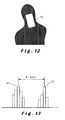
- Figs. 12 and 13 show how such a step may be detected.
- a rectangular inspection area 19 of, for example, 20 cm height by 10 cm width, oriented according to the main axis of the candidate ellipse and centred on its lower edge is selected in the depth map (I ndg ).
- a chin is detected if the depth values measured in this inspection area are concentrated around two distinct frequency maxima 20,21 approximately 4 to 9 cm apart, as shown in the histogram of Fig. 13 .
- the elbow When the user holds at least one arm to the head, the elbow may form another candidate ellipse 16, as shown in Fig. 14 . Simultaneously, a hole 22 forms between the head and this elbow in the silhouette of the human user 1 formed by the bitmap image (I b ). In another supplementary method, the formation of such holes 22 in the silhouette is detected, and any simultaneously created new candidate 16 ellipses which are adjacent to the hole 22 will be given a lower weighting.
- time coherence and temporary occlusions may also be taken into consideration. For instance, if the candidate ranked by the previous methods has jumped by more than a predetermined distance from a previous frame to the current frame, a lower-ranked candidate may be considered if it is within said predetermined distance from the head position in the previous frame. If the area corresponding to the highest ranked candidate in a precedent frame is occluded in the new frame, the candidates in the new frame may be disregarded, and the head position from the previous frame maintained, eventually until the occlusion ends.
Landscapes
- Engineering & Computer Science (AREA)
- Physics & Mathematics (AREA)
- General Physics & Mathematics (AREA)
- Theoretical Computer Science (AREA)
- Multimedia (AREA)
- Human Computer Interaction (AREA)
- General Health & Medical Sciences (AREA)
- Oral & Maxillofacial Surgery (AREA)
- Health & Medical Sciences (AREA)
- Geometry (AREA)
- Computer Vision & Pattern Recognition (AREA)
- Image Analysis (AREA)
- Image Processing (AREA)
- Length Measuring Devices By Optical Means (AREA)
- Apparatus For Radiation Diagnosis (AREA)
- Measurement Of The Respiration, Hearing Ability, Form, And Blood Characteristics Of Living Organisms (AREA)
Claims (14)
- Procédé implémenté par ordinateur pour détecter une tête humaine et déterminer sa position dans une image source en profondeur ayant des valeurs de profondeur pour chaque pixel de celle-ci, le procédé comprenant les étapes consistant à :a) segmenter au moins une partie d'un corps humain d'un arrière-plan dans ladite image source en profondeur ;b) détecter des bords de ladite partie segmentée d'un corps humain pour déterminer un contour de ladite partie ; etc) déterminer la position d'une tête humaine dans ladite image source en profondeur ;caractérisé en ce que l'étape c) comprend en outre les étapes consistant à:c1) calculer une profondeur de ladite au moins une partie segmentée d'un corps humain dans ladite image source en profondeur ;c2) calculer une taille de rayon majeur et une taille de rayon mineur d'une ellipse correspondant à la taille d'une tête humaine à ladite profondeur calculée dans ladite image source ;c3) générer dans une matrice accumulatrice, pour au moins un segment d'une ellipse centrée sur les positions d'un ensemble de pixels de contour, ledit au moins un segment de ladite ellipse ayant lesdites tailles de rayons majeur et mineur calculées ; etc4) sélectionner une position d'un maximum d'intensité local dans ladite matrice accumulatrice qui correspond à la position d'une tête humaine dans l'image source en profondeur.
- Procédé implémenté par ordinateur selon la revendication 1 dans lequel ladite profondeur est une profondeur moyenne de ladite partie d'un corps humain dans ladite image source en profondeur.
- Procédé implémenté par ordinateur selon la revendication 1, dans lequel ladite profondeur et lesdites tailles de rayons majeur et mineur sont calculées individuellement pour chaque pixel de contour.
- Procédé implémenté par ordinateur selon l'une quelconque des revendications précédentes, comprenant en outre l'étape consistant à effectuer une dilatation morphologique dudit contour avant l'étape c3) et cette étape c3) est effectuée sur ledit contour dilaté.
- Procédé implémenté par ordinateur selon l'une quelconque des revendications précédentes, dans lequel ledit au moins un segment d'une ellipse est flou.
- Procédé implémenté par ordinateur selon l'une quelconque des revendications précédentes, dans lequel l'étape b) comprend en outre la détection d'une orientation de contour locale pour chaque pixel dans ledit contour.
- Procédé implémenté par ordinateur selon la revendication 6, dans lequel ledit au moins un segment d'une ellipse est orienté selon ladite orientation de contour locale.
- Procédé implémenté par ordinateur selon l'une quelconque des revendications précédentes, dans lequel, avant l'étape c4), les étapes suivantes sont effectuées sur chacun d'une pluralité de maxima d'intensité locaux dans ladite matrice accumulatrice ;(i) localiser une première position dans une circonférence centrée sur chaque maximum d'intensité local dans la matrice accumulatrice, dans laquelle ladite première position a l'intensité la plus élevée dans ladite circonférence ;(ii) localiser une deuxième position dans ladite circonférence, dans laquelle ladite deuxième position a l'intensité la plus élevée dans un arc de ladite circonférence opposé à la première position ; et(iii) pondérer l'intensité m du maximum d'intensité local avec un facteur W = m2/mc1-mc2, dans lequel mc1 est l'intensité dans ladite première position et mc2 est l'intensité dans ladite deuxième position.
- Procédé implémenté par ordinateur selon l'une quelconque des revendications précédentes, dans lequel, avant l'étape c4), l'intensité de chacun d'une pluralité de maxima d'intensité locaux dans la matrice accumulatrice est pondéré sur la base de la sortie d'au moins un procédé additionnel de reconnaissance de tête sélectionné dans un groupe comprenant une reconnaissance de teint de peau, un filtrage par motif, une reconnaissance de cheveux, une détection de menton, une détection de trou, une détection d'une connexion avec un centre de masse ou une extrémité dudit corps humain, une distance jusqu'à une épine dorsale virtuelle, un axe du haut du corps et/ou une position précédente de la tête dans une séquence vidéo.
- Procédé implémenté par ordinateur selon l'une quelconque des revendications précédentes, consistant en outre, si ladite image source est une trame actuelle dans une séquence vidéo, et une position sélectionnée dans une trame précédente est occluse dans ladite trame actuelle, à ne tenir compte d'aucun maximum d'intensité local et à maintenir la position sélectionnée dans la trame précédente comme correspondant à la position de la tête dans la trame actuelle.
- Support de stockage de données lisible par ordinateur contenant des instructions exécutables par ordinateur pour mettre en oeuvre un procédé implémenté par ordinateur selon l'une quelconque des revendications précédentes.
- Système informatique programmé pour mettre en oeuvre le procédé selon l'une quelconque des revendications 1 à 10.
- Système informatique selon la revendication 12 et comprenant un dispositif d'imagerie pour capturer ladite image source.
- Système informatique selon la revendication 13 dans lequel ledit dispositif d'imagerie est un dispositif d'imagerie en 3D pour capturer également ladite profondeur.
Priority Applications (13)
| Application Number | Priority Date | Filing Date | Title |
|---|---|---|---|
| EP20090180783 EP2339507B1 (fr) | 2009-12-28 | 2009-12-28 | Procédé de détection et localisation de tête |
| US13/519,502 US9081999B2 (en) | 2009-12-28 | 2010-12-28 | Head recognition from depth image |
| KR1020127019659A KR101362631B1 (ko) | 2009-12-28 | 2010-12-28 | 머리 인식 방법 |
| AU2010338283A AU2010338283B2 (en) | 2009-12-28 | 2010-12-28 | Head recognition method |
| TW99146209A TW201142719A (en) | 2009-12-28 | 2010-12-28 | Head recognition method |
| JP2012546438A JP5514918B2 (ja) | 2009-12-28 | 2010-12-28 | 頭部認識方法 |
| BR112012015986A BR112012015986A2 (pt) | 2009-12-28 | 2010-12-28 | método de reconhecimento de cabeça |
| PCT/EP2010/070817 WO2011080280A1 (fr) | 2009-12-28 | 2010-12-28 | Procédé de reconnaissance de tête |
| CN201080059596.2A CN102812474B (zh) | 2009-12-28 | 2010-12-28 | 头部识别方法 |
| CA 2784554 CA2784554C (fr) | 2009-12-28 | 2010-12-28 | Procede de reconnaissance de tete |
| SG2012042412A SG181597A1 (en) | 2009-12-28 | 2010-12-28 | Head recognition method |
| MX2012007593A MX2012007593A (es) | 2009-12-28 | 2010-12-28 | Metodo para el reconocimiento de una cabeza. |
| ZA2012/04263A ZA201204263B (en) | 2009-12-28 | 2012-06-11 | Head recognition method |
Applications Claiming Priority (1)
| Application Number | Priority Date | Filing Date | Title |
|---|---|---|---|
| EP20090180783 EP2339507B1 (fr) | 2009-12-28 | 2009-12-28 | Procédé de détection et localisation de tête |
Publications (2)
| Publication Number | Publication Date |
|---|---|
| EP2339507A1 EP2339507A1 (fr) | 2011-06-29 |
| EP2339507B1 true EP2339507B1 (fr) | 2013-07-17 |
Family
ID=42199070
Family Applications (1)
| Application Number | Title | Priority Date | Filing Date |
|---|---|---|---|
| EP20090180783 Active EP2339507B1 (fr) | 2009-12-28 | 2009-12-28 | Procédé de détection et localisation de tête |
Country Status (13)
| Country | Link |
|---|---|
| US (1) | US9081999B2 (fr) |
| EP (1) | EP2339507B1 (fr) |
| JP (1) | JP5514918B2 (fr) |
| KR (1) | KR101362631B1 (fr) |
| CN (1) | CN102812474B (fr) |
| AU (1) | AU2010338283B2 (fr) |
| BR (1) | BR112012015986A2 (fr) |
| CA (1) | CA2784554C (fr) |
| MX (1) | MX2012007593A (fr) |
| SG (1) | SG181597A1 (fr) |
| TW (1) | TW201142719A (fr) |
| WO (1) | WO2011080280A1 (fr) |
| ZA (1) | ZA201204263B (fr) |
Families Citing this family (14)
| Publication number | Priority date | Publication date | Assignee | Title |
|---|---|---|---|---|
| US9001190B2 (en) * | 2011-07-05 | 2015-04-07 | Microsoft Technology Licensing, Llc | Computer vision system and method using a depth sensor |
| TWI496090B (zh) * | 2012-09-05 | 2015-08-11 | Ind Tech Res Inst | 使用深度影像的物件定位方法與裝置 |
| CN103336948A (zh) * | 2013-06-24 | 2013-10-02 | 深圳锐取信息技术股份有限公司 | 一种基于人脸识别的视频跟踪方法 |
| KR101501487B1 (ko) * | 2013-07-18 | 2015-03-12 | 전자부품연구원 | 깊이 영상 기반 머리 검출방법 및 장치 |
| KR102106135B1 (ko) * | 2013-10-01 | 2020-05-04 | 한국전자통신연구원 | 행동 인식 기반의 응용 서비스 제공 장치 및 그 방법 |
| TWI510953B (zh) * | 2013-12-20 | 2015-12-01 | Wistron Corp | 身份驗證防僞方法與應用此方法的身份驗證裝置 |
| US10147007B1 (en) * | 2015-01-13 | 2018-12-04 | State Farm Mutual Automobile Insurance Company | Apparatuses, systems and methods for determining whether a vehicle is being operated in autonomous mode or manual mode |
| JP6481537B2 (ja) * | 2015-07-14 | 2019-03-13 | コニカミノルタ株式会社 | 被監視者監視装置および被監視者監視方法 |
| US20170255821A1 (en) * | 2016-03-02 | 2017-09-07 | National Taiwan University | Gesture recognition system and related method |
| US11321951B1 (en) | 2017-01-19 | 2022-05-03 | State Farm Mutual Automobile Insurance Company | Apparatuses, systems and methods for integrating vehicle operator gesture detection within geographic maps |
| CN107093182B (zh) * | 2017-03-23 | 2019-10-11 | 东南大学 | 一种基于特征拐点的人体高度估计方法 |
| US10431000B2 (en) * | 2017-07-18 | 2019-10-01 | Sony Corporation | Robust mesh tracking and fusion by using part-based key frames and priori model |
| CN107631691A (zh) * | 2017-09-13 | 2018-01-26 | 南京云计趟信息技术有限公司 | 一种基于tof技术的车载货物体积计算方法 |
| CN109859158A (zh) * | 2018-11-27 | 2019-06-07 | 邦鼓思电子科技(上海)有限公司 | 一种基于视觉的工作区域边界的检测系统、方法及机器设备 |
Family Cites Families (20)
| Publication number | Priority date | Publication date | Assignee | Title |
|---|---|---|---|---|
| JPH09138471A (ja) * | 1995-09-13 | 1997-05-27 | Fuji Photo Film Co Ltd | 特定形状領域の抽出方法、特定領域の抽出方法及び複写条件決定方法 |
| US6072494A (en) | 1997-10-15 | 2000-06-06 | Electric Planet, Inc. | Method and apparatus for real-time gesture recognition |
| JP2003028635A (ja) | 2001-07-16 | 2003-01-29 | Honda Motor Co Ltd | 画像測距装置 |
| US20030169906A1 (en) * | 2002-02-26 | 2003-09-11 | Gokturk Salih Burak | Method and apparatus for recognizing objects |
| US7203356B2 (en) * | 2002-04-11 | 2007-04-10 | Canesta, Inc. | Subject segmentation and tracking using 3D sensing technology for video compression in multimedia applications |
| JP2004295776A (ja) * | 2003-03-28 | 2004-10-21 | Minolta Co Ltd | 画像認識装置および画像認識プログラム |
| US7379559B2 (en) * | 2003-05-28 | 2008-05-27 | Trw Automotive U.S. Llc | Method and apparatus for determining an occupant's head location in an actuatable occupant restraining system |
| JP4355341B2 (ja) * | 2003-05-29 | 2009-10-28 | 本田技研工業株式会社 | 深度データを用いたビジュアルトラッキング |
| EP3190546A3 (fr) * | 2003-06-12 | 2017-10-04 | Honda Motor Co., Ltd. | Estimation d'orientation de cible au moyen de détection de profondeur |
| US20050196015A1 (en) * | 2004-03-02 | 2005-09-08 | Trw Automotive U.S. Llc | Method and apparatus for tracking head candidate locations in an actuatable occupant restraining system |
| JP4592744B2 (ja) * | 2005-02-17 | 2010-12-08 | 富士通株式会社 | 画像処理方法、画像処理システム、画像処理装置及びコンピュータプログラム |
| JP2006318350A (ja) | 2005-05-16 | 2006-11-24 | Sony Corp | 物体追跡方法、物体追跡方法のプログラム、物体追跡方法のプログラムを記録した記録媒体及び物体追跡装置 |
| DE102005047160B4 (de) * | 2005-09-30 | 2007-06-06 | Fraunhofer-Gesellschaft zur Förderung der angewandten Forschung e.V. | Vorrichtung, Verfahren und Computerprogramm zum Ermitteln einer Information über eine Form und/oder eine Lage einer Ellipse in einem graphischen Bild |
| US20070127787A1 (en) * | 2005-10-24 | 2007-06-07 | Castleman Kenneth R | Face recognition system and method |
| JP3962803B2 (ja) * | 2005-12-16 | 2007-08-22 | インターナショナル・ビジネス・マシーンズ・コーポレーション | 頭部検出装置、頭部検出方法および頭部検出プログラム |
| JP5041458B2 (ja) * | 2006-02-09 | 2012-10-03 | 本田技研工業株式会社 | 三次元物体を検出する装置 |
| EP2122327B1 (fr) | 2007-03-13 | 2013-12-25 | Advanced Liquid Logic, Inc. | Procédé améliorant la détection par absorbance d'une gouttelette |
| DE102007018802B3 (de) | 2007-04-20 | 2008-08-28 | Universität Tübingen | Abhör- und manipulationssichere Verschlüsselung für Online-Accounts |
| JP5255623B2 (ja) | 2007-04-20 | 2013-08-07 | ソフトキネティック エス.エイ. | ボリューム認識方法およびシステム |
| JP5227888B2 (ja) * | 2009-05-21 | 2013-07-03 | 富士フイルム株式会社 | 人物追跡方法、人物追跡装置および人物追跡プログラム |
-
2009
- 2009-12-28 EP EP20090180783 patent/EP2339507B1/fr active Active
-
2010
- 2010-12-28 US US13/519,502 patent/US9081999B2/en active Active
- 2010-12-28 KR KR1020127019659A patent/KR101362631B1/ko not_active Expired - Fee Related
- 2010-12-28 MX MX2012007593A patent/MX2012007593A/es active IP Right Grant
- 2010-12-28 BR BR112012015986A patent/BR112012015986A2/pt not_active IP Right Cessation
- 2010-12-28 SG SG2012042412A patent/SG181597A1/en unknown
- 2010-12-28 WO PCT/EP2010/070817 patent/WO2011080280A1/fr not_active Ceased
- 2010-12-28 TW TW99146209A patent/TW201142719A/zh unknown
- 2010-12-28 AU AU2010338283A patent/AU2010338283B2/en not_active Ceased
- 2010-12-28 JP JP2012546438A patent/JP5514918B2/ja not_active Expired - Fee Related
- 2010-12-28 CN CN201080059596.2A patent/CN102812474B/zh not_active Expired - Fee Related
- 2010-12-28 CA CA 2784554 patent/CA2784554C/fr active Active
-
2012
- 2012-06-11 ZA ZA2012/04263A patent/ZA201204263B/en unknown
Non-Patent Citations (1)
| Title |
|---|
| SANGHO PARK ET AL: "Head segmentation and head orientation in 3D space for pose estimation of multiple people", 20000402; 20000402 - 20000404, 2 April 2000 (2000-04-02), pages 192 - 196, XP010378658 * |
Also Published As
| Publication number | Publication date |
|---|---|
| CA2784554A1 (fr) | 2011-07-07 |
| BR112012015986A2 (pt) | 2016-04-19 |
| MX2012007593A (es) | 2012-11-29 |
| CN102812474A (zh) | 2012-12-05 |
| US20130022262A1 (en) | 2013-01-24 |
| TW201142719A (en) | 2011-12-01 |
| US9081999B2 (en) | 2015-07-14 |
| JP2013516013A (ja) | 2013-05-09 |
| AU2010338283A1 (en) | 2012-07-26 |
| ZA201204263B (en) | 2013-09-25 |
| AU2010338283A2 (en) | 2012-08-09 |
| WO2011080280A1 (fr) | 2011-07-07 |
| AU2010338283B2 (en) | 2013-11-21 |
| EP2339507A1 (fr) | 2011-06-29 |
| CN102812474B (zh) | 2015-06-17 |
| JP5514918B2 (ja) | 2014-06-04 |
| KR20120130090A (ko) | 2012-11-28 |
| CA2784554C (fr) | 2015-02-10 |
| SG181597A1 (en) | 2012-07-30 |
| KR101362631B1 (ko) | 2014-02-12 |
Similar Documents
| Publication | Publication Date | Title |
|---|---|---|
| EP2339507B1 (fr) | Procédé de détection et localisation de tête | |
| US9330307B2 (en) | Learning based estimation of hand and finger pose | |
| US8582867B2 (en) | Learning-based pose estimation from depth maps | |
| US8989455B2 (en) | Enhanced face detection using depth information | |
| US9117138B2 (en) | Method and apparatus for object positioning by using depth images | |
| US20140133740A1 (en) | Intelligent part identification for use with scene characterization or motion capture | |
| EP0849697A1 (fr) | Procédé et système de reconnaissance de gestes de la main | |
| JPH10214346A6 (ja) | ハンドジェスチャ認識システムおよび方法 | |
| CN106326860A (zh) | 基于视觉的手势识别方法 | |
| Shinmura et al. | Estimation of Human Orientation using Coaxial RGB-Depth Images. | |
| Holte et al. | View invariant gesture recognition using the CSEM SwissRanger SR-2 camera | |
| CN109146969A (zh) | 行人定位方法、装置及处理设备及其存储介质 | |
| Kerdvibulvech | Hybrid model of human hand motion for cybernetics application | |
| Li et al. | Bilateral symmetry detection for real-time robotics applications | |
| Jacques et al. | Improved head-shoulder human contour estimation through clusters of learned shape models | |
| Ebrahimi et al. | PiPCS: Perspective Independent Point Cloud Simplifier for Complex 3D Indoor Scenes | |
| CN115862096B (zh) | 基于深度相机的面部检测方法、装置、设备及存储介质 | |
| JP2021064120A (ja) | 情報処理装置、情報処理方法、及びプログラム | |
| Webster | Automatic rain drop detection for improved sensing in automotive computer vision applications | |
| Stilp et al. | Addressing Retail Object Detection Challenges through Dual Network Integration | |
| Hadi et al. | Improved occlusion handling for human detection from mobile robot | |
| Layher et al. | Robust stereoscopic head pose estimation in human-computer interaction and a unified evaluation framework | |
| Domhof | " Look at this | |
| Schreiber et al. | Omni-directional multiperson tracking in meeting scenarios combining simulated annealing and particle filtering | |
| Li | 3D computer vision: passive depth from defocus and manifold learning-based human activity recognition |
Legal Events
| Date | Code | Title | Description |
|---|---|---|---|
| PUAI | Public reference made under article 153(3) epc to a published international application that has entered the european phase |
Free format text: ORIGINAL CODE: 0009012 |
|
| AK | Designated contracting states |
Kind code of ref document: A1 Designated state(s): AT BE BG CH CY CZ DE DK EE ES FI FR GB GR HR HU IE IS IT LI LT LU LV MC MK MT NL NO PL PT RO SE SI SK SM TR |
|
| AX | Request for extension of the european patent |
Extension state: AL BA RS |
|
| 17P | Request for examination filed |
Effective date: 20111228 |
|
| RAP1 | Party data changed (applicant data changed or rights of an application transferred) |
Owner name: SOFTKINETIC SOFTWARE |
|
| 17Q | First examination report despatched |
Effective date: 20120801 |
|
| GRAP | Despatch of communication of intention to grant a patent |
Free format text: ORIGINAL CODE: EPIDOSNIGR1 |
|
| GRAS | Grant fee paid |
Free format text: ORIGINAL CODE: EPIDOSNIGR3 |
|
| GRAA | (expected) grant |
Free format text: ORIGINAL CODE: 0009210 |
|
| AK | Designated contracting states |
Kind code of ref document: B1 Designated state(s): AT BE BG CH CY CZ DE DK EE ES FI FR GB GR HR HU IE IS IT LI LT LU LV MC MK MT NL NO PL PT RO SE SI SK SM TR |
|
| AX | Request for extension of the european patent |
Extension state: AL BA RS |
|
| REG | Reference to a national code |
Ref country code: GB Ref legal event code: FG4D |
|
| REG | Reference to a national code |
Ref country code: CH Ref legal event code: EP |
|
| REG | Reference to a national code |
Ref country code: IE Ref legal event code: FG4D |
|
| REG | Reference to a national code |
Ref country code: AT Ref legal event code: REF Ref document number: 622607 Country of ref document: AT Kind code of ref document: T Effective date: 20130815 |
|
| REG | Reference to a national code |
Ref country code: DE Ref legal event code: R096 Ref document number: 602009017188 Country of ref document: DE Effective date: 20130912 |
|
| REG | Reference to a national code |
Ref country code: NL Ref legal event code: T3 |
|
| REG | Reference to a national code |
Ref country code: AT Ref legal event code: MK05 Ref document number: 622607 Country of ref document: AT Kind code of ref document: T Effective date: 20130717 |
|
| REG | Reference to a national code |
Ref country code: LT Ref legal event code: MG4D |
|
| PG25 | Lapsed in a contracting state [announced via postgrant information from national office to epo] |
Ref country code: IS Free format text: LAPSE BECAUSE OF FAILURE TO SUBMIT A TRANSLATION OF THE DESCRIPTION OR TO PAY THE FEE WITHIN THE PRESCRIBED TIME-LIMIT Effective date: 20131117 Ref country code: PT Free format text: LAPSE BECAUSE OF FAILURE TO SUBMIT A TRANSLATION OF THE DESCRIPTION OR TO PAY THE FEE WITHIN THE PRESCRIBED TIME-LIMIT Effective date: 20131118 Ref country code: CY Free format text: LAPSE BECAUSE OF FAILURE TO SUBMIT A TRANSLATION OF THE DESCRIPTION OR TO PAY THE FEE WITHIN THE PRESCRIBED TIME-LIMIT Effective date: 20130724 Ref country code: LT Free format text: LAPSE BECAUSE OF FAILURE TO SUBMIT A TRANSLATION OF THE DESCRIPTION OR TO PAY THE FEE WITHIN THE PRESCRIBED TIME-LIMIT Effective date: 20130717 Ref country code: AT Free format text: LAPSE BECAUSE OF FAILURE TO SUBMIT A TRANSLATION OF THE DESCRIPTION OR TO PAY THE FEE WITHIN THE PRESCRIBED TIME-LIMIT Effective date: 20130717 Ref country code: HR Free format text: LAPSE BECAUSE OF FAILURE TO SUBMIT A TRANSLATION OF THE DESCRIPTION OR TO PAY THE FEE WITHIN THE PRESCRIBED TIME-LIMIT Effective date: 20130717 Ref country code: NO Free format text: LAPSE BECAUSE OF FAILURE TO SUBMIT A TRANSLATION OF THE DESCRIPTION OR TO PAY THE FEE WITHIN THE PRESCRIBED TIME-LIMIT Effective date: 20131017 Ref country code: SE Free format text: LAPSE BECAUSE OF FAILURE TO SUBMIT A TRANSLATION OF THE DESCRIPTION OR TO PAY THE FEE WITHIN THE PRESCRIBED TIME-LIMIT Effective date: 20130717 |
|
| PG25 | Lapsed in a contracting state [announced via postgrant information from national office to epo] |
Ref country code: LV Free format text: LAPSE BECAUSE OF FAILURE TO SUBMIT A TRANSLATION OF THE DESCRIPTION OR TO PAY THE FEE WITHIN THE PRESCRIBED TIME-LIMIT Effective date: 20130717 Ref country code: SI Free format text: LAPSE BECAUSE OF FAILURE TO SUBMIT A TRANSLATION OF THE DESCRIPTION OR TO PAY THE FEE WITHIN THE PRESCRIBED TIME-LIMIT Effective date: 20130717 Ref country code: GR Free format text: LAPSE BECAUSE OF FAILURE TO SUBMIT A TRANSLATION OF THE DESCRIPTION OR TO PAY THE FEE WITHIN THE PRESCRIBED TIME-LIMIT Effective date: 20131018 Ref country code: FI Free format text: LAPSE BECAUSE OF FAILURE TO SUBMIT A TRANSLATION OF THE DESCRIPTION OR TO PAY THE FEE WITHIN THE PRESCRIBED TIME-LIMIT Effective date: 20130717 Ref country code: ES Free format text: LAPSE BECAUSE OF FAILURE TO SUBMIT A TRANSLATION OF THE DESCRIPTION OR TO PAY THE FEE WITHIN THE PRESCRIBED TIME-LIMIT Effective date: 20131028 Ref country code: PL Free format text: LAPSE BECAUSE OF FAILURE TO SUBMIT A TRANSLATION OF THE DESCRIPTION OR TO PAY THE FEE WITHIN THE PRESCRIBED TIME-LIMIT Effective date: 20130717 |
|
| PG25 | Lapsed in a contracting state [announced via postgrant information from national office to epo] |
Ref country code: CY Free format text: LAPSE BECAUSE OF FAILURE TO SUBMIT A TRANSLATION OF THE DESCRIPTION OR TO PAY THE FEE WITHIN THE PRESCRIBED TIME-LIMIT Effective date: 20130717 |
|
| PG25 | Lapsed in a contracting state [announced via postgrant information from national office to epo] |
Ref country code: DK Free format text: LAPSE BECAUSE OF FAILURE TO SUBMIT A TRANSLATION OF THE DESCRIPTION OR TO PAY THE FEE WITHIN THE PRESCRIBED TIME-LIMIT Effective date: 20130717 Ref country code: RO Free format text: LAPSE BECAUSE OF FAILURE TO SUBMIT A TRANSLATION OF THE DESCRIPTION OR TO PAY THE FEE WITHIN THE PRESCRIBED TIME-LIMIT Effective date: 20130717 Ref country code: EE Free format text: LAPSE BECAUSE OF FAILURE TO SUBMIT A TRANSLATION OF THE DESCRIPTION OR TO PAY THE FEE WITHIN THE PRESCRIBED TIME-LIMIT Effective date: 20130717 Ref country code: SK Free format text: LAPSE BECAUSE OF FAILURE TO SUBMIT A TRANSLATION OF THE DESCRIPTION OR TO PAY THE FEE WITHIN THE PRESCRIBED TIME-LIMIT Effective date: 20130717 Ref country code: CZ Free format text: LAPSE BECAUSE OF FAILURE TO SUBMIT A TRANSLATION OF THE DESCRIPTION OR TO PAY THE FEE WITHIN THE PRESCRIBED TIME-LIMIT Effective date: 20130717 |
|
| PLBE | No opposition filed within time limit |
Free format text: ORIGINAL CODE: 0009261 |
|
| STAA | Information on the status of an ep patent application or granted ep patent |
Free format text: STATUS: NO OPPOSITION FILED WITHIN TIME LIMIT |
|
| PG25 | Lapsed in a contracting state [announced via postgrant information from national office to epo] |
Ref country code: IT Free format text: LAPSE BECAUSE OF FAILURE TO SUBMIT A TRANSLATION OF THE DESCRIPTION OR TO PAY THE FEE WITHIN THE PRESCRIBED TIME-LIMIT Effective date: 20130717 |
|
| 26N | No opposition filed |
Effective date: 20140422 |
|
| REG | Reference to a national code |
Ref country code: DE Ref legal event code: R097 Ref document number: 602009017188 Country of ref document: DE Effective date: 20140422 Ref country code: CH Ref legal event code: PL |
|
| PG25 | Lapsed in a contracting state [announced via postgrant information from national office to epo] |
Ref country code: MC Free format text: LAPSE BECAUSE OF FAILURE TO SUBMIT A TRANSLATION OF THE DESCRIPTION OR TO PAY THE FEE WITHIN THE PRESCRIBED TIME-LIMIT Effective date: 20130717 Ref country code: LU Free format text: LAPSE BECAUSE OF FAILURE TO SUBMIT A TRANSLATION OF THE DESCRIPTION OR TO PAY THE FEE WITHIN THE PRESCRIBED TIME-LIMIT Effective date: 20131228 |
|
| REG | Reference to a national code |
Ref country code: IE Ref legal event code: MM4A |
|
| PG25 | Lapsed in a contracting state [announced via postgrant information from national office to epo] |
Ref country code: IE Free format text: LAPSE BECAUSE OF NON-PAYMENT OF DUE FEES Effective date: 20131228 Ref country code: LI Free format text: LAPSE BECAUSE OF NON-PAYMENT OF DUE FEES Effective date: 20131231 Ref country code: CH Free format text: LAPSE BECAUSE OF NON-PAYMENT OF DUE FEES Effective date: 20131231 |
|
| PG25 | Lapsed in a contracting state [announced via postgrant information from national office to epo] |
Ref country code: SM Free format text: LAPSE BECAUSE OF FAILURE TO SUBMIT A TRANSLATION OF THE DESCRIPTION OR TO PAY THE FEE WITHIN THE PRESCRIBED TIME-LIMIT Effective date: 20130717 |
|
| PG25 | Lapsed in a contracting state [announced via postgrant information from national office to epo] |
Ref country code: TR Free format text: LAPSE BECAUSE OF FAILURE TO SUBMIT A TRANSLATION OF THE DESCRIPTION OR TO PAY THE FEE WITHIN THE PRESCRIBED TIME-LIMIT Effective date: 20130717 |
|
| PG25 | Lapsed in a contracting state [announced via postgrant information from national office to epo] |
Ref country code: BG Free format text: LAPSE BECAUSE OF FAILURE TO SUBMIT A TRANSLATION OF THE DESCRIPTION OR TO PAY THE FEE WITHIN THE PRESCRIBED TIME-LIMIT Effective date: 20130717 Ref country code: HU Free format text: LAPSE BECAUSE OF FAILURE TO SUBMIT A TRANSLATION OF THE DESCRIPTION OR TO PAY THE FEE WITHIN THE PRESCRIBED TIME-LIMIT; INVALID AB INITIO Effective date: 20091228 Ref country code: MK Free format text: LAPSE BECAUSE OF FAILURE TO SUBMIT A TRANSLATION OF THE DESCRIPTION OR TO PAY THE FEE WITHIN THE PRESCRIBED TIME-LIMIT Effective date: 20130717 |
|
| PG25 | Lapsed in a contracting state [announced via postgrant information from national office to epo] |
Ref country code: MT Free format text: LAPSE BECAUSE OF FAILURE TO SUBMIT A TRANSLATION OF THE DESCRIPTION OR TO PAY THE FEE WITHIN THE PRESCRIBED TIME-LIMIT Effective date: 20130717 |
|
| REG | Reference to a national code |
Ref country code: FR Ref legal event code: PLFP Year of fee payment: 7 |
|
| REG | Reference to a national code |
Ref country code: FR Ref legal event code: PLFP Year of fee payment: 8 |
|
| REG | Reference to a national code |
Ref country code: FR Ref legal event code: PLFP Year of fee payment: 9 |
|
| REG | Reference to a national code |
Ref country code: BE Ref legal event code: HC Owner name: SONY DEPTHSENSING SOLUTIONS; BE Free format text: DETAILS ASSIGNMENT: CHANGE OF OWNER(S), CHANGEMENT DE NOM DU PROPRIETAIRE; FORMER OWNER NAME: SOFTKINETIC INTERNATIONAL Effective date: 20180621 Ref country code: BE Ref legal event code: PD Owner name: SOFTKINETIC INTERNATIONAL; BE Free format text: DETAILS ASSIGNMENT: CHANGE OF OWNER(S), FUSION; FORMER OWNER NAME: SOFTKINETIC SOFTWARE Effective date: 20180621 |
|
| REG | Reference to a national code |
Ref country code: DE Ref legal event code: R079 Ref document number: 602009017188 Country of ref document: DE Free format text: PREVIOUS MAIN CLASS: G06K0009000000 Ipc: G06V0010000000 |
|
| REG | Reference to a national code |
Ref country code: GB Ref legal event code: 746 Effective date: 20211105 |
|
| PGFP | Annual fee paid to national office [announced via postgrant information from national office to epo] |
Ref country code: NL Payment date: 20211118 Year of fee payment: 13 |
|
| PGFP | Annual fee paid to national office [announced via postgrant information from national office to epo] |
Ref country code: BE Payment date: 20211122 Year of fee payment: 13 |
|
| PGFP | Annual fee paid to national office [announced via postgrant information from national office to epo] |
Ref country code: GB Payment date: 20221116 Year of fee payment: 14 Ref country code: FR Payment date: 20221122 Year of fee payment: 14 |
|
| P01 | Opt-out of the competence of the unified patent court (upc) registered |
Effective date: 20230527 |
|
| REG | Reference to a national code |
Ref country code: NL Ref legal event code: MM Effective date: 20230101 |
|
| REG | Reference to a national code |
Ref country code: BE Ref legal event code: MM Effective date: 20221231 |
|
| PG25 | Lapsed in a contracting state [announced via postgrant information from national office to epo] |
Ref country code: NL Free format text: LAPSE BECAUSE OF NON-PAYMENT OF DUE FEES Effective date: 20230101 |
|
| PG25 | Lapsed in a contracting state [announced via postgrant information from national office to epo] |
Ref country code: BE Free format text: LAPSE BECAUSE OF NON-PAYMENT OF DUE FEES Effective date: 20221231 |
|
| PGFP | Annual fee paid to national office [announced via postgrant information from national office to epo] |
Ref country code: DE Payment date: 20231121 Year of fee payment: 15 |
|
| GBPC | Gb: european patent ceased through non-payment of renewal fee |
Effective date: 20231228 |
|
| PG25 | Lapsed in a contracting state [announced via postgrant information from national office to epo] |
Ref country code: GB Free format text: LAPSE BECAUSE OF NON-PAYMENT OF DUE FEES Effective date: 20231228 |
|
| PG25 | Lapsed in a contracting state [announced via postgrant information from national office to epo] |
Ref country code: FR Free format text: LAPSE BECAUSE OF NON-PAYMENT OF DUE FEES Effective date: 20231231 |
|
| PG25 | Lapsed in a contracting state [announced via postgrant information from national office to epo] |
Ref country code: GB Free format text: LAPSE BECAUSE OF NON-PAYMENT OF DUE FEES Effective date: 20231228 Ref country code: FR Free format text: LAPSE BECAUSE OF NON-PAYMENT OF DUE FEES Effective date: 20231231 |
|
| REG | Reference to a national code |
Ref country code: DE Ref legal event code: R119 Ref document number: 602009017188 Country of ref document: DE |
|
| PG25 | Lapsed in a contracting state [announced via postgrant information from national office to epo] |
Ref country code: DE Free format text: LAPSE BECAUSE OF NON-PAYMENT OF DUE FEES Effective date: 20250701 |