EP2345978A1 - Détection des scènes éclairées par flash dans les clips vidéo et classement associé des clips vidéo - Google Patents
Détection des scènes éclairées par flash dans les clips vidéo et classement associé des clips vidéo Download PDFInfo
- Publication number
- EP2345978A1 EP2345978A1 EP10150794A EP10150794A EP2345978A1 EP 2345978 A1 EP2345978 A1 EP 2345978A1 EP 10150794 A EP10150794 A EP 10150794A EP 10150794 A EP10150794 A EP 10150794A EP 2345978 A1 EP2345978 A1 EP 2345978A1
- Authority
- EP
- European Patent Office
- Prior art keywords
- frames
- flash
- video
- video data
- segmentation
- Prior art date
- Legal status (The legal status is an assumption and is not a legal conclusion. Google has not performed a legal analysis and makes no representation as to the accuracy of the status listed.)
- Granted
Links
Images
Classifications
-
- G—PHYSICS
- G06—COMPUTING OR CALCULATING; COUNTING
- G06V—IMAGE OR VIDEO RECOGNITION OR UNDERSTANDING
- G06V20/00—Scenes; Scene-specific elements
- G06V20/40—Scenes; Scene-specific elements in video content
- G06V20/49—Segmenting video sequences, i.e. computational techniques such as parsing or cutting the sequence, low-level clustering or determining units such as shots or scenes
-
- G—PHYSICS
- G06—COMPUTING OR CALCULATING; COUNTING
- G06V—IMAGE OR VIDEO RECOGNITION OR UNDERSTANDING
- G06V20/00—Scenes; Scene-specific elements
- G06V20/40—Scenes; Scene-specific elements in video content
- G06V20/41—Higher-level, semantic clustering, classification or understanding of video scenes, e.g. detection, labelling or Markovian modelling of sport events or news items
-
- G—PHYSICS
- G06—COMPUTING OR CALCULATING; COUNTING
- G06V—IMAGE OR VIDEO RECOGNITION OR UNDERSTANDING
- G06V20/00—Scenes; Scene-specific elements
- G06V20/40—Scenes; Scene-specific elements in video content
- G06V20/46—Extracting features or characteristics from the video content, e.g. video fingerprints, representative shots or key frames
Definitions
- the present invention relates to a method according to the preamble of independent claim 1 and more particularly to a computer program and a system adapted for performing said method.
- Such methods in which video data is extracted to a plurality of frames and the single frames are analysed for detecting a flash illumination can be used for processing video data and in particular for the detection of flash illuminated scenes in video clips as well as related ranking of video clips. Detection of such abrupt events, such as caused by camera flashes in the scene, allows for isolating and ranking salient segments in video clips.
- Ranking video clips or video segments within a video clip according to the number of detected camera-flashes in the scene of a given video stream can be relevant for automatic or quick indexing, browsing and retrieval of video data and it alleviates fast search for important sections of video clips within large databases.
- the invention can be used in multimedia database browsing systems, remote video-based education, video summarization, video-on-demand services, or quickly indexing important segments in live video capture etc..
- Unconstrained video clips belong to no specific source or method of capture or method of distribution. It can be any type of video stream from personal or family events (birthdays, recitals etc.) using a handheld camera to publicly transmitted video streams such as sports events, news or entertainment events available on the World Wide Web or as part of the television programming such as news and entertainment channels, documentaries, movies and the like. In many cases these unconstrained video streams are available without any indexing information, i.e. the important segments of the video clip are unknown unless the complete clip is viewed and consciously marked by a user. Additionally, because of a recent development of the data storage technology, video compression techniques and broadband internet connections, the amount of the available video information is greatly increased. In such an environment, search for a desired video material is a difficult problem. Hence, efficient search and indexing procedures becomes necessary.
- Video search and indexing has been an active topic of the recent research in video summarization, where a video content has to be represented in a user-friendly manner.
- Video abstraction a systematic review and classification
- video clips are summarized by sets of key-frames (i.e. still images) or condensed video skims, which give the user maximal information about the content.
- key-frames i.e. still images
- condensed video skims which give the user maximal information about the content.
- An important step in video search and indexing is detection of scene changes. While many types of scene changes can be localized in the detection such as colour transition, facial expression changes, scene changes or the like, the change caused by transition of illumination of the scene carries significant information and it is easily detectable. Such a transition can be slow (fade in or fade out, camera adaptation, etc.) or sharp (scene cut, flash light, etc.).
- a method for detection of both illumination transitions has been proposed in Qian et al., "Effective fades and flashlight detection based on accumulating histogram difference", IEEE Transactions on Circuits and Systems for Video Technology, vol. 16, no. 10, 2006 , where the difference of histograms of the consecutive frames is analyzed and classified into several cases.
- computation of accumulating histogram differences is complex which can cause on one hand that the performance of the method can be low and/or on the other hand that the technical requirements to a system for performing the method can be high.
- the invention deals with a method of processing video data wherein the video data is extracted to a plurality of frames and the single frames are analysed for detecting a flash illumination.
- each of the frames is segmented into spatial groups of elements of predefined characteristics and each segmented frame is analysed with regard to illumination transition of its segments.
- predefined characteristics in this context relates to grouping characteristics of the elements of the frame such as, e.g., groups of foreground elements and background elements of the frame, illumination intensity groups of the frame or the like.
- the method can include a detection of illumination transitions and in particular a detection of the sharp illumination transitions being caused by flash light.
- transitions can be generated in several ways such as camera flash light source, lighting, strobe-lights, etc., but a common property is that the illumination is changing as a pulse function of time, i.e. an abrupt increase followed by an abrupt decrease of the illumination. Typically, these changes caused by flash last only for a few frames in the video clip and take no more than 200 ms.
- the method according to the invention allows an implementation involving comparably simple computations. For example, no computation of accumulating histogram differences is necessary. Further, in the method according to the invention it is not necessary to heuristically define any input parameters such as thresholds or the like. Like this, improved reliability, reproducibility and traceability can be achieved. Still further, the method according to the invention allows the detection of scenes in video clips whose illumination changes noticeably because of flash light sources rather than detecting the flash light sources themselves. The method uses higher level information by segmentation the images into distinct parts and extracting signal measures for flash illumination detection from each segment. Like this, the quality of the video data processing can be improved and the field of its possible applications can be extended. Summarizing the above, the method according to the invention allows a comparably simple and efficient video data processing and in particular detection of flash illuminated scenes in video clips and related ranking thereof.
- luminance components are extracted from each segment of each segmented frame.
- the luminance component extraction preferably comprises obtaining the frames of the video data in a RGB-format wherein the RGB components are converted into the luminance component wherein the RGB-format can also only be used internally after decompressing the video data into raw data, i.e. into a sequence of frames.
- said conversion preferably is implemented by using floating point operations.
- said conversion preferably is approximated by using integer operations. This allows a comparably efficient processing of video data of the wide spread RGB-format.
- RGB-components conversion can be a comparably simple and efficient implementation of the luminance components extraction.
- a mean of the luminance components is calculated for each segment of each segmented frame.
- the luminance components of a segment can be reduced to one parameter or feature which is further processed. This allows further improving simplicity and efficiency of the method according to the invention.
- the luminance components calculated from the RGB-components of each pixel of a segment can be concentrated to one parameter or feature per segment.
- Such parameters or features the calculation of which is not relying on a plurality of consecutive frames is also named "non-differentials" hereinbelow.
- differences of the means of luminance components of corresponding segments of consecutive segmented frames are also calculated.
- a second parameter or feature being characteristic for flash illumination of a video clip scene can be extracted which can further improve the quality of the flash illumination detection in a comparably easy manner.
- Such parameters or features the calculation of which is relying on a plurality of consecutive frames is also named "differentials" hereinbelow.
- the segmentation of each of the frames into spatial groups of elements of predefined characteristics comprises plural segmentation of each of the frames by applying a plurality of different segmentation methods such that a corresponding plurality of segmented frames is provided per frame.
- each extracted segment of each frame can be processed independently in the following steps such that this plural segmentation step has multiple output streams, wherein the number of outputs is equal to the number of applied segmentation methods.
- the segmentation methods preferably are rectangular segmentation, foreground-background segmentation, illumination intensity histogram-based segmentation, colour-based segmentation or no segmentation, wherein rectangular segmentation can be non-adaptive quad-tree and no segmentation means that the entire frame is treated as a single segment.
- segmentation features of the plurality of segmented frames are consolidated per frame.
- segmentation features corresponds to luminance components, mean of luminance components, differences of these means and the like. Consolidation can preferably correspond to augmentation. Like this, the quality and efficiency can be further improved.
- a set of reference data is created by manually labelling each of the frames with regard to the presence of a flash.
- This manual reference data creation can typically be performed prior productively processing the video data.
- this reference data creation can be performed as a training step using one or more reference video data sets.
- the reference data preferably comprise a global mean and a global variance calculated from the consolidated segmentation features and the manual labels.
- normalized features corresponds to consolidated segmentation features, manual labels, global means and/or global variances. Of the normalized features those are important for the method which are retained according to specific criteria, wherein it is also possible that all normalized features are treated as important.
- extraction of important normalized features allows to further improve the efficiency of the method.
- the extraction of the normalized features is preferably performed by applying principal component analysis.
- principal component analysis in this context relates to a mathematical procedure that transforms a number of possibly correlated variables into a smaller number of uncorrelated variables called principal components wherein the first principal component accounts for as much of the variability in the data as possible, and each succeeding component accounts for as much of the remaining variability as possible.
- principal components which has many components, can be simplified.
- the number of parameters or features in such a set is also called dimensionality, since each feature can be considered as a dimension of a parameter or feature vector. The reduction of the dimensionality can be done using the principal component analysis allowing a comparably simple and fast application of the method.
- eigenvalues of the normalized features are calculated and the eigenvalues are ordered.
- the normalized features with the highest eigenvalues are preferably retained such that the sum of squares of the retained eigenvalues is above a predefined threshold p, wherein p is larger than zero and smaller or equals the sum of squares of all eigenvalues.
- p is larger than zero and smaller or equals the sum of squares of all eigenvalues.
- square also relates to energy as used hereinbelow.
- an automatic label with regard to the presence of a flash is associated to each of the frames.
- the video data is preferably ranked with regard to the automatic labels.
- Ranking video segments using flash detection and number of detected flashes has a variety of applications. For example, in “ Audiovisual celebrity recognition in unconstrained web videos" by M.E Sargin, H. Aradhye, P.J. Moreno and M. Zhao published in International conference in acoustics speech and signal processing (ICASSP) 2009. ISBN: 978-1-4244-35 2353-8 , the authors describe a method to recognize celebrities in unconstrained video. Using flash detection and video ranking described in this invention, it is also possible to isolate video segments in which a celebrity is present and also process videos for celebrity recognition according to the ranking.
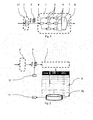
- Fig. 1 shows an embodiment of the method according to the invention comprising frame extraction 2 for extracting input video data or an input video stream, respectively, to a plurality of frames.
- the frame extraction 2 also includes decompressing 21 the video data.
- the output of the frame extraction 2 is a sequence of frames 3 which is used in feature extraction 1.
- the feature extraction 1 comprises segmentation 4 of the sequence of frames 3 applying three segmentation methods such that three streams of segmented frames are provided by the segmentation 4.
- luminance extraction 5 is applied in which a luminance component is extracted and feature computation 6.
- the computed features of the streams of segmented frames are then augmented and normalized 7 in order to reduce their dimensionality 8.
- a training phase is shown in which a human operator or user 12 labels each of the frames of the sequence of frames 3 with regard to flash illumination.
- a set of reference data is created and stored as labelled feature vectors 10.
- the labelled feature vectors are then used in a pattern recognition algorithm 11.
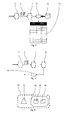
- Fig. 3 shows automatic labelling of a sequence of frames by the pattern recognition algorithm 11 using the labelled feature vectors wherein an automatic labelled set of illumination data 13 is created.
- the set of illumination data 13 is used in post processing 14 such as ranking of the video data.
- the required input to the method is video data such as a video clip.
- the intermediate flash-detection output is a series of binary labels denoted as "flash” and "no-flash” that are associated to each extracted frame. This information stream is statistically measured and the result is used subsequently to rank a given video clip or a segment of video clip.
- the embodiment of the method shown in the Figs. can be broken down into the blocks/steps illustrated.
- the Figs. comprise the following blocks/steps for feature extraction: decompressing video clip into raw data 2; segmentation 4; extraction of luminance Y component 5; feature computation 6; augmentation and normalization of the features 7; and dimensionality reduction 8.
- the input in the block 2 is a video clip as video data.
- the block 4 applies a variety of segmentation methods to the decompressed raw frames and, thus, it provides a set of outputs. These outputs are separately processed in the blocks 5 and 6. Finally, the parallel outputs are joint in block 7 and 8.
- the method is implemented in three functionalities: offline training; online deployment for flash detection; and online deployment for ranking.
- offline training Within the training functionally, manually or semi-automatically, i.e. under a human supervision, annotated video clips are used to train the pattern recognition algorithm. This process is marked as block 11.
- the method is applied to non-annotated video clips for flash detection in the deployment functionality.
- the number of flashes detected over a time period is measured to determine the relative rank of the video segment being processed.
- Segmentation 4 is applied to each frame of the processed video clip separately.
- the task of the segmentation block 4 is to spatially group the contiguous elements with the same predefined characteristics within a frame so that the feature extraction block 1 allows for more efficient flash illumination detection.
- Different characteristics are addressed in the segmentation process and, thereof, there are several segmentation methods. In particular, any combination of one or more of the five segmentation methods can be applied. These methods are: rectangular segmentation (non-adaptive quad-tree); foreground-background segmentation; illumination intensity histogram-based segmentation; colour-based segmentation; and no segmentation (entire frame as a single segment).
- each extracted segment is processed independently in the subsequent blocks 5 and 6.
- this block has multiple output streams, where the number of outputs is equal to the number of applied segmentation procedures.
- the conversion can be implemented using floating point operations or approximated using integer operations in case computational complexity has to be saved. This block is depicted as 5 in Fig. 1 .
- Two types of parameters or features, respectively, are computed from the luminance Y components in block 6 for each segment of the frames: non-differentials and differentials.
- the non-differentials are calculated as the mean of the luminance coefficients within the analyzed segments so that one feature per segment is generated.
- the number of the non-differentials for each frame is equal to the number of extracted segments in block 4.
- the differentials are calculated as the difference between the mean of the luminance coefficients across each segment in consecutive frames. Therefore, the number of features is equal to the number of segments in a group of consecutive frames. As a consequence, the detection is delayed by the duration of the corresponding group of frames.
- the differentials and non-differentials are calculated for each segmentation method or segmentation procedure, respectively, in block 4. This results in multiple streams of information per frame from the video clip. As a result, the dynamic range and the offset differ from each other depending on the illumination conditions and the method of calculation for a given frame and the applied segmentation procedure.
- all the features belonging to a given time index are consolidated by augmenting the features from each stream and subsequently a global mean and global variance is calculated for a given set of semi-automatically labelled, i.e. under a human supervision, video clips. Subsequently all the extracted features for an unknown video stream in the online deployment are also normalized using the global mean and global variance values obtained in this step.
- PCA principal component analysis
- the retained features are forwarded to the next block as a series of numbers for each frame.
- the outputs of blocks 4 to 8 comprise the feature extraction stage (jointly denoted as block 2). Feature extraction is performed for each video segment presented to the system. A flash or no-flash is detected based on the signal information extracted in this stage in combination with a pattern recognition algorithm.
- the method is applied within three functionalities: Offline-training as illustrated in Fig. 2 ; online-deployment for flash-detection as illustrated in Fig. 3 ; and online-deployment for video ranking as illustrated in Figure 4 .
- a set of annotated data is created. The annotation of the data assumes that each frame of a chosen video clip or a set of video clips is labelled semi-automatically, i.e. under human supervision, as "flash” or "no-flash”. Then, this data is analyzed in the method and the pattern recognition algorithm is tuned for obtaining best detection accuracy.
- Figs. 3 and 4 depict the flash detection system that takes a raw video stream as the input and outputs a binary signal ("TRUE" or "FALSE") for each frame that is detected to have a flash or otherwise respectively.
- Fig. 4 shows the video ranking system that uses the flash detection system described in Fig. 3 .
- the goal is to label each frame in the video clip or the sequence of frames 3 as "flash” or “no-flash” according to the set of features extracted in block 2. These labels refer to the two possible outcomes of the detection, that is, the analyzed frame is or is not flash illuminated, respectively.
- a collection of video clips that comprises clips with and without flash is input to the system.
- a human operator or user 12 sequentially checks out and manually labels each frame as “flash” or "no-flash”. This results in table 9 that contains the frame number and an additional field that marks each frame to have a flash or no-flash.
- This training data is the collection of labelled feature vectors 10.
- This collection 10 is used as a reference to train the pattern recognition algorithm 11, that learns to classify a given feature vector from an frame into flash or no-flash by learning a deterministic function or by learning parameters of a probabilistic function.
- the support-vector-machine classifier described in " A tutorial on Support Vector Machines for Pattern Recognition” by C.J.C Burges in Data Mining and Knowledge discovery Volume 2, Number 2 / June, 1998 with ISSN 1384-5810 can be used in one embodiment of the method according to the invention.
- a deterministic function is replaced by direct comparison with the labeled data 11 using a distance metric such as Euclidean distance metric.
- Block 2 is used to convert the input video stream into a sequence of decompressed frames 3. Later, the feature extraction stage 2 is used to extract signal features from each frame. This is the input to the previously trained pattern recognition block 11, which may use the labelled data 10.
- the output of the pattern recognition algorithm block is a series of "TRUE” or "FALSE" for each time-indexed frame for flash or no-flash respectively.
- Blocks 2, 3, 1 and 11 are sequentially used as described.
- the output of block 11 is a binary signal (“TRUE"/"FALSE” or "1"/"0") that labels each frame as a flash or no-flash, respectively.
- This binary signal is shown as D(i frame ). This signal over a period of time, such as from a few frames, or seconds to a whole clip, is used to calculate the rank of a given video stream or a segment of a given video stream.
- the video ranking devised in this invention is based on the fact that if a camera records a scene with multiple flashes at different segments of the capture, the most important segment containing the stream can be deduced by estimating the number of flashes detected using the previously described flash detection algorithm.
- the rank is calculated proportional to the number of non-zero values in D(i frame ) over a period of time or over a set of frames.
- Video Rank (segment i L to i U ) sum(D(i frame )) where i L ⁇ i frame ⁇ i U
- Fig. 5 shows an embodiment of a system 30 according to the invention comprising a computing means 31 such as a central processing unit (CPU) or the like and a memory means 32 such as random access memory (RAM) and/or a hard disk.
- a computing means 31 such as a central processing unit (CPU) or the like
- a memory means 32 such as random access memory (RAM) and/or a hard disk.
- RAM random access memory
- a computer program 40 according to the invention is stored as well as a database 33 system comprising the labelled data 10.
- the system 30 is adapted such that the computing means 31 can execute the computer program 40 in order to perform the method described above.
- the invention also covers all further features shown in the Figs. individually although they may not have been described in the afore or following description.
- a computer program may be stored/distributed on a suitable medium, such as an optical storage medium or a solid-state medium supplied together with or as part of other hardware, but may also be distributed in other forms, such as via the Internet or other wired or wireless telecommunication systems. Any reference signs in the claims should not be construed as limiting the scope.
Landscapes
- Engineering & Computer Science (AREA)
- Theoretical Computer Science (AREA)
- Physics & Mathematics (AREA)
- General Physics & Mathematics (AREA)
- Multimedia (AREA)
- Computing Systems (AREA)
- Computational Linguistics (AREA)
- Software Systems (AREA)
- Image Analysis (AREA)
Priority Applications (1)
| Application Number | Priority Date | Filing Date | Title |
|---|---|---|---|
| EP10150794.5A EP2345978B1 (fr) | 2010-01-14 | 2010-01-14 | Détection des scènes éclairées par flash dans les clips vidéo et classement associé des clips vidéo |
Applications Claiming Priority (1)
| Application Number | Priority Date | Filing Date | Title |
|---|---|---|---|
| EP10150794.5A EP2345978B1 (fr) | 2010-01-14 | 2010-01-14 | Détection des scènes éclairées par flash dans les clips vidéo et classement associé des clips vidéo |
Publications (2)
| Publication Number | Publication Date |
|---|---|
| EP2345978A1 true EP2345978A1 (fr) | 2011-07-20 |
| EP2345978B1 EP2345978B1 (fr) | 2018-11-21 |
Family
ID=42078924
Family Applications (1)
| Application Number | Title | Priority Date | Filing Date |
|---|---|---|---|
| EP10150794.5A Active EP2345978B1 (fr) | 2010-01-14 | 2010-01-14 | Détection des scènes éclairées par flash dans les clips vidéo et classement associé des clips vidéo |
Country Status (1)
| Country | Link |
|---|---|
| EP (1) | EP2345978B1 (fr) |
Cited By (5)
| Publication number | Priority date | Publication date | Assignee | Title |
|---|---|---|---|---|
| CN108280406A (zh) * | 2017-12-30 | 2018-07-13 | 广州海昇计算机科技有限公司 | 一种基于分段双流模型的行为识别方法、系统及装置 |
| US10033970B2 (en) | 2009-08-05 | 2018-07-24 | Electro Industries/Gauge Tech | Intelligent electronic device having image capture capabilities |
| US10270764B2 (en) | 2009-08-05 | 2019-04-23 | Electro Industries/Gauge Tech | Intelligent electronic device having user-authenticating capabilities |
| US11283795B2 (en) | 2009-08-05 | 2022-03-22 | Electro Industries/Gauge Tech | Intelligent electronic device having image capture capabilities |
| US11937022B2 (en) | 2009-08-05 | 2024-03-19 | Ei Electronics Llc | Intelligent electronic device having user-authenticating capabilities |
Citations (2)
| Publication number | Priority date | Publication date | Assignee | Title |
|---|---|---|---|---|
| EP0659016A2 (fr) * | 1993-12-17 | 1995-06-21 | Nippon Telegraph And Telephone Corporation | Procédé et dispositif de détection d'une coupure vidéo |
| US20090208106A1 (en) * | 2008-02-15 | 2009-08-20 | Digitalsmiths Corporation | Systems and methods for semantically classifying shots in video |
-
2010
- 2010-01-14 EP EP10150794.5A patent/EP2345978B1/fr active Active
Patent Citations (2)
| Publication number | Priority date | Publication date | Assignee | Title |
|---|---|---|---|---|
| EP0659016A2 (fr) * | 1993-12-17 | 1995-06-21 | Nippon Telegraph And Telephone Corporation | Procédé et dispositif de détection d'une coupure vidéo |
| US20090208106A1 (en) * | 2008-02-15 | 2009-08-20 | Digitalsmiths Corporation | Systems and methods for semantically classifying shots in video |
Non-Patent Citations (2)
| Title |
|---|
| COTSACES C ET AL: "Video shot detection and condensed representation. A review", IEEE SIGNAL PROCESSING MAGAZINE, IEEE SERVICE CENTER, PISCATAWAY, NJ, US LNKD- DOI:10.1109/MSP.2006.1621446, vol. 23, no. 2, 1 March 2006 (2006-03-01), pages 28 - 37, XP002524623, ISSN: 1053-5888 * |
| FANJUN QI ET AL: "Supervised classification for video shot segmentation", PROC. OF THE 2003 INTERNATIONAL CONFERENCE ON MULTIMEDIA AND EXPO: 6 - 9 JULY 2003, BALTIMORE MARRIOTT WATERFRONT HOTEL, BALTIMORE, MARYLAND, USA, IEEE OPERATIONS CENTER, US, vol. 2, 6 July 2003 (2003-07-06), pages 689 - 692, XP010650565, ISBN: 978-0-7803-7965-7 * |
Cited By (5)
| Publication number | Priority date | Publication date | Assignee | Title |
|---|---|---|---|---|
| US10033970B2 (en) | 2009-08-05 | 2018-07-24 | Electro Industries/Gauge Tech | Intelligent electronic device having image capture capabilities |
| US10270764B2 (en) | 2009-08-05 | 2019-04-23 | Electro Industries/Gauge Tech | Intelligent electronic device having user-authenticating capabilities |
| US11283795B2 (en) | 2009-08-05 | 2022-03-22 | Electro Industries/Gauge Tech | Intelligent electronic device having image capture capabilities |
| US11937022B2 (en) | 2009-08-05 | 2024-03-19 | Ei Electronics Llc | Intelligent electronic device having user-authenticating capabilities |
| CN108280406A (zh) * | 2017-12-30 | 2018-07-13 | 广州海昇计算机科技有限公司 | 一种基于分段双流模型的行为识别方法、系统及装置 |
Also Published As
| Publication number | Publication date |
|---|---|
| EP2345978B1 (fr) | 2018-11-21 |
Similar Documents
| Publication | Publication Date | Title |
|---|---|---|
| EP2641401B1 (fr) | Procédé et système de création de résumé de vidéo | |
| CN104520875B (zh) | 优选用于搜索和检索目的的从视频内容提取描述符的方法和装置 | |
| EP3477506B1 (fr) | Procédé de détection vidéo, serveur et support de stockage | |
| EP2318979B1 (fr) | Procédé et système d'annotation automatisée de personnes dans un contenu vidéo | |
| US10915574B2 (en) | Apparatus and method for recognizing person | |
| US8467610B2 (en) | Video summarization using sparse basis function combination | |
| TWI712316B (zh) | 視訊摘要的生成方法及裝置 | |
| US20140214885A1 (en) | Apparatus and method for generating evidence video | |
| JP2001155169A (ja) | ビデオ画像の分割、分類、および要約のための方法およびシステム | |
| CN102395984A (zh) | 用于视频内容分析的关键帧提取 | |
| JP4907938B2 (ja) | 少なくとも1つの画像及び画像群を表現する方法、画像又は画像群の表現、画像及び/又は画像群を比較する方法、画像又は画像群を符号化する方法、画像又は画像シーケンスを復号する方法、符号化されたデータの使用、画像又は画像群を表現する装置、画像及び/又は画像群を比較する装置、コンピュータプログラム、システム、及びコンピュータ読み取り可能な記憶媒体 | |
| EP2345978B1 (fr) | Détection des scènes éclairées par flash dans les clips vidéo et classement associé des clips vidéo | |
| Asha et al. | Content based video retrieval using SURF descriptor | |
| WO2017032245A1 (fr) | Procédé et dispositif permettant de générer des informations d'index de fichier vidéo | |
| Kini et al. | A survey on video summarization techniques | |
| Sunuwar et al. | A comparative analysis on major key-frame extraction techniques | |
| Shao et al. | Motion histogram analysis based key frame extraction for human action/activity representation | |
| EP2270748A2 (fr) | Procédés de représentation d'images | |
| US20060093215A1 (en) | Methods of representing and analysing images | |
| Guru et al. | Histogram based split and merge framework for shot boundary detection | |
| Khan et al. | Semantic analysis of news based on the deep convolution neural network | |
| Sulaiman et al. | Shot boundaries detection based video summary using dynamic time warping and mean shift | |
| Bhaumik et al. | Real-time storyboard generation in videos using a probability distribution based threshold | |
| Hari et al. | Human face based approach for video summarization | |
| Chaisorn et al. | A simplified ordinal-based method for video signature |
Legal Events
| Date | Code | Title | Description |
|---|---|---|---|
| PUAI | Public reference made under article 153(3) epc to a published international application that has entered the european phase |
Free format text: ORIGINAL CODE: 0009012 |
|
| 17P | Request for examination filed |
Effective date: 20110202 |
|
| AK | Designated contracting states |
Kind code of ref document: A1 Designated state(s): AT BE BG CH CY CZ DE DK EE ES FI FR GB GR HR HU IE IS IT LI LT LU LV MC MK MT NL NO PL PT RO SE SI SK SM TR |
|
| AX | Request for extension of the european patent |
Extension state: AL BA RS |
|
| 17Q | First examination report despatched |
Effective date: 20130122 |
|
| GRAP | Despatch of communication of intention to grant a patent |
Free format text: ORIGINAL CODE: EPIDOSNIGR1 |
|
| STAA | Information on the status of an ep patent application or granted ep patent |
Free format text: STATUS: GRANT OF PATENT IS INTENDED |
|
| INTG | Intention to grant announced |
Effective date: 20180605 |
|
| RAP1 | Party data changed (applicant data changed or rights of an application transferred) |
Owner name: DEUTSCHE TELEKOM AG |
|
| GRAS | Grant fee paid |
Free format text: ORIGINAL CODE: EPIDOSNIGR3 |
|
| GRAA | (expected) grant |
Free format text: ORIGINAL CODE: 0009210 |
|
| STAA | Information on the status of an ep patent application or granted ep patent |
Free format text: STATUS: THE PATENT HAS BEEN GRANTED |
|
| AK | Designated contracting states |
Kind code of ref document: B1 Designated state(s): AT BE BG CH CY CZ DE DK EE ES FI FR GB GR HR HU IE IS IT LI LT LU LV MC MK MT NL NO PL PT RO SE SI SK SM TR |
|
| REG | Reference to a national code |
Ref country code: CH Ref legal event code: EP |
|
| REG | Reference to a national code |
Ref country code: IE Ref legal event code: FG4D |
|
| REG | Reference to a national code |
Ref country code: DE Ref legal event code: R096 Ref document number: 602010055217 Country of ref document: DE |
|
| REG | Reference to a national code |
Ref country code: AT Ref legal event code: REF Ref document number: 1068400 Country of ref document: AT Kind code of ref document: T Effective date: 20181215 |
|
| REG | Reference to a national code |
Ref country code: NL Ref legal event code: MP Effective date: 20181121 |
|
| REG | Reference to a national code |
Ref country code: AT Ref legal event code: MK05 Ref document number: 1068400 Country of ref document: AT Kind code of ref document: T Effective date: 20181121 |
|
| PG25 | Lapsed in a contracting state [announced via postgrant information from national office to epo] |
Ref country code: IS Free format text: LAPSE BECAUSE OF FAILURE TO SUBMIT A TRANSLATION OF THE DESCRIPTION OR TO PAY THE FEE WITHIN THE PRESCRIBED TIME-LIMIT Effective date: 20190321 Ref country code: FI Free format text: LAPSE BECAUSE OF FAILURE TO SUBMIT A TRANSLATION OF THE DESCRIPTION OR TO PAY THE FEE WITHIN THE PRESCRIBED TIME-LIMIT Effective date: 20181121 Ref country code: BG Free format text: LAPSE BECAUSE OF FAILURE TO SUBMIT A TRANSLATION OF THE DESCRIPTION OR TO PAY THE FEE WITHIN THE PRESCRIBED TIME-LIMIT Effective date: 20190221 Ref country code: LT Free format text: LAPSE BECAUSE OF FAILURE TO SUBMIT A TRANSLATION OF THE DESCRIPTION OR TO PAY THE FEE WITHIN THE PRESCRIBED TIME-LIMIT Effective date: 20181121 Ref country code: ES Free format text: LAPSE BECAUSE OF FAILURE TO SUBMIT A TRANSLATION OF THE DESCRIPTION OR TO PAY THE FEE WITHIN THE PRESCRIBED TIME-LIMIT Effective date: 20181121 Ref country code: HR Free format text: LAPSE BECAUSE OF FAILURE TO SUBMIT A TRANSLATION OF THE DESCRIPTION OR TO PAY THE FEE WITHIN THE PRESCRIBED TIME-LIMIT Effective date: 20181121 Ref country code: AT Free format text: LAPSE BECAUSE OF FAILURE TO SUBMIT A TRANSLATION OF THE DESCRIPTION OR TO PAY THE FEE WITHIN THE PRESCRIBED TIME-LIMIT Effective date: 20181121 Ref country code: LV Free format text: LAPSE BECAUSE OF FAILURE TO SUBMIT A TRANSLATION OF THE DESCRIPTION OR TO PAY THE FEE WITHIN THE PRESCRIBED TIME-LIMIT Effective date: 20181121 Ref country code: NO Free format text: LAPSE BECAUSE OF FAILURE TO SUBMIT A TRANSLATION OF THE DESCRIPTION OR TO PAY THE FEE WITHIN THE PRESCRIBED TIME-LIMIT Effective date: 20190221 |
|
| PG25 | Lapsed in a contracting state [announced via postgrant information from national office to epo] |
Ref country code: PT Free format text: LAPSE BECAUSE OF FAILURE TO SUBMIT A TRANSLATION OF THE DESCRIPTION OR TO PAY THE FEE WITHIN THE PRESCRIBED TIME-LIMIT Effective date: 20190321 Ref country code: GR Free format text: LAPSE BECAUSE OF FAILURE TO SUBMIT A TRANSLATION OF THE DESCRIPTION OR TO PAY THE FEE WITHIN THE PRESCRIBED TIME-LIMIT Effective date: 20190222 Ref country code: NL Free format text: LAPSE BECAUSE OF FAILURE TO SUBMIT A TRANSLATION OF THE DESCRIPTION OR TO PAY THE FEE WITHIN THE PRESCRIBED TIME-LIMIT Effective date: 20181121 Ref country code: SE Free format text: LAPSE BECAUSE OF FAILURE TO SUBMIT A TRANSLATION OF THE DESCRIPTION OR TO PAY THE FEE WITHIN THE PRESCRIBED TIME-LIMIT Effective date: 20181121 |
|
| PG25 | Lapsed in a contracting state [announced via postgrant information from national office to epo] |
Ref country code: CZ Free format text: LAPSE BECAUSE OF FAILURE TO SUBMIT A TRANSLATION OF THE DESCRIPTION OR TO PAY THE FEE WITHIN THE PRESCRIBED TIME-LIMIT Effective date: 20181121 Ref country code: IT Free format text: LAPSE BECAUSE OF FAILURE TO SUBMIT A TRANSLATION OF THE DESCRIPTION OR TO PAY THE FEE WITHIN THE PRESCRIBED TIME-LIMIT Effective date: 20181121 Ref country code: DK Free format text: LAPSE BECAUSE OF FAILURE TO SUBMIT A TRANSLATION OF THE DESCRIPTION OR TO PAY THE FEE WITHIN THE PRESCRIBED TIME-LIMIT Effective date: 20181121 Ref country code: PL Free format text: LAPSE BECAUSE OF FAILURE TO SUBMIT A TRANSLATION OF THE DESCRIPTION OR TO PAY THE FEE WITHIN THE PRESCRIBED TIME-LIMIT Effective date: 20181121 |
|
| REG | Reference to a national code |
Ref country code: DE Ref legal event code: R097 Ref document number: 602010055217 Country of ref document: DE |
|
| PG25 | Lapsed in a contracting state [announced via postgrant information from national office to epo] |
Ref country code: SK Free format text: LAPSE BECAUSE OF FAILURE TO SUBMIT A TRANSLATION OF THE DESCRIPTION OR TO PAY THE FEE WITHIN THE PRESCRIBED TIME-LIMIT Effective date: 20181121 Ref country code: MC Free format text: LAPSE BECAUSE OF FAILURE TO SUBMIT A TRANSLATION OF THE DESCRIPTION OR TO PAY THE FEE WITHIN THE PRESCRIBED TIME-LIMIT Effective date: 20181121 Ref country code: RO Free format text: LAPSE BECAUSE OF FAILURE TO SUBMIT A TRANSLATION OF THE DESCRIPTION OR TO PAY THE FEE WITHIN THE PRESCRIBED TIME-LIMIT Effective date: 20181121 Ref country code: SM Free format text: LAPSE BECAUSE OF FAILURE TO SUBMIT A TRANSLATION OF THE DESCRIPTION OR TO PAY THE FEE WITHIN THE PRESCRIBED TIME-LIMIT Effective date: 20181121 Ref country code: EE Free format text: LAPSE BECAUSE OF FAILURE TO SUBMIT A TRANSLATION OF THE DESCRIPTION OR TO PAY THE FEE WITHIN THE PRESCRIBED TIME-LIMIT Effective date: 20181121 |
|
| REG | Reference to a national code |
Ref country code: CH Ref legal event code: PL |
|
| PLBE | No opposition filed within time limit |
Free format text: ORIGINAL CODE: 0009261 |
|
| STAA | Information on the status of an ep patent application or granted ep patent |
Free format text: STATUS: NO OPPOSITION FILED WITHIN TIME LIMIT |
|
| PG25 | Lapsed in a contracting state [announced via postgrant information from national office to epo] |
Ref country code: LU Free format text: LAPSE BECAUSE OF NON-PAYMENT OF DUE FEES Effective date: 20190114 |
|
| REG | Reference to a national code |
Ref country code: BE Ref legal event code: MM Effective date: 20190131 |
|
| 26N | No opposition filed |
Effective date: 20190822 |
|
| REG | Reference to a national code |
Ref country code: IE Ref legal event code: MM4A |
|
| PG25 | Lapsed in a contracting state [announced via postgrant information from national office to epo] |
Ref country code: SI Free format text: LAPSE BECAUSE OF FAILURE TO SUBMIT A TRANSLATION OF THE DESCRIPTION OR TO PAY THE FEE WITHIN THE PRESCRIBED TIME-LIMIT Effective date: 20181121 |
|
| PG25 | Lapsed in a contracting state [announced via postgrant information from national office to epo] |
Ref country code: BE Free format text: LAPSE BECAUSE OF NON-PAYMENT OF DUE FEES Effective date: 20190131 |
|
| PG25 | Lapsed in a contracting state [announced via postgrant information from national office to epo] |
Ref country code: CH Free format text: LAPSE BECAUSE OF NON-PAYMENT OF DUE FEES Effective date: 20190131 Ref country code: LI Free format text: LAPSE BECAUSE OF NON-PAYMENT OF DUE FEES Effective date: 20190131 |
|
| PG25 | Lapsed in a contracting state [announced via postgrant information from national office to epo] |
Ref country code: IE Free format text: LAPSE BECAUSE OF NON-PAYMENT OF DUE FEES Effective date: 20190114 |
|
| PG25 | Lapsed in a contracting state [announced via postgrant information from national office to epo] |
Ref country code: TR Free format text: LAPSE BECAUSE OF FAILURE TO SUBMIT A TRANSLATION OF THE DESCRIPTION OR TO PAY THE FEE WITHIN THE PRESCRIBED TIME-LIMIT Effective date: 20181121 |
|
| PG25 | Lapsed in a contracting state [announced via postgrant information from national office to epo] |
Ref country code: MT Free format text: LAPSE BECAUSE OF NON-PAYMENT OF DUE FEES Effective date: 20190114 |
|
| PG25 | Lapsed in a contracting state [announced via postgrant information from national office to epo] |
Ref country code: CY Free format text: LAPSE BECAUSE OF FAILURE TO SUBMIT A TRANSLATION OF THE DESCRIPTION OR TO PAY THE FEE WITHIN THE PRESCRIBED TIME-LIMIT Effective date: 20181121 |
|
| PG25 | Lapsed in a contracting state [announced via postgrant information from national office to epo] |
Ref country code: HU Free format text: LAPSE BECAUSE OF FAILURE TO SUBMIT A TRANSLATION OF THE DESCRIPTION OR TO PAY THE FEE WITHIN THE PRESCRIBED TIME-LIMIT; INVALID AB INITIO Effective date: 20100114 |
|
| REG | Reference to a national code |
Ref country code: DE Ref legal event code: R079 Ref document number: 602010055217 Country of ref document: DE Free format text: PREVIOUS MAIN CLASS: G06K0009000000 Ipc: G06V0010000000 |
|
| PG25 | Lapsed in a contracting state [announced via postgrant information from national office to epo] |
Ref country code: MK Free format text: LAPSE BECAUSE OF FAILURE TO SUBMIT A TRANSLATION OF THE DESCRIPTION OR TO PAY THE FEE WITHIN THE PRESCRIBED TIME-LIMIT Effective date: 20181121 |
|
| PGFP | Annual fee paid to national office [announced via postgrant information from national office to epo] |
Ref country code: GB Payment date: 20260122 Year of fee payment: 17 |
|
| PGFP | Annual fee paid to national office [announced via postgrant information from national office to epo] |
Ref country code: DE Payment date: 20260120 Year of fee payment: 17 |
|
| PGFP | Annual fee paid to national office [announced via postgrant information from national office to epo] |
Ref country code: FR Payment date: 20260123 Year of fee payment: 17 |