EP2347702A1 - Kontaktloses Multidiagnosesystem unter Verwendung physiologischer Okularparameter - Google Patents
Kontaktloses Multidiagnosesystem unter Verwendung physiologischer Okularparameter Download PDFInfo
- Publication number
- EP2347702A1 EP2347702A1 EP10290034A EP10290034A EP2347702A1 EP 2347702 A1 EP2347702 A1 EP 2347702A1 EP 10290034 A EP10290034 A EP 10290034A EP 10290034 A EP10290034 A EP 10290034A EP 2347702 A1 EP2347702 A1 EP 2347702A1
- Authority
- EP
- European Patent Office
- Prior art keywords
- physiological parameter
- antenna
- measuring system
- parameter measuring
- sensing means
- Prior art date
- Legal status (The legal status is an assumption and is not a legal conclusion. Google has not performed a legal analysis and makes no representation as to the accuracy of the status listed.)
- Granted
Links
- 238000000034 method Methods 0.000 claims abstract description 10
- 230000003750 conditioning effect Effects 0.000 claims description 26
- 239000011521 glass Substances 0.000 claims description 20
- 239000000758 substrate Substances 0.000 claims description 20
- 230000004044 response Effects 0.000 claims description 19
- 238000012544 monitoring process Methods 0.000 claims description 16
- 239000010410 layer Substances 0.000 claims description 15
- 238000001914 filtration Methods 0.000 claims description 14
- 239000003990 capacitor Substances 0.000 claims description 13
- 230000008859 change Effects 0.000 claims description 12
- 230000004397 blinking Effects 0.000 claims description 6
- 239000012790 adhesive layer Substances 0.000 claims description 5
- 230000004418 eye rotation Effects 0.000 claims description 3
- 238000004458 analytical method Methods 0.000 claims description 2
- 238000001514 detection method Methods 0.000 claims description 2
- 230000010363 phase shift Effects 0.000 claims description 2
- WQZGKKKJIJFFOK-GASJEMHNSA-N Glucose Natural products OC[C@H]1OC(O)[C@H](O)[C@@H](O)[C@@H]1O WQZGKKKJIJFFOK-GASJEMHNSA-N 0.000 claims 1
- 239000008103 glucose Substances 0.000 claims 1
- 238000005259 measurement Methods 0.000 description 21
- 238000013461 design Methods 0.000 description 8
- 230000008901 benefit Effects 0.000 description 5
- 230000008878 coupling Effects 0.000 description 5
- 238000010168 coupling process Methods 0.000 description 5
- 238000005859 coupling reaction Methods 0.000 description 5
- 230000004410 intraocular pressure Effects 0.000 description 4
- 230000005855 radiation Effects 0.000 description 4
- 210000004087 cornea Anatomy 0.000 description 3
- 230000000694 effects Effects 0.000 description 3
- 238000012545 processing Methods 0.000 description 3
- 230000035945 sensitivity Effects 0.000 description 3
- RYGMFSIKBFXOCR-UHFFFAOYSA-N Copper Chemical compound [Cu] RYGMFSIKBFXOCR-UHFFFAOYSA-N 0.000 description 2
- 208000010412 Glaucoma Diseases 0.000 description 2
- 239000000560 biocompatible material Substances 0.000 description 2
- 229910052802 copper Inorganic materials 0.000 description 2
- 239000010949 copper Substances 0.000 description 2
- 238000012937 correction Methods 0.000 description 2
- 230000005284 excitation Effects 0.000 description 2
- PCHJSUWPFVWCPO-UHFFFAOYSA-N gold Chemical compound [Au] PCHJSUWPFVWCPO-UHFFFAOYSA-N 0.000 description 2
- 239000010931 gold Substances 0.000 description 2
- 229910052737 gold Inorganic materials 0.000 description 2
- 230000001939 inductive effect Effects 0.000 description 2
- 230000021715 photosynthesis, light harvesting Effects 0.000 description 2
- 206010000117 Abnormal behaviour Diseases 0.000 description 1
- 239000004642 Polyimide Substances 0.000 description 1
- XUIMIQQOPSSXEZ-UHFFFAOYSA-N Silicon Chemical compound [Si] XUIMIQQOPSSXEZ-UHFFFAOYSA-N 0.000 description 1
- 239000000853 adhesive Substances 0.000 description 1
- 230000001070 adhesive effect Effects 0.000 description 1
- 239000003985 ceramic capacitor Substances 0.000 description 1
- 238000006243 chemical reaction Methods 0.000 description 1
- 238000004891 communication Methods 0.000 description 1
- 238000013500 data storage Methods 0.000 description 1
- 230000002542 deteriorative effect Effects 0.000 description 1
- 238000005265 energy consumption Methods 0.000 description 1
- 238000005516 engineering process Methods 0.000 description 1
- 230000007613 environmental effect Effects 0.000 description 1
- 239000012530 fluid Substances 0.000 description 1
- 238000007726 management method Methods 0.000 description 1
- 238000004519 manufacturing process Methods 0.000 description 1
- 239000000463 material Substances 0.000 description 1
- 239000002184 metal Substances 0.000 description 1
- 229910052751 metal Inorganic materials 0.000 description 1
- 230000037081 physical activity Effects 0.000 description 1
- 229920001721 polyimide Polymers 0.000 description 1
- 229920000642 polymer Polymers 0.000 description 1
- 235000015277 pork Nutrition 0.000 description 1
- 238000012805 post-processing Methods 0.000 description 1
- 230000036544 posture Effects 0.000 description 1
- 238000007781 pre-processing Methods 0.000 description 1
- 230000008569 process Effects 0.000 description 1
- 229910052710 silicon Inorganic materials 0.000 description 1
- 239000010703 silicon Substances 0.000 description 1
- 238000001228 spectrum Methods 0.000 description 1
- 230000001360 synchronised effect Effects 0.000 description 1
- 238000012360 testing method Methods 0.000 description 1
- 238000012546 transfer Methods 0.000 description 1
- 230000001131 transforming effect Effects 0.000 description 1
- 238000010200 validation analysis Methods 0.000 description 1
Images




Classifications
-
- A—HUMAN NECESSITIES
- A61—MEDICAL OR VETERINARY SCIENCE; HYGIENE
- A61B—DIAGNOSIS; SURGERY; IDENTIFICATION
- A61B3/00—Apparatus for testing the eyes; Instruments for examining the eyes
- A61B3/10—Objective types, i.e. instruments for examining the eyes independent of the patients' perceptions or reactions
- A61B3/16—Objective types, i.e. instruments for examining the eyes independent of the patients' perceptions or reactions for measuring intraocular pressure, e.g. tonometers
-
- A—HUMAN NECESSITIES
- A61—MEDICAL OR VETERINARY SCIENCE; HYGIENE
- A61B—DIAGNOSIS; SURGERY; IDENTIFICATION
- A61B5/00—Measuring for diagnostic purposes; Identification of persons
- A61B5/68—Arrangements of detecting, measuring or recording means, e.g. sensors, in relation to patient
- A61B5/6801—Arrangements of detecting, measuring or recording means, e.g. sensors, in relation to patient specially adapted to be attached to or worn on the body surface
- A61B5/6813—Specially adapted to be attached to a specific body part
- A61B5/6814—Head
- A61B5/6821—Eye
Definitions
- the invention relates to a physiological parameter measuring system, in particular for measuring the intraocular eye pressure (IOP), comprising a contact lens.
- IOP intraocular eye pressure
- the invention also relates to a corresponding method.
- Intraocular pressure is a physiological parameter used to diagnose glaucoma, which is characterized by an elevated pressure with, in many cases, large variations inside the eye.
- the intraocular pressure is measured using special ophthalmological devices called Tonometers.
- Tonometers special ophthalmological devices
- the measurements can only be carried out in a doctor's practice or at hospital. As a consequence, this kind of measurement needs the presence of the patient in the practice or at hospital and the IOP pressure is only measured at a given time during the day and no information about the evolution of the IOP is obtained during a long period of the day in a patient's normal environment.
- Prior art document WO 03/001991 proposes an intraocular pressure recording system allowing a continuous monitoring over prolonged periods, regardless of a patient's position and activities.
- the recording system described therein comprises a soft contact lens including an active strain gauge for measuring spherical deformations.
- the information is transmitted to an external recording system. Due to the use of the active strain gauge on the contact lens, substantial power needs to be provided to the contact lens, thus a rather high radiation level close to the patient's eye can be observed and heat needs to be dissipated.
- the power consumption leads to a limited autonomy of the system in case of a battery driven use.
- the energy transmitting device needs to be positioned as close as possible to the user which reduces the wearing comfort for the patient.
- the physiological parameter measuring system comprising one or two contact lenses, wherein each contact lens comprises an antenna and a purely passive sensing means.
- the inventive system proposes the use of a passive sensing means so that the energy consumption and, therefore, the energy transfer towards the contact lens, can be greatly reduced compared to the use of an active strain gauge.
- the physiological parameter is the intraocular eye pressure.
- the passive sensing means can comprise a capacitor or a transducer, in particular a piezoelectric transducer.
- a capacitor which can be an off the shelf capacitor or fabricated together with the antenna before being embedded into the contact lens, and thus leads to a simplified design representing a LC circuit.
- a piezoelectric transducer can replace the capacitor and is arranged in parallel with the antenna.
- the electrical equivalent model shows that the principle of measuring the variation of the resonant frequency is still valid. This solution offers a higher sensitivity, thus less energy is required to power the sensor.
- unwanted effects of radiation and of energy dissipation which might be harmful to the patient, can be lowered.
- variations of the physiological parameter can be identified based on the observed resonant frequency shift.
- the physiological parameter measuring system can further comprise one or two antenna patches external to the one or two contact lenses. Via the antenna patches an inductive coupling can be achieved with the circuitry of the contact lens so that signals provided by the sensing means can be received by the antenna patch via the antenna of the contact lens.
- an inductive coupling can be achieved with the circuitry of the contact lens so that signals provided by the sensing means can be received by the antenna patch via the antenna of the contact lens.
- the antenna patch can comprise a transparent, in particular flexible, support layer and an adhesive layer.
- This antenna patch can thus be simply attached to a pair of spectacles, so that they can be positioned in front of the contact lens to ensure an inductive coupling between the antenna of the contact lens and the antenna of the patch.
- the physiological parameter measuring system can comprise at least one electronic conditioning unit, in particular one electronic conditioning unit per antenna patch, connected to an antenna patch and configured to supply a stimulus signal to the antenna patch and to receive a response signal received in turn by the antenna patch from the antenna of the contact lens.
- the stimulus signal can be a sine wave with a varying frequency, thus like a swept sine signal.
- the conditioning unit can furthermore be configured to analyse the response signal, in particular in the frequency domain and of the determining phase properties of the response signal.
- the influence of the coupling between the contact lens and the antenna patch can be reduced compared to a measurement based on amplitude measurements.
- At least one of the at least one electronic conditioning units is connected, in particular wirelessly connected, to a data monitoring unit.
- the evolution of the physiological parameter can be easily monitored continuously.
- the data monitoring unit can in turn comprise an interface for transmitting the monitored data of the IOP to another electronic device, e.g. over the internet at a distant location.
- the electronic conditioning unit/s is/are attached to a branch or the frame of spectacles and each one of the one or two antenna patches is adhered to one glass, in particular on the side of the glasses towards a patient's eye, of the spectacles respectively.
- a compact measuring system which is easy to wear by a patient, is provided.
- the data monitoring unit with its data storage means, can be transported, for instance in a pocket, so that, in the presence of the data monitoring unit, an easily wearable monitoring system is provided.
- the electronic conditioning unit can be clipped or adhered to the spectacles of a patient.
- the adhesive layer can be configured such that the antenna patch is detachable from the glass of the spectacles, preferably without leaving a residue after removal.
- a patient can use his own glasses as part of the measuring system and remove the antenna patch, once the monitoring has been accomplished.
- the physiological parameter measuring system can further comprise a filtering unit configured to reduce spurious artifacts from the response signals based on the detection of a simultaneous predetermined change property of the response signal received from the two contact lenses.
- the spurious values can be automatically removed out of the set of measured pressures to improve the accuracy of the measurement.
- it is first checked if the response signal is 'normal' by testing it against criteria. This operation is done on each eye individually. If some abnormal behaviour is observed, then the system is configured to check if the response is similar on both eyes. In that case, it can be eye blinking or an eye rotation, for example, the system decides to erase the result and to repeat the measurement.
- the filtering unit can also be configured to improve the signal-to.-noise ration by reducing the contributions of electromagnetic disturbances which can also be eliminated by doing this dual-channel measurement, because they are present on both when occurring.
- the filtering unit can also be configured to improve the signal-to.-noise ration by reducing the contributions of electromagnetic disturbances which can also be eliminated by doing this dual-channel measurement, because they are present on both when occurring.
- the filtering can be performed using digital signal processing after an analog to digital conversion and can therefore offer a high flexibility concerning data treatment.
- the two electronic conditioning units can be arranged in a master and slave configuration, in a system using two electronic conditioning units. Using this configuration, one can balance the weight of or on the branches of the spectacles.
- one conditioner can comprise the batteries, power management, and a few first part of electronic components, whereas the other one comprises the remaining electronic components, to achieve this balance.
- the contact lens can be a vision correcting contact lens or the spectacles can have vision correcting glasses. This further improves the user-friendliness of the inventive physiological parameter measuring system, in particular in combination with the patient's own spectacles.
- the antenna and the purely passive sensing means can be arranged on both sides of a flexible carrier substrate.
- the sensitivity of the system can be improved.
- the antenna and the purely passive sensing means can comprise spires on the on the one side of a flexible carrier substrate and spires on the other side of a flexible carrier substrate, wherein the spires are connected via a plurality of vias with each other.
- This arrangement reduces the resistivity of the circuit and thus improves the quality factor of the LC circuit.
- the antenna and the purely passive sensing means can comprise spires on the on the one side of a flexible carrier substrate and spires on the other side of a flexible carrier substrate, wherein the spires are connected by a via to form a first and second inductance arranged in series.
- This arrangement corresponds to a simplified yet functional design.
- an end region of the spires can be enlarged such as to form a capacitor with a predetermined capacitance to thereby adjust the resonant frequency of the LC circuit.
- the invention also relates to a method for measuring a physiological parameter, in particular the intraocular eye pressure, comprising the steps of: a). transmitting a stimulus signal from an antenna patch, in particular adhered to the glasses or spectacles, to a purely passive sensing means of a contact lens, b). receiving a response signal from the purely passive sensing means via the antenna patch, and c). determining the physiological parameter based on a resonant frequency and/or phase shift.
- a physiological parameter in particular the intraocular eye pressure
- the steps a) - c) can be carried out with two antenna patches and two corresponding contact lenses and, furthermore, comprise a filtering step to filter out spurious artifacts, in particular eye blinking or eye rotations leading to a change of the viewing direction, based on a simultaneous predetermined change property in the response signal received from the two contact lenses.
- a filtering step to filter out spurious artifacts, in particular eye blinking or eye rotations leading to a change of the viewing direction, based on a simultaneous predetermined change property in the response signal received from the two contact lenses.
- FIG. 1 illustrates a physiological parameter measuring system 1 according to a first embodiment of the invention.
- the physiological parameter measuring system 1 comprises a first and second contact lens 3a, 3b and a first and second antenna patch 5a, 5b adhered to the glasses 7a, 7b of a pair of spectacles 9, on the side of the of the glasses towards a patient's eye.
- the antenna patches 5a, 5b are connected to a first and second electronic conditioning unit 11 a, 11b, which are connected to each other.
- one of the electronic conditioning units, in this embodiment 11a is configured to communicate with a data monitoring unit 13, e.g. using a wireless technology, Wifi, Bluetooth, Zigbee, ISM etc.
- the data monitoring unit 13 further comprises a data interface 15 via which the monitored data can be transmitted to an external device, for instance a computer 17, e.g. using a wired or wireless communication line.
- the system 1 can only comprise one electronic condition unit being connected to both antenna patches 7a, 7b.
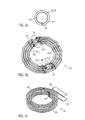
- Figure 2a schematically illustrates the structure of each one of contact lenses 3a, 3b.
- the contact lens comprises a contact lens base 21, comparable to a standard soft contact lens, which can have or not vision correction properties.
- the contact lens 3a, 3b comprises an antenna 23 and a sensing means 25 which, are embedded into the contact lens base 12 to improve the wearing comfort.
- the sensing means 25 is a fully passive sensing means.
- the purely passive sensing means 25 is a capacitor, e.g. an off the shelf capacitor added to the antenna 23, or an integrated capacitor fabricated at the same time as the antenna loop, or a piezoelectric transducer transforming a mechanical excitation into an electric signal.
- Antenna 23 and sensing means 25 effectively build up a passive device corresponding to a LC (inductance + capacitance) circuit.
- the physiological parameter measurement can then be based on the observation of a frequency drift of the resonance frequency as a function of cornea deformation.
- the inductance and capacitance are chosen such that a resonance frequency is observed in a frequency range allowed by the national safety regulations, in particular in the so called ISM band 26,957 to 27,283 MHz.
- To adapt the resonance frequency to such a frequency band it is possible to adapt the number of spires, e.g. in a rang of about 1 to 5 spires, of the antenna 23 and to adapt the capacitance by using an appropriate additional capacitor in addition to the self capacitance of the antenna loop.
- the contact lenses 3a, 3b according to the invention are fabricated in a two step fabrication process.
- the antenna and sensing means are fabricated.
- the antenna 23 according to the invention can be formed by a first metal layer, in particular a copper layer, and a second layer on top thereof, in particular out of a biocompatible material like gold, with a spiral form.
- the first and second layer are provided on one main surface of a carrier substrate, e.g. a flexible material, like for instance polyimide.
- a third layer of copper and a fourth layer of gold can be provided on the opposing other main surface of the carrier substrate,
- One pair of layers has a thickness in a range of about 20 to 40 ⁇ m whereas the flexible carrier substrate typically has a thickness in the range of 20 to 30 ⁇ m.
- the antenna 23 is connected to the capacitor (off the shelf or fabricated at the same time than the antenna) or piezoelectric transducer of the sensing means 25 before being mold in a biocompatible material, e.g. a PDMS (polydimethysiloxane) silicon polymer, serving as contact lens.
- a biocompatible material e.g. a PDMS (polydimethysiloxane) silicon polymer, serving as contact lens.
- the invention can also be realized with only one layer, or one layer on each side of the flexible carrier substrate.
- Figure 2b illustrates a first practical example 61 of the LC circuit comprising the antenna and the sensing means.
- this first practical example spires 63 and 65 are arranged on the front and backside of a flexible carrier substrate, which is not illustrated in this figure.
- Electric conductive vias, in particular metallic vias, 67a, 67b, ..., 67n-1, 67n connect the spires 63 on the one side and the spires 65 on the other side along their entire length.
- This arrangement has the advantage that the effective thickness of the spires is essentially doubled and thus the resistance can be reduced and the quality factor of the circuit enhanced.
- the design is chosen such that the two connecting parts 69 and 71 are side by side on one surface of the flexible carrier substrate to allow the connection to an additional capacitor.
- figure 2a has two crossing areas 73 and 75 connecting an essentially semi circularly shaped part on an inner area with an essentially semi circularly shaped part in the subsequent round of the spires so that in the end the spires on one side of the substrate never cross more than one spires on the other side of the carrier substrate.
- Figure 2c illustrates a second practical example 81. Again spires 83 and 85 are arranged on the front and back side of the flexible carrier substrate, not illustrated. The spires are connected to each other with a via 87 going through the carrier substrate. The via connects the end of the first inductance with the beginning of the second inductance and both are thus forming two inductances connected in series. Both inductances are wound in the same direction, so that the total inductance is enhanced, without needing more space.
- Figure 2c furthermore illustrates two electrodes 89 and 91 connected to the beginning of the first inductance 83 and the end of the second inductance 85 thereby forming an integrated capacitance to adapt the resonant frequency to the desired frequency range.
- the integrated capacitance could also be provided in the first practical example, just like the design of the second practical example could be connected to an external capacitance.
- the contact lens With the all passive design, it is possible to embed thin components, like already mentioned in the order of 20 to 40 ⁇ m per layer pair, in the contact lens, the thickness of which can be kept in the order of 100 ⁇ m which greatly enhances the wearing comfort compared to the prior art device which due to the presence of the active strain gauge, is thicker, typically at least 150 ⁇ m corresponding to a thickness at which the wearing comfort for the patient reduces rapidly.
- the thinner the lens can be made the more sensitive the IOP measurement. Indeed, a change in pressure can be better indentified for a thin lens than a thick lens which is more rigid.
- the use of a purely passive sensing means has the advantage that, compared to active sensing means, the power consumption in the circuit of the contact lens is greatly reduced, so that radiation and energy dissipating phenomena, which may harm the patient's eye, can be kept at a lower level compared to the prior art using active strain gauges.
- Figure 3 illustrates a partial 3-dimensional view of one of the antenna patches 5a, 5b and the corresponding conditioner 11 a, 11 b.
- the antenna patch 5a, 5b comprises a transparent support layer 31, an antenna loop 33 which, according to a variant, could also be transparent, as well as an adhesive layer 35 used to attach each antenna patch 5a, 5b to one of the glasses 7a, 7b of the spectacles respectively.
- the adhesive 35 is chosen such that the antenna patch can be removed from the glass 7a, 7b without leaving a trace or without deteriorating the glass 7a, 7b of the spectacles.
- This antenna patch 5a, 5b can thus be attached to any glasses with or without vision correction.
- the glasses of the spectacles of the patient which he uses in his daily life can be used in the monitoring system 1.
- antenna patches 5a, 5b with various shapes can be provided to be compatible with any form and design of spectacle glasses.
- An electric connector 37 links the antenna patch to an electronic conditioning unit 11 a, 11 b being attached or clamped to the branches 39 of the spectacles.
- the electrical connection 37 is pinched to the electronic conditioning unit 11 a, 11 b.
- Figure 4 illustrates the electrical equivalent circuit of the contact lens 3a, 3b and the antenna patch 5a, 5b.
- the antenna loop 33 corresponds to the antenna inductance L ant
- the antenna 23 to the sensing inductance L sens also representing a varying part ⁇ L sens
- the pressure dependant capacitance changing as a function of contact lens deformation as a consequence of the cornea deformation corresponds to C sens
- the eventually present additional capacitance to tune the resonant frequency to the desired value corresponds to C tune .
- the resistance of the overall circuit design is represented by R sens .
- inventive physiological parameter measuring system as illustrated in Figures 1 - 3 is used according to the following inventive method according to a third embodiment to measure a physiological parameter, in particular the intraocular eye pressure.
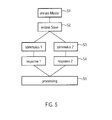
- the method is illustrated in Figure 5 .
- the electronic conditioning unit 11a serving as the master electronic conditioning unit, transmits a signal to initiate the slave electronic conditioning unit (Step S2). Subsequently stimulus signals are transmitted via the antennas of the antenna patches 5a, 5b inductively coupled to the antennas 23 of the contact lenses 3a, 3b (Step S3). The contact lenses 3a, 3b then in turn transmit their response signals from the sensing means 25 in each one of the contact lenses 3a, 3b back to the antenna patch (Step S4) so that the response signal can be received by the electronic conditioning unit 11 a, 11 b for further processing (Step S5), either within one or both of the electronic conditioning units 11 a, 11 b or the data monitoring unit 13.
- the signals in the data monitoring unit 13 are treated in a programmable integrated circuit such as a DSP (Digital Signal Processor), or an FPGA (Field Programmable Gate Array) so that the system 1 is fully programmable with respect to the type of stimulus, the type of pre and post-processing, and thus adaptable to any special demand.
- a programmable integrated circuit such as a DSP (Digital Signal Processor), or an FPGA (Field Programmable Gate Array) so that the system 1 is fully programmable with respect to the type of stimulus, the type of pre and post-processing, and thus adaptable to any special demand.
- the physiological parameter measurement and here in particular the IOP measurement with the system 1 according to the invention is based on the following method.
- M modulus
- ⁇ phase
- the resonance frequency of the LC circuit of the antenna 23 and the sensing means 25 shifts with IOP variations and the impedance phase ( ⁇ (Z)) goes through a minima at the resonance frequency of the LC circuit on the lens 3a, 3b.
- Doing a frequency sweep on the antenna patch 5a, 5b thus permits to find out the phase minima and thus the frequency offset due to the IOP variations.
- the frequency shifts information are transmitted to the data monitoring unit 13 which, after validation of the measurement, is computed into IOP variations by taking into account cornea thickness information, measured on the patient just before this one is equipped with device.
- the invention thus gives access to the pressure variations which represent an important aspect for glaucoma patients.
- the use of the frequency based measurement has the advantage that it is non-sensitive to the amplitude of the signal and consequently also independent of the distance between the glasses of the spectacles and the contact lens 3a. Nevertheless using the transparent antenna patches 5a, 5b, the antenna loop 33 can be placed right in front of the contact lens 3a and 3b. Thus the coupling between the two circuits can be optimized while at the same time wearing comfort can be kept high.
- Figure 6 illustrates the results of a frequency and phase measurement using a contact lens with an antenna 23 like illustrated in Figure 2b .
- an additional capacitance was added, here an MLCC (Multi-Layer Ceramic Capacitor) type capacitor.
- MLCC Multi-Layer Ceramic Capacitor
- the measurement results illustrated in Figure 6 were obtained by placing the contact lens 3a on an enucleated pork eye with the antenna patch 5a positioned 1,5 cm above the lens.
- the pressure in the eye was varied by injecting a fluid.
- the four curves correspond to Oml air injected (about 20mmHg IOP), O,2ml air injected (about 70mmHg IOP), 0,3 ml air injected (about 85mmHg IOP) and 0,4 ml air injected (about 90mmHg IOP).
- the upper figure illustrates the change in the impedance
- the lower figure illustrates the change in phase for IOP pressure changes in the order of 70mmHg a frequency shift of about 77KHz was observed.
- Figure 7 illustrates a fourth embodiment according to the invention, wherein the physiological parameter measuring system 41 comprises, in addition, a filtering unit 43 which is configured to remove spurious artifacts which are observed in the measured signals and which can be due to eye blinking or a change of the viewing direction which lead to predetermined changes in the signals which can be removed by the filtering unit 43 to improve accuracy of the system.
- eye blinking and change of viewing direction is typically a synchronized event between the left and the right eye
- the observation of the predetermined change in the signal simultaneously in both signal channels is used to trigger a filtering event.
- electromagnetic disturbances of the signals can also be eliminated in the filtering unit based on the dual-channel measurement, as they are present in both response signals when occurring.
- the filtering is based on digital signal processing.
- the filtering unit 43 of this embodiment is embedded in the data monitoring unit 13. As mentioned above, it is easy to detect a simultaneous event on both channels (e.g., same shape in the spectrum).
Landscapes
- Health & Medical Sciences (AREA)
- Life Sciences & Earth Sciences (AREA)
- Heart & Thoracic Surgery (AREA)
- Medical Informatics (AREA)
- Biophysics (AREA)
- Veterinary Medicine (AREA)
- Engineering & Computer Science (AREA)
- Biomedical Technology (AREA)
- Ophthalmology & Optometry (AREA)
- Physics & Mathematics (AREA)
- Molecular Biology (AREA)
- Surgery (AREA)
- Animal Behavior & Ethology (AREA)
- General Health & Medical Sciences (AREA)
- Public Health (AREA)
- Pathology (AREA)
- Eye Examination Apparatus (AREA)
- Measuring And Recording Apparatus For Diagnosis (AREA)
Priority Applications (2)
| Application Number | Priority Date | Filing Date | Title |
|---|---|---|---|
| DK10290034T DK2347702T3 (da) | 2010-01-22 | 2010-01-22 | Kontaktfrit multidiagnosesystem under anvendelse af fysiologiske okulære parametre |
| EP20100290034 EP2347702B1 (de) | 2010-01-22 | 2010-01-22 | Kontaktloses Multidiagnosesystem unter Verwendung physiologischer Okularparameter |
Applications Claiming Priority (1)
| Application Number | Priority Date | Filing Date | Title |
|---|---|---|---|
| EP20100290034 EP2347702B1 (de) | 2010-01-22 | 2010-01-22 | Kontaktloses Multidiagnosesystem unter Verwendung physiologischer Okularparameter |
Publications (2)
| Publication Number | Publication Date |
|---|---|
| EP2347702A1 true EP2347702A1 (de) | 2011-07-27 |
| EP2347702B1 EP2347702B1 (de) | 2014-07-16 |
Family
ID=42224585
Family Applications (1)
| Application Number | Title | Priority Date | Filing Date |
|---|---|---|---|
| EP20100290034 Not-in-force EP2347702B1 (de) | 2010-01-22 | 2010-01-22 | Kontaktloses Multidiagnosesystem unter Verwendung physiologischer Okularparameter |
Country Status (2)
| Country | Link |
|---|---|
| EP (1) | EP2347702B1 (de) |
| DK (1) | DK2347702T3 (de) |
Cited By (3)
| Publication number | Priority date | Publication date | Assignee | Title |
|---|---|---|---|---|
| WO2019073675A1 (ja) * | 2017-10-13 | 2019-04-18 | ソニー株式会社 | 生体情報処理装置 |
| EP3861924A1 (de) | 2020-02-07 | 2021-08-11 | Alfa Intes Industria Terapeutica Splendore S.r.l. | Kontaktlinsenvorrichtung und zugehöriges drucküberwachungskit und system damit |
| CN115211809A (zh) * | 2021-04-19 | 2022-10-21 | 香港科技大学 | 用于眼睛的感测装置及相应的制造方法和监测系统 |
Citations (4)
| Publication number | Priority date | Publication date | Assignee | Title |
|---|---|---|---|---|
| EP0061777A2 (de) * | 1981-03-31 | 1982-10-06 | Fraunhofer-Gesellschaft Zur Förderung Der Angewandten Forschung E.V. | Einrichtung zum Messen des Augeninnendrucks |
| WO2003001991A1 (en) | 2001-06-29 | 2003-01-09 | Ecole Polytechnique Federale De Lausanne (Epfl) | Intraocular pressure recording system |
| WO2003073959A2 (en) * | 2002-03-05 | 2003-09-12 | Microsense Cardiovascular Systems 1996 | Implantable passive intraocular pressure sensor |
| WO2007136993A1 (en) * | 2006-05-17 | 2007-11-29 | Mayo Foundation For Medical Education And Research | Monitoring intraocular pressure |
-
2010
- 2010-01-22 EP EP20100290034 patent/EP2347702B1/de not_active Not-in-force
- 2010-01-22 DK DK10290034T patent/DK2347702T3/da active
Patent Citations (4)
| Publication number | Priority date | Publication date | Assignee | Title |
|---|---|---|---|---|
| EP0061777A2 (de) * | 1981-03-31 | 1982-10-06 | Fraunhofer-Gesellschaft Zur Förderung Der Angewandten Forschung E.V. | Einrichtung zum Messen des Augeninnendrucks |
| WO2003001991A1 (en) | 2001-06-29 | 2003-01-09 | Ecole Polytechnique Federale De Lausanne (Epfl) | Intraocular pressure recording system |
| WO2003073959A2 (en) * | 2002-03-05 | 2003-09-12 | Microsense Cardiovascular Systems 1996 | Implantable passive intraocular pressure sensor |
| WO2007136993A1 (en) * | 2006-05-17 | 2007-11-29 | Mayo Foundation For Medical Education And Research | Monitoring intraocular pressure |
Non-Patent Citations (5)
| Title |
|---|
| "Passivity (engineering)", WIKIPEDIA, THE FREE ENCYCLOPEDIA ARTICLE, pages 1 - 4, XP003028424, Retrieved from the Internet <URL:http://en.wikipedia.org/wiki/Passivity_(engineering)> |
| "Strain gauge", WIKIPEDIA, THE FREE ENCYCLOPEDIA ARTICLE, pages 1 - 6, XP003028426, Retrieved from the Internet <URL:http://en.wikipedia.org/wiki/Strain_gauge> |
| "Transducer", WIKIPEDIA, THE FREE ENCYCLOPEDIA ARTICLE, pages 1 - 2, XP003028428, Retrieved from the Internet <URL:http://en.wikipedia.org/wiki/Transducer> |
| JAY F.: "IEEE Standard Dictionary of Electrical and Electronics Terms, Second Edition", 1978, pages: 474, XP003028425 |
| SENSORLAND.COM, pages 1 - 6, XP003028427, Retrieved from the Internet <URL:http://www.sensorland.com/HowPage002.html> |
Cited By (5)
| Publication number | Priority date | Publication date | Assignee | Title |
|---|---|---|---|---|
| WO2019073675A1 (ja) * | 2017-10-13 | 2019-04-18 | ソニー株式会社 | 生体情報処理装置 |
| JPWO2019073675A1 (ja) * | 2017-10-13 | 2020-12-17 | ソニー株式会社 | 生体情報処理装置 |
| JP7442318B2 (ja) | 2017-10-13 | 2024-03-04 | ソニーグループ株式会社 | 生体情報処理装置 |
| EP3861924A1 (de) | 2020-02-07 | 2021-08-11 | Alfa Intes Industria Terapeutica Splendore S.r.l. | Kontaktlinsenvorrichtung und zugehöriges drucküberwachungskit und system damit |
| CN115211809A (zh) * | 2021-04-19 | 2022-10-21 | 香港科技大学 | 用于眼睛的感测装置及相应的制造方法和监测系统 |
Also Published As
| Publication number | Publication date |
|---|---|
| DK2347702T3 (da) | 2014-09-08 |
| EP2347702B1 (de) | 2014-07-16 |
Similar Documents
| Publication | Publication Date | Title |
|---|---|---|
| EP2412305A1 (de) | Integrierter flexibler Passivsensor in einer weichen Kontaktlinse zur Überwachung des Innenaugendrucks | |
| US9192298B2 (en) | Contact lens for intraocular pressure measurement | |
| EP3861924A1 (de) | Kontaktlinsenvorrichtung und zugehöriges drucküberwachungskit und system damit | |
| CN103747720A (zh) | 表面形变传感器 | |
| JP2017527329A (ja) | 垂直積層構造を備える、気密封止したインプラントセンサ | |
| US20100234717A1 (en) | Intraocular Pressure Monitoring Device | |
| AU2006318294A1 (en) | Implantable device for telemetric measurement of blood pressure/temperature within the heart | |
| CN102695449A (zh) | 眼内压力监测装置 | |
| An et al. | High-sensitivity liquid-metal-based contact lens sensor for continuous intraocular pressure monitoring | |
| CN104510443B (zh) | 非侵入式眼压传感元件 | |
| Kakaday et al. | Advances in telemetric continuous intraocular pressure assessment | |
| EP2347702B1 (de) | Kontaktloses Multidiagnosesystem unter Verwendung physiologischer Okularparameter | |
| US20120289810A1 (en) | Pressure monitor | |
| CN116269200A (zh) | 一种连续眼压监测传感器及眼压测量方法 | |
| JP6487056B2 (ja) | 生理学的パラメータ監視装置 | |
| KR20170077240A (ko) | 생리적 파라미터 모니터링 디바이스 | |
| CN220876746U (zh) | 一种眼内压测量装置 | |
| US20220330843A1 (en) | Sensors for In-Vivo Measurements | |
| CN108703746A (zh) | 一种用于检测乳房疾病的可穿戴设备 | |
| KR20160066102A (ko) | 무전원 무선 안압 센서, 그리고 그것을 포함하는 측정 시스템 | |
| Piffaretti et al. | Rollable and implantable intraocular pressure sensor for the continuous adaptive management of glaucoma | |
| WO2023076563A1 (en) | Intraocular pressure tonometers, methods of fabrication, and systems and methods for monitoring intraocular pressure | |
| WO2014018294A1 (en) | Pressure monitor | |
| KR102763117B1 (ko) | 안구 생체 역학적 특성 측정 및 모니터링 장치 | |
| RU2464925C2 (ru) | Устройство для контроля внутриглазного давления |
Legal Events
| Date | Code | Title | Description |
|---|---|---|---|
| PUAI | Public reference made under article 153(3) epc to a published international application that has entered the european phase |
Free format text: ORIGINAL CODE: 0009012 |
|
| AK | Designated contracting states |
Kind code of ref document: A1 Designated state(s): AT BE BG CH CY CZ DE DK EE ES FI FR GB GR HR HU IE IS IT LI LT LU LV MC MK MT NL NO PL PT RO SE SI SK SM TR |
|
| AX | Request for extension of the european patent |
Extension state: AL BA RS |
|
| TPAC | Observations filed by third parties |
Free format text: ORIGINAL CODE: EPIDOSNTIPA |
|
| 17P | Request for examination filed |
Effective date: 20120127 |
|
| GRAP | Despatch of communication of intention to grant a patent |
Free format text: ORIGINAL CODE: EPIDOSNIGR1 |
|
| INTG | Intention to grant announced |
Effective date: 20140129 |
|
| GRAS | Grant fee paid |
Free format text: ORIGINAL CODE: EPIDOSNIGR3 |
|
| GRAA | (expected) grant |
Free format text: ORIGINAL CODE: 0009210 |
|
| AK | Designated contracting states |
Kind code of ref document: B1 Designated state(s): AT BE BG CH CY CZ DE DK EE ES FI FR GB GR HR HU IE IS IT LI LT LU LV MC MK MT NL NO PL PT RO SE SI SK SM TR |
|
| REG | Reference to a national code |
Ref country code: GB Ref legal event code: FG4D |
|
| REG | Reference to a national code |
Ref country code: CH Ref legal event code: EP |
|
| REG | Reference to a national code |
Ref country code: IE Ref legal event code: FG4D |
|
| REG | Reference to a national code |
Ref country code: AT Ref legal event code: REF Ref document number: 677039 Country of ref document: AT Kind code of ref document: T Effective date: 20140815 |
|
| REG | Reference to a national code |
Ref country code: DE Ref legal event code: R096 Ref document number: 602010017461 Country of ref document: DE Effective date: 20140828 |
|
| REG | Reference to a national code |
Ref country code: CH Ref legal event code: NV Representative=s name: BOVARD AG, CH |
|
| REG | Reference to a national code |
Ref country code: NL Ref legal event code: T3 |
|
| REG | Reference to a national code |
Ref country code: DK Ref legal event code: T3 Effective date: 20140902 |
|
| REG | Reference to a national code |
Ref country code: SE Ref legal event code: TRGR |
|
| REG | Reference to a national code |
Ref country code: AT Ref legal event code: MK05 Ref document number: 677039 Country of ref document: AT Kind code of ref document: T Effective date: 20140716 |
|
| REG | Reference to a national code |
Ref country code: LT Ref legal event code: MG4D |
|
| PG25 | Lapsed in a contracting state [announced via postgrant information from national office to epo] |
Ref country code: PT Free format text: LAPSE BECAUSE OF FAILURE TO SUBMIT A TRANSLATION OF THE DESCRIPTION OR TO PAY THE FEE WITHIN THE PRESCRIBED TIME-LIMIT Effective date: 20141117 Ref country code: LT Free format text: LAPSE BECAUSE OF FAILURE TO SUBMIT A TRANSLATION OF THE DESCRIPTION OR TO PAY THE FEE WITHIN THE PRESCRIBED TIME-LIMIT Effective date: 20140716 Ref country code: GR Free format text: LAPSE BECAUSE OF FAILURE TO SUBMIT A TRANSLATION OF THE DESCRIPTION OR TO PAY THE FEE WITHIN THE PRESCRIBED TIME-LIMIT Effective date: 20141017 Ref country code: ES Free format text: LAPSE BECAUSE OF FAILURE TO SUBMIT A TRANSLATION OF THE DESCRIPTION OR TO PAY THE FEE WITHIN THE PRESCRIBED TIME-LIMIT Effective date: 20140716 Ref country code: NO Free format text: LAPSE BECAUSE OF FAILURE TO SUBMIT A TRANSLATION OF THE DESCRIPTION OR TO PAY THE FEE WITHIN THE PRESCRIBED TIME-LIMIT Effective date: 20141016 Ref country code: BG Free format text: LAPSE BECAUSE OF FAILURE TO SUBMIT A TRANSLATION OF THE DESCRIPTION OR TO PAY THE FEE WITHIN THE PRESCRIBED TIME-LIMIT Effective date: 20141016 |
|
| PG25 | Lapsed in a contracting state [announced via postgrant information from national office to epo] |
Ref country code: AT Free format text: LAPSE BECAUSE OF FAILURE TO SUBMIT A TRANSLATION OF THE DESCRIPTION OR TO PAY THE FEE WITHIN THE PRESCRIBED TIME-LIMIT Effective date: 20140716 Ref country code: LV Free format text: LAPSE BECAUSE OF FAILURE TO SUBMIT A TRANSLATION OF THE DESCRIPTION OR TO PAY THE FEE WITHIN THE PRESCRIBED TIME-LIMIT Effective date: 20140716 Ref country code: PL Free format text: LAPSE BECAUSE OF FAILURE TO SUBMIT A TRANSLATION OF THE DESCRIPTION OR TO PAY THE FEE WITHIN THE PRESCRIBED TIME-LIMIT Effective date: 20140716 Ref country code: CY Free format text: LAPSE BECAUSE OF FAILURE TO SUBMIT A TRANSLATION OF THE DESCRIPTION OR TO PAY THE FEE WITHIN THE PRESCRIBED TIME-LIMIT Effective date: 20140716 Ref country code: IS Free format text: LAPSE BECAUSE OF FAILURE TO SUBMIT A TRANSLATION OF THE DESCRIPTION OR TO PAY THE FEE WITHIN THE PRESCRIBED TIME-LIMIT Effective date: 20141116 |
|
| REG | Reference to a national code |
Ref country code: DE Ref legal event code: R097 Ref document number: 602010017461 Country of ref document: DE |
|
| PG25 | Lapsed in a contracting state [announced via postgrant information from national office to epo] |
Ref country code: CZ Free format text: LAPSE BECAUSE OF FAILURE TO SUBMIT A TRANSLATION OF THE DESCRIPTION OR TO PAY THE FEE WITHIN THE PRESCRIBED TIME-LIMIT Effective date: 20140716 Ref country code: SK Free format text: LAPSE BECAUSE OF FAILURE TO SUBMIT A TRANSLATION OF THE DESCRIPTION OR TO PAY THE FEE WITHIN THE PRESCRIBED TIME-LIMIT Effective date: 20140716 Ref country code: IT Free format text: LAPSE BECAUSE OF FAILURE TO SUBMIT A TRANSLATION OF THE DESCRIPTION OR TO PAY THE FEE WITHIN THE PRESCRIBED TIME-LIMIT Effective date: 20140716 Ref country code: EE Free format text: LAPSE BECAUSE OF FAILURE TO SUBMIT A TRANSLATION OF THE DESCRIPTION OR TO PAY THE FEE WITHIN THE PRESCRIBED TIME-LIMIT Effective date: 20140716 Ref country code: RO Free format text: LAPSE BECAUSE OF FAILURE TO SUBMIT A TRANSLATION OF THE DESCRIPTION OR TO PAY THE FEE WITHIN THE PRESCRIBED TIME-LIMIT Effective date: 20140716 |
|
| PLBE | No opposition filed within time limit |
Free format text: ORIGINAL CODE: 0009261 |
|
| STAA | Information on the status of an ep patent application or granted ep patent |
Free format text: STATUS: NO OPPOSITION FILED WITHIN TIME LIMIT |
|
| 26N | No opposition filed |
Effective date: 20150417 |
|
| PG25 | Lapsed in a contracting state [announced via postgrant information from national office to epo] |
Ref country code: BE Free format text: LAPSE BECAUSE OF NON-PAYMENT OF DUE FEES Effective date: 20150131 |
|
| PG25 | Lapsed in a contracting state [announced via postgrant information from national office to epo] |
Ref country code: LU Free format text: LAPSE BECAUSE OF FAILURE TO SUBMIT A TRANSLATION OF THE DESCRIPTION OR TO PAY THE FEE WITHIN THE PRESCRIBED TIME-LIMIT Effective date: 20150122 |
|
| PG25 | Lapsed in a contracting state [announced via postgrant information from national office to epo] |
Ref country code: MC Free format text: LAPSE BECAUSE OF FAILURE TO SUBMIT A TRANSLATION OF THE DESCRIPTION OR TO PAY THE FEE WITHIN THE PRESCRIBED TIME-LIMIT Effective date: 20140716 |
|
| PG25 | Lapsed in a contracting state [announced via postgrant information from national office to epo] |
Ref country code: SI Free format text: LAPSE BECAUSE OF FAILURE TO SUBMIT A TRANSLATION OF THE DESCRIPTION OR TO PAY THE FEE WITHIN THE PRESCRIBED TIME-LIMIT Effective date: 20140716 |
|
| REG | Reference to a national code |
Ref country code: CH Ref legal event code: PCOW Free format text: NEW ADDRESS: 5 ESPLANADE ANTON PHILIPS CAMPUS EFFISCIENCE, 14460 COLOMBELLES (FR) |
|
| REG | Reference to a national code |
Ref country code: FR Ref legal event code: PLFP Year of fee payment: 7 |
|
| REG | Reference to a national code |
Ref country code: FR Ref legal event code: CA Effective date: 20160222 |
|
| PG25 | Lapsed in a contracting state [announced via postgrant information from national office to epo] |
Ref country code: BE Free format text: LAPSE BECAUSE OF FAILURE TO SUBMIT A TRANSLATION OF THE DESCRIPTION OR TO PAY THE FEE WITHIN THE PRESCRIBED TIME-LIMIT Effective date: 20140716 |
|
| PG25 | Lapsed in a contracting state [announced via postgrant information from national office to epo] |
Ref country code: MT Free format text: LAPSE BECAUSE OF FAILURE TO SUBMIT A TRANSLATION OF THE DESCRIPTION OR TO PAY THE FEE WITHIN THE PRESCRIBED TIME-LIMIT Effective date: 20140716 |
|
| REG | Reference to a national code |
Ref country code: FR Ref legal event code: PLFP Year of fee payment: 8 |
|
| PGFP | Annual fee paid to national office [announced via postgrant information from national office to epo] |
Ref country code: NL Payment date: 20170119 Year of fee payment: 8 |
|
| PGFP | Annual fee paid to national office [announced via postgrant information from national office to epo] |
Ref country code: CH Payment date: 20170126 Year of fee payment: 8 Ref country code: DE Payment date: 20170127 Year of fee payment: 8 Ref country code: FI Payment date: 20170123 Year of fee payment: 8 Ref country code: SE Payment date: 20170126 Year of fee payment: 8 Ref country code: FR Payment date: 20170126 Year of fee payment: 8 |
|
| PG25 | Lapsed in a contracting state [announced via postgrant information from national office to epo] |
Ref country code: HU Free format text: LAPSE BECAUSE OF FAILURE TO SUBMIT A TRANSLATION OF THE DESCRIPTION OR TO PAY THE FEE WITHIN THE PRESCRIBED TIME-LIMIT; INVALID AB INITIO Effective date: 20100122 Ref country code: SM Free format text: LAPSE BECAUSE OF FAILURE TO SUBMIT A TRANSLATION OF THE DESCRIPTION OR TO PAY THE FEE WITHIN THE PRESCRIBED TIME-LIMIT Effective date: 20140716 |
|
| PGFP | Annual fee paid to national office [announced via postgrant information from national office to epo] |
Ref country code: DK Payment date: 20170126 Year of fee payment: 8 Ref country code: IE Payment date: 20170126 Year of fee payment: 8 Ref country code: GB Payment date: 20170126 Year of fee payment: 8 |
|
| PG25 | Lapsed in a contracting state [announced via postgrant information from national office to epo] |
Ref country code: HR Free format text: LAPSE BECAUSE OF FAILURE TO SUBMIT A TRANSLATION OF THE DESCRIPTION OR TO PAY THE FEE WITHIN THE PRESCRIBED TIME-LIMIT Effective date: 20140716 |
|
| PG25 | Lapsed in a contracting state [announced via postgrant information from national office to epo] |
Ref country code: TR Free format text: LAPSE BECAUSE OF FAILURE TO SUBMIT A TRANSLATION OF THE DESCRIPTION OR TO PAY THE FEE WITHIN THE PRESCRIBED TIME-LIMIT Effective date: 20140716 |
|
| PG25 | Lapsed in a contracting state [announced via postgrant information from national office to epo] |
Ref country code: MK Free format text: LAPSE BECAUSE OF FAILURE TO SUBMIT A TRANSLATION OF THE DESCRIPTION OR TO PAY THE FEE WITHIN THE PRESCRIBED TIME-LIMIT Effective date: 20140716 |
|
| REG | Reference to a national code |
Ref country code: DE Ref legal event code: R119 Ref document number: 602010017461 Country of ref document: DE |
|
| REG | Reference to a national code |
Ref country code: DK Ref legal event code: EBP Effective date: 20180131 |
|
| REG | Reference to a national code |
Ref country code: SE Ref legal event code: EUG |
|
| REG | Reference to a national code |
Ref country code: CH Ref legal event code: PL |
|
| REG | Reference to a national code |
Ref country code: NL Ref legal event code: MM Effective date: 20180201 |
|
| GBPC | Gb: european patent ceased through non-payment of renewal fee |
Effective date: 20180122 |
|
| PG25 | Lapsed in a contracting state [announced via postgrant information from national office to epo] |
Ref country code: FI Free format text: LAPSE BECAUSE OF NON-PAYMENT OF DUE FEES Effective date: 20180122 Ref country code: FR Free format text: LAPSE BECAUSE OF NON-PAYMENT OF DUE FEES Effective date: 20180131 Ref country code: DE Free format text: LAPSE BECAUSE OF NON-PAYMENT OF DUE FEES Effective date: 20180801 Ref country code: SE Free format text: LAPSE BECAUSE OF NON-PAYMENT OF DUE FEES Effective date: 20180123 |
|
| REG | Reference to a national code |
Ref country code: IE Ref legal event code: MM4A |
|
| REG | Reference to a national code |
Ref country code: FR Ref legal event code: ST Effective date: 20180928 |
|
| PG25 | Lapsed in a contracting state [announced via postgrant information from national office to epo] |
Ref country code: LI Free format text: LAPSE BECAUSE OF NON-PAYMENT OF DUE FEES Effective date: 20180131 Ref country code: CH Free format text: LAPSE BECAUSE OF NON-PAYMENT OF DUE FEES Effective date: 20180131 Ref country code: GB Free format text: LAPSE BECAUSE OF NON-PAYMENT OF DUE FEES Effective date: 20180122 Ref country code: NL Free format text: LAPSE BECAUSE OF NON-PAYMENT OF DUE FEES Effective date: 20180201 |
|
| PG25 | Lapsed in a contracting state [announced via postgrant information from national office to epo] |
Ref country code: DK Free format text: LAPSE BECAUSE OF NON-PAYMENT OF DUE FEES Effective date: 20180131 Ref country code: IE Free format text: LAPSE BECAUSE OF NON-PAYMENT OF DUE FEES Effective date: 20180122 |