EP2348068B1 - Composition de caoutchouc et pneu fabriqué au moyen de celle-ci - Google Patents
Composition de caoutchouc et pneu fabriqué au moyen de celle-ci Download PDFInfo
- Publication number
- EP2348068B1 EP2348068B1 EP09817800.7A EP09817800A EP2348068B1 EP 2348068 B1 EP2348068 B1 EP 2348068B1 EP 09817800 A EP09817800 A EP 09817800A EP 2348068 B1 EP2348068 B1 EP 2348068B1
- Authority
- EP
- European Patent Office
- Prior art keywords
- carbon black
- rubber
- reaction
- zone
- rubber composition
- Prior art date
- Legal status (The legal status is an assumption and is not a legal conclusion. Google has not performed a legal analysis and makes no representation as to the accuracy of the status listed.)
- Revoked
Links
- 239000005060 rubber Substances 0.000 title claims description 135
- 229920001971 elastomer Polymers 0.000 title claims description 132
- 239000000203 mixture Substances 0.000 title claims description 75
- 239000006229 carbon black Substances 0.000 claims description 125
- 238000010791 quenching Methods 0.000 claims description 60
- 230000000171 quenching effect Effects 0.000 claims description 60
- 238000006243 chemical reaction Methods 0.000 claims description 58
- 238000002156 mixing Methods 0.000 claims description 41
- 150000001993 dienes Chemical class 0.000 claims description 30
- 229920000642 polymer Polymers 0.000 claims description 29
- 238000000034 method Methods 0.000 claims description 26
- 239000002994 raw material Substances 0.000 claims description 25
- 238000010521 absorption reaction Methods 0.000 claims description 20
- 230000014759 maintenance of location Effects 0.000 claims description 19
- 239000012485 toluene extract Substances 0.000 claims description 19
- 238000002834 transmittance Methods 0.000 claims description 19
- 239000003607 modifier Substances 0.000 claims description 18
- 238000002485 combustion reaction Methods 0.000 claims description 15
- 239000001257 hydrogen Substances 0.000 claims description 13
- 229910052739 hydrogen Inorganic materials 0.000 claims description 13
- 238000006116 polymerization reaction Methods 0.000 claims description 11
- 239000012495 reaction gas Substances 0.000 claims description 11
- 238000005507 spraying Methods 0.000 claims description 11
- 239000000567 combustion gas Substances 0.000 claims description 10
- 150000002431 hydrogen Chemical class 0.000 claims description 10
- 150000001875 compounds Chemical class 0.000 claims description 8
- -1 amine compound Chemical class 0.000 claims description 7
- 238000001179 sorption measurement Methods 0.000 claims description 6
- UFHFLCQGNIYNRP-UHFFFAOYSA-N Hydrogen Chemical compound [H][H] UFHFLCQGNIYNRP-UHFFFAOYSA-N 0.000 claims description 5
- 150000001339 alkali metal compounds Chemical class 0.000 claims description 5
- 125000000524 functional group Chemical group 0.000 claims description 5
- 230000003993 interaction Effects 0.000 claims description 5
- XKRFYHLGVUSROY-UHFFFAOYSA-N Argon Chemical compound [Ar] XKRFYHLGVUSROY-UHFFFAOYSA-N 0.000 claims description 4
- LZZYPRNAOMGNLH-UHFFFAOYSA-M Cetrimonium bromide Chemical compound [Br-].CCCCCCCCCCCCCCCC[N+](C)(C)C LZZYPRNAOMGNLH-UHFFFAOYSA-M 0.000 claims description 4
- 150000003377 silicon compounds Chemical class 0.000 claims description 4
- 150000003606 tin compounds Chemical class 0.000 claims description 4
- ATJFFYVFTNAWJD-UHFFFAOYSA-N Tin Chemical compound [Sn] ATJFFYVFTNAWJD-UHFFFAOYSA-N 0.000 claims description 3
- 150000002909 rare earth metal compounds Chemical class 0.000 claims description 3
- 229910052786 argon Inorganic materials 0.000 claims description 2
- 238000010438 heat treatment Methods 0.000 claims description 2
- 235000019241 carbon black Nutrition 0.000 description 111
- 238000005299 abrasion Methods 0.000 description 36
- DOIRQSBPFJWKBE-UHFFFAOYSA-N dibutyl phthalate Chemical compound CCCCOC(=O)C1=CC=CC=C1C(=O)OCCCC DOIRQSBPFJWKBE-UHFFFAOYSA-N 0.000 description 36
- 238000004519 manufacturing process Methods 0.000 description 28
- 238000005096 rolling process Methods 0.000 description 27
- 239000000446 fuel Substances 0.000 description 14
- 229920002857 polybutadiene Polymers 0.000 description 12
- 239000004215 Carbon black (E152) Substances 0.000 description 11
- 229930195733 hydrocarbon Natural products 0.000 description 11
- 150000002430 hydrocarbons Chemical class 0.000 description 11
- 230000020169 heat generation Effects 0.000 description 10
- 230000000052 comparative effect Effects 0.000 description 9
- 230000001276 controlling effect Effects 0.000 description 8
- 230000001965 increasing effect Effects 0.000 description 8
- 238000006011 modification reaction Methods 0.000 description 8
- QVGXLLKOCUKJST-UHFFFAOYSA-N atomic oxygen Chemical compound [O] QVGXLLKOCUKJST-UHFFFAOYSA-N 0.000 description 6
- 238000009833 condensation Methods 0.000 description 6
- 230000005494 condensation Effects 0.000 description 6
- 238000001816 cooling Methods 0.000 description 6
- 239000007789 gas Substances 0.000 description 6
- 239000003921 oil Substances 0.000 description 6
- 239000001301 oxygen Substances 0.000 description 6
- 229910052760 oxygen Inorganic materials 0.000 description 6
- 239000002245 particle Substances 0.000 description 6
- 239000003570 air Substances 0.000 description 5
- 239000000126 substance Substances 0.000 description 5
- MZRVEZGGRBJDDB-UHFFFAOYSA-N N-Butyllithium Chemical compound [Li]CCCC MZRVEZGGRBJDDB-UHFFFAOYSA-N 0.000 description 4
- XLOMVQKBTHCTTD-UHFFFAOYSA-N Zinc monoxide Chemical compound [Zn]=O XLOMVQKBTHCTTD-UHFFFAOYSA-N 0.000 description 4
- 238000010539 anionic addition polymerization reaction Methods 0.000 description 4
- 239000003963 antioxidant agent Substances 0.000 description 4
- 229920006164 aromatic vinyl copolymer Polymers 0.000 description 4
- 239000003795 chemical substances by application Substances 0.000 description 4
- 238000004821 distillation Methods 0.000 description 4
- 230000000694 effects Effects 0.000 description 4
- 239000012530 fluid Substances 0.000 description 4
- 230000000977 initiatory effect Effects 0.000 description 4
- 229910052751 metal Inorganic materials 0.000 description 4
- 239000002184 metal Substances 0.000 description 4
- 238000004073 vulcanization Methods 0.000 description 4
- XLYOFNOQVPJJNP-UHFFFAOYSA-N water Substances O XLYOFNOQVPJJNP-UHFFFAOYSA-N 0.000 description 4
- IJGRMHOSHXDMSA-UHFFFAOYSA-N Atomic nitrogen Chemical compound N#N IJGRMHOSHXDMSA-UHFFFAOYSA-N 0.000 description 3
- YXFVVABEGXRONW-UHFFFAOYSA-N Toluene Chemical compound CC1=CC=CC=C1 YXFVVABEGXRONW-UHFFFAOYSA-N 0.000 description 3
- 150000004703 alkoxides Chemical group 0.000 description 3
- 230000003078 antioxidant effect Effects 0.000 description 3
- 230000006835 compression Effects 0.000 description 3
- 238000007906 compression Methods 0.000 description 3
- 230000002708 enhancing effect Effects 0.000 description 3
- DEQZTKGFXNUBJL-UHFFFAOYSA-N n-(1,3-benzothiazol-2-ylsulfanyl)cyclohexanamine Chemical compound C1CCCCC1NSC1=NC2=CC=CC=C2S1 DEQZTKGFXNUBJL-UHFFFAOYSA-N 0.000 description 3
- 239000003505 polymerization initiator Substances 0.000 description 3
- 230000003014 reinforcing effect Effects 0.000 description 3
- DIGKGWWSMMWBIZ-UHFFFAOYSA-N 3-[diethoxy(methyl)silyl]-n,n-bis(trimethylsilyl)propan-1-amine Chemical compound CCO[Si](C)(OCC)CCCN([Si](C)(C)C)[Si](C)(C)C DIGKGWWSMMWBIZ-UHFFFAOYSA-N 0.000 description 2
- ZZMVLMVFYMGSMY-UHFFFAOYSA-N 4-n-(4-methylpentan-2-yl)-1-n-phenylbenzene-1,4-diamine Chemical compound C1=CC(NC(C)CC(C)C)=CC=C1NC1=CC=CC=C1 ZZMVLMVFYMGSMY-UHFFFAOYSA-N 0.000 description 2
- KAKZBPTYRLMSJV-UHFFFAOYSA-N Butadiene Chemical compound C=CC=C KAKZBPTYRLMSJV-UHFFFAOYSA-N 0.000 description 2
- OKTJSMMVPCPJKN-UHFFFAOYSA-N Carbon Chemical compound [C] OKTJSMMVPCPJKN-UHFFFAOYSA-N 0.000 description 2
- CURLTUGMZLYLDI-UHFFFAOYSA-N Carbon dioxide Chemical compound O=C=O CURLTUGMZLYLDI-UHFFFAOYSA-N 0.000 description 2
- 244000043261 Hevea brasiliensis Species 0.000 description 2
- KFZMGEQAYNKOFK-UHFFFAOYSA-N Isopropanol Chemical compound CC(C)O KFZMGEQAYNKOFK-UHFFFAOYSA-N 0.000 description 2
- 239000005062 Polybutadiene Substances 0.000 description 2
- 235000021355 Stearic acid Nutrition 0.000 description 2
- NINIDFKCEFEMDL-UHFFFAOYSA-N Sulfur Chemical compound [S] NINIDFKCEFEMDL-UHFFFAOYSA-N 0.000 description 2
- 229910052799 carbon Inorganic materials 0.000 description 2
- 238000005336 cracking Methods 0.000 description 2
- 150000001934 cyclohexanes Chemical class 0.000 description 2
- 239000000945 filler Substances 0.000 description 2
- 239000000295 fuel oil Substances 0.000 description 2
- AFRJJFRNGGLMDW-UHFFFAOYSA-N lithium amide Chemical class [Li+].[NH2-] AFRJJFRNGGLMDW-UHFFFAOYSA-N 0.000 description 2
- 229920003052 natural elastomer Polymers 0.000 description 2
- 229920001194 natural rubber Polymers 0.000 description 2
- 229910052757 nitrogen Inorganic materials 0.000 description 2
- QJGQUHMNIGDVPM-UHFFFAOYSA-N nitrogen group Chemical group [N] QJGQUHMNIGDVPM-UHFFFAOYSA-N 0.000 description 2
- QIQXTHQIDYTFRH-UHFFFAOYSA-N octadecanoic acid Chemical compound CCCCCCCCCCCCCCCCCC(O)=O QIQXTHQIDYTFRH-UHFFFAOYSA-N 0.000 description 2
- OQCDKBAXFALNLD-UHFFFAOYSA-N octadecanoic acid Natural products CCCCCCCC(C)CCCCCCCCC(O)=O OQCDKBAXFALNLD-UHFFFAOYSA-N 0.000 description 2
- 230000000704 physical effect Effects 0.000 description 2
- 238000003825 pressing Methods 0.000 description 2
- 239000008117 stearic acid Substances 0.000 description 2
- 229920003048 styrene butadiene rubber Polymers 0.000 description 2
- 229910052717 sulfur Inorganic materials 0.000 description 2
- 239000011593 sulfur Substances 0.000 description 2
- 239000010936 titanium Substances 0.000 description 2
- 229920002554 vinyl polymer Polymers 0.000 description 2
- 239000011787 zinc oxide Substances 0.000 description 2
- POILWHVDKZOXJZ-ARJAWSKDSA-M (z)-4-oxopent-2-en-2-olate Chemical compound C\C([O-])=C\C(C)=O POILWHVDKZOXJZ-ARJAWSKDSA-M 0.000 description 1
- FZLHAQMQWDDWFI-UHFFFAOYSA-N 2-[2-(oxolan-2-yl)propan-2-yl]oxolane Chemical compound C1CCOC1C(C)(C)C1CCCO1 FZLHAQMQWDDWFI-UHFFFAOYSA-N 0.000 description 1
- NPHULPIAPWNOOH-UHFFFAOYSA-N 2-[4-[2-(2,3-dihydro-1H-inden-2-ylamino)pyrimidin-5-yl]-3-(2,3-dihydroindol-1-ylmethyl)pyrazol-1-yl]-1-(2,4,6,7-tetrahydrotriazolo[4,5-c]pyridin-5-yl)ethanone Chemical compound C1C(CC2=CC=CC=C12)NC1=NC=C(C=N1)C=1C(=NN(C=1)CC(=O)N1CC2=C(CC1)NN=N2)CN1CCC2=CC=CC=C12 NPHULPIAPWNOOH-UHFFFAOYSA-N 0.000 description 1
- JIDHFKQYRQEGCQ-UHFFFAOYSA-N 2-[diethoxy(methyl)silyl]-n,n-bis(trimethylsilyl)ethanamine Chemical compound CCO[Si](C)(OCC)CCN([Si](C)(C)C)[Si](C)(C)C JIDHFKQYRQEGCQ-UHFFFAOYSA-N 0.000 description 1
- ZPOBBCVISKKFBH-UHFFFAOYSA-N 2-[dimethoxy(methyl)silyl]-n,n-bis(trimethylsilyl)ethanamine Chemical compound CO[Si](C)(OC)CCN([Si](C)(C)C)[Si](C)(C)C ZPOBBCVISKKFBH-UHFFFAOYSA-N 0.000 description 1
- KIQGYRNUJSVUNI-UHFFFAOYSA-N 3-(1,2-dihydroimidazol-3-yl)propyl-triethoxysilane Chemical compound CCO[Si](OCC)(OCC)CCCN1CNC=C1 KIQGYRNUJSVUNI-UHFFFAOYSA-N 0.000 description 1
- JRFVCFVEJBDLDT-UHFFFAOYSA-N 3-[dimethoxy(methyl)silyl]-n,n-bis(trimethylsilyl)propan-1-amine Chemical compound CO[Si](C)(OC)CCCN([Si](C)(C)C)[Si](C)(C)C JRFVCFVEJBDLDT-UHFFFAOYSA-N 0.000 description 1
- NLZUEZXRPGMBCV-UHFFFAOYSA-N Butylhydroxytoluene Chemical compound CC1=CC(C(C)(C)C)=C(O)C(C(C)(C)C)=C1 NLZUEZXRPGMBCV-UHFFFAOYSA-N 0.000 description 1
- XDTMQSROBMDMFD-UHFFFAOYSA-N Cyclohexane Chemical compound C1CCCCC1 XDTMQSROBMDMFD-UHFFFAOYSA-N 0.000 description 1
- 229920002943 EPDM rubber Polymers 0.000 description 1
- DGAQECJNVWCQMB-PUAWFVPOSA-M Ilexoside XXIX Chemical compound C[C@@H]1CC[C@@]2(CC[C@@]3(C(=CC[C@H]4[C@]3(CC[C@@H]5[C@@]4(CC[C@@H](C5(C)C)OS(=O)(=O)[O-])C)C)[C@@H]2[C@]1(C)O)C)C(=O)O[C@H]6[C@@H]([C@H]([C@@H]([C@H](O6)CO)O)O)O.[Na+] DGAQECJNVWCQMB-PUAWFVPOSA-M 0.000 description 1
- 239000006237 Intermediate SAF Substances 0.000 description 1
- WHXSMMKQMYFTQS-UHFFFAOYSA-N Lithium Chemical compound [Li] WHXSMMKQMYFTQS-UHFFFAOYSA-N 0.000 description 1
- AFCARXCZXQIEQB-UHFFFAOYSA-N N-[3-oxo-3-(2,4,6,7-tetrahydrotriazolo[4,5-c]pyridin-5-yl)propyl]-2-[[3-(trifluoromethoxy)phenyl]methylamino]pyrimidine-5-carboxamide Chemical compound O=C(CCNC(=O)C=1C=NC(=NC=1)NCC1=CC(=CC=C1)OC(F)(F)F)N1CC2=C(CC1)NN=N2 AFCARXCZXQIEQB-UHFFFAOYSA-N 0.000 description 1
- 239000004793 Polystyrene Substances 0.000 description 1
- ZLMJMSJWJFRBEC-UHFFFAOYSA-N Potassium Chemical compound [K] ZLMJMSJWJFRBEC-UHFFFAOYSA-N 0.000 description 1
- 241000982035 Sparattosyce Species 0.000 description 1
- BOTDANWDWHJENH-UHFFFAOYSA-N Tetraethyl orthosilicate Chemical compound CCO[Si](OCC)(OCC)OCC BOTDANWDWHJENH-UHFFFAOYSA-N 0.000 description 1
- 229910021627 Tin(IV) chloride Inorganic materials 0.000 description 1
- RTAQQCXQSZGOHL-UHFFFAOYSA-N Titanium Chemical compound [Ti] RTAQQCXQSZGOHL-UHFFFAOYSA-N 0.000 description 1
- NFPAABGCCNQGDZ-UHFFFAOYSA-N [2,2-bis(ethoxymethyl)azasilolidin-1-yl]-trimethylsilane Chemical compound CCOC[Si]1(COCC)CCCN1[Si](C)(C)C NFPAABGCCNQGDZ-UHFFFAOYSA-N 0.000 description 1
- GAZZTULIUXRAAI-UHFFFAOYSA-N [2,3-bis(diethylamino)phenyl]-phenylmethanone Chemical compound CCN(CC)C1=CC=CC(C(=O)C=2C=CC=CC=2)=C1N(CC)CC GAZZTULIUXRAAI-UHFFFAOYSA-N 0.000 description 1
- 239000000654 additive Substances 0.000 description 1
- 229910052782 aluminium Inorganic materials 0.000 description 1
- XAGFODPZIPBFFR-UHFFFAOYSA-N aluminium Chemical compound [Al] XAGFODPZIPBFFR-UHFFFAOYSA-N 0.000 description 1
- 125000003277 amino group Chemical group 0.000 description 1
- 229910052797 bismuth Inorganic materials 0.000 description 1
- JCXGWMGPZLAOME-UHFFFAOYSA-N bismuth atom Chemical compound [Bi] JCXGWMGPZLAOME-UHFFFAOYSA-N 0.000 description 1
- 238000009835 boiling Methods 0.000 description 1
- MTAZNLWOLGHBHU-UHFFFAOYSA-N butadiene-styrene rubber Chemical class C=CC=C.C=CC1=CC=CC=C1 MTAZNLWOLGHBHU-UHFFFAOYSA-N 0.000 description 1
- 229910052792 caesium Inorganic materials 0.000 description 1
- TVFDJXOCXUVLDH-UHFFFAOYSA-N caesium atom Chemical compound [Cs] TVFDJXOCXUVLDH-UHFFFAOYSA-N 0.000 description 1
- 229910002092 carbon dioxide Inorganic materials 0.000 description 1
- 239000001569 carbon dioxide Substances 0.000 description 1
- 150000007942 carboxylates Chemical class 0.000 description 1
- 238000006482 condensation reaction Methods 0.000 description 1
- 230000003247 decreasing effect Effects 0.000 description 1
- RJGHQTVXGKYATR-UHFFFAOYSA-L dibutyl(dichloro)stannane Chemical compound CCCC[Sn](Cl)(Cl)CCCC RJGHQTVXGKYATR-UHFFFAOYSA-L 0.000 description 1
- SBOSGIJGEHWBKV-UHFFFAOYSA-L dioctyltin(2+);dichloride Chemical compound CCCCCCCC[Sn](Cl)(Cl)CCCCCCCC SBOSGIJGEHWBKV-UHFFFAOYSA-L 0.000 description 1
- 239000006185 dispersion Substances 0.000 description 1
- 230000007613 environmental effect Effects 0.000 description 1
- 238000011049 filling Methods 0.000 description 1
- 239000011521 glass Substances 0.000 description 1
- 230000005484 gravity Effects 0.000 description 1
- 125000001183 hydrocarbyl group Chemical group 0.000 description 1
- 239000011261 inert gas Substances 0.000 description 1
- 239000011256 inorganic filler Substances 0.000 description 1
- 229910003475 inorganic filler Inorganic materials 0.000 description 1
- 229920003049 isoprene rubber Polymers 0.000 description 1
- 238000004898 kneading Methods 0.000 description 1
- 229910052744 lithium Inorganic materials 0.000 description 1
- 150000002739 metals Chemical class 0.000 description 1
- 239000000178 monomer Substances 0.000 description 1
- 238000000465 moulding Methods 0.000 description 1
- QNLKMLHMENQFSA-UHFFFAOYSA-N n-(3-triethoxysilylbutyl)butan-1-imine Chemical compound CCCC=NCCC(C)[Si](OCC)(OCC)OCC QNLKMLHMENQFSA-UHFFFAOYSA-N 0.000 description 1
- 150000002894 organic compounds Chemical class 0.000 description 1
- 230000000737 periodic effect Effects 0.000 description 1
- 229920001084 poly(chloroprene) Polymers 0.000 description 1
- 229920002223 polystyrene Polymers 0.000 description 1
- 229910052700 potassium Inorganic materials 0.000 description 1
- 239000011591 potassium Substances 0.000 description 1
- 238000002360 preparation method Methods 0.000 description 1
- 125000002924 primary amino group Chemical group [H]N([H])* 0.000 description 1
- 239000003507 refrigerant Substances 0.000 description 1
- 230000001105 regulatory effect Effects 0.000 description 1
- 239000012779 reinforcing material Substances 0.000 description 1
- 230000003252 repetitive effect Effects 0.000 description 1
- 238000011160 research Methods 0.000 description 1
- 229910052701 rubidium Inorganic materials 0.000 description 1
- IGLNJRXAVVLDKE-UHFFFAOYSA-N rubidium atom Chemical compound [Rb] IGLNJRXAVVLDKE-UHFFFAOYSA-N 0.000 description 1
- 150000003839 salts Chemical class 0.000 description 1
- VSZWPYCFIRKVQL-UHFFFAOYSA-N selanylidenegallium;selenium Chemical compound [Se].[Se]=[Ga].[Se]=[Ga] VSZWPYCFIRKVQL-UHFFFAOYSA-N 0.000 description 1
- 229910052708 sodium Inorganic materials 0.000 description 1
- 239000011734 sodium Substances 0.000 description 1
- 239000002904 solvent Substances 0.000 description 1
- 239000007921 spray Substances 0.000 description 1
- 238000003756 stirring Methods 0.000 description 1
- RIECPYZYOLVSJK-UHFFFAOYSA-N tert-butyl 2-dimethylsilyl-5-methylindole-1-carboxylate Chemical compound C[SiH](C)c1cc2cc(C)ccc2n1C(=O)OC(C)(C)C RIECPYZYOLVSJK-UHFFFAOYSA-N 0.000 description 1
- 125000001302 tertiary amino group Chemical group 0.000 description 1
- 238000004227 thermal cracking Methods 0.000 description 1
- HPGGPRDJHPYFRM-UHFFFAOYSA-J tin(iv) chloride Chemical compound Cl[Sn](Cl)(Cl)Cl HPGGPRDJHPYFRM-UHFFFAOYSA-J 0.000 description 1
- 229910052719 titanium Inorganic materials 0.000 description 1
- JXUKBNICSRJFAP-UHFFFAOYSA-N triethoxy-[3-(oxiran-2-ylmethoxy)propyl]silane Chemical compound CCO[Si](OCC)(OCC)CCCOCC1CO1 JXUKBNICSRJFAP-UHFFFAOYSA-N 0.000 description 1
- BPSIOYPQMFLKFR-UHFFFAOYSA-N trimethoxy-[3-(oxiran-2-ylmethoxy)propyl]silane Chemical compound CO[Si](OC)(OC)CCCOCC1CO1 BPSIOYPQMFLKFR-UHFFFAOYSA-N 0.000 description 1
- 238000010792 warming Methods 0.000 description 1
Images
Classifications
-
- C—CHEMISTRY; METALLURGY
- C08—ORGANIC MACROMOLECULAR COMPOUNDS; THEIR PREPARATION OR CHEMICAL WORKING-UP; COMPOSITIONS BASED THEREON
- C08K—Use of inorganic or non-macromolecular organic substances as compounding ingredients
- C08K3/00—Use of inorganic substances as compounding ingredients
- C08K3/02—Elements
- C08K3/04—Carbon
-
- C—CHEMISTRY; METALLURGY
- C08—ORGANIC MACROMOLECULAR COMPOUNDS; THEIR PREPARATION OR CHEMICAL WORKING-UP; COMPOSITIONS BASED THEREON
- C08L—COMPOSITIONS OF MACROMOLECULAR COMPOUNDS
- C08L7/00—Compositions of natural rubber
-
- B—PERFORMING OPERATIONS; TRANSPORTING
- B60—VEHICLES IN GENERAL
- B60C—VEHICLE TYRES; TYRE INFLATION; TYRE CHANGING; CONNECTING VALVES TO INFLATABLE ELASTIC BODIES IN GENERAL; DEVICES OR ARRANGEMENTS RELATED TO TYRES
- B60C1/00—Tyres characterised by the chemical composition or the physical arrangement or mixture of the composition
-
- B—PERFORMING OPERATIONS; TRANSPORTING
- B60—VEHICLES IN GENERAL
- B60C—VEHICLE TYRES; TYRE INFLATION; TYRE CHANGING; CONNECTING VALVES TO INFLATABLE ELASTIC BODIES IN GENERAL; DEVICES OR ARRANGEMENTS RELATED TO TYRES
- B60C1/00—Tyres characterised by the chemical composition or the physical arrangement or mixture of the composition
- B60C1/0016—Compositions of the tread
-
- C—CHEMISTRY; METALLURGY
- C09—DYES; PAINTS; POLISHES; NATURAL RESINS; ADHESIVES; COMPOSITIONS NOT OTHERWISE PROVIDED FOR; APPLICATIONS OF MATERIALS NOT OTHERWISE PROVIDED FOR
- C09C—TREATMENT OF INORGANIC MATERIALS, OTHER THAN FIBROUS FILLERS, TO ENHANCE THEIR PIGMENTING OR FILLING PROPERTIES ; PREPARATION OF CARBON BLACK ; PREPARATION OF INORGANIC MATERIALS WHICH ARE NO SINGLE CHEMICAL COMPOUNDS AND WHICH ARE MAINLY USED AS PIGMENTS OR FILLERS
- C09C1/00—Treatment of specific inorganic materials other than fibrous fillers; Preparation of carbon black
- C09C1/44—Carbon
- C09C1/48—Carbon black
- C09C1/50—Furnace black ; Preparation thereof
-
- C—CHEMISTRY; METALLURGY
- C01—INORGANIC CHEMISTRY
- C01P—INDEXING SCHEME RELATING TO STRUCTURAL AND PHYSICAL ASPECTS OF SOLID INORGANIC COMPOUNDS
- C01P2006/00—Physical properties of inorganic compounds
- C01P2006/12—Surface area
-
- C—CHEMISTRY; METALLURGY
- C01—INORGANIC CHEMISTRY
- C01P—INDEXING SCHEME RELATING TO STRUCTURAL AND PHYSICAL ASPECTS OF SOLID INORGANIC COMPOUNDS
- C01P2006/00—Physical properties of inorganic compounds
- C01P2006/19—Oil-absorption capacity, e.g. DBP values
-
- C—CHEMISTRY; METALLURGY
- C08—ORGANIC MACROMOLECULAR COMPOUNDS; THEIR PREPARATION OR CHEMICAL WORKING-UP; COMPOSITIONS BASED THEREON
- C08C—TREATMENT OR CHEMICAL MODIFICATION OF RUBBERS
- C08C19/00—Chemical modification of rubber
- C08C19/30—Addition of a reagent which reacts with a hetero atom or a group containing hetero atoms of the macromolecule
- C08C19/42—Addition of a reagent which reacts with a hetero atom or a group containing hetero atoms of the macromolecule reacting with metals or metal-containing groups
- C08C19/44—Addition of a reagent which reacts with a hetero atom or a group containing hetero atoms of the macromolecule reacting with metals or metal-containing groups of polymers containing metal atoms exclusively at one or both ends of the skeleton
-
- C—CHEMISTRY; METALLURGY
- C08—ORGANIC MACROMOLECULAR COMPOUNDS; THEIR PREPARATION OR CHEMICAL WORKING-UP; COMPOSITIONS BASED THEREON
- C08K—Use of inorganic or non-macromolecular organic substances as compounding ingredients
- C08K2201/00—Specific properties of additives
- C08K2201/002—Physical properties
- C08K2201/006—Additives being defined by their surface area
-
- C—CHEMISTRY; METALLURGY
- C08—ORGANIC MACROMOLECULAR COMPOUNDS; THEIR PREPARATION OR CHEMICAL WORKING-UP; COMPOSITIONS BASED THEREON
- C08L—COMPOSITIONS OF MACROMOLECULAR COMPOUNDS
- C08L15/00—Compositions of rubber derivatives
-
- C—CHEMISTRY; METALLURGY
- C08—ORGANIC MACROMOLECULAR COMPOUNDS; THEIR PREPARATION OR CHEMICAL WORKING-UP; COMPOSITIONS BASED THEREON
- C08L—COMPOSITIONS OF MACROMOLECULAR COMPOUNDS
- C08L21/00—Compositions of unspecified rubbers
-
- C—CHEMISTRY; METALLURGY
- C08—ORGANIC MACROMOLECULAR COMPOUNDS; THEIR PREPARATION OR CHEMICAL WORKING-UP; COMPOSITIONS BASED THEREON
- C08L—COMPOSITIONS OF MACROMOLECULAR COMPOUNDS
- C08L9/00—Compositions of homopolymers or copolymers of conjugated diene hydrocarbons
-
- Y—GENERAL TAGGING OF NEW TECHNOLOGICAL DEVELOPMENTS; GENERAL TAGGING OF CROSS-SECTIONAL TECHNOLOGIES SPANNING OVER SEVERAL SECTIONS OF THE IPC; TECHNICAL SUBJECTS COVERED BY FORMER USPC CROSS-REFERENCE ART COLLECTIONS [XRACs] AND DIGESTS
- Y02—TECHNOLOGIES OR APPLICATIONS FOR MITIGATION OR ADAPTATION AGAINST CLIMATE CHANGE
- Y02T—CLIMATE CHANGE MITIGATION TECHNOLOGIES RELATED TO TRANSPORTATION
- Y02T10/00—Road transport of goods or passengers
- Y02T10/80—Technologies aiming to reduce greenhouse gasses emissions common to all road transportation technologies
- Y02T10/86—Optimisation of rolling resistance, e.g. weight reduction
Definitions
- the present invention relates to a rubber composition and a pneumatic tire prepared by using the same. More specifically, the present invention relates to a rubber composition containing specific carbon black which provides a pneumatic tire having an excellent balance between a rolling resistance and an abrasion resistance and a pneumatic tire containing the same.
- Carbon black is an industrially useful raw material produced by spraying raw material hydrocarbon into a high temperature combustion gas which is generated in a furnace oven under strictly controlled conditions or which is generated outside and introduced into an oven and thermally cracking or incompletely burning the above raw material hydrocarbon. Carbon black has the peculiar property that it can dramatically enhance characteristics such as a mechanical property, particularly a tensile strength and an abrasion resistance of a composition in blending rubber, and therefore it is widely used as a filling reinforcing material for various rubber products including tires.
- Carbon black for blending with rubber exerts a large influence on the performances of a blend rubber composition according to physicochemical characteristics thereof, that is, a diameter of a unit particle constituting the carbon black, a surface area (specific surface area) per unit mass, a connecting manner (structure) of the particles, surface properties and the like, and therefore carbon blacks having various different characteristics are selectively used according to the required rubber performances, the environment used and the like.
- An excellent resistance property (abrasion resistance) against abrasion caused by contact with roads while rotating at a high speed as well as a reduction (low heat generation property) in a hysteresis loss characteristic brought about by repetitive deformation of a rubber composition which is caused by contact with a road surface are important factors in a rubber composition used for a ground contact surface of a tire, and it is known that the above two characteristics provide an antinomic phenomenon.
- an abrasion resistance and a low heat generation property are characteristics which are antithetical to each other as described above, and carbon blacks having various characteristics are proposed in order to solve the above problem.
- CTAB cetyltrimethylammonium bromide
- DBP dibutyl phthalate
- carbon black for blending to a tire tread having the characteristics of (1) a DBP absorption number (DBP) of 40 to 250 ml/100 g, (2) a DBP absorption number (24M4DBP) of 35 to 220 ml/100 g after compression operation, (3) a CTAB adsorption specific surface area (CTAB) of 70 to 200 m 2 /g, (4) a hydrogen discharge rate (%) of >0.260 - 0.000625 ⁇ (CTAB) and (5) a toluene extract light transmittance of 90 % or more is disclosed as carbon black satisfying an excellent abrasion resistance and an excellent hysteresis characteristic (low heat generation property) at the same time (refer to, for example, a patent document 1).
- DBP DBP absorption number
- 24M4DBP DBP absorption number
- a rolling resistance in the performances of tires is required to be reduced in order to meet the above requirements.
- a method of optimizing a tire structure has so far been investigated as a method for reducing a rolling resistance of tires, and it is carried out as the most usual method at present to use a rubber composition having a lower heat generation property as a rubber composition applied to tires.
- Rubber compositions prepared by using a modified conjugated diene based polymer having an amino group introduced into a polymerization active end as a rubber component and using carbon black as a filler in order to reduce a rolling resistance are proposed in patent documents 2 and 3.
- US2007/0197715 , JP2005-272729 and JP2006-143822 all disclose carbon blacks for use in rubber compositions used in tires.
- a particle diameter and a structure of carbon black blended with a rubber composition constituting a tire are considered to be controlling factors for enhancing an abrasion resistance of the tire, and the more the particle diameter of carbon black is reduced, the more the abrasion resistance thereof is enhanced.
- a particle diameter of carbon black is extremely small, inferior dispersion thereof is brought about in the rubber to increase the heat generation property.
- a tire tread is produced from the above rubber composition, it is excellent in an abrasion resistance but inferior in a low fuel consumption. That is, an abrasion resistance and a low fuel consumption stay in an antinomic relation in a particle diameter of carbon black.
- the more the structure is increased the more the abrasion resistance tends to be enhanced, but if the structure is increased too much, involved therein are the problems that the processability and the chipping resistance are reduced and that the heat generation property grows larger. Further, the abrasion resistance grows larger to some extent by increasing a blend amount of carbon black, but the same concern (reduction in the processability) as in a case of increasing the structure is brought about.
- the present invention has been made under the above situations, and an object of the present invention is to provide a carbon black-containing rubber composition providing a pneumatic tire in which a rolling resistance and an abrasion resistance are balanced at a high level and a pneumatic tire containing the same.
- the present invention provides:
- the rubber composition of the present invention provides the following effects by containing the carbon black which is obtained by the specific process and which has the specific properties in a prescribed proportion.
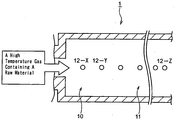
- Fig. 1 is a partial longitudinal front explanatory drawing of one example of a carbon black production furnace for producing the carbon black for blending with rubber.
- the rubber composition of the present invention contains carbon black for blending with rubber which is obtained in a reaction equipment continuously provided with a combustion gas-generating zone, a reaction zone and a reaction-stopping zone by producing a high temperature combustion gas in the combustion gas-generating zone, subsequently spraying and introducing a raw material into the reaction zone to form a reaction gas stream containing carbon black and then quenching the above reaction gas stream by a multistage quenching medium-introducing means to terminate the reaction.
- An inside of the carbon black production furnace is of a structure in which a combustion zone, a reaction zone and a reaction-stopping zone are continuously provided, and a whole part thereof is covered with a refractory.
- the carbon black production furnace is equipped with a combustible fluid-introducing chamber as the combustion zone, a cylinder for introducing an oxygen-containing gas in which an oxygen-containing gas introduced from an outer circumference of a furnace head part through an oxygen-containing gas-introducing tube is straightened by means of a current plate and introduced into the combustible fluid-introducing chamber and a fuel oil-spraying device introducing tube which is installed in a central axis of the cylinder for introducing an oxygen-containing gas and which introduces hydrocarbon for a fuel into the combustible fluid-introducing chamber.
- a high temperature combustion gas is produced in the combustion zone by combustion of the hydrocarbon for a fuel.
- the carbon black production furnace is equipped with a converging chamber as the reaction zone in which the cylinder converges gradually, a raw material oil-introducing chamber having, for example, four fuel oil-spraying ports at a downstream side of the converging chamber and a reaction chamber at a downstream side of the fuel oil-introducing chamber.
- a raw material hydrocarbon is sprayed and introduced through the fuel oil-spraying ports into a high temperature combustion gas stream coming from the combustion zone.
- the raw material hydrocarbon is sprayed and introduced into the high temperature combustion gas stream in the reaction zone to convert the raw material hydrocarbon into carbon black by incomplete combustion or thermal cracking reaction.
- Fig. 1 is a partial longitudinal front explanatory drawing of one example of the above carbon black production furnace for producing the above carbon black for blending with rubber, and it shows a reaction chamber 10 into which a high temperature gas containing a raw material (raw material hydrocarbon) for carbon black is introduced and a reaction continuing-cum-cooling chamber 11.
- the carbon black production furnace 1 is equipped with the reaction continuing-cum-cooling chamber 11 having a multistage quenching medium-introducing means 12 as the reaction-stopping zone.
- the multistage quenching medium-introducing means 12 sprays a quenching medium such as water and the kike onto the high temperature combustion gas stream coming from the combustion zone.
- the high temperature combustion gas stream is quenched by the quenching medium in the reaction-stopping zone to terminate the reaction.
- the carbon black production furnace 1 may be equipped with a device for introducing a gaseous substance in the reaction zone or the reaction-stopping zone.
- a device for introducing a gaseous substance in the reaction zone or the reaction-stopping zone a mixture of air, oxygen and hydrocarbon, a combustion gas obtained by combustion reaction thereof and the like can be used as the "gaseous substance".
- an average reaction temperature and a retention time in the respective zones through which the reaction gas stream passes until it goes into the reaction-stopping zone are controlled in production of the carbon black to set the toluene extract light transmittances X, Y and Z to the desired values, whereby the carbon black for blending with rubber which is used for the rubber composition of the present invention is obtained.
- the combustion zone is a region in which a high temperature gas stream is produced by reaction of a fuel and air, and a downstream end thereof shows a point in which the raw material oil is introduced into the reaction equipment (when introduced in the plural positions, an uppermost stream side), for example, an upper stream side (left side in Fig. 1 ) than a point in which the raw material oil is introduced.
- the reaction zone shows a zone from a point in which the raw material hydrocarbon is introduced (when introduced in the plural positions, an uppermost stream side) up to a point in which the multistage quenching water-spraying means 12 (these means are freely taken out and put in in the reaction continuing-cum-cooling chamber 11, and use positions thereof are selected according to the kind of the products produced and the characteristics thereof) in the reaction continuing-cum-cooling chamber 11 work (introducing a refrigerant such as water and the like). That is, in a case where the raw material oil is introduced, for example, in the third raw material oil-spraying port and where water is introduced in the multistage quenching medium-introducing means 12, a region between them is the reaction zone.
- the reaction-stopping zone shows a zone present at a lower side (right side in Fig. 1 ) than the point in which the quenching water-pressing and spraying means is allowed to work.
- reaction continuing-cum-cooling chamber 11 is used in Fig. 1 because of the following reasons; a zone from the point in which the raw material is introduced up to the point in which the quenching water-pressing and spraying means for stopping the reaction works is the reaction zone, and a zone following it is the reaction-stopping zone; and the above quenching water-introducing position moves in a certain case according to performances required to the carbon black.
- the carbon black for blending with rubber obtained in the manner described above has to satisfy the following relational equations (1) and (2): 10 ⁇ X ⁇ 40 90 ⁇ Z ⁇ 100
- X described above represents a toluene extract light transmittance (%) of the carbon black after introducing the quenching medium from the raw material-introducing position by the first quenching medium-introducing means (12-X in Fig. 1 ), and Z described above represents a toluene extract light transmittance (%) of the carbon black after introducing the quenching medium by the final quenching medium-introducing means (12-Z in Fig. 1 ).
- a toluene extract light transmittance of the carbon black after introducing the first quenching medium has to fall in a range of higher than 10 % and less than 40 %
- a toluene extract light transmittance of the carbon black (carbon black for blending with rubber) after introducing the final quenching medium has to fall in a range of higher than 90 % and less than 100 %. If a toluene extract light transmittance of the above carbon black for blending with rubber is 90 % or less, a heavy tar component contained in the above carbon black is present in a large amount, and the carbon black can not provide the rubber with a sufficiently high reinforcing property, and an abrasion resistance thereof is reduced.
- the carbon black is reduced in a reinforcing property to lower an abrasion resistance thereof.
- the carbon black for blending with rubber having the above properties can be obtained by controlling the reaction temperature and the retention time in the following manner.
- the above carbon black for blending with rubber can be obtained by controlling the above factors so that the following relational equations (3), (4) and (5) are satisfied: 2.00 ⁇ ⁇ 1 ⁇ 5.00 ⁇ ⁇ 2 ⁇ 9.00 ⁇ 2.5 ⁇ ⁇ 1 + ⁇ 2 + 85.0 ⁇ ⁇ ⁇ 90.0 (wherein ⁇ 1 is t 1 ⁇ T 1 ; ⁇ 2 is t 2 ⁇ T 2 ; and is t 3 ⁇ T 3 ),
- the carbon black production furnace 1 assumes a structure in which thermocouples can be inserted into the furnace at optional several spots in order to monitor a temperature of the furnace.
- the temperatures are preferably measured at least at 2 spots, desirably 3 to 4 spots in the respective steps (respective zones) in order to calculate the average reaction temperatures T 11 , T 2 and T 3 .
- the retention times t 1 , t 2 and t 3 shall be calculated according to the following equations by calculating a volume of the introduced reaction gas fluid according to a publicly known thermodynamic calculating method. Incidentally, an increase in the volume brought about by the cracking reaction of the raw material oil and the quenching medium shall be neglected.
- Retention time t 1 (second) (capacity (m 3 ) passing in the furnace from the raw material hydrocarbon-introducing position up to the first quenching medium-introducing position) / (volume (m 3 /sec) of the reaction gas fluid)
- Retention time t 2 (second) (capacity (m 3 ) passing in the furnace from the first quenching medium-introducing position up to the second quenching medium-introducing position) / (volume (m 3 /sec) of the reaction gas fluid)
- Retention time t 3 (second) (capacity (m 3 ) passing in the furnace from the second quenching medium-introducing position up to the final quenching medium-introducing position) / (volume (m 3 /sec) of the reaction gas fluid)
- carbon black which is obtained by controlling the factors so that the following relational equations (6), (7) and (8) are satisfied can suitably be used as the above carbon black for blending with rubber: 20 ⁇ X ⁇ 40 50 ⁇ Y ⁇ 60 90 ⁇ Z ⁇ 95 (wherein Y represents a toluene extract light transmittance of the carbon black after introducing the second quenching medium, and X and Z are the same as described above).
- the toluene extract light transmittance described above is measured by a method described in an eighth item B method of JIS K6218 : 1997 and shown by a percentage based on that of pure toluene.
- the above carbon black for blending with rubber has a hydrogen discharge rate exceeding 0.3 % by mass. If the above hydrogen discharge rate exceeds 0.3 % by mass, the rubber composition of the present invention is enhanced in an abrasion resistance and reduced in a heat generation property.
- the above hydrogen discharge rate is preferably 0.35 % by mass or more. An upper limit thereof is usually about 0.4 % by mass.
- the hydrogen discharge rate described above is determined in the following manner:
- the above carbon black for blending with rubber has preferably a dibutyl phthalate absorption number (DBP) of 95 to 220 mL/100 g, a compression DBP absorption number (24 M4DBP) of 90 to 200 mL/100 g and a cetyltrimethylammonium bromide absorption specific surface area (CTAB) of 70 200 m 2 /g.
- DBP dibutyl phthalate absorption number
- 24 M4DBP compression DBP absorption number
- CTAB cetyltrimethylammonium bromide absorption specific surface area
- the dibutyl phthalate absorption number (DBP) and the compression DBP absorption number (24M4DBP) are measured by methods described in ASTM D2414-88 (JIS K6217-4 : 2001) and shown by volume mL of dibutyl phthalate (DBP) absorbed in 100 g of carbon black.
- the cetyltrimethylammonium bromide absorption specific surface area (CTAB) is measured by a method described in JIS K6217-3 : 2001 and shown by a specific surface area m 2 /g per unit mass of carbon black.
- the rubber composition of the present invention has to contain (B) the carbon black for blending with rubber described above in a proportion of 10 to 250 parts by mass based on 100 parts by mass of (A) the rubber component containing a conjugated diene based rubber.
- a content of the carbon black of the component (B) described above is preferably 20 to 150 parts by mass, more preferably 30 to 120 parts by mass based on 100 parts by mass of (A) the rubber component.
- Carbon black which is produced by the method described above and which has the physical properties described above is used as the carbon black for blending with rubber of the component (B) described above, and the form of the above carbon black includes FEF, SRF, HAF, ISAF, ISAF-LS, SAF-LS and the like.
- the conjugated diene based rubber contained in (A) the rubber component includes at least one selected from natural rubber, polybutadiene rubber, styrene-butadiene copolymer rubber, synthetic isoprene rubber, ethylene-propylene-diene rubber, chloroprene rubber and the like, and all of (A) the rubber component comprise preferably the conjugated diene based rubber.
- a modified conjugated diene based polymer obtained by modifying at least one molecular end thereof by a modifier comprising a compound containing a functional group having an interaction with the carbon black is contained further preferably in (A) the rubber component from the viewpoint of a balance between an abrasion resistance and a low rolling resistance of the rubber composition obtained.
- the modifier described above includes at least one selected from tin compounds, amine compounds and silicon compounds.
- the conjugated diene based polymer modified at at least one molecular end thereof by the above modifiers includes modified polybutadiene rubbers, modified styrene-butadiene copolymer rubbers and the like.
- the above modified conjugated diene based polymers is contained in (A) the rubber component described above in a proportion of preferably 10 % by mass or more, more preferably 30 % by mass or more based on a whole amount thereof from the viewpoint of a balance between an abrasion resistance and a low rolling resistance of the above rubber composition.
- the tin compounds of the modifier described above include tin tetrachloride, dichlorodioctyltin, trioctyltin chloride, dibutyldichlorotin and the like.
- the amine compounds include N,N-diethylbenzaldehyde, bis(N,N-diethylamino)benzophenone and the like.
- the silicon compounds include N,N-bis(trimethylsilyl)aminopropylmethyldimethoxysilane, N,N-bis(trimethylsilyl)aminopropylmethyldiethoxysilane, N,N-bis(trimethylsilyl)aminoethylmethyldimethoxysilane, N,N-bis(trimethylsilyl)aminoethylmethyldiethoxysilane, 1-trimethylsilyl-2,2-diethoxymethyl-1-aza-2-silacyclopentane, triethoxysilylpropyldihydroimidazole, methylbutylidenetriethoxysilylpropylamine, 3-glycidoxypropyltrimethoxysilane, 3-glycidoxypropyltriethoxysilane, tetraethoxysilane and the like.
- a use amount of the modifiers is preferably 0.5 to 200 mmol/kg•conjugated diene polymer or conjugated diene-aromatic vinyl copolymer.
- the above content is more preferably 1 to 100 mmol/kg•conjugated diene-aromatic vinyl copolymer or conjugated diene polymer, particularly preferably 2 to 50 mmol/kg•conjugated diene-aromatic vinyl copolymer or conjugated diene polymer.
- the conjugated diene polymer or the conjugated diene-aromatic vinyl copolymer means a mass of only the polymer which does not contain additives such as an antioxidant and the like added in or after production. Controlling a use amount of the modifier to the ranges described above makes the filler excellent in a dispersibility and improves the mechanical characteristics, the abrasion resistance and the low fuel consumption after vulcanization.
- a condensation accelerator may be used in order to accelerate condensation reaction which an alkoxysilane compound used as the modifier described above participates in.
- condensation accelerator compounds having a tertiary amino group or organic compounds containing at least one element belonging to any of the 3rd group, the 4th group, the 5th group, the 12th group, the 13th group, the 14th group and the 15th group in the periodic table (long-form).
- the condensation accelerator is preferably alkoxides, carboxylates or acetylacetonate complex salts containing at least one metal selected from the group consisting of titanium (Ti), zirconium (Zr), bismuth (Bi), aluminum (Al) and tin (Sn).
- the condensation accelerator used above can be added before the modification reaction described above, and it is added to the modification reaction system preferably in the middle of the modification reaction and/or after finishing the modification reaction. If it is added before the modification reaction, direct reaction with an active end is brought about, and a hydrocarbyloxy group having a primary amino group protected by the active end is not introduced in a certain case.
- An addition timing of the condensation accelerator is usually 5 minutes to 5 hours after initiating the modification reaction, preferably 15 minutes to 1 hour after initiating the modification reaction.
- conjugated diene based polymer Capable of being used as the modified conjugated diene based polymer described above are compounds obtained by reacting the modifiers described above with active ends of conjugated diene based polymers prepared by carrying out anionic polymerization using organic alkali metal compounds or active ends of conjugated diene based polymers prepared by carrying out coordinate polymerization using rare earth metal compounds.
- Hydrocarbyllithium compounds, lithium amide compounds or first group metal alkoxides are preferably used as the organic alkali metal compounds.
- First group metals of the first group metal alkoxides include lithium, sodium, potassium, rubidium, cesium and the like.
- the lithium amide compounds are used as the polymerization initiator, conjugated diene based polymers which have a nitrogen-containing functional group at a polymerization initiation end and in which the other end is a polymerization active site are obtained, and the above polymers can be used as the modified conjugated diene based polymer in the present invention without being modified by the modifier.
- a method in which the conjugated diene based polymers having an active end are produced by anionic polymerization using the organic alkali metal compounds described above as the polymerization initiator shall not specifically be restricted, and a conjugated diene compound alone or a mixture of a conjugated diene compound and an organic vinyl compound is polymerized on publicly known conditions in a hydrocarbon solvent which is inactive to the polymerization reaction, whereby the conjugated diene based polymers having an active end can be produced.
- the above anionic polymerization may be carried out in the presence of a randomizer.
- the rubber composition of the present invention can be blended with, in addition to (A) the rubber component containing a conjugated diene based rubber and (B) the carbon black for blending with rubber, other components, for example, blending agents usually used in the rubber industry, such as inorganic fillers, vulcanizing agents, vulcanization accelerators, zinc oxide, stearic acid, antioxidants and the like by suitably selecting them in a range in which the effects of the present invention are not damaged. Commercial products can suitably be used as the above blending agents.
- the rubber composition described above can be prepared by blending the respective blending agents suitably selected with (A) the rubber component and (B) the carbon black for blending with rubber, kneading the mixture by means of a Banbury mixer, a roll, an internal mixer, an intensive mixer and the like and then warming and extruding it.
- the pneumatic tire of the present invention is characterized by that the rubber composition described above is applied to any of tire members.
- the rubber composition of the present invention is used particularly preferably for a tread in the tire of the present invention, and the tire in which the rubber composition described above is used for a tread is excellent in an abrasion resistance, low in a rolling resistance and excellent as well in a low fuel consumption.
- Gas filled in the tire of the present invention includes air which is usual or changed in an oxygen partial pressure or inert gases such as nitrogen and the like.
- the rubber composition of the present invention When used for a tread, it is extruded and processed into, for example, a member for a tread, and the member is adhered on a tire and molded by a usual method in a tire molding machine, whereby a crude tire is molded. This crude tire is heated and pressed in a vulcanizing equipment to obtain a tire.
- the tires for a test were mounted on a vehicle and run 40,000 km, and then a loss weight of the groove portion was measured and shown by an index, wherein an inverse number of a loss weight value of a tire prepared in Comparative Example 1 was set to 100.
- Rolling resistance index rolling resistance value of the tire for a test ⁇ 100 / rolling resistance value of the tire of Comparative Example 1
- a toluene extract light transmittance, a hydrogen discharge rate, a DBP absorption number, a 24M4DBP absorption number and a CTAB adsorption specific surface area of the carbon black were measured according to the methods described in the present specification.
- the carbon black production furnace shown in Fig. 1 was used to produce carbon black A, wherein a three stage quenching medium-introducing means comprising a first quenching medium-introducing means 12-X, a second quenching medium-introducing means 12-Y and a final quenching medium-introducing means 12-Z was used as a multistage quenching medium-introducing means 12 in Fig. 1 .
- thermocouples could be inserted into the furnace at optional several spots in order to monitor a temperature of the furnace.
- an A heavy oil having a specific density of 0.8622 (15°C/4°C) was used for a fuel, and a heavy oil having properties shown in Table 1 was used for raw material oil.
- Operating conditions of the carbon black production furnace and characteristics of carbon black are shown in Table 3.
- Carbon blacks B to K were produced in the same manner as in Production Example 1, except that operating conditions shown in Table 3 were employed. The characteristics of the respective carbon blacks are shown in Table 3.
- a pressure-proof glass vessel having a content volume of about 900 ml which was dried and substituted with nitrogen was charged with 283 g of cyclohexane, 100 g of a 1,3-butadiene monomer and 0.015 mmol of 2,2-ditetrahydrofurylpropane in the form of a cyclohexane solution, and 0.50 mmol of n-butyllithium (BuLi) was added thereto, followed by carrying out polymerization for 4.5 hours in a warm water bath of 50°C which was equipped with a stirring device. The conversion rate was almost 100 %.
- N,N-bis(trimethylsilyl)-aminopropylmethyldiethoxysilane 0.50 mmol was added to the above polymerization system in the form of a cyclohexane solution, and the mixture was stirred at 50°C for 30 minutes. Thereafter, 0.5 ml of an isopropanol 5 mass % solution of 2,6-di-tert-butyl-p-cresol (BHT) was further added to terminate the reaction, and the solution was dried according to an ordinary method to thereby obtain a modified polybutadiene rubber.
- the modified polybutadiene rubber thus obtained had a vinyl bond content of 20 %.
- a polybutadiene rubber before modified had a weight average molecular weight (Mw) of 300,000 in terms of polystyrene, which was measured by GPC.
- Example 1 to 5 7 and 8 and Comparative Examples 1 to 4, the respective carbon blacks A to K shown in Table 3 were used to prepare 11 kinds of rubber compositions blended with the rubber composition 1 shown in Table 2 by means of a Banbury mixer.
- Example 6 the carbon black E shown in Table 3 was used to prepare a rubber composition blended with the rubber composition 2 (the modified polybutadiene rubber was used) shown in Table 2 by means of the Banbury mixer.
- Example 9 the carbon black A shown in Table 3 was used to prepare a rubber composition blended with the rubber composition 3 shown in Table 2 by means of the Banbury mixer.
- Example 10 the carbon black A shown in Table 3 was used to prepare a rubber composition blended with the rubber composition 4 shown in Table 2 by means of the Banbury mixer.
- Modified polybutadiene rubber modified polybutadiene rubber obtained in Production Example 12
- Carbon black carbon blacks obtained in Production Examples 1 to 11
- Antioxidant 6C N-(1,3-dimethylbutyl)-N'-phenyl-p-phenylenediamine, trade name "Nocrac 6C", manufactured by Ouchi Shinko Chemical Industrial Co., Ltd. 6)
- Vulcanization accelerator CZ N-cyclohexyl-2-benzothiazylsulfenamide, trade name "Nocceler CZ", manufactured by Ouchi Shinko Chemical Industrial Co., Ltd.
- the rubber compositions of the present invention are blended with carbon blacks which are obtained by the specific process and which have the specific properties, whereby pneumatic tires in which an abrasion resistance and a low heat generation property (low rolling resistance) are balanced at a high level can be provided.
Landscapes
- Chemical & Material Sciences (AREA)
- Organic Chemistry (AREA)
- Engineering & Computer Science (AREA)
- Mechanical Engineering (AREA)
- Health & Medical Sciences (AREA)
- Chemical Kinetics & Catalysis (AREA)
- Medicinal Chemistry (AREA)
- Polymers & Plastics (AREA)
- Compositions Of Macromolecular Compounds (AREA)
- Tires In General (AREA)
Claims (9)
- Composition de caoutchouc contenant du noir de carbone destiné à être mélangé à du caoutchouc qui est obtenue dans un appareil de réaction comportant de façon continue une zone de génération de gaz de combustion, une zone de réaction et une zone d'arrêt de réaction, par génération d'un gaz de combustion à haute température dans la zone de génération de gaz de combustion, puis pulvérisation et introduction d'une matière première dans la zone de réaction pour former un flux gazeux réactionnel contenant du noir de carbone, et ensuite refroidissement du flux gazeux réactionnel susmentionné dans la zone d'arrêt de réaction par un moyen permettant d'introduire un fluide de refroidissement à plusieurs étages pour mettre fin à la réaction,
dans laquelle(1) le noir de carbone susmentionné destiné à être mélangé avec du caoutchouc satisfait aux équations relationnelles suivantes (1) et (2) :
 (2) (B) le noir de carbone susmentionné destiné à être mélangé à du caoutchouc est contenu dans une proportion de 10 à 250 parties en masse, basée sur 100 parties en masse (A) d'un composant de caoutchouc contenant un caoutchouc à base de diène conjugué, caractérisée en ce qu'un taux d'évacuation d'hydrogène du noir de carbone destiné à être mélangé à du caoutchouc est supérieur à 0,30 % en masse tel qu'il est déterminé par (1), un échantillon de noir de carbone est séché pendant une heure à 105° C dans une étuve régulée en température, puis refroidi à température ambiante dans un dessicateur,(2) environ 10 mg de l'échantillon est pesé avec précision dans un récipient d'échantillon tubulaire en étain, puis comprimé et le récipient est bouché hermétiquement, et(3) la quantité d'hydrogène gazeux produite en chauffant l'échantillon à 2000 °C pendant 15 minutes sous un flux d'argon est mesurée au moyen d'un appareil d'analyse d'hydrogène (EMGA621W, fabriqué par HORIBA Ltd.) et exprimée en pourcentage de masse.
 - Composition de caoutchouc selon la revendication 1, dans laquelle le noir de carbone destiné à être mélangé à du caoutchouc est obtenu en contrôlant les facteurs suivants de sorte à satisfaire aux équations relationnelles suivantes (3), (4), et (5) :



t3 (en secondes) est un temps de rétention passé dans la zone depuis l'introduction du second fluide de refroidissement jusqu'à l'introduction du fluide de refroidissement final, et T3 (°C) est une température moyenne de réaction dans la zone de réaction susmentionnée ; α1 = t1 x T1 ; α2 = t2 x T2 ; et β = t3 x T3). - Composition de caoutchouc selon la revendication 1 ou 2, dans laquelle le noir de carbone destiné à être mélangé à du caoutchouc est obtenu en contrôlant les facteurs de sorte à satisfaire aux équations relationnelles suivantes (6), (7) et (8) :



- Composition de caoutchouc selon l'une quelconque des revendications 1 à 3, dans laquelle le noir de carbone destiné à être mélangé à du caoutchouc a un indice d'absorption DBP de 95 à 220 ml/100 g (mesuré par des méthodes décrites dans la norme ASTM D2414-88 (JIS K6217-4: 2001), a un indice d'absorption 24 M4-DBP de 90 à 200 ml/100 g (mesuré par des méthodes décrites dans la norme ASTM D2414-88 (JIS K6217-4: 2001), et une surface spécifique d'adsorption CTAB de 70 à 200 m2/g (mesurée par une méthode décrite dans le brevet JIS K6217-3: 2001).
- Composition de caoutchouc selon l'une quelconque des revendications 1 à 4, dans laquelle (A) le composant de caoutchouc contient un polymère à base de diène conjugué modifié obtenu en modifiant au moins une extrémité moléculaire de celui-ci par un agent modificateur comprenant un composé contenant un groupe fonctionnel ayant une interaction avec le noir de carbone.
- Composition de caoutchouc selon la revendication 5, dans laquelle l'agent modificateur est au moins l'un sélectionné parmi un composé d'étain, un composé amine et un composé de silicium.
- Composition de caoutchouc selon la revendication 5 ou 6, dans laquelle le polymère à base de diène conjugué modifié est contenu dans une proportion de 10 % en masse ou plus par rapport à la quantité totale (A) du composant de caoutchouc.
- Composition de caoutchouc selon l'une quelconque des revendications 5 à 7, dans laquelle le polymère à base de diène conjugué modifié est obtenu en faisant réagir l'agent modificateur avec une extrémité active d'un polymère à base de diène conjugué préparé par polymérisation en utilisant un composé organique d'un métal alcalin ou un composé d'un métal de terre rare.
- Pneumatique fabriqué en utilisant la composition de caoutchouc selon l'une quelconque des revendications 1 à 8.
Applications Claiming Priority (2)
| Application Number | Priority Date | Filing Date | Title |
|---|---|---|---|
| JP2008256369 | 2008-10-01 | ||
| PCT/JP2009/067013 WO2010038768A1 (fr) | 2008-10-01 | 2009-09-30 | Composition de caoutchouc et pneu fabriqué au moyen de celle-ci |
Publications (3)
| Publication Number | Publication Date |
|---|---|
| EP2348068A1 EP2348068A1 (fr) | 2011-07-27 |
| EP2348068A4 EP2348068A4 (fr) | 2015-01-07 |
| EP2348068B1 true EP2348068B1 (fr) | 2017-01-04 |
Family
ID=42073528
Family Applications (1)
| Application Number | Title | Priority Date | Filing Date |
|---|---|---|---|
| EP09817800.7A Revoked EP2348068B1 (fr) | 2008-10-01 | 2009-09-30 | Composition de caoutchouc et pneu fabriqué au moyen de celle-ci |
Country Status (7)
| Country | Link |
|---|---|
| US (1) | US8633272B2 (fr) |
| EP (1) | EP2348068B1 (fr) |
| JP (1) | JP5291717B2 (fr) |
| CN (2) | CN102171285B (fr) |
| BR (1) | BRPI0920726A2 (fr) |
| RU (1) | RU2512349C2 (fr) |
| WO (1) | WO2010038768A1 (fr) |
Families Citing this family (11)
| Publication number | Priority date | Publication date | Assignee | Title |
|---|---|---|---|---|
| WO2011125637A1 (fr) * | 2010-03-31 | 2011-10-13 | 株式会社ブリヂストン | Composition de caoutchouc et pneu l'utilisant |
| NL2011151C2 (en) | 2012-07-13 | 2015-03-24 | Cabot Corp | High structure carbon blacks. |
| EP2995645B1 (fr) * | 2013-05-07 | 2018-07-04 | Bridgestone Corporation | Composition de caoutchouc et pneu l'utilisant |
| WO2014189102A1 (fr) * | 2013-05-24 | 2014-11-27 | 株式会社ブリヂストン | Composition de caoutchouc |
| JP5914727B2 (ja) * | 2014-05-28 | 2016-05-11 | 株式会社ブリヂストン | タイヤトレッド用ゴム組成物の製造方法、及びその方法で得られたゴム組成物をタイヤトレッドに配設するタイヤの製造方法 |
| CN106687518B (zh) * | 2014-09-12 | 2019-04-02 | Dic株式会社 | 橡胶与金属的粘接促进剂、橡胶组合物及轮胎 |
| JP2019001958A (ja) * | 2017-06-19 | 2019-01-10 | 株式会社ブリヂストン | ゴム組成物、及びタイヤ |
| EP3851489A4 (fr) | 2018-09-14 | 2022-06-15 | Bridgestone Corporation | Copolymère multi-constituants modifié, composition de caoutchouc, composition de résine, pneu et produit de résine |
| JP7421325B2 (ja) * | 2019-12-19 | 2024-01-24 | 旭カーボン株式会社 | タイヤ用ゴム組成物に用いるカーボンブラック |
| JP7530171B2 (ja) * | 2019-12-19 | 2024-08-07 | 株式会社ブリヂストン | ゴム組成物、タイヤ用ゴム組成物、及びタイヤ |
| JP7693436B2 (ja) * | 2021-07-30 | 2025-06-17 | 株式会社ブリヂストン | タイヤトレッド用ゴム組成物、及びタイヤ |
Citations (3)
| Publication number | Priority date | Publication date | Assignee | Title |
|---|---|---|---|---|
| US6084022A (en) | 1997-09-22 | 2000-07-04 | The Goodyear Tire & Rubber Company | Tire tread compositions containing asymmetrically tin-coupled polybutadiene rubber |
| EP1616905A1 (fr) | 2003-04-22 | 2006-01-18 | Bridgestone Corporation | Composition de caoutchouc et pneumatique dans lequel elle est utilisee |
| EP1958986A1 (fr) | 2005-12-07 | 2008-08-20 | Bridgestone Corporation | Composition de caoutchouc et pneu l utilisant |
Family Cites Families (15)
| Publication number | Priority date | Publication date | Assignee | Title |
|---|---|---|---|---|
| JPH0694519B2 (ja) * | 1985-03-12 | 1994-11-24 | 株式会社ブリヂストン | タイヤトレツド用ゴム組成物 |
| US5674798A (en) | 1992-10-16 | 1997-10-07 | Bridgestone Corporation | Hydrocarbon soluble anionic polymerization initiators |
| WO1993019578A2 (fr) * | 1993-07-14 | 1993-10-14 | Bridgestone Corporation | Composition de caoutchouc pour bande de roulement de pneumatique |
| CA2161385C (fr) | 1994-10-25 | 2007-06-05 | David F. Lawson | Polymeres amines et produits derives |
| DE19840663A1 (de) * | 1998-09-05 | 2000-03-09 | Degussa | Ruß |
| JP2000080302A (ja) * | 1998-09-07 | 2000-03-21 | Tokai Carbon Co Ltd | ハード系ハイストラクチャーカーボンブラック及び該カーボンブラックを配合したゴム組成物 |
| US6670416B1 (en) * | 1999-08-18 | 2003-12-30 | The Goodyear Tire & Rubber Company | Tread rubber for high traction tires |
| US6645287B2 (en) * | 2001-04-27 | 2003-11-11 | Cabot Corporation | Coating compositions comprising high t-area carbon products |
| AU2002353093A1 (en) * | 2001-12-10 | 2003-07-09 | Exxonmobil Chemical Patents Inc. | Elastomeric compositions |
| WO2005092970A1 (fr) * | 2004-03-25 | 2005-10-06 | Bridgestone Corporation | Composition caoutchouteuse pour bande de roulement et bandage pneumatique utilisant celle-ci |
| JP5027989B2 (ja) * | 2004-03-25 | 2012-09-19 | 旭カーボン株式会社 | タイヤトレッド用カーボンブラックの製造方法 |
| JP2005272734A (ja) | 2004-03-25 | 2005-10-06 | Asahi Carbon Kk | タイヤトレッドゴム配合用カーボンブラック |
| JP2006143822A (ja) * | 2004-11-17 | 2006-06-08 | Bridgestone Corp | タイヤ用ゴム組成物 |
| JP5350577B2 (ja) * | 2005-09-15 | 2013-11-27 | 株式会社ブリヂストン | ゴム組成物およびそれを用いたタイヤ |
| RU2308469C1 (ru) * | 2006-01-24 | 2007-10-20 | Семен Моисеевич Кавун | Вулканизуемая резиновая смесь для низкогистерезисных протекторов шин с улучшенными сцепными свойствами и износостойкостью |
-
2009
- 2009-09-30 JP JP2010531873A patent/JP5291717B2/ja not_active Expired - Fee Related
- 2009-09-30 CN CN200980138982.8A patent/CN102171285B/zh active Active
- 2009-09-30 EP EP09817800.7A patent/EP2348068B1/fr not_active Revoked
- 2009-09-30 WO PCT/JP2009/067013 patent/WO2010038768A1/fr not_active Ceased
- 2009-09-30 CN CN201410797576.5A patent/CN104530497A/zh active Pending
- 2009-09-30 US US13/122,100 patent/US8633272B2/en not_active Expired - Fee Related
- 2009-09-30 BR BRPI0920726A patent/BRPI0920726A2/pt not_active Application Discontinuation
- 2009-09-30 RU RU2011112366/05A patent/RU2512349C2/ru active
Patent Citations (3)
| Publication number | Priority date | Publication date | Assignee | Title |
|---|---|---|---|---|
| US6084022A (en) | 1997-09-22 | 2000-07-04 | The Goodyear Tire & Rubber Company | Tire tread compositions containing asymmetrically tin-coupled polybutadiene rubber |
| EP1616905A1 (fr) | 2003-04-22 | 2006-01-18 | Bridgestone Corporation | Composition de caoutchouc et pneumatique dans lequel elle est utilisee |
| EP1958986A1 (fr) | 2005-12-07 | 2008-08-20 | Bridgestone Corporation | Composition de caoutchouc et pneu l utilisant |
Non-Patent Citations (3)
| Title |
|---|
| "EMGA Series for Windows - EMGA-620W Series for OXYGEN/NITROGEN, EMGA-620W/C Series for OXYGEN/NITROGEN, EMGA-621W for HYDROGEN", HORIBA BROCHURE, 2004, pages 1 - 11, XP055431082 |
| "Kirk-Othmer Encyclopedia of Chemical Technology, 5th ed.", vol. 4, 2004, WILEY-INTERSCIENCE, article "Carbon Black", pages: 761 - 778, XP055431072 |
| "Standard Test Method for Carbon Black Extractables - Transmittance of Toluene Extract", ASTM D1618 - 99, 2011, pages 1 - 3, XP055431076 |
Also Published As
| Publication number | Publication date |
|---|---|
| RU2512349C2 (ru) | 2014-04-10 |
| JPWO2010038768A1 (ja) | 2012-03-01 |
| EP2348068A1 (fr) | 2011-07-27 |
| WO2010038768A1 (fr) | 2010-04-08 |
| BRPI0920726A2 (pt) | 2015-12-29 |
| CN104530497A (zh) | 2015-04-22 |
| EP2348068A4 (fr) | 2015-01-07 |
| CN102171285A (zh) | 2011-08-31 |
| US8633272B2 (en) | 2014-01-21 |
| CN102171285B (zh) | 2015-11-25 |
| JP5291717B2 (ja) | 2013-09-18 |
| US20110224364A1 (en) | 2011-09-15 |
| RU2011112366A (ru) | 2012-10-10 |
Similar Documents
| Publication | Publication Date | Title |
|---|---|---|
| US8633272B2 (en) | Rubber composition and pneumatic tire produced using same | |
| EP3181631B1 (fr) | Pneumatique | |
| JP5374007B2 (ja) | タイヤトレッド用ゴム組成物及びこれを用いた空気入りタイヤ | |
| EP3178879B1 (fr) | Pneu | |
| EP1728820B1 (fr) | Composition caoutchouteuse pour bande de roulement et bandage pneumatique utilisant celle-ci | |
| EP2995645B1 (fr) | Composition de caoutchouc et pneu l'utilisant | |
| EP3006495B1 (fr) | Composition de caoutchouc | |
| JP5027989B2 (ja) | タイヤトレッド用カーボンブラックの製造方法 | |
| JP2012087173A (ja) | ゴム組成物及びそれを用いたタイヤ | |
| JP2010144011A (ja) | タイヤトレッドゴム配合用カーボンブラック、それを用いたタイヤ用ゴム組成物および自動車用タイヤ | |
| CN102245694A (zh) | 胎面用橡胶组合物及使用该橡胶组合物的轮胎 | |
| JP2005272734A (ja) | タイヤトレッドゴム配合用カーボンブラック | |
| JP5697304B2 (ja) | カーボンブラックの製造方法 | |
| JP2010144003A (ja) | カーボンブラックの製造方法、それより得られたカーボンブラックおよびそれを含有するゴム組成物 | |
| JP2006143822A (ja) | タイヤ用ゴム組成物 | |
| JP5917942B2 (ja) | ゴム組成物の製造方法および空気入りタイヤの製造方法 | |
| JP2649200B2 (ja) | ゴム組成物 |
Legal Events
| Date | Code | Title | Description |
|---|---|---|---|
| PUAI | Public reference made under article 153(3) epc to a published international application that has entered the european phase |
Free format text: ORIGINAL CODE: 0009012 |
|
| 17P | Request for examination filed |
Effective date: 20110401 |
|
| AK | Designated contracting states |
Kind code of ref document: A1 Designated state(s): AT BE BG CH CY CZ DE DK EE ES FI FR GB GR HR HU IE IS IT LI LT LU LV MC MK MT NL NO PL PT RO SE SI SK SM TR |
|
| AX | Request for extension of the european patent |
Extension state: AL BA RS |
|
| DAX | Request for extension of the european patent (deleted) | ||
| A4 | Supplementary search report drawn up and despatched |
Effective date: 20141209 |
|
| RIC1 | Information provided on ipc code assigned before grant |
Ipc: C08L 21/00 20060101AFI20141202BHEP Ipc: C08K 3/04 20060101ALI20141202BHEP Ipc: B60C 1/00 20060101ALI20141202BHEP |
|
| GRAP | Despatch of communication of intention to grant a patent |
Free format text: ORIGINAL CODE: EPIDOSNIGR1 |
|
| INTG | Intention to grant announced |
Effective date: 20160729 |
|
| GRAS | Grant fee paid |
Free format text: ORIGINAL CODE: EPIDOSNIGR3 |
|
| GRAA | (expected) grant |
Free format text: ORIGINAL CODE: 0009210 |
|
| AK | Designated contracting states |
Kind code of ref document: B1 Designated state(s): AT BE BG CH CY CZ DE DK EE ES FI FR GB GR HR HU IE IS IT LI LT LU LV MC MK MT NL NO PL PT RO SE SI SK SM TR |
|
| REG | Reference to a national code |
Ref country code: GB Ref legal event code: FG4D |
|
| REG | Reference to a national code |
Ref country code: CH Ref legal event code: EP |
|
| REG | Reference to a national code |
Ref country code: AT Ref legal event code: REF Ref document number: 859209 Country of ref document: AT Kind code of ref document: T Effective date: 20170115 |
|
| REG | Reference to a national code |
Ref country code: IE Ref legal event code: FG4D |
|
| REG | Reference to a national code |
Ref country code: DE Ref legal event code: R096 Ref document number: 602009043594 Country of ref document: DE |
|
| REG | Reference to a national code |
Ref country code: LT Ref legal event code: MG4D Ref country code: NL Ref legal event code: MP Effective date: 20170104 |
|
| REG | Reference to a national code |
Ref country code: AT Ref legal event code: MK05 Ref document number: 859209 Country of ref document: AT Kind code of ref document: T Effective date: 20170104 |
|
| PG25 | Lapsed in a contracting state [announced via postgrant information from national office to epo] |
Ref country code: NL Free format text: LAPSE BECAUSE OF FAILURE TO SUBMIT A TRANSLATION OF THE DESCRIPTION OR TO PAY THE FEE WITHIN THE PRESCRIBED TIME-LIMIT Effective date: 20170104 |
|
| PG25 | Lapsed in a contracting state [announced via postgrant information from national office to epo] |
Ref country code: IS Free format text: LAPSE BECAUSE OF FAILURE TO SUBMIT A TRANSLATION OF THE DESCRIPTION OR TO PAY THE FEE WITHIN THE PRESCRIBED TIME-LIMIT Effective date: 20170504 Ref country code: LT Free format text: LAPSE BECAUSE OF FAILURE TO SUBMIT A TRANSLATION OF THE DESCRIPTION OR TO PAY THE FEE WITHIN THE PRESCRIBED TIME-LIMIT Effective date: 20170104 Ref country code: HR Free format text: LAPSE BECAUSE OF FAILURE TO SUBMIT A TRANSLATION OF THE DESCRIPTION OR TO PAY THE FEE WITHIN THE PRESCRIBED TIME-LIMIT Effective date: 20170104 Ref country code: GR Free format text: LAPSE BECAUSE OF FAILURE TO SUBMIT A TRANSLATION OF THE DESCRIPTION OR TO PAY THE FEE WITHIN THE PRESCRIBED TIME-LIMIT Effective date: 20170405 Ref country code: FI Free format text: LAPSE BECAUSE OF FAILURE TO SUBMIT A TRANSLATION OF THE DESCRIPTION OR TO PAY THE FEE WITHIN THE PRESCRIBED TIME-LIMIT Effective date: 20170104 Ref country code: NO Free format text: LAPSE BECAUSE OF FAILURE TO SUBMIT A TRANSLATION OF THE DESCRIPTION OR TO PAY THE FEE WITHIN THE PRESCRIBED TIME-LIMIT Effective date: 20170404 |
|
| PG25 | Lapsed in a contracting state [announced via postgrant information from national office to epo] |
Ref country code: BG Free format text: LAPSE BECAUSE OF FAILURE TO SUBMIT A TRANSLATION OF THE DESCRIPTION OR TO PAY THE FEE WITHIN THE PRESCRIBED TIME-LIMIT Effective date: 20170404 Ref country code: ES Free format text: LAPSE BECAUSE OF FAILURE TO SUBMIT A TRANSLATION OF THE DESCRIPTION OR TO PAY THE FEE WITHIN THE PRESCRIBED TIME-LIMIT Effective date: 20170104 Ref country code: PT Free format text: LAPSE BECAUSE OF FAILURE TO SUBMIT A TRANSLATION OF THE DESCRIPTION OR TO PAY THE FEE WITHIN THE PRESCRIBED TIME-LIMIT Effective date: 20170504 Ref country code: AT Free format text: LAPSE BECAUSE OF FAILURE TO SUBMIT A TRANSLATION OF THE DESCRIPTION OR TO PAY THE FEE WITHIN THE PRESCRIBED TIME-LIMIT Effective date: 20170104 Ref country code: SE Free format text: LAPSE BECAUSE OF FAILURE TO SUBMIT A TRANSLATION OF THE DESCRIPTION OR TO PAY THE FEE WITHIN THE PRESCRIBED TIME-LIMIT Effective date: 20170104 Ref country code: PL Free format text: LAPSE BECAUSE OF FAILURE TO SUBMIT A TRANSLATION OF THE DESCRIPTION OR TO PAY THE FEE WITHIN THE PRESCRIBED TIME-LIMIT Effective date: 20170104 Ref country code: LV Free format text: LAPSE BECAUSE OF FAILURE TO SUBMIT A TRANSLATION OF THE DESCRIPTION OR TO PAY THE FEE WITHIN THE PRESCRIBED TIME-LIMIT Effective date: 20170104 |
|
| REG | Reference to a national code |
Ref country code: FR Ref legal event code: PLFP Year of fee payment: 9 |
|
| REG | Reference to a national code |
Ref country code: DE Ref legal event code: R026 Ref document number: 602009043594 Country of ref document: DE |
|
| PLBI | Opposition filed |
Free format text: ORIGINAL CODE: 0009260 |
|
| PG25 | Lapsed in a contracting state [announced via postgrant information from national office to epo] |
Ref country code: EE Free format text: LAPSE BECAUSE OF FAILURE TO SUBMIT A TRANSLATION OF THE DESCRIPTION OR TO PAY THE FEE WITHIN THE PRESCRIBED TIME-LIMIT Effective date: 20170104 Ref country code: SK Free format text: LAPSE BECAUSE OF FAILURE TO SUBMIT A TRANSLATION OF THE DESCRIPTION OR TO PAY THE FEE WITHIN THE PRESCRIBED TIME-LIMIT Effective date: 20170104 Ref country code: RO Free format text: LAPSE BECAUSE OF FAILURE TO SUBMIT A TRANSLATION OF THE DESCRIPTION OR TO PAY THE FEE WITHIN THE PRESCRIBED TIME-LIMIT Effective date: 20170104 Ref country code: CZ Free format text: LAPSE BECAUSE OF FAILURE TO SUBMIT A TRANSLATION OF THE DESCRIPTION OR TO PAY THE FEE WITHIN THE PRESCRIBED TIME-LIMIT Effective date: 20170104 |
|
| PGFP | Annual fee paid to national office [announced via postgrant information from national office to epo] |
Ref country code: FR Payment date: 20170928 Year of fee payment: 9 Ref country code: DE Payment date: 20170928 Year of fee payment: 9 Ref country code: IT Payment date: 20170926 Year of fee payment: 9 |
|
| PLAX | Notice of opposition and request to file observation + time limit sent |
Free format text: ORIGINAL CODE: EPIDOSNOBS2 |
|
| 26 | Opposition filed |
Opponent name: CABOT CORPORATION Effective date: 20171004 |
|
| PG25 | Lapsed in a contracting state [announced via postgrant information from national office to epo] |
Ref country code: DK Free format text: LAPSE BECAUSE OF FAILURE TO SUBMIT A TRANSLATION OF THE DESCRIPTION OR TO PAY THE FEE WITHIN THE PRESCRIBED TIME-LIMIT Effective date: 20170104 Ref country code: SM Free format text: LAPSE BECAUSE OF FAILURE TO SUBMIT A TRANSLATION OF THE DESCRIPTION OR TO PAY THE FEE WITHIN THE PRESCRIBED TIME-LIMIT Effective date: 20170104 |
|
| PG25 | Lapsed in a contracting state [announced via postgrant information from national office to epo] |
Ref country code: SI Free format text: LAPSE BECAUSE OF FAILURE TO SUBMIT A TRANSLATION OF THE DESCRIPTION OR TO PAY THE FEE WITHIN THE PRESCRIBED TIME-LIMIT Effective date: 20170104 |
|
| RDAF | Communication despatched that patent is revoked |
Free format text: ORIGINAL CODE: EPIDOSNREV1 |
|
| REG | Reference to a national code |
Ref country code: DE Ref legal event code: R064 Ref document number: 602009043594 Country of ref document: DE Ref country code: DE Ref legal event code: R103 Ref document number: 602009043594 Country of ref document: DE |
|
| PLBB | Reply of patent proprietor to notice(s) of opposition received |
Free format text: ORIGINAL CODE: EPIDOSNOBS3 |
|
| REG | Reference to a national code |
Ref country code: CH Ref legal event code: PL |
|
| GBPC | Gb: european patent ceased through non-payment of renewal fee |
Effective date: 20170930 |
|
| PG25 | Lapsed in a contracting state [announced via postgrant information from national office to epo] |
Ref country code: MC Free format text: LAPSE BECAUSE OF FAILURE TO SUBMIT A TRANSLATION OF THE DESCRIPTION OR TO PAY THE FEE WITHIN THE PRESCRIBED TIME-LIMIT Effective date: 20170104 |
|
| RDAG | Patent revoked |
Free format text: ORIGINAL CODE: 0009271 |
|
| STAA | Information on the status of an ep patent application or granted ep patent |
Free format text: STATUS: PATENT REVOKED |
|
| REG | Reference to a national code |
Ref country code: IE Ref legal event code: MM4A |
|
| REG | Reference to a national code |
Ref country code: BE Ref legal event code: MM Effective date: 20170930 |
|
| PG25 | Lapsed in a contracting state [announced via postgrant information from national office to epo] |
Ref country code: LU Free format text: LAPSE BECAUSE OF NON-PAYMENT OF DUE FEES Effective date: 20170930 |
|
| 27W | Patent revoked |
Effective date: 20180319 |
|
| PG25 | Lapsed in a contracting state [announced via postgrant information from national office to epo] |
Ref country code: GB Free format text: LAPSE BECAUSE OF NON-PAYMENT OF DUE FEES Effective date: 20170930 Ref country code: CH Free format text: LAPSE BECAUSE OF NON-PAYMENT OF DUE FEES Effective date: 20170930 Ref country code: LI Free format text: LAPSE BECAUSE OF NON-PAYMENT OF DUE FEES Effective date: 20170930 Ref country code: IE Free format text: LAPSE BECAUSE OF NON-PAYMENT OF DUE FEES Effective date: 20170930 |
|
| PG25 | Lapsed in a contracting state [announced via postgrant information from national office to epo] |
Ref country code: BE Free format text: LAPSE BECAUSE OF NON-PAYMENT OF DUE FEES Effective date: 20170930 |
|
| PG25 | Lapsed in a contracting state [announced via postgrant information from national office to epo] |
Ref country code: MT Free format text: LAPSE BECAUSE OF NON-PAYMENT OF DUE FEES Effective date: 20170930 |
|
| PG25 | Lapsed in a contracting state [announced via postgrant information from national office to epo] |
Ref country code: MK Free format text: LAPSE BECAUSE OF FAILURE TO SUBMIT A TRANSLATION OF THE DESCRIPTION OR TO PAY THE FEE WITHIN THE PRESCRIBED TIME-LIMIT Effective date: 20170104 |
|
| PG25 | Lapsed in a contracting state [announced via postgrant information from national office to epo] |
Ref country code: CY Free format text: LAPSE BECAUSE OF FAILURE TO SUBMIT A TRANSLATION OF THE DESCRIPTION OR TO PAY THE FEE WITHIN THE PRESCRIBED TIME-LIMIT Effective date: 20170104 |