EP2348086A1 - Mehrkomponentenklebstoff zur Herstellung von Feuerschutztüren, damit versehene Feuerschutztür sowie Herstellverfahren - Google Patents
Mehrkomponentenklebstoff zur Herstellung von Feuerschutztüren, damit versehene Feuerschutztür sowie Herstellverfahren Download PDFInfo
- Publication number
- EP2348086A1 EP2348086A1 EP11150032A EP11150032A EP2348086A1 EP 2348086 A1 EP2348086 A1 EP 2348086A1 EP 11150032 A EP11150032 A EP 11150032A EP 11150032 A EP11150032 A EP 11150032A EP 2348086 A1 EP2348086 A1 EP 2348086A1
- Authority
- EP
- European Patent Office
- Prior art keywords
- adhesive
- fire
- component
- substance
- cooling
- Prior art date
- Legal status (The legal status is an assumption and is not a legal conclusion. Google has not performed a legal analysis and makes no representation as to the accuracy of the status listed.)
- Withdrawn
Links
- 230000001070 adhesive effect Effects 0.000 title claims abstract description 88
- 239000000853 adhesive Substances 0.000 title claims abstract description 87
- 238000004519 manufacturing process Methods 0.000 title claims description 14
- 239000003063 flame retardant Substances 0.000 title 2
- 239000000126 substance Substances 0.000 claims abstract description 27
- 238000001816 cooling Methods 0.000 claims abstract description 26
- 238000004026 adhesive bonding Methods 0.000 claims abstract 2
- VYPSYNLAJGMNEJ-UHFFFAOYSA-N Silicium dioxide Chemical compound O=[Si]=O VYPSYNLAJGMNEJ-UHFFFAOYSA-N 0.000 claims description 10
- VTHJTEIRLNZDEV-UHFFFAOYSA-L magnesium dihydroxide Chemical compound [OH-].[OH-].[Mg+2] VTHJTEIRLNZDEV-UHFFFAOYSA-L 0.000 claims description 7
- 239000000347 magnesium hydroxide Substances 0.000 claims description 6
- 229910001862 magnesium hydroxide Inorganic materials 0.000 claims description 6
- 239000000377 silicon dioxide Substances 0.000 claims description 5
- 238000000034 method Methods 0.000 claims description 2
- XAGFODPZIPBFFR-UHFFFAOYSA-N aluminium Chemical compound [Al] XAGFODPZIPBFFR-UHFFFAOYSA-N 0.000 claims 2
- 229910052782 aluminium Inorganic materials 0.000 claims 1
- 239000004814 polyurethane Substances 0.000 description 25
- 229920002635 polyurethane Polymers 0.000 description 24
- WNROFYMDJYEPJX-UHFFFAOYSA-K aluminium hydroxide Chemical compound [OH-].[OH-].[OH-].[Al+3] WNROFYMDJYEPJX-UHFFFAOYSA-K 0.000 description 10
- 235000019353 potassium silicate Nutrition 0.000 description 6
- 230000000694 effects Effects 0.000 description 5
- NTHWMYGWWRZVTN-UHFFFAOYSA-N sodium silicate Chemical compound [Na+].[Na+].[O-][Si]([O-])=O NTHWMYGWWRZVTN-UHFFFAOYSA-N 0.000 description 5
- XLYOFNOQVPJJNP-UHFFFAOYSA-N water Substances O XLYOFNOQVPJJNP-UHFFFAOYSA-N 0.000 description 4
- 239000000463 material Substances 0.000 description 3
- 238000002156 mixing Methods 0.000 description 3
- 239000002826 coolant Substances 0.000 description 2
- 239000011810 insulating material Substances 0.000 description 2
- 229910052751 metal Inorganic materials 0.000 description 2
- 239000002184 metal Substances 0.000 description 2
- UGFAIRIUMAVXCW-UHFFFAOYSA-N Carbon monoxide Chemical compound [O+]#[C-] UGFAIRIUMAVXCW-UHFFFAOYSA-N 0.000 description 1
- DGAQECJNVWCQMB-PUAWFVPOSA-M Ilexoside XXIX Chemical compound C[C@@H]1CC[C@@]2(CC[C@@]3(C(=CC[C@H]4[C@]3(CC[C@@H]5[C@@]4(CC[C@@H](C5(C)C)OS(=O)(=O)[O-])C)C)[C@@H]2[C@]1(C)O)C)C(=O)O[C@H]6[C@@H]([C@H]([C@@H]([C@H](O6)CO)O)O)O.[Na+] DGAQECJNVWCQMB-PUAWFVPOSA-M 0.000 description 1
- 229910000831 Steel Inorganic materials 0.000 description 1
- RREGISFBPQOLTM-UHFFFAOYSA-N alumane;trihydrate Chemical compound O.O.O.[AlH3] RREGISFBPQOLTM-UHFFFAOYSA-N 0.000 description 1
- 239000011248 coating agent Substances 0.000 description 1
- 238000000576 coating method Methods 0.000 description 1
- 238000010276 construction Methods 0.000 description 1
- 230000001419 dependent effect Effects 0.000 description 1
- 238000007865 diluting Methods 0.000 description 1
- 238000001035 drying Methods 0.000 description 1
- 239000003546 flue gas Substances 0.000 description 1
- 239000000499 gel Substances 0.000 description 1
- 238000010438 heat treatment Methods 0.000 description 1
- 239000012774 insulation material Substances 0.000 description 1
- 238000011031 large-scale manufacturing process Methods 0.000 description 1
- 239000011777 magnesium Substances 0.000 description 1
- DCUGZOBNIZLALZ-UHFFFAOYSA-N magnesium;dihydrate Chemical compound O.O.[Mg] DCUGZOBNIZLALZ-UHFFFAOYSA-N 0.000 description 1
- 239000011490 mineral wool Substances 0.000 description 1
- 239000000203 mixture Substances 0.000 description 1
- 239000000843 powder Substances 0.000 description 1
- RMAQACBXLXPBSY-UHFFFAOYSA-N silicic acid Chemical compound O[Si](O)(O)O RMAQACBXLXPBSY-UHFFFAOYSA-N 0.000 description 1
- 235000012239 silicon dioxide Nutrition 0.000 description 1
- 239000011734 sodium Substances 0.000 description 1
- 229910052708 sodium Inorganic materials 0.000 description 1
- IHQKEDIOMGYHEB-UHFFFAOYSA-M sodium dimethylarsinate Chemical class [Na+].C[As](C)([O-])=O IHQKEDIOMGYHEB-UHFFFAOYSA-M 0.000 description 1
- 235000019351 sodium silicates Nutrition 0.000 description 1
- 239000002904 solvent Substances 0.000 description 1
- 239000010959 steel Substances 0.000 description 1
Images
Classifications
-
- E—FIXED CONSTRUCTIONS
- E06—DOORS, WINDOWS, SHUTTERS, OR ROLLER BLINDS IN GENERAL; LADDERS
- E06B—FIXED OR MOVABLE CLOSURES FOR OPENINGS IN BUILDINGS, VEHICLES, FENCES OR LIKE ENCLOSURES IN GENERAL, e.g. DOORS, WINDOWS, BLINDS, GATES
- E06B5/00—Doors, windows, or like closures for special purposes; Border constructions therefor
- E06B5/10—Doors, windows, or like closures for special purposes; Border constructions therefor for protection against air-raid or other war-like action; for other protective purposes
- E06B5/16—Fireproof doors or similar closures; Adaptations of fixed constructions therefor
-
- C—CHEMISTRY; METALLURGY
- C09—DYES; PAINTS; POLISHES; NATURAL RESINS; ADHESIVES; COMPOSITIONS NOT OTHERWISE PROVIDED FOR; APPLICATIONS OF MATERIALS NOT OTHERWISE PROVIDED FOR
- C09J—ADHESIVES; NON-MECHANICAL ASPECTS OF ADHESIVE PROCESSES IN GENERAL; ADHESIVE PROCESSES NOT PROVIDED FOR ELSEWHERE; USE OF MATERIALS AS ADHESIVES
- C09J11/00—Features of adhesives not provided for in group C09J9/00, e.g. additives
- C09J11/02—Non-macromolecular additives
- C09J11/04—Non-macromolecular additives inorganic
-
- C—CHEMISTRY; METALLURGY
- C09—DYES; PAINTS; POLISHES; NATURAL RESINS; ADHESIVES; COMPOSITIONS NOT OTHERWISE PROVIDED FOR; APPLICATIONS OF MATERIALS NOT OTHERWISE PROVIDED FOR
- C09J—ADHESIVES; NON-MECHANICAL ASPECTS OF ADHESIVE PROCESSES IN GENERAL; ADHESIVE PROCESSES NOT PROVIDED FOR ELSEWHERE; USE OF MATERIALS AS ADHESIVES
- C09J175/00—Adhesives based on polyureas or polyurethanes; Adhesives based on derivatives of such polymers
- C09J175/04—Polyurethanes
-
- C—CHEMISTRY; METALLURGY
- C08—ORGANIC MACROMOLECULAR COMPOUNDS; THEIR PREPARATION OR CHEMICAL WORKING-UP; COMPOSITIONS BASED THEREON
- C08K—Use of inorganic or non-macromolecular organic substances as compounding ingredients
- C08K3/00—Use of inorganic substances as compounding ingredients
- C08K3/18—Oxygen-containing compounds, e.g. metal carbonyls
- C08K3/20—Oxides; Hydroxides
- C08K3/22—Oxides; Hydroxides of metals
- C08K2003/2217—Oxides; Hydroxides of metals of magnesium
- C08K2003/2224—Magnesium hydroxide
-
- C—CHEMISTRY; METALLURGY
- C08—ORGANIC MACROMOLECULAR COMPOUNDS; THEIR PREPARATION OR CHEMICAL WORKING-UP; COMPOSITIONS BASED THEREON
- C08K—Use of inorganic or non-macromolecular organic substances as compounding ingredients
- C08K3/00—Use of inorganic substances as compounding ingredients
- C08K3/18—Oxygen-containing compounds, e.g. metal carbonyls
- C08K3/20—Oxides; Hydroxides
- C08K3/22—Oxides; Hydroxides of metals
- C08K2003/2227—Oxides; Hydroxides of metals of aluminium
-
- C—CHEMISTRY; METALLURGY
- C08—ORGANIC MACROMOLECULAR COMPOUNDS; THEIR PREPARATION OR CHEMICAL WORKING-UP; COMPOSITIONS BASED THEREON
- C08K—Use of inorganic or non-macromolecular organic substances as compounding ingredients
- C08K3/00—Use of inorganic substances as compounding ingredients
- C08K3/18—Oxygen-containing compounds, e.g. metal carbonyls
- C08K3/20—Oxides; Hydroxides
- C08K3/22—Oxides; Hydroxides of metals
-
- C—CHEMISTRY; METALLURGY
- C08—ORGANIC MACROMOLECULAR COMPOUNDS; THEIR PREPARATION OR CHEMICAL WORKING-UP; COMPOSITIONS BASED THEREON
- C08K—Use of inorganic or non-macromolecular organic substances as compounding ingredients
- C08K3/00—Use of inorganic substances as compounding ingredients
- C08K3/34—Silicon-containing compounds
- C08K3/36—Silica
-
- E—FIXED CONSTRUCTIONS
- E06—DOORS, WINDOWS, SHUTTERS, OR ROLLER BLINDS IN GENERAL; LADDERS
- E06B—FIXED OR MOVABLE CLOSURES FOR OPENINGS IN BUILDINGS, VEHICLES, FENCES OR LIKE ENCLOSURES IN GENERAL, e.g. DOORS, WINDOWS, BLINDS, GATES
- E06B3/00—Window sashes, door leaves, or like elements for closing wall or like openings; Layout of fixed or moving closures, e.g. windows in wall or like openings; Features of rigidly-mounted outer frames relating to the mounting of wing frames
- E06B3/70—Door leaves
- E06B3/7015—Door leaves characterised by the filling between two external panels
- E06B2003/7032—Door leaves characterised by the filling between two external panels of non-vegetal fibrous material, e.g. glass or rock wool
-
- E—FIXED CONSTRUCTIONS
- E06—DOORS, WINDOWS, SHUTTERS, OR ROLLER BLINDS IN GENERAL; LADDERS
- E06B—FIXED OR MOVABLE CLOSURES FOR OPENINGS IN BUILDINGS, VEHICLES, FENCES OR LIKE ENCLOSURES IN GENERAL, e.g. DOORS, WINDOWS, BLINDS, GATES
- E06B3/00—Window sashes, door leaves, or like elements for closing wall or like openings; Layout of fixed or moving closures, e.g. windows in wall or like openings; Features of rigidly-mounted outer frames relating to the mounting of wing frames
- E06B3/70—Door leaves
- E06B3/7015—Door leaves characterised by the filling between two external panels
- E06B2003/7036—Door leaves characterised by the filling between two external panels of plaster
-
- E—FIXED CONSTRUCTIONS
- E06—DOORS, WINDOWS, SHUTTERS, OR ROLLER BLINDS IN GENERAL; LADDERS
- E06B—FIXED OR MOVABLE CLOSURES FOR OPENINGS IN BUILDINGS, VEHICLES, FENCES OR LIKE ENCLOSURES IN GENERAL, e.g. DOORS, WINDOWS, BLINDS, GATES
- E06B3/00—Window sashes, door leaves, or like elements for closing wall or like openings; Layout of fixed or moving closures, e.g. windows in wall or like openings; Features of rigidly-mounted outer frames relating to the mounting of wing frames
- E06B3/70—Door leaves
- E06B3/7015—Door leaves characterised by the filling between two external panels
- E06B2003/7042—Door leaves characterised by the filling between two external panels with a fire retardant layer
Definitions
- the invention relates to a multi-component adhesive for producing a fire door, a fire door glued thereto and a manufacturing method for the adhesive and the fire door.
- Water glass adhesives are water glass based adhesives, i. Sodium or potassium silicates, which have a cooling potential, wherein the solidified water glass at high temperatures from about 150 ° C liquefied.
- water glass adhesive systems have the disadvantage that they are not suitable in the production, since in particular e.g. In powder coating or in sheet metal forming by friction or applied voltages, temperatures rise to the maximum temperature, to the water glass adhesives have a cooling potential come close.
- Polyurethane adhesives cure with the addition of humidity and / or heat. In contrast, a two-component polyurethane adhesive cures independently of the humidity. Although polyurethane adhesives have the advantage that they have a low heat transfer coefficient and thus a low heat conduction. However, one-part and two-part polyurethane adhesives typically increase fire load. They are therefore used sparingly in fire doors, if necessary, with additional measures being taken for fire protection.
- the object of the invention is to provide a suitable for easy production with possibly also large-scale bonding of fire doors and their industrial large-scale production adhesive.
- the invention provides a multicomponent adhesive for the production of fire protection closures, in particular fire doors,
- a multi-component adhesive is particularly advantageous.
- several components with different functions are next to each other.
- at least one adhesive component is provided for bonding the individual parts of the fire protection closure, in particular the fire protection door leaves, wherein this adhesive component is admixed with a substance which has a cooling effect in the event of fire.
- the multi-component adhesive By the multi-component adhesive, an adhesive system can be created, which is both highly elastic and on the other cooling properties. Nevertheless, this multi-component adhesive is suitable for use in the manufacture of fire protection finishes and stable to the prevailing temperatures there.
- setting times of the adhesive can be achieved with heat-dried (70 ° C) under 3 minutes.
- At least one of the adhesive components is a one-component (1-K) or two-component (2-K) polyurethane (PU) adhesive.
- Polyurethane adhesives are Adhesives used in construction in large quantities because they have the advantage of sticking very well to many materials. These adhesives are inexpensive to obtain because they are produced industrially in large quantities. They are available, for example, as a one-component polyurethane adhesive, which reacts with the humidity, causing it to harden. An equally cheap two-component polyurethane adhesive is composed of two components, which are mixed before the adhesive is applied. The two-component polyurethane adhesive has the advantage that it also cures independently of atmospheric moisture. Polyurethane adhesives have the further advantage that when cured they are resistant to water, oil, gasoline, alkalis and various solvents and further that they are not rot-proof and rot-resistant.
- the substance which cools in the event of fire is a cooling dry substance.
- a cooling drier can be added very easily to the polyurethane adhesive.
- a dry substance can be easily added even with a long time interval to the desired curing of the adhesive.
- the dry matter is a fire-cooling substance selected from a group containing aluminum hydroxide, magnesium hydroxide and silicic acid.
- Aluminum hydroxide (AI (OH) 3 ) also known as ATH (aluminum trihydrate), splits off water by strong heating and thus has a cooling and gas-diluting effect. Furthermore, it has great efficiency as a flue gas and cooling agent.
- Magnesium hydroxide (Mg (OH) 2 ), also known as MDH (magnesium dihydrate), unfolds the same mode of action as aluminum hydroxide but has higher temperature resistance.
- Silicas also called silica gels, form porous aggregates with water-filled cavities. Due to the large amount of water, they also have a cooling effect.
- the substance which cools in the event of fire is preferably admixed with a proportion of not more than 50% of the adhesive component.
- a fire door on at least two bonded together sub-elements, wherein the two sub-elements are glued together with an adhesive as has been described above.
- the use of the multicomponent adhesive ensures that the two sub-elements glued together adhere firmly to one another, the fire-protection door simultaneously having a cooling effect due to the admixed proportion of the substance which cools in the event of fire.
- the sub-elements are plate-shaped and have on facing broad sides over a large area on the multi-component adhesive. If the adhesive is distributed over a large area on the two plate-shaped sub-elements, a cooling material is advantageously present in a large area of the fire door. Thus, it can preferably be achieved that heat can be absorbed in all areas of the fire door.
- Mehrkomponentenklebers is advantageously mixed at least one adhesive component a cooling dry substance. If the multicomponent adhesive has several adhesive components, it is also possible for two, more or all of the adhesive components to be admixed with a cooling dry substance. In this case, it is also possible for a plurality of dry substances or a mixture of a plurality of dry substances to be mixed in so as to be able to advantageously cover a larger temperature range, for example.
- two sub-elements of a fire termination are glued to such a multi-component adhesive.
- the fire completion unfolds a cooling effect, with its sub-elements still adhere firmly to each other and do not dissolve in the production despite prevailing temperatures.
- a multi-component adhesive 10 for producing a fire protection closure 12, in particular a fire door 14, between sub-elements 16, 18 to be bonded is introduced.
- the first sub-elements 16 are formed by enclosing metal sheets, for example steel sheets
- the second sub-member 18 is an insulating material 19, such as a plate made of plasterboard, mineral wool or other insulation materials with fire protection function.
- the multicomponent adhesive 10 has at least one adhesive component 20 and at least one substance 22 which cools in the event of fire.
- Fig. 1 shows that, as the adhesive component 20, a first polyurethane component 24 is mixed with aluminum hydroxide 26 as cooling dry substance 28 in a mixing device 30.
- the proportion of the aluminum hydroxide 26 in the total amount of the multi-component adhesive 10 is a maximum of 50%.
- first polyurethane component 24 and aluminum hydroxide 26 can also be introduced via feed lines 32 and valves 33 into the mixing device 30, a second polyurethane component 34, magnesium hydroxide 36 and / or silica 38 and mixed with a whirler 39.
- both a one-component polyurethane adhesive with one, two or three cooling substances 22 can be mixed, but it is also possible to mix a two-component polyurethane adhesive with one, two or three cooling substances 22.
- the multi-component adhesive 10 thus produced between the sub-elements 16, 18 of a fire door 14 is introduced.
- Fig. 2 is a longitudinal section through the fire door 14 shown by the method Fig. 1 has been produced.
- the multi-component adhesive 10 which has been introduced between the two sub-elements 16, 18 of the fire door 14, cured.
- the dry matter 28 in the form of the aluminum hydroxide 26 is evenly distributed in the cured multi-component adhesive 10.
- the aluminum hydroxide 26 acts in the multi-component adhesive 10 cooling by absorbing heat energy.
- the polyurethane can thus better withstand high fire temperatures.
- An idea of the production of a multi-component adhesive system may be to admix dry coolants 28, with a maximum proportion of 50%, to known, commercially available 1-component or 2-component PU adhesives.
- Suitable dry substances 28 are here in particular aluminum hydroxide 26, magnesium hydroxide 36 or silica 38.
- the described multicomponent system makes it possible to formulate a highly elastic adhesive system with cooling properties. Under standard production conditions, setting times under heat-dried drying at 70 ° C. of ⁇ 3 minutes are given.
Landscapes
- Chemical & Material Sciences (AREA)
- Organic Chemistry (AREA)
- Engineering & Computer Science (AREA)
- Civil Engineering (AREA)
- Structural Engineering (AREA)
- Inorganic Chemistry (AREA)
- Special Wing (AREA)
Abstract
Ein Mehrkomponentenkleber (10) zur Herstellung von Feuerschutzabschlüssen (12), insbesondere Feuerschutztüren (14), enthält wenigstens eine Klebstoffkomponente, insbesondere einen 1-K- oder 2-K-PU-Klebstoff (24, 34), dem eine im Brandfall kühlende Substanz (22) beigemischt ist. Die beizumischende Substanz (22) weist einen Mengenanteil von maximal 50% auf und ist aus einer Gruppe, die Aluminiumhydroxid (26), Magnesiumhydroxid (36) und Kieselsäure (38) enthält, ausgewählt.
Description
- Die Erfindung betrifft einen Mehrkomponentenklebstoff zur Herstellung einer Feuerschutztür, eine damit verklebte Feuerschutztür sowie ein Herstellverfahren für den Kleber sowie die Feuerschutztür.
- Es sind bereits Feuerschutztüren auf dem Markt, bei denen Einzelteile mittels eines Klebstoffes verklebt sind. Denkbar ist dabei die Nutzung von Wasserglasklebstoffsystemen oder die Verwendung von 1-K-PU (Einkomponenten-Polyurethan)-Klebstoffen oder 2-K-PU (Zweikomponenten-Polyurethan)-Klebstoffen.
- Wasserglasklebstoffe sind Klebstoffe auf der Basis von Wasserglas, d.h. Natrium-oder Kaliumsilikaten, die ein Kühlpotential haben, wobei sich das erstarrte Wasserglas bei hohen Temperaturen ab etwa 150°C verflüssigt. Wasserglasklebstoffsysteme haben jedoch den Nachteil, dass sie in der Fertigung nicht geeignet sind, da insbesondere z.B. bei Pulver-Lackierverfahren oder bei Blechumformungen durch Reibung oder angelegte Spannungen Temperaturen entstehen, die an die Maximaltemperatur, bis zu der Wasserglasklebstoffe ein Kühlpotential aufweisen, heranreichen.
- Polyurethan-Klebstoffe härten unter Zugabe von Luftfeuchtigkeit und/oder Wärme aus. Ein Zweikomponenten-Polyurethan-Klebstoff härtet dagegen unabhängig von der Luftfeuchtigkeit aus. Polyurethan-Klebstoffe haben zwar den Vorteil, dass sie einen geringen Wärmedurchgangskoeffizient und damit eine geringe Wärmeleitung haben. Jedoch erhöhen die einkomponentigen und die zweikomponentigen Polyurethan-Klebstoffe in der Regel die Brandlast. Sie werden daher bei Feuerschutztüren allenfalls sparsam eingesetzt, wobei Zusatzmaßnahmen zum Brandschutz getroffen werden.
- Aufgabe der Erfindung ist es, einen für eine einfache Herstellung mit eventuell auch großflächiger Verklebung von Feuerschutztüren und deren industrieller Großfertigung geeigneten Klebstoff zu schaffen.
- Diese Aufgabe wird durch einen Mehrkomponentenkleber gemäß Patentanspruch 1 gelöst.
- Vorteilhafte Ausgestaltungen der Erfindung sind Gegenstand der Unteransprüche.
- Die Erfindung schafft einen Mehrkomponentenkleber zur Herstellung von Feuerschutzabschlüssen, wie insbesondere Feuerschutztüren,
- enthaltend wenigstens eine Klebstoffkomponente, der eine im Brandfall kühlende Substanz beigemischt ist.
- Zur Herstellung von Türblättern mit mehreren Schichten ist die Verwendung eines Mehrkomponentenklebers besonders vorteilhaft. In einem solchen Kleber liegen mehrere Komponenten mit unterschiedlicher Funktion nebeneinander vor. Zur Verwendung in Feuerschutzabschlüssen ist wenigstens eine Klebstoffkomponente zum Verkleben der Einzelteile des Feuerschutzabschlusses, insbesondere der Feuerschutztürblätter, vorgesehen, wobei dieser Klebstoffkomponente eine Substanz beigemischt ist, die im Brandfall kühlend wirkt.
- Durch den Mehrkomponentenkleber kann ein Klebstoffsystem geschaffen werden, das zum einen hochelastisch ist und zum anderen kühlende Eigenschaften hat. Dennoch ist dieser Mehrkomponentenkleber zur Verwendung in der Fertigung von Feuerschutzabschlüssen geeignet und gegenüber den dort vorherrschenden Temperaturen stabil.
- In bevorzugter Ausgestaltung lassen sich Abbindezeiten des Klebers bei wärmeforcierter Trocknung (70°C) unter 3 Minuten erreichen.
- Vorteilhaft ist wenigstens eine der Klebstoffkomponenten ein Einkomponenten(1-K)-oder Zweikomponenten(2-K)-Polyurethan(PU)-Klebstoff. Polyurethan-Klebstoffe sind Klebstoffe, die im Bauwesen in großen Mengen verwendet werden, weil sie den Vorteil haben, dass sie auf vielen Materialien sehr gut kleben. Diese Klebstoffe sind günstig zu erhalten, da sie großtechnisch in großen Mengen hergestellt werden. Sie sind z.B. erhältlich als Einkomponenten-Polyurethan-Kleber, der mit der Luftfeuchtigkeit reagiert, wodurch er aushärtet. Ein ebenfalls günstig erhältlicher Zweikomponenten-Polyurethan-Kleber ist aus zwei Komponenten aufgebaut, die gemischt werden, bevor der Kleber aufgetragen wird. Der Zweikomponenten-Polyurethan-Kleber hat den Vorteil, dass er auch unabhängig von Luftfeuchtigkeit aushärtet. Polyurethan-Klebstoffe haben den weiteren Vorteil, dass sie im ausgehärteten Zustand beständig sind gegen Wasser, Öl, Benzin, Laugen und diverse Lösungsmittel und weiter dass sie unverrottbar und fäulnisresistent sind.
- In besonders bevorzugter Ausgestaltung ist die im Brandfall kühlende Substanz ein kühlender Trockenstoff. Ein solcher kühlender Trockenstoff kann sehr einfach zu dem Polyurethan-Klebstoff hinzugefügt werden. Ein Trockenstoff lässt sich problemlos auch mit großem zeitlichem Abstand zu der gewünschten Aushärtung des Klebstoffes beimischen.
- Vorteilhaft ist der Trockenstoff eine im Brandfall kühlende Substanz, die ausgewählt ist aus einer Gruppe, die Aluminiumhydroxid, Magnesiumhydroxid und Kieselsäure enthält. Aluminiumhydroxid (AI(OH)3), auch ATH (Aluminiumtrihydrat) genannt, spaltet durch starkes Erhitzen Wasser ab und wirkt so kühlend und gasverdünnend. Weiter hat es eine große Effizienz als Rauchgas und Abkühlungsmittel.
- Magnesiumhydroxid (Mg(OH)2), auch bekannt als MDH (Magnesiumdihydrat), entfaltet die gleiche Wirkungsweise wie Aluminiumhydroxid, hat aber eine höhere Temperaturbeständigkeit.
- Kieselsäuren, auch Kieselgele genannt, bilden poröse Aggregate mit wassergefüllten Hohlräumen. Durch den großen Wasseranteil wirken auch sie kühlend.
- Vorzugsweise ist die im Brandfall kühlende Substanz mit einem Mengenanteil von maximal 50% der Klebstoffkomponente beigemischt. Dadurch wird weiterhin eine gute Klebewirkung durch die Polyurethan-Klebstoffe geschaffen, wobei dennoch ein kühlendes Material vorhanden ist, das Wärmeenergie von der mit Brand beaufschlagten Seite des Feuerabschlusses bzw. der Feuerschutztür aufnimmt.
- Vorteilhaft weist eine Feuerschutztür wenigstens zwei miteinander verklebte Teilelemente auf, wobei die beiden Teilelemente mit einem Kleber zusammengeklebt sind, wie er voranstehend beschrieben worden ist. Durch die Verwendung des Mehrkomponentenklebers ist gewährleistet, dass die beiden miteinander verklebten Teilelemente fest aneinander haften, wobei die Feuerschutztür gleichzeitig durch den beigemengten Anteil der im Brandfall kühlenden Substanz eine kühlende Wirkung hat.
- Vorzugsweise sind die Teilelemente plattenförmig ausgebildet und weisen auf zugewandten Breitseiten großflächig den Mehrkomponentenkleber auf. Wenn der Kleber großflächig auf den beiden plattenförmigen Teilelementen verteilt ist, ist vorteilhaft in einem großen Bereich der Feuerschutztür ein kühlendes Material vorhanden. So kann vorzugsweise erreicht werden, dass in allen Bereichen der Feuerschutztür Wärme aufgenommen werden kann.
- In einem Verfahren zum Herstellen des oben beschriebenen
- Mehrkomponentenklebers wird vorteilhaft wenigstens einer Klebstoffkomponente eine kühlende Trockensubstanz beigemischt. Weist der Mehrkomponentenkleber mehrere Klebstoffkomponenten auf, kann auch zwei, mehreren oder allen Klebstoffkomponenten eine kühlende Trockensubstanz beigemischt sein. Es können dabei auch mehrere Trockensubstanzen oder ein Gemisch von mehreren Trockensubstanzen beigemischt sein, um so beispielsweise vorteilhaft einen größeren Temperaturbereich abdecken zu können.
- Vorzugsweise werden zwei Teilelemente eines Feuerabschlusses mit einem solchen Mehrkomponentenkleber verklebt. Damit entfaltet der Feuerabschluss eine kühlende Wirkung, wobei seine Teilelemente dennoch fest aufeinander haften und sich bei der Fertigung trotz vorherrschender Temperaturen nicht voneinander lösen.
- Ein Ausführungsbeispiel der Erfindung wird nachfolgend anhand der beigefügten Zeichnungen näher erläutert. Darin zeigt:
- Fig. 1
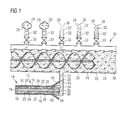
- eine Seitenansicht einer Vorrichtung zum Herstellen einer Feuerschutztür; und
- Fig. 2
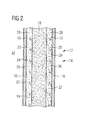
- einen Längsschnitt durch die gemäß
Fig. 1 hergestellte Feuerschutztür. - In
Fig. 1 ist dargestellt, wie ein Mehrkomponentenkleber 10 zur Herstellung eines Feuerschutzabschlusses 12, insbesondere einer Feuerschutztür 14, zwischen zu verklebende Teilelemente 16, 18 eingebracht wird. Die ersten Teilelemente 16 werden von einfassenden Metallblechen, beispielsweise Stahlblechen, gebildet, das zweite Teilelement 18 ist ein isolierendes Material 19, wie z.B. ein Platte aus Gipskarton, Mineralwolle oder sonstigen Isolationsmaterialien mit Brandschutzfunktion. - Der Mehrkomponentenkleber 10 weist wenigstens eine Klebstoffkomponente 20 und wenigstens eine im Brandfall kühlende Substanz 22 auf.
Fig. 1 zeigt, dass als Klebstoffkomponente 20 eine erste Polyurethankomponente 24 mit Aluminiumhydroxid 26 als kühlendem Trockenstoff 28 in einer Mischvorrichtung 30 vermengt wird. Der Anteil des Aluminiumhydroxides 26 an der Gesamtmenge des Mehrkomponentenklebers 10 beträgt maximal 50%. - In die Mischvorrichtung 30 können neben den bereits erwähnten Stoffen erste Polyurethankomponente 24 und Aluminiumhydroxid 26 über Zuleitungen 32 und Ventile 33 auch eine zweite Polyurethankomponente 34, Magnesiumhydroxid 36 und/oder Kieselsäure 38 eingebracht werden und mit einer Quirleinrichtung 39 vermengt werden.
- Somit kann sowohl ein einkomponentiger Polyurethan-Klebstoff mit einer, zwei oder drei kühlenden Substanzen 22 vermengt werden, es ist aber auch möglich, einen zweikomponentigen Polyurethan-Klebstoff mit einer, zwei oder drei kühlenden Substanzen 22 zu vermengen.
- Über Düsen 40 wird der so hergestellte Mehrkomponentenkleber 10 zwischen die Teilelemente 16, 18 einer Feuerschutztür 14 eingebracht.
- In
Fig. 2 ist ein Längsschnitt durch die Feuerschutztür 14 gezeigt, die nach dem Verfahren ausFig. 1 hergestellt worden ist. Durch Kontakt mit der Umgebungsfeuchte und/oder durch eine unterstützende Temperaturerhöhung ist der Mehrkomponentenkleber 10, der zwischen die beiden Teilelemente 16, 18 der Feuerschutztür 14 eingebracht worden ist, ausgehärtet. Der Trockenstoff 28 in Form des Aluminiumhydroxides 26 ist gleichmäßig in dem ausgehärteten Mehrkomponentenkleber 10 verteilt. - Entsteht nun auf der ersten Seite 42 der Feuerschutztür 14 ein Brand, wirkt das Aluminiumhydroxid 26 in dem Mehrkomponentenkleber 10 kühlend indem es Wärmeenergie aufnimmt. Das Polyurethan kann so besser hohen Brandtemperaturen widerstehen.
- Eine Idee der Herstellung eines Mehrkomponentenklebstoffsystems kann sein, bekannten, kommerziell erhältlichen 1-K- oder 2-K-PU-Klebstoffen kühlende Trockenstoffe 28 mit einem maximalen Mengenanteil von 50% entsprechend beizumischen. Passende Trockenstoffe 28 sind hier insbesondere Aluminiumhydroxid 26, Magnesiumhydroxid 36 bzw. Kieselsäure 38.
- Durch das beschriebene Mehrkomponentensystem kann ein hochelastisches Klebstoffsystem mit kühlenden Eigenschaften formuliert werden. Unter üblichen Fertigungsbedingungen sind Abbindezeiten unter wärmeforcierter Trocknung bei 70°C von < 3 Minuten gegeben.
-
- 10
- Mehrkomponentenkleber
- 12
- Feuerschutzabschluss
- 14
- Feuerschutztür
- 16
- erstes Teilelement
- 18
- zweites Teilelement
- 19
- isolierendes Material
- 20
- Klebstoffkomponente
- 22
- Substanz
- 24
- erste Polyurethankomponente
- 26
- Aluminiumhydroxid
- 28
- Trockenstoff
- 30
- Mischvorrichtung
- 32
- Zuleitungen
- 33
- Ventile
- 34
- zweite Polyurethankomponente
- 36
- Magnesiumhydroxid
- 38
- Kieselsäure
- 39
- Quirleinrichtung
- 40
- Düsen
- 42
- erste Seite
Claims (9)
- Mehrkomponentenkleber (10) zur Herstellung von Feuerschutzabschlüssen (12), wie insbesondere Feuerschutztüren (10),
enthaltend wenigstens eine Klebstoffkomponente (20), der eine im Brandfall kühlende Substanz (22) beigemischt ist. - Kleber (10) nach Anspruch 1,
dadurch gekennzeichnet,
dass die wenigstens eine Klebstoffkomponente (20) eine Komponente eines 1-K-oder 2-K-PU-Klebstoffes (24, 34) ist. - Kleber (10) nach einem der voranstehenden Ansprüche,
dadurch gekennzeichnet,
dass die im Brandfall kühlende Substanz (22) ein kühlender Trockenstoff (28) ist. - Kleber (10) nach einem der voranstehenden Ansprüche,
dadurch gekennzeichnet,
dass die im Brandfall kühlende Substanz (22) ausgewählt ist aus einer Gruppe, die Aluminiumhydroxid (26), Magnesiumhydroxid (36) und Kieselsäure (38) enthält. - Kleber (10) nach einem der voranstehenden Ansprüche,
dadurch gekennzeichnet,
dass die Substanz (22) mit einem Mengenanteil von maximal 50% beigemischt ist. - Feuerschutztür (14) mit wenigstens zwei miteinander verklebten Teilelementen (16, 18),
dadurch gekennzeichnet,
dass die Teilelemente (16, 18) mit einem Kleber (10) nach einem der voranstehenden Ansprüche zusammengeklebt sind. - Feuerschutztür (14) nach Anspruch 6,
dadurch gekennzeichnet,
dass die Teilelemente (16, 18) plattenförmig sind und mit einander zugewandten Breitseiten großflächig mit dem Kleber (10) verklebt sind. - Verfahren zum Herstellen eines Klebers nach einem der Ansprüche 1 bis 5,
dadurch gekennzeichnet,
dass wenigstens einer Klebstoffkomponente (24, 34) eines Ein- oder Mehrkomponentenklebers eine kühlende Trockensubstanz (28) beigemischt wird. - Verfahren zum Herstellen eines Feuerschutzabschlusses (12),
enthaltend den Schritt:Verkleben wenigstens zweier Teileelemente (16, 18) mittels eines Klebers (10) nach einem der Ansprüche 1 bis 5.
Applications Claiming Priority (3)
| Application Number | Priority Date | Filing Date | Title |
|---|---|---|---|
| DE102010005371 | 2010-01-20 | ||
| DE102010005732 | 2010-01-26 | ||
| DE102010021285A DE102010021285A1 (de) | 2010-01-20 | 2010-05-21 | Mehrkomponentenklebestoff zur Herstellung von Feuerschutztüren, damit versehene Feuerschutztür sowie Herstellverfahren |
Publications (1)
| Publication Number | Publication Date |
|---|---|
| EP2348086A1 true EP2348086A1 (de) | 2011-07-27 |
Family
ID=43877293
Family Applications (1)
| Application Number | Title | Priority Date | Filing Date |
|---|---|---|---|
| EP11150032A Withdrawn EP2348086A1 (de) | 2010-01-20 | 2011-01-03 | Mehrkomponentenklebstoff zur Herstellung von Feuerschutztüren, damit versehene Feuerschutztür sowie Herstellverfahren |
Country Status (2)
| Country | Link |
|---|---|
| EP (1) | EP2348086A1 (de) |
| DE (1) | DE102010021285A1 (de) |
Citations (4)
| Publication number | Priority date | Publication date | Assignee | Title |
|---|---|---|---|---|
| EP1097807A2 (de) * | 1999-11-03 | 2001-05-09 | Saint Gobain Isover G+H Aktiengesellschaft | Gebundenes Mineralwolleprodukt mit Feuerschutzfunktion sowie Brandschutzelement mit dem gebundenen Mineralwolleprodukt |
| GB2357111A (en) * | 1999-12-10 | 2001-06-13 | Environmental Seals Ltd | Polyurethane twin-walled fireproof structure |
| WO2003051954A1 (de) * | 2001-12-18 | 2003-06-26 | Henkel Kommanditgesellschaft Auf Aktien | Schwerbrennbare polyurethanklebstoffe |
| WO2007050000A1 (en) * | 2005-10-26 | 2007-05-03 | Industrial Property Of Scandinavia Ab | Fire-resistant composition for coating, sealing and protection purposes |
Family Cites Families (4)
| Publication number | Priority date | Publication date | Assignee | Title |
|---|---|---|---|---|
| DE19880516D2 (de) * | 1997-04-22 | 2000-07-06 | Casanin Ag Buchrain | Ein- oder Zweikomponenten-Polyurethansystem |
| DE19956448A1 (de) * | 1999-11-24 | 2001-05-31 | Fischer Artur Werke Gmbh | Zweikomponenten-Polyurethan-Montageschaum |
| DE10007980B4 (de) * | 2000-02-22 | 2007-07-12 | Hilti Ag | Zweikomponenten-Ortschaumsystem und dessen Verwendung zum Ausschäumen von Öffnungen zum Zwecke des Brandschutzes |
| DE102007062529A1 (de) * | 2007-12-20 | 2009-06-25 | Henkel Ag & Co. Kgaa | 2K-PU-Klebstoff zum Verkleben von Faserformteilen |
-
2010
- 2010-05-21 DE DE102010021285A patent/DE102010021285A1/de not_active Withdrawn
-
2011
- 2011-01-03 EP EP11150032A patent/EP2348086A1/de not_active Withdrawn
Patent Citations (4)
| Publication number | Priority date | Publication date | Assignee | Title |
|---|---|---|---|---|
| EP1097807A2 (de) * | 1999-11-03 | 2001-05-09 | Saint Gobain Isover G+H Aktiengesellschaft | Gebundenes Mineralwolleprodukt mit Feuerschutzfunktion sowie Brandschutzelement mit dem gebundenen Mineralwolleprodukt |
| GB2357111A (en) * | 1999-12-10 | 2001-06-13 | Environmental Seals Ltd | Polyurethane twin-walled fireproof structure |
| WO2003051954A1 (de) * | 2001-12-18 | 2003-06-26 | Henkel Kommanditgesellschaft Auf Aktien | Schwerbrennbare polyurethanklebstoffe |
| WO2007050000A1 (en) * | 2005-10-26 | 2007-05-03 | Industrial Property Of Scandinavia Ab | Fire-resistant composition for coating, sealing and protection purposes |
Also Published As
| Publication number | Publication date |
|---|---|
| DE102010021285A1 (de) | 2011-07-21 |
Similar Documents
| Publication | Publication Date | Title |
|---|---|---|
| EP2431341A1 (de) | Zusammensetzung zur Ausbildung einer schnell aushärtenden, vollständig durchtrocknenden Beschichtung auf einem bauseitigen Untergrund und/oder Bauelement | |
| EP3020691B1 (de) | Aus unterschiedlichen werkstoffen herstellbarer vakuumbaustein | |
| EP0017969A2 (de) | Unbrennbare äussere Wärmedämmschicht mit Oberflächenbeschichtung | |
| DE102004049632B4 (de) | Verbundschichtplatte für Brandschutztüren | |
| DE19952931A1 (de) | Gebundenes Mineralwolleprodukt mit Feuerschutzfunktion sowie Brandschutzelement mit dem gebundenen Mineralwolleprodukt | |
| EP2722319A2 (de) | Dämmputzzusammensetzung zur Ausbildung einer Schall- und/oder Wärmedämmung, Verfahren zur Ausbildung einer Schall- und/oder Wärmedämmung, Schall- und/oder Wärmedämmung sowie Wärmedämmsystem | |
| DE2635736C2 (de) | Feuerhemmende Platte | |
| DE102008061001A1 (de) | Plattenförmiges Holzverbundelement | |
| EP1239093A2 (de) | Brandschutzelement, insbesondere für Feuerschutztüren | |
| EP2374959B1 (de) | Sandwichelement für den Gebäudebau und Verfahren zur Erstellung eines solchen Sandwichelementes | |
| EP2154310A1 (de) | Gebäudewandbekleidung mit Bekleidungsplatten | |
| DE102010021285A1 (de) | Mehrkomponentenklebestoff zur Herstellung von Feuerschutztüren, damit versehene Feuerschutztür sowie Herstellverfahren | |
| DE2745345A1 (de) | Mehrschichtige brandschutz-verbundplatte | |
| DE10212331A1 (de) | Brandschutzelement, insbesondere für Feuerschutztüren | |
| DE1621708B1 (de) | Schaumschichtbildendes Feuerschutzmittel | |
| AT409646B (de) | Holzblock zum errichten von wänden | |
| DE2737585C2 (de) | Feuerhemmende Trennwand | |
| DE102011116960B3 (de) | Dämmschichtbildendes Anstrichmittel | |
| EP1347144A2 (de) | Brandschutzelement, insbesondere für Feuerschutztüren | |
| EP2045219A1 (de) | Verfahren zur Herstellung einer Bauplatte auf Calciumsulfat-Bariumsulfat-Basis | |
| DE202009013674U1 (de) | Metallgehäuseelement und Metallgehäuse | |
| DE202018104079U1 (de) | Dämmelement mit einem beschichteten Grundkörper und radikal härtender Grundierung | |
| DE3327039A1 (de) | Mit anorganischen hydraulischen bindemitteln gebundene bauteile | |
| DE102007049727A1 (de) | Brand-Schall-Schutztür | |
| DE202016106261U1 (de) | Dämmelement mit einem beschichteten Grundkörper zur Isolierung |
Legal Events
| Date | Code | Title | Description |
|---|---|---|---|
| PUAI | Public reference made under article 153(3) epc to a published international application that has entered the european phase |
Free format text: ORIGINAL CODE: 0009012 |
|
| AK | Designated contracting states |
Kind code of ref document: A1 Designated state(s): AL AT BE BG CH CY CZ DE DK EE ES FI FR GB GR HR HU IE IS IT LI LT LU LV MC MK MT NL NO PL PT RO RS SE SI SK SM TR |
|
| AX | Request for extension of the european patent |
Extension state: BA ME |
|
| STAA | Information on the status of an ep patent application or granted ep patent |
Free format text: STATUS: THE APPLICATION IS DEEMED TO BE WITHDRAWN |
|
| 18D | Application deemed to be withdrawn |
Effective date: 20120128 |