EP2349964B1 - Dérivés dibenzocycloheptanone et agents pharmaceutiques contenant ces composés - Google Patents
Dérivés dibenzocycloheptanone et agents pharmaceutiques contenant ces composés Download PDFInfo
- Publication number
- EP2349964B1 EP2349964B1 EP09783915.3A EP09783915A EP2349964B1 EP 2349964 B1 EP2349964 B1 EP 2349964B1 EP 09783915 A EP09783915 A EP 09783915A EP 2349964 B1 EP2349964 B1 EP 2349964B1
- Authority
- EP
- European Patent Office
- Prior art keywords
- cyclohepten
- dihydrodibenzo
- mmol
- alkyl
- dmso
- Prior art date
- Legal status (The legal status is an assumption and is not a legal conclusion. Google has not performed a legal analysis and makes no representation as to the accuracy of the status listed.)
- Active
Links
- 0 *c(cc1CCc(c2ccc3)c3O)ccc1C2=O Chemical compound *c(cc1CCc(c2ccc3)c3O)ccc1C2=O 0.000 description 4
- HZALJZIIPRDRDR-UHFFFAOYSA-N CC1(C)OC(COc(cc2CCc3cc(Nc(cccc4)c4N)ccc33)ccc2C3=O)CO1 Chemical compound CC1(C)OC(COc(cc2CCc3cc(Nc(cccc4)c4N)ccc33)ccc2C3=O)CO1 HZALJZIIPRDRDR-UHFFFAOYSA-N 0.000 description 1
- RPKCLSMBVQLWIN-UHFFFAOYSA-N CNc1ccccc1N Chemical compound CNc1ccccc1N RPKCLSMBVQLWIN-UHFFFAOYSA-N 0.000 description 1
- BYHKKYDYZBJRRB-UHFFFAOYSA-N COc1cccc2c1CCc1cc(Nc(cccc3)c3N)ccc1C2=O Chemical compound COc1cccc2c1CCc1cc(Nc(cccc3)c3N)ccc1C2=O BYHKKYDYZBJRRB-UHFFFAOYSA-N 0.000 description 1
- JRCIIGGTYWLOSY-UHFFFAOYSA-N OCC(COc(cc1)cc(CCc2cc(Nc(ccc(F)c3)c3F)ccc22)c1C2=O)O Chemical compound OCC(COc(cc1)cc(CCc2cc(Nc(ccc(F)c3)c3F)ccc22)c1C2=O)O JRCIIGGTYWLOSY-UHFFFAOYSA-N 0.000 description 1
Classifications
-
- C—CHEMISTRY; METALLURGY
- C07—ORGANIC CHEMISTRY
- C07D—HETEROCYCLIC COMPOUNDS
- C07D295/00—Heterocyclic compounds containing polymethylene-imine rings with at least five ring members, 3-azabicyclo [3.2.2] nonane, piperazine, morpholine or thiomorpholine rings, having only hydrogen atoms directly attached to the ring carbon atoms
- C07D295/04—Heterocyclic compounds containing polymethylene-imine rings with at least five ring members, 3-azabicyclo [3.2.2] nonane, piperazine, morpholine or thiomorpholine rings, having only hydrogen atoms directly attached to the ring carbon atoms with substituted hydrocarbon radicals attached to ring nitrogen atoms
- C07D295/08—Heterocyclic compounds containing polymethylene-imine rings with at least five ring members, 3-azabicyclo [3.2.2] nonane, piperazine, morpholine or thiomorpholine rings, having only hydrogen atoms directly attached to the ring carbon atoms with substituted hydrocarbon radicals attached to ring nitrogen atoms substituted by singly bound oxygen or sulfur atoms
- C07D295/084—Heterocyclic compounds containing polymethylene-imine rings with at least five ring members, 3-azabicyclo [3.2.2] nonane, piperazine, morpholine or thiomorpholine rings, having only hydrogen atoms directly attached to the ring carbon atoms with substituted hydrocarbon radicals attached to ring nitrogen atoms substituted by singly bound oxygen or sulfur atoms with the ring nitrogen atoms and the oxygen or sulfur atoms attached to the same carbon chain, which is not interrupted by carbocyclic rings
- C07D295/088—Heterocyclic compounds containing polymethylene-imine rings with at least five ring members, 3-azabicyclo [3.2.2] nonane, piperazine, morpholine or thiomorpholine rings, having only hydrogen atoms directly attached to the ring carbon atoms with substituted hydrocarbon radicals attached to ring nitrogen atoms substituted by singly bound oxygen or sulfur atoms with the ring nitrogen atoms and the oxygen or sulfur atoms attached to the same carbon chain, which is not interrupted by carbocyclic rings to an acyclic saturated chain
-
- A—HUMAN NECESSITIES
- A61—MEDICAL OR VETERINARY SCIENCE; HYGIENE
- A61P—SPECIFIC THERAPEUTIC ACTIVITY OF CHEMICAL COMPOUNDS OR MEDICINAL PREPARATIONS
- A61P29/00—Non-central analgesic, antipyretic or antiinflammatory agents, e.g. antirheumatic agents; Non-steroidal antiinflammatory drugs [NSAID]
-
- A—HUMAN NECESSITIES
- A61—MEDICAL OR VETERINARY SCIENCE; HYGIENE
- A61P—SPECIFIC THERAPEUTIC ACTIVITY OF CHEMICAL COMPOUNDS OR MEDICINAL PREPARATIONS
- A61P35/00—Antineoplastic agents
-
- A—HUMAN NECESSITIES
- A61—MEDICAL OR VETERINARY SCIENCE; HYGIENE
- A61P—SPECIFIC THERAPEUTIC ACTIVITY OF CHEMICAL COMPOUNDS OR MEDICINAL PREPARATIONS
- A61P37/00—Drugs for immunological or allergic disorders
- A61P37/02—Immunomodulators
-
- A—HUMAN NECESSITIES
- A61—MEDICAL OR VETERINARY SCIENCE; HYGIENE
- A61P—SPECIFIC THERAPEUTIC ACTIVITY OF CHEMICAL COMPOUNDS OR MEDICINAL PREPARATIONS
- A61P37/00—Drugs for immunological or allergic disorders
- A61P37/02—Immunomodulators
- A61P37/06—Immunosuppressants, e.g. drugs for graft rejection
-
- A—HUMAN NECESSITIES
- A61—MEDICAL OR VETERINARY SCIENCE; HYGIENE
- A61P—SPECIFIC THERAPEUTIC ACTIVITY OF CHEMICAL COMPOUNDS OR MEDICINAL PREPARATIONS
- A61P37/00—Drugs for immunological or allergic disorders
- A61P37/08—Antiallergic agents
-
- A—HUMAN NECESSITIES
- A61—MEDICAL OR VETERINARY SCIENCE; HYGIENE
- A61P—SPECIFIC THERAPEUTIC ACTIVITY OF CHEMICAL COMPOUNDS OR MEDICINAL PREPARATIONS
- A61P43/00—Drugs for specific purposes, not provided for in groups A61P1/00-A61P41/00
-
- A—HUMAN NECESSITIES
- A61—MEDICAL OR VETERINARY SCIENCE; HYGIENE
- A61P—SPECIFIC THERAPEUTIC ACTIVITY OF CHEMICAL COMPOUNDS OR MEDICINAL PREPARATIONS
- A61P7/00—Drugs for disorders of the blood or the extracellular fluid
-
- A—HUMAN NECESSITIES
- A61—MEDICAL OR VETERINARY SCIENCE; HYGIENE
- A61P—SPECIFIC THERAPEUTIC ACTIVITY OF CHEMICAL COMPOUNDS OR MEDICINAL PREPARATIONS
- A61P9/00—Drugs for disorders of the cardiovascular system
- A61P9/04—Inotropic agents, i.e. stimulants of cardiac contraction; Drugs for heart failure
-
- A—HUMAN NECESSITIES
- A61—MEDICAL OR VETERINARY SCIENCE; HYGIENE
- A61P—SPECIFIC THERAPEUTIC ACTIVITY OF CHEMICAL COMPOUNDS OR MEDICINAL PREPARATIONS
- A61P9/00—Drugs for disorders of the cardiovascular system
- A61P9/10—Drugs for disorders of the cardiovascular system for treating ischaemic or atherosclerotic diseases, e.g. antianginal drugs, coronary vasodilators, drugs for myocardial infarction, retinopathy, cerebrovascula insufficiency, renal arteriosclerosis
-
- C—CHEMISTRY; METALLURGY
- C07—ORGANIC CHEMISTRY
- C07C—ACYCLIC OR CARBOCYCLIC COMPOUNDS
- C07C205/00—Compounds containing nitro groups bound to a carbon skeleton
- C07C205/45—Compounds containing nitro groups bound to a carbon skeleton the carbon skeleton being further substituted by at least one doubly—bound oxygen atom, not being part of a —CHO group
-
- C—CHEMISTRY; METALLURGY
- C07—ORGANIC CHEMISTRY
- C07C—ACYCLIC OR CARBOCYCLIC COMPOUNDS
- C07C205/00—Compounds containing nitro groups bound to a carbon skeleton
- C07C205/49—Compounds containing nitro groups bound to a carbon skeleton the carbon skeleton being further substituted by carboxyl groups
- C07C205/57—Compounds containing nitro groups bound to a carbon skeleton the carbon skeleton being further substituted by carboxyl groups having nitro groups and carboxyl groups bound to carbon atoms of six-membered aromatic rings of the carbon skeleton
- C07C205/58—Compounds containing nitro groups bound to a carbon skeleton the carbon skeleton being further substituted by carboxyl groups having nitro groups and carboxyl groups bound to carbon atoms of six-membered aromatic rings of the carbon skeleton the carbon skeleton being further substituted by halogen atoms
-
- C—CHEMISTRY; METALLURGY
- C07—ORGANIC CHEMISTRY
- C07C—ACYCLIC OR CARBOCYCLIC COMPOUNDS
- C07C205/00—Compounds containing nitro groups bound to a carbon skeleton
- C07C205/49—Compounds containing nitro groups bound to a carbon skeleton the carbon skeleton being further substituted by carboxyl groups
- C07C205/57—Compounds containing nitro groups bound to a carbon skeleton the carbon skeleton being further substituted by carboxyl groups having nitro groups and carboxyl groups bound to carbon atoms of six-membered aromatic rings of the carbon skeleton
- C07C205/59—Compounds containing nitro groups bound to a carbon skeleton the carbon skeleton being further substituted by carboxyl groups having nitro groups and carboxyl groups bound to carbon atoms of six-membered aromatic rings of the carbon skeleton the carbon skeleton being further substituted by singly-bound oxygen atoms
-
- C—CHEMISTRY; METALLURGY
- C07—ORGANIC CHEMISTRY
- C07C—ACYCLIC OR CARBOCYCLIC COMPOUNDS
- C07C225/00—Compounds containing amino groups and doubly—bound oxygen atoms bound to the same carbon skeleton, at least one of the doubly—bound oxygen atoms not being part of a —CHO group, e.g. amino ketones
- C07C225/22—Compounds containing amino groups and doubly—bound oxygen atoms bound to the same carbon skeleton, at least one of the doubly—bound oxygen atoms not being part of a —CHO group, e.g. amino ketones having amino groups bound to carbon atoms of six-membered aromatic rings of the carbon skeleton
-
- C—CHEMISTRY; METALLURGY
- C07—ORGANIC CHEMISTRY
- C07C—ACYCLIC OR CARBOCYCLIC COMPOUNDS
- C07C229/00—Compounds containing amino and carboxyl groups bound to the same carbon skeleton
- C07C229/02—Compounds containing amino and carboxyl groups bound to the same carbon skeleton having amino and carboxyl groups bound to acyclic carbon atoms of the same carbon skeleton
- C07C229/04—Compounds containing amino and carboxyl groups bound to the same carbon skeleton having amino and carboxyl groups bound to acyclic carbon atoms of the same carbon skeleton the carbon skeleton being acyclic and saturated
- C07C229/06—Compounds containing amino and carboxyl groups bound to the same carbon skeleton having amino and carboxyl groups bound to acyclic carbon atoms of the same carbon skeleton the carbon skeleton being acyclic and saturated having only one amino and one carboxyl group bound to the carbon skeleton
- C07C229/10—Compounds containing amino and carboxyl groups bound to the same carbon skeleton having amino and carboxyl groups bound to acyclic carbon atoms of the same carbon skeleton the carbon skeleton being acyclic and saturated having only one amino and one carboxyl group bound to the carbon skeleton the nitrogen atom of the amino group being further bound to acyclic carbon atoms or to carbon atoms of rings other than six-membered aromatic rings
- C07C229/12—Compounds containing amino and carboxyl groups bound to the same carbon skeleton having amino and carboxyl groups bound to acyclic carbon atoms of the same carbon skeleton the carbon skeleton being acyclic and saturated having only one amino and one carboxyl group bound to the carbon skeleton the nitrogen atom of the amino group being further bound to acyclic carbon atoms or to carbon atoms of rings other than six-membered aromatic rings to carbon atoms of acyclic carbon skeletons
-
- C—CHEMISTRY; METALLURGY
- C07—ORGANIC CHEMISTRY
- C07C—ACYCLIC OR CARBOCYCLIC COMPOUNDS
- C07C229/00—Compounds containing amino and carboxyl groups bound to the same carbon skeleton
- C07C229/02—Compounds containing amino and carboxyl groups bound to the same carbon skeleton having amino and carboxyl groups bound to acyclic carbon atoms of the same carbon skeleton
- C07C229/34—Compounds containing amino and carboxyl groups bound to the same carbon skeleton having amino and carboxyl groups bound to acyclic carbon atoms of the same carbon skeleton the carbon skeleton containing six-membered aromatic rings
-
- C—CHEMISTRY; METALLURGY
- C07—ORGANIC CHEMISTRY
- C07C—ACYCLIC OR CARBOCYCLIC COMPOUNDS
- C07C271/00—Derivatives of carbamic acids, i.e. compounds containing any of the groups, the nitrogen atom not being part of nitro or nitroso groups
- C07C271/06—Esters of carbamic acids
- C07C271/40—Esters of carbamic acids having oxygen atoms of carbamate groups bound to carbon atoms of six-membered aromatic rings
- C07C271/42—Esters of carbamic acids having oxygen atoms of carbamate groups bound to carbon atoms of six-membered aromatic rings with the nitrogen atoms of the carbamate groups bound to hydrogen atoms or to acyclic carbon atoms
- C07C271/54—Esters of carbamic acids having oxygen atoms of carbamate groups bound to carbon atoms of six-membered aromatic rings with the nitrogen atoms of the carbamate groups bound to hydrogen atoms or to acyclic carbon atoms to carbon atoms of hydrocarbon radicals substituted by carboxyl groups
-
- C—CHEMISTRY; METALLURGY
- C07—ORGANIC CHEMISTRY
- C07C—ACYCLIC OR CARBOCYCLIC COMPOUNDS
- C07C309/00—Sulfonic acids; Halides, esters, or anhydrides thereof
- C07C309/63—Esters of sulfonic acids
- C07C309/64—Esters of sulfonic acids having sulfur atoms of esterified sulfo groups bound to acyclic carbon atoms
- C07C309/65—Esters of sulfonic acids having sulfur atoms of esterified sulfo groups bound to acyclic carbon atoms of a saturated carbon skeleton
-
- C—CHEMISTRY; METALLURGY
- C07—ORGANIC CHEMISTRY
- C07C—ACYCLIC OR CARBOCYCLIC COMPOUNDS
- C07C49/00—Ketones; Ketenes; Dimeric ketenes; Ketonic chelates
- C07C49/587—Unsaturated compounds containing a keto groups being part of a ring
- C07C49/703—Unsaturated compounds containing a keto groups being part of a ring containing hydroxy groups
- C07C49/747—Unsaturated compounds containing a keto groups being part of a ring containing hydroxy groups containing six-membered aromatic rings
-
- C—CHEMISTRY; METALLURGY
- C07—ORGANIC CHEMISTRY
- C07C—ACYCLIC OR CARBOCYCLIC COMPOUNDS
- C07C49/00—Ketones; Ketenes; Dimeric ketenes; Ketonic chelates
- C07C49/587—Unsaturated compounds containing a keto groups being part of a ring
- C07C49/753—Unsaturated compounds containing a keto groups being part of a ring containing ether groups, groups, groups, or groups
- C07C49/755—Unsaturated compounds containing a keto groups being part of a ring containing ether groups, groups, groups, or groups a keto group being part of a condensed ring system with two or three rings, at least one ring being a six-membered aromatic ring
-
- C—CHEMISTRY; METALLURGY
- C07—ORGANIC CHEMISTRY
- C07D—HETEROCYCLIC COMPOUNDS
- C07D309/00—Heterocyclic compounds containing six-membered rings having one oxygen atom as the only ring hetero atom, not condensed with other rings
- C07D309/02—Heterocyclic compounds containing six-membered rings having one oxygen atom as the only ring hetero atom, not condensed with other rings having no double bonds between ring members or between ring members and non-ring members
- C07D309/08—Heterocyclic compounds containing six-membered rings having one oxygen atom as the only ring hetero atom, not condensed with other rings having no double bonds between ring members or between ring members and non-ring members with hetero atoms or with carbon atoms having three bonds to hetero atoms with at the most one bond to halogen, e.g. ester or nitrile radicals, directly attached to ring carbon atoms
- C07D309/10—Oxygen atoms
- C07D309/12—Oxygen atoms only hydrogen atoms and one oxygen atom directly attached to ring carbon atoms, e.g. tetrahydropyranyl ethers
-
- C—CHEMISTRY; METALLURGY
- C07—ORGANIC CHEMISTRY
- C07D—HETEROCYCLIC COMPOUNDS
- C07D313/00—Heterocyclic compounds containing rings of more than six members having one oxygen atom as the only ring hetero atom
- C07D313/02—Seven-membered rings
- C07D313/06—Seven-membered rings condensed with carbocyclic rings or ring systems
- C07D313/10—Seven-membered rings condensed with carbocyclic rings or ring systems condensed with two six-membered rings
- C07D313/12—[b,e]-condensed
-
- C—CHEMISTRY; METALLURGY
- C07—ORGANIC CHEMISTRY
- C07D—HETEROCYCLIC COMPOUNDS
- C07D317/00—Heterocyclic compounds containing five-membered rings having two oxygen atoms as the only ring hetero atoms
- C07D317/08—Heterocyclic compounds containing five-membered rings having two oxygen atoms as the only ring hetero atoms having the hetero atoms in positions 1 and 3
- C07D317/10—Heterocyclic compounds containing five-membered rings having two oxygen atoms as the only ring hetero atoms having the hetero atoms in positions 1 and 3 not condensed with other rings
- C07D317/14—Heterocyclic compounds containing five-membered rings having two oxygen atoms as the only ring hetero atoms having the hetero atoms in positions 1 and 3 not condensed with other rings with substituted hydrocarbon radicals attached to ring carbon atoms
- C07D317/18—Radicals substituted by singly bound oxygen or sulfur atoms
- C07D317/22—Radicals substituted by singly bound oxygen or sulfur atoms etherified
-
- C—CHEMISTRY; METALLURGY
- C07—ORGANIC CHEMISTRY
- C07D—HETEROCYCLIC COMPOUNDS
- C07D405/00—Heterocyclic compounds containing both one or more hetero rings having oxygen atoms as the only ring hetero atoms, and one or more rings having nitrogen as the only ring hetero atom
- C07D405/02—Heterocyclic compounds containing both one or more hetero rings having oxygen atoms as the only ring hetero atoms, and one or more rings having nitrogen as the only ring hetero atom containing two hetero rings
- C07D405/04—Heterocyclic compounds containing both one or more hetero rings having oxygen atoms as the only ring hetero atoms, and one or more rings having nitrogen as the only ring hetero atom containing two hetero rings directly linked by a ring-member-to-ring-member bond
-
- C—CHEMISTRY; METALLURGY
- C07—ORGANIC CHEMISTRY
- C07C—ACYCLIC OR CARBOCYCLIC COMPOUNDS
- C07C2603/00—Systems containing at least three condensed rings
- C07C2603/02—Ortho- or ortho- and peri-condensed systems
- C07C2603/04—Ortho- or ortho- and peri-condensed systems containing three rings
- C07C2603/30—Ortho- or ortho- and peri-condensed systems containing three rings containing seven-membered rings
- C07C2603/32—Dibenzocycloheptenes; Hydrogenated dibenzocycloheptenes
Definitions
- the present invention relates to compounds of the formula I. in which X, Y and R 1 to R 4 have the meanings given below, and also pharmaceutical agents which contain the compounds of the formula I.
- the compounds are interleukin-1 ⁇ (IL-1 ⁇ ) and tumor necrosis factor- ⁇ (TNF- ⁇ ) inhibitors useful in the treatment of inflammatory diseases.
- IL-1 ⁇ interleukin-1 ⁇
- TNF- ⁇ tumor necrosis factor- ⁇
- IL-1 ⁇ and TNF- ⁇ protect the body from infectious agents, tumors or tissue damage.
- autoimmune diseases there is an increased production of IL-1 ⁇ and TNF- ⁇ , which may for example result in bone and cartilage degradation.
- Drugs which regulate the release of IL-1 ⁇ and TNF- ⁇ are therefore useful for the treatment of inflammatory diseases.
- a group of compounds which inhibit the release of IL-1 ⁇ and TNF- ⁇ are known from US Pat WO 98/32730 known. They correspond to the general formula and are useful for the treatment and prophylaxis of asthma, allergies, rheumatoid arthritis, spondyloarthritis, gout, atherosclerosis, inflammatory bowel disease, proliferative and inflammatory skin diseases such as psoriasis and atopic dermatitis.
- the compounds are interleukin-1 ⁇ (IL-1 ⁇ ) and tumor necrosis factor- ⁇ (TNF- ⁇ ) inhibitors which are useful for the treatment of inflammatory diseases.
- IL-1 ⁇ interleukin-1 ⁇
- TNF- ⁇ tumor necrosis factor- ⁇
- the present invention is therefore based on the object of providing anti-inflammatory compounds which have improved activity.
- alkyl (also in connection with other groups such as alkoxy, haloalkyl, etc.) includes straight and branched chain alkyl groups preferably having 1 to 6 and 1 to 4 carbon atoms, respectively, such as methyl, ethyl, n- and i-propyl, n -, i- and t-butyl, sec-butyl, n-pentyl and n-hexyl.
- halogen represents a fluorine, chlorine, bromine or iodine atom, in particular a fluorine or chlorine atom.
- C 1 -C 6 -alkoxy which is substituted by 1, 2 or 3 hydroxy or C 1 -C 6 -alkoxy groups is preferably C 2 -C 6 -alkoxy, in particular 2-hydroxyethoxy, Hydroxypropoxy, 2-hydroxypropoxy, 1,2-dihydraxyethoxy, 2,3-dihydroxypropoxy or 2,3-dimethoxypropoxy.
- a saturated non-aromatic heterocycle is in particular pyrrolidinyl, piperidinyl, hydroxypiperidinyl, piperazinyl, tetrahydropyranyl, tetrahydrofuranyl, dioxolanyl, 2,2-dimethyldioxoianyl, dioxanyl, morpholinyl or thiomorpholinyl.
- the piperidinyl radical can be replaced by 1, 2, 3 or 4C 1 -C 4 alkyl groups, in particular methyl groups substituted.
- a preferred piperidinyl radical is 2,2,6,6-tetramethylpiperidinyl.
- the nitrogen heterocycles may be bonded via a nitrogen atom or a carbon atom.
- An unsaturated non-aromatic heterocycle is, in particular, pyrrolinyl, di- or tetrahydropyridinyl.
- An aromatic heterocycle is in particular pyridyl, preferably 3- or 4-pyridyl, pyrimidinyl, pyrrolyl, imidazolyl, pyrazolyl, oxazolyl, isoxazolyl, furyl, thienyl, thiazolyl, thiadiazolyl, isothiazolyl or the corresponding benzoderivatives thereof.
- R1 is in position 7 (position 1, relative to X). According to another embodiment, R1 is in position 8 (position 2, relative to X). According to another embodiment, R1 is in position 9 (position 3, relative to X). Positions 7 and 8 and in particular position 7 are preferred.
- R 2 is preferably H.
- R3 is preferably in position 3 (relative to Y). In one embodiment, R 3 is the above-mentioned meanings b) and g).
- R3 is preferably in position 3 (relative to Y). According to one embodiment, R 3 is the abovementioned meanings b) and e).
- R3 is according to a further embodiment of the above formula (b).
- R3 stands for wherein R8, R9, R10 and R11 have the meanings given above.
- R10 and R11 are preferably in the 3 and 5 positions.
- R3 stands for wherein R8, R9 and R10 have the meanings given above.
- R10 is preferably in the 4-position.
- R4, R5, R6, R7 and R8 are preferably H.
- R 9, R 10 and R 11 preferably have the abovementioned meanings a), b), e), f), g) and h) and in particular H, NH 2 , C 1 -C 6 -alkoxy or halogen.
- R12 is preferably H.
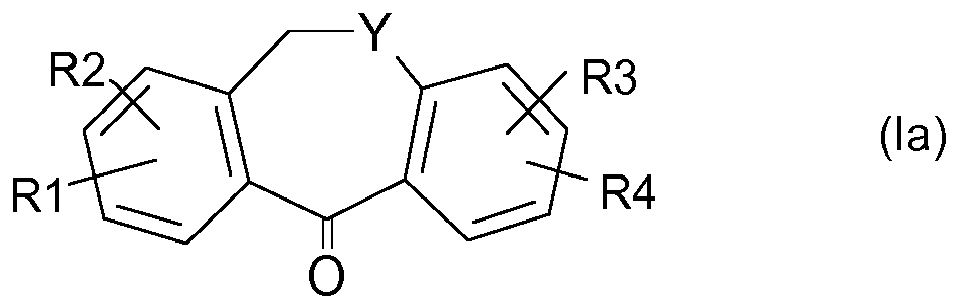
- An embodiment of the invention are the compounds of the formula Ia: wherein Y is O or S and R1, R2, R3 and R4 have the meanings given above.
- R2 and R4 are H.
- R1 is in position 1 or 2 (relative to the methylene group of the 7-membered ring) and R3 is in position 2 (relative to Y).
- R2 and R4 are H and R1 in position 1 or 2 (relative to the methylene group of the 7-ring) and R3 in position 2 (relative to Y).
- Another embodiment of the invention are the compounds of formula Ib wherein X is O or S and R1, R2, R3 and R4 have the meanings given above.
- R2 and R4 are H.
- R1 is in position 1 or 2 (relative to X) and R3 in position 2 (relative to the methylene group of the 7-ring).
- R2 and R4 are H and R1 in position 1 or 2 (relative to X) and R3 in position 2 (relative to the methylene group of the 7-ring).
- Another embodiment is the compounds of formula Ibb wherein X is O or S and R1, R9 and R10 have the meanings given above.
- Another embodiment is the compounds of formula Ibc wherein X is O or S and R2, R9 and R10 have the meanings given above.
- R2 and R4 are H.
- R1 is in position 1 or 2 (relative to X) and R3 in position 2 (relative to Y).
- R2 and R4 are H and R1 in position 1 or 2 (relative to X) and R3 in position 2 (relative to Y).
- the invention also encompasses the physiologically tolerated salts of the compounds of the formula I.
- these are in particular the acid addition salts.
- inorganic acids such as hydrochloric acid, sulfuric acid or phosphoric acid or organic acids such as tartaric acid, citric acid, maleic acid, fumaric acid, malic acid, mandelic acid, ascorbic acid, gluconic acid, methanesulfonic acid, benzenesulfonic acid or toluenesulfonic acid and the like are used.
- the invention also provides the solvates of the compounds of the formula I or the salts thereof, in particular the hydrates.
- a formyl group is introduced via the phthalide (2).
- the unsaturated compound (5a) is obtained, which can be hydrogenated in a conventional manner, for example using a noble metal catalyst, such as Pt or Pd.
- a noble metal catalyst such as Pt or Pd.
- the amino group Prior to ring closure by Friedel-Crafts acylation, the amino group is protected by a suitable protecting group, which is removed after Friedel-Crafts acylation. After reaction with an aryl halide, compound (10) is obtained.
- Scheme II shows an alternative method for preparing (10) which avoids the use of the protecting group:
- the methoxy-substituted compounds at position 7 (10) can be converted into the hydroxy compounds (11) by ether cleavage, for example by means of aqueous HBr, see Scheme III.
- bromination with N-bromosuccinimide takes place first.
- the resulting bromomethylmethoxybenzoic acid (6) is reacted with 3-chlorobenzaldehyde in a Wittig reaction to give chlorophenylvinylmethoxybenzoic acid (7).
- the subsequent hydrogenation of chlorophenylvinylmethoxybenzoic acid is carried out in the usual way using noble metal catalysts, such as Pd / BaSO 4 (substitution in position 8) or Pd / C (substitution in position 9).
- the carboxylic acid (8) is converted to the acid chloride, for example by reaction with thionyl chloride.
- the compounds according to the invention exhibit immunomodulatory activity in vitro and in vivo and inhibit the release of TNF- ⁇ and IL-1 ⁇ .
- the compounds according to the invention are therefore suitable for the treatment of diseases which are associated with a disorder of the immune system. They are useful, for example, in the treatment of autoimmune diseases, cancer, rheumatoid arthritis, gout, septic shock, osteoporosis, neuropathic pain, HIV spread, HIV dementia, viral myocarditis, insulin-dependent diabetes, periodontal disease, restenosis, alopecia, T-cell depletion HIV infection or AIDS, psoriasis, acute pancreatitis, allograft rejection, allergic pneumonia, arteriosclerosis, multiple sclerosis, cachexia, Alzheimer's disease, stroke, jaundice, ulcerative colitis, Crohn's disease, inflammatory bowel disease (IBD), ischemia , congestive heart failure, pulmonary fibrosis, hepatitis, glioblastoma,
- the compounds of the invention can be administered either as individual therapeutic agents or as mixtures with other therapeutic agents.
- the compounds may be administered alone, but in general they are dosed and administered in the form of pharmaceutical agents, i. as mixtures of the active ingredients with suitable pharmaceutical carriers or diluents.
- the compounds or agents may be administered orally or parenterally, preferably given in oral dosage forms.
- Oral agents may, for example, be in the form of tablets or capsules and may contain conventional excipients such as binders (eg syrup, acacia, gelatin, sorbitol, tragacanth or polyvinylpyrrolidone), fillers (eg lactose, sugar, maize starch, calcium phosphate, sorbitol or glycine), lubricants (eg magnesium stearate, talc, polyethylene glycol or silica), disintegrating agent (eg starch) or wetting agent (eg sodium lauryl sulfate).
- binders eg syrup, acacia, gelatin, sorbitol, tragacanth or polyvinylpyrrolidone
- fillers eg lactose, sugar, maize starch, calcium phosphate, sorbitol or glycine
- lubricants eg magnesium stearate, talc, polyethylene glycol or silica
- Oral liquid preparations may be in the form of aqueous or oily suspensions, solutions, emulsions, syrups, elixirs or sprays, and the like. They may also be in the form of dry powder, which is prepared for reconstitution with water or other suitable carrier. Such liquid preparations may contain conventional additives, for example suspending agents, flavorings, diluents or emulsifiers. For parenteral administration, solutions or suspensions may be employed with conventional pharmaceutical carriers.
- the compounds or agents of the invention may be administered to mammals (human or animal) at a dose of from about 0.5 mg to 100 mg per kg of body weight per day. They can be given in a single dose or in multiple doses.
- the spectrum of activity of the compounds as inhibitors of TNF- ⁇ and IL-1 ⁇ release was determined by the test systems as described by Donat C. and Laufer S. in Arch. Pharm. Pharm. Med. Chem. 333, Suppl. 1, 1-40, 2000 , examined.
- the IC 50 values obtained were in relation to the values for the compound SB-203580 of the formula set.
- the numerical values given in the table below are thus the relative activity calculated from the ratio of IC 50 (SB-203580) / IC 50 (test compound). The higher the number, the more effective the connection.
- the Compounds in which R1 is H represent the prior art WO2006 / 120010 , Table: Inhibition of p38 MAP kinase and TNF- ⁇ .
- the indicated amount of acid is suspended in dichloromethane and the batch is purged with argon. After heating to reflux, a solution of thionyl chloride in 50 ml of dichloromethane is added dropwise with stirring within 1 hour and stirred for a further hour. After cooling to room temperature, a suspension of AlCl 3 in dichloromethane is added dropwise within 45 min, stirred for 30 min at room temperature and the reaction mixture is poured with stirring onto a mixture of 30 g of ice and 50 ml of water. The hydrolysis mixture is stirred for about 30 minutes, the precipitate is filtered off and the two phases of the filtrate are separated. The product is obtained by concentration of the organic phase in vacuo. The purification is carried out by recrystallization with MeOH.
- test compounds a mixture of aryl halide, amine, Pd (OAc) 2 , phosphine ligand, KOtert-Bu, toluene and tert-BuOH is heated under argon to 100 ° C and stirred for the specified time at this temperature. It is then cooled to room temperature, hydrolyzed with 150 ml of H 2 O, extracted with 3 ⁇ 200 ml of diethyl ether, the organic phase is filtered and concentrated in vacuo. The purification is carried out by flash chromatography.
- the 80 ° C hot solution is washed with 40 ml of 20% Na 2 SO 4 solution until the pH of the aqueous solution is alkaline, then washed with 40 ml of H 2 O.
- the organic phase is stirred after addition of 6 ml of morpholine for 2 h at 80 ° C, then with 50 ml of 10% H 2 SO 4 , until the aqueous phase is acidic, and washed with two times 50 ml of H 2 O.
- To crystallize the product is concentrated to 50 ml, optionally added a seed and stirred until cool to room temperature. The product is obtained by filtration in the form of white crystals.
- the filtrate is concentrated by evaporation until an oily residue is obtained, which is taken up in 10% strength NaOH solution and washed with three times 300 ml of dichloromethane. After acidification of the aqueous phase with concentrated HCl, the mixture is stirred at 0 ° C. for 1 hour. The acid precipitates in the form of a white precipitate, from which it is filtered off.
- IR (ATR) 3327 (NH), 3074 (CH) arom , 2941-2842 (CH) aliph , 1338, 1551 (C O), 1525, 1498, 1325, 1281, 1238, 854, 832, 786.
- a yellow oil is obtained which is redissolved in ethyl acetate and 5% Na 2 HCO 3 solution (50 ml). The organic phase is separated and i. Vak. concentrated. The diol precipitates as a white solid. The solid is dissolved in hexane / ethyl acetate (1: 1) and stirred for 1 h. It is filtered off and i. Vak. concentrated.
- a yellow oil is obtained which is redissolved in ethyl acetate and 5% Na 2 HCO 3 solution (50 ml). The organic phase is separated and concentrated in vacuo. The diol precipitates as a white solid. The solid is dissolved in hexane / ethyl acetate (1: 1) and stirred for 1 h. It is filtered off and i. Vak. concentrated.
- a yellow oil is obtained which is redissolved in ethyl acetate and 5% Na 2 HCO 3 solution (50 ml). The organic phase is separated and i. Vak. concentrated. The diol precipitates as a white solid. The solid is dissolved in hexane / ethyl acetate (1: 1) and stirred for 1 h. It is filtered off and i. Vak. concentrated.
- a yellow oil is obtained which is redissolved in ethyl acetate and 5% Na 2 HCO 3 solution (50 ml). The organic phase is separated and i. Vak. concentrated. The diol precipitates as a white solid. The solid is dissolved in hexane / ethyl acetate (1: 1) and stirred for 1 h. It is filtered off and i. Vak. concentrated.
- the methoxymethylbenzoic acid and NBS are added to chlorobenzene and the reaction mixture is heated to 70 ° C.
- Chlorphenylvinylmethoxybenzoeklare is dissolved in methanol and treated with hydrochloric acid. Then Pd / BaSO 4 (5%) is added. After evacuation is rinsed with 4 IH 2 . The solution is stirred under H 2 atmosphere for 2 days at room temperature. It is then filtered off from the carbon and concentrated in vacuo. The resulting oil is transferred to a separatory funnel with dichloromethane and the organic phase is washed with water. After concentration, a pale yellow oil is obtained, which crystallizes on standing.
- Chlorphenylvinylmethoxybenzoeklare is dissolved in the specified solvent mixture. Subsequently, Pd / C (10%) is added. After evacuation is rinsed with 4 liters of H 2 . The solution is stirred under H 2 atmosphere (further H 2 balloon) for 4 hours at room temperature. It is then filtered off from the carbon and concentrated in vacuo.
- the chlorophenylethylmethoxybenzoic acid is suspended in dichloromethane (dry) and the reaction is purged with argon. Then the batch is heated to reflux temperature and Thionyl chloride in dichloromethane is added dropwise with stirring within one hour of the solution. Then it is stirred for another hour. The reaction mixture is cooled to room temperature and within 30 min anhydrous AlCl 3 is added in. The mixture is then stirred for a further 45 min and the reaction mixture is then poured with stirring onto a mixture of 90 g of ice and 150 ml of water. The hydrolysis mixture is stirred for about 30 minutes. Subsequently, the two phases are separated. The organic phase is concentrated in vacuo
- the methoxydihydrodibenzosuberenone is dissolved in glacial acetic acid and HBr (48%, aqueous) is added. It is heated at 120-130 ° C for 3 h.
- a mixture of phenol, alkyl halide and K 2 CO 3 is heated in the specified solvent to 80 ° C, stirred for 3 h, cooled to RT and redissolved in EA and water.
- the org. Phase is washed with water and brine, dried over Na 2 SO 4 and i. Vacuum concentrated.
- Method I gives 45.6 g (0.186 mol) of 2-bromomethyl-4-methoxybenzoic acid, 48.8 g (0.186 mol) of triphenylphosphine, 26.1 g (0.186 mol) of 3-chlorobenzaldehyde and 84.0 g (0.435 mol) NaOMe (28%) in 150 ml of methanol.
- the purification is carried out by recrystallization from methanol at 4 ° C.
- Method M gives 0.50 g (1.9 mmol) of 2-chloro-8-hydroxy-10,11-dihydrodibenzo [a, d] cyclohepten-5-one, 0.75 g (2.6 mmol) of (R) -toluene-4-sulfonic acid 2,2-dimethyl- [1,3] dioxolan-4-ylmethyl ester and 0.80 g (5.8 mmol) of K 2 CO 3 in 10 ml of dry DMF.
- Mr 372.85
- Method N gives 0.10 g (0.215 mmol) of (S) -8- (2,4-difluorophenylamino) -1- (2,2-dimethyl- [1,3] dioxolan-4-ylmethoxy) -10,11-dihydro-dibenzo [a, d] cyclohepten-5-one and 0.0054 g (0.0284 mmol) of p-toluenesulfonic acid monohydrate in 6 ml of methanol and 1.5 ml of water.
- Method O gives 0.91 g (0.0024 mol) of (S) -2-chloro-8- (2,2-dimethyl- [1,3] dioxolan-4-ylmethoxy) -10,11 dihydrodibenzo [a, d] cyclohepten-5-one, 1.00 g (0.0092 mol) of phenylenediamine, 2 spatula tips of Pd (OAc) 2 , 0.18 g of phosphine ligand and 1.60 g (0.0166 mol) of NaOtert -Bu reacted in 10 ml of toluene and 2 ml of tert-BuOH.
- Method N gives 0.10 g (0.225 mmol) of (S) -2- (2-amino-phenylamino) -8- (2,2-dimethyl- [1,3] dioxolan-4-ylmethoxy) -10,11-dihydrodibenzo [a, d] cyclohepten-5-ones and 0.0537 g (0.282 mmol) of p-toluenesulfonic acid monohydrate in 6 ml of methanol and 1.5 ml of water.
- Example 57 2-Bromomethyl-3-methoxybenzoic acid (6) for the synthesis of the title compound are obtained by method H (variant 1) 6.64 g (0.040 mol) of 3-methoxy-2-methylbenzoic acid, 7.1 g (0.040 mol) of NBS and 0.25 g AIBN reacted in 150 ml chlorobenzene.
- Method O gives 0.54 g (0.0020 mol) of 8-chloro-1-methoxy-10,11-dihydro-dibenzo [a, d] -cyclohepten-5-one, 1.08 g (0.010 mol) of phenylenediamine, 2 spatula tips of Pd (OAc) 2 , 0.14 g of phosphine ligand and 1.60 g (0.0166 mol) of NaOtert-Bu in 10 ml of toluene and 2 ml of tert-BuOH.
- the purification is carried out by column chromatography (flash; SiO 2 ; hexane 80% / ethyl acetate 20%).
- Method M gives 0.50 g (1.9 mmol) of 8-chloro-1-hydroxy-10,11-dihydrodibenzo [a, d] cyclohepten-5-one, 0.75 g (2.6 mmol) of (R) -toluene-4-sulfonic acid 2,2-dimethyl- [1,3] dioxolan-4-ylmethyl ester and 0.80 g (5.8 mmol) of K 2 CO 3 in 10 ml of dry DMF.
- Method N gives 0.10 g (0.215 mmol) of (S) -8- (2,4-difluorophenylamino) -1- (2,2-dimethyl- [1,3] dioxolan-4-ylmethoxy) -10,11-dihydro-dibenzo [a, d] cyclohepten-5-one and 0.0054 g (0.0284 mmol) of p-toluenesulfonic acid monohydrate in 6 ml of methanol and 1.5 ml of water.
- Method N gives 0.10 g (0.225 mmol) of (S) -8- (2-aminophenylamino) -1- (2,2-dimethyl- [1,3] dioxolan-4-ylmethoxy) -10 , 11-dihydrodibenzo [a, d] cyclohepten-5-one and 0.0537 g (0.282 mmol) of p-toluenesulfonic acid monohydrate in 6 ml of methanol and 1.5 ml of water.
- Trifluoromethanesulfonic acid 8-chloro-5-oxo-10,11-dihydro-5H-dibenzo [a, d] cyclohepten-1-yl ester
- test compounds a mixture of aryl halide, aniline derivative, Pd (OAc) 2 , phosphine ligand, Na-O-tert-butylate or KO tert-butylate, toluene and tert-BuOH is heated to 100 ° C under argon inert gas atmosphere and stirred the indicated time at this temperature. It is then cooled to room temperature, hydrolyzed with 150 ml of H 2 O, extracted with 3 ⁇ 200 ml of diethyl ether, the organic phase is filtered and concentrated in vacuo. The purification is carried out by flash chromatography.
- the stated amounts of the amino component are dissolved in a dry 100 ml three-necked flask with reflux condenser and bubble counter under an argon atmosphere in a toluene-tert-butanol mixture while heating.
- the indicated amounts of the phosphine ligand (2- (dicyclohexylphosphino) -2 ', 4', 6'-triisopropylbiphenyl, KO tert-butylate, halogen component and Pd (OAc) 2 are added and the mixture under argon atmosphere at 110 ° C under
- the reaction mixture is cooled to RT and filtered off, the filter residue is washed several times with dichloromethane, methanol and ethyl acetate, and the combined organic phases are concentrated in vacuo, leaving the brown product mixture remaining chromatographically with hexane Ethyl acetate (3: 1) purified over silica gel.
- IR (ATR) (cm -1 ): 3302, 2913, 1581, 1494, 1261, 1238, 1138, 1093, 1033, 965, 954, 862, 846, 777, 729, 695, 563, 511, 444.
Landscapes
- Organic Chemistry (AREA)
- Chemical & Material Sciences (AREA)
- Health & Medical Sciences (AREA)
- Bioinformatics & Cheminformatics (AREA)
- Engineering & Computer Science (AREA)
- Veterinary Medicine (AREA)
- Medicinal Chemistry (AREA)
- Nuclear Medicine, Radiotherapy & Molecular Imaging (AREA)
- General Chemical & Material Sciences (AREA)
- Pharmacology & Pharmacy (AREA)
- Life Sciences & Earth Sciences (AREA)
- Animal Behavior & Ethology (AREA)
- General Health & Medical Sciences (AREA)
- Public Health (AREA)
- Chemical Kinetics & Catalysis (AREA)
- Immunology (AREA)
- Cardiology (AREA)
- Heart & Thoracic Surgery (AREA)
- Transplantation (AREA)
- Vascular Medicine (AREA)
- Urology & Nephrology (AREA)
- Diabetes (AREA)
- Hematology (AREA)
- Pulmonology (AREA)
- Hospice & Palliative Care (AREA)
- Pain & Pain Management (AREA)
- Rheumatology (AREA)
- Pharmaceuticals Containing Other Organic And Inorganic Compounds (AREA)
- Acyclic And Carbocyclic Compounds In Medicinal Compositions (AREA)
Claims (14)
- Composés de formule I

l'un des atomes X et Y formant le cycle représente CH2 et l'autre représente O, S, SO, SO2 ou NR5 ;
ou -X-Y- représente -CH2-CH2- ou -CH=CH- ;
R1 représente RO-, R étant choisi parmi :a) un groupe alkyle en C1-C6 qui est substitué par 1, 2 ou 3 groupes hydroxy ou alcoxy en C1-C6 ;b) un groupe alkyle en C1-C6 qui est substitué par un hétérocycle saturé ou insaturé, aromatique ou non aromatique, à 5 ou 6 atomes formant le cycle, qui comporte 1, 2 ou 3 hétéroatomes qui sont choisis chacun indépendamment parmi O, N et S, l'hétérocycle comportant éventuellement 1 ou 2 substituants hydroxy, alcoxy en C1-C6 ou alkyle en C1-C6 et pouvant être soudé à un cycle phényle ou à un cycle carbocyclique saturé ou insaturé ayant 5 ou 6 atomes formant le cycle ;c) un groupe alkyle en C1-C6 ; etd) un groupe alkyle en C1-C6 qui est substitué par NR6R7 ;R2 représente H ou un groupe alkyle en C1-C6 ;
R3 est choisi parmi :a) b)
b) c)
c) d)
d) e) -NH-alkylène(C1-C6)-NR6R7f) tétrazolo ;R4 représente H, un atome d'halogène ou un groupe alkyle en C1-C6 ;
R5 représente H ou un groupe alkyle en C1-C6 qui est substitué par 1, 2 ou 3 groupes hydroxy ou alcoxy en C1-C6 ;
R6 et R7, qui peuvent être identiques ou différents, représentent H ou un groupe alkyle en C1-C6 qui est substitué par 1, 2 ou 3 groupes hydroxy ou alcoxy en C1-C6 ;
R8 représente H ou un groupe alkyle en C1-C6 ;
R9, R10 et R11, qui peuvent être identiques ou différents, sont choisis parmi :a) H,b) NH2,c) un groupe monoalkyl(C1-C6)amino,d) un groupe dialkyl(C1-C6)amino,e) un groupe alkyle en C1-C6,f) un groupe alcoxy en C1-C6,g) un groupe hydroxy,h) un atome d'halogène,i) un groupe alkyle en C1-C6 qui est substitué par 1, 2 ou 3 atomes d'halogène ;j) CONR6R7 ; etk) NO2 ;R12 représente H ou NH2 ;
R13 et R14, qui peuvent être identiques ou différents, représentent H ou un groupe alkyle en C1-C6 ou forment ensemble, avec l'atome d'azote auquel ils sont liés, un hétérocycle non aromatique ayant 5 ou 6 atomes formant le cycle, qui comporte 1 ou 2 hétéroatomes qui sont choisis, indépendamment l'un de l'autre, parmi O et N ;
et leurs isomères optiques, sels et produits de solvatation physiologiquement acceptables. - Composés selon la revendication 1, choisis parmi l'une des formules la, Ib et Ic


- Composés selon l'une quelconque des revendications précédentes, dans lesquels R1 est choisi parmi alkyle en C1-C6 qui est substitué par 1, 2 ou 3 groupes hydroxy.
- Composés selon l'une quelconque des revendications précédentes, dans lesquels R3 est choisi parmib)
 e) phényle etg) tétrazolo.
 - Composés selon la revendication 4, dans lesquels R9 et R10 sont choisis indépendamment l'un de l'autre parmi H, NH2, monoalkyl (C1-C6) amino, dialkyl(C1-C6)amino, un atome d'halogène, CF3, des groupes alkyle en C1-C6 et alcoxy en C1-C6 et R11 représente H ou un atome d'halogène.
- Composés selon la revendication 4 ou 5, dans lesquels R3 représente un radical de formule

- Composés selon l'une quelconque des revendications précédentes, dans lesquels R4 représente H.
- Composés selon l'une quelconque des revendications précédentes, dans lesquels R6 et R7 représentent H.
- Composés selon l'une quelconque des revendications précédentes, de formule

- Composés selon la revendication 2 de formule Iaa

- Composés selon la revendication 2, de formule Ica :

X-Y- représente -CH2-CH2- ou -CH=CH- et R1, R2, R9 et R10 ont les significations indiquées dans la revendication 1 ou 5. - Composés selon la revendication 1 :(1) 2-(2-aminoanilino)-7-méthoxydibenzosubérone ;(2) 2-(2-amino-4-fluoroanilino)-7-méthoxydibenzosubérone ;(3) 2-(2,4-difluoroanilino)-7-méthoxydibenzosubérone ;(4) 2-(2-chloro-4-fluoroanilino)-7-méthoxydibenzosubérone ;(5) 2-(2,4,5-trifluoranilino)-7-méthoxydibenzosubérone ;(6) 2-(2-trifluorométhylanilino)-7-méthoxydibenzosubérone ;(7) 2-(anilino)-7-méthoxydibenzosubérone ;(8) 2-(2-méthoxyanilino)-7-méthoxydibenzosubérone ;(9) 2-(3-méthyl-4-fluoroanilino)-7-méthoxydibenzosubérone ;(10) 2-(2-amino-4-trifluorométhylanilino)-7-méthoxydibenzosubérone ;(11) 2-(phényl)-7-méthoxydibenzosubérone ;(12) 2-(2,4-difluoroanilino)-7-méthoxydibenzosubérénone ;(13) 2-(2,4-difluoroanilino)-7-(S-1,2-isopropylidèneglycér-3-yl)-10,11-dihydro-dibenzo[a,d]-cycloheptén-5-one ;(14) 2-(2,4-difluoroanilino)-7-(R-1,2-isopropylidèneglycér-3-yl)-10,11-dihydro-dibenzo[a,d]-cyc!oheptén-5-one ;(15) 2-(2-aminoanilino)-7-(S-1,2-isopropylidèneglycér-3-yl)-10,11-dihydro-dibenzo[a,d]cycloheptén-5-one ;(16) 2-(2-aminoanilino)-7-(R-1,2-isopropylidèneglycer-3-yl)-10,11-dihydro-dibenzo[a,d]cycloheptén-5-one ;(17) 2-(2,4-difluoranilino)-7-[2R-,3-dihydroxypropoxy]-10,11-dihydro-dibenzo[a,d]cycloheptén-5-one ;(18) 2-(2,4-difluoroanilino)7-[2S-,3-dihydroxypropoxy]-10,11-dihydro-dibenzo[a,d]cycloheptén-5-one ;(19) 2-(2-aminoanilino)-7-[2R-,3-dihydroxypropoxy]-10,11-dihydro-dibenzo[a,d]-cycloheptén-5-one ;(20) 2-(2-aminoanilino)-7-[2S-,3-dihydroxypropoxy]-10,11-dihydro-dibenzo[a,d]-cycloheptén-5-one ;(21) 2-(2,4-difluoranilino)-7-(2-hydroxy-éthoxy)-10,11-dihydro-dibenzo[a,d]-cycloheptén-5-one ;(22) 2-(2,4-difluoranilino)-7-(3-hydroxy-propoxy)-10,11-dihydro-dibenzo[a,d]cycloheptén-5-one ;(23) (S)-2-(2,4-difluorophénylamino)-8-(2,2-diméthyl-[1,3]dioxolan-4-ylméthoxy)-10,11-dihydro-dibenzo[a,d]-cycloheptén-5-one ;(24) (R)-2-(2,4-difluorophénylamino)-8-(2,3-dihydroxypropoxy)-10,11-dihydrodibenzo[a,d]cycloheptén-5-one ;(25) (S)-2-(2-aminophénylamino)-8-(2,2-diméthyl-[1,3]-dioxolan-4-ylméthoxy)-10,11-dihydrodibenzo[a,d]-cycloheptén-5-one ;(26) (R)-2-(2-aminophénylamino)-8-(2,3-dihydroxypropoxy)-10,11-dihydrodibenzo[a,d]cycloheptén-5-one ;(27) 2-(2,4-difluorophénylamino)-8-(2-morpholin-4-yl-éthoxy)-10,11-dihydrodibenzo[a,d]cycloheptén-5-one ;(28) 8-(2,4-difluorophénylamino)-1-méthoxy-10,11-dihydrodibenzo[a,d}cycloheptén-5-one ;(29) 8-(2-aminophénylamino)-1-méthoxy-10,11-dihydrodibenzo[a,d]cycloheptén-5-one ;(30) (S)-8-(2,4-difluorophénylamino)-1-(2,2-diméthyl-[1,3]dioxolan-4-ylméthoxy)-10,11-dihydrodibenzo[a,d]-cycloheptén-5-one ;(31) (R)-8-(2,4-difluorophénylamino)-1-(2,3-dihydroxypropoxy)-10,11-dihydrodibenzo[a,d]cycloheptén-5-one ;(32) (S)-8-(2-aminophénylamino)-1-(2,2-diméthyl-[1,3]dioxolan-4-ylméthoxy)-10,11-dihydrodibenzo[a,d]-cycloheptén-5-one ;(33) (R)-8-(2-aminophénylamino)-1-(2,3-dihydroxypropoxy)-10,11-dihydrodibenzo[a,d]cycloheptén-5-one ;(34) 8-(2,4-difluorophénylamino)-1-(2-morpholin-4-yl-éthoxy)-10,11-dihydrodibenzo[a,d]cycloheptén-5-one ;(35) 2-(2-méthyl-4-fluoroanilino)-7-méthoxydibenzosubérone ;(36) 2-(2-chloranilino)-7-méthoxydibenzosubérone.
- Produit pharmaceutique, contenant au moins un composé de formule I selon l'une quelconque des revendications 1 à 12, éventuellement conjointement avec des excipients physiologiquement acceptables.
- Composé de formule I selon l'une quelconque des revendications 1 à 12, destiné à l'utilisation dans un procédé pour le traitement de maladies auto-immunes, du cancer, de la polyarthrite rhumatoïde, de la goutte, du choc septique, de l'ostéoporose, de la douleur neuropathique, de la propagation du VIH, de la démence due au VIH, de la myocardite virale, du diabète insulino-dépendant, de maladies parodontales, de la resténose, de l'alopécie, de la déplétion des lymphocytes T dans des infections à VIH ou le SIDA, du psoriasis, de la pancréatite aiguë, de réactions de rejet dans des transplants allogéniques, d'inflammation pulmonaire d'origine allergique, de l'artériosclérose, de la sclérose en plaques, de la cachexie, de la maladie d'Alzheimer, de l'accident vasculaire cérébral, de l'ictère, de la colite ulcéreuse, de la maladie de Crohn, de la maladie intestinale inflammatoire (IBD), de l'ischémie, de l'insuffisance rénale congestive, de la fibrose pulmonaire, de l'hépatite, du glioblastome, du syndrome de Guillain-Barré, du lupus érythémateux disséminé, du syndrome de détresse respiratoire de l'adulte (ARDS) et du syndrome de détresse respiratoire.
Priority Applications (1)
| Application Number | Priority Date | Filing Date | Title |
|---|---|---|---|
| EP09783915.3A EP2349964B1 (fr) | 2008-10-09 | 2009-10-09 | Dérivés dibenzocycloheptanone et agents pharmaceutiques contenant ces composés |
Applications Claiming Priority (3)
| Application Number | Priority Date | Filing Date | Title |
|---|---|---|---|
| EP08166223A EP2206534A1 (fr) | 2008-10-09 | 2008-10-09 | Dérivés de dibenzocycloheptanone et produits pharmaceutiques comprenant ces composés |
| EP09783915.3A EP2349964B1 (fr) | 2008-10-09 | 2009-10-09 | Dérivés dibenzocycloheptanone et agents pharmaceutiques contenant ces composés |
| PCT/EP2009/063215 WO2010040843A2 (fr) | 2008-10-09 | 2009-10-09 | Dérivés dibenzocycloheptanone et agents pharmaceutiques contenant ces composés |
Publications (2)
| Publication Number | Publication Date |
|---|---|
| EP2349964A2 EP2349964A2 (fr) | 2011-08-03 |
| EP2349964B1 true EP2349964B1 (fr) | 2015-09-09 |
Family
ID=40374923
Family Applications (2)
| Application Number | Title | Priority Date | Filing Date |
|---|---|---|---|
| EP08166223A Ceased EP2206534A1 (fr) | 2008-10-09 | 2008-10-09 | Dérivés de dibenzocycloheptanone et produits pharmaceutiques comprenant ces composés |
| EP09783915.3A Active EP2349964B1 (fr) | 2008-10-09 | 2009-10-09 | Dérivés dibenzocycloheptanone et agents pharmaceutiques contenant ces composés |
Family Applications Before (1)
| Application Number | Title | Priority Date | Filing Date |
|---|---|---|---|
| EP08166223A Ceased EP2206534A1 (fr) | 2008-10-09 | 2008-10-09 | Dérivés de dibenzocycloheptanone et produits pharmaceutiques comprenant ces composés |
Country Status (4)
| Country | Link |
|---|---|
| US (1) | US8633312B2 (fr) |
| EP (2) | EP2206534A1 (fr) |
| ES (1) | ES2553757T3 (fr) |
| WO (1) | WO2010040843A2 (fr) |
Families Citing this family (10)
| Publication number | Priority date | Publication date | Assignee | Title |
|---|---|---|---|---|
| CN101786942B (zh) * | 2009-01-23 | 2014-01-08 | 常州亚邦制药有限公司 | 2,4-二氯-10,11-二氢-5H-二苯并[a,d]环庚烯-5-醇的制备方法 |
| WO2012079017A1 (fr) * | 2010-12-10 | 2012-06-14 | Nektar Therapeutics | Composés tricycliques hydroxylés |
| EP3111937B1 (fr) * | 2011-07-08 | 2020-06-17 | Helmholtz-Zentrum für Infektionsforschung GmbH | Médicament pour le traitement du cancer du foie |
| WO2016116522A1 (fr) * | 2015-01-20 | 2016-07-28 | Cynora Gmbh | Molécules organiques à utiliser dans des composants optoélectroniques |
| CN105017041B (zh) * | 2015-06-12 | 2017-09-29 | 北京科技大学 | 二苯并环庚烯酮衍生物及其制备和应用 |
| US10342786B2 (en) | 2017-10-05 | 2019-07-09 | Fulcrum Therapeutics, Inc. | P38 kinase inhibitors reduce DUX4 and downstream gene expression for the treatment of FSHD |
| WO2019071144A1 (fr) | 2017-10-05 | 2019-04-11 | Fulcrum Therapeutics, Inc. | Utilisation d'inhibiteurs de p38 pour réduire l'expression de dux4 |
| US20230017312A1 (en) * | 2019-08-27 | 2023-01-19 | Synovo Gmbh | Centrally active p38alpha inhibiting compounds |
| WO2023186881A1 (fr) | 2022-03-29 | 2023-10-05 | Baden-Württemberg Stiftung Ggmbh | Inhibiteurs de la map kinase p38 à utiliser dans le traitement du cancer colorectal |
| CN115385887B (zh) * | 2022-06-08 | 2024-01-23 | 北京联本医药化学技术有限公司 | 一种铵盐离子液体催化环合反应制备伊索克酸的方法 |
Family Cites Families (20)
| Publication number | Priority date | Publication date | Assignee | Title |
|---|---|---|---|---|
| FR2138257B1 (fr) | 1971-05-21 | 1974-08-23 | Roussel Uclaf | |
| US4235820A (en) * | 1976-08-10 | 1980-11-25 | Merck & Co., Inc. | Process for dibenzocycloheptene compounds |
| US4576960A (en) * | 1981-12-23 | 1986-03-18 | Hoechst Roussel Pharmaceuticals Incorporated | 6,11-Dihydro-11-oxo-dibenz[b,e]oxepin derivatives |
| JPH0646560A (ja) * | 1992-04-20 | 1994-02-18 | Nec Corp | スイッチング電源の電圧検出回路 |
| CN1046279C (zh) * | 1993-02-16 | 1999-11-10 | 宇部兴产株式会社 | 喹啉衍生物 |
| CA2175287A1 (fr) * | 1996-04-29 | 1997-10-30 | Pauline C. Ting | Derives tricycliques; compositions et methodes d'utilisation |
| GB9701453D0 (en) | 1997-01-24 | 1997-03-12 | Leo Pharm Prod Ltd | Aminobenzophenones |
| BR9808552A (pt) * | 1997-04-15 | 2000-05-23 | Kyowa Hakko Kogyo Kk | Composto tricìclico ou um sal farmaceuticamente aceitável do mesmo, e, composição farmacêutica |
| JPH11130713A (ja) * | 1997-10-23 | 1999-05-18 | Senju Pharmaceut Co Ltd | ジベンゾシクロヘプテノン誘導体及びその塩 |
| ATE277897T1 (de) | 1999-07-16 | 2004-10-15 | Leo Pharma As | Aminobenzophenone als inhibitoren von il-1beta und tnf-alpha |
| PT1202957E (pt) | 1999-07-16 | 2005-01-31 | Leo Pharma As | Aminobenzofenonas como inibidoras de il-1beta e tnf-alpha |
| HUP0201910A3 (en) | 1999-07-16 | 2006-03-28 | Leo Pharm Prod Ltd | Novel aminobenzophenones, pharmaceutical compositions containing them and their use |
| AU768878B2 (en) | 1999-07-16 | 2004-01-08 | Leo Pharmaceutical Products Ltd. A/S (Lovens Kemiske Fabrik Produktionsaktieselskab) | Aminobenzophenones as inhibitors of IL-1beta and TNF-alpha |
| DK1210320T3 (da) | 1999-07-16 | 2005-01-31 | Leo Pharma As | Aminobenzofenoner som inhibitorer for IL-1beta og TNF-alfa |
| ATE362912T1 (de) | 1999-12-06 | 2007-06-15 | Leo Pharma As | Aminobenzophenone als inhibitoren von il-1beta und tnf-alpha |
| US20020165286A1 (en) | 2000-12-08 | 2002-11-07 | Hanne Hedeman | Dermal anti-inflammatory composition |
| GB0107368D0 (en) | 2001-03-23 | 2001-05-16 | Novartis Ag | Organic compounds |
| CA2458611C (fr) | 2001-08-28 | 2012-05-29 | Leo Pharma A/S | Aminobenzophenones en tant qu'inhibiteurs de l'interleukine-1 beta et du facteur de necrose tumorale-alpha |
| US7482460B2 (en) * | 2003-12-10 | 2009-01-27 | Hypnion, Inc. | Doxepin analogs and methods of use thereof |
| DE102005022020A1 (de) | 2005-05-12 | 2006-11-23 | Merckle Gmbh | Dibenzocycloheptanverbindungen und pharmazeutische Mittel, welche diese Verbindungen enthalten |
-
2008
- 2008-10-09 EP EP08166223A patent/EP2206534A1/fr not_active Ceased
-
2009
- 2009-10-09 WO PCT/EP2009/063215 patent/WO2010040843A2/fr not_active Ceased
- 2009-10-09 EP EP09783915.3A patent/EP2349964B1/fr active Active
- 2009-10-09 US US13/122,883 patent/US8633312B2/en active Active
- 2009-10-09 ES ES09783915.3T patent/ES2553757T3/es active Active
Also Published As
| Publication number | Publication date |
|---|---|
| WO2010040843A2 (fr) | 2010-04-15 |
| ES2553757T3 (es) | 2015-12-11 |
| EP2206534A1 (fr) | 2010-07-14 |
| WO2010040843A3 (fr) | 2010-08-05 |
| EP2349964A2 (fr) | 2011-08-03 |
| US20120115862A1 (en) | 2012-05-10 |
| US8633312B2 (en) | 2014-01-21 |
Similar Documents
| Publication | Publication Date | Title |
|---|---|---|
| ES2553757T3 (es) | Derivados de dibenzocicloheptanona y agentes farmacéuticos que contienen estos compuestos | |
| DE60307628T2 (de) | Verfahren zur herstellung von xanthin phosphodiesterase v inhibitoren und deren vorstufen | |
| CN103342633B (zh) | 用于制备苯并呋喃类化合物的方法 | |
| NL194205C (nl) | Carbostyrilverbindingen met cardiotonische werking en preparaten die deze verbindingen bevatten. | |
| BG97737A (bg) | Метод за получаване на производни на пиримидина | |
| DK157550B (da) | Analogifremgangsmaade til fremstilling af 8-aminoalkyl-xantinderivater. | |
| WO2005000778A1 (fr) | Inhibiteur de proteines de la famille hsp90 | |
| JPH0140830B2 (fr) | ||
| EP0612731A1 (fr) | Nouveaux dérivés de quinoléinone et naphtyridone | |
| JPH0633254B2 (ja) | N−置換ジフエニルピペリジン類 | |
| US20120029179A1 (en) | Process for the synthesis of cleistanthin | |
| FR2669029A1 (fr) | Nouveaux derives de la n-benzoyl proline, leur procede de preparation et les compositions pharmaceutiques qui les contiennent. | |
| EP0004024B1 (fr) | Méthode de préparation de 3-hydroxy-6-phényl-1,2,3,4-tétrahydro-1,5-benzodiazocines | |
| DE69403084T2 (de) | Benzopyrane und diese enthaltende pharmazeutische zusammenstellungen | |
| HU209293B (en) | Process for producing cyclic substituted (quinolin-2-yl-methoxy)-phenyl acetic acid derivatives and pharmaceutical compositions containing them | |
| US20090149488A1 (en) | Tetrahydroprotoberberine Compounds, the Synthetic Method and the Use Thereof | |
| JP2000504352A (ja) | ハロアルコキシ基を含有するピロロ[3,2―c]キノリン誘導体及び薬学的に許容されるその塩 | |
| WO2006120010A2 (fr) | Dibenzocycloheptanes et agents pharmaceutiques contenant ces composes | |
| SE450704B (sv) | 3,7-diazabicyklo /3,3,1/ nonaner, forfarande for framstellning och farmaceutisk beredning derav | |
| DE60108105T2 (de) | Verfahren zur Herstellung von 5-substituierten Isobenzofuranen | |
| DE60311284T2 (de) | 4-(3,5-dicyanophenoxy)pyrazol-derivate zur verwendung als reverse transkriptase modulatoren zur behandlung von u.a. hiv | |
| US20090281146A1 (en) | Process for the preparation of n-(3,5-dichloropyrid-4-yl)-4-difluoromethoxy-8-methanesulfonamido-dibenzo[b,d]furan-1-carboxamide | |
| DE3008902C2 (fr) | ||
| Pujol et al. | Novel tricyclic spiropiperidines. Synthesis and adrenergic activity of spiro [1, 3-benzodioxolopiperidines] and spiro [1, 3-benzodioxanepiperidines] | |
| EP1904502B1 (fr) | Composes precurseurs antiarythmiques, leurs procedes de synthese et leurs procedes d'utilisation |
Legal Events
| Date | Code | Title | Description |
|---|---|---|---|
| PUAI | Public reference made under article 153(3) epc to a published international application that has entered the european phase |
Free format text: ORIGINAL CODE: 0009012 |
|
| 17P | Request for examination filed |
Effective date: 20110408 |
|
| AK | Designated contracting states |
Kind code of ref document: A2 Designated state(s): AT BE BG CH CY CZ DE DK EE ES FI FR GB GR HR HU IE IS IT LI LT LU LV MC MK MT NL NO PL PT RO SE SI SK SM TR |
|
| DAX | Request for extension of the european patent (deleted) | ||
| 17Q | First examination report despatched |
Effective date: 20130716 |
|
| GRAP | Despatch of communication of intention to grant a patent |
Free format text: ORIGINAL CODE: EPIDOSNIGR1 |
|
| INTG | Intention to grant announced |
Effective date: 20140502 |
|
| GRAP | Despatch of communication of intention to grant a patent |
Free format text: ORIGINAL CODE: EPIDOSNIGR1 |
|
| INTG | Intention to grant announced |
Effective date: 20141208 |
|
| GRAS | Grant fee paid |
Free format text: ORIGINAL CODE: EPIDOSNIGR3 |
|
| GRAA | (expected) grant |
Free format text: ORIGINAL CODE: 0009210 |
|
| AK | Designated contracting states |
Kind code of ref document: B1 Designated state(s): AT BE BG CH CY CZ DE DK EE ES FI FR GB GR HR HU IE IS IT LI LT LU LV MC MK MT NL NO PL PT RO SE SI SK SM TR |
|
| REG | Reference to a national code |
Ref country code: GB Ref legal event code: FG4D Free format text: NOT ENGLISH |
|
| REG | Reference to a national code |
Ref country code: AT Ref legal event code: REF Ref document number: 747998 Country of ref document: AT Kind code of ref document: T Effective date: 20150915 Ref country code: CH Ref legal event code: EP |
|
| REG | Reference to a national code |
Ref country code: IE Ref legal event code: FG4D Free format text: LANGUAGE OF EP DOCUMENT: GERMAN |
|
| REG | Reference to a national code |
Ref country code: DE Ref legal event code: R096 Ref document number: 502009011569 Country of ref document: DE |
|
| REG | Reference to a national code |
Ref country code: FR Ref legal event code: PLFP Year of fee payment: 7 |
|
| REG | Reference to a national code |
Ref country code: CH Ref legal event code: NV Representative=s name: BOVARD AG, CH |
|
| REG | Reference to a national code |
Ref country code: ES Ref legal event code: FG2A Ref document number: 2553757 Country of ref document: ES Kind code of ref document: T3 Effective date: 20151211 |
|
| REG | Reference to a national code |
Ref country code: NL Ref legal event code: MP Effective date: 20150909 |
|
| PG25 | Lapsed in a contracting state [announced via postgrant information from national office to epo] |
Ref country code: LV Free format text: LAPSE BECAUSE OF FAILURE TO SUBMIT A TRANSLATION OF THE DESCRIPTION OR TO PAY THE FEE WITHIN THE PRESCRIBED TIME-LIMIT Effective date: 20150909 Ref country code: FI Free format text: LAPSE BECAUSE OF FAILURE TO SUBMIT A TRANSLATION OF THE DESCRIPTION OR TO PAY THE FEE WITHIN THE PRESCRIBED TIME-LIMIT Effective date: 20150909 Ref country code: GR Free format text: LAPSE BECAUSE OF FAILURE TO SUBMIT A TRANSLATION OF THE DESCRIPTION OR TO PAY THE FEE WITHIN THE PRESCRIBED TIME-LIMIT Effective date: 20151210 Ref country code: NO Free format text: LAPSE BECAUSE OF FAILURE TO SUBMIT A TRANSLATION OF THE DESCRIPTION OR TO PAY THE FEE WITHIN THE PRESCRIBED TIME-LIMIT Effective date: 20151209 Ref country code: LT Free format text: LAPSE BECAUSE OF FAILURE TO SUBMIT A TRANSLATION OF THE DESCRIPTION OR TO PAY THE FEE WITHIN THE PRESCRIBED TIME-LIMIT Effective date: 20150909 |
|
| REG | Reference to a national code |
Ref country code: LT Ref legal event code: MG4D |
|
| PG25 | Lapsed in a contracting state [announced via postgrant information from national office to epo] |
Ref country code: SE Free format text: LAPSE BECAUSE OF FAILURE TO SUBMIT A TRANSLATION OF THE DESCRIPTION OR TO PAY THE FEE WITHIN THE PRESCRIBED TIME-LIMIT Effective date: 20150909 Ref country code: HR Free format text: LAPSE BECAUSE OF FAILURE TO SUBMIT A TRANSLATION OF THE DESCRIPTION OR TO PAY THE FEE WITHIN THE PRESCRIBED TIME-LIMIT Effective date: 20150909 |
|
| PG25 | Lapsed in a contracting state [announced via postgrant information from national office to epo] |
Ref country code: NL Free format text: LAPSE BECAUSE OF FAILURE TO SUBMIT A TRANSLATION OF THE DESCRIPTION OR TO PAY THE FEE WITHIN THE PRESCRIBED TIME-LIMIT Effective date: 20150909 |
|
| PG25 | Lapsed in a contracting state [announced via postgrant information from national office to epo] |
Ref country code: IS Free format text: LAPSE BECAUSE OF FAILURE TO SUBMIT A TRANSLATION OF THE DESCRIPTION OR TO PAY THE FEE WITHIN THE PRESCRIBED TIME-LIMIT Effective date: 20160109 Ref country code: CZ Free format text: LAPSE BECAUSE OF FAILURE TO SUBMIT A TRANSLATION OF THE DESCRIPTION OR TO PAY THE FEE WITHIN THE PRESCRIBED TIME-LIMIT Effective date: 20150909 Ref country code: EE Free format text: LAPSE BECAUSE OF FAILURE TO SUBMIT A TRANSLATION OF THE DESCRIPTION OR TO PAY THE FEE WITHIN THE PRESCRIBED TIME-LIMIT Effective date: 20150909 Ref country code: SK Free format text: LAPSE BECAUSE OF FAILURE TO SUBMIT A TRANSLATION OF THE DESCRIPTION OR TO PAY THE FEE WITHIN THE PRESCRIBED TIME-LIMIT Effective date: 20150909 |
|
| PG25 | Lapsed in a contracting state [announced via postgrant information from national office to epo] |
Ref country code: PL Free format text: LAPSE BECAUSE OF FAILURE TO SUBMIT A TRANSLATION OF THE DESCRIPTION OR TO PAY THE FEE WITHIN THE PRESCRIBED TIME-LIMIT Effective date: 20150909 Ref country code: PT Free format text: LAPSE BECAUSE OF FAILURE TO SUBMIT A TRANSLATION OF THE DESCRIPTION OR TO PAY THE FEE WITHIN THE PRESCRIBED TIME-LIMIT Effective date: 20160111 Ref country code: RO Free format text: LAPSE BECAUSE OF FAILURE TO SUBMIT A TRANSLATION OF THE DESCRIPTION OR TO PAY THE FEE WITHIN THE PRESCRIBED TIME-LIMIT Effective date: 20150909 |
|
| REG | Reference to a national code |
Ref country code: DE Ref legal event code: R097 Ref document number: 502009011569 Country of ref document: DE |
|
| PG25 | Lapsed in a contracting state [announced via postgrant information from national office to epo] |
Ref country code: MC Free format text: LAPSE BECAUSE OF FAILURE TO SUBMIT A TRANSLATION OF THE DESCRIPTION OR TO PAY THE FEE WITHIN THE PRESCRIBED TIME-LIMIT Effective date: 20150909 |
|
| PLBE | No opposition filed within time limit |
Free format text: ORIGINAL CODE: 0009261 |
|
| STAA | Information on the status of an ep patent application or granted ep patent |
Free format text: STATUS: NO OPPOSITION FILED WITHIN TIME LIMIT |
|
| REG | Reference to a national code |
Ref country code: IE Ref legal event code: MM4A |
|
| 26N | No opposition filed |
Effective date: 20160610 |
|
| PG25 | Lapsed in a contracting state [announced via postgrant information from national office to epo] |
Ref country code: DK Free format text: LAPSE BECAUSE OF FAILURE TO SUBMIT A TRANSLATION OF THE DESCRIPTION OR TO PAY THE FEE WITHIN THE PRESCRIBED TIME-LIMIT Effective date: 20150909 Ref country code: SI Free format text: LAPSE BECAUSE OF FAILURE TO SUBMIT A TRANSLATION OF THE DESCRIPTION OR TO PAY THE FEE WITHIN THE PRESCRIBED TIME-LIMIT Effective date: 20150909 |
|
| REG | Reference to a national code |
Ref country code: FR Ref legal event code: PLFP Year of fee payment: 8 |
|
| PG25 | Lapsed in a contracting state [announced via postgrant information from national office to epo] |
Ref country code: IE Free format text: LAPSE BECAUSE OF NON-PAYMENT OF DUE FEES Effective date: 20151009 |
|
| PG25 | Lapsed in a contracting state [announced via postgrant information from national office to epo] |
Ref country code: BG Free format text: LAPSE BECAUSE OF FAILURE TO SUBMIT A TRANSLATION OF THE DESCRIPTION OR TO PAY THE FEE WITHIN THE PRESCRIBED TIME-LIMIT Effective date: 20150909 Ref country code: SM Free format text: LAPSE BECAUSE OF FAILURE TO SUBMIT A TRANSLATION OF THE DESCRIPTION OR TO PAY THE FEE WITHIN THE PRESCRIBED TIME-LIMIT Effective date: 20150909 Ref country code: HU Free format text: LAPSE BECAUSE OF FAILURE TO SUBMIT A TRANSLATION OF THE DESCRIPTION OR TO PAY THE FEE WITHIN THE PRESCRIBED TIME-LIMIT; INVALID AB INITIO Effective date: 20091009 |
|
| PG25 | Lapsed in a contracting state [announced via postgrant information from national office to epo] |
Ref country code: CY Free format text: LAPSE BECAUSE OF FAILURE TO SUBMIT A TRANSLATION OF THE DESCRIPTION OR TO PAY THE FEE WITHIN THE PRESCRIBED TIME-LIMIT Effective date: 20150909 |
|
| PG25 | Lapsed in a contracting state [announced via postgrant information from national office to epo] |
Ref country code: BE Free format text: LAPSE BECAUSE OF NON-PAYMENT OF DUE FEES Effective date: 20151031 |
|
| PG25 | Lapsed in a contracting state [announced via postgrant information from national office to epo] |
Ref country code: MT Free format text: LAPSE BECAUSE OF FAILURE TO SUBMIT A TRANSLATION OF THE DESCRIPTION OR TO PAY THE FEE WITHIN THE PRESCRIBED TIME-LIMIT Effective date: 20150909 Ref country code: TR Free format text: LAPSE BECAUSE OF FAILURE TO SUBMIT A TRANSLATION OF THE DESCRIPTION OR TO PAY THE FEE WITHIN THE PRESCRIBED TIME-LIMIT Effective date: 20150909 |
|
| REG | Reference to a national code |
Ref country code: FR Ref legal event code: PLFP Year of fee payment: 9 |
|
| PG25 | Lapsed in a contracting state [announced via postgrant information from national office to epo] |
Ref country code: LU Free format text: LAPSE BECAUSE OF NON-PAYMENT OF DUE FEES Effective date: 20151009 |
|
| PG25 | Lapsed in a contracting state [announced via postgrant information from national office to epo] |
Ref country code: MK Free format text: LAPSE BECAUSE OF FAILURE TO SUBMIT A TRANSLATION OF THE DESCRIPTION OR TO PAY THE FEE WITHIN THE PRESCRIBED TIME-LIMIT Effective date: 20150909 |
|
| REG | Reference to a national code |
Ref country code: FR Ref legal event code: PLFP Year of fee payment: 10 |
|
| PGFP | Annual fee paid to national office [announced via postgrant information from national office to epo] |
Ref country code: AT Payment date: 20221117 Year of fee payment: 14 |
|
| PGFP | Annual fee paid to national office [announced via postgrant information from national office to epo] |
Ref country code: CH Payment date: 20221124 Year of fee payment: 14 |
|
| REG | Reference to a national code |
Ref country code: CH Ref legal event code: PL |
|
| REG | Reference to a national code |
Ref country code: AT Ref legal event code: MM01 Ref document number: 747998 Country of ref document: AT Kind code of ref document: T Effective date: 20231009 |
|
| PG25 | Lapsed in a contracting state [announced via postgrant information from national office to epo] |
Ref country code: CH Free format text: LAPSE BECAUSE OF NON-PAYMENT OF DUE FEES Effective date: 20231031 |
|
| PG25 | Lapsed in a contracting state [announced via postgrant information from national office to epo] |
Ref country code: AT Free format text: LAPSE BECAUSE OF NON-PAYMENT OF DUE FEES Effective date: 20231009 |
|
| PG25 | Lapsed in a contracting state [announced via postgrant information from national office to epo] |
Ref country code: CH Free format text: LAPSE BECAUSE OF NON-PAYMENT OF DUE FEES Effective date: 20231031 Ref country code: AT Free format text: LAPSE BECAUSE OF NON-PAYMENT OF DUE FEES Effective date: 20231009 |
|
| PGFP | Annual fee paid to national office [announced via postgrant information from national office to epo] |
Ref country code: DE Payment date: 20251128 Year of fee payment: 17 |
|
| PGFP | Annual fee paid to national office [announced via postgrant information from national office to epo] |
Ref country code: GB Payment date: 20251127 Year of fee payment: 17 |
|
| PGFP | Annual fee paid to national office [announced via postgrant information from national office to epo] |
Ref country code: IT Payment date: 20251127 Year of fee payment: 17 |
|
| PGFP | Annual fee paid to national office [announced via postgrant information from national office to epo] |
Ref country code: FR Payment date: 20251128 Year of fee payment: 17 |
|
| PGFP | Annual fee paid to national office [announced via postgrant information from national office to epo] |
Ref country code: ES Payment date: 20251209 Year of fee payment: 17 |