EP2351611A1 - Catalyseur de traitement de gaz d'échappement et appareil de purification de gaz d'échappement l'employant - Google Patents
Catalyseur de traitement de gaz d'échappement et appareil de purification de gaz d'échappement l'employant Download PDFInfo
- Publication number
- EP2351611A1 EP2351611A1 EP09823370A EP09823370A EP2351611A1 EP 2351611 A1 EP2351611 A1 EP 2351611A1 EP 09823370 A EP09823370 A EP 09823370A EP 09823370 A EP09823370 A EP 09823370A EP 2351611 A1 EP2351611 A1 EP 2351611A1
- Authority
- EP
- European Patent Office
- Prior art keywords
- exhaust gas
- gas treating
- treating catalyst
- catalyst
- purification apparatus
- Prior art date
- Legal status (The legal status is an assumption and is not a legal conclusion. Google has not performed a legal analysis and makes no representation as to the accuracy of the status listed.)
- Granted
Links
Images



Classifications
-
- B—PERFORMING OPERATIONS; TRANSPORTING
- B01—PHYSICAL OR CHEMICAL PROCESSES OR APPARATUS IN GENERAL
- B01J—CHEMICAL OR PHYSICAL PROCESSES, e.g. CATALYSIS OR COLLOID CHEMISTRY; THEIR RELEVANT APPARATUS
- B01J23/00—Catalysts comprising metals or metal oxides or hydroxides, not provided for in group B01J21/00
- B01J23/70—Catalysts comprising metals or metal oxides or hydroxides, not provided for in group B01J21/00 of the iron group metals or copper
- B01J23/89—Catalysts comprising metals or metal oxides or hydroxides, not provided for in group B01J21/00 of the iron group metals or copper combined with noble metals
-
- B—PERFORMING OPERATIONS; TRANSPORTING
- B01—PHYSICAL OR CHEMICAL PROCESSES OR APPARATUS IN GENERAL
- B01D—SEPARATION
- B01D53/00—Separation of gases or vapours; Recovering vapours of volatile solvents from gases; Chemical or biological purification of waste gases, e.g. engine exhaust gases, smoke, fumes, flue gases, aerosols
- B01D53/34—Chemical or biological purification of waste gases
- B01D53/92—Chemical or biological purification of waste gases of engine exhaust gases
- B01D53/94—Chemical or biological purification of waste gases of engine exhaust gases by catalytic processes
- B01D53/9404—Removing only nitrogen compounds
- B01D53/9409—Nitrogen oxides
- B01D53/9431—Processes characterised by a specific device
-
- B—PERFORMING OPERATIONS; TRANSPORTING
- B01—PHYSICAL OR CHEMICAL PROCESSES OR APPARATUS IN GENERAL
- B01D—SEPARATION
- B01D53/00—Separation of gases or vapours; Recovering vapours of volatile solvents from gases; Chemical or biological purification of waste gases, e.g. engine exhaust gases, smoke, fumes, flue gases, aerosols
- B01D53/34—Chemical or biological purification of waste gases
- B01D53/92—Chemical or biological purification of waste gases of engine exhaust gases
- B01D53/922—Mixtures of carbon monoxide or hydrocarbons and nitrogen oxides
- B01D53/925—Simultaneous elimination of carbon monoxide or hydrocarbons and nitrogen oxides
-
- B—PERFORMING OPERATIONS; TRANSPORTING
- B01—PHYSICAL OR CHEMICAL PROCESSES OR APPARATUS IN GENERAL
- B01D—SEPARATION
- B01D53/00—Separation of gases or vapours; Recovering vapours of volatile solvents from gases; Chemical or biological purification of waste gases, e.g. engine exhaust gases, smoke, fumes, flue gases, aerosols
- B01D53/34—Chemical or biological purification of waste gases
- B01D53/92—Chemical or biological purification of waste gases of engine exhaust gases
- B01D53/922—Mixtures of carbon monoxide or hydrocarbons and nitrogen oxides
- B01D53/927—Successive elimination of carbon monoxide or hydrocarbons and nitrogen oxides
-
- B—PERFORMING OPERATIONS; TRANSPORTING
- B01—PHYSICAL OR CHEMICAL PROCESSES OR APPARATUS IN GENERAL
- B01D—SEPARATION
- B01D53/00—Separation of gases or vapours; Recovering vapours of volatile solvents from gases; Chemical or biological purification of waste gases, e.g. engine exhaust gases, smoke, fumes, flue gases, aerosols
- B01D53/34—Chemical or biological purification of waste gases
- B01D53/92—Chemical or biological purification of waste gases of engine exhaust gases
- B01D53/94—Chemical or biological purification of waste gases of engine exhaust gases by catalytic processes
-
- B—PERFORMING OPERATIONS; TRANSPORTING
- B01—PHYSICAL OR CHEMICAL PROCESSES OR APPARATUS IN GENERAL
- B01D—SEPARATION
- B01D53/00—Separation of gases or vapours; Recovering vapours of volatile solvents from gases; Chemical or biological purification of waste gases, e.g. engine exhaust gases, smoke, fumes, flue gases, aerosols
- B01D53/34—Chemical or biological purification of waste gases
- B01D53/92—Chemical or biological purification of waste gases of engine exhaust gases
- B01D53/94—Chemical or biological purification of waste gases of engine exhaust gases by catalytic processes
- B01D53/9404—Removing only nitrogen compounds
- B01D53/9409—Nitrogen oxides
- B01D53/9413—Processes characterised by a specific catalyst
- B01D53/9422—Processes characterised by a specific catalyst for removing nitrogen oxides by NOx storage or reduction by cyclic switching between lean and rich exhaust gases (LNT, NSC, NSR)
-
- B—PERFORMING OPERATIONS; TRANSPORTING
- B01—PHYSICAL OR CHEMICAL PROCESSES OR APPARATUS IN GENERAL
- B01D—SEPARATION
- B01D53/00—Separation of gases or vapours; Recovering vapours of volatile solvents from gases; Chemical or biological purification of waste gases, e.g. engine exhaust gases, smoke, fumes, flue gases, aerosols
- B01D53/34—Chemical or biological purification of waste gases
- B01D53/92—Chemical or biological purification of waste gases of engine exhaust gases
- B01D53/94—Chemical or biological purification of waste gases of engine exhaust gases by catalytic processes
- B01D53/9459—Removing one or more of nitrogen oxides, carbon monoxide, or hydrocarbons by multiple successive catalytic functions; systems with more than one different function, e.g. zone coated catalysts
- B01D53/9477—Removing one or more of nitrogen oxides, carbon monoxide, or hydrocarbons by multiple successive catalytic functions; systems with more than one different function, e.g. zone coated catalysts with catalysts positioned on separate bricks, e.g. exhaust systems
-
- B—PERFORMING OPERATIONS; TRANSPORTING
- B01—PHYSICAL OR CHEMICAL PROCESSES OR APPARATUS IN GENERAL
- B01J—CHEMICAL OR PHYSICAL PROCESSES, e.g. CATALYSIS OR COLLOID CHEMISTRY; THEIR RELEVANT APPARATUS
- B01J23/00—Catalysts comprising metals or metal oxides or hydroxides, not provided for in group B01J21/00
- B01J23/002—Mixed oxides other than spinels, e.g. perovskite
-
- B—PERFORMING OPERATIONS; TRANSPORTING
- B01—PHYSICAL OR CHEMICAL PROCESSES OR APPARATUS IN GENERAL
- B01J—CHEMICAL OR PHYSICAL PROCESSES, e.g. CATALYSIS OR COLLOID CHEMISTRY; THEIR RELEVANT APPARATUS
- B01J23/00—Catalysts comprising metals or metal oxides or hydroxides, not provided for in group B01J21/00
- B01J23/70—Catalysts comprising metals or metal oxides or hydroxides, not provided for in group B01J21/00 of the iron group metals or copper
- B01J23/89—Catalysts comprising metals or metal oxides or hydroxides, not provided for in group B01J21/00 of the iron group metals or copper combined with noble metals
- B01J23/8933—Catalysts comprising metals or metal oxides or hydroxides, not provided for in group B01J21/00 of the iron group metals or copper combined with noble metals also combined with metals, or metal oxides or hydroxides provided for in groups B01J23/02 - B01J23/36
- B01J23/898—Catalysts comprising metals or metal oxides or hydroxides, not provided for in group B01J21/00 of the iron group metals or copper combined with noble metals also combined with metals, or metal oxides or hydroxides provided for in groups B01J23/02 - B01J23/36 with vanadium, tantalum, niobium or polonium
-
- F—MECHANICAL ENGINEERING; LIGHTING; HEATING; WEAPONS; BLASTING
- F01—MACHINES OR ENGINES IN GENERAL; ENGINE PLANTS IN GENERAL; STEAM ENGINES
- F01N—GAS-FLOW SILENCERS OR EXHAUST APPARATUS FOR MACHINES OR ENGINES IN GENERAL; GAS-FLOW SILENCERS OR EXHAUST APPARATUS FOR INTERNAL-COMBUSTION ENGINES
- F01N13/00—Exhaust or silencing apparatus characterised by constructional features
- F01N13/009—Exhaust or silencing apparatus characterised by constructional features having two or more separate purifying devices arranged in series
-
- F—MECHANICAL ENGINEERING; LIGHTING; HEATING; WEAPONS; BLASTING
- F01—MACHINES OR ENGINES IN GENERAL; ENGINE PLANTS IN GENERAL; STEAM ENGINES
- F01N—GAS-FLOW SILENCERS OR EXHAUST APPARATUS FOR MACHINES OR ENGINES IN GENERAL; GAS-FLOW SILENCERS OR EXHAUST APPARATUS FOR INTERNAL-COMBUSTION ENGINES
- F01N3/00—Exhaust or silencing apparatus having means for purifying, rendering innocuous, or otherwise treating exhaust
- F01N3/08—Exhaust or silencing apparatus having means for purifying, rendering innocuous, or otherwise treating exhaust for rendering innocuous
- F01N3/10—Exhaust or silencing apparatus having means for purifying, rendering innocuous, or otherwise treating exhaust for rendering innocuous by thermal or catalytic conversion of noxious components of exhaust
-
- F—MECHANICAL ENGINEERING; LIGHTING; HEATING; WEAPONS; BLASTING
- F01—MACHINES OR ENGINES IN GENERAL; ENGINE PLANTS IN GENERAL; STEAM ENGINES
- F01N—GAS-FLOW SILENCERS OR EXHAUST APPARATUS FOR MACHINES OR ENGINES IN GENERAL; GAS-FLOW SILENCERS OR EXHAUST APPARATUS FOR INTERNAL-COMBUSTION ENGINES
- F01N3/00—Exhaust or silencing apparatus having means for purifying, rendering innocuous, or otherwise treating exhaust
- F01N3/08—Exhaust or silencing apparatus having means for purifying, rendering innocuous, or otherwise treating exhaust for rendering innocuous
- F01N3/10—Exhaust or silencing apparatus having means for purifying, rendering innocuous, or otherwise treating exhaust for rendering innocuous by thermal or catalytic conversion of noxious components of exhaust
- F01N3/24—Exhaust or silencing apparatus having means for purifying, rendering innocuous, or otherwise treating exhaust for rendering innocuous by thermal or catalytic conversion of noxious components of exhaust characterised by constructional aspects of converting apparatus
-
- B—PERFORMING OPERATIONS; TRANSPORTING
- B01—PHYSICAL OR CHEMICAL PROCESSES OR APPARATUS IN GENERAL
- B01D—SEPARATION
- B01D2255/00—Catalysts
- B01D2255/10—Noble metals or compounds thereof
- B01D2255/102—Platinum group metals
- B01D2255/1023—Palladium
-
- B—PERFORMING OPERATIONS; TRANSPORTING
- B01—PHYSICAL OR CHEMICAL PROCESSES OR APPARATUS IN GENERAL
- B01D—SEPARATION
- B01D2255/00—Catalysts
- B01D2255/10—Noble metals or compounds thereof
- B01D2255/102—Platinum group metals
- B01D2255/1025—Rhodium
-
- B—PERFORMING OPERATIONS; TRANSPORTING
- B01—PHYSICAL OR CHEMICAL PROCESSES OR APPARATUS IN GENERAL
- B01D—SEPARATION
- B01D2255/00—Catalysts
- B01D2255/20—Metals or compounds thereof
- B01D2255/204—Alkaline earth metals
- B01D2255/2042—Barium
-
- B—PERFORMING OPERATIONS; TRANSPORTING
- B01—PHYSICAL OR CHEMICAL PROCESSES OR APPARATUS IN GENERAL
- B01D—SEPARATION
- B01D2255/00—Catalysts
- B01D2255/20—Metals or compounds thereof
- B01D2255/206—Rare earth metals
- B01D2255/2063—Lanthanum
-
- B—PERFORMING OPERATIONS; TRANSPORTING
- B01—PHYSICAL OR CHEMICAL PROCESSES OR APPARATUS IN GENERAL
- B01D—SEPARATION
- B01D2255/00—Catalysts
- B01D2255/20—Metals or compounds thereof
- B01D2255/207—Transition metals
-
- B—PERFORMING OPERATIONS; TRANSPORTING
- B01—PHYSICAL OR CHEMICAL PROCESSES OR APPARATUS IN GENERAL
- B01D—SEPARATION
- B01D2255/00—Catalysts
- B01D2255/20—Metals or compounds thereof
- B01D2255/207—Transition metals
- B01D2255/20738—Iron
-
- B—PERFORMING OPERATIONS; TRANSPORTING
- B01—PHYSICAL OR CHEMICAL PROCESSES OR APPARATUS IN GENERAL
- B01D—SEPARATION
- B01D2255/00—Catalysts
- B01D2255/40—Mixed oxides
- B01D2255/402—Perovskites
-
- B—PERFORMING OPERATIONS; TRANSPORTING
- B01—PHYSICAL OR CHEMICAL PROCESSES OR APPARATUS IN GENERAL
- B01D—SEPARATION
- B01D2258/00—Sources of waste gases
- B01D2258/01—Engine exhaust gases
- B01D2258/012—Diesel engines and lean burn gasoline engines
-
- B—PERFORMING OPERATIONS; TRANSPORTING
- B01—PHYSICAL OR CHEMICAL PROCESSES OR APPARATUS IN GENERAL
- B01J—CHEMICAL OR PHYSICAL PROCESSES, e.g. CATALYSIS OR COLLOID CHEMISTRY; THEIR RELEVANT APPARATUS
- B01J2523/00—Constitutive chemical elements of heterogeneous catalysts
Definitions
- This invention relates to an exhaust gas treating catalyst and an exhaust gas purification apparatus using it. More particularly, the invention relates to an exhaust gas treating catalyst which is effective when used in removing nitrogen oxides, hydrocarbons, and carbon monoxide in an exhaust gas discharged from a diesel engine or the like; and an exhaust gas purification apparatus using the exhaust gas treating catalyst.
- Exhaust gas treating catalysts for removing nitrogen oxides in an exhaust gas discharged from a diesel engine or the like include, for example, those having a carrier coated on a honeycomb-shaped substrate, the carrier supporting a precious metal and an occluding or storage material for occluding or storing NO x .
- the precious metal are platinum, rhodium, and palladium.
- the storage material are alkali metals such as potassium, and alkaline earth metals such as barium.
- Examples of the carrier are alumina, ceria, zirconia, and titania.
- Nitrogen oxides in the exhaust gas are removed by installing such an exhaust gas treating catalyst in an exhaust pipe of a diesel engine or the like. That is, when the exhaust gas is in a lean state (a state where the oxygen concentration is high (3% or more)), NO and oxygen react on the precious metal to form NO x , and this NO x is occluded or stored in the storage material.
- a lean state a state where the oxygen concentration is high (3% or more)
- NO and oxygen react on the precious metal to form NO x , and this NO x is occluded or stored in the storage material.
- Another practice is to spray the exhaust gas treating catalyst with an organic compound or a fuel, which will serve as a reducing agent, or increase the injection volume of the fuel in the engine, thereby creating a reducing atmosphere with the exhaust gas in a rich state (a state where the oxygen concentration is low).
- NO x stored in the storage material migrates onto the precious metal.
- This NO x , hydrocarbons and CO react to generate water, nitrogen and carbon dioxide, and these substances are discharged.
- the exhaust gas treating catalyst therefore, the storage of nitrogen oxides and the discharge of the stored nitrogen oxides as nitrogen (regeneration of the catalyst) are performed repeatedly.
- the basic metal (alkali metal, alkaline earth metal) as the above-mentioned storage material is poisoned by the sulfur content in the fuel to decrease in storage performance for the nitrogen oxides.
- the sulfur-poisoned storage material is exposed to a reducing atmosphere at a high temperature, say, a temperature of 650°C or higher, to desorb and remove sulfur.
- the reducing atmosphere can be created, for example, by the injection of fuel or the elevation of the exhaust gas temperature, but such an operation worsens fuel economy.
- the exposure of the catalyst to the high temperature causes heat deterioration.
- the active metal is sintered, so that the performance of the exhaust gas treating catalyst degrades.
- DPF diesel particulate filter
- Patent Document 1 JP-A-2006-346602
- the above-described exhaust gas treating catalyst containing the complex oxide can remove nitrogen oxides contained in the exhaust gas, but a further improvement in the denitrification performance of the exhaust gas treating catalyst has been desired.
- the present invention has been proposed in the light of the problems mentioned above. It is an object of the present invention to provide an exhaust gas treating catalyst further improved in denitrification performance, and an exhaust gas purification apparatus using it.
- An exhaust gas treating catalyst for solving the above problems is an exhaust gas treating catalyst containing a complex oxide represented by the general formula ABO 3 , where the A-site is composed of a lanthanoid (La) and barium (Ba), and the B-site is composed of iron (Fe), niobium (Nb) and palladium (Pd).
- ABO 3 complex oxide represented by the general formula ABO 3 , where the A-site is composed of a lanthanoid (La) and barium (Ba), and the B-site is composed of iron (Fe), niobium (Nb) and palladium (Pd).
- An exhaust gas treating catalyst according to a second aspect of the invention for solving the above problems is the exhaust gas treating catalyst according to the first aspect of the invention, which fulfills ⁇ La x Ba (1-x) ⁇ Fe y Nb (1-y) ⁇ (1-z) Pd z O 3 where x is in the range of more than 0.30, but 0.95 or less, y is in the range of 0.07 or more, but 0.94 or less, and z is in the range of 0.01 or more, but 0.10 or less.
- An exhaust gas treating catalyst according to a third aspect of the invention for solving the above problems is the exhaust gas treating catalyst according to the first aspect of the invention, which fulfills ⁇ La x Ba (1-x) ⁇ Fe y Nb (1-y) ⁇ (1-z) Pd z O 3 where x is in the range of more than 0.60, but less than 0.80, y is in the range of 0.63 or more, but 0.88 or less, and z is in the range of 0.02 or more, but 0.04 or less.
- An exhaust gas treating catalyst according to a fourth aspect of the invention for solving the above problems is the exhaust gas treating catalyst according to any one of the first to third aspects of the invention, further containing at least one precious metal among Pt, Rh, Ir and Ru.
- An exhaust gas treating catalyst according to a fifth aspect of the invention for solving the above problems is the exhaust gas treating catalyst according to the fourth aspect of the invention, wherein the precious metal is contained in an amount of 0.1 wt.% or more based on the complex oxide.
- An exhaust gas purification apparatus for solving the above problems is an exhaust gas purification apparatus for reducing nitrogen oxides in an exhaust gas to purify the exhaust gas, the apparatus comprising a trapping means for trapping particulate matter in the exhaust gas, and the exhaust gas treating catalyst according to any one of the first to third aspects of the invention, the exhaust gas treating catalyst being disposed downstream of the trapping means in the flow-through direction of the exhaust gas.
- An exhaust gas purification apparatus for solving the above problems is an exhaust gas purification apparatus for reducing nitrogen oxides in an exhaust gas to purify the exhaust gas, the apparatus comprising a trapping means for trapping particulate matter in the exhaust gas, and the exhaust gas treating catalyst according to the fourth aspect of the invention, the exhaust gas treating catalyst being disposed downstream of the trapping means in the flow-through direction of the exhaust gas.
- An exhaust gas purification apparatus for solving the above problems is an exhaust gas purification apparatus for reducing nitrogen oxides in an exhaust gas to purify the exhaust gas, the apparatus comprising a trapping means for trapping particulate matter in the exhaust gas, and the exhaust gas treating catalyst according to the fifth aspect of the invention, the exhaust gas treating catalyst being disposed downstream of the trapping means in the flow-through direction of the exhaust gas.
- An exhaust gas purification apparatus for solving the above problems is the exhaust gas purification apparatus according to the sixth aspect of the invention, further comprising an oxidation catalyst for oxidizing unburned hydrocarbons, carbon monoxide, nitrogen oxides, and a black smoke carbon component in the exhaust gas, the oxidation catalyst being disposed upstream of the trapping means in the flow-through direction of the exhaust gas.
- An exhaust gas purification apparatus for solving the above problems is the exhaust gas purification apparatus according to the seventh aspect of the invention, further comprising an oxidation catalyst for oxidizing unburned hydrocarbons, carbon monoxide, nitrogen oxides, and a black smoke carbon component in the exhaust gas, the oxidation catalyst being disposed upstream of the trapping means in the flow-through direction of the exhaust gas.
- An exhaust gas purification apparatus for solving the above problems is the exhaust gas purification apparatus according to the eighth aspect of the invention, further comprising an oxidation catalyst for oxidizing unburned hydrocarbons, carbon monoxide, nitrogen oxides, and a black smoke carbon component in the exhaust gas, the oxidation catalyst being disposed upstream of the trapping means in the flow-through direction of the exhaust gas.
- the exhaust gas treating catalyst according to the first aspect of the invention is the exhaust gas treating catalyst containing a complex oxide represented by the general formula ABO 3 , where the A-site is composed of a lanthanoid (La) and barium (Ba), and the B-site is composed of iron (Fe), niobium (Nb) and palladium (Pd).
- ABO 3 a complex oxide represented by the general formula ABO 3 , where the A-site is composed of a lanthanoid (La) and barium (Ba), and the B-site is composed of iron (Fe), niobium (Nb) and palladium (Pd).
- barium functions as a NO x storing agent
- niobium acts on palladium to accelerate NO oxidation and NO x reduction.
- this exhaust gas treating catalyst increases the denitrification rate as compared with an exhaust gas treating catalyst containing LaFe 0.95 Pd 0.05 O 3 which is a conventional complex oxide.
- the exhaust gas treating catalysts according to the second and third aspects of the invention exhibit the same actions and effects as those of the exhaust gas treating catalyst according to the first aspect of the invention.
- the exhaust gas treating catalysts according to the fourth and fifth aspects of the invention can show denitrification performance comparable to that of an exhaust gas treating catalyst, which does not contain at least one precious metal among Pt, Rh, Ir and Ru, over the exhaust gas temperature range of 250 to 400°C. Furthermore, the exhaust gas treating catalysts according to the fourth and fifth aspects of the invention can exhibit denitrification performance comparable to that shown when the temperature of the exhaust gas is 250°C even if the temperature of the exhaust gas is 200°C.
- the exhaust gas treating catalyst can show denitrification performance of the order of 40%, even in the temperature range of 200 to 300°C.
- the exhaust gas treating catalyst can be disposed downstream of the trapping means in the flow-through direction of the exhaust gas. Consequently, the particulate matter in the exhaust gas can be trapped and removed by the trapping means, the aged deterioration of the exhaust gas treating catalyst due to the deposition of the particulate matter can be suppressed, and an increase in the operating cost can be curtailed.
- the amount of the exhaust gas treating catalyst disposed can be decreased, and the apparatus can be rendered compact.
- the exhaust gas purification apparatuses according to the ninth, tenth and eleventh aspects of the invention further comprise an oxidation catalyst for oxidizing unburned hydrocarbons, carbon monoxide, nitrogen oxides, and a black smoke carbon component in the exhaust gas, the oxidation catalyst being disposed upstream of the trapping means in the flow-through direction of the exhaust gas. Consequently, these exhaust gas purification apparatuses exhibit the same actions and effects as those of the exhaust gas purification apparatuses according to the sixth, seventh and eighth aspects of the invention.
- unburned hydrocarbons, carbonmonoxide, nitrogenoxides, and a black smoke carbon component in the exhaust gas are oxidized by the oxidation catalyst on the upstream side of the exhaust gas treating catalyst in the flow-through direction of the exhaust gas.
- nitrogen oxides can be purified by the exhaust gas treating catalyst with high efficiency.
- FIG. 1 is a schematic configuration drawing of a first embodiment of an exhaust gas purification apparatus using an exhaust gas treating catalyst according to the present invention.
- Embodiments of an exhaust gas treating catalyst according to the present invention, and an exhaust gas purification apparatus using the exhaust gas treating catalyst will be described below.
- FIG. 1 is a schematic configuration drawing of the first embodiment of the exhaust gas purification apparatus using the exhaust gas treating catalyst.
- An exhaust gas purification apparatus 10 has a diesel particulate filter (DPF) 11 which is a trapping means for trapping particulate matter, and an exhaust gas treating catalyst 12, as shown in Fig. 1 .
- DPF diesel particulate filter
- an exhaust gas 21 is introduced into the DPF 11, where the particulate matter (PM) in the exhaust gas 21 is trapped, whereby the PM is removed from the exhaust gas 21.
- the exhaust gas freed of the PM is introduced into the exhaust gas treating catalyst 12, and nitrogen oxides in the exhaust gas are purified by the exhaust gas treating catalyst 12. That is, in the exhaust gas purification apparatus 10, the DPF 11 and the exhaust gas treating catalyst 12 are arranged in this order from the upstream side in the flow-through direction of the exhaust gas.
- a catalyst containing a complex oxide composed of a perovskite-type catalyst for reducing the nitrogen oxides in the exhaust gas to nitrogen, thereby purifying the exhaust gas there can be used.
- a catalyst represented by the following general formula (1) can be used as the exhaust gas treating catalyst 12.
- the A component is lanthanum (La)
- the A' component is barium (Ba)
- the B component is iron (Fe)
- the B' component is niobium (Nb)
- PM1 (precious metal) is palladium (Pd).
- the catalyst represented by the aforementioned general formula (1) use can be made of the catalyst represented by the aforementioned general formula (1), and a catalyst obtained by further supporting a precious metal on the catalyst represented by the general formula (1), the precious metal being different from the precious metal constituting the complex oxide.
- a catalyst represented by the following general formula (2) can be used as the exhaust gas treating catalyst 12.
- the aforementioned x is in the range of more than 0.30, but 0.95 or less, and preferably, x is in the range of more than 0.60, but less than 0.80.
- the content of barium is 0.05 mol or more, but less than 0.70 mol, and preferably, exceeds 0.20 mol, but is less than 0.40 mol.
- the content of barium is more than 0.05 mol, the effect of storing NO x can be exhibited. If the content of barium is 0.70 mol or more, on the other hand, the perovskite-type catalyst of the general formula ABO 3 will collapse.
- the aforementioned y is in the range of 0.07 or more, but 0.94 or less, and preferably, is in the range of 0.63 or more, but 0.88 or less.
- the content of niobium is 0.05 mol or more, but 0.80 mol or less, and preferably, is in the range of 0.10 mol or more, but 0.30 mol or less. If the content of niobium is less than 0.05 mol, the acceleration of the reaction between stored NO x and CO by its action on palladium does not take place any more. If the content of niobium is more than 0.80 mol, on the other hand, the perovskite-type catalyst of the general formula ABO 3 will collapse.
- the aforementioned z is in the range of 0.01 mol or more, but 0.10 mol or less, preferably, in the range of 0.02 mol or more, but 0.04 mol or less. If the content of palladium falls short of 0.01 mol, the effect ascribed to the incorporation of the precious metal cannot be exhibited. If the content of palladium exceeds 0.10 mol, on the other hand, the cost advantage will be reduced.
- the exhaust gas treating catalyst 12 is the catalyst of the aforementioned general formula (1) or the catalyst of the aforementioned general formula (2), it can show denitrification performance of the order of 40% even in the temperature range of 200 to 300°C (a concrete example will be described later).
- metal salt solutions containing La, Ba, Fe and Pd, and an aqueous solution of an organic acid (an aqueous solution of acetic acid, oxalic acid, or amino acid, an aqueous solution of hydrogen peroxide containing niobiumdioxide, or an aqueous solution from niobium hydrogenoxalate as a starting source) containing the aforementioned Nb component are used as the starting materials.
- the above-mentioned starting materials are prepared as aqueous solutions at arbitrary concentrations before the preparation process described below.
- the water-washed filter cake is immediately added to a solution mixture of an aqueous solution of hydrogen peroxide (35% aqueous solution 25 mL + water 25 mL) and ammonia water (28%, 6 mL), and the mixture is stirred to obtain a colorless solution.
- the colorless solution is added to 100 mL of acetone, and the resulting white sediment is collected by filtration.
- the filtered-off white sediment is dissolved in a 3.5% aqueous solution of hydrogen peroxide to obtain a 3.5% hydrogen peroxide aqueous solution of niobium dioxide.
- oxides or carbonates containing La, Ba, Fe, Nb and Pd which are starting materials, a dispersing agent, and various solvents (H 2 O, ethanol, methanol, etc.) are used.
- the above starting materials are placed in a dryer having an internal atmosphere at 120 °C before the following preparation process, and thoroughly dried there.
- a precious metal including at least one of platinum (Pt), rhodium (Rh), iridium (Ir) and ruthenium (Ru) is particularly effective as the precious metal used in (7) of the above-described procedure for preparation by the liquid phase process and in (VII) of the above-described procedure for preparation by the solid phase process.
- the content of this precious metal is preferably 0.1 to 5 wt.% based on the complex oxide (the exhaust gas treating catalyst obtained in the above (6) or (VI)). If the content of the precious metal is less than 0.1 wt.%, denitrification performance exhibited is merely equal to that obtained when the exhaust gas treating catalyst is free of the precious metal. Even if the content is more than 5 wt. %, denitrification performance levels off and does not improve any more.
- a fuel injection nozzle (fuel injection means) (not shown) is disposed upstream of the DPF 11 in the flow-through direction of the exhaust gas.
- a fuel as a reducing agent, is jetted from the fuel injection nozzle periodically, for example, for only 4 seconds per minute, and supplied to the exhaust gas treating catalyst 12.
- the fuel injection means is not limited to that installed in the exhaust pipe, and may be by post-injection or the like in the internal combustion engine.
- the reducing agent is not limited to a hydrocarbon or carbon monoxide produced from the fuel, but includes hydrogen, etc.
- the exhaust gas treating catalyst 12 can exhibit denitrification performance of the order of 40% even in the temperature range of 200 to 300°C.
- the exhaust gas treating catalyst 12 can be disposed downstream of the DPF 11 in the flow-through direction of the exhaust gas. Because of this configuration, PM in the exhaust gas can be trapped and removed by the DPF 11 disposed upstream of the exhaust gas treating catalyst 12 in the flow-through direction of the exhaust gas, so that the aged deterioration of the exhaust gas treating catalyst 12 due to the deposition of PM or the like can be suppressed.
- the life of the exhaust gas treating catalyst 12 itself can be prolonged, and an increase in the operating cost owing to maintenance such as the periodical replacement of the catalyst 12 can be curtailed. Furthermore, the amount of the exhaust gas treating catalyst 12 disposed can be decreased, and the compactness of the apparatus can be achieved.
- FIG. 2 is a schematic configuration drawing of the second embodiment of the exhaust gas purification apparatus using the exhaust gas treating catalyst.
- the exhaust gas purification apparatus has an oxidation catalyst disposed upstream of the DPF 11 in the aforementioned exhaust gas purification apparatus 10 and, except for this feature, is of the same configuration as that of the exhaust gas purification apparatus 10.
- the same instruments as the instruments provided in the above-mentioned exhaust gas purification apparatus 10 will be assigned the same numerals as those in the exhaust gas purification apparatus 10, and explanations for them will be omitted.
- an oxidation catalyst 31, a DPF 11 and an exhaust gas treating catalyst 12 are arranged in this order from the upstream side in the flow-through direction of an exhaust gas 40, as shown in Fig. 2 .
- the oxidation catalyst 31 oxidizes unburned hydrocarbons, carbon monoxide, nitrogen oxides, and a black smoke carbon component in the exhaust gas 40.
- the exhaust gas purification apparatus 30 concerned with the present embodiment therefore, unburned hydrocarbons, carbon monoxide, nitrogen oxides, and a black smoke carbon component in the exhaust gas are oxidized by the oxidation catalyst 31 on the side upstream of the exhaust gas treating catalyst 12 in the exhaust gas flow-through direction.
- the nitrogen oxides can be efficiently purified by the exhaust gas treating catalyst 12.
- trapping and removal of PM in the exhaust gas can be performed reliably by the DPF 11 disposed upstream of the exhaust gas treating catalyst 12 in the exhaust gas flow-through direction, so that the aged deterioration of the exhaust gas treating catalyst 12 due to the deposition of PM or the like can be suppressed more reliably.
- the life of the exhaust gas treating catalyst 12 itself can be prolonged, and an increase in the operating cost owing to maintenance such as the periodical replacement of the catalyst 12 canbe curtailed. Furthermore, the amount of the exhaust gas treating catalyst 12 disposed can be decreased, and the compactness of the apparatus can be achieved.
- the present confirmatory test is a test conducted to confirm the relationship between the content of Ba in the exhaust gas treating catalyst and the denitrification rate by the exhaust gas treating catalyst.
- the relationship between the content of Ba in the exhaust gas treating catalyst and the denitrification rate of the exhaust gas treating catalyst will be described concretely by reference to Figs. 3(a) and 3(b) .
- a conventional exhaust gas treating catalyst LaFe 0.95 Pd 0.05 O 3 (barium content: 0 mol), an exhaust gas treating catalyst La 0.9 Ba 0.1 Fe 0.776 Nb 0.194 Pd 0.03 O 3 with a barium content of 0.1 mol, an exhaust gas treating catalyst La 0.8 Ba 0.2 Fe 0.776 Nb 0.194 Pd 0.03 O 3 with a barium content of 0.2 mol, an exhaust gas treating catalyst La 0.7 Ba 0.3 Fe 0.776 Nb 0.194 Pd 0.03 O 3 with a barium content of 0.3 mol, an exhaust gas treating catalyst La 0.6 Ba 0.4 Fe 0.776 Nb 0.194 Pd 0.03 O 3 with a barium content of 0.4 mol, and an exhaust gas treating catalyst La 0.4 Ba 0.6 Fe 0.776 Nb 0.194 Pd 0.03 O 3 with a barium content of 0.6 mol were each prepared by the aforementioned liquid phase process.
- the exhaust gas was passed through each of the above-mentioned exhaust gas treating catalysts under the conditions shown in Table 1 below, and the denitrification performance of each catalyst was measured.
- Table 1 denotes space velocity (flow rate of fluid/volume of catalyst), and Lean/Rich represents the ratio of the treatment time in the lean state/the treatment time in the rich state.
- the denitrification rate represents the average of the denitrification rate when the gas treated was in a lean state, and the denitrification rate when the gas treated was in a rich state.
- the denitrification rate was higher than about 30%, with the denitrification rate peaking with 0.3 mol.
- the exhaust gas treating catalyst La x Ba (1-x) Fe 0.776 Nb 0.194 Pd 0.03 O 3 with the Ba content in the above range was found to provide a higher denitrification rate than the exhaust gas treating catalyst LaFe 0.95 Pd 0.05 O 3 (Ba content: 0 mol).
- the denitrification rate was higher than about 20%, with the denitrification rate peaking with 0.3 mol.
- the exhaust gas treating catalyst La x Ba (1-x) Fe 0.776 Nb 0.194 Pd 0.03 O 3 with the Ba content in the above range was found to provide a higher denitrification rate than the exhaust gas treating catalyst LaFe 0.95 Pd 0.05 O 3 (Ba content: 0 mol).
- the present confirmatory test is a test conducted to confirm the relationship between the content of Nb in the exhaust gas treating catalyst and the denitrification rate by the exhaust gas treating catalyst.
- the relationship between the content of Nb in the exhaust gas treating catalyst and the denitrification rate of the exhaust gas treating catalyst will be described concretely by reference to Figs. 4(a) and 4(b) .
- Figs. 4(a) and 4(b) are graphs showing the relationship between the content of niobium and the denitrification rate in the exhaust gas treating catalyst, Fig. 4(a) showing a case where the temperature of the exhaust gas was 250°C, and Fig. 4(b) showing a case where the temperature of the exhaust gas was 300°C.
- an exhaust gas treating catalyst La 0.7 Ba 0.3 Fe 0.194 Nb 0.776 Pd 0.03 O 3 with a niobium content of 0.776 mol, and an exhaust gas treating catalyst La 0.7 Ba 0.3 Fe 0.097 Nb 0 . 873 Pd 0.03 O 3 with a niobium content of 0. 873 mol were each prepared by the aforementioned liquid phase process.
- the exhaust gas was passed through each of the above-mentioned exhaust gas treating catalysts under the conditions shown in Table 1 above, and the denitrification performance of each catalyst was measured.
- the denitrification rate represents the average of the denitrification rate when the gas treated was in a lean state, and the denitrification rate when the gas treated was in a rich state.
- the exhaust gas treating catalyst according to the present invention is the exhaust gas treating catalyst containing the complex oxide represented by the general formula ABO 3 , where the A-site is composed of a lanthanoid (La) and barium (Ba), and the B-site is composed of iron (Fe), niobium (Nb) and palladium (Pd). Because of these features, barium functions as a NO x storing agent, and niobium acts on palladium to accelerate NO oxidation and NO x reduction. Hence, this exhaust gas treating catalyst increases in the denitrification rate as compared with an exhaust gas treating catalyst containing a complex oxide composed of LaFe 0.95 Pd 0.05 O 3 which is a conventional complex oxide.
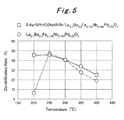
- the present confirmatory test is a test conducted to confirm the relationship between the denitrification rate by the exhaust gas treating catalyst having precious metals added thereto and the temperature of the exhaust gas.
- the relationship between the denitrification rate by the exhaust gas treating catalyst having precious metals added thereto and the temperature of the exhaust gas will be described concretely by reference to Fig. 5 .
- Fig. 5 is a graph showing the relationship between the denitrification rate by the exhaust gas treating catalyst and the temperature of the exhaust gas.
- the exhaust gas treating catalyst having precious metals added thereto (0.4 wt.% Pt + 0.04 wt.% Rh/La 0.7 Ba 0.3 Fe 0.776 Nb 0.194 Pd 0.03 O 3 ), as Test Catalyst 1, and the exhaust gas treating catalyst having no precious metals added thereto (La 0.7 Ba 0.3 Fe 0.776 Nb 0.194 Pd 0.03 O 3 ), as Comparative Test Catalyst 1, were each prepared by the aforementioned liquid phase process.
- the denitrification rate represents the average of the denitrification rate when the gas treated was in a lean state, and the denitrification rate when the gas treated was in a rich state.
- Test Catalyst 1 was found to provide a higher denitrification rate than Comparative Test Catalyst 1 over a range of 200°C or higher, but 400°C or lower. Test Catalyst 1 was also found to provide a denitrification rate comparable to that provided by Comparative Test Catalyst 1 at 250°C. Test Catalyst 1 was further found to show denitrification performance about 5 times as high as that of Comparative Test Catalyst 1 at 200°C.
- the present confirmatory test is a test conducted to confirm the relationship between the amounts of precious metals added to the exhaust gas treating catalyst and the denitrification rate by the exhaust gas treating catalyst.
- the relationship between the amounts of precious metals added to the exhaust gas treating catalyst and the denitrification rate by the exhaust gas treating catalyst will be described concretely by reference to Fig. 6 .
- Fig. 6 is a graph showing the relationship between the amounts of precious metals added to the exhaust gas treating catalyst and the denitrification rate by the exhaust gas treating catalyst when the temperature of the exhaust gas was 200°C.
- the exhaust gas treating catalyst having no precious metals added thereto (La 0.7 Ba 0.3 Fe 0.776 Nb 0.194 Pd 0.03 O 3 ), as Comparative Test Catalyst 2, the exhaust gas treating catalyst having 0.1 wt.% platinum and 0.01 wt.% rhodium added thereto (0.1 wt.% Pt + 0.01 wt.% Rh/La 0.7 Ba 0.3 Fe 0.776 Nb 0.194 Pd 0.03 O 3 ), as Test Catalyst 2, the exhaust gas treating catalyst having 0.2 wt.% platinum and 0.02 wt.% rhodium added thereto (0.2 wt.% Pt + 0.02 wt.% Rh/La 0.7 Ba 0.3 Fe 0 .
- Test Catalyst 4 776 Nb 0.194 Pd 0.03 O 3
- Test Catalyst 4 were each prepared by the aforementioned liquid phase process.
- the denitrification rate represents the average of the denitrification rate when the gas treated was in a lean state, and the denitrification rate when the gas treated was in a rich state.
- Test Catalysts 2, 3 and 4 were found to increase the denitrification rate in comparison with Comparative Test Catalyst 2, as shown in Fig. 6 . That is, by setting the amount of the precious metals added to the exhaust gas treating catalyst (La 0.7 Ba 0.3 Fe 0.776 Nb 0.194 Pd 0.03 ) at 0.11 wt.% or more, the denitrification rate was found tobe increased as compared with the exhaust gas treating catalyst containing no precious metals (La 0.7 Ba 0.3 Fe 0.776 Nb 0.194 Pd 0.03 O 3 ), Particularly when the amount of the precious metals contained in the exhaust gas treating catalyst (La 0.7 Ba 0.3 Fe 0.776 Nb 0.194 Pd 0.03 O 3 ) was in the range of 0.22 wt.% or more, but 0.44 wt.% or less, it was found that a denitrification rate of about 45% was shown.
- the exhaust gas treating catalyst according to the present invention is an exhaust gas treating catalyst further containing at least one precious metal among Pt, Rh, Ir and Ru in addition to a complex oxide composed of La x Ba (1-x) ⁇ Fe y Nb (1-y) ⁇ (1-z) Pd z O 3 .
- an exhaust gas treating catalyst having a complex oxide free of this precious metal
- such an exhaust gas treating catalyst can exhibit denitrification performance comparable to that of an exhaust gas treating catalyst not containing at least one precious metal among Pt, Rh, Ir and Ru, over an exhaust gas temperature range of 250 to 400°C, and even at the exhaust gas temperature of 200°C, can show denitrification performance comparable to that shown when the temperature of the exhaust gas was 250°C.
- the compactness of the exhaust gas treating catalyst can be achieved.
- the present invention has been described above using the exhaust gas treating catalyst prepared by the liquid phase process.
- the exhaust gas treating catalyst prepared by the solid phase process can also be adopted. Even such an exhaust gas treating catalyst prepared by this technique shows the same actions and effects as those of the above-described exhaust gas treating catalyst.
Landscapes
- Chemical & Material Sciences (AREA)
- Engineering & Computer Science (AREA)
- Chemical Kinetics & Catalysis (AREA)
- Combustion & Propulsion (AREA)
- Health & Medical Sciences (AREA)
- Materials Engineering (AREA)
- Oil, Petroleum & Natural Gas (AREA)
- General Chemical & Material Sciences (AREA)
- Analytical Chemistry (AREA)
- Environmental & Geological Engineering (AREA)
- Biomedical Technology (AREA)
- Organic Chemistry (AREA)
- Mechanical Engineering (AREA)
- General Engineering & Computer Science (AREA)
- Toxicology (AREA)
- Exhaust Gas Treatment By Means Of Catalyst (AREA)
- Catalysts (AREA)
- Exhaust Gas After Treatment (AREA)
Applications Claiming Priority (2)
| Application Number | Priority Date | Filing Date | Title |
|---|---|---|---|
| JP2008280727A JP5388052B2 (ja) | 2008-10-31 | 2008-10-31 | 排ガス処理触媒 |
| PCT/JP2009/058331 WO2010050257A1 (fr) | 2008-10-31 | 2009-04-28 | Catalyseur de traitement de gaz d'échappement et appareil de purification de gaz d'échappement l'employant |
Publications (3)
| Publication Number | Publication Date |
|---|---|
| EP2351611A1 true EP2351611A1 (fr) | 2011-08-03 |
| EP2351611A4 EP2351611A4 (fr) | 2014-10-08 |
| EP2351611B1 EP2351611B1 (fr) | 2018-04-04 |
Family
ID=42128627
Family Applications (1)
| Application Number | Title | Priority Date | Filing Date |
|---|---|---|---|
| EP09823370.3A Not-in-force EP2351611B1 (fr) | 2008-10-31 | 2009-04-28 | Catalyseur de traitement de gaz d'échappement et appareil de purification de gaz d'échappement l'employant |
Country Status (8)
| Country | Link |
|---|---|
| US (2) | US9174170B2 (fr) |
| EP (1) | EP2351611B1 (fr) |
| JP (1) | JP5388052B2 (fr) |
| KR (1) | KR101319680B1 (fr) |
| CN (2) | CN102202785A (fr) |
| CA (1) | CA2740964C (fr) |
| RU (1) | RU2467794C1 (fr) |
| WO (1) | WO2010050257A1 (fr) |
Cited By (2)
| Publication number | Priority date | Publication date | Assignee | Title |
|---|---|---|---|---|
| EP3153225A1 (fr) * | 2015-10-08 | 2017-04-12 | Cataler Corporation | Gaz d'échappement purifiant le catalyseur |
| WO2020193678A1 (fr) * | 2019-03-27 | 2020-10-01 | Forschungszentrum Jülich GmbH | Perovskite à oxydo-réduction stable pour le stockage d'oxydes d'azote de gaz d'échappement |
Families Citing this family (2)
| Publication number | Priority date | Publication date | Assignee | Title |
|---|---|---|---|---|
| JP6582625B2 (ja) * | 2015-07-02 | 2019-10-02 | 富士通株式会社 | 状態監視方法、状態監視プログラム及び状態監視装置 |
| GB2560940A (en) * | 2017-03-29 | 2018-10-03 | Johnson Matthey Plc | Three layer NOx Adsorber catalyst |
Family Cites Families (22)
| Publication number | Priority date | Publication date | Assignee | Title |
|---|---|---|---|---|
| FR2279463A1 (fr) * | 1974-04-25 | 1976-02-20 | Du Pont | Compositions catalytiques d'oxydes de metaux |
| JPS63302950A (ja) * | 1987-06-03 | 1988-12-09 | Nissan Motor Co Ltd | 排ガス浄化用触媒 |
| JPH01159029A (ja) | 1987-12-16 | 1989-06-22 | Toyota Motor Corp | ディーゼルエンジンの排気浄化装置 |
| EP0532024B1 (fr) | 1991-09-12 | 1998-08-12 | Sakai Chemical Industry Co., Ltd., | Catalyseur pour la réduction catalytique d'oxydes d'azote |
| JP2558566B2 (ja) * | 1991-11-13 | 1996-11-27 | 財団法人石油産業活性化センター | 窒素酸化物接触還元用触媒 |
| JPH0576762A (ja) * | 1991-09-21 | 1993-03-30 | Sakai Chem Ind Co Ltd | 窒素酸化物接触還元用触媒 |
| JPH05187230A (ja) * | 1992-01-14 | 1993-07-27 | Toyota Motor Corp | 内燃機関の排気浄化装置 |
| US5877377A (en) * | 1993-08-14 | 1999-03-02 | Johnson Matthey Public Limited Company | Metal oxide catalyst and use thereof in chemical reactions |
| CN1179357A (zh) * | 1997-08-18 | 1998-04-22 | 秦建武 | 一种复合金属氧化物催化剂及其制备方法 |
| JP2001269578A (ja) * | 2000-01-19 | 2001-10-02 | Toyota Motor Corp | 排気ガス浄化用触媒 |
| RU2003104602A (ru) * | 2003-02-18 | 2004-08-27 | Александр Юрьевич Логинов (RU) | Катализатор для очистки выхлопных газов двигателей |
| ITRM20030259A1 (it) * | 2003-05-28 | 2004-11-29 | Consiglio Nazionale Ricerche | Catalizzatore multistrato, procedimento per la sua |
| JP2006036558A (ja) * | 2004-07-23 | 2006-02-09 | Dowa Mining Co Ltd | ペロブスカイト型複合酸化物および触媒 |
| JP2006205021A (ja) | 2005-01-27 | 2006-08-10 | Mitsubishi Heavy Ind Ltd | 複合酸化物触媒 |
| WO2006095557A1 (fr) * | 2005-03-04 | 2006-09-14 | Daihatsu Motor Co., Ltd. | Composition catalytique |
| JP4647406B2 (ja) * | 2005-06-16 | 2011-03-09 | ダイハツ工業株式会社 | 排ガス浄化用触媒 |
| EP2010317A4 (fr) * | 2006-04-12 | 2012-08-29 | Very Small Particle Company Ltd | Catalyseur d'émissions résistant au soufre |
| JP5459927B2 (ja) | 2006-07-07 | 2014-04-02 | 株式会社キャタラー | 排ガス浄化用触媒 |
| JP2008215093A (ja) * | 2007-02-28 | 2008-09-18 | Babcock Hitachi Kk | 排気浄化フィルタ及びそれを備える自動車 |
| JP4954761B2 (ja) * | 2007-03-26 | 2012-06-20 | 東京瓦斯株式会社 | タール分解触媒 |
| JP5076762B2 (ja) * | 2007-09-12 | 2012-11-21 | パナソニック株式会社 | 端子付角型電池 |
| JP4985351B2 (ja) * | 2007-11-28 | 2012-07-25 | 三菱重工業株式会社 | 排ガス処理触媒および排ガス浄化装置 |
-
2008
- 2008-10-31 JP JP2008280727A patent/JP5388052B2/ja active Active
-
2009
- 2009-04-28 CN CN2009801435370A patent/CN102202785A/zh active Pending
- 2009-04-28 CA CA2740964A patent/CA2740964C/fr not_active Expired - Fee Related
- 2009-04-28 EP EP09823370.3A patent/EP2351611B1/fr not_active Not-in-force
- 2009-04-28 WO PCT/JP2009/058331 patent/WO2010050257A1/fr not_active Ceased
- 2009-04-28 RU RU2011121847/04A patent/RU2467794C1/ru active
- 2009-04-28 CN CN201610291343.7A patent/CN105944736A/zh active Pending
- 2009-04-28 US US13/126,965 patent/US9174170B2/en not_active Expired - Fee Related
- 2009-04-28 KR KR1020117009796A patent/KR101319680B1/ko not_active Expired - Fee Related
-
2015
- 2015-09-17 US US14/857,526 patent/US9308498B2/en not_active Expired - Fee Related
Cited By (3)
| Publication number | Priority date | Publication date | Assignee | Title |
|---|---|---|---|---|
| EP3153225A1 (fr) * | 2015-10-08 | 2017-04-12 | Cataler Corporation | Gaz d'échappement purifiant le catalyseur |
| US10279338B2 (en) | 2015-10-08 | 2019-05-07 | Cataler Corporation | Exhaust gas-purifying catalyst |
| WO2020193678A1 (fr) * | 2019-03-27 | 2020-10-01 | Forschungszentrum Jülich GmbH | Perovskite à oxydo-réduction stable pour le stockage d'oxydes d'azote de gaz d'échappement |
Also Published As
| Publication number | Publication date |
|---|---|
| KR101319680B1 (ko) | 2013-10-17 |
| EP2351611B1 (fr) | 2018-04-04 |
| US9308498B2 (en) | 2016-04-12 |
| CA2740964C (fr) | 2014-02-25 |
| CN105944736A (zh) | 2016-09-21 |
| EP2351611A4 (fr) | 2014-10-08 |
| US20160001230A1 (en) | 2016-01-07 |
| JP5388052B2 (ja) | 2014-01-15 |
| JP2010104933A (ja) | 2010-05-13 |
| CA2740964A1 (fr) | 2010-05-06 |
| US9174170B2 (en) | 2015-11-03 |
| US20120014841A1 (en) | 2012-01-19 |
| KR20110082535A (ko) | 2011-07-19 |
| WO2010050257A1 (fr) | 2010-05-06 |
| RU2467794C1 (ru) | 2012-11-27 |
| CN102202785A (zh) | 2011-09-28 |
Similar Documents
| Publication | Publication Date | Title |
|---|---|---|
| US7375054B2 (en) | Exhaust gas treatment catalyst and exhaust gas treatment method | |
| US8409518B2 (en) | Sulfur tolerant perovskite supported catalysts | |
| US20140336045A1 (en) | Perovskite and Mullite-like Structure Catalysts for Diesel Oxidation and Method of Making Same | |
| JP2001269578A (ja) | 排気ガス浄化用触媒 | |
| WO2009087852A1 (fr) | Dispositif de nettoyage de gaz d'échappement | |
| US9308498B2 (en) | Exhaust gas treating catalyst and exhaust gas purification apparatus using the same | |
| WO2012093599A1 (fr) | Catalyseur de purification de gaz d'échappement | |
| US6767526B1 (en) | Method for treating by combustion carbon-containing particles in an internal combustion engine exhaust circuit | |
| JPH07116519A (ja) | 排ガス浄化材および排ガス浄化方法 | |
| JPH09884A (ja) | 排ガス中の亜酸化窒素などの除去方法と装置および触媒 | |
| JP4985351B2 (ja) | 排ガス処理触媒および排ガス浄化装置 | |
| JPH08229404A (ja) | 排ガス浄化触媒および排ガス浄化装置 | |
| JP5196656B2 (ja) | 排ガス浄化用触媒及びその製造方法 | |
| WO2011157963A2 (fr) | Systeme de catalyse electrochimique | |
| WO2006134787A1 (fr) | Catalyseur pour la purification de gaz d'echappement | |
| JP2006326375A (ja) | 排ガス浄化用触媒、排ガス浄化装置及び排ガス浄化方法 | |
| JP4755131B2 (ja) | 複合酸化物触媒およびその製造方法並びに排ガス浄化装置 | |
| US20100075842A1 (en) | Potassium oxide-incorporated alumina catalysts with enhanced storage capacities of nitrogen oxide and a producing method therefor | |
| JP2009138591A (ja) | 熱機関の排ガス浄化装置、排ガス浄化方法及びNOx浄化触媒 | |
| JP2002301337A (ja) | 内燃機関の排気ガス浄化装置及び排気ガス浄化用触媒 | |
| JP2007239616A (ja) | 排ガスの浄化装置及び排ガスの浄化方法,浄化触媒 | |
| JP2004321986A (ja) | 排気ガス浄化触媒 | |
| JP2011050855A (ja) | 排ガス浄化装置 | |
| JP4494068B2 (ja) | 排ガス中のメタンの酸化除去用触媒及び排ガス浄化方法 | |
| JP2022110644A (ja) | エンジンの排気浄化装置 |
Legal Events
| Date | Code | Title | Description |
|---|---|---|---|
| PUAI | Public reference made under article 153(3) epc to a published international application that has entered the european phase |
Free format text: ORIGINAL CODE: 0009012 |
|
| 17P | Request for examination filed |
Effective date: 20110413 |
|
| AK | Designated contracting states |
Kind code of ref document: A1 Designated state(s): AT BE BG CH CY CZ DE DK EE ES FI FR GB GR HR HU IE IS IT LI LT LU LV MC MK MT NL NO PL PT RO SE SI SK TR |
|
| DAX | Request for extension of the european patent (deleted) | ||
| A4 | Supplementary search report drawn up and despatched |
Effective date: 20140910 |
|
| RIC1 | Information provided on ipc code assigned before grant |
Ipc: B01J 23/89 20060101AFI20140904BHEP Ipc: F01N 3/10 20060101ALI20140904BHEP Ipc: F01N 3/24 20060101ALI20140904BHEP Ipc: B01D 53/94 20060101ALI20140904BHEP |
|
| 17Q | First examination report despatched |
Effective date: 20170117 |
|
| GRAP | Despatch of communication of intention to grant a patent |
Free format text: ORIGINAL CODE: EPIDOSNIGR1 |
|
| INTG | Intention to grant announced |
Effective date: 20171025 |
|
| GRAS | Grant fee paid |
Free format text: ORIGINAL CODE: EPIDOSNIGR3 |
|
| GRAA | (expected) grant |
Free format text: ORIGINAL CODE: 0009210 |
|
| AK | Designated contracting states |
Kind code of ref document: B1 Designated state(s): AT BE BG CH CY CZ DE DK EE ES FI FR GB GR HR HU IE IS IT LI LT LU LV MC MK MT NL NO PL PT RO SE SI SK TR |
|
| REG | Reference to a national code |
Ref country code: GB Ref legal event code: FG4D |
|
| REG | Reference to a national code |
Ref country code: CH Ref legal event code: EP |
|
| REG | Reference to a national code |
Ref country code: AT Ref legal event code: REF Ref document number: 985010 Country of ref document: AT Kind code of ref document: T Effective date: 20180415 |
|
| REG | Reference to a national code |
Ref country code: IE Ref legal event code: FG4D |
|
| REG | Reference to a national code |
Ref country code: DE Ref legal event code: R096 Ref document number: 602009051655 Country of ref document: DE |
|
| REG | Reference to a national code |
Ref country code: NL Ref legal event code: MP Effective date: 20180404 |
|
| REG | Reference to a national code |
Ref country code: LT Ref legal event code: MG4D |
|
| PG25 | Lapsed in a contracting state [announced via postgrant information from national office to epo] |
Ref country code: NL Free format text: LAPSE BECAUSE OF FAILURE TO SUBMIT A TRANSLATION OF THE DESCRIPTION OR TO PAY THE FEE WITHIN THE PRESCRIBED TIME-LIMIT Effective date: 20180404 |
|
| PG25 | Lapsed in a contracting state [announced via postgrant information from national office to epo] |
Ref country code: ES Free format text: LAPSE BECAUSE OF FAILURE TO SUBMIT A TRANSLATION OF THE DESCRIPTION OR TO PAY THE FEE WITHIN THE PRESCRIBED TIME-LIMIT Effective date: 20180404 Ref country code: SE Free format text: LAPSE BECAUSE OF FAILURE TO SUBMIT A TRANSLATION OF THE DESCRIPTION OR TO PAY THE FEE WITHIN THE PRESCRIBED TIME-LIMIT Effective date: 20180404 Ref country code: BG Free format text: LAPSE BECAUSE OF FAILURE TO SUBMIT A TRANSLATION OF THE DESCRIPTION OR TO PAY THE FEE WITHIN THE PRESCRIBED TIME-LIMIT Effective date: 20180704 Ref country code: FI Free format text: LAPSE BECAUSE OF FAILURE TO SUBMIT A TRANSLATION OF THE DESCRIPTION OR TO PAY THE FEE WITHIN THE PRESCRIBED TIME-LIMIT Effective date: 20180404 Ref country code: NO Free format text: LAPSE BECAUSE OF FAILURE TO SUBMIT A TRANSLATION OF THE DESCRIPTION OR TO PAY THE FEE WITHIN THE PRESCRIBED TIME-LIMIT Effective date: 20180704 Ref country code: PL Free format text: LAPSE BECAUSE OF FAILURE TO SUBMIT A TRANSLATION OF THE DESCRIPTION OR TO PAY THE FEE WITHIN THE PRESCRIBED TIME-LIMIT Effective date: 20180404 Ref country code: LT Free format text: LAPSE BECAUSE OF FAILURE TO SUBMIT A TRANSLATION OF THE DESCRIPTION OR TO PAY THE FEE WITHIN THE PRESCRIBED TIME-LIMIT Effective date: 20180404 |
|
| PG25 | Lapsed in a contracting state [announced via postgrant information from national office to epo] |
Ref country code: GR Free format text: LAPSE BECAUSE OF FAILURE TO SUBMIT A TRANSLATION OF THE DESCRIPTION OR TO PAY THE FEE WITHIN THE PRESCRIBED TIME-LIMIT Effective date: 20180705 Ref country code: HR Free format text: LAPSE BECAUSE OF FAILURE TO SUBMIT A TRANSLATION OF THE DESCRIPTION OR TO PAY THE FEE WITHIN THE PRESCRIBED TIME-LIMIT Effective date: 20180404 Ref country code: LV Free format text: LAPSE BECAUSE OF FAILURE TO SUBMIT A TRANSLATION OF THE DESCRIPTION OR TO PAY THE FEE WITHIN THE PRESCRIBED TIME-LIMIT Effective date: 20180404 |
|
| REG | Reference to a national code |
Ref country code: CH Ref legal event code: PL |
|
| REG | Reference to a national code |
Ref country code: AT Ref legal event code: MK05 Ref document number: 985010 Country of ref document: AT Kind code of ref document: T Effective date: 20180404 |
|
| REG | Reference to a national code |
Ref country code: BE Ref legal event code: MM Effective date: 20180430 |
|
| PG25 | Lapsed in a contracting state [announced via postgrant information from national office to epo] |
Ref country code: PT Free format text: LAPSE BECAUSE OF FAILURE TO SUBMIT A TRANSLATION OF THE DESCRIPTION OR TO PAY THE FEE WITHIN THE PRESCRIBED TIME-LIMIT Effective date: 20180806 |
|
| REG | Reference to a national code |
Ref country code: DE Ref legal event code: R097 Ref document number: 602009051655 Country of ref document: DE |
|
| REG | Reference to a national code |
Ref country code: IE Ref legal event code: MM4A |
|
| PG25 | Lapsed in a contracting state [announced via postgrant information from national office to epo] |
Ref country code: LU Free format text: LAPSE BECAUSE OF NON-PAYMENT OF DUE FEES Effective date: 20180428 Ref country code: MC Free format text: LAPSE BECAUSE OF FAILURE TO SUBMIT A TRANSLATION OF THE DESCRIPTION OR TO PAY THE FEE WITHIN THE PRESCRIBED TIME-LIMIT Effective date: 20180404 Ref country code: RO Free format text: LAPSE BECAUSE OF FAILURE TO SUBMIT A TRANSLATION OF THE DESCRIPTION OR TO PAY THE FEE WITHIN THE PRESCRIBED TIME-LIMIT Effective date: 20180404 Ref country code: CZ Free format text: LAPSE BECAUSE OF FAILURE TO SUBMIT A TRANSLATION OF THE DESCRIPTION OR TO PAY THE FEE WITHIN THE PRESCRIBED TIME-LIMIT Effective date: 20180404 Ref country code: EE Free format text: LAPSE BECAUSE OF FAILURE TO SUBMIT A TRANSLATION OF THE DESCRIPTION OR TO PAY THE FEE WITHIN THE PRESCRIBED TIME-LIMIT Effective date: 20180404 Ref country code: AT Free format text: LAPSE BECAUSE OF FAILURE TO SUBMIT A TRANSLATION OF THE DESCRIPTION OR TO PAY THE FEE WITHIN THE PRESCRIBED TIME-LIMIT Effective date: 20180404 Ref country code: SK Free format text: LAPSE BECAUSE OF FAILURE TO SUBMIT A TRANSLATION OF THE DESCRIPTION OR TO PAY THE FEE WITHIN THE PRESCRIBED TIME-LIMIT Effective date: 20180404 Ref country code: DK Free format text: LAPSE BECAUSE OF FAILURE TO SUBMIT A TRANSLATION OF THE DESCRIPTION OR TO PAY THE FEE WITHIN THE PRESCRIBED TIME-LIMIT Effective date: 20180404 |
|
| PLBE | No opposition filed within time limit |
Free format text: ORIGINAL CODE: 0009261 |
|
| STAA | Information on the status of an ep patent application or granted ep patent |
Free format text: STATUS: NO OPPOSITION FILED WITHIN TIME LIMIT |
|
| PG25 | Lapsed in a contracting state [announced via postgrant information from national office to epo] |
Ref country code: LI Free format text: LAPSE BECAUSE OF NON-PAYMENT OF DUE FEES Effective date: 20180430 Ref country code: CH Free format text: LAPSE BECAUSE OF NON-PAYMENT OF DUE FEES Effective date: 20180430 Ref country code: BE Free format text: LAPSE BECAUSE OF NON-PAYMENT OF DUE FEES Effective date: 20180430 |
|
| 26N | No opposition filed |
Effective date: 20190107 |
|
| PG25 | Lapsed in a contracting state [announced via postgrant information from national office to epo] |
Ref country code: FR Free format text: LAPSE BECAUSE OF NON-PAYMENT OF DUE FEES Effective date: 20180604 Ref country code: IE Free format text: LAPSE BECAUSE OF NON-PAYMENT OF DUE FEES Effective date: 20180428 |
|
| PG25 | Lapsed in a contracting state [announced via postgrant information from national office to epo] |
Ref country code: SI Free format text: LAPSE BECAUSE OF FAILURE TO SUBMIT A TRANSLATION OF THE DESCRIPTION OR TO PAY THE FEE WITHIN THE PRESCRIBED TIME-LIMIT Effective date: 20180404 |
|
| PG25 | Lapsed in a contracting state [announced via postgrant information from national office to epo] |
Ref country code: MT Free format text: LAPSE BECAUSE OF NON-PAYMENT OF DUE FEES Effective date: 20180428 |
|
| PG25 | Lapsed in a contracting state [announced via postgrant information from national office to epo] |
Ref country code: TR Free format text: LAPSE BECAUSE OF FAILURE TO SUBMIT A TRANSLATION OF THE DESCRIPTION OR TO PAY THE FEE WITHIN THE PRESCRIBED TIME-LIMIT Effective date: 20180404 |
|
| PG25 | Lapsed in a contracting state [announced via postgrant information from national office to epo] |
Ref country code: HU Free format text: LAPSE BECAUSE OF FAILURE TO SUBMIT A TRANSLATION OF THE DESCRIPTION OR TO PAY THE FEE WITHIN THE PRESCRIBED TIME-LIMIT; INVALID AB INITIO Effective date: 20090428 |
|
| PG25 | Lapsed in a contracting state [announced via postgrant information from national office to epo] |
Ref country code: CY Free format text: LAPSE BECAUSE OF FAILURE TO SUBMIT A TRANSLATION OF THE DESCRIPTION OR TO PAY THE FEE WITHIN THE PRESCRIBED TIME-LIMIT Effective date: 20180404 Ref country code: MK Free format text: LAPSE BECAUSE OF NON-PAYMENT OF DUE FEES Effective date: 20180404 |
|
| PG25 | Lapsed in a contracting state [announced via postgrant information from national office to epo] |
Ref country code: IS Free format text: LAPSE BECAUSE OF FAILURE TO SUBMIT A TRANSLATION OF THE DESCRIPTION OR TO PAY THE FEE WITHIN THE PRESCRIBED TIME-LIMIT Effective date: 20180804 |
|
| PGFP | Annual fee paid to national office [announced via postgrant information from national office to epo] |
Ref country code: IT Payment date: 20210310 Year of fee payment: 13 |
|
| PGFP | Annual fee paid to national office [announced via postgrant information from national office to epo] |
Ref country code: GB Payment date: 20210331 Year of fee payment: 13 |
|
| PGFP | Annual fee paid to national office [announced via postgrant information from national office to epo] |
Ref country code: DE Payment date: 20210330 Year of fee payment: 13 |
|
| REG | Reference to a national code |
Ref country code: DE Ref legal event code: R119 Ref document number: 602009051655 Country of ref document: DE |
|
| GBPC | Gb: european patent ceased through non-payment of renewal fee |
Effective date: 20220428 |
|
| PG25 | Lapsed in a contracting state [announced via postgrant information from national office to epo] |
Ref country code: GB Free format text: LAPSE BECAUSE OF NON-PAYMENT OF DUE FEES Effective date: 20220428 Ref country code: DE Free format text: LAPSE BECAUSE OF NON-PAYMENT OF DUE FEES Effective date: 20221103 |
|
| PG25 | Lapsed in a contracting state [announced via postgrant information from national office to epo] |
Ref country code: IT Free format text: LAPSE BECAUSE OF NON-PAYMENT OF DUE FEES Effective date: 20220428 |