EP2352480B1 - Article dentaire céramique, son procédé de production et ses utilisations - Google Patents
Article dentaire céramique, son procédé de production et ses utilisations Download PDFInfo
- Publication number
- EP2352480B1 EP2352480B1 EP09744288.3A EP09744288A EP2352480B1 EP 2352480 B1 EP2352480 B1 EP 2352480B1 EP 09744288 A EP09744288 A EP 09744288A EP 2352480 B1 EP2352480 B1 EP 2352480B1
- Authority
- EP
- European Patent Office
- Prior art keywords
- substance
- dental
- article
- composition
- ceramic article
- Prior art date
- Legal status (The legal status is an assumption and is not a legal conclusion. Google has not performed a legal analysis and makes no representation as to the accuracy of the status listed.)
- Not-in-force
Links
- 238000000034 method Methods 0.000 title claims description 37
- 239000011351 dental ceramic Substances 0.000 title claims description 33
- 230000008569 process Effects 0.000 title claims description 32
- 238000004519 manufacturing process Methods 0.000 title claims description 19
- 239000000126 substance Substances 0.000 claims description 91
- 239000000203 mixture Substances 0.000 claims description 72
- OMOVVBIIQSXZSZ-UHFFFAOYSA-N [6-(4-acetyloxy-5,9a-dimethyl-2,7-dioxo-4,5a,6,9-tetrahydro-3h-pyrano[3,4-b]oxepin-5-yl)-5-formyloxy-3-(furan-3-yl)-3a-methyl-7-methylidene-1a,2,3,4,5,6-hexahydroindeno[1,7a-b]oxiren-4-yl] 2-hydroxy-3-methylpentanoate Chemical compound CC12C(OC(=O)C(O)C(C)CC)C(OC=O)C(C3(C)C(CC(=O)OC4(C)COC(=O)CC43)OC(C)=O)C(=C)C32OC3CC1C=1C=COC=1 OMOVVBIIQSXZSZ-UHFFFAOYSA-N 0.000 claims description 68
- MCMNRKCIXSYSNV-UHFFFAOYSA-N Zirconium dioxide Chemical compound O=[Zr]=O MCMNRKCIXSYSNV-UHFFFAOYSA-N 0.000 claims description 52
- RVTZCBVAJQQJTK-UHFFFAOYSA-N oxygen(2-);zirconium(4+) Chemical compound [O-2].[O-2].[Zr+4] RVTZCBVAJQQJTK-UHFFFAOYSA-N 0.000 claims description 39
- 229910001928 zirconium oxide Inorganic materials 0.000 claims description 39
- 239000000654 additive Substances 0.000 claims description 29
- 238000004040 coloring Methods 0.000 claims description 18
- 239000007788 liquid Substances 0.000 claims description 15
- 229910052692 Dysprosium Inorganic materials 0.000 claims description 14
- KBQHZAAAGSGFKK-UHFFFAOYSA-N dysprosium atom Chemical compound [Dy] KBQHZAAAGSGFKK-UHFFFAOYSA-N 0.000 claims description 14
- 230000031700 light absorption Effects 0.000 claims description 13
- 238000003825 pressing Methods 0.000 claims description 13
- NLQFUUYNQFMIJW-UHFFFAOYSA-N dysprosium(III) oxide Inorganic materials O=[Dy]O[Dy]=O NLQFUUYNQFMIJW-UHFFFAOYSA-N 0.000 claims description 11
- 238000003754 machining Methods 0.000 claims description 10
- 229910052779 Neodymium Inorganic materials 0.000 claims description 9
- QEFYFXOXNSNQGX-UHFFFAOYSA-N neodymium atom Chemical compound [Nd] QEFYFXOXNSNQGX-UHFFFAOYSA-N 0.000 claims description 9
- 239000006112 glass ceramic composition Substances 0.000 claims description 8
- 239000011521 glass Substances 0.000 claims description 7
- 239000002904 solvent Substances 0.000 claims description 6
- 239000011230 binding agent Substances 0.000 claims description 5
- 238000005266 casting Methods 0.000 claims description 5
- 150000001768 cations Chemical class 0.000 claims description 4
- RUDFQVOCFDJEEF-UHFFFAOYSA-N yttrium(III) oxide Inorganic materials [O-2].[O-2].[O-2].[Y+3].[Y+3] RUDFQVOCFDJEEF-UHFFFAOYSA-N 0.000 claims description 4
- PLDDOISOJJCEMH-UHFFFAOYSA-N neodymium oxide Inorganic materials [O-2].[O-2].[O-2].[Nd+3].[Nd+3] PLDDOISOJJCEMH-UHFFFAOYSA-N 0.000 claims description 3
- 239000000463 material Substances 0.000 description 27
- 238000005245 sintering Methods 0.000 description 20
- 239000000919 ceramic Substances 0.000 description 18
- 239000000243 solution Substances 0.000 description 15
- 238000010521 absorption reaction Methods 0.000 description 14
- 238000002189 fluorescence spectrum Methods 0.000 description 13
- 239000000843 powder Substances 0.000 description 13
- 150000002500 ions Chemical class 0.000 description 12
- 230000000996 additive effect Effects 0.000 description 9
- 238000010304 firing Methods 0.000 description 9
- 229910003440 dysprosium oxide Inorganic materials 0.000 description 8
- 238000000411 transmission spectrum Methods 0.000 description 8
- PNEYBMLMFCGWSK-UHFFFAOYSA-N aluminium oxide Inorganic materials [O-2].[O-2].[O-2].[Al+3].[Al+3] PNEYBMLMFCGWSK-UHFFFAOYSA-N 0.000 description 7
- 230000005284 excitation Effects 0.000 description 6
- 239000011572 manganese Substances 0.000 description 6
- 239000011148 porous material Substances 0.000 description 6
- 150000003839 salts Chemical class 0.000 description 6
- XLYOFNOQVPJJNP-UHFFFAOYSA-N water Substances O XLYOFNOQVPJJNP-UHFFFAOYSA-N 0.000 description 6
- 229910052727 yttrium Inorganic materials 0.000 description 6
- VWQVUPCCIRVNHF-UHFFFAOYSA-N yttrium atom Chemical compound [Y] VWQVUPCCIRVNHF-UHFFFAOYSA-N 0.000 description 6
- 238000000227 grinding Methods 0.000 description 5
- 238000005259 measurement Methods 0.000 description 5
- 238000001228 spectrum Methods 0.000 description 5
- BVKZGUZCCUSVTD-UHFFFAOYSA-L Carbonate Chemical compound [O-]C([O-])=O BVKZGUZCCUSVTD-UHFFFAOYSA-L 0.000 description 4
- 241000183024 Populus tremula Species 0.000 description 4
- 239000003086 colorant Substances 0.000 description 4
- 210000004268 dentin Anatomy 0.000 description 4
- 238000004043 dyeing Methods 0.000 description 4
- AKFFNTKRAYWFRN-UHFFFAOYSA-N ethyl 5-(trifluoromethyl)-1h-pyrazole-3-carboxylate Chemical compound CCOC(=O)C=1C=C(C(F)(F)F)NN=1 AKFFNTKRAYWFRN-UHFFFAOYSA-N 0.000 description 4
- 229910001940 europium oxide Inorganic materials 0.000 description 4
- AEBZCFFCDTZXHP-UHFFFAOYSA-N europium(3+);oxygen(2-) Chemical compound [O-2].[O-2].[O-2].[Eu+3].[Eu+3] AEBZCFFCDTZXHP-UHFFFAOYSA-N 0.000 description 4
- 238000001764 infiltration Methods 0.000 description 4
- 230000008595 infiltration Effects 0.000 description 4
- 238000003801 milling Methods 0.000 description 4
- 238000012986 modification Methods 0.000 description 4
- 230000004048 modification Effects 0.000 description 4
- 239000007787 solid Substances 0.000 description 4
- BYDYILQCRDXHLB-UHFFFAOYSA-N 3,5-dimethylpyridine-2-carbaldehyde Chemical compound CC1=CN=C(C=O)C(C)=C1 BYDYILQCRDXHLB-UHFFFAOYSA-N 0.000 description 3
- 229910052691 Erbium Inorganic materials 0.000 description 3
- OKKJLVBELUTLKV-UHFFFAOYSA-N Methanol Chemical compound OC OKKJLVBELUTLKV-UHFFFAOYSA-N 0.000 description 3
- PXHVJJICTQNCMI-UHFFFAOYSA-N Nickel Chemical compound [Ni] PXHVJJICTQNCMI-UHFFFAOYSA-N 0.000 description 3
- 229910000831 Steel Inorganic materials 0.000 description 3
- 238000001354 calcination Methods 0.000 description 3
- 239000010949 copper Substances 0.000 description 3
- RKTYLMNFRDHKIL-UHFFFAOYSA-N copper;5,10,15,20-tetraphenylporphyrin-22,24-diide Chemical compound [Cu+2].C1=CC(C(=C2C=CC([N-]2)=C(C=2C=CC=CC=2)C=2C=CC(N=2)=C(C=2C=CC=CC=2)C2=CC=C3[N-]2)C=2C=CC=CC=2)=NC1=C3C1=CC=CC=C1 RKTYLMNFRDHKIL-UHFFFAOYSA-N 0.000 description 3
- 229910052593 corundum Inorganic materials 0.000 description 3
- UYAHIZSMUZPPFV-UHFFFAOYSA-N erbium Chemical compound [Er] UYAHIZSMUZPPFV-UHFFFAOYSA-N 0.000 description 3
- 239000004744 fabric Substances 0.000 description 3
- 239000002241 glass-ceramic Substances 0.000 description 3
- XEEYBQQBJWHFJM-UHFFFAOYSA-N iron Substances [Fe] XEEYBQQBJWHFJM-UHFFFAOYSA-N 0.000 description 3
- 229910052748 manganese Inorganic materials 0.000 description 3
- 238000002156 mixing Methods 0.000 description 3
- 229910052574 oxide ceramic Inorganic materials 0.000 description 3
- 238000005498 polishing Methods 0.000 description 3
- 229910052761 rare earth metal Inorganic materials 0.000 description 3
- 229910002076 stabilized zirconia Inorganic materials 0.000 description 3
- 239000010959 steel Substances 0.000 description 3
- 229910001845 yogo sapphire Inorganic materials 0.000 description 3
- QTBSBXVTEAMEQO-UHFFFAOYSA-M Acetate Chemical compound CC([O-])=O QTBSBXVTEAMEQO-UHFFFAOYSA-M 0.000 description 2
- CSCPPACGZOOCGX-UHFFFAOYSA-N Acetone Chemical compound CC(C)=O CSCPPACGZOOCGX-UHFFFAOYSA-N 0.000 description 2
- VEXZGXHMUGYJMC-UHFFFAOYSA-M Chloride anion Chemical compound [Cl-] VEXZGXHMUGYJMC-UHFFFAOYSA-M 0.000 description 2
- KRKNYBCHXYNGOX-UHFFFAOYSA-K Citrate Chemical compound [O-]C(=O)CC(O)(CC([O-])=O)C([O-])=O KRKNYBCHXYNGOX-UHFFFAOYSA-K 0.000 description 2
- RYGMFSIKBFXOCR-UHFFFAOYSA-N Copper Chemical compound [Cu] RYGMFSIKBFXOCR-UHFFFAOYSA-N 0.000 description 2
- LFQSCWFLJHTTHZ-UHFFFAOYSA-N Ethanol Chemical compound CCO LFQSCWFLJHTTHZ-UHFFFAOYSA-N 0.000 description 2
- 229910002651 NO3 Inorganic materials 0.000 description 2
- NHNBFGGVMKEFGY-UHFFFAOYSA-N Nitrate Chemical compound [O-][N+]([O-])=O NHNBFGGVMKEFGY-UHFFFAOYSA-N 0.000 description 2
- GWEVSGVZZGPLCZ-UHFFFAOYSA-N Titan oxide Chemical compound O=[Ti]=O GWEVSGVZZGPLCZ-UHFFFAOYSA-N 0.000 description 2
- 238000013459 approach Methods 0.000 description 2
- 230000001680 brushing effect Effects 0.000 description 2
- 239000006227 byproduct Substances 0.000 description 2
- 239000011651 chromium Substances 0.000 description 2
- 239000011248 coating agent Substances 0.000 description 2
- 238000000576 coating method Methods 0.000 description 2
- 239000004020 conductor Substances 0.000 description 2
- 229910052802 copper Inorganic materials 0.000 description 2
- 239000008367 deionised water Substances 0.000 description 2
- 238000007598 dipping method Methods 0.000 description 2
- 238000009826 distribution Methods 0.000 description 2
- 238000001035 drying Methods 0.000 description 2
- 230000000694 effects Effects 0.000 description 2
- 239000000835 fiber Substances 0.000 description 2
- 238000010438 heat treatment Methods 0.000 description 2
- AMWRITDGCCNYAT-UHFFFAOYSA-L hydroxy(oxo)manganese;manganese Chemical compound [Mn].O[Mn]=O.O[Mn]=O AMWRITDGCCNYAT-UHFFFAOYSA-L 0.000 description 2
- 230000001678 irradiating effect Effects 0.000 description 2
- MRELNEQAGSRDBK-UHFFFAOYSA-N lanthanum(3+);oxygen(2-) Chemical compound [O-2].[O-2].[O-2].[La+3].[La+3] MRELNEQAGSRDBK-UHFFFAOYSA-N 0.000 description 2
- 239000007769 metal material Substances 0.000 description 2
- ZKATWMILCYLAPD-UHFFFAOYSA-N niobium pentoxide Chemical compound O=[Nb](=O)O[Nb](=O)=O ZKATWMILCYLAPD-UHFFFAOYSA-N 0.000 description 2
- 230000003287 optical effect Effects 0.000 description 2
- 230000003647 oxidation Effects 0.000 description 2
- 238000007254 oxidation reaction Methods 0.000 description 2
- 239000011224 oxide ceramic Substances 0.000 description 2
- 239000002245 particle Substances 0.000 description 2
- 238000002360 preparation method Methods 0.000 description 2
- 230000005855 radiation Effects 0.000 description 2
- 238000007569 slipcasting Methods 0.000 description 2
- 238000005507 spraying Methods 0.000 description 2
- 239000003381 stabilizer Substances 0.000 description 2
- 238000012360 testing method Methods 0.000 description 2
- 238000001429 visible spectrum Methods 0.000 description 2
- WQXKGOOORHDGFP-UHFFFAOYSA-N 1,2,4,5-tetrafluoro-3,6-dimethoxybenzene Chemical compound COC1=C(F)C(F)=C(OC)C(F)=C1F WQXKGOOORHDGFP-UHFFFAOYSA-N 0.000 description 1
- 238000007088 Archimedes method Methods 0.000 description 1
- VYZAMTAEIAYCRO-UHFFFAOYSA-N Chromium Chemical compound [Cr] VYZAMTAEIAYCRO-UHFFFAOYSA-N 0.000 description 1
- 206010014128 Echopraxia Diseases 0.000 description 1
- GYHNNYVSQQEPJS-UHFFFAOYSA-N Gallium Chemical compound [Ga] GYHNNYVSQQEPJS-UHFFFAOYSA-N 0.000 description 1
- PWHULOQIROXLJO-UHFFFAOYSA-N Manganese Chemical compound [Mn] PWHULOQIROXLJO-UHFFFAOYSA-N 0.000 description 1
- 241001465754 Metazoa Species 0.000 description 1
- 229910002637 Pr6O11 Inorganic materials 0.000 description 1
- 229910052777 Praseodymium Inorganic materials 0.000 description 1
- 229910052772 Samarium Inorganic materials 0.000 description 1
- XUIMIQQOPSSXEZ-UHFFFAOYSA-N Silicon Chemical compound [Si] XUIMIQQOPSSXEZ-UHFFFAOYSA-N 0.000 description 1
- XHCLAFWTIXFWPH-UHFFFAOYSA-N [O-2].[O-2].[O-2].[O-2].[O-2].[V+5].[V+5] Chemical compound [O-2].[O-2].[O-2].[O-2].[O-2].[V+5].[V+5] XHCLAFWTIXFWPH-UHFFFAOYSA-N 0.000 description 1
- 238000004026 adhesive bonding Methods 0.000 description 1
- 150000001298 alcohols Chemical class 0.000 description 1
- 230000004075 alteration Effects 0.000 description 1
- 239000004411 aluminium Substances 0.000 description 1
- 229910052782 aluminium Inorganic materials 0.000 description 1
- XAGFODPZIPBFFR-UHFFFAOYSA-N aluminium Chemical compound [Al] XAGFODPZIPBFFR-UHFFFAOYSA-N 0.000 description 1
- 239000012752 auxiliary agent Substances 0.000 description 1
- 238000009835 boiling Methods 0.000 description 1
- 239000000872 buffer Substances 0.000 description 1
- 229910010293 ceramic material Inorganic materials 0.000 description 1
- 229910000420 cerium oxide Inorganic materials 0.000 description 1
- 230000008859 change Effects 0.000 description 1
- 238000006243 chemical reaction Methods 0.000 description 1
- 239000003795 chemical substances by application Substances 0.000 description 1
- 229910052804 chromium Inorganic materials 0.000 description 1
- 239000010941 cobalt Substances 0.000 description 1
- 229910017052 cobalt Inorganic materials 0.000 description 1
- GUTLYIVDDKVIGB-UHFFFAOYSA-N cobalt atom Chemical compound [Co] GUTLYIVDDKVIGB-UHFFFAOYSA-N 0.000 description 1
- 238000009694 cold isostatic pressing Methods 0.000 description 1
- 150000001875 compounds Chemical class 0.000 description 1
- 239000010987 cubic zirconia Substances 0.000 description 1
- 238000005520 cutting process Methods 0.000 description 1
- 229910021641 deionized water Inorganic materials 0.000 description 1
- 238000000280 densification Methods 0.000 description 1
- 239000005548 dental material Substances 0.000 description 1
- 238000002845 discoloration Methods 0.000 description 1
- 239000006185 dispersion Substances 0.000 description 1
- 238000000295 emission spectrum Methods 0.000 description 1
- VQCBHWLJZDBHOS-UHFFFAOYSA-N erbium(III) oxide Inorganic materials O=[Er]O[Er]=O VQCBHWLJZDBHOS-UHFFFAOYSA-N 0.000 description 1
- 238000002474 experimental method Methods 0.000 description 1
- 239000010419 fine particle Substances 0.000 description 1
- 229910052733 gallium Inorganic materials 0.000 description 1
- 229910052732 germanium Inorganic materials 0.000 description 1
- GNPVGFCGXDBREM-UHFFFAOYSA-N germanium atom Chemical compound [Ge] GNPVGFCGXDBREM-UHFFFAOYSA-N 0.000 description 1
- 229910000449 hafnium oxide Inorganic materials 0.000 description 1
- WIHZLLGSGQNAGK-UHFFFAOYSA-N hafnium(4+);oxygen(2-) Chemical compound [O-2].[O-2].[Hf+4] WIHZLLGSGQNAGK-UHFFFAOYSA-N 0.000 description 1
- CJNBYAVZURUTKZ-UHFFFAOYSA-N hafnium(IV) oxide Inorganic materials O=[Hf]=O CJNBYAVZURUTKZ-UHFFFAOYSA-N 0.000 description 1
- 230000006872 improvement Effects 0.000 description 1
- 239000012535 impurity Substances 0.000 description 1
- 229910052738 indium Inorganic materials 0.000 description 1
- APFVFJFRJDLVQX-UHFFFAOYSA-N indium atom Chemical compound [In] APFVFJFRJDLVQX-UHFFFAOYSA-N 0.000 description 1
- 239000004615 ingredient Substances 0.000 description 1
- JEIPFZHSYJVQDO-UHFFFAOYSA-N iron(III) oxide Inorganic materials O=[Fe]O[Fe]=O JEIPFZHSYJVQDO-UHFFFAOYSA-N 0.000 description 1
- 230000001788 irregular Effects 0.000 description 1
- FZLIPJUXYLNCLC-UHFFFAOYSA-N lanthanum atom Chemical group [La] FZLIPJUXYLNCLC-UHFFFAOYSA-N 0.000 description 1
- 239000011344 liquid material Substances 0.000 description 1
- 229910052759 nickel Inorganic materials 0.000 description 1
- BMMGVYCKOGBVEV-UHFFFAOYSA-N oxo(oxoceriooxy)cerium Chemical compound [Ce]=O.O=[Ce]=O BMMGVYCKOGBVEV-UHFFFAOYSA-N 0.000 description 1
- 238000010422 painting Methods 0.000 description 1
- 230000035515 penetration Effects 0.000 description 1
- PUDIUYLPXJFUGB-UHFFFAOYSA-N praseodymium atom Chemical compound [Pr] PUDIUYLPXJFUGB-UHFFFAOYSA-N 0.000 description 1
- BDERNNFJNOPAEC-UHFFFAOYSA-N propan-1-ol Chemical compound CCCO BDERNNFJNOPAEC-UHFFFAOYSA-N 0.000 description 1
- 238000010791 quenching Methods 0.000 description 1
- 230000000171 quenching effect Effects 0.000 description 1
- 229910001404 rare earth metal oxide Inorganic materials 0.000 description 1
- 239000002994 raw material Substances 0.000 description 1
- 230000001105 regulatory effect Effects 0.000 description 1
- 238000009877 rendering Methods 0.000 description 1
- KZUNJOHGWZRPMI-UHFFFAOYSA-N samarium atom Chemical compound [Sm] KZUNJOHGWZRPMI-UHFFFAOYSA-N 0.000 description 1
- JPDBEEUPLFWHAJ-UHFFFAOYSA-K samarium(3+);triacetate Chemical compound [Sm+3].CC([O-])=O.CC([O-])=O.CC([O-])=O JPDBEEUPLFWHAJ-UHFFFAOYSA-K 0.000 description 1
- 238000007493 shaping process Methods 0.000 description 1
- 229910052710 silicon Inorganic materials 0.000 description 1
- 239000010703 silicon Substances 0.000 description 1
- 229920002379 silicone rubber Polymers 0.000 description 1
- 239000004945 silicone rubber Substances 0.000 description 1
- 230000006641 stabilisation Effects 0.000 description 1
- 238000011105 stabilization Methods 0.000 description 1
- 238000010186 staining Methods 0.000 description 1
- 239000012192 staining solution Substances 0.000 description 1
- 238000010561 standard procedure Methods 0.000 description 1
- 238000003860 storage Methods 0.000 description 1
- PBCFLUZVCVVTBY-UHFFFAOYSA-N tantalum pentoxide Inorganic materials O=[Ta](=O)O[Ta](=O)=O PBCFLUZVCVVTBY-UHFFFAOYSA-N 0.000 description 1
- 230000009974 thixotropic effect Effects 0.000 description 1
- 230000009466 transformation Effects 0.000 description 1
- 238000003826 uniaxial pressing Methods 0.000 description 1
- 229910052720 vanadium Inorganic materials 0.000 description 1
- LEONUFNNVUYDNQ-UHFFFAOYSA-N vanadium atom Chemical compound [V] LEONUFNNVUYDNQ-UHFFFAOYSA-N 0.000 description 1
- 229910001935 vanadium oxide Inorganic materials 0.000 description 1
- 238000005303 weighing Methods 0.000 description 1
- 238000009736 wetting Methods 0.000 description 1
- XLOMVQKBTHCTTD-UHFFFAOYSA-N zinc oxide Inorganic materials [Zn]=O XLOMVQKBTHCTTD-UHFFFAOYSA-N 0.000 description 1
Images


Classifications
-
- C—CHEMISTRY; METALLURGY
- C04—CEMENTS; CONCRETE; ARTIFICIAL STONE; CERAMICS; REFRACTORIES
- C04B—LIME, MAGNESIA; SLAG; CEMENTS; COMPOSITIONS THEREOF, e.g. MORTARS, CONCRETE OR LIKE BUILDING MATERIALS; ARTIFICIAL STONE; CERAMICS; REFRACTORIES; TREATMENT OF NATURAL STONE
- C04B35/00—Shaped ceramic products characterised by their composition; Ceramics compositions; Processing powders of inorganic compounds preparatory to the manufacturing of ceramic products
- C04B35/01—Shaped ceramic products characterised by their composition; Ceramics compositions; Processing powders of inorganic compounds preparatory to the manufacturing of ceramic products based on oxide ceramics
- C04B35/48—Shaped ceramic products characterised by their composition; Ceramics compositions; Processing powders of inorganic compounds preparatory to the manufacturing of ceramic products based on oxide ceramics based on zirconium or hafnium oxides, zirconates, zircon or hafnates
- C04B35/486—Fine ceramics
-
- A—HUMAN NECESSITIES
- A61—MEDICAL OR VETERINARY SCIENCE; HYGIENE
- A61K—PREPARATIONS FOR MEDICAL, DENTAL OR TOILETRY PURPOSES
- A61K6/00—Preparations for dentistry
- A61K6/15—Compositions characterised by their physical properties
- A61K6/16—Refractive index
-
- A—HUMAN NECESSITIES
- A61—MEDICAL OR VETERINARY SCIENCE; HYGIENE
- A61K—PREPARATIONS FOR MEDICAL, DENTAL OR TOILETRY PURPOSES
- A61K6/00—Preparations for dentistry
- A61K6/70—Preparations for dentistry comprising inorganic additives
- A61K6/78—Pigments
-
- A—HUMAN NECESSITIES
- A61—MEDICAL OR VETERINARY SCIENCE; HYGIENE
- A61K—PREPARATIONS FOR MEDICAL, DENTAL OR TOILETRY PURPOSES
- A61K6/00—Preparations for dentistry
- A61K6/80—Preparations for artificial teeth, for filling teeth or for capping teeth
- A61K6/802—Preparations for artificial teeth, for filling teeth or for capping teeth comprising ceramics
- A61K6/818—Preparations for artificial teeth, for filling teeth or for capping teeth comprising ceramics comprising zirconium oxide
-
- A—HUMAN NECESSITIES
- A61—MEDICAL OR VETERINARY SCIENCE; HYGIENE
- A61K—PREPARATIONS FOR MEDICAL, DENTAL OR TOILETRY PURPOSES
- A61K6/00—Preparations for dentistry
- A61K6/80—Preparations for artificial teeth, for filling teeth or for capping teeth
- A61K6/802—Preparations for artificial teeth, for filling teeth or for capping teeth comprising ceramics
- A61K6/822—Preparations for artificial teeth, for filling teeth or for capping teeth comprising ceramics comprising rare earth metal oxides
-
- A—HUMAN NECESSITIES
- A61—MEDICAL OR VETERINARY SCIENCE; HYGIENE
- A61K—PREPARATIONS FOR MEDICAL, DENTAL OR TOILETRY PURPOSES
- A61K6/00—Preparations for dentistry
- A61K6/80—Preparations for artificial teeth, for filling teeth or for capping teeth
- A61K6/802—Preparations for artificial teeth, for filling teeth or for capping teeth comprising ceramics
- A61K6/824—Preparations for artificial teeth, for filling teeth or for capping teeth comprising ceramics comprising transition metal oxides
-
- C—CHEMISTRY; METALLURGY
- C04—CEMENTS; CONCRETE; ARTIFICIAL STONE; CERAMICS; REFRACTORIES
- C04B—LIME, MAGNESIA; SLAG; CEMENTS; COMPOSITIONS THEREOF, e.g. MORTARS, CONCRETE OR LIKE BUILDING MATERIALS; ARTIFICIAL STONE; CERAMICS; REFRACTORIES; TREATMENT OF NATURAL STONE
- C04B41/00—After-treatment of mortars, concrete, artificial stone or ceramics; Treatment of natural stone
- C04B41/009—After-treatment of mortars, concrete, artificial stone or ceramics; Treatment of natural stone characterised by the material treated
-
- C—CHEMISTRY; METALLURGY
- C04—CEMENTS; CONCRETE; ARTIFICIAL STONE; CERAMICS; REFRACTORIES
- C04B—LIME, MAGNESIA; SLAG; CEMENTS; COMPOSITIONS THEREOF, e.g. MORTARS, CONCRETE OR LIKE BUILDING MATERIALS; ARTIFICIAL STONE; CERAMICS; REFRACTORIES; TREATMENT OF NATURAL STONE
- C04B41/00—After-treatment of mortars, concrete, artificial stone or ceramics; Treatment of natural stone
- C04B41/45—Coating or impregnating, e.g. injection in masonry, partial coating of green or fired ceramics, organic coating compositions for adhering together two concrete elements
- C04B41/50—Coating or impregnating, e.g. injection in masonry, partial coating of green or fired ceramics, organic coating compositions for adhering together two concrete elements with inorganic materials
- C04B41/5007—Coating or impregnating, e.g. injection in masonry, partial coating of green or fired ceramics, organic coating compositions for adhering together two concrete elements with inorganic materials with salts or salty compositions, e.g. for salt glazing
-
- C—CHEMISTRY; METALLURGY
- C04—CEMENTS; CONCRETE; ARTIFICIAL STONE; CERAMICS; REFRACTORIES
- C04B—LIME, MAGNESIA; SLAG; CEMENTS; COMPOSITIONS THEREOF, e.g. MORTARS, CONCRETE OR LIKE BUILDING MATERIALS; ARTIFICIAL STONE; CERAMICS; REFRACTORIES; TREATMENT OF NATURAL STONE
- C04B41/00—After-treatment of mortars, concrete, artificial stone or ceramics; Treatment of natural stone
- C04B41/80—After-treatment of mortars, concrete, artificial stone or ceramics; Treatment of natural stone of only ceramics
- C04B41/81—Coating or impregnation
- C04B41/85—Coating or impregnation with inorganic materials
-
- A—HUMAN NECESSITIES
- A61—MEDICAL OR VETERINARY SCIENCE; HYGIENE
- A61C—DENTISTRY; APPARATUS OR METHODS FOR ORAL OR DENTAL HYGIENE
- A61C13/00—Dental prostheses; Making same
-
- C—CHEMISTRY; METALLURGY
- C04—CEMENTS; CONCRETE; ARTIFICIAL STONE; CERAMICS; REFRACTORIES
- C04B—LIME, MAGNESIA; SLAG; CEMENTS; COMPOSITIONS THEREOF, e.g. MORTARS, CONCRETE OR LIKE BUILDING MATERIALS; ARTIFICIAL STONE; CERAMICS; REFRACTORIES; TREATMENT OF NATURAL STONE
- C04B2111/00—Mortars, concrete or artificial stone or mixtures to prepare them, characterised by specific function, property or use
- C04B2111/00474—Uses not provided for elsewhere in C04B2111/00
- C04B2111/00836—Uses not provided for elsewhere in C04B2111/00 for medical or dental applications
-
- C—CHEMISTRY; METALLURGY
- C04—CEMENTS; CONCRETE; ARTIFICIAL STONE; CERAMICS; REFRACTORIES
- C04B—LIME, MAGNESIA; SLAG; CEMENTS; COMPOSITIONS THEREOF, e.g. MORTARS, CONCRETE OR LIKE BUILDING MATERIALS; ARTIFICIAL STONE; CERAMICS; REFRACTORIES; TREATMENT OF NATURAL STONE
- C04B2111/00—Mortars, concrete or artificial stone or mixtures to prepare them, characterised by specific function, property or use
- C04B2111/80—Optical properties, e.g. transparency or reflexibility
- C04B2111/807—Luminescent or fluorescent materials
-
- C—CHEMISTRY; METALLURGY
- C04—CEMENTS; CONCRETE; ARTIFICIAL STONE; CERAMICS; REFRACTORIES
- C04B—LIME, MAGNESIA; SLAG; CEMENTS; COMPOSITIONS THEREOF, e.g. MORTARS, CONCRETE OR LIKE BUILDING MATERIALS; ARTIFICIAL STONE; CERAMICS; REFRACTORIES; TREATMENT OF NATURAL STONE
- C04B2235/00—Aspects relating to ceramic starting mixtures or sintered ceramic products
- C04B2235/02—Composition of constituents of the starting material or of secondary phases of the final product
- C04B2235/30—Constituents and secondary phases not being of a fibrous nature
- C04B2235/32—Metal oxides, mixed metal oxides, or oxide-forming salts thereof, e.g. carbonates, nitrates, (oxy)hydroxides, chlorides
- C04B2235/3224—Rare earth oxide or oxide forming salts thereof, e.g. scandium oxide
-
- C—CHEMISTRY; METALLURGY
- C04—CEMENTS; CONCRETE; ARTIFICIAL STONE; CERAMICS; REFRACTORIES
- C04B—LIME, MAGNESIA; SLAG; CEMENTS; COMPOSITIONS THEREOF, e.g. MORTARS, CONCRETE OR LIKE BUILDING MATERIALS; ARTIFICIAL STONE; CERAMICS; REFRACTORIES; TREATMENT OF NATURAL STONE
- C04B2235/00—Aspects relating to ceramic starting mixtures or sintered ceramic products
- C04B2235/02—Composition of constituents of the starting material or of secondary phases of the final product
- C04B2235/30—Constituents and secondary phases not being of a fibrous nature
- C04B2235/32—Metal oxides, mixed metal oxides, or oxide-forming salts thereof, e.g. carbonates, nitrates, (oxy)hydroxides, chlorides
- C04B2235/3224—Rare earth oxide or oxide forming salts thereof, e.g. scandium oxide
- C04B2235/3225—Yttrium oxide or oxide-forming salts thereof
-
- C—CHEMISTRY; METALLURGY
- C04—CEMENTS; CONCRETE; ARTIFICIAL STONE; CERAMICS; REFRACTORIES
- C04B—LIME, MAGNESIA; SLAG; CEMENTS; COMPOSITIONS THEREOF, e.g. MORTARS, CONCRETE OR LIKE BUILDING MATERIALS; ARTIFICIAL STONE; CERAMICS; REFRACTORIES; TREATMENT OF NATURAL STONE
- C04B2235/00—Aspects relating to ceramic starting mixtures or sintered ceramic products
- C04B2235/02—Composition of constituents of the starting material or of secondary phases of the final product
- C04B2235/30—Constituents and secondary phases not being of a fibrous nature
- C04B2235/44—Metal salt constituents or additives chosen for the nature of the anions, e.g. hydrides or acetylacetonate
- C04B2235/449—Organic acids, e.g. EDTA, citrate, acetate, oxalate
-
- C—CHEMISTRY; METALLURGY
- C04—CEMENTS; CONCRETE; ARTIFICIAL STONE; CERAMICS; REFRACTORIES
- C04B—LIME, MAGNESIA; SLAG; CEMENTS; COMPOSITIONS THEREOF, e.g. MORTARS, CONCRETE OR LIKE BUILDING MATERIALS; ARTIFICIAL STONE; CERAMICS; REFRACTORIES; TREATMENT OF NATURAL STONE
- C04B2235/00—Aspects relating to ceramic starting mixtures or sintered ceramic products
- C04B2235/60—Aspects relating to the preparation, properties or mechanical treatment of green bodies or pre-forms
- C04B2235/602—Making the green bodies or pre-forms by moulding
-
- C—CHEMISTRY; METALLURGY
- C04—CEMENTS; CONCRETE; ARTIFICIAL STONE; CERAMICS; REFRACTORIES
- C04B—LIME, MAGNESIA; SLAG; CEMENTS; COMPOSITIONS THEREOF, e.g. MORTARS, CONCRETE OR LIKE BUILDING MATERIALS; ARTIFICIAL STONE; CERAMICS; REFRACTORIES; TREATMENT OF NATURAL STONE
- C04B2235/00—Aspects relating to ceramic starting mixtures or sintered ceramic products
- C04B2235/60—Aspects relating to the preparation, properties or mechanical treatment of green bodies or pre-forms
- C04B2235/602—Making the green bodies or pre-forms by moulding
- C04B2235/6027—Slip casting
-
- C—CHEMISTRY; METALLURGY
- C04—CEMENTS; CONCRETE; ARTIFICIAL STONE; CERAMICS; REFRACTORIES
- C04B—LIME, MAGNESIA; SLAG; CEMENTS; COMPOSITIONS THEREOF, e.g. MORTARS, CONCRETE OR LIKE BUILDING MATERIALS; ARTIFICIAL STONE; CERAMICS; REFRACTORIES; TREATMENT OF NATURAL STONE
- C04B2235/00—Aspects relating to ceramic starting mixtures or sintered ceramic products
- C04B2235/60—Aspects relating to the preparation, properties or mechanical treatment of green bodies or pre-forms
- C04B2235/604—Pressing at temperatures other than sintering temperatures
-
- C—CHEMISTRY; METALLURGY
- C04—CEMENTS; CONCRETE; ARTIFICIAL STONE; CERAMICS; REFRACTORIES
- C04B—LIME, MAGNESIA; SLAG; CEMENTS; COMPOSITIONS THEREOF, e.g. MORTARS, CONCRETE OR LIKE BUILDING MATERIALS; ARTIFICIAL STONE; CERAMICS; REFRACTORIES; TREATMENT OF NATURAL STONE
- C04B2235/00—Aspects relating to ceramic starting mixtures or sintered ceramic products
- C04B2235/60—Aspects relating to the preparation, properties or mechanical treatment of green bodies or pre-forms
- C04B2235/612—Machining
-
- C—CHEMISTRY; METALLURGY
- C04—CEMENTS; CONCRETE; ARTIFICIAL STONE; CERAMICS; REFRACTORIES
- C04B—LIME, MAGNESIA; SLAG; CEMENTS; COMPOSITIONS THEREOF, e.g. MORTARS, CONCRETE OR LIKE BUILDING MATERIALS; ARTIFICIAL STONE; CERAMICS; REFRACTORIES; TREATMENT OF NATURAL STONE
- C04B2235/00—Aspects relating to ceramic starting mixtures or sintered ceramic products
- C04B2235/60—Aspects relating to the preparation, properties or mechanical treatment of green bodies or pre-forms
- C04B2235/616—Liquid infiltration of green bodies or pre-forms
-
- C—CHEMISTRY; METALLURGY
- C04—CEMENTS; CONCRETE; ARTIFICIAL STONE; CERAMICS; REFRACTORIES
- C04B—LIME, MAGNESIA; SLAG; CEMENTS; COMPOSITIONS THEREOF, e.g. MORTARS, CONCRETE OR LIKE BUILDING MATERIALS; ARTIFICIAL STONE; CERAMICS; REFRACTORIES; TREATMENT OF NATURAL STONE
- C04B2235/00—Aspects relating to ceramic starting mixtures or sintered ceramic products
- C04B2235/65—Aspects relating to heat treatments of ceramic bodies such as green ceramics or pre-sintered ceramics, e.g. burning, sintering or melting processes
- C04B2235/66—Specific sintering techniques, e.g. centrifugal sintering
- C04B2235/661—Multi-step sintering
-
- C—CHEMISTRY; METALLURGY
- C04—CEMENTS; CONCRETE; ARTIFICIAL STONE; CERAMICS; REFRACTORIES
- C04B—LIME, MAGNESIA; SLAG; CEMENTS; COMPOSITIONS THEREOF, e.g. MORTARS, CONCRETE OR LIKE BUILDING MATERIALS; ARTIFICIAL STONE; CERAMICS; REFRACTORIES; TREATMENT OF NATURAL STONE
- C04B2235/00—Aspects relating to ceramic starting mixtures or sintered ceramic products
- C04B2235/70—Aspects relating to sintered or melt-casted ceramic products
- C04B2235/72—Products characterised by the absence or the low content of specific components, e.g. alkali metal free alumina ceramics
-
- C—CHEMISTRY; METALLURGY
- C04—CEMENTS; CONCRETE; ARTIFICIAL STONE; CERAMICS; REFRACTORIES
- C04B—LIME, MAGNESIA; SLAG; CEMENTS; COMPOSITIONS THEREOF, e.g. MORTARS, CONCRETE OR LIKE BUILDING MATERIALS; ARTIFICIAL STONE; CERAMICS; REFRACTORIES; TREATMENT OF NATURAL STONE
- C04B2235/00—Aspects relating to ceramic starting mixtures or sintered ceramic products
- C04B2235/70—Aspects relating to sintered or melt-casted ceramic products
- C04B2235/74—Physical characteristics
- C04B2235/77—Density
-
- C—CHEMISTRY; METALLURGY
- C04—CEMENTS; CONCRETE; ARTIFICIAL STONE; CERAMICS; REFRACTORIES
- C04B—LIME, MAGNESIA; SLAG; CEMENTS; COMPOSITIONS THEREOF, e.g. MORTARS, CONCRETE OR LIKE BUILDING MATERIALS; ARTIFICIAL STONE; CERAMICS; REFRACTORIES; TREATMENT OF NATURAL STONE
- C04B2235/00—Aspects relating to ceramic starting mixtures or sintered ceramic products
- C04B2235/70—Aspects relating to sintered or melt-casted ceramic products
- C04B2235/96—Properties of ceramic products, e.g. mechanical properties such as strength, toughness, wear resistance
-
- C—CHEMISTRY; METALLURGY
- C04—CEMENTS; CONCRETE; ARTIFICIAL STONE; CERAMICS; REFRACTORIES
- C04B—LIME, MAGNESIA; SLAG; CEMENTS; COMPOSITIONS THEREOF, e.g. MORTARS, CONCRETE OR LIKE BUILDING MATERIALS; ARTIFICIAL STONE; CERAMICS; REFRACTORIES; TREATMENT OF NATURAL STONE
- C04B2235/00—Aspects relating to ceramic starting mixtures or sintered ceramic products
- C04B2235/70—Aspects relating to sintered or melt-casted ceramic products
- C04B2235/96—Properties of ceramic products, e.g. mechanical properties such as strength, toughness, wear resistance
- C04B2235/9646—Optical properties
- C04B2235/9661—Colour
Definitions
- the invention generally relates to a dental article comprising zirconium oxide and at least two different substances A and B, having certain light emission and light absorption properties.
- the dental article can be used e.g. in the field of dentistry for producing dental crowns and bridges.
- US 4,758,541 relates to a zirconia sintered body comprising, in addition to ZrO 2 , Y 2 O 3 and TiO 2 , 0.1 to 3 mol % of an oxide of a rare earth element of the lanthanum group having a fluorescence-radiating property as well as a high translucence.
- US 6,709,694 relates to the coloring of ceramics by means of ionic or complex-containing solutions. Solutions preferred for this contain defined concentrations of at least one of the salts or complexes of the rare earth elements or the elements of the subgroups.
- US 6,713,421 relates to blanks comprising zirconium oxide-based ceramic with an addition of 0.1 to 0.50 wt.-% of at least one of the oxides of the elements aluminium, gallium, germanium, indium and their use.
- US 2007/0292597 relates to compositions based on ZrO 2 and single- and multi-colored blanks made from oxide ceramics and a process for their preparation, in which oxide ceramic powder is coated with a colouring substance.
- EP 1 818 318 A2 describes a production method of a dental ceramics material comprising the step of mixing a pink coloring agent and a yellow coloring agent at a certain mixing ratio with zirconium oxide.
- a pink coloring agent manganese oxide is used and as the yellow coloring agent vanadium oxide is used.
- US 2005/0060948 refers to a method of making glass-ceramics comprising Al 2 O 3 , rare earth oxides, at least one of ZrO 2 or HfO 2 and at least one of Nb 2 O 5 or Ta 2 O 5 .
- US 5,263,858 is directed to an ivory-colored zirconia sintered body containing stabilizer-containing ZrO 2 as a main component and also containing certain amounts of Er 2 O 3 , Pr 6 O 11 , Fe 2 O 3 and ZnO.
- the present invention features a dental ceramic article to be used as a dental support structure, the dental ceramic article not comprising a glass or glass ceramic material in an amount above about 10 wt.-% and comprising zirconium oxide and at least two different substances A and B, substance A showing a light emission in the range of about 480 nm to about 510 nm and substance B showing a light absorption in the range of about 520 nm to about 750 nm, preferably in the range of about 550 to about 630 nm, substance A and substance B usually being materials which are different from each other, wherein substance A being present in an amount in the range of 0.1 to 5 mol-% and/or substance B being present in an amount in the range of 0.01 to 1 mol-%, wherein the amounts of the substances are calculated as molar amounts of the cations, the molar ratio of substance A to substance B being from 1:1 to 500:1, wherein the molar ratio is calculated based on the cations of the respective elements.
- the invention relates to different processes of producing the dental article as described in the text of the invention e.g. by a process comprising a casting step, a pressing step, or an infiltration step.
- the invention features the use of the dental article as described in the text of the invention for producing of crowns, bridges and parts thereof.
- the invention is also directed to the use of either a composition containing a substance A or a composition containing a substance B for producing a dental article containing zirconium oxide, wherein the dental article obtained after the production process comprises substance A and substance B and wherein substance A and substance B are as described in the text of the present invention.
- a further aspect of the invention relates to a composition to be used in a process for producing a dental article, the composition comprising
- dental article is to be understood as an article which can and is to be used in the dental and/or orthodontic area including dental laboratories. In view of regulatory requirements dental articles have to fulfil certain standards.
- a typical example of a dental article is a dental restoration.
- dental restoration means any restoration which can be used in the dental field.
- the dental restoration shall have sufficient strength.
- Dental restorations are typically comprised of at least two parts: a dental support structure and a dental veneer or facing. Examples include crowns, abutments and bridges (including 2, 3, 4, 5, 6, 7 or even 8 parts bridges).
- Dental support structures are typically made of or comprise oxide ceramic materials including ZrO 2 or Al 2 O 3 . Compared to other framework such as pottery or paving stones, the dental support structure is small and filigree and of high strength. The thickness of the dental support structure can vary from very thin, e.g. at the edges and rims (below about 0.1 mm) to considerably thick, e.g. in the biting area (up to about 7 mm). Dental support structures do typically not comprise a glass ceramic material.
- Ceramic means an inorganic non-metallic material that is produced by application of heat. Ceramics are usually hard, porous and brittle and, in contrast to glasses or glass ceramics, display an essentially purely crystalline structure.
- Glass-ceramic means an inorganic non-metallic material where one or more crystalline phases are surrounded by a glassy phase.
- a dental mill blank is meant a solid block (3-dim article) of material from which a dental article, dental workpiece, dental support structure or dental restoration can be machined.
- a dental mill blank may have a size of 20 mm to 30 mm in two dimensions, for example may have a diameter in that range, and may be of a certain length in a third dimension.
- a blank for making a single crown may have a length of 15 mm to 30 mm, and a blank for making bridges may have a length of 40 mm to 80 mm.
- a typical size of a blank as it is used for making a single crown has a diameter of about 24 mm and a length of about 19 mm. Further, a typical size of a blank as it is used for making bridges has a diameter of about 24 mm and a length of about 58 mm.
- machining is meant milling, grinding, cutting, carving, or shaping a material by a machine. Milling is usually faster and more cost effective than grinding.
- a dental ceramic article is classified as "pre-sintered” if the dental ceramic article has been treated with heat (temperature range from 900 to 1100°C) for 1 to 3 h to such an extend that the raw breaking resistance of the dental ceramic article is within a range of 5 to 55 MPa or 5 to 30 MPa (measured according to the "punch on three ball test" (biaxial flexural strength) described in DIN EN ISO 6872, edition March 1999, with the following modifications: diameter of steel ball: 6 mm; diameter of support circle: 14 mm; diameter of flat punch: 3.6 mm; diameter of sample disc: 20 mm, thickness of sample disc: 2 mm; no grinding and polishing of samples.).
- a pre-sintered dental ceramic article typically has a porous structure and its density (usually 3.0 g/cm 3 for an Yttrium stabilized ZrO 2 ceramic) is less compared to a completely sintered dental ceramic article (usually 6.1 g/cm 3 for an Yttrium stabilized ZrO 2 ceramic).
- the diameter of the pores can be in a range of 50 nm to 150 nm (corresponding to 500 to 1500 ⁇ ).
- a typical pore diameter is about 120 nm.
- the sintering temperature to be applied depends on the ceramic material chosen. For ZrO 2 based ceramics a typical sintering temperature range is 1200 °C to 1500 °C. Al 2 O 3 based ceramics are typically sintered in a temperature range of 1300 °C to 1700 °C. Glass ceramic materials are typically sintered in a range of 700 to 1100 °C for 1 to 3 h.
- Sintering typically includes the densification of a porous material to a less porous material (or a material having less cells) having a higher density, in some cases sintering may also include changes of the material phase composition (for example, a partial conversion of an amorphous phase toward a crystalline phase).
- Density means the ratio of mass to volume of an object.
- the unit of density is typically g/cm 3 .
- the density of an object can be calculated e.g. by determining its volume (e.g. by calculation or applying the Archimedes principle or method) and measuring its mass.
- a "green body” means an un-sintered ceramic item.
- a “particle” means a substance being a solid having a shape which can be geometrically determined. The shape can be regular or irregular. Particles can typically be analysed with respect to e.g. grain size and grain size distribution.
- a "powder” means a dry, bulk solid composed of a large number of very fine particles that may flow freely when shaken or tilted.
- “Casting” means a manufacturing process by which a liquid material (e.g. solution or dispersion) is poured into a mould, which contains a hollow cavity of the desired shape, and then allowed to solidify.
- a liquid material e.g. solution or dispersion
- a "liquid” within the meaning of the invention is any solvent or liquid which is able to at least partially disperse or dissolve the inorganic binder at ambient conditions (e.g. 23°C).
- Ambient conditions mean the conditions which the inventive solution is usually subjected to during storage and handling.
- Ambient conditions may, for example, be a pressure of 900 to 1100 mbar, a temperature of -10 to 60 °C and a relative humidity of 10 to 100 %. In the laboratory ambient conditions are adjusted to about 23 °C and about 1013 mbar.
- a composition or solution is "essentially or substantially free of" a certain component within the meaning of the invention, if the composition or solution does not contain said component as an essential feature. Thus, said component is not wilfully added to the composition or solution either as such or in combination with other components or ingredient of other components. Ideally the composition or solution does not contain the said component at all. However, sometimes the presence of a small amount of the said component (e.g. up to about 0.1 or up to about 0.01 or up to about 0.001 wt.-% with respect to the weight of the dental article) is not avoidable e.g. due to impurities contained in the raw materials used.
- a small amount of the said component e.g. up to about 0.1 or up to about 0.01 or up to about 0.001 wt.-% with respect to the weight of the dental article
- the inventive dental article which can be used as support structure in the production process of dental restorations, has fluorescent properties itself.
- Fluorescent zirconium oxide containing material does not only match the behaviour of natural dentin in a dark environment with UV light present. It also facilitates the provision of dental restorations with a more natural, shining look in broad daylight. The desired natural looking or "shine" is produced inside the dental restoration through fluorescence of the zirconium oxide material used.
- Some substances or additives providing fluorescent properties to dental articles sometimes show light emission in ranges of the spectrum, which may be contraproductive to the desired fluorescence properties.
- dysprosium shows fluorescence in a desired range of the spectrum, however, also has emission properties in a range of the visible spectrum resulting overall in a yellow coloured appearance of a sample and overlaying the more desired fluorescence.
- a dental article can be provided having the appearance of natural dentin material.
- Emission measurements were performed for wavelengths between 450 and 780 nm.
- Absorption measurements were performed for wavelengths between 380 and 900 nm.
- the dental article typically contains zirconium oxide in an amount of at least about 70 mol-% or at least about 80 mol-% or at least about 90 mol-% with respect to the whole composition.
- the dental article can contain zirconium oxide in an amount up to about 99 mol-% or up to about 98 mol-% or up to about 97 mol-% with respect to the whole composition.
- Useful ranges for zirconium oxide contained in the dental article include from 70 to 99 mol-% or from 80 to 98 mol-% or from 90 to 97 mol-%.
- Components containing zirconium oxide are commercially available from e.g. Tosoh Corp., Japan, Toray, Japan or Inframat Corp., USA.
- Yttrium stabilized zirconium oxide has been proven to be advantageous, due to its stability regarding the phase transformation from tetragonal to monoclinic, rendering the material tetragonal at ambient conditions.
- zirconium oxide in the tetragonal phase zirconium oxide in the cubic phase can also be used. The latter one might be preferred, if a more translucent dental article is desired.
- the dental article can comprise further oxides including hafnium oxide, alumina, lanthanum oxide and/or cerium oxide, if desired.
- Zirconium oxide containing materials which can be used are described also in US 6,713,421 and US 2004/0119180 , the contents of which with respect to the description of zirconium oxide containing materials are herewith incorporated by reference.
- Substance A contained in the dental article shows light emission (especially fluorescence emission) in the range of 470 nm to 510 nm or from 430 nm to 520 nm (determined according to the description in the measurement section below).
- Substance A is contained in the dental article from 0.1 to 5 mol-% or from 0.2 to 3 mol-% or from 0.5 to 2 mol-% with respect to the whole composition (calculation based on the ion of the element used).
- the amount of substance A can also be given in wt.-% based on the oxide (in this case, substance A having an oxidation number of III).
- Useful ranges for substance A contained in the dental article include from 0.15 wt.-% to 7.5 wt.-% or from 0.3 wt.-% to 4.5 wt.-% or from 0.75 wt.-% to 3 wt.-% with respect to the whole composition.
- the concentration is outside the above mentioned ranges, the desired colour appearance or light emission intensity sometimes cannot be achieved or the mechanical properties of the material may change significantly.
- quenching i.e. a decrease in fluorescence can occur.
- higher amounts of cubic zirconia may appear in the material due to a possible stabilization of this phase by the additive.
- fluorescence might be too weak to produce a visible effect.
- Useful substances A include compositions or components comprising dysprosium (Dy).
- Dyprosium Components containing dysprosium are commercially available from e.g. Aldrich, USA or Fluka, Germany.
- Dysprosium containing components can be provided as oxides or water soluble compositions including acetate, citrate, carbonate, chloride and nitrate.
- salts or oxides of dysprosium which do not produce corrosive side products upon heating are preferred.
- Preferred salts include dysprosium acetate and carbonate.
- substance A is contained in the dental support structure of the dental article.
- Substance B contained in the dental article shows light absorption at wavelengths where substance A may show undesired light emission. Substance B is different from substance A. If substance A is dysprosium, light absorption of substance B should be in the range from 520 nm to 750 nm or from 550 nm to 650 nm (determined according to the description in the measurement section below).
- Substance B is contained in the dental article from 0.01 to 1 mol-% or from 0.05 to 0.5 mol-% or from 0.1 to 0.3 mol-% with respect to the whole composition (calculation based on the ion of the element used).
- the amount of substance B can also be given in wt.-% based on the oxide (in this case, substance B having an oxidation number of III).
- Useful ranges for substance B contained in the dental article include from 0.014 wt.-% to 1.4 wt.-% or from 0.07 wt.-% to 0.7 wt.-% or from 0.14 wt.-% to 0.4 wt.-% with respect to the whole composition.
- the concentration is outside the above mentioned ranges, the desired colour appearance sometimes cannot be achieved.
- the concentration is above a value of about 1 mol-% (this value, however, may also depend on the amount of substance A in the material), then ambient light might be adsorbed in addition to the irradiated light from substance A, which may lead to a discoloration of the material.
- the concentration is below a value of about 0.01 mol-%, then light absorption might be insufficient to remove the undesired emission band from substance A.
- Useful substances B include compositions or components comprising neodymium (Nd), especially if substance A is dysprosium (Dy).
- Components containing neodymium are commercially available from e.g. Aldrich, USA, Merck or Fluka, Germany.
- Neodymium containing components can be provided as oxides or water soluble compositions including acetate, citrate, carbonate, chloride and nitrate.
- salts or oxides of neodymium or copper which do not produce corrosive side products upon heating are preferred.
- Preferred salts include neodymium acetate and carbonate.
- Substance B can be contained in the dental support structure of a dental restoration together with substance A, however, substance B can also be contained in a layer or coating typically applied directly on the dental support structure (e.g. as a liner).
- substance A is used in excess relative to substance B (with respect to the molar ratio). Otherwise, the light absorption of substance B might exceed the light emission of substance A. This might lead to unwanted coloration.
- the molar ratio of substance A to substance B is from 1:1 to 500:1 or 2:1 to 10:1 (molar ratio calculated based on the ions of the respective elements).
- the dental article can contain further additives, including further colouring additives.
- additives which can be present include erbium (Er), iron (Fe), praseodymium (Pr), manganese (Mn) and combinations thereof.
- additives there is no need for additives to be present at all, however, it they are present they are typically present in an amount of up to about 1 wt.-% or up to about 0.1 wt.-% or up to about 0.01 wt.-% (calculation based on the ion of the element used).
- Typical ranges include from 0.0001 wt.-% to 1 wt.-% or from 0.001 wt.-% to 0.8 wt.-% (calculation based on the ion of the element used).
- the additives can be added to the zirconium oxide powder before conducting a pressing and/or pre-sintering step or can be added afterwards, e.g. after a pre-sintering step but before a final sintering step.
- the additives can be added either as a solid substance or applied to a pre-sintered article using a colouring solution or colouring composition, e.g. by dipping the article into a composition comprising the desired additive or by applying the composition comprising the desired additive on the surface of the article (e.g. by brushing or spraying).
- a colouring solution or colouring composition e.g. by dipping the article into a composition comprising the desired additive or by applying the composition comprising the desired additive on the surface of the article (e.g. by brushing or spraying).
- the dental article comprises (in the sintered ceramic, all components are present as oxides): ZrO 2 : from 80 wt.-% to 99 wt.-% or from 90 wt.-% to 97 wt.-%, Y 2 O 3 : from 0.5 wt.-% to 10 wt.-% or from 2.5 wt.-% to 6 wt.-%, Dy 2 O 3 : from 0.15 wt.-% to 7.5 wt.-% or from 0.75 wt.-% to 3 wt.-%, Nd 2 O 3 : from 0.014 wt.-% to 1.4 wt.-% or from 0.14 wt.-% to 0.4 wt.-%, and Additives: from 0.0001 wt.-% to 1 wt.-% or from 0.001 wt.-% to 0.8 wt.-%, wherein the term additive includes components other than ZrO 2
- a dental article having the above composition is especially suitable for producing a dental restoration or part thereof, especially a dental support structure.
- the final dental restoration or dental support structure has typically a white, slightly bluish colour or can take shades of yellow and brown if further colouring additives are applied and it mimicries the appearance of natural human or animal dentin.
- the dental article (before conducting a final sintering or firing step) can typically be characterized by at least one or more, sometimes all of the following features:
- the raw breaking resistance can be determined according to DIN EN ISO 6872 (with the following modifications: diameter of steel ball: 6 mm; diameter of support circle: 14 mm; diameter of flat punch: 3.6 mm; diameter of sample disc: 20 mm, thickness of sample disc: 2 mm; no grinding and polishing of samples.).
- the dental article (after conducting a final sintering or firing step) fulfils at least one or more, sometimes all of the following features:
- the breaking resistance of the sintered dental ceramic article can be determined according to the "punch on three ball test" (biaxial flexural strength) described in DIN EN ISO 6872, edition March 1999, with the following modifications: diameter of steel ball: 3 mm; diameter of support circle: 12 mm; diameter of flat punch: 3.6 mm; diameter of sample disc: 16 mm, thickness of sample disc: 1.6 mm (+/- 0.05 mm); grinding of samples with 10 ⁇ m disc to be +/- 0.05 mm plan parallel and polishing of samples consecutively with 9 and 3 ⁇ m.
- the density can be obtained from determining the mass (by weighing) and the volume (e.g. by calculation or using the "Archimedes Method").
- the fluorescence spectrum can be obtained as described in detail in the experimental section below.
- Typical firing or sintering temperatures include a range from 1200 °C to 1500 °C.
- a zirconium oxide containing green body can be produced by any standard procedure known to the person skilled in the art, including uniaxial pressing, cold isostatic pressing (CIP), and slip casting.
- the colouring substance can be added before production of a green body by mixing a zirconium oxide containing material with substance A and/or substance B.
- the substance can be added after a pre-sintering step of a zirconium oxide containing material e.g. by infiltrating the zirconium oxide containing material with a composition containing the desired ions.
- Using the infiltration route can facilitate the whole production process e.g. by reducing the number of process steps needed for providing a coloured and fluorescent material.
- Another embodiment of the invention is directed to the production of dental mill blocks comprising a dental article having fluorescent properties.
- the dental mill blank can be used for producing a dental support structure.
- inventive dental article can be produced using different methods.
- one embodiment is directed to a process comprising the steps of
- Liquids which can be used include water and low boiling alcohols (e.g. methanol, ethanol, and propanol) and ketons (e.g. acetone).
- alcohols e.g. methanol, ethanol, and propanol
- ketons e.g. acetone
- Fig. 1 a is a flow chart showing a production route using a slip casting method.
- Pre-sintering if desired, can be carried out in a temperature range from 700 °C to 1000 °C or from 800 °C to 950 °C.
- Option B is directed to a process comprising the steps of
- FIG. 1b shows a flow chart of possible production route comprising a pressing step.
- Still another embodiment is directed to a process comprising the steps of
- Fig. 1c shows a flow chart of a production route comprising a pressing and infiltration step.
- composition containing either substance A or substance B or substance A and substance B which is used in the processes above is typically in a liquid stage.
- the composition typically contains a liquid or solvent in addition.
- the composition should have an adequate viscosity so that sufficient wetting and colouring of and penetration into the pores of the zirconium oxide containing article can be achieved. Good results can be obtained with a solution having a dynamic viscosity of 1 mPa*s up to 100 mPa*s or up to 80 mPa*s or up to 60 mPa*s.
- the dynamic viscosity can be determined with a Physica MCR301 instrument using a cone plate geometry, diameter 50 mm, angle (cone) 1°, at 23 °C.
- a typical shear rate is 200 rounds/sec, however, generally the viscosity of liquids is independent from the shear rate in a wide range.
- the viscosity of the composition to be applied in this process is too low, the colour of the coloured dental article might not be homogenous.
- Colouring the dental article is usually achieved by dipping the article into the composition.
- the composition can also be applied to the article by spraying, brushing, painting or by using a sponge or fabric.
- the dental article is usually treated with the composition for 1 to 5 min, preferably from 2 to 3 min at room temperature (about 23 °C). Preferably no pressure is used.
- Drying the coloured dental ceramic article is not absolutely necessary, but can be preferred to reduce the time needed for firing and to avoid undesired inhomogenous colour effects. Drying can be effected by simply storing the dental ceramic article on a surface at ambient conditions for a couple of hours (1 to 3 h).
- a typical composition which can be used in one of the process described above (especially Option C and Option D) comprises
- the invention also relates to a composition as described above used for producing a dental article containing substance A and/or substance B, wherein substance A and substance B are as described in the text of the invention.
- the 3-dim article or the green body mentioned in the processes described above has the shape of a dental mill blank.
- the dental article can also be sintered, if desired. Sintering conditions are dependant on the material used. An oven which can be used is the commercially available LAVATM Therm (3M ESPE; Germany). During the sintering process the coloured dental ceramic article is sintered to its final shape, thereby undergoing changes with regard to dimension, density, hardness, raw breaking resistance and/or grain size.
- the sintering usually takes place for a ZrO 2 based ceramic at a temperature above about 1300°C, preferably above about 1400°C, more preferably above about 1450°C and lasts for at least about 0.5 h, preferably for at least about 1 h, more preferably for at least about 2 h.
- the sintering conditions are adjusted such that the sintered dental article has a density of equal or greater than about 98 % compared with the theoretically achievable density. In one embodiment this can be accomplished using a temperature above about 1300 °C.
- a further aspect of the invention relates to the use of the dental article described in the text of the invention for producing a dental restoration, including crowns, bridges, abutments and parts thereof.
- the crowns, bridges, abutments and parts thereof typically contain a support structure comprising the inventive dental article and a veneering structure or layer of a different material, e.g. a glass or glass ceramic material.
- the production step typically includes the step of machining the dental article.
- the inventive dental article is typically contained in a holding device like a frame or fixed on a stub.
- Holding devices including frames have been proven to be useful, if the dental article should be put in a magazine, either for storing or for machining.
- the holding device typically facilitates the machining of the dental article, e.g. by a machining device such as a milling device. Examples of holding devices are shown in US 2003/0132539 , US 6,769,912 , and EP 0 455 854 B1 .
- Fixing of the dental article on a stub can be achieved e.g. by gluing.
- the fixing should be such that the dental article can be processed in a milling machine e.g. on a CerecTM InLab machine available from Sirona AG, Bensheim, Germany.
- the dental article comprises a dental support structure, the dental support structure comprising ZrO 2 , substance A and substance B, wherein substance A and substance B are defined as described in the text of the invention.
- the dental article comprises a dental support structure and a composition applied on the surface of the dental support structure, wherein the dental support structure comprises ZrO 2 and substance A and the composition comprises substance B, wherein substance A and substance B are defined as described in the text of the invention.
- the composition (containing substance B) to be applied on the dental support structure may migrate or diffuse into the pores of the support structure. This is typically the case, if a low viscous composition is used and/or substance B is contained in the composition in a soluble form (e.g. salt dissolved in a liquid).
- a soluble form e.g. salt dissolved in a liquid
- the composition (containing substance B) to be applied on the dental support structure may remain on the surface of the support structure. This is typically the case, if a high viscous composition is used or if substance B is contained in the composition in a non soluble form (e.g. as oxide).
- the invention also relates to the use of either a composition containing substance A or a composition containing substance B for producing a dental article containing ZrO 2 , wherein the dental article obtained after the production process comprises substance A and substance B.
- the dental article of the present invention does typically not contain components or additives which jeopardize the intended purpose to be achieved with the present invention, i.e. providing an aesthetic dental restoration.
- components or additives added in an amount which finally results in a non-tooth-coloured article are usually not contained in the dental article.
- an article is characterized as not being tooth coloured if it cannot be allocated a colour from the Vita colour code system, known to the person skilled in the art.
- components which reduce the mechanical strength of the dental restoration to a degree, where mechanical failure may occur are also not included in the dental article.
- the inventive dental article does typically not contain or is essentially free of either or more or all of the elements or ions of vanadium (V), chromium (Cr), cobalt (Co), nickel (Ni), copper (Cu) and/or silicon (Si).
- the inventive dental article does typically not contain glass or glass ceramic material in an amount above about 10 or above about 5 or above about 2 wt.-% or is essentially free of glass or glass ceramic material, wt.-% with respect to the weight of the dental ceramic article.
- the fluorescence properties were determined using an optical setup comprising the following parts: GC America G-Light as light source, irradiating light of around 409 nm wavelength, an Ulbricht sphere, fiber optics from Topsensor Systems as light conductor and an A/D converter.
- a sample having the shape of a disc (diameter of 16 mm, thickness of 1.6 mm) was used to cover the opening of the Ulbricht sphere.
- the light emission spectrum of the sample was measured while transilluminating it with exitation radiation (violet light).
- the light absorption properties were determined using an optical setup with the following parts: HL-200 from Micropack as light source, irradiating white light, an Ulbricht sphere, fiber optics from Topsensor Systems as light conductor and an A/D converter.
- a sample having the shape of a disc (diameter of 16 mm, thickness of 1.6 mm) was used to cover the opening of the Ulbricht sphere.
- the light transmission spectrum of the sample was measured while transilluminating it with white light.
- Table 2 Name Description Availability Dolapix CE 64 Auxiliary agent for slip preparation of ceramic powders Zschimmer & Schwarz TZ-3Y-E Yttrium stabilized zirconia containing 0.25 wt.-% alumina. Tosoh Corp. TZ-3Y-SBE Yttrium stabilized zirconia containing 0.25 wt.-% alumina. Tosoh Corp. TZ-3Y-SBC Yttrium stabilized zirconia containing 0.25 wt.-% alumina. Tosoh Corp. LAVATM Frame Shade Dyeing Liquid FS 1 containing small amounts of Pr, Er and Mn 3M ESPE; Germany
- the rare earth element containing compounds can be obtained e.g. from Aldrich, Merck or Fluka, Germany. According to the information provided by the manufacturer, TZ-3Y-SBC and TZ-3Y-SBE powders contain binder material in two different amounts, whereas TZ-3Y-E powder is essentially free of a binder material.
- Zirconia green bodies were produced by pressing 2.1 g of TZ-3Y-SBC powder at a pressure of 6.4 tons. The green bodies were presintered at 800 °C. The obtained discs were then fired in a LAVATM Therm oven (3M ESPE) up to a temperature of 1500 °C. The final ceramic was taken from the oven after reaching room temperature again.
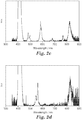
- Figure 2b shows the fluorescence spectrum of a sample containing no colouring additives.
- Example 2 The process described in Example 1 was repeated except for using 0.4 g of erbium carbonate as fluorescent additive.
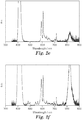
- the sample fluoresced with green colour under violet light excitation ( Fig. 2d ).
- Example 2 The process described in Example 1 was repeated except for using 0.4 g of europium oxide as fluorescent additive.
- the sample fluoresces with red colour under violet light excitation ( Fig. 2e ).
- Example 2 The process described in Example 1 was repeated except for using 0.2 g of each dysprosium oxide, erbium carbonate and europium oxide as fluorescent additive to yield a fluorescence colour different from each of the single additives.
- the sample fluoresces with bright yellow, almost white colour under violet light excitation ( Fig. 2f ).
- Zirconia green bodies were produced by pressing 2.1 g of TZ-3Y-SBE powder at a pressure of 6.4 tons.
- the green bodies were presintered at 800 °C.
- the staining solution was made by adding 0.3 g of samarium acetate to 2.5 ml of LAVATM Frame Shade Dyeing Liquid FS 1 (commercially available from 3M ESPE, Germany; lot number: 249730).
- the pre-sintered disc was put into the staining liquid for 5 min. Afterwards it was removed from the solution, wiped clean with a soft, wet cloth and dried at ambient conditions.
- the stained body was fired in a LAVATM Therm oven up to a temperature of 1500 °C without any extra calcination step.
- the final ceramic was taken from the oven after reaching room temperature again.
- the sample fluoresces weakly with orange colour under violet light excitation ( Fig. 3b ).
- Zirconia green bodies were produced by pressing 2.1 g of TZ-3Y-SBC powder mixed with 0.22 g of dysprosium oxide at a pressure of 6.4 tons into discs of 20 mm diameter and 2 mm thickness.
- the green bodies were pre-sintered at 800 °C.
- the colouring solution was made by adding 0.05 g of neodymium acetate to 2.5 ml of de-ioinized water.
- the presintered disc was put into the colouring solution for 5 min. Afterwards it was removed from the solution, wiped clean with a soft, wet cloth and dried at ambient conditions.
- the stained body was fired in a LAVATM Therm oven up to a temperature of 1500 °C without any extra calcination step.
- the final ceramic was taken from the oven after reaching room temperature again.
- the sample fluoresced with a more bluish colour than a sample containing dysprosium only.
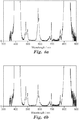
- the fluorescence spectrum of the sample containing dysprosium oxide only is shown in Fig. 4a .
- the spectrum of the sample with dysprosium oxide and neodymium acetate infiltrated is shown in Fig. 4b .
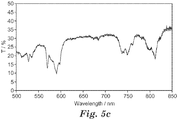
- the yellow band around about 580 nm is weakened compared to the other bands (e.g. blue at 480 nm) due to the addition of traces of neodymium. This may help in improving the aesthetic properties of the sample.
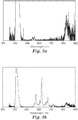
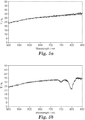
- Fig. 5a the light transmission spectrum of a 3Y-TZP zirconium oxide sample without any colouring additive is shown (range: 500 to 850 nm).
- Fig. 5b the light transmission spectrum of a 3Y-TZP zirconium oxide sample containing dysprosium is shown (range: 500 to 850 nm).
- Fig. 5c the light transmission spectrum of a 3Y-TZP zirconium oxide sample containing neodymium is shown (range: 500 to 850 nm).
- Zirconia green bodies were produced as described in Example 6, however, using 2.1 g TZ-3Y-SBC powder from TOSOH mixed with 0.44 g dysprosium oxide and pre-sintering at 900°C. All other compositions and working steps from Example 6 remain unchanged.
Landscapes
- Chemical & Material Sciences (AREA)
- Health & Medical Sciences (AREA)
- Ceramic Engineering (AREA)
- Engineering & Computer Science (AREA)
- Oral & Maxillofacial Surgery (AREA)
- Epidemiology (AREA)
- Life Sciences & Earth Sciences (AREA)
- Animal Behavior & Ethology (AREA)
- General Health & Medical Sciences (AREA)
- Public Health (AREA)
- Veterinary Medicine (AREA)
- Materials Engineering (AREA)
- Organic Chemistry (AREA)
- Structural Engineering (AREA)
- Inorganic Chemistry (AREA)
- Plastic & Reconstructive Surgery (AREA)
- Manufacturing & Machinery (AREA)
- Composite Materials (AREA)
- Crystallography & Structural Chemistry (AREA)
- Dental Preparations (AREA)
Claims (14)
- Article dentaire en céramique comprenant de l'oxyde de zirconium et au moins deux substances colorantes A et B différentes, la substance A présentant une émission de lumière dans la plage allant de 470 nm à 510 nm et la substance B présentant une absorption de lumière dans la plage allant de 520 nm à 750 nm,
l'article dentaire étant utilisé en tant que structure de support dentaire et ne comprenant pas de matériau en verre ou vitrocéramique en une quantité supérieure à environ 10 % en poids,
la substance A étant présente en une quantité dans la plage de 0,1 à 5 % molaires et la substance B étant présente en une quantité dans la plage de 0,01 à 1 % molaire, dans lequel les quantités des substances sont calculées en tant que quantités molaires des cations, et
le rapport molaire de la substance A à la substance B allant de 1:1 à 500:1, dans lequel le rapport molaire est calculé sur la base des cations des éléments respectifs. - Article dentaire en céramique selon la revendication précédente, la substance A étant choisie parmi des composants comprenant du dysprosium.
- Article dentaire en céramique selon l'une quelconque des revendications précédentes, la substance B étant choisie parmi des composants comprenant du néodyme.
- Article dentaire en céramique selon l'une quelconque des revendications précédentes, caractérisé par au moins une des caractéristiques suivantes :• résistance à la rupture : au moins environ 400 MPa,• masse volumique : de 5,9 à 6,1 g/cm3, et/ou• émission de lumière dans la région de 470 nm à 510 nm.
- Article dentaire en céramique selon l'une quelconque des revendications précédentes, comprenant :
ZrO2 : de 80 % en poids à 99 % en poids, Y2O3 : de 0,5 % en poids à 10 % en poids, Dy2O3 : de 0,15 % en poids à 7,5 % en poids, Nd2O3 : de 0,014 % en poids à 1,4 % en poids, et Additifs : de 0,0001 % en poids à 1 % en poids - Article dentaire en céramique selon l'une quelconque des revendications précédentes, fixé dans ou à un dispositif de maintien.
- Procédé de production de l'article dentaire en céramique selon l'une quelconque des revendications 1 à 6, le procédé comprenant les étapes consistant àa) fournir une composition comprenant de l'oxyde de zirconium, un liquide, une substance A, une substance B et éventuellement un liantb) couler la composition dans un moule de façon à obtenir un article tridimensionnel,dans lequel la substance A et la substance B sont telles que définies et sont présentes dans l'article dentaire en céramique en une quantité telle que décrite dans l'une quelconque des revendications 1 à 6 précédentes.
- Procédé de production de l'article dentaire en céramique selon l'une quelconque des revendications 1 à 6, le procédé comprenant les étapes consistant àa) fournir une composition comprenant de l'oxyde de zirconium, une substance A et une substance B,b) appliquer une pression et/ou une température à la composition de façon à obtenir un article tridimensionnel,dans lequel la substance A et la substance B sont telles que définies et sont présentes dans l'article dentaire en céramique en une quantité telle que décrite dans l'une quelconque des revendications 1 à 6 précédentes.
- Procédé de production de l'article dentaire en céramique selon l'une quelconque des revendications 1 à 6, le procédé comprenant les étapes consistant à• fournir un article dentaire comprenant de l'oxyde de zirconium,• appliquer une composition contenant une substance B et une substance A à l'article dentaire,dans lequel la substance A et la substance B sont telles que définies et sont présentes dans l'article dentaire en céramique en une quantité telle que décrite dans l'une quelconque des revendications 1 à 6 précédentes.
- Procédé de production de l'article dentaire en céramique selon l'une quelconque des revendications 1 à 6, le procédé comprenant les étapes consistant à• fournir une composition comprenant de l'oxyde de zirconium et une substance A ou une substance B,• appliquer une pression et/ou une température à la composition de façon à obtenir un article tridimensionnel,• appliquer une composition contenant une substance qui n'a pas été utilisée à l'étape a), la substance étant choisie parmi une substance B ou une substance A, à l'article obtenu à l'étape b) ou à l'étape c), etdans lequel la substance A et la substance B sont telles que définies et sont présentes dans l'article dentaire en céramique en une quantité telle que décrite dans l'une quelconque des revendications 1 à 6 précédentes.
- Utilisation de l'article dentaire en céramique selon l'une quelconque des revendications 1 à 6 ou des produits pouvant être obtenus selon l'un quelconque des procédés décrits dans les revendications 7 à 10 pour produire une restauration dentaire ou une partie de celle-ci.
- Utilisation selon la revendication 11, dans laquelle le procédé de production de la restauration dentaire ou une partie de celle-ci comprend une étape d'usinage.
- Utilisation de l'une ou l'autre parmi une composition contenant une substance A ou une composition contenant une substance B pour produire un article dentaire en céramique contenant de l'oxyde de zirconium, l'article dentaire étant utilisé en tant que structure de support dentaire et ne comprenant pas de matériau en verre ou vitrocéramique en une quantité supérieure à environ 10 % en poids, dans laquelle l'article dentaire en céramique obtenu après le procédé de production comprend une substance A et une substance B et dans lequel la substance A et la substance B sont telles que définies et sont présentes dans l'article dentaire en céramique en une quantité telle que décrite dans l'une quelconque des revendications 1 à 6.
- Composition à utiliser dans un processus de production d'un article dentaire en céramique tel que décrit dans l'une quelconque des revendications 1 à 6, la composition comprenant• un solvant en une quantité de 20 à 99 % en poids,• ou une substance A ou une substance B ou une substance A et une substance B,dans laquelle, si la substance A est présente, la substance A est présente en une quantité de 1 % en poids à 50 % en poids, et si la substance B est présente, la substance B est présente en une quantité de 0,1 % en poids à 20 % en poids, les % en poids étant par rapport au poids de la composition entière, dans laquelle la substance A et la substance B sont telles que décrites dans l'une quelconque des revendications 1 à 6.
Priority Applications (1)
| Application Number | Priority Date | Filing Date | Title |
|---|---|---|---|
| EP09744288.3A EP2352480B1 (fr) | 2008-11-27 | 2009-10-26 | Article dentaire céramique, son procédé de production et ses utilisations |
Applications Claiming Priority (3)
| Application Number | Priority Date | Filing Date | Title |
|---|---|---|---|
| EP08170071A EP2191809A1 (fr) | 2008-11-27 | 2008-11-27 | Article dentaire en céramique, son procédé de fabrication et son utilisation |
| PCT/US2009/062029 WO2010062541A1 (fr) | 2008-11-27 | 2009-10-26 | Article dentaire céramique, son procédé de production et ses utilisations |
| EP09744288.3A EP2352480B1 (fr) | 2008-11-27 | 2009-10-26 | Article dentaire céramique, son procédé de production et ses utilisations |
Publications (2)
| Publication Number | Publication Date |
|---|---|
| EP2352480A1 EP2352480A1 (fr) | 2011-08-10 |
| EP2352480B1 true EP2352480B1 (fr) | 2017-05-31 |
Family
ID=40210507
Family Applications (2)
| Application Number | Title | Priority Date | Filing Date |
|---|---|---|---|
| EP08170071A Withdrawn EP2191809A1 (fr) | 2008-11-27 | 2008-11-27 | Article dentaire en céramique, son procédé de fabrication et son utilisation |
| EP09744288.3A Not-in-force EP2352480B1 (fr) | 2008-11-27 | 2009-10-26 | Article dentaire céramique, son procédé de production et ses utilisations |
Family Applications Before (1)
| Application Number | Title | Priority Date | Filing Date |
|---|---|---|---|
| EP08170071A Withdrawn EP2191809A1 (fr) | 2008-11-27 | 2008-11-27 | Article dentaire en céramique, son procédé de fabrication et son utilisation |
Country Status (5)
| Country | Link |
|---|---|
| US (1) | US8841223B2 (fr) |
| EP (2) | EP2191809A1 (fr) |
| CN (1) | CN102271647A (fr) |
| BR (1) | BRPI0916485A2 (fr) |
| WO (1) | WO2010062541A1 (fr) |
Cited By (1)
| Publication number | Priority date | Publication date | Assignee | Title |
|---|---|---|---|---|
| WO2019016272A1 (fr) * | 2017-07-20 | 2019-01-24 | Saint-Gobain Centre De Recherches Et D'etudes Europeen | Produit fritte de zircone |
Families Citing this family (33)
| Publication number | Priority date | Publication date | Assignee | Title |
|---|---|---|---|---|
| GB0820018D0 (en) | 2008-11-03 | 2008-12-10 | 3M Innovative Properties Co | A system for making a dental restoration providing ventilation of a control unit of the system, and a corresponding method |
| GB0820017D0 (en) * | 2008-11-03 | 2008-12-10 | 3M Innovative Properties Co | A method and device for making a dental workpiece |
| EP2500009A1 (fr) | 2011-03-17 | 2012-09-19 | 3M Innovative Properties Company | Article dentaire en céramique, son procédé de fabrication et son utilisation |
| JP5685126B2 (ja) * | 2011-03-31 | 2015-03-18 | 株式会社ジーシー | ジルコニア系複合セラミック焼結体及びその作製方法 |
| CN102579147A (zh) * | 2012-01-19 | 2012-07-18 | 深圳市金悠然科技有限公司 | 二氧化锆假牙的制备方法 |
| US8936848B2 (en) | 2012-02-23 | 2015-01-20 | B&D Dental Corp | Non-pre-colored multi-layer zirconia dental blank that has a gradual change in translucency through a thickness after sintering |
| US9668837B2 (en) | 2012-02-23 | 2017-06-06 | B & D Dental Corporation | Creating a translucent effect within one half of a green body zirconia blank |
| US9434651B2 (en) | 2012-05-26 | 2016-09-06 | James R. Glidewell Dental Ceramics, Inc. | Method of fabricating high light transmission zirconia blanks for milling into natural appearance dental appliances |
| CN105026337B (zh) * | 2013-03-11 | 2019-04-05 | 可乐丽则武齿科株式会社 | 氧化锆烧结体、以及氧化锆的组合物和预烧体 |
| CN105007883B (zh) | 2013-03-12 | 2018-03-27 | 3M创新有限公司 | 赋予牙科陶瓷荧光的着色溶液 |
| RU2698021C1 (ru) * | 2013-12-04 | 2019-08-21 | 3М Инновейтив Пропертиз Компани | Стоматологическая заготовка для фрезерования, способ ее изготовления и использования |
| CN104058742B (zh) * | 2014-06-13 | 2015-10-07 | 吉利 | 陶瓷托槽 |
| US10709529B2 (en) | 2014-07-31 | 2020-07-14 | 3M Innovative Properties Company | Kit of parts containing dental mill blank colouring solution |
| JP6741592B2 (ja) * | 2014-12-26 | 2020-08-19 | クラレノリタケデンタル株式会社 | ジルコニア組成物、ジルコニア仮焼体及びジルコニア焼結体、並びに歯科用製品 |
| US11339095B2 (en) * | 2015-05-28 | 2022-05-24 | 3M Innovative Properties Company | Sol containing nano zirconia particles for use in additive manufacturing processes for the production of 3-dimensional articles |
| JP6897087B2 (ja) * | 2016-02-09 | 2021-06-30 | 東ソー株式会社 | 紫色ジルコニア焼結体及びその製造方法 |
| EP3108849B2 (fr) * | 2016-04-25 | 2025-03-12 | Solventum Intellectual Properties Company | Ébauche pour fraisage dentaire à zircone multicouche et procédé de production |
| JP6698417B2 (ja) * | 2016-04-27 | 2020-05-27 | 京セラ株式会社 | ビーム検出用の蛍光性ジルコニア材の製造方法 |
| KR102639446B1 (ko) * | 2017-02-21 | 2024-02-21 | 소후 인코포레이티드 | 치과 절삭 가공용 지르코니아 피절삭체와 그 제조 방법 및 치과 절삭 가공용 지르코니아 피절삭체용 투명성 향상액과 그 사용 방법 |
| JP7125402B2 (ja) * | 2017-07-31 | 2022-08-24 | クラレノリタケデンタル株式会社 | ジルコニア粒子および蛍光剤を含む粉末の製造方法 |
| KR102657206B1 (ko) * | 2017-07-31 | 2024-04-12 | 쿠라레 노리타케 덴탈 가부시키가이샤 | 형광제를 포함하는 지르코니아 소결체 |
| CN111093559B (zh) * | 2017-09-26 | 2022-07-12 | 可乐丽则武齿科株式会社 | 牙科用研磨坯料和其制造方法 |
| WO2019068807A1 (fr) * | 2017-10-04 | 2019-04-11 | Ceramtec Gmbh | Matériau à base d'oxyde de zirconium partiellement stabilisé doté d'une forte activité de frittage |
| JP2021500186A (ja) * | 2017-10-26 | 2021-01-07 | ユニベルズィダード ドゥ ミンホUniversidade Do Minho | 歯科用途のためのセラミック構造体、方法およびその使用 |
| EP4371548B1 (fr) * | 2018-03-30 | 2025-11-05 | Shofu Inc. | Procédé d'application d'un liquide opaque pour la zircone |
| EP3846769A1 (fr) | 2018-09-04 | 2021-07-14 | 3M Innovative Properties Company | Composition de vernissage fluorescent pour article de zircone dentaire, procédé de frittage et kit de pièces |
| JP7390094B2 (ja) * | 2018-09-20 | 2023-12-01 | 株式会社松風 | 歯科用セメントキット |
| US12502337B2 (en) * | 2019-03-04 | 2025-12-23 | Solventum Intellectual Properties Company | Process for producing a colored dental zirconia article |
| EP3950638A4 (fr) * | 2019-03-26 | 2022-12-21 | Tosoh Corporation | Corps fritté en zircone et son procédé de production |
| US11731312B2 (en) | 2020-01-29 | 2023-08-22 | James R. Glidewell Dental Ceramics, Inc. | Casting apparatus, cast zirconia ceramic bodies and methods for making the same |
| CN115849899A (zh) * | 2022-12-23 | 2023-03-28 | 爱迪特(秦皇岛)科技股份有限公司 | 一种荧光美观陶瓷及其制备方法 |
| CN115894017A (zh) * | 2022-12-23 | 2023-04-04 | 爱迪特(秦皇岛)科技股份有限公司 | 一种氧化锆组合物、氧化锆烧结体及制备方法 |
| US20240390117A1 (en) * | 2023-05-23 | 2024-11-28 | Opa Dental, LLC | Dental prosthetic appliance |
Family Cites Families (16)
| Publication number | Priority date | Publication date | Assignee | Title |
|---|---|---|---|---|
| US3957500A (en) * | 1971-06-29 | 1976-05-18 | Magnesium Elektron Limited | Stabilised zirconia and a process for the preparation thereof |
| DE3683959D1 (de) | 1985-06-20 | 1992-04-02 | Tosoh Corp | Zirkoniumdioxidsinterkoerper mit verbesserter lichtdurchlaessigkeit. |
| JPS62123042A (ja) * | 1985-11-20 | 1987-06-04 | Nippon Electric Glass Co Ltd | 審美性に優れた歯科材料用結晶化ガラスおよびその製造方法 |
| DE59005464D1 (de) | 1990-05-09 | 1994-05-26 | Siemens Ag | Rohlingkörper zur Herstellung eines Zahnrestaurations-Passkörpers. |
| US5263858A (en) * | 1991-03-06 | 1993-11-23 | Hoya Corporation | Ivory-colored zirconia sintered body, process for its production and its use |
| EP1105550B1 (fr) | 1998-07-27 | 2003-03-12 | Imperial College Of Science, Technology & Medicine | Revetement a barriere thermique comprenant un materiau indicateur thermoluminescent integre |
| DE29815486U1 (de) | 1998-08-28 | 2000-01-05 | ESPE Dental AG, 82229 Seefeld | Vorrichtung zur Herstellung eines Zahnersatzteils |
| DE19904522C5 (de) | 1999-02-04 | 2013-11-14 | 3M Deutschland Gmbh | Einfärbung von keramischem Zahnersatz mittels ionischer oder komplexhaltiger Lösungen |
| DE19938143A1 (de) | 1999-08-16 | 2001-02-22 | Espe Dental Ag | Verwendung von Zirkonoxidkeramiken mit Sinterzusatz zur Herstellung von Zahnersatz |
| CA2414082C (fr) | 2000-06-22 | 2007-12-11 | 3M Espe Ag | Dispositif de fabrication de pieces dentaires |
| EP1167565B1 (fr) * | 2000-06-29 | 2007-03-07 | Shin-Etsu Chemical Co., Ltd. | Procédé de dépôt par pulvérisation thermique et poudre d'oxyde de terre rare utilisée à cet effet |
| DE10107451B4 (de) | 2001-02-14 | 2004-04-15 | 3M Espe Ag | Verfahren zur Herstellung von Zahnersatz, nach dem Verfahren herstellbares Zahnersatzteil sowie vorgesinterter Rohling |
| EP1486476B1 (fr) | 2003-06-13 | 2005-11-09 | 3M Espe AG | Structure céramique de teinte homogene et une solution colorante pour céramiques |
| US7297171B2 (en) * | 2003-09-18 | 2007-11-20 | 3M Innovative Properties Company | Methods of making ceramics comprising Al2O3, REO, ZrO2 and/or HfO2 and Nb205 and/or Ta2O5 |
| JP4804943B2 (ja) * | 2006-02-08 | 2011-11-02 | 株式会社ジーシー | 歯科用セラミックス材の作製方法 |
| EP2359771B1 (fr) | 2006-05-23 | 2016-05-11 | Ivoclar Vivadent AG | Procédé destiné à la fabrication d'ébauches colorées et de pièces moulées dentaires |
-
2008
- 2008-11-27 EP EP08170071A patent/EP2191809A1/fr not_active Withdrawn
-
2009
- 2009-10-26 US US13/131,428 patent/US8841223B2/en not_active Expired - Fee Related
- 2009-10-26 EP EP09744288.3A patent/EP2352480B1/fr not_active Not-in-force
- 2009-10-26 CN CN2009801534624A patent/CN102271647A/zh active Pending
- 2009-10-26 BR BRPI0916485A patent/BRPI0916485A2/pt not_active Application Discontinuation
- 2009-10-26 WO PCT/US2009/062029 patent/WO2010062541A1/fr not_active Ceased
Non-Patent Citations (1)
| Title |
|---|
| None * |
Cited By (2)
| Publication number | Priority date | Publication date | Assignee | Title |
|---|---|---|---|---|
| WO2019016272A1 (fr) * | 2017-07-20 | 2019-01-24 | Saint-Gobain Centre De Recherches Et D'etudes Europeen | Produit fritte de zircone |
| FR3069242A1 (fr) * | 2017-07-20 | 2019-01-25 | Saint-Gobain Centre De Recherches Et D'etudes Europeen | Produit fritte de zircone |
Also Published As
| Publication number | Publication date |
|---|---|
| US8841223B2 (en) | 2014-09-23 |
| EP2352480A1 (fr) | 2011-08-10 |
| CN102271647A (zh) | 2011-12-07 |
| EP2191809A1 (fr) | 2010-06-02 |
| BRPI0916485A2 (pt) | 2016-02-16 |
| US20110236860A1 (en) | 2011-09-29 |
| WO2010062541A1 (fr) | 2010-06-03 |
Similar Documents
| Publication | Publication Date | Title |
|---|---|---|
| EP2352480B1 (fr) | Article dentaire céramique, son procédé de production et ses utilisations | |
| US9758435B2 (en) | Dental ceramic article, process of production and use thereof | |
| JP7473696B2 (ja) | 歯科切削加工用ジルコニア被切削体及びその製造方法並びに歯科切削加工用ジルコニア被切削体用透明性向上液及びその使用方法 | |
| EP2968076B1 (fr) | Solution colorante conférant de la fluorescence pour céramiques dentaires | |
| US20130059272A1 (en) | Dental ceramic article, process for production and use thereof | |
| EP4027933B1 (fr) | Procédé de production d'une ébauche pour fraisage dentaire d'un matériau de zircone poreux contenant des oxydes de tb, er et cr | |
| US12502337B2 (en) | Process for producing a colored dental zirconia article | |
| JP7503900B2 (ja) | 歯科修復物の製造のためのプロセス | |
| EP4065038B1 (fr) | Procédé de traitement d'une ébauche de fraisage de zircone dentaire poreux avec des solutions de coloration | |
| KR20230079037A (ko) | 치과용 세라믹스 착색 용액 | |
| JP7792772B2 (ja) | インジウムを含有する歯科用ジルコニア仮焼体用透光性向上液 | |
| US12121599B2 (en) | Fluorescent glazing composition for a dental zirconia article, process of sintering and kit of parts |
Legal Events
| Date | Code | Title | Description |
|---|---|---|---|
| PUAI | Public reference made under article 153(3) epc to a published international application that has entered the european phase |
Free format text: ORIGINAL CODE: 0009012 |
|
| 17P | Request for examination filed |
Effective date: 20110531 |
|
| AK | Designated contracting states |
Kind code of ref document: A1 Designated state(s): AT BE BG CH CY CZ DE DK EE ES FI FR GB GR HR HU IE IS IT LI LT LU LV MC MK MT NL NO PL PT RO SE SI SK SM TR |
|
| DAX | Request for extension of the european patent (deleted) | ||
| 17Q | First examination report despatched |
Effective date: 20120412 |
|
| GRAP | Despatch of communication of intention to grant a patent |
Free format text: ORIGINAL CODE: EPIDOSNIGR1 |
|
| STAA | Information on the status of an ep patent application or granted ep patent |
Free format text: STATUS: GRANT OF PATENT IS INTENDED |
|
| INTG | Intention to grant announced |
Effective date: 20170216 |
|
| GRAS | Grant fee paid |
Free format text: ORIGINAL CODE: EPIDOSNIGR3 |
|
| GRAA | (expected) grant |
Free format text: ORIGINAL CODE: 0009210 |
|
| STAA | Information on the status of an ep patent application or granted ep patent |
Free format text: STATUS: THE PATENT HAS BEEN GRANTED |
|
| AK | Designated contracting states |
Kind code of ref document: B1 Designated state(s): AT BE BG CH CY CZ DE DK EE ES FI FR GB GR HR HU IE IS IT LI LT LU LV MC MK MT NL NO PL PT RO SE SI SK SM TR |
|
| REG | Reference to a national code |
Ref country code: CH Ref legal event code: EP Ref country code: GB Ref legal event code: FG4D |
|
| REG | Reference to a national code |
Ref country code: AT Ref legal event code: REF Ref document number: 896780 Country of ref document: AT Kind code of ref document: T Effective date: 20170615 |
|
| REG | Reference to a national code |
Ref country code: IE Ref legal event code: FG4D |
|
| REG | Reference to a national code |
Ref country code: DE Ref legal event code: R096 Ref document number: 602009046352 Country of ref document: DE |
|
| REG | Reference to a national code |
Ref country code: NL Ref legal event code: MP Effective date: 20170531 |
|
| REG | Reference to a national code |
Ref country code: LT Ref legal event code: MG4D |
|
| REG | Reference to a national code |
Ref country code: AT Ref legal event code: MK05 Ref document number: 896780 Country of ref document: AT Kind code of ref document: T Effective date: 20170531 |
|
| PG25 | Lapsed in a contracting state [announced via postgrant information from national office to epo] |
Ref country code: GR Free format text: LAPSE BECAUSE OF FAILURE TO SUBMIT A TRANSLATION OF THE DESCRIPTION OR TO PAY THE FEE WITHIN THE PRESCRIBED TIME-LIMIT Effective date: 20170901 Ref country code: ES Free format text: LAPSE BECAUSE OF FAILURE TO SUBMIT A TRANSLATION OF THE DESCRIPTION OR TO PAY THE FEE WITHIN THE PRESCRIBED TIME-LIMIT Effective date: 20170531 Ref country code: FI Free format text: LAPSE BECAUSE OF FAILURE TO SUBMIT A TRANSLATION OF THE DESCRIPTION OR TO PAY THE FEE WITHIN THE PRESCRIBED TIME-LIMIT Effective date: 20170531 Ref country code: LT Free format text: LAPSE BECAUSE OF FAILURE TO SUBMIT A TRANSLATION OF THE DESCRIPTION OR TO PAY THE FEE WITHIN THE PRESCRIBED TIME-LIMIT Effective date: 20170531 Ref country code: NO Free format text: LAPSE BECAUSE OF FAILURE TO SUBMIT A TRANSLATION OF THE DESCRIPTION OR TO PAY THE FEE WITHIN THE PRESCRIBED TIME-LIMIT Effective date: 20170831 Ref country code: HR Free format text: LAPSE BECAUSE OF FAILURE TO SUBMIT A TRANSLATION OF THE DESCRIPTION OR TO PAY THE FEE WITHIN THE PRESCRIBED TIME-LIMIT Effective date: 20170531 Ref country code: AT Free format text: LAPSE BECAUSE OF FAILURE TO SUBMIT A TRANSLATION OF THE DESCRIPTION OR TO PAY THE FEE WITHIN THE PRESCRIBED TIME-LIMIT Effective date: 20170531 |
|
| PG25 | Lapsed in a contracting state [announced via postgrant information from national office to epo] |
Ref country code: NL Free format text: LAPSE BECAUSE OF FAILURE TO SUBMIT A TRANSLATION OF THE DESCRIPTION OR TO PAY THE FEE WITHIN THE PRESCRIBED TIME-LIMIT Effective date: 20170531 Ref country code: LV Free format text: LAPSE BECAUSE OF FAILURE TO SUBMIT A TRANSLATION OF THE DESCRIPTION OR TO PAY THE FEE WITHIN THE PRESCRIBED TIME-LIMIT Effective date: 20170531 Ref country code: SE Free format text: LAPSE BECAUSE OF FAILURE TO SUBMIT A TRANSLATION OF THE DESCRIPTION OR TO PAY THE FEE WITHIN THE PRESCRIBED TIME-LIMIT Effective date: 20170531 Ref country code: IS Free format text: LAPSE BECAUSE OF FAILURE TO SUBMIT A TRANSLATION OF THE DESCRIPTION OR TO PAY THE FEE WITHIN THE PRESCRIBED TIME-LIMIT Effective date: 20170930 Ref country code: BG Free format text: LAPSE BECAUSE OF FAILURE TO SUBMIT A TRANSLATION OF THE DESCRIPTION OR TO PAY THE FEE WITHIN THE PRESCRIBED TIME-LIMIT Effective date: 20170831 |
|
| PG25 | Lapsed in a contracting state [announced via postgrant information from national office to epo] |
Ref country code: RO Free format text: LAPSE BECAUSE OF FAILURE TO SUBMIT A TRANSLATION OF THE DESCRIPTION OR TO PAY THE FEE WITHIN THE PRESCRIBED TIME-LIMIT Effective date: 20170531 Ref country code: DK Free format text: LAPSE BECAUSE OF FAILURE TO SUBMIT A TRANSLATION OF THE DESCRIPTION OR TO PAY THE FEE WITHIN THE PRESCRIBED TIME-LIMIT Effective date: 20170531 Ref country code: SK Free format text: LAPSE BECAUSE OF FAILURE TO SUBMIT A TRANSLATION OF THE DESCRIPTION OR TO PAY THE FEE WITHIN THE PRESCRIBED TIME-LIMIT Effective date: 20170531 Ref country code: CZ Free format text: LAPSE BECAUSE OF FAILURE TO SUBMIT A TRANSLATION OF THE DESCRIPTION OR TO PAY THE FEE WITHIN THE PRESCRIBED TIME-LIMIT Effective date: 20170531 Ref country code: EE Free format text: LAPSE BECAUSE OF FAILURE TO SUBMIT A TRANSLATION OF THE DESCRIPTION OR TO PAY THE FEE WITHIN THE PRESCRIBED TIME-LIMIT Effective date: 20170531 |
|
| PG25 | Lapsed in a contracting state [announced via postgrant information from national office to epo] |
Ref country code: SM Free format text: LAPSE BECAUSE OF FAILURE TO SUBMIT A TRANSLATION OF THE DESCRIPTION OR TO PAY THE FEE WITHIN THE PRESCRIBED TIME-LIMIT Effective date: 20170531 Ref country code: PL Free format text: LAPSE BECAUSE OF FAILURE TO SUBMIT A TRANSLATION OF THE DESCRIPTION OR TO PAY THE FEE WITHIN THE PRESCRIBED TIME-LIMIT Effective date: 20170531 Ref country code: IT Free format text: LAPSE BECAUSE OF FAILURE TO SUBMIT A TRANSLATION OF THE DESCRIPTION OR TO PAY THE FEE WITHIN THE PRESCRIBED TIME-LIMIT Effective date: 20170531 |
|
| REG | Reference to a national code |
Ref country code: DE Ref legal event code: R097 Ref document number: 602009046352 Country of ref document: DE |
|
| PLBE | No opposition filed within time limit |
Free format text: ORIGINAL CODE: 0009261 |
|
| STAA | Information on the status of an ep patent application or granted ep patent |
Free format text: STATUS: NO OPPOSITION FILED WITHIN TIME LIMIT |
|
| 26N | No opposition filed |
Effective date: 20180301 |
|
| PG25 | Lapsed in a contracting state [announced via postgrant information from national office to epo] |
Ref country code: MC Free format text: LAPSE BECAUSE OF FAILURE TO SUBMIT A TRANSLATION OF THE DESCRIPTION OR TO PAY THE FEE WITHIN THE PRESCRIBED TIME-LIMIT Effective date: 20170531 Ref country code: SI Free format text: LAPSE BECAUSE OF FAILURE TO SUBMIT A TRANSLATION OF THE DESCRIPTION OR TO PAY THE FEE WITHIN THE PRESCRIBED TIME-LIMIT Effective date: 20170531 |
|
| GBPC | Gb: european patent ceased through non-payment of renewal fee |
Effective date: 20171026 |
|
| REG | Reference to a national code |
Ref country code: IE Ref legal event code: MM4A |
|
| REG | Reference to a national code |
Ref country code: FR Ref legal event code: ST Effective date: 20180629 |
|
| PG25 | Lapsed in a contracting state [announced via postgrant information from national office to epo] |
Ref country code: LU Free format text: LAPSE BECAUSE OF NON-PAYMENT OF DUE FEES Effective date: 20171026 Ref country code: GB Free format text: LAPSE BECAUSE OF NON-PAYMENT OF DUE FEES Effective date: 20171026 |
|
| REG | Reference to a national code |
Ref country code: BE Ref legal event code: MM Effective date: 20171031 |
|
| PG25 | Lapsed in a contracting state [announced via postgrant information from national office to epo] |
Ref country code: FR Free format text: LAPSE BECAUSE OF NON-PAYMENT OF DUE FEES Effective date: 20171031 Ref country code: BE Free format text: LAPSE BECAUSE OF NON-PAYMENT OF DUE FEES Effective date: 20171031 |
|
| PG25 | Lapsed in a contracting state [announced via postgrant information from national office to epo] |
Ref country code: MT Free format text: LAPSE BECAUSE OF NON-PAYMENT OF DUE FEES Effective date: 20171026 |
|
| PG25 | Lapsed in a contracting state [announced via postgrant information from national office to epo] |
Ref country code: IE Free format text: LAPSE BECAUSE OF NON-PAYMENT OF DUE FEES Effective date: 20171026 |
|
| PGFP | Annual fee paid to national office [announced via postgrant information from national office to epo] |
Ref country code: DE Payment date: 20181016 Year of fee payment: 10 |
|
| PGFP | Annual fee paid to national office [announced via postgrant information from national office to epo] |
Ref country code: CH Payment date: 20181015 Year of fee payment: 10 |
|
| PG25 | Lapsed in a contracting state [announced via postgrant information from national office to epo] |
Ref country code: HU Free format text: LAPSE BECAUSE OF FAILURE TO SUBMIT A TRANSLATION OF THE DESCRIPTION OR TO PAY THE FEE WITHIN THE PRESCRIBED TIME-LIMIT; INVALID AB INITIO Effective date: 20091026 |
|
| PG25 | Lapsed in a contracting state [announced via postgrant information from national office to epo] |
Ref country code: CY Free format text: LAPSE BECAUSE OF NON-PAYMENT OF DUE FEES Effective date: 20170531 |
|
| REG | Reference to a national code |
Ref country code: DE Ref legal event code: R079 Ref document number: 602009046352 Country of ref document: DE Free format text: PREVIOUS MAIN CLASS: A61K0006060000 Ipc: A61K0006849000 |
|
| PG25 | Lapsed in a contracting state [announced via postgrant information from national office to epo] |
Ref country code: MK Free format text: LAPSE BECAUSE OF FAILURE TO SUBMIT A TRANSLATION OF THE DESCRIPTION OR TO PAY THE FEE WITHIN THE PRESCRIBED TIME-LIMIT Effective date: 20170531 |
|
| PG25 | Lapsed in a contracting state [announced via postgrant information from national office to epo] |
Ref country code: TR Free format text: LAPSE BECAUSE OF FAILURE TO SUBMIT A TRANSLATION OF THE DESCRIPTION OR TO PAY THE FEE WITHIN THE PRESCRIBED TIME-LIMIT Effective date: 20170531 |
|
| REG | Reference to a national code |
Ref country code: DE Ref legal event code: R119 Ref document number: 602009046352 Country of ref document: DE |
|
| PG25 | Lapsed in a contracting state [announced via postgrant information from national office to epo] |
Ref country code: PT Free format text: LAPSE BECAUSE OF FAILURE TO SUBMIT A TRANSLATION OF THE DESCRIPTION OR TO PAY THE FEE WITHIN THE PRESCRIBED TIME-LIMIT Effective date: 20170531 |
|
| REG | Reference to a national code |
Ref country code: CH Ref legal event code: PL |
|
| PG25 | Lapsed in a contracting state [announced via postgrant information from national office to epo] |
Ref country code: DE Free format text: LAPSE BECAUSE OF NON-PAYMENT OF DUE FEES Effective date: 20200501 Ref country code: CH Free format text: LAPSE BECAUSE OF NON-PAYMENT OF DUE FEES Effective date: 20191031 Ref country code: LI Free format text: LAPSE BECAUSE OF NON-PAYMENT OF DUE FEES Effective date: 20191031 |