EP2353689A1 - Flachdüsenboden-Druckfilter für Wasserbehandlungs- und Aufbereitungsanlagen - Google Patents
Flachdüsenboden-Druckfilter für Wasserbehandlungs- und Aufbereitungsanlagen Download PDFInfo
- Publication number
- EP2353689A1 EP2353689A1 EP11000453A EP11000453A EP2353689A1 EP 2353689 A1 EP2353689 A1 EP 2353689A1 EP 11000453 A EP11000453 A EP 11000453A EP 11000453 A EP11000453 A EP 11000453A EP 2353689 A1 EP2353689 A1 EP 2353689A1
- Authority
- EP
- European Patent Office
- Prior art keywords
- filter
- water
- nozzle bottom
- flat
- flat nozzle
- Prior art date
- Legal status (The legal status is an assumption and is not a legal conclusion. Google has not performed a legal analysis and makes no representation as to the accuracy of the status listed.)
- Granted
Links
- XLYOFNOQVPJJNP-UHFFFAOYSA-N water Substances O XLYOFNOQVPJJNP-UHFFFAOYSA-N 0.000 title claims abstract description 72
- 238000009826 distribution Methods 0.000 claims abstract description 22
- 239000011521 glass Substances 0.000 claims abstract description 7
- 239000000463 material Substances 0.000 claims description 60
- 239000000126 substance Substances 0.000 claims description 5
- 238000007789 sealing Methods 0.000 claims description 4
- 238000009827 uniform distribution Methods 0.000 claims description 4
- 239000000654 additive Substances 0.000 claims description 3
- 239000008213 purified water Substances 0.000 claims description 3
- 238000010276 construction Methods 0.000 claims 1
- 238000009434 installation Methods 0.000 claims 1
- 238000013461 design Methods 0.000 abstract description 10
- 239000002184 metal Substances 0.000 abstract 3
- 238000001914 filtration Methods 0.000 description 14
- 238000011001 backwashing Methods 0.000 description 12
- 238000000034 method Methods 0.000 description 12
- 230000001580 bacterial effect Effects 0.000 description 5
- 239000002245 particle Substances 0.000 description 5
- 239000000706 filtrate Substances 0.000 description 4
- 239000004576 sand Substances 0.000 description 4
- 230000000694 effects Effects 0.000 description 3
- 230000009182 swimming Effects 0.000 description 3
- 241000894006 Bacteria Species 0.000 description 2
- ZAMOUSCENKQFHK-UHFFFAOYSA-N Chlorine atom Chemical compound [Cl] ZAMOUSCENKQFHK-UHFFFAOYSA-N 0.000 description 2
- 230000015572 biosynthetic process Effects 0.000 description 2
- 229910052801 chlorine Inorganic materials 0.000 description 2
- 239000000460 chlorine Substances 0.000 description 2
- 239000004615 ingredient Substances 0.000 description 2
- 238000012423 maintenance Methods 0.000 description 2
- 230000007935 neutral effect Effects 0.000 description 2
- 230000000630 rising effect Effects 0.000 description 2
- 229920006395 saturated elastomer Polymers 0.000 description 2
- 239000007787 solid Substances 0.000 description 2
- 230000000712 assembly Effects 0.000 description 1
- 238000000429 assembly Methods 0.000 description 1
- 238000009530 blood pressure measurement Methods 0.000 description 1
- 238000004140 cleaning Methods 0.000 description 1
- 239000002131 composite material Substances 0.000 description 1
- 230000003247 decreasing effect Effects 0.000 description 1
- 230000007812 deficiency Effects 0.000 description 1
- 230000001419 dependent effect Effects 0.000 description 1
- 239000003651 drinking water Substances 0.000 description 1
- 235000020188 drinking water Nutrition 0.000 description 1
- 238000011156 evaluation Methods 0.000 description 1
- 208000015181 infectious disease Diseases 0.000 description 1
- 239000007788 liquid Substances 0.000 description 1
- 239000000203 mixture Substances 0.000 description 1
- QEHKBHWEUPXBCW-UHFFFAOYSA-N nitrogen trichloride Chemical compound ClN(Cl)Cl QEHKBHWEUPXBCW-UHFFFAOYSA-N 0.000 description 1
- 238000000746 purification Methods 0.000 description 1
- 230000000717 retained effect Effects 0.000 description 1
- 239000010865 sewage Substances 0.000 description 1
- 230000035939 shock Effects 0.000 description 1
- 238000004065 wastewater treatment Methods 0.000 description 1
Images


Classifications
-
- C—CHEMISTRY; METALLURGY
- C02—TREATMENT OF WATER, WASTE WATER, SEWAGE, OR SLUDGE
- C02F—TREATMENT OF WATER, WASTE WATER, SEWAGE, OR SLUDGE
- C02F1/00—Treatment of water, waste water, or sewage
- C02F1/001—Processes for the treatment of water whereby the filtration technique is of importance
- C02F1/004—Processes for the treatment of water whereby the filtration technique is of importance using large scale industrial sized filters
-
- B—PERFORMING OPERATIONS; TRANSPORTING
- B01—PHYSICAL OR CHEMICAL PROCESSES OR APPARATUS IN GENERAL
- B01D—SEPARATION
- B01D24/00—Filters comprising loose filtering material, i.e. filtering material without any binder between the individual particles or fibres thereof
- B01D24/02—Filters comprising loose filtering material, i.e. filtering material without any binder between the individual particles or fibres thereof with the filter bed stationary during the filtration
- B01D24/04—Filters comprising loose filtering material, i.e. filtering material without any binder between the individual particles or fibres thereof with the filter bed stationary during the filtration the filtering material being clamped between pervious fixed walls
-
- B—PERFORMING OPERATIONS; TRANSPORTING
- B01—PHYSICAL OR CHEMICAL PROCESSES OR APPARATUS IN GENERAL
- B01D—SEPARATION
- B01D24/00—Filters comprising loose filtering material, i.e. filtering material without any binder between the individual particles or fibres thereof
- B01D24/46—Regenerating the filtering material in the filter
- B01D24/4631—Counter-current flushing, e.g. by air
Definitions
- the invention relates to a flat nozzle bottom pressure filter for filtering suspended solids from water in water treatment and treatment plants of pools, swimming pools, outdoor pools, indoor pools, swimming pools and garden ponds, aquariums, rainwater, drinking water, sewage and similar liquid media.
- filter systems with filtration material fillings of gravel, sand, AFM (activated filter material) or NFM ( neutral filter material) of other materials are used for the water treatment and treatment.
- the filters are used to retain and filter out suspended solids from the water and are used in a wide variety of designs and sizes.
- the type of filter used depends on the type of water and the resulting substances to be filtered.
- All filter systems have a similar mode of action.
- the filters are flooded with the water to be filtered.
- the filter material keeps dirt, particulates, hair, small particles, and other in-water ingredients from passing through the filter by collecting these particles in the filter material gaps.
- the outflow of water from the filter is ensured by the use of so-called filter nozzles, which are usually provided with slots of different slot width and only the water itself, as well as particles smaller than the slot width flow out of the filter.
- filter nozzles which are usually provided with slots of different slot width and only the water itself, as well as particles smaller than the slot width flow out of the filter.
- the filter material itself and the filtration materials are retained in the filter.
- Each filter no matter which filter material is used at some point so saturated with filtration materials in the filter material that hardly or only very small amounts of water can pass through the filter.
- the resulting composite of the individual filter material grains allows the filter to literally grow and thus significantly reduces the filtration effect.
- the resulting bacterial culture is a significant source of infection. If the filter material is not completely cleaned and dirt is removed when backwashing a filter, the process of growing the filter is repeated more quickly with each new filtration process. The filter will become ineffective over time, the filter material filling must then be replaced.
- Filter systems are operated with different operating pressures, which in turn can be monitored by different pressure-indicating systems.
- the displayed pressure in the filter can be used to draw conclusions about the operating status of a filter. In all filters an increased operating pressure indicates an increased degree of clogging of the filter.
- the filter must be cleaned or backwashed at the latest.
- nozzles are used in different designs and arrangements in filters.
- prior art filter nozzles are available for the most part as a cylindrical or conical slot nozzle body and are installed in the filters standing, lying or freely arranged in space. Due to the slot nozzles used, of course, reduces the free, available cross-sectional area of a filter housing. The required filter cross-section is determined according to the free cross-sectional areas of the individual filter nozzles and their arrangement and the number and the closed area between the nozzle locations in the filter bottom.
- the respective flow direction of the water is determined that enters and exits into the filter and with which the filter material is flowed through.
- the more difficult part of the filter design is the water and pressure distribution for the backwashing process. In the best possible water distribution and sufficient pressure, all filter material regions should flow through uniformly, be flushed and loosened so that the entire filter bed is slightly raised, very well mixed and the dirt or filtrate stored in the filter material is completely removed from the filter.
- the structure of the filter material layers is started with a coarse grain over the nozzles and worked in the direction of upward with decreasing particle sizes. Therefore, filters are usually built very high. With the use of filter layers between 200 mm and far beyond rising, distributed on cross-sectional areas of 0.1 to 3 and more m 2 , of course, with increasing filter material, especially in the backwashing significantly increasing amounts of water and pressures needed to mix the filter material as best as possible and loosen up and finally discharge the filtrate from the filter.
- the invention is therefore based on the object to provide a technical solution by which the deficiencies of the prior art can be overcome.
- a flat filter nozzle bottom was developed, which is installed horizontally in the filter base, in which nozzle-shaped openings are arranged over the entire filter cross section, which realize a vertical flow direction of the backwash water in the direction of the filter material.
- the sum of the nozzle-shaped openings corresponds to the free connection pipe cross-section of the filter and the space between the individual nozzle-shaped openings is dimensioned so small that all areas of the filter material can be evenly mixed and stirred up during the backwashing of the filter.
- the total cross-sectional area of the flat filter nozzle bottom corresponds to a maximum of 25 times the free cross-sectional area of the connecting pipe diameter at the filter.
- the thickness or height of the flat nozzle bottom is only between 0.01 -10 mm.
- the nozzle-shaped openings of the flat filter nozzle bottom are dimensioned so that the smallest filter material grain of the filter material can not be discharged from the filter during the filtering process.
- the full-surface slotted flat bottom of the nozzle is supplied with water from the bottom of the filter with a special distributor system so that all nozzle-shaped openings are flooded vertically with backwash water.
- a horizontally located suitable distribution system is arranged, which ensures that the filter water is passed uniformly vertically through the filter material, without causing turbulence of the filter material and that the outflow the backwash water is directed to the outlet nozzle.
- the geometric design of the distributor plate of the water distribution system in Filterober- and -unterteil is designed so that the connections of the filter can be arranged horizontally and vertically and in any case an optimal vertical flow direction of the inflow and outflow water is ensured. It has a constant plate thickness, tapers and breakthroughs of different size and shape in their areal education and is located immediately above the water inlet and below the filter nozzle bottom in the filter base and filter top directly below the water inlet in its planar formation horizontally.
- the support elements of the flat filter nozzle bottom are so down and, or arranged in the top of the filter container that they do not give fluidic interference source.
- the filter material dump height in the filter corresponds to a maximum of 40% of the free cylinder height of the filter chamber between the flat filter nozzle bottom and the upper filter connection piece.
- the filter consists of 3 easy to assemble and disassemble main components that make up the filter housing. A filter base, a filter casing and a filter top, which are pressure-tight and tightly joined together with corresponding connection and sealing elements.
- the filter jacket consists of a pressure-resistant transparent glass or plastic tube, which serves the good observation of the filter contents.
- the filter bottom and top, the flat filter nozzle bottom and the water distribution elements are made of pressure-resistant, resistant to chemical water additives material.
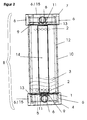
- FIGS. 1 to 3 consists of a flat nozzle bottom pressure filter according to the invention for water treatment and treatment plants from a filter base 4, a filter shell and a filter container arranged therebetween, a filter bottom with filter nozzles arranged there, filter material and inflows and outflows for the cleaned and the purified water.
- a filter nozzle base 1 is arranged horizontally over the entire filter cross section in the filter container lower part 4, this filter nozzle base 1 being designed as a flat slotted plate.
- the slots in the slotted plate have a slot opening formation that realizes the vertical passage of the water.
- Below this filter nozzle base 1 a serving for the supply of the backwash water distribution system is arranged.
- nozzle-shaped openings 5 are formed as slots over the entire filter cross section, which realize a uniform vertical flow direction 2 of the backwash water in the direction of the filter material 3 lying directly on the flat nozzle base.
- the sum of the individual nozzle-shaped openings 5 of the flat nozzle bottom 1 corresponds to the free connecting pipe cross-section 6 of the filter.
- the space between the individual nozzle-shaped openings is dimensioned so small that all areas of the overlying filter material 3 can be uniformly mixed and stirred up.
- the total area of the flat filter nozzle bottom 1 corresponds to a maximum of 25 times the free cross-sectional area of the connecting pipe diameter 6 at the filter.
- the thickness or height of the flat nozzle bottom 1 is only between 0.01 -10 mm.
- the nozzle-shaped openings 5 of the flat filter nozzle bottom 1 are dimensioned so that the smallest Filtermaterialkom the filter material 3 are not discharged during the filtering process from the filter.
- a vertical flow direction 2 of the backwash water in the direction of the filter material 3 is advantageously realized by the alignment of the nozzle-shaped openings 5 of the flat filter nozzle bottom 1.
- the full-surface slotted flat nozzle bottom 1 is so from the lower filter part 4 with a special distribution system in the form of a specially designed distributor plate 9 with water so that all nozzle-shaped openings 5 are flooded vertically evenly with backwash.
- the filter top 7 of the filter housing 8 is also for the uniform distribution of the inflow vertically into the filter also a horizontal lying suitable distribution system arranged in the form of a distributor plate 9, which ensures that the filter water is passed uniformly vertically through the filter material, without causing turbulence of the filter material 3 comes and that the outflow of Ruthêts is passed to the outlet nozzle in the filter top 7 out.
- the geometric design of the water distribution system 9 is designed so that the terminals 6 of the filter can be arranged horizontally and vertically on the filter base 4 and the filter top 7 or on the filter casing 10 and in each case an optimal vertical flow of inflow and outflow water in the filter. 8 is guaranteed.
- the flat filter nozzle bottom 1 is stabilized by the arrangement between two support elements 11.
- the support elements 11 are arranged so down and / or above in the filter container 8 that they do not give fluidic interference source in the filter 8.
- the loose Filtermaterial property assume in the filter 8 corresponds to a maximum of 50% of the free cylinder height of the filter chamber between the flat filter nozzle bottom 1 in the filter base 4 and the upper filter connection piece 6 in the filter top. 7
- the filter 8 consists of a total of three easy to assemble and disassemble main assemblies that make up the filter housing 8. Namely, from a filter base 4, a filter casing 10 and a filter shell 7. All three modules are pressure-tight and tightly joined together with corresponding connecting elements 12 and sealing elements 13.
- the filter casing 10 is made of a pressure-resistant transparent glass or plastic tube or is equipped with a vertically over the entire height of the filter jacket 3 arranged sight glass 14, through which a good observation of the entire filter content is made possible.
- the filter base 4 and the filter top 7, the flat filter nozzle bottom 1 and the water distribution elements 9, the filter casing 10 and all components are made of pressure-resistant, chemical and biological water additives resistant material. All components of the flat nozzle bottom pressure filter are positively and non-positively connected with each other and are easy to assemble and disassemble.
Landscapes
- Chemical & Material Sciences (AREA)
- Chemical Kinetics & Catalysis (AREA)
- Life Sciences & Earth Sciences (AREA)
- Hydrology & Water Resources (AREA)
- Engineering & Computer Science (AREA)
- Environmental & Geological Engineering (AREA)
- Water Supply & Treatment (AREA)
- Organic Chemistry (AREA)
- Filtration Of Liquid (AREA)
Abstract
dass im Filterbehälterunterteil (4) horizontal über den gesamten Filterquerschnitt ein Filterdüsenboden ( 1 ) angeordnet ist,
dass der Filterdüsenboden (1) aus einem Schlitzblech ausgebildet ist,
dass die Schlitze im Schlitzblech eine das vertikale Durchströmen des Wassers realisierende Schlitzöffnungsausbildung aufweisen,
dass unterhalb dieses Filterdüsenbodens (1) ein für die Zuführung des Rückspülwassers dienendes Wasserverteilungssystem angeordnet ist,
dass das Schlitzblech eben ausgebildet ist.
Description
- Die Erfindung betrifft einen Flachdüsenboden-Druckfilter für das Filtrieren von Schwebstoffen aus Wasser in Wasserbehandlungs- und Aufbereitungsanlagen von Pools, Schwimmbädern, Freibädern, Hallenbädern, Schwimm- und Gartenteichen, Aquarien, Regenwasser, Trinkwasser, Abwasser und ähnlichen flüssigen Medien.
- Verbreitet und dem Stand der Technik entsprechend werden für die Wasseraufbereitung- und Behandlung Filteranlagen mit Filtermaterialfüllungen aus Kies, Sand, AFM ( aktiviertes Filtermaterial ) oder NFM (neutrales Filtermaterial ) anderen Materialien verwendet. Die Filter dienen dem Zurückhalten und Ausfiltrieren von Schwebstoffen aus dem Wasser und werden in unterschiedlichsten Bauarten sowie Größe eingesetzt.
- Der jeweils eingesetzte Filtertyp ist abhängig von der Wasserart und den anfallenden zu filternden Stoffen.
- Allen Filteranlagen liegt ein ähnliches Wirkprinzip vor. Die Filter werden mit dem zu filternden Wasser durchflutet. Das Filtermaterial hält bzw. filtert Schmutz, Schwebstoffe, Haare, Kleinteilchen und andere im Wasser befindliche Inhaltsstoffe während dem Durchlauf durch den Filter aus, indem diese Teilchen in den Filtermaterial-Lücken gesammelt werden. Der Abfluss des Wassers aus dem Filter wird durch den Einsatz von so genannten Filterdüsen gewährleistet, die meist mit Schlitzen unterschiedlicher Schlitzweite versehen sind und nur das Wasser an sich, sowie Teilchen kleiner der Schlitzweite aus dem Filter abfließen lassen. Somit werden das Filtermaterial selbst und die Filtrationsstoffe im Filter zurückgehalten. Jeder Filter, egal mit welchem eingesetzten Filtermaterial ist irgendwann so mit Filtrationsstoffen im Filtermaterial gesättigt, dass kaum noch oder nur sehr geringe Mengen Wasser den Filter durchlaufen können. Man spricht gebräuchlich dann von einem zugesetzten Filter oder sagt einfach, der Filter ist zu, oder voll gesättigt.
- Bei herkömmlich eingesetzten Filtern wie Kies/ Sandfiltern ist zu verzeichnen, dass sich in den Filtermaterialien an den einzelnen Körnern des Filtermaterials selbst Bakterienfilme bilden, die nur sehr schwer zu lösen sind und selbst bei sehr starken Rückspülkräften kaum oder nur teilweise Aufgelöst werden können. Diese Bakterienfilme führen dazu, dass die einzelnen Filtermaterialkörner auf Grund der gebildeten Bakterienschichten zusammen wachsen und einen relativ festen Verbund bilden. Mit zunehmender Wassertemperatur wird dieser Prozess um ein Vielfaches beschleunigt.
- Der so entstandene Verbund der einzelnen Filtermaterialkörner lässt den Filter regelrecht zuwachsen und vermindert so die Filtrationswirkung erheblich. Zudem ist die entstandene Bakterienkultur ein erheblicher Infektionsherd. Wird beim Rückspülen eines Filters nicht das gesamte Filtermaterial restlos gesäubert und alles an Schmutz ausgetragen, wiederholt sich der Prozess des Zuwachsens des Filters mit jedem erneuten Filtervorgang schneller. Der Filter wird so mit der Zeit ineffektiv, die Filtermaterialfüllung muss dann ausgetauscht werden.
- Da die meisten bekannten Filter jedoch Filtermaterialschüttungen zwischen 20 Kg und 150 Kg bis hin zu 15 - 25 t haben, ist der Austausch des Filtermaterials mit sehr viel Aufwand und Kosten verbunden.
- Filteranlagen werden mit unterschiedlichen Betriebsdrücken betrieben, die über wiederum unterschiedliche Druck-Anzeigesysteme überwacht werden können. Der angezeigte Druck im Filter lässt dabei Rückschlüsse über den Betriebszustand eines Filters erfahren. In allen Filtern zeigt ein erhöhter Betriebsdruck einen erhöhten Zusetzungsgrad des Filters an.
- Wird ein bestimmter Wert erreicht, muss der Filter spätestens dann gereinigt bzw. rückgespült werden.
- Das Rückspülen eines verkrusteten Filters ist dann meistens nur noch mit sehr großen Wasserdrücken oder nur noch unter Zuwirkung von Druckluft als Luft-Wassergemisch, bei sehr zugesetzten Filtern oft nur mit zusätzlichem Chlorschock möglich. Wobei die bereits auf den Filtermaterialkörnern gebildeten Bakterienfilme nicht völlig mit abgetragen werden können. Sie bleiben vorhanden und führen dazu, dass nach jedem Rückspülvorgang der Prozess des wiederholten Bakterienwachstums noch schneller beginnen kann.
- So entstehen im Filter selbst immer wieder anerobe Zonen mit aneroben Bakterien, die sich sehr negativ auf die Wasserqualität auswirken und auch eine Gefahr für den Nutzer des Wassers darstellen. Dies ist vor allem in Pool- und Schwimmbadanlagen, die mit Chlor desinfiziert werden, da sich Trichloramin bilden kann.
- Für die Verhinderung des Zusetzens eines Filters wurden 2 neue Filtermaterialien auf den Markt gebracht, die durch ihre Eigenschaften gegenüber herkömmlich bekanntem Filterkies-oder Sand eine wesentliche Verbesserung der Filtrationswirkung erzielen lassen. Diese neu entwickelten Fitermedien sind AFM ( aktiviertes Filtermaterial ) und NFM (neutrales Filtermaterial ). Beide Filtermedien kommen, wie auch alle herkömmlich bekannten Filtermaterialien in unterschiedlichen Fraktionen ( Korngrößen ) zum Einsatz.
- Um die einzelnen Filtermaterialkörner während dem Filter- und Rückspülvorgang im Filter zurück zu halten und nur das anfallende Wasser und den Schmutz oder das entsprechende Filtrat in den Filter eintreten und nur das gefilterte Wasser beim Filtern, sowie nur das Filtrat wieder aus dem Filter beim Rückspülen austreten zu lassen ist es notwendig entsprechende Düsen im Filter einzubauen, die das Filtermaterial selbst nicht aus dem Filter austreten lassen und es zurückhalten.
- Diese Düsen werden in unterschiedlichen Bauarten und Anordnungen in Filtern eingesetzt. Man spricht gebräuchlicher Weise von so genannten Schlitzdüsenkörpern mit, zu der entsprechenden Größe des kleinsten Filtermaterialkornes ausgewählten Schlitzweiten.
- Die auf dem Markt befindlichen, dem bisherigen Stand der Technik entsprechenden Filterdüsen sind zum größten Teil als zylindrische oder kegelförmige Schlitzdüsenkörper erhältlich und werden in den Filtern stehend, liegend oder frei im Raum angeordnet eingebaut. Auf Grund der eingesetzten Schlitzdüsen verringert sich natürlich die freie, zur Verfügung stehende Querschnittsfläche eines Filtergehäuses. Der benötigte Filterquerschnitt wird entsprechend der freien Querschnittsflächen der einzelnen Filterdüsen und deren Anordnung sowie der Anzahl und der geschlossenen Fläche zwischen den Düsenplätzen im Filterboden bestimmt.
- Je nach gewählter Bauform und Anordnung der Schlitzdüsen ist die jeweilige Strömungsrichtung des Wassers bestimmt, dass in den Filter ein- und austritt und mit der das Filtermaterial durchströmt wird.
- Die Verteilung des Einströmwassers beim Filterprozess über der Filtermaterialschüttung ist in den gebräuchlichsten Filtertypen bereits sehr gut gelöst, dies ist auch das kleinste technisch zu lösende Problem beim Aufbau eines Filters.
- Das schwierigere am Filteraufbau ist die Wasser- und Druckverteilung für den Rückspülprozess. Dabei sollen unter möglichst sehr guter Wasserverteilung und genügendem Druck besten Falls alle Filtermaterialbereiche gleichmäßig durchströmt, durchspült und so gelockert werden, dass das gesamte Filterbett leicht angehoben, sehr gut durchmischt und der im Filtermaterial eingelagerte Schmutz bzw. das Filtrat restlos aus dem Filter ausgetragen wird.
- Die Verteilung des Einströmwassers beim Filterprozess über der Filtermaterialschüttung ist in den gebräuchlichsten Filtertypen bereits sehr gut gelöst, dies ist auch das kleinste technisch zu lösende Problem beim Aufbau eines Filters. Jedoch sind die Lösungen für das Rückspülen alle nicht geeignet, eine umfangreiche Reinigung des gesamten Filtermaterials zu erreichen. Am besten wird diese Aufgabe in Filterbauarten mit so genannten Düsenböden realisiert. Dabei wird ein im Filter eingebauter horizontaler Boden mit senkrecht stehenden zylinder-oder kegelförmigen Schlitzdüsen bestückt. Die Aufteilung der Düsen ist wiederum von den Rahmenbedingungen eines Filters und dem Filtermaterial abhängig. Trotz bestmöglicher Aufteilung der Düsen auf dem Filterboden ist zwischen den einzelnen Düsen noch ungeschlitzte Fläche vorhanden, die ein Durchströmen des Filtermaterials eben über diesen Flächen unmöglich macht. Zwar ist ein Filterboden mit Filterdüsen im Filter schon gegenüber den sternförmig oder anders angeordneten Filterlanzen anderer Filterbauformen erheblich effizienter, trotzdem ist eine absolut gleichmäßige und restlose Durchströmung des Filtermaterials technisch nicht vollständig realisierbar.
- Auf Grund der eingesetzten einzelnen Schlitzdüsen, egal welcher Bauform und Anordnung wird in der Summe aller Einflussfaktoren letztendlich die Dimension eines Filters bestimmt. Daher sind ausschließlich alle Kies- Sand- und andere Kornfilter in den Einsatzgebieten der Wasserbehandlung und Wasseraufbereitung mindestens 400 mm im Durchmesser und 500 mm hoch. Das Füllvolumen mit Filtermedium beginnt bei ca. 20 kg und ist nach oben offen. Um einen Filter wie bisher bekannt effektiv einzusetzen wurde gebräuchlich nach der Regel gearbeitet. Filterbetrieb ca. mit halber bis 3/4 - telster Strömungsgeschwindigkeit gegenüber dem Rückspülprozess. Weiter wurde bisher auch durch renommierte Filterhersteller empfohlen, hohe Filterschichten mit abgestuften Filterkomgrößen zu verwenden, um möglichst gute bis sehr gute Filtrationsergebnisse und Wasserverteilung zu erzielen. Dabei wird in der Regel der Aufbau der Filtermaterialschichten mit einem Grobkorn über den Düsen begonnen und in Richtung nach oben hin mit jeweils kleiner werdenden Korngrößen gearbeitet. Daher sind in der Regel Filter sehr hoch gebaut. Mit dem Einsatz von Filterschichten zwischen 200 mm und weit darüber hinaus ansteigend, auf Querschnittsflächen von 0,1 bis 3 und mehr m2 verteilt werden natürlich mit steigender Filtermaterialschüttung vor allem beim Rückspülprozess erheblich steigende Wassermengen-und Drücke benötigt, um das Filtermaterial bestmöglichst zu durchmischen und aufzulockern und letztendlich das Filtrat aus dem Filter auszutragen.
- Die Folge von ungünstigen Düsenverhältnissen- und Verteilungen im Filter, sehr hohen Schüttungen mit Filtermaterial und großen Filterdurchmessern ist die Notwendigkeit des Einsatzes sehr leistungsfähiger Pumpen mit hohem Energiebedarf für den gesamten Filterbetrieb und sehr großer Wassermengen beim Rückspülen der Filter, sowie Zusatzenergie in Form von Druckluft und gegebenenfalls Bakterien lösende Chemikalien.
- Dies hat wiederum zur Folge, dass neben den steigenden Betriebskosten, verbunden mit dem Einsatz von Hilfsstoffen für die Wasser- und Abwasseraufbereitung, einem hohen Energiebedarf für den Betrieb von Filteranlagen, enormer Wasserverbrauch für das Rückspülen sowie ein hoher Aufwand für die Wartung von Filtern zu enormen Kosten solcher Anlagen beitragen.
- Der Erfindung liegt deshalb die Aufgabe zu Grunde eine technische Lösung zu schaffen, mit deren Hilfe die Mängel des bekannten Standes der Technik überwunden werden können. Insbesondere soll eine einfache, kostengünstige und praxisnahe Lösung zum Verteilen des Rückspülwassers, dem Verringern der Baugrößen, dem Verringern von Filtermaterialschütthöhen und der Optimierung des Reinigungsgrades von Filtermedien unter Verringerung des Rückspülwasserbedarfes in Filtern, sowie eine Minimierung des Wartungsaufwandes von Filtern realisiert werden.
- Erfindungsgemäß wird die Aufgabe im Wesentlichen durch die kennzeichnenden Merkmale des Anspruches 1 gelöst. Die vorteilhaften Ausgestaltungen sind in den Unteransprüchen beschrieben.
- Danach wurde ein flacher Filterdüsenboden entwickelt, der horizontal im Filterunterteil eingebaut ist, in dem über den gesamten Filterquerschnitt düsenförmige Öffnungen angeordnet sind, die eine vertikale Strömungsrichtung des Rückspülwassers in Richtung des Filtermaterials realisieren. Die Summe der düsenförmigen Öffnungen dem freien Anschlussrohr-Querschnitt des Filters entspricht und der Zwischenraum zwischen den einzelnen düsenförmigen Öffnungen so klein bemessen ist, dass alle Bereiche des Filtermaterials beim Rückspülen des Filters gleichmäßig durchmischt und aufgewirbelt werden können. Die Gesamtquerschnittsfläche des flachen Filterdüsenbodens entspricht maximal dem 25 fachen der freien Querschnittsfläche des Anschlussrohrleitungsdurchmessers am Filter. Die Stärke bzw. Höhe des Flachdüsenbodens beträgt nur zwischen 0.01 -10 mm.
- Die düsenförmigen Öffnungen des flachen Filterdüsenbodens sind so bemessen, dass das kleinste Filtermaterialkorn des Filtermaterials nicht während des Filtervorganges aus dem Filter ausgetragen werden kann.
- Der vollflächig geschlitzte Flachdüsenboden wird vom Filterunterteil aus mit einem speziellen Verteilersystem so mit Wasser angeströmt, dass alle düsenförmigen Öffnungen gleichmäßig mit Rückspülwasser vertikal durchflutet werden.
- Im oberen Teil des Filtergehäuses ist für die gleichmäßige Verteilung des Einströmwassers vertikal in den Filter ebenfalls ein horizontal liegendes geeignetes Verteilersystem angeordnet, welches gewährleistet, dass das Filterwasser gleichmäßig vertikal durch das Filtermaterial geleitet wird, ohne dass es zu Aufwirbelungen des Filtermaterials kommt und dass das Ausströmen des Rückspülwassers zum Auslass-Stutzen hin geleitet wird.
- Die geometrische Ausführung der Verteilerplatte des Wasserverteilersystems im Filterober-und -unterteil ist so gestaltet, dass die Anschlüsse des Filters horizontal als auch vertikal angeordnet sein können und in jedem Fall eine optimale vertikale Strömungsrichtung des Einström- und Austrittswassers gewährleistet ist. Sie weist dazu eine gleichbleibenden Plattenstärke, in ihrer flächigen Ausbildung Verjüngungen und Durchbrüche unterschiedlicher Größe und auch Form auf und ist unmittelbar oberhalb des Wassereinlasses und unterhalb des Filterdüsenbodens im Filterunterteil und im Filteroberteil unmittelbar unter dem Wassereinlass in ihrer flächigen Ausbildung horizontal angeordnet.
- Die Abstützungselemente des flachen Filterdüsenbodens sind so nach unten und, oder oben im Filterbehälter angeordnet, dass sie keine strömungstechnische Störquelle ergeben.
- Die Filtermaterialschütthöhe im Filter entspricht maximal 40 % der freien Zylinderhöhe des Filterraumes zwischen dem flachen Filterdüsenboden und dem oberen Filteranschlussstutzen. Der Filter besteht aus 3 leicht montier- und demontierbaren Hauptbauteilen, die das Filtergehäuse ergeben. Einem Filterunterteil, einem Filtermantel und einem Filteroberteil, die mit entsprechenden Verbindungs- und Dichtungselementen druckfest und dicht zusammengefügt werden.
- Der Filtermantel, besteht aus einem druckfesten transparenten Glas- oder Kunststoffrohr, welches der guten Beobachtung des Filterinhaltes dient.
- Das Filterunter- und Oberteil, der flache Filterdüsenboden sowie die Wasserverteilerelemente sind aus druckfestem, gegenüber chemischen Wasserzusatzstoffen resistentem Material gefertigt.
- Die Erfindung soll nachstehend an einem Ausführungsbeispiel näher erläutert werden. In der beigefügten Zeichnung zeigen:
- Fig. 1
- eine schematische Parallelansicht eines Flachdüsenboden-Druckfilters;
- Fig. 2
- eine schematische Seitenansicht eines Flachdüsenboden-Druckfilters und
- Fig. 3
- eine schematische Ansicht einer Verteilerplatte 9.
- Gemäß der
Figuren 1 bis 3 besteht ein erfindungsgemäßer Flachdüsenboden-Druckfilter für Wasserbehandlungs- und Aufbereitungsanlagen aus einem Filterunterteil 4, einem Filteroberteil und einem dazwischen angeordnetem Filterbehälter, einem Filterboden mit dort angeordneten Filterdüsen, Filtermaterial und Zu- und Abläufen für das zu reinigende und das gereinigte Wasser. Erfindungsgemäß ist im Filterbehälterunterteil 4 horizontal über den gesamten Filterquerschnitt ein Filterdüsenboden 1 angeordnet, wobei dieser Filterdüsenboden 1 als ebenes Schlitzblech ausgebildet ist. Die Schlitze im Schlitzblech weisen eine das vertikale Durchströmen des Wassers realisierende Schlitzöffnungsausbildung auf. Unterhalb dieses Filterdüsenbodens 1 ist ein für die Zuführung des Rückspülwassers dienendes Wasserverteilungssystem angeordnet. - In dem horizontal im Filterunterteil 4 eingebauten flachen Filterdüsenboden 1 sind über den gesamten Filterquerschnitt düsenförmige Öffnungen 5 als Schlitze ausgebildet, die eine gleichmäßige vertikale Strömungsrichtung 2 des Rückspülwassers in Richtung des direkt auf dem Flachdüsenboden liegenden Filtermaterials 3 realisieren. Die Summe der einzelnen düsenförmigen Öffnungen 5 des Flachdüsenbodens 1 entspricht dem freien Anschlussrohr-Querschnitt 6 des Filters. Der Zwischenraum zwischen den einzelnen düsenförmigen Öffnungen ist so klein bemessen, dass alle Bereiche des darüber liegenden Filtermaterials 3 gleichmäßig durchmischt und aufgewirbelt werden können. Die Gesamtfläche des flachen Filterdüsenbodens 1 entspricht maximal dem 25 fachen der freien Querschnittsfläche des Anschlussrohrleitungsdurchmessers 6 am Filter. Die Stärke bzw. Höhe des Flachdüsenbodens 1 beträgt nur zwischen 0.01 -10 mm.
- Die düsenförmigen Öffnungen 5 des flachen Filterdüsenbodens 1 sind so bemessen, dass das kleinste Filtermaterialkom des Filtermaterials 3 nicht während des Filtervorganges aus dem Filter ausgetragen werden.
- Eine vertikale Strömungsrichtung 2 des Rückspülwassers in Richtung des Filtermaterials 3 wird vorteilhaft durch die Ausrichtung der düsenförmigen Öffnungen 5 des flachen Filterdüsenbodens 1 realisiert.
- Der vollflächig geschlitzte Flachdüsenboden 1 wird vom Filterunterteil 4 aus mit einem speziellen Verteilersystem in Form einer speziell ausgebildeten Verteilerplatte 9 so mit Wasser angeströmt, dass alle düsenförmigen Öffnungen 5 gleichmäßig mit Rückspülwasser vertikal durchflutet werden.
- Im Filteroberteil 7 des Filtergehäuses 8 ist ebenfalls für die gleichmäßige Verteilung des Einströmwassers vertikal in den Filter ebenfalls ein horizontal liegendes geeignetes Verteilersystem in Form einer Verteilerplatte 9 angeordnet, welches gewährleistet, dass das Filterwasser gleichmäßig vertikal durch das Filtermaterial geleitet wird, ohne dass es zu Aufwirbelungen des Filtermaterials 3 kommt und dass das Ausströmen des Rückspülwassers zum Auslass-Stutzen im Filteroberteil 7 hin geleitet wird.
- Die geometrische Ausführung des Wasserverteilersystems 9 so gestaltet ist, dass die Anschlüsse 6 des Filters horizontal als auch vertikal am Filterunterteil 4 und am Filteroberteil 7 oder am Filtermantel 10 angeordnet sein können und in jedem Fall eine optimale vertikale Strömung des Einström- und Austrittswassers im Filter 8 gewährleistet ist.
- Der flache Filterdüsenboden 1 ist durch die Anordnung zwischen zwei Abstützelementen 11 stabilisiert. Die Abstützungselemente 11 sind so nach unten und/oder oben im Filterbehälter 8 angeordnet, dass sie keine strömungstechnische Störquelle im Filter 8 ergeben.
- Die lose liegende Filtermaterialschütthöhe im Filter 8 entspricht maximal 50 % der freien Zylinderhöhe des Filterraumes zwischen dem flachen Filterdüsenboden 1 im Filterunterteil 4 und dem oberen Filteranschlussstutzen 6 im Filteroberteil 7.
- Der Filter 8 besteht aus insgesamt drei leicht montier- und demontierbaren Hauptbaugruppen, die das Filtergehäuse 8 ergeben. Und zwar aus einem Filterunterteil 4 , einem Filtermantel 10 und einem Filteroberteil 7. Alle drei Baugruppen sind mit entsprechenden Verbindungselementen 12 und Dichtungselementen 13 druckfest und dicht zusammengefügt.
- Der Filtermantel 10 besteht aus einem druckfesten transparenten Glas- oder Kunststoffrohr oder ist mit einem vertikal über die gesamte Höhe des Filtermantels 3 angeordneten Schauglas 14 ausgestattet, durch welches eine gute Beobachtung des gesamten Filterinhaltes ermöglicht wird.
- Das Filterunterteil 4 und das Filteroberteil 7, der flache Filterdüsenboden 1 sowie die Wasserverteilerelemente 9 , der Filtermantel 10 und alle Einbauteile sind aus druckfestem, gegenüber chemischen und biologischen Wasserzusatzstoffen resistentem Material gefertigt. Alle Bauteile des Flachdüsenboden-Druckfilters sind form- und kraftschlüssig mit einander verbunden sind und leicht montier- und demontierbar sind.
- Im Filteroberteil 7 und im Filterunterteil 4 des Flachdüsenboden-Druckfilters sind leicht zu öffnende und zu schließende Öffnungen 15 angebracht sind, durch welche eine einfache Zugabe und Entnahme von Filtermaterial 3 und anderen Filterinhaltsstoffen möglich ist. Am Filtergehäuse 8 ist eine Druckmessung in Form von Druckmanometern oder elektrischen Druckmessgebern möglich, die Aufschlüsse über den Innendruck im Filter 8 geben und über deren Auswertung ein handgesteuerter oder ein elektrisch gesteuerter Wechsel zwischen Filtrations- und Rückspülprozess abgeleitet werden kann.
-
- 1
- Flachdüsenboden
- 2
- vertikale Strömungsrichtung
- 3
- Filtermaterial
- 4
- Filterunterteil
- 5
- düsenförmige Öffnungen des Flachdüsenbodens
- 6
- Filteranschlussstutzen
- 7
- Filteroberteil
- 8
- Filtergehäuse, Filterbehälter
- 9
- Wasserverteilerelemente (Verteilerplatte)
- 10
- Filtermantel
- 11
- Abstützelemente
- 12
- Verbindungselemente
- 13
- Dichtungselemente
- 14
- Schauglas
- 15
- Öffnungen
Claims (10)
- Flachdüsenboden-Druckfilter für Wasserbehandlungs- und Aufbereitungsanlagen, bestehend aus einem Filterunterteil, einem Filteroberteil und einem dazwischen angeordnetem Filterbehälter, einem Filterboden mit dort angeordneten Filterdüsen, Filtermaterial und Zu- und Abläufen für das zu reinigende und das gereinigten Wasser, dadurch gekennzeichnet,
dass im Filterbehälterunterteil (4) horizontal über den gesamten Filterquerschnitt ein Filterdüsenboden (1) angeordnet ist,
dass der Filterdüsenboden (1) aus einem Schlitzblech ausgebildet ist,
dass die Schlitze im Schlitzblech eine das vertikale Durchströmen des Wassers realisierende Schlitzöffnungsausbildung aufweisen,
dass unterhalb dieses Filterdüsenbodens (1) ein für die Zuführung des Rückspülwassers dienendes Wasserverteilungssystem angeordnet ist,
dass das Schlitzblech eben ausgebildet ist. - Flachdüsenboden-Druckfilter nach dem Anspruch 1, dadurch gekennzeichnet, dass die Dicke des Flachdüsenbodens (1) zwischen 0.01 - 10 mm beträgt.
- Flachdüsenboden-Druckfilter nach einem der Ansprüche 1 und 2, dadurch gekennzeichnet, dass die Gesamtfläche des Filterdüsenbodens (1) maximal dem 25-fachen der freien Querschnittsfläche des Anschlussrohrleitungsdurchmessers ( 6 ) am Filter entspricht.
- Flachdüsenboden-Druckfilter nach einem der Ansprüche 1 bis 3, dadurch gekennzeichnet, dass im Filterunterteil (4) als Wasserverteilungssystem unterhalb des vollflächig geschlitzten Flachdüsenboden (1) eine zur gleichmäßigen Verteilung des Rückspülwassers dienende sowie eine spezielle Geometrie und eine oder mehrere Durchbrüche unterschiedlicher Größe aufweisende Wasserverteilungsplatte (9) angeordnet ist.
- Flachdüsenboden-Druckfilter nach einem der Ansprüche 1 bis 4, dadurch gekennzeichnet, dass im Oberteil (7) als Wasserverteilungssystem eine zur gleichmäßigen Verteilung des Einströmwassers dienende sowie eine spezielle Geometrie und eine oder mehrere Durchbrüche unterschiedlicher Größe aufweisende Wasserverteilungsplatte (9) angeordnet ist.
- Flachdüsenboden-Druckfilter nach einem der Ansprüche 1 bis 5, dadurch gekennzeichnet, dass die Abstützungselemente (11) des flachen Filterdüsenbodens (1) nach unten und/oder oben im Filterbehälter (8) eine die strömungstechnische Störquelle minimierende Anordnung aufweisen.
- Flachdüsenboden-Druckfilter nach einem der Ansprüche 1 bis 6, dadurch gekennzeichnet, dass die lose liegende Filtermaterialschütthöhe im Filterbehälter (8) maximal 50 % der freien Zylinderhöhe des Filterraumes zwischen dem flachen Filterdüsenboden (1) im Filterunterteil (4) und dem oberen Filteranschlussstutzen (6) im Filteroberteil (7) entspricht.
- Flachdüsenboden-Druckfilter nach einem der Ansprüche 1 bis 7, dadurch gekennzeichnet, dass der Filter (8) aus drei leicht montier- und demontierbaren das Filtergehäuse (8) ergebenden Hauptbestandteile, einem Filterunterteil (4), einem Filtermantel (10) und einem Filteroberteil (7) besteht, welche mittels entsprechenden Verbindungselementen (12) und Dichtungselementen (13) druckfest und dicht zusammengefügt und angeordnet sind.
- Flachdüsenboden-Druckfilter nach einem der Ansprüche 1 bis 4, dadurch gekennzeichnet, dass der Filtermantel (10), aus Gründen der guten Beobachtung des gesamten Filterinhaltes dienenden druckfesten transparenten Glas- oder Kunststoffrohr besteht, oder mit einem vertikal über die gesamte Höhe des Filtermantels (3) angeordneten Schauglas (14) ausgestattet ist.
- Flachdüsenboden-Druckfilter nach einem der Ansprüche 1 bis 4, dadurch gekennzeichnet, dass alle Bau- und Einbauteile (1-4 und 6 -14) des Filters aus druckfestem, gegenüber chemischen und biologischen Wasserzusatzstoffen resistentem Material bestehen.
Applications Claiming Priority (1)
| Application Number | Priority Date | Filing Date | Title |
|---|---|---|---|
| DE202010001973U DE202010001973U1 (de) | 2010-02-05 | 2010-02-05 | Flachdüsenboden-Druckfilter für Wasserbehandlungs- und Aufbereitungsanlagen |
Publications (2)
| Publication Number | Publication Date |
|---|---|
| EP2353689A1 true EP2353689A1 (de) | 2011-08-10 |
| EP2353689B1 EP2353689B1 (de) | 2014-04-16 |
Family
ID=42243877
Family Applications (1)
| Application Number | Title | Priority Date | Filing Date |
|---|---|---|---|
| EP11000453.8A Not-in-force EP2353689B1 (de) | 2010-02-05 | 2011-01-20 | Flachdüsenboden-Druckfilter für Wasserbehandlungs- und Aufbereitungsanlagen |
Country Status (2)
| Country | Link |
|---|---|
| EP (1) | EP2353689B1 (de) |
| DE (1) | DE202010001973U1 (de) |
Citations (5)
| Publication number | Priority date | Publication date | Assignee | Title |
|---|---|---|---|---|
| DE805038C (de) * | 1948-10-02 | 1951-05-07 | Rheinisch Westfaelische Wasser | Rueckspuelbares Fluessigkeitsfilter |
| GB2232092A (en) * | 1989-04-26 | 1990-12-05 | Natural Purewater Plc | Water filter |
| US5114595A (en) * | 1991-02-19 | 1992-05-19 | Coyanosa Operations Company, Inc. | Multiple screen filter and method |
| US6048456A (en) * | 1996-03-01 | 2000-04-11 | Palmer Technologies, Inc. | Water filter housing |
| DE10258414A1 (de) * | 2002-12-13 | 2004-06-24 | Becke, Christian, Prof. Dr.-Ing. | Schlitzboden |
Family Cites Families (2)
| Publication number | Priority date | Publication date | Assignee | Title |
|---|---|---|---|---|
| US4260426A (en) * | 1979-11-13 | 1981-04-07 | Cpc International Inc. | Environmental filters |
| US5350505A (en) * | 1993-03-01 | 1994-09-27 | Jet, Inc. | Plastic media filter |
-
2010
- 2010-02-05 DE DE202010001973U patent/DE202010001973U1/de not_active Expired - Lifetime
-
2011
- 2011-01-20 EP EP11000453.8A patent/EP2353689B1/de not_active Not-in-force
Patent Citations (5)
| Publication number | Priority date | Publication date | Assignee | Title |
|---|---|---|---|---|
| DE805038C (de) * | 1948-10-02 | 1951-05-07 | Rheinisch Westfaelische Wasser | Rueckspuelbares Fluessigkeitsfilter |
| GB2232092A (en) * | 1989-04-26 | 1990-12-05 | Natural Purewater Plc | Water filter |
| US5114595A (en) * | 1991-02-19 | 1992-05-19 | Coyanosa Operations Company, Inc. | Multiple screen filter and method |
| US6048456A (en) * | 1996-03-01 | 2000-04-11 | Palmer Technologies, Inc. | Water filter housing |
| DE10258414A1 (de) * | 2002-12-13 | 2004-06-24 | Becke, Christian, Prof. Dr.-Ing. | Schlitzboden |
Also Published As
| Publication number | Publication date |
|---|---|
| EP2353689B1 (de) | 2014-04-16 |
| DE202010001973U1 (de) | 2010-06-10 |
Similar Documents
| Publication | Publication Date | Title |
|---|---|---|
| EP2998009A1 (de) | Filteranlage | |
| DE1461395C3 (de) | Steuereinrichtung für die Flüssigkeitsströme in einer Filteranlage | |
| AT512481A1 (de) | Verteileinheit, ihre verwendung und ein system zur filterung eines gewässers | |
| EP2294016B1 (de) | Verfahren und vorrichtung zur wasseraufbereitung | |
| DE202007010704U1 (de) | Belebtschlamm Filtervorrichtung | |
| DE1926934A1 (de) | Verfahren und Vorrichtung zur Reinigung von Fluessigkeiten durch Filtration | |
| EP2251071A1 (de) | Rückhaltesystem für Wasser-Schlammgemische bei Rückspülprozessen an Filteranlagen | |
| EP2353689B1 (de) | Flachdüsenboden-Druckfilter für Wasserbehandlungs- und Aufbereitungsanlagen | |
| DE102017108684B3 (de) | Modulfuß, Vorrichtung und Verfahren zum Filtern eines eine Verschmutzung enthaltenden Rohfluids mittels mindestens einer Membranfiltereinheit sowie eine Verwendung hierzu | |
| DE102005033314B4 (de) | Verfahren und Filteranlage zum Filtern von Rohwasser | |
| DE3325203C2 (de) | ||
| EP2070574A1 (de) | Druckfilter und Verfahren zum Klären von Flüssigkeiten | |
| EP1265819B1 (de) | Verfahren und vorrichtung zur abwasserreinigung | |
| WO2002074411A1 (de) | Bierfilter | |
| EP1618072B1 (de) | Verfahren und vorrichtung zur behandlung fliessfähiger medien mit einem filterreaktor | |
| DE202017105534U1 (de) | Doppelrohrbelüftungselement und Belüftungsanlage | |
| EP3338877B1 (de) | Verfahren und vorrichtung zum filtern eines eine verschmutzung enthaltenden rohfluids mittels mindestens einer membranfiltereinheit sowie eine verwendung hierzu | |
| DE102004004121A1 (de) | Lakebehälter mit Filtersystem | |
| EP1038436B1 (de) | Vorrichtung zum Filtern eines Gewässers | |
| DE1922982B2 (de) | Vorrichtung zur Wasseraufbereitung mittels einer Mehrspalt-Klärvorrichtung | |
| EP2322262A1 (de) | Filtermaterial für Filter in Wasserbehandlungs-und Aufbereitungsanlagen | |
| DE202005011219U1 (de) | Filteranlage zum Filtern von Rohwasser | |
| DE2436965A1 (de) | Reinigungsfilter fuer fluessigkeiten | |
| EP0077411B1 (de) | Verfahren zum Beseitigen von Feststoffen aus einer Flüssigkeit | |
| DE2840751A1 (de) | Entkalkungsfiltertank und abwasserbehandlungsanlage |
Legal Events
| Date | Code | Title | Description |
|---|---|---|---|
| PUAI | Public reference made under article 153(3) epc to a published international application that has entered the european phase |
Free format text: ORIGINAL CODE: 0009012 |
|
| AK | Designated contracting states |
Kind code of ref document: A1 Designated state(s): AL AT BE BG CH CY CZ DE DK EE ES FI FR GB GR HR HU IE IS IT LI LT LU LV MC MK MT NL NO PL PT RO RS SE SI SK SM TR |
|
| AX | Request for extension of the european patent |
Extension state: BA ME |
|
| 17P | Request for examination filed |
Effective date: 20120201 |
|
| 17Q | First examination report despatched |
Effective date: 20120618 |
|
| GRAP | Despatch of communication of intention to grant a patent |
Free format text: ORIGINAL CODE: EPIDOSNIGR1 |
|
| INTG | Intention to grant announced |
Effective date: 20131211 |
|
| GRAS | Grant fee paid |
Free format text: ORIGINAL CODE: EPIDOSNIGR3 |
|
| GRAA | (expected) grant |
Free format text: ORIGINAL CODE: 0009210 |
|
| AK | Designated contracting states |
Kind code of ref document: B1 Designated state(s): AL AT BE BG CH CY CZ DE DK EE ES FI FR GB GR HR HU IE IS IT LI LT LU LV MC MK MT NL NO PL PT RO RS SE SI SK SM TR |
|
| REG | Reference to a national code |
Ref country code: GB Ref legal event code: FG4D Free format text: NOT ENGLISH |
|
| REG | Reference to a national code |
Ref country code: CH Ref legal event code: EP |
|
| REG | Reference to a national code |
Ref country code: AT Ref legal event code: REF Ref document number: 662146 Country of ref document: AT Kind code of ref document: T Effective date: 20140515 |
|
| REG | Reference to a national code |
Ref country code: IE Ref legal event code: FG4D Free format text: LANGUAGE OF EP DOCUMENT: GERMAN |
|
| REG | Reference to a national code |
Ref country code: DE Ref legal event code: R096 Ref document number: 502011002699 Country of ref document: DE Effective date: 20140522 |
|
| REG | Reference to a national code |
Ref country code: CH Ref legal event code: NV Representative=s name: MEYER AND KOLLEGEN, CH |
|
| REG | Reference to a national code |
Ref country code: NL Ref legal event code: VDEP Effective date: 20140416 |
|
| REG | Reference to a national code |
Ref country code: LT Ref legal event code: MG4D |
|
| PG25 | Lapsed in a contracting state [announced via postgrant information from national office to epo] |
Ref country code: LT Free format text: LAPSE BECAUSE OF FAILURE TO SUBMIT A TRANSLATION OF THE DESCRIPTION OR TO PAY THE FEE WITHIN THE PRESCRIBED TIME-LIMIT Effective date: 20140416 Ref country code: GR Free format text: LAPSE BECAUSE OF FAILURE TO SUBMIT A TRANSLATION OF THE DESCRIPTION OR TO PAY THE FEE WITHIN THE PRESCRIBED TIME-LIMIT Effective date: 20140717 Ref country code: NL Free format text: LAPSE BECAUSE OF FAILURE TO SUBMIT A TRANSLATION OF THE DESCRIPTION OR TO PAY THE FEE WITHIN THE PRESCRIBED TIME-LIMIT Effective date: 20140416 Ref country code: NO Free format text: LAPSE BECAUSE OF FAILURE TO SUBMIT A TRANSLATION OF THE DESCRIPTION OR TO PAY THE FEE WITHIN THE PRESCRIBED TIME-LIMIT Effective date: 20140716 Ref country code: FI Free format text: LAPSE BECAUSE OF FAILURE TO SUBMIT A TRANSLATION OF THE DESCRIPTION OR TO PAY THE FEE WITHIN THE PRESCRIBED TIME-LIMIT Effective date: 20140416 Ref country code: IS Free format text: LAPSE BECAUSE OF FAILURE TO SUBMIT A TRANSLATION OF THE DESCRIPTION OR TO PAY THE FEE WITHIN THE PRESCRIBED TIME-LIMIT Effective date: 20140816 Ref country code: BG Free format text: LAPSE BECAUSE OF FAILURE TO SUBMIT A TRANSLATION OF THE DESCRIPTION OR TO PAY THE FEE WITHIN THE PRESCRIBED TIME-LIMIT Effective date: 20140716 Ref country code: CY Free format text: LAPSE BECAUSE OF FAILURE TO SUBMIT A TRANSLATION OF THE DESCRIPTION OR TO PAY THE FEE WITHIN THE PRESCRIBED TIME-LIMIT Effective date: 20140416 |
|
| PG25 | Lapsed in a contracting state [announced via postgrant information from national office to epo] |
Ref country code: HR Free format text: LAPSE BECAUSE OF FAILURE TO SUBMIT A TRANSLATION OF THE DESCRIPTION OR TO PAY THE FEE WITHIN THE PRESCRIBED TIME-LIMIT Effective date: 20140416 Ref country code: PL Free format text: LAPSE BECAUSE OF FAILURE TO SUBMIT A TRANSLATION OF THE DESCRIPTION OR TO PAY THE FEE WITHIN THE PRESCRIBED TIME-LIMIT Effective date: 20140416 Ref country code: LV Free format text: LAPSE BECAUSE OF FAILURE TO SUBMIT A TRANSLATION OF THE DESCRIPTION OR TO PAY THE FEE WITHIN THE PRESCRIBED TIME-LIMIT Effective date: 20140416 Ref country code: SE Free format text: LAPSE BECAUSE OF FAILURE TO SUBMIT A TRANSLATION OF THE DESCRIPTION OR TO PAY THE FEE WITHIN THE PRESCRIBED TIME-LIMIT Effective date: 20140416 Ref country code: ES Free format text: LAPSE BECAUSE OF FAILURE TO SUBMIT A TRANSLATION OF THE DESCRIPTION OR TO PAY THE FEE WITHIN THE PRESCRIBED TIME-LIMIT Effective date: 20140416 Ref country code: RS Free format text: LAPSE BECAUSE OF FAILURE TO SUBMIT A TRANSLATION OF THE DESCRIPTION OR TO PAY THE FEE WITHIN THE PRESCRIBED TIME-LIMIT Effective date: 20140416 |
|
| PG25 | Lapsed in a contracting state [announced via postgrant information from national office to epo] |
Ref country code: PT Free format text: LAPSE BECAUSE OF FAILURE TO SUBMIT A TRANSLATION OF THE DESCRIPTION OR TO PAY THE FEE WITHIN THE PRESCRIBED TIME-LIMIT Effective date: 20140818 |
|
| REG | Reference to a national code |
Ref country code: DE Ref legal event code: R097 Ref document number: 502011002699 Country of ref document: DE |
|
| PG25 | Lapsed in a contracting state [announced via postgrant information from national office to epo] |
Ref country code: SK Free format text: LAPSE BECAUSE OF FAILURE TO SUBMIT A TRANSLATION OF THE DESCRIPTION OR TO PAY THE FEE WITHIN THE PRESCRIBED TIME-LIMIT Effective date: 20140416 Ref country code: RO Free format text: LAPSE BECAUSE OF FAILURE TO SUBMIT A TRANSLATION OF THE DESCRIPTION OR TO PAY THE FEE WITHIN THE PRESCRIBED TIME-LIMIT Effective date: 20140416 Ref country code: CZ Free format text: LAPSE BECAUSE OF FAILURE TO SUBMIT A TRANSLATION OF THE DESCRIPTION OR TO PAY THE FEE WITHIN THE PRESCRIBED TIME-LIMIT Effective date: 20140416 Ref country code: EE Free format text: LAPSE BECAUSE OF FAILURE TO SUBMIT A TRANSLATION OF THE DESCRIPTION OR TO PAY THE FEE WITHIN THE PRESCRIBED TIME-LIMIT Effective date: 20140416 Ref country code: DK Free format text: LAPSE BECAUSE OF FAILURE TO SUBMIT A TRANSLATION OF THE DESCRIPTION OR TO PAY THE FEE WITHIN THE PRESCRIBED TIME-LIMIT Effective date: 20140416 |
|
| PLBE | No opposition filed within time limit |
Free format text: ORIGINAL CODE: 0009261 |
|
| STAA | Information on the status of an ep patent application or granted ep patent |
Free format text: STATUS: NO OPPOSITION FILED WITHIN TIME LIMIT |
|
| 26N | No opposition filed |
Effective date: 20150119 |
|
| PG25 | Lapsed in a contracting state [announced via postgrant information from national office to epo] |
Ref country code: IT Free format text: LAPSE BECAUSE OF FAILURE TO SUBMIT A TRANSLATION OF THE DESCRIPTION OR TO PAY THE FEE WITHIN THE PRESCRIBED TIME-LIMIT Effective date: 20140416 |
|
| REG | Reference to a national code |
Ref country code: DE Ref legal event code: R097 Ref document number: 502011002699 Country of ref document: DE Effective date: 20150119 |
|
| PG25 | Lapsed in a contracting state [announced via postgrant information from national office to epo] |
Ref country code: BE Free format text: LAPSE BECAUSE OF NON-PAYMENT OF DUE FEES Effective date: 20150131 |
|
| PG25 | Lapsed in a contracting state [announced via postgrant information from national office to epo] |
Ref country code: SI Free format text: LAPSE BECAUSE OF FAILURE TO SUBMIT A TRANSLATION OF THE DESCRIPTION OR TO PAY THE FEE WITHIN THE PRESCRIBED TIME-LIMIT Effective date: 20140416 |
|
| PG25 | Lapsed in a contracting state [announced via postgrant information from national office to epo] |
Ref country code: LU Free format text: LAPSE BECAUSE OF FAILURE TO SUBMIT A TRANSLATION OF THE DESCRIPTION OR TO PAY THE FEE WITHIN THE PRESCRIBED TIME-LIMIT Effective date: 20150120 |
|
| GBPC | Gb: european patent ceased through non-payment of renewal fee |
Effective date: 20150120 |
|
| PG25 | Lapsed in a contracting state [announced via postgrant information from national office to epo] |
Ref country code: MC Free format text: LAPSE BECAUSE OF FAILURE TO SUBMIT A TRANSLATION OF THE DESCRIPTION OR TO PAY THE FEE WITHIN THE PRESCRIBED TIME-LIMIT Effective date: 20140416 |
|
| PG25 | Lapsed in a contracting state [announced via postgrant information from national office to epo] |
Ref country code: GB Free format text: LAPSE BECAUSE OF NON-PAYMENT OF DUE FEES Effective date: 20150120 |
|
| REG | Reference to a national code |
Ref country code: FR Ref legal event code: ST Effective date: 20150930 |
|
| REG | Reference to a national code |
Ref country code: IE Ref legal event code: MM4A |
|
| PG25 | Lapsed in a contracting state [announced via postgrant information from national office to epo] |
Ref country code: FR Free format text: LAPSE BECAUSE OF NON-PAYMENT OF DUE FEES Effective date: 20150202 |
|
| PG25 | Lapsed in a contracting state [announced via postgrant information from national office to epo] |
Ref country code: IE Free format text: LAPSE BECAUSE OF NON-PAYMENT OF DUE FEES Effective date: 20150120 |
|
| REG | Reference to a national code |
Ref country code: DE Ref legal event code: R082 Ref document number: 502011002699 Country of ref document: DE Representative=s name: SCHNEIDER, ANDREAS, DIPL.-PHYS., DE Ref country code: DE Ref legal event code: R081 Ref document number: 502011002699 Country of ref document: DE Owner name: BRAEUTIGAM, ROLAND, DE Free format text: FORMER OWNER: BRAEUTIGAM KUNSTSTOFFSYSTEME GMBH, 07987 MOHLSDORF, DE |
|
| PG25 | Lapsed in a contracting state [announced via postgrant information from national office to epo] |
Ref country code: MT Free format text: LAPSE BECAUSE OF FAILURE TO SUBMIT A TRANSLATION OF THE DESCRIPTION OR TO PAY THE FEE WITHIN THE PRESCRIBED TIME-LIMIT Effective date: 20140416 |
|
| PG25 | Lapsed in a contracting state [announced via postgrant information from national office to epo] |
Ref country code: HU Free format text: LAPSE BECAUSE OF FAILURE TO SUBMIT A TRANSLATION OF THE DESCRIPTION OR TO PAY THE FEE WITHIN THE PRESCRIBED TIME-LIMIT; INVALID AB INITIO Effective date: 20110120 Ref country code: SM Free format text: LAPSE BECAUSE OF FAILURE TO SUBMIT A TRANSLATION OF THE DESCRIPTION OR TO PAY THE FEE WITHIN THE PRESCRIBED TIME-LIMIT Effective date: 20140416 |
|
| PG25 | Lapsed in a contracting state [announced via postgrant information from national office to epo] |
Ref country code: TR Free format text: LAPSE BECAUSE OF FAILURE TO SUBMIT A TRANSLATION OF THE DESCRIPTION OR TO PAY THE FEE WITHIN THE PRESCRIBED TIME-LIMIT Effective date: 20140416 |
|
| REG | Reference to a national code |
Ref country code: CH Ref legal event code: PUE Owner name: ROLAND BRAEUTIGAM, DE Free format text: FORMER OWNER: BRAEUTIGAM KUNSTSTOFFSYSTEME GMBH, DE |
|
| PG25 | Lapsed in a contracting state [announced via postgrant information from national office to epo] |
Ref country code: MK Free format text: LAPSE BECAUSE OF FAILURE TO SUBMIT A TRANSLATION OF THE DESCRIPTION OR TO PAY THE FEE WITHIN THE PRESCRIBED TIME-LIMIT Effective date: 20140416 |
|
| REG | Reference to a national code |
Ref country code: AT Ref legal event code: PC Ref document number: 662146 Country of ref document: AT Kind code of ref document: T Owner name: BRAEUTIGAM KUNSTSTOFFSYSTEME GMBH, DE Effective date: 20180730 |
|
| PG25 | Lapsed in a contracting state [announced via postgrant information from national office to epo] |
Ref country code: AL Free format text: LAPSE BECAUSE OF FAILURE TO SUBMIT A TRANSLATION OF THE DESCRIPTION OR TO PAY THE FEE WITHIN THE PRESCRIBED TIME-LIMIT Effective date: 20140416 |
|
| REG | Reference to a national code |
Ref country code: AT Ref legal event code: PC Ref document number: 662146 Country of ref document: AT Kind code of ref document: T Owner name: ROLAND BRAEUTIGAM, DE Effective date: 20181017 |
|
| PGFP | Annual fee paid to national office [announced via postgrant information from national office to epo] |
Ref country code: CH Payment date: 20201219 Year of fee payment: 11 |
|
| PGFP | Annual fee paid to national office [announced via postgrant information from national office to epo] |
Ref country code: AT Payment date: 20201218 Year of fee payment: 11 |
|
| REG | Reference to a national code |
Ref country code: CH Ref legal event code: PL |
|
| REG | Reference to a national code |
Ref country code: AT Ref legal event code: MM01 Ref document number: 662146 Country of ref document: AT Kind code of ref document: T Effective date: 20220120 |
|
| PG25 | Lapsed in a contracting state [announced via postgrant information from national office to epo] |
Ref country code: AT Free format text: LAPSE BECAUSE OF NON-PAYMENT OF DUE FEES Effective date: 20220120 |
|
| PG25 | Lapsed in a contracting state [announced via postgrant information from national office to epo] |
Ref country code: LI Free format text: LAPSE BECAUSE OF NON-PAYMENT OF DUE FEES Effective date: 20220131 Ref country code: CH Free format text: LAPSE BECAUSE OF NON-PAYMENT OF DUE FEES Effective date: 20220131 |
|
| PGFP | Annual fee paid to national office [announced via postgrant information from national office to epo] |
Ref country code: DE Payment date: 20230116 Year of fee payment: 13 |
|
| P01 | Opt-out of the competence of the unified patent court (upc) registered |
Effective date: 20230528 |
|
| REG | Reference to a national code |
Ref country code: DE Ref legal event code: R082 Ref document number: 502011002699 Country of ref document: DE |
|
| REG | Reference to a national code |
Ref country code: DE Ref legal event code: R119 Ref document number: 502011002699 Country of ref document: DE |
|
| PG25 | Lapsed in a contracting state [announced via postgrant information from national office to epo] |
Ref country code: DE Free format text: LAPSE BECAUSE OF NON-PAYMENT OF DUE FEES Effective date: 20240801 |
|
| PG25 | Lapsed in a contracting state [announced via postgrant information from national office to epo] |
Ref country code: DE Free format text: LAPSE BECAUSE OF NON-PAYMENT OF DUE FEES Effective date: 20240801 |