EP2354236A1 - Mikrobiologische CO2-Sequestrierung innerhalb von Abfallablagerungsstätten - Google Patents
Mikrobiologische CO2-Sequestrierung innerhalb von Abfallablagerungsstätten Download PDFInfo
- Publication number
- EP2354236A1 EP2354236A1 EP20100153121 EP10153121A EP2354236A1 EP 2354236 A1 EP2354236 A1 EP 2354236A1 EP 20100153121 EP20100153121 EP 20100153121 EP 10153121 A EP10153121 A EP 10153121A EP 2354236 A1 EP2354236 A1 EP 2354236A1
- Authority
- EP
- European Patent Office
- Prior art keywords
- waste
- microorganisms
- calcifying
- calcium
- carbon dioxide
- Prior art date
- Legal status (The legal status is an assumption and is not a legal conclusion. Google has not performed a legal analysis and makes no representation as to the accuracy of the status listed.)
- Withdrawn
Links
Images

Classifications
-
- C—CHEMISTRY; METALLURGY
- C12—BIOCHEMISTRY; BEER; SPIRITS; WINE; VINEGAR; MICROBIOLOGY; ENZYMOLOGY; MUTATION OR GENETIC ENGINEERING
- C12P—FERMENTATION OR ENZYME-USING PROCESSES TO SYNTHESISE A DESIRED CHEMICAL COMPOUND OR COMPOSITION OR TO SEPARATE OPTICAL ISOMERS FROM A RACEMIC MIXTURE
- C12P3/00—Preparation of elements or inorganic compounds except carbon dioxide
-
- B—PERFORMING OPERATIONS; TRANSPORTING
- B09—DISPOSAL OF SOLID WASTE; RECLAMATION OF CONTAMINATED SOIL
- B09B—DISPOSAL OF SOLID WASTE NOT OTHERWISE PROVIDED FOR
- B09B3/00—Destroying solid waste or transforming solid waste into something useful or harmless
- B09B3/70—Chemical treatment, e.g. pH adjustment or oxidation
-
- B—PERFORMING OPERATIONS; TRANSPORTING
- B09—DISPOSAL OF SOLID WASTE; RECLAMATION OF CONTAMINATED SOIL
- B09B—DISPOSAL OF SOLID WASTE NOT OTHERWISE PROVIDED FOR
- B09B3/00—Destroying solid waste or transforming solid waste into something useful or harmless
- B09B3/60—Biochemical treatment, e.g. by using enzymes
-
- Y—GENERAL TAGGING OF NEW TECHNOLOGICAL DEVELOPMENTS; GENERAL TAGGING OF CROSS-SECTIONAL TECHNOLOGIES SPANNING OVER SEVERAL SECTIONS OF THE IPC; TECHNICAL SUBJECTS COVERED BY FORMER USPC CROSS-REFERENCE ART COLLECTIONS [XRACs] AND DIGESTS
- Y02—TECHNOLOGIES OR APPLICATIONS FOR MITIGATION OR ADAPTATION AGAINST CLIMATE CHANGE
- Y02W—CLIMATE CHANGE MITIGATION TECHNOLOGIES RELATED TO WASTEWATER TREATMENT OR WASTE MANAGEMENT
- Y02W30/00—Technologies for solid waste management
- Y02W30/20—Waste processing or separation
Definitions
- the present invention relates to the sequestration of large quantities of carbon dioxide generated in waste disposal sites. It provides means for sequestering and stabilising waste containing carbon and calcium by promoting the activity of calcifying microorganisms, typically bacteria and/or Archaea.
- waste is disposed of in huge landfill disposal sites. These require a lot of space.
- waste disposal is mostly unselective, it produces large amounts of toxic leachate that requires remediation
- Methane emission can be either recovered, or removed by flaring. That method however is limited to methane reduction.
- Another method called dry tomb method, consists, in a first step, in stabilising and immobilising hazardous waste. In a second step, the waste volume is reduced.
- the stabilisation of waste though is not yet fully sustainable. In addition it requires chemical treatment and it is extremely costly.
- Another problem associated with that method resides in the absence of further bio-processing, thereby impeding extended waste valorisation.
- the degradation of organic material is accelerated by aeration with oxygen.
- the degradation of organic matter however releases carbon dioxide in the atmosphere, very little of which is presently sequestered.
- the rate of waste deposition is of about 6,000 tons per day.
- the present invention discloses a method for disposing of waste using calcifying microorganisms.
- the landfill may comprise organic or biodegradable or inorganic material, or a combination thereof.
- the organic waste material can be selected for example from sludge, dredged material, oxalates, light organic acids or urea-rich waste, building material such as wood, domestic waste.
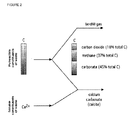
- Figure 2 represents a conceptual diagram showing the fate of carbon derived from putrescible matter within domestic waste, maximising potential production of carbonate. As disclosed by Manning et al. ( Manning, D. A. C. (2001). "Calcite precipitation in landfills: an essential product of waste stabilization.” Mineralogical Magazine 65(5): 603-610 .
- Rich et al. Rich C., Gronow J, Voulvoulis N., in Waste Management, 28, 1039, 2008 .
- the aerobic conditions are obtained by forcing air into waste mass.
- the anaerobic process comprises five stages: aerobic, fermentation, acetogenesis, methanogenesis and oxidation. During the process the temperature ranges between 30 and 65°C, preferably between 30 and 45°C in anaerobic conditions whereas it ranges between 40 and 70°C, ideally between 54 and 66°C in aerobic conditions.
- the pH ranges between 5 and 9, ideally 6.8 and 7.5 in anaerobic conditions whereas it ranges between 7.5 and 8.5 in aerobic conditions; In aerobic conditions, fewer acids are produced than in anaerobic conditions, resulting from limited fermentation.
- the time scale involved in the process vary from decades to millennia in the anaerobic process whereas it is reduced to at most 5 years in aerobic processes.
- the emissions are CO 2 , H 2 O and trace pollutants for both techniques with additional methane for anaerobic processes.
- one or more calcifying microorganisms that can be used in the present invention are preferably selected from but not restricted to, the families Bacillaceae, Pseudomonadaceae, Enterobacteriaceae, Vibrionaceae, and Myxococcales and optionally from one or more sulphate and/or sulphur reducing microorganisms such as, but not restricted to, the families Desulfovibrionaceae and Desulfobacteriaceae.
- Said microorganisms may be indigenous to the waste material. Said microorganisms may also be isolated and selectively enriched outside the waste material. The microorganisms may be isolated and selected from environments where carbonate precipitation as well as sulphate and/or sulphur reduction have been shown to be the result of a microbial activity. The microorganisms may also be selected from strain libraries.
- Calcium is needed in the process according to the present invention. If it is not present in the available waste material, it must be added, for example, as calcium-containing waste.
- the calcium-containing supplement selected for example from calcium-containing waste, is added in an amount ranging between 10 and 40 wt%, based on the total weight of waste.
- the amount added depends upon the nature of the waste to treat. It can be selected from gypsum and more preferably, under the form of sand or fine grains.
- the alkaline waste can for example be selected from slag, fly ash or red mud, lime or gypsum. It can be added either as bottom liner or added periodically. It is preferably added in an amount sufficient to reach a pH of at least 7, preferably of from 7 to 10 and more preferably of 8 to 9. The pH is measured on the leachate.
- the microorganisms must be placed in conditions allowing the promotion of preferably heterotrophic metabolisms and optionally sulphate and/or sulphur reduction, that lead to carbonate formation and precipitation.
- microorganisms such as bacteria and Archaea, selected according to the present invention, promote and accelerate waste stabilisation by reaction with the carbon dioxide resulting from degradation of organic or biodegradable matter. They promote the precipitation of carbon dioxide into carbonate, preferably calcium carbonate.
- the precipitation reaction is preferably carried under moist conditions.
- the preferred level of humidity is of at least 60%.
- the precipitation is carried under aerobic conditions.
- the present method thus results in the sequestration of large quantities of carbon waste through their stabilisation as solid carbonate. More preferably, carbon dioxide is trapped and sequestered as calcium carbonate.
- Hazardous waste is thereby stabilised into a solid matrix formed of calcite or other forms of calcium carbonate. It offers the further advantage of immobilising heavy metals possibly contained in waste.
- Landfill greenhouse gas emissions are also reduced by sequestration of carbon dioxide.
- the leachates are recycled.
- the mechanical strength of micro-organism-induced carbonate precipitation is excellent when mixed with sand as explained by Al-Thawadi ( Al-Thawadi, S, in Biological Sciences and Biotechnology, Murdoch University, Perth, AU, 2008 ).
- the deposits, preferably mixed with sand, can thus provide sound foundations for construction.
- mechanical strength of bio-remediated sludge and dredged material can increase during the ripening phase, as disclosed by de Haan et al. ( de Haan et al., in Water Science and technology, 37, 371, 1998 ).
- Said ripening phase includes physical processes such as desiccation and chemical and biological processes.
- This structure can be reinforced by addition of cement or additives causing mineral precipitation such as carbonates as disclosed in Wu et al. ( Wu T.H., Zhou S.Z., Gale S.M., in Canadian geotechnical Journal, 44, 545, 2007 ).
- it can be strengthened by pH manipulation or microbial acceleration as explained by Burnham in US-A-5,417,861
- Landfill wastes are a significant source of oxalates and light acids. They can be degraded with precipitation of calcite in the presence of a source of calcium ions as described by Manning ( Manning D.A.C., in Journal of Geological Society, 157, 229, 2000 ). It is known that the evolution of leachate is methanogenic and releases carbon dioxide. In the presence of ammonium ions resulting from denitrification, pH increases thereby causing precipitation of carbonates. Precipitation of calcite as cement thus appears also in landfill processes of stabilisation.
- the present invention provides an accelerated land curing system as well as sustainable waste management. It is cost efficient and does not require any gas collection system.
- the rate of deposition is of about 6,000 t/day. After a period of time of 5 years, which is the average time of completion for an aerated landfill, 11 Mt of waste have been deposited. A maximum amount of 7.5 Mt of CaCO 3 is thus produced. It corresponds to about 70 % of waste stabilisation by formation of calcite. This corresponds to the sequestration of 3 Mt of carbon dioxide over a period of time of 5 years.
- the rate of deposition is of about 6,000 t/day.
- 11 Mt of waste have been deposited.
- a maximum amount of 1.2 Mt of CaCO 3 is thus produced. It corresponds to about 11 % of waste stabilisation by formation of calcite. This corresponds to the sequestration of 0.5 Mt of carbon dioxide over a period of time of 5 years.
Landscapes
- Chemical & Material Sciences (AREA)
- Engineering & Computer Science (AREA)
- General Chemical & Material Sciences (AREA)
- Chemical Kinetics & Catalysis (AREA)
- Environmental & Geological Engineering (AREA)
- Life Sciences & Earth Sciences (AREA)
- General Health & Medical Sciences (AREA)
- Biochemistry (AREA)
- Health & Medical Sciences (AREA)
- Organic Chemistry (AREA)
- Wood Science & Technology (AREA)
- Toxicology (AREA)
- Zoology (AREA)
- Biotechnology (AREA)
- Microbiology (AREA)
- Bioinformatics & Cheminformatics (AREA)
- General Engineering & Computer Science (AREA)
- Genetics & Genomics (AREA)
- Processing Of Solid Wastes (AREA)
- Treatment Of Sludge (AREA)
Priority Applications (2)
| Application Number | Priority Date | Filing Date | Title |
|---|---|---|---|
| EP20100153121 EP2354236A1 (de) | 2010-02-09 | 2010-02-09 | Mikrobiologische CO2-Sequestrierung innerhalb von Abfallablagerungsstätten |
| EP20110153851 EP2354237A1 (de) | 2010-02-09 | 2011-02-09 | Mikrobiologische CO2-Sequestrierung innerhalb von Abfallablagerungsstätten |
Applications Claiming Priority (1)
| Application Number | Priority Date | Filing Date | Title |
|---|---|---|---|
| EP20100153121 EP2354236A1 (de) | 2010-02-09 | 2010-02-09 | Mikrobiologische CO2-Sequestrierung innerhalb von Abfallablagerungsstätten |
Publications (1)
| Publication Number | Publication Date |
|---|---|
| EP2354236A1 true EP2354236A1 (de) | 2011-08-10 |
Family
ID=42320376
Family Applications (1)
| Application Number | Title | Priority Date | Filing Date |
|---|---|---|---|
| EP20100153121 Withdrawn EP2354236A1 (de) | 2010-02-09 | 2010-02-09 | Mikrobiologische CO2-Sequestrierung innerhalb von Abfallablagerungsstätten |
Country Status (1)
| Country | Link |
|---|---|
| EP (1) | EP2354236A1 (de) |
Cited By (1)
| Publication number | Priority date | Publication date | Assignee | Title |
|---|---|---|---|---|
| CN115213190A (zh) * | 2022-07-18 | 2022-10-21 | 青岛理工大学 | 加速垃圾填埋场甲烷产生及氧化并协同固碳的方法及装置 |
Citations (3)
| Publication number | Priority date | Publication date | Assignee | Title |
|---|---|---|---|---|
| GB2143810A (en) * | 1983-06-20 | 1985-02-20 | Duncan Lagnese & Ass Inc | Process for biological reduction of sulphur oxides |
| US5417861A (en) | 1990-11-30 | 1995-05-23 | N-Viro International Corporation | Process to stabilize bioorganic, raw or treated wastewater sludge |
| WO2009098070A1 (en) * | 2008-02-06 | 2009-08-13 | Biomim-Greenloop Sa | Subterranean storage of co2 or its derivatives |
-
2010
- 2010-02-09 EP EP20100153121 patent/EP2354236A1/de not_active Withdrawn
Patent Citations (3)
| Publication number | Priority date | Publication date | Assignee | Title |
|---|---|---|---|---|
| GB2143810A (en) * | 1983-06-20 | 1985-02-20 | Duncan Lagnese & Ass Inc | Process for biological reduction of sulphur oxides |
| US5417861A (en) | 1990-11-30 | 1995-05-23 | N-Viro International Corporation | Process to stabilize bioorganic, raw or treated wastewater sludge |
| WO2009098070A1 (en) * | 2008-02-06 | 2009-08-13 | Biomim-Greenloop Sa | Subterranean storage of co2 or its derivatives |
Non-Patent Citations (12)
| Title |
|---|
| AI-THAWADI, S, BIOLOGICAL SCIENCES AND BIOTECHNOLOGY, 2008 |
| DATABASE WATER [online] 1972, DENVER REGIONAL COUNCIL OF GOVERNMENTS: "FEASIBILITY OF COMBINED SOLID WASTE AND STORM DRAINAGE PROJECTS", XP002592879, Database accession no. 2004071192 * |
| DATABASE WATER [online] 1994, TAY, J.-H. & SHOW, K.-Y.: "Innovative civil engineering material from sewage sludge: Biocement and its use as blended cement material", XP002592878, Database accession no. 2004267763 * |
| HAAN ET AL., WATER SCIENCE AND TECHNOLOGY, vol. 37, 1998, pages 371 |
| MANNING D.A.C., JOURNAL OF GEOLOGICAL SOCIETY, vol. 157, 2000, pages 229 |
| MANNING, D. A. C.: "Calcite precipitation in landfills: an essential product of waste stabilization", MINERALOGICAL MAGAZINE, vol. 65, no. 5, 2001, pages 603 - 610 |
| MANNING, D. A. C.: "Carbonates and oxalates in sediments and landfill: monitors of death and decay in natural and artificial systems", JOURNAL OF THE GEOLOGICAL SOCIETY, vol. 157, 2000, pages 229 - 238 |
| MANNING, D.A.C.: "Calcite precipitation in landfills: an essential product of waste stabilization", MINERALOGICAL MAGAZINE, vol. 65, no. 5, October 2001 (2001-10-01), pages 603 - 610, XP008124513 * |
| MANNING, D.A.C: "Carbonates and oxalates in sediments and landfill: monitors of death and decay in natural and artificial systems", JOURNAL OF THE GEOLOGICAL SOCIETY, vol. 157, no. 1, 2000, pages 229 - 238, XP008124514 * |
| MUTHRAPARSAD N.: "School of Molecular Cell Biology", 2007 |
| RICH C.; GRONOW J; VOULVOULIS N., WASTE MANAGEMENT, vol. 28, 2008, pages 1039 |
| WU T.H.; ZHOU S.Z.; GALE S.M., CANADIAN GEOTECHNICAL JOURNAL, vol. 44, 2007, pages 545 |
Cited By (2)
| Publication number | Priority date | Publication date | Assignee | Title |
|---|---|---|---|---|
| CN115213190A (zh) * | 2022-07-18 | 2022-10-21 | 青岛理工大学 | 加速垃圾填埋场甲烷产生及氧化并协同固碳的方法及装置 |
| CN115213190B (zh) * | 2022-07-18 | 2023-07-28 | 青岛理工大学 | 加速垃圾填埋场甲烷产生及氧化并协同固碳的方法及装置 |
Similar Documents
| Publication | Publication Date | Title |
|---|---|---|
| Vieitez et al. | Kinetics of accelerated solid-state fermentation of organic-rich municipal solid waste | |
| Komilis et al. | The effect of landfill design and operation practices on waste degradation behavior: a review | |
| Komilis et al. | The effect of municipal solid waste pretreatment on landfill behavior: a literature review | |
| EP3874053B1 (de) | Verfahren zur verwendung von co2-haltigem industriegas zur herstellung einer methanangereicherten gaszusammensetzung | |
| Li et al. | Simultaneous chemical oxygen demand removal, methane production and heavy metal precipitation in the biological treatment of landfill leachate using acid mine drainage as sulfate resource | |
| Jun et al. | Impacts of aeration and active sludge addition on leachate recirculation bioreactor | |
| Warith et al. | Bioreactor landfills: state-of-the-art review | |
| Warith et al. | Technical review of methods to enhance biological degradation in sanitary landfills | |
| Awasthi et al. | Greenhouse gas emissions through biological processing of solid waste and their global warming potential | |
| Magowo et al. | Bioremediation of acid mine drainage using Fischer-Tropsch waste water as a feedstock for dissimilatory sulfate reduction | |
| Sponza et al. | Effects of shredding of wastes on the treatment of municipal solid wastes (MSWs) in simulated anaerobic recycled reactors | |
| Srivastava et al. | Advancements in operations of bioreactor landfills for enhanced biodegradation of municipal solid waste | |
| Onay et al. | Nitrogen and sulfate attenuation in simulated landfill bioreactors | |
| Zhao et al. | Research on sludge-fly ash ceramic particles (SFCP) for synthetic and municipal wastewater treatment in biological aerated filter (BAF) | |
| Parmar et al. | Bio cementation: a novel technique and approach towards sustainable material | |
| CN104829043A (zh) | 一种兼氧膜生物反应器技术处理食品废水的方法 | |
| Botheju et al. | Biological treatment of amine wastes generated in post combustion CO2 capture | |
| EP2354237A1 (de) | Mikrobiologische CO2-Sequestrierung innerhalb von Abfallablagerungsstätten | |
| Leikam et al. | Aerobic in situ stabilization of completed landfills and old sites | |
| Kaura et al. | Bacteria and pollutants | |
| Ghosh et al. | Oxygenated leachate recirculation for enhanced MSW stabilization and landfill space reclamation: lab-scale bioreactor insights | |
| Plyatsuk et al. | Intensification of the anaerobic microbiological degradation of sewage sludge under bio-sulfidogenic conditions | |
| Sen | Acidophilic sulphate reducing bacteria: candidates for bioremediation of acid mine drainage pollution | |
| Lee et al. | Characterization of acetogenic and methanogenic leachates generated from a sanitary landfill site | |
| Szelenyi | Biomethanisation: Biogas Production Technologies |
Legal Events
| Date | Code | Title | Description |
|---|---|---|---|
| PUAI | Public reference made under article 153(3) epc to a published international application that has entered the european phase |
Free format text: ORIGINAL CODE: 0009012 |
|
| AK | Designated contracting states |
Kind code of ref document: A1 Designated state(s): AT BE BG CH CY CZ DE DK EE ES FI FR GB GR HR HU IE IS IT LI LT LU LV MC MK MT NL NO PL PT RO SE SI SK SM TR |
|
| AX | Request for extension of the european patent |
Extension state: AL BA RS |
|
| STAA | Information on the status of an ep patent application or granted ep patent |
Free format text: STATUS: THE APPLICATION IS DEEMED TO BE WITHDRAWN |
|
| 18D | Application deemed to be withdrawn |
Effective date: 20120211 |