EP2356773B1 - Identifikations- oder autorisierungsverfahren und diesbezügliches system und sicheres modul - Google Patents
Identifikations- oder autorisierungsverfahren und diesbezügliches system und sicheres modul Download PDFInfo
- Publication number
- EP2356773B1 EP2356773B1 EP09801745.2A EP09801745A EP2356773B1 EP 2356773 B1 EP2356773 B1 EP 2356773B1 EP 09801745 A EP09801745 A EP 09801745A EP 2356773 B1 EP2356773 B1 EP 2356773B1
- Authority
- EP
- European Patent Office
- Prior art keywords
- biometric data
- data
- digital
- value
- secure module
- Prior art date
- Legal status (The legal status is an assumption and is not a legal conclusion. Google has not performed a legal analysis and makes no representation as to the accuracy of the status listed.)
- Not-in-force
Links
Images


Classifications
-
- H—ELECTRICITY
- H04—ELECTRIC COMMUNICATION TECHNIQUE
- H04L—TRANSMISSION OF DIGITAL INFORMATION, e.g. TELEGRAPHIC COMMUNICATION
- H04L9/00—Cryptographic mechanisms or cryptographic arrangements for secret or secure communications; Network security protocols
- H04L9/32—Cryptographic mechanisms or cryptographic arrangements for secret or secure communications; Network security protocols including means for verifying the identity or authority of a user of the system or for message authentication, e.g. authorization, entity authentication, data integrity or data verification, non-repudiation, key authentication or verification of credentials
-
- H—ELECTRICITY
- H04—ELECTRIC COMMUNICATION TECHNIQUE
- H04L—TRANSMISSION OF DIGITAL INFORMATION, e.g. TELEGRAPHIC COMMUNICATION
- H04L9/00—Cryptographic mechanisms or cryptographic arrangements for secret or secure communications; Network security protocols
- H04L9/32—Cryptographic mechanisms or cryptographic arrangements for secret or secure communications; Network security protocols including means for verifying the identity or authority of a user of the system or for message authentication, e.g. authorization, entity authentication, data integrity or data verification, non-repudiation, key authentication or verification of credentials
- H04L9/3226—Cryptographic mechanisms or cryptographic arrangements for secret or secure communications; Network security protocols including means for verifying the identity or authority of a user of the system or for message authentication, e.g. authorization, entity authentication, data integrity or data verification, non-repudiation, key authentication or verification of credentials using a predetermined code, e.g. password, passphrase or PIN
- H04L9/3231—Biological data, e.g. fingerprint, voice or retina
-
- G—PHYSICS
- G06—COMPUTING OR CALCULATING; COUNTING
- G06F—ELECTRIC DIGITAL DATA PROCESSING
- G06F18/00—Pattern recognition
- G06F18/20—Analysing
- G06F18/22—Matching criteria, e.g. proximity measures
-
- G—PHYSICS
- G06—COMPUTING OR CALCULATING; COUNTING
- G06V—IMAGE OR VIDEO RECOGNITION OR UNDERSTANDING
- G06V10/00—Arrangements for image or video recognition or understanding
- G06V10/70—Arrangements for image or video recognition or understanding using pattern recognition or machine learning
- G06V10/74—Image or video pattern matching; Proximity measures in feature spaces
- G06V10/761—Proximity, similarity or dissimilarity measures
-
- G—PHYSICS
- G06—COMPUTING OR CALCULATING; COUNTING
- G06V—IMAGE OR VIDEO RECOGNITION OR UNDERSTANDING
- G06V40/00—Recognition of biometric, human-related or animal-related patterns in image or video data
- G06V40/10—Human or animal bodies, e.g. vehicle occupants or pedestrians; Body parts, e.g. hands
-
- H—ELECTRICITY
- H04—ELECTRIC COMMUNICATION TECHNIQUE
- H04L—TRANSMISSION OF DIGITAL INFORMATION, e.g. TELEGRAPHIC COMMUNICATION
- H04L2209/00—Additional information or applications relating to cryptographic mechanisms or cryptographic arrangements for secret or secure communication H04L9/00
- H04L2209/80—Wireless
- H04L2209/805—Lightweight hardware, e.g. radio-frequency identification [RFID] or sensor
Definitions
- the present invention relates to identification and / or authorization from biometric data.
- the identification generally consists in finding the identity of an individual from one of his biometric data.
- FIG. 1 It is schematized on the figure 1 , where it is performed using a system comprising a biometric database M storing biometric data b 1 , ..., b N relating to respective individuals and previously obtained during a so-called enrollment phase , and a biometric sensor C adapted to acquire such biometric data.
- a biometric database M storing biometric data b 1 , ..., b N relating to respective individuals and previously obtained during a so-called enrollment phase
- a biometric sensor C adapted to acquire such biometric data.
- the biometric data can be of any type and relate to any characteristic of an individual, such as an iris, one or more fingerprints, minutiae, a face, a palm of the hand, a venous network of 'a finger or a hand, a combination of the preceding features, or others.
- a biometric data item b 'relating to this individual is obtained using the sensor C, then is compared, in turn, with each of the biometric data b 1 , ..., b N until a correspondence with one of these biometric data, b i1 , is established.
- An authorization is distinguished simply identifying who has been described by the fact that the biometric data b i1 obtained is used to find the identity of the person whose biometric data b 'was acquired, but to give any authorization to this individual, such as an authorization to access a site, an authorization for the issue of a product, a document, or other.
- authorization we can therefore content to answer that b 'has been detected as coming from one of the individuals in the enrollment database but without trying to read or return an identity (which may not be stored in this case).
- biometric data are stored in the biometric database M in an encrypted manner, a decrypted version of these biometric data is however manipulated by the system, in particular for comparison with the acquired biometric data item b '.
- An object of the present invention is to improve the preservation of the identity of individuals whose biometric data has been acquired.
- the invention thus proposes an identification or authorization method according to claim 1.
- Using a secure module provides protection against attacker access to the digital data it contains. As a result, these digital data are not accessible to such an attacker.
- biometric data from which said digital data is obtained can themselves be protected, for example by encryption and / or storage within the secure module. The identity of the individuals to whom the biometric data relates is therefore preserved.
- the aforementioned digitization algorithm may for example be a quantification algorithm arranged to match a biometric data item relating to the same individual as one of the biometric data of said set of biometric data, to a numerical value fulfilling said proximity criterion with the digital datum corresponding to said biometric datum of said set of biometric data.
- the following subsequent step can be implemented: / f / if there is no match, obtain a biometric data of said set of biometric data corresponding to a lower position numeric data in the ranking.
- the secure module may be divided into at least two sub-parts arranged to communicate with one another in a secure manner, one of said sub-parts being in charge of step / c / and another of said sub-parts being in load of step / e /.
- the secure module can for example store at least a first and a second set of digital data each obtained from minus first and second respective sets of respective biometric data using a respective scanning algorithm.
- At least one biometric data acquired by at least one respective sensor is obtained, at least a first and a second digital value is obtained by applying to said acquired biometric data of each scanning algorithms, at least one of the digital data of the first and second sets of digital data is classified in the secure module at least according to their proximity to each of the at least first and second digital values, and obtaining a biometric data of one of the first and second sets of biometric data at least taking into account a position of the corresponding digital data within the ranking.
- At least a first and a second biometric data acquired by respective sensors are obtained, at least a first and a second digital value is obtained by applying the algorithm of digitizing respectively at least the first and the second biometric data acquired respectively, a classification of a subset of digital data of the second set of digital data is performed within the secure module, according to their proximity to the second numerical value, a biometric data of the second set of biometric data is obtained by taking into account a position of the second numerical data within said ranking, wherein said subset of digital data of the second set of digital data is selected for correspond to a subset of biometric data of the second set of biometric data relating to the same individuals as a subset of biometric data of the first set of biometric data determined from of the first numerical value.
- Identification or authorization can thus be facilitated because the classification is made only on a limited number of data.
- the convergence time can therefore be reduced thereby, without degrading the reliability of the identification or authorization.
- the invention also proposes an identification or authorization system according to claim 13.
- the considered system may consist of a local system comprising a terminal including the sensor and to which the secure module is associated (e.g., by incorporation or by external connection).
- the secure module may for example take the form of a chip capable of being included in the terminal.
- the system can be distributed. It can then include a centralized database storing at least a portion of the biometric data and at least one decentralized terminal including a sensor.
- each secure module used may be associated with the centralized database associated with at least one of the decentralized terminals or associated for part with the centralized database and for another part with at least one of the decentralized terminals.
- the invention also proposes a secure module according to claim 14.
- the figure 2 shows a first example of an identification or authorization system according to the invention.
- the system comprises a terminal 1 including a sensor 2 able to acquire biometric data that can be of any type and refer to any characteristic of an individual, such as an iris, one or more fingerprints digital, minutiae, a face, a palm of the hand, a venous network of a finger or a hand, a combination of the preceding features, or others.
- the terminal 1 also comprises a secure module 4, that is to say an entity providing physical protection of the data it contains.
- this secure module consists of a chip which is included in the terminal 1, for example during its design or insertion of a chip card, possibly removable, inside this terminal 1.
- the terminal 1 stores a set of biometric data b 1 , ..., b N relating to respective individuals. These biometric data are for example derived from prior enrollment of the corresponding individuals. They may possibly have been obtained using the sensor 2 of the terminal 1, or by any other appropriate means, such as a sensor independent of the terminal 1.
- biometric data can be stored in a memory 3 of the terminal 1.
- they are preferably stored in an encrypted manner, to prevent access by an attacker having access to the terminal 1.
- this is illustrated by the references E K (b 1 ),..., E K (b N ), where E denotes an encryption algorithm and K an encryption key.
- the encryption algorithm used can be of any type, for example symmetrical or asymmetrical.
- the algorithms AES and DES are non-limiting examples of usable ciphering algorithms.
- the selected encryption algorithm can be chosen so that the corresponding decryption algorithm is of relatively fast execution, to limit the necessary calculation time.
- the chip 4 advantageously stores the decryption algorithm and / or the appropriate decryption key (which is symbolized by the reference to the encryption key K inside the chip 4 on the figure 2 ), so as to be able to find the biometric data b 1 , ..., b N from their encrypted version stored in the memory 3.
- the biometric data b 1 , ..., b N can be stored inside the chip 4, when it has a sufficient storage capacity.
- the biometric data can be stored in clear, since the chip 4 provides physical protection.
- a combination of these two storage modes namely a storage of some of the biometric data encrypted in a memory 3 and a clear storage of some biometric data within the chip 4, is also possible.
- biometric data b 1 ,..., B N could not be stored in the terminal 1, but for example be accessible from an external database.
- a set of digital data c 1 , ..., c N is also obtained from the respective biometric data b 1 , ..., b N using a scanning algorithm ⁇ .
- ⁇ ⁇ (b 1 )
- c N ⁇ (b N )
- the digitization algorithm ⁇ is an algorithm that matches a numerical datum and a biometric datum.
- the numerical data c 1 ,..., C N thus obtained are possibly of reduced size compared with the biometric data.
- this digitization algorithm corresponds to a biometric datum b i of the order of the kilobyte, a digital datum c i of a hundred or so bytes, or less.
- the ratio of the sizes between digital data and biometric data is thus from 1 to 10 or more (a ratio of 1 to 100 is also possible).
- the scanning algorithm ⁇ can be seen as an algorithm for projecting the biometric data to advantageously lightened digital data.
- the digitization performed to obtain a digital datum sufficiently degrades the corresponding biometric data to render ineffective the positive identification against a large database.
- the digitization algorithm ⁇ may also consist of a quantification algorithm arranged to match a biometric data item b 'relating to the same individual as one of the biometric data items b i from among b 1 , ..., b N , to a numerical value c 'fulfilling a proximity criterion with the digital datum c i corresponding to the biometric data item b i .
- This statistical error rate concerns false positives, ie a proximity between the numerical values without the individuals to whom the corresponding biometric data relate being the same, as the false negatives, ie an absence of proximity between the numerical values corresponding to two biometric data from the same individual.
- the quantification algorithm ⁇ can make it possible to find, with a certain level of confidence, biometric data of individuals from numerical values of limited size.
- the proximity criterion used may make use of a numerical distance calculation, such as a Hamming distance, a Euclidean distance, or other.
- the scanning algorithm can be any known algorithm.
- the scanning algorithm is for example stored in the memory 3 of the terminal 1. As a variant, it could be stored in the chip 4, or else outside the terminal 1.
- the set of digital data C 1 ,..., C N is stored in the chip 4, which ensures its protection. As a result, a possible attacker can not have access to these digital data C 1 ,..., C N and he can not therefore deduce any information that would inform him about the biometric data b 1 , ..., b N whose numerical data c 1 , ..., c N are derived.
- the size of the digital data C 1 , ..., C N is much smaller than those of the corresponding biometric data b 1 ,..., B N , they can still be stored in a chip 4 with reduced storage capacity, which is not always the case for the biometric data b 1 , ..., b N themselves.
- a numerical value c ' is then obtained by applying the digitization algorithm ⁇ to the biometric data item b' acquired by the sensor 2.
- This numerical value c ' is, for example, determined by a calculation unit 5 of the terminal 1, to which a version of the biometric data item b 'and a version of the digitization algorithm ⁇ have previously been transmitted.
- the calculation of c 'could be achieved by the chip 4 itself.
- the calculation of c 'could be carried out by a unit external to the terminal 1, which supposes its subsequent transfer to the terminal 1.
- the numerical value c ' is made available to the chip 4 for the purpose of identification or authorization.
- the chip 4 proceeds to an analysis of this numerical value c 'in relation with the digital data C 1 ,..., C N which it has, so as to classify the digital data C 1 , ..., C N in the order of their proximity with c 'according to the criterion of proximity mentioned above.
- the first p numerical data c 1 , ..., c p , with p ⁇ N could be the subject of a proximity test with c '.
- all or part of the digital data c 1 ,..., C N could be the subject of such a test, but only digital data having a sufficient proximity with c 'could be classified.
- the ranking is then used to determine the biometric data among b 1 , ... b N which has the highest probability of referring to the same individual as b '.
- the index i 1 is the first of the list 7. This means that the corresponding numerical data c i1 is the closest to c 'in the sense of the above-mentioned proximity criterion.
- the biometric data item b i1 corresponding to the digital data item c i1 based on the index i 1 , it may be advantageous for the order in which the digital data c 1 , ... c N are stored in the chip 4 is the same as that in which the biometric data b 1 , ..., b N are stored for example in the memory 3. Different orders are nevertheless possible, insofar as one can find the biometric data b i corresponding to any numerical data c i .
- the chip 4 can then be able to obtain this biometric data item b i1 , either because it disposes of it in its memory, or because it is capable of receiving an encrypted version E K (b i1 ) (step 8) from the memory 3 of the terminal 1. After a possible decryption using the algorithm and / or key stored in its memory, the chip 4 then has the biometric data b i1 to the step 9.
- This biometric data item b i1 can be used directly to identify or authorize the individual who has introduced himself for this purpose. Note that the value of b i1 does not come out of the chip 4, which provides protection.
- an additional check is made to increase the reliability of the identification or authorization.
- This additional verification may consist in making a comparison between the biometric data item b i1 obtained in step 9 and the biometric data item b 'acquired by the sensor (step 10).
- This biometric comparison can implement any conventional algorithm, depending on the nature of the biometric data used. It can be done within the chip 4.
- biometric data item b i1 is well representative of the same individual as b', so that the identification or the authorization may continue on this basis.
- the biometric data item b i2 corresponding to the digital datum c i2 having the second greatest proximity to the numerical value c 'according to the classification established in step 7, can be obtained , possibly after decryption (steps 11 and 12).
- This process may advantageously continue until obtaining a biometric data item from among b 1 , ... b N corresponding to the same individual as b 'with a sufficient level of confidence.
- step 6 the distance calculations performed in step 6 are of reduced complexity, since they apply to small numerical values.
- the biometric data item b i1 obtained in step 9 can therefore be determined at the end of a relatively short calculation time.
- a chip 4 having limited computing capabilities is still able to implement these simple calculations.
- the steps described above can be implemented in relation to each of the sets of digital data c 1 ... c N.
- numerical values c 'each obtained by applying one of the scanning algorithms to the biometric data b' can be calculated.
- a classification of at least some of the digital data of each of these sets can be performed within the chip 4 according to a proximity criterion as mentioned above.
- the index among 1,..., N having the highest position considering the different rankings can be used as a first approximation to obtain the corresponding biometric data.
- the biometric data corresponding to the different digital data at the head of the respective rankings could be selected and then each subject to an additional check to retain only one.
- the biometric data sets could relate to different biometrics, for example fingerprints of respective fingers, a fingerprint on the one hand and a face on the other hand, a fingerprint on the one hand and a venous network on the other hand, a fingerprint, an iris and a palm footprint, or any conceivable combination.
- one or more acquisitions b ' can be implemented using one or more sensors adapted according to the nature of the different sets of biometric data. Respective digital values c 'can then be obtained from the biometric data. respective b '.
- An implementation of the previously described steps makes it possible to obtain several biometric data from at least some of the available biometric data sets.
- each of the biometric data obtained could be compared with the acquired biometric data of the same nature, to retain only that which is most likely to match the individual to identify or allow.
- biometric data obtained relate to one and the same individual.
- the first in order to make a rapid selection of individuals (a list of possible candidates), and the second that would identify precisely, from this selection, the individual corresponding to the captured biometrics.
- the first ranking is used to make a selection of candidates (considering for example the first k positions of the ranking) on which is made the second ranking.
- the second ranking is thus based on the proximity between the numerical value obtained by applying a scanning algorithm to the second biometrics and the only digital data relating to the selected individuals.
- a first low-discriminating biometry possibly not digitized or in combination with the numerical value
- a second highly discriminating biometry eg the face to select the candidates, then the iris for identification, or the venous network to select candidates, then the fingerprint for identification.
- the secure module could include one or more secure boxes, for example HSM (Hardware Security Module) type.
- HSM Hardware Security Module
- this type of module also offers physical protection of the data, so that an attacker can not have access to its contents.
- Such a type of biometric system may for example comprise one or more sub-parts of one or more HSM (s), one or more server (s) central databases or not, one or more sensor (s), one or more scanning server (s) and network links to allow communication between these different entities.
- An HSM can possibly be divided into two sub-parts, at least one of which would be dedicated to the classification of c i and at least one would be dedicated to the verification (matching), these subparts of HSM, which can be physically separated, being arranged to communicate with each other in a secure manner.
- Other architectures are also conceivable as will be apparent to those skilled in the art.
- a terminal as described with reference to the figure 2 could indeed use a secure module divided into several subparts, possibly physically separated, such as several separate chips each dedicated to certain tasks and able to communicate with each other in a secure manner.
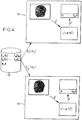
- the figure 4 illustrates an example of a distributed system comprising a centralized database 13 and decentralized terminals 14 and 15. Note that a single decentralized terminal, or a number of decentralized terminals greater than 3 could alternatively be used.
- the database 13 contains several sets of biometric data, preferably encrypted. It can also contain the scanning algorithms allowing the implementation of the method described above.
- the database 13 stores a set of biometric data (E K (b 1 ), ..., E K (b N ) and E k (d 1 ), ..., E k (d N )) and a digitization algorithm ( ⁇ and ⁇ ) for each of the two decentralized terminals 14 and 15 respectively.
- the database 13 may be part of a central station where enrollments are made, that is to say the biometric data entries prior to any verification.
- Each of the terminals 14 and 15 can operate as the terminal 1 described above, after having obtained from the database 13, so secure, for example by encryption, the biometric data necessary for its operation for the purpose of identification or authorization.
- the enrollment system also manages the sending or the renewal of data c i or e i stored in the terminals.
- This type of architecture can for example be used on a site comprising a central station where enlistments are made, and a plurality of rooms whose access is controlled by a respective terminal.
- identity of the enlisted individuals is preserved by the encryption of their biometric data within the database 13 and by the physical protection provided by the secure modules of each of the terminals 14 and 15.
- terminals 14 and 15 may be of reduced complexity, since they work on digital data of reduced size in comparison with the biometric data.
- the system can be local. It thus includes a terminal including the sensor and to which the secure module is associated (e.g. by incorporation or by external connection).
- the secure module may for example take the form of a chip capable of being included in the terminal.
- the system can be distributed. It can then include a centralized database storing at least a portion of the biometric data and at least one decentralized terminal including a sensor.
- each secure module used can be associated with the centralized database, associated with at least one of the decentralized terminals or associated for part with the centralized database and for another part with at least one of the decentralized terminals. .
- Part of the biometric data could also be stored at at least one of the decentralized terminals.
Landscapes
- Engineering & Computer Science (AREA)
- Theoretical Computer Science (AREA)
- Computer Security & Cryptography (AREA)
- Physics & Mathematics (AREA)
- General Physics & Mathematics (AREA)
- Computer Vision & Pattern Recognition (AREA)
- Life Sciences & Earth Sciences (AREA)
- Data Mining & Analysis (AREA)
- General Health & Medical Sciences (AREA)
- Health & Medical Sciences (AREA)
- Multimedia (AREA)
- Evolutionary Computation (AREA)
- Artificial Intelligence (AREA)
- Computer Networks & Wireless Communication (AREA)
- Signal Processing (AREA)
- Biodiversity & Conservation Biology (AREA)
- Biomedical Technology (AREA)
- Bioinformatics & Computational Biology (AREA)
- Human Computer Interaction (AREA)
- Bioinformatics & Cheminformatics (AREA)
- Evolutionary Biology (AREA)
- General Engineering & Computer Science (AREA)
- Computing Systems (AREA)
- Databases & Information Systems (AREA)
- Software Systems (AREA)
- Medical Informatics (AREA)
- Collating Specific Patterns (AREA)
- Measurement Of The Respiration, Hearing Ability, Form, And Blood Characteristics Of Living Organisms (AREA)
Claims (14)
- Identifikations- oder Autorisierungsverfahren, das ein System verwendet, das mindestens einen Sensor (2) zum Erfassen der biometrischen Daten und ein sicheres Modul (4) umfasst, das einen Satz numerischer Daten (c1, ..., cN), die ausgehend von einem Satz jeweiliger biometrischer Daten (b1, ..., bN) mit Hilfe eines Digitalisierungsalgorithmus (φ) erhalten werden, speichert, wobei die biometrischen Daten (b1, ..., bN) jeweilige Individuen betreffen,
wobei zumindest einige der biometrische Daten des biometrischen Datensatzes (b1, ..., bN) auf verschlüsselte Art in einem Speicher (3) außerhalb des sicheren Moduls (4) gespeichert werden, und wobei das sichere Modul eingerichtet ist, um die verschlüsselten biometrischen Daten zu entschlüsseln, wobei das Verfahren die folgenden Schritte umfasst:/a/ Erhalten eines biometrischen Datums (b'), das von dem Sensor erfasst wird;/b/ Erhalten eines numerischen Werts (c'), durch Anwenden des Digitalisierungsalgorithmus auf das erfasste biometrische Datum; dadurch gekennzeichnet, dass das Verfahren die folgenden Schritte umfasst:/c/ Ausführen innerhalb des sicheren Moduls eines Proximitätstests mit zumindest einigen der numerischen Daten des numerischen Datensatzes, und Erstellen einer Klassifizierung mindestens bestimmter der numerischen Daten in Abhängigkeit von ihrer Proximität mit dem Zahlenwert, der gemäß dem Proximitätskriterium erhalten wird;/d/ Erhalten eines biometrischen Datums (bi1) des biometrischen Datensatzes unter Berücksichtigung einer Position des entsprechenden numerischen Datums innerhalb der Klassifizierung, und/e/ Prüfen einer Entsprechung zwischen dem biometrischen Datum (bi1) des erhaltenen biometrischen Datensatzes (b1, ..., bN) und dem biometrischen Datum (b'), das von dem Sensor (2) erfasst wird. - Verfahren nach Anspruch 1, das außerdem den folgenden späteren Schritt umfasst:
/f/ bei Abwesenheit von Entsprechung, Erhalten eines biometrischen Datums (bi2) des biometrischen Datensatzes, das einem numerischen Datum mit niedrigerer Position in der Klassifizierung entspricht. - Verfahren nach Anspruch 2, wobei das sichere Modul (4) in mindestens zwei Untereinheiten geteilt ist, die eingerichtet sind, um miteinander abgesichert zu kommunizieren, wobei einem der Untereinheiten der Schritt /c/ obliegt und einem anderen der Untereinheiten der Schritt /e/ obliegt.
- Verfahren nach einem der vorhergehenden Ansprüche, wobei der Digitalisierungsalgorithmus ein Quantifizierungsalgorithmus ist, der eingerichtet ist, um ein biometrisches Datum, das mit einem selben Individuum zusammenhängt wie ein biometrisches Datum des biometrischen Datensatzes, mit einem numerischen Wert, der das Proximitätskriterium mit dem numerischen Datum, das dem biometrischen Datum des biometrischen Datensatzes entspricht, erfüllt, übereinstimmen zu lassen.
- Verfahren nach einem der vorhergehenden Ansprüche, wobei zumindest einige der biometrischen Daten des biometrischen Datensatzes (b1, ..., bN) in Klarschrift in dem sicheren Modul (4) gespeichert sind.
- Verfahren nach einem der vorhergehenden Ansprüche, wobei die numerischen Daten des numerischen Datensatzes (c1, ..., cN) eine Größe aufweisen, die kleiner ist als eine Größe der jeweiligen biometrischen Daten des biometrischen Datensatzes (b1, ..., bN) .
- Verfahren nach einem der vorhergehenden Ansprüche, wobei das sichere Modul (4) mindestens zwei numerische Datensätze speichert, die jeweils ausgehend von einem jeweiligen biometrischen Datensatz mit Hilfe eines jeweiligen Digitalisierungsalgorithmus erhalten werden, wobei mindestens zwei numerische Werte durch Anwenden des jeweiligen Digitalisierungsalgorithmus auf das erfasste biometrische Datum (b') erhalten werden, innerhalb des sicheren Moduls zumindest einige der numerischen Daten von jedem der numerischen Datensätze in Abhängigkeit von ihrer Proximität mit dem entsprechenden numerischen Wert gemäß einem Proximitätskriterium klassifiziert werden, und wobei ein biometrisches Datum des biometrischen Datensatzes unter Berücksichtigung einer Position der entsprechenden numerischen Daten innerhalb der Klassifizierungen erhalten wird.
- Verfahren nach einem der vorhergehenden Ansprüche, wobei das sichere Modul (4) mindestens einen ersten und einen zweiten numerischen Datensatz speichert, die jeweils ausgehend von mindestens einem ersten und einem zweiten biometrischen Datensatz mit Hilfe eines jeweiligen Digitalisierungsalgorithmus erhalten werden.
- Verfahren nach Anspruch 8, wobei mindestens ein biometrisches Datum, das durch mindestens einen jeweiligen Sensor erfasst wird, erhalten wird, mindestens ein erster und ein zweiter numerischer Wert durch Anwenden auf das erfasste biometrische Datum jedes der Digitalisierungsalgorithmen erhalten wird, innerhalb des sicheren Moduls eine Klassifizierung mindestens bestimmter der numerischen Daten des ersten und zweiten numerischen Datensatzes mindestens in Abhängigkeit von ihrer Proximität mit zumindest einigen des ersten und zweiten numerischen Werts ausgeführt wird, und ein biometrisches Datum des ersten und zweiten biometrischen Datensatzes mindestens unter Berücksichtigung einer Position des entsprechenden numerischen Datums innerhalb der Klassifizierung erhalten wird.
- Verfahren nach Anspruch 8, wobei mindestens ein erstes und ein zweites biometrisches Datum, die von jeweiligen Sensoren erfasst werden, erhalten werden, mindestens ein erster und ein zweiter numerischer Wert durch Anwenden des jeweiligen Digitalisierungsalgorithmus auf mindestens das erste und zweite biometrische Datum, die jeweils erfasst werden, erhalten werden, innerhalb des sicheren Moduls eine Klassifizierung einer Untereinheit numerischer Daten des zweiten numerischen Datensatzes in Abhängigkeit von ihrer Proximität mit dem zweiten numerischen Wert ausgeführt wird, ein biometrisches Datum des zweiten biometrischen Datensatzes unter Berücksichtigung einer Position des zweiten biometrischen Datums innerhalb der Klassifizierung erhalten wird, wobei die Untereinheit numerischer Daten des zweiten numerischen Datensatzes ausgewählt wird, um einer Untereinheit biometrischer Daten des zweiten biometrischen Datensatzes zu entsprechen, die dieselben Individuen betreffen wie eine Untereinheit biometrischer Daten des ersten biometrischen Datensatzes, die ausgehend von dem ersten numerischen Wert bestimmt wird.
- Verfahren nach einem der vorhergehenden Ansprüche, wobei das System ein lokales System ist, das ein Endgerät (1) umfasst, das den Sensor enthält, und mit dem das sichere Modul (4) assoziiert ist.
- Verfahren nach einem der Ansprüche 1 bis 10, wobei das System ein verteiltes System ist, das eine zentrale Datenbank (13) umfasst, die mindestens einen Teil der biometrischen Daten (EK(b1), ..., EK(bN); EK(d1), ..., EK(dN)) speichert, und mindestens ein dezentrales Endgerät.
- Identifikations- und Autorisierungssystem für das Umsetzen des Verfahrens nach einem der vorhergehenden Ansprüche, wobei das System mindestens einen Sensor (2) zum Erfassen der biometrischen Daten und ein sicheres Modul (4), umfasst, das einen numerischen Datensatz (c1, ..., cN) speichert, die ausgehend von einem jeweiligen biometrischen Datensatz (b1, ..., bN) mit Hilfe eines Digitalisierungsalgorithmus (φ) erhalten werden, wobei die biometrischen Daten (b1, ..., bN) jeweilige Individuen betreffen,
wobei das sichere Modul eingerichtet ist, um mindestens bestimmte verschlüsselte biometrische Daten, die in einem Speicher (3) außerhalb des sicheren Moduls (4) gespeichert sind, zu entschlüsseln, wobei das System Folgendes umfasst:/a/ Mittel zum Erhalten eines biometrischen Datums (b'), das von dem Sensor erfasst wird;/b/ eine Recheneinheit, um einen numerischen Wert (c') durch Anwenden des Digitalisierungsalgorithmus auf das biometrische Datum zu bestimmen, dadurch gekennzeichnet, dass das System Folgendes umfasst:/c/ eine Klassifizierungseinheit zum Ausführen innerhalb des sicheren Moduls eines Proximitätstests des numerischen Werts mit mindestens bestimmten der numerischen Daten des numerischen Datensatzes, und Erstellen einer Klassifizierung mindestens bestimmter der numerischen Daten in Abhängigkeit von ihrer Proximität mit dem Zahlenwert, der gemäß dem Proximitätskriterium erhalten wird; und/d/ eine Identifikations- oder Autorisierungseinheit zum Erhalten eines biometrischen Datums (bi1) des biometrischen Datensatzes unter Berücksichtigung einer Position des entsprechenden numerischen Datums innerhalb der Klassifizierung,/e/ Mittel zum Prüfen einer Entsprechung zwischen dem biometrischen Datum (bi1) des erhaltenen biometrischen Datensatzes (b1, ..., bN) und des biometrischen Datums (b'), das von dem Sensor (2) erfasst wird. - Sicheres Modul (4) für eine Verwendung in einem Identifikations- oder Autorisierungssystem zur Durchführung des Verfahrens nach einem der Ansprüche 1 bis 12, und das mindestens einen Sensor (2) zum Erfassen der biometrischen Daten umfasst, wobei das sichere Modul einen Speicher umfasst, um einen numerischen Datensatz (c1, ..., cN) zu speichern, die ausgehend von einem jeweiligen biometrischen Datensatz (b1, ..., bN) mit Hilfe eines Digitalisierungsalgorithmus (φ) erhalten werden, wobei die biometrischen Daten (b1, ..., bN) jeweilige Individuen betreffen, dadurch gekennzeichnet, dass das sichere Modul außerdem eingerichtet ist, um mindestens bestimmte verschlüsselte biometrische Daten, die in einem Speicher (3) außerhalb des sicheren Moduls (4) gespeichert sind, zu entschlüsseln, und das Folgendes umfasst:- Mittel zum Erhalten eines numerischen Wert (c') durch Anwenden des Digitalisierungsalgorithmus auf ein biometrisches Datum (b'), das von dem Sensor erfasst wird;- eine Klassifizierungseinheit zum Ausführen eines Proximitätstests mit mindestens bestimmten der numerischen Daten des numerischen Datensatzes, und Erstellen einer Klassifizierung mindestens bestimmter der numerischen Daten in Abhängigkeit von ihrer Proximität mit dem Zahlenwert, der gemäß einem Proximitätskriterium erhalten wird; und- eine Identifikations- oder Autorisierungseinheit zum Erhalten eines biometrischen Datums (bi1) des biometrischen Datensatzes unter Berücksichtigung einer Position des entsprechenden digitalen Datums innerhalb der Klassifizierung, und- Mittel zum Prüfen einer Entsprechung zwischen dem biometrischen Datum (bi1) des erhaltenen biometrischen Datensatzes (b1, ..., bN) und dem biometrischen Datum (b'), das von dem Sensor (2) erfasst wird.
Applications Claiming Priority (2)
| Application Number | Priority Date | Filing Date | Title |
|---|---|---|---|
| FR0858364A FR2939583B1 (fr) | 2008-12-08 | 2008-12-08 | Procede d'identification ou d'autorisation, et systeme et module securise asssocies. |
| PCT/FR2009/052420 WO2010066992A1 (fr) | 2008-12-08 | 2009-12-04 | Procede d'identification ou d'autorisation, et systeme et module securise associes |
Publications (2)
| Publication Number | Publication Date |
|---|---|
| EP2356773A1 EP2356773A1 (de) | 2011-08-17 |
| EP2356773B1 true EP2356773B1 (de) | 2019-11-20 |
Family
ID=40974640
Family Applications (1)
| Application Number | Title | Priority Date | Filing Date |
|---|---|---|---|
| EP09801745.2A Not-in-force EP2356773B1 (de) | 2008-12-08 | 2009-12-04 | Identifikations- oder autorisierungsverfahren und diesbezügliches system und sicheres modul |
Country Status (9)
| Country | Link |
|---|---|
| US (1) | US8972727B2 (de) |
| EP (1) | EP2356773B1 (de) |
| JP (1) | JP2012511202A (de) |
| KR (1) | KR101618136B1 (de) |
| CN (1) | CN102273128B (de) |
| BR (1) | BRPI0923344B1 (de) |
| CA (1) | CA2743954C (de) |
| FR (1) | FR2939583B1 (de) |
| WO (1) | WO2010066992A1 (de) |
Families Citing this family (10)
| Publication number | Priority date | Publication date | Assignee | Title |
|---|---|---|---|---|
| FR2984559B1 (fr) * | 2011-12-20 | 2015-10-23 | Morpho | Identification d'individus par calcul securise |
| CN102682290A (zh) * | 2012-05-07 | 2012-09-19 | 蔡翔 | 分别式生物特征识别方法和系统 |
| WO2014163819A1 (en) * | 2013-03-11 | 2014-10-09 | Lockheed Martin Corporation | Biometric template protection using error correction coding |
| KR102208631B1 (ko) * | 2014-02-19 | 2021-01-28 | 삼성전자 주식회사 | 전자 장치의 보안 정보 입출력 방법 및 이를 사용하는 전자 장치 |
| CN111859463B (zh) * | 2014-09-13 | 2024-07-09 | 先进元素科技公司 | 用于基于安全和可靠标识的计算的方法和系统 |
| CN104901805B (zh) | 2014-11-17 | 2016-08-24 | 深圳市腾讯计算机系统有限公司 | 一种身份鉴权方法、装置和系统 |
| CN104794430B (zh) * | 2015-03-25 | 2019-04-12 | 酷派软件技术(深圳)有限公司 | 一种指纹解密的方法和系统 |
| US9916432B2 (en) | 2015-10-16 | 2018-03-13 | Nokia Technologies Oy | Storing and retrieving cryptographic keys from biometric data |
| US10565247B2 (en) * | 2017-07-28 | 2020-02-18 | Global Tel*Link Corporation | Controlled environment secure media streaming system with digital video recording |
| US11063936B2 (en) * | 2018-08-07 | 2021-07-13 | Microsoft Technology Licensing, Llc | Encryption parameter selection |
Family Cites Families (10)
| Publication number | Priority date | Publication date | Assignee | Title |
|---|---|---|---|---|
| JP3819172B2 (ja) | 1999-04-06 | 2006-09-06 | 株式会社エヌ・ティ・ティ・データ | Icカード、icカード照合システム、及びicカード照合方法 |
| US20040193893A1 (en) * | 2001-05-18 | 2004-09-30 | Michael Braithwaite | Application-specific biometric templates |
| CN1246800C (zh) * | 2003-02-13 | 2006-03-22 | 合肥工业大学 | 协同指纹识别方法 |
| CA2584121C (en) * | 2004-10-15 | 2014-08-19 | The Regents Of The University Of Colorado, A Body Corporate | Revocable biometrics with robust distance metrics |
| US7620818B2 (en) * | 2004-12-07 | 2009-11-17 | Mitsubishi Electric Research Laboratories, Inc. | Biometric based user authentication and data encryption |
| JP4937607B2 (ja) | 2006-03-14 | 2012-05-23 | 富士通株式会社 | 生体認証方法及び生体認証装置 |
| US20070297653A1 (en) * | 2006-06-22 | 2007-12-27 | Rudolf Maarten Bolle | Fingerprint representation using localized texture features |
| US20080298642A1 (en) * | 2006-11-03 | 2008-12-04 | Snowflake Technologies Corporation | Method and apparatus for extraction and matching of biometric detail |
| FR2925729B1 (fr) * | 2007-12-21 | 2010-11-12 | Thales Sa | Procede et systeme pour generer des donnees biometriques stables |
| US8355543B2 (en) * | 2008-06-02 | 2013-01-15 | The Hong Kong Polytechnic University | Method and system for identifying a person based on their tongue |
-
2008
- 2008-12-08 FR FR0858364A patent/FR2939583B1/fr active Active
-
2009
- 2009-12-04 BR BRPI0923344-0A patent/BRPI0923344B1/pt not_active IP Right Cessation
- 2009-12-04 CN CN200980154836.4A patent/CN102273128B/zh not_active Expired - Fee Related
- 2009-12-04 EP EP09801745.2A patent/EP2356773B1/de not_active Not-in-force
- 2009-12-04 JP JP2011539086A patent/JP2012511202A/ja active Pending
- 2009-12-04 US US13/130,458 patent/US8972727B2/en active Active
- 2009-12-04 KR KR1020117014409A patent/KR101618136B1/ko not_active Expired - Fee Related
- 2009-12-04 CA CA2743954A patent/CA2743954C/fr active Active
- 2009-12-04 WO PCT/FR2009/052420 patent/WO2010066992A1/fr not_active Ceased
Non-Patent Citations (3)
| Title |
|---|
| CZAJKA ADAM ET AL: "Iris recognition with match-on-card", 2007 15TH EUROPEAN SIGNAL PROCESSING CONFERENCE, IEEE, 3 September 2007 (2007-09-03), pages 189 - 192, XP032772929, ISBN: 978-83-921340-4-6, [retrieved on 20150430] * |
| F A AFSAR ET AL: "Fingerprint Identification and Verification System using Minutiae Matching", NATIONAL CONFERENCE ON EMERGING TECHNOLOGIES, 1 January 2004 (2004-01-01), pages 141, XP055360723, Retrieved from the Internet <URL:http://faculty.pieas.edu.pk/fayyaz/_static/pubfiles/papers/fprint_ncet.pdf> * |
| STEFANO BISTARELLI ET AL: "An asymmetric fingerprint matching algorithm for Java Card TM", PATTERN ANALYSIS AND APPLICATIONS, SPRINGER-VERLAG, LO, vol. 9, no. 4, 3 October 2006 (2006-10-03), pages 359 - 376, XP019431615, ISSN: 1433-755X, DOI: 10.1007/S10044-006-0048-4 * |
Also Published As
| Publication number | Publication date |
|---|---|
| US20110231667A1 (en) | 2011-09-22 |
| KR20110104934A (ko) | 2011-09-23 |
| KR101618136B1 (ko) | 2016-05-04 |
| CA2743954C (fr) | 2018-08-21 |
| JP2012511202A (ja) | 2012-05-17 |
| CN102273128B (zh) | 2015-07-15 |
| EP2356773A1 (de) | 2011-08-17 |
| BRPI0923344B1 (pt) | 2021-03-23 |
| US8972727B2 (en) | 2015-03-03 |
| WO2010066992A1 (fr) | 2010-06-17 |
| BRPI0923344A2 (pt) | 2018-05-29 |
| FR2939583A1 (fr) | 2010-06-11 |
| CN102273128A (zh) | 2011-12-07 |
| FR2939583B1 (fr) | 2011-06-24 |
| CA2743954A1 (fr) | 2010-06-17 |
Similar Documents
| Publication | Publication Date | Title |
|---|---|---|
| EP2356773B1 (de) | Identifikations- oder autorisierungsverfahren und diesbezügliches system und sicheres modul | |
| EP1811422B1 (de) | Verfahren zur Bestimmung eines Identifikators und zur biometrischen Verifizierung und zugehörige Systeme | |
| EP2795831B1 (de) | Biometrische identifikation durch filterung und sichere mehrparteien-berechnung | |
| CA2646635C (fr) | Traitement de donnees biometriques dans un referentiel multi dimensionnel | |
| EP2705503B1 (de) | Verfahren zur biometrischen registrierung und überprüfung sowie entsprechende systeme und vorrichtungen | |
| FR3087558A1 (fr) | Procede d'extraction de caracteristiques d'une empreinte digitale representee par une image d'entree | |
| FR3088467A1 (fr) | Procede de classification d'une image d'entree representative d'un trait biometrique au moyen d'un reseau de neurones a convolution | |
| EP2171913B1 (de) | Verarbeitung biometrischer daten durch transformation | |
| FR3018934A1 (fr) | Procede d'enrolement de donnees dans une base pour la protection desdites donnees | |
| EP3742699B1 (de) | Starkes authentifizierungsverfahren einer person | |
| EP2619713A1 (de) | Verfahren zur klassifizierung von biometrischen daten | |
| FR3003061B1 (fr) | Procede de traitement securise de donnees et application a la biometrie | |
| EP2826200B1 (de) | Verfahren zur verschlüsselung einer vielzahl von daten in einem sicheren datensatz | |
| EP2147394A1 (de) | Verfahren und vorrichtung zur automatisierten authentifizierung einer punktmenge | |
| EP2517151B1 (de) | Biometrische kodierung | |
| WO2009083528A1 (fr) | Procédé et système pour générer des données biométriques stables | |
| FR2925730A1 (fr) | Procede et systeme pour authentifier des individus a partir de donnees biometriques | |
| CA2613884A1 (fr) | Procede pour disposer d'un lien de communication securise entre un utilisateur et une entite | |
| EP2572316B1 (de) | Verfahren für anmeldung und biometrische überprüfung sowie entsprechende systeme und vorrichtungen | |
| EP4607478A1 (de) | Verfahren zum vergleichen zweier fingerabdrucker | |
| FR2947136A1 (fr) | Procede de verification de l'identite d'un individu. |
Legal Events
| Date | Code | Title | Description |
|---|---|---|---|
| PUAI | Public reference made under article 153(3) epc to a published international application that has entered the european phase |
Free format text: ORIGINAL CODE: 0009012 |
|
| 17P | Request for examination filed |
Effective date: 20110512 |
|
| AK | Designated contracting states |
Kind code of ref document: A1 Designated state(s): AT BE BG CH CY CZ DE DK EE ES FI FR GB GR HR HU IE IS IT LI LT LU LV MC MK MT NL NO PL PT RO SE SI SK SM TR |
|
| DAX | Request for extension of the european patent (deleted) | ||
| 17Q | First examination report despatched |
Effective date: 20120425 |
|
| RAP1 | Party data changed (applicant data changed or rights of an application transferred) |
Owner name: MORPHO |
|
| STAA | Information on the status of an ep patent application or granted ep patent |
Free format text: STATUS: EXAMINATION IS IN PROGRESS |
|
| RAP1 | Party data changed (applicant data changed or rights of an application transferred) |
Owner name: IDEMIA IDENTITY & SECURITY FRANCE |
|
| GRAP | Despatch of communication of intention to grant a patent |
Free format text: ORIGINAL CODE: EPIDOSNIGR1 |
|
| STAA | Information on the status of an ep patent application or granted ep patent |
Free format text: STATUS: GRANT OF PATENT IS INTENDED |
|
| INTG | Intention to grant announced |
Effective date: 20190702 |
|
| GRAS | Grant fee paid |
Free format text: ORIGINAL CODE: EPIDOSNIGR3 |
|
| GRAA | (expected) grant |
Free format text: ORIGINAL CODE: 0009210 |
|
| STAA | Information on the status of an ep patent application or granted ep patent |
Free format text: STATUS: THE PATENT HAS BEEN GRANTED |
|
| AK | Designated contracting states |
Kind code of ref document: B1 Designated state(s): AT BE BG CH CY CZ DE DK EE ES FI FR GB GR HR HU IE IS IT LI LT LU LV MC MK MT NL NO PL PT RO SE SI SK SM TR |
|
| REG | Reference to a national code |
Ref country code: GB Ref legal event code: FG4D Free format text: NOT ENGLISH |
|
| REG | Reference to a national code |
Ref country code: CH Ref legal event code: EP |
|
| REG | Reference to a national code |
Ref country code: IE Ref legal event code: FG4D Free format text: LANGUAGE OF EP DOCUMENT: FRENCH |
|
| REG | Reference to a national code |
Ref country code: DE Ref legal event code: R096 Ref document number: 602009060496 Country of ref document: DE |
|
| REG | Reference to a national code |
Ref country code: AT Ref legal event code: REF Ref document number: 1205413 Country of ref document: AT Kind code of ref document: T Effective date: 20191215 |
|
| REG | Reference to a national code |
Ref country code: NL Ref legal event code: MP Effective date: 20191120 |
|
| REG | Reference to a national code |
Ref country code: LT Ref legal event code: MG4D |
|
| PG25 | Lapsed in a contracting state [announced via postgrant information from national office to epo] |
Ref country code: SE Free format text: LAPSE BECAUSE OF FAILURE TO SUBMIT A TRANSLATION OF THE DESCRIPTION OR TO PAY THE FEE WITHIN THE PRESCRIBED TIME-LIMIT Effective date: 20191120 Ref country code: LV Free format text: LAPSE BECAUSE OF FAILURE TO SUBMIT A TRANSLATION OF THE DESCRIPTION OR TO PAY THE FEE WITHIN THE PRESCRIBED TIME-LIMIT Effective date: 20191120 Ref country code: GR Free format text: LAPSE BECAUSE OF FAILURE TO SUBMIT A TRANSLATION OF THE DESCRIPTION OR TO PAY THE FEE WITHIN THE PRESCRIBED TIME-LIMIT Effective date: 20200221 Ref country code: LT Free format text: LAPSE BECAUSE OF FAILURE TO SUBMIT A TRANSLATION OF THE DESCRIPTION OR TO PAY THE FEE WITHIN THE PRESCRIBED TIME-LIMIT Effective date: 20191120 Ref country code: ES Free format text: LAPSE BECAUSE OF FAILURE TO SUBMIT A TRANSLATION OF THE DESCRIPTION OR TO PAY THE FEE WITHIN THE PRESCRIBED TIME-LIMIT Effective date: 20191120 Ref country code: NL Free format text: LAPSE BECAUSE OF FAILURE TO SUBMIT A TRANSLATION OF THE DESCRIPTION OR TO PAY THE FEE WITHIN THE PRESCRIBED TIME-LIMIT Effective date: 20191120 Ref country code: NO Free format text: LAPSE BECAUSE OF FAILURE TO SUBMIT A TRANSLATION OF THE DESCRIPTION OR TO PAY THE FEE WITHIN THE PRESCRIBED TIME-LIMIT Effective date: 20200220 Ref country code: BG Free format text: LAPSE BECAUSE OF FAILURE TO SUBMIT A TRANSLATION OF THE DESCRIPTION OR TO PAY THE FEE WITHIN THE PRESCRIBED TIME-LIMIT Effective date: 20200220 Ref country code: FI Free format text: LAPSE BECAUSE OF FAILURE TO SUBMIT A TRANSLATION OF THE DESCRIPTION OR TO PAY THE FEE WITHIN THE PRESCRIBED TIME-LIMIT Effective date: 20191120 |
|
| PG25 | Lapsed in a contracting state [announced via postgrant information from national office to epo] |
Ref country code: HR Free format text: LAPSE BECAUSE OF FAILURE TO SUBMIT A TRANSLATION OF THE DESCRIPTION OR TO PAY THE FEE WITHIN THE PRESCRIBED TIME-LIMIT Effective date: 20191120 Ref country code: IS Free format text: LAPSE BECAUSE OF FAILURE TO SUBMIT A TRANSLATION OF THE DESCRIPTION OR TO PAY THE FEE WITHIN THE PRESCRIBED TIME-LIMIT Effective date: 20200320 |
|
| PG25 | Lapsed in a contracting state [announced via postgrant information from national office to epo] |
Ref country code: CZ Free format text: LAPSE BECAUSE OF FAILURE TO SUBMIT A TRANSLATION OF THE DESCRIPTION OR TO PAY THE FEE WITHIN THE PRESCRIBED TIME-LIMIT Effective date: 20191120 Ref country code: RO Free format text: LAPSE BECAUSE OF FAILURE TO SUBMIT A TRANSLATION OF THE DESCRIPTION OR TO PAY THE FEE WITHIN THE PRESCRIBED TIME-LIMIT Effective date: 20191120 Ref country code: DK Free format text: LAPSE BECAUSE OF FAILURE TO SUBMIT A TRANSLATION OF THE DESCRIPTION OR TO PAY THE FEE WITHIN THE PRESCRIBED TIME-LIMIT Effective date: 20191120 Ref country code: EE Free format text: LAPSE BECAUSE OF FAILURE TO SUBMIT A TRANSLATION OF THE DESCRIPTION OR TO PAY THE FEE WITHIN THE PRESCRIBED TIME-LIMIT Effective date: 20191120 Ref country code: PT Free format text: LAPSE BECAUSE OF FAILURE TO SUBMIT A TRANSLATION OF THE DESCRIPTION OR TO PAY THE FEE WITHIN THE PRESCRIBED TIME-LIMIT Effective date: 20200412 |
|
| REG | Reference to a national code |
Ref country code: CH Ref legal event code: PL |
|
| REG | Reference to a national code |
Ref country code: AT Ref legal event code: MK05 Ref document number: 1205413 Country of ref document: AT Kind code of ref document: T Effective date: 20191120 |
|
| REG | Reference to a national code |
Ref country code: DE Ref legal event code: R097 Ref document number: 602009060496 Country of ref document: DE |
|
| REG | Reference to a national code |
Ref country code: BE Ref legal event code: MM Effective date: 20191231 |
|
| PG25 | Lapsed in a contracting state [announced via postgrant information from national office to epo] |
Ref country code: SK Free format text: LAPSE BECAUSE OF FAILURE TO SUBMIT A TRANSLATION OF THE DESCRIPTION OR TO PAY THE FEE WITHIN THE PRESCRIBED TIME-LIMIT Effective date: 20191120 Ref country code: MC Free format text: LAPSE BECAUSE OF FAILURE TO SUBMIT A TRANSLATION OF THE DESCRIPTION OR TO PAY THE FEE WITHIN THE PRESCRIBED TIME-LIMIT Effective date: 20191120 Ref country code: SM Free format text: LAPSE BECAUSE OF FAILURE TO SUBMIT A TRANSLATION OF THE DESCRIPTION OR TO PAY THE FEE WITHIN THE PRESCRIBED TIME-LIMIT Effective date: 20191120 |
|
| PLBE | No opposition filed within time limit |
Free format text: ORIGINAL CODE: 0009261 |
|
| STAA | Information on the status of an ep patent application or granted ep patent |
Free format text: STATUS: NO OPPOSITION FILED WITHIN TIME LIMIT |
|
| 26N | No opposition filed |
Effective date: 20200821 |
|
| PG25 | Lapsed in a contracting state [announced via postgrant information from national office to epo] |
Ref country code: LU Free format text: LAPSE BECAUSE OF NON-PAYMENT OF DUE FEES Effective date: 20191204 Ref country code: IE Free format text: LAPSE BECAUSE OF NON-PAYMENT OF DUE FEES Effective date: 20191204 |
|
| PG25 | Lapsed in a contracting state [announced via postgrant information from national office to epo] |
Ref country code: LI Free format text: LAPSE BECAUSE OF NON-PAYMENT OF DUE FEES Effective date: 20191231 Ref country code: SI Free format text: LAPSE BECAUSE OF FAILURE TO SUBMIT A TRANSLATION OF THE DESCRIPTION OR TO PAY THE FEE WITHIN THE PRESCRIBED TIME-LIMIT Effective date: 20191120 Ref country code: BE Free format text: LAPSE BECAUSE OF NON-PAYMENT OF DUE FEES Effective date: 20191231 Ref country code: PL Free format text: LAPSE BECAUSE OF FAILURE TO SUBMIT A TRANSLATION OF THE DESCRIPTION OR TO PAY THE FEE WITHIN THE PRESCRIBED TIME-LIMIT Effective date: 20191120 Ref country code: CH Free format text: LAPSE BECAUSE OF NON-PAYMENT OF DUE FEES Effective date: 20191231 Ref country code: AT Free format text: LAPSE BECAUSE OF FAILURE TO SUBMIT A TRANSLATION OF THE DESCRIPTION OR TO PAY THE FEE WITHIN THE PRESCRIBED TIME-LIMIT Effective date: 20191120 |
|
| PG25 | Lapsed in a contracting state [announced via postgrant information from national office to epo] |
Ref country code: IT Free format text: LAPSE BECAUSE OF FAILURE TO SUBMIT A TRANSLATION OF THE DESCRIPTION OR TO PAY THE FEE WITHIN THE PRESCRIBED TIME-LIMIT Effective date: 20191120 |
|
| PG25 | Lapsed in a contracting state [announced via postgrant information from national office to epo] |
Ref country code: CY Free format text: LAPSE BECAUSE OF FAILURE TO SUBMIT A TRANSLATION OF THE DESCRIPTION OR TO PAY THE FEE WITHIN THE PRESCRIBED TIME-LIMIT Effective date: 20191120 |
|
| PG25 | Lapsed in a contracting state [announced via postgrant information from national office to epo] |
Ref country code: HU Free format text: LAPSE BECAUSE OF FAILURE TO SUBMIT A TRANSLATION OF THE DESCRIPTION OR TO PAY THE FEE WITHIN THE PRESCRIBED TIME-LIMIT; INVALID AB INITIO Effective date: 20091204 Ref country code: MT Free format text: LAPSE BECAUSE OF FAILURE TO SUBMIT A TRANSLATION OF THE DESCRIPTION OR TO PAY THE FEE WITHIN THE PRESCRIBED TIME-LIMIT Effective date: 20191120 |
|
| PG25 | Lapsed in a contracting state [announced via postgrant information from national office to epo] |
Ref country code: TR Free format text: LAPSE BECAUSE OF FAILURE TO SUBMIT A TRANSLATION OF THE DESCRIPTION OR TO PAY THE FEE WITHIN THE PRESCRIBED TIME-LIMIT Effective date: 20191120 |
|
| PG25 | Lapsed in a contracting state [announced via postgrant information from national office to epo] |
Ref country code: MK Free format text: LAPSE BECAUSE OF FAILURE TO SUBMIT A TRANSLATION OF THE DESCRIPTION OR TO PAY THE FEE WITHIN THE PRESCRIBED TIME-LIMIT Effective date: 20191120 |
|
| P01 | Opt-out of the competence of the unified patent court (upc) registered |
Effective date: 20230428 |
|
| PGFP | Annual fee paid to national office [announced via postgrant information from national office to epo] |
Ref country code: GB Payment date: 20231121 Year of fee payment: 15 |
|
| PGFP | Annual fee paid to national office [announced via postgrant information from national office to epo] |
Ref country code: FR Payment date: 20231122 Year of fee payment: 15 Ref country code: DE Payment date: 20231121 Year of fee payment: 15 |
|
| REG | Reference to a national code |
Ref country code: DE Ref legal event code: R119 Ref document number: 602009060496 Country of ref document: DE |
|
| GBPC | Gb: european patent ceased through non-payment of renewal fee |
Effective date: 20241204 |
|
| PG25 | Lapsed in a contracting state [announced via postgrant information from national office to epo] |
Ref country code: DE Free format text: LAPSE BECAUSE OF NON-PAYMENT OF DUE FEES Effective date: 20250701 |
|
| PG25 | Lapsed in a contracting state [announced via postgrant information from national office to epo] |
Ref country code: GB Free format text: LAPSE BECAUSE OF NON-PAYMENT OF DUE FEES Effective date: 20241204 |
|
| PG25 | Lapsed in a contracting state [announced via postgrant information from national office to epo] |
Ref country code: FR Free format text: LAPSE BECAUSE OF NON-PAYMENT OF DUE FEES Effective date: 20241231 |