EP2357586A2 - Einzelne Hardwareplattform mit Mehrfachsoftwareredundanz - Google Patents
Einzelne Hardwareplattform mit Mehrfachsoftwareredundanz Download PDFInfo
- Publication number
- EP2357586A2 EP2357586A2 EP11153755A EP11153755A EP2357586A2 EP 2357586 A2 EP2357586 A2 EP 2357586A2 EP 11153755 A EP11153755 A EP 11153755A EP 11153755 A EP11153755 A EP 11153755A EP 2357586 A2 EP2357586 A2 EP 2357586A2
- Authority
- EP
- European Patent Office
- Prior art keywords
- software
- attack
- software system
- computer
- loaded
- Prior art date
- Legal status (The legal status is an assumption and is not a legal conclusion. Google has not performed a legal analysis and makes no representation as to the accuracy of the status listed.)
- Withdrawn
Links
Images

Classifications
-
- G—PHYSICS
- G06—COMPUTING OR CALCULATING; COUNTING
- G06F—ELECTRIC DIGITAL DATA PROCESSING
- G06F21/00—Security arrangements for protecting computers, components thereof, programs or data against unauthorised activity
- G06F21/50—Monitoring users, programs or devices to maintain the integrity of platforms, e.g. of processors, firmware or operating systems
- G06F21/55—Detecting local intrusion or implementing counter-measures
- G06F21/56—Computer malware detection or handling, e.g. anti-virus arrangements
- G06F21/568—Computer malware detection or handling, e.g. anti-virus arrangements eliminating virus, restoring damaged files
-
- G—PHYSICS
- G06—COMPUTING OR CALCULATING; COUNTING
- G06F—ELECTRIC DIGITAL DATA PROCESSING
- G06F21/00—Security arrangements for protecting computers, components thereof, programs or data against unauthorised activity
- G06F21/50—Monitoring users, programs or devices to maintain the integrity of platforms, e.g. of processors, firmware or operating systems
- G06F21/55—Detecting local intrusion or implementing counter-measures
- G06F21/554—Detecting local intrusion or implementing counter-measures involving event detection and direct action
Definitions
- the present disclosure relates to computer system security, and in an embodiment, but not by way of limitation, computer system security using a single hardware platform but multiple software redundancy.
- Computer systems can be vulnerable to cyber attacks if the software or firmware in such systems contains flaws or weaknesses that can be exploited by an attacker.
- the attacker could be a live human attempting to access the system, or it could be a piece of malicious software (e.g., a worm).
- a computer When a computer is found to be vulnerable, it typically requires a human to detect the attack or intrusion, clean up the system (remove the hostile code that may have been loaded), and in some instances, load a patch or antivirus update to prevent the reoccurrence of the attack. This type of clean up is slow, requires taking the computer offline for a significant amount of time, and typically requires a human to be involved.
- Any computer system is vulnerable to an attack. This even includes embedded computers such as those used in avionics systems, process control systems and Supervisory Control and Data Acquisition (SCADA).
- SCADA Supervisory Control and Data Acquisition
- Embodiments of the invention include features, methods, or processes embodied within machine-executable instructions provided by a machine-readable medium.
- a machine-readable medium includes any mechanism which provides (i.e., stores and/or transmits) information in a form accessible by a machine (e.g., a computer, a network device, a personal digital assistant, manufacturing tool, any device with a set of one or more processors, etc .).
- a machine-readable medium includes volatile and/or non-volatile media (e.g., read only memory (ROM), random access memory (RAM), magnetic disk storage media, optical storage media, flash memory devices, etc .), as well as electrical, optical, acoustical or other form of propagated signals (e.g., carrier waves, infrared signals, digital signals, etc .)). Consequently, a machine-readable medium can be either tangible or intangible in nature.
- volatile and/or non-volatile media e.g., read only memory (ROM), random access memory (RAM), magnetic disk storage media, optical storage media, flash memory devices, etc .
- electrical, optical, acoustical or other form of propagated signals e.g., carrier waves, infrared signals, digital signals, etc .
- Such instructions are utilized to cause a general or special purpose processor, programmed with the instructions, to perform methods or processes of the embodiments of the invention.
- the features or operations of embodiments of the invention are performed by specific hardware components which contain hard-wired logic for performing the operations, or by any combination of programmed data processing components and specific hardware components.
- Embodiments of the invention include digital/analog signal processing systems, software, data processing hardware, data processing system-implemented methods, and various processing operations, further described herein.
- One or more figures show block diagrams of systems and apparatus of embodiments of the invention.
- One or more figures show flow diagrams illustrating systems and apparatus for such embodiments.
- the operations of the flow diagrams will be described with references to the systems/apparatuses shown in the block diagrams. However, it should be understood that the operations of the flow diagrams could be performed by embodiments of systems and apparatus other than those discussed with reference to the block diagrams, and embodiments discussed with reference to the systems/apparatus could perform operations different than those discussed with reference to the flow diagrams.
- One response could be to reboot the computer system. This could be done automatically by using a watchdog timer.
- One or more embodiments in this disclosure extend such preventative measures to provide for rebooting a different version of the executing software, or rebooting completely different software that nonetheless has the same or similar functionality as the software that suffered the attack.
- the rebooting can be based upon either a watchdog timer or an intrusion/fault detection mechanism.
- the approaches disclosed herein incorporate security instead of just relating to and dealing with hardware related faults.
- the inventor has realized that an intrusion detection technique in an embedded system can take advantage of the embedded system's relatively stable environment to provide more effective detection.
- a computer system in response to a cyber attack, automatically detects the attack or intrusion, ejects any intruder associated with the attack (e.g., kills the process, terminates the attacker's Telnet session, etc .), replaces the vulnerable software with software that has a low probability of having the same flaw or weakness as the vulnerable software, and brings the system back online in a timely manner.
- any intruder associated with the attack e.g., kills the process, terminates the attacker's Telnet session, etc .
- One or more embodiments provide a means for replacing the software by having a locally accessible copy. That is, the computer does not require a human to load new software, nor does it require an active internet connection. This can be useful for embedded systems because they often operate unattended (e.g., in a spacecraft or electrical substation), and access to the internet may consequently be limited.
- the replacement software may be stored in read only memory (ROM), on a local hard disk, on a flash drive, or on or in any other means of providing accessible storage.
- ROM read only memory
- the replacement software is specifically designed to be functionally equivalent but implemented differently. This ensures that the replacement software continues to provide critical services while increasing the probability that the new software does not share the same vulnerability (flaw or weakness) as the original software. This is beneficial to embedded systems, especially those which are unmanned and may not have an operator nearby to detect and respond to the event.
- One or more embodiments may be applied to systems with multiple software components by replacing the single flawed component. For example, if a system implementation includes a network interface that implements the Transmission Control Protocol (TCP), and the system detects that a segmentation fault occurred due to a problem in the TCP processing software, the system could replace the original TCP software module with a replacement module. By applying appropriate software diversity techniques, there could be a high probability that the replacement module would not re-instantiate the same flaw.
- TCP Transmission Control Protocol
- cyber contingency plans that are embedded into nodes. These cyber contingency plans would be instantiated as an alternate software load that is invoked automatically upon an attack or intrusion.
- An example would be an islanding plan for an electrical substation.
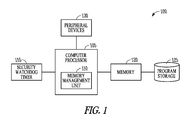
- the system 100 includes a computer processor 105 .
- the computer processor 105 executes instructions and may contain mechanisms to detect attacks or intrusions.
- a memory management unit 110 may detect a segmentation fault or an attempt to execute a portion of memory identified as read only.
- An integrated security/watch dog timer 115 detects when the processor 105 is no longer executing the code as expected.
- An intrusion detection mechanism can generally function by identifying a signature of a known attacker or malicious piece of software, and/or by detecting an anomaly-based intrusion such as identifying different behavior---for example, attempting to write to Read Only memory.
- the timer 115 has the ability to set a nonvolatile flag indicating the type of fault or error caused by the detected intrusion, and it initiates a reset of the system.
- Memory 120 stores the code to be executed.
- Memory 120 may be static RAM, dynamic RAM, or some other memory mechanism (e.g., a FLASH memory) capable of storing code to be executed.
- Program storage 125 provides a mechanism for storing the pieces of software to be executed.
- Program storage 125 includes the primary software as well as one or more instances of backup software. Each instance of backup software would be unique so that there is a low probability that two instances would contain the same flaw.
- the program storage 125 could be a hard disk, CD, DVD, FLASH memory, ROM, or even a nearby device supporting a bootstrap protocol.
- the system 100 will typically consist of other components or peripherals 130 to support I/O, perform sensing, or support other functions.
- the system 100 When the system 100 is initially booted, it loads the primary executable software. This is typically the operating system (real time OS, executive OS, or a richer OS) and one or more applications.
- the boot process initializes the integrated security/watch dog timer 115 .
- the system 100 then runs and provides the service for which it was designed.
- the security monitor and watch dog timer 115 are continuously verifying the integrity of the system. Assuming a flaw or attack occurs, the integrated security/watch dog timer 115 sets a flag indicating the version of the software which experienced the flaw. The timer 115 then forces a reboot.
- the system 100 When the system 100 reboots, it reads the flag(s) set by the integrated security/watch dog timer 115 and selects the software to run based upon the flags. The system 100 then boots using the newly loaded software and re-establishes itself within the larger system context—for example, it may re-establish network connections or update operating parameters.
- the system 100 described above is simplified in order to explain the concept. There are many possible variations on any such system.
- the entire software load is replaced upon reboot---that is, the OS and all applications are replaced.
- the approach is implemented such that a finer granularity is supported. In some instances, such as a buffer overflow attack against a particular application, only that application needs to be restarted using replacement software---that is, a partial reboot. This allows other applications to continue operating and allows a more rapid recovery.
- the suspect software modules e.g., a DLL
- FIG. 2 is a flowchart of an example process 200 that detects and responds to attacks on a computer system.
- FIG. 2 includes a number of process blocks 205 - 250. Though arranged serially in the example of FIG. 2 , other examples may reorder the blocks, omit one or more blocks, and/or execute two or more blocks in parallel using multiple processors or a single processor organized as two or more virtual machines or sub-processors. Moreover, still other examples can implement the blocks as one or more specific interconnected hardware or integrated circuit modules with related control and data signals communicated between and through the modules. Thus, any process flow is applicable to software, firmware, hardware, and hybrid implementations.
- an attack is detected on a software system.
- this attack could be a live human trying to hack into the software system, or a piece of malicious software.
- the attack may or may not result in an actual intrusion into the software system.
- the attack or intrusion is eradicated. This eradication could include terminating the attacker's connection, deleting the malicious software, or some other response.
- software is automatically loaded into the software system in response to the attack.
- This loaded software is replacement software.
- the replacement software includes the substantially similar functionality of at least a portion of the software system and a different implementation of the functionality of the portion of the software system.
- the replacement software can be locally available (as contrasted with loaded from a remote site via a network connection).
- either the replacement software is booted, or the entire software system is rebooted.
- the software system can be an embedded software system.
- a complete replacement of the software system is loaded into the software system.
- the eradication of the attack or intrusion includes terminating one or more processes, locating and erasing data, and terminating a user connection.
- the attack or intrusion is detected by one or more of a programming fault, an execution fault, or a security fault.
- one or more flags are set in response to the attack or intrusion, and the automatically loaded replacement software is selected as a function of the flags.
- the attack or intrusion can include a local or remote human access of the system, or can include a piece of malicious software loaded into the system.
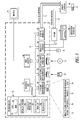
- FIG. 3 is an overview diagram of a hardware and operating environment in conjunction with which embodiments of the invention may be practiced.
- the description of FIG. 3 is intended to provide a brief, general description of suitable computer hardware and a suitable computing environment in conjunction with which the invention may be implemented.
- the invention is described in the general context of computer-executable instructions, such as program modules, being executed by a computer, such as a personal computer.
- program modules include routines, programs, objects, components, data structures, etc., that perform particular tasks or implement particular abstract data types.
- the invention may be practiced with other computer system configurations, including hand-held devices, multiprocessor systems, microprocessor-based or programmable consumer electronics, network PCs, minicomputers, mainframe computers, and the like.
- the invention may also be practiced in distributed computer environments where tasks are performed by I/0 remote processing devices that are linked through a communications network.
- program modules may be located in both local and remote memory storage devices.
- FIG. 3 a hardware and operating environment is provided that is applicable to any of the servers and/or remote clients shown in the other Figures.
- one embodiment of the hardware and operating environment includes a general purpose computing device in the form of a computer 20 (e.g., a personal computer, workstation, or server), including one or more processing units 21 , a system memory 22 , and a system bus 23 that operatively couples various system components including the system memory 22 to the processing unit 21 .
- a computer 20 e.g., a personal computer, workstation, or server
- processing units 21 e.g., a personal computer, workstation, or server
- system bus 23 that operatively couples various system components including the system memory 22 to the processing unit 21 .
- the processor of computer 20 comprises a single central-processing unit (CPU), or a plurality of processing units, commonly referred to as a multiprocessor or parallel-processor environment.
- a multiprocessor system can include cloud computing environments.
- computer 20 is a conventional computer, a distributed computer, or any other type of computer.
- the system bus 23 can be any of several types of bus structures including a memory bus or memory controller, a peripheral bus, and a local bus using any of a variety of bus architectures.
- the system memory can also be referred to as simply the memory, and, in some embodiments, includes read-only memory (ROM) 24 and random-access memory (RAM) 25 .
- ROM read-only memory
- RAM random-access memory
- a basic input/output system (BIOS) program 26 containing the basic routines that help to transfer information between elements within the computer 20 , such as during start-up, may be stored in ROM 24 .
- the computer 20 further includes a hard disk drive 27 for reading from and writing to a hard disk, not shown, a magnetic disk drive 28 for reading from or writing to a removable magnetic disk 29 , and an optical disk drive 30 for reading from or writing to a removable optical disk 31 such as a CD ROM or other optical media.
- a hard disk drive 27 for reading from and writing to a hard disk, not shown
- a magnetic disk drive 28 for reading from or writing to a removable magnetic disk 29
- an optical disk drive 30 for reading from or writing to a removable optical disk 31 such as a CD ROM or other optical media.
- the hard disk drive 27 , magnetic disk drive 28 , and optical disk drive 30 couple with a hard disk drive interface 32 , a magnetic disk drive interface 33 , and an optical disk drive interface 34 , respectively.
- the drives and their associated computer-readable media provide non volatile storage of computer-readable instructions, data structures, program modules and other data for the computer 20 . It should be appreciated by those skilled in the art that any type of computer-readable media which can store data that is accessible by a computer, such as magnetic cassettes, flash memory cards, digital video disks, Bernoulli cartridges, random access memories (RAMs), read only memories (ROMs), redundant arrays of independent disks (e.g., RAID storage devices) and the like, can be used in the exemplary operating environment.
- RAMs random access memories
- ROMs read only memories
- redundant arrays of independent disks e.g., RAID storage devices
- a plurality of program modules can be stored on the hard disk, magnetic disk 29 , optical disk 31 , ROM 24 , or RAM 25 , including an operating system 35 , one or more application programs 36 , other program modules 37 , and program data 38 .
- a user may enter commands and information into computer 20 through input devices such as a keyboard 40 and pointing device 42 .
- Other input devices can include a microphone, joystick, game pad, satellite dish, scanner, or the like.
- These other input devices are often connected to the processing unit 21 through a serial port interface 46 that is coupled to the system bus 23 , but can be connected by other interfaces, such as a parallel port, game port, or a universal serial bus (USB).
- a monitor 47 or other type of display device can also be connected to the system bus 23 via an interface, such as a video adapter 48 .
- the monitor 40 can display a graphical user interface for the user.
- computers typically include other peripheral output devices (not shown), such as speakers and printers.
- the computer 20 may operate in a networked environment using logical connections to one or more remote computers or servers, such as remote computer 49 . These logical connections are achieved by a communication device coupled to or a part of the computer 20 ; the invention is not limited to a particular type of communications device.
- the remote computer 49 can be another computer, a server, a router, a network PC, a client, a peer device or other common network node, and typically includes many or all of the elements described above I/0 relative to the computer 20 , although only a memory storage device 50 has been illustrated.
- the logical connections depicted in FIG. 3 include a local area network (LAN) 51 and/or a wide area network (WAN) 52.
- LAN local area network
- WAN wide area network
- the computer 20 When used in a LAN-networking environment, the computer 20 is connected to the LAN 51 through a network interface or adapter 53 , which is one type of communications device.
- the computer 20 when used in a WAN-networking environment, the computer 20 typically includes a modem 54 (another type of communications device) or any other type of communications device, e.g., a wireless transceiver, for establishing communications over the wide-area network 52 , such as the internet.
- the modem 54 which may be internal or external, is connected to the system bus 23 via the serial port interface 46 .
- program modules depicted relative to the computer 20 can be stored in the remote memory storage device 50 of remote computer, or server 49 .
- network connections shown are exemplary and other means of, and communications devices for, establishing a communications link between the computers may be used including hybrid fiber-coax connections, T1-T3 lines, DSL's, OC-3 and/or OC-12, TCP/IP, microwave, wireless application protocol, and any other electronic media through any suitable switches, routers, outlets and power lines, as the same are known and understood by one of ordinary skill in the art.
- inventive subject matter may be referred to herein, individually and/or collectively, by the term "invention" merely for convenience and without intending to voluntarily limit the scope of this application to any single invention or inventive concept if more than one is in fact disclosed.
- inventive subject matter may be referred to herein, individually and/or collectively, by the term "invention" merely for convenience and without intending to voluntarily limit the scope of this application to any single invention or inventive concept if more than one is in fact disclosed.
- inventive subject matter merely for convenience and without intending to voluntarily limit the scope of this application to any single invention or inventive concept if more than one is in fact disclosed.
Landscapes
- Engineering & Computer Science (AREA)
- Computer Security & Cryptography (AREA)
- Software Systems (AREA)
- Theoretical Computer Science (AREA)
- Computer Hardware Design (AREA)
- General Engineering & Computer Science (AREA)
- General Physics & Mathematics (AREA)
- Physics & Mathematics (AREA)
- Health & Medical Sciences (AREA)
- Virology (AREA)
- General Health & Medical Sciences (AREA)
- Stored Programmes (AREA)
- Debugging And Monitoring (AREA)
Applications Claiming Priority (1)
| Application Number | Priority Date | Filing Date | Title |
|---|---|---|---|
| US12/658,907 US20110202995A1 (en) | 2010-02-16 | 2010-02-16 | Single hardware platform multiple software redundancy |
Publications (2)
| Publication Number | Publication Date |
|---|---|
| EP2357586A2 true EP2357586A2 (de) | 2011-08-17 |
| EP2357586A3 EP2357586A3 (de) | 2011-11-09 |
Family
ID=44144900
Family Applications (1)
| Application Number | Title | Priority Date | Filing Date |
|---|---|---|---|
| EP11153755A Withdrawn EP2357586A3 (de) | 2010-02-16 | 2011-02-08 | Einzelne Hardwareplattform mit Mehrfachsoftwareredundanz |
Country Status (2)
| Country | Link |
|---|---|
| US (1) | US20110202995A1 (de) |
| EP (1) | EP2357586A3 (de) |
Families Citing this family (5)
| Publication number | Priority date | Publication date | Assignee | Title |
|---|---|---|---|---|
| US20130181809A1 (en) * | 2011-07-27 | 2013-07-18 | Michael R. Lin | SpaceCube MINI |
| US8181247B1 (en) * | 2011-08-29 | 2012-05-15 | Kaspersky Lab Zao | System and method for protecting a computer system from the activity of malicious objects |
| EP4221076A3 (de) * | 2013-10-03 | 2023-10-04 | Musarubra US LLC | Dynamische adaptive verteidigung für cybersicherheitsbedrohungen |
| US10536484B2 (en) | 2015-06-22 | 2020-01-14 | Fireeye, Inc. | Methods and apparatus for graphical user interface environment for creating threat response courses of action for computer networks |
| CN110262522B (zh) * | 2019-07-29 | 2023-03-24 | 北京百度网讯科技有限公司 | 用于控制自动驾驶车辆的方法和装置 |
Family Cites Families (11)
| Publication number | Priority date | Publication date | Assignee | Title |
|---|---|---|---|---|
| US7296274B2 (en) * | 1999-11-15 | 2007-11-13 | Sandia National Laboratories | Method and apparatus providing deception and/or altered execution of logic in an information system |
| CN1319237C (zh) * | 2001-02-24 | 2007-05-30 | 国际商业机器公司 | 超级计算机中通过动态重新划分的容错 |
| US7581103B2 (en) * | 2001-06-13 | 2009-08-25 | Intertrust Technologies Corporation | Software self-checking systems and methods |
| DE10142511B4 (de) * | 2001-08-30 | 2004-04-29 | Daimlerchrysler Ag | Fehlerbehandlung von Softwaremodulen |
| WO2003030434A2 (en) * | 2001-10-03 | 2003-04-10 | Shield One, Llc | Remotely controlled failsafe boot mechanism and remote manager for a network device |
| JP2003256234A (ja) * | 2002-03-05 | 2003-09-10 | Communication Research Laboratory | 抗脆弱性サーバ装置及びソフトウェア |
| US7117390B1 (en) * | 2002-05-20 | 2006-10-03 | Sandia Corporation | Practical, redundant, failure-tolerant, self-reconfiguring embedded system architecture |
| US8561190B2 (en) * | 2005-05-16 | 2013-10-15 | Microsoft Corporation | System and method of opportunistically protecting a computer from malware |
| KR100750132B1 (ko) * | 2005-09-27 | 2007-08-21 | 삼성전자주식회사 | 부팅, 소프트웨어 자동 업데이트 및 에러 복원 방법과 그시스템, 그 방법을 기록한 컴퓨터 판독 가능한 기록매체 |
| US8099785B1 (en) * | 2007-05-03 | 2012-01-17 | Kaspersky Lab, Zao | Method and system for treatment of cure-resistant computer malware |
| US8103909B2 (en) * | 2008-09-15 | 2012-01-24 | Juniper Networks, Inc. | Automatic hardware-based recovery of a compromised computer |
-
2010
- 2010-02-16 US US12/658,907 patent/US20110202995A1/en not_active Abandoned
-
2011
- 2011-02-08 EP EP11153755A patent/EP2357586A3/de not_active Withdrawn
Non-Patent Citations (1)
| Title |
|---|
| None |
Also Published As
| Publication number | Publication date |
|---|---|
| US20110202995A1 (en) | 2011-08-18 |
| EP2357586A3 (de) | 2011-11-09 |
Similar Documents
| Publication | Publication Date | Title |
|---|---|---|
| US10701084B2 (en) | Reliable and secure firmware update with a dynamic validation for internet of things (IoT) devices | |
| US9473526B2 (en) | Fight-through nodes for survivable computer network | |
| US20140053269A1 (en) | Attack resistant continuous network service trustworthiness controller | |
| US10409988B2 (en) | Escalated remediation | |
| US8386853B2 (en) | System and method for a staggered execution environment | |
| EP3120279B1 (de) | Integritätszusicherung und neustartlose aktualisierung während der laufzeit | |
| US8640238B2 (en) | Fight-through nodes for survivable computer network | |
| EP2649548B1 (de) | Schutz von virtuellen maschinen vor schadprogrammen | |
| EP2610774B1 (de) | System und Verfahren zur Erkennung von auf den Boot-Vorgang eines Computers abzielenden Schadprogrammen | |
| US11620196B2 (en) | Computer duplication and configuration management systems and methods | |
| US7886190B2 (en) | System and method for enabling seamless boot recovery | |
| US11290492B2 (en) | Malicious data manipulation detection using markers and the data protection layer | |
| US20110083002A1 (en) | System and method providing a pluggable architecture for task management on computers | |
| US11321454B2 (en) | Notice of intrusion into firmware | |
| US20160371163A1 (en) | Systems and methods for smart diagnoses and triage of failures with identity continuity | |
| US20130042139A1 (en) | Systems and methods for fault recovery in multi-tier applications | |
| DE202014011092U1 (de) | Sicherheitsarchitektur für virtuelle Maschinen | |
| KR20120079847A (ko) | 컴퓨터 애플리케이션에서의 데이터 손실을 최소화하기 위한 방법 및 시스템 | |
| EP2357586A2 (de) | Einzelne Hardwareplattform mit Mehrfachsoftwareredundanz | |
| JP2017507431A (ja) | コンピューティングデバイスの初期化トレース | |
| US20160364304A1 (en) | Providing availability of an agent virtual computing instance during a storage failure | |
| US9734191B2 (en) | Asynchronous image repository functionality | |
| US11599426B2 (en) | Recovery via backups of recovery information | |
| US9135002B1 (en) | Systems and methods for recovering an application on a computing device | |
| US11947420B2 (en) | Hardware memory error tolerant software system |
Legal Events
| Date | Code | Title | Description |
|---|---|---|---|
| PUAI | Public reference made under article 153(3) epc to a published international application that has entered the european phase |
Free format text: ORIGINAL CODE: 0009012 |
|
| 17P | Request for examination filed |
Effective date: 20110208 |
|
| AK | Designated contracting states |
Kind code of ref document: A2 Designated state(s): AL AT BE BG CH CY CZ DE DK EE ES FI FR GB GR HR HU IE IS IT LI LT LU LV MC MK MT NL NO PL PT RO RS SE SI SK SM TR |
|
| AX | Request for extension of the european patent |
Extension state: BA ME |
|
| PUAL | Search report despatched |
Free format text: ORIGINAL CODE: 0009013 |
|
| AK | Designated contracting states |
Kind code of ref document: A3 Designated state(s): AL AT BE BG CH CY CZ DE DK EE ES FI FR GB GR HR HU IE IS IT LI LT LU LV MC MK MT NL NO PL PT RO RS SE SI SK SM TR |
|
| AX | Request for extension of the european patent |
Extension state: BA ME |
|
| RIC1 | Information provided on ipc code assigned before grant |
Ipc: G06F 21/00 20060101AFI20110930BHEP |
|
| 17Q | First examination report despatched |
Effective date: 20111104 |
|
| STAA | Information on the status of an ep patent application or granted ep patent |
Free format text: STATUS: THE APPLICATION IS DEEMED TO BE WITHDRAWN |
|
| 18D | Application deemed to be withdrawn |
Effective date: 20140902 |