EP2358717B1 - Aminotetrahydropyranes en tant qu'inhibiteurs de dipeptidyle peptidase-iv pour le traitement ou la prevention du diabete - Google Patents
Aminotetrahydropyranes en tant qu'inhibiteurs de dipeptidyle peptidase-iv pour le traitement ou la prevention du diabete Download PDFInfo
- Publication number
- EP2358717B1 EP2358717B1 EP20090756204 EP09756204A EP2358717B1 EP 2358717 B1 EP2358717 B1 EP 2358717B1 EP 20090756204 EP20090756204 EP 20090756204 EP 09756204 A EP09756204 A EP 09756204A EP 2358717 B1 EP2358717 B1 EP 2358717B1
- Authority
- EP
- European Patent Office
- Prior art keywords
- alkyl
- optionally substituted
- alkoxy
- compound
- independently selected
- Prior art date
- Legal status (The legal status is an assumption and is not a legal conclusion. Google has not performed a legal analysis and makes no representation as to the accuracy of the status listed.)
- Active
Links
- 0 CCC1C=C(C(*CC2)(C(OC)=**C=O)C(C)=C2C2=C(C)C=CCC2)C=**1 Chemical compound CCC1C=C(C(*CC2)(C(OC)=**C=O)C(C)=C2C2=C(C)C=CCC2)C=**1 0.000 description 12
- UFSVVFUWHTZWIL-WCZHJHOJSA-N CCC[C@@H](C[C@H]1N)CO[C@H]1[AlH2] Chemical compound CCC[C@@H](C[C@H]1N)CO[C@H]1[AlH2] UFSVVFUWHTZWIL-WCZHJHOJSA-N 0.000 description 1
- YFHCTVCJFUZFTO-UHFFFAOYSA-N Cc(ccc(Oc([nH]c1c2)nc1cc(-c1ccc(C3(CO)CC3)cc1)c2Cl)c1)c1C(O)=O Chemical compound Cc(ccc(Oc([nH]c1c2)nc1cc(-c1ccc(C3(CO)CC3)cc1)c2Cl)c1)c1C(O)=O YFHCTVCJFUZFTO-UHFFFAOYSA-N 0.000 description 1
- QYUWWVKKEPRUDZ-UHFFFAOYSA-N NC(C1)C(c(cc(c(F)c2)F)c2F)OCC1N(Cc1c2)Cc1n[n]2S(C1CCCC1)(=O)=O Chemical compound NC(C1)C(c(cc(c(F)c2)F)c2F)OCC1N(Cc1c2)Cc1n[n]2S(C1CCCC1)(=O)=O QYUWWVKKEPRUDZ-UHFFFAOYSA-N 0.000 description 1
- SUKBIIOMRBFEMR-UHFFFAOYSA-N NC(C1)C(c(cc(cc2)F)c2F)OCC1N(C1)Cc2c1cn[n]2S(C1CC1)(=O)=O Chemical compound NC(C1)C(c(cc(cc2)F)c2F)OCC1N(C1)Cc2c1cn[n]2S(C1CC1)(=O)=O SUKBIIOMRBFEMR-UHFFFAOYSA-N 0.000 description 1
- HQRVCZSAVCSZFT-AJYIIGQXSA-N N[C@@H](C1)C(c(cc(c(F)c2)F)c2F)OC[C@@H]1N(C1)Cc2c1cn[n]2S(C1CCCC1)(=O)=O Chemical compound N[C@@H](C1)C(c(cc(c(F)c2)F)c2F)OC[C@@H]1N(C1)Cc2c1cn[n]2S(C1CCCC1)(=O)=O HQRVCZSAVCSZFT-AJYIIGQXSA-N 0.000 description 1
- SUKBIIOMRBFEMR-ZJLLDPBHSA-N N[C@@H](C1)[C@@H](c(cc(cc2)F)c2F)OCC1N(C1)Cc2c1cn[n]2S(C1CC1)(=O)=O Chemical compound N[C@@H](C1)[C@@H](c(cc(cc2)F)c2F)OCC1N(C1)Cc2c1cn[n]2S(C1CC1)(=O)=O SUKBIIOMRBFEMR-ZJLLDPBHSA-N 0.000 description 1
- WWEJERVWWLOAPT-PLIICFKJSA-N N[C@@H](C1)[C@@H](c(cc(cc2)F)c2F)OCC1N(Cc1c2)Cc1n[n]2S(C1CCCC1)(=O)=O Chemical compound N[C@@H](C1)[C@@H](c(cc(cc2)F)c2F)OCC1N(Cc1c2)Cc1n[n]2S(C1CCCC1)(=O)=O WWEJERVWWLOAPT-PLIICFKJSA-N 0.000 description 1
- GPWUJWWTILETQW-UHFFFAOYSA-N O=C(CC1NP)COC1[AlH2] Chemical compound O=C(CC1NP)COC1[AlH2] GPWUJWWTILETQW-UHFFFAOYSA-N 0.000 description 1
Classifications
-
- C—CHEMISTRY; METALLURGY
- C07—ORGANIC CHEMISTRY
- C07D—HETEROCYCLIC COMPOUNDS
- C07D309/00—Heterocyclic compounds containing six-membered rings having one oxygen atom as the only ring hetero atom, not condensed with other rings
- C07D309/16—Heterocyclic compounds containing six-membered rings having one oxygen atom as the only ring hetero atom, not condensed with other rings having one double bond between ring members or between a ring member and a non-ring member
- C07D309/28—Heterocyclic compounds containing six-membered rings having one oxygen atom as the only ring hetero atom, not condensed with other rings having one double bond between ring members or between a ring member and a non-ring member with hetero atoms or with carbon atoms having three bonds to hetero atoms with at the most one bond to halogen, e.g. ester or nitrile radicals, directly attached to ring carbon atoms
- C07D309/30—Oxygen atoms, e.g. delta-lactones
-
- A—HUMAN NECESSITIES
- A61—MEDICAL OR VETERINARY SCIENCE; HYGIENE
- A61K—PREPARATIONS FOR MEDICAL, DENTAL OR TOILETRY PURPOSES
- A61K31/00—Medicinal preparations containing organic active ingredients
- A61K31/33—Heterocyclic compounds
- A61K31/395—Heterocyclic compounds having nitrogen as a ring hetero atom, e.g. guanethidine or rifamycins
- A61K31/41—Heterocyclic compounds having nitrogen as a ring hetero atom, e.g. guanethidine or rifamycins having five-membered rings with two or more ring hetero atoms, at least one of which being nitrogen, e.g. tetrazole
- A61K31/415—1,2-Diazoles
- A61K31/4162—1,2-Diazoles condensed with heterocyclic ring systems
-
- A—HUMAN NECESSITIES
- A61—MEDICAL OR VETERINARY SCIENCE; HYGIENE
- A61K—PREPARATIONS FOR MEDICAL, DENTAL OR TOILETRY PURPOSES
- A61K38/00—Medicinal preparations containing peptides
- A61K38/16—Peptides having more than 20 amino acids; Gastrins; Somatostatins; Melanotropins; Derivatives thereof
- A61K38/17—Peptides having more than 20 amino acids; Gastrins; Somatostatins; Melanotropins; Derivatives thereof from animals; from humans
- A61K38/1703—Peptides having more than 20 amino acids; Gastrins; Somatostatins; Melanotropins; Derivatives thereof from animals; from humans from vertebrates
- A61K38/1709—Peptides having more than 20 amino acids; Gastrins; Somatostatins; Melanotropins; Derivatives thereof from animals; from humans from vertebrates from mammals
-
- A—HUMAN NECESSITIES
- A61—MEDICAL OR VETERINARY SCIENCE; HYGIENE
- A61K—PREPARATIONS FOR MEDICAL, DENTAL OR TOILETRY PURPOSES
- A61K38/00—Medicinal preparations containing peptides
- A61K38/16—Peptides having more than 20 amino acids; Gastrins; Somatostatins; Melanotropins; Derivatives thereof
- A61K38/17—Peptides having more than 20 amino acids; Gastrins; Somatostatins; Melanotropins; Derivatives thereof from animals; from humans
- A61K38/22—Hormones
- A61K38/26—Glucagons
-
- A—HUMAN NECESSITIES
- A61—MEDICAL OR VETERINARY SCIENCE; HYGIENE
- A61K—PREPARATIONS FOR MEDICAL, DENTAL OR TOILETRY PURPOSES
- A61K45/00—Medicinal preparations containing active ingredients not provided for in groups A61K31/00 - A61K41/00
- A61K45/06—Mixtures of active ingredients without chemical characterisation, e.g. antiphlogistics and cardiaca
-
- A—HUMAN NECESSITIES
- A61—MEDICAL OR VETERINARY SCIENCE; HYGIENE
- A61K—PREPARATIONS FOR MEDICAL, DENTAL OR TOILETRY PURPOSES
- A61K9/00—Medicinal preparations characterised by special physical form
- A61K9/20—Pills, tablets, discs, rods
- A61K9/2004—Excipients; Inactive ingredients
- A61K9/2022—Organic macromolecular compounds
- A61K9/205—Polysaccharides, e.g. alginate, gums; Cyclodextrin
- A61K9/2054—Cellulose; Cellulose derivatives, e.g. hydroxypropyl methylcellulose
-
- A—HUMAN NECESSITIES
- A61—MEDICAL OR VETERINARY SCIENCE; HYGIENE
- A61P—SPECIFIC THERAPEUTIC ACTIVITY OF CHEMICAL COMPOUNDS OR MEDICINAL PREPARATIONS
- A61P3/00—Drugs for disorders of the metabolism
-
- A—HUMAN NECESSITIES
- A61—MEDICAL OR VETERINARY SCIENCE; HYGIENE
- A61P—SPECIFIC THERAPEUTIC ACTIVITY OF CHEMICAL COMPOUNDS OR MEDICINAL PREPARATIONS
- A61P3/00—Drugs for disorders of the metabolism
- A61P3/06—Antihyperlipidemics
-
- A—HUMAN NECESSITIES
- A61—MEDICAL OR VETERINARY SCIENCE; HYGIENE
- A61P—SPECIFIC THERAPEUTIC ACTIVITY OF CHEMICAL COMPOUNDS OR MEDICINAL PREPARATIONS
- A61P3/00—Drugs for disorders of the metabolism
- A61P3/08—Drugs for disorders of the metabolism for glucose homeostasis
- A61P3/10—Drugs for disorders of the metabolism for glucose homeostasis for hyperglycaemia, e.g. antidiabetics
-
- A—HUMAN NECESSITIES
- A61—MEDICAL OR VETERINARY SCIENCE; HYGIENE
- A61P—SPECIFIC THERAPEUTIC ACTIVITY OF CHEMICAL COMPOUNDS OR MEDICINAL PREPARATIONS
- A61P43/00—Drugs for specific purposes, not provided for in groups A61P1/00-A61P41/00
-
- C—CHEMISTRY; METALLURGY
- C07—ORGANIC CHEMISTRY
- C07D—HETEROCYCLIC COMPOUNDS
- C07D405/00—Heterocyclic compounds containing both one or more hetero rings having oxygen atoms as the only ring hetero atoms, and one or more rings having nitrogen as the only ring hetero atom
- C07D405/02—Heterocyclic compounds containing both one or more hetero rings having oxygen atoms as the only ring hetero atoms, and one or more rings having nitrogen as the only ring hetero atom containing two hetero rings
- C07D405/04—Heterocyclic compounds containing both one or more hetero rings having oxygen atoms as the only ring hetero atoms, and one or more rings having nitrogen as the only ring hetero atom containing two hetero rings directly linked by a ring-member-to-ring-member bond
-
- C—CHEMISTRY; METALLURGY
- C07—ORGANIC CHEMISTRY
- C07D—HETEROCYCLIC COMPOUNDS
- C07D487/00—Heterocyclic compounds containing nitrogen atoms as the only ring hetero atoms in the condensed system, not provided for by groups C07D451/00 - C07D477/00
- C07D487/02—Heterocyclic compounds containing nitrogen atoms as the only ring hetero atoms in the condensed system, not provided for by groups C07D451/00 - C07D477/00 in which the condensed system contains two hetero rings
- C07D487/04—Ortho-condensed systems
Definitions
- the present invention relates to novel substituted aminotetrahydropyrans which are inhibitors of the dipeptidyl peptidase-IV enzyme ("DPP-4 inhibitors") and which are useful in the treatment or prevention of diseases in which the dipeptidyl peptidase-IV enzyme is involved, such as diabetes and particularly Type 2 diabetes.
- DPP-4 inhibitors inhibitors of the dipeptidyl peptidase-IV enzyme
- the invention is also directed to pharmaceutical compositions comprising these compounds and these compounds and compositions for use in the prevention or treatment of such diseases in which the dipeptidyl peptidase-IV enzyme is involved.
- Diabetes refers to a disease process derived from multiple causative factors and characterized by elevated levels of plasma glucose or hyperglycemia in the fasting state or after administration of glucose during an oral glucose tolerance test. Persistent or uncontrolled hyperglycemia is associated with increased and premature morbidity and mortality. Often abnormal glucose homeostasis is associated both directly and indirectly with alterations of the lipid, lipoprotein and apolipoprotein metabolism and other metabolic and hemodynamic disease. Therefore patients with Type 2 diabetes mellitus are at especially increased risk of macrovascular and microvascular complications, including coronary heart disease, stroke, peripheral vascular disease, hypertension, nephropathy, neuropathy, and retinopathy. Therefore, therapeutical control of glucose homeostasis, lipid metabolism and hypertension are critically important in the clinical management and treatment of diabetes mellitus.
- Type 1 diabetes or insulin-dependent diabetes mellitus (IDDM)
- IDDM insulin-dependent diabetes mellitus
- NIDDM noninsulin dependent diabetes mellitus
- Insulin resistance is not primarily due to a diminished number of insulin receptors but to a post-insulin receptor binding defect that is not yet understood. This resistance to insulin responsiveness results in insufficient insulin activation of glucose uptake, oxidation and storage in muscle and inadequate insulin repression of lipolysis in adipose tissue and of glucose production and secretion in the liver.
- Type 2 diabetes which have not changed substantially in many years, have recognized limitations. While physical exercise and reductions in dietary intake of calories will dramatically improve the diabetic condition, compliance with this treatment is very poor because of well-entrenched sedentary lifestyles and excess food consumption, especially of foods containing high amounts of saturated fat.
- sulfonylureas e.g. tolbutamide and glipizide
- meglitinide which stimulate the pancreatic ⁇ cells to secrete more insulin, and/or by injection of insulin when sulfonylureas or meglitinide become ineffective, can result in insulin concentrations high enough to stimulate the very insulin-resistant tissues.
- sulfonylureas or meglitinide sulfonylureas or meglitinide
- the biguanides increase insulin sensitivity resulting in some correction of hyperglycemia.
- the two biguanides, phenformin and metformin can induce lactic acidosis and nausea/diarrhea.
- Metformin has fewer side effects than phenformin and is often prescribed for the treatment of Type 2 diabetes.
- the glitazones constitute an additional class of compounds with potential for ameliorating many symptoms of Type 2 diabetes. These agents substantially increase insulin sensitivity in muscle, liver and adipose tissue in several animal models of Type 2 diabetes resulting in partial or complete correction of the elevated plasma levels of glucose without occurrence of hypoglycemia.
- the glitazones that are currently marketed are agonists of the peroxisome proliferator activated receptor (PPAR), primarily the PPAR-gamma subtype.
- PPAR-gamma agonism is generally believed to be responsible for the improved insulin sensititization that is observed with the glitazones.
- Newer PPAR agonists that are being tested for treatment of Type 2 diabetes are agonists of the alpha, gamma or delta subtype, or a combination of these, and in many cases are chemically different from the glitazones (i.e., they are not thiazolidinediones in structure). Serious side effects (e.g. liver toxicity) have occurred with some of the glitazones, such as troglitazone.
- alpha-glucosidase inhibitors e.g. acarbose
- GLP-1 mimetics e.g., exenatide and liraglutide
- glucagon receptor antagonists e.g., glucokinase activators, and GPR-119 agonists.
- DPP-4 dipeptidyl peptidase-IV
- WO 97/40832 WO 98/19998
- U.S. Patent No. 5,939,560 U.S. Patent No. 6,303,661
- U.S. Patent No. 6,699,871 U.S. Patent No. 6,166,063
- Additional patent publications that disclose DPP-4 inhibitors useful for the treatment of diabetes are the following: WO 2006/009886 (26 January 2006 ); WO 2006/039325 (13 April 2006 ); WO 2006/058064 (1 June 2006 ); WO 2006/127530 (30 November 2006 ); WO 2007/024993 (1 March 2007 ); WO 2007/070434 (21 June 2007 ); WO 2007/087231 (2 August 2007 ); WO 07/097931 (30 August 2007 ); WO 07/126745 (8 November 2007 ); WO 07/136603 (29 November 2007 ); and WO 08/060488 (22 May 2008 ).
- DPP-4 inhibitors in the treatment of Type 2 diabetes is based on the fact that DPP-4 in vivo readily inactivates glucagon like peptide-1 (GLP-1) and gastric inhibitory peptide (GIP).
- GLP-1 and GIP are incretins and are produced when food is consumed. The incretins stimulate production of insulin. Inhibition of DPP-4 leads to decreased inactivation of the incretins, and this in turn results in increased effectiveness of the incretins in stimulating production of insulin by the pancreas. DPP-4 inhibition therefore results in an increased level of serum insulin.
- DPP-4 inhibition is not expected to increase the level of insulin at inappropriate times, such as between meals, which can lead to excessively low blood sugar (hypoglycemia). Inhibition of DPP-4 is therefore expected to increase insulin without increasing the risk of hypoglycemia, which is a dangerous side effect associated with the use of insulin secretagogues.
- DPP-4 inhibitors also have other therapeutic utilities, as discussed herein. New compounds are needed so that improved DPP-4 inhibitors can be found for the treatment of diabetes and potentially other diseases and conditions. In particular, there is a need for DPP-4 inhibitors that are selective over other members of the family of serine peptidases that includes quiescent cell proline dipeptidase (QPP), DPP8, and DPP9 [see G. Lankas, et al., "Dipeptidyl Peptidase-IV Inhibition for the Treatment of Type 2 Diabetes: Potential Importance of Selectivity Over Dipeptidyl Peptidases 8 and 9," Diabetes, 54: 2988-2994 (2005 ); N.S. Kang, et al., "Docking-based 3D-QSAR study for selectivity of DPP4, DPP8, and DPP9 inhibitors," Bioorg. Med. Chem. Lett., 17: 3716-3721 (2007 )].
- QPP quiescent cell proline dipeptidase
- DPP8
- DPP-4 inhibitors for the treatment of Type 2 diabetes is discussed by (i) D.J. Drucker, Exp. Opin. Invest. Drugs, 12: 87-100 (2003 ); (ii) K. Augustyns, et al., Exp. Opin. Ther. Patents, 13: 499-510 (2003 ); (iii) J.J. Holst, Exp. Opin. Emerg. Drugs, 9: 155-166 (2004 ); (iv) H.-U. Demuth, et al., Biochim. Biophys. Acta, 1751: 33-44 (2005 ); (v) R. Mentlein, Exp. Opin. Invest.
- DPP-4 inhibitors either already approved or under clinical investigation for the treatment of Type 2 diabetes include sitagliptin, vildagliptin, saxagliptin, alogliptin, carmegliptin, melogliptin, and dutogliptin.
- the present invention is directed to novel substituted 3-aminotetrahydropyrans which are inhibitors of the dipeptidyl peptidase-IV enzyme ("DPP-4 inhibitors") and which are useful in the treatment or prevention of diseases in which the dipeptidyl peptidase-IV enzyme is involved, such as diabetes and particularly Type 2 diabetes.
- DPP-4 inhibitors novel substituted 3-aminotetrahydropyrans which are inhibitors of the dipeptidyl peptidase-IV enzyme
- the invention is also directed to pharmaceutical compositions comprising these compounds and these compounds and compositions for use in the prevention or treatment of such diseases in which the dipeptidyl peptidase-IV enzyme is involved.
- the present invention relates to novel substituted 3-aminotetrahydropyrans that are useful as inhibitors of dipeptidyl peptidase-IV.
- Compounds of the present invention are described by structural formula I: and pharmaceutically acceptable salts thereof; wherein V is selected from the group consisting of: Ar is phenyl optionally substituted with one to five R 1 substituents; each R 1 is independently selected from the group consisting of:
- Ar is optionally substituted with one to three substituents independently selected from the group consisting of fluorine, chlorine, bromine, methyl, trifluoromethyl, and trifluoromethoxy.
- Ar is 2,5-difluorophenyl or 2,4,5-trifluorophenyl.
- R3a and R3b are both hydrogen.
- V is selected from the group consisting of: wherein R 2 and R 8 are as defined above.
- R 2 is hydrogen.
- V is In another class of this third embodiment, V is In a subclass of this class, R 2 is hydrogen.
- R 8 is selected from the group consisting of:
- V is selected from the group consisting of: wherein R 2 and R 8 are as defined above.
- R 2 is hydrogen
- R 8 is -SO 2 C 1-6 alkyl or -SO 2 C 3-6 cycloalkyl, wherein alkyl and cycloalkyl are optionally substituted with one to five fluorines.
- V is selected from the group consisting of: wherein R 2 and R 8 are as defined above.
- R 2 is hydrogen
- R 8 is -SO 2 C 1-6 alkyl or -SO 2 C 3-6 cycloalkyl, wherein alkyl and cycloalkyl are optionally substituted with one to five fluorines.
- each R 2 is independently selected from the group consisting of hydrogen; C 1-6 alkyl, wherein alkyl is optionally substituted with one to five fluorines; and C 3-6 cycloalkyl, wherein cycloalkyl is optionally substituted with one to three substituents independently selected from halogen, hydroxy, C 1-4 alkyl, and C 1-4 alkoxy, wherein alkyl and alkoxy are optionally substituted with one to five fluorines.
- each R 2 is independently selected from the group consisting of hydrogen, C 1-3 alkyl, trifluoromethyl, 2,2,2-trifluoroethyl, and cyclopropyl. In a subclass of this class, each R 2 is hydrogen.
- Nonlimiting examples of compounds of the present invention that are useful as dipeptidyl peptidase-IV inhibitors are the following structures having the indicated absolute stereochemical configurations at the three stereogenic tetrahydropyran carbon atoms:
- alkyl as well as other groups having the prefix “alk”, such as alkoxy and alkanoyl, means carbon chains which may be linear or branched, and combinations thereof, unless the carbon chain is defined otherwise.
- alkyl groups include methyl, ethyl, propyl, isopropyl, butyl, sec - and tert -butyl, pentyl, hexyl, heptyl, octyl, nonyl, and the like.
- the term alkyl also includes cycloalkyl groups, and combinations of linear or branched alkyl chains combined with cycloalkyl structures. When no number of carbon atoms is specified, C 1-6 is intended.
- Cycloalkyl is a subset of alkyl and means a saturated carbocyclic ring having a specified number of carbon atoms. Examples of cycloalkyl include cyclopropyl, cyclobutyl, cyclopentyl, cyclohexyl, cycloheptyl, cyclooctyl, and the like. A cycloalkyl group generally is monocyclic unless stated otherwise. Cycloalkyl groups are saturated unless otherwise defined.
- alkoxy refers to straight or branched chain alkoxides of the number of carbon atoms specified (e.g., C 1-10 alkoxy), or any number within this range [i.e., methoxy (MeO-), ethoxy, isopropoxy, etc.].
- alkylthio refers to straight or branched chain alkylsulfides of the number of carbon atoms specified (e.g., C 1-10 alkylthio), or any number within this range [i.e., methylthio (MeS-), ethylthio, isopropylthio, etc.].
- alkylamino refers to straight or branched alkylamines of the number of carbon atoms specified (e.g., C 1-6 alkylamino), or any number within this range [i.e., methylamino, ethylamino, isopropylamino, t-butylamino, etc.].
- alkylsulfonyl refers to straight or branched chain alkylsulfones of the number of carbon atoms specified (e.g., C 1-6 alkylsulfonyl), or any number within this range [i.e., methylsulfonyl (MeSO 2 -), ethylsulfonyl, isopropylsulfonyl, etc.].
- alkyloxycarbonyl refers to straight or branched chain esters of a carboxylic acid derivative of the present invention of the number of carbon atoms specified (e.g., C 1-6 alkyloxycarbonyl), or any number within this range [i.e., methyloxycarbonyl (MeOCO-), ethyloxycarbonyl, or butyloxycarbonyl].
- Aryl means a mono- or polycyclic aromatic ring system containing carbon ring atoms.
- the preferred aryls are monocyclic or bicyclic 6-10 membered aromatic ring systems. Phenyl and naphthyl are preferred aryls. The most preferred aryl is phenyl.
- heterocyclyl refers to saturated or unsaturated non-aromatic rings or ring systems containing at least one heteroatom selected from O, S and N, further including the oxidized forms of sulfur, namely SO and SO 2 .
- heterocycles include tetrahydrofuran (THF), dihydrofuran, 1,4-dioxane, morpholine, 1,4-dithiane, piperazine, piperidine, 1,3-dioxolane, imidazolidine, imidazoline, pyrroline, pyrrolidine, tetrahydropyran, dihydropyran, oxathiolane, dithiolane, 1,3-dioxane, 1,3-dithiane, oxathiane, thiomorpholine, pyrrolidinone, oxazolidin-2-one, imidazolidine-2-one, pyridone, and the like.
- Heteroaryl means an aromatic or partially aromatic heterocycle that contains at least one ring heteroatom selected from O, S and N. Heteroaryls also include heteroaryls fused to other kinds of rings, such as aryls, cycloalkyls and heterocycles that are not aromatic.
- heteroaryl groups include pyrrolyl, isoxazolyl, isothiazolyl, pyrazolyl, pyridinyl, 2-oxo-(1 H )-pyridinyl (2-hydroxy-pyridinyl), oxazolyl, 1,2,4-oxadiazolyl, 1,3,4-oxadiazolyl, thiadiazolyl, thiazolyl, imidazolyl, triazolyl, tetrazolyl, furyl, triazinyl, thienyl, pyrimidinyl, pyrazinyl, benzisoxazolyl, benzoxazolyl, benzothiazolyl, benzothiadiazolyl, dihydrobenzofuranyl, indolinyl, pyridazinyl, indazolyl, isoindolyl, dihydrobenzothienyl, indolizinyl, cinnolinyl, phthalaziny
- Halogen refers to fluorine, chlorine, bromine and iodine. Chlorine and fluorine are generally preferred. Fluorine is most preferred when the halogens are substituted on an alkyl or alkoxy group (e.g. CF 3 O and CF 3 CH 2 O).
- the compounds of the present invention contain one or more asymmetric centers and can thus occur as racemates, racemic mixtures, single enantiomers, diastereomeric mixtures, and individual diastereomers.
- the compounds of the present invention have an asymmetric center at the stereogenic carbon atoms marked with an * in formulae Ia, Ib, Ic, Id, Ie, and If. Additional asymmetric centers may be present depending upon the nature of the various substituents on the molecule. Each such asymmetric center will independently produce two optical isomers and it is intended that all of the possible optical isomers and diastereomers in mixtures and as pure or partially purified compounds are included within the ambit of this invention. The present invention is meant to comprehend all such isomeric forms of these compounds.
- Some of the compounds described herein may exist as tautomers, which have different points of attachment of hydrogen accompanied by one or more double bond shifts.
- a ketone and its enol form are keto-enol tautomers.
- the individual tautomers as well as mixtures thereof are encompassed with compounds of the present invention.
- An example of tautomers which are intended to be encompassed within the compounds of the present invention is illustrated below:
- Formula I shows the structure of the class of compounds without preferred stereochemistry.
- Formulae Ia and Ib show the preferred stereochemistry at the stereogenic carbon atoms to which are attached the NH 2 and Ar groups on the tetrahydropyran ring.
- Formulae lc and Id show the preferred stereochemistry at the stereogenic carbon atoms to which are attached the NH 2 , Ar, and V groups on the tetrahydropyran ring.
- racemic mixtures of the compounds may be separated so that the individual enantiomers are isolated.
- the separation can be carried out by methods well known in the art, such as the coupling of a racemic mixture of compounds to an enantiomerically pure compound to form a diastereomeric mixture, followed by separation of the individual diastereomers by standard methods, such as fractional crystallization or chromatography.
- the coupling reaction is often the formation of salts using an enantiomerically pure acid or base.
- the diasteromeric derivatives may then be converted to the pure enantiomers by cleavage of the added chiral residue.
- the racemic mixture of the compounds can also be separated directly by chromatographic methods utilizing chiral stationary phases, which methods are well known in the art.
- any enantiomer of a compound may be obtained by stereoselective synthesis using optically pure starting materials or reagents of known configuration by methods well known in the art.
- the atoms may exhibit their natural isotopic abundances, or one or more of the atoms may be artificially enriched in a particular isotope having the same atomic number, but an atomic mass or mass number different from the atomic mass or mass number predominantly found in nature.
- the present invention is meant to include all suitable isotopic variations of the compounds of generic Formula I.
- different isotopic forms of hydrogen (H) include protium ( 1 H) and deuterium ( 2 H).
- Protium is the predominant hydrogen isotope found in nature. Enriching for deuterium may afford certain therapeutic advantages, such as increasing in vivo half-life or reducing dosage requirements, or may provide a compound useful as a standard for characterization of biological samples.
- Isotopically-enriched compounds within generic Formula I can be prepared without undue experimentation by conventional techniques well known to those skilled in the art or by processes analogous to those described in the Schemes and Examples herein using appropriate isotopically-enriched reagents and/or intermediates.
- references to the compounds of structural formula I are meant to also include the pharmaceutically acceptable salts, and also salts that are not pharmaceutically acceptable when they are used as precursors to the free compounds or their pharmaceutically acceptable salts or in other synthetic manipulations.
- the compounds of the present invention may be administered in the form of a pharmaceutically acceptable salt.
- pharmaceutically acceptable salt refers to salts prepared from pharmaceutically acceptable non-toxic bases or acids including inorganic or organic bases and inorganic or organic acids. Salts of basic compounds encompassed within the term “pharmaceutically acceptable salt” refer to non-toxic salts of the compounds of this invention which are generally prepared by reacting the free base with a suitable organic or inorganic acid.
- Representative salts of basic compounds of the present invention include, but are not limited to, the following: acetate, benzenesulfonate, benzoate, bicarbonate, bisulfate, bitartrate, borate, bromide, camsylate, carbonate, chloride, clavulanate, citrate, dihydrochloride, edetate, edisylate, estolate, esylate, fumarate, gluceptate, gluconate, glutamate, glycollylarsanilate, hexylresorcinate, hydrabamine, hydrobromide, hydrochloride, hydroxynaphthoate, iodide, isothionate, lactate, lactobionate, laurate, malate, maleate, mandelate, mesylate, methylbromide, methylnitrate, methylsulfate, mucate, napsylate, nitrate, N-methylglucamine ammonium salt,
- suitable pharmaceutically acceptable salts thereof include, but are not limited to, salts derived from inorganic bases including aluminum, ammonium, calcium, copper, ferric, ferrous, lithium, magnesium, manganic, mangamous, potassium, sodium, zinc, and the like. Particularly preferred are the ammonium, calcium, magnesium, potassium, and sodium salts.
- Salts derived from pharmaceutically acceptable organic non-toxic bases include salts of primary, secondary, and tertiary amines, cyclic amines, and basic ion-exchange resins, such as arginine, betaine, caffeine, choline, N,N-dibenzylethylenediamine, diethylamine, 2-diethylaminoethanol, 2-dimethylaminoethanol, ethanolamine, ethylenediamine, N-ethylmorpholine, N-ethylpiperidine, glucamine, glucosamine, histidine, hydrabamine, isopropylamine, lysine, methylglucamine, morpholine, piperazine, piperidine, polyamine resins, procaine, purines, theobromine, triethylamine, trimethylamine, tripropylamine, tromethamine, and the like.
- basic ion-exchange resins such as arginine, betaine, caffeine, cho
- esters of carboxylic acid derivatives such as methyl, ethyl, or pivaloyloxymethyl
- acyl derivatives of alcohols such as O -acetyl, O -pivaloyl, O -benzoyl, and O- aminoacyl
- esters and acyl groups known in the art for modifying the solubility or hydrolysis characteristics for use as sustained-release or prodrug formulations.
- the subject compounds are useful in a method of inhibiting the dipeptidyl peptidase-IV enzyme in a patient such as a mammal in need of such inhibition comprising the administration of an effective amount of the compound.
- the present invention is directed to the use of the compounds disclosed herein as inhibitors of dipeptidyl peptidase-IV enzyme activity.
- mammals including, but not limited to, cows, sheep, goats, horses, dogs, cats, guinea pigs, rats or other bovine, ovine, equine, canine, feline, rodent or murine species can be treated.
- the method can also be practiced in other species, such as avian species (e.g., chickens).
- the present invention is further directed to a method for the manufacture of a medicament for inhibiting dipeptidyl peptidase-IV enzyme activity in humans and animals comprising combining a compound of the present invention with a pharmaceutically acceptable carrier or diluent. More particularly, the present invention is directed to the use of a compound of structural formula I in the manufacture of a medicament for use in treating a condition selected from the group consisting of hyperglycemia, Type 2 diabetes, obesity, and a lipid disorder in a mammal, wherein the lipid disorder is selected from the group consisting of dyslipidemia, hyperlipidemia, hypertriglyceridemia, hypercholesterolemia, low HDL, and high LDL.
- the subject treated in the present methods is generally a mammal, preferably a human being, male or female, in whom inhibition of dipeptidyl peptidase-IV enzyme activity is desired.
- therapeutically effective amount means the amount of the subject compound that will elicit the biological or medical response of a tissue, system, animal or human that is being sought by the researcher, veterinarian, medical doctor or other clinician.
- composition as used herein is intended to encompass a product comprising the specified ingredients in the specified amounts, as well as any product which results, directly or indirectly, from combination of the specified ingredients in the specified amounts.
- Such term in relation to pharmaceutical composition is intended to encompass a product comprising the active ingredient(s), and the inert ingredient(s) that make up the carrier, as well as any product which results, directly or indirectly, from combination, complexation or aggregation of any two or more of the ingredients, or from dissociation of one or more of the ingredients, or from other types of reactions or interactions of one or more of the ingredients.
- the pharmaceutical compositions of the present invention encompass any composition made by admixing a compound of the present invention and a pharmaceutically acceptable carrier.
- pharmaceutically acceptable it is meant the carrier, diluent or excipient must be compatible with the other ingredients of the formulation and not deleterious to the recipient thereof.
- administering should be understood to mean providing a compound of the invention or a prodrug of a compound of the invention to the individual in need of treatment.
- a typical reaction contains approximately 50 pM enzyme, 50 ⁇ M Gly-Pro-AMC, and buffer (100 mM HEPES, pH 7.5, 0.1 mg/ml BSA) in a total reaction volume of 100 ⁇ L.
- Liberation of AMC is monitored continuously in a 96-well plate fluorometer using an excitation wavelength of 360 nm and an emission wavelength of 460 nm. Under these conditions, approximately 0.8 ⁇ M AMC is produced in 30 minutes at 25 degrees C.
- the enzyme used in these studies was soluble (transmembrane domain and cytoplasmic extension excluded) human protein produced in a baculovirus expression system (Bac-To-Bac, Gibco BRL).
- the kinetic constants for hydrolysis of Gly-Pro-AMC and GLP-1 were found to be in accord with literature values for the native enzyme.
- solutions of inhibitor in DMSO were added to reactions containing enzyme and substrate (final DMSO concentration is 1%). All experiments were conducted at room temperature using the standard reaction conditions described above.
- dissociation constants (K i ) reaction rates were fit by nonlinear regression to the Michaelis-Menton equation for competitive inhibition. The errors in reproducing the dissociation constants are typically less than two-fold.
- Dipeptidyl peptidase-IV enzyme is a cell surface protein that has been implicated in a wide range of biological functions. It has a broad tissue distribution (intestine, kidney, liver, pancreas, placenta, thymus, spleen, epithelial cells, vascular endothelium, lymphoid and myeloid cells, serum), and distinct tissue and cell-type expression levels. DPP-4 is identical to the T cell activation marker CD26, and it can cleave a number of immunoregulatory, endocrine, and neurological peptides in vitro. This has suggested a potential role for this peptidase in a variety of disease processes in humans or other species.
- the subject compounds are useful in a method for the prevention or treatment of the following diseases, disorders and conditions.
- Type II Diabetes and Related Disorders It is well established that the incretins GLP-1 and GIP are rapidly inactivated in vivo by DPP-4. Studies with DPP-4 (-/-) -deficient mice and preliminary clinical trials indicate that DPP-4 inhibition increases the steady state concentrations of GLP-1 and GIP, resulting in improved glucose tolerance. By analogy to GLP-1 and GIP, it is likely that other glucagon family peptides involved in glucose regulation are also inactivated by DPP-4 (eg. PACAP). Inactivation of these peptides by DPP-4 may also play a role in glucose homeostasis.
- DPP-4 eg. PACAP
- the DPP-4 inhibitors of the present invention therefore have utility in the treatment of type II diabetes and in the treatment and prevention of the numerous conditions that often accompany Type II diabetes, including Syndrome X (also known as Metabolic Syndrome), reactive hypoglycemia, and diabetic dyslipidemia.
- Syndrome X also known as Metabolic Syndrome
- Obesity is another condition that is often found with Type II diabetes that may respond to treatment with the compounds of this invention.
- the following diseases, disorders and conditions are related to Type 2 diabetes, and therefore may be treated, controlled or in some cases prevented, by treatment with the compounds of this invention: (1) hyperglycemia, (2) low glucose tolerance, (3) insulin resistance, (4) obesity, (5) lipid disorders, (6) dyslipidemia, (7) hyperlipidemia, (8) hypertriglyceridemia, (9) hypercholesterolemia, (10) low HDL levels, (11) high LDL levels, (12) atherosclerosis and its sequelae, (13) vascular restenosis, (14) irritable bowel syndrome, (15) inflammatory bowel disease, including Crohn's disease and ulcerative colitis, (16) other inflammatory conditions, (17) pancreatitis, (18) abdominal obesity, (19) neurodegenerative disease, (20) retinopathy, (21) nephropathy, (22) neuropathy, (23) Syndrome X, (24) ovarian hyperandrogenism (polycystic ovarian syndrome), and other disorders where insulin resistance is a component.
- DPP-4 inhibitors may also be useful to treat hypertension associated with this condition.
- Obesity DPP-4 inhibitors may be useful for the treatment of obesity. This is based on the observed inhibitory effects on food intake and gastric emptying of GLP-1 and GLP-2. Exogenous administration of GLP-1 in humans significantly decreases food intake and slows gastric emptying ( Am. J. Physiol., 277: R910-R916 (1999 )). ICV administration of GLP-1 in rats and mice also has profound effects on food intake ( Nature Medicine, 2: 1254-1258 (1996 )).
- GLP-1R -/- mice
- GLP-2 is also regulated by DPP-4.
- ICV administration of GLP-2 also inhibits food intake, analogous to the effects observed with GLP-1 ( Nature Medicine, 6: 802-807 (2000 )).
- studies with DPP-4 deficient mice suggest that these animals are resistant to diet-induced obesity and associated pathology (e.g. hyperinsulinonemia).
- GLP-1 has been shown to be beneficial when administered to patients following acute myocardial infarction, leading to improved left ventricular function and reduced mortality after primary angioplasty ( Circulation, 109: 962-965 (2004 )). GLP-1 administration is also useful for the treatment of left ventricular systolic dysfunction in dogs with dilated cardiomyopathy and ischemic induced left ventricular dysfunction, and thus may prove useful for the treatment of patients with heart failure ( US2004/0097411 ). DPP-4 inhibitors are expected to show similar effects through their ability to stabilize endogenous GLP-1.
- DPP-4 inhibition may be useful for the treatment of growth hormone deficiency, based on the hypothesis that growth-hormone releasing factor (GRF), a peptide that stimulates release of growth hormone from the anterior pituitary, is cleaved by the DPP-4 enzyme in vivo ( WO 00/56297 ).
- GRF growth-hormone releasing factor
- GRF is an endogenous substrate: (1) GRF is efficiently cleaved in vitro to generate the inactive product GRF[3-44] ( BBA 1122: 147-153 (1992 )); (2) GRF is rapidly degraded in plasma to GRF[3-44]; this is prevented by the DPP-4 inhibitor diprotin A; and (3) GRF[3-44] is found in the plasma of a human GRF transgenic pig ( J. Clin. Invest., 83: 1533-1540 (1989 )).
- DPP-4 inhibitors may be useful for the same spectrum of indications which have been considered for growth hormone secretagogues.
- DPP-4 inhibitors for the treatment of intestinal injury is suggested by the results of studies indicating that glucagon-like peptide-2 (GLP-2), a likely endogenous substrate for DPP-4, may exhibit trophic effects on the intestinal epithelium ( Regulatory Peptides, 90: 27-32 (2000 )).
- GLP-2 glucagon-like peptide-2
- Regulatory Peptides, 90: 27-32 (2000 ) a likely endogenous substrate for DPP-4
- Administration of GLP-2 results in increased small bowel mass in rodents and attenuates intestinal injury in rodent models of colitis and enteritis.
- Immunosuppression DPP-4 inhibition may be useful for modulation of the immune response, based upon studies implicating the DPP-4 enzyme in T cell activation and in chemokine processing, and efficacy of DPP-4 inhibitors in in vivo models of disease.
- DPP-4 has been shown to be identical to CD26, a cell surface marker for activated immune cells.
- the expression of CD26 is regulated by the differentiation and activation status of immune cells. It is generally accepted that CD26 functions as a co-stimulatory molecule in in vitro models of T cell activation.
- a number of chemokines contain proline in the penultimate position, presumably to protect them from degradation by non-specific aminopeptidases. Many of these have been shown to be processed in vitro by DPP-4. In several cases (RANTES, LD78-beta, MDC, eotaxin, SDF-1alpha), cleavage results in an altered activity in chemotaxis and signaling assays. Receptor selectivity also appears to be modified in some cases (RANTES). Multiple N-terminally truncated forms of a number of chemokines have been identified in in vitro cell culture systems, including the predicted products of DPP-4 hydrolysis.
- DPP-4 inhibitors have been shown to be efficacious immunosuppressants in animal models of transplantation and arthritis.
- Prodipine Pro-Pro-diphenyl-phosphonate
- DPP-4 inhibitors have been tested in collagen and alkyldiamine-induced arthritis in rats and showed a statistically significant attenuation of hind paw swelling in this model [ Int. J. Immunopharmacology, 19:15-24 (1997 ) and Immunopharmacology, 40: 21-26 (1998 )].
- DPP-4 is upregulated in a number of autoimmune diseases including rheumatoid arthritis, multiple sclerosis, Graves' disease, and Hashimoto's thyroiditis ( Immunology Today, 20: 367-375 (1999 )).
- HIV Infection DPP-4 inhibition may be useful for the treatment or prevention of HIV infection or AIDS because a number of chemokines which inhibit HIV cell entry are potential substrates for DPP-4 ( Immunology Today 20: 367-375 (1999 )).
- SDF-1alpha cleavage decreases antiviral activity ( PNAS, 95: 6331-6 (1998 )).
- stabilization of SDF-1alpha through inhibition of DPP-4 would be expected to decrease HIV infectivity.
- DPP-4 inhibition may be useful for the treatment or prevention of hematopiesis because DPP-4 may be involved in hematopoiesis.
- a DPP-4 inhibitor, Val-Boro-Pro stimulated hematopoiesis in a mouse model of cyclophosphamide-induced neutropenia ( WO 99/56753 ).
- Neuronal Disorders DPP-4 inhibition may be useful for the treatment or prevention of various neuronal or psychiatric disorders because a number of peptides implicated in a variety of neuronal processes are cleaved in vitro by DPP-4. A DPP-4 inhibitor thus may have a therapeutic benefit in the treatment of neuronal disorders.
- Endomorphin-2, beta-casomorphin, and substance P have all been shown to be in vitro substrates for DPP-4, In all cases, in vitro cleavage is highly efficient, with k cat /K m about 10 6 M -1 s -1 or greater. In an electric shock jump test model of analgesia in rats, a DPP-4 inhibitor showed a significant effect that was independent of the presence of exogenous endomorphin-2 ( Brain Research, 815: 278-286 (1999 )).
- DPP-4 inhibitors were also evidenced by the inhibitors' ability to protect motor neurons from excitotoxic cell death, to protect striatal innervation of dopaminergic neurons when administered concurrently with MPTP, and to promote recovery of striatal innervation density when given in a therapeutic manner following MPTP treatment [see Yong-Q. Wu, et al., "Neuroprotective Effects of Inhibitors of Dipeptidyl peptidase-IV In Vitro and In Vivo," Int. Conf. On Dipeptidyl Aminopeptidases: Basic Science and Clinical Applications, September 26-29, 2002 (Berlin, Germany )].
- DPP-4 deficient mice also have an anxiolytic phenotype using the porsolt and light/dark models. Thus DPP-4 inhibitors may prove useful for treating anxiety and related disorders.
- Memory and Cognition GLP-1 agonists are active in models of learning (passive avoidance, Morris water maze) and neuronal injury (kainate-induced neuronal apoptosis) as demonstrated by During et al. (Nature Med. 9: 1173-1179 (2003 )).
- DPP-4 inhibitors Stabilization of GLP-1 by DPP-4 inhibitors are expected to show similar effects
- Myocardial Infarction GLP-1 has been shown to be beneficial when administered to patients following acute myocardial infarction ( Circulation, 109: 962-965 (2004 )).
- DPP-4 inhibitors are expected to show similar effects through their ability to stabilize endogenous GLP-1.
- Tumor Invasion and Metastasis DPP-4 inhibition may be useful for the treatment or prevention of tumor invasion and metastasis because an increase or decrease in expression of several ectopeptidases including DPP-4 has been observed during the transformation of normal cells to a malignant phenotype ( J. Exp.
- DPP-4 inhibition may be useful for the treatment of benign prostatic hypertrophy because increased DPP-4 activity was noted in prostate tissue from patients with BPH ( Eur. J. Clin. Chem. Clin. Biochem., 30: 333-338 (1992 )).
- DPP-4 inhibition may be useful for the altering sperm motility and for male contraception because in seminal fluid, prostatosomes, prostate derived organelles important for sperm motility, possess very high levels of DPP-4 activity ( Eur. J. Clin. Chem. Clin. Biochem., 30: 333-338 (1992 )).
- Gingivitis DPP-4 inhibition may be useful for the treatment of gingivitis because DPP-4 activity was found in gingival crevicular fluid and in some studies correlated with periodontal disease severity ( Arch. Oral Biol., 37: 167-173 (1992 )).
- Osteoporosis DPP-4 inhibition may be useful for the treatment or prevention of osteoporosis because GIP receptors are present in osteoblasts.
- Stem Cell Transplantation Inhibition of DPP-4 on donor stem cells has been shown to lead to an enhancement of their bone marrow homing efficiency and engraftment, and an increase in survival in mice ( Christopherson, et al., Science, 305:1000-1003 (2004 )). Thus DPP-4 inhibitors may be useful in bone marrow transplantation.
- the compounds of the present invention have utility in treating or preventing one or more of the following conditions or diseases: (1) hyperglycemia, (2) low glucose tolerance, (3) insulin resistance, (4) obesity, (5) lipid disorders, (6) dyslipidemia, (7) hyperlipidemia, (8) hypertriglyceridemia, (9) hypercholesterolemia, (10) low HDL levels, (11) high LDL levels, (12) atherosclerosis and its sequelae, (13) vascular restenosis, (14) irritable bowel syndrome, (15) inflammatory bowel disease, including Crohn's disease and ulcerative colitis, (16) other inflammatory conditions, (17) pancreatitis, (18) abdominal obesity, (19) neurodegenerative disease, (20) retinopathy, (21) nephropathy, (22) neuropathy, (23) Syndrome X, (24) ovarian hyperandrogenism (polycystic ovarian syndrome), (25) Type 2 diabetes, (26) growth hormone deficiency, (27) neutropenia, (28) neuronal disorders, (29) tumor metastasis,
- the compounds of the present invention are further useful in methods for the prevention or treatment of the aforementioned diseases, disorders and conditions in combination with other therapeutic agents.
- the compounds of the present invention may be used in combination with one or more other drugs in the treatment, prevention, suppression or amelioration of diseases or conditions for which compounds of Formula I or the other drugs may have utility, where the combination of the drugs together are safer or more effective than either drug alone.
- Such other drug(s) may be administered, by a route and in an amount commonly used therefor, contemporaneously or sequentially with a compound of Formula I.
- a pharmaceutical composition in unit dosage form containing such other drugs and the compound of Formula I is preferred, particularly in combination with a pharmaceutically acceptable carrier.
- the combination therapy may also include therapies in which the compound of Formula I and one or more other drugs are administered on different overlapping schedules.
- compositions of the present invention include those that contain one or more other active ingredients, in addition to a compound of Formula I.
- compositions of the present invention include those that also contain one or more other active ingredients, in addition to a compound of the present invention.
- the weight ratio of the compound of the present invention to the second active ingredient may be varied and will depend upon the effective dose of each ingredient. Generally, an effective dose of each will be used. Thus, for example, when a compound of the present invention is combined with another agent, the weight ratio of the compound of the present invention to the other agent will generally range from about 1000:1 to about 1:1000, preferably about 200:1 to about 1:200. Combinations of a compound of the present invention and other active ingredients will generally also be within the aforementioned range, but in each case, an effective dose of each active ingredient should be used.
- the compound of the present invention and other active agents may be administered separately or in conjunction.
- the administration of one element may be prior to, concurrent to, or subsequent to the administration of other agent(s).
- Examples of other active ingredients that may be administered in combination with a compound of Formula I, and either administered separately or in the same pharmaceutical composition include, but are not limited to:
- Antiobesity compounds that can be combined with compounds of Formula I include topiramate; zonisamide; naltrexone; phentermine; bupropion; the combination of bupropion and naltrexone; the combination of bupropion and zonisamide; the combination of topiramate and phentermine; fenfluramine; dexfenfluramine; sibutramine; lipase inhibitors, such as orlistat and cetilistat; melanocortin receptor agonists, in particular, melanocortin-4 receptor agonists; CCK-1 agonists; melanin-concentrating hormone (MCH) receptor antagonists; neuropeptide Y 1 or Y 5 antagonists (such as MK-0557); CB1 receptor inverse agonists and antagonists (such as rimonabant and taranabant); ⁇ 3 adrenergic receptor agonists; ghrelin antagonists; bonabesin receptor agonists (such as bombesin receptor
- Glucagon receptor antagonists that can be used in combination with the compounds of Formula I include, but are not limited to:
- Inhibitors of stearoyl-coenzyme A delta-9 desaturase (SCD) that can be used in combination with the compounds of Formula I include, but are not limited to:
- Glucokinase activators that can be used in combination with the compounds of Formula I include, but are not limited to:
- Agonists of the GPR-119 receptor that can be used in combination with the compounds of Formula I include, but are not limited to:
- Selective PPAR ⁇ modulators that can be used in combination with the compounds of Formula I include, but are not limited to:
- Inhibitors of 11 ⁇ -hydroxysteroid dehydrogenase type 1 that can be used in combination with the compounds of Formula I include, but are not limited to:
- Somatostatin subtype receptor 3 (SSTR3) antagonists that can be used in combination with the compounds of Formula I include, but are not limited to: and and pharmaceutically acceptable salts thereof.
- AMP-activated Protein Kinase (AMPK) activators that can be used in combination with the compounds of Formula I include, but are not limited to: and pharmaceutically acceptable salts thereof.
- Inhibitors of acetyl-CoA carboxylase-1 and 2 that can be used in combination with the compounds of Formula I include, but are not limited to:
- the compounds of the present invention may be administered by oral, parenteral (e.g., intramuscular, intraperitoneal, intravenous, ICV, intracisternal injection or infusion, subcutaneous injection, or implant), by inhalation spray, nasal, vaginal, rectal, sublingual, or topical routes of administration and may be formulated, alone or together, in suitable dosage unit formulations containing conventional non-toxic pharmaceutically acceptable carriers, adjuvants and vehicles appropriate for each route of administration.
- parenteral e.g., intramuscular, intraperitoneal, intravenous, ICV, intracisternal injection or infusion, subcutaneous injection, or implant
- inhalation spray nasal, vaginal, rectal, sublingual, or topical routes of administration
- nasal, vaginal, rectal, sublingual, or topical routes of administration may be formulated, alone or together, in suitable dosage unit formulations containing conventional non-toxic pharmaceutically acceptable carriers, adjuvants and vehicles appropriate for each route of administration.
- the compounds of the invention are effective for
- compositions for the administration of the compounds of this invention may conveniently be presented in dosage unit form and may be prepared by any of the methods well known in the art of pharmacy. All methods include the step of bringing the active ingredient into association with the carrier which constitutes one or more accessory ingredients.
- the pharmaceutical compositions are prepared by uniformly and intimately bringing the active ingredient into association with a liquid carrier or a finely divided solid carrier or both, and then, if necessary, shaping the product into the desired formulation.
- the active object compound is included in an amount sufficient to produce the desired effect upon the process or condition of diseases.
- composition is intended to encompass a product comprising the specified ingredients in the specified amounts, as well as any product which results, directly or indirectly, from combination of the specified ingredients in the specified amounts.
- compositions containing the active ingredient may be in a form suitable for oral use, for example, as tablets, troches, lozenges, aqueous or oily suspensions, dispersible powders or granules, emulsions, hard or soft capsules, or syrups or elixirs.
- Compositions intended for oral use may be prepared according to any method known to the art for the manufacture of pharmaceutical compositions and such compositions may contain one or more agents selected from the group consisting of sweetening agents, flavoring agents, coloring agents and preserving agents in order to provide pharmaceutically elegant and palatable preparations. Tablets contain the active ingredient in admixture with non-toxic pharmaceutically acceptable excipients which are suitable for the manufacture of tablets.
- excipients may be for example, inert diluents, such as calcium carbonate, sodium carbonate, lactose, calcium phosphate or sodium phosphate; granulating and disintegrating agents, for example, corn starch, or alginic acid; binding agents, for example starch, gelatin or acacia, and lubricating agents, for example magnesium stearate, stearic acid or talc.
- the tablets may be uncoated or they may be coated by known techniques to delay disintegration and absorption in the gastrointestinal tract and thereby provide a sustained action over a longer period.
- a time delay material such as glyceryl monostearate or glyceryl distearate may be employed. They may also be coated by the techniques described in the U.S. Patents 4,256,108 ; 4,166,452 ; and 4,265,874 to form osmotic therapeutic tablets for control release.
- Formulations for oral use may also be presented as hard gelatin capsules wherein the active ingredient is mixed with an inert solid diluent, for example, calcium carbonate, calcium phosphate or kaolin, or as soft gelatin capsules wherein the active ingredient is mixed with water or an oil medium, for example peanut oil, liquid paraffin, or olive oil.
- an inert solid diluent for example, calcium carbonate, calcium phosphate or kaolin
- water or an oil medium for example peanut oil, liquid paraffin, or olive oil.
- Aqueous suspensions contain the active materials in admixture with excipients suitable for the manufacture of aqueous suspensions.
- excipients are suspending agents, for example sodium carboxymethylcellulose, methylcellulose, hydroxy- propylmethylcellulose, sodium alginate, polyvinyl-pyrrolidone, gum tragacanth and gum acacia; dispersing or wetting agents may be a naturally-occurring phosphatide, for example lecithin, or condensation products of an alkylene oxide with fatty acids, for example polyoxyethylene stearate, or condensation products of ethylene oxide with long chain aliphatic alcohols, for example heptadecaethyleneoxycetanol, or condensation products of ethylene oxide with partial esters derived from fatty acids and a hexitol such as polyoxyethylene sorbitol monooleate, or condensation products of ethylene oxide with partial esters derived from fatty acids and hexitol anhydrides, for example polyethylene sorbitan monoo
- the aqueous suspensions may also contain one or more preservatives, for example ethyl or n-propyl p-hydroxybenzoate, one or more coloring agents, one or more flavoring agents, and one or more sweetening agents, such as sucrose or saccharin.
- preservatives for example ethyl or n-propyl p-hydroxybenzoate
- coloring agents for example ethyl or n-propyl p-hydroxybenzoate
- flavoring agents for example ethyl or n-propyl p-hydroxybenzoate
- sweetening agents such as sucrose or saccharin.
- Oily suspensions may be formulated by suspending the active ingredient in a vegetable oil, for example arachis oil, olive oil, sesame oil or coconut oil, or in a mineral oil such as liquid paraffin.
- the oily suspensions may contain a thickening agent, for example beeswax, hard paraffin or cetyl alcohol. Sweetening agents such as those set forth above, and flavoring agents may be added to provide a palatable oral preparation. These compositions may be preserved by the addition of an anti-oxidant such as ascorbic acid.
- Dispersible powders and granules suitable for preparation of an aqueous suspension by the addition of water provide the active ingredient in admixture with a dispersing or wetting agent, suspending agent and one or more preservatives.
- a dispersing or wetting agent e.g., glycerol, glycerol, glycerol, glycerol, glycerol, glycerol, glycerin, glycerin, glycerin, glycerin, glycerin, sorbitol, sorbitol, sorbitol, sorbitol, sorbitol, sorbitol, sorbitol, sorbitol, sorbitol, sorbitol, glycerol, glycerol, glycerol, glycerol, glycerol, glycerol, glycerol, glycerol, glycerol
- the pharmaceutical compositions of the invention may also be in the form of oil-in-water emulsions.
- the oily phase may be a vegetable oil, for example olive oil or arachis oil, or a mineral oil, for example liquid paraffin or mixtures of these.
- Suitable emulsifying agents may be naturally- occurring gums, for example gum acacia or gum tragacanth, naturally-occurring phosphatides, for example soy bean, lecithin, and esters or partial esters derived from fatty acids and hexitol anhydrides, for example sorbitan monooleate, and condensation products of the said partial esters with ethylene oxide, for example polyoxyethylene sorbitan monooleate.
- the emulsions may also contain sweetening and flavoring agents.
- Syrups and elixirs may be formulated with sweetening agents, for example glycerol, propylene glycol, sorbitol or sucrose. Such formulations may also contain a demulcent, a preservative and flavoring and coloring agents.
- sweetening agents for example glycerol, propylene glycol, sorbitol or sucrose.
- Such formulations may also contain a demulcent, a preservative and flavoring and coloring agents.
- the pharmaceutical compositions may be in the form of a sterile injectable aqueous or oleagenous suspension.
- This suspension may be formulated according to the known art using those suitable dispersing or wetting agents and suspending agents which have been mentioned above.
- the sterile injectable preparation may also be a sterile injectable solution or suspension in a non-toxic parenterally-acceptable diluent or solvent, for example as a solution in 1,3-butanediol.
- the acceptable vehicles and solvents that may be employed are water, Ringer's solution and isotonic sodium chloride solution.
- sterile, fixed oils are conventionally employed as a solvent or suspending medium.
- any bland fixed oil may be employed including synthetic mono- or diglycerides.
- fatty acids such as oleic acid find use in the preparation of injectables.
- the compounds of the present invention may also be administered in the form of suppositories for rectal administration of the drug.
- These compositions can be prepared by mixing the drug with a suitable non-irritating excipient which is solid at ordinary temperatures but liquid at the rectal temperature and will therefore melt in the rectum to release the drug.
- suitable non-irritating excipient which is solid at ordinary temperatures but liquid at the rectal temperature and will therefore melt in the rectum to release the drug.
- Such materials are cocoa butter and polyethylene glycols.
- creams, ointments, jellies, solutions or suspensions, etc., containing the compounds of the present invention are employed.
- topical application shall include mouthwashes and gargles.
- compositions and method of the present invention may further comprise other therapeutically active compounds as noted herein which are usually applied in the treatment of the above mentioned pathological conditions.
- an appropriate dosage level will generally be about 0.01 to 500 mg per kg patient body weight per day which can be administered in single or multiple doses.
- the dosage level will be about 0.1 to about 250 mg/kg per day; more preferably about 0.5 to about 100 mg/kg per day.
- a suitable dosage level may be about 0.01 to 250 mg/kg per day, about 0.05 to 100 mg/kg per day, or about 0.1 to 50 mg/kg per day. Within this range the dosage may be 0.05 to 0.5, 0.5 to 5 or 5 to 50 mg/kg per day.
- compositions are preferably provided in the form of tablets containing 1.0 to 1000 mg of the active ingredient, particularly 1.0, 5.0, 10.0, 15.0, 20.0, 25.0, 50.0, 75.0, 100.0, 150.0, 200.0, 250.0, 300.0, 400.0, 500.0, 600.0, 750.0, 800.0, 900.0, and 1000.0 mg of the active ingredient for the symptomatic adjustment of the dosage to the patient to be treated.
- the compounds may be administered on a regimen of 1 to 4 times per day, preferably once or twice per day.
- the compounds of the present invention are administered at a daily dosage of from about 0.1 mg to about 100 mg per kilogram of animal body weight, preferably given as a single daily dose or in divided doses two to six times a day, or in sustained release form.
- the total daily dosage is from about 1.0 mg to about 1000 mg, preferably from about 1 mg to about 50 mg. In the case of a 70 kg adult human, the total daily dose will generally be from about 7 mg to about 350 mg. This dosage regimen may be adjusted to provide the optimal therapeutic response.
- the compounds of the present invention can be prepared from intermediates such as those of formula II and III using standard reductive amination conditions followed by deprotection, where Ar and V are as defined above and P is a suitable nitrogen protecting group such as tert-butoxycarbonyl (BOC), benzyloxycarbonyl (Cbz), or 9-fluorenylmethoxycarbonyl (Fmoc).
- BOC tert-butoxycarbonyl
- Cbz benzyloxycarbonyl
- Fmoc 9-fluorenylmethoxycarbonyl
- pyran 4 Heating the nitroketone 3 with 3-iodo-2-(iodomethyl)prop-1-ene gives the pyran 4 , which, when reduced with sodium borohydride and isomerized with a base such as 1,8-diazabicyclo[5.4.0]undec-7-ene (DBU), provides the trans pyran 5 .
- DBU 1,8-diazabicyclo[5.4.0]undec-7-ene
- the enantiomers of 5 may be separated at this stage by a variety of methods known to those skilled in the art. Conveniently, the racemate may be resolved by HPLC using a chiral column.
- nitro-substituted pyran 5 is then reduced, for example, using zinc and an acid, such as hydrochloric acid, and the resulting amine 6 protected, for example, as its BOC derivative, by treatment with di- tert -butyl dicarbonate to give 7 .
- Treatment of 7 with osmium tetroxide and N -methylmorpholine N-oxide forms the diol 8 which upon treatment with sodium periodate gives intermediate pyranone IIa.
- the compounds of the present invention structural formula (I) may be prepared by reductive amination of Intermediate II in the presence of Intermediate III using reagents such as sodium cyanoborohydride, decaborane, or sodium triacetoxyborohydride in solvents such as dichloromethane, tetrahydrofuran, or methanol to provide Intermediate IV.
- reagents such as sodium cyanoborohydride, decaborane, or sodium triacetoxyborohydride in solvents such as dichloromethane, tetrahydrofuran, or methanol to provide Intermediate IV.
- the reaction is conducted optionally in the presence of a Lewis acid such as titanium tetrachloride or titanium tetraisopropoxide.
- the reaction may also be facilitated by adding an acid such as acetic acid.
- Intermediate III may be a salt, such as a hydrochloric acid or trifluoroacetic acid salt, and in these cases it is convenient to add a base, generally N,N- diisopropylethylamine, to the reaction mixture.
- a base generally N,N- diisopropylethylamine
- the protecting group is then removed with, for example, trifluoroacetic acid or methanolic hydrogen chloride in the case of Boc, or palladium-on-carbon and hydrogen gas in the case of Cbz to give the desired amine I.
- the product is purified, if necessary, by recrystallization, trituration, preparative thin layer chromatography, flash chromatography on silica gel, such as with a Biotage® apparatus, or HPLC. Compounds that are purified by HPLC may be isolated as the corresponding salt.
- the product I or synthetic intermediates illustrated in the above schemes may be further modified, for example, by manipulation of substituents on Ar or V. These manipulations may include, but are not limited to, reduction, oxidation, alkylation, acylation, and hydrolysis reactions that are commonly known to those skilled in the art. In some cases the order of carrying out the foregoing reaction schemes may be varied to facilitate the reaction or to avoid unwanted reaction products.
- the compounds of structural formula I of the present invention can be prepared according to the procedures of the following Schemes and Examples, using appropriate materials and are further exemplified by the following specific examples.
- the compounds illustrated in the examples are not, however, to be construed as forming the only genus that is considered as the invention.
- the Examples further illustrate details for the preparation of the compounds of the present invention. Those skilled in the art will readily understand that known variations of the conditions and processes of the following preparative procedures can be used to prepare these compounds.
- the instant compounds are generally isolated in the form of their pharmaceutically acceptable salts, such as those described previously hereinabove.
- the free amine bases corresponding to the isolated salts can be generated by neutralization with a suitable base, such as aqueous sodium hydrogencarbonate, sodium carbonate, sodium hydroxide, and potassium hydroxide, and extraction of the liberated amine free base into an organic solvent followed by evaporation.
- a suitable base such as aqueous sodium hydrogencarbonate, sodium carbonate, sodium hydroxide, and potassium hydroxide
- the amine free base isolated in this manner can be further converted into another pharmaceutically acceptable salt by dissolution in an organic solvent followed by addition of the appropriate acid and subsequent evaporation, precipitation, or crystallization. All temperatures are degrees Celsius unless otherwise noted.
- Mass spectra (MS) were measured by electron-spray ion-mass spectroscopy.
- Step B 2-Nitro-1-(2,4,5-trifluorophenyl)ethanone
- Step C 3-Methylene-5-nitro-6-(2,4,5-trifluorophenyl)-3,4-dihydro-2 H -pyran
- N,N -diisopropylethylamine (0.20 mL) was added to a solution of 2-nitro-1-(2,4,5-trifluorophenyl)ethanone (110 mg, 0.5 mmol) in N,N- dimethylformamide (3 mL) and 3-iodo-2-(iodomethyl)prop-1-ene (170 mg, 0.55 mmol) and the mixture was heated at 60 °C for 2.5 hours, evaporated and purified by chromatography on a Biotage Horizon® system (silica, gradient 0-30% dichloromethane in hexane) to yield 3-methylene-5-nitro-6-(2,4,5-trifluorophenyl)-3,4-dihydro-2 H -pyran.
- Step D (2 R, 3 S )-5-Methylene-3-nitro-2-(2,4,5-trifluorophenyl)tetrahydro-2 H- pyran
- Step E (2 R, 3 S )-5-Methylene-2-(2,4,5-trifluorophenyl)tetrahydro-2 H- pyran-3-amine
- Step F tert -Butyl [(2 R, 3 S )-5-methylene-2-2,4,5-trifluorophenyl)tetrahydro-2 H- pyran-3-yl]carbamate
- Step G tert -Butyl [(2 R, 3 S )-hydroxy-5-(hydroxymethyl)-2-(2,4,5-trifluorophenyl)tetrahydro-2 H- pyran-3-yl]carbamate
- reaction mixture was treated with aqueous sodium bisulfite solution (5 mL, 2.0 N ) followed after 10 min by ethyl acetate.
- the organic layer was washed successively with 2N hydrochloric acid and saturated aqueous sodium bicarbonate solution, dried over anhydrous sodium sulfate, filtered and evaporated to yield tert -butyl [(2 R ,3 S )-5-hydroxy-5-(hydroxymethyl)-2-(2,4,5-trifluorophenyl)tetrahydro-2 H -pyran-3-yl]carbamate which was used in the next step without further purification.
- Step H tert -Butyl [(2 R ,3 S )-5-oxo-2-(2,4,5-trifluorophenyl)tetrahydro-2 H- pyran-3-yl]carbamate
- Step B 2-Nitro-1-(2,5-difluorophenyl)ethanone
- Step C 3-Iodo-2-(iodomethyl)prop-1-ene
- Step D 3-Methylene-5-nitro-6-(2,5-difluorophenyl)-3,4-dihydro-2 H- pyran
- N,N- diisopropylethylamine (184 mL) was added to a solution of 2-nitro-1-(2,5-difluorophenyl)ethanone (92.7 g, 461 mmol) in N,N- dimethylformamide (1000 mL) and 3-iodo-2-(iodomethyl)prop-1-ene (156 g, 507 mmol).
- the mixture was heated at 60 °C for 2 h, evaporated and purified by chromatography (silica gel, gradient 0-30% dichloromethane in hexane) to yield 3-methylene-5-nitro-6-(2,5-difluorophenyl)-3,4-dihydro-2 H- pyran.
- Step E (2 R, 3 S )-5-Methylene-3-nitro-2-(2,5-difluorophenyl)tetrahydro-2 H -pyran
- Step F (2 R ,3 S )-5-Methylene-2-(2,5-difluorophenyl)tetrahydro-2 H -pyran-3-amine
- Step G tert -Butyl [(2 R, 3 S )-5-methylene-2-(2,5-difluorophenyl)tetrahydro-2 H- pyran-3-yl]carbamate
- This compound was made by following the same method described in Intermediate 1, Step F by using (2 R ,3 S )-5-methylene-2-(2,5-difluorophenyl)tetrahydro-2 H- pyran-3-amine.
- Step H tert -Butyl [(2R,3 S )-5-hydroxy-5-(hydroxymethyl)-2-(2,5-difluorophenyl)tetahydro-2 H -pyran-3-yl]carbamate
- This compound was made by following the same method described in Intermediate 1, Step G by using tert -butyl [(2 R ,3 S )-5-methylene-2-(2,5-difluorophenyl)tetrahydro-2 H -pyran-3-yl]carbamate.
- Step I tert -Butyl [(2 R ,3 S -5-oxo-2-(2,5-difluoropheny)tetrahydro-2 H -pyran-3-yl],carbamate
- Step A tert -Butyl (3Z)-3-[(dimethylamino)methylene]-4-oxopyrrolidine-1-carboxylate
- Step B 1,4,5,6-Tetrahydropyrrolo[3,4- c ]pyrazole
- Step A tert -Butyl 1-(cyclopentylsulfonyl)-4,6-dihydropyrrolo[3,4- c ]pyrazole-5(1 H )-carboxylate (A) and tert -butyl 2-(cyclopentylsulfonyl)-2,6-dihydropyrrolo[3,4- c ]pyrazole-5(4 H )-carboxylate (B)
- N-Boc-pyrazolopyrolidine (Intermediate 3, Step B) (316 mg, 1.51 mmol) in dichloromethane was added N,N- diisopropylethylamine (0.791 mL) followed by cyclopentanesulfonyl chloride (0.299 mL, 2.265 mmol). The mixture was stirred at room temperature for 18 h. The reaction mixture was loaded on BiotageTM column and chromatographed with 50% ethyl acetate in hexane to give intermediates A and B both as off-white solids. LC-MS: 342.09 (M+1).
- Step B 1-(Cyclopentylsulfonyl)-1,4,5,6-tetrahydropyrrolo[3,4-c]pyrazole
- Step A tert -Butyl 1-(methylsulfonyl)]-4,6-dihydropyrrolo[3,4- c ]pyrazole-5(1 H )-carboxylate (A) and tert -butyl 2-(methylsulfonyl)]-2,6-dihydropyrrolo[3,4-c]pyrazole-5(4 H )-carboxylate (B)
- Step B 2-(Methylsulfonyl)-2,4,5,6-tetrahydropyrrolo[3,4- c ]pyrazole
- Trifluoroacetic acid 200 mL was added slowly to a solution containing intermediates A and B prepared in the previous step (48.4 g,168 mmol) in dichloromethane (400 mL) at 0°C. After addition, the cooling bath was removed and the reaction was allowed to stir at room temperature for 2 h. Solvent was removed under reduced pressure and the resulting trifluoroacetate salt was then neutralized with 500 mL of 25% methanol and 2.5% ammonium hydroxide in dichloromethane. After removal of solvent, the desired Intermediate 5 was obtained after chromatography on a BiotageTM column (2x340 g) eluting with 2.5-12.5% methanol and 0.25-1.25% ammonium hydroxide in dichloromethane. LC-MS: 109.85 (M+1).
- Step A tert -Butyl 1-(cyclopropylsulfonyl)-4,6-dihydropyrrolo[3,4- c ]pyrazole-5(1 H )-carboxylate (A) and tert -butyl 2-(cyclopentylsulfonyl)-2,6-dihydropyrrolo[3,4-c]pyrazole-5(4 H )-carboxylate (B)
- Step B 1-(Cyclopropylsulfonyl)-1,4,5,6-tetrahydropyrrolo[3,4- c ]pyrazole
- Step A tert -Butyl ⁇ (2 R ,3 S, 5 R )-2-(2,5-difluorophenyl)-5-[2-(methylsulfonyl)-2,6-dihydropyrrolo[3,4- c ]pyrazol-5(4 H )-yl]tetrahydro-2 H- pyran-3-yl ⁇ -carbamate
- Step B (2 R, 3 S ,5 R )-2-(2,5-Difluorophenyl)-5-[2-(methylsulfonyl)-2,6-dihydropyrrolo[3,4- c ]pyrazol-5(4 H )-yl]tetrahydro-2 H -pyran-3-amine
- Step A tert -Butyl ⁇ (2 R ,3 S, 5 R)- 2 - (2,4,5 - Trifluorophenyl)-5-[2-(methylsulfonyl)-2,6-dihydropyrrolo[3,4- c ]pyrazol-5(4 H )-yl]tetrahydro-2 H -pyran-3-yl ⁇ carbamate
- Step B (2 R ,3 S ,5 R )-2-(2,4,5-Trifluorophenyl)-5-[2-(methylsulfonyl)-2,6-dihydropyrrolo[3,4- c ]pyrazol-5(4 H )-yl]tetrahydro-2 H -pyran-3-amine
- Step A tert -Butyl ⁇ (2 R, 3 S, 5 R )-2-(2,5-difluorophenyl)-5-[1-(cyclopentylsulfonyl)-2,6-dihydropyrrolo[3,4- c ]pyrazol-5(4 H )-yl]tetrahydro-2 H- pyran-3-yl ⁇ carbamate
- Step A tert -Butyl ⁇ (2 R, 3 S, 5 R )-2-(2,5-difluorophenyl)-5-[2-(cyclopentylsulfonyl)-2,6-dihydropyrrolo[3,4- c ]pyrazol-5(4 H )-yl]tetrahydro-2 H- pyran-3-yl ⁇ carbamate
- StepB (2 R, 3 S, 5 R )-2-(2,5-Difluorophenyl)-5-[2-(cyclopentylsulfonyl)-2,6-dihydropyrrolo[3,4- c ]pyrazol-5(4 H )-yl]tetrahydro-2 H -pyran-3-amine trifluoroacetate salt
- Step A tert -Butyl ⁇ (2 R, 3 S, 5 R )-2-(2,4,5-trifluorophenyl)-5-[2-(cyclopentylsulfonyl)-2,6-dihydropyrrolo[3,4- c ]pyrazol-5(4 H )-yl]tetrahydro-2 H- pyran-3-yl ⁇ carbamate
- StepB (2 R, 3 S, 5 R )-2-(2,4,5-Trifluorophenyl)-5-[2-(cyclopentylsulfonyl)-2,6-dihydropyrrolo[3,4- c ]pyrazol-5(4 H )-yl]tetrahydro-2 H- pyran-3-amine trifluoroacetate salt
- StepA tert- Butyl ⁇ (2 R, 3 S, 5 R )-2-(2,5-difluorophenyl)-5-[1-(cyclopropylsulfonyl)-2,6-dihydropyrrolo[3,4- c ]pyrazol-5(4 H )-yl]tetrahydro-2 H -pyran-3-yl ⁇ carbamate
- Step B (2 R ,3 S ,5 R )-2-(2,5-Difluorophenyl)-5-[1-(cyclopropylsufonyl)-2,6-dihydropyrrolo[3,4- c ]lpyrazol-5(4 H )-yl]tetrahydro-2 H -pyran-3-amine trifluoroacetate salt
- Step A tert -Butyl ⁇ (2 R ,3 S ,5 R )-2-(2,5-difluorophenyl)-5-[2-(cyclopropylsulfonyl)-2,6-dihydropyrrolo[3,4- c ]pyrazol-5(4)-yl]tetrahydro-2 H- pyran-3-yl ⁇ carbamate
- StepB (2 R ,3 S ,5 R )-2-(2,5-Difluorophenyl)-5-[2-(cyclopropylsulfonyl)-2,6-dihydropyrrolo[3,4- c ]pyrazol-5(4 H )-yl]tetrahydro-2 H -pyran-3-amine trifluoroacetate salt
- Step A tert- Butyl ⁇ (2 R ,3 S ,5 R )-2-(2,4,5-trifluorophenyl)-5-[2-(cyclopropylsulfonyl)-2,6-dihydropyrrolo[3,4- c ]pyrazol-5(4 H )-yl]tetrahydro-2 H- pyran-3-yl ⁇ carbamate
- Step B (2 R ,3 S ,5 R )-2-(2,4,5-Trifluorophenyl)-5-[2-(cyclopropylsulfonyl)-2,6-dihydropyrrolo[3,4- c ]pyrazol-5(4H)-yl]tetrahydro-2 H -pyran-3-amine trifluoroacetate salt
- a 100 mg potency tablet is composed of 100 mg of any one of the Examples, 268 mg microcrystalline cellulose, 20 mg of croscarmellose sodium, and 4 mg of magnesium stearate.
- the active, microcrystalline cellulose, and croscarmellose are blended first.
- the mixture is then lubricated by magnesium stearate and pressed into tablets.
Landscapes
- Health & Medical Sciences (AREA)
- Chemical & Material Sciences (AREA)
- Organic Chemistry (AREA)
- Life Sciences & Earth Sciences (AREA)
- Medicinal Chemistry (AREA)
- Veterinary Medicine (AREA)
- Public Health (AREA)
- Animal Behavior & Ethology (AREA)
- General Health & Medical Sciences (AREA)
- Pharmacology & Pharmacy (AREA)
- Epidemiology (AREA)
- Bioinformatics & Cheminformatics (AREA)
- Engineering & Computer Science (AREA)
- Diabetes (AREA)
- Chemical Kinetics & Catalysis (AREA)
- Nuclear Medicine, Radiotherapy & Molecular Imaging (AREA)
- General Chemical & Material Sciences (AREA)
- Obesity (AREA)
- Hematology (AREA)
- Gastroenterology & Hepatology (AREA)
- Zoology (AREA)
- Immunology (AREA)
- Proteomics, Peptides & Aminoacids (AREA)
- Endocrinology (AREA)
- Marine Sciences & Fisheries (AREA)
- Emergency Medicine (AREA)
- Pharmaceuticals Containing Other Organic And Inorganic Compounds (AREA)
- Nitrogen Condensed Heterocyclic Rings (AREA)
- Acyclic And Carbocyclic Compounds In Medicinal Compositions (AREA)
- Medicines That Contain Protein Lipid Enzymes And Other Medicines (AREA)
Claims (22)
- Composé de la formule développée I:

V est sélectionné parmi le groupe consistant en:

cyano,
hydroxy,
alkyle C1-6, optionnellement substitué par un à cinq fluors, et
alcoxy C1-6, optionnellement substitué par un à cinq fluors;
chaque R2 est sélectionné indépendamment parmi le groupe consistant en:hydrogène,halogène,cyano,alcoxy C1-10, où l'alcoxy est optionnellement substitué par un à cinq substituants sélectionnés indépendamment parmi fluor et hydroxy,alkyle C1-10, où l'alkyle est optionnellement substitué par un à cinq substituants sélectionnés indépendamment parmi fluor et hydroxy,alcényle C2-10, où l'alcényle est optionnellement substitué par un à cinq substituants sélectionnés indépendamment parmi fluor et hydroxy,(CH2)n-aryle, où l'aryle est optionnellement substitué par un à cinq substituants sélectionnés indépendamment parmi hydroxy, halogène, cyano, nitro, CO2H, alkyloxycarbonyle C1-6, alkyle C1-6 et alcoxy C1-6, où l'alkyle et l'alcoxy sont optionnellement substitués par un à cinq fluors,(CH2)n-hétéroaryle, où l'hétéroaryle est optionnellement substitué par un à trois substituants sélectionnés indépendamment parmi hydroxy, halogène, cyano, nitro, CO2H, alkyloxycarbonyle C1-6, alkyle C1-6 et alcoxy C1-6, où l'alkyle et l'alcoxy sont optionnellement substitués par un à cinq fluors,(CH2)n-hétérocyclyle, où l'hétérocyclyle est optionnellement substitué par un à trois substituants sélectionnés indépendamment parmi oxo, hydroxy, halogène, cyano, nitro, CO2H, alkyloxycarbonyle C1-6, alkyle C1-6 et alcoxy C1-6, où l'alkyle et l'alcoxy sont optionnellement substitués par un à cinq fluors,(CH2)n-cycloalkyle C3-6, où le cycloalkyle est optionnellement substitué par un à trois substituants sélectionnés indépendamment parmi halogène, hydroxy, cyano, nitro, CO2H, alkyloxycarbonyle C1-6, alkyle C1-6 et alcoxy C1-6, où l'alkyle et l'alcoxy sont optionnellement substitués par un à cinq fluors,(CH2)n-COOH,(CH2)n-COOalkyle C1-6,(CH2)n-NR4R5,(CH2)n-CONR4R5,(CH2)n-OCONR4R5,(CH2)n-SO2NR4R5,(CH2)n-SO2R6,(CH2)n-NR7SO2R6,(CH2)n-NR7CONR4R5,(CH2)n-NR7COR7, et(CH2)n-NR7CO2R6,où n'importe quel atome de carbone individuel de méthylène (CH2) dans (CH2)n est optionnellement substitué par un à deux substituants sélectionnés indépendamment parmi fluor, hydroxy, alkyle C1-4 et alcoxy C1-4, où l'alkyle et l'alcoxy sont optionnellement substitués par un à cinq fluors;R3a et R3b sont chacun indépendamment hydrogène ou alkyle C1-4 optionnellement substitué par un à cinq fluors;R4 et R5 sont chacun sélectionné indépendamment parmi le groupe consistant en:hydrogène,(CH2)m-phényle,(CH2)m-cycloalkyle C3-6, etalkyle C1-6, où l'alkyle est optionnellement substitué par un à cinq substituants sélectionnés indépendamment parmi fluor et hydroxy et où le phényle et le cycloalkyle sont optionnellement substitués par un à cinq substituants sélectionnés indépendamment parmi halogène, hydroxy, alkyle C1-6 et alcoxy C1-6, où l'alkyle et l'alcoxy sont optionnellement substitués par un à cinq fluors;ou bien R4 et R5 ensemble avec l'atome d'azote auquel ils sont attachés, forment un cycle hétérocyclique sélectionné parmi azétidine, pyrrolidine, pipéridine, pipérazine et morpholine, où ledit cycle hétérocyclique est optionnellement substitué par un à trois substituants sélectionnés indépendamment parmi halogène, hydroxy, alkyle C1-6 et alcoxy C1-6, où l'alkyle et l'alcoxy sont optionnellement substitués par un à cinq fluors;chaque R6 est indépendamment alkyle C1-6, où l'alkyle est optionnellement substitué par un à cinq substituants sélectionnés indépendamment parmi fluor et hydroxyle;R7 est hydrogène ou R6;R8 est sélectionné parmi le groupe consistant en:- SO2alkyle C1-6,- SO2cycloalkyle C3-6,- SO2-aryle,- SO2-hétéroaryle,où l'alkyle et le cycloalkyle sont optionnellement substitués par un à cinq fluors et où l'aryle et l'hétéroaryle sont optionnellement substitués par un à cinq substituants sélectionnés indépendamment parmi le groupe consistant en hydroxy, halogène, cyano, nitro, CO2H, alkyloxycarbonyle C1-6, alkyle C1-6 et alcoxy C1-6, où l'alkyle et l'alcoxy sont optionnellement substitués par un à cinq fluors;chaque n est indépendamment 0, 1, 2 ou 3; etchaque m est indépendamment 0, 1 ou 2. - Composé selon la revendication 1, dans lequel Ar est optionnellement substitué par un à trois substituants sélectionnés indépendamment parmi le groupe consistant en fluor, chlore, brome, méthyle, trifluorométhyle et trifluorométhoxy.
- Composé selon la revendication 2, dans lequel Ar est un 2,5-difluorophényle ou un 2,4,5-trifluorophényle.
- Composé selon la revendication 1, dans lequel R3a et R3b sont tous les deux un hydrogène.
- Composé selon la revendication 1, dans lequel V est sélectionné parmi le groupe consistant en:

- Composé selon la revendication 5, dans lequel R2 est un hydrogène.
- Composé selon la revendication 5, dans lequel V est

- Composé selon la revendication 1, dans lequel R8 est -SO2alkyle C1-6 ou-SO2cycloalkyle C3-6, où l'alkyle et le cycloalkyle sont optionnellement substitués par un à cinq fluors.
- Composé selon la revendication 1 de la formule développée Ia ou Ib ayant la configuration stéréochimique indiquée aux deux atomes de carbone stéréogéniques marqués d'un * :
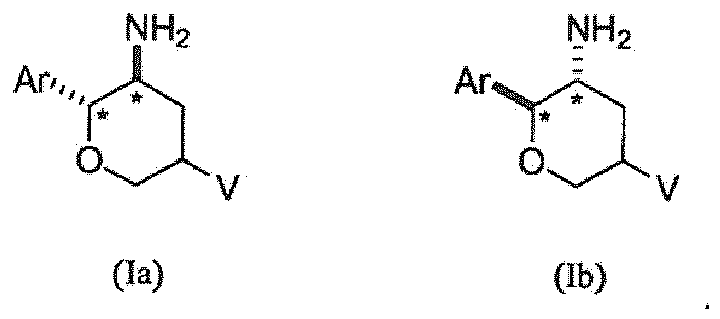
- Composé selon la revendication 9 de la formule développée Ia ayant la configuration stéréochimique absolue indiquée aux deux atomes de carbone stéréogéniques marqués d'un *:

- Composé selon la revendication 9 de la formule développée Ic et Id ayant la configuration stéréochimique indiquée aux trois atomes de carbone stéréogéniques marqués d'un *:

- Composé selon la revendication 11 de la formule développée Ic ayant la configuration stéréochimique absolue indiquée aux trois atomes de carbone stéréogéniques marqués d'un *:

- Composé selon la revendication 12, dans lequel V est sélectionné parmi le groupe consistant en:

- Composé selon la revendication 13, dans lequel R2 est un hydrogène et R8 est - SO2alkyle C1-6 ou -SO2cycloalkyle C3-6, où l'alkyle et le cycloalkyle sont optionnellement substitués par un à cinq fluors.
- Composé selon la revendication 1, dans lequel chaque R2 est sélectionné indépendamment parmi le groupe consistant en:hydrogène;alkyle C1-6, où l'alkyle est optionnellement substitué par un à cinq fluors; etcycloalkyle C3-6, où le cycloalkyle est optionnellement substitué par un à trois substituants sélectionnés indépendamment parmi halogène, hydroxy, alkyle C1-4 et alcoxy C1-4, où l'alkyle et l'alcoxy sont optionnellement substitués par un à cinq fluors.
- Composé selon la revendication 15, dans lequel chaque R2 est un hydrogène.
- Composé selon la revendication 1, qui est sélectionné parmi le groupe consistant en:


- Composé selon la revendication 1, qui est:

- Composition pharmaceutique qui comprend un composé selon la revendication 1 et un véhicule pharmaceutiquement acceptable.
- Composé selon la revendication 1, à utiliser en thérapie.
- Composé selon la revendication 1, à utiliser dans le traitement de l'insulino-résistance, du diabète hyperglycémique ou de type 2.
- Utilisation d'un composé selon la revendication 1, dans la fabrication d'un médicament pour le traitement de l'insulino-résistance, du diabète hyperglycémique ou de type 2.
Priority Applications (6)
| Application Number | Priority Date | Filing Date | Title |
|---|---|---|---|
| EP20130180590 EP2676959A1 (fr) | 2008-11-13 | 2009-11-11 | Combinaison thérapeutique contenant des aminotetrahydropyrannes en tant qu'inhibiteurs de dipeptidyl peptidase-IV pour le traitement ou la prévention des diabètes |
| SI200930757T SI2358717T1 (sl) | 2008-11-13 | 2009-11-11 | Aminotetrahidropirani kot dipeptidil peptidazni-iv inhibitorji za zdravljenje ali prepreäśevanje sladkorne bolezni |
| EP13180592.1A EP2676960B1 (fr) | 2008-11-13 | 2009-11-11 | Combinaison thérapeutique contenant des aminotetrahydropyrannes en tant qu'inhibiteurs de dipeptidyl peptidase-IV pour le traitement ou la prévention des diabètes |
| PL09756204T PL2358717T3 (pl) | 2008-11-13 | 2009-11-11 | Aminotetrahydropirany jako inhibitory dipeptydylopeptydazy-IV do leczenia lub zapobiegania cukrzycy |
| EP13180593.9A EP2676961B1 (fr) | 2008-11-13 | 2009-11-11 | Combinaison thérapeutique contenant des aminotetrahydropyrannes en tant qu'inhibiteurs de dipeptidyl peptidase-IV pour le traitement ou la prévention des diabètes |
| CY20131100966T CY1114617T1 (el) | 2008-11-13 | 2013-10-31 | Αμινοτετραϋδροπυρανια ως αναστολεις διπεπτιδυλο πεπτιδασης-iv για την αγωγη ή προληψη διαβητη |
Applications Claiming Priority (2)
| Application Number | Priority Date | Filing Date | Title |
|---|---|---|---|
| US19917908P | 2008-11-13 | 2008-11-13 | |
| PCT/US2009/063976 WO2010056708A1 (fr) | 2008-11-13 | 2009-11-11 | Aminotétrahydropyranes en tant qu’inhibiteurs de dipeptidyle peptidase-iv pour le traitement ou la prévention du diabète |
Related Child Applications (2)
| Application Number | Title | Priority Date | Filing Date |
|---|---|---|---|
| EP13180592.1A Division EP2676960B1 (fr) | 2008-11-13 | 2009-11-11 | Combinaison thérapeutique contenant des aminotetrahydropyrannes en tant qu'inhibiteurs de dipeptidyl peptidase-IV pour le traitement ou la prévention des diabètes |
| EP13180593.9A Division EP2676961B1 (fr) | 2008-11-13 | 2009-11-11 | Combinaison thérapeutique contenant des aminotetrahydropyrannes en tant qu'inhibiteurs de dipeptidyl peptidase-IV pour le traitement ou la prévention des diabètes |
Publications (2)
| Publication Number | Publication Date |
|---|---|
| EP2358717A1 EP2358717A1 (fr) | 2011-08-24 |
| EP2358717B1 true EP2358717B1 (fr) | 2013-08-21 |
Family
ID=41559521
Family Applications (4)
| Application Number | Title | Priority Date | Filing Date |
|---|---|---|---|
| EP13180593.9A Active EP2676961B1 (fr) | 2008-11-13 | 2009-11-11 | Combinaison thérapeutique contenant des aminotetrahydropyrannes en tant qu'inhibiteurs de dipeptidyl peptidase-IV pour le traitement ou la prévention des diabètes |
| EP20130180590 Withdrawn EP2676959A1 (fr) | 2008-11-13 | 2009-11-11 | Combinaison thérapeutique contenant des aminotetrahydropyrannes en tant qu'inhibiteurs de dipeptidyl peptidase-IV pour le traitement ou la prévention des diabètes |
| EP13180592.1A Active EP2676960B1 (fr) | 2008-11-13 | 2009-11-11 | Combinaison thérapeutique contenant des aminotetrahydropyrannes en tant qu'inhibiteurs de dipeptidyl peptidase-IV pour le traitement ou la prévention des diabètes |
| EP20090756204 Active EP2358717B1 (fr) | 2008-11-13 | 2009-11-11 | Aminotetrahydropyranes en tant qu'inhibiteurs de dipeptidyle peptidase-iv pour le traitement ou la prevention du diabete |
Family Applications Before (3)
| Application Number | Title | Priority Date | Filing Date |
|---|---|---|---|
| EP13180593.9A Active EP2676961B1 (fr) | 2008-11-13 | 2009-11-11 | Combinaison thérapeutique contenant des aminotetrahydropyrannes en tant qu'inhibiteurs de dipeptidyl peptidase-IV pour le traitement ou la prévention des diabètes |
| EP20130180590 Withdrawn EP2676959A1 (fr) | 2008-11-13 | 2009-11-11 | Combinaison thérapeutique contenant des aminotetrahydropyrannes en tant qu'inhibiteurs de dipeptidyl peptidase-IV pour le traitement ou la prévention des diabètes |
| EP13180592.1A Active EP2676960B1 (fr) | 2008-11-13 | 2009-11-11 | Combinaison thérapeutique contenant des aminotetrahydropyrannes en tant qu'inhibiteurs de dipeptidyl peptidase-IV pour le traitement ou la prévention des diabètes |
Country Status (39)
| Country | Link |
|---|---|
| US (8) | US8143289B2 (fr) |
| EP (4) | EP2676961B1 (fr) |
| JP (2) | JP4854825B1 (fr) |
| KR (2) | KR101260162B1 (fr) |
| CN (1) | CN102272136B (fr) |
| AR (1) | AR074306A1 (fr) |
| AU (1) | AU2009314191B2 (fr) |
| BR (1) | BRPI0921375B8 (fr) |
| CA (1) | CA2742783C (fr) |
| CL (1) | CL2011001082A1 (fr) |
| CO (1) | CO6382129A2 (fr) |
| CR (1) | CR20110257A (fr) |
| CY (1) | CY1114617T1 (fr) |
| DK (1) | DK2358717T3 (fr) |
| DO (1) | DOP2011000128A (fr) |
| EA (1) | EA018613B1 (fr) |
| EC (1) | ECSP11011044A (fr) |
| ES (1) | ES2432191T3 (fr) |
| GE (1) | GEP20135724B (fr) |
| HN (1) | HN2011001256A (fr) |
| HR (1) | HRP20130924T1 (fr) |
| IL (2) | IL212485A (fr) |
| JO (1) | JO2870B1 (fr) |
| MA (1) | MA32887B1 (fr) |
| MX (1) | MX2011005044A (fr) |
| MY (1) | MY150787A (fr) |
| NI (1) | NI201100081A (fr) |
| NZ (1) | NZ592826A (fr) |
| PA (1) | PA8848201A1 (fr) |
| PE (1) | PE20120027A1 (fr) |
| PL (1) | PL2358717T3 (fr) |
| PT (1) | PT2358717E (fr) |
| RS (1) | RS52946B (fr) |
| SI (1) | SI2358717T1 (fr) |
| SV (1) | SV2011003903A (fr) |
| TN (1) | TN2011000201A1 (fr) |
| TW (1) | TWI398443B (fr) |
| UA (1) | UA101414C2 (fr) |
| WO (1) | WO2010056708A1 (fr) |
Cited By (1)
| Publication number | Priority date | Publication date | Assignee | Title |
|---|---|---|---|---|
| US10377732B2 (en) | 2015-12-03 | 2019-08-13 | F.I.S.—Fabbrica Italiana Sintetici S.p.A. | Process for preparing aminotetrahydropyrans |
Families Citing this family (57)
| Publication number | Priority date | Publication date | Assignee | Title |
|---|---|---|---|---|
| BRPI0915720A2 (pt) | 2008-06-12 | 2015-08-04 | Janssen Pharmaceutica Nv | Moduladores de diaminopiridina, pirimidina, e piridazina do receptor de histamina h4 |
| JO2870B1 (en) | 2008-11-13 | 2015-03-15 | ميرك شارب اند دوهم كورب | Amino Tetra Hydro Pirans as Inhibitors of Peptide Dipeptide IV for the Treatment or Prevention of Diabetes |
| CA2771352A1 (fr) | 2009-09-02 | 2011-03-10 | Merck Sharp & Dohme Corp. | Aminotetrahydropanes utilises comme inhibiteurs de la dipeptyl peptidase-iv pour traiter ou prevenir le diabete |
| WO2011037793A1 (fr) | 2009-09-25 | 2011-03-31 | Merck Sharp & Dohme Corp. | Aminopipéridines substituées utilisées en tant qu'inhibiteurs de la dipeptidyl peptidase-iv dans le cadre du traitement du diabète |
| US8853212B2 (en) | 2010-02-22 | 2014-10-07 | Merck Sharp & Dohme Corp | Substituted aminotetrahydrothiopyrans and derivatives thereof as dipeptidyl peptidase-IV inhibitors for the treatment of diabetes |
| WO2011146358A1 (fr) | 2010-05-21 | 2011-11-24 | Merck Sharp & Dohme Corp. | Composés hétérocycliques substitués à sept chaînons en tant qu'inhibiteurs de la dipeptidyl-peptidase iv pour le traitement du diabète |
| WO2012078448A1 (fr) | 2010-12-06 | 2012-06-14 | Schering Corporation | Hétérocycles tricycliques utiles comme inhibiteurs de la dipeptidyl peptidase iv |
| JP2014521594A (ja) * | 2011-05-25 | 2014-08-28 | アミリン・ファーマシューティカルズ,リミテッド・ライアビリティ・カンパニー | 長持続期間デュアルホルモンコンジュゲート |
| CA2838738A1 (fr) * | 2011-06-29 | 2013-01-03 | Merck Sharp & Dohme Corp. | Nouvelles formes cristallines d'un inhibiteur de peptidase-iv |
| EP2729468A4 (fr) | 2011-07-05 | 2015-03-18 | Merck Sharp & Dohme | Hétérocycles tricycliques utiles comme inhibiteurs de la dipeptidyl peptidase-iv |
| WO2013122920A1 (fr) | 2012-02-17 | 2013-08-22 | Merck Sharp & Dohme Corp. | Inhibiteurs de dipeptidyle peptidase-iv pour le traitement ou la prévention du diabète |
| EP2874622A4 (fr) | 2012-07-23 | 2015-12-30 | Merck Sharp & Dohme | Traitement du diabète par administration d'inhibiteurs de dipeptidyl peptidase-iv |
| US9156848B2 (en) | 2012-07-23 | 2015-10-13 | Merck Sharp & Dohme Corp. | Treating diabetes with dipeptidyl peptidase-IV inhibitors |
| TWI500613B (zh) | 2012-10-17 | 2015-09-21 | Cadila Healthcare Ltd | 新穎之雜環化合物 |
| EP3038465B1 (fr) * | 2013-08-30 | 2021-10-06 | Merck Sharp & Dohme Corp. | Formulation pharmaceutique orale d'omarigliptine |
| ES2587585T3 (es) | 2014-03-20 | 2016-10-25 | F.I.S.- Fabbrica Italiana Sintetici S.P.A. | Procedimiento para la preparación de intermedios clave de omarigliptina |
| CN105037367A (zh) * | 2014-04-18 | 2015-11-11 | 四川海思科制药有限公司 | 氨基六元环类衍生物及其在医药上的应用 |
| CN105085528A (zh) * | 2014-05-15 | 2015-11-25 | 成都贝斯凯瑞生物科技有限公司 | 作为二肽基肽酶-iv抑制剂的氨基四氢吡喃衍生物 |
| CN105085530B (zh) * | 2014-05-23 | 2019-01-04 | 四川海思科制药有限公司 | 三元稠合环取代的氨基六元环类衍生物及其在医药上的应用 |
| MY181641A (en) * | 2014-06-17 | 2020-12-30 | Sichuan Haisco Pharmaceutical Co Ltd | Amino pyran ring derivative and composition and use thereof |
| CN105294694B (zh) * | 2014-06-18 | 2019-01-04 | 四川海思科制药有限公司 | 氨基六元环类衍生物及其在医药上的应用 |
| US9862725B2 (en) | 2014-07-21 | 2018-01-09 | Merck Sharp & Dohme Corp. | Process for preparing chiral dipeptidyl peptidase-IV inhibitors |
| CN105985357A (zh) * | 2015-02-12 | 2016-10-05 | 北京赛林泰医药技术有限公司 | 取代的氨基六元饱和杂脂环类长效dpp-iv抑制剂 |
| CN107250135B (zh) * | 2015-08-24 | 2020-05-26 | 四川科伦博泰生物医药股份有限公司 | 长效二肽基肽酶-ⅳ抑制剂、用途及其中间体的制备方法 |
| CN106478631B (zh) * | 2015-08-24 | 2019-04-05 | 四川科伦药物研究院有限公司 | 长效二肽基肽酶-iv抑制剂、用途及其中间体的制备方法 |
| WO2017032705A1 (fr) | 2015-08-25 | 2017-03-02 | Sandoz Ag | Forme cristalline d'omarigliptine |
| TWI681962B (zh) * | 2015-08-26 | 2020-01-11 | 大陸商四川海思科製藥有限公司 | 胺基六員環類衍生物及其在醫藥上的應用 |
| TWI640524B (zh) * | 2015-08-27 | 2018-11-11 | 四川海思科製藥有限公司 | Aminopyran ring derivatives and compositions and uses thereof |
| CN105198847B (zh) * | 2015-10-28 | 2017-05-17 | 四川凯科医药科技有限公司 | 一种化合物的制备方法 |
| CN105399744B (zh) * | 2015-12-17 | 2017-07-18 | 黄燕鸽 | 一种奥格列汀的合成方法 |
| EP3181565A1 (fr) | 2015-12-18 | 2017-06-21 | Sandoz Ag | Sels cristallins d'omarigliptin |
| CN106916158A (zh) * | 2015-12-25 | 2017-07-04 | 四川海思科制药有限公司 | 一种吡喃衍生物盐酸盐水合物及其中间体的制备方法 |
| CN106916157A (zh) * | 2015-12-25 | 2017-07-04 | 四川海思科制药有限公司 | 取代的氨基吡喃衍生物的晶型 |
| CN106928228B (zh) * | 2015-12-29 | 2019-08-30 | 杭州普晒医药科技有限公司 | 奥格列汀盐及其晶型、它们的制备方法和药物组合物 |
| CN107337674B (zh) * | 2016-04-29 | 2019-09-20 | 江苏吉贝尔药业股份有限公司 | 用于dpp-iv抑制剂的四氢吡喃胺衍生物、其药物组合物和制剂以及用途 |
| CN109071551B (zh) * | 2016-05-25 | 2020-12-08 | 四川海思科制药有限公司 | 一种三氟甲基取代的吡喃衍生物的制备方法 |
| WO2017202365A1 (fr) * | 2016-05-25 | 2017-11-30 | 四川海思科制药有限公司 | Procédé de préparation d'un dérivé de pyranne substitué par un trifluorométhyle |
| CN107652291B (zh) * | 2016-07-26 | 2020-07-14 | 中国科学院上海药物研究所 | 一种制备手性四氢吡喃衍生物的方法 |
| WO2018028666A1 (fr) * | 2016-08-12 | 2018-02-15 | 正大天晴药业集团股份有限公司 | Cristal d'inhibiteur de dpp-iv à action prolongée et son sel |
| CN106674227B (zh) * | 2016-12-06 | 2019-03-19 | 上海博志研新药物技术有限公司 | 一种奥格列汀及其中间体的制备方法 |
| EP3335702A1 (fr) | 2016-12-16 | 2018-06-20 | Hexal AG | Compositions pharmaceutiques comprenant de l'omarigliptine |
| EP3335701A1 (fr) | 2016-12-16 | 2018-06-20 | Hexal AG | Composition pharmaceutique contenant de l'omarigliptine |
| EP3335703A1 (fr) | 2016-12-16 | 2018-06-20 | Hexal AG | Composition pharmaceutique contenant de l'omarigliptine |
| EP3335704A1 (fr) | 2016-12-16 | 2018-06-20 | Hexal AG | Composition pharmaceutique comprenant de l'omarigliptine |
| CN107024590A (zh) * | 2017-03-13 | 2017-08-08 | 新疆医科大学 | 一种诊断1型和2型糖尿病的血清蛋白标志物组 |
| WO2018167589A1 (fr) | 2017-03-16 | 2018-09-20 | Inventia Healthcare Private Limited | Composition pharmaceutique comprenant de la dapagliflozine |
| ES2747768T3 (es) | 2017-03-20 | 2020-03-11 | Forma Therapeutics Inc | Composiciones de pirrolopirrol como activadores de quinasa de piruvato (PKR) |
| CN109796455B (zh) * | 2017-11-17 | 2021-02-26 | 四川海思科制药有限公司 | 一种氨基吡喃衍生物的盐、其晶型及其制备方法和用途 |
| CN116919952A (zh) * | 2018-02-06 | 2023-10-24 | 四川海思科制药有限公司 | 一种氨基吡喃衍生物的组合物 |
| ES2989438T3 (es) | 2018-09-19 | 2024-11-26 | Novo Nordisk Healthcare Ag | Activación de la piruvato cinasa R |
| US12053458B2 (en) | 2018-09-19 | 2024-08-06 | Novo Nordisk Health Care Ag | Treating sickle cell disease with a pyruvate kinase R activating compound |
| US12421269B2 (en) | 2019-07-26 | 2025-09-23 | Cgenetech (Suzhou, China) Co., Ltd. | SGLT2/DPP4 inhibitor and application thereof |
| CN110568100B (zh) * | 2019-09-12 | 2022-05-31 | 江西金水宝制药有限公司 | 一种米格列奈钙r-异构体的检测方法 |
| US20220378756A1 (en) | 2019-09-19 | 2022-12-01 | Forma Therapeutics, Inc. | Activating pyruvate kinase r |
| CN111793071B (zh) * | 2020-07-06 | 2021-06-04 | 四川凯科医药科技有限公司 | 奥格列汀的合成工艺 |
| US12128035B2 (en) | 2021-03-19 | 2024-10-29 | Novo Nordisk Health Care Ag | Activating pyruvate kinase R |
| CN119504764B (zh) * | 2024-11-26 | 2025-09-23 | 斯坦德药典标准物质研发(湖北)有限公司 | 一种Omarigliptin的制备方法 |
Family Cites Families (70)
| Publication number | Priority date | Publication date | Assignee | Title |
|---|---|---|---|---|
| US4166452A (en) | 1976-05-03 | 1979-09-04 | Generales Constantine D J Jr | Apparatus for testing human responses to stimuli |
| US4256108A (en) | 1977-04-07 | 1981-03-17 | Alza Corporation | Microporous-semipermeable laminated osmotic system |
| US4265874A (en) | 1980-04-25 | 1981-05-05 | Alza Corporation | Method of delivering drug with aid of effervescent activity generated in environment of use |
| US5232929A (en) | 1990-11-28 | 1993-08-03 | Pfizer Inc. | 3-aminopiperidine derivatives and related nitrogen containing heterocycles and pharmaceutical compositions and use |
| US5545618A (en) | 1990-01-24 | 1996-08-13 | Buckley; Douglas I. | GLP-1 analogs useful for diabetes treatment |
| IL111785A0 (en) | 1993-12-03 | 1995-01-24 | Ferring Bv | Dp-iv inhibitors and pharmaceutical compositions containing them |
| DE19616486C5 (de) | 1996-04-25 | 2016-06-30 | Royalty Pharma Collection Trust | Verfahren zur Senkung des Blutglukosespiegels in Säugern |
| AR008789A1 (es) | 1996-07-31 | 2000-02-23 | Bayer Corp | Piridinas y bifenilos substituidos |
| UA65549C2 (uk) | 1996-11-05 | 2004-04-15 | Елі Ліллі Енд Компані | Спосіб регулювання ожиріння шляхом периферійного введення аналогів та похідних glp-1 (варіанти) та фармацевтична композиція |
| TW492957B (en) | 1996-11-07 | 2002-07-01 | Novartis Ag | N-substituted 2-cyanopyrrolidnes |
| US6054587A (en) | 1997-03-07 | 2000-04-25 | Metabasis Therapeutics, Inc. | Indole and azaindole inhibitors of fructose-1,6-bisphosphatase |
| AU6452098A (en) | 1997-03-07 | 1998-09-22 | Metabasis Therapeutics, Inc. | Novel purine inhibitors of fructose-1,6-bisphosphatase |
| DE69819311T2 (de) | 1997-03-07 | 2004-07-29 | Metabasis Therapeutics Inc., San Diego | Neue benzimidazol inhibitoren der fructose-1,6-bisphosphatase |
| AU749271B2 (en) | 1997-07-01 | 2002-06-20 | Agouron Pharmaceuticals, Inc. | Glucagon antagonists/inverse agonists |
| US6613942B1 (en) | 1997-07-01 | 2003-09-02 | Novo Nordisk A/S | Glucagon antagonists/inverse agonists |
| PA8469501A1 (es) * | 1998-04-10 | 2000-09-29 | Pfizer Prod Inc | Hidroxamidas del acido (4-arilsulfonilamino)-tetrahidropiran-4-carboxilico |
| CA2331122A1 (fr) | 1998-05-04 | 1999-11-11 | Point Therapeutics, Inc. | Stimulation hematopoietique |
| ATE246197T1 (de) | 1998-09-09 | 2003-08-15 | Metabasis Therapeutics Inc | Neue heteroaromatische fructose 1,6- bisphosphatase inhibitoren |
| CO5150173A1 (es) | 1998-12-10 | 2002-04-29 | Novartis Ag | Compuestos n-(glicilo sustituido)-2-cianopirrolidinas inhibidores de peptidasa de dipeptidilo-iv (dpp-iv) los cuales son efectivos en el tratamiento de condiciones mediadas por la inhibicion de dpp-iv |
| GB9906715D0 (en) | 1999-03-23 | 1999-05-19 | Ferring Bv | Compositions for promoting growth |
| WO2000069810A1 (fr) | 1999-05-17 | 2000-11-23 | Novo Nordisk A/S | Antagonistes/agonistes inverses de glucagon |
| WO2002008188A1 (fr) | 2000-07-25 | 2002-01-31 | Merck & Co., Inc. | Indoles n-substitues utiles pour le traitement du diabete |
| KR20030096227A (ko) | 2000-10-27 | 2003-12-24 | 프로비오드룩 아게 | 신경 및 신경정신 질환의 치료방법 |
| WO2002060388A2 (fr) | 2001-01-30 | 2002-08-08 | Merck & Co., Inc. | Acyl-sulfamides pour le traitement de l'obesite, du diabete et des troubles lipidiques |
| DE60221983T2 (de) | 2001-06-27 | 2008-05-15 | Smithkline Beecham Corp. | Fluorpyrrolidine als dipeptidyl-peptidase inhibitoren |
| UA74912C2 (en) | 2001-07-06 | 2006-02-15 | Merck & Co Inc | Beta-aminotetrahydroimidazo-(1,2-a)-pyrazines and tetratriazolo-(4,3-a)-pyrazines as inhibitors of dipeptylpeptidase for the treatment or prevention of diabetes |
| GB0121709D0 (en) | 2001-09-07 | 2001-10-31 | Imp College Innovations Ltd | Food inhibition agent |
| AR040241A1 (es) | 2002-06-10 | 2005-03-23 | Merck & Co Inc | Inhibidores de la 11-beta-hidroxiesteroide deshidrogrenasa 1 para el tratamiento de la diabetes obesidad y dislipidemia |
| WO2004020408A1 (fr) | 2002-08-29 | 2004-03-11 | Merck & Co., Inc. | Indoles a activite antidiabetique |
| WO2004019869A2 (fr) | 2002-08-29 | 2004-03-11 | Merck & Co., Inc. | Indoles presentant un effet antidiabetique |
| WO2004037159A2 (fr) | 2002-10-23 | 2004-05-06 | Obetherapy Biotechnology | Composes, compositions et methodes permettant de moduler le metabolisme des graisses |
| US7192922B2 (en) | 2002-11-19 | 2007-03-20 | Allegheny-Singer Research Institute | Method of treating left ventricular dysfunction |
| JO2397B1 (en) | 2002-12-20 | 2007-06-17 | ميرك شارب اند دوم كوربوريشن | Terazol derivatives as beta-hydroxy steroid dihydrogenase-1 inhibitors |
| JP2007504285A (ja) | 2003-01-17 | 2007-03-01 | メルク エンド カムパニー インコーポレーテッド | N−シクロヘキシルアミノカルボニルベンゼンスルホンアミド誘導体 |
| WO2004091499A2 (fr) | 2003-04-09 | 2004-10-28 | Neose Technologies, Inc. | Formation intracellulaire de conjugues de peptides |
| US7145012B2 (en) * | 2003-04-23 | 2006-12-05 | Pfizer Inc. | Cannabinoid receptor ligands and uses thereof |
| US20040214856A1 (en) * | 2003-04-23 | 2004-10-28 | Pfizer Inc | Cannabinoid receptor ligands and uses thereof |
| WO2005030751A2 (fr) * | 2003-09-08 | 2005-04-07 | Takeda Pharmaceutical Company Limited | Inhibiteurs de dipeptidyle peptidase |
| WO2005061523A1 (fr) | 2003-12-23 | 2005-07-07 | Progen Industries Limited | Composes mimetiques du glycosaminoglycane (gag) |
| AU2005265148B2 (en) * | 2004-06-21 | 2011-01-20 | Merck Sharp & Dohme Corp. | Aminocyclohexanes as dipeptidyl peptidase-IV inhibitors for the treatment or prevention of diabetes |
| WO2006020372A2 (fr) | 2004-07-23 | 2006-02-23 | Neose Technologies, Inc. | Modification enzymatique de glycopeptides |
| US7718667B2 (en) * | 2004-09-28 | 2010-05-18 | Merck Sharp & Dohme Corp. | Fused aminopiperidines as dipeptidyl peptidase-IV inhibitors for the treatment or prevention of diabetes |
| AU2005292134B2 (en) | 2004-10-01 | 2010-12-23 | Merck Sharp & Dohme Corp. | Aminopiperidines as dipeptidyl peptidase-IV inhibitors for the treatment or prevention of diabetes |
| US20090253752A1 (en) | 2004-10-25 | 2009-10-08 | Bryan Burkey | Combination of dpp-iv inhibitor, ppar antidiabetic and metmorfin |
| JP4999698B2 (ja) | 2004-11-29 | 2012-08-15 | メルク・シャープ・エンド・ドーム・コーポレイション | 糖尿病の治療または予防用のジペプチジルペプチダーゼ−iv阻害剤としての縮合アミノピペリジン |
| CN101090888A (zh) | 2004-12-20 | 2007-12-19 | 霍夫曼-拉罗奇有限公司 | 4-氨基哌啶衍生物 |
| US7411093B2 (en) | 2004-12-20 | 2008-08-12 | Hoffman-La Roche Inc. | Aminocycloalkanes as DPP-IV inhibitors |
| EP1702916A1 (fr) | 2005-03-18 | 2006-09-20 | Santhera Pharmaceuticals (Schweiz) GmbH | Inhibiteurs de DPP-IV |
| TWI357902B (en) * | 2005-04-01 | 2012-02-11 | Lg Life Science Ltd | Dipeptidyl peptidase-iv inhibiting compounds, meth |
| JP5069678B2 (ja) | 2005-05-25 | 2012-11-07 | メルク・シャープ・エンド・ドーム・コーポレイション | 糖尿病の治療又は予防のためのジペプチジルペプチダーゼiv阻害剤としてのアミノシクロヘキサン |
| RU2485135C2 (ru) | 2005-06-13 | 2013-06-20 | Импиэриэл Инноувейшнс Лимитид | Соединения оксинтомодулина (варианты), фармацевтическая композиция на их основе, способы лечения и профилактики ожирения и сопутствующих заболеваний (варианты) и лекарственное средство (варианты) |
| CA2619111C (fr) | 2005-08-26 | 2013-04-09 | Merck & Co., Inc. | Aminopiperidines fusionnees utilisees comme inhibiteurs de dipeptidyl-peptidase-iv pour le traitement ou la prevention du diabete |
| US7943615B2 (en) | 2005-12-14 | 2011-05-17 | Merck Sharp & Dohme Corp. | Fused aminopiperidines as dipeptidyl peptidase-4 inhibitors for the treatment or prevention of diabetes |
| CA2636757A1 (fr) * | 2006-01-25 | 2007-08-02 | Tesfaye Biftu | Aminocyclohexanes utiles en tant qu'inhibiteurs de la dipeptidyl peptidase-iv pour traiter ou prevenir le diabete |
| WO2007097931A2 (fr) | 2006-02-15 | 2007-08-30 | Merck & Co., Inc. | Aminotétrahydropyrannes en tant qu'inhibiteurs de dipeptidylpeptidase-iv dans le traitement prophylactique ou thérapeutique du diabète |
| CN101389648B (zh) | 2006-02-22 | 2013-07-17 | 默沙东公司 | 肽胃泌酸调节素衍生物 |
| KR20090005329A (ko) | 2006-03-20 | 2009-01-13 | 머크 앤드 캄파니 인코포레이티드 | 뉴로메딘 u 수용체 효능제 및 이의 용도 |
| TW200806669A (en) * | 2006-03-28 | 2008-02-01 | Merck & Co Inc | Aminotetrahydropyrans as dipeptidyl peptidase-IV inhibitors for the treatment or prevention of diabetes |
| AU2007254357B2 (en) | 2006-05-16 | 2011-07-21 | Merck Sharp & Dohme Corp. | Aminotetrahydropyrans as dipeptidyl peptidase-IV inhibitors for the treatment or prevention of diabetes |
| AU2007275294A1 (en) | 2006-07-18 | 2008-01-24 | Centocor, Inc. | Human GLP-1 mimetibodies, compositions, methods and uses |
| CA2668662A1 (fr) * | 2006-11-14 | 2008-05-22 | Merck & Co., Inc. | Composes heteroaromatiques tricycliques en tant qu'inhibiteurs de la dipeptidyle peptidase-iv pour le traitement ou la prevention de diabetes |
| AU2008216265B2 (en) | 2007-02-15 | 2014-04-03 | Indiana University Research And Technology Corporation | Glucagon/GLP-1 receptor co-agonists |
| AU2008267724A1 (en) | 2007-06-28 | 2008-12-31 | Merck Frosst Canada Ltd | Substituted fused pyrimidines as antagonists of GPR105 activity |
| EP2178537A4 (fr) | 2007-07-19 | 2011-08-17 | Merck Sharp & Dohme | Dérivés de bêta-carboline en tant que composés antidiabétiques |
| WO2009014676A1 (fr) * | 2007-07-23 | 2009-01-29 | Merck & Co., Inc. | Nouvelle forme cristalline d'un sel de dichlorhydrate d'un inhibiteur de la dipeptidyle peptidase iv |
| CA2696211C (fr) | 2007-08-21 | 2015-05-26 | Merck Sharp & Dohme Corp. | Composes heterocycliques en tant qu'inhibiteurs de dipeptidylpeptidase-iv pour le traitement ou la prevention des diabetes |
| WO2009042053A2 (fr) | 2007-09-21 | 2009-04-02 | Merck & Co., Inc. | Agonistes du récepteur de la neuromédine u et leurs utilisations |
| US7902376B2 (en) * | 2008-01-23 | 2011-03-08 | Merck Sharp & Dohme Corp. | Process for preparing chiral dipeptidyl peptidase-IV inhibitor intermediates |
| CN102272135A (zh) | 2008-10-08 | 2011-12-07 | 百时美施贵宝公司 | 唑并吡咯酮黑色素浓集激素受体-1拮抗剂 |
| JO2870B1 (en) | 2008-11-13 | 2015-03-15 | ميرك شارب اند دوهم كورب | Amino Tetra Hydro Pirans as Inhibitors of Peptide Dipeptide IV for the Treatment or Prevention of Diabetes |
-
2009
- 2009-11-04 JO JO2009408A patent/JO2870B1/en active
- 2009-11-09 TW TW98137972A patent/TWI398443B/zh not_active IP Right Cessation
- 2009-11-09 AR ARP090104318 patent/AR074306A1/es unknown
- 2009-11-11 EA EA201170670A patent/EA018613B1/ru not_active IP Right Cessation
- 2009-11-11 SI SI200930757T patent/SI2358717T1/sl unknown
- 2009-11-11 PA PA8848201A patent/PA8848201A1/es unknown
- 2009-11-11 BR BRPI0921375A patent/BRPI0921375B8/pt active IP Right Grant
- 2009-11-11 EP EP13180593.9A patent/EP2676961B1/fr active Active
- 2009-11-11 MY MYPI20112075 patent/MY150787A/en unknown
- 2009-11-11 MX MX2011005044A patent/MX2011005044A/es active IP Right Grant
- 2009-11-11 KR KR1020117010775A patent/KR101260162B1/ko active Active
- 2009-11-11 WO PCT/US2009/063976 patent/WO2010056708A1/fr not_active Ceased
- 2009-11-11 JP JP2011536433A patent/JP4854825B1/ja active Active
- 2009-11-11 DK DK09756204T patent/DK2358717T3/da active
- 2009-11-11 PE PE2011001028A patent/PE20120027A1/es not_active Application Discontinuation
- 2009-11-11 EP EP20130180590 patent/EP2676959A1/fr not_active Withdrawn
- 2009-11-11 NZ NZ592826A patent/NZ592826A/en not_active IP Right Cessation
- 2009-11-11 PT PT09756204T patent/PT2358717E/pt unknown
- 2009-11-11 AU AU2009314191A patent/AU2009314191B2/en active Active
- 2009-11-11 CN CN200980154484.2A patent/CN102272136B/zh active Active
- 2009-11-11 KR KR20127021008A patent/KR101454093B1/ko active Active
- 2009-11-11 PL PL09756204T patent/PL2358717T3/pl unknown
- 2009-11-11 HR HRP20130924AT patent/HRP20130924T1/hr unknown
- 2009-11-11 ES ES09756204T patent/ES2432191T3/es active Active
- 2009-11-11 UA UAA201107305A patent/UA101414C2/uk unknown
- 2009-11-11 CA CA 2742783 patent/CA2742783C/fr active Active
- 2009-11-11 RS RSP20130426 patent/RS52946B/sr unknown
- 2009-11-11 EP EP13180592.1A patent/EP2676960B1/fr active Active
- 2009-11-11 GE GEAP200912261A patent/GEP20135724B/en unknown
- 2009-11-11 EP EP20090756204 patent/EP2358717B1/fr active Active
- 2009-11-12 US US12/616,831 patent/US8143289B2/en active Active
-
2011
- 2011-04-21 TN TN2011000201A patent/TN2011000201A1/fr unknown
- 2011-04-26 IL IL212485A patent/IL212485A/en not_active IP Right Cessation
- 2011-04-28 NI NI201100081A patent/NI201100081A/es unknown
- 2011-05-06 HN HN2011001256A patent/HN2011001256A/es unknown
- 2011-05-09 DO DO2011000128A patent/DOP2011000128A/es unknown
- 2011-05-11 EC ECSP11011044 patent/ECSP11011044A/es unknown
- 2011-05-12 SV SV2011003903A patent/SV2011003903A/es unknown
- 2011-05-12 CO CO11058568A patent/CO6382129A2/es active IP Right Grant
- 2011-05-12 CL CL2011001082A patent/CL2011001082A1/es unknown
- 2011-05-13 CR CR20110257A patent/CR20110257A/es unknown
- 2011-06-08 MA MA33925A patent/MA32887B1/fr unknown
- 2011-07-06 JP JP2011150098A patent/JP5537507B2/ja active Active
-
2012
- 2012-02-17 US US13/398,887 patent/US8415297B2/en active Active
-
2013
- 2013-02-07 US US13/761,407 patent/US8592371B2/en active Active
- 2013-03-13 IL IL225198A patent/IL225198A/en active IP Right Grant
- 2013-10-22 US US14/059,638 patent/US8772328B2/en active Active
- 2013-10-31 CY CY20131100966T patent/CY1114617T1/el unknown
-
2014
- 2014-06-02 US US14/293,031 patent/US8951965B2/en active Active
-
2015
- 2015-01-07 US US14/591,124 patent/US9138426B2/en active Active
- 2015-08-13 US US14/825,535 patent/US9278976B2/en active Active
-
2016
- 2016-01-26 US US15/006,220 patent/US9403790B2/en active Active
Cited By (1)
| Publication number | Priority date | Publication date | Assignee | Title |
|---|---|---|---|---|
| US10377732B2 (en) | 2015-12-03 | 2019-08-13 | F.I.S.—Fabbrica Italiana Sintetici S.p.A. | Process for preparing aminotetrahydropyrans |
Also Published As
Similar Documents
| Publication | Publication Date | Title |
|---|---|---|
| EP2358717B1 (fr) | Aminotetrahydropyranes en tant qu'inhibiteurs de dipeptidyle peptidase-iv pour le traitement ou la prevention du diabete | |
| EP2473047B1 (fr) | Aminotétrahydropyranes utilisés comme inhibiteurs de la dipeptyl peptidase-iv pour traiter ou prévenir le diabète | |
| EP2571876B1 (fr) | Composés hétérocycliques substitués à sept chaînons en tant qu'inhibiteurs de la dipeptidyl-peptidase iv pour le traitement du diabète | |
| EP2538783B1 (fr) | Aminotétrahydrothiopyranes substitués et dérivés de ceux-ci utilisés en tant qu'inhibiteurs de la dipeptidylpeptidase-iv dans le cadre du traitement du diabète | |
| HK1154849B (en) | Aminotetrahydropyrans as dipeptidyl peptidase-iv inhibitors for the treatment or prevention of diabetes | |
| HK1187343A (en) | Combination drugs comprising aminotetrahydropyrans as dipeptidyl peptidase-iv inhibitors for the treatment or prevention of diabetes | |
| HK1187344A (en) | Combination drugs comprising aminotetrahydropyrans as dipeptidyl peptidase-iv inhibitors for the treatment or prevention of diabetes | |
| HK1187342A (en) | Combination drugs comprising aminotetrahydropyrans as dipeptidyl peptidase-iv inhibitors for the treatment or prevention of diabetes |
Legal Events
| Date | Code | Title | Description |
|---|---|---|---|
| PUAI | Public reference made under article 153(3) epc to a published international application that has entered the european phase |
Free format text: ORIGINAL CODE: 0009012 |
|
| 17P | Request for examination filed |
Effective date: 20110614 |
|
| AK | Designated contracting states |
Kind code of ref document: A1 Designated state(s): AT BE BG CH CY CZ DE DK EE ES FI FR GB GR HR HU IE IS IT LI LT LU LV MC MK MT NL NO PL PT RO SE SI SK SM TR |
|
| AX | Request for extension of the european patent |
Extension state: AL BA RS |
|
| 17Q | First examination report despatched |
Effective date: 20120306 |
|
| REG | Reference to a national code |
Ref country code: HK Ref legal event code: DE Ref document number: 1154849 Country of ref document: HK |
|
| RAP1 | Party data changed (applicant data changed or rights of an application transferred) |
Owner name: MERCK SHARP & DOHME CORP. |
|
| GRAP | Despatch of communication of intention to grant a patent |
Free format text: ORIGINAL CODE: EPIDOSNIGR1 |
|
| GRAP | Despatch of communication of intention to grant a patent |
Free format text: ORIGINAL CODE: EPIDOSNIGR1 |
|
| GRAS | Grant fee paid |
Free format text: ORIGINAL CODE: EPIDOSNIGR3 |
|
| GRAA | (expected) grant |
Free format text: ORIGINAL CODE: 0009210 |
|
| AK | Designated contracting states |
Kind code of ref document: B1 Designated state(s): AT BE BG CH CY CZ DE DK EE ES FI FR GB GR HR HU IE IS IT LI LT LU LV MC MK MT NL NO PL PT RO SE SI SK SM TR |
|
| AX | Request for extension of the european patent |
Extension state: AL BA RS |
|
| REG | Reference to a national code |
Ref country code: GB Ref legal event code: FG4D |
|
| REG | Reference to a national code |
Ref country code: CH Ref legal event code: EP |
|
| REG | Reference to a national code |
Ref country code: CH Ref legal event code: NV Representative=s name: MARKS AND CLERK (LUXEMBOURG) LLP, CH |
|
| REG | Reference to a national code |
Ref country code: AT Ref legal event code: REF Ref document number: 628026 Country of ref document: AT Kind code of ref document: T Effective date: 20130915 |
|
| REG | Reference to a national code |
Ref country code: IE Ref legal event code: FG4D |
|
| REG | Reference to a national code |
Ref country code: HR Ref legal event code: TUEP Ref document number: P20130924 Country of ref document: HR |
|
| REG | Reference to a national code |
Ref country code: DE Ref legal event code: R096 Ref document number: 602009018192 Country of ref document: DE Effective date: 20131017 |
|
| REG | Reference to a national code |
Ref country code: HR Ref legal event code: T1PR Ref document number: P20130924 Country of ref document: HR |
|
| REG | Reference to a national code |
Ref country code: RO Ref legal event code: EPE |
|
| REG | Reference to a national code |
Ref country code: DK Ref legal event code: T3 Effective date: 20131112 |
|
| REG | Reference to a national code |
Ref country code: PT Ref legal event code: SC4A Free format text: AVAILABILITY OF NATIONAL TRANSLATION Effective date: 20131119 |
|
| REG | Reference to a national code |
Ref country code: HK Ref legal event code: GR Ref document number: 1154849 Country of ref document: HK |
|
| REG | Reference to a national code |
Ref country code: ES Ref legal event code: FG2A Ref document number: 2432191 Country of ref document: ES Kind code of ref document: T3 Effective date: 20131202 |
|
| REG | Reference to a national code |
Ref country code: SE Ref legal event code: TRGR |
|
| REG | Reference to a national code |
Ref country code: NL Ref legal event code: T3 |
|
| REG | Reference to a national code |
Ref country code: SK Ref legal event code: T3 Ref document number: E 15123 Country of ref document: SK |
|
| REG | Reference to a national code |
Ref country code: NO Ref legal event code: T2 Effective date: 20130821 |
|
| REG | Reference to a national code |
Ref country code: PL Ref legal event code: T3 |
|
| REG | Reference to a national code |
Ref country code: EE Ref legal event code: FG4A Ref document number: E008740 Country of ref document: EE Effective date: 20131106 |
|
| REG | Reference to a national code |
Ref country code: GR Ref legal event code: EP Ref document number: 20130402448 Country of ref document: GR Effective date: 20140102 |
|
| PLBE | No opposition filed within time limit |
Free format text: ORIGINAL CODE: 0009261 |
|
| STAA | Information on the status of an ep patent application or granted ep patent |
Free format text: STATUS: NO OPPOSITION FILED WITHIN TIME LIMIT |
|
| REG | Reference to a national code |
Ref country code: HU Ref legal event code: AG4A Ref document number: E019800 Country of ref document: HU |
|
| 26N | No opposition filed |
Effective date: 20140522 |
|
| PG25 | Lapsed in a contracting state [announced via postgrant information from national office to epo] |
Ref country code: MC Free format text: LAPSE BECAUSE OF FAILURE TO SUBMIT A TRANSLATION OF THE DESCRIPTION OR TO PAY THE FEE WITHIN THE PRESCRIBED TIME-LIMIT Effective date: 20130821 |
|
| REG | Reference to a national code |
Ref country code: DE Ref legal event code: R097 Ref document number: 602009018192 Country of ref document: DE Effective date: 20140522 |
|
| PG25 | Lapsed in a contracting state [announced via postgrant information from national office to epo] |
Ref country code: SM Free format text: LAPSE BECAUSE OF FAILURE TO SUBMIT A TRANSLATION OF THE DESCRIPTION OR TO PAY THE FEE WITHIN THE PRESCRIBED TIME-LIMIT Effective date: 20130821 |
|
| REG | Reference to a national code |
Ref country code: FR Ref legal event code: PLFP Year of fee payment: 7 |
|
| REG | Reference to a national code |
Ref country code: FR Ref legal event code: PLFP Year of fee payment: 8 |
|
| PGFP | Annual fee paid to national office [announced via postgrant information from national office to epo] |
Ref country code: CY Payment date: 20161025 Year of fee payment: 8 |
|
| REG | Reference to a national code |
Ref country code: FR Ref legal event code: PLFP Year of fee payment: 9 |
|
| REG | Reference to a national code |
Ref country code: HR Ref legal event code: ODRP Ref document number: P20130924 Country of ref document: HR Payment date: 20171109 Year of fee payment: 9 |
|
| PGFP | Annual fee paid to national office [announced via postgrant information from national office to epo] |
Ref country code: LU Payment date: 20171102 Year of fee payment: 9 |
|
| PGFP | Annual fee paid to national office [announced via postgrant information from national office to epo] |
Ref country code: DK Payment date: 20171026 Year of fee payment: 9 Ref country code: NO Payment date: 20171026 Year of fee payment: 9 Ref country code: FI Payment date: 20171026 Year of fee payment: 9 Ref country code: HU Payment date: 20171026 Year of fee payment: 9 Ref country code: EE Payment date: 20171103 Year of fee payment: 9 Ref country code: CZ Payment date: 20171026 Year of fee payment: 9 Ref country code: SK Payment date: 20171026 Year of fee payment: 9 Ref country code: RO Payment date: 20171017 Year of fee payment: 9 Ref country code: LT Payment date: 20171107 Year of fee payment: 9 |
|
| PGFP | Annual fee paid to national office [announced via postgrant information from national office to epo] |
Ref country code: AT Payment date: 20171027 Year of fee payment: 9 Ref country code: SI Payment date: 20171025 Year of fee payment: 9 Ref country code: SE Payment date: 20171108 Year of fee payment: 9 Ref country code: BE Payment date: 20171121 Year of fee payment: 9 Ref country code: HR Payment date: 20171109 Year of fee payment: 9 Ref country code: BG Payment date: 20170927 Year of fee payment: 9 Ref country code: IE Payment date: 20171026 Year of fee payment: 9 Ref country code: IS Payment date: 20171013 Year of fee payment: 9 Ref country code: PT Payment date: 20171026 Year of fee payment: 9 Ref country code: PL Payment date: 20171009 Year of fee payment: 9 Ref country code: LV Payment date: 20171030 Year of fee payment: 9 Ref country code: GR Payment date: 20171026 Year of fee payment: 9 |
|
| PGFP | Annual fee paid to national office [announced via postgrant information from national office to epo] |
Ref country code: MK Payment date: 20171030 Year of fee payment: 9 |
|
| PG25 | Lapsed in a contracting state [announced via postgrant information from national office to epo] |
Ref country code: CY Free format text: LAPSE BECAUSE OF NON-PAYMENT OF DUE FEES Effective date: 20171111 |
|
| PGFP | Annual fee paid to national office [announced via postgrant information from national office to epo] |
Ref country code: MT Payment date: 20170912 Year of fee payment: 9 |
|
| REG | Reference to a national code |
Ref country code: FR Ref legal event code: PLFP Year of fee payment: 10 |
|
| REG | Reference to a national code |
Ref country code: HR Ref legal event code: PBON Ref document number: P20130924 Country of ref document: HR Effective date: 20181111 |
|
| REG | Reference to a national code |
Ref country code: LT Ref legal event code: MM4D Effective date: 20181111 |
|
| REG | Reference to a national code |
Ref country code: EE Ref legal event code: MM4A Ref document number: E008740 Country of ref document: EE Effective date: 20181130 |
|
| REG | Reference to a national code |
Ref country code: DK Ref legal event code: EBP Effective date: 20181130 Ref country code: NO Ref legal event code: MMEP |
|
| REG | Reference to a national code |
Ref country code: SE Ref legal event code: EUG |
|
| REG | Reference to a national code |
Ref country code: AT Ref legal event code: MM01 Ref document number: 628026 Country of ref document: AT Kind code of ref document: T Effective date: 20181111 |
|
| PG25 | Lapsed in a contracting state [announced via postgrant information from national office to epo] |
Ref country code: FI Free format text: LAPSE BECAUSE OF NON-PAYMENT OF DUE FEES Effective date: 20181111 Ref country code: LU Free format text: LAPSE BECAUSE OF NON-PAYMENT OF DUE FEES Effective date: 20181111 Ref country code: NO Free format text: LAPSE BECAUSE OF NON-PAYMENT OF DUE FEES Effective date: 20181130 Ref country code: LT Free format text: LAPSE BECAUSE OF NON-PAYMENT OF DUE FEES Effective date: 20181111 Ref country code: PT Free format text: LAPSE BECAUSE OF NON-PAYMENT OF DUE FEES Effective date: 20190513 Ref country code: SE Free format text: LAPSE BECAUSE OF NON-PAYMENT OF DUE FEES Effective date: 20181112 Ref country code: CZ Free format text: LAPSE BECAUSE OF NON-PAYMENT OF DUE FEES Effective date: 20181111 |
|
| REG | Reference to a national code |
Ref country code: SK Ref legal event code: MM4A Ref document number: E 15123 Country of ref document: SK Effective date: 20181111 |
|
| REG | Reference to a national code |
Ref country code: BE Ref legal event code: MM Effective date: 20181130 |
|
| REG | Reference to a national code |
Ref country code: IE Ref legal event code: MM4A |
|
| PG25 | Lapsed in a contracting state [announced via postgrant information from national office to epo] |
Ref country code: HR Free format text: LAPSE BECAUSE OF NON-PAYMENT OF DUE FEES Effective date: 20181111 Ref country code: RO Free format text: LAPSE BECAUSE OF NON-PAYMENT OF DUE FEES Effective date: 20181111 Ref country code: SI Free format text: LAPSE BECAUSE OF NON-PAYMENT OF DUE FEES Effective date: 20181112 Ref country code: GR Free format text: LAPSE BECAUSE OF NON-PAYMENT OF DUE FEES Effective date: 20190605 Ref country code: LV Free format text: LAPSE BECAUSE OF NON-PAYMENT OF DUE FEES Effective date: 20181111 Ref country code: BG Free format text: LAPSE BECAUSE OF NON-PAYMENT OF DUE FEES Effective date: 20190531 Ref country code: IS Free format text: LAPSE BECAUSE OF FAILURE TO SUBMIT A TRANSLATION OF THE DESCRIPTION OR TO PAY THE FEE WITHIN THE PRESCRIBED TIME-LIMIT Effective date: 20190531 Ref country code: SK Free format text: LAPSE BECAUSE OF NON-PAYMENT OF DUE FEES Effective date: 20181111 Ref country code: HU Free format text: LAPSE BECAUSE OF NON-PAYMENT OF DUE FEES Effective date: 20181112 Ref country code: EE Free format text: LAPSE BECAUSE OF NON-PAYMENT OF DUE FEES Effective date: 20181130 |
|
| REG | Reference to a national code |
Ref country code: SI Ref legal event code: KO00 Effective date: 20190708 |
|
| PG25 | Lapsed in a contracting state [announced via postgrant information from national office to epo] |
Ref country code: DK Free format text: LAPSE BECAUSE OF NON-PAYMENT OF DUE FEES Effective date: 20181130 Ref country code: IE Free format text: LAPSE BECAUSE OF NON-PAYMENT OF DUE FEES Effective date: 20181111 Ref country code: AT Free format text: LAPSE BECAUSE OF NON-PAYMENT OF DUE FEES Effective date: 20181111 |
|
| PG25 | Lapsed in a contracting state [announced via postgrant information from national office to epo] |
Ref country code: BE Free format text: LAPSE BECAUSE OF NON-PAYMENT OF DUE FEES Effective date: 20181130 |
|
| PG25 | Lapsed in a contracting state [announced via postgrant information from national office to epo] |
Ref country code: PL Free format text: LAPSE BECAUSE OF NON-PAYMENT OF DUE FEES Effective date: 20181111 |
|
| PG25 | Lapsed in a contracting state [announced via postgrant information from national office to epo] |
Ref country code: MT Free format text: LAPSE BECAUSE OF NON-PAYMENT OF DUE FEES Effective date: 20181111 |
|
| REG | Reference to a national code |
Ref country code: DE Ref legal event code: R081 Ref document number: 602009018192 Country of ref document: DE Owner name: MERCK SHARP & DOHME LLC, RAHWAY, US Free format text: FORMER OWNER: MERCK SHARP & DOHME CORP., 07065 RAHWAY, N.J., US |
|
| REG | Reference to a national code |
Ref country code: NL Ref legal event code: PD Owner name: MERCK SHARP & DOHME LLC; US Free format text: DETAILS ASSIGNMENT: CHANGE OF OWNER(S), MERGE; FORMER OWNER NAME: MERCK SHARP & DOHME CORP. Effective date: 20220922 Ref country code: GB Ref legal event code: 732E Free format text: REGISTERED BETWEEN 20220908 AND 20220914 |
|
| REG | Reference to a national code |
Ref country code: ES Ref legal event code: PC2A Owner name: MERCK SHARP & DOHME LLC Effective date: 20230227 |
|
| P01 | Opt-out of the competence of the unified patent court (upc) registered |
Effective date: 20230522 |
|
| PGFP | Annual fee paid to national office [announced via postgrant information from national office to epo] |
Ref country code: NL Payment date: 20241014 Year of fee payment: 16 |
|
| PGFP | Annual fee paid to national office [announced via postgrant information from national office to epo] |
Ref country code: IT Payment date: 20241113 Year of fee payment: 16 Ref country code: ES Payment date: 20241212 Year of fee payment: 16 |
|
| PGFP | Annual fee paid to national office [announced via postgrant information from national office to epo] |
Ref country code: CH Payment date: 20241201 Year of fee payment: 16 |
|
| PGFP | Annual fee paid to national office [announced via postgrant information from national office to epo] |
Ref country code: TR Payment date: 20241015 Year of fee payment: 16 |
|
| PGFP | Annual fee paid to national office [announced via postgrant information from national office to epo] |
Ref country code: DE Payment date: 20251013 Year of fee payment: 17 |
|
| PGFP | Annual fee paid to national office [announced via postgrant information from national office to epo] |
Ref country code: GB Payment date: 20251009 Year of fee payment: 17 |
|
| PGFP | Annual fee paid to national office [announced via postgrant information from national office to epo] |
Ref country code: FR Payment date: 20251013 Year of fee payment: 17 |