EP2359860A2 - Polymermizellenzusammensetzung zur behandlung resistenter krebszellen - Google Patents
Polymermizellenzusammensetzung zur behandlung resistenter krebszellen Download PDFInfo
- Publication number
- EP2359860A2 EP2359860A2 EP09827766A EP09827766A EP2359860A2 EP 2359860 A2 EP2359860 A2 EP 2359860A2 EP 09827766 A EP09827766 A EP 09827766A EP 09827766 A EP09827766 A EP 09827766A EP 2359860 A2 EP2359860 A2 EP 2359860A2
- Authority
- EP
- European Patent Office
- Prior art keywords
- composition
- cyclosporin
- polymer micelle
- taxane
- treatment
- Prior art date
- Legal status (The legal status is an assumption and is not a legal conclusion. Google has not performed a legal analysis and makes no representation as to the accuracy of the status listed.)
- Granted
Links
Images

Classifications
-
- A—HUMAN NECESSITIES
- A61—MEDICAL OR VETERINARY SCIENCE; HYGIENE
- A61K—PREPARATIONS FOR MEDICAL, DENTAL OR TOILETRY PURPOSES
- A61K31/00—Medicinal preparations containing organic active ingredients
- A61K31/33—Heterocyclic compounds
- A61K31/335—Heterocyclic compounds having oxygen as the only ring hetero atom, e.g. fungichromin
-
- A—HUMAN NECESSITIES
- A61—MEDICAL OR VETERINARY SCIENCE; HYGIENE
- A61K—PREPARATIONS FOR MEDICAL, DENTAL OR TOILETRY PURPOSES
- A61K47/00—Medicinal preparations characterised by the non-active ingredients used, e.g. carriers or inert additives; Targeting or modifying agents chemically bound to the active ingredient
- A61K47/30—Macromolecular organic or inorganic compounds, e.g. inorganic polyphosphates
- A61K47/36—Polysaccharides; Derivatives thereof, e.g. gums, starch, alginate, dextrin, hyaluronic acid, chitosan, inulin, agar or pectin
- A61K47/40—Cyclodextrins; Derivatives thereof
-
- A—HUMAN NECESSITIES
- A61—MEDICAL OR VETERINARY SCIENCE; HYGIENE
- A61K—PREPARATIONS FOR MEDICAL, DENTAL OR TOILETRY PURPOSES
- A61K9/00—Medicinal preparations characterised by special physical form
- A61K9/10—Dispersions; Emulsions
- A61K9/107—Emulsions ; Emulsion preconcentrates; Micelles
- A61K9/1075—Microemulsions or submicron emulsions; Preconcentrates or solids thereof; Micelles, e.g. made of phospholipids or block copolymers
-
- A—HUMAN NECESSITIES
- A61—MEDICAL OR VETERINARY SCIENCE; HYGIENE
- A61K—PREPARATIONS FOR MEDICAL, DENTAL OR TOILETRY PURPOSES
- A61K9/00—Medicinal preparations characterised by special physical form
- A61K9/10—Dispersions; Emulsions
- A61K9/127—Synthetic bilayered vehicles, e.g. liposomes or liposomes with cholesterol as the only non-phosphatidyl surfactant
-
- A—HUMAN NECESSITIES
- A61—MEDICAL OR VETERINARY SCIENCE; HYGIENE
- A61P—SPECIFIC THERAPEUTIC ACTIVITY OF CHEMICAL COMPOUNDS OR MEDICINAL PREPARATIONS
- A61P35/00—Antineoplastic agents
-
- A—HUMAN NECESSITIES
- A61—MEDICAL OR VETERINARY SCIENCE; HYGIENE
- A61P—SPECIFIC THERAPEUTIC ACTIVITY OF CHEMICAL COMPOUNDS OR MEDICINAL PREPARATIONS
- A61P43/00—Drugs for specific purposes, not provided for in groups A61P1/00-A61P41/00
Definitions
- the present disclosure relates to a polymer micelle composition for treatment of resistant cancer and a method for preparing the same.
- Taxane anti-cancer agents are successfully used in the treatment of breast cancer, ovarian cancer, lung cancer, prostate cancer, or the like.
- the taxane anti-cancer agents paclitaxel and docetaxel are very poorly soluble in water, they need to be solubilized, for example, by a nonionic surfactant.
- the agents are commercially available as Taxol® or Taxotere®, which are solubilized by a nonionic surfactant such as Cremophor and polysorbate.
- Taxol® and Taxotere® show superior anti-cancer effects, they have side effects such as hypersensitive reactions caused by the use of the solubilizer. Thus, researches are ongoing about new agents with no side effect.
- Verapamil, ketoconazole, cyclosporin, etc. are known as typical P-glycoprotein inhibitors. These substances are studied as P-glycoprotein inhibitor for resolving the reduced oral bioavailability problem of the anti-cancer agent due to the overexpression of P-glycoprotein.
- Cyclosporin is a poorly soluble drug.
- a composition using Cremophor as a solubilizer is marketed under the brand name Sandimmune® as a formulation for intravenous injection and oral administration.
- an orally-administered microemulsion formulation is available under the brand name Neoral®.
- the cyclosporin formulation for intravenous injection includes Cremophor as the solubilizer.
- Cremophor is associated with the side effect due to hypersensitive reaction. For this reason, it is very difficult to apply a combination therapy of the taxane anti-cancer agent Taxol® or Taxotere® together with the cyclosporin formulation for intravenous injection Sandimmune® for treating resistant cancer.
- the drug when cyclosporin is administered non-specifically, e.g. via intravenous injection, the drug may be delivered to the systemic circulation, resulting in declined immunity of the cancer patient who already has weakened immunity.
- the present disclosure is directed to providing a polymer micelle composition for treatment of resistant cancer comprising an amphiphilic diblock copolymer and active ingredients, wherein said active ingredients are taxane and a P-glycoprotein inhibitor, the P-glycoprotein inhibitor being cyclosporine.
- the present disclosure is also directed to providing a method for preparing a polymer micelle composition for treatment of resistant cancer comprising an amphiphilic diblock copolymer and active ingredients, wherein said active ingredients are taxane and a P-glycoprotein inhibitor, the P-glycoprotein inhibitor being cyclosporine
- the present disclosure provides a polymer micelle composition for treatment of resistant cancer comprising an amphiphilic diblock copolymer and active ingredients, wherein said active ingredients are taxane and a P-glycoprotein inhibitor, the P-glycoprotein inhibitor being cyclosporine.
- the present disclosure provides a method for preparing the polymer micelle composition for treatment of resistant cancer.
- the polymer micelle composition disclosure for treatment of resistant cancer which comprises the amphiphilic diblock copolymer and, optionally, the polylactic acid alkali metal salt having at least one terminal carboxyl group, can be accumulated in cancer tissue at high concentrations because of the enhanced permeability and retention (EPR) effect. Since it comprises taxane as well as the P-glycoprotein inhibitor, it exhibits superior anti-cancer effects for the cancer cells exhibiting resistance due to overexpression of P-glycoprotein by a taxane anti-cancer agent in the cancer tissue. Furthermore, it does not cause hypersensitive reactions due to the use of a solubilizer. In addition, it can reduce the side effect caused by systemic circulation of cyclosporin by allowing cyclosporin to be predominantly distributed in the cancer tissue.
- EPR enhanced permeability and retention
- the present disclosure a polymer micelle composition for treatment of resistant cancer comprising an amphiphilic diblock copolymer and active ingredients, wherein said active ingredients are taxane and a P-glycoprotein inhibitor, the P-glycoprotein inhibitor being cyclosporine.
- the polymer micelle composition for treatment of resistant cancer may comprise taxane, cyclosporin and an amphiphilic diblock copolymer to solubilize the taxane and cyclosporin.
- the polymer micelle may be a nanoparticle.
- the micelle or nanoparticle may have a particle diameter of 10-200 nm.
- taxane and cyclosporin are both poorly soluble in water, special technique and composition for solubilization are required for administration to the human body.
- the organic solvent ethanol and the surfactant Cremophor or polysorbate are used to solubilize the drugs.
- the two surfactants may cause severe hypersensitive reaction when administered, for example, intravenously, caution and pretreatment are required.
- the present disclosure provides a composition with no side effect such as hypersensitive reaction even when taxane and cyclosporin are administered together intravenously.
- resistant cancer as used in the present disclosure collectively refers to a cancer that has developed resistance to an anti-cancer agent due to its use. More specifically, it refers to a cancer that has developed resistance due to overexpression of P-glycoprotein.
- the cancer includes all type of cancers, e.g. breast cancer, ovarian cancer, lung cancer, prostate cancer, etc., without any special restriction.
- nanoparticle refers to a particle having a nano-scale particle diameter. It may include a micelle-structured particle.
- mixed used to describe “mixed micelle”, “mixed nanoparticle”, “mixed micelle or nanoparticle”, or the kind of micelle in the present disclosure refers to a state wherein one drug is encapsulated in one micelle or nanoparticle, and a taxane-containing micelle and a cyclosporin-containing micelle are mixed.
- the mixed micelle or nanoparticle may be obtained by preparing a taxane-containing micelle and a cyclosporin-containing micelle or nanoparticle separately and then mixing them.
- complex used to describe “complex micelle”, “complex nanoparticle”, “complex micelle or nanoparticle”, or the kind of micelle in the present disclosure refers to a state wherein taxane and cyclosporin are encapsulated together in one micelle or nanoparticle.
- the complex micelle or nanoparticle may be obtained encapsulating the two drugs in a micelle or nanoparticle core at the same time.
- the polymer micelle composition according to the present disclosure includes both the mixed and complex polymer micelles encapsulating taxane and cyclosporin.
- the anti-cancer agent composition for treatment of resistant cancer may comprise the active ingredients taxane and cyclosporin encapsulated in a micelle formed from an amphiphilic diblock copolymer.
- the composition may be either a complex micelle form wherein taxane and cyclosporin are encapsulated together in one micelle formed from the amphiphilic diblock copolymer, or a mixed form wherein taxane and cyclosporin are encapsulated in different micelles.
- the composition may be a mixture of: a composition comprising taxane and cyclosporin together in one micelle; and a composition comprising a mixture of a taxane-containing polymer micelle and a cyclosporin-containing polymer micelle.
- the taxane may be paclitaxel, docetaxel, 7-epipaclitaxel, t-acetyl paclitaxel, 10-desacetyl paclitaxel, 10-desacetyl-7-epipaclitaxel, 7-xylosyl paclitaxel, 10-desacetyl-7-glutaryl paclitaxel, 7-N,N-dimethylglycyl paclitaxel, 7-L-alanyl paclitaxel or a mixture thereof.
- it may be paclitaxel or docetaxel.
- the taxane may be either amorphous or crystalline. Further, it may be either an anhydride or a hydrate. In another embodiment, the taxane may be an anhydride of paclitaxel or docetaxel.
- the cyclosporin serves to suppress overexpression of P-glycoprotein.
- Cyclosporin A, B, C or D may be used.
- the cyclosporin may be cyclosporin A.
- Cyclosporin A is a cyclic peptide consisting of 11 amino acids, and has various physiological activities including anti-bacterial, anti-parasitic, and immune-suppressing activities.
- cyclosporin A is widely used for tissue or organ transplantation and treatment of autoimmune diseases because of its immunosuppressing ability.
- the weight ratio of taxane to cyclosporin may be from 0.1 to 2.0, more specifically from 0.8 to 1.5. Within this weight ratio range, the effect of taxane as the anti-cancer agent and the effect of cyclosporin as the P-glycoprotein inhibitor may be optimized.
- the combined content of taxane and cyclosporin may be 0.1-20 wt%, specifically 0.2-10 wt%, based on the total weight of the composition. Since taxane and cyclosporin are encapsulated in the polymer micelle, the content of taxane and cyclosporin that can be encapsulated in the polymer micelle is limited. In an embodiment of the present disclosure, taxane may be included in an amount of 0.01-10 wt%, specifically 0.01-5 wt%, and cyclosporin may be included in an amount of 0.01-10 wt%, specifically 0.01-5 wt%, based on the total weight of the composition.
- the amphiphilic diblock copolymer may be an A-B type diblock copolymer comprising a hydrophilic block A and a hydrophobic block B.
- the hydrophilic block A may be polyethylene glycol
- the hydrophobic block B may be polylactic acid or a derivative thereof.
- the polyethylene glycol as the hydrophilic block A may be one or more selected from a group consisting of polyethylene glycol and methoxypolyethylene glycol, but without being limited thereto. Specifically, it may be methoxypolyethylene glycol.
- the polylactic acid or its derivative as the hydrophobic block B may be one or more selected from a group consisting of polylactic acid, polylactide, polyglycolide, polymandelic acid, polycaprolactone, polydioxan-2-one, polyamino acid, polyorthoester, polyanhydride and a copolymer thereof. Specifically, it may be polylactic acid, polylactide, polyglycolide, polymandelic acid, polycaprolactone or polydioxan-2-one.
- the polylactic acid or its derivative may be one or more selected from a group consisting of polylactic acid, polylactide, polycaprolactone, a copolymer of lactic acid and mandelic acid, a copolymer of lactic acid and glycolic acid, a copolymer of lactic acid and caprolactone, and a copolymer of lactic acid and 1,4-dioxan-2-one.
- the hydrophilic block A may have a number average molecular weight of 500-20,000 daltons, more specifically 1,000-10,000 daltons.
- the hydrophobic block B may have a number average molecular weight of 500-10,000 daltons.
- the content of the hydrophilic block A may be 40-70 wt%, more specifically 50-65 wt%, based on the total weight of the diblock copolymer. Within this range, the micelle of the amphiphilic diblock copolymer can be maintained stably.
- the amount of the amphiphilic diblock copolymer may be 80-99.9 wt%, more specifically 40-90 wt%, based on the total weight of the composition.
- the composition may comprise: 0.01-10 wt% of taxane; 0.01-10 wt% of cyclosporin; and 80-99.8 wt% of an amphiphilic diblock copolymer, based on the total weight of the composition.
- the composition may comprise: 0.01-10 wt% of taxane; 0.01-10 wt% of cyclosporin; 40-90 wt% of an amphiphilic diblock copolymer; and 10-50 wt% of a polylactic acid alkali metal salt having a terminal carboxyl group.
- the complex amphiphilic diblock copolymer micelle composition in which taxane and cyclosporin are encapsulated together may have a particle size of 10-200 nm in an aqueous solution, and may be in solid state when freeze dried.
- the polymer micelle composition for treatment of resistant cancer may further comprise a polylactic acid alkali metal salt having at least one terminal carboxyl group, in addition to the taxane, the cyclosporin and the amphiphilic diblock copolymer.
- the polylactic acid alkali metal salt keeps the inside of the micelle core in which the drug is incorporated strongly and thus improves the encapsulation efficiency.
- the present disclosure provides a polymer micelle composition for treatment of resistant cancer comprising taxane, cyclosporin, an amphiphilic diblock copolymer, and a polylactic acid alkali metal salt having at least one terminal carboxyl group.
- the polylactic acid alkali metal salt refers to a salt formed by an ionic bonding between the terminal carboxyl group and an alkali metal ion.
- polylactic acid alkali metal salt having at least one terminal carboxyl group may be represented by Chemical Formula 1: wherein
- the polylactic acid alkali metal salt may have one terminal carboxyl group.
- the other terminus of the polylactic acid alkali metal salt may be substituted with a substituent selected from a group consisting of hydroxyl, acetoxy, benzoyloxy, decanoyloxy, palmitoyloxy and alkoxy.
- the polylactic acid alkali metal salt is dissolved in an aqueous solution and forms a micelle as the hydrophilic (carboxylate) moiety and the hydrophobic (polylactic acid) moiety of the polylactic acid alkali metal salt keep balance.
- the micelle may not be formed easily since the carboxylates of the hydrophilic moieties aggregate together.
- the polylactic acid alkali metal salt may have a number average molecular weight of 500-2,500 daltons, specifically 1,000-2,000 daltons. When the molecular weight is smaller than 500 daltons, the polylactic acid alkali metal salt may be completely dissolved in water and thus the micelle may not be formed. And, when the molecular weight exceeds 2,500 daltons, the polylactic acid alkali metal salt may not be dissolved well in an aqueous solution, making the formation of the micelle difficult.
- the alkali metal of the polylactic acid alkali metal salt may be a monovalent metal such as sodium, potassium or lithium.
- the polymer micelle composition may comprise: 0.1-20 wt%, specifically 0.2-10 wt%, of taxane and cyclosporin, respectively; 40-90 wt%, specifically 45-74 wt%, of an amphiphilic diblock copolymer; and 10-50 wt%, specifically 25-45 wt%, of a polylactic acid alkali metal salt having at least one terminal carboxyl group, based on the total weight of the composition.
- a divalent or trivalent metal ion may be added to the micelle composition to further stabilize the polymer micelle formed by mixing the amphiphilic diblock copolymer with the polylactic acid derivative.
- the divalent or trivalent metal ion is bound to the terminal carboxyl group of the polylactic acid derivative and thus forms a polymer nanoparticle to which the divalent or trivalent metal ion is bound.
- the present disclosure provides a nanoparticle composition for treatment of resistant cancer comprising taxane, cyclosporin, an amphiphilic diblock copolymer and a polylactic acid having a carboxyl terminus to which a divalent or trivalent metal ion is bound.
- the divalent or trivalent metal ion substitutes the monovalent metal cation at the carboxyl terminal group of the polylactic acid in the polymer micelle and forms an ionic bonding.
- the ionic bonding formed by the metal ion further stabilizes the polymer micelle with the strong binding force.
- the divalent or trivalent metal ion may be selected from calcium, magnesium, barium, chromium, iron, manganese, nickel, copper, zinc, aluminum, etc. More specifically, it may be calcium or magnesium.
- the metal ion may be added to the polymer micelle composition in the form of sulfate, hydrochloride, carbonate, phosphate or hydrate.
- calcium chloride, magnesium chloride, zinc chloride, aluminum chloride, iron chloride, calcium carbonate, magnesium carbonate, calcium phosphate, magnesium phosphate, aluminum phosphate, magnesium sulfate, calcium hydroxide, magnesium hydroxide, aluminum hydroxide or zinc hydroxide may be added.
- the content of the divalent or trivalent metal ion may be controlled according to the desired release rate of the drug encapsulated in the polymer nanoparticle. Specifically, when the metal ion is included in the polymer nanoparticle composition in an amount less than 1 equivalent based on the carboxyl group of the polylactic acid alkali metal salt, the drug is released quickly. And, when it is included in an amount of 1 equivalent or more based on the carboxyl group of the polylactic acid alkali metal salt, the drug is released slowly.
- the composition may comprise: 0.1-20 wt%, specifically 0.2-10 wt%, of taxane and cyclosporin, respectively; 40-90 wt%, specifically 45-74 wt%, of an amphiphilic diblock copolymer; and 10-50 wt%, specifically 25-45 wt%, of a polylactic acid salt having at least one terminal carboxyl group, including the divalent or trivalent metal ion in an amount of 0.01-10 equivalents, specifically 1-2 equivalents, based on the terminal carboxyl group of the polylactic acid salt, based on the total weight of the composition.
- composition for treatment of resistant cancer of the present disclosure may comprise the amphiphilic diblock copolymer alone, a polymer mixture comprising the amphiphilic diblock copolymer and the polylactic acid alkali metal salt, a polymer mixture comprising the amphiphilic diblock copolymer and the polylactic acid salt having a carboxyl terminus to which the divalent or trivalent metal ion is bound, or a polymer mixture thereof.
- the micelle or nanoparticle composition of the present disclosure may be a mixed or complex micelle or nanoparticle composition.
- the composition of the present disclosure may comprise a micelle comprising an amphiphilic diblock copolymer, a micelle comprising an amphiphilic diblock copolymer and a polylactic acid alkali metal salt, a micelle comprising an amphiphilic diblock copolymer and a polylactic acid salt having a carboxyl terminus to which a divalent or trivalent metal ion is bound, or a mixture thereof.
- a method for preparing a polymer micelle composition for treatment of resistant cancer comprising taxane and cyclosporin as active ingredients may comprise: (a) solubilizing taxane, cyclosporin and an amphiphilic diblock copolymer in an organic solvent; (b) evaporating the organic solvent to prepare a mixture wherein taxane, cyclosporin and the polymer are uniformly mixed; and (c) adding an aqueous solution to the mixture prepared in the step (b) to prepare a polymer micelle wherein taxane and cyclosporin are encapsulated.
- a method for preparing a polymer micelle composition for treatment of resistant cancer comprising taxane and cyclosporin as active ingredients may comprise: (a) solubilizing taxane, cyclosporin, an amphiphilic diblock copolymer and a polylactic acid alkali metal salt having at least one terminal carboxyl group in an organic solvent; (b) evaporating the organic solvent to prepare a mixture wherein taxane, cyclosporin and the polymer are uniformly mixed; and (c) adding an aqueous solution to the mixture prepared in the step (b) to prepare a polymer micelle wherein taxane and cyclosporin are encapsulated.
- Taxane and cyclosporin may be separately solubilized together with the polymer in different organic solvents, and then a resulting taxane-containing polymer micelle composition and a cyclosporin-containing polymer micelle composition thus prepared may be mixed to prepare the mixed micelle composition.
- the anti-cancer agent composition according to the present disclosure may be either a complex type wherein taxane and cyclosporin are encapsulated together in the polymer micelle or nanoparticle, or a mixture of a taxane-containing polymer micelle or nanoparticle with a cyclosporin-containing polymer micelle or nanoparticle. More specifically, the two types of compositions may be prepared as follows.
- composition is a complex type wherein taxane and cyclosporin are encapsulated together in one micelle or nanoparticle.
- a method for preparing a complex anti-cancer agent polymer micelle composition wherein taxane and cyclosporin are encapsulated together as active ingredients may comprise:
- the preparation method may further comprise, after the step (c):
- an aqueous solution containing 0.001-2 M of a divalent or trivalent metal ion may be added to the aqueous solution of the complex polymer micelle, and the resultant mixture may be slowly stirred at room temperature for 0.1-1 hour to bind the metal ion to the terminal group of the polylactic acid salt via ionic bonding.
- preparation method may further comprise, after the step (c) or (c-1):
- the aqueous solution may be sterilized by filtering through a sterilizing filter.
- the organic solvent in the step (b), may be evaporated by a commonly employed method. Specifically, it may be evaporated by using a vacuum evaporator.
- the aqueous solution used in the step (c) may be distilled water, physiological saline, or an aqueous solution of a freeze-drying adjuvant.
- step (f) one or more selected from a group consisting of mannitol, sorbitol, lactic acid, trehalose and sucrose may be used as a freeze-drying adjuvant. Specifically, mannitol may be used.
- a micelle comprising an amphiphilic diblock copolymer, a micelle comprising an amphiphilic diblock copolymer and a polylactic acid alkali metal salt, a micelle comprising an amphiphilic diblock copolymer and a polylactic acid salt having a carboxyl terminus to which a divalent or trivalent metal ion is bound, or a mixture thereof can be prepared.
- composition is a mixed type wherein a taxane-containing polymer micelle or nanoparticle and a cyclosporin-containing polymer micelle or nanoparticle are uniformly mixed.
- the mixed micelle composition is prepared by mixing the polymer micelle compositions containing the respective drugs.
- a method for preparing an anti-cancer agent composition comprising a mixture of a taxane-containing polymer micelle composition and a cyclosporin-containing polymer micelle composition may comprise:
- the preparation method may further comprise, after the step (c):
- an aqueous solution containing 0.001-2 M of a divalent or trivalent metal ion may be added to the aqueous solution of the mixed polymer micelle, and the resultant mixture may be slowly stirred at room temperature for 0.1-1 hour to bind the metal ion to the terminal group of the polylactic acid salt via ionic bonding.
- preparation method may further comprise, after the step (c):
- the steps (d) through (f) are post-treatment processes of the prepared composition.
- the organic solvent may be evaporated by a commonly employed method. Specifically, it may be evaporated by using a vacuum evaporator.
- the aqueous solution used in the step (c) may be distilled water, physiological saline, or an aqueous solution of a freeze-drying adjuvant.
- step (f) one or more selected from a group consisting of mannitol, sorbitol, lactic acid, trehalose and sucrose may be used as a freeze-drying adjuvant. Specifically, mannitol may be used.
- a micelle comprising an amphiphilic diblock copolymer, a micelle comprising an amphiphilic diblock copolymer and a polylactic acid alkali metal salt, a micelle comprising an amphiphilic diblock copolymer and a polylactic acid salt having a carboxyl terminus to which a divalent or trivalent metal ion is bound, or a mixture thereof can be prepared.
- the anti-cancer agent composition for treatment of resistant cancer may further comprise a pharmaceutical adjuvant such as an antiseptic, a stabilizer, a hydration agent, an emulsion accelerator, a salt and/or buffer for osmotic pressure control, etc. or other therapeutically useful substances, and may be prepared into formulations for oral or parenteral administration according to commonly employed methods.
- a pharmaceutical adjuvant such as an antiseptic, a stabilizer, a hydration agent, an emulsion accelerator, a salt and/or buffer for osmotic pressure control, etc. or other therapeutically useful substances, and may be prepared into formulations for oral or parenteral administration according to commonly employed methods.
- Formulations for parenteral administration may be administered rectally, topically, transdermally, intravenously, intramuscularly, intraabdominally, subcutaneously, or the like.
- a typical example is an isotonic aqueous solution or suspension for injection.
- the anti-cancer agent composition for treatment of resistant cancer may be prepared into a freeze-dried formulation and may be administered by intravenous injection after reconstructing in distilled water for injection, 5% glucose solution, physiological saline, or the like.
- Formulations for oral administration include, for example, tablet, pill, had and soft capsule, liquid, suspension, emulsion, syrup, granule, or the like. These formulations may comprise, in addition to the active ingredients, a diluent (e.g., lactose, dextrose, sucrose, mannitol, sorbitol, cellulose and glycine) and a lubricant (e.g., silica, talc, stearic acid and its magnesium or calcium salt, and polyethylene glycol).
- a diluent e.g., lactose, dextrose, sucrose, mannitol, sorbitol, cellulose and glycine
- a lubricant e.g., silica, talc, stearic acid and its magnesium or calcium salt, and polyethylene glycol.
- a tablet may further comprise a binder such as magnesium aluminum silicate, starch paste, gelatin, tragacanth, methyl cellulose, sodium carboxymethyl cellulose and polyvinylpyrrolidone, and, optionally, a pharmaceutical additive such as a disintegrant like starch, agar, alginic acid or its sodium salt, an absorbent, a colorant, a flavor, a sweetener, or the like.
- a binder such as magnesium aluminum silicate, starch paste, gelatin, tragacanth, methyl cellulose, sodium carboxymethyl cellulose and polyvinylpyrrolidone
- a pharmaceutical additive such as a disintegrant like starch, agar, alginic acid or its sodium salt, an absorbent, a colorant, a flavor, a sweetener, or the like.
- the tablet may be prepared by a commonly employed mixing, granulation or coating method.
- An acceptable dose of cyclosporin for human is 190-230 mg/m 3 /day, and it may be administered slowly via intravenous dropwise injection.
- Taxol® may be administered slowly via intravenous dropwise injection (175 mg/m 3 over 3 hours)
- Abraxane® may be administered slowly via intravenous dropwise injection (300 mg/m 3 over 3 hours).
- the anti-cancer agent composition according to the present disclosure which is a complex or mixed polymer composition comprising taxane effective for resistant cancer caused by overexpression of P-glycoprotein and cyclosporin as a P-glycoprotein inhibitor, exhibits a significantly improved effect on resistant cancer in a resistant cancer-transplanted animal.
- An amphiphilic diblock copolymer and a polylactic acid alkali metal salt having at least one terminal carboxyl group were prepared according to the method disclosed in Korean Patent Application NO. 2005-7020313 .
- Example 1 Preparation of complex anti-cancer agent micelle composition comprising amphiphilic diblock copolymer wherein paclitaxel and cyclosporin are encapsulated together
- a complex anti-cancer agent composition for treatment of resistant cancer comprising an amphiphilic monomethoxypolyethylene glycol-polylactide (mPEG-PLA) diblock copolymer wherein paclitaxel and cyclosporin are encapsulated together was prepared.
- mPEG-PLA amphiphilic monomethoxypolyethylene glycol-polylactide
- Example 2 Preparation of complex anti-cancer agent micelle composition comprising amphiphilic diblock copolymer and polylactic acid alkali metal salt wherein paclitaxel and cyclosporin are encapsulated together
- a complex anti-cancer agent micelle composition for treatment of resistant cancer comprising an amphiphilic mPEG-PLA diblock copolymer and a polylactic acid sodium salt (PLA-COONa) wherein paclitaxel and cyclosporin are encapsulated together was prepared.
- the organic solvent was evaporated using a vacuum evaporator to prepare a composition wherein paclitaxel, cyclosporin and the polymer are uniformly mixed.
- an aqueous solution was added so that the final concentration of paclitaxel was 3 mg/mL to prepare a complex polymer micelle composition wherein paclitaxel and cyclosporin are encapsulated together.
- the resulting composition was filtered through a sterilizing filter, transferred to a glass vial, and then free dried after adding 100 mg of mannitol.
- a micelle composition comprising an amphiphilic diblock copolymer and a polylactic acid alkali metal salt wherein docetaxel and cyclosporin are encapsulated together was prepared in the same manner as in Examples 1 and 2, except for using docetaxel instead of paclitaxel. Details are shown in Table 3. Table 3 mPEG-PLA (mg) Docetaxel (DTX, mg) CyA (mg) DTX/CyA Composition 6 577.8 10 20 0.5 Composition 7 400 10 10 10 1.0
- the mixture was solubilized in ethanol and then the organic solvent was evaporated using a vacuum evaporator. Then, an aqueous solution was added so that the final concentration of cyclosporin was 3 mg/mL to prepare a cyclosporin-containing polymer micelle composition.
- the mixture was solubilized in ethanol and then the organic solvent was evaporated using a vacuum evaporator. Then, an aqueous solution was added so that the final concentration of paclitaxel was 3 mg/mL to prepare a paclitaxel-containing polymer micelle composition.
- a mixed polymer micelle composition was prepared by mixing the paclitaxel-containing polymer micelle composition and the cyclosporin-containing polymer micelle composition in an aqueous solution so that the weight proportion of paclitaxel/cyclosporin was 1.0.
- a nanoparticle to which a divalent metal ion is bound was prepared as follows. A mixture comprising the followings was prepared. Cyclosporin 20 mg mPEG-PLA (2,000-1,500 daltons) 300 mg D,L-PLA-COONa (1,300 daltons) 60 mg
- the mixture was solubilized in ethanol in the same manner as in Example 2 and then the organic solvent was evaporated using a vacuum evaporator. An aqueous solution was added to the resultant so that the final concentration of cyclosporin was 3 mg/mL. Then, 3.9 mg of CaCl 2 was added to prepare a cyclosporin-containing polymer nanoparticle composition.
- Docetaxel was completely dissolved in ethanol. Then, after adding the polymer, the resulting mixture was solubilized until complete dissolution. Then, after adding an aqueous solution of 10.89 mg of CaCl 2 , the mixture was completely mixed using an electromagnetic mixer.
- a mixed polymer nanoparticle composition was prepared by mixing the docetaxel-containing polymer nanoparticle composition and the cyclosporin-containing polymer nanoparticle composition in an aqueous solution so that the weight proportion of docetaxel/cyclosporin was 1.0.
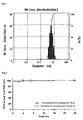
- Composition 5 of Example 2 was reconstructed in physiological saline so that the final concentration of paclitaxel was 3 mg/mL and then diluted 20 times with the same solvent to prepare a sample for particle size measurement.
- the particle size of the diluted Composition 5 solution was measured using a particle size analyzer. The result is shown in FIG. 1 .
- the polymer micelle had a particle size of 40-50 nm.
- the polymer micelle had a very uniform particle size distribution with a polydispersity index smaller than 0.200.
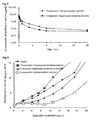
- the Composition 5 solution diluted in Test Example 1 was allowed to stand at room temperature for 24 hours in order to evaluate the stability of the solution.
- the concentration of paclitaxel and cyclosporin was measured by high-performance liquid chromatography (HPLC). The result is shown in FIG. 2 and the specific HPLC condition is as follows.
- the release volume of paclitaxel and cyclosporin can be calculated by measuring their concentration in the polymer micelle. As seen from FIG. 2 , the concentration of paclitaxel and cyclosporin was maintained above 98%, indicating that the two drugs were released within 2%.
- Composition 5 wherein paclitaxel and cyclosporin are encapsulated together and delivery of paclitaxel to the brain were evaluated.
- Composition 5 of Example 2 Composition 12 of Example 5, or commercially available Taxol® for injection was injected to the tail vein, at a dose of 5 mg/kg based on paclitaxel. 10 and 30 minutes and 1, 5, 10, 24 and 48 hours after the injection, whole blood and brain tissue samples were taken from the mouse.
- the whole blood sample was centrifuged and 0.1 mL of clear serum (supernatant) was put in a covered glass tube.
- the brain tissue sample was added to ultrapure water of about 4 times its weight, homogenized using a tissue homogenizer, and the same volume as that of the serum was put in a covered glass tube.
- 0.1 mL of an acetonitrile solution containing an internal standard was added to each sample.
- centrifugation was performed at 2,500 ppm for 10 minutes.
- the organic solvent was completely evaporated at 40 °C under nitrogen flow.
- HPLC HPLC condition was as follows. The concentration of paclitaxel in the serum is shown in FIG. 3 , and the delivery of the drug to the brain tissue is shown in FIG. 4 .
- the IC 50 value of paclitaxel in DLD-1 colon cancer cells treated with 1.88 ⁇ g/mL cyclosporin which is the concentration exhibiting the maximum P-glycoprotein inhibition effect without affecting cytotoxicity, decreased 15 times (from 160 ng/mL to 11 ng/mL) as compared to when paclitaxel was administered alone.
- Composition 13 showed longer retention in bloodstream than Composition 12. This reveals that cyclosporin keeps the concentration of paclitaxel in blood higher.
- PBS phosphate buffered saline
- a cell suspension containing 7x10 6 human resistant colon cancer cells (DLD-1) was subcutaneously injected to the right flank of a healthy athymic nude (nu/nu) mouse (20-25 g, 8 weeks old). After the cancer had grown to a certain size, xenotransplantation was performed 3 times to form a xenograft of 3-4 mm. The xenograft was subcutaneously injected to the right flank of a healthy athymic nude (nu/nu) mouse (20-25 g, 8 weeks old) using a 12-gauge troca needle. After the tumor volume reached 100-300 m 3 , the drug was administered. The day on which the drug was administered was recorded as day 0.
- DLD-1 human resistant colon cancer cells
- mice On day 0, the mice were divided into 5 groups. On days 0, 3 and 6, the cyclosporin-containing polymer micelle composition (Composition 11), the paclitaxel-containing polymer micelle composition (Composition 12) and the mixed polymer micelle composition (Composition 13) were each administered through the tail vein at a dose of 35 mg/kg paclitaxel and 35 mg/kg cyclosporin.
- Tumor volume TV W 2 ⁇ L / 2 L : major axis , W : minor axis
- Relative tumor volume V t / V o x 100 % V t : TV on day t , V o : TV on day 0
- mice were used per treatment and at least 4 tumors were used per group.
- the tumor size was 4 mm in diameter and 30 mm 3 in volume.
- the animals that died within 2 weeks after the final drug administration were regarded as toxified death and excluded from the evaluation.
- the groups with more than one death out of 3 animals, attributable to toxified death, or the groups including animals that had an average body weight decrease of more than 15% and did not show signs of thorough recovery were considered to have no anti-cancer activity. The result is shown in FIG. 6 .
- the group treated with the cyclosporin-containing polymer micelle composition had no effect on the anti-cancer activity.
- the tumor volume increased when compared to the control group.
- the groups treated with the paclitaxel-containing polymer micelle composition (Composition 12) or the mixed polymer micelle composition (Composition 13) showed improved inhibitory activity against cancer growth compared with the control group.
- the group treated with the mixed polymer micelle composition (Composition 13) showed better inhibitory activity against cancer growth than the group treated with the paclitaxel-containing polymer micelle composition (Composition 12).
Landscapes
- Health & Medical Sciences (AREA)
- Chemical & Material Sciences (AREA)
- Life Sciences & Earth Sciences (AREA)
- General Health & Medical Sciences (AREA)
- Veterinary Medicine (AREA)
- Public Health (AREA)
- Medicinal Chemistry (AREA)
- Pharmacology & Pharmacy (AREA)
- Animal Behavior & Ethology (AREA)
- Epidemiology (AREA)
- Dispersion Chemistry (AREA)
- Molecular Biology (AREA)
- Biophysics (AREA)
- Chemical Kinetics & Catalysis (AREA)
- General Chemical & Material Sciences (AREA)
- Nuclear Medicine, Radiotherapy & Molecular Imaging (AREA)
- Organic Chemistry (AREA)
- Engineering & Computer Science (AREA)
- Bioinformatics & Cheminformatics (AREA)
- Inorganic Chemistry (AREA)
- Pharmaceuticals Containing Other Organic And Inorganic Compounds (AREA)
- Medicinal Preparation (AREA)
- Medicines That Contain Protein Lipid Enzymes And Other Medicines (AREA)
Applications Claiming Priority (2)
| Application Number | Priority Date | Filing Date | Title |
|---|---|---|---|
| KR20080116141 | 2008-11-21 | ||
| PCT/KR2009/006882 WO2010059001A2 (ko) | 2008-11-21 | 2009-11-23 | 내성암 치료용 고분자 미셀 조성물 및 그 제조방법 |
Publications (3)
| Publication Number | Publication Date |
|---|---|
| EP2359860A2 true EP2359860A2 (de) | 2011-08-24 |
| EP2359860A4 EP2359860A4 (de) | 2012-04-25 |
| EP2359860B1 EP2359860B1 (de) | 2014-08-06 |
Family
ID=42198692
Family Applications (1)
| Application Number | Title | Priority Date | Filing Date |
|---|---|---|---|
| EP09827766.8A Active EP2359860B1 (de) | 2008-11-21 | 2009-11-23 | Polymermizellenzusammensetzung zur behandlung resistenter krebszellen |
Country Status (6)
| Country | Link |
|---|---|
| US (1) | US20110224151A1 (de) |
| EP (1) | EP2359860B1 (de) |
| JP (1) | JP5449388B2 (de) |
| KR (1) | KR20110091515A (de) |
| CN (1) | CN102292109A (de) |
| WO (1) | WO2010059001A2 (de) |
Cited By (2)
| Publication number | Priority date | Publication date | Assignee | Title |
|---|---|---|---|---|
| WO2014001904A1 (en) * | 2012-06-27 | 2014-01-03 | Medincell | Biodegradable drug delivery for hydrophobic compositions |
| US12558309B2 (en) | 2015-11-16 | 2026-02-24 | Medincell S.A. | Method for morselizing and/or targeting pharmaceutically active principles to synovial tissue |
Families Citing this family (8)
| Publication number | Priority date | Publication date | Assignee | Title |
|---|---|---|---|---|
| CN102920649B (zh) * | 2012-08-24 | 2014-07-02 | 中国科学院深圳先进技术研究院 | 载药纳米胶束及其制备方法和应用 |
| PL405241A1 (pl) | 2013-09-04 | 2015-03-16 | Wrocławskie Centrum Badań Eit + Spółka Z Ograniczoną Odpowiedzialnością | Micela polimerowa, sposób jej wytwarzania i zastosowanie |
| CN104758256B (zh) * | 2014-02-14 | 2016-05-04 | 苏州海特比奥生物技术有限公司 | 一种多西他赛纳米聚合物胶束冻干制剂及其制备方法 |
| KR101801566B1 (ko) * | 2014-12-30 | 2017-11-28 | 주식회사 삼양바이오팜 | 고분자 나노입자 동결건조물 및 그 제조방법 |
| CN110538328A (zh) * | 2018-05-28 | 2019-12-06 | 中国科学院宁波材料技术与工程研究所 | 多肽复合物和载药纳米粒子及其制法和药物组合物及应用 |
| CN112999151B (zh) * | 2019-12-19 | 2024-03-19 | 鲁南制药集团股份有限公司 | 一种口服用紫杉醇复合胶束 |
| CN114246840B (zh) * | 2020-09-22 | 2024-10-11 | 鲁南制药集团股份有限公司 | 一种口服用紫杉醇胶囊 |
| WO2025160108A1 (en) * | 2024-01-22 | 2025-07-31 | Sapu Nano Limited | Compositions for cancer therapeutics |
Family Cites Families (3)
| Publication number | Priority date | Publication date | Assignee | Title |
|---|---|---|---|---|
| KR0180334B1 (ko) * | 1995-09-21 | 1999-03-20 | 김윤 | 블럭 공중합체 미셀을 이용한 약물전달체 및 이에 약물을 봉입하는 방법 |
| US7217770B2 (en) * | 2000-05-17 | 2007-05-15 | Samyang Corporation | Stable polymeric micelle-type drug composition and method for the preparation thereof |
| US7879317B2 (en) * | 2001-10-18 | 2011-02-01 | Samyang Corporation | Polymeric micelle compositions with improved stability and methods of making thereof |
-
2009
- 2009-11-23 JP JP2011537369A patent/JP5449388B2/ja active Active
- 2009-11-23 CN CN2009801550218A patent/CN102292109A/zh active Pending
- 2009-11-23 EP EP09827766.8A patent/EP2359860B1/de active Active
- 2009-11-23 US US13/130,259 patent/US20110224151A1/en not_active Abandoned
- 2009-11-23 KR KR1020117011336A patent/KR20110091515A/ko not_active Ceased
- 2009-11-23 WO PCT/KR2009/006882 patent/WO2010059001A2/ko not_active Ceased
Cited By (3)
| Publication number | Priority date | Publication date | Assignee | Title |
|---|---|---|---|---|
| WO2014001904A1 (en) * | 2012-06-27 | 2014-01-03 | Medincell | Biodegradable drug delivery for hydrophobic compositions |
| EA031522B1 (ru) * | 2012-06-27 | 2019-01-31 | Мединселл | Биоразлагаемая композиция для доставки лекарственного средства (варианты) и способ получения биоразлагаемой композиции (варианты) |
| US12558309B2 (en) | 2015-11-16 | 2026-02-24 | Medincell S.A. | Method for morselizing and/or targeting pharmaceutically active principles to synovial tissue |
Also Published As
| Publication number | Publication date |
|---|---|
| EP2359860A4 (de) | 2012-04-25 |
| WO2010059001A2 (ko) | 2010-05-27 |
| CN102292109A (zh) | 2011-12-21 |
| WO2010059001A3 (ko) | 2010-09-10 |
| JP2012509318A (ja) | 2012-04-19 |
| JP5449388B2 (ja) | 2014-03-19 |
| EP2359860B1 (de) | 2014-08-06 |
| KR20110091515A (ko) | 2011-08-11 |
| US20110224151A1 (en) | 2011-09-15 |
Similar Documents
| Publication | Publication Date | Title |
|---|---|---|
| EP2359860B1 (de) | Polymermizellenzusammensetzung zur behandlung resistenter krebszellen | |
| JP5539993B2 (ja) | 薬物送達のためのナノ担体 | |
| US9173841B2 (en) | Polymer nanoparticle injection formulation composition containing rapamycin with improved water solubility, preparation method thereof, and anticancer composition for combined use with radiotherapy | |
| CN109771663B (zh) | 一种酸响应性抗癌纳米药物的制备及应用 | |
| KR101180558B1 (ko) | 암의 진단과 치료를 동시에 수행하는 항암제 | |
| Wei et al. | Janus nanogels of PEGylated Taxol and PLGA–PEG–PLGA copolymer for cancer therapy | |
| TWI572369B (zh) | 酸鹼應答型奈米微粒的製備並應用於製備促進抗癌藥物於腫瘤的傳輸與深層滲透之藥物的用途 | |
| Chen et al. | Synergistic antitumor efficacy of doxorubicin and gambogic acid-encapsulated albumin nanocomposites | |
| KR20110056042A (ko) | 종양세포 표적지향을 위한 나노 입자 및 이의 제조방법 | |
| EP2792348A2 (de) | Zusammensetzung einer wässrigen lösung aus polymernanopartikeln sowie verfahren zur herstellung davon | |
| Lv et al. | “Carrier–drug” layer-by-layer hybrid assembly of biocompatible polydopamine nanoparticles to amplify photo-chemotherapy | |
| EP2242514A2 (de) | Wirkstoffträger für intralymphatische chemotherapie | |
| KR20190018052A (ko) | 표적화된 치료 나노입자 및 그의 제조 및 사용 방법 | |
| AU2019446285B2 (en) | Pharmaceutical compositions containing mixed polymeric micelles | |
| CN110538328A (zh) | 多肽复合物和载药纳米粒子及其制法和药物组合物及应用 | |
| US10864280B2 (en) | Nanodroplet compositions for the efficient delivery of anti-cancer agents | |
| EP2934593B1 (de) | Cabazitaxelzusammensetzung | |
| KR20180101462A (ko) | 치료제를 포함하는 치료 나노입자 및 그의 제조 및 사용 방법 | |
| CN113307824A (zh) | 一种双亲性材料及其在制备脂质体中的应用 | |
| KR101435261B1 (ko) | 항암제-링커-알부민 결합체, 이의 제조방법 및 상기 결합체를 포함하는 약물 전달용 조성물 | |
| EP4417204A1 (de) | Zusammensetzung mit antitumorwirkstoff und herstellungsverfahren dafür und verwendung davon | |
| CN115551917B (zh) | 用于治疗脑肿瘤的交联纳米治疗学的顺序靶向 | |
| EP3395370B1 (de) | Liposom und liposomzusammensetzung | |
| KR102377334B1 (ko) | 핀골리모드 유도체 화합물의 가용화 조성물 및 이의 용도 | |
| CN121943800A (zh) | 一种难溶药物纳米混合胶束载体系统及其制备方法 |
Legal Events
| Date | Code | Title | Description |
|---|---|---|---|
| PUAI | Public reference made under article 153(3) epc to a published international application that has entered the european phase |
Free format text: ORIGINAL CODE: 0009012 |
|
| 17P | Request for examination filed |
Effective date: 20110617 |
|
| AK | Designated contracting states |
Kind code of ref document: A2 Designated state(s): AT BE BG CH CY CZ DE DK EE ES FI FR GB GR HR HU IE IS IT LI LT LU LV MC MK MT NL NO PL PT RO SE SI SK SM TR |
|
| DAX | Request for extension of the european patent (deleted) | ||
| A4 | Supplementary search report drawn up and despatched |
Effective date: 20120323 |
|
| RIC1 | Information provided on ipc code assigned before grant |
Ipc: A61K 31/335 20060101ALI20120319BHEP Ipc: A61K 47/30 20060101AFI20120319BHEP Ipc: A61P 35/00 20060101ALI20120319BHEP |
|
| RAP1 | Party data changed (applicant data changed or rights of an application transferred) |
Owner name: SAMYANG BIOPHARMACEUTICALS CORPORATION |
|
| GRAP | Despatch of communication of intention to grant a patent |
Free format text: ORIGINAL CODE: EPIDOSNIGR1 |
|
| INTG | Intention to grant announced |
Effective date: 20140227 |
|
| GRAS | Grant fee paid |
Free format text: ORIGINAL CODE: EPIDOSNIGR3 |
|
| GRAA | (expected) grant |
Free format text: ORIGINAL CODE: 0009210 |
|
| AK | Designated contracting states |
Kind code of ref document: B1 Designated state(s): AT BE BG CH CY CZ DE DK EE ES FI FR GB GR HR HU IE IS IT LI LT LU LV MC MK MT NL NO PL PT RO SE SI SK SM TR |
|
| REG | Reference to a national code |
Ref country code: GB Ref legal event code: FG4D |
|
| REG | Reference to a national code |
Ref country code: AT Ref legal event code: REF Ref document number: 680689 Country of ref document: AT Kind code of ref document: T Effective date: 20140815 Ref country code: CH Ref legal event code: EP |
|
| REG | Reference to a national code |
Ref country code: IE Ref legal event code: FG4D |
|
| REG | Reference to a national code |
Ref country code: DE Ref legal event code: R096 Ref document number: 602009025864 Country of ref document: DE Effective date: 20140918 |
|
| REG | Reference to a national code |
Ref country code: AT Ref legal event code: MK05 Ref document number: 680689 Country of ref document: AT Kind code of ref document: T Effective date: 20140806 |
|
| REG | Reference to a national code |
Ref country code: NL Ref legal event code: VDEP Effective date: 20140806 |
|
| REG | Reference to a national code |
Ref country code: LT Ref legal event code: MG4D |
|
| PG25 | Lapsed in a contracting state [announced via postgrant information from national office to epo] |
Ref country code: NO Free format text: LAPSE BECAUSE OF FAILURE TO SUBMIT A TRANSLATION OF THE DESCRIPTION OR TO PAY THE FEE WITHIN THE PRESCRIBED TIME-LIMIT Effective date: 20141106 Ref country code: SE Free format text: LAPSE BECAUSE OF FAILURE TO SUBMIT A TRANSLATION OF THE DESCRIPTION OR TO PAY THE FEE WITHIN THE PRESCRIBED TIME-LIMIT Effective date: 20140806 Ref country code: FI Free format text: LAPSE BECAUSE OF FAILURE TO SUBMIT A TRANSLATION OF THE DESCRIPTION OR TO PAY THE FEE WITHIN THE PRESCRIBED TIME-LIMIT Effective date: 20140806 Ref country code: BG Free format text: LAPSE BECAUSE OF FAILURE TO SUBMIT A TRANSLATION OF THE DESCRIPTION OR TO PAY THE FEE WITHIN THE PRESCRIBED TIME-LIMIT Effective date: 20141106 Ref country code: GR Free format text: LAPSE BECAUSE OF FAILURE TO SUBMIT A TRANSLATION OF THE DESCRIPTION OR TO PAY THE FEE WITHIN THE PRESCRIBED TIME-LIMIT Effective date: 20141107 Ref country code: ES Free format text: LAPSE BECAUSE OF FAILURE TO SUBMIT A TRANSLATION OF THE DESCRIPTION OR TO PAY THE FEE WITHIN THE PRESCRIBED TIME-LIMIT Effective date: 20140806 Ref country code: PT Free format text: LAPSE BECAUSE OF FAILURE TO SUBMIT A TRANSLATION OF THE DESCRIPTION OR TO PAY THE FEE WITHIN THE PRESCRIBED TIME-LIMIT Effective date: 20141209 Ref country code: LT Free format text: LAPSE BECAUSE OF FAILURE TO SUBMIT A TRANSLATION OF THE DESCRIPTION OR TO PAY THE FEE WITHIN THE PRESCRIBED TIME-LIMIT Effective date: 20140806 |
|
| PG25 | Lapsed in a contracting state [announced via postgrant information from national office to epo] |
Ref country code: LV Free format text: LAPSE BECAUSE OF FAILURE TO SUBMIT A TRANSLATION OF THE DESCRIPTION OR TO PAY THE FEE WITHIN THE PRESCRIBED TIME-LIMIT Effective date: 20140806 Ref country code: PL Free format text: LAPSE BECAUSE OF FAILURE TO SUBMIT A TRANSLATION OF THE DESCRIPTION OR TO PAY THE FEE WITHIN THE PRESCRIBED TIME-LIMIT Effective date: 20140806 Ref country code: HR Free format text: LAPSE BECAUSE OF FAILURE TO SUBMIT A TRANSLATION OF THE DESCRIPTION OR TO PAY THE FEE WITHIN THE PRESCRIBED TIME-LIMIT Effective date: 20140806 Ref country code: IS Free format text: LAPSE BECAUSE OF FAILURE TO SUBMIT A TRANSLATION OF THE DESCRIPTION OR TO PAY THE FEE WITHIN THE PRESCRIBED TIME-LIMIT Effective date: 20141206 Ref country code: AT Free format text: LAPSE BECAUSE OF FAILURE TO SUBMIT A TRANSLATION OF THE DESCRIPTION OR TO PAY THE FEE WITHIN THE PRESCRIBED TIME-LIMIT Effective date: 20140806 Ref country code: CY Free format text: LAPSE BECAUSE OF FAILURE TO SUBMIT A TRANSLATION OF THE DESCRIPTION OR TO PAY THE FEE WITHIN THE PRESCRIBED TIME-LIMIT Effective date: 20140806 Ref country code: NL Free format text: LAPSE BECAUSE OF FAILURE TO SUBMIT A TRANSLATION OF THE DESCRIPTION OR TO PAY THE FEE WITHIN THE PRESCRIBED TIME-LIMIT Effective date: 20140806 |
|
| PG25 | Lapsed in a contracting state [announced via postgrant information from national office to epo] |
Ref country code: SK Free format text: LAPSE BECAUSE OF FAILURE TO SUBMIT A TRANSLATION OF THE DESCRIPTION OR TO PAY THE FEE WITHIN THE PRESCRIBED TIME-LIMIT Effective date: 20140806 Ref country code: CZ Free format text: LAPSE BECAUSE OF FAILURE TO SUBMIT A TRANSLATION OF THE DESCRIPTION OR TO PAY THE FEE WITHIN THE PRESCRIBED TIME-LIMIT Effective date: 20140806 Ref country code: EE Free format text: LAPSE BECAUSE OF FAILURE TO SUBMIT A TRANSLATION OF THE DESCRIPTION OR TO PAY THE FEE WITHIN THE PRESCRIBED TIME-LIMIT Effective date: 20140806 Ref country code: IT Free format text: LAPSE BECAUSE OF FAILURE TO SUBMIT A TRANSLATION OF THE DESCRIPTION OR TO PAY THE FEE WITHIN THE PRESCRIBED TIME-LIMIT Effective date: 20140806 Ref country code: DK Free format text: LAPSE BECAUSE OF FAILURE TO SUBMIT A TRANSLATION OF THE DESCRIPTION OR TO PAY THE FEE WITHIN THE PRESCRIBED TIME-LIMIT Effective date: 20140806 Ref country code: RO Free format text: LAPSE BECAUSE OF FAILURE TO SUBMIT A TRANSLATION OF THE DESCRIPTION OR TO PAY THE FEE WITHIN THE PRESCRIBED TIME-LIMIT Effective date: 20140806 |
|
| REG | Reference to a national code |
Ref country code: DE Ref legal event code: R097 Ref document number: 602009025864 Country of ref document: DE |
|
| PLBE | No opposition filed within time limit |
Free format text: ORIGINAL CODE: 0009261 |
|
| STAA | Information on the status of an ep patent application or granted ep patent |
Free format text: STATUS: NO OPPOSITION FILED WITHIN TIME LIMIT |
|
| PG25 | Lapsed in a contracting state [announced via postgrant information from national office to epo] |
Ref country code: MC Free format text: LAPSE BECAUSE OF FAILURE TO SUBMIT A TRANSLATION OF THE DESCRIPTION OR TO PAY THE FEE WITHIN THE PRESCRIBED TIME-LIMIT Effective date: 20140806 Ref country code: BE Free format text: LAPSE BECAUSE OF NON-PAYMENT OF DUE FEES Effective date: 20141130 Ref country code: LU Free format text: LAPSE BECAUSE OF FAILURE TO SUBMIT A TRANSLATION OF THE DESCRIPTION OR TO PAY THE FEE WITHIN THE PRESCRIBED TIME-LIMIT Effective date: 20141123 |
|
| REG | Reference to a national code |
Ref country code: CH Ref legal event code: PL |
|
| 26N | No opposition filed |
Effective date: 20150507 |
|
| PG25 | Lapsed in a contracting state [announced via postgrant information from national office to epo] |
Ref country code: CH Free format text: LAPSE BECAUSE OF NON-PAYMENT OF DUE FEES Effective date: 20141130 Ref country code: LI Free format text: LAPSE BECAUSE OF NON-PAYMENT OF DUE FEES Effective date: 20141130 |
|
| REG | Reference to a national code |
Ref country code: IE Ref legal event code: MM4A |
|
| PG25 | Lapsed in a contracting state [announced via postgrant information from national office to epo] |
Ref country code: IE Free format text: LAPSE BECAUSE OF NON-PAYMENT OF DUE FEES Effective date: 20141123 |
|
| PG25 | Lapsed in a contracting state [announced via postgrant information from national office to epo] |
Ref country code: SI Free format text: LAPSE BECAUSE OF FAILURE TO SUBMIT A TRANSLATION OF THE DESCRIPTION OR TO PAY THE FEE WITHIN THE PRESCRIBED TIME-LIMIT Effective date: 20140806 |
|
| PG25 | Lapsed in a contracting state [announced via postgrant information from national office to epo] |
Ref country code: SM Free format text: LAPSE BECAUSE OF FAILURE TO SUBMIT A TRANSLATION OF THE DESCRIPTION OR TO PAY THE FEE WITHIN THE PRESCRIBED TIME-LIMIT Effective date: 20140806 |
|
| PG25 | Lapsed in a contracting state [announced via postgrant information from national office to epo] |
Ref country code: BE Free format text: LAPSE BECAUSE OF FAILURE TO SUBMIT A TRANSLATION OF THE DESCRIPTION OR TO PAY THE FEE WITHIN THE PRESCRIBED TIME-LIMIT Effective date: 20140806 Ref country code: MT Free format text: LAPSE BECAUSE OF FAILURE TO SUBMIT A TRANSLATION OF THE DESCRIPTION OR TO PAY THE FEE WITHIN THE PRESCRIBED TIME-LIMIT Effective date: 20140806 Ref country code: TR Free format text: LAPSE BECAUSE OF FAILURE TO SUBMIT A TRANSLATION OF THE DESCRIPTION OR TO PAY THE FEE WITHIN THE PRESCRIBED TIME-LIMIT Effective date: 20140806 Ref country code: HU Free format text: LAPSE BECAUSE OF FAILURE TO SUBMIT A TRANSLATION OF THE DESCRIPTION OR TO PAY THE FEE WITHIN THE PRESCRIBED TIME-LIMIT; INVALID AB INITIO Effective date: 20091123 |
|
| REG | Reference to a national code |
Ref country code: FR Ref legal event code: PLFP Year of fee payment: 8 |
|
| REG | Reference to a national code |
Ref country code: FR Ref legal event code: PLFP Year of fee payment: 9 |
|
| PG25 | Lapsed in a contracting state [announced via postgrant information from national office to epo] |
Ref country code: MK Free format text: LAPSE BECAUSE OF FAILURE TO SUBMIT A TRANSLATION OF THE DESCRIPTION OR TO PAY THE FEE WITHIN THE PRESCRIBED TIME-LIMIT Effective date: 20140806 |
|
| REG | Reference to a national code |
Ref country code: FR Ref legal event code: PLFP Year of fee payment: 10 |
|
| REG | Reference to a national code |
Ref country code: DE Ref legal event code: R081 Ref document number: 602009025864 Country of ref document: DE Owner name: SAMYANG HOLDINGS CORPORATION, KR Free format text: FORMER OWNER: SAMYANG BIOPHARMACEUTICALS CORP., SEOUL, KR |
|
| REG | Reference to a national code |
Ref country code: GB Ref legal event code: 732E Free format text: REGISTERED BETWEEN 20220526 AND 20220601 |
|
| P01 | Opt-out of the competence of the unified patent court (upc) registered |
Effective date: 20230602 |
|
| PGFP | Annual fee paid to national office [announced via postgrant information from national office to epo] |
Ref country code: GB Payment date: 20250909 Year of fee payment: 17 |
|
| PGFP | Annual fee paid to national office [announced via postgrant information from national office to epo] |
Ref country code: FR Payment date: 20250909 Year of fee payment: 17 |
|
| PGFP | Annual fee paid to national office [announced via postgrant information from national office to epo] |
Ref country code: DE Payment date: 20250908 Year of fee payment: 17 |