EP2361961A2 - Compositions avancées de carburant à partir de sources renouvelables et procédés associés pour fabriquer et utiliser le carburant - Google Patents
Compositions avancées de carburant à partir de sources renouvelables et procédés associés pour fabriquer et utiliser le carburant Download PDFInfo
- Publication number
- EP2361961A2 EP2361961A2 EP11155089A EP11155089A EP2361961A2 EP 2361961 A2 EP2361961 A2 EP 2361961A2 EP 11155089 A EP11155089 A EP 11155089A EP 11155089 A EP11155089 A EP 11155089A EP 2361961 A2 EP2361961 A2 EP 2361961A2
- Authority
- EP
- European Patent Office
- Prior art keywords
- alkanes
- fuel
- saturated alkanes
- saturated
- iso
- Prior art date
- Legal status (The legal status is an assumption and is not a legal conclusion. Google has not performed a legal analysis and makes no representation as to the accuracy of the status listed.)
- Withdrawn
Links
Images



Classifications
-
- C—CHEMISTRY; METALLURGY
- C10—PETROLEUM, GAS OR COKE INDUSTRIES; TECHNICAL GASES CONTAINING CARBON MONOXIDE; FUELS; LUBRICANTS; PEAT
- C10L—FUELS NOT OTHERWISE PROVIDED FOR; NATURAL GAS; SYNTHETIC NATURAL GAS OBTAINED BY PROCESSES NOT COVERED BY SUBCLASSES C10G OR C10K; LIQUIFIED PETROLEUM GAS; USE OF ADDITIVES TO FUELS OR FIRES; FIRE-LIGHTERS
- C10L1/00—Liquid carbonaceous fuels
- C10L1/10—Liquid carbonaceous fuels containing additives
- C10L1/14—Organic compounds
- C10L1/16—Hydrocarbons
- C10L1/1616—Hydrocarbons fractions, e.g. lubricants, solvents, naphta, bitumen, tars, terpentine
-
- C—CHEMISTRY; METALLURGY
- C10—PETROLEUM, GAS OR COKE INDUSTRIES; TECHNICAL GASES CONTAINING CARBON MONOXIDE; FUELS; LUBRICANTS; PEAT
- C10L—FUELS NOT OTHERWISE PROVIDED FOR; NATURAL GAS; SYNTHETIC NATURAL GAS OBTAINED BY PROCESSES NOT COVERED BY SUBCLASSES C10G OR C10K; LIQUIFIED PETROLEUM GAS; USE OF ADDITIVES TO FUELS OR FIRES; FIRE-LIGHTERS
- C10L1/00—Liquid carbonaceous fuels
- C10L1/04—Liquid carbonaceous fuels essentially based on blends of hydrocarbons
-
- C—CHEMISTRY; METALLURGY
- C10—PETROLEUM, GAS OR COKE INDUSTRIES; TECHNICAL GASES CONTAINING CARBON MONOXIDE; FUELS; LUBRICANTS; PEAT
- C10L—FUELS NOT OTHERWISE PROVIDED FOR; NATURAL GAS; SYNTHETIC NATURAL GAS OBTAINED BY PROCESSES NOT COVERED BY SUBCLASSES C10G OR C10K; LIQUIFIED PETROLEUM GAS; USE OF ADDITIVES TO FUELS OR FIRES; FIRE-LIGHTERS
- C10L1/00—Liquid carbonaceous fuels
- C10L1/04—Liquid carbonaceous fuels essentially based on blends of hydrocarbons
- C10L1/06—Liquid carbonaceous fuels essentially based on blends of hydrocarbons for spark ignition
-
- C—CHEMISTRY; METALLURGY
- C10—PETROLEUM, GAS OR COKE INDUSTRIES; TECHNICAL GASES CONTAINING CARBON MONOXIDE; FUELS; LUBRICANTS; PEAT
- C10L—FUELS NOT OTHERWISE PROVIDED FOR; NATURAL GAS; SYNTHETIC NATURAL GAS OBTAINED BY PROCESSES NOT COVERED BY SUBCLASSES C10G OR C10K; LIQUIFIED PETROLEUM GAS; USE OF ADDITIVES TO FUELS OR FIRES; FIRE-LIGHTERS
- C10L1/00—Liquid carbonaceous fuels
- C10L1/04—Liquid carbonaceous fuels essentially based on blends of hydrocarbons
- C10L1/08—Liquid carbonaceous fuels essentially based on blends of hydrocarbons for compression ignition
-
- C—CHEMISTRY; METALLURGY
- C10—PETROLEUM, GAS OR COKE INDUSTRIES; TECHNICAL GASES CONTAINING CARBON MONOXIDE; FUELS; LUBRICANTS; PEAT
- C10G—CRACKING HYDROCARBON OILS; PRODUCTION OF LIQUID HYDROCARBON MIXTURES, e.g. BY DESTRUCTIVE HYDROGENATION, OLIGOMERISATION, POLYMERISATION; RECOVERY OF HYDROCARBON OILS FROM OIL-SHALE, OIL-SAND, OR GASES; REFINING MIXTURES MAINLY CONSISTING OF HYDROCARBONS; REFORMING OF NAPHTHA; MINERAL WAXES
- C10G2300/00—Aspects relating to hydrocarbon processing covered by groups C10G1/00 - C10G99/00
- C10G2300/10—Feedstock materials
- C10G2300/1011—Biomass
- C10G2300/1014—Biomass of vegetal origin
-
- C—CHEMISTRY; METALLURGY
- C10—PETROLEUM, GAS OR COKE INDUSTRIES; TECHNICAL GASES CONTAINING CARBON MONOXIDE; FUELS; LUBRICANTS; PEAT
- C10G—CRACKING HYDROCARBON OILS; PRODUCTION OF LIQUID HYDROCARBON MIXTURES, e.g. BY DESTRUCTIVE HYDROGENATION, OLIGOMERISATION, POLYMERISATION; RECOVERY OF HYDROCARBON OILS FROM OIL-SHALE, OIL-SAND, OR GASES; REFINING MIXTURES MAINLY CONSISTING OF HYDROCARBONS; REFORMING OF NAPHTHA; MINERAL WAXES
- C10G2300/00—Aspects relating to hydrocarbon processing covered by groups C10G1/00 - C10G99/00
- C10G2300/20—Characteristics of the feedstock or the products
- C10G2300/30—Physical properties of feedstocks or products
- C10G2300/308—Gravity, density, e.g. API
-
- Y—GENERAL TAGGING OF NEW TECHNOLOGICAL DEVELOPMENTS; GENERAL TAGGING OF CROSS-SECTIONAL TECHNOLOGIES SPANNING OVER SEVERAL SECTIONS OF THE IPC; TECHNICAL SUBJECTS COVERED BY FORMER USPC CROSS-REFERENCE ART COLLECTIONS [XRACs] AND DIGESTS
- Y02—TECHNOLOGIES OR APPLICATIONS FOR MITIGATION OR ADAPTATION AGAINST CLIMATE CHANGE
- Y02E—REDUCTION OF GREENHOUSE GAS [GHG] EMISSIONS, RELATED TO ENERGY GENERATION, TRANSMISSION OR DISTRIBUTION
- Y02E50/00—Technologies for the production of fuel of non-fossil origin
- Y02E50/10—Biofuels, e.g. bio-diesel
-
- Y—GENERAL TAGGING OF NEW TECHNOLOGICAL DEVELOPMENTS; GENERAL TAGGING OF CROSS-SECTIONAL TECHNOLOGIES SPANNING OVER SEVERAL SECTIONS OF THE IPC; TECHNICAL SUBJECTS COVERED BY FORMER USPC CROSS-REFERENCE ART COLLECTIONS [XRACs] AND DIGESTS
- Y02—TECHNOLOGIES OR APPLICATIONS FOR MITIGATION OR ADAPTATION AGAINST CLIMATE CHANGE
- Y02P—CLIMATE CHANGE MITIGATION TECHNOLOGIES IN THE PRODUCTION OR PROCESSING OF GOODS
- Y02P30/00—Technologies relating to oil refining and petrochemical industry
- Y02P30/20—Technologies relating to oil refining and petrochemical industry using bio-feedstock
-
- Y—GENERAL TAGGING OF NEW TECHNOLOGICAL DEVELOPMENTS; GENERAL TAGGING OF CROSS-SECTIONAL TECHNOLOGIES SPANNING OVER SEVERAL SECTIONS OF THE IPC; TECHNICAL SUBJECTS COVERED BY FORMER USPC CROSS-REFERENCE ART COLLECTIONS [XRACs] AND DIGESTS
- Y02—TECHNOLOGIES OR APPLICATIONS FOR MITIGATION OR ADAPTATION AGAINST CLIMATE CHANGE
- Y02T—CLIMATE CHANGE MITIGATION TECHNOLOGIES RELATED TO TRANSPORTATION
- Y02T50/00—Aeronautics or air transport
- Y02T50/60—Efficient propulsion technologies, e.g. for aircraft
- Y02T50/678—Aviation using fuels of non-fossil origin
Definitions
- This invention generally relates to fuel compositions. Some specific embodiments of the invention are directed to jet fuel compositions which are at least partially bio-based, and which exhibit a desirable combination of physical and performance characteristics.
- biomass which can be used to prepare a variety of different types of fuel - some of which are referred to as “biofuel”, or “biodiesel”.
- biofuel or “biodiesel”.
- the physical removal of freezing-substances may require cycles of chilling, distilling, and/or filtering. This can be a relatively long process, and the composition which is now free of the solid components often would not meet all of the other requirements for the fuel, e.g., density and combustion characteristics.
- the use of various compounds as additives in the fuel can be beneficial in inhibiting nucleation and crystallization.
- the mechanism appears to involve the bonding of the additives to frozen molecules, so that frozen molecules are prevented from bonding with each other and agglomerating).
- this technique appears to sometimes have a greater effect on the "pour point" of the fuel, as compared to the cloud point.
- the cloud point is viewed as being the more critical property, in terms of low temperature capabilities).
- pyrolysis oil is a synthetic fuel obtained by the destructive distillation of dried biomass. While pyrolysis oil can potentially be used to prepare stable bio-crude oil fractions for some end uses, it does not have the properties for any realistic application to aviation fuel. For example, pyrolysis oil contains an excessive amount of oxygen; has a relatively poor energy density; and would not have the cold-temperature properties required for such a demanding application.
- isoprenoids Another potential fuel source is based on isoprenoids, which can apparently be prepared from bio-sources (e.g., microbes), using various biosynthesis techniques.
- isoprenoids are derived from isoprene, a five-carbon hydrocarbon, with a branched-chain structure, and can naturally be found in some crude oil fractions). While isoprenoid-based materials may show some promise, they also do not appear to have the cold-temperature and energy density attributes required for bio-fuels.
- compositions that are suitable for aviation use would be welcome in the art.
- the compositions should be based entirely or partially on bio-derived materials, and should have acceptable properties, such as freeze point, flash point, density, and combustion characteristics.
- new techniques for determining if bio-based fuels would have the freeze-point characteristics necessary for aviation applications would also be of great interest in the industry.
- One embodiment of this invention is directed to a method for preparing a fuel composition.
- the method comprises the steps of:
- Another embodiment is directed to a fuel composition, comprising
- An additional embodiment of the invention is directed to a method for lowering the freeze point of a hydrocarbon fuel composition which comprises a mixture of iso-saturated alkanes and normal-saturated alkanes having a flash point of at least about 35°C.
- the method comprises the step of increasing the weight ratio of iso-saturated alkanes to normal-saturated alkanes in the composition, from a ratio of about 1.0 to at least about 2.0.
- FIG. 1 is a plot of alkane carbon number as a function of alkane mass percent, for a petroleum-based sample.
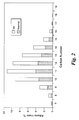
- FIG. 2 is a plot of alkane carbon number as a function of alkane mass percent, with estimated proportions of n-alkane and i-alkane compounds, for a petroleum-based sample.
- FIG. 3 is a plot of n-alkane and i-alkane compounds, as a function of mass percent, for a petroleum-derived sample.
- FIG. 4 is a plot of n-alkane and i-alkane compounds, as a function of mass percent, for a bio-derived sample.
- FIG. 5 is another plot of n-alkane and i-alkane compounds, as a function of mass percent, for a bio-derived sample.
- compositional ranges disclosed herein are inclusive and combinable (e.g., ranges of "up to about 25 wt%", or, more specifically, "about 5 wt% to about 20 wt%", are inclusive of the endpoints and all intermediate values of the ranges).
- Weight levels are provided on the basis of the weight of the entire composition, unless otherwise specified; and ratios are also provided on a weight basis.
- the term “combination” is inclusive of blends, mixtures, alloys, reaction products, and the like.
- first, second, and the like, herein do not denote any order, quantity, or importance, but rather are used to distinguish one element from another.
- the terms “a” and “an” herein do not denote a limitation of quantity, but rather denote the presence of at least one of the referenced items.
- the modifier “about” used in connection with a quantity is inclusive of the stated value, and has the meaning dictated by context, (e.g., includes the degree of error associated with measurement of the particular quantity).
- the suffix "(s)" is usually intended to include both the singular and the plural of the term that it modifies, thereby including one or more of that term (e.g., "the compound” may include one or more compounds, unless otherwise specified).
- Reference throughout the specification to "one embodiment”, “another embodiment”, “an embodiment”, and so forth, means that a particular element (e.g., feature, structure, and/or characteristic) described in connection with the embodiment is included in at least one embodiment described herein, and may or may not be present in other embodiments.
- the described inventive features may be combined in any suitable manner in the various embodiments.
- the hydrocarbon fuel described herein may contain a blend of a large number of chemical compounds - perhaps over 1,000 individual compounds.
- the fuel primarily comprises hydrocarbons, i.e., saturated alkanes ("paraffins").
- the fuel composition comprises both a bio-based fuel and a petroleum-based fuel
- the composition further comprises aromatics, olefins, and naphthalenes.
- aromatics, olefins, and naphthalenes Non-limiting examples of these materials include benzene and its derivatives, xylene and its derivatives; naphthalene and its derivatives; and combinations thereof).
- the alkanes themselves can be linear alkanes, branched alkanes, or combinations thereof, as well as the cyclic alkanes referred to below.
- the alkane component usually comprises C 7 to C 18 saturated alkanes (iso-saturated or normal-saturated). In some specific embodiments, at least about 70 weight percent of the saturated alkanes have a carbon chain length of C 10 to C 12 .
- cyclo-saturated alkanes generally refers to compounds having one or more rings of carbon atoms.
- the cycloalkanes contain only carbon and hydrogen, and may include a wide variety of side-chains.
- Non-limiting examples of the cycloalkanes include cyclopentane, butylcyclopentane, methyl cyclopentane, methylpropylcyclopentane, dimethylethylcyclopentane, tetramethylcyclopentane, dimethyl cyclopentane, ethyl cyclopentane, methylbutylcyclopentane, ethylpropylcyclopentane, cyclohexane, n-butyl cyclohexane, isobutyl cyclohexane, propylcyclohexane, methylethylcyclohexane, trimethylcyclohexane, methyl cyclohexane
- the total amount of cycloalkanes is no greater than about 15 volume percent, based on the total volume of the fuel composition. In some embodiments, the amount is no greater than about 5 volume percent, e.g., about 0.1 volume percent to about 5 volume percent.
- the weight ratio of iso-saturated alkanes and cyclo-saturated alkanes (the total) to normal-saturated alkanes is at least about 2.0. In some specific embodiments, the weight ratio is at least about 5.0. (For the sake of simplicity in this disclosure, the ratio will sometimes be referred to as the "i-n ratio") These proportions result in a fuel with characteristics that are especially advantageous in a number of ways. First, the freeze point (or “freezing point") of the fuels is decreased, as compared to the freeze point of fuels with a lower i-n ratio, and as compared to conventional, petroleum-based fuels.
- the decreased freeze point is very important for successful use of the fuel at lower ambient temperatures.
- the fuel is characterized by a higher energy density, as compared to fuels with a lower i-n ratio.
- a third characteristic, related to the increased energy density, is that the fuel has the tendency to bum more "cleanly", with a decreased level of combustion byproducts such as smoke and soot.
- bio-derived fuel generally refers to a fuel which is produced from renewable biological resources, such as plant biomass, tree biomass, and treated-municipal and industrial waste.
- renewable biological resources such as plant biomass, tree biomass, and treated-municipal and industrial waste.
- Non-limiting examples of processes for preparing bio-derived fuel compositions, and related technology, can be found in U.S. Patent Publications 2009/0259082 (Deluga et al ); 2009/0158663 (Deluga et al ); 2008/0244962 (Abhari et al ) and 2008/0092436 (Seames et al ); all incorporated herein by reference.
- the bio-derived fuel composition is produced by a technique which comprises hydro-treating renewable oils, as described in the above-referenced Publication 2009/0259082 .
- the process can employ a bio-oil feedstock, from which a bio-oil can be extracted.
- suitable bio-oils are discussed in the Deluga '082 reference, and include oil bearing seeds like soybean, colza, camelina, canola, rapeseed, corn, cottonseed, sunflower, safflower, flax, olive, peanut, shea nut, and the like.
- the bio-oil feedstock may also include inedible varieties like linseed, castor, jatropha and the like.
- bio-oil feedstock e.g., the kernels from trees like coconut, babassu and palm.
- the bio-oil feedstock may also include certain algae, microalgae, seaweeds and microbes that produce oil.
- extraction of the bio-oil from the bio-oil feedstock also produces a substantially deoiled residue, as a byproduct.
- this residue can be gasified, to generate a hydrogen-containing gas.
- the hydrogen gas can be enriched in hydrogen content, and can then be used for a number of purposes.
- the bio-oil is subjected to an upgrading procedure.
- an upgrading procedure is described in detail in Publication 2009/0259082 , and typically involves a hydro-treating step. Hydro-treating can be followed by a hydro-isomerization step, and then a separation step, which separates various components of the isomerization products.
- the hydro-treating step differs significantly from the hydro-treating operations which are common in the petroleum industry, i.e., in the refining of crude oil.
- Petroleum-based feedstock includes asphalt, aromatics, or ring compounds, with carbon chain lengths of about C 30 .
- bio-oils typically include relatively high levels of compounds such as triglycerides, fatty acids and other esters of fatty acids.
- hydro-treating is primarily employed to effect hydro-deoxygenation. Oxygen does not add to the heating value of the fuel product and hence, it is desirable to keep the concentration of oxygen at relatively low levels. In some embodiments, the oxygen concentration is reduced to levels as low as about 0.004% by weight.
- the hydro-treating reaction also involves the saturation of the double bonds. It removes the double bonds from the components of bio-oil, and this reduces the problems associated with unsaturated compounds that would readily polymerize and cause fuel instability and problems in combustion.
- the hydrogen reacts with the triglycerides to form hydrogenated triglycerides.
- the hydrogenated triglycerides further react with hydrogen to form diglycerides, monoglycerides, acids, and waxes. These materials further react with hydrogen, to undergo hydro-deoxygenation to form linear alkanes. As described herein, some of the products include propane, as well as linear C 16 and C 18 alkanes.
- Transition metal sulfides are generally used as catalysts for hydro-treating, e.g., sulfides of NiMo or CoMo.
- Typical temperatures maintained during hydro-treating are between about 200°C and about 450°C.
- a typical pressure range for the hydro-treating operation is between about 10 bar and about 80 bar. In some embodiments, the pressures of about 40 to about 60 bar, and temperatures of about 280°C to about 350°C, may be more preferred.
- an illustrative reaction scheme for the hydrogenation of a triglyceride-based vegetable oil, such as soybean oil is provided in the '082 publication.
- the hydro-treating reaction produces water molecules, CO 2 , and some light hydrocarbons such as propane, in addition to (long chain) linear alkanes, which are the desired products. These additional products can be separated from the linear alkanes, before the step of hydro-isomerization.
- the water may be used for various purposes, e.g., to form steam, which can be used in a gasification reaction, discussed below.
- the light hydrocarbons like propane can be used as a fuel to generate heat energy, e.g., in a steam generating system like a boiler.
- the hydro-treating reaction is usually followed by a hydro-isomerization reaction (sometimes referred to herein as simply an "isomerization reaction” or “isomerization”).
- a hydro-isomerization reaction sometimes referred to herein as simply an "isomerization reaction” or “isomerization”
- the linear alkanes present in the mixture are reacted with hydrogen, in the presence of specified catalysts, to produce branched compounds, i.e., branched isomers.
- the branched isomers of light paraffins have higher octane numbers than the corresponding normal straight alkanes and hence, are often a desirable component of the fuel.
- the specifications require that the octane number for a lean mixture of the grade 80 fuel should be about 80 at minimum.
- grade 100 the value is required to be about 91, and for grade 100 LL (Low Lead), the octane value needs to be at about 99.5 at a minimum.
- the fuel composition of the present invention is dependent on a specified proportion of iso-saturated alkanes and cyclo-saturated alkanes (the total) to normal-saturated alkanes.
- the catalyst system comprises a combination of silica-alumina, alumina, and at least one group VIII metal, i.e., iron, cobalt, nickel, ruthenium, rhodium, palladium, osmium, iridium, or platinum.
- group VIII metal i.e., iron, cobalt, nickel, ruthenium, rhodium, palladium, osmium, iridium, or platinum.
- the catalyst composition comprises:
- Such a catalyst composition can further comprise about 5 weight percent to about 70 weight percent of a zeolite.
- the zeolite comprises silicon and aluminum; at a ratio (weight) in the range of about 1.0 to about 300.
- Non-limiting examples of the zeolites are as follows: zeolite Y, zeolite beta, ferrierite, mordenite, zeolite ZSM-22/23, and zeolite ZSM-5.
- typical temperatures are maintained in the range of about 200°C and about 450°C.
- a typical pressure range for the operation is between about 10 bar and about 80 bar. In some embodiments, a pressure range of about 40 to about 60 bar, and a temperature range of about 275°C to about 350°C, may be more preferred.
- the isomerization reaction involves rearrangement of the alkyl groups.
- a separation step is often undertaken, after hydro-isomerization.
- This step is very useful in separating the various components which constitute the isomerization products.
- the step can comprise one or more procedures.
- different fractions of the isomerization products can be separated, based on boiling point ranges.
- Exemplary techniques include flash distillation, fractionation, and the like.
- the separation step can also involve a flash operation, wherein the products of the hydro-isomerization step are sent at a high pressure to a flash vessel, and are subjected to a low pressure.
- a flash operation wherein the products of the hydro-isomerization step are sent at a high pressure to a flash vessel, and are subjected to a low pressure.
- two streams are formed -the gaseous stream rich in more volatile components, and the liquid stream, which contains a higher percentage of lower volatile components.
- a cascade of such separations, or a distillation column may be employed.
- the separation step may also include a fractionation column, where multiple components (e.g., light hydrocarbons) can be separated in a single column.
- at least a portion of the light hydrocarbon generated in the hydro-treating operation, or the light hydrocarbon generated in the hydro-isomerization operation is sent to the separation operation. (Both light hydrocarbon streams can be sent as well).
- the separation step allows for greater control of the composition of the product
- At least a portion of the substantially deoiled residue which is produced by one or more extraction steps can be gasified, to generate a hydrogen-containing gas.
- Various gasification techniques can be employed.
- One useful operation is described in a copending application filed on December 21, 2007, Serial No. 11/962,245 , which is incorporated herein by reference.
- a portion of the light hydrocarbon product is sometimes used to prepare a slurry of deoiled residue. (The slurry can be aqueous in some instances, as well).
- the gasification of the deoiled residue can be carried out in a conventional manner, with a dry feed, and without the use of any light hydrocarbon material.
- the resultant tar-laden gas is subjected to a reforming step to reduce the tars.
- the light hydrocarbon stream can be injected into the reformer, which is positioned downstream of the gasifier.
- the light hydrocarbon can undergo complete or partial combustion in the reformer, resulting in higher temperatures in the reformer section. Higher temperatures in turn result in the cracking of tars.
- the higher the temperature in the reformer section the greater degree of tar cracking, thus leading to greater tar reduction.
- tars which are formed in the gasifier are subjected to cracking in the reformer section, which is immediately downstream of the gasifier. The reduction of tar content ensures a more efficient operation.
- Gasification of the substantially deoiled residue is especially advantageous for many embodiments, due the resulting generation of the hydrogen-containing gas.
- most or all of the hydrogen stream can be used in the upgrading operation described above, i.e., in hydro-treating and/or in hydro-isomerization.
- the hydrogen can be used for a number of different purposes, e.g., combustion, fuel cell operation, and a wide variety of other industrial operations.
- a hydrogen enrichment step can be incorporated into the gasification operation, e.g., by subjecting the gasification product stream ("syngas") to a water gas shift (WGS) reaction.
- gasification product stream gasification product stream
- WGS water gas shift
- the WGS step converts (removes) carbon monoxide from the syngas, and adds hydrogen to it, resulting in the enrichment.
- the hydrogen enrichment process can include a hydrogen-selective membrane unit.
- the gasification operation can include an acid gas removal unit.
- This station can be used to remove acid gases such as hydrogen sulfide, which is the predominant form of sulfur compounds which would typically originate in the gasifier. (The amount of sulfur that is present depends in large part on the type of initial bio-oil feedstock).
- Another embodiment of this invention is directed to a method for preparing a fuel composition, as mentioned above.
- a key step in the method is the preparation of the bio-derived fuel component, which includes a mixture of iso-saturated alkanes and normal-saturated alkanes.
- a determination is then made, as to whether the ratio of iso-saturated alkanes to normal-saturated alkanes in the bio-derived component is at least about 2.0. If the ratio meets that requirement, then the composition satisfies a key parameter for the invention.
- the bio-derived fuel component is usually blended with a petroleum-derived component.
- a petroleum-derived component Non-limiting examples include the commercial fuels mentioned previously, such as JP-8.
- the petroleum-derived component supplies aromatic content to the overall composition, which is important for most embodiments.
- the aromatic content of the petroleum-derived component is at least about 16 % by volume, as measured by ASTM D2425.
- the bio-derived component comprises iso-saturated alkanes and normal-saturated alkanes that have a carbon chain length of C 10 to C 12 , wherein the ratio of iso-saturated alkanes to normal-saturated alkanes for each respective C 10 to C 12 combination of alkanes is at least about 2.0.
- the resulting fuel composition can be characterized has having:
- some specific embodiments of the composition comprise about 59 volume percent to about 92 volume percent of a mixture of iso-saturated alkanes and normal-saturated alkanes having a flash point in the range of about 35°C to about 60°C.
- the compositions often comprise about 8 volume percent to about 25 volume percent aromatic compounds. If olefinic compounds are present, they are usually limited to about 1 volume percent or less.
- the usual range of cyclic compounds, when present, is in the range of about 0.05 volume percent to about 15 volume percent.
- the composition is characterized by the i-n ratio specified previously, and has a freeze point less than about -50°C, and in some instances, less than about -40°C.
- Turbine engines typically contain three primary units: a compressor, a combustion chamber, and a turbine. Air which is drawn into the compressor is compressed (and thus becomes heated). The compressed air is directed into the combustion chamber, and a suitable hydrocarbon fuel is injected and ignited. The burning air/fuel mixture expands, and provides energy to the turbine.
- the air stream exiting the turbine can be used as propulsion (e.g., a jet engine), or can be used to provide power in a mechanical system (e.g., a power turbine).
- propulsion e.g., a jet engine
- mechanical system e.g., a power turbine
- the use of the hydrocarbon fuel described herein provides very important advantages for many of those applications.
- FIG. 1 is a bar graph which expresses the relative amount of each of the predominant n-alkane compounds in the sample. The sum of the constituents in the figure is 19% by volume.
- a second figure was constructed, expressing the particular n-alkane compounds as a function of alkane mass. (See FIG. 2 ).
- the data for this figure is based in part on the assumption that the i/n ratio is constant, by carbon number. While this assumption may not be entirely accurate, it appears to be accurate enough to demonstrate several points regarding the composition.
- freeze point of the sample in this example was -51°C. It is believed that the presence of non-paraffinic components depressed the freeze point, below the value that would have been obtained if the sample had only contained iso-and normal-alkanes.
- the coconut oil (approximately 1 liter) was directed through a reactor, and subjected to hydro-treating conditions, as follows:
- the resulting liquid was fractionated by distillation, to obtain a number of samples. Each sample had a very similar carbon number distribution, but differed from the other samples, in terms of iso/normal ratios.
- 200 ml of the hydro-treated product was distilled, using an insulated column packed with glass beads, and having a length of 6 inches (15.2 cm), and a diameter of 0.5-inch (1.3 cm). Each sample was collected with a pot temperature regimen extending from 305°C-330°C.
- Sample A had a composition outside the scope of this invention.
- the composition is expressed in FIG. 3 , which is a plot of n-alkane and i-alkane compounds (by way of carbon number), as a function of mass percent.
- Sample A was similar to the petroleum-derived sample depicted in Example 1 (i/n ratio of 1.0), without the presence of any aromatic compounds or additives.
- the hydro-treating conditions for this sample included temperature levels of 290°C, and an lhsv value of 0.75.
- Sample A had a density of 0.745 g/ml.
- the sample had a freeze point between - 35°C and -40°C, which did not meet the current specification for most jet fuels (-47°C).
- Sample B had a composition within the scope of this invention. Compositional parameters are depicted in FIG. 4 , which is also a plot of n-alkane and i-alkane compounds, as a function of mass percent.
- the hydro-treating conditions for this sample included temperature levels of 300°C, and an lhsv value of 0.35.
- the i/n ratio for Sample B was 2.2.
- the sample had a density of 0.746 g/ml.
- Sample B had a freeze point between -50°C and -55°C, which meets the current specification for jet fuel (-47°C). In general, Sample B conformed to substantially all specifications for commercial jet fuel, with the exception of density.
- Sample C had a composition which was also within the scope of this invention. Its characteristics are depicted in FIG. 5 , which is another plot of n-alkane and i-alkane compounds, as a function of mass percent.
- the hydro-treating conditions for this sample included temperature levels of 305°C, and an lhsv value of 0.5 lhsv.
- the i/n ratio for Sample C was 5.3.
- the sample had a density of 0.747 g/ml.
- Sample C had a freeze point of less than -55°C, which would generally meet or surpass all current specifications for cold-weather behavior.
- This example generally describes various catalyst systems which may be used for isomerization steps in some embodiments of the invention.
- the subject matter of these examples is also set forth in pending Patent Application S.N. 12/344,291, filed on December 26, 2008 ), and mentioned previously.
- Hydro-treated soy oil is a roughly 50/50 mixture of n-heptadecane and n-octadecane.
- a catalyst comprising 30 weight percent zeolite beta, 69.5 weight percent alumina binder, and 0.50 weight percent platinum is used in the hydro-isomerization of a soy oil feedstock.
- the isomerization of the feedstock occurs preferentially, with relatively low levels of C 7 to C 14 isomerized product.
- a catalyst comprising 25 weight percent zeolite beta, 25 weight percent silica-alumina support, 49.5 weight percent alumina binder, and 0.50 weight percent platinum is used in the hydro-isomerization of the soy oil feedstock.
- This mixed catalyst results in a higher ratio of isomerized product to non-isomerized product relative to Examples 3 and 4, which provides a better freezing point, flash point and combustion characteristic for the resulting middle distillate fuel.
Landscapes
- Chemical & Material Sciences (AREA)
- Oil, Petroleum & Natural Gas (AREA)
- Engineering & Computer Science (AREA)
- Chemical Kinetics & Catalysis (AREA)
- General Chemical & Material Sciences (AREA)
- Organic Chemistry (AREA)
- Production Of Liquid Hydrocarbon Mixture For Refining Petroleum (AREA)
- Liquid Carbonaceous Fuels (AREA)
Applications Claiming Priority (1)
| Application Number | Priority Date | Filing Date | Title |
|---|---|---|---|
| US12/710,955 US20110203253A1 (en) | 2010-02-23 | 2010-02-23 | Advanced fuel compositions from renewable sources, and related methods for making and using the fuel |
Publications (2)
| Publication Number | Publication Date |
|---|---|
| EP2361961A2 true EP2361961A2 (fr) | 2011-08-31 |
| EP2361961A3 EP2361961A3 (fr) | 2011-11-09 |
Family
ID=43971231
Family Applications (1)
| Application Number | Title | Priority Date | Filing Date |
|---|---|---|---|
| EP11155089A Withdrawn EP2361961A3 (fr) | 2010-02-23 | 2011-02-18 | Compositions avancées de carburant à partir de sources renouvelables et procédés associés pour fabriquer et utiliser le carburant |
Country Status (4)
| Country | Link |
|---|---|
| US (1) | US20110203253A1 (fr) |
| EP (1) | EP2361961A3 (fr) |
| JP (1) | JP2011174066A (fr) |
| CA (1) | CA2731565A1 (fr) |
Cited By (2)
| Publication number | Priority date | Publication date | Assignee | Title |
|---|---|---|---|---|
| WO2014015145A3 (fr) * | 2012-07-19 | 2014-04-17 | Kior, Inc. | Procédé de fabrication de biocarburant à l'aide d'un courant désoxygéné prétraité |
| US11859143B2 (en) | 2019-11-19 | 2024-01-02 | Neste Oyj | Hydrocarbon composition |
Families Citing this family (11)
| Publication number | Priority date | Publication date | Assignee | Title |
|---|---|---|---|---|
| CA2889005A1 (fr) * | 2012-12-28 | 2014-09-25 | Exxonmobil Research And Engineering Company | Melange de biocarburants deparaffines avec des fractions de distillats de kerosene (aviation) mineraux pour former des carburants aviation repondant aux specifications |
| US20150112106A1 (en) * | 2012-12-28 | 2015-04-23 | Exxonmobil Research And Engineering Company | Blending of dewaxed biofuels and synthesized paraffinic kerosines with mineral-based kero(jet) distillate cuts to provide on-spec jet fuels |
| WO2015171570A1 (fr) * | 2014-05-05 | 2015-11-12 | Agri-Tech Producers, Llc | Procédé de production de biomasse et de bioproduit de remédiation combiné |
| TW201602336A (zh) | 2014-06-09 | 2016-01-16 | W R 康格雷氏公司 | 天然油及脂之催化脫氧方法 |
| US9567264B2 (en) | 2015-03-31 | 2017-02-14 | Uop Llc | Process for producing diesel fuel and aviation fuel from renewable feedstocks having improving yields |
| US9914880B2 (en) | 2015-12-04 | 2018-03-13 | Uop Llc | Method of increasing the yield of aviation fuel from renewable feedstocks |
| US11225619B2 (en) * | 2017-10-16 | 2022-01-18 | Idemitsu Kosan Co., Ltd. | Aviation biofuel base material, aviation biofuel including same, and method for manufacturing aviation biofuel |
| FI130601B (en) * | 2018-12-14 | 2023-12-07 | Neste Oyj | Diesel fuel composition |
| WO2021094645A1 (fr) * | 2019-11-15 | 2021-05-20 | Neste Oyj | Production de produits paraffiniques |
| CN112852506B (zh) * | 2021-01-13 | 2022-08-05 | 北京航空航天大学 | 提高燃气涡轮发动机点火性能的航空替代燃料调和方法 |
| US12129438B2 (en) * | 2021-12-22 | 2024-10-29 | Uop Llc | Process for producing jet fuel from isomerizing a biorenewable feed |
Citations (7)
| Publication number | Priority date | Publication date | Assignee | Title |
|---|---|---|---|---|
| US4374466A (en) | 1979-03-08 | 1983-02-22 | Rolls Royce Limited | Gas turbine engine |
| US4492085A (en) | 1982-08-09 | 1985-01-08 | General Electric Company | Gas turbine power plant |
| US5661969A (en) | 1992-12-30 | 1997-09-02 | General Electric Co. | Fuel trim system for a multiple chamber gas turbine combustion system |
| US20080092436A1 (en) | 2006-06-30 | 2008-04-24 | University Of North Dakota | Method for cold stable biojet fuel |
| US20080244962A1 (en) | 2007-04-06 | 2008-10-09 | Ramin Abhari | Process for Co-Producing Jet Fuel and LPG from Renewable Sources |
| US20090158663A1 (en) | 2007-12-21 | 2009-06-25 | General Electric Company | Method of biomass gasification |
| US20090259082A1 (en) | 2008-04-11 | 2009-10-15 | General Electric Company | Integrated system and method for producing fuel composition from biomass |
Family Cites Families (11)
| Publication number | Priority date | Publication date | Assignee | Title |
|---|---|---|---|---|
| CA1231728A (fr) * | 1983-07-15 | 1988-01-19 | Broken Hill Proprietary Company Limited (The) | Production de carburants, notamment de types aviation et diesel, et de leurs composantes |
| NZ531876A (en) * | 2001-09-28 | 2005-04-29 | Sumitomo Electrical Ind Ltd | Radio wave lens antenna device including Luneberg lens to receive/transmit radio waves from/to geostationary satellite and a pointing map |
| EP1357168A1 (fr) * | 2002-04-16 | 2003-10-29 | Infineum International Limited | Compositions de carburant pour turbines |
| AU2004267372B2 (en) * | 2003-08-01 | 2008-03-13 | The Procter & Gamble Company | Fuel for jet, gas turbine, rocket, and diesel engines |
| ITMI20040798A1 (it) * | 2004-04-23 | 2004-07-23 | Eni Spa | Processo e catalizzatori per l'apertura di anelli naftenici |
| EP1795576B1 (fr) * | 2005-12-12 | 2014-05-21 | Neste Oil Oyj | Procédé de préparation d'hydrocarbures |
| US8523959B2 (en) * | 2007-07-26 | 2013-09-03 | Chevron U.S.A. Inc. | Paraffinic biologically-derived distillate fuels with bio-oxygenates for improved lubricity and methods of making same |
| US8058492B2 (en) * | 2008-03-17 | 2011-11-15 | Uop Llc | Controlling production of transportation fuels from renewable feedstocks |
| US8329967B2 (en) * | 2008-04-06 | 2012-12-11 | Uop Llc | Production of blended fuel from renewable feedstocks |
| US8324438B2 (en) * | 2008-04-06 | 2012-12-04 | Uop Llc | Production of blended gasoline and blended aviation fuel from renewable feedstocks |
| PT2141217E (pt) * | 2008-07-01 | 2015-07-30 | Neste Oil Oyj | Processo para o fabrico de combustível para aviação ou stocks de mistura para combustível para aviação de origem biológica |
-
2010
- 2010-02-23 US US12/710,955 patent/US20110203253A1/en not_active Abandoned
-
2011
- 2011-02-10 CA CA2731565A patent/CA2731565A1/fr not_active Abandoned
- 2011-02-17 JP JP2011031544A patent/JP2011174066A/ja not_active Withdrawn
- 2011-02-18 EP EP11155089A patent/EP2361961A3/fr not_active Withdrawn
Patent Citations (7)
| Publication number | Priority date | Publication date | Assignee | Title |
|---|---|---|---|---|
| US4374466A (en) | 1979-03-08 | 1983-02-22 | Rolls Royce Limited | Gas turbine engine |
| US4492085A (en) | 1982-08-09 | 1985-01-08 | General Electric Company | Gas turbine power plant |
| US5661969A (en) | 1992-12-30 | 1997-09-02 | General Electric Co. | Fuel trim system for a multiple chamber gas turbine combustion system |
| US20080092436A1 (en) | 2006-06-30 | 2008-04-24 | University Of North Dakota | Method for cold stable biojet fuel |
| US20080244962A1 (en) | 2007-04-06 | 2008-10-09 | Ramin Abhari | Process for Co-Producing Jet Fuel and LPG from Renewable Sources |
| US20090158663A1 (en) | 2007-12-21 | 2009-06-25 | General Electric Company | Method of biomass gasification |
| US20090259082A1 (en) | 2008-04-11 | 2009-10-15 | General Electric Company | Integrated system and method for producing fuel composition from biomass |
Cited By (6)
| Publication number | Priority date | Publication date | Assignee | Title |
|---|---|---|---|---|
| WO2014015145A3 (fr) * | 2012-07-19 | 2014-04-17 | Kior, Inc. | Procédé de fabrication de biocarburant à l'aide d'un courant désoxygéné prétraité |
| CN104603240A (zh) * | 2012-07-19 | 2015-05-06 | Kior股份有限公司 | 用于使用预处理的脱氧物流生产生物燃料的方法 |
| US9303213B2 (en) | 2012-07-19 | 2016-04-05 | Kior, Llc | Process for producing renewable biofuel from a pyrolyzed biomass containing bio-oil stream |
| US11859143B2 (en) | 2019-11-19 | 2024-01-02 | Neste Oyj | Hydrocarbon composition |
| SE545870C2 (en) * | 2019-11-19 | 2024-02-27 | Neste Oyj | A hydrocarbon composition |
| US12241028B2 (en) | 2019-11-19 | 2025-03-04 | Neste Oyj | Hydrocarbon composition |
Also Published As
| Publication number | Publication date |
|---|---|
| JP2011174066A (ja) | 2011-09-08 |
| EP2361961A3 (fr) | 2011-11-09 |
| CA2731565A1 (fr) | 2011-08-23 |
| US20110203253A1 (en) | 2011-08-25 |
Similar Documents
| Publication | Publication Date | Title |
|---|---|---|
| EP2361961A2 (fr) | Compositions avancées de carburant à partir de sources renouvelables et procédés associés pour fabriquer et utiliser le carburant | |
| JP7693735B2 (ja) | 炭化水素組成物 | |
| US7888540B2 (en) | Integrated system and method for producing fuel composition from biomass | |
| Serrano-Ruiz et al. | From biodiesel and bioethanol to liquid hydrocarbon fuels: new hydrotreating and advanced microbial technologies | |
| CA2631879C (fr) | Procede de fabrication d'hydrocarbures | |
| US7459597B2 (en) | Process for the manufacture of hydrocarbons | |
| AU2007347872B2 (en) | Method for cold stable biojet fuel | |
| Pinto et al. | Hydrogenation of rapeseed oil for production of liquid bio-chemicals | |
| US20080244962A1 (en) | Process for Co-Producing Jet Fuel and LPG from Renewable Sources | |
| KR20100052465A (ko) | 독립적으로 제조된 혼합원료로부터 제조된 항공기용 케로센 | |
| MX2007011534A (es) | Produccion de combustible diesel a partir de aceites vegetales y animales. | |
| US11549061B2 (en) | Process for hydroprocessing of biological feedstocks | |
| BR112020017866A2 (pt) | Método de processar um material de base biológica e aparelho para processar o mesmo | |
| Zhao et al. | Production of biojet fuels from biomass | |
| WO2025247757A1 (fr) | Composant de carburéacteur | |
| WO2025090797A1 (fr) | Sélectivité élevée de diesel lors de la fabrication de diesel renouvelable | |
| WO2026006320A2 (fr) | Co-traitement de bio-oléfines | |
| Betancourt et al. | Use of Biofuels in the Aeronautical Industry. Case of the Colombian Air Force. | |
| HK1128038B (en) | Process for the manufacture of hydrocarbons |
Legal Events
| Date | Code | Title | Description |
|---|---|---|---|
| PUAI | Public reference made under article 153(3) epc to a published international application that has entered the european phase |
Free format text: ORIGINAL CODE: 0009012 |
|
| AK | Designated contracting states |
Kind code of ref document: A2 Designated state(s): AL AT BE BG CH CY CZ DE DK EE ES FI FR GB GR HR HU IE IS IT LI LT LU LV MC MK MT NL NO PL PT RO RS SE SI SK SM TR |
|
| AX | Request for extension of the european patent |
Extension state: BA ME |
|
| PUAL | Search report despatched |
Free format text: ORIGINAL CODE: 0009013 |
|
| AK | Designated contracting states |
Kind code of ref document: A3 Designated state(s): AL AT BE BG CH CY CZ DE DK EE ES FI FR GB GR HR HU IE IS IT LI LT LU LV MC MK MT NL NO PL PT RO RS SE SI SK SM TR |
|
| AX | Request for extension of the european patent |
Extension state: BA ME |
|
| RIC1 | Information provided on ipc code assigned before grant |
Ipc: C10L 1/08 20060101ALI20111006BHEP Ipc: C10L 1/16 20060101AFI20111006BHEP |
|
| 17P | Request for examination filed |
Effective date: 20120509 |
|
| 17Q | First examination report despatched |
Effective date: 20121005 |
|
| STAA | Information on the status of an ep patent application or granted ep patent |
Free format text: STATUS: THE APPLICATION IS DEEMED TO BE WITHDRAWN |
|
| 18D | Application deemed to be withdrawn |
Effective date: 20140531 |