EP2362130A2 - Dispositif de raccordement pour une conduite de fluide - Google Patents
Dispositif de raccordement pour une conduite de fluide Download PDFInfo
- Publication number
- EP2362130A2 EP2362130A2 EP10015310A EP10015310A EP2362130A2 EP 2362130 A2 EP2362130 A2 EP 2362130A2 EP 10015310 A EP10015310 A EP 10015310A EP 10015310 A EP10015310 A EP 10015310A EP 2362130 A2 EP2362130 A2 EP 2362130A2
- Authority
- EP
- European Patent Office
- Prior art keywords
- sleeve
- connecting device
- release
- connection
- axially
- Prior art date
- Legal status (The legal status is an assumption and is not a legal conclusion. Google has not performed a legal analysis and makes no representation as to the accuracy of the status listed.)
- Withdrawn
Links
- 239000012530 fluid Substances 0.000 title claims description 52
- 230000001681 protective effect Effects 0.000 claims abstract description 84
- 238000007789 sealing Methods 0.000 claims description 40
- 210000000078 claw Anatomy 0.000 claims description 18
- 238000011144 upstream manufacturing Methods 0.000 claims description 11
- 230000001747 exhibiting effect Effects 0.000 claims 1
- 238000004140 cleaning Methods 0.000 description 11
- 238000013461 design Methods 0.000 description 4
- 238000006073 displacement reaction Methods 0.000 description 4
- 239000012535 impurity Substances 0.000 description 4
- 230000008901 benefit Effects 0.000 description 3
- 238000011109 contamination Methods 0.000 description 2
- 230000008021 deposition Effects 0.000 description 2
- 238000002347 injection Methods 0.000 description 2
- 239000007924 injection Substances 0.000 description 2
- 238000001746 injection moulding Methods 0.000 description 2
- 238000004519 manufacturing process Methods 0.000 description 2
- 239000000463 material Substances 0.000 description 2
- 229910052751 metal Inorganic materials 0.000 description 2
- 239000002184 metal Substances 0.000 description 2
- 238000003825 pressing Methods 0.000 description 2
- 230000002441 reversible effect Effects 0.000 description 2
- 230000035945 sensitivity Effects 0.000 description 2
- 230000009471 action Effects 0.000 description 1
- 229910052782 aluminium Inorganic materials 0.000 description 1
- XAGFODPZIPBFFR-UHFFFAOYSA-N aluminium Chemical compound [Al] XAGFODPZIPBFFR-UHFFFAOYSA-N 0.000 description 1
- 230000004323 axial length Effects 0.000 description 1
- 230000006835 compression Effects 0.000 description 1
- 238000007906 compression Methods 0.000 description 1
- 230000001419 dependent effect Effects 0.000 description 1
- 238000011161 development Methods 0.000 description 1
- 230000018109 developmental process Effects 0.000 description 1
- 230000003670 easy-to-clean Effects 0.000 description 1
- 230000000694 effects Effects 0.000 description 1
- 230000005489 elastic deformation Effects 0.000 description 1
- 230000006870 function Effects 0.000 description 1
- 238000003780 insertion Methods 0.000 description 1
- 230000037431 insertion Effects 0.000 description 1
- 239000007788 liquid Substances 0.000 description 1
- 230000036961 partial effect Effects 0.000 description 1
- 239000002245 particle Substances 0.000 description 1
- 230000035515 penetration Effects 0.000 description 1
- 230000009993 protective function Effects 0.000 description 1
- 230000002829 reductive effect Effects 0.000 description 1
- 230000000717 retained effect Effects 0.000 description 1
- 238000009420 retrofitting Methods 0.000 description 1
- 238000007493 shaping process Methods 0.000 description 1
- 229910001220 stainless steel Inorganic materials 0.000 description 1
- 239000010935 stainless steel Substances 0.000 description 1
- 238000012549 training Methods 0.000 description 1
- 230000007704 transition Effects 0.000 description 1
Images

Classifications
-
- F—MECHANICAL ENGINEERING; LIGHTING; HEATING; WEAPONS; BLASTING
- F16—ENGINEERING ELEMENTS AND UNITS; GENERAL MEASURES FOR PRODUCING AND MAINTAINING EFFECTIVE FUNCTIONING OF MACHINES OR INSTALLATIONS; THERMAL INSULATION IN GENERAL
- F16L—PIPES; JOINTS OR FITTINGS FOR PIPES; SUPPORTS FOR PIPES, CABLES OR PROTECTIVE TUBING; MEANS FOR THERMAL INSULATION IN GENERAL
- F16L37/00—Couplings of the quick-acting type
- F16L37/08—Couplings of the quick-acting type in which the connection between abutting or axially overlapping ends is maintained by locking members
- F16L37/084—Couplings of the quick-acting type in which the connection between abutting or axially overlapping ends is maintained by locking members combined with automatic locking
- F16L37/091—Couplings of the quick-acting type in which the connection between abutting or axially overlapping ends is maintained by locking members combined with automatic locking by means of a ring provided with teeth or fingers
- F16L37/0915—Couplings of the quick-acting type in which the connection between abutting or axially overlapping ends is maintained by locking members combined with automatic locking by means of a ring provided with teeth or fingers with a separate member for releasing the coupling
-
- F—MECHANICAL ENGINEERING; LIGHTING; HEATING; WEAPONS; BLASTING
- F16—ENGINEERING ELEMENTS AND UNITS; GENERAL MEASURES FOR PRODUCING AND MAINTAINING EFFECTIVE FUNCTIONING OF MACHINES OR INSTALLATIONS; THERMAL INSULATION IN GENERAL
- F16L—PIPES; JOINTS OR FITTINGS FOR PIPES; SUPPORTS FOR PIPES, CABLES OR PROTECTIVE TUBING; MEANS FOR THERMAL INSULATION IN GENERAL
- F16L2201/00—Special arrangements for pipe couplings
- F16L2201/80—Dust covers
Definitions
- the invention relates to a connection device for a fluid line, comprising a housing body which has at least one connection section extending in an axial direction, at the front side of which a recess opens, in which a retaining claw serving for detachable fixing of an inserted fluid line projects radially inwardly annular holding element is arranged, and with a retaining claws axially upstream release sleeve which protrudes frontally from the recess front and one of the front of the connection portion spaced upstream, radially projecting actuating portion, wherein the release sleeve is axially displaceable relative to the connection portion and the support member and by acting on the actuating portion so axially against the retaining element can be pressed that its retaining claws are moved to release an inserted fluid line radially outward.
- One from the EP 0 745 801 A1 known connection device of this type includes a housing body with a continuous recess in which an annular support member and a front of the holding element release sleeve are fixed.
- a fluid line to be connected can be inserted through the release sleeve into the holding element, so that it is acted upon by radially inwardly projecting retaining claws of the holding element and held.
- the release sleeve can be acted upon by pressing on a radially projecting actuating portion such that it moves axially and lifts the retaining claws of the inserted fluid line.
- connection device has numerous edges and spaces in the region of its outer periphery, where dirt can be deposited.
- the connection device is therefore less easy to clean and can therefore only be used in cleaning-intensive areas, for example in the food and pharmaceutical industries, only to a limited extent.
- the DE 39 05 722 C2 describes inter alia a connection device whose release sleeve has two mutually concentric sleeve sections, the outer sleeve section axially overlapping the housing body of the connection device. In this way, a space axially upstream of the housing body is shielded from the environment, which greatly improves the cleaning options. Because of the special release sleeve, however, the production of this connection device is relatively expensive, so they are not recommended for cost reasons for normal use, in which the sensitivity to contamination does not matter.
- connection device which is designed specifically with regard to a good cleaning ability. It contains an axially movable collet chuck and a one-piece actuating sleeve which can be screwed axially on a housing body in order to actuate the collet chuck, which carries a seal enclosing the inserted fluid line at the front end region.
- a fluid line is not already through fixes the insertion, but requires for their fixation of an active axial adjustment of the actuating sleeve in the direction of the back of the housing body. In this respect, the handling of this optimized for ease of cleaning connection device is not very comfortable.
- the housing body has at the front end via a hinged seal, which is acted upon by the end face of an inserted fluid line so that it rests against the outer circumference of the fluid line.
- the fixing of the fluid line to the connection body is effected solely by the fact that the fluid line is plugged onto a connecting piece, which has on the outer circumference a pressing into the inner surface of the fluid line retaining projection.
- a connecting device which has a female part, in which the end of a fluid line can be inserted and which has an annular retaining element for holding the inserted fluid line.
- a sleeve-shaped separating ram arranged in the female part can be pressed against the holding element in order to release the retained fluid line for removal.
- a sleeve which acts as a protective hood and is separate with respect to the separating plunger is provided which can be plugged onto the female part, independently of the separating plunger, in order to prevent accidental actuation of the separating plunger. In order to operate the separating plunger, the sleeve or protective cover must first be removed.
- the DE 40 02 057 A1 discloses a plug-in fitting for connecting pipelines, wherein in a housing body serving for holding an inserted pipe
- Collet is slidably mounted.
- the collet is formed in two parts and has a plurality of clamping arms bearing ring portion on the outside acting as a release element protective cap is placed.
- the protective cap has a radially projecting sealing lip, which bears sealingly against an end face of the housing body without axially overlapping the housing body.
- connection device of the type mentioned measures that improve the ease of cleaning.
- the release sleeve by latching a separate protective sleeve so fixed or fixable that it forms an axially displaceable protection and release unit together with the release sleeve, wherein the protective sleeve extends under axial overlap of the connection portion in the direction of the rear side and thereby surrounds both the axial clearance existing between the operating portion and the terminal portion and the overlapped length portion of the terminal portion all around.
- the protective sleeve By means of the protective sleeve fixed to the release sleeve, the intermediate space present between the actuating portion and the connecting portion as well as the region of the housing body overlapped by the protective sleeve are covered, so that no impurities can be deposited there which impede the cleaning of the connecting device.
- the protective sleeve can be made so smooth on the outside that no dirt can form nests and a possibly sprayed cleaning liquid can flow smoothly.
- the operation of the connecting device is not hindered by this measure, because the release sleeve together with the Protective sleeve forms a designated as a protection and release unit movement unit that can be moved uniformly to apply for the purpose of releasing an inserted fluid line to the holding element.
- a particular advantage of the embodiment of the invention lies in the respect to the release sleeve separate training of the protective sleeve and the latching attachment to the release sleeve, since thus an optional equipping a connection device is provided with a protective sleeve. If there are no special requirements for ease of cleaning, the protective sleeve can be omitted and the connecting device can be used conventionally. This avoids unnecessary manufacturing costs. Equipment with the protective sleeve only takes place if special requirements for ease of cleaning are made. There is also the possibility of designing the protective sleeve so that any time retrofitting conventional connection devices simply by the fact that the protective sleeve is snapped onto the release sleeve.
- the actuating section is expediently a ring projection of the release sleeve which protrudes radially in a manner comparable to an annular flange and which is arranged on a sleeve section of the release sleeve protruding from the recess of the connection section.
- a preferred type of latching connection provides that the protective sleeve is latched to the radially projecting actuating portion of the release sleeve.
- the operating portion is particularly well suited for fixing the protective sleeve because of its protruding design.
- the locking connection does not necessarily have to be detachable, since a mounted protective sleeve normally does not have to be removed. Nevertheless, however, a releasable locking would also be conceivable.
- a particularly secure and simple locking connection can be achieved by providing a locking groove which is preferably designed as an annular groove and is radially inwardly open on the inner circumference of the protective sleeve, into which the actuating portion of the release sleeve engages with its radially outer edge portion.
- the protective sleeve could be designed so that it extends from the operating portion only in the direction of the back of the connection portion and thus no or only slight radial overlap of the actuating portion takes place at its opposite end of the holding element.
- the protective sleeve is designed cup-shaped and is attached from the outside axially on the release sleeve, so that its bottom portion is upstream of the actuating portion and is supported in particular on this operating portion.
- a central bottom opening of the bottom portion which is aligned with the passage opening of the release sleeve, allows the passage of the fluid line to be connected.
- a serving for fixing to the release sleeve locking groove of the protective sleeve may be formed so that the outer of its two groove flanks is formed by the annular bottom portion.
- the bottom aperture is made in its cross-section so that the same is substantially the outer diameter an inserted fluid line corresponds and when the fluid line is inserted there is only a minimal gap in which hardly impurities could enter.
- a sealing ring which is coaxial with the base opening and concentrically surrounds the inserted fluid line and seals against its outer circumference.
- Such a sealing ring can be fixed for example by a snap connection to the bottom portion or by cohesive connection, in particular by uniform implementation together with the protective sleeve in the form of a multi-component injection molded part.
- the sealing ring can protrude beyond the bottom section on the axial side opposite the release sleeve and in particular have a sealing lip which bears against the outer circumference of the inserted fluid line under radial prestressing.
- the sealing ring could also be integrated axially into the bottom section in such a way that it does not protrude beyond the protective and detaching unit on the outside.
- a cup-shaped protective sleeve expediently has a sleeve section which adjoins the bottom section coaxially and encloses the connecting section of the housing body along at least a partial length all around.
- annular sealing unit which is axially deformable.
- a deformable sealing unit may require the axial clearance between the protective sleeve to ensure axial movement of the protective and detaching unit and bridge a support member carrying the connection device, so that all protruding from the support member components of the connection device are shielded by the protective sleeve and the seal unit to the environment.
- the protective sleeve ends at unreacted release sleeve at a distance from the rear end portion of the connection portion to ensure the axial adjustability of the protection and release unit. Said distance is expediently bridged by the already mentioned sealing unit.
- the sealing unit it is expedient to attach the sealing unit to the protective sleeve, so that it forms a structural unit with this. It can be fixed, for example, by a snap connection or materially bonded, in particular by joint realization of the two components in the context of a multi-component injection molded part.
- the sealing unit expediently extends, starting from the protective sleeve, at least as far as the rear end region of the connecting section, so that it can be supported axially on a carrier component carrying the connecting device. If a sealing ring which seals the connection between the connecting device and the carrier component still adjoins the connection section, the sealing unit can protrude axially beyond the connection section and also extend axially beyond the sealing ring.
- the housing body is expediently stepped and has at the rear, following the connection section, a fastening section which has a smaller external cross-section in this regard, for example for pressfit fastening or can be designed for screw fastening.
- a fastening section which has a smaller external cross-section in this regard, for example for pressfit fastening or can be designed for screw fastening.
- the protective sleeve may consist of adapted to the particular application materials.
- it can be made of metal, in particular aluminum or stainless steel, or of plastic material.
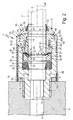
- the connecting device permits a connection, which is in particular fluid-tight, of a FIG. 2 in the connected state shown fluid line 2.
- the fluid line 2 is in particular a fluid hose, but may for example be designed as a rigid pipe or pipe section.
- connection device 1 is expediently provided with a fastening section 3, which allows its mounting, whether detachable or non-detachable, on a schematically indicated support component 4.
- the carrier component 4 is, for example, a housing of a fluidic component, for example a valve or a fluid-actuated drive. In the state of the fluid line 2 connected to the connecting device 1, a fluid connection between the line channel 5 formed in the fluid line 2 and a component channel 6 of the carrier component 4 is produced by the connecting device 1.
- the connecting device 1 has a housing body 8 which is elongate in the exemplary embodiment and has a longitudinal axis 7, which is penetrated in its longitudinal direction by a recess 12.
- the connected fluid line 2 is inserted in the recess 12.
- a length section of the recess 12 adjoining the inserted fluid line 2 forms a fluid channel 13, which establishes the connection between the line channel 5 and the component channel 6.
- the already mentioned attachment portion 3 is formed by a rear end portion of the housing body 8. He has in the embodiment via an external thread with which he is screwed into the support member 4. Alternatively, it may be configured, for example, for producing a non-releasable press-in connection.
- This is expediently formed integrally with the attachment portion 3.
- the connection portion has a cylindrical, in particular circular cylindrical outer contour.
- connection section 14 has a rear side 15 oriented toward the attachment section 3 and an axially opposite front side 16.
- the outer cross section of the connection section 14 is expediently larger than that of the attachment section 3, so that the transitional area between the connection section 14 and the attachment section 3 is stepped. Due to this gradation, the connection section 14 has at its rear side 15 an annular rear-side end face 17 that is oriented backwards and faces the optionally present carrier component.
- annular seal 18 can be placed coaxially on the attachment section 3, which rests sealingly on the rear end face 17 and on the other hand against the opposite surface of the carrier component 4 when the connection device 1 is mounted ,
- connection section 14 has an annular front end face 23 enclosing the opening 12 of the recess 12 there.
- connection section 14 has a longitudinal axis 24, which expediently coincides with the longitudinal axis 7 of the housing body 8.
- annular, in particular made of metal holding member 25 is arranged coaxially. Conveniently, it is immovably fixed in the axial direction with respect to the connection portion 14. It has a radially outer annular attachment portion 26, starting from the plurality of retaining claws 27 protrude radially inward.
- the retaining claws 27 are arranged distributed on the attachment portion 26 in its circumferential direction, so that the holding member 25 is designed similar to a claw. All holding claws 27 are resiliently pivotable, so that they are from the illustrated in solid lines, taken in the unactuated state basic position according to arrow 28 radially outwardly in a dash-dotted line indicated release position 32 are pivotable. This pivoting movement is reversible.
- the diameter of the retaining claws 27 together enclosed passage opening of the holding element 25 is smaller in the basic position than in the release position. In the basic position, it is in particular also smaller than the outer diameter of the fluid line 2 to be connected.
- a fluid line 2 to be connected is introduced into the recess 12 from the front side 16 and thereby inserted through the annular retaining element 25.
- the retaining claws 27 are acted upon by the fluid line 2 at its front side 33 facing the front side 33 and pivoted outward under spring elastic deformation according to arrow 28, so that they rest under prestress on the outer circumference of the fluid line 2.
- connection portion 14 For the preferred axially immovable fixation of the retaining element 25 with respect to the connection portion 14 provides the attachment portion 26. This is clamped in an annular retaining groove 34 which is formed jointly by an axially immovably inserted into the recess 12 mounting sleeve 35 and an axially immovable inserted into the mounting sleeve 35 support ring 36.
- the fastening sleeve 35 can protrude from the connection section 14 on the front side 16.
- the retaining claws 27 are shaped so that they already have an oblique course in the basic position, such that they extend from the annular mounting portion 26 obliquely radially inward and at the same time in the direction of the rear side 15.
- This shaping has the advantage that the clamping force exerted on the outer circumference of the fluid line 2 is amplified when a force directed axially outwards acts on the fluid line 2.
- annular line seal 37 is arranged coaxially in the recess 12 expediently.
- the same can be supported axially on the inside by a stepped support surface 38 formed by a step of the recess 12 and facing the mouth 22.
- Its inner diameter is chosen so that it is elastically expanded by an inserted fluid line 2 and comes with bias on the outer circumference of this fluid line 2 to the plant.
- a release sleeve 42 arranged coaxially with respect to the longitudinal axis 24 is present.
- the release sleeve 42 is arranged so that it is the support jaws 27 of the support member 25 upstream of the front side 16 and over an end face Bearing portion 43 which axially opposite the front surfaces 33 of the retaining claws 27.
- the release sleeve 42 emerges into the recess 12 at least part way from the front side 16, specifically into the vicinity of the retaining element 25, so that its end section facing the retaining element 25 forms the biasing section 43.
- the release sleeve 42 is axially displaceable relative to the housing body 8 and to the support member 25 in the axial direction of the longitudinal axis 24. This possibility of displacement is indicated by a double arrow at 44.
- the release sleeve 42 has a the Beauftschungsabêt 43 forming sleeve portion 45, with which it is guided relative to the housing body 8 to allow the displacement 44 linearly displaceable.
- the sliding guide is achieved by the mounting sleeve 35, in which the release sleeve 42 dips in the embodiment with its sleeve portion 45 axially displaceable.
- At least one of the sleeve portion 45 radially projecting securing projection 46 engages behind a housing fixed, formed in the embodiment of the mounting sleeve 35 stop surface 47, whereby the release sleeve 42 is secured against accidental withdrawal from the recess 12.
- the release sleeve 42 has a radially projecting from the sleeve portion 45 actuating portion 48.
- This is suitably annular and forms a coaxial with the longitudinal axis 24 annular projection.
- a groove-like contoured axial gap 52nd is a groove-like contoured axial gap 52nd
- the release sleeve 42 By acting in the direction of the back 15 impact on the release sleeve 42 and in particular the operating portion 48, the release sleeve 42 can be moved from the apparent in the drawing unactuated position in an axially further immersed in the recess 12 release position.
- the retaining claws 27 are lifted according to arrow 28 from the outer periphery of the inserted fluid line 2 or at least reduced in their respective bias voltage so that the fluid line 2 can be easily pulled out of the recess 12. Taking away the actuating force of the release sleeve 42 again, it is pushed back by the resiliently acting on them holding claws 27 in the unactuated position.
- the connecting device 1 is also provided with a protective sleeve 53, which reduces the soiling sensitivity and improves the ease of cleaning.
- protection and release unit 54 assembly The protective sleeve 53 is combined with the release sleeve 42 to a hereinafter referred to as protection and release unit 54 assembly so that they are coupled together in their possible movements and, in particular in the axial direction, always only uniformly displaceable.
- protection and release unit 54th a hereinafter referred to as protection and release unit 54 assembly
- the protective sleeve 53 is fixed to the release sleeve 42 by latching. This allows a very simple assembly. Appropriately, the protective sleeve 53 must be plugged only on the release sleeve 42 in the axial direction.
- connection device 1 either without or with protective sleeve 53.
- connection device 1 For applications in which there is no problem of contamination, one can spare the protective sleeve 53 and has a cost-producible connecting device 1 available. If, on the other hand, the protective function is desired, only the protective sleeve 53 needs to be snapped or snapped onto the release sleeve 52.
- the latching connection means are designed so that the latching connection under normal circumstances is no longer solvable. However, one can readily provide a releasable latching connection.
- the protective sleeve 53 extends from the actuating portion 48 under axial overlap of the connecting portion 14 in the direction of its rear side 15.
- the protective sleeve 53 surrounds both the above-described gap 52 and the overlapped longitudinal portion of the terminal portion 14 around, so along the entire extending in the circumferential direction outer periphery.
- the locking connection takes place on the part of the release sleeve 42 expediently on the actuating portion 48, which is particularly predestined for its radially projecting shape.
- the protective sleeve 53 is cup-shaped. It has a suitably substantially hollow cylindrical sleeve section 55 and a bottom section 56 arranged on an end face of the sleeve section 55, wherein the bottom portion has a central perforation referred to below as a bottom opening 57.
- the bottom portion 56 has a total of about an annular shape.
- the protective sleeve 53 in the embodiment has a formed in the transition region between the bottom portion 56 and the sleeve portion 55 on its inner circumference locking groove 63, which is preferably a concentric with the longitudinal axis 24 annular groove and the groove opening points radially inward.
- the release sleeve 42 engages with the radially outer annular edge portion 64 of the actuating portion 48 in the locking groove 63 and is thus fixed axially immovable with respect to the protective sleeve 53.
- the release sleeve 42 is supported with its operating portion 48 axially from the bottom portion 56 located upstream. In this way, a particularly stable connection between the two separate components 42, 53 results.
- the locking groove 63 has an outer groove flank 65a and a facing this, lying closer to the front side 16 inner groove flank 65b. With its outer edge portion 64 of the operating portion 48 dives between these two groove flanks 65a, 65b. It is useful in this context, when the outer groove flank 65a is formed directly from the bottom portion 56.
- actuation force F is introduced directly mounted in the protective sleeve 53 with mounted protective sleeve 53 and transmitted from the protective sleeve 53 to the latched with her release sleeve 42.
- the introduction of force can be done in particular by manual action on the outer surface of the bottom portion 56.
- the protective sleeve 53 is expediently conically designed on the outside, with a front outer surface section 66 widening starting from the bottom opening 57 in the direction of the sleeve section 45.
- the protective sleeve 53 expediently carries a sealing ring 67 provided for engagement on the outer circumference of the inserted fluid line 2.
- the sealing ring 67 is expediently attached to the bottom section 56 with respect to the bottom opening 57 arranged coaxial alignment.
- the sealing ring 67 is fixed by a snap connection, in particular by snapping into a retaining groove 68, which is formed on the inner circumference of the bottom opening 57.
- the sealing ring 67 can protrude beyond the bottom portion 56 on the axial side opposite the release sleeve 42, in which case it has, in particular, a radially elastic sealing lip 72, which seals well against the outer circumference can cling to an inserted fluid line 2.
- sealing ring 67 Other types of attachment for the sealing ring 67 would also be conceivable, for example cohesive connections and in particular an integral embodiment with the protective sleeve 53 in the context of a multi-component injection molding process.
- the protective sleeve 53 exerts an axial movement or displacement movement 44 when the protective and release unit 54 is actuated, and this movement must not be hindered by a carrier component 4 equipped with the connection device 1.
- the protective sleeve 53 is therefore designed such that it ends in the unactuated position of the release sleeve 42 at a distance in front of the end region of the connection section 14 defined by the rear end face 17. In this way, a gap of length "s" would remain without additional measures, which would favor the deposition of dirt particles.
- the protective sleeve 53 is coaxially preceded by an annular sealing unit 73 on the front side facing the rear side 15 of the connection section 14, which coaxially bridges or fills the gap.
- the sealing unit 73 can be axially deformed so that it can not block the sliding movement 44 of the protective sleeve 53. If the protective and release unit 54 is actuated, an axial compression of the one hand, at the front end portion 58 of the protective sleeve 53 and on the other hand supported on the support member 4 sealing unit 73 takes place, in particular in the dash-dotted in 74 indicated way reversible bulge radially outward or may bulge.
- the sealing unit 73 is suitably attached to the protective sleeve 53.
- it is integrally formed on the protective sleeve 53 in a multi-component injection molding process.
- it could also be snapped or glued, for example.
- connection device 1 Due to the annular seal 18 placed between the housing body 8 and the carrier component 4, a radial distance between the rear end face 17 of the connection section 14 and the carrier component 4, which is filled by said seal 18, results when the connection device 1 is mounted. It is therefore expedient to choose the axial length of the sealing unit 73 such that it projects beyond the connection section 14 on the rear side and also bridges the axial gap caused by the annular seal 18 until it bears against the carrier component 4.
- the sealing unit 73 could end at the rear end region of the connection section 14 or at the level of the rear end face 17.
- the sealing unit 73 may in this case have an L-shaped cross-section and have two legs, one of which faces the protective sleeve 53 and the other between the connection portion 14 and the support member 4 is immersed.
- the immersed sealing leg 75 can take over the function of the annular seal 18 or may, if necessary, the possibly still existing annular seal 18 overlap the back.
- the outer surface of the protective sleeve 53 is expediently formed smooth-surfaced, as is the outer surface of the sealing unit 73. In this way, a deposition of impurities is hindered and favors the drainage of cleaning fluid.
- the sealing unit 73 expediently has a hollow cylindrical shape. Its wall thickness corresponds in particular to that of the sleeve section 45.
- connection device 1 is to offer the possibility of connecting a plurality of fluid lines 2 to one another, a plurality of connection sections may be formed on the housing body 8, to which a holding element 25 and a protective and release unit 54 are respectively assigned in the illustrated sense.
- a connection device 1 can be designed for example as L-piece or T-piece.
Landscapes
- Engineering & Computer Science (AREA)
- General Engineering & Computer Science (AREA)
- Mechanical Engineering (AREA)
- Quick-Acting Or Multi-Walled Pipe Joints (AREA)
Applications Claiming Priority (1)
| Application Number | Priority Date | Filing Date | Title |
|---|---|---|---|
| DE102010008926.5A DE102010008926B4 (de) | 2010-02-23 | 2010-02-23 | Anschlussvorrichtung für eine Fluidleitung |
Publications (2)
| Publication Number | Publication Date |
|---|---|
| EP2362130A2 true EP2362130A2 (fr) | 2011-08-31 |
| EP2362130A3 EP2362130A3 (fr) | 2013-12-11 |
Family
ID=44063782
Family Applications (1)
| Application Number | Title | Priority Date | Filing Date |
|---|---|---|---|
| EP10015310.5A Withdrawn EP2362130A3 (fr) | 2010-02-23 | 2010-12-04 | Dispositif de raccordement pour une conduite de fluide |
Country Status (2)
| Country | Link |
|---|---|
| EP (1) | EP2362130A3 (fr) |
| DE (1) | DE102010008926B4 (fr) |
Families Citing this family (4)
| Publication number | Priority date | Publication date | Assignee | Title |
|---|---|---|---|---|
| DE102012003192A1 (de) * | 2012-02-17 | 2013-08-22 | Festo Ag & Co. Kg | Vakuum-Spannvorrichtung |
| WO2016041989A1 (fr) * | 2014-09-17 | 2016-03-24 | Parker Hannifin Manufacturing France Sas | Dispositif et procédé de raccordement pour tube chanfreiné |
| US10480698B2 (en) * | 2014-09-19 | 2019-11-19 | Kongsberg Automotive As | Tube connector |
| DE102024118564B4 (de) * | 2024-07-01 | 2026-03-05 | Festo Se & Co. Kg | Schlauchkupplung und Fluidelement |
Citations (6)
| Publication number | Priority date | Publication date | Assignee | Title |
|---|---|---|---|---|
| DE4002057A1 (de) | 1989-08-03 | 1991-02-07 | Voss Armaturen | Steckarmatur zum loesbaren anschluss von rohrleitungen |
| DE3905722C2 (fr) | 1989-01-25 | 1992-02-20 | Festo Kg, 7300 Esslingen, De | |
| EP0745801A1 (fr) | 1995-06-02 | 1996-12-04 | Kabushiki Kaisha Nihon Pisco | Raccord de tuyaux |
| DE10249958B3 (de) | 2002-10-26 | 2004-08-12 | Martin Biermann | Vorrichtung zum lösbaren Verbinden mit einem Ende einer röhrenartigen Leitung, insbesondere Schlauch-Schnellverbinder |
| DE60105440T2 (de) | 2000-10-26 | 2005-10-13 | Legris S.A. | Anschlussanordnung mit einer schnellkupplung zum verbinden von einem leitungsende mit einem anschlussteil und vorrichtung zum schutz der verbindung |
| EP0978679B1 (fr) | 1998-08-01 | 2006-05-24 | Festo AG & Co | Dispositif de connexion pour des conduits de fluide |
Family Cites Families (3)
| Publication number | Priority date | Publication date | Assignee | Title |
|---|---|---|---|---|
| GB8411713D0 (en) * | 1984-05-08 | 1984-06-13 | Gordon Brigitte | Connectors for pipes |
| GB9202268D0 (en) * | 1992-02-03 | 1992-03-18 | Guest John D | Improvements in or relating to tube couplings |
| DE19932602C2 (de) * | 1999-07-13 | 2002-07-11 | Voswinkel Kg | Rohrkupplung |
-
2010
- 2010-02-23 DE DE102010008926.5A patent/DE102010008926B4/de not_active Expired - Fee Related
- 2010-12-04 EP EP10015310.5A patent/EP2362130A3/fr not_active Withdrawn
Patent Citations (6)
| Publication number | Priority date | Publication date | Assignee | Title |
|---|---|---|---|---|
| DE3905722C2 (fr) | 1989-01-25 | 1992-02-20 | Festo Kg, 7300 Esslingen, De | |
| DE4002057A1 (de) | 1989-08-03 | 1991-02-07 | Voss Armaturen | Steckarmatur zum loesbaren anschluss von rohrleitungen |
| EP0745801A1 (fr) | 1995-06-02 | 1996-12-04 | Kabushiki Kaisha Nihon Pisco | Raccord de tuyaux |
| EP0978679B1 (fr) | 1998-08-01 | 2006-05-24 | Festo AG & Co | Dispositif de connexion pour des conduits de fluide |
| DE60105440T2 (de) | 2000-10-26 | 2005-10-13 | Legris S.A. | Anschlussanordnung mit einer schnellkupplung zum verbinden von einem leitungsende mit einem anschlussteil und vorrichtung zum schutz der verbindung |
| DE10249958B3 (de) | 2002-10-26 | 2004-08-12 | Martin Biermann | Vorrichtung zum lösbaren Verbinden mit einem Ende einer röhrenartigen Leitung, insbesondere Schlauch-Schnellverbinder |
Also Published As
| Publication number | Publication date |
|---|---|
| DE102010008926B4 (de) | 2014-12-31 |
| DE102010008926A1 (de) | 2011-08-25 |
| EP2362130A3 (fr) | 2013-12-11 |
Similar Documents
| Publication | Publication Date | Title |
|---|---|---|
| EP3399220B1 (fr) | Raccord rapide | |
| EP1250547B1 (fr) | Dispositif de raccord d'une conduite de fluide | |
| EP3114378B1 (fr) | Joint d'étanchéité | |
| DE4118463C2 (de) | Verbindungsanordnung für den Kühlkreislauf von Motoren | |
| DE102016205621B3 (de) | Anschlussvorrichtung für eine Fluidleitung und diesbezügliches Montageverfahren | |
| DE102012021683A1 (de) | Anschlussvorrichtung für mindestens eine Fluiddleitung | |
| EP0728979A1 (fr) | Raccord étanche entre un tuyau en matière plastique et une pièce de raccordement fabriquée en métal | |
| EP2998449B1 (fr) | Robinetterie sanitaire | |
| DE102008051888A1 (de) | Ventil für einen Behälter zur Abgabe von unter Druck stehendem Fluid | |
| DE202011001782U1 (de) | Frostsichere Auslaufarmatur | |
| WO2018108407A1 (fr) | Dispositif de raccordement pour conduite de fluide et procédé de montage correspondant | |
| DE29921406U1 (de) | Steckarmatur zum schnellen und lösbaren Anschluß von Druckmittel-Leitungen | |
| EP2362130A2 (fr) | Dispositif de raccordement pour une conduite de fluide | |
| EP3189263B1 (fr) | Dispositif de raccordement pour une conduite de fluide | |
| EP2542814B1 (fr) | Dispositif de raccordement pour une canalisation hydraulique | |
| EP2697524B1 (fr) | Ensemble de conduite des fluides équipé d'élément de fixation annulaire | |
| EP3529527B1 (fr) | Joint d'accouplement par emboîtement pour une conduite de fluide d'un moteur d'entraînement | |
| DE102010012523A1 (de) | Vorrichtung zum Verbinden mit einer Rohr- oder Schlauchleitung, insbesondere Klemmringverschraubung | |
| DE102007036732B3 (de) | Befestigungsclip | |
| EP2134994B1 (fr) | Dispositif de blocage d'un passage de fluide par une partie en forme de conduit au moyen d'un clapet antiretour, en particulier dans un appareil menager | |
| DE19653866B4 (de) | Schnellkupplung zum Anschließen einer Schlauchleitung | |
| AT401097B (de) | Dichtung zum flüssigkeitsdichten verbinden zweier rohre | |
| DE102014225280A1 (de) | Anschlussvorrichtung für eine Fluidleitung | |
| DE2551939C3 (de) | Konstruktion zum Verbinden eines elastischen Konstruktionselementes mit einem formstabilen Konstruktionselement | |
| DE202005005319U1 (de) | Steckverbindereinrichtung für hydraulische oder pneumatische Leitungssysteme |
Legal Events
| Date | Code | Title | Description |
|---|---|---|---|
| PUAI | Public reference made under article 153(3) epc to a published international application that has entered the european phase |
Free format text: ORIGINAL CODE: 0009012 |
|
| AK | Designated contracting states |
Kind code of ref document: A2 Designated state(s): AL AT BE BG CH CY CZ DE DK EE ES FI FR GB GR HR HU IE IS IT LI LT LU LV MC MK MT NL NO PL PT RO RS SE SI SK SM TR |
|
| AX | Request for extension of the european patent |
Extension state: BA ME |
|
| PUAL | Search report despatched |
Free format text: ORIGINAL CODE: 0009013 |
|
| AK | Designated contracting states |
Kind code of ref document: A3 Designated state(s): AL AT BE BG CH CY CZ DE DK EE ES FI FR GB GR HR HU IE IS IT LI LT LU LV MC MK MT NL NO PL PT RO RS SE SI SK SM TR |
|
| AX | Request for extension of the european patent |
Extension state: BA ME |
|
| RIC1 | Information provided on ipc code assigned before grant |
Ipc: F16L 37/091 20060101AFI20131105BHEP |
|
| 17P | Request for examination filed |
Effective date: 20140502 |
|
| RBV | Designated contracting states (corrected) |
Designated state(s): AL AT BE BG CH CY CZ DE DK EE ES FI FR GB GR HR HU IE IS IT LI LT LU LV MC MK MT NL NO PL PT RO RS SE SI SK SM TR |
|
| GRAP | Despatch of communication of intention to grant a patent |
Free format text: ORIGINAL CODE: EPIDOSNIGR1 |
|
| INTG | Intention to grant announced |
Effective date: 20170130 |
|
| STAA | Information on the status of an ep patent application or granted ep patent |
Free format text: STATUS: THE APPLICATION IS DEEMED TO BE WITHDRAWN |
|
| 18D | Application deemed to be withdrawn |
Effective date: 20170610 |