EP2362282A2 - Appareil et procédé pour cellules à vapeur alcalines - Google Patents
Appareil et procédé pour cellules à vapeur alcalines Download PDFInfo
- Publication number
- EP2362282A2 EP2362282A2 EP10190558A EP10190558A EP2362282A2 EP 2362282 A2 EP2362282 A2 EP 2362282A2 EP 10190558 A EP10190558 A EP 10190558A EP 10190558 A EP10190558 A EP 10190558A EP 2362282 A2 EP2362282 A2 EP 2362282A2
- Authority
- EP
- European Patent Office
- Prior art keywords
- chamber
- pathway
- alkali metal
- silicon wafer
- vapor
- Prior art date
- Legal status (The legal status is an assumption and is not a legal conclusion. Google has not performed a legal analysis and makes no representation as to the accuracy of the status listed.)
- Withdrawn
Links
Images


Classifications
-
- G—PHYSICS
- G04—HOROLOGY
- G04F—TIME-INTERVAL MEASURING
- G04F5/00—Apparatus for producing preselected time intervals for use as timing standards
- G04F5/14—Apparatus for producing preselected time intervals for use as timing standards using atomic clocks
Definitions
- Chip-Scale Atomic Clocks contain vapors of alkali metals - typically either rubidium (Rb) or cesium (Cs).
- a bichromatic (2 wavelength) optical field is sent through the vapor, exciting hyperfine transitions using a phenomena called coherent population trapping (CPT).
- CPT coherent population trapping
- a rubidium-based CSAC works by exciting the D1 hyperfine transition using a vcsel that is tuned to the broad absorption at 795nm and RF modulated at 3.417 GHz - precisely half the D1 transition frequency.
- Cs was preferred over Rb because readily available vcsels at 852nm could be used to excite hyperfine transitions in 133 CS vapors. More recently as 795nm vcsels have continued to mature, Rb has been gaining favor.
- Rubidium with its simpler Zeeman structure provides better S/N than Cs, and with its lower vapor pressure allows CSACs to operate at higher temperatures.
- Contaminants in the optical path of a Chip-Scale Atomic Clock can adversely affect the signal-to-noise (S/N) ratio and the temperature sensitivity of the CSAC.
- S/N signal-to-noise
- Embodiments of the present invention provide methods and systems for designs and processes that eliminate or significantly avoid the presence of contaminants in the optical path and will be understood by reading and studying the following specification.
- a vapor cell comprises a silicon wafer having defined within a first chamber, a second chamber, and a pathway connecting the first chamber to the second chamber; a first glass wafer anodically-bonded to a first surface of the silicon wafer; a second glass wafer anodically-bonded to an opposing second surface of the silicon wafer, wherein the first chamber defines an optical path through the vapor cell; and an alkali metal material deposited into the second chamber.
- the pathway connecting the first chamber to the second chamber is configured with a geometry that is at least partially inhibitive to alkali metal vapor flow.
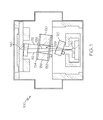
- FIG. 1 provides an illustration of a CSAC 100 of one embodiment of the present invention.
- CSAC 100 comprises a vertical cavity surface emitting laser 110(vcsel), a quarter wave plate (QWP)/ neutral density filter (NDF) 120, a vapor cell 130 and a photo detector 140.
- QWP quarter wave plate
- NDF neutral density filter
- anodic bonding is used during production of vapor cell 130 to seal optically clear glass wafers 132 and 134 (for example, Pyrex or similar glass) to a silicon wafer substrate 136.
- One benefit of using Pyrex type glasses for glass wafers 132 and 134 is that their structures include a significant quantity of mobile sodium ions.
- a first glass wafer 132 is initially bonded to a base side of the silicon wafer 136 after which the Rubidium, or other alkali metal (either in liquid or solid form) is deposited into an appropriate chamber (as detailed further below).
- the second glass wafer 134 is bonded to the opposing side of the silicon wafer 136 to form the vapor cell 130.
- the manufacturing equipment containing the components for vapor cell 130 is evacuated, after which the selected buffer gas is backfilled in.
- the bonding is completed to seal vapor cell 130, the alkali metal and optional buffering gas are trapped within the chambers defined within silicon wafer 136.
- FIG. 2 is a diagram illustrating a vapor cell 200 for a CSAC of one embodiment of the present invention.
- Vapor cell 200 comprises a silicon wafer 205 in which a first chamber 210, a second chamber 220 and at least one connecting pathway 215 are defined.
- the chambers 210, 220 and pathway 215 are sealed within Vapor cell 200 between glass wafers (such as glass wafers 132, 134) as described above for Figure 1 .
- the first chamber 210 comprises part of the optical path for the CSAC 100 and must be kept clean for the reasons described above.
- the Rubidium or other alkali metal (shown generally at 235) is deposited as a liquid or solid into the second chamber 220.
- Connecting pathway 215 establishes what can be characterized as a "tortuous path" (illustrated generally by 230) for the alkali metal vapor molecules to travel from the second chamber 220 to the first chamber 210.
- the particular connecting pathway 215 shown in the embodiment of Figure 2 comprises combinations of straight segments, right angle corner segments and curved segments.
- connecting pathway 215 slows the flow of alkali metal vapor molecules into the first chamber 210, during the anodic bonding process contaminants and precipitates are largely confined to the proximity of the second chamber 210. That is, any contaminants that may exist in the optically active first chamber 210 (e.g. water, 02, organics) will to some degree mingle and react with the alkali metal vapor, but that reaction will occur predominantly in or near to the second chamber 220 rather than in the optically active first chamber 210.
- any contaminants that may exist in the optically active first chamber 210 e.g. water, 02, organics
- the fact that the alkali atoms briefly stick to the chamber walls when they collide with the walls causes the net rate of migration of the alkali atoms from the second chamber 220 toward the first chamber 210 to be much slower than the net rate of migration of oxygen and water from first chamber 210 toward second chamber 220.
- the slow rate of migration of alkali atoms further ensures that most of the precipitates will be largely confined near the second chamber 220.
- the second chamber 220 is isolated from the connecting pathway 215 except for a shallow trench 245 (50um deep, for example) to further slow migration of alkali metal vapor from the second chamber 220.
- the second chamber 220 is hermetically isolated from the first chamber 210.
- the contaminants and precipitates that might react with the alkali metal vapor are largely confined to the second chamber 220.
- a portion of a wall (such as shown generally at 240) that separates the second chamber 220 from the connecting pathway 215, is obliterated using a laser to allow the alkali metal vapor to migrate to the first chamber 210.
- Figure 3 is a flow chart illustrating a method for one embodiment of the present invention.
- the method begins at 310 with forming within a silicon wafer, a first chamber, a second chamber, and a pathway connecting the first chamber to the second chamber.
- the silicon wafer is anodically bonded to a lower Pyrex or other transparent wafer, as further described for 330, below, thereby forming a floor for the chambers.
- the pathway connecting the first chamber to the second chamber is configured with a geometry that is at least partially inhibitive to alkali metal vapor flow.
- the term "at least partially inhibitive" is used to mean that the pathway slows the migration of alkali metal vapor through the path, but does not completely prevent such flow.
- the pathway comprises one or more right angle corner segments and/or curved segments in order to provide a geometry that is at least partially inhibitive to alkali metal vapor flow.
- the method further comprises forming a trench between with second chamber and the pathway, which in one embodiment is approximately 50um in depth. Because the path is at least partially inhibitive to alkali metal vapor flow, during the anodic bonding discussed below contaminants and precipitates are largely confined to the proximity of the second chamber, thus avoiding the formation of light blocking oxide contaminants in the first chamber.
- the method proceeds to 320 with depositing an alkali metal material into the second chamber.
- the alkali metal material can comprise either Rubidium or Cesium, and may be in either solid or liquid form.
- the method proceeds to 330 with sealing the first chamber, second chamber, and pathway by anodically-bonding a first glass wafer to a first surface of the silicon wafer, and a second glass wafer to an opposing second surface of the silicon wafer.
- the first chamber defines part of an optical path for the CSAC.
- the first chamber provides an optical path for laser light from vcsel 110 to photo detector 140.
- a glass wafer containing a mobile ion such as sodium is brought into contact with a silicon wafer, with an electrical contact to both the glass and silicon.
- This causes the sodium in the glass to move toward the negative electrode, and allows for more voltage to be dropped across the gaps between the glass and silicon, causing more intimate contact.
- oxygen ions are released from the glass and flow toward the silicon, and help to form a bridge between the silicon in the glass and the silicon in the silicon wafer.
- This joint can be very strong.
- the process can be operated with a wide variety of background gases and pressures, from well above atmospheric to high vacuum. Higher gas pressures improve heat transfer, and speed up the process. If the wafers are patterned with etched cavities, these cavities can have the desired gas sealed inside.
- the first chamber is hermetically isolated from the second chamber.
- contaminants and precipitates that might react with the alkali metal vapor are largely confined to the second chamber.
- a portion of a wall that separates the second chamber from the connecting pathway is obliterated, such as by using a laser for example. This allows the alkali metal vapor to migrate to the first chamber after boding is completed, avoiding formation of light blocking oxide material within the first chamber.
- embodiments of the present invention are not only limited to Chip-Scale Atomic Clock applications. Other applications for Alkali Vapor Cells are contemplated as within the scope of embodiments of the present invention.
Landscapes
- Physics & Mathematics (AREA)
- General Physics & Mathematics (AREA)
- Stabilization Of Oscillater, Synchronisation, Frequency Synthesizers (AREA)
- Apparatus Associated With Microorganisms And Enzymes (AREA)
Applications Claiming Priority (2)
| Application Number | Priority Date | Filing Date | Title |
|---|---|---|---|
| US30149710P | 2010-02-04 | 2010-02-04 | |
| US12/873,441 US20110187464A1 (en) | 2010-02-04 | 2010-09-01 | Apparatus and methods for alkali vapor cells |
Publications (2)
| Publication Number | Publication Date |
|---|---|
| EP2362282A2 true EP2362282A2 (fr) | 2011-08-31 |
| EP2362282A3 EP2362282A3 (fr) | 2011-11-02 |
Family
ID=44202083
Family Applications (1)
| Application Number | Title | Priority Date | Filing Date |
|---|---|---|---|
| EP10190558A Withdrawn EP2362282A3 (fr) | 2010-02-04 | 2010-11-09 | Appareil et procédé pour cellules à vapeur alcalines |
Country Status (4)
| Country | Link |
|---|---|
| US (1) | US20110187464A1 (fr) |
| EP (1) | EP2362282A3 (fr) |
| JP (1) | JP2012013671A (fr) |
| IL (1) | IL209260A0 (fr) |
Families Citing this family (18)
| Publication number | Priority date | Publication date | Assignee | Title |
|---|---|---|---|---|
| US8941442B2 (en) | 2010-02-04 | 2015-01-27 | Honeywell International Inc. | Fabrication techniques to enhance pressure uniformity in anodically bonded vapor cells |
| US8299860B2 (en) | 2010-02-04 | 2012-10-30 | Honeywell International Inc. | Fabrication techniques to enhance pressure uniformity in anodically bonded vapor cells |
| US8624682B2 (en) | 2011-06-13 | 2014-01-07 | Honeywell International Inc. | Vapor cell atomic clock physics package |
| US8837540B2 (en) * | 2011-06-29 | 2014-09-16 | Honeywell International Inc. | Simple, low power microsystem for saturation spectroscopy |
| EP2746876B1 (fr) * | 2012-10-29 | 2019-04-10 | Honeywell International Inc. | Techniques de fabrication pour améliorer l'uniformité de la pression dans des cellules de vapeur anodiquement liées et struktur plaquette correspondante |
| JP6135308B2 (ja) * | 2012-11-21 | 2017-05-31 | 株式会社リコー | アルカリ金属セル、原子発振器及びアルカリ金属セルの製造方法 |
| CN103633535B (zh) * | 2013-05-03 | 2016-08-03 | 中国科学院电子学研究所 | 一种碱金属蒸气室及其装配制作方法 |
| JP6171748B2 (ja) | 2013-09-05 | 2017-08-02 | セイコーエプソン株式会社 | 原子セル、量子干渉装置、原子発振器、電子機器および移動体 |
| JP6484922B2 (ja) * | 2014-03-20 | 2019-03-20 | セイコーエプソン株式会社 | 原子セル、量子干渉装置、原子発振器および電子機器 |
| JP2016207695A (ja) | 2015-04-15 | 2016-12-08 | セイコーエプソン株式会社 | 原子セル、原子セルの製造方法、量子干渉装置、原子発振器、電子機器および移動体 |
| JP6672615B2 (ja) * | 2015-05-28 | 2020-03-25 | セイコーエプソン株式会社 | 電子デバイス、量子干渉装置、原子発振器および電子機器 |
| US10295488B2 (en) * | 2016-01-11 | 2019-05-21 | Texas Instruments Incorporated | Sensor fluid reservoirs for microfabricated sensor cells |
| JP2017183377A (ja) | 2016-03-29 | 2017-10-05 | セイコーエプソン株式会社 | 量子干渉装置、原子発振器、電子機器および移動体 |
| EP3244269B1 (fr) | 2016-05-11 | 2021-12-15 | CSEM Centre Suisse d'Electronique et de Microtechnique SA - Recherche et Développement | Cellule de vapeur alcaline |
| JP2017208559A (ja) * | 2017-07-05 | 2017-11-24 | セイコーエプソン株式会社 | 原子セル、量子干渉装置、原子発振器、電子機器および移動体 |
| US10859980B2 (en) * | 2017-12-29 | 2020-12-08 | Texas Instruments Incorporated | Molecular atomic clock with wave propagating rotational spectroscopy cell |
| JP2019193238A (ja) | 2018-04-27 | 2019-10-31 | セイコーエプソン株式会社 | 原子発振器および周波数信号生成システム |
| JP2020167591A (ja) * | 2019-03-29 | 2020-10-08 | セイコーエプソン株式会社 | 原子発振器および周波数信号生成システム |
Family Cites Families (5)
| Publication number | Priority date | Publication date | Assignee | Title |
|---|---|---|---|---|
| US6570459B1 (en) * | 2001-10-29 | 2003-05-27 | Northrop Grumman Corporation | Physics package apparatus for an atomic clock |
| US7400207B2 (en) * | 2004-01-06 | 2008-07-15 | Sarnoff Corporation | Anodically bonded cell, method for making same and systems incorporating same |
| US7666485B2 (en) * | 2005-06-06 | 2010-02-23 | Cornell University | Alkali metal-wax micropackets for alkali metal handling |
| US7893780B2 (en) * | 2008-06-17 | 2011-02-22 | Northrop Grumman Guidance And Electronic Company, Inc. | Reversible alkali beam cell |
| US7902927B2 (en) * | 2008-06-18 | 2011-03-08 | Sri International | System and method for modulating pressure in an alkali-vapor cell |
-
2010
- 2010-09-01 US US12/873,441 patent/US20110187464A1/en not_active Abandoned
- 2010-11-09 EP EP10190558A patent/EP2362282A3/fr not_active Withdrawn
- 2010-11-11 IL IL209260A patent/IL209260A0/en unknown
- 2010-11-15 JP JP2010254879A patent/JP2012013671A/ja not_active Withdrawn
Also Published As
| Publication number | Publication date |
|---|---|
| IL209260A0 (en) | 2011-02-28 |
| US20110187464A1 (en) | 2011-08-04 |
| JP2012013671A (ja) | 2012-01-19 |
| EP2362282A3 (fr) | 2011-11-02 |
Similar Documents
| Publication | Publication Date | Title |
|---|---|---|
| EP2362282A2 (fr) | Appareil et procédé pour cellules à vapeur alcalines | |
| EP2362281B1 (fr) | Techniques de fabrication pour améliorer l'uniformité de la pression dans des cellules de vapeur anodiquement liées | |
| Liew et al. | Microfabricated alkali atom vapor cells | |
| US9498777B2 (en) | Cells having cavities and the manufacture and use of the same | |
| JP6031787B2 (ja) | 原子発振器の製造方法 | |
| JP6685565B2 (ja) | ガスセル、原子時計および原子センサ | |
| CN103941576A (zh) | 基于mems技术的原子气体腔器件及其制造方法 | |
| EP3112315B1 (fr) | Procédé de remplissage de cellules d'absorption d' un csac avec un métal alcalin à haute pureté | |
| CN103955129A (zh) | 具有双反射镜的微型原子气体腔器件及其制造方法 | |
| CN116930624A (zh) | 一种异型碱金属原子气室结构及其制备方法 | |
| US12449595B2 (en) | Integrated vacuum cell assemblies | |
| WO2021005051A1 (fr) | Cellule à vapeur | |
| CN103792838B (zh) | 用以增强阳极键合蒸气室中的压力均匀性的制造技术 | |
| CN103941577A (zh) | 具有双反射镜和凹槽形结构的原子气体腔器件及其制造方法 | |
| Liew et al. | Micromachined alkali atom vapor cells for chip-scale atomic clocks | |
| US20250189934A1 (en) | Microfabricated alkaline earth vapor cell and method of fabrication | |
| CN203950129U (zh) | 基于mems技术的原子气体腔器件 | |
| Gorecki | Development of first European chip-scale atomic clocks: Technologies, assembling and metrology | |
| Kazakin et al. | Microfabrication of Alkali Vapor MEMS Cells for chip-scale atomic clock | |
| US20230412178A1 (en) | Metal-gas-filled cell and method for manufacturing the same | |
| Komarevtsev et al. | Single-step alkaline etching of deep silicon cavities for chip-scale atomic clock technology | |
| US12602016B2 (en) | Chip-scale atomic beam generating systems | |
| US20260079451A1 (en) | Metal-gas-filled cell | |
| CN203720553U (zh) | 一种碱金属谐振器 | |
| CN102838080B (zh) | 三维光子限制光学微腔结构及其制备方法 |
Legal Events
| Date | Code | Title | Description |
|---|---|---|---|
| PUAI | Public reference made under article 153(3) epc to a published international application that has entered the european phase |
Free format text: ORIGINAL CODE: 0009012 |
|
| 17P | Request for examination filed |
Effective date: 20101109 |
|
| AK | Designated contracting states |
Kind code of ref document: A2 Designated state(s): AL AT BE BG CH CY CZ DE DK EE ES FI FR GB GR HR HU IE IS IT LI LT LU LV MC MK MT NL NO PL PT RO RS SE SI SK SM TR |
|
| AX | Request for extension of the european patent |
Extension state: BA ME |
|
| PUAL | Search report despatched |
Free format text: ORIGINAL CODE: 0009013 |
|
| AK | Designated contracting states |
Kind code of ref document: A3 Designated state(s): AL AT BE BG CH CY CZ DE DK EE ES FI FR GB GR HR HU IE IS IT LI LT LU LV MC MK MT NL NO PL PT RO RS SE SI SK SM TR |
|
| AX | Request for extension of the european patent |
Extension state: BA ME |
|
| RIC1 | Information provided on ipc code assigned before grant |
Ipc: G04F 5/14 20060101AFI20110923BHEP |
|
| 17Q | First examination report despatched |
Effective date: 20111019 |
|
| STAA | Information on the status of an ep patent application or granted ep patent |
Free format text: STATUS: THE APPLICATION IS DEEMED TO BE WITHDRAWN |
|
| 18D | Application deemed to be withdrawn |
Effective date: 20120301 |