EP2362479A1 - Système de stockage d'énergie - Google Patents
Système de stockage d'énergie Download PDFInfo
- Publication number
- EP2362479A1 EP2362479A1 EP11156022A EP11156022A EP2362479A1 EP 2362479 A1 EP2362479 A1 EP 2362479A1 EP 11156022 A EP11156022 A EP 11156022A EP 11156022 A EP11156022 A EP 11156022A EP 2362479 A1 EP2362479 A1 EP 2362479A1
- Authority
- EP
- European Patent Office
- Prior art keywords
- electric power
- assembled battery
- amount
- storage system
- discharged
- Prior art date
- Legal status (The legal status is an assumption and is not a legal conclusion. Google has not performed a legal analysis and makes no representation as to the accuracy of the status listed.)
- Withdrawn
Links
- 238000007599 discharging Methods 0.000 claims abstract description 53
- 238000006243 chemical reaction Methods 0.000 claims description 4
- HBBGRARXTFLTSG-UHFFFAOYSA-N Lithium ion Chemical compound [Li+] HBBGRARXTFLTSG-UHFFFAOYSA-N 0.000 description 3
- 230000003203 everyday effect Effects 0.000 description 3
- 229910001416 lithium ion Inorganic materials 0.000 description 3
- 238000010248 power generation Methods 0.000 description 3
- PXHVJJICTQNCMI-UHFFFAOYSA-N Nickel Chemical compound [Ni] PXHVJJICTQNCMI-UHFFFAOYSA-N 0.000 description 2
- 230000015556 catabolic process Effects 0.000 description 2
- 238000006731 degradation reaction Methods 0.000 description 2
- 238000000034 method Methods 0.000 description 2
- UFHFLCQGNIYNRP-UHFFFAOYSA-N Hydrogen Chemical compound [H][H] UFHFLCQGNIYNRP-UHFFFAOYSA-N 0.000 description 1
- 238000004378 air conditioning Methods 0.000 description 1
- 238000004891 communication Methods 0.000 description 1
- 230000002354 daily effect Effects 0.000 description 1
- 238000001514 detection method Methods 0.000 description 1
- 239000007789 gas Substances 0.000 description 1
- 229910052739 hydrogen Inorganic materials 0.000 description 1
- 239000001257 hydrogen Substances 0.000 description 1
- 229910052759 nickel Inorganic materials 0.000 description 1
Images

Classifications
-
- H—ELECTRICITY
- H01—ELECTRIC ELEMENTS
- H01M—PROCESSES OR MEANS, e.g. BATTERIES, FOR THE DIRECT CONVERSION OF CHEMICAL ENERGY INTO ELECTRICAL ENERGY
- H01M10/00—Secondary cells; Manufacture thereof
- H01M10/42—Methods or arrangements for servicing or maintenance of secondary cells or secondary half-cells
- H01M10/4207—Methods or arrangements for servicing or maintenance of secondary cells or secondary half-cells for several batteries or cells simultaneously or sequentially
-
- H—ELECTRICITY
- H01—ELECTRIC ELEMENTS
- H01M—PROCESSES OR MEANS, e.g. BATTERIES, FOR THE DIRECT CONVERSION OF CHEMICAL ENERGY INTO ELECTRICAL ENERGY
- H01M10/00—Secondary cells; Manufacture thereof
- H01M10/42—Methods or arrangements for servicing or maintenance of secondary cells or secondary half-cells
- H01M10/44—Methods for charging or discharging
- H01M10/441—Methods for charging or discharging for several batteries or cells simultaneously or sequentially
-
- Y—GENERAL TAGGING OF NEW TECHNOLOGICAL DEVELOPMENTS; GENERAL TAGGING OF CROSS-SECTIONAL TECHNOLOGIES SPANNING OVER SEVERAL SECTIONS OF THE IPC; TECHNICAL SUBJECTS COVERED BY FORMER USPC CROSS-REFERENCE ART COLLECTIONS [XRACs] AND DIGESTS
- Y02—TECHNOLOGIES OR APPLICATIONS FOR MITIGATION OR ADAPTATION AGAINST CLIMATE CHANGE
- Y02E—REDUCTION OF GREENHOUSE GAS [GHG] EMISSIONS, RELATED TO ENERGY GENERATION, TRANSMISSION OR DISTRIBUTION
- Y02E60/00—Enabling technologies; Technologies with a potential or indirect contribution to GHG emissions mitigation
- Y02E60/10—Energy storage using batteries
Definitions
- the present invention relates to a power storage system including an assembled battery which is chargeable and dischargeable.
- a system including a storage battery which is connected to a commercial electric power system so that the storage battery is charged with commercial electric power supplied from the system during nighttime and is discharged to supply electric power during daytime (for example, refer to JP-A-2006-149037 ).
- the storage battery In general, in the system using the above storage battery, the storage battery is charged up to the rating capacity (fully charged) everyday.
- daytime electric power demand significantly varies with seasons or the other various factors, and the capacity of the storage battery is often determined based at a point in time with a large demand as a standard. Therefore, in practice, it is not the case that the storage battery needs to be fully charged everyday, and it is likely that the storage battery stores a larger amount of electric power than required.
- a power storage system comprising: an assembled battery which is chargeable and dischargeable and is comprised of a plurality of battery modules; a control apparatus that controls the power storage system to perform a charging mode in which the assembled battery is charged in a first predetermined time period and a discharging mode in which the assembled battery is discharged in a second predetermined time period; a residual electric power amount determination unit that detects an amount of one of electric current and electric power currently remaining in the assembled battery; and a discharged electric power amount determination unit that detects an amount of one of electric current and electric power discharged from the assembled battery during the second predetermined time period in which the discharging mode is performed, wherein the control apparatus estimates an amount of one of electric current and electric power being charged to the assembled battery during a next first predetermined time period in which the charging mode is to be performed based on amounts of one of electric current and electric power having been discharged from the assembled battery during past second predetermined time periods
- control apparatus may control the power storage system to alternately perform the charging mode and the discharging mode.
- the first predetermined time period may be overlapped with at least a time period in nighttime.
- the correction control unit may add a minimum value of an amount of one of electric current and electric power to be remained in the assembled battery to the estimated amount and then compare the sum with the amount of one of electric current and electric power currently remaining in the assembled battery.
- the correction control unit may control the power storage system not to perform the charging mode in the next first predetermined time period if the amount of one of electric current and electric power currently remaining in the assembled battery, detected by the residual electric power amount determination unit is equal to or more than half of a full capacity of the assembled battery.
- the discharged electric power amount determination unit may detect the amount of one of electric current and electric power discharged from the assembled battery during the second predetermined time period based on the amount of one of electric current and electric power remaining in the assembled battery at the beginning of the second predetermined time period, detected by the residual electric power amount determination unit and the amount of one of electric current and electric power remaining in the assembled battery at the end of the first predetermined time period, detected by the residual electric power amount determination unit, and the control apparatus may obtain the estimated value based on an average value of the amounts of one of electric current and electric power having been discharged from the assembled battery during the past second predetermined time periods, detected by the discharged electric power amount determination unit and a standard deviation thereof.
- the power storage system may further comprises a charging circuit that charged the assembled battery with electric power supplied from a system; and at least one of a conversion circuit that converts the electric power charged in the assembled battery to an alternating current with a frequency corresponding to an alternating load and then supplies the alternating current to the alternating load, and a conversion circuit that converts the electric power charged in the assembled battery to a voltage corresponding to a direct load and then supplies the voltage to the direct load, wherein the power storage system repeatedly performs the charging mode and the discharging mode.
- the present invention it is possible to optimize the amount of electric power to be charged in the storage battery by determining the amount of electric power to be charged according to electric power demand. In addition, it is possible to extend the service life of the storage battery by suppressing the number of times of charging and discharging in the storage battery.
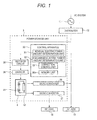
- Fig. 1 is a schematic view illustrating the configuration of the power storage system 1 according to an embodiment to which the present invention is applied.
- the power storage system 1 illustrated in Fig. 1 is provided with a commercial electric power system 11 supplied by a grid and a power storage unit 3 including an assembled battery 4 which is to be charged with electric power supplied from the commercial electric power system 11.
- the commercial electric power system 11 is connected to the power storage unit 3 and an AC load 13 which is operated by alternating current power through a distributor 12 including a current-limiting breaker and a reverse current flow preventer which are now shown.
- the commercial electric power system 11 supplies an alternating current power to the power storage unit 3 and the AC load 13.
- Examples of the AC load 13 include lighting apparatuses, air conditioning apparatuses, office equipment, a variety of electric home appliances.
- the power storage unit 3 includes the assembled battery 4 and a charger 34 that charges the assembled battery 4, and the charger 34 is connected to the commercial electric power system 11 through a rectifier circuit 35.
- the rectifier circuit 35 converts an alternating current power from the commercial electric power system 11 to a direct current and supplies the direct current to the charger 34, and the charger 34 charges the assembled battery 4 with the direct current.
- the charger 34 and the rectifier circuit 35 constitute a charging circuit of the assembled battery 4.
- the assembled battery 4 includes a plurality of battery modules 41 which are connected to each other in series and/or parallel and a controller 42 that monitors the temperature or voltage of the battery modules 41 or the electric current in the assembled battery 4.
- the battery modules 41 are secondary battery modules such as a lithium ion battery, a nickel hydrogen battery or the like, and the embodiment will describe a case in which the lithium ion battery modules are used.
- the controller 42 detects the temperature of the batter modules 41 and stops charging and discharging when the detected temperature is above a predetermined value.
- the controller 42 also detects the voltage between both ends of the plurality of battery modules 41 connected in series, calculates the Relative State Of Charge (RSOC) based on the detected voltage values or electric current values and outputs the measured values, RSOC data or the like to an external control unit which is connected to the assembled battery 4.
- RSOC Relative State Of Charge
- a DC/AC converter 36 is connected to the assembled battery 4, and the direct current power discharged from the assembled battery 4 is converted to an alternating current by the DC/AC converter 36 and then output to the AC load 13.
- a DC/DC converter 37 is connected to the assembled battery 4 and direct current power from the assembled battery 4 is converted to direct current power with a predetermined voltage through the DC/DC converter 37 and then is supplied to a DC load 14. Examples of the DC load 14 include a direct current home appliance which is operated by the direct current power.
- the power storage unit 3 includes a control apparatus 30 that controls charging and discharging of the assembled battery 4.
- the power storage unit 3 alternately performs a charging mode in which the assembled battery 4 is charged with the electric power supplied from the system during nighttime and a discharging mode in which the assembled battery 4 is discharged mainly during a time period in which the electric power demand of the AC load 13 and the DC load 14 increases.
- the control apparatus 30 is set to perform the charging mode during a time period in which electric power demand is relatively small (for example, from 11 pm to 7 am or from 10 pm to 8 am).
- it is set to perform the discharging mode during other than the time period in which the charging mode is performed (for example, from 7 am to 11 pm or from 8 am to 10 pm).
- the control apparatus 30 includes a residual electric power amount determination unit 31 that obtains the residual capacity of stored electric charges (and/or stored electric power amount) in the assembled battery 4, a discharged electric power amount determination unit 32 that obtains the amount of electric power and/or the amount of electric current discharged from the assembled battery 4 based on the residual capacity of the assembled battery 4, obtained by the residual electric power amount determination unit 31 when finishing the charging mode and the residual capacity of the assembled battery 4, obtained by the residual electric power amount determination unit 31 when starting the next charging mode, a correction control unit 33 that controls the charging operation of the assembled battery 4 based on the amount of electric power and/or the amount of electric current obtained by the discharged electric power amount determination unit 32, and a memory unit 30a that stores the residual capacity of the assembled battery 4, obtained by the residual electric power amount determination unit 31 and the amount of discharged electric power and/or the amount of discharged electric current obtained by the discharged electric power amount determination unit 32.
- the control apparatus 30 includes a clock so that the residual electric power amount determination unit 31, the discharged electric power amount determination unit 32 and
- the discharged electric power amount determination unit 32 obtains the amount of electric power and/or the amount of electric current discharged from the assembled battery 4 and the correction control unit 33 controls the charging operation of the assembled battery 4 based on the amount of electric power and/or the amount of electric current obtained by the discharged electric power amount determination unit 32, in the present embodiment to be described below, the case of performing the operation based on the amount of electric power discharged from the assembled battery 4 will be described. However, it is definitely possible to perform the operation based on the amount of electric current discharged from the assembled battery 4.
- the residual electric power amount determination unit 31 obtains the RSOC data output from the controller 42 in the assembled battery 4 at the beginning of the charging mode or before and after thereof, and at the end of the charging mode, before and after thereof, or at the time of completing charging so as to detect and determine the residual capacity of the assembled battery 4.
- the residual electric power amount determination unit 31 stores the residual capacity of the assembled battery 4 together with detection times in the memory unit 30a.
- the discharged electric power amount determination unit 32 obtains the residual capacity of the assembled battery 4, detected by the residual electric power amount determination unit 31 and stored in the memory unit 30a and calculates the difference between the residual capacity detected at the end of the charging mode and the residual capacity detected at the beginning of the charging mode for that night so as to obtain the amount of electric power discharged. What is obtained herein is the amount of electric power discharged in the discharging mode for a single day, and the discharged electric power amount determination unit 32 stores the obtained amount of electric power discharged in the memory unit 30a with the corresponding date.
- the memory unit 30a is capable of storing the amount of electric power discharged everyday for at least a week (for 7 days).
- the correction control unit 33 performs a calculation treatment based on the amounts of electric power discharged for recent several days, which are stored in the memory unit 30a, and estimates the amount of electric power discharged for the next day to obtain an estimated value. Specifically, the average value of the amounts of electric power discharged for recent 7 days and the standard deviation thereof are obtained, and the estimated value is obtained by summing the average value and the standard deviation. Since the estimated value includes the standard deviation which corresponds to a variation range added to the average value of the amount of electric power discharged, it is possible to reduce the risk of the estimated value falling significantly below the actual amount of electric power discharged.
- the correction control unit 33 compares the estimated value of the amount of electric power discharged for the next day (i.e. the sum of the average value and the standard deviation) and the residual capacity of the assembled battery 4. If the residual capacity of the assembled battery 4 is equal to or more than the estimated value, the correction control unit 33 controls the power storage unit 3 not to perform the charging mode in the time period of the corresponding day, in which the charging mode is supposed to be performed. More specifically, the correction control unit 33 compares a value obtained by adding the minimum residual amount of the assembled battery 4 to the estimated value of the amount of electric power discharged for the next day with the residual capacity of the assembled battery 4, and does not perform the charging mode if the residual capacity of the assembled battery 4 is equal to or more than the value.
- the minimum residual amount of the assembled battery 4 refers to a residual capacity which is set as a residual capacity that has to be remained in the battery modules 41 at all times.
- a battery (particularly, lithium ion battery) used for the battery modules 41 becomes degraded with charging and discharging cycles to the extent of the amount of charge. Therefore, in the power storage system 1, a minimum residual amount (a minimum value of an amount of electric power to be remained in the assembled battery 4) is set in advance to prevent the depth of discharge from deepening excessively while the charging mode and the discharging mode are performed alternately, and the correction control unit 33 controls the charging operation such that the residual capacity of the assembled battery 4 does not fall below the set minimum residual amount. Thereby, it is possible to effectively postpone degradation of the battery module 41 and thus achieve a longer service life.
- Fig. 2 is a flowchart illustrating the operation of the control apparatus 30 of the power storage system.
- the operation illustrated in Fig. 2 is started at or before the beginning of the charging mode (the charging starting time).
- the capacity of the assembled battery 4 is represented by the letter C
- the residual capacity of the assembled battery 4 at the charging starting time which is obtained by the residual electric power amount determination unit 31 is represented by the letters C R
- the residual capacity of the assembled battery 4 at the charging finishing time which is obtained by the residual electric power amount determination unit 31 is represented by the letters C S
- the amount of electric power used in the discharging mode of a single day which is obtained by the discharged electric power amount determination unit 32 is represented by the letters P E
- the average amount of electric power used obtained by the correction control unit 33 from the amounts of electric power used for a plurality of days is represented by the letters P EA
- the standard deviation thereof is represented by the letter ⁇ .
- the residual electric power amount determination unit 31 in the control apparatus 30 obtains the residual capacity C R of the assembled battery 4 at the charging starting time (for example, at 11 pm) and stores the C R in the memory unit 30a (Step S1).
- the discharged electric power amount determination unit 32 calculates the amount of electric power used P E in the discharging mode of the corresponding day based on the residual capacity C R at the charging starting time detected and stored in the memory unit 30a by the residual electric power amount determination unit 31 and the residual capacity C S detected at the charging finishing time of the corresponding day (for example, at 7 am) and stored in the memory unit 30a by the residual electric power amount determination unit 31 and stores the P E in the memory unit 30a with the corresponding date (Step S2).
- the correction control unit 33 in the control apparatus 30 determines whether the memory unit 30a stores the data of the amount of electric power used P E for more than 7 days (Step S3).
- the correction control unit 33 controls the charger 34 to fully charge the assembled battery 4 (Step 4).
- the residual electric power amount determination unit 31 obtains the residual capacity C S of the assembled battery 4 at the time of finishing the charging mode or when actually finishing charging, and stores the residual capacity C S in the memory unit 30a (Step S5), whereby the power storage system 1 finishes the operation of Fig. 2 and moves to the discharging mode.
- the correction control unit 33 calculates the average amount of electric power used P EA which is the average value of the amounts of electric power used for 7 days and, furthermore, calculates the standard deviation ⁇ of the amounts of electric power used P E for 7 days based on the calculated average amount of electric power used P EA and the amount of electric power used P E for each of the 7 days (Step S7), and then the correction control unit 33 places a flag indicating the presence of the study data of the amount of electric power used P E stored in the memory unit 30a (Step S8).
- the correction control unit 33 determines whether the average amount of electric power used P EA is equal to or more than half of the capacity C of the assembled battery 4 (Step S9). In a case in which the average amount of electric power used P EA is equal to or more than half of the capacity C of the assembled battery 4 (Step S9; Yes), the residual capacity C R of the assembled battery 4 at the charging starting time is just less than half of the full capacity C of the assembled battery 4 so that there is a concern in that, if the assembled battery 4 will not be charged, electric power would be insufficient in the discharging mode of the next day. Therefore, the correction control unit 33 moves to Step S4 and fully charges the assembled battery 4.
- the correction control unit 33 determines whether the average amount of electric power used P EA with the standard deviation ⁇ added thereto is equal to or more than half of the capacity C (Step S10).
- a value of "the average amount of electric power used P EA + the standard deviation ⁇ " refers to a value of the average value with the standard deviation added thereto and is equivalent to the estimated value of electric power used in the discharging mode of the next day.
- the estimated value is set to a value taking the variation in the amount of electric power used daily into consideration so that the estimated value does not become a value excessively lower than the actual amount of electric power used.
- the correction control unit 33 determines whether the average amount of electric power used P EA with the standard deviation ⁇ and the minimum residual amount ⁇ of the assembled battery 4 added thereto is equal to or less than the residual capacity C R at the charging starting time (Step S11). The correction control unit 33 adds the minimum residual amount ⁇ when performing the comparison in order to prevent the depth of discharging of the assembled battery 4 from excessively deepening.
- the correction control unit 33 controls the power storage unit 3 and the charger 34 not to perform charging of the assembled battery 4. After that, the control apparatus 30 moves to Step S5 so as to detect the residual capacity C S and store the C S stored in the memory unit 30a, and then moves to the discharging mode.
- the correction control unit 33 may not only compare the residual capacity C R and the sum of "the average amount of electric power used P EA + the standard deviation ⁇ + the minimum residual amount ⁇ " but also simply determine whether the residual capacity C R is equal to or more than half of the capacity C. In this case, since the residual capacity C R is evidently larger than the estimated value of the amount of electric power used for the next day, the correction control unit 33 moves to Step S12 and performs a control of not performing charging of the assembled battery 4.
- Step S11 the correction control unit 33 moves to Step S4 and fully charges the assembled battery 4.
- the residual capacity C R is insufficient with respect to the estimated value of the amount of electric power used for the next day, and the short amount is smaller than twice the standard deviation ⁇ .
- the correction control unit 33 charges the assembled battery 4 with an amount of electric power as much as twice the standard deviation ⁇ (Step S 13) and moves to Step 5.
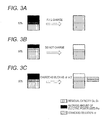
- Figs. 3A to 3C are schematic views illustrating specific examples of charging operations performed by the power storage system 1 with controls of the correction control unit 33.
- the residual capacities C R and C S , average amount of electric power used P EA and standard deviation ⁇ of the assembled battery 4 are respectively expressed by hatched rectangular areas.
- the correction control unit 33 moves to the discharging mode without charging the assembled battery 4 in Step S12.
- the correction control unit 33 charges the assembled battery 4 with an amount of electric power as much as twice the standard deviation ⁇ in Step S13.
- the power storage system 1 including: the assembled battery 4 which is chargeable and dischargeable and is comprised of a plurality of battery modules 41; the control apparatus 30 that controls the power storage system 1 to perform a charging mode in which the assembled battery 4 is charged in a first predetermined time period and a discharging mode in which the assembled battery 4 is discharged in a second predetermined time period; the residual electric power amount determination unit 31 that detects the amount of electric power currently remained in the assembled battery 4; the discharged electric power amount determination unit 32 that detects the amount of electric power discharged from the assembled battery 4 during the second predetermined period in which the discharging mode is performed.
- the control apparatus 30 estimates the amount of electric power discharged from the assembled battery 4 during a next second predetermined time period in which the discharging mode is to be performed based on amounts of electric power having been discharged from the assembled battery 4 during past second predetermined time period in which the discharging mode has been performed, detected by the discharged electric power amount determination unit 32.
- the correction control unit 33 controls the power storage system 1 not to perform the charging mode in a next first predetermined time period if the estimated value is less than the amount of electric power currently remained in the assembled battery 4, detected by the residual electric power amount determination unit 31.
- the control apparatus 30 estimates an amount of electric power to be discharged in the discharging mode for the next day based on the residual capacity C R of the assembled battery 4 which has been obtained by the residual electric power amount determination unit 31, and, in a case in which the estimated value is less than the residual amount of electric power in the assembled battery 4, the correction control unit 33 controls the power storage system 1 not to perform charging even at the next first predetermined time period in which the charging mode is to be performed. Therefore, it is possible to optimize the amount of electric power to be charged in the assembled battery 4 by suppressing the amount of electric power to be charged according to electric power demand of the discharging mode. In addition, it is possible to reduce the number of times of charging the assembled battery 4, thereby achieving a longer service life of the assembled battery 4, and the charger 34 and the rectifier circuit 35 which constitute the charging circuit for charging the assembled battery 4.
- control apparatus 30 controls the power storage system 1 to alternately perform the charging mode and the discharging mode.
- the control apparatus 30 controls the power storage system 1 to alternately perform the charging mode and the discharging mode.
- the first predetermined time period in which the charging mode is to be performed is overlapped with at least a time period in nighttime.
- the charging mode is performed from 11 pm to 7 am or from 10 pm to 8 am.
- the correction control unit 33 adds a minimum residual amount ⁇ of assembled battery 4 to the estimated value of the amount of electric power used in the discharging mode of the next day and then compares the sum with the residual capacity C R charged in the assembled battery 4.
- the necessity of charging is determined with an assumption of ensuring the minimum residual amount ⁇ .
- correction control unit 33 can also control the power storage system 1 not to perform the charging mode in the next first predetermined time period when the residual capacity C R of the assembled battery 4, determined by the residual electric power amount determination unit 31 is equal to or more than half of the full capacity C of the fully charged assembled battery 4. In this case, it is possible to rapidly determine the necessity of charging simply by performing calculation of a light load.
- the discharge electric power amount determination unit 32 detects the amount of electric power used P E discharged during the discharging mode of the corresponding day based on the residual capacity C S at the beginning of the second predetermined time period in which the discharging mode is performed, detected by the residual electric power amount determination unit 31, that is, when finishing the charging mode, and the residual capacity C R at the end of the second predetermined time period in which the discharging mode is performed, detected by the residual electric power amount determination unit 31, that is, when starting the charging mode.
- the control apparatus 30 obtains the estimated value of the amount of electric power used in the discharging mode for the next day based on the average amount of electric power used P EA which is an average value of the amounts of electric power used P E having been discharged from the assembled battery during the past second predetermined time periods for the recent several days (for example, 7 days), detected by the discharged electric power amount determination unit 32 and the standard deviation ⁇ thereof.
- P EA is an average value of the amounts of electric power used P E having been discharged from the assembled battery during the past second predetermined time periods for the recent several days (for example, 7 days)
- the discharged electric power amount determination unit 32 the standard deviation ⁇ thereof.
- the power storage system 1 includes the charging circuit constituted of the charger 34 and the rectifier circuit 35 which are used for charging the assembled battery 4 from the system 11, and at least one of the DC/AC converter 36 that converts electric power charged in the assembled battery 4 to an alternating current with a frequency corresponding to the AC load 13 and then supplies the alternating current to the AC load 13, and the DC/DC converter 37 that converts electric power charged in the assembled battery 4 to a voltage corresponding to the DC load 14 and then supplies the voltage to the DC load 14.
- the power storage system 1 repeatedly performs the charging mode and the discharging mode. Thus, it is possible to perform the peak cut of power consumption by charging the assembled battery 4 during time periods in which electric power demand is lowered and supplying electric power from the charged electric power during time periods with a high electric power demand, such as daytime or the like.
- the present invention has been described based on the embodiment, but the above embodiment simply shows specific examples of application; therefore the present invention is not limited thereto.
- the above embodiment describes an example in which the amount of electric power used P E in the discharging mode is obtained from the residual capacity C R and residual capacity C S of the assembled battery 4, and an estimated value of the amount of electric value used for the next day is obtained based on the amount of electric power used P E , but the present invention is not limited thereto. It is also possible to have a configuration in which the amount of electric current used in the discharging mode is obtained, and thus an estimated value of the amount of electric current used for the next day is obtained based on the amount of electric current used.
- the above embodiment described an example in which the residual capacity C R and residual capacity C S of the assembled battery 4 are obtained by the control apparatus 30 included in the power storage unit 3 so as to obtain the amount of electric power used P E in the discharging mode; an estimated value of the amount of electric power used for the next day is obtained based on the amount of electric power used P E ; and the necessity of charging the assembled battery 4 is determined so as to control charging operations, but the present invention is not limited thereto. It is also possible to perform a variety of the above processes with a control apparatus provided in the power storage system 1, separately from the power storage unit 3, and to perform a variety of the above processes with a remote control apparatus which is connected with the power storage system 1 through communication lines.
- a power generation apparatus such as a solar power generation apparatus, a gas engine-driven power generation apparatus or the like
- a power generation apparatus such as a solar power generation apparatus, a gas engine-driven power generation apparatus or the like
- the commercial electric power system 11 provided in the power storage system 1
- arbitrary variations can be made with regard to other parts of the detailed configuration or the like of the power storage system 1.
Landscapes
- Engineering & Computer Science (AREA)
- Manufacturing & Machinery (AREA)
- Chemical & Material Sciences (AREA)
- Chemical Kinetics & Catalysis (AREA)
- Electrochemistry (AREA)
- General Chemical & Material Sciences (AREA)
- Charge And Discharge Circuits For Batteries Or The Like (AREA)
- Secondary Cells (AREA)
- Supply And Distribution Of Alternating Current (AREA)
Applications Claiming Priority (2)
| Application Number | Priority Date | Filing Date | Title |
|---|---|---|---|
| JP2010039911 | 2010-02-25 | ||
| JP2010243652A JP2011200102A (ja) | 2010-02-25 | 2010-10-29 | 蓄電システム |
Publications (1)
| Publication Number | Publication Date |
|---|---|
| EP2362479A1 true EP2362479A1 (fr) | 2011-08-31 |
Family
ID=43836776
Family Applications (1)
| Application Number | Title | Priority Date | Filing Date |
|---|---|---|---|
| EP11156022A Withdrawn EP2362479A1 (fr) | 2010-02-25 | 2011-02-25 | Système de stockage d'énergie |
Country Status (4)
| Country | Link |
|---|---|
| US (1) | US20110204852A1 (fr) |
| EP (1) | EP2362479A1 (fr) |
| JP (1) | JP2011200102A (fr) |
| CN (1) | CN102170151A (fr) |
Cited By (2)
| Publication number | Priority date | Publication date | Assignee | Title |
|---|---|---|---|---|
| WO2014122602A1 (fr) * | 2013-02-07 | 2014-08-14 | Koninklijke Philips N.V. | Système et procédé de sécurité améliorée pour éclairage à énergie solaire |
| WO2015011127A1 (fr) * | 2013-07-23 | 2015-01-29 | Koninklijke Philips N.V. | Système mis en œuvre par batterie et à alimentation solaire et procédés pour les commander |
Families Citing this family (6)
| Publication number | Priority date | Publication date | Assignee | Title |
|---|---|---|---|---|
| TWI431835B (zh) * | 2011-09-08 | 2014-03-21 | 亞旭電子科技(江蘇)有限公司 | 電池充放電管理系統及方法 |
| JP6000007B2 (ja) * | 2012-07-20 | 2016-09-28 | 三菱重工業株式会社 | 充電制御装置、電気自動車充電システム、及び電気自動車充電方法 |
| US9660649B2 (en) * | 2014-11-17 | 2017-05-23 | Qualcomm Incorporated | Voltage scaling for holistic energy management |
| KR20190107888A (ko) * | 2018-03-13 | 2019-09-23 | 한국전자통신연구원 | 제로 에너지 타운 피크 전력 관리 방법 및 장치 |
| TWI709101B (zh) * | 2019-07-29 | 2020-11-01 | 和碩聯合科技股份有限公司 | 電池充電方法 |
| JP7705308B2 (ja) * | 2021-08-31 | 2025-07-09 | 株式会社Subaru | 車両 |
Citations (6)
| Publication number | Priority date | Publication date | Assignee | Title |
|---|---|---|---|---|
| JP2001045668A (ja) * | 1999-07-27 | 2001-02-16 | Sanyo Electric Co Ltd | 電池の充放電制御方法 |
| US6304061B1 (en) * | 1998-11-30 | 2001-10-16 | Sanyo Electric Co., Ltd. | Method of controlling charging and discharging |
| JP2006149037A (ja) | 2004-11-17 | 2006-06-08 | Seiko Electric Co Ltd | 電力貯蔵システム |
| JP2010041883A (ja) * | 2008-08-07 | 2010-02-18 | Panasonic Corp | 蓄電システム |
| JP2010039911A (ja) | 2008-08-07 | 2010-02-18 | Tokai Rika Co Ltd | 操作レバー負荷付与装置 |
| JP2010243652A (ja) | 2009-04-02 | 2010-10-28 | Canon Inc | Gpsを内蔵した撮像装置 |
Family Cites Families (3)
| Publication number | Priority date | Publication date | Assignee | Title |
|---|---|---|---|---|
| US6490200B2 (en) * | 2000-03-27 | 2002-12-03 | Sandisk Corporation | Non-volatile memory with improved sensing and method therefor |
| US6784641B2 (en) * | 2000-09-20 | 2004-08-31 | Toshiba Battery Co., Ltd. | Uninterruptible power supply |
| JP3673715B2 (ja) * | 2000-12-06 | 2005-07-20 | キヤノン株式会社 | ピークホールド回路 |
-
2010
- 2010-10-29 JP JP2010243652A patent/JP2011200102A/ja active Pending
-
2011
- 2011-02-23 CN CN2011100486247A patent/CN102170151A/zh active Pending
- 2011-02-24 US US13/034,304 patent/US20110204852A1/en not_active Abandoned
- 2011-02-25 EP EP11156022A patent/EP2362479A1/fr not_active Withdrawn
Patent Citations (6)
| Publication number | Priority date | Publication date | Assignee | Title |
|---|---|---|---|---|
| US6304061B1 (en) * | 1998-11-30 | 2001-10-16 | Sanyo Electric Co., Ltd. | Method of controlling charging and discharging |
| JP2001045668A (ja) * | 1999-07-27 | 2001-02-16 | Sanyo Electric Co Ltd | 電池の充放電制御方法 |
| JP2006149037A (ja) | 2004-11-17 | 2006-06-08 | Seiko Electric Co Ltd | 電力貯蔵システム |
| JP2010041883A (ja) * | 2008-08-07 | 2010-02-18 | Panasonic Corp | 蓄電システム |
| JP2010039911A (ja) | 2008-08-07 | 2010-02-18 | Tokai Rika Co Ltd | 操作レバー負荷付与装置 |
| JP2010243652A (ja) | 2009-04-02 | 2010-10-28 | Canon Inc | Gpsを内蔵した撮像装置 |
Cited By (5)
| Publication number | Priority date | Publication date | Assignee | Title |
|---|---|---|---|---|
| WO2014122602A1 (fr) * | 2013-02-07 | 2014-08-14 | Koninklijke Philips N.V. | Système et procédé de sécurité améliorée pour éclairage à énergie solaire |
| CN105122170A (zh) * | 2013-02-07 | 2015-12-02 | 皇家飞利浦有限公司 | 用于太阳能供电照明的增强安全性的系统和方法 |
| CN105122170B (zh) * | 2013-02-07 | 2018-05-08 | 飞利浦灯具控股公司 | 用于太阳能供电照明的增强安全性的系统和方法 |
| WO2015011127A1 (fr) * | 2013-07-23 | 2015-01-29 | Koninklijke Philips N.V. | Système mis en œuvre par batterie et à alimentation solaire et procédés pour les commander |
| US10224739B2 (en) | 2013-07-23 | 2019-03-05 | Koninklijke Philips N.V. | Solar powered and battery operated systems and methods for controlling the same |
Also Published As
| Publication number | Publication date |
|---|---|
| JP2011200102A (ja) | 2011-10-06 |
| US20110204852A1 (en) | 2011-08-25 |
| CN102170151A (zh) | 2011-08-31 |
Similar Documents
| Publication | Publication Date | Title |
|---|---|---|
| JP3469228B2 (ja) | 蓄電装置の充放電制御装置及び充放電制御方法並びに電力貯蔵システム | |
| JP5583781B2 (ja) | 電力管理システム | |
| EP2362479A1 (fr) | Système de stockage d'énergie | |
| EP3204998B1 (fr) | Dispositif de stockage d'énergie électrique | |
| US9431832B2 (en) | Stationary electrical storage system and control method | |
| US9071056B2 (en) | Apparatus and method for managing battery cell, and energy storage system | |
| EP2472278A1 (fr) | Système de gestion d'énergie | |
| EP2822138B1 (fr) | Dispositif de commande, système de commande et procédé de commande de pile de stockage | |
| US20140021925A1 (en) | Battery power supply apparatus and battery power supply system | |
| EP2629387A1 (fr) | Système de gestion d'électricité | |
| JP4691140B2 (ja) | 充放電システムおよび携帯式コンピュータ | |
| KR20180014957A (ko) | 배터리 팩 및 이를 포함하는 에너지 저장 시스템 | |
| EP3444625A1 (fr) | Dispositif de stockage d'électricité, système de stockage d'électricité et système d'alimentation électrique | |
| CN104303386A (zh) | 电力控制装置以及电力控制方法 | |
| US20170310112A1 (en) | Power management method | |
| JP2013042598A (ja) | 充放電制御装置 | |
| JP2012088086A (ja) | 電力管理システム | |
| KR101550304B1 (ko) | 휴대형 자가 발전 장치 | |
| JP2004120857A (ja) | 電源装置 | |
| WO2012049955A1 (fr) | Système de gestion d'énergie | |
| JP2014103819A (ja) | 充電装置、充電方法及び電力供給システムとその蓄電残量計測方法 | |
| EP3869658B1 (fr) | Système de commande de charge d'énergie d'équilibrage intelligent | |
| JP2013247045A (ja) | 電池システム及び電池システム搭載機器 | |
| JP6076381B2 (ja) | 電力供給システム | |
| WO2012049973A1 (fr) | Système de gestion d'énergie |
Legal Events
| Date | Code | Title | Description |
|---|---|---|---|
| PUAI | Public reference made under article 153(3) epc to a published international application that has entered the european phase |
Free format text: ORIGINAL CODE: 0009012 |
|
| AK | Designated contracting states |
Kind code of ref document: A1 Designated state(s): AL AT BE BG CH CY CZ DE DK EE ES FI FR GB GR HR HU IE IS IT LI LT LU LV MC MK MT NL NO PL PT RO RS SE SI SK SM TR |
|
| AX | Request for extension of the european patent |
Extension state: BA ME |
|
| 17P | Request for examination filed |
Effective date: 20111017 |
|
| RIC1 | Information provided on ipc code assigned before grant |
Ipc: H01M 10/44 20060101ALI20120404BHEP Ipc: H01M 10/42 20060101AFI20120404BHEP |
|
| GRAP | Despatch of communication of intention to grant a patent |
Free format text: ORIGINAL CODE: EPIDOSNIGR1 |
|
| STAA | Information on the status of an ep patent application or granted ep patent |
Free format text: STATUS: THE APPLICATION HAS BEEN WITHDRAWN |
|
| 18W | Application withdrawn |
Effective date: 20121018 |