EP2362617B1 - Unité de commande externe pour un téléphone mobile - Google Patents
Unité de commande externe pour un téléphone mobile Download PDFInfo
- Publication number
- EP2362617B1 EP2362617B1 EP11004269.4A EP11004269A EP2362617B1 EP 2362617 B1 EP2362617 B1 EP 2362617B1 EP 11004269 A EP11004269 A EP 11004269A EP 2362617 B1 EP2362617 B1 EP 2362617B1
- Authority
- EP
- European Patent Office
- Prior art keywords
- operating unit
- mobile radio
- radio telephone
- functions
- link
- Prior art date
- Legal status (The legal status is an assumption and is not a legal conclusion. Google has not performed a legal analysis and makes no representation as to the accuracy of the status listed.)
- Expired - Lifetime
Links
Images

Classifications
-
- H—ELECTRICITY
- H04—ELECTRIC COMMUNICATION TECHNIQUE
- H04M—TELEPHONIC COMMUNICATION
- H04M1/00—Substation equipment, e.g. for use by subscribers
- H04M1/60—Substation equipment, e.g. for use by subscribers including speech amplifiers
- H04M1/6033—Substation equipment, e.g. for use by subscribers including speech amplifiers for providing handsfree use or a loudspeaker mode in telephone sets
- H04M1/6041—Portable telephones adapted for handsfree use
- H04M1/6075—Portable telephones adapted for handsfree use adapted for handsfree use in a vehicle
- H04M1/6083—Portable telephones adapted for handsfree use adapted for handsfree use in a vehicle by interfacing with the vehicle audio system
- H04M1/6091—Portable telephones adapted for handsfree use adapted for handsfree use in a vehicle by interfacing with the vehicle audio system including a wireless interface
-
- F—MECHANICAL ENGINEERING; LIGHTING; HEATING; WEAPONS; BLASTING
- F16—ENGINEERING ELEMENTS AND UNITS; GENERAL MEASURES FOR PRODUCING AND MAINTAINING EFFECTIVE FUNCTIONING OF MACHINES OR INSTALLATIONS; THERMAL INSULATION IN GENERAL
- F16K—VALVES; TAPS; COCKS; ACTUATING-FLOATS; DEVICES FOR VENTING OR AERATING
- F16K15/00—Check valves
- F16K15/02—Check valves with guided rigid valve members
- F16K15/04—Check valves with guided rigid valve members shaped as balls
- F16K15/044—Check valves with guided rigid valve members shaped as balls spring-loaded
-
- F—MECHANICAL ENGINEERING; LIGHTING; HEATING; WEAPONS; BLASTING
- F16—ENGINEERING ELEMENTS AND UNITS; GENERAL MEASURES FOR PRODUCING AND MAINTAINING EFFECTIVE FUNCTIONING OF MACHINES OR INSTALLATIONS; THERMAL INSULATION IN GENERAL
- F16K—VALVES; TAPS; COCKS; ACTUATING-FLOATS; DEVICES FOR VENTING OR AERATING
- F16K17/00—Safety valves; Equalising valves, e.g. pressure relief valves
- F16K17/02—Safety valves; Equalising valves, e.g. pressure relief valves opening on surplus pressure on one side; closing on insufficient pressure on one side
- F16K17/04—Safety valves; Equalising valves, e.g. pressure relief valves opening on surplus pressure on one side; closing on insufficient pressure on one side spring-loaded
- F16K17/0406—Safety valves; Equalising valves, e.g. pressure relief valves opening on surplus pressure on one side; closing on insufficient pressure on one side spring-loaded in the form of balls
-
- F—MECHANICAL ENGINEERING; LIGHTING; HEATING; WEAPONS; BLASTING
- F16—ENGINEERING ELEMENTS AND UNITS; GENERAL MEASURES FOR PRODUCING AND MAINTAINING EFFECTIVE FUNCTIONING OF MACHINES OR INSTALLATIONS; THERMAL INSULATION IN GENERAL
- F16K—VALVES; TAPS; COCKS; ACTUATING-FLOATS; DEVICES FOR VENTING OR AERATING
- F16K27/00—Construction of housing; Use of materials therefor
- F16K27/02—Construction of housing; Use of materials therefor of lift valves
- F16K27/0209—Check valves or pivoted valves
-
- H—ELECTRICITY
- H04—ELECTRIC COMMUNICATION TECHNIQUE
- H04M—TELEPHONIC COMMUNICATION
- H04M1/00—Substation equipment, e.g. for use by subscribers
- H04M1/60—Substation equipment, e.g. for use by subscribers including speech amplifiers
- H04M1/6033—Substation equipment, e.g. for use by subscribers including speech amplifiers for providing handsfree use or a loudspeaker mode in telephone sets
- H04M1/6041—Portable telephones adapted for handsfree use
- H04M1/6075—Portable telephones adapted for handsfree use adapted for handsfree use in a vehicle
- H04M1/6083—Portable telephones adapted for handsfree use adapted for handsfree use in a vehicle by interfacing with the vehicle audio system
-
- H—ELECTRICITY
- H04—ELECTRIC COMMUNICATION TECHNIQUE
- H04M—TELEPHONIC COMMUNICATION
- H04M1/00—Substation equipment, e.g. for use by subscribers
- H04M1/72—Mobile telephones; Cordless telephones, i.e. devices for establishing wireless links to base stations without route selection
- H04M1/724—User interfaces specially adapted for cordless or mobile telephones
- H04M1/72403—User interfaces specially adapted for cordless or mobile telephones with means for local support of applications that increase the functionality
- H04M1/72406—User interfaces specially adapted for cordless or mobile telephones with means for local support of applications that increase the functionality by software upgrading or downloading
-
- H—ELECTRICITY
- H04—ELECTRIC COMMUNICATION TECHNIQUE
- H04M—TELEPHONIC COMMUNICATION
- H04M1/00—Substation equipment, e.g. for use by subscribers
- H04M1/72—Mobile telephones; Cordless telephones, i.e. devices for establishing wireless links to base stations without route selection
- H04M1/724—User interfaces specially adapted for cordless or mobile telephones
- H04M1/72403—User interfaces specially adapted for cordless or mobile telephones with means for local support of applications that increase the functionality
- H04M1/72409—User interfaces specially adapted for cordless or mobile telephones with means for local support of applications that increase the functionality by interfacing with external accessories
-
- H—ELECTRICITY
- H04—ELECTRIC COMMUNICATION TECHNIQUE
- H04M—TELEPHONIC COMMUNICATION
- H04M1/00—Substation equipment, e.g. for use by subscribers
- H04M1/72—Mobile telephones; Cordless telephones, i.e. devices for establishing wireless links to base stations without route selection
- H04M1/724—User interfaces specially adapted for cordless or mobile telephones
- H04M1/72403—User interfaces specially adapted for cordless or mobile telephones with means for local support of applications that increase the functionality
- H04M1/72409—User interfaces specially adapted for cordless or mobile telephones with means for local support of applications that increase the functionality by interfacing with external accessories
- H04M1/72412—User interfaces specially adapted for cordless or mobile telephones with means for local support of applications that increase the functionality by interfacing with external accessories using two-way short-range wireless interfaces
-
- H—ELECTRICITY
- H04—ELECTRIC COMMUNICATION TECHNIQUE
- H04M—TELEPHONIC COMMUNICATION
- H04M1/00—Substation equipment, e.g. for use by subscribers
- H04M1/72—Mobile telephones; Cordless telephones, i.e. devices for establishing wireless links to base stations without route selection
- H04M1/724—User interfaces specially adapted for cordless or mobile telephones
- H04M1/72403—User interfaces specially adapted for cordless or mobile telephones with means for local support of applications that increase the functionality
- H04M1/72445—User interfaces specially adapted for cordless or mobile telephones with means for local support of applications that increase the functionality for supporting Internet browser applications
-
- H—ELECTRICITY
- H04—ELECTRIC COMMUNICATION TECHNIQUE
- H04M—TELEPHONIC COMMUNICATION
- H04M2250/00—Details of telephonic subscriber devices
- H04M2250/02—Details of telephonic subscriber devices including a Bluetooth® interface
Definitions
- the invention relates to an operating unit for a mobile phone, wherein the operating unit is formed separately from the mobile phone and connectable to the mobile phone. Furthermore, the invention relates to a method for updating command functions of an external operating unit for the operation of a mobile telephone.
- a telematics service kit in which via an additional device that can be connected to a mobile phone, via various buttons a breakdown assistance requested, sent an emergency call or traffic information can be requested.
- This accessory thus also provides an external control unit for certain functions of a mobile telephone.
- the auxiliary device can be used only with certain types of mobile phones.
- the document WO 99/66647 A1 discloses a so-called mobile telephone docking device, ie means for receiving and connecting a mobile telephone.
- the mobile telephone docking device is an external operating unit for operating a mobile telephone.
- WO 99/30429 A1 discloses a control unit in a motor vehicle via which a mobile telephone can be controlled.
- the mobile phone must be docked to a base station, where the base station can communicate via a wireless connection with the control unit (control unit).
- the document US Pat. No. 5,964,847 discloses a so-called "mobile client system” that combines a tablet computer and a cellular phone so that the tablet computer can communicate with a server via the cellular network using the cellular phone.
- the tablet computer according to document D4 thus represents an operating device for the Mobiffunktelefon.
- the document EP 0 996 267 A2 discloses an interface device for transmitting information between input / output devices and application devices in an information and / or communication system known.
- the interface device allows application devices to be used with a variety of input / output devices without requiring changes to the application device.
- the interface device uses input / output formats and structures which are stored in a memory device.
- WAP Wireless Application Protocol
- UMTS Universal Mobile Telecommunications System
- the object is achieved by an operating unit for a mobile telephone according to claim 1 and a method for operating a mobile telephone according to claim 15.
- control unit While known control units are designed for operation with certain types of mobile phones, which may naturally be in the mobile phones only those that were already available at the time of sale of the control unit on the market, by the control unit according to the invention is also an operation with future mobile phone types guaranteed.
- a memory module of the control unit a first set of standardized functions for mobile phones is stored, which includes only a few standard functions. These include the functions for establishing a fixed data connection to a mobile telephone and for transmitting an identity feature of the mobile telephone.
- the identity feature is a feature that clearly identifies the type of connected mobile telephone. This can be, for example, the exact type designation of the mobile telephone or even a code number.
- a new mobile telephone is now connected to the operating unit, a fixed data connection to the mobile telephone is initially set up and a model name of the mobile telephone is queried via said data connection. Based on the model name is then checked whether in the memory module of the control unit, a second set of specialized functions of the mobile phone is stored. If the said check shows that the second set is stored in the memory module (4), the operating unit is ready to operate the mobile telephone. If the said check reveals that the second set is not stored in the memory module (4), a library with a second set of the specialized functions of the mobile telephone is loaded into the operating unit and stored in the memory module of the operating unit. Subsequently, the operating unit for the operation of the mobile phone is ready.
- the operating unit has a control module with a program, generally referred to as a browser, for accessing files of a generally accessible external computer system, in particular the Internet, via a radio link of the mobile telephone.
- a browser for accessing files of a generally accessible external computer system, in particular the Internet, via a radio link of the mobile telephone.
- files of the Internet are accessed in a known manner, the connection being made to an Internet provider via a radio link of the mobile telephone.
- Corresponding information about the specialized functions can be made available to customers by the mobile communications manufacturers on the Internet, as is already the case for other application programs such as printer drivers.
- the mobile telephone is a mobile telephone which can be operated without the external operating unit.
- another display and control unit is integrated in the mobile phone.
- the operating unit according to the invention for a mobile telephone can in particular be permanently installed in a motor vehicle and also serve as a hands-free device.
- the operating unit can in particular be installed as a standalone device in the motor vehicle, in particular in a display instrument of the vehicle or in the dashboard.
- the control unit according to the invention can also be integrated into another component of the motor vehicle. This may in particular be a car radio, a navigation system or a multimedia system.
- operating and display elements of these components can be used for the control unit according to the invention, so that there is a cost advantage.
- the mobile telephone can be permanently installed in a motor vehicle, the control unit in particular a mobile control unit such as a notebook or a PDA (Personal Digital Assistant) can be.
- a mobile control unit such as a notebook or a PDA (Personal Digital Assistant) can be.
- the connection between the operating unit and the mobile telephone can be made via a wired connection.
- a wireless connection between the control unit and the mobile telephone in particular a wireless short-range radio link as described in the aforementioned German patent application 199 21 533.2 is described, in particular according to the Bluetooth standard.
- the browser preferably present in the display unit is, in particular, a WAP browser. This allows Internet access via the control unit via the WAP standard.
- the browser uses the protocols or languages WML and WMLScript. These are standardized protocols or languages which are analogous to the existing protocols or languages HTML and Java-Script.
- the invention is not limited to the use of a WAP browser, so that in particular future standards can be used.
- the standardized basic functions already mentioned, which are permanently stored in the operating unit, are, in particular, functions that are part of the standardized AT + C instruction set.
- the storage of the second set of specialized functions may be permanent, in particular. Alternatively, however, the second set of specialized functions may also be stored only temporarily, so that this or parts thereof are always loaded via the mobile connection. This ensures a regular update of the specialized functions and thus the functionality of the mobile phone. If necessary, a reference to the always current functions to be loaded is stored.
- FIG. 1 a block diagram of the control unit 1 is shown, which is connected to a mobile phone 2.
- the operating unit 1 includes a control module 3 with a WAP browser.
- the browser uses the protocols or languages WML and WMLscript in this embodiment.
- the browser allows access to the Internet and data transmission from and to the Internet by means of a mobile radio connection via the mobile telephone 2. For this purpose, a connection to an Internet provider is established in a known manner.
- the control module 3 is connected to a memory module 4.
- a first set of standardized functions for mobile phones is stored.
- This first set of standardized functions is part of the so-called AT + C instruction set.
- This set of standardized functions contains at least the functions for establishing a fixed data connection and for transmitting an identity feature of the mobile telephone.
- further specialized functions of the mobile telephone 2 are stored in the memory module.
- the control unit 1 thus the full range of functions of the mobile phone 2 is available.
- the control module 3 is further connected to a user interface 6.
- the user interface 6 includes an input unit and an output unit.
- the input unit may in particular be a keyboard.
- the output unit is in particular an optical output unit.
- the input and output unit can be combined with each other, for example in the form of a touch-sensitive screen (touch-screen). Via the user interface 6, Internet pages can thus be called up in a known manner with the aid of the browser in the control module 3 and the mobile telephone 2, and files can be downloaded from the Internet.
- connection 5 may be both a wired and a wireless connection. If it is a wireless connection, in particular a short-distance radio link between the control unit 1 and the mobile phone 2 preferred, for example, according to the Bluetooth standard.
- both the control unit 1 and the mobile telephone 2 contain corresponding transmitting and receiving devices.
- the connection between the operating unit 1 and the mobile telephone 2 can also be made by an optical connection, in particular an infrared connection. In this case, corresponding infrared transmitting and receiving modules in the control unit 1 and in the mobile phone 2 are provided.
- the operating unit 1 can also have a plurality of said connection possibilities, so that both a wired and a wireless connection to corresponding mobile telephones is ensured.
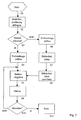
- step S1 After switching on the device in step S1, the model name of the connected mobile device is first queried by the control module 3 of the control unit 1 in step S2. This may in particular be a coded model name.
- step S3 it is checked whether it is a known model, ie whether a library with specialized functions of the connected mobile telephone is stored in the memory module 4. If this is the case, the connection can be established directly in step S4 and in step S5 the operator inputs can be made by the user. The actions associated with the operator inputs are performed in step S9.
- step S10 it is checked if the connection should be terminated. If this is the case, the connection is terminated in step S11. Otherwise, new operator inputs may be made in step S5.
- step S6 a connection establishment of the mobile telephone to an Internet provider first takes place in step S6.
- This connection is possible because the mobile phone has at least a first set of standardized functions, which is also stored in the memory module 4. These functions are the functions for establishing a fixed data connection and transmitting an identity feature of the mobile telephone. The latter function was already required in step S2 to query the model name. Via the standardized function for establishing a fixed data connection, access to the Internet provider now ensues in step S6.
- step S7 a library with a second set of specialized functions of the cellular phone is loaded from the Internet.
- the step S7 comprises a plurality of sub-steps, comprising in particular the transmission of the identity feature of the mobile telephone, such as a coded model name, to an Internet database and a search operation for accessing the library belonging to this mobile telephone with a second set of specialized functions of the mobile telephone.
- the selected library is transmitted to the operating unit 1.
- the thus loaded library is stored in the memory module 4 of the operating unit 1.
- the memory module 4 contains corresponding writable memory elements.
- the usual operator inputs can be made in a known manner in step S5.
- the specialized functions of this mobile telephone are now in the control unit 1, so that the described process of loading the library is required only when first connecting a new type of mobile radio to the control unit 1.
- the operating unit according to the invention or the method according to the invention thus opens up the possibility of an existing operating unit, in particular a control unit for mobile phones arranged in a vehicle, also to use with newly coming to the market mobile phones with new specialized functions.
Landscapes
- Engineering & Computer Science (AREA)
- General Engineering & Computer Science (AREA)
- Signal Processing (AREA)
- Computer Networks & Wireless Communication (AREA)
- Mechanical Engineering (AREA)
- Human Computer Interaction (AREA)
- Multimedia (AREA)
- Mobile Radio Communication Systems (AREA)
- Telephonic Communication Services (AREA)
- Small-Scale Networks (AREA)
- Telephone Function (AREA)
Claims (23)
- Unité de commande pour un téléphone radio mobile,- l'unité de commande (1) étant réalisée séparément du téléphone radio mobile (2) et pouvant être reliée au téléphone radio mobile (2) et- l'unité de commande (1) comprenant un module de mémoire (4) dans lequel est stocké un premier jeu de fonctions standardisées pour téléphones radio mobiles, lequel jeu contient les fonctions servant à établir une liaison de données fixe vers le téléphone radio mobile (2) et à transmettre une désignation de modèle du téléphone radio mobile (2),caractérisée en ce que l'unité de commande est réalisée de manière àa) utiliser des fonctions dudit premier jeu pour établir une liaison de données fixe vers le téléphone radio mobile (2) et s'enquérir d'une désignation de modèle du téléphone radio mobile (2) via ladite liaison de données ;b) vérifier, à l'aide de la désignation de modèle, si un deuxième jeu de fonctions spécialisées du téléphone radio mobile (2) est stocké dans le module de mémoire (4) ;c) utiliser lesdits premier et deuxième jeux de fonctions pour permettre la commande du téléphone radio mobile (2) s'il ressort de ladite vérification que le deuxième jeu est stocké dans le module de mémoire (4).
- Unité de commande selon la revendication 1, caractérisée en ce qu'est intégré à l'unité de commande (1) un module de commande (3) avec un programme (Browser) pour accéder à des fichiers d'un système informatique externe généralement accessible, en particulier de l'internet, via une liaison radio du téléphone radio mobile (2).
- Unité de commande selon la revendication 1 ou 2, caractérisée en ce que le deuxième jeu de fonctions spécialisées peut être chargé au moyen de la liaison radio à partir d'une base de données externe, en particulier via l'internet.
- Unité de commande selon l'une des revendications précédentes, caractérisée en ce qu'une autre unité de commande est intégrée au téléphone radio mobile (2).
- Unité de commande selon l'une des revendications précédentes 2 à 4, caractérisée en ce que le browser présent dans l'unité de commande (1) se présente sous la forme d'un WAP-Browser.
- Unité de commande selon la revendication 5, caractérisée en ce que le browser utilise les normes WML et/ou WMLscript.
- Unité de commande selon l'une des revendications précédentes, caractérisée en ce que les fonctions standardisées font partie du jeu de commandes standardisé AT+C.
- Unité de commande selon l'une des revendications précédentes, caractérisée en ce que l'unité de commande (1) est montée en tant qu'appareil autonome dans un instrument d'affichage d'un véhicule automobile ou dans le tableau de bord d'un véhicule automobile.
- Unité de commande selon l'une des revendications précédentes, caractérisée en ce que l'unité de commande (1) est intégrée à une autoradio.
- Unité de commande selon l'une des revendications précédentes, caractérisée en ce que l'unité de commande (1) est intégrée à un système de navigation ou à un système multimédia.
- Unité de commande selon l'une des revendications précédentes, caractérisée en ce que l'unité de commande (1) peut être reliée au téléphone radio mobile (2) via une liaison filaire.
- Unité de commande selon l'une des revendications précédentes, caractérisée en ce que l'unité de commande (1) peut être reliée au téléphone radio mobile (2) via une liaison sans fil.
- Unité de commande selon la revendication 12, caractérisée en ce que la liaison entre l'unité de commande (1) et le téléphone radio mobile (2) se produit via une liaison radio courte distance.
- Unité de commande selon la revendication 13, caractérisée en ce que la liaison radio courte distance se produit selon la norme Bluetooth.
- Procédé de commande d'un téléphone radio mobile via une unité de commande externe, un premier jeu de fonctions standardisées qui contient les fonctions servant à établir une liaison de données fixe vers un téléphone radio mobile et à transmettre une désignation de modèle du téléphone radio mobile étant stocké dans un module de mémoire associé à l'unité de commande, caractérisé en ce que l'unité de commande exécute les étapes suivantes :- utiliser au moins une fonction dudit premier jeu pour établir une liaison de données fixe vers le téléphone radio mobile (2) ;- utiliser au moins une fonction dudit premier jeu pour s'enquérir de la désignation de modèle du téléphone radio mobile ;- vérifier, à l'aide de la désignation de modèle, si, pour le téléphone radio mobile, un deuxième jeu de fonctions spécialisées du téléphone radio mobile est stocké dans l'unité de commande ;- utiliser les fonctions desdits premier et deuxième jeux pour permettre la commande du téléphone radio mobile (2) s'il ressort de ladite vérification que le deuxième jeu est stocké dans le module de mémoire (4).
- Procédé selon la revendication 15, caractérisé en ce que l'unité de commande exécute les étapes suivantes s'il n'y a pas de deuxième jeu de fonctions spécialisées stocké pour le téléphone radio mobile :- établissement automatique d'une liaison radio via le téléphone radio mobile vers une base de données externe ;- interrogation d'un deuxième jeu de fonctions spécialisées de la base de données externe à l'aide de la désignation de modèle ;- réception du deuxième jeu de fonctions spécialisées ;- stockage du deuxième jeu de fonctions spécialisées dans le module de mémoire de l'unité de commande ;- utilisation des fonctions desdits premier et deuxième jeux pour permettre la commande du téléphone radio mobile (2).
- Procédé selon la revendication 16, caractérisé en ce que la liaison vers l'internet se produit via un programme (Browser) apte à tourner dans un module de commande de l'unité de commande pour accéder à des fichiers internet.
- Procédé selon la revendication 17, caractérisé en ce que la liaison vers l'internet se produit via un WAP-Browser.
- Procédé selon la revendication 18, caractérisé en ce que le browser utilise les normes WML et WMLscript.
- Procédé selon l'une des revendications précédentes, caractérisé en ce que les fonctions standardisées font partie du jeu de commandes AT+C.
- Procédé selon l'une des revendications précédentes, caractérisé en ce qu'il se produit une liaison filaire entre l'unité de commande et le téléphone radio mobile.
- Procédé selon l'une des revendications précédentes, caractérisé en ce qu'il se produit une liaison radio courte distance entre l'unité de commande et le téléphone radio mobile, en particulier selon la norme Bluetooth.
- Unité de commande selon la revendication 1, caractérisée en ce qu'elle est réalisée pour :- établir une liaison radio au moyen du téléphone radio mobile vers une base de données externe s'il ressort de ladite vérification que le deuxième jeu n'est pas stocké dans le module de mémoire (4) ;- à l'aide de la désignation de modèle du téléphone radio mobile, demander le deuxième jeu de fonctions spécialisées à la base de données externe ;- recevoir le deuxième jeu de fonctions spécialisées de la base de données externe et le stocker dans le module de mémoire qui lui est associé ;- utiliser lesdits premier et deuxième jeux de fonctions pour permettre la commande du téléphone radio mobile (2).
Applications Claiming Priority (2)
| Application Number | Priority Date | Filing Date | Title |
|---|---|---|---|
| DE10030603A DE10030603A1 (de) | 2000-06-21 | 2000-06-21 | Externe Bedieneinheit für ein Mobilfunktelefon |
| EP01113459A EP1168784B1 (fr) | 2000-06-21 | 2001-06-02 | Unité de commande externe pour un téléphone mobile |
Related Parent Applications (2)
| Application Number | Title | Priority Date | Filing Date |
|---|---|---|---|
| EP01113459.0 Division | 2001-06-02 | ||
| EP01113459A Division EP1168784B1 (fr) | 2000-06-21 | 2001-06-02 | Unité de commande externe pour un téléphone mobile |
Publications (2)
| Publication Number | Publication Date |
|---|---|
| EP2362617A1 EP2362617A1 (fr) | 2011-08-31 |
| EP2362617B1 true EP2362617B1 (fr) | 2015-08-26 |
Family
ID=7646528
Family Applications (2)
| Application Number | Title | Priority Date | Filing Date |
|---|---|---|---|
| EP01113459A Expired - Lifetime EP1168784B1 (fr) | 2000-06-21 | 2001-06-02 | Unité de commande externe pour un téléphone mobile |
| EP11004269.4A Expired - Lifetime EP2362617B1 (fr) | 2000-06-21 | 2001-06-02 | Unité de commande externe pour un téléphone mobile |
Family Applications Before (1)
| Application Number | Title | Priority Date | Filing Date |
|---|---|---|---|
| EP01113459A Expired - Lifetime EP1168784B1 (fr) | 2000-06-21 | 2001-06-02 | Unité de commande externe pour un téléphone mobile |
Country Status (4)
| Country | Link |
|---|---|
| US (1) | US7027835B2 (fr) |
| EP (2) | EP1168784B1 (fr) |
| JP (1) | JP2002118510A (fr) |
| DE (1) | DE10030603A1 (fr) |
Families Citing this family (25)
| Publication number | Priority date | Publication date | Assignee | Title |
|---|---|---|---|---|
| EP1476792B2 (fr) † | 2002-02-18 | 2015-10-14 | Intel Mobile Communications GmbH | Système de commande et procédé pour faire fonctionner un dispositif d'émission/réception |
| JP2004005006A (ja) * | 2002-03-27 | 2004-01-08 | Nec Corp | 移動通信端末装置の辞書追加方法 |
| DE10215928A1 (de) * | 2002-04-11 | 2003-10-23 | Grundig Ag I Ins | Kommunikationsvorrichtung mit einem Autoradio und einem Handy |
| KR20080080219A (ko) | 2002-05-22 | 2008-09-02 | 인터디지탈 테크날러지 코포레이션 | 인터넷 프로토콜 기능을 갖는 모바일 장치 |
| US6778824B2 (en) | 2002-06-19 | 2004-08-17 | Telular Corp. | Apparatus for wirelessly-coupling a bluetooth-wireless cellular mobile handset to a docking station for connecting a standard telephone set to the cellular network |
| US20040147281A1 (en) * | 2002-11-12 | 2004-07-29 | Integration Associates Inc. | Transmitter and receiver circuits with controller-less operation capability |
| US20040204205A1 (en) * | 2003-04-11 | 2004-10-14 | Paul Goodjohn | Cable-free programmable radio |
| JP4232092B2 (ja) | 2003-06-06 | 2009-03-04 | 日本電気株式会社 | 携帯端末システム及び携帯端末 |
| US7155254B2 (en) * | 2003-09-23 | 2006-12-26 | Motorola, Inc. | Method and apparatus to self-configure an accessory device |
| WO2005043865A1 (fr) * | 2003-10-30 | 2005-05-12 | Vodafone K.K. | Terminal de communication mobile, module central pour terminal de communication mobile et module de fonction pour terminal de communication mobile |
| US9014753B2 (en) | 2004-03-31 | 2015-04-21 | Volkswagen Ag | Communication system and information system for a motor vehicle |
| EP1732780B1 (fr) * | 2004-03-31 | 2017-04-26 | Volkswagen Aktiengesellschaft | Système de communication et système d'information pour automobile |
| EP1641226B1 (fr) * | 2004-09-22 | 2012-08-22 | Andreas Peiker | Système pour opérer un terminal de communication sans fil dans un vehicule |
| EP1688850A1 (fr) | 2005-02-07 | 2006-08-09 | Sony Ericsson Mobile Communications AB | Analyseur générique pour les dispositifs électroniques |
| US8081964B1 (en) | 2005-03-28 | 2011-12-20 | At&T Mobility Ii Llc | System, method and apparatus for wireless communication between a wireless mobile telecommunications device and a remote wireless display |
| DE102005027492B4 (de) * | 2005-06-15 | 2008-06-05 | Daimler Ag | Verfahren und Vorrichtung zum Betrieb eines Mobiltelefons in einem Fahrzeug |
| DE202005009908U1 (de) * | 2005-06-23 | 2006-11-02 | Henryk Bury Mielec Sp.Z.O.O. | Zusatz-Anzeigeeinheit |
| DE102006005942A1 (de) * | 2006-02-09 | 2007-08-23 | Bayerische Motoren Werke Ag | Verfahren zur Unterstützung der Fehlersuche für ein Kraftfahrzeug |
| US8150371B2 (en) | 2007-05-03 | 2012-04-03 | Qualcomm Incorporated | Interactive control of access to services and capabilities of a mobile device |
| DE102008008088A1 (de) | 2008-02-08 | 2008-08-21 | Daimler Ag | Telefonanordnung in einem Fahrzeug |
| US20090280861A1 (en) * | 2008-05-09 | 2009-11-12 | Ashana Sabana Nisha Khan | Multifunctional all-in-one detachable wrist wireless mobile communication device |
| US8271033B2 (en) | 2010-03-15 | 2012-09-18 | Sony Ericsson Mobile Communications Ab | Dedicated accessory devices for handheld communication devices and related methods |
| EP2439914A3 (fr) * | 2010-10-11 | 2012-06-20 | HTC Corporation | Procédé opérationnel entre une unité embarquée et un dispositif mobile et son système d'unité embarquée |
| US8989961B2 (en) * | 2012-04-13 | 2015-03-24 | Htc Corporation | Method of controlling interaction between mobile electronic device and in-vehicle electronic system and devices using the same |
| JP6111703B2 (ja) * | 2013-01-31 | 2017-04-12 | アイコム株式会社 | 無線通信機 |
Family Cites Families (21)
| Publication number | Priority date | Publication date | Assignee | Title |
|---|---|---|---|---|
| JPH02174448A (ja) * | 1988-12-27 | 1990-07-05 | Sony Corp | 電話機 |
| US5479479A (en) * | 1991-10-19 | 1995-12-26 | Cell Port Labs, Inc. | Method and apparatus for transmission of and receiving signals having digital information using an air link |
| US5249218A (en) * | 1992-04-06 | 1993-09-28 | Spectrum Information Technologies, Inc. | Programmable universal interface system |
| DE4244468C2 (de) * | 1992-12-23 | 1998-01-22 | Porsche Ag | Bedieneinrichtung für ein Bediensystem |
| US5636140A (en) * | 1995-08-25 | 1997-06-03 | Advanced Micro Devices, Inc. | System and method for a flexible MAC layer interface in a wireless local area network |
| GB2310110B (en) * | 1996-02-09 | 2000-05-10 | Nokia Mobile Phones Ltd | Transferring information |
| DE19618535A1 (de) * | 1996-05-08 | 1997-07-24 | Siemens Ag | Fahrerinformationssystem |
| DE19625002B4 (de) * | 1996-06-22 | 2005-03-10 | Daimler Chrysler Ag | Fahrzeugkommunikationssystem |
| US6031836A (en) * | 1996-09-13 | 2000-02-29 | Lucent Technologies Inc. | Web-page interface to telephony features |
| DE19640735A1 (de) * | 1996-10-02 | 1998-04-23 | Bosch Gmbh Robert | Telematikgerät für ein Kraftfahrzeug |
| US5956487A (en) * | 1996-10-25 | 1999-09-21 | Hewlett-Packard Company | Embedding web access mechanism in an appliance for user interface functions including a web server and web browser |
| US5964847A (en) * | 1997-03-10 | 1999-10-12 | International Business Machines Corporation | Mobile client computer interacting with docking device |
| DE69837680D1 (de) * | 1997-12-11 | 2007-06-06 | Ericsson Inc | Verteiltes funktelefon für ein kraftfahrzeug |
| DE19803178A1 (de) * | 1998-01-28 | 1999-07-29 | Bosch Gmbh Robert | Autoradio mit einem abnehmbaren Bedienteil |
| AU4676799A (en) * | 1998-06-19 | 2000-01-05 | Albert William Honeywill | Mobile telephone docking station |
| DE19848364A1 (de) * | 1998-10-21 | 1999-08-12 | Frank Slembeck | Verfahren zur Vereinfachung der Datenpflege von Daten auf Mobiltelefonen |
| DE19848791A1 (de) * | 1998-10-22 | 2000-04-27 | Nokia Mobile Phones Ltd | Schnittstelleneinrichtung |
| US6529724B1 (en) * | 1999-10-26 | 2003-03-04 | Qualcomm Incorporated | System and method for managing contact information based on use of a communications device |
| US6763247B1 (en) * | 1999-12-01 | 2004-07-13 | Telefonaktiebolaget Lm Ericsson (Publ) | Portable telecommunication apparatus for controlling an electronic utility device |
| US6377825B1 (en) * | 2000-02-18 | 2002-04-23 | Cellport Systems, Inc. | Hands-free wireless communication in a vehicle |
| FR2807272A1 (fr) * | 2000-03-28 | 2001-10-05 | Koninkl Philips Electronics Nv | Appareil comprenant un dispositif de stockage pour des informations de fonctionnement et procede pour mettre a jour ce dispositif de stockage |
-
2000
- 2000-06-21 DE DE10030603A patent/DE10030603A1/de not_active Withdrawn
-
2001
- 2001-06-02 EP EP01113459A patent/EP1168784B1/fr not_active Expired - Lifetime
- 2001-06-02 EP EP11004269.4A patent/EP2362617B1/fr not_active Expired - Lifetime
- 2001-06-20 JP JP2001187136A patent/JP2002118510A/ja active Pending
- 2001-06-25 US US09/892,220 patent/US7027835B2/en not_active Expired - Lifetime
Also Published As
| Publication number | Publication date |
|---|---|
| US7027835B2 (en) | 2006-04-11 |
| EP2362617A1 (fr) | 2011-08-31 |
| EP1168784A3 (fr) | 2005-03-02 |
| DE10030603A1 (de) | 2002-01-03 |
| US20020042289A1 (en) | 2002-04-11 |
| JP2002118510A (ja) | 2002-04-19 |
| EP1168784B1 (fr) | 2011-05-25 |
| EP1168784A2 (fr) | 2002-01-02 |
Similar Documents
| Publication | Publication Date | Title |
|---|---|---|
| EP2362617B1 (fr) | Unité de commande externe pour un téléphone mobile | |
| EP1599991B1 (fr) | Agencement et module d'interface pour la connexion de divers radiotelephones mobiles a des composants de commande dans un vehicule a moteur | |
| DE60215990T2 (de) | Dynamisches Dienstmerkmal in einem mobilen Kommunikationsgerät oder einer SIM-Karte zum Empfang und zur Ausführung von dynamischen Dienstskripten in Form kurzer Textnachrichten, beispielsweise SMS | |
| DE102007051157B4 (de) | Verfahren zum Herstellen einer Datenverbindung zu einem Fahrzeug mit Telematikausstattung | |
| EP1732780B1 (fr) | Système de communication et système d'information pour automobile | |
| WO2003027629A1 (fr) | Procede de realisation d'un telediagnostic sur un vehicule automobile, module de diagnostic de vehicule et centre de services | |
| WO1999026442A1 (fr) | Procede pour l'utilisation par un terminal de services offerts par une unite centrale, et terminal a cet effet | |
| DE102006001458B4 (de) | Mobiltelefon und tragbare Speichereinrichtung, das selbiges verwendet | |
| EP1284065B1 (fr) | Procede pour integrer un appareil dans un reseau de communication automobile | |
| EP1031190B1 (fr) | Procede d'actualisation d'informations stockees dans un terminal de communication mobile, et terminal de communication | |
| DE19644104C1 (de) | Kommunikationseinrichtung | |
| DE102006041617B4 (de) | Verfahren zum Modifizieren von Bluetooth-Transceiver-Parametern und darauf bezogenes System | |
| EP1009137B1 (fr) | Méthode, ordinateur et progiciel pour l'accès à des informations dépendantes de l'emplacement | |
| EP3058565B1 (fr) | Procédé de commande vocale ainsi que produit-programme d'ordinateur pour exécuter le procédé | |
| DE10302924B3 (de) | Multimediasystem, insbesondere zur Realisierung einer Offboard-Navigation in einem Kraftfahrzeug | |
| DE102017101910A1 (de) | Dynamische Anzeige von Open-Source-Software-Konformitätsinformationen | |
| WO2004053811A1 (fr) | Procede pour apporter une assistance informative a un conducteur d'automobile a l'aide d'un systeme multimedia embarque | |
| DE69833470T2 (de) | Verfahren und Gerät zur Aktualisierung von Textdaten für eine elektrische Einrichtung | |
| DE102005052311B4 (de) | System und Verfahren zum Anwendungsmanagement und entsprechende Geräte | |
| EP1656803B1 (fr) | Procede pour faire fonctionner une carte a puce sur laquelle plusieurs applications sont mises en oeuvre | |
| EP1213897A1 (fr) | Méthode pour la configuration de l'interface utilisateur | |
| DE69428826T2 (de) | Anordnung zum Erweitern des Kurzwahlspeichers eines Sprechfunks | |
| WO2018113977A1 (fr) | Terminal utilisateur, interface utilisateur, produit-programme d'ordinateur, suite de signaux, moyen de transport et procédé de configuration d'une interface utilisateur d'un moyen de transport | |
| EP1098499B1 (fr) | Appareil et procédé de télécommunication | |
| DE102024109102A1 (de) | Verfahren zum Vorschlagen und/oder zur Verwendung einer Zieladresse einer Fahrzeugnavigationsapp, Fahrzeuganordnung sowie Fahrzeug |
Legal Events
| Date | Code | Title | Description |
|---|---|---|---|
| PUAI | Public reference made under article 153(3) epc to a published international application that has entered the european phase |
Free format text: ORIGINAL CODE: 0009012 |
|
| AC | Divisional application: reference to earlier application |
Ref document number: 1168784 Country of ref document: EP Kind code of ref document: P |
|
| AK | Designated contracting states |
Kind code of ref document: A1 Designated state(s): DE FR GB SE |
|
| RIN1 | Information on inventor provided before grant (corrected) |
Inventor name: KABATEK, ULRICH, DR. |
|
| 17P | Request for examination filed |
Effective date: 20120228 |
|
| RAP1 | Party data changed (applicant data changed or rights of an application transferred) |
Owner name: SIEMENS AKTIENGESELLSCHAFT |
|
| 17Q | First examination report despatched |
Effective date: 20130419 |
|
| GRAP | Despatch of communication of intention to grant a patent |
Free format text: ORIGINAL CODE: EPIDOSNIGR1 |
|
| RIC1 | Information provided on ipc code assigned before grant |
Ipc: H04M 1/60 20060101ALI20150130BHEP Ipc: H04M 1/725 20060101AFI20150130BHEP Ipc: F16K 17/04 20060101ALI20150130BHEP Ipc: B60R 11/02 20060101ALI20150130BHEP Ipc: F16K 27/02 20060101ALI20150130BHEP Ipc: F16K 15/04 20060101ALI20150130BHEP |
|
| INTG | Intention to grant announced |
Effective date: 20150306 |
|
| GRAS | Grant fee paid |
Free format text: ORIGINAL CODE: EPIDOSNIGR3 |
|
| GRAA | (expected) grant |
Free format text: ORIGINAL CODE: 0009210 |
|
| AC | Divisional application: reference to earlier application |
Ref document number: 1168784 Country of ref document: EP Kind code of ref document: P |
|
| AK | Designated contracting states |
Kind code of ref document: B1 Designated state(s): DE FR GB SE |
|
| REG | Reference to a national code |
Ref country code: GB Ref legal event code: FG4D Free format text: NOT ENGLISH |
|
| REG | Reference to a national code |
Ref country code: DE Ref legal event code: R096 Ref document number: 50116497 Country of ref document: DE |
|
| PG25 | Lapsed in a contracting state [announced via postgrant information from national office to epo] |
Ref country code: SE Free format text: LAPSE BECAUSE OF FAILURE TO SUBMIT A TRANSLATION OF THE DESCRIPTION OR TO PAY THE FEE WITHIN THE PRESCRIBED TIME-LIMIT Effective date: 20150826 |
|
| REG | Reference to a national code |
Ref country code: DE Ref legal event code: R097 Ref document number: 50116497 Country of ref document: DE |
|
| REG | Reference to a national code |
Ref country code: FR Ref legal event code: PLFP Year of fee payment: 16 |
|
| PLBE | No opposition filed within time limit |
Free format text: ORIGINAL CODE: 0009261 |
|
| STAA | Information on the status of an ep patent application or granted ep patent |
Free format text: STATUS: NO OPPOSITION FILED WITHIN TIME LIMIT |
|
| 26N | No opposition filed |
Effective date: 20160530 |
|
| REG | Reference to a national code |
Ref country code: FR Ref legal event code: PLFP Year of fee payment: 17 |
|
| REG | Reference to a national code |
Ref country code: FR Ref legal event code: PLFP Year of fee payment: 18 |
|
| PGFP | Annual fee paid to national office [announced via postgrant information from national office to epo] |
Ref country code: DE Payment date: 20180820 Year of fee payment: 18 |
|
| PGFP | Annual fee paid to national office [announced via postgrant information from national office to epo] |
Ref country code: FR Payment date: 20190619 Year of fee payment: 19 |
|
| PGFP | Annual fee paid to national office [announced via postgrant information from national office to epo] |
Ref country code: GB Payment date: 20190610 Year of fee payment: 19 |
|
| REG | Reference to a national code |
Ref country code: DE Ref legal event code: R119 Ref document number: 50116497 Country of ref document: DE |
|
| PG25 | Lapsed in a contracting state [announced via postgrant information from national office to epo] |
Ref country code: DE Free format text: LAPSE BECAUSE OF NON-PAYMENT OF DUE FEES Effective date: 20200101 |
|
| GBPC | Gb: european patent ceased through non-payment of renewal fee |
Effective date: 20200602 |
|
| PG25 | Lapsed in a contracting state [announced via postgrant information from national office to epo] |
Ref country code: GB Free format text: LAPSE BECAUSE OF NON-PAYMENT OF DUE FEES Effective date: 20200602 Ref country code: FR Free format text: LAPSE BECAUSE OF NON-PAYMENT OF DUE FEES Effective date: 20200630 |