EP2362623A1 - Optimisation d'un arrière-plan de tronçons d'appels terminés/initiés par un mobile - Google Patents
Optimisation d'un arrière-plan de tronçons d'appels terminés/initiés par un mobile Download PDFInfo
- Publication number
- EP2362623A1 EP2362623A1 EP10154944A EP10154944A EP2362623A1 EP 2362623 A1 EP2362623 A1 EP 2362623A1 EP 10154944 A EP10154944 A EP 10154944A EP 10154944 A EP10154944 A EP 10154944A EP 2362623 A1 EP2362623 A1 EP 2362623A1
- Authority
- EP
- European Patent Office
- Prior art keywords
- call
- mobile device
- voice call
- incoming
- calls
- Prior art date
- Legal status (The legal status is an assumption and is not a legal conclusion. Google has not performed a legal analysis and makes no representation as to the accuracy of the status listed.)
- Withdrawn
Links
- 238000000034 method Methods 0.000 claims description 25
- 230000004044 response Effects 0.000 claims description 5
- 230000015654 memory Effects 0.000 description 12
- 238000004891 communication Methods 0.000 description 10
- 230000006870 function Effects 0.000 description 8
- 238000005516 engineering process Methods 0.000 description 6
- 238000013459 approach Methods 0.000 description 3
- 238000005457 optimization Methods 0.000 description 3
- 238000000926 separation method Methods 0.000 description 3
- 230000011664 signaling Effects 0.000 description 2
- 230000009471 action Effects 0.000 description 1
- 230000004075 alteration Effects 0.000 description 1
- 230000009286 beneficial effect Effects 0.000 description 1
- 230000005294 ferromagnetic effect Effects 0.000 description 1
- 238000001914 filtration Methods 0.000 description 1
- 230000000977 initiatory effect Effects 0.000 description 1
- 238000002372 labelling Methods 0.000 description 1
- 230000007246 mechanism Effects 0.000 description 1
- 238000010295 mobile communication Methods 0.000 description 1
- 230000003252 repetitive effect Effects 0.000 description 1
Images

Classifications
-
- H—ELECTRICITY
- H04—ELECTRIC COMMUNICATION TECHNIQUE
- H04M—TELEPHONIC COMMUNICATION
- H04M3/00—Automatic or semi-automatic exchanges
- H04M3/42—Systems providing special services or facilities to subscribers
- H04M3/436—Arrangements for screening incoming calls, i.e. evaluating the characteristics of a call before deciding whether to answer it
-
- H—ELECTRICITY
- H04—ELECTRIC COMMUNICATION TECHNIQUE
- H04M—TELEPHONIC COMMUNICATION
- H04M2201/00—Electronic components, circuits, software, systems or apparatus used in telephone systems
- H04M2201/12—Counting circuits
-
- H—ELECTRICITY
- H04—ELECTRIC COMMUNICATION TECHNIQUE
- H04M—TELEPHONIC COMMUNICATION
- H04M2201/00—Electronic components, circuits, software, systems or apparatus used in telephone systems
- H04M2201/18—Comparators
-
- H—ELECTRICITY
- H04—ELECTRIC COMMUNICATION TECHNIQUE
- H04M—TELEPHONIC COMMUNICATION
- H04M2201/00—Electronic components, circuits, software, systems or apparatus used in telephone systems
- H04M2201/36—Memories
-
- H—ELECTRICITY
- H04—ELECTRIC COMMUNICATION TECHNIQUE
- H04M—TELEPHONIC COMMUNICATION
- H04M2203/00—Aspects of automatic or semi-automatic exchanges
- H04M2203/55—Aspects of automatic or semi-automatic exchanges related to network data storage and management
- H04M2203/551—Call history
-
- H—ELECTRICITY
- H04—ELECTRIC COMMUNICATION TECHNIQUE
- H04M—TELEPHONIC COMMUNICATION
- H04M2207/00—Type of exchange or network, i.e. telephonic medium, in which the telephonic communication takes place
- H04M2207/20—Type of exchange or network, i.e. telephonic medium, in which the telephonic communication takes place hybrid systems
-
- H—ELECTRICITY
- H04—ELECTRIC COMMUNICATION TECHNIQUE
- H04M—TELEPHONIC COMMUNICATION
- H04M3/00—Automatic or semi-automatic exchanges
- H04M3/42—Systems providing special services or facilities to subscribers
- H04M3/42314—Systems providing special services or facilities to subscribers in private branch exchanges
Definitions
- the following relates to mobile telephony, and more particularly to optimization of calls that are terminated or initiated by mobile devices.
- Mobile devices in many cases continue to be tariffed differently than PSTN-based devices. For example, a mobile device may accrue charges for outgoing calls (e.g., minutes for outgoing calls will be counted against an allocation), while incoming calls do not accrue such charges.
- Other aspects of a user experience of voice calling on mobile devices include how much delay there is in call establishment. It would be beneficial to continue to improve such user experiences and tailor mobile device voice telephony usage to reduce unnecessary charges.
- FIG. 1 depicts an example system view in which aspects described herein can be practiced
- FIG. 2 depicts an example mobile device view in which aspects described herein can be practiced
- FIG. 3 depicts a schematic example of a switching network that can implement voice channels, which can be used for voice calls, according to the description herein;
- FIG. 4 depicts an example method
- FIGs. 5-9 depict example methods which can be used for call acceptance prediction, as depicted in FIG. 4 ;
- FIG. 10 depicts a method of maintaining information to be used in call acceptance prediction
- FIG. 11 depicts an example composition of a mobile device, such as that illustrated in FIG. 2 .
- mobile phone and “mobile communications device” generally can be used to refer to any portable or mobile network-enabled device that has capabilities to send and receive voice calls and may also be able to send and receive data, such as data generated by web browsing, e-mail, SMS, instant messaging, and the like.
- data such as data generated by web browsing, e-mail, SMS, instant messaging, and the like.
- devices in a variety of form factors can meet such a definition, including, for example, phones, smartphones, laptops configured with appropriate network connections and user input devices, tablet computers, navigation devices embedded in automobiles, and netbooks.
- a system e.g., a server
- PBX Private Branch eXchange
- the system can receive a call that is to be forwarded to a mobile device.
- the system can signal, over a data channel to the mobile device, that the system has a call to be forwarded to the mobile device.
- the mobile device can respond by beginning to initiate a voice channel before the user of the mobile device has indicated that the call is to be accepted (an early call).
- the mobile device can begin initiation of the voice channel responsive to the user indicating that the call is to be accepted (a late call).
- a delay perceived by the user will be shorter, or possibly even zero.
- the former case also can incur fees and charges, even if the user ignores or rejects the call.
- Devices may be pre-configured to perform either early or late calls. However, further optimizations may be available.
- information about the calling party i.e., the party that called the PBX, or more generally, any entity that can receive such calls
- prior history of how the user responded to calls from that party is used to predict whether the user will answer the call. If the prediction is that the user will answer the call, then an early call strategy is used. If the prediction is that the user will not answer the call, a late call strategy is used. A variety of example approaches to making such predictions will be described below.
- these aspects can improve user experience, by reducing call setup delay, while avoiding increased costs of early call setup in situations where the user may ultimately not want to have the call established at all.
- FIG. 1 depicts a system architecture 100 in which a data and voice-enabled mobile device 107 can operate.
- a Radio Access Network (RAN) 105 provides broadband wireless access to device 107.
- RAN 105 communicates wirelessly with device 107, and connects device 107 via a circuit 122 with a voice-quality network channel 103.
- Voice-quality network 103 can serve as a bearer channel for voice calls in which mobile device 107 participates, and can comprise portions of the Public Switched Telephone Network (PSTN).
- PSTN Public Switched Telephone Network
- RAN 105 also can connect through an IP link 124 to private network(s) 112 and through an IP link 126 to public network(s) 111.
- IP is exemplary and other addressing systems can be provided.
- private networks 112 can use X25 addressing and also can be implemented using Virtual Private Network (VPN) technology to carry data over public networks 111.
- VPN Virtual Private Network
- Mobile device 107 also can have an interface for communication using local area wireless network technologies, such as 802.11 series technologies. When using such technologies for communication, mobile device 107 typically interfaces with a wireless LAN access point 114, which can communicate over public network(s) 111, such as through a router (not depicted). Communications on this medium also can be addressed using IP, as depicted by labeling the link IP link 128.
- local area wireless network technologies such as 802.11 series technologies.
- mobile device 107 typically interfaces with a wireless LAN access point 114, which can communicate over public network(s) 111, such as through a router (not depicted). Communications on this medium also can be addressed using IP, as depicted by labeling the link IP link 128.
- Each voice call in which mobile device 107 participates can be terminated at the PBX, or the device 107.
- a router 119 can communicate with a firewall 115.
- Firewall 115 can directly communicate to and receive communication from public network(s) 111 and private network(s) 112 that originate from PBX 118, or which otherwise involve signaling concerning voice calls that travels over the data network (such as the data network elements depicted in FIG. 1 ).
- FIG. 1 also depicts the existence of other networks 193 and other devices 192, which can call into PBX 118.
- the existence of such other devices 192 is for setting context that PBX 118 may be getting any number of incoming voice calls at a given time. For example, a larger PBX, for a company or company site with several thousand employees would be expected to have a large number of calls incoming to the PBX in any given period of time.
- Mobile device 107 comprises a display 212 and the cursor or view positioning device 214, shown in this implementation as a trackball 214, which may serve as another input member and is both rotational to provide selection inputs and can also be pressed in a direction generally toward housing to provide another selection input.
- Trackball 214 permits multi-directional positioning of a selection cursor 218, such that the selection cursor 218 can be moved in an upward direction, in a downward direction and, if desired and/or permitted, in any diagonal direction.
- the trackball 214 is in this example situated on a front face (not separately numbered) of a housing, to enable a user to manoeuvre the trackball 214 while holding mobile device 107 in one hand.
- the display 212 may provide that selection cursor 218 depicts generally where the next input or selection will be received.
- the selection cursor 218 may comprise a box, alteration of an icon or any combination of features that enable the user to identify the currently chosen icon or item.
- the mobile device 107 in Figure 2 also comprises a programmable convenience button 215 to activate a selected application such as, for example, a calendar or calculator. Further, mobile device 107 can include an escape or cancel button 216, a camera button 217, a menu or option button 224 and a keyboard 220. Camera button 217 is able to activate photo-capturing functions when pressed preferably in the direction towards the housing. Menu or option button 224 loads a menu or list of options on display 212 when pressed.
- the escape or cancel button 216, menu option button 224, and keyboard 220 are disposed on the front face of the mobile device housing, while the convenience button 215 and camera button 217 are disposed at the side of the housing. This button placement enables a user to operate these buttons while holding mobile device 107 in one hand.
- the keyboard 220 is, in this example, a standard QWERTY keyboard.
- FIG. 3 depicts a simplified example of how a voice channel may be setup, over the voice network 103 depicted in FIG. 1.
- voice network 103 may comprise a number of switches (e.g., SS7 switches 192a-f), which, based on signaling, can be used to establish a circuit between an ingress point and an egress point from network 103.
- switches e.g., SS7 switches 192a-f
- switches e.g., SS7 switches 192a-f
- a selection of the switches such as SS7 switches 192b, 192c and 192e are used in making circuit 122.
- the selection of appropriate switches, allocation of resources at those switches, and the establishment of connections among the switches can take time, which can result in a perceived delay to begin using the circuit 122 for voice communication.
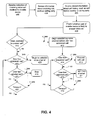
- FIG. 4 depicts a method in which a predictive setup of such a voice channel is begun for a call incoming to a mobile device, before there has been an actual disposition of the incoming call (e.g., an ignore or answer disposition).
- FIG. 4 depicts that an indication of an available incoming call destined for a mobile device is received (402).
- PBX 118 can arrange for an indication of such incoming call to be sent to device 107 over a data channel, such as through router 119 and over any of the networks depicted in FIG. 1 (such as public network 111 or private network 112).
- Information about the incoming call is accessed (404). For example, ANI or caller-ID information, which identifies a calling party placing the incoming call, can be accessed. This data can be presented over a data channel that signaled the availability of the call.
- Information about history of call disposition is then accessed (406).
- Such information can include information about a number of calls that have been placed by the calling party to the mobile device, a number of calls from the calling party that have been answered at the mobile device, a number of calls in total that have been placed to the mobile device, and a number of calls in total that have been answered at the mobile device, for example.
- a prediction (408) whether the user at the mobile device is likely to answer the incoming call is made. Further aspects of such prediction are described with respect to FIGs.
- a decision (410) is made as to whether to begin establishing (412) a voice channel to be used for the voice call or not.
- the voice channel establishment will be started. Otherwise, FIG. 4 depicts that the method will await a disposition of the call by the user.
- Such disposition can comprise a determination whether the user has answered (420) the call, and if so, then voice channel establishment can begin (423). If the user has not yet answered, then a decision can be made as to whether the user selected to ignore/reject (421) the call. If the user rejected the call, then the method can stop (418), or take another suitable action.
- a timeout decision (422) can be made, which in the occurrence of a timeout, can also cause the method to stop (418). Otherwise, a loop to again determine whether user has answered (420) can be provided.
- the method also can check whether the call has been answered (414), and if so, then the call can proceed (416). If the call has been rejected/ignored (470) or there was a timeout (472), then the voice channel which was begun can be torn down 471). Otherwise, there can be a loop to again determine whether user has answered (414).
- FIG. 4 depicts an example approach to implementing the predictive aspects disclosed herein.
- a logically equivalent method may be provided by those of ordinary skill in the art that would differ from an order or arrangement of the elements depicted in FIG. 4 .
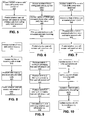
- FIGs. 5-9 relate to more specific examples of how call disposition predictions can be made. These examples also are by way of explanation, rather than limitation, as those of ordinary skill in the art would be able to provide other call disposition predictive mechanisms based on these disclosures.
- FIG. 5 depicts that one approach to call disposition prediction can include accessing (502), such as from a memory, data representative of a number of times that calls from the calling party were answered, and predicting (504) whether the user will answer based on such number. For example, if there were prior calls from the calling party, but none were answered, then the prediction can be that the user will not answer this call either.
- FIG. 6 depicts that another method can involve accessing a number of times that the calling party has called (506), accessing a number of times that the user answered when the calling party called (508), producing a ratio between the answers and the total (510) and predicting (512) whether the user will answer the call based on the ratio. For example, if the ratio indicates that more than half of the calls were answered, then this call will be predicted to be answered.
- FIG. 7 depicts another prediction method, in which stored information concerning a number of times calls from the calling party were answered can be accessed (518). Other information that can be accessed (520) relates to a number of times, in total, that the user answered the phone. A ratio between the number of calls answered from the calling party to the total number of answered calls can be produced (522), and a prediction is made (524) based on that ratio.
- FIG. 8 depicts another prediction method in which a number of times that calls were answered is accessed (514); a number of incoming calls in total is accessed (516), a ratio between such total number of calls answered and number of incoming calls in total is produced (525), and a prediction made based on that ratio (527).
- each of the above ratios, and more generally, the comparisons between the data elements described, can be viewed as a statistic that can be used in predicting whether the user will answer the phone for a given incoming call.
- FIG. 9 depicts that multiple such statistics can be used in forming such a prediction.
- FIG. 9 depicts that a statistics 1...n can be produced (steps 530, 532, and 534) and those statistics can be used in making a prediction (536) about whether the call will be answered.
- a statistics 1...n can be produced (steps 530, 532, and 534) and those statistics can be used in making a prediction (536) about whether the call will be answered.
- each of the ratios described with respect to FIGs. 6-8 can be a statistic used in the method of FIG. 9 .
- FIG. 10 depicts that the data that can be used in producing the statistics or otherwise making the predictions described with respect to FIGs. 4-9 can be gathered and maintained.
- a number of incoming calls can be updated (554), and a number of calls from the calling party can be updated (558), regardless of disposition of the incoming call. If the call was answered, then a total number of calls answered can be updated (552), as can a total number of calls answered from the calling party (556).
- These updated numbers can then be used for predictive purposes during for future incoming calls.
- the data can be stored as raw numbers, or some of the ratios described can be precomputed and stored.
- the prediction can be made in advance based on the data, and the prediction stored. For example, a flag can be stored with identifying information for a particular calling party that indicates to answer or ignore the next call from this particular calling party. Such data can be stored on the mobile device, in the network, on PBX 118, or in another suitable location.
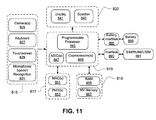
- FIG. 11 depicts an example composition of a device which can perform the method aspects described above in processing resources, as well as store, or otherwise have access to a computer readable medium that stores code for configuring processing resources to perform such methods.
- FIG. 11 depicts that device 107 can be provided with components as follows.
- Device 107 can have a variety of components by which user input can be received, including a camera 825, a keyboard 827, a touch screen 829, and a microphone 831 that can be used for speech recognition, for example (collectively, input sources 816).
- processing resource 819 can be comprised of a plurality of components, such as a programmable processor 845, one or more ASICs 847, as well as other co-processors 849.
- an ASIC or co-processor may be provided for implementing graphics functionality, encryption and decryption, audio filtering, and other such functions that often involve many repetitive, math-intensive steps.
- Processing resource 819 also may interface with one or more network interfaces 817, each of which may be comprised of one or more Media Access Controllers (MACs) 851, which in turn interface with physical layers 853.
- MACs Media Access Controllers
- Processing resource 819 also may interface with a memory resource 818 which may be comprised of a plurality of memories, including a RAM 855, and a non-volatile memory 857, which can be implemented with one or more of Flash memory, PROM, EPROM, and so on.
- Non-volatile memory 857 can be implemented as flash memory, ferromagnetic, phase-change memory, and other non-volatile memory technologies.
- Non-volatile memory 857 also can store programs, device state, various user information, one or more operating systems, device configuration data, and other data that may need to be accessed persistently.
- Such memory 818 can be used for storing the call history, statistics, and/or flags, which were described with respect to the method aspects above.
- Processing resource 819 also may interface with user output 820 components, which can include a display 841, as well as a speaker 843, which can be used for text to speech or for performing audio, more generally.
- user output 820 components can include a display 841, as well as a speaker 843, which can be used for text to speech or for performing audio, more generally.
- a battery interface 888 interfaces a battery 889 with processing resource 819.
- Battery interface 888 can provide battery status updates and manage recharging of the battery, for example.
- Processing resource 819 also can couple, through an interface 890, with a SIMIRUIMIUSIM 891, to enable communication over protocols that would use each.
- aspects described above can be implemented as computer executable code modules that can be stored on computer readable media, read by one or more processors, and executed thereon. Such computer readable media can be read by such processors over a network, which can be implemented using wired and wireless network technologies.
- processors can be implemented using wired and wireless network technologies.
- separate boxes or illustrated separation of functional elements of illustrated systems does not necessarily require physical separation of such functions, as communications between such elements can occur by way of messaging, function calls, shared memory space, and so on, without any such physical separation.
Landscapes
- Engineering & Computer Science (AREA)
- Signal Processing (AREA)
- Telephonic Communication Services (AREA)
- Mobile Radio Communication Systems (AREA)
- Telephone Function (AREA)
Priority Applications (2)
| Application Number | Priority Date | Filing Date | Title |
|---|---|---|---|
| EP10154944A EP2362623A1 (fr) | 2010-02-26 | 2010-02-26 | Optimisation d'un arrière-plan de tronçons d'appels terminés/initiés par un mobile |
| CA2732943A CA2732943C (fr) | 2010-02-26 | 2011-02-25 | Optimisation des troncons d'appel termines par un mobile/inities par un mobile |
Applications Claiming Priority (1)
| Application Number | Priority Date | Filing Date | Title |
|---|---|---|---|
| EP10154944A EP2362623A1 (fr) | 2010-02-26 | 2010-02-26 | Optimisation d'un arrière-plan de tronçons d'appels terminés/initiés par un mobile |
Publications (1)
| Publication Number | Publication Date |
|---|---|
| EP2362623A1 true EP2362623A1 (fr) | 2011-08-31 |
Family
ID=42537614
Family Applications (1)
| Application Number | Title | Priority Date | Filing Date |
|---|---|---|---|
| EP10154944A Withdrawn EP2362623A1 (fr) | 2010-02-26 | 2010-02-26 | Optimisation d'un arrière-plan de tronçons d'appels terminés/initiés par un mobile |
Country Status (2)
| Country | Link |
|---|---|
| EP (1) | EP2362623A1 (fr) |
| CA (1) | CA2732943C (fr) |
Citations (4)
| Publication number | Priority date | Publication date | Assignee | Title |
|---|---|---|---|---|
| EP1280080A1 (fr) * | 2001-07-26 | 2003-01-29 | BRITISH TELECOMMUNICATIONS public limited company | Méthode et appareil pour modéliser le comportement d'un utilisateur |
| EP1524830A2 (fr) * | 2003-10-15 | 2005-04-20 | Microsoft Corporation | Gestion des communications selon des préférences de l'abonné appelé et selon le coût de l'interruption |
| WO2007103121A2 (fr) | 2006-03-02 | 2007-09-13 | Tango Networks, Inc. | Passerelle d'application mobile permettant de connecter des dispositifs présents sur un réseau cellulaire avec des réseaux d'entreprise et de données individuels |
| US20100046731A1 (en) * | 2007-10-02 | 2010-02-25 | Douglas Gisby | Method, apparatus and system for use of presence and location information in intelligent call routing |
-
2010
- 2010-02-26 EP EP10154944A patent/EP2362623A1/fr not_active Withdrawn
-
2011
- 2011-02-25 CA CA2732943A patent/CA2732943C/fr not_active Expired - Fee Related
Patent Citations (4)
| Publication number | Priority date | Publication date | Assignee | Title |
|---|---|---|---|---|
| EP1280080A1 (fr) * | 2001-07-26 | 2003-01-29 | BRITISH TELECOMMUNICATIONS public limited company | Méthode et appareil pour modéliser le comportement d'un utilisateur |
| EP1524830A2 (fr) * | 2003-10-15 | 2005-04-20 | Microsoft Corporation | Gestion des communications selon des préférences de l'abonné appelé et selon le coût de l'interruption |
| WO2007103121A2 (fr) | 2006-03-02 | 2007-09-13 | Tango Networks, Inc. | Passerelle d'application mobile permettant de connecter des dispositifs présents sur un réseau cellulaire avec des réseaux d'entreprise et de données individuels |
| US20100046731A1 (en) * | 2007-10-02 | 2010-02-25 | Douglas Gisby | Method, apparatus and system for use of presence and location information in intelligent call routing |
Also Published As
| Publication number | Publication date |
|---|---|
| CA2732943A1 (fr) | 2011-08-26 |
| CA2732943C (fr) | 2014-07-08 |
Similar Documents
| Publication | Publication Date | Title |
|---|---|---|
| US7283829B2 (en) | Management of call requests in multi-modal communication environments | |
| US7577429B2 (en) | Real-time communications architecture and methods for use with a personal computer system | |
| US8416767B2 (en) | Communication mode swapping for telecommunications devices | |
| US9215409B2 (en) | Systems and related methods for controlling audio communications between a relay service and an audio endpoint | |
| US20090086953A1 (en) | Active call filtering, screening and dispatching | |
| CN102833401B (zh) | 一种手机自动接听的方法及手机 | |
| US8953762B1 (en) | Telephone system, apparatus, and method for providing enhanced privacy features | |
| CN103167453B (zh) | 一种强插呼叫业务的实现方法 | |
| CN103249018A (zh) | 一种多方通话进行切换的方法及终端设备 | |
| CN101478735A (zh) | 基于ussd推送菜单实现来电拒接信息通知业务的系统和方法 | |
| CN105264923A (zh) | 用于确定推送消息的可靠性的消息传送系统 | |
| WO2014082450A1 (fr) | Procédé et appareil de conversation, et terminal | |
| US20080285727A1 (en) | Communications Controller And Protocol | |
| US20140148137A1 (en) | Conversation method and terminal | |
| JP2007081759A (ja) | コミュニケーションシステム、プレゼンスサーバ及びそれらに用いるコミュニケーション方法 | |
| CN101699883A (zh) | 一种来电转移系统及其来电转移的方法 | |
| CN105262881A (zh) | 一种通信控制方法及电子设备 | |
| CN103259940A (zh) | 通信终端以及留言数据传输方法 | |
| CA2732943C (fr) | Optimisation des troncons d'appel termines par un mobile/inities par un mobile | |
| US8463240B2 (en) | Optimizing mobile terminated/mobile initiated call legs | |
| KR20130059278A (ko) | 인터액티브 ars 음성 메뉴 접속 시스템 및 이를 이용한 접속 방법 | |
| JP2004304770A (ja) | 電話交換機 | |
| US20060098798A1 (en) | Method to selectively mute parties on a conference call | |
| EP1521443B1 (fr) | Traitement d'appels après le premier renvoi appel | |
| JP2003087395A5 (fr) |
Legal Events
| Date | Code | Title | Description |
|---|---|---|---|
| PUAI | Public reference made under article 153(3) epc to a published international application that has entered the european phase |
Free format text: ORIGINAL CODE: 0009012 |
|
| 17P | Request for examination filed |
Effective date: 20100303 |
|
| AK | Designated contracting states |
Kind code of ref document: A1 Designated state(s): AT BE BG CH CY CZ DE DK EE ES FI FR GB GR HR HU IE IS IT LI LT LU LV MC MK MT NL NO PL PT RO SE SI SK SM TR |
|
| AX | Request for extension of the european patent |
Extension state: AL BA RS |
|
| RAP1 | Party data changed (applicant data changed or rights of an application transferred) |
Owner name: BLACKBERRY LIMITED |
|
| RAP1 | Party data changed (applicant data changed or rights of an application transferred) |
Owner name: BLACKBERRY LIMITED |
|
| STAA | Information on the status of an ep patent application or granted ep patent |
Free format text: STATUS: THE APPLICATION IS DEEMED TO BE WITHDRAWN |
|
| 18D | Application deemed to be withdrawn |
Effective date: 20150901 |