EP2362633A2 - Procédé de détermination de données de caractérisation d'un processus d'impression - Google Patents
Procédé de détermination de données de caractérisation d'un processus d'impression Download PDFInfo
- Publication number
- EP2362633A2 EP2362633A2 EP20110001027 EP11001027A EP2362633A2 EP 2362633 A2 EP2362633 A2 EP 2362633A2 EP 20110001027 EP20110001027 EP 20110001027 EP 11001027 A EP11001027 A EP 11001027A EP 2362633 A2 EP2362633 A2 EP 2362633A2
- Authority
- EP
- European Patent Office
- Prior art keywords
- color
- printing
- data
- subset
- tone
- Prior art date
- Legal status (The legal status is an assumption and is not a legal conclusion. Google has not performed a legal analysis and makes no representation as to the accuracy of the status listed.)
- Granted
Links
- 238000000034 method Methods 0.000 title claims abstract description 90
- 230000008569 process Effects 0.000 title claims abstract description 59
- 238000012512 characterization method Methods 0.000 title claims abstract description 37
- 238000007639 printing Methods 0.000 claims abstract description 128
- 238000012360 testing method Methods 0.000 claims abstract description 100
- 239000000976 ink Substances 0.000 claims abstract description 82
- 230000003595 spectral effect Effects 0.000 claims abstract description 55
- 239000003086 colorant Substances 0.000 claims abstract description 30
- 238000004364 calculation method Methods 0.000 claims abstract description 26
- 238000001228 spectrum Methods 0.000 claims abstract description 23
- 238000012937 correction Methods 0.000 claims description 13
- 238000005259 measurement Methods 0.000 claims description 10
- 238000012935 Averaging Methods 0.000 claims description 3
- 239000000463 material Substances 0.000 claims description 3
- 239000000758 substrate Substances 0.000 claims description 3
- 230000015654 memory Effects 0.000 description 11
- 238000000926 separation method Methods 0.000 description 10
- 230000001419 dependent effect Effects 0.000 description 4
- 238000005516 engineering process Methods 0.000 description 3
- 230000003287 optical effect Effects 0.000 description 3
- 230000006978 adaptation Effects 0.000 description 2
- 238000011161 development Methods 0.000 description 2
- 230000018109 developmental process Effects 0.000 description 2
- 230000006870 function Effects 0.000 description 2
- 238000013507 mapping Methods 0.000 description 2
- 238000005457 optimization Methods 0.000 description 2
- 238000004886 process control Methods 0.000 description 2
- 238000012545 processing Methods 0.000 description 2
- 230000009467 reduction Effects 0.000 description 2
- 239000007787 solid Substances 0.000 description 2
- 230000009466 transformation Effects 0.000 description 2
- 230000000007 visual effect Effects 0.000 description 2
- 241000533901 Narcissus papyraceus Species 0.000 description 1
- 238000004458 analytical method Methods 0.000 description 1
- 230000001413 cellular effect Effects 0.000 description 1
- 238000006243 chemical reaction Methods 0.000 description 1
- 238000004737 colorimetric analysis Methods 0.000 description 1
- 238000007641 inkjet printing Methods 0.000 description 1
- 230000003993 interaction Effects 0.000 description 1
- 239000011159 matrix material Substances 0.000 description 1
- 238000002156 mixing Methods 0.000 description 1
- 238000007645 offset printing Methods 0.000 description 1
- 238000007649 pad printing Methods 0.000 description 1
- 230000002093 peripheral effect Effects 0.000 description 1
- 230000000704 physical effect Effects 0.000 description 1
- 230000011218 segmentation Effects 0.000 description 1
- 238000000844 transformation Methods 0.000 description 1
Images
Classifications
-
- H—ELECTRICITY
- H04—ELECTRIC COMMUNICATION TECHNIQUE
- H04N—PICTORIAL COMMUNICATION, e.g. TELEVISION
- H04N1/00—Scanning, transmission or reproduction of documents or the like, e.g. facsimile transmission; Details thereof
- H04N1/46—Colour picture communication systems
- H04N1/56—Processing of colour picture signals
- H04N1/60—Colour correction or control
- H04N1/603—Colour correction or control controlled by characteristics of the picture signal generator or the picture reproducer
- H04N1/6033—Colour correction or control controlled by characteristics of the picture signal generator or the picture reproducer using test pattern analysis
Definitions
- the invention relates to the field of electronic reproduction technology and relates to a method for determining characterization data for use in a printing process, wherein at least one test element having a number of color fields is first printed on a printing material to which color fields are assigned tonal values of at least one printing ink, the color fields of the at least one test element are spectrally measured with a measuring device for determining measurement results and the measurement results are stored as actual spectral data.
- print templates are created for printed pages containing all the elements to be printed, such as text, graphics and images.
- a separate print template is created for each ink, containing all the elements printed in each color.
- these are the inks Cyan (C), Magenta (M), Yellow (Y), and Black (K).
- C Cyan
- M Magenta
- Y Yellow
- K Black
- the printed originals separated by printing inks are also called color separations.
- the artwork is usually rasterized and exposed to film with a setter, which then produces printing plates for high-volume printing.
- the print templates can be exposed directly on printing plates in special exposure devices or they are transferred directly as digital data to a digital printing press.
- the print data are then exposed to printing plates, for example, with an integrated into the printing unit exposure unit before immediately after the pad printing begins.
- digital printing machines which do not require printing plates because they are e.g. operate on the electrophotographic printing principle or with ink jet printing.
- the artwork is electronically reproduced. Images are scanned in a color scanner and stored in the form of digital data. Texts are created with word processing programs and graphics with drawing programs. With a layout program the picture, text and graphic elements are put together to a printed page. The data of several printed pages are combined with the data of other elements, such as crosshatches, crop marks and folding marks and print control fields, combined to print templates for a sheet.
- PostScript and PDF Portable Document Format
- the PostScript or PDF data are converted in a first step in color separation values for the color separations C, M, Y and K before recording the artwork in a raster image processor (RIP).
- the color separation values are a measure of the color densities with which the four printing colors cyan, magenta, yellow and black are printed on the substrate. In special cases where more than four colors are printed, each pixel is described by as many color separation values as there are inks.
- the color separation values can be stored, for example, with 8 bits per pixel and printing color as data value, whereby the value range from 0% to 100% is subdivided into 256 tone value levels.
- the colors of the elements of a print page are usually not defined in the same way in the CMYK color system of the inks, but usually in a different color system.
- the images in a scanner are separated by color filters into the color components red, green and blue (RGB), ie into the components of a three-dimensional color space.
- RGB red, green and blue
- the image data must therefore be transformed before the recording of the artwork on color separation films or printing plates from the RGB color space of the scanner in the CMYK color space of the printing process to be used. The same applies to the digitally photographed images.
- Such color space transformations are needed in the reproduction technique, because the devices and processes used have certain limitations and peculiarities in the representation and reproduction of colors and these properties are different in all devices and processes. Therefore, there are different color spaces for various devices and processes such as scanners, monitors, test printing devices, printing processes, etc., which optimally describe the color characteristics of the device or process and which are referred to as device-dependent color spaces.
- device-dependent color spaces In addition to the device-dependent color spaces, there are still device-independent color spaces (English: device independent color space), based on the human visual properties based on a so-called normal observer.
- Such color spaces are, for example, the CIE 1931 XYZ color space (abbreviated to XYZ color space) or the CIE 1976 L * a * b * color space (abbreviated to Lab color space) defined by the CIE (Commission Internationale d'Éclairage) the Lab color space has become more prevalent in technology. If one wants to know whether two colors are perceived as the same or different by the human eye, then the measurement of the XYZ or Lab color components is sufficient.
- the Lab color components form a three-dimensional color space with a brightness axis (L) and two color axes (a, b), which can be imagined in the plane of a color circle, through the center of which runs the brightness axis.
- the Lab color components are related to the XYZ color components through non-linear conversion equations.
- a device or color-processing process can be characterized in terms of its color properties by assigning all possible value combinations of the associated device-dependent color space (tonal values) to the Lab color components (color values) that a human sees in the colors produced with these tone value combinations.
- the different CMYK tone combinations each produce a different printed color.
- a colorimeter you can determine the Lab components of the printed colors and assign them to the CMYK tone combinations.
- Such an association which relates the device-dependent colors generated with a device or process to a device-independent color space (XYZ or Lab), is also referred to as a color profile, in the case of a printing process as an output color profile.
- ICC International Color Consortium
- ISO ISO IS015076-1: 2005
- the assignment defined with a color profile can be realized with the aid of a table memory. For example, if the Lab color values are to be assigned to the CMYK tonal values of a print process, the table memory for each possible value combination of the CMYK tonal values must have a memory location in which the associated Lab color values are stored.
- the printable tonal values in contrast to the CMYK combinations, are built up by a number of other inks, so that the ICC color profiles become correspondingly larger.
- ICC color profiles are used for the color separation, in which additional process-related boundary conditions such as, for example, the color build-up (areal coverage, maximum black, black buildup) and the mapping of non-printable color values (gamut mapping) are incorporated. While printing tables for CMYK systems can be well calculated using conventional colorimetric methods, this becomes easily unwieldy and expensive for systems with spot colors and multicolor systems.
- the print tables are calculated from the characterization data of a printing process.
- Characterization data is the determination of a clear relationship between digital tonal values and measured color values in the print (tonal values CMYK / color values CIEXYZ or CIELAB). In particular, in this case the measured color values can be stored as spectra.
- the characterization data could also be used for process control and process calibration.
- CMYK systems are determined in the prior art using a test element according to ISO 12642-2: 2006 or using corresponding manufacturer-specific test elements, this is especially necessary for multi-color systems. So it is for example from the DE 10 2004 001 937 A1
- For generating an ICC color profile it is known to create four test forms, to obtain characterization data from these test forms, in order then to create corresponding table memories which describe the assignment of the color values from the device-independent color space to the print color space.
- the use of four test forms is due to the fact that spot colors should be replaced by the use of secondary inks.
- matrix operations are proposed here by way of example in order to take account of non-linear changes in the tonal levels, ie in addition gradation corrections, for example as a function of dot gains of the individual pressure points, are taken into account.
- the object of the present invention is to present a method for calculating characterization data of a printing process, which is easier to handle and less expensive than the previously known methods.
- test form at least one test element is formed and printed by means of this test form a substrate in a printing press.
- this test element can also be imaged in an area of the print original and the printing form that is not to be used.
- the printing machine may be, for example, an electrophotographic, an offset printing machine, or the like.
- This at least one test element can be measured with a spectrophotometer and corresponding spectral measurement results can be determined as measurement results. These measurement results can then be stored as actual spectral data.
- a first dot gain for the assigned tonal values of the color fields of the first subset can then be determined.
- a tone value curve can also be determined for this first subset.
- tone value increase is first of all determined for individual, specific tone values, it is further provided that a first tone value increase curve or tone value curve is determined by interpolation from these first tone value increases of the assigned tone values.
- At least a second subset of the actual data is used to determine at least one parameter of a model for calculating color values of the printing process.
- Tonwertzuddlingkurve or Tonwertkurve from the first subset of data to correct the assignment of tonal values of the inks to printed color values or their spectra are used.
- This correction curve should then be used to calculate the corresponding characterization data of the printing process.
- table stores can be generated from this correction curve.
- such a more accurate model of the printing process can be achieved, which allows a sufficiently accurate calculation of the characterization data using a smaller test element.
- the model of the printing process can actually be used, but not necessarily known in detail physical boundary conditions of the printing process itself are considered in the determination of the characterization data.
- dot gains can now be considered much more accurately.
- the spectral Yule-Nielsen Neugebauer model preferably the segmented spectral Yule-Nielsen-Neugebauer model
- a factor n is used as the parameter for modeling the at least one of the first and second subset optical point broadening is determined iteratively.
- densitometric, colorimetric or spectral first tone values or tonal value increases are calculated from the first subset of the spectral actual data.
- corresponding curves for example by interpolation, can be determined from these determined or calculated tone values or tone value increases.
- calculated spectral tonal values are preferred.
- the first subset is spectral actual data recorded by color wedges, which preferably consist of color fields which are exclusively composed of an ink and preferably to tone values with intervals of 10%. based on each other. Including a zero percent value, this results in a total of 44 color patches, for example for a four-color print. If six inks are used, the number increases to 66 swatches which are used to determine first tone gain curves or tone curves by interpolation.
- the second subset is data of color fields which are formed by the overprinting of used printing inks.
- the printing inks used for this purpose are printed according to tonal values which are selected from a given selection of reference points.
- the support point selection should have a total of k support points.
- the individual color patches are then formed by printing the inks one above the other according to each possible combination of the support points. When using m printing inks, k m combinations of printed ink covers printed on one another are thus obtained.
- the support points 0%, 40% and 100% are preferably selected for selection, resulting in a total of 81 further color fields for the determination of the second subset of the spectral data for a four-color process. In a five-color process, an additional 243 color patches result.
- the at least one test element has color fields in color wedges for determining the data of the first subset and color fields for determining the data of the data of the second subset Subset has, wherein the amount of the color fields for determining the first or second subset is reduced by the color fields, which is already used to determine the second or first subset.
- These color fields should then be printed in only one of the two quantities, but used to determine both subsets.
- color fields for determining the first or second subset, on which the same tone values are based should be used both for determining the first and the second subset, in particular averaging for multiply printed color fields being provided.
- a minimal test element then consists of 40 color fields for determining the first data and 73 color fields for determining the second data, wherein from the second color field quantity one color field (white) for determining the first subset and the first color field quantity eight color fields (4 x 40% and 4 x 100%) are used to determine the second subset.
- Such a minimal test element then consists of a four-color print out of a total of 113 color patches.
- the characterization data are stored and at least a color profile of the printing process is created using this characterization data, this color profile is to be used for color control of a printing press of the printing process.
- test element for determining characterization data which comprises a first set of color fields according to a color wedge, wherein the color fields are each formed with only one printing ink and the underlying tone values are predetermined Distance, which eg Has 10% of the tone value, each other.
- test element should have a second set of color fields, which are formed by the overprinting of the printing inks, wherein the printing inks are here printed according to tonal values, which are selected from a given support point selection of k support points.
- three interpolation points e.g. 0%, 40%, 100%.
- test element is constructed in such a way that the first set of color fields is reduced by no longer providing those color patches which are already contained in the second set and / or that color patches in the second set already contained in the first set are no longer used and thus no longer be printed.
- this test element it is provided that from the first set of color values the color fields are left out, which just have no coverage and no printing ink, i. have a coverage of 0% and a tone value of 0% and / or that are omitted from the second set such color fields, which are composed exclusively of an ink.
- the object of the invention is achieved by a device which is suitable for carrying out the method described above, wherein a corresponding test element is used.
- the device in this case comprises a printing press, which is designed so that printing materials can be printed with at least one test element according to the invention and where further a measuring device is provided, which can determine by measuring spectral data of color fields of the test element.
- a measuring device here a spectrophotometer is provided.
- the device further comprises a memory device for storing the spectral actual data, wherein the memory device is designed in particular such that it can store partial data sets of the spectral data which are assigned in part to different color fields or different partial regions of the test element.
- a tone value increase calculation device for calculating tone value curves or tone value increase curves from a first subset of the stored actual spectral data.
- the dot gain calculating device determines or determines color values or spectra from the measured actual data of a first subarea of the test element and assigns these color values or spectra to the tonal values on which the individual color fields are based. This is possible on the one hand in the form of a direct assignment of the colors or in the form of a dot gain, which describe the deviation of the measured color values from intended color values.
- the device further comprises a further calculation device for calculating spectra for tone value combinations according to a model, in particular according to a Yule-Nielsen-Neugebauer model, more preferably according to a segmented spectral Yule-Nielsen-Neugebauer model.
- the calculation device assigns spectra to the tonal value combinations of the printing process.
- the calculation device determines at least one parameter of the model, taking into account the tone values or the tone curve, which was determined in the tone value increase calculation device. This may in particular be the factor n of the spectral Yule-Nielsen-Neugebauer equation which is intended to describe the increase in the tone value by widening.
- the calculation device determines this parameter in particular iteratively by a Optimization of the parameter so that the tone values calculated from the model agree as well as possible with the tone curve from the tone value increase calculator.
- the calculation device can in particular have a comparison and optimization element.
- a further calculating device is provided for calculating characterization data of the printing process by means of a tone value increase curve, which was determined in the dot gain calculating device, based on the model.
- the calculation device can be part of the calculation device for calculating spectra for this purpose.
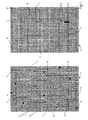
- the FIG. 1 shows test elements 1, 2 according to the prior art, which are used to determine characterization data, for example, according to ISO 12642-2: 2006. These are test elements for a CMYK printing process. These test elements can, for example, also by manufacturers specific test elements, which are necessary in particular when using special colors are replaced.
- test elements 1, 2 are constructed from color fields 3, wherein a total distinction must be made between color fields 4 without coverage, d. H. white color patches 4, color patches 5 having blending proportions produced by overprinting different inks, full tone patches 6 created by 100% blanketing each of a single ink, and dot color patches 7 made up of only one ink; the tonal value underlying the coverage of the color field may be between 0 and 100% of the individual ink.
- test elements 1, 2, as in the FIG. 1 are generally so large that at least one test form, ie a printing plate, must be imaged, which is then used in a printing process in order to be able to determine the characterization data of this printing process.
- the field stop for example, has a diameter of about 3 mm, so that the minimum field size must be at least 5 x 5 mm 2 for a reliable measurement. The area requirement for such a complete test element is therefore very large.
- Recording characterization data with such known test elements is very cumbersome, since when using several test elements, in some cases the test elements and color patches used have to be distributed over a plurality of printed sheets. Such a distribution is especially true when more than four inks and / or spot colors are used.
- the test elements shown here have 1617 fields in four colors.
- test element according to the invention as z.
- FIG. 2 or 3 is shown for characterizing a printing process.
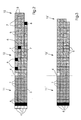
- FIG. 2 a first example of a test element 10 according to the invention is shown. This is an example of a four-color system with the colors CMYK.
- the test element 10 is divided into two subregions 11 and 12. These subareas 11, 12 of the test element 10 are each associated with color fields 3, wherein the amount of color fields 3 which are assigned to a subarea 11, 12 is assigned a respective subset 54, 54 of later measured actual data.
- the subarea 11 includes color fields 3, which build a step wedge.
- the color fields 3 are each constructed exclusively from one printing ink (CMYK) with different tonal values. If the tone value is 0%, four white color patches 4 are formed. With a tone value of 100%, the four tone color fields 6 result.
- the other color fields 3 result from variations of the tone values, each with a 10% distance of the tone value, so that a total of 36 tone color fields 7 result.
- the subarea 11 is made up of 44 color fields in the form of a step wedge
- the subarea 12 comprises a total of 81 color fields 3.
- the color fields 3 are formed by the overprinting of the different printing inks (CMYK) in all possible combinations.
- the possible combinations result from the number of support points in which the tonal values of the individual printing inks (CMYK) are specified.
- color values of the values 0%, 40% and 100% are to be used as reference points, so that for each printing ink CMYK three different tonal values are available.
- the number of combinations of the overprinted inks CMYK is therefore given by the formula k m , where k is the number of printing dots and m is the number of printing inks.
- a mixed color field 5 is to be understood as a color field 3 which has been printed with at least two different printing inks CMYK.
- FIG. 3 shows an alternative preferred version of a test element 10 ', wherein here in the sub-areas 1 1', 12 'each redundant color fields 3 have been deleted.
- the white color fields 4 of the partial region 11 were deleted in the test element 10 ', so that the reduced partial region 11' now has four full tone color fields 6 and 36 tone color fields 7.
- the four spot color fields 6, which are identical to the full tone color fields 6 of the partial area 11', and the tonal color fields 7, which are also identical to the tone color fields 7 of the partial area 11 ' are dispensed with, so that only one Number of 72 mixed color fields 5 and a white color field 4 are used, so only a total of 73 color fields are used.
- the entire reduced test element 10 'then only includes 113 color fields 3 and still serves as a starting point for determining the necessary characterization data of a four-color printing process.
- a further reduction of the color fields 3 can in particular for a use of more than four printing inks by a Farbraumseparation, as shown in the DE 10 2004 001 1 937 is described.
- the color space is correspondingly separated into areas which have only three printing inks.
- a test element 10, 10 'as described above can be independently exposed to a printing plate in a printing process for determining the characterization types of a printing press 50 and applied to a printed sheet 51 in the printing press 50.
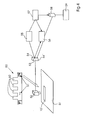
- Fig. 4 shows a corresponding structure for generating characterization data, in which a printing sheet 51 is first printed in a printing machine 50 having a plurality of inking units 60, wherein in a peripheral region of the printing sheet 51, a reduced test element 10 'is provided. It should preferably always be ensured that the test element 10 'is provided in an area with a sufficient ink supply.
- the printed signature 51 in the area of the reduced test element 10 ' is measured by means of a spectrophotometer 52.
- the measurement results determined in this way are stored as actual spectral data 54, 54 'in a memory device 53.
- the spectral actual data consist of a first subset 54 and a second subset 54 ', which in each case the subregions 11' and 12 'of the reduced test element 10' can be attributed to the color fields 3, which reduce the test element 10 to a reduced test element 10 'in the respective sub-area 11, 12 have been omitted, now both subsets 54, 54' are assigned. This can be achieved in particular by doubling the corresponding data.
- the first subset 54 of the stored spectral actual data is forwarded to a dot gain calculating means 55, alternatively the dot gain calculating means 55 also directly to the partial data set 54 can access.
- a dot gain calculating means 55 also directly to the partial data set 54 can access.
- densitometric, colorimetric or spectral tonal values and / or dot gains in particular from the color wedges of the subregion 11 of the reduced test element 10 'are obtained by known methods, in particular further to the white field 4 from the subregion 12' of the reduced subelement 10 'resorted to.
- corresponding tone value increase correction curves for the individual inks CMYK are determined by suitable interpolation methods.
- the spectral dot gain from the first subset of the stored spectral data 54 is preferably calculated. By using spectral dot gains, accuracy can generally be increased for all colors.
- a spectral calculation device 56 accesses the second subset 54 'of the stored actual data in the memory 53.
- this second subset 54 ' which essentially corresponds to the reduced subregion 12' of the test element 10 'and taking into account spectral data of color fields 3, which no longer in the subregion 12' for reducing the test element 10 ', but exclusively in subregion 11 can be used, which now belong to the first subset of data 54, spectra for all possible overprinting of the different printing inks can be calculated by means of a model stored in the spectral calculation device 56.
- the so-called segmented spectral Yule-Nielsen-Neugebauer model is used as the model for calculating the spectra of the different overprintings of printing inks (English: CYNSN Cellular Yule-Nielsen modified spectral Neugebauer model).
- Other models for calculating spectra from specifying measured vertices may also be used.
- the support points R i used which are the corner points of the individual segments of the body of the printing inks, are defined by the predefined percentage values of the printing inks in the partial region 12 or 12 'of the test element 10, 10'. In the example used, three interpolation points 0%, 40% and 100% are defined.
- the nodes R i correspond to the spectral actual data of the color fields 3 at these points.
- the axes of the body are each formed from the spectral values corresponding to the tonal values of only one ink.
- the segmentation of this body in turn results in bodies that are defined by the selected support points within the body of the printing inks.
- the simple Yule-Nielsen-Neugebauer spectral model applies, and thus equation (1), where the index i relates to the basic values of a segment.
- the support points are thus defined by the overprinting of two possible printing inks.
- the effective area coverage c I , m I and y I of the halftones describe the relative area coverage of a pressure point which would be within a corresponding segment.
- the equation (1) based on the measured spectra R i of the k interpolation points determined on the color fields 4, 5, 6 and 7 of the subarea 12 or 12 'of a test element 10 or 10' now shows the spectra of arbitrary tone value combinations within a segment can be calculated.
- the spectral values R ( ⁇ ) for all ink combinations within a segment can then be calculated.
- the factor n according to formula (1) is intended to take into account an optical pixel broadening.
- the factor n is determined by the calculation of the spectra of the tonal color fields 7 of the partial regions 11, 11 and / or 12, 12 'after the segmented spectral Yule-Nielsen-Neugebauer model. If further color wedges or test elements are used on the same test form or printing form, color fields of these test elements can additionally or alternatively be used to determine the factor n.
- n 2 being preferred as starting point.
- the factor or parameter n the factor or parameter n is adjusted so that the differences between the calculated spectra R ( ⁇ ) and the measured spectra of the color fields 7 or all color fields 3 of the sub-area 11, 11 and / or 12, 12 'minimize. n can be minimized overall over all color fields 3 of a subarea or for the individual colors of the subarea 11, 11, an averaging can then be carried out here.
- the segmented spectral Yule-Nielsen-Neugebauer equation according to equation (1) can be adapted to the extent that all color patches 3 of test elements 1, 2 for characterizing a printing process can be calculated with sufficient accuracy, ie the spectral Yule-Nielsen-Neugebauer equation used in the model can be used together, taking into account the dot gain curve correction after the color patches 3 of the subregions 11, 11 alone for the calculation of all necessary characterization data of a printing process, so that the small test elements 10, 10 'are sufficient for characterization of the printing process. These can then be prepared together with further test elements for further determinations according to a test form. The small test elements 10, 10 'can thus advantageously completely replace the large test elements 1, 2 without sacrificing accuracy.
- the dot gain correction curve after the partial regions 11, 11 is determined as described in the dot gain calculating device 55.
- tone value combinations of the printing inks eg CMYK
- Tonal values CMYK are first corrected according to the detected and calculated tone gain curve.
- spectra R ( ⁇ ) for tone value combination C b M b Y b K b are then made available in a memory device 58 together with the predetermined tone value combination CMYK as characterization data.
- Profiling of a printing process, process calibrations or process controls can then subsequently be carried out in a calculation device 59 by means of this characterization data.
- this method with a corresponding adaptation of Demmichel coefficients and support points R i, can also be easily extended to multi-color systems, in particular with special colors.
- dot gain correction curves in a dot gain calculator 55 for the use of predetermined color values of different inks in a spectral model of the printing process, here the segmented Yule-Nielsen-Neugebauer spectral model, the required number of color patches 3 of a test element 10 is easily obtained '10' is greatly reduced and simplified, since it has been found experimentally that by means of this interaction with the additional dot gain correction curve, in particular all the spectral values of the color patches 3 of test elements 1, 2 according to the prior art can be calculated with sufficient accuracy and thus also let all intervening tone value combinations be determined accordingly. Thus, these data are completely sufficient for characterizing a printing process.
- dot gain correction curves it is also possible to base both the given tonal values and the tonal values of a corresponding calculation determined from the determined color values.
Landscapes
- Engineering & Computer Science (AREA)
- Multimedia (AREA)
- Signal Processing (AREA)
- Facsimile Image Signal Circuits (AREA)
- Color Image Communication Systems (AREA)
- Spectrometry And Color Measurement (AREA)
Applications Claiming Priority (1)
| Application Number | Priority Date | Filing Date | Title |
|---|---|---|---|
| DE102010007858A DE102010007858A1 (de) | 2010-02-12 | 2010-02-12 | Verfahren zur Bestimmung von Charakterisierungsdaten eines Druckprozesses |
Publications (4)
| Publication Number | Publication Date |
|---|---|
| EP2362633A2 true EP2362633A2 (fr) | 2011-08-31 |
| EP2362633A3 EP2362633A3 (fr) | 2012-07-25 |
| EP2362633B1 EP2362633B1 (fr) | 2017-08-30 |
| EP2362633B9 EP2362633B9 (fr) | 2017-11-08 |
Family
ID=44168890
Family Applications (1)
| Application Number | Title | Priority Date | Filing Date |
|---|---|---|---|
| EP11001027.9A Active EP2362633B9 (fr) | 2010-02-12 | 2011-02-09 | Procédé de détermination de données de caractérisation d'un processus d'impression |
Country Status (4)
| Country | Link |
|---|---|
| US (1) | US8654395B2 (fr) |
| EP (1) | EP2362633B9 (fr) |
| CN (1) | CN102189756B (fr) |
| DE (1) | DE102010007858A1 (fr) |
Cited By (1)
| Publication number | Priority date | Publication date | Assignee | Title |
|---|---|---|---|---|
| WO2024017911A1 (fr) * | 2022-07-19 | 2024-01-25 | Xeikon Manufacturing N.V. | Système et procédé de préparation de données d'impression |
Families Citing this family (18)
| Publication number | Priority date | Publication date | Assignee | Title |
|---|---|---|---|---|
| US9858243B2 (en) * | 2011-04-08 | 2018-01-02 | Hewlett-Packard Development Company, L.P. | Computing a spectrum of a sample |
| US9185266B2 (en) * | 2011-06-21 | 2015-11-10 | Eastman Kodak Company | Method of creating an ICC profile for a printing system |
| ITMO20110229A1 (it) * | 2011-09-14 | 2013-03-15 | Antonio Maccari | Metodo per controllare un target di calibrazione colori. |
| CN103042853B (zh) * | 2013-01-21 | 2014-07-16 | 上海紫恩数码科技有限公司 | 一种专色模拟的方法 |
| CN103576550A (zh) * | 2013-03-29 | 2014-02-12 | 岑夏凤 | 基于光谱数据的Yule-Nielsen修正值n的最优化方法 |
| DE102014002509A1 (de) | 2014-02-21 | 2015-08-27 | Heidelberger Druckmaschinen Ag | Umrechnung spektraler Charakterisierungsdaten |
| DE102015204956B4 (de) | 2014-05-02 | 2022-04-14 | Heidelberger Druckmaschinen Ag | Verfahren zur Berechnung von Multicolor-Profilen |
| DE102014010061A1 (de) * | 2014-07-07 | 2016-01-07 | Heidelberger Druckmaschinen Ag | Verfahren zur Berechung von Ersatzfarben für Sonderfarben |
| DE102014221207B3 (de) * | 2014-10-20 | 2015-09-24 | Heidelberger Druckmaschinen Ag | Verfahren zur Berechnung einer Sonderfarben-Datenbank |
| EP3182690A1 (fr) * | 2015-12-16 | 2017-06-21 | Agfa Graphics NV | Procédé de caractérisation d'une imprimante |
| EP3632093A1 (fr) | 2017-05-31 | 2020-04-08 | M/S Kothari Infotech Pvt. Limited | Procédé qui utilise les données de combinaison d'encre mesurées/l'ensemble d'apprentissage pour calculer les erreurs qui peuvent être appliquées universellement pour corriger la sortie d'un modèle de prédiction |
| CN107395919B (zh) * | 2017-07-06 | 2019-05-28 | 杭州电子科技大学 | 一种通过修改特性文件实现数字印刷颜色校正的方法 |
| CN110435314B (zh) * | 2018-05-02 | 2021-03-12 | 海德堡印刷机械股份公司 | Cmy颜色的层厚的模拟 |
| CN111427591B (zh) * | 2020-03-19 | 2023-06-02 | Oppo(重庆)智能科技有限公司 | 程序离线制作方法、装置、存储介质及电子设备 |
| CN112622461A (zh) * | 2020-12-16 | 2021-04-09 | 福建长信纸业包装有限公司 | 一种柔性印刷人物面部颜色的优化控制方法 |
| TWI777776B (zh) * | 2021-09-17 | 2022-09-11 | 中央印製廠 | 以影像預測印刷品色彩度量值的方法 |
| DE102022101631B3 (de) | 2022-01-25 | 2023-01-05 | Heidelberger Druckmaschinen Aktiengesellschaft | Verfahren zur Anpassung eines Lab-Sollfarbwertes mehrfarbiger Druckprodukte |
| CN114905851B (zh) * | 2022-07-15 | 2022-11-11 | 浙江工业大学 | 一种印刷色密度特征曲线采集方法 |
Citations (1)
| Publication number | Priority date | Publication date | Assignee | Title |
|---|---|---|---|---|
| DE102004001937A1 (de) | 2004-01-14 | 2005-08-25 | Heidelberger Druckmaschinen Ag | Verfahren zur Reproduktion von Sonderfarben mit Primärdruckfarben und Sekundärdruckfarben |
Family Cites Families (16)
| Publication number | Priority date | Publication date | Assignee | Title |
|---|---|---|---|---|
| DE429267C (de) | 1925-01-28 | 1926-05-20 | Linke Hofmann Lauchhammer Akt | Waschbecken |
| EP0429267B1 (fr) * | 1989-11-20 | 1995-02-01 | Westinghouse Electric Corporation | Bouchon et procédé de bouchonnage pour corps tubulaires |
| US5315380A (en) * | 1991-08-23 | 1994-05-24 | Iris Graphics Inc. | Apparatus and method for transforming the digital representation of a color input image |
| US5255085A (en) | 1991-10-25 | 1993-10-19 | Eastman Kodak Company | Adaptive technique for providing accurate tone reproduction control in an imaging system |
| DE4318044A1 (de) * | 1993-05-29 | 1994-12-01 | Theodor Koerner Gmbh & Co | Kontrollstreifen |
| EP1146726A1 (fr) * | 2000-04-10 | 2001-10-17 | Agfa-Gevaert N.V. | Procédé d'optimisation du target des couleurs d'un dispositif d'impression |
| US20010038459A1 (en) * | 2000-04-10 | 2001-11-08 | Marc Mahy | Method for optimising the colour target for a printer model |
| EP1275502A1 (fr) * | 2001-07-12 | 2003-01-15 | Alcan Technology & Management AG | Plages de contrôle pour héliogravure en polychromie |
| DE10205476A1 (de) | 2002-02-11 | 2003-08-28 | Heidelberger Druckmasch Ag | Verfahren zur Druckprozesstransformation des Farbdrucks für Schwarzweiß-Bilder |
| DE10300639B4 (de) | 2003-01-10 | 2010-11-11 | Heidelberger Druckmaschinen Ag | Verfahren zur Druckprozessanpassung mit Erhaltung des Schwarzaufbaus |
| US7423778B2 (en) * | 2003-08-01 | 2008-09-09 | Ecole Polytechnique Federale De Lausanne (Epfl) | Prediction model for color separation, calibration and control of printers |
| JP4305113B2 (ja) * | 2003-09-29 | 2009-07-29 | ブラザー工業株式会社 | 画像形成装置 |
| US7505173B2 (en) * | 2005-06-15 | 2009-03-17 | Xerox Corporation | System and method for spatial gray balance calibration using hybrid sensing systems |
| DE102007007628A1 (de) * | 2007-02-16 | 2008-08-21 | Schorsch, Claus Peter | Vorrichtung zur Überwachung der Druckparameter einer Druckmaschine |
| DE102007032944B4 (de) * | 2007-07-14 | 2011-10-20 | Christian Nelissen | Verfahren zur Festlegung von Parametern eines Druckprozesses zur Erzeugung standadisierter Drucke |
| US8456697B2 (en) * | 2009-07-16 | 2013-06-04 | Xerox Corporation | Adaptive illumination independent matching of spot colors |
-
2010
- 2010-02-12 DE DE102010007858A patent/DE102010007858A1/de not_active Withdrawn
-
2011
- 2011-02-09 EP EP11001027.9A patent/EP2362633B9/fr active Active
- 2011-02-12 CN CN201110038850.7A patent/CN102189756B/zh not_active Expired - Fee Related
- 2011-02-14 US US13/026,432 patent/US8654395B2/en not_active Expired - Fee Related
Patent Citations (1)
| Publication number | Priority date | Publication date | Assignee | Title |
|---|---|---|---|---|
| DE102004001937A1 (de) | 2004-01-14 | 2005-08-25 | Heidelberger Druckmaschinen Ag | Verfahren zur Reproduktion von Sonderfarben mit Primärdruckfarben und Sekundärdruckfarben |
Cited By (2)
| Publication number | Priority date | Publication date | Assignee | Title |
|---|---|---|---|---|
| WO2024017911A1 (fr) * | 2022-07-19 | 2024-01-25 | Xeikon Manufacturing N.V. | Système et procédé de préparation de données d'impression |
| NL2032543B1 (en) * | 2022-07-19 | 2024-01-26 | Xeikon Mfg Nv | System and method for preparing printing data |
Also Published As
| Publication number | Publication date |
|---|---|
| EP2362633A3 (fr) | 2012-07-25 |
| DE102010007858A1 (de) | 2011-08-18 |
| EP2362633B9 (fr) | 2017-11-08 |
| CN102189756B (zh) | 2014-10-29 |
| US8654395B2 (en) | 2014-02-18 |
| CN102189756A (zh) | 2011-09-21 |
| EP2362633B1 (fr) | 2017-08-30 |
| US20110199626A1 (en) | 2011-08-18 |
Similar Documents
| Publication | Publication Date | Title |
|---|---|---|
| EP2362633B1 (fr) | Procédé de détermination de données de caractérisation d'un processus d'impression | |
| EP2506559B1 (fr) | Procédé de correction de la balance des gris d'un processus d'impression | |
| DE102004001937B4 (de) | Verfahren zur Reproduktion von Sonderfarben mit Primärdruckfarben und Sekundärdruckfarben | |
| DE69510710T2 (de) | Farbdruck mit erweitertem Dichteumfang | |
| DE69400830T2 (de) | Charakterisierverfahren für lichtempfindliche Farbprobeabdrucksysteme | |
| DE69806153T2 (de) | Anordnung und verfahren zur hochgenauen kolorimetrischen charakterisierung von anzeigevorrichtungen | |
| EP0526510B1 (fr) | Procede et dispositif pour la production d'une table d'impression numerique pour les couleurs d'imprimerie dans les appareils de reproduction des images | |
| DE10359322B4 (de) | Verfahren und Vorrichtung zur Korrektur von nicht angepassten Druckdaten anhand eines farbmetrisch vermessenen Referenzbogens | |
| DE4335143A1 (de) | Verfahren und Einrichtung zur Umsetzung von Farbwerten | |
| DE10252575A1 (de) | Bestimmung von Bezugspunkten für einen Aufbau einer Erster-Farbraum-Zu-Zweiter-Farbraum-Nachschlag- tabelle | |
| WO1980000753A1 (fr) | Procede de reproduction de modeles originaux qui sont explores, en ce qui concerne leur teneur en couleur, selon un procede a trois composantes | |
| EP1237355B1 (fr) | Procédé de détermination d'un profil de couleurs pour l'impression au moyen de plus que trois encres d'impression colorées | |
| EP1525981B1 (fr) | Evaluation de la qualité des couleurs et réglage de l'encrage dans la reproduction de couleurs | |
| DE102004003300B4 (de) | Verfahren zur Herstellung eines Prüfdrucks für einen Druckprozess mit mehr als vier Druckfarben | |
| DE102008031735B4 (de) | Graubalancekorrektur eines Druckverfahrens | |
| DE102011012806B4 (de) | Graubalancekorrektur eines Druckverfahrens | |
| DE602004008979T2 (de) | Verfahren zum Farbeinstellen in einem Korrekturabzug | |
| EP2966850B1 (fr) | Procede de calcul de couleurs de remplacement pour couleurs speciales | |
| EP4325829B1 (fr) | Procédé pour effectuer des transformations de données de couleur | |
| DE69120589T2 (de) | Farbtrennungsverfahren | |
| DE102015204956B4 (de) | Verfahren zur Berechnung von Multicolor-Profilen | |
| DE19701967C2 (de) | Verfahren zur Bestimmung der farblichen Erscheinung sowie entsprechende Vorrichtung | |
| EP1989874A1 (fr) | Procede et dispositif pour la conversion de donnees d'entree descriptives de couleurs appropriees a l'edition graphique a l'aide d'un appareil d'edition en donnees de sortie adaptees descriptives de couleurs | |
| DE60003373T2 (de) | Verfahren und Vorrichtung zur Kalibrierung einer Druckvorrichtung | |
| EP4325831B1 (fr) | Procédé pour effectuer des transformations de données de couleur avec une prescription de transformation |
Legal Events
| Date | Code | Title | Description |
|---|---|---|---|
| PUAI | Public reference made under article 153(3) epc to a published international application that has entered the european phase |
Free format text: ORIGINAL CODE: 0009012 |
|
| AK | Designated contracting states |
Kind code of ref document: A2 Designated state(s): AL AT BE BG CH CY CZ DE DK EE ES FI FR GB GR HR HU IE IS IT LI LT LU LV MC MK MT NL NO PL PT RO RS SE SI SK SM TR |
|
| AX | Request for extension of the european patent |
Extension state: BA ME |
|
| PUAL | Search report despatched |
Free format text: ORIGINAL CODE: 0009013 |
|
| AK | Designated contracting states |
Kind code of ref document: A3 Designated state(s): AL AT BE BG CH CY CZ DE DK EE ES FI FR GB GR HR HU IE IS IT LI LT LU LV MC MK MT NL NO PL PT RO RS SE SI SK SM TR |
|
| AX | Request for extension of the european patent |
Extension state: BA ME |
|
| RIC1 | Information provided on ipc code assigned before grant |
Ipc: H04N 1/60 20060101AFI20120615BHEP |
|
| 17P | Request for examination filed |
Effective date: 20130125 |
|
| 17Q | First examination report despatched |
Effective date: 20130709 |
|
| GRAP | Despatch of communication of intention to grant a patent |
Free format text: ORIGINAL CODE: EPIDOSNIGR1 |
|
| INTG | Intention to grant announced |
Effective date: 20170418 |
|
| GRAS | Grant fee paid |
Free format text: ORIGINAL CODE: EPIDOSNIGR3 |
|
| GRAA | (expected) grant |
Free format text: ORIGINAL CODE: 0009210 |
|
| GRAT | Correction requested after decision to grant or after decision to maintain patent in amended form |
Free format text: ORIGINAL CODE: EPIDOSNCDEC |
|
| AK | Designated contracting states |
Kind code of ref document: B1 Designated state(s): AL AT BE BG CH CY CZ DE DK EE ES FI FR GB GR HR HU IE IS IT LI LT LU LV MC MK MT NL NO PL PT RO RS SE SI SK SM TR |
|
| REG | Reference to a national code |
Ref country code: GB Ref legal event code: FG4D Free format text: NOT ENGLISH |
|
| REG | Reference to a national code |
Ref country code: CH Ref legal event code: EP |
|
| REG | Reference to a national code |
Ref country code: AT Ref legal event code: REF Ref document number: 924654 Country of ref document: AT Kind code of ref document: T Effective date: 20170915 |
|
| REG | Reference to a national code |
Ref country code: IE Ref legal event code: FG4D Free format text: LANGUAGE OF EP DOCUMENT: GERMAN |
|
| REG | Reference to a national code |
Ref country code: DE Ref legal event code: R096 Ref document number: 502011012873 Country of ref document: DE |
|
| REG | Reference to a national code |
Ref country code: NL Ref legal event code: MP Effective date: 20170830 |
|
| REG | Reference to a national code |
Ref country code: LT Ref legal event code: MG4D |
|
| PG25 | Lapsed in a contracting state [announced via postgrant information from national office to epo] |
Ref country code: NO Free format text: LAPSE BECAUSE OF FAILURE TO SUBMIT A TRANSLATION OF THE DESCRIPTION OR TO PAY THE FEE WITHIN THE PRESCRIBED TIME-LIMIT Effective date: 20171130 Ref country code: HR Free format text: LAPSE BECAUSE OF FAILURE TO SUBMIT A TRANSLATION OF THE DESCRIPTION OR TO PAY THE FEE WITHIN THE PRESCRIBED TIME-LIMIT Effective date: 20170830 Ref country code: LT Free format text: LAPSE BECAUSE OF FAILURE TO SUBMIT A TRANSLATION OF THE DESCRIPTION OR TO PAY THE FEE WITHIN THE PRESCRIBED TIME-LIMIT Effective date: 20170830 Ref country code: SE Free format text: LAPSE BECAUSE OF FAILURE TO SUBMIT A TRANSLATION OF THE DESCRIPTION OR TO PAY THE FEE WITHIN THE PRESCRIBED TIME-LIMIT Effective date: 20170830 Ref country code: FI Free format text: LAPSE BECAUSE OF FAILURE TO SUBMIT A TRANSLATION OF THE DESCRIPTION OR TO PAY THE FEE WITHIN THE PRESCRIBED TIME-LIMIT Effective date: 20170830 |
|
| REG | Reference to a national code |
Ref country code: FR Ref legal event code: PLFP Year of fee payment: 8 |
|
| PG25 | Lapsed in a contracting state [announced via postgrant information from national office to epo] |
Ref country code: LV Free format text: LAPSE BECAUSE OF FAILURE TO SUBMIT A TRANSLATION OF THE DESCRIPTION OR TO PAY THE FEE WITHIN THE PRESCRIBED TIME-LIMIT Effective date: 20170830 Ref country code: BG Free format text: LAPSE BECAUSE OF FAILURE TO SUBMIT A TRANSLATION OF THE DESCRIPTION OR TO PAY THE FEE WITHIN THE PRESCRIBED TIME-LIMIT Effective date: 20171130 Ref country code: GR Free format text: LAPSE BECAUSE OF FAILURE TO SUBMIT A TRANSLATION OF THE DESCRIPTION OR TO PAY THE FEE WITHIN THE PRESCRIBED TIME-LIMIT Effective date: 20171201 Ref country code: RS Free format text: LAPSE BECAUSE OF FAILURE TO SUBMIT A TRANSLATION OF THE DESCRIPTION OR TO PAY THE FEE WITHIN THE PRESCRIBED TIME-LIMIT Effective date: 20170830 Ref country code: ES Free format text: LAPSE BECAUSE OF FAILURE TO SUBMIT A TRANSLATION OF THE DESCRIPTION OR TO PAY THE FEE WITHIN THE PRESCRIBED TIME-LIMIT Effective date: 20170830 Ref country code: IS Free format text: LAPSE BECAUSE OF FAILURE TO SUBMIT A TRANSLATION OF THE DESCRIPTION OR TO PAY THE FEE WITHIN THE PRESCRIBED TIME-LIMIT Effective date: 20171230 |
|
| PG25 | Lapsed in a contracting state [announced via postgrant information from national office to epo] |
Ref country code: NL Free format text: LAPSE BECAUSE OF FAILURE TO SUBMIT A TRANSLATION OF THE DESCRIPTION OR TO PAY THE FEE WITHIN THE PRESCRIBED TIME-LIMIT Effective date: 20170830 |
|
| PG25 | Lapsed in a contracting state [announced via postgrant information from national office to epo] |
Ref country code: CZ Free format text: LAPSE BECAUSE OF FAILURE TO SUBMIT A TRANSLATION OF THE DESCRIPTION OR TO PAY THE FEE WITHIN THE PRESCRIBED TIME-LIMIT Effective date: 20170830 Ref country code: RO Free format text: LAPSE BECAUSE OF FAILURE TO SUBMIT A TRANSLATION OF THE DESCRIPTION OR TO PAY THE FEE WITHIN THE PRESCRIBED TIME-LIMIT Effective date: 20170830 Ref country code: DK Free format text: LAPSE BECAUSE OF FAILURE TO SUBMIT A TRANSLATION OF THE DESCRIPTION OR TO PAY THE FEE WITHIN THE PRESCRIBED TIME-LIMIT Effective date: 20170830 Ref country code: PL Free format text: LAPSE BECAUSE OF FAILURE TO SUBMIT A TRANSLATION OF THE DESCRIPTION OR TO PAY THE FEE WITHIN THE PRESCRIBED TIME-LIMIT Effective date: 20170830 |
|
| PG25 | Lapsed in a contracting state [announced via postgrant information from national office to epo] |
Ref country code: IT Free format text: LAPSE BECAUSE OF FAILURE TO SUBMIT A TRANSLATION OF THE DESCRIPTION OR TO PAY THE FEE WITHIN THE PRESCRIBED TIME-LIMIT Effective date: 20170830 Ref country code: SK Free format text: LAPSE BECAUSE OF FAILURE TO SUBMIT A TRANSLATION OF THE DESCRIPTION OR TO PAY THE FEE WITHIN THE PRESCRIBED TIME-LIMIT Effective date: 20170830 Ref country code: SM Free format text: LAPSE BECAUSE OF FAILURE TO SUBMIT A TRANSLATION OF THE DESCRIPTION OR TO PAY THE FEE WITHIN THE PRESCRIBED TIME-LIMIT Effective date: 20170830 Ref country code: EE Free format text: LAPSE BECAUSE OF FAILURE TO SUBMIT A TRANSLATION OF THE DESCRIPTION OR TO PAY THE FEE WITHIN THE PRESCRIBED TIME-LIMIT Effective date: 20170830 |
|
| REG | Reference to a national code |
Ref country code: DE Ref legal event code: R097 Ref document number: 502011012873 Country of ref document: DE |
|
| PLBE | No opposition filed within time limit |
Free format text: ORIGINAL CODE: 0009261 |
|
| STAA | Information on the status of an ep patent application or granted ep patent |
Free format text: STATUS: NO OPPOSITION FILED WITHIN TIME LIMIT |
|
| 26N | No opposition filed |
Effective date: 20180531 |
|
| PG25 | Lapsed in a contracting state [announced via postgrant information from national office to epo] |
Ref country code: SI Free format text: LAPSE BECAUSE OF FAILURE TO SUBMIT A TRANSLATION OF THE DESCRIPTION OR TO PAY THE FEE WITHIN THE PRESCRIBED TIME-LIMIT Effective date: 20170830 |
|
| REG | Reference to a national code |
Ref country code: CH Ref legal event code: PL |
|
| PG25 | Lapsed in a contracting state [announced via postgrant information from national office to epo] |
Ref country code: MT Free format text: LAPSE BECAUSE OF FAILURE TO SUBMIT A TRANSLATION OF THE DESCRIPTION OR TO PAY THE FEE WITHIN THE PRESCRIBED TIME-LIMIT Effective date: 20170830 Ref country code: MC Free format text: LAPSE BECAUSE OF FAILURE TO SUBMIT A TRANSLATION OF THE DESCRIPTION OR TO PAY THE FEE WITHIN THE PRESCRIBED TIME-LIMIT Effective date: 20170830 |
|
| REG | Reference to a national code |
Ref country code: IE Ref legal event code: MM4A |
|
| REG | Reference to a national code |
Ref country code: BE Ref legal event code: MM Effective date: 20180228 |
|
| PG25 | Lapsed in a contracting state [announced via postgrant information from national office to epo] |
Ref country code: LU Free format text: LAPSE BECAUSE OF NON-PAYMENT OF DUE FEES Effective date: 20180209 Ref country code: LI Free format text: LAPSE BECAUSE OF NON-PAYMENT OF DUE FEES Effective date: 20180228 Ref country code: CH Free format text: LAPSE BECAUSE OF NON-PAYMENT OF DUE FEES Effective date: 20180228 |
|
| PG25 | Lapsed in a contracting state [announced via postgrant information from national office to epo] |
Ref country code: IE Free format text: LAPSE BECAUSE OF NON-PAYMENT OF DUE FEES Effective date: 20180209 |
|
| PG25 | Lapsed in a contracting state [announced via postgrant information from national office to epo] |
Ref country code: BE Free format text: LAPSE BECAUSE OF NON-PAYMENT OF DUE FEES Effective date: 20180228 |
|
| REG | Reference to a national code |
Ref country code: AT Ref legal event code: MM01 Ref document number: 924654 Country of ref document: AT Kind code of ref document: T Effective date: 20180209 |
|
| PG25 | Lapsed in a contracting state [announced via postgrant information from national office to epo] |
Ref country code: AT Free format text: LAPSE BECAUSE OF NON-PAYMENT OF DUE FEES Effective date: 20180209 |
|
| PG25 | Lapsed in a contracting state [announced via postgrant information from national office to epo] |
Ref country code: TR Free format text: LAPSE BECAUSE OF FAILURE TO SUBMIT A TRANSLATION OF THE DESCRIPTION OR TO PAY THE FEE WITHIN THE PRESCRIBED TIME-LIMIT Effective date: 20170830 |
|
| PG25 | Lapsed in a contracting state [announced via postgrant information from national office to epo] |
Ref country code: PT Free format text: LAPSE BECAUSE OF FAILURE TO SUBMIT A TRANSLATION OF THE DESCRIPTION OR TO PAY THE FEE WITHIN THE PRESCRIBED TIME-LIMIT Effective date: 20170830 Ref country code: HU Free format text: LAPSE BECAUSE OF FAILURE TO SUBMIT A TRANSLATION OF THE DESCRIPTION OR TO PAY THE FEE WITHIN THE PRESCRIBED TIME-LIMIT; INVALID AB INITIO Effective date: 20110209 |
|
| PG25 | Lapsed in a contracting state [announced via postgrant information from national office to epo] |
Ref country code: CY Free format text: LAPSE BECAUSE OF FAILURE TO SUBMIT A TRANSLATION OF THE DESCRIPTION OR TO PAY THE FEE WITHIN THE PRESCRIBED TIME-LIMIT Effective date: 20170830 Ref country code: MK Free format text: LAPSE BECAUSE OF NON-PAYMENT OF DUE FEES Effective date: 20170830 |
|
| PG25 | Lapsed in a contracting state [announced via postgrant information from national office to epo] |
Ref country code: AL Free format text: LAPSE BECAUSE OF FAILURE TO SUBMIT A TRANSLATION OF THE DESCRIPTION OR TO PAY THE FEE WITHIN THE PRESCRIBED TIME-LIMIT Effective date: 20170830 |
|
| PGFP | Annual fee paid to national office [announced via postgrant information from national office to epo] |
Ref country code: FR Payment date: 20210223 Year of fee payment: 11 |
|
| PGFP | Annual fee paid to national office [announced via postgrant information from national office to epo] |
Ref country code: GB Payment date: 20210219 Year of fee payment: 11 |
|
| GBPC | Gb: european patent ceased through non-payment of renewal fee |
Effective date: 20220209 |
|
| PG25 | Lapsed in a contracting state [announced via postgrant information from national office to epo] |
Ref country code: FR Free format text: LAPSE BECAUSE OF NON-PAYMENT OF DUE FEES Effective date: 20220228 |
|
| PG25 | Lapsed in a contracting state [announced via postgrant information from national office to epo] |
Ref country code: GB Free format text: LAPSE BECAUSE OF NON-PAYMENT OF DUE FEES Effective date: 20220209 |
|
| P01 | Opt-out of the competence of the unified patent court (upc) registered |
Effective date: 20230426 |
|
| PGFP | Annual fee paid to national office [announced via postgrant information from national office to epo] |
Ref country code: DE Payment date: 20250228 Year of fee payment: 15 |