EP2362933B1 - Gegenstrom-indirekter-verdampfungswämetauscher - Google Patents
Gegenstrom-indirekter-verdampfungswämetauscher Download PDFInfo
- Publication number
- EP2362933B1 EP2362933B1 EP09825644.9A EP09825644A EP2362933B1 EP 2362933 B1 EP2362933 B1 EP 2362933B1 EP 09825644 A EP09825644 A EP 09825644A EP 2362933 B1 EP2362933 B1 EP 2362933B1
- Authority
- EP
- European Patent Office
- Prior art keywords
- heat exchanger
- water
- wet
- passages
- dry
- Prior art date
- Legal status (The legal status is an assumption and is not a legal conclusion. Google has not performed a legal analysis and makes no representation as to the accuracy of the status listed.)
- Active
Links
Images


Classifications
-
- F—MECHANICAL ENGINEERING; LIGHTING; HEATING; WEAPONS; BLASTING
- F28—HEAT EXCHANGE IN GENERAL
- F28D—HEAT-EXCHANGE APPARATUS, NOT PROVIDED FOR IN ANOTHER SUBCLASS, IN WHICH THE HEAT-EXCHANGE MEDIA DO NOT COME INTO DIRECT CONTACT
- F28D5/00—Heat-exchange apparatus having stationary conduit assemblies for one heat-exchange medium only, the media being in contact with different sides of the conduit wall, using the cooling effect of natural or forced evaporation
- F28D5/02—Heat-exchange apparatus having stationary conduit assemblies for one heat-exchange medium only, the media being in contact with different sides of the conduit wall, using the cooling effect of natural or forced evaporation in which the evaporating medium flows in a continuous film or trickles freely over the conduits
-
- F—MECHANICAL ENGINEERING; LIGHTING; HEATING; WEAPONS; BLASTING
- F24—HEATING; RANGES; VENTILATING
- F24F—AIR-CONDITIONING; AIR-HUMIDIFICATION; VENTILATION; USE OF AIR CURRENTS FOR SCREENING
- F24F1/00—Room units for air-conditioning, e.g. separate or self-contained units or units receiving primary air from a central station
- F24F1/0007—Indoor units, e.g. fan coil units
-
- F—MECHANICAL ENGINEERING; LIGHTING; HEATING; WEAPONS; BLASTING
- F24—HEATING; RANGES; VENTILATING
- F24F—AIR-CONDITIONING; AIR-HUMIDIFICATION; VENTILATION; USE OF AIR CURRENTS FOR SCREENING
- F24F1/00—Room units for air-conditioning, e.g. separate or self-contained units or units receiving primary air from a central station
- F24F1/0007—Indoor units, e.g. fan coil units
- F24F1/0059—Indoor units, e.g. fan coil units characterised by heat exchangers
- F24F1/0063—Indoor units, e.g. fan coil units characterised by heat exchangers by the mounting or arrangement of the heat exchangers
-
- F—MECHANICAL ENGINEERING; LIGHTING; HEATING; WEAPONS; BLASTING
- F24—HEATING; RANGES; VENTILATING
- F24F—AIR-CONDITIONING; AIR-HUMIDIFICATION; VENTILATION; USE OF AIR CURRENTS FOR SCREENING
- F24F5/00—Air-conditioning systems or apparatus not covered by F24F1/00 or F24F3/00, e.g. using solar heat or combined with household units such as an oven or water heater
- F24F5/0007—Air-conditioning systems or apparatus not covered by F24F1/00 or F24F3/00, e.g. using solar heat or combined with household units such as an oven or water heater cooling apparatus specially adapted for use in air-conditioning
- F24F5/0035—Air-conditioning systems or apparatus not covered by F24F1/00 or F24F3/00, e.g. using solar heat or combined with household units such as an oven or water heater cooling apparatus specially adapted for use in air-conditioning using evaporation
-
- F—MECHANICAL ENGINEERING; LIGHTING; HEATING; WEAPONS; BLASTING
- F24—HEATING; RANGES; VENTILATING
- F24F—AIR-CONDITIONING; AIR-HUMIDIFICATION; VENTILATION; USE OF AIR CURRENTS FOR SCREENING
- F24F6/00—Air-humidification, e.g. cooling by humidification
- F24F6/02—Air-humidification, e.g. cooling by humidification by evaporation of water in the air
- F24F6/04—Air-humidification, e.g. cooling by humidification by evaporation of water in the air using stationary unheated wet elements
- F24F6/043—Air-humidification, e.g. cooling by humidification by evaporation of water in the air using stationary unheated wet elements with self-sucking action, e.g. wicks
-
- Y—GENERAL TAGGING OF NEW TECHNOLOGICAL DEVELOPMENTS; GENERAL TAGGING OF CROSS-SECTIONAL TECHNOLOGIES SPANNING OVER SEVERAL SECTIONS OF THE IPC; TECHNICAL SUBJECTS COVERED BY FORMER USPC CROSS-REFERENCE ART COLLECTIONS [XRACs] AND DIGESTS
- Y02—TECHNOLOGIES OR APPLICATIONS FOR MITIGATION OR ADAPTATION AGAINST CLIMATE CHANGE
- Y02B—CLIMATE CHANGE MITIGATION TECHNOLOGIES RELATED TO BUILDINGS, e.g. HOUSING, HOUSE APPLIANCES OR RELATED END-USER APPLICATIONS
- Y02B30/00—Energy efficient heating, ventilation or air conditioning [HVAC]
- Y02B30/54—Free-cooling systems
Definitions
- the present invention relates to counter flow indirect evaporative heat exchangers for evaporative coolers; for example, self contained air-conditioning units suitable for supplying cooled air to an enclosed space and also to self contained conditioning units suitable for supplying cooled water for use in heat exchange units forming part of a system for the cooling of enclosed spaces.
- coolers Of great practical importance in the provision of coolers is their size and shape which must be such as to fit and blend into the surroundings of, say, a domestic dwelling. While it has been traditional to mount direct evaporative coolers on rooves, the additional size and weight of indirect coolers of the same cooling capacity make this approach impractical. A similar problem presents itself when the working models of indirect evaporative coolers are positioned at ground level around the outside of a dwelling.
- the cooler may have a plan area which can be too large and use too much of the available space between, say, the wall of a building and a boundary fence.
- An ideal configuration consistent with technical requirements for its operation and, considering the above, would typically project from a wall, against which it is mounted, a distance of no more than about 600 mm, a width of up to 900 mm and height limited to about 2100 mm.
- the Maisotsenko device shown in US 6,581,402 has a heat exchanger width and depth restrained by air flow and resistance considerations where capacity is determined by the height of the exchanger.
- the configurations of Reinders and James have the depth and height of the heat exchanger determined by technical considerations, while the width determines the capacity of the device. We believe that if the favourable characteristics of each of these configurations could be combined into a device, then a much more practicable indirect cooler could be developed for the marketplace.
- the device disclosed in US 6,581,402 requires horizontal heat exchanger plates with a wettable surface on one side and an impervious surface on the other. Water distribution throughout the wettable surface relies on a wickable media distributing water from a central trough with a combination of wicking along the surface and some gravitational assistance from a slight decline from the horizontal. Cooling to a low temperature requires water flow through the wetted surface to be as low as possible, and preferably just sufficient to replace the loss due to evaporation. Flushing of the wettable surfaces to remove any accumulation of salts left behind by evaporating water is not possible without significant degradation of the thermal performance of the air conditioner.
- the Maisotsenko configuration which progressively transfers a percentage of cooled air from the dry passage to the wet passage to provide evaporative cooling, compromises the temperature of the delivered air relative to other configurations, since the transferred air cannot be subjected to the full temperature difference offered by the heat exchanger.
- water distribution to the heat exchanger core is by irrigation of the top surface of the core, allowing water to flow down through the core to be collected in a reservoir below the core.
- This water flow through the core must be kept to a minimum while the cooler is in operation since any excess water flow over that required for evaporation will compromise the temperatures of the usable conditioned air that can be delivered by the cooler.
- the water flow requirement for thermal performance desirably includes the capability for it to flush residual salts from the core surfaces.
- a reasonable, practical compromise utilised by both Reinders and James is to periodically wet the core with an excess of water to flush out residual salts and fill the water retaining capability of the materials used to form the wet channels, followed by relatively long periods of operation without wetting. During this period, evaporation still takes place from water held in the wetted surfaces and full thermal performance of the cooler is achieved. This solution works well provided the wetting period is short, and the period between wettings is long.
- a preferred solution is therefore to periodically wet the wet passages of the core with periods as long as possible between wettings to allow evaporation to take place and maximise the cooling capacity of the heat exchanger. This ideal becomes more difficult as the height of the heat exchanger is increased to take advantage of the preferred configuration of the overall indirect evaporative cooler.
- Water can only be added to the top of the core at a rate determined by the time it takes to trickle down through the wet passages. The wetting cycle must continue until water has spread through most of the vertical distance of the core, and to then be cut off allowing the excess water to flow all the way through the core and back to the reservoir.
- the cooling effect of the heat exchanger is compromised all the time that water is flowing through the wet passages, and only reverts to maximum cooling when all water flow has stopped.
- WO 2006/074508 A1 discloses an evaporative heat exchanger, having the precharacterizmg features of claim 1 or claim 2.
- the present invention proposes an amelioration of the problems associated with the prior art by constructing a heat exchange core wherein the wet and dry passages are mounted near to horizontal and stacked alternately one above the other, and wherein there is provided an alternative method and means for periodically wetting the wet passages of the core.
- the present invention provides a counter flow indirect evaporative heat exchanger having the characterizing features of claim 1.
- the present invention provides a counter flow indirect evaporative heat exchanger having the characterizing features of claim 2.
- wet and dry passages are constructed from corrugated sheets with one side comprising a wettable and absorbent medium and the other side comprising a water impermeable surface, membrane or layer.
- the wet and dry passages are constructed from a wettable and absorbent cellulose base with an impermeable membrane applied to one surface.
- the wet and dry passages are constructed from a water impermeable formed sheet to which is applied a water absorbent media to one surface of the sheet.
- corrugated sheets to make each passage are assembled such that the corrugations of vertically adjacent sheets intersect at an angle in the range of 20° to 70°.
- the corrugated sheets of the top and bottom of each passage are divided into two parts symmetrically about a centre-line substantially parallel to the mean airflow direction in each passage, with the corrugation angle in one part set at a complementary angle to the corrugation angle in the adjacent part.
- the corrugated sheets are constructed with the corrugations set in a herringbone angular pattern symmetrical about a centre line of each respective sheet.
- the heat exchanger is constructed with a cavity space available for the incorporation of the slotted tubes so as to contain water delivered from the slot to the heat exchanger passages.
- One preferred form of desired wetting mechanism comprises a vertically traveling water spreader which wets a small plurality of passages of the core at the one time relative to the total number of passages of the core while undergoing movement to adjacent sections of the core until a complete wetting cycle of the core is completed.
- vertical movement of the wetting mechanism between adjacent horizontal passages of the core is continuous.
- a traveling water spreader is wetting a particular plurality of wet passages, the cooling efficiency of those passages is compromised by the flow of water therein.
- the number of passages wetted at any one time is only a small proportion of the total number of wet passages in the whole core, the compromise to overall cooling is limited.
- the use of this mode of wetting allows heat exchange cores to be constructed with only structural or mechanical constraints as to height, thereby providing the flexibility required to provide an indirect evaporative cooler within desired size and shape constraints.
- an evaporative cooler having a counter flow indirect evaporative heat exchanger in accordance with the first or second aspect.
- a still further aspect of this invention provides a method of operating a counter flow indirect evaporative heat exchanger having a vertical stack of alternate substantially horizontal wet and dry passages in accordance with the first or second aspect.
- heat exchanger passages particularly suited for use in embodiments of the present invention includes corrugated sheets with a wettable surface and a water impermeable surface, with corrugation angles set at opposing angles as described in WO 2006/074508 A1 , which disclosure is incorporated herein by reference. It will, however, be understood by a person skilled in the art that the principles of the present invention could equally be applied to other methods of construction of heat exchanger stacks or cores.
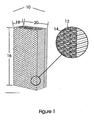
- the aspect ratio of the dimensions of heat exchanger core 10 are such as to fit the preferred requirements of an indirect evaporative cooler.
- Dimension 16 is large compared to the dimensions 18 and 20. Typically, dimension 16 will be about 1,500 mm, dimension 20 about 900 mm and dimension 18 about 400 mm.
- Both the dry passages 12 (shown with horizontal shading) and wet passages 14 (shown with vertical shading) are orientated to be essentially horizontal, although it may be beneficial that they be slightly off horizontal to aid the distribution of water in the wet channels and the removal of excess water.
- the heat exchanger 10 is shown in front elevation with dry passages 12 and wet passages 14 orientated to be horizontal in use.
- Hot, dry intake air enters the dry passages 12 of the heat exchanger from side 40 and leaves from side 42 as cooled air.
- a proportion of air enters the wet passages 14 from side 42 to flow back along the wet passages until it enters exhaust space 44, from which it is exhausted to atmosphere.
- This flow path through the core produces a useable stream of cool air from side 42 being the proportion of air not passing back through the wet passages 14 to be exhausted via space 44.
- the means by which this arrangement cools the stream of useable air is described in previous publications, in particular see WO 2006/074508 A1 .
- a traversing water distribution mechanism is shown with shrouds 52 covering a proportion of the delivery side of the heat exchanger 10.
- cooled air travels through the dry channels 12 of the heat exchanger 10, exiting along face 51.
- a proportion of the air exiting from dry channel 12 is diverted to wet channel 14, the remainder if the cooled air from dry channel 12 is available as useful air to be delivered by the cooler.
- the shrouds 52 of the water delivery mechanism 50 are covering a small number of the wet and dry channels on the delivery side, the air cannot split into 2 streams as in normal operation.
- the static pressure in dry channel 12 will always be relatively high since the dry channel is connected directly to the space to be cooled which is pressurised by a fan (not shown).
- the water thus sprayed can only flow through the wet channel 14, since the static pressure differences created by the shrouds 52 ensure that all air must flow from the dry channel to the wet channel.
- all water sprayed is available to wet the wet channel 14, and water entering wet channel 14 is distributed throughout the wet channel by the accelerated air flow therein.
- wet channels necessarily need to be periodically wetted, the water distribution mechanism must be traversed vertically up and down along the cooled air delivery face 51 of the heat exchanger. By this means, a small number of wet channels are wetted at a time, with the means of wetting moving on to adjacent channels until the entire face has been traversed and all wet channels have been wetted.
- FIG. 3 One method of traversing the water distribution mechanism is illustrated in Figure 3 .
- the water distribution mechanism is attached to a threaded nut 62, which runs on an extended screw 60.
- a driving means such as an electric motor, not shown
- the water distributing mechanism will move over the delivery face of the heat exchanger.
- FIG. 4 An alternative water distribution mechanism is illustrated in Figure 4 .
- Water is conducted through a hollow conduit 70, which has a slot along its length on the side facing the delivery face of the heat exchanger 10.
- a sliding plug 76 Inside the hollow conduit 70 is a sliding plug 76, held in position by a continuous belt or chain 72.
- Flexible belt 72 is positioned by capstans 74, driven by, say, an electric motor such that the drive of the capstan causes the sliding plug 76 to move up and down within conduit 70.
- water 78 is directed down the conduit 70 from the top.
- the water 78 flows down conduit 70 until it impacts on sliding plug 76.
- the sliding plug 76 diverts the water flow through the slot in conduit 70 at the position of sliding plug 76. Since the slot of conduit 70 is positioned against the delivery face of heat exchanger 10, as shown in Section A-A, the water so diverted will impinge on a small proportion of both the wet and dry channels at the position of the plug 76. Since air is flowing out of the dry channels and into the wet channels along the delivery face of heat exchanger 10, the water diverted onto the delivery face of heat exchanger 10 will tend to flow into the wet channels only, thereby providing the means of wetting the internal surfaces of the wet channel. The effect at the dry channel, wherein no water flows against the direction of air flow is shown in Section B-B. As sliding plug 76 progresses up and down the face of heat exchanger 10, all the wet channels will be progressively wetted during a wetting cycle.
- FIG. 1 A preferred arrangement for transmitting water diverted by plug 76 into the heat exchanger 10 is illustrated in section Alt A-A.
- heat exchanger 10 is constructed with notches 80 on the delivery face 51 such that the slot in conduit 70 is contained within the notch of the heat exchanger.
- the water delivered to the heat exchanger by the sliding plug 76 is contained within the notch 80 greatly reducing the tendency to spray water into the delivered air space (42 in Figure 2 ) when it impacts the delivery face of the heat exchanger at high velocity.
- the method and means of applying water to the wet channels of the heat exchanger described above are designed to apply water to the wet channels at a rate much greater than is actually required for evaporation. Such a high flow rate is required for the purposes of flushing salt deposits and contaminants from the surfaces of the wet channels, and to ensure that all the internal surfaces of the wet channels are indeed wetted.
- the angle of the corrugations tend to bias all the water flow (which tends to cling to the lower surfaces of the channels) in the direction of the angle of the corrugation.
- Figure 5 shows a single sheet of the heat exchanger core wherein the pattern of corrugations follows a "herringbone" shape. Corrugations are set at an angle to the airflow (depicted by arrowed lines) as indicated by ridges 90 on one side of the sheet. Symmetrical about centreline 91, the angle of corrugations on the other side of line 91 are the mirror image as indicated by ridge line 94. Successive sheets in the heat exchanger stack are placed in the opposite direction such that the corrugation ridges intersect each other at an angle.
- an indirect evaporative cooler as herein described and exemplified by the embodiments shown in the drawings enables such a cooler to be made in which the channel elements are horizontal or approximately so, and ultimate cooling capacity of the cooler is determined by the height of the heat exchanger stack.
- a compact cooler can be constructed which has minimal projection from, say, a wall on which it is mounted.
- the preferred method of distributing water to the wet channels of the heat exchanger stack allows for reliable, periodic wetting of the channel surfaces with provision or capacity for the flushing of contaminants.
Landscapes
- Engineering & Computer Science (AREA)
- Mechanical Engineering (AREA)
- General Engineering & Computer Science (AREA)
- Chemical & Material Sciences (AREA)
- Combustion & Propulsion (AREA)
- Physics & Mathematics (AREA)
- Thermal Sciences (AREA)
- Life Sciences & Earth Sciences (AREA)
- Sustainable Development (AREA)
- Heat-Exchange Devices With Radiators And Conduit Assemblies (AREA)
Claims (14)
- Indirekter Gegenstrom-Verdampfungswärmetauscher (10), wobei vertikal benachbarte Gegenstrom-Nasskanäle und -Trockenkanäle (14, 12) in Verwendung horizontal oder nahezu horizontal orientiert sind, wobei die Nasskanäle (14) durch ein Benetzungsmittel benetzt werden, das sequenziell über die Höhe des Wärmetauschers (10) längs der Nasskanäle (14) Wasser aufbringt, dadurch gekennzeichnet, dass das Benetzungsmittel eine Wasserzuführvorrichtung enthält, die dafür ausgelegt ist, im Allgemeinen vertikal zu dem Wärmetauscher (10) zu laufen, um Wasser entlang einer Luftzuführfläche (51) des Wärmetauschers (10) direkt in eine kleine Vielzahl der Gesamtzahl von Nasskanälen (14) zu einer Zeit zuzuführen.
- Indirekter Gegenstrom-Verdampfungswärmetauscher (10), wobei vertikal benachbarte Gegenstrom-Nasskanäle und -Trockenkanäle (14, 12) in Verwendung horizontal oder nahezu horizontal orientiert sind, wobei die Nasskanäle (14) durch ein Benetzungsmittel benetzt werden, das sequenziell über die Höhe des Wärmetauschers (10) längs der Nasskanäle (14) Wasser aufbringt, dadurch gekennzeichnet, dass die Wasserzuführvorrichtung eine Vielzahl von Rohren (70) umfasst, die entlang einer Luftzuführfläche (51) des Wärmetauschers (10) vertikal angeordnet sind, wobei die Rohre (70) in den Rohren Schlitze aufweisen, die der Luftzuführfläche (51) zugewandt sind, und wobei ein Schieber (76) dafür ausgelegt ist, in jedem geschlitzten Rohr (30) in der Weise auf- und abzulaufen, dass der Ort des Schiebers (76) in jedem Rohr (70) definiert, wo Wasser von jedem Rohr (70) zu den Nasskanälen (14) des Wärmetauschers (10) zugeführt wird, während Wasser in die Oberseite jedes Rohrs (70) zugeführt wird.
- Wärmetauscher (10) nach Anspruch 1 oder 2, wobei die Nass- und Trockenkanäle (14, 12) aus Riffelplatten konstruiert sind, wobei eine Seite ein benetzbares und absorbierendes Medium umfasst und die andere Seite eine wasserundurchlässige Oberfläche, Membran oder Schicht umfasst.
- Wärmetauscher (10) nach Anspruch 1, 2 oder 3, wobei die Nass- und Trockenkanäle (14, 12) aus einer benetzbaren und absorbierenden Zellulosebasis konstruiert sind, wobei auf eine Oberfläche eine undurchlässige Membran aufgebracht ist.
- Wärmetauscher (10) nach Anspruch 1, 2 oder 3, wobei die Nass- und Trockenkanäle (14, 12) aus einer wasserundurchlässigen, geformten Platte konstruiert sind, auf die ein wasserabsorbierendes Medium auf eine Oberfläche der Platte aufgebracht ist.
- Wärmetauscher (10) nach Anspruch 3 oder nach Anspruch 4 oder 5, wenn abhängig von Anspruch 3, wobei die Riffelplatten zur Herstellung jedes Kanals (14, 12) in der Weise zusammengesetzt sind, dass sich die Riffelungen vertikal benachbarter Platten unter einem Winkel in dem Bereich von 20° bis 70° schneiden.
- Wärmetauscher (10) nach Anspruch 6, wobei die Riffelplatten oben und unten in jedem Kanal (14, 12) in zwei Teile geteilt sind, die symmetrisch um eine Mittellinie sind, die im Wesentlichen parallel zu einer Hauptluftströmungsrichtung in jedem Kanal (14, 12) ist, wobei der Riffelungswinkel in einem Teil unter einem komplementären Winkel zu dem Riffelungswinkel in dem benachbarten Teil eingestellt ist.
- Wärmetauscher (10) nach Anspruch 6 oder 7, wobei die Riffelplatten mit den in einem Fischgrätenwinkelmuster symmetrisch um eine Mittellinie jeder jeweiligen Platte eingestellten Riffelungen konstruiert sind.
- Wärmetauscher nach einem der vorhergehenden Ansprüche, wenn wenigstens abhängig von Anspruch 2, der entlang der Luftzuführfläche (51) Hohlräume oder Aussparungen enthält, die so geformt sind, dass sie zu den geschlitzten Rohren (30) passen und dadurch Wasser enthalten, das den Wärmetauscherkanälen (14) zugeführt wird.
- Wärmetauscher (10) nach einem der vorhergehenden Ansprüche, wenn wenigstens abhängig von Anspruch 1, wobei die Wasserzuführvorrichtung einen vertikal beweglichen Wasserverteiler umfasst, der dafür ausgelegt ist, eine kleine Vielzahl einer Gesamtzahl von Kanälen entlang einer Luftzuführfläche (51) des Wärmetauschers zu einer Zeit zu benetzen.
- Wärmetauscher nach Anspruch 10, wobei die vertikale Bewegung des Wasserverteilers während eines Benetzungszyklus ununterbrochen ist.
- Wärmetauscher nach Anspruch 10 oder 11, wobei Wasser durch den Wasserverteiler während eines Benetzungszyklus ununterbrochen verteilt wird.
- Verdampfungskühler, der einen indirekten Gegenstrom-Verdampfungswärmetauscher (10) nach einem der vorhergehenden Ansprüche aufweist.
- Verfahren zum Betreiben eines indirekten Gegenstrom-Verdampfungswärmetauschers (10) nach einem der vorhergehenden Ansprüche, wobei der Wärmetauscher (10) einen vertikalen Stapel sich abwechselnder im Wesentlichen horizontaler Nass- und Trockenkanäle (14, 12) aufweist, wobei das Verfahren das zyklische Benetzen in Längsrichtung einer kleinen Vielzahl der Gesamtzahl der Nasskanäle (14) zu jeder Zeit umfasst, während sich die Nasskanäle (14) während der Luftströmung durch den Wärmetauscher (10) einem Austrocknungszustand nähern.
Applications Claiming Priority (2)
| Application Number | Priority Date | Filing Date | Title |
|---|---|---|---|
| AU2008905875A AU2008905875A0 (en) | 2008-11-13 | Indirect Evaporative Cooler construction | |
| PCT/AU2009/001463 WO2010054426A1 (en) | 2008-11-13 | 2009-11-10 | Indirect evaporative cooler construction |
Publications (4)
| Publication Number | Publication Date |
|---|---|
| EP2362933A1 EP2362933A1 (de) | 2011-09-07 |
| EP2362933A4 EP2362933A4 (de) | 2014-03-12 |
| EP2362933B1 true EP2362933B1 (de) | 2015-12-16 |
| EP2362933B8 EP2362933B8 (de) | 2016-02-24 |
Family
ID=42169527
Family Applications (1)
| Application Number | Title | Priority Date | Filing Date |
|---|---|---|---|
| EP09825644.9A Active EP2362933B8 (de) | 2008-11-13 | 2009-11-10 | Gegenstrom-indirekter-verdampfungswämetauscher |
Country Status (10)
| Country | Link |
|---|---|
| US (1) | US8783054B2 (de) |
| EP (1) | EP2362933B8 (de) |
| CN (1) | CN102272535B (de) |
| AU (1) | AU2009316228B2 (de) |
| CA (1) | CA2745336A1 (de) |
| ES (1) | ES2564817T3 (de) |
| IL (1) | IL213183A (de) |
| PT (1) | PT2362933E (de) |
| WO (1) | WO2010054426A1 (de) |
| ZA (1) | ZA201104578B (de) |
Families Citing this family (12)
| Publication number | Priority date | Publication date | Assignee | Title |
|---|---|---|---|---|
| AU2013200027B2 (en) * | 2012-01-04 | 2016-09-08 | Seeley International Pty. Ltd. | Scaleable Capacity Indirect Evaporative Cooler |
| US9234705B2 (en) * | 2013-01-03 | 2016-01-12 | F.F. Seeley Nominees Pty Ltd | Scaleable capacity indirect evaporative cooler |
| CN103968678B (zh) * | 2014-05-05 | 2016-04-06 | 中国神华能源股份有限公司 | 哈蒙式间接空冷喷雾降温系统 |
| EP3191782B1 (de) * | 2014-09-08 | 2020-11-04 | F.F. Seeley Nominees Pty Ltd. | Kompakter kühler mit indirekter verdampfung |
| RU2694379C1 (ru) | 2015-06-22 | 2019-07-12 | Дач Инновейшн Ин Эр Тритмент Бв | Здание, снабженное системой обработки воздуха |
| US10422540B2 (en) * | 2015-10-05 | 2019-09-24 | Matthew Morris | Evaporative cooling device and control system |
| CN107543438A (zh) * | 2016-06-28 | 2018-01-05 | 陈祖卫 | 膜片式露点间接蒸发冷却换热器 |
| JP6615080B2 (ja) * | 2016-10-31 | 2019-12-04 | 三菱電機株式会社 | 加湿装置、換気装置及び空気調和装置 |
| EP3860754A4 (de) * | 2018-10-02 | 2022-06-15 | President and Fellows of Harvard College | Hydrophobe sperrschicht für keramische indirekte verdampfungskühlsysteme |
| CN111023863B (zh) * | 2019-12-25 | 2021-07-30 | 深圳市辰诺节能科技有限公司 | 一种可改变喷雾角度的水矢量喷雾推进通风冷却塔 |
| CN111365797A (zh) * | 2020-02-28 | 2020-07-03 | 徐州申恒环境科技有限公司 | 一种纺织空调用折板式间接蒸发冷却设备及其工作方式 |
| ES2933748B2 (es) * | 2021-08-10 | 2023-08-03 | Univ Cordoba | Intercambiador ultracompacto de alta eficiencia para el tratamiento simultáneo de temperatura y humedad del aire |
Family Cites Families (20)
| Publication number | Priority date | Publication date | Assignee | Title |
|---|---|---|---|---|
| SE383777B (sv) | 1973-07-18 | 1976-03-29 | Munters Ab Carl | Sett och anordning for kylning av luft |
| SE415928B (sv) * | 1979-01-17 | 1980-11-10 | Alfa Laval Ab | Plattvermevexlare |
| US4660390A (en) | 1986-03-25 | 1987-04-28 | Worthington Mark N | Air conditioner with three stages of indirect regeneration |
| RU1778453C (ru) | 1987-05-12 | 1992-11-30 | Одесский Инженерно-Строительный Институт | Способ обработки воздуха в помещении |
| US5349829A (en) * | 1992-05-21 | 1994-09-27 | Aoc, Inc. | Method and apparatus for evaporatively cooling gases and/or fluids |
| AUPM777294A0 (en) * | 1994-08-30 | 1994-09-22 | William Allen Trusts Pty Ltd | Spaced evaporative wicks within an air cooler |
| DE29506110U1 (de) * | 1995-01-20 | 1995-08-17 | Polybloc Ag, Winterthur | Plattenwärmeaustauscher mit Benetzungseinrichtung |
| AUPN123495A0 (en) | 1995-02-20 | 1995-03-16 | F F Seeley Nominees Pty Ltd | Contra flow heat exchanger |
| IL113078A0 (en) | 1995-03-22 | 1995-06-29 | Coolsys Maarachot Keroor Mitka | Air cooler |
| EP0773412B1 (de) | 1995-11-07 | 2003-12-17 | Kabushiki Kaisha Seibu Giken | Verfahren und Vorrichtung zum Kühlen eines Fluidstromes und trocknende Gaskühlung |
| JPH11187220A (ja) * | 1997-12-17 | 1999-07-09 | Seiko Instruments Inc | カラー画像読み取り装置 |
| WO1999041552A1 (en) * | 1998-02-13 | 1999-08-19 | Antonius Van Hecke | Method and device for cooling air |
| US6523604B1 (en) * | 1998-11-06 | 2003-02-25 | Barry R. Brooks | Indirect evaporative cooling apparatus |
| CN100380082C (zh) | 2000-09-27 | 2008-04-09 | 埃达雷克斯技术公司 | 用于露点蒸发冷却器的方法和板设备 |
| NL1018735C1 (nl) | 2001-08-10 | 2003-02-11 | Forest Air B V | Enthalpie-uitwisselaar. |
| US20040061245A1 (en) | 2002-08-05 | 2004-04-01 | Valeriy Maisotsenko | Indirect evaporative cooling mechanism |
| GB0415549D0 (en) * | 2004-07-12 | 2004-08-11 | Oxycell Holding Bv | Heat exchange device |
| EP1836046B1 (de) * | 2005-01-11 | 2021-12-29 | Seeley International Pty Ltd | Verfahren und materialien zur verbesserung von verdunstungswärmetauschern |
| CN101191646B (zh) * | 2006-11-30 | 2011-08-24 | 新疆绿色使者空气环境技术有限公司 | 蒸发制冷冷水机组 |
| CN101266091B (zh) * | 2008-04-14 | 2010-10-27 | 西安工程大学 | 一种多孔功能陶瓷露点板翅式间接蒸发冷却器 |
-
2009
- 2009-11-10 EP EP09825644.9A patent/EP2362933B8/de active Active
- 2009-11-10 PT PT98256449T patent/PT2362933E/pt unknown
- 2009-11-10 CA CA2745336A patent/CA2745336A1/en not_active Abandoned
- 2009-11-10 ES ES09825644.9T patent/ES2564817T3/es active Active
- 2009-11-10 CN CN200980154068.2A patent/CN102272535B/zh active Active
- 2009-11-10 AU AU2009316228A patent/AU2009316228B2/en active Active
- 2009-11-10 WO PCT/AU2009/001463 patent/WO2010054426A1/en not_active Ceased
- 2009-11-10 US US13/142,901 patent/US8783054B2/en active Active
-
2011
- 2011-05-26 IL IL213183A patent/IL213183A/en active IP Right Grant
- 2011-06-21 ZA ZA2011/04578A patent/ZA201104578B/en unknown
Also Published As
| Publication number | Publication date |
|---|---|
| ES2564817T3 (es) | 2016-03-29 |
| EP2362933A4 (de) | 2014-03-12 |
| EP2362933B8 (de) | 2016-02-24 |
| CN102272535B (zh) | 2014-07-30 |
| AU2009316228B2 (en) | 2015-10-22 |
| AU2009316228A1 (en) | 2010-05-20 |
| US20110302946A1 (en) | 2011-12-15 |
| EP2362933A1 (de) | 2011-09-07 |
| PT2362933E (pt) | 2016-03-04 |
| IL213183A (en) | 2014-03-31 |
| IL213183A0 (en) | 2011-07-31 |
| ZA201104578B (en) | 2012-03-28 |
| WO2010054426A1 (en) | 2010-05-20 |
| CA2745336A1 (en) | 2010-05-20 |
| US8783054B2 (en) | 2014-07-22 |
| CN102272535A (zh) | 2011-12-07 |
Similar Documents
| Publication | Publication Date | Title |
|---|---|---|
| EP2362933B1 (de) | Gegenstrom-indirekter-verdampfungswämetauscher | |
| US8636269B2 (en) | Method and materials for improving evaporative heat exchangers | |
| CN101970966B (zh) | 干湿式冷却塔和冷却方法 | |
| US20110041531A1 (en) | Evaporative cooler | |
| US20190346221A1 (en) | Cooling tower water distribution system | |
| JP3348848B2 (ja) | 間接気化冷却装置 | |
| AU2005215644B2 (en) | Plate heat and mass exchanger with edge extension | |
| KR101054445B1 (ko) | 재생증발식 냉방기, 냉방 시스템 및 그의 코어 모듈 | |
| WO2018051157A1 (en) | Water distribution systems for plate heat and mass exchanger for indirect evaportive cooling | |
| RU2635726C2 (ru) | Блок оросителя градирни | |
| AU2010201392B2 (en) | Method and Means for Operating Evaporative Coolers |
Legal Events
| Date | Code | Title | Description |
|---|---|---|---|
| PUAI | Public reference made under article 153(3) epc to a published international application that has entered the european phase |
Free format text: ORIGINAL CODE: 0009012 |
|
| 17P | Request for examination filed |
Effective date: 20110602 |
|
| AK | Designated contracting states |
Kind code of ref document: A1 Designated state(s): AT BE BG CH CY CZ DE DK EE ES FI FR GB GR HR HU IE IS IT LI LT LU LV MC MK MT NL NO PL PT RO SE SI SK SM TR |
|
| DAX | Request for extension of the european patent (deleted) | ||
| A4 | Supplementary search report drawn up and despatched |
Effective date: 20140211 |
|
| RIC1 | Information provided on ipc code assigned before grant |
Ipc: F28D 9/00 20060101ALI20140205BHEP Ipc: F24F 6/04 20060101ALI20140205BHEP Ipc: F28F 3/08 20060101ALI20140205BHEP Ipc: F24F 12/00 20060101AFI20140205BHEP Ipc: F28D 5/00 20060101ALI20140205BHEP |
|
| 17Q | First examination report despatched |
Effective date: 20141027 |
|
| GRAP | Despatch of communication of intention to grant a patent |
Free format text: ORIGINAL CODE: EPIDOSNIGR1 |
|
| INTG | Intention to grant announced |
Effective date: 20150612 |
|
| GRAS | Grant fee paid |
Free format text: ORIGINAL CODE: EPIDOSNIGR3 |
|
| GRAA | (expected) grant |
Free format text: ORIGINAL CODE: 0009210 |
|
| AK | Designated contracting states |
Kind code of ref document: B1 Designated state(s): AT BE BG CH CY CZ DE DK EE ES FI FR GB GR HR HU IE IS IT LI LT LU LV MC MK MT NL NO PL PT RO SE SI SK SM TR |
|
| REG | Reference to a national code |
Ref country code: GB Ref legal event code: FG4D |
|
| REG | Reference to a national code |
Ref country code: CH Ref legal event code: EP |
|
| REG | Reference to a national code |
Ref country code: IE Ref legal event code: FG4D |
|
| REG | Reference to a national code |
Ref country code: AT Ref legal event code: REF Ref document number: 765749 Country of ref document: AT Kind code of ref document: T Effective date: 20160115 |
|
| RAP2 | Party data changed (patent owner data changed or rights of a patent transferred) |
Owner name: F.F. SEELEY NOMINEES PTY LTD. |
|
| REG | Reference to a national code |
Ref country code: DE Ref legal event code: R096 Ref document number: 602009035306 Country of ref document: DE |
|
| REG | Reference to a national code |
Ref country code: PT Ref legal event code: SC4A Free format text: AVAILABILITY OF NATIONAL TRANSLATION Effective date: 20160128 |
|
| REG | Reference to a national code |
Ref country code: ES Ref legal event code: FG2A Ref document number: 2564817 Country of ref document: ES Kind code of ref document: T3 Effective date: 20160329 |
|
| REG | Reference to a national code |
Ref country code: NL Ref legal event code: MP Effective date: 20151216 |
|
| REG | Reference to a national code |
Ref country code: LT Ref legal event code: MG4D |
|
| PG25 | Lapsed in a contracting state [announced via postgrant information from national office to epo] |
Ref country code: NO Free format text: LAPSE BECAUSE OF FAILURE TO SUBMIT A TRANSLATION OF THE DESCRIPTION OR TO PAY THE FEE WITHIN THE PRESCRIBED TIME-LIMIT Effective date: 20160316 Ref country code: HR Free format text: LAPSE BECAUSE OF FAILURE TO SUBMIT A TRANSLATION OF THE DESCRIPTION OR TO PAY THE FEE WITHIN THE PRESCRIBED TIME-LIMIT Effective date: 20151216 Ref country code: LT Free format text: LAPSE BECAUSE OF FAILURE TO SUBMIT A TRANSLATION OF THE DESCRIPTION OR TO PAY THE FEE WITHIN THE PRESCRIBED TIME-LIMIT Effective date: 20151216 |
|
| REG | Reference to a national code |
Ref country code: AT Ref legal event code: MK05 Ref document number: 765749 Country of ref document: AT Kind code of ref document: T Effective date: 20151216 |
|
| PG25 | Lapsed in a contracting state [announced via postgrant information from national office to epo] |
Ref country code: NL Free format text: LAPSE BECAUSE OF FAILURE TO SUBMIT A TRANSLATION OF THE DESCRIPTION OR TO PAY THE FEE WITHIN THE PRESCRIBED TIME-LIMIT Effective date: 20151216 Ref country code: FI Free format text: LAPSE BECAUSE OF FAILURE TO SUBMIT A TRANSLATION OF THE DESCRIPTION OR TO PAY THE FEE WITHIN THE PRESCRIBED TIME-LIMIT Effective date: 20151216 Ref country code: LV Free format text: LAPSE BECAUSE OF FAILURE TO SUBMIT A TRANSLATION OF THE DESCRIPTION OR TO PAY THE FEE WITHIN THE PRESCRIBED TIME-LIMIT Effective date: 20151216 Ref country code: SE Free format text: LAPSE BECAUSE OF FAILURE TO SUBMIT A TRANSLATION OF THE DESCRIPTION OR TO PAY THE FEE WITHIN THE PRESCRIBED TIME-LIMIT Effective date: 20151216 |
|
| REG | Reference to a national code |
Ref country code: GR Ref legal event code: EP Ref document number: 20160400490 Country of ref document: GR Effective date: 20160505 |
|
| PG25 | Lapsed in a contracting state [announced via postgrant information from national office to epo] |
Ref country code: CZ Free format text: LAPSE BECAUSE OF FAILURE TO SUBMIT A TRANSLATION OF THE DESCRIPTION OR TO PAY THE FEE WITHIN THE PRESCRIBED TIME-LIMIT Effective date: 20151216 |
|
| PG25 | Lapsed in a contracting state [announced via postgrant information from national office to epo] |
Ref country code: RO Free format text: LAPSE BECAUSE OF FAILURE TO SUBMIT A TRANSLATION OF THE DESCRIPTION OR TO PAY THE FEE WITHIN THE PRESCRIBED TIME-LIMIT Effective date: 20151216 Ref country code: EE Free format text: LAPSE BECAUSE OF FAILURE TO SUBMIT A TRANSLATION OF THE DESCRIPTION OR TO PAY THE FEE WITHIN THE PRESCRIBED TIME-LIMIT Effective date: 20151216 Ref country code: AT Free format text: LAPSE BECAUSE OF FAILURE TO SUBMIT A TRANSLATION OF THE DESCRIPTION OR TO PAY THE FEE WITHIN THE PRESCRIBED TIME-LIMIT Effective date: 20151216 Ref country code: IS Free format text: LAPSE BECAUSE OF FAILURE TO SUBMIT A TRANSLATION OF THE DESCRIPTION OR TO PAY THE FEE WITHIN THE PRESCRIBED TIME-LIMIT Effective date: 20160416 Ref country code: SK Free format text: LAPSE BECAUSE OF FAILURE TO SUBMIT A TRANSLATION OF THE DESCRIPTION OR TO PAY THE FEE WITHIN THE PRESCRIBED TIME-LIMIT Effective date: 20151216 Ref country code: SM Free format text: LAPSE BECAUSE OF FAILURE TO SUBMIT A TRANSLATION OF THE DESCRIPTION OR TO PAY THE FEE WITHIN THE PRESCRIBED TIME-LIMIT Effective date: 20151216 |
|
| REG | Reference to a national code |
Ref country code: DE Ref legal event code: R097 Ref document number: 602009035306 Country of ref document: DE |
|
| PLBE | No opposition filed within time limit |
Free format text: ORIGINAL CODE: 0009261 |
|
| STAA | Information on the status of an ep patent application or granted ep patent |
Free format text: STATUS: NO OPPOSITION FILED WITHIN TIME LIMIT |
|
| REG | Reference to a national code |
Ref country code: FR Ref legal event code: PLFP Year of fee payment: 8 |
|
| PG25 | Lapsed in a contracting state [announced via postgrant information from national office to epo] |
Ref country code: DK Free format text: LAPSE BECAUSE OF FAILURE TO SUBMIT A TRANSLATION OF THE DESCRIPTION OR TO PAY THE FEE WITHIN THE PRESCRIBED TIME-LIMIT Effective date: 20151216 Ref country code: PL Free format text: LAPSE BECAUSE OF FAILURE TO SUBMIT A TRANSLATION OF THE DESCRIPTION OR TO PAY THE FEE WITHIN THE PRESCRIBED TIME-LIMIT Effective date: 20151216 |
|
| 26N | No opposition filed |
Effective date: 20160919 |
|
| PG25 | Lapsed in a contracting state [announced via postgrant information from national office to epo] |
Ref country code: BE Free format text: LAPSE BECAUSE OF FAILURE TO SUBMIT A TRANSLATION OF THE DESCRIPTION OR TO PAY THE FEE WITHIN THE PRESCRIBED TIME-LIMIT Effective date: 20151216 |
|
| PG25 | Lapsed in a contracting state [announced via postgrant information from national office to epo] |
Ref country code: SI Free format text: LAPSE BECAUSE OF FAILURE TO SUBMIT A TRANSLATION OF THE DESCRIPTION OR TO PAY THE FEE WITHIN THE PRESCRIBED TIME-LIMIT Effective date: 20151216 |
|
| REG | Reference to a national code |
Ref country code: DE Ref legal event code: R119 Ref document number: 602009035306 Country of ref document: DE |
|
| REG | Reference to a national code |
Ref country code: CH Ref legal event code: PL |
|
| PG25 | Lapsed in a contracting state [announced via postgrant information from national office to epo] |
Ref country code: CH Free format text: LAPSE BECAUSE OF NON-PAYMENT OF DUE FEES Effective date: 20161130 Ref country code: LI Free format text: LAPSE BECAUSE OF NON-PAYMENT OF DUE FEES Effective date: 20161130 |
|
| REG | Reference to a national code |
Ref country code: IE Ref legal event code: MM4A |
|
| PG25 | Lapsed in a contracting state [announced via postgrant information from national office to epo] |
Ref country code: LU Free format text: LAPSE BECAUSE OF NON-PAYMENT OF DUE FEES Effective date: 20161130 |
|
| REG | Reference to a national code |
Ref country code: FR Ref legal event code: PLFP Year of fee payment: 9 |
|
| PG25 | Lapsed in a contracting state [announced via postgrant information from national office to epo] |
Ref country code: IE Free format text: LAPSE BECAUSE OF NON-PAYMENT OF DUE FEES Effective date: 20161110 Ref country code: DE Free format text: LAPSE BECAUSE OF NON-PAYMENT OF DUE FEES Effective date: 20170601 |
|
| PG25 | Lapsed in a contracting state [announced via postgrant information from national office to epo] |
Ref country code: HU Free format text: LAPSE BECAUSE OF FAILURE TO SUBMIT A TRANSLATION OF THE DESCRIPTION OR TO PAY THE FEE WITHIN THE PRESCRIBED TIME-LIMIT; INVALID AB INITIO Effective date: 20091110 Ref country code: CY Free format text: LAPSE BECAUSE OF FAILURE TO SUBMIT A TRANSLATION OF THE DESCRIPTION OR TO PAY THE FEE WITHIN THE PRESCRIBED TIME-LIMIT Effective date: 20151216 |
|
| PG25 | Lapsed in a contracting state [announced via postgrant information from national office to epo] |
Ref country code: MK Free format text: LAPSE BECAUSE OF FAILURE TO SUBMIT A TRANSLATION OF THE DESCRIPTION OR TO PAY THE FEE WITHIN THE PRESCRIBED TIME-LIMIT Effective date: 20151216 Ref country code: MC Free format text: LAPSE BECAUSE OF FAILURE TO SUBMIT A TRANSLATION OF THE DESCRIPTION OR TO PAY THE FEE WITHIN THE PRESCRIBED TIME-LIMIT Effective date: 20151216 |
|
| PG25 | Lapsed in a contracting state [announced via postgrant information from national office to epo] |
Ref country code: BG Free format text: LAPSE BECAUSE OF FAILURE TO SUBMIT A TRANSLATION OF THE DESCRIPTION OR TO PAY THE FEE WITHIN THE PRESCRIBED TIME-LIMIT Effective date: 20151216 |
|
| REG | Reference to a national code |
Ref country code: FR Ref legal event code: PLFP Year of fee payment: 10 |
|
| PG25 | Lapsed in a contracting state [announced via postgrant information from national office to epo] |
Ref country code: MT Free format text: LAPSE BECAUSE OF NON-PAYMENT OF DUE FEES Effective date: 20161110 |
|
| PGFP | Annual fee paid to national office [announced via postgrant information from national office to epo] |
Ref country code: PT Payment date: 20251003 Year of fee payment: 17 |
|
| PGFP | Annual fee paid to national office [announced via postgrant information from national office to epo] |
Ref country code: GB Payment date: 20251002 Year of fee payment: 17 |
|
| PGFP | Annual fee paid to national office [announced via postgrant information from national office to epo] |
Ref country code: IT Payment date: 20251006 Year of fee payment: 17 |
|
| PGFP | Annual fee paid to national office [announced via postgrant information from national office to epo] |
Ref country code: FR Payment date: 20251002 Year of fee payment: 17 |
|
| PGFP | Annual fee paid to national office [announced via postgrant information from national office to epo] |
Ref country code: TR Payment date: 20251002 Year of fee payment: 17 Ref country code: GR Payment date: 20251128 Year of fee payment: 17 |
|
| PGFP | Annual fee paid to national office [announced via postgrant information from national office to epo] |
Ref country code: ES Payment date: 20251219 Year of fee payment: 17 |