EP2363331A1 - Procédé pour le trafic combiné et semi-remorque pour l'utilisation dans le procédé - Google Patents
Procédé pour le trafic combiné et semi-remorque pour l'utilisation dans le procédé Download PDFInfo
- Publication number
- EP2363331A1 EP2363331A1 EP10001929A EP10001929A EP2363331A1 EP 2363331 A1 EP2363331 A1 EP 2363331A1 EP 10001929 A EP10001929 A EP 10001929A EP 10001929 A EP10001929 A EP 10001929A EP 2363331 A1 EP2363331 A1 EP 2363331A1
- Authority
- EP
- European Patent Office
- Prior art keywords
- payload
- semi
- trailer
- frame
- trailers
- Prior art date
- Legal status (The legal status is an assumption and is not a legal conclusion. Google has not performed a legal analysis and makes no representation as to the accuracy of the status listed.)
- Withdrawn
Links
Images

Classifications
-
- B—PERFORMING OPERATIONS; TRANSPORTING
- B61—RAILWAYS
- B61D—BODY DETAILS OR KINDS OF RAILWAY VEHICLES
- B61D3/00—Wagons or vans
- B61D3/16—Wagons or vans adapted for carrying special loads
- B61D3/18—Wagons or vans adapted for carrying special loads for vehicles
- B61D3/182—Wagons or vans adapted for carrying special loads for vehicles specially adapted for heavy vehicles, e.g. public work vehicles, trucks, trailers
- B61D3/184—Wagons or vans adapted for carrying special loads for vehicles specially adapted for heavy vehicles, e.g. public work vehicles, trucks, trailers the heavy vehicles being of the trailer or semi-trailer type
-
- B—PERFORMING OPERATIONS; TRANSPORTING
- B61—RAILWAYS
- B61B—RAILWAY SYSTEMS; EQUIPMENT THEREFOR NOT OTHERWISE PROVIDED FOR
- B61B1/00—General arrangement of stations, platforms, or sidings; Railway networks; Rail vehicle marshalling systems
- B61B1/005—Rail vehicle marshalling systems; Rail freight terminals
-
- B—PERFORMING OPERATIONS; TRANSPORTING
- B62—LAND VEHICLES FOR TRAVELLING OTHERWISE THAN ON RAILS
- B62D—MOTOR VEHICLES; TRAILERS
- B62D53/00—Tractor-trailer combinations; Road trains
- B62D53/04—Tractor-trailer combinations; Road trains comprising a vehicle carrying an essential part of the other vehicle's load by having supporting means for the front or rear part of the other vehicle
- B62D53/06—Semi-trailers
- B62D53/061—Semi-trailers of flat bed or low loader type or fitted with swan necks
-
- G—PHYSICS
- G06—COMPUTING OR CALCULATING; COUNTING
- G06Q—INFORMATION AND COMMUNICATION TECHNOLOGY [ICT] SPECIALLY ADAPTED FOR ADMINISTRATIVE, COMMERCIAL, FINANCIAL, MANAGERIAL OR SUPERVISORY PURPOSES; SYSTEMS OR METHODS SPECIALLY ADAPTED FOR ADMINISTRATIVE, COMMERCIAL, FINANCIAL, MANAGERIAL OR SUPERVISORY PURPOSES, NOT OTHERWISE PROVIDED FOR
- G06Q10/00—Administration; Management
- G06Q10/08—Logistics, e.g. warehousing, loading or distribution; Inventory or stock management
Definitions
- the invention relates to a method for combined road and rail transport and to a semi-trailer for use in the method.
- Combined transport is a generic term for freight transport where complete loading units are carried on the route by at least two different modes of transport.
- the loading units are usually containers, swap bodies, semitrailers or complete trucks.
- the modes of transport are trucks, trains or ships.
- the goods remain in the loading units both during transport and during the transhipment between the different types of transport.
- the combined transport usually requires at least two transshipment operations from one to the other mode of transport.
- Combined transport has the advantage of relieving the burden on the road and improving the CO 2 balance of transports.
- Semi-trailers are trailers that relocate part of their weight to the axles of a semitrailer tractor. They are connected via a kingpin on its underside with a fifth wheel of the tractor.
- the semi-trailer For use in combined transport, the semi-trailer must be able to be craned. For this purpose, it is provided with gripping edges on which a lifting device can attack.
- semi-trailers are loaded onto pocket wagons by a crane or a mobile handling device.
- a baggage car is one as Flat car trained bogie wagon.
- the semi-trailer is secured with the kingpin in a coupling plate, which is located on a height-adjustable and movable in the carriage longitudinal support bracket of the bag wagon.
- the wheels can be locked with wedges on the baggage car.
- the semi-trailers are transported by rail to another transhipment terminal. Drivers and tractors stay at the place of loading.
- the semitrailers are put on tractors by the pocket wagons.
- the maximum permissible total weight of the semitrailer is 40 t. Considering a weight of the tractor of about 7500 kg and a tare weight of the semi-trailer of about 6500 kg, the maximum payload of the semitrailer is about 26 t. For articulated lorries for combined transport, the maximum permissible total weight is increased to 44 t, so that the maximum payload is about 30 t.
- the object of the invention is to provide a method for combined traffic on road and rail, which further reduces the traffic volume on the road and further improves the CO 2 balance of the transports.
- a semi-trailer is to be made available for use in the process.
- craneable semi-trailers are used for the first time, in which frame and engaging means for a handling device are dimensioned so that they can be loaded with a payload in the range of 35 to 40 t.
- the method utilizes transhipment terminals having at least one handling device capable of loading such a semi-trailer when it is loaded with a payload in the range of 35 to 40 tons. Taking into account a tare weight of the semi-trailer in the range of 4.5 to 7.5 t, this means that the transhipment device must be able to lift a total weight in the range of 39.5 to 47.5 t.
- the handling device may be a (portal) crane or a mobile handling device.
- the semi-trailer is loaded to the maximum, taking into account its curb weight and its own weight of about 7500 kg, a total weight of the semitrailer of 47 to 55 t is reached, which is generally not permitted in road traffic.
- the loading points may be located on the same premises as the transhipment terminals or may be connected to them by private routes so that an official permit for transport between the loading point and the transhipment terminal is not required.
- the operation of semi-trailers with such high overall weights on short and well-defined public roads is technically very well controlled and therefore special permits accessible.
- the short-run and the short-run preferably extend for a maximum of a distance of 10 km, more preferably 5 km, further preferably 2 km.
- the transport capacity is increased by 5 to 10 t payload per semitrailer and accordingly reduces the traffic on the road and improves the CO 2 balance.
- the loading point may coincide with the consignor of the goods to be transported, for example be located at a manufacturer or dealer of the goods.
- the further loading point may coincide with the recipient of the goods, for example at a wholesaler or a central warehouse of the retail trade.
- the loading point can also serve the transhipment of goods delivered by the shipper to the loading point on the semitrailer trays of the short forward.
- the further loading point can serve the transhipment of goods, which are supplied by the tractor trailers of the short trailer to transport the goods to recipients.
- transport units are loaded at least one consignor with a payload of up to 30 t and driven the transport units in a further flow from the shipper to the loading point in which the trucks are loaded.
- Road transport approved units with a payload of up to 30 t are available, for example in the form of semi-trailers with a maximum total weight of 44 t. As a result, the further flow can be made over longer distances on public roads.
- the transport units are semitrailers with semi-trailers with a craneable payload in the range of 35 to 40 tons, which are loaded at the consignor with a payload of up to 30 t and are driven in the further flow to the loading point, in which they Payload loaded until they are loaded with a payload in the range of 35 to 40 t.
- the transport units then do not have to be unloaded at the loading point, but can additionally be loaded up to the entire craneable payload.
- the semitrailers loaded in this way are driven from the loading point to the transhipment terminal in the short run, where the loaded semitrailers are loaded onto pocket wagons.
- transport units with a payload of up to 30 t are moved in a further overrun from the further loading location to at least one receiver.
- Road transport approved units with a payload of up to 30 t are available, for example in the form of semi-trailers with a maximum total weight of 44 t.
- payloads from semi-trailers with a craneable payload in the range of 35 to 40 t can be loaded into the transport units and transported on public roads to the consignee.
- the further transport units are in the short trailer to the other loading station driven trucks with a craneable payload in the range of 35 to 40 t, which payload is taken in the other loading point so that they contain a payload of up to 30 t.
- the semitrailer tractors may be driven on public roads in the further caster.
- the further advance and / or the further caster can take place over a distance of preferably up to 200 km, more preferably up to 150 km.
- the payload is basically any goods. It is preferably semi-finished or finished goods.
- the payload includes beverage containers that are inserted into carriers that are stacked on top of each other.
- the beverage containers are preferably bottles (refillable bottles or disposable bottles) or cans.
- the charge carriers are beverage crates.
- the charge carriers are preferably carrier plates which have receptacles for the bottom regions of beverage containers at the top and which have receptacles for the head region of beverage containers at the bottom.
- the carrier plates are stackable on crates.
- the charge carriers comprise both carrier plates and beverage crates.
- the payload comprises beverage containers which are inserted in load carriers, which are stacked on top of one another and placed on pallets.
- load carriers Preferably Euro pallets are used.
- the payload of 35 to 40 t comprises several stacked stacks with beverage containers and load carriers on pallets.
- the payload comprises stacked stacks with five layers of beverage containers on load carriers on a pallet and a stack arranged thereon comprising four layers of beverage containers on load carriers on a further pallet.
- up to 34 pallets are placed on the floor of the semi-trailer and placed on the 34 pallets, each with 5 layers of beverage containers and placed on it up to 14 pallets, each with 4 layers of beverage containers.
- a slip-resistant material is arranged between the stacks.
- the slip-resistant material is flexible sheet material or a tarpaulin.
- the semi-trailer has a dead weight in the range of 4.5 to 7.5 t. Preferably, it has a dead weight of about 6.5 t.
- the engaging means are gripping edges. Preferably they are gripper tongs.
- the semi-trailer has a sliding tarpaulin structure.
- the semi-trailer body is equipped with a so-called curtain tarpaulin instead of rigid walls on the left and right sides. This is attached to top rollers and Fixed at the bottom with straps on the vehicle floor.
- the sliding tarpaulin can be raised like a curtain.
- the sliding tarpaulin construction is particularly light and allows particularly high payloads.
- Stanchions that support the roof construction are preferably displaceable sideways.
- the semi-trailer is loading and unloading after moving the sliding tarpaulin and the stanchions from the side or after opening a rear door.
- the cargo space has a clear loading height of about 3000 mm. This favors the transport of beverage containers in stacks arranged one above the other, the lower stack comprising a Euro pallet and five layers of bottles in carrier plates and a carrier plate on the uppermost layer and the upper layer comprising a Euro pallet and four layers of bottles in carrier plates on the Euro pallet and a carrier plate the topmost layer comprises bottles.
- a roller is arranged on the inside of the front end wall of the semitrailer, on which a flexible, non-slip material is rolled, which is unwound in the longitudinal direction of the cargo space to the rear.
- the slip-resistant material is mounted at a height behind the front end wall, which comprises approximately the height of a stack of a Euro pallet and five layers of bottles on carrier plates with a carrier plate on the uppermost layer bottles.
- the non-slip flexible material is fixable on the sides and / or on the rear end wall of the structure.
- the roller is connected to a gear for winding and / or unwinding of the roller.
- the semi-trailer has a height-adjustable roof, which is a clear loading height of at least 3000 mm adjustable. This makes it possible to adjust the roof to a height that facilitates the loading and unloading of the semi-trailer.
- the semi-trailer may have a structure with a fixed roof.
- the roof is a sliding roof.
- the sliding roof has a relatively low weight and benefits the maximum payload of the semi-trailer.
- the wheel suspensions are preferably height-adjustable relative to the frame, so that the height of the kingpin with respect to the footprint of the wheels in a range of at least 880 to 960 mm can be varied.
- the semi-trailer between the frame and the suspension has a pneumatic suspension. The pneumatic suspension allows height adjustment of the suspension with respect to the frame. In this way, the height of the kingpin can be adjusted with respect to the footprint of the wheels.
- the semi-trailer has a total height of about 4000 to 4010 mm in road operation and railway operation.
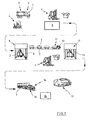
- Tractors 1 with tractors 2 and semitrailers 3 are loaded at the sender 4 with a payload of up to 30 t comprising beverage bottles, carrier plates and Euro pallets.
- the semitrailer 1 are driven in the run to a loading station 5, which is located near a transfer terminal 6.
- additional payload is loaded by means of forklifts 7 in the semitrailer 3 until it contains a payload in the range of 35 to 40 t.
- the additional payload is driven by means of other trucks to the loading point 5.
- These may be conventional articulated lorries with a maximum payload of 30 t.
- the train 11 is driven in the main run of the transfer terminal 6 to another terminal terminal 12, which is located some 100 km away from the transfer terminal 6.
- the semitrailer 3 are loaded by means of another gantry crane 13 of the pocket wagon 9 on more tractors 14 and form together with them more semitrailer 15th
- the other semitrailer tractors 15 travel in short caster to a further loading point 16 located at a short distance from the further transhipment terminal 12.
- payload is removed from the semitrailer 3 so that a payload of a maximum of 30 t remains in the semitrailer 3.
- the semitrailer 15 is moved from the other loading point 16 to the receiver 17. There he is unloaded.
- the unloaded payload can be transported by means of other articulated trucks to receivers 17.
- These may be conventional type semitrailers capable of carrying a maximum of 30 tons of payload.
- a semi-trailer 3 has a frame 18 with a kingpin 19 at the bottom.
- the frame 18 is preferably a lead frame. Further, on both longitudinal sides of the frame 18 in each case two gripping edges 20, 21 for a crane available.
- the frame 18 and the gripping edges 20, 21 are dimensioned for a maximum craneable payload in the range of 35 to 40 t.
- the semi-trailer 3 On the frame 18, the semi-trailer 3 has a structure 31.
- the structure 31 has front and rear end walls 32, 33, wherein the rear end wall 33 has an openable door.
- the side walls of the structure are formed by sliding tarpaulins 34.
- the structure 31 has a roof 35 which is supported by stanchions 36, 37, 38, 39 height adjustable on the frame 18.
- the roof 35 is designed as a sliding roof.
- a roller 40 is mounted, on which a flexible, anti-slip material 41 is rolled up.
- a drive mechanism 42 for winding and unwinding the flexible material 41 is coupled to the roller 40.
- underrun protection 43 is arranged in each case.
- the slip-resistant material 41 is arranged on top of these support plates. Then another Euro pallet is set. On the other Euro pallet, four further layers are each stacked of load carriers and bottles inserted in them. On the topmost layer bottles are in turn arranged carrier plates for stabilization. The bottles can be transported in the filled or empty state.
Landscapes
- Engineering & Computer Science (AREA)
- Business, Economics & Management (AREA)
- Transportation (AREA)
- Mechanical Engineering (AREA)
- Economics (AREA)
- Marketing (AREA)
- Quality & Reliability (AREA)
- Combustion & Propulsion (AREA)
- Entrepreneurship & Innovation (AREA)
- Human Resources & Organizations (AREA)
- Chemical & Material Sciences (AREA)
- Operations Research (AREA)
- Development Economics (AREA)
- Strategic Management (AREA)
- Tourism & Hospitality (AREA)
- Physics & Mathematics (AREA)
- General Business, Economics & Management (AREA)
- General Physics & Mathematics (AREA)
- Theoretical Computer Science (AREA)
- Loading Or Unloading Of Vehicles (AREA)
Priority Applications (1)
| Application Number | Priority Date | Filing Date | Title |
|---|---|---|---|
| EP10001929A EP2363331A1 (fr) | 2010-02-25 | 2010-02-25 | Procédé pour le trafic combiné et semi-remorque pour l'utilisation dans le procédé |
Applications Claiming Priority (1)
| Application Number | Priority Date | Filing Date | Title |
|---|---|---|---|
| EP10001929A EP2363331A1 (fr) | 2010-02-25 | 2010-02-25 | Procédé pour le trafic combiné et semi-remorque pour l'utilisation dans le procédé |
Publications (1)
| Publication Number | Publication Date |
|---|---|
| EP2363331A1 true EP2363331A1 (fr) | 2011-09-07 |
Family
ID=42315241
Family Applications (1)
| Application Number | Title | Priority Date | Filing Date |
|---|---|---|---|
| EP10001929A Withdrawn EP2363331A1 (fr) | 2010-02-25 | 2010-02-25 | Procédé pour le trafic combiné et semi-remorque pour l'utilisation dans le procédé |
Country Status (1)
| Country | Link |
|---|---|
| EP (1) | EP2363331A1 (fr) |
Citations (5)
| Publication number | Priority date | Publication date | Assignee | Title |
|---|---|---|---|---|
| EP0142589A1 (fr) * | 1983-11-22 | 1985-05-29 | Fruehauf France S.A. | Perfectionnements apportés aux semi-remorques destinées aux transports mixtes rail-route |
| US4751882A (en) * | 1986-03-06 | 1988-06-21 | Canadian National Railway Company | Articulated lightweight piggyback railcar |
| EP0510467A1 (fr) * | 1991-04-25 | 1992-10-28 | Waggonfabrik Talbot | Wagon à marchandises |
| DE4112995A1 (de) * | 1991-04-20 | 1992-11-05 | Karl F Riese | Eisenbahn-spezialwagen mit kraftschluessig eingehaengter wanne fuer den transport von lastkraftwagen |
| GB2434131A (en) * | 2006-01-11 | 2007-07-18 | Robert Malcolm Ord | Rail wagon for high volume containers and trailers |
-
2010
- 2010-02-25 EP EP10001929A patent/EP2363331A1/fr not_active Withdrawn
Patent Citations (5)
| Publication number | Priority date | Publication date | Assignee | Title |
|---|---|---|---|---|
| EP0142589A1 (fr) * | 1983-11-22 | 1985-05-29 | Fruehauf France S.A. | Perfectionnements apportés aux semi-remorques destinées aux transports mixtes rail-route |
| US4751882A (en) * | 1986-03-06 | 1988-06-21 | Canadian National Railway Company | Articulated lightweight piggyback railcar |
| DE4112995A1 (de) * | 1991-04-20 | 1992-11-05 | Karl F Riese | Eisenbahn-spezialwagen mit kraftschluessig eingehaengter wanne fuer den transport von lastkraftwagen |
| EP0510467A1 (fr) * | 1991-04-25 | 1992-10-28 | Waggonfabrik Talbot | Wagon à marchandises |
| GB2434131A (en) * | 2006-01-11 | 2007-07-18 | Robert Malcolm Ord | Rail wagon for high volume containers and trailers |
Similar Documents
| Publication | Publication Date | Title |
|---|---|---|
| EP2902299B1 (fr) | Dispositif de déchargement pour une semi-remorque de camion | |
| EP2151403B1 (fr) | Système logistique | |
| EP0885794B1 (fr) | Système de transbordement | |
| DE102010028821B4 (de) | Verfahren zum Be- und Entladen von Fahrzeugen sowie Logistiksysteme mit Übergabestation | |
| EP3194232B1 (fr) | Wagon de marchandises équipé d'une superstructure, dispositif de transbordement de marchandises avec des tels wagons de marchandises et procédé de transbordement de marchandises | |
| EP1776264A2 (fr) | Procede manutention et systeme de transport | |
| DE102013108289B4 (de) | Ladeplattform, Verfahren zum Laden einer Absetzmulde auf eine solche sowie Verwendung einer Ladeplattform im unbegleiteten kombinierten Ladungsverkehr | |
| US20190352089A1 (en) | Container | |
| AU685211B2 (en) | Vehicle with superstructure | |
| EP1539619A1 (fr) | Procede pour charger et decharger | |
| EP1135287B1 (fr) | Wagon a plate-forme surbaissee | |
| EP1582496B1 (fr) | Procédé pour manipuler une semi-remorque et moyens de saisie pour la mise en oeuvre de ce procédé | |
| EP1728729B1 (fr) | Procédure pour transporter des troncs d'arbre ou du bois coupé | |
| CH624361A5 (en) | Device for loading and unloading a road-bound or rail-bound vehicle | |
| DE19610674C2 (de) | Umschlagsystem | |
| EP0594275B1 (fr) | Wagon - porteur pour le transport combiné | |
| EP2363331A1 (fr) | Procédé pour le trafic combiné et semi-remorque pour l'utilisation dans le procédé | |
| EP0933251B1 (fr) | Véhicule de transport, particulièrement pour l'industrie de la bière et de la brasserie | |
| DE102013110494B4 (de) | Transportfahrzeug | |
| DE4134903A1 (de) | Tragwagen fuer den kombinierten ladungsverkehr | |
| DE102005020717A1 (de) | Verfahren und Fahrzeug für das Handling und den Transport von Stückgütern | |
| DE202005002137U1 (de) | Behältertransportaufbau | |
| DE1053411B (de) | Verfahren zum Be- und Entladen von auf Eisenbahnwagen zu befoerdernden Strassenfahrzeugen und Transportfahrzeug zur Ausuebung des Verfahrens | |
| DE20023310U1 (de) | Einrichtung zur Be- und Entladung von Schienenwaggons für den kombinierten Schienenverkehr | |
| DE19929311C2 (de) | Ladeverfahren |
Legal Events
| Date | Code | Title | Description |
|---|---|---|---|
| PUAI | Public reference made under article 153(3) epc to a published international application that has entered the european phase |
Free format text: ORIGINAL CODE: 0009012 |
|
| AK | Designated contracting states |
Kind code of ref document: A1 Designated state(s): AT BE BG CH CY CZ DE DK EE ES FI FR GB GR HR HU IE IS IT LI LT LU LV MC MK MT NL NO PL PT RO SE SI SK SM TR |
|
| AX | Request for extension of the european patent |
Extension state: AL BA RS |
|
| STAA | Information on the status of an ep patent application or granted ep patent |
Free format text: STATUS: THE APPLICATION IS DEEMED TO BE WITHDRAWN |
|
| 18D | Application deemed to be withdrawn |
Effective date: 20120308 |