EP2363375B1 - Wasserstoff speicherndes Kompositmaterial und seine Verwendung - Google Patents
Wasserstoff speicherndes Kompositmaterial und seine Verwendung Download PDFInfo
- Publication number
- EP2363375B1 EP2363375B1 EP11158275.5A EP11158275A EP2363375B1 EP 2363375 B1 EP2363375 B1 EP 2363375B1 EP 11158275 A EP11158275 A EP 11158275A EP 2363375 B1 EP2363375 B1 EP 2363375B1
- Authority
- EP
- European Patent Office
- Prior art keywords
- storage state
- composite material
- hydride
- hydrogen
- libh
- Prior art date
- Legal status (The legal status is an assumption and is not a legal conclusion. Google has not performed a legal analysis and makes no representation as to the accuracy of the status listed.)
- Expired - Lifetime
Links
Images



Classifications
-
- C—CHEMISTRY; METALLURGY
- C01—INORGANIC CHEMISTRY
- C01B—NON-METALLIC ELEMENTS; COMPOUNDS THEREOF; METALLOIDS OR COMPOUNDS THEREOF NOT COVERED BY SUBCLASS C01C
- C01B3/00—Hydrogen; Gaseous mixtures containing hydrogen; Separation of hydrogen from mixtures containing it; Purification of hydrogen; Reversible storage of hydrogen
- C01B3/02—Production of hydrogen; Production of gaseous mixtures containing hydrogen
- C01B3/06—Production of hydrogen; Production of gaseous mixtures containing hydrogen by reaction of inorganic compounds containing electro-positively bound hydrogen with inorganic reducing agents
- C01B3/065—Production of hydrogen; Production of gaseous mixtures containing hydrogen by reaction of inorganic compounds containing electro-positively bound hydrogen with inorganic reducing agents by reaction of inorganic compounds with hydrides
-
- C—CHEMISTRY; METALLURGY
- C01—INORGANIC CHEMISTRY
- C01B—NON-METALLIC ELEMENTS; COMPOUNDS THEREOF; METALLOIDS OR COMPOUNDS THEREOF NOT COVERED BY SUBCLASS C01C
- C01B6/00—Hydrides of metals including fully or partially hydrided metals, alloys or intermetallic compounds ; Compounds containing at least one metal-hydrogen bond, e.g. (GeH3)2S, SiH GeH; Monoborane or diborane; Addition complexes thereof
- C01B6/04—Hydrides of alkali metals, alkaline earth metals, beryllium or magnesium; Addition complexes thereof
-
- Y—GENERAL TAGGING OF NEW TECHNOLOGICAL DEVELOPMENTS; GENERAL TAGGING OF CROSS-SECTIONAL TECHNOLOGIES SPANNING OVER SEVERAL SECTIONS OF THE IPC; TECHNICAL SUBJECTS COVERED BY FORMER USPC CROSS-REFERENCE ART COLLECTIONS [XRACs] AND DIGESTS
- Y02—TECHNOLOGIES OR APPLICATIONS FOR MITIGATION OR ADAPTATION AGAINST CLIMATE CHANGE
- Y02E—REDUCTION OF GREENHOUSE GAS [GHG] EMISSIONS, RELATED TO ENERGY GENERATION, TRANSMISSION OR DISTRIBUTION
- Y02E60/00—Enabling technologies; Technologies with a potential or indirect contribution to GHG emissions mitigation
- Y02E60/30—Hydrogen technology
- Y02E60/32—Hydrogen storage
-
- Y—GENERAL TAGGING OF NEW TECHNOLOGICAL DEVELOPMENTS; GENERAL TAGGING OF CROSS-SECTIONAL TECHNOLOGIES SPANNING OVER SEVERAL SECTIONS OF THE IPC; TECHNICAL SUBJECTS COVERED BY FORMER USPC CROSS-REFERENCE ART COLLECTIONS [XRACs] AND DIGESTS
- Y02—TECHNOLOGIES OR APPLICATIONS FOR MITIGATION OR ADAPTATION AGAINST CLIMATE CHANGE
- Y02E—REDUCTION OF GREENHOUSE GAS [GHG] EMISSIONS, RELATED TO ENERGY GENERATION, TRANSMISSION OR DISTRIBUTION
- Y02E60/00—Enabling technologies; Technologies with a potential or indirect contribution to GHG emissions mitigation
- Y02E60/30—Hydrogen technology
- Y02E60/36—Hydrogen production from non-carbon containing sources, e.g. by water electrolysis
Definitions
- the invention relates to a hydrogen-storing composite material and its use for the reversible storage of hydrogen, in particular for the supply of fuel cells.
- Hydrogen has ideal properties. Hydrogen can be generated from water by electrolysis, the electrical energy ideally being obtained from regenerable energy sources, such as wind, solar or water energy. In addition, in the combustion of hydrogen, for example, in internal combustion engines or fuel cells, only water vapor is generated, creating a closed energy cycle without polluting emissions. In addition to stationary applications, the hydrogen-based energy is also suitable for mobile applications in so-called zero emission vehicles.
- H 2 hydrogen
- the storage of hydrogen (H 2 ) because of its low boiling point (about 20 K or -253 ° C at 1 bar) and its low density in the gaseous state at atmospheric pressure (90 g / m 3 ).
- the storage of liquid or gaseous H 2 leads to security problems.
- Hydrogen storage systems are therefore advantageous in which H 2 is chemically stored and which have good long-term stability and low H 2 pressures and whose volume-related energy density is even higher by about 60% than that of liquid hydrogen.
- Chemical hydrogen storage devices have a storage state and a non-storage state (and possibly one or more intermediate states) between which they are ideally reversibly convertible.
- MgH 2 can theoretically store up to 7.6 wt% H 2 . Disadvantages of these compounds are their slow storage rates at room temperature, which require several hours for a "tank filling". Only at temperatures above 300 ° C in the case of MgH 2 are sufficient storage rates available, which is why the light metal hydrides are also referred to as high-temperature hydrides.
- M complex hydrides of the formula M x A y H z , wherein M is an alkali or alkaline earth metal and A usually aluminum Al or boron B is. They can store up to about 5% by weight of H 2 and are salt-like from the cationic alkali metal or alkaline earth metal (eg Na + or Mg 2+ ) and anionic hydride groups (eg AlH 4 - or BH 4 - ).
- the alkali metal alkanes LiAlH 4 and NaAlH 4 are particularly interesting because of their relatively high mass-based H 2 storage capacities.
- Alanates decompose in two steps eg 3 NaAlH 4 ⁇ Na 3 AlH 6 + 2 Al + 3 H 2 ⁇ 3 NaH + 3 Al + 9/2 H 2 ).
- rehydration requires the diffusion and recombination of metal atoms, which still leads to relatively slow kinetics.
- nanocrystalline alanates with addition of TiCl 3 as a promoter.
- sodium alanates will reduct at temperatures of 100 to 150 ° C within 10 minutes, but pressures of at least 80 bars are required.
- room temperature hydrides of transition metals are known (eg FeTiH 2 or LaNi 5 H z ) which, although usable at room temperature, can only store at most 3% by weight of hydrogen.
- the latter may be a non-hydride-forming metal or semimetal or a hydride-forming alkaline earth or transition metal or a binary metal hydride of these or another AlH 3 -based complex hydride.
- the single-phase material according to X-ray structure analysis has a mass-based H 2 storage capacity of not more than 3% and an absorption time of about 130 ° C. and 80 bar of several hours.
- the system is in the hydrogenated state (storage state) before single-phase, for example as Li-CH, wherein in the dehydrogenated state of the elemental additive enters a compound or solution with Li to form a phase (eg Li-C).
- the Li-CH system has a dehydrogenation temperature of 150 to 230 ° C and a hydrogenation temperature of 200 ° C and a storage capacity of about 0.5 wt%.
- both the (hydrogenated) storage and the (dehydrated) non-storage state of the composite material in each case at least two solid phases, wherein the material may have an amorphous and / or crystalline, preferably nanocrystalline, microstructure or mixtures of these.
- a "phase” means a defined (crystal) structure (in contrast to an aggregate state), that is, in a solid "multiphase system” according to the invention there are two or more structures distinguishable by X-ray structure analysis each may be crystalline or amorphous.
- a "hydrogen-free" component, compound or alloy is to be understood as meaning a phase which is not present as a hydride.
- non-storage state is understood to mean a state which is hydrogen-depleted from the “storage state” but need not necessarily be completely hydrogen-free.
- LiBH 4 ⁇ LiH + B + 3/2 H 2 ⁇ the driving thermodynamic force of the hydrogenation reaction is higher than in a multiphase system of the invention ⁇ z.
- B. 2 LiBH 4 + MgH 2 ⁇ 2 LiH + MgB 2 + 4 H 2 ⁇ measurements show easy hydrogenation and thus good reversibility only for the inventive system. This is presumably due to a kinetic effect, in particular to the high tendency of the elementary boron to diffuse, which may lead to a macroscopic separation of the components, which hinders the reaction of B with LiH to form LiBH 4 in the known system.
- the local positioning of MgB 2 in the mixture and the electronic situation of boron in MgB 2 in the system according to the invention seems to promote the hydrogenation reaction.
- Another advantage is the less negative reaction enthalpy, that is the higher driving thermodynamic force in the dehydrogenation reaction at a given temperature, which is due to the more favorable electronic situation of the non-storage hydrogen-free (binary or higher) compound (eg MgB 2 opposite B in the above example). It is particularly preferred to select the components of both the non-storage and the storage state and / or the microstructure of the material so that the reaction enthalpy of the total redox reaction of the system between its storage and non-storage state per mole of hydrogen H 2 in the range of - 10 to -65 kJ / mol, in particular -15 to -40 kJ / mol. In this way, dehydration temperatures (desorption temperatures) can be adjusted in the range of typically 20 to 180 ° C. These temperatures can be further reduced by adding one or more suitable catalysts.
- the material according to the invention can be converted between its storage state and its non-storage state (and its optional intermediate states) by varying the pressure and / or the temperature.
- the material may be readily prepared from the components of the storage state and subjected to one or more dehydrogenation and hydrogenation cycles prior to its use.
- the components of the non-storage state can be processed together and subsequently hydrogenated.
- Mixed forms in which the components are used partly in the hydrogenated and partly in the dehydrogenated state or in intermediate states or precursor structures are also conceivable.
- an elemental metal E can be used for the production, which forms the binary hydride E x H z after hydrogenation.
- the second component (b) may also be a combination of two or more components from groups b1 to b5.
- Another aspect of the invention relates to the use of the composite material for the reversible storage of hydrogen H 2 , in particular for supplying a fuel cell in mobile or stationary applications or an internal combustion engine.
- a catalyst may be added to the material, which supports the initial dissociation of H 2 in 2H in the hydrogenation process of the material.
- Such catalysts are well known.
- the starting materials LiH and MgB 2 were mixed in a molar ratio of 2: 1 and ground for 24 hours in a SPEX 8000 mill.
- 1 g of the nanocrystalline powder thus obtained was hydrogenated in a high-pressure vessel under 300 bar hydrogen pressure at a temperature of 400 ° C. over a period of 24 h (2LiH + MgB 2 +3 H 2 ⁇ 2 LiBH 4 + MgH 2 ).
- a mass increase of 12% was found.
- the composite material thus prepared was examined for its absorption and desorption characteristics, for which it was exposed to different temperatures in a closed container and the pressure change in the container was measured.
- FIG. 1 it can be seen that even at the starting temperature of 200 ° C, the release of hydrogen (Dehydrogenation) is observed and this reaction is accelerated at higher temperatures. At a temperature of about 360 ° C is a very fast and virtually complete transition to the non-storage state.
- a suitable catalyst By using a suitable catalyst, the dehydrogenation can be accelerated, so that even at significantly lower temperatures sufficiently fast kinetics are present.
- Such catalysts are well known and will not be detailed here. From a differential weighing of the material before and after the absorption of hydrogen resulted in a specific hydrogen storage capacity of 10 wt .-% based on the material before the hydrogenation, that is, its non-storage state.
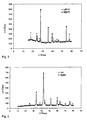
- FIGS. 2 and 3 X-ray structural analyzes of the material before and after the desorption of hydrogen, that is to say from its storage or non-storage state, were also carried out ( FIGS. 2 and 3 ).
- FIG. 2 All the diffraction reflexes of the hydrated storage state could be attributed to the crystal structures of LiBH 4 and MgH 2 .
- the diffraction reflexes in FIG. 3 clearly assign the components LiH and MgB 2 of the dehydrated non-storage state. This proves the two-phase state of the system in both its memory and non-memory states.
- FIG. 4 which shows the X-ray diffraction pattern of the material NaBH 4 / MgH 2 after hydrogenation, results in a clear assignment of all occurring reflections to the components MgH 2 and NaBH 4 of the storage state.
- FIG. 5 visual reflections measured after dehydration to components MgB 2 and NaH of the non-storage state.
- Example 2 The preparation was carried out analogously to Example 1. The relevant production parameters and material properties are summarized below in tabular form.
- FIG. 6 which shows the X-ray diffraction pattern of the material Ca (BH 4 ) 2 / MgH 2 after the hydrogenation, results in a clear assignment of all occurring reflections to the components MgH 2 and Ca (BH 4 ) 2 of the storage state.
- FIG. 7 visual reflections measured after dehydration to components MgB 2 and CaH 2 of the non-storage state.
- the desorption characteristic of the material Ca (BH 4 ) 2 / MgH 2 was investigated analogously to the procedure described in Example 1 at temperatures of 130, 350 and 400 ° C.
- FIG. 8 shown.
- the pressure change corresponds to a release of 8.3 wt .-% H 2 (reversible hydrogen content) based on the storage state.
- FIG. 9 which shows the X-ray diffraction pattern of the material LiBH 4 / Mg 2 Sn / Sn after hydrogenation, results in a clear assignment of all occurring reflections to the components Mg 2 Sn, LiBH 4 and Sn of the memory state.
- FIG. 10 visual reflections measured after dehydration to components of non-storage state Li 7 Sn 2 and MgB 2 .
Landscapes
- Chemical & Material Sciences (AREA)
- Organic Chemistry (AREA)
- Inorganic Chemistry (AREA)
- General Health & Medical Sciences (AREA)
- Engineering & Computer Science (AREA)
- Combustion & Propulsion (AREA)
- Health & Medical Sciences (AREA)
- Chemical Kinetics & Catalysis (AREA)
- Life Sciences & Earth Sciences (AREA)
- General Life Sciences & Earth Sciences (AREA)
- Geology (AREA)
- Hydrogen, Water And Hydrids (AREA)
- Filling Or Discharging Of Gas Storage Vessels (AREA)
- Solid-Sorbent Or Filter-Aiding Compositions (AREA)
Description
- Die Erfindung betrifft ein Wasserstoff speicherndes Kompositmaterial sowie seine Verwendung zur reversiblen Speicherung von Wasserstoff, insbesondere für die Versorgung von Brennstoffzellen.
- Zunehmende Umweltverschmutzung und sinkende Vorräte an fossilen Brennstoffen erfordern neue Energiekonzepte. Insbesondere sind erneuerbare Energiequellen wünschenswert, welche die fossilen Kraftstoffe ersetzen sollen, die aufgrund ihrer CO2-Emissionen für den Treibhauseffekt und die globale Erwärmung verantwortlich gemacht werden. In diesem Zusammenhang weist Wasserstoff ideale Eigenschaften auf. Wasserstoff kann aus Wasser durch Elektrolyse erzeugt werden, wobei die elektrische Energie idealerweise aus regenerierbaren Energiequellen, wie Wind-, Solar- oder Wasserenergie gewonnen wird. Zudem wird bei der Verbrennung von Wasserstoff, beispielsweise in Verbrennungsmotoren oder Brennstoffzellen lediglich Wasserdampf erzeugt, wodurch ein geschlossener Energiekreis ohne umweltschädliche Emissionen entsteht. Neben stationären Anwendungen eignet sich die Wasserstoff-basierte Energie auch für mobile Anwendungen in so genannten Null-Emissionskraftfahrzeugen. Als problematisch gestaltet sich jedoch sowohl für stationäre als auch mobile Anwendungen die Speicherung von Wasserstoff (H2) wegen seines niedrigen Siedepunktes (ca. 20 K oder -253°C bei 1 bar) und seiner geringen Dichte im gasförmigen Zustand bei Normaldruck (90 g/m3). Zudem führt die Speicherung von flüssigem oder gasförmigen H2 zu Sicherheitsproblemen. Vorteilhaft sind daher Wasserstoffspeichersysteme, in denen H2 chemisch gespeichert vorliegt und die eine gute Langzeitstabilität und niedrige H2-Drücke aufweisen und deren volumenbezogene Energiedichte sogar um etwa 60 % höher als die von flüssigem Wasserstoff ist. Chemische Wasserstoffspeicher weisen einen Speicherzustand und einen Nichtspeicherzustand (und gegebenenfalls einen oder mehrere Zwischenzustände) auf, zwischen denen sie idealerweise reversibel überführbar sind.
- Eine bekannte Gruppe chemischer Wasserstoffspeicher mit hoher spezifischer Wasserstoffspeicherkapazität sind Leichtmetallhydride, etwa von Mg, B oder Al. Beispielsweise kann MgH2 theoretisch bis zu 7,6 Gew.-% H2 speichern. Nachteilig an diesen Verbindungen sind ihre langsamen Speicherkinetiken bei Raumtemperatur, die für eine "Tankfüllung" mehrere Stunden erfordern. Erst bei Temperaturen oberhalb von 300°C im Falle von MgH2 liegen ausreichende Speichergeschwindigkeiten vor, weswegen die Leichtmetallhydride auch als Hochtemperaturhydride bezeichnet werden.
- Es sind ferner komplexe Hydride der Formel MxAyHz bekannt, worin M ein Alkali- oder Erdalkalimetall und A meist Aluminium Al oder Bor B ist. Sie können bis zu ca. 5 Gew.-% H2 speichern und sind salzartig aus dem kationischen Alkali- oder Erdalkalimetall (z. B. Na+ oder Mg2+) und anionischen Hydridgruppen (z. B. AlH4 -oder BH4 -) aufgebaut. Die Alkalialanate LiAlH4 und NaAlH4 sind aufgrund ihrer relativ hohen massenbezogenen H2-Speicherkapazitäten besonders interessant. Alanate zerfallen in zwei Schritten (z. B. 3 NaAlH4 → Na3AlH6 + 2 Al + 3 H2 → 3 NaH + 3 Al + 9/2 H2). Die Rehydrierung erfordert aber die Diffusion und Rekombination von Metallatomen, was noch immer zu relativ langsamen Kinetiken führt. Nahezu vollständige Reversibilität konnte unter Verwendung von nanokristallinen Alanaten mit Zusätzen von TiCl3 als Promotor gezeigt werden. So redydrieren Natriumalanate bei Temperaturen von 100 bis 150°C innerhalb von 10 min, wozu jedoch Drücke von mindestens 80 bar erforderlich sind.
- Auf der anderen Seite sind so genannte Raumtemperaturhydride von Übergangmetallen bekannt (z. B. FeTiH2 oder LaNi5Hz), die zwar bei Raumtemperatur einsetzbar sind, jedoch nur höchstens 3 Gew.-% Wasserstoff speichern können.
- Neueste Ansätze untersuchen die Einsetzbarkeit von stickstoffhaltigen Gruppen, etwa die Konversion von Lithiumamid zu Lithiumimid, wobei theoretisch bis zu 9,1 Gew.-% Wasserstoff gespeichert werden können. Da hierbei jedoch Stickstoff in Form von NH3 entweichen kann, weist das System nur eine begrenzte Reversibilität auf. Wesentliche Verbesserungen wurden durch die Zugabe von Mg und die Bildung von Magnesiumnitrid Mg3N3 erreicht, wobei Reversibilität bei 200°C und 50 bar beobachtet wurde.
- Aus
US 2001/0018939 A ist eine Zusammensetzung bekannt, die aus einer homogenen Legierung aus einem AlH3-basierten komplexen Hydrid Mx(AlH3)Hz (mit M= Li, Na, Be, Mg, Ca) und einer zweiten Komponente besteht. Letztere kann ein nicht hydridbildendes Metall oder Halbmetall sein oder ein hydridbildendes Erdalkali- oder Übergangsmetall beziehungsweise ein binäres Metallhydrid von diesen oder ein weiteres AlH3-basiertes komplexes Hydrid. Das laut Röntgenstrukturanalyse einphasig vorliegende Material weist eine massenbezogene H2-Speicherkapazität von maximal 3 % auf und eine Absorptionsdauer bei etwa 130°C und 80 bar von mehreren Stunden. -
US 6,514,478 B beschreibt ein System, das im hydrogenierten Zustand LiH oder ein Lithium-basiertes komplexes Hydrid LixMyHz mit M= Be, Mg, Ti, V, Zr und einen Zusatz eines Metalls oder Halbmetalls enthält. Das System liegt im hydrogenierten Zustand (Speicherzustand) einphasig vor, beispielsweise als Li-C-H, wobei im dehydrogenierten Zustand der elementare Zusatz eine Verbindung oder Lösung mit Li unter Bildung einer Phase (z. B. Li-C) eingeht. Das System Li-C-H etwa weist eine Dehydrierungstemperatur von 150 bis 230°C und eine Hydrierungstemperatur von 200°C sowie eine Speicherkapazität von etwa 0,5 Gew.-% auf. - Ferner ist bekannt, die binären Hydridkomponenten LiH und MgH2 durch Zusatz von Si zu destabilisieren (Vajo, J. Phys. Chem. B (2004), 108, S. 13977-13983). Dabei wird im Nichtspeicher-Zustand ein einphasiges Material gebildet.
- Zusammenfassend lässt sich feststellen, dass derzeit kein System existiert, das Wasserstoff bei mittleren bis niedrigen Temperaturen mit einer ausreichenden Geschwindigkeit hoch reversibel und in größeren Mengen speichert. Ein solches Material bereitzustellen, insbesondere ein Material mit hoher spezifischer Speicherkapazität und Reversibilität bei niedrigen Hydrierungs- und Dehydrierungstemperaturen, ist Aufgabe der vorliegenden Erfindung.
- Diese Aufgabe wird erfindungsgemäß durch ein Kompositmaterial mit den im Anspruch 1 und den abhängigen Ansprüchen 2-8 genannten Merkmalen gelöst.
- Erfindungsgemäß liegt demnach sowohl der (hydrierte) Speicher- als auch der (dehydrierte) Nichtspeicherzustand des Kompositmaterials in jeweils mindestens zwei festen Phasen vor, wobei das Material eine amorphe und/oder kristalline, vorzugsweise nanokristalline, Mikrostruktur aufweisen kann oder Mischungen von diesen. Dabei wird im Rahmen der vorliegenden Erfindung unter einer "Phase" eine definierte (Kristall)struktur (im Gegensatz zu einem Aggregatzustand) verstanden, das heißt in einem festen "Mehrphasensystem" gemäß der Erfindung liegen zwei oder mehr, durch Röntgenstrukturanalyse unterscheidbare Strukturen vor, die jeweils kristallin oder amorph sein können. Weiterhin soll im Folgenden unter einer "wasserstofffreien" Komponente, Verbindung oder Legierung eine Phase verstanden werden, die nicht als Hydrid vorliegt. Dies schließt jedoch nicht aus, dass die "wasserstofffreie" Phase geringe Mengen Wasserstoff in gelöster Form, insbesondere in der Nähe von Gitterdefekten enthält. Ferner versteht sich der Begriff "Nichtspeicherzustand" als ein Zustand, der gegenüber dem "Speicherzustand" wasserstoffverarmt ist, aber nicht zwangsläufig vollständig wasserstofffrei sein muss.
- Mit anderen Worten existieren in beiden Zuständen immer zumindest zwei Phasen, die auf die Einzelkomponenten rückführbar sind. Bei der bevorzugten im Wesentlichen nanokristallinen Mikrostruktur des Systems bedeutet dies die Existenz von Nanokristallen der ersten Hydridkomponente (a) und Nanokristallen der zweiten Komponente (b) nebeneinander. Es wurde nämlich gefunden, dass das erfindungsgemäße System einerseits den Vorteil einer erleichterten (Re)Hydrierung (Wasserstoffabsorption) und damit verbesserten Reversibilität gegenüber Einphasensystemen aufweist und andererseits eine niedrigere Dehydrierungstemperatur. Obwohl beispielsweise in einem System gemäß Stand der Technik {z. B. LiBH4 → LiH + B + 3/2 H2} die treibende thermodynamische Kraft der Hydrierungsreaktion höher ist als in einem erfindungsgemäßen Mehrphasensystem {z. B. 2 LiBH4 + MgH2 ↔ 2 LiH + MgB2 + 4 H2}, zeigen Messungen eine leichte Hydrierbarkeit und damit gute Reversibilität nur für das erfindungsgemäße System. Dies ist vermutlich auf einen kinetischen Effekt, insbesondere auf die hohe Diffusionsneigung des elementaren Bors zurückzuführen, wodurch es zu einer makroskopischen Entmischung der Komponenten kommen kann, welche die Reaktion von B mit LiH unter Bildung von LiBH4 im bekannten System erschwert. Dagegen scheint die örtliche Positionierung von MgB2 in der Mischung und die elektronische Situation von Bor in MgB2 im erfindungsgemäßen System die Hydrierungsreaktion zu fördern.
- Ein weiterer Vorteil besteht in der weniger stark negativen Reaktionsenthalpie, das heißt der höheren treibenden thermodynamischen Kraft bei der Dehydrierungsreaktion bei einer gegebenen Temperatur, die durch die günstigere elektronische Situation der im Nichtspeicherzustand gebildeten wasserstofffreien (binären oder höheren) Verbindung (z. B. MgB2 gegenüber B im oben genannten Beispiel) verursacht wird. Es ist besonders bevorzugt vorgesehen, die Komponenten sowohl des Nichtspeicher- als auch des Speicherzustandes und/oder die Mikrostruktur des Materials so zu wählen, dass die Reaktionsenthalpie der Redoxgesamtreaktion des Systems zwischen seinem Speicher- und seinem Nichtspeicherzustand pro Mol Wasserstoff H2 im Bereich von -10 bis -65 kJ/mol, insbesondere -15 bis -40 kJ/mol liegt. Auf diese Weise können Dehydrierungstemperaturen (Desorptionstemperaturen) im Bereich von typischerweise 20 bis 180°C eingestellt werden. Diese Temperaturen lassen sich durch Zusetzung eines oder mehrerer geeigneter Katalysatoren noch herabsetzen.
- Insgesamt scheint die Hydrierungsreaktion des erfindungsgemäßen Materials aufgrund kinetischer Effekte und die Dehydrierungsreaktion aufgrund thermodynamischer Effekte gegenüber bekannten Einphasensystemen verbessert zu sein, so dass sich das Material einerseits durch eine hohe Reversibilität und andererseits durch eine niedrige Desorptionstemperatur auszeichnet.
- Das erfindungsgemäße Material kann zwischen seinem Speicherzustand und seinem Nichtspeicherzustand (und seinen optionalen Zwischenzuständen) durch Variation des Drucks und/oder der Temperatur überführt werden.
- Das Material kann in einfacher Weise aus den Komponenten des Speicherzustandes dargestellt werden und vor seiner Nutzung einem oder mehreren Dehydrierungs- und Hydrierungszyklen unterworfen werden. Alternativ können auch die Komponenten des Nichtspeicherzustandes miteinander verarbeitet und nachfolgend hydriert werden. Auch Mischformen, bei denen die Komponenten teils des hydrogenierten und teils des dehydrogenierten Zustandes oder von Zwischenzuständen oder von Vorläuferstrukturen eingesetzt werden, sind denkbar. Beispielsweise kann ein elementares Metall E zur Herstellung eingesetzt werden, das nach Hydrierung das binäre Hydrid ExHz bildet.
- Gegebenenfalls kann die zweite Komponente (b) auch eine Kombination zweier oder mehrerer Komponenten aus den Gruppen b1 bis b5 sein.
- Bevorzugte Beispiele für Kompositmaterialien gemäß der Erfindung sind:
- 2LiBH4 + Cr ↔ 2LiH + CrB2 + 3H2
Δ G298 = 86.000 J/mol - (T × 295 J/(mol · K))
⇒ Teq. = 18°C; ΔHH2 = 28,7 kJ/mol - 2LiBH4 + MgH2 ↔ MgB2 + 2LiH + 3H2
Δ G = 183.000 J/mol - (T × 413 (J/mol · K))
⇒ Teq. = 170°C; ΔHH2 = 61,0 kJ/mol - 2LiBH4 + MgS ↔ Li2S + MgB2 + 4H2
Δ G = 166.000 J/mol - (T × 417 (J/mol · K))
⇒ Teq. = 125°C; ΔHH2 = 41,5 kJ/mol - 8LiBH4 + 2Mg2Sn ↔ Li7Sn2 + 4MgB2 + 15, 5H2 + LiH
Δ G = 758.000 J/mol - (T × 1679 J/(mol · K))
⇒ Teq. = 178°C, ΔHH2 = 48,9 kJ/mol - 6LiBH4 + Se3Al2 ↔ 3Li2Se + 6B + 2Al + 12H2
Δ G = 446.000 J/mol - (T × 1246 J/(mol · K))
⇒ Teq. = 84°C ; ΔHH2 = 37, 2 kJ/mol - 2LiBH4 + Se ↔ Li2Se + 2B + 4H2
2LiBH4 + Te ↔ Li2Te + 2B + 4H2 - Ein weiterer Aspekt der Erfindung betrifft die Verwendung des Kompositmaterials zur reversiblen Speicherung von Wasserstoff H2, insbesondere zur Versorgung einer Brennstoffzelle in mobilen oder stationären Anwendungen oder eines Verbrennungsmotors. Dabei kann dem Material noch ein Katalysator zugesetzt sein, der die initiale Dissoziation von H2 in 2H beim Hydrierungsprozess des Materials unterstützt. Solche Katalysatoren sind zahlreich bekannt.
- Weitere vorteilhafte Ausgestaltungen der Erfindung ergeben sich aus den in den Unteransprüchen genannten Merkmalen.
- Die Erfindung wird nachfolgend in einem Ausführungsbeispiel anhand der zugehörigen Zeichnungen näher erläutert. Es zeigen:
- Figur 1
- Desorptionscharakteristik des Materials LiBH4/MgH2 bei unterschiedlichen Temperaturen;
- Figur 2, 3
- Röntgendiffraktionsmuster des Materials LiBH4/MgH2 nach Hydrierung (Speicherzustand) bzw. nach Dehydrierung (Nichtspeicherzustand);
- Figur 4, 5
- Röntgendiffraktionsmuster des nicht in den Schutzbereich des Patents fallenden Materials NaBH4/MgH2 im Speicher- bzw. Nichtspeicherzustand;
- Figur 6, 7
- Röntgendiffraktionsmuster des nicht in den Schutzbereich des Patents fallenden Materials Ca(BH4)2/MgH2 Speicher- bzw. Nichtspeicherzustand;
- Figur 8
- Desorptionscharakteristik des nicht in den Schutzbereich des Patents fallenden Materials Ca(BH4)2/MgH2 bei unterschiedlichen Temperaturen und
- Figur 9, 10
- Röntgendiffraktionsmuster des Materials LiBH4/Mg2Sn im Speicher- bzw. Nichtspeicherzustand.
- Die Ausgangsmaterialien LiH und MgB2 wurden in einem Molverhältnis von 2:1 gemischt und 24 h in einer Mühle des Typs SPEX 8000 gemahlen. Von dem so erhaltenen nanokristallinen Pulver wurde jeweils 1 g in einem Hochdruckbehälter unter 300 bar Wasserstoffdruck bei einer Temperatur von 400°C über einen Zeitraum von 24 h hydriert (2LiH + MgB2 +3 H2 → 2 LiBH4 + MgH2). Dabei wurde eine Massenzunahme von 12 % festgestellt.
- Das so hergestellte Kompositmaterial wurde hinsichtlich seiner Absorptions- und Desorptionscharakteristik untersucht, wofür es in einem geschlossenen Behältnis verschiedenen Temperaturen ausgesetzt wurde und die Druckveränderung im Behältnis gemessen wurde. Aus
Figur 1 ist ersichtlich, dass bereits bei der Starttemperatur von 200°C die Freisetzung von Wasserstoff (Dehydrierung) beobachtet wird und diese Reaktion bei höheren Temperaturen beschleunigt wird. Bei einer Temperatur von ca. 360°C erfolgt ein sehr schneller und praktisch vollständiger Übergang in den Nichtspeicherzustand. Durch Verwendung eines geeigneten Katalysators lässt sich die Dehydrierung beschleunigen, so dass auch bei deutlich niedrigeren Temperaturen hinreichend schnelle Kinetiken vorliegen. Derartige Katalysatoren sind allgemein bekannt und sollen hier nicht näher ausgeführt werden. Aus einer Differenzwägung des Materials vor und nach der Absorption von Wasserstoff ergab sich eine spezifische Wasserstoffspeicherkapazität von 10 Gew.-% bezogen auf das Material vor der Hydrierung, das heißt auf seinen Nichtspeicherzustand. - Es wurden ferner Röntgenstrukturanalysen des Materials vor und nach der Desorption von Wasserstoff, das heißt von seinem Speicher- bzw. Nichtspeicherzustand durchgeführt (
Figuren 2 und 3 ). GemäßFigur 2 konnten sämtliche Diffraktionsreflexe des hydrierten Speicherzustandes auf die Kristallstrukturen von LiBH4 und MgH2 zurückgeführt werden. Hingegen lassen sich die Diffraktionsreflexe inFigur 3 eindeutig den Komponenten LiH und MgB2 des dehydrierten Nichtspeicherzustandes zuordnen. Hierdurch ist der zweiphasige Zustand des Systems sowohl in seinem Speicher- als auch in seinem Nichtspeicherzustand bewiesen. - Die Herstellung erfolgte analog Beispiel 1. Die relevanten Herstellungsparameter und Materialeigenschaften sind nachfolgend tabellarisch zusammengefasst. Herstellungsreaktion:
MgB2 + 2 NaH + 4H2 → 2NaBH4 + MgH2
berechnete Gleichgewichtstemperatur Teq.: 170°C Ausgangsmaterialien: NaH, MgB2 (Molverhältnis 2:1)
Mahldauer: 10 h
Hydrierungsdruck: 300 bar
Hydrierungstemperatur: 200°C
Hydrierungsdauer: 12 h
reversibler Wasserstoffgehalt: 8 Gew.-%
stöchiometr. Wasserstoffgehalt in NaBH4: 10,5 Gew.-% - Aus
Figur 4 , die das Röntgendiffraktionsmuster des Materials NaBH4/MgH2 nach der Hydrierung zeigt, ergibt sich eine eindeutige Zuordnung sämtlicher auftretender Reflexe zu den Komponenten MgH2 und NaBH4 des Speicherzustandes. Hingegen lassen sich die inFigur 5 sichtbaren Reflexe, die nach der Dehydrierung gemessen wurden, den Komponenten MgB2 und NaH des Nichtspeicherzustandes zuordnen. - Die Herstellung erfolgte analog Beispiel 1. Die relevanten Herstellungsparameter und Materialeigenschaften sind nachfolgend tabellarisch zusammengefasst.
- Herstellungsreaktion:
MgB2 + CaH2 + 4H2 → Ca(BH4)2 + MgH2
berechnete Gleichgewichtstemperatur Teq.: 120-150°C Ausgangsmaterialien: CaH2, MgB2 (Molverhältnis 1:1)
Mahldauer: 6 h
Hydrierungsdruck: 300 bar
Hydrierungstemperatur: 200°C
Hydrierungsdauer: 6 h
reversibler Wasserstoffgehalt: 8,3 Gew.-%
stöchiom. Wasserstoffgehalt in Ca(BH4)2: 11,5 Gew.-% - Aus
Figur 6 , die das Röntgendiffraktionsmuster des Materials Ca(BH4)2/MgH2 nach der Hydrierung zeigt, ergibt sich eine eindeutige Zuordnung sämtlicher auftretender Reflexe zu den Komponenten MgH2 und Ca(BH4)2 des Speicherzustandes. Hingegen lassen sich die inFigur 7 sichtbaren Reflexe, die nach der Dehydrierung gemessen wurden, den Komponenten MgB2 und CaH2 des Nichtspeicherzustandes zuordnen. - Die Desorptionscharakteristik des Materials Ca(BH4)2/ MgH2 wurde analog zu der in Beispiel 1 beschriebenen Vorgehensweise bei den Temperaturen 130, 350 und 400°C untersucht und ist in
Figur 8 dargestellt. Die Druckänderung entspricht einer Freisetzung von 8,3 Gew.-% H2 (reversibler Wasserstoffgehalt) bezogen auf den Speicherzustand. - Die Herstellung erfolgte analog Beispiel 1. Die relevanten Herstellungsparameter und Materialeigenschaften sind nachfolgend tabellarisch zusammengefasst. Herstellungsreaktion:
Li7Sn2 + 3,5MgB2 + 14H2 → 7LiBH4 + 1,75Mg2Sn + 0,25Sn
berechnete Gleichgewichtstemperatur Teq.: 172°C
Δ G = 684.000 J/mol - (T X 1.535 J/ (mol·K))
Ausgangsmaterialien: Li7Sn2, MgB2 (Molverh. 1:3,5)
Mahldauer: 12 h
Hydrierungsdruck: 300 bar
Hydrierungstemperatur: 300°C
Hydrierungsdauer: 6 h
reversibler Wasserstoffgehalt: 6 Gew.-%
stöchiometr. Wasserstoffgehalt in LiBH4: 18,5 Gew.-% - Aus
Figur 9 , die das Röntgendiffraktionsmuster des Materials LiBH4/Mg2Sn/Sn nach der Hydrierung zeigt, ergibt sich eine eindeutige Zuordnung sämtlicher auftretender Reflexe zu den Komponenten Mg2Sn, LiBH4 und Sn des Speicherzustandes. Hingegen lassen sich die inFigur 10 sichtbaren Reflexe, die nach der Dehydrierung gemessen wurden, den Komponenten Li7Sn2 und MgB2 des Nichtspeicherzustandes zuordnen. - Sämtliche vorstehend für die Herstellung der Materialien genannten Hydrierungsbedingungen (Druck, Temperatur, Dauer) wurden nicht optimiert. Vielmehr wurden sie entsprechend einer möglichst hohen Hydrierungsrate gewählt.
Claims (10)
- Wasserstoff speicherndes Kompositmaterial, das im Wesentlichen reversibel zwischen einem Speicherzustand und einem Nichtspeicherzustand und optional einem oder mehreren Zwischenzuständen überführbar ist, wobei das System in seinem Speicherzustand die Komponenten umfasst:(a) zumindest eine erste Hydridkomponente, die ein komplexes Lithiumhydrid LixAyHz umfasst, worin A Bor (B) ist, und(b) zumindest eine zweite Komponente, die mindestens eine Komponente umfasst aus:wobei die zumindest eine erste Hydridkomponente und die zumindest eine zweite Komponente in einem ersten festen Mehrphasensystem vorliegen und wobei bei der Überführung in den Nichtspeicherzustand des Systems die zumindest eine erste Hydridkomponente mit der zumindest einen zweiten Komponente derart unter Bildung von H2 reagiert, dass im Nichtspeicherzustand mindestens eine weitere wasserstofffreie Verbindung und/oder Legierung gebildet wird und ein weiteres festes Mehrphasensystem entsteht.(b1) mindestens einem Element C1 in der Oxidationsstufe 0, ausgewählt aus der Gruppe Zn, Mn, Fe, Cr, Cu, wobei im Nichtspeicherzustand des Systems LiH gebildet wird,(b2) mindestens einem Element C2 in der Oxidationsstufe 0, ausgewählt aus der Gruppe Sb, Bi, Ge, Sn, Pb, Ga, Tl, Se, S, Te, Br, I, In, As, Mo, W, Co, Ni, Cd, Hg, N,(b3) einer wasserstofffreien, binären oder höheren Verbindung oder Legierung des Elements C1 oder C2 mit mindestens einem weiteren Element D der Ordnungszahl > 3,(b4) mindestens einem binären Hydrid ExHz, wobei E ausgewählt ist aus den Gruppen IA, IIA, IIIB, IVB, VB, XB und XIIB und den Lanthaniden, und (b5) mindestens einem Legierungshydrid FxGyHz mindestens zweier Metalle F und G,
- Kompositmaterial nach Anspruch 1, wobei das Material eine amorphe oder kristalline, insbesondere nanokristalline, Mikrostruktur aufweist, oder eine Mischung von diesen.
- Kompositmaterial nach einem der vorhergehenden Ansprüche, wobei
im Speicherzustand die zumindest eine erste Hydridkomponente (a) zusätzlich zu dem(i) zumindest einen komplexen Hydrid LixAyHz mit A gleich Bor (B)(ii) zumindest ein zweites binäres Hydrid BxHz umfasst, worin B ausgewählt ist aus den Gruppen IA, IIA, IIIB, IVB, VB, XB und XIIB und den Lanthaniden. - Kompositmaterial nach einem der vorhergehenden Ansprüchen, wobei
das Element D ausgewählt ist aus der Gruppe der Metalle, Nicht-, Halb- und Übergangsmetalle und den Lanthaniden, insbesondere aus der Gruppe Sb, Bi, Ge, Sn, Pb, Ga, In, Tl, Se, S, Te, Br, I, Sc, Y, La, Ti, Zr, Hf, V, Nb, Ta, Mo, W, Re, Ru, Os, Co, Ag, Li, Rb, Cs, Be, Mg, Sr, Ba und den Lanthaniden. - Kompositmaterial nach einem der vorhergehenden Ansprüche, wobei
die Elemente B und E der binären Hydride ausgewählt sind aus der Gruppe Li, Na, K, Rb, Cs, Be, Mg, Ca, Sr, Sc, Y, La, Ti, Zr, Hf, V, Nb, Ta, Zn, Pd und den Lanthaniden. - Kompositmaterial nach einem der vorhergehenden Ansprüche, wobei die Komponenten und die Mikrostruktur des Materials so gewählt sind, dass die Reaktionsenthalpie (ΔH) der Gesamtreaktion des Systems zwischen seinem Nichtspeicher- und seinem Speicherzustand pro Mol Wasserstoff H2 im Bereich von -10 bis -65 kJ/molH2, insbesondere -15 bis -40 kJ/molH2 liegt.
- Kompositmaterial nach einem der vorhergehenden Ansprüche, wobei das Material zwischen seinem Speicherzustand und seinem Nichtspeicherzustand und optional seinem oder seinen Zwischenzuständen durch Variation des Drucks und/oder der Temperatur überführbar ist.
- Kompositmaterial nach einem der vorhergehenden Ansprüche, ausgewählt aus einem der Systeme LiBH4/MgH2, LiBH4/Cr, LiBH4/MgS, LiBH4/Mg2Sn, LiBH4/Se3Al2, LiBH4/Se und LiBH4/Te.
- Verwendung eines Kompositmaterials nach einem der Ansprüche 1 bis 8 zur reversiblen Speicherung von Wasserstoff (H2).
- Verwendung nach Anspruch 9 zur Versorgung einer Brennstoffzelle oder eines Verbrennungsmotors.
Applications Claiming Priority (2)
| Application Number | Priority Date | Filing Date | Title |
|---|---|---|---|
| DE102004061286.2A DE102004061286B4 (de) | 2004-12-14 | 2004-12-14 | Wasserstoff speicherndes Kompositmaterial sowie eine Vorrichtung zur reversiblen Speicherung von Wasserstoff |
| EP05739531A EP1824780B8 (de) | 2004-12-14 | 2005-03-30 | Wasserstoff speicherndes kompositmaterial sowie seine verwendung in einer vorrichtung zur reversiblen speicherung von wasserstoff |
Related Parent Applications (4)
| Application Number | Title | Priority Date | Filing Date |
|---|---|---|---|
| WOPCT/EP2005/003494 Previously-Filed-Application | 2005-03-30 | ||
| EP05739531A Division EP1824780B8 (de) | 2004-12-14 | 2005-03-30 | Wasserstoff speicherndes kompositmaterial sowie seine verwendung in einer vorrichtung zur reversiblen speicherung von wasserstoff |
| PCT/EP2005/003494 Previously-Filed-Application WO2006063627A1 (de) | 2004-12-14 | 2005-03-30 | Wasserstoff speicherndes kompositmaterial sowie vorrichtung zur reversiblen speicherung von wasserstoff |
| EP05739531.1 Division | 2005-03-30 |
Publications (2)
| Publication Number | Publication Date |
|---|---|
| EP2363375A1 EP2363375A1 (de) | 2011-09-07 |
| EP2363375B1 true EP2363375B1 (de) | 2014-03-19 |
Family
ID=34966993
Family Applications (2)
| Application Number | Title | Priority Date | Filing Date |
|---|---|---|---|
| EP05739531A Expired - Lifetime EP1824780B8 (de) | 2004-12-14 | 2005-03-30 | Wasserstoff speicherndes kompositmaterial sowie seine verwendung in einer vorrichtung zur reversiblen speicherung von wasserstoff |
| EP11158275.5A Expired - Lifetime EP2363375B1 (de) | 2004-12-14 | 2005-03-30 | Wasserstoff speicherndes Kompositmaterial und seine Verwendung |
Family Applications Before (1)
| Application Number | Title | Priority Date | Filing Date |
|---|---|---|---|
| EP05739531A Expired - Lifetime EP1824780B8 (de) | 2004-12-14 | 2005-03-30 | Wasserstoff speicherndes kompositmaterial sowie seine verwendung in einer vorrichtung zur reversiblen speicherung von wasserstoff |
Country Status (7)
| Country | Link |
|---|---|
| US (1) | US20090294728A1 (de) |
| EP (2) | EP1824780B8 (de) |
| JP (1) | JP4764885B2 (de) |
| AT (1) | ATE501977T1 (de) |
| CA (1) | CA2590210C (de) |
| DE (2) | DE102004061286B4 (de) |
| WO (1) | WO2006063627A1 (de) |
Families Citing this family (14)
| Publication number | Priority date | Publication date | Assignee | Title |
|---|---|---|---|---|
| ZA200704897B (en) | 2004-12-07 | 2008-09-25 | Univ Queensland | Magnesium alloys for hydrogen storage |
| US8551663B2 (en) | 2007-04-25 | 2013-10-08 | Honeywell International Inc. | Power generator with additional hydrogen storage |
| US8883371B2 (en) * | 2007-10-16 | 2014-11-11 | Motorola Mobility Llc | Hydrogen storage materials and hydrogen fuel cells |
| US9029038B2 (en) | 2007-11-01 | 2015-05-12 | Honeywell International Inc. | Method of forming a fuel cell stack |
| US7807131B2 (en) | 2007-11-01 | 2010-10-05 | Honeywell International Inc. | Hydrogen producing fuel for power generator |
| DE102007054843B4 (de) | 2007-11-16 | 2012-04-12 | Helmholtz-Zentrum Geesthacht Zentrum für Material- und Küstenforschung GmbH | Wasserstoff speichernde Kompositmaterialien |
| US8187348B2 (en) | 2008-04-07 | 2012-05-29 | Honeywell International Inc. | Hydrogen generator |
| US20100233076A1 (en) * | 2008-09-18 | 2010-09-16 | Ford Global Technologies, Llc | Hydrogen Storage Materials |
| JP2011144094A (ja) * | 2010-01-18 | 2011-07-28 | Toyota Motor Corp | 水素貯蔵材料の水素化方法 |
| JP5532949B2 (ja) * | 2010-01-19 | 2014-06-25 | トヨタ自動車株式会社 | 水素貯蔵材料の水素化方法 |
| US9435489B2 (en) | 2010-02-24 | 2016-09-06 | Hydrexia Pty Ltd | Hydrogen release system |
| EP2737564A4 (de) | 2011-07-25 | 2015-06-24 | Douglas Howard Phillips | Verfahren und systeme zur herstellung von wasserstoff |
| EP3325190A4 (de) | 2015-07-23 | 2019-08-14 | Hydrexia Pty Ltd | Auf mg basierende legierung zur wasserstoffspeicherung |
| EP4538224A1 (de) | 2023-10-11 | 2025-04-16 | Cyrus S.A. "Lefkippos" Technology Park of Attica - NCSR | Verfahren zur wasserstoffkompression |
Family Cites Families (22)
| Publication number | Priority date | Publication date | Assignee | Title |
|---|---|---|---|---|
| US4554152A (en) * | 1978-02-02 | 1985-11-19 | Studiengesellschaft Kohle Mbh | Method of preparing active magnesium-hydride or magnesium hydrogen-storer systems |
| US4389326A (en) * | 1979-08-27 | 1983-06-21 | Agence Nationale De Valorization De La Recherche | Method of storing hydrogen in intimate mixtures of hydrides of magnesium and other metals or alloys |
| DE19526434A1 (de) * | 1995-07-19 | 1997-01-23 | Studiengesellschaft Kohle Mbh | Verfahren zur reversilben Speicherung von Wasserstoff |
| CA2218271A1 (en) | 1997-10-10 | 1999-04-10 | Mcgill University | Method of fabrication of complex alkali mental hydrides |
| CA2220503A1 (en) * | 1997-11-07 | 1999-05-07 | Leszek Zaluski | Hydrogen storage composition |
| DE19758384C2 (de) * | 1997-12-23 | 2002-08-01 | Geesthacht Gkss Forschung | Verfahren zur Herstellung nanokristalliner Metallhydride |
| ATE220643T1 (de) * | 1998-10-07 | 2002-08-15 | Univ Mcgill | Lithiumhaltiger wasserstoffspeicher |
| DE69806072T2 (de) | 1998-10-07 | 2003-01-16 | Mcgill University, Montreal | Reversibler wasserstoffspeicher |
| DE10002117A1 (de) * | 2000-01-20 | 2001-08-16 | Geesthacht Gkss Forschung | Katalyse der Wasserstoffsorptionskinetik von Hydriden durch Nitride und Carbide |
| JP2001253702A (ja) * | 2000-03-08 | 2001-09-18 | Toyota Central Res & Dev Lab Inc | 水素発生方法及び水素発生材料 |
| DE10012794A1 (de) * | 2000-03-16 | 2001-09-20 | Studiengesellschaft Kohle Mbh | Verfahren zur reversiblen Speicherung von Wasserstoff auf der Basis von Alkalimetallen und Aluminium |
| JP2004224684A (ja) * | 2002-11-27 | 2004-08-12 | Materials & Energy Research Institute Tokyo Ltd | テトラヒドロホウ酸塩の製造方法 |
| US6680043B2 (en) * | 2001-11-29 | 2004-01-20 | General Motors Corporation | Process for enhancing the kinetics of hydrogenation/dehydrogenation of MAIH4 and MBH4 metal hydrides for reversible hydrogen storage |
| JP4066159B2 (ja) * | 2002-08-26 | 2008-03-26 | ソニー株式会社 | 水素ガス製造装置及びエネルギー変換システム |
| JP2004161554A (ja) * | 2002-11-14 | 2004-06-10 | Honda Motor Co Ltd | 水素を必要とする機器への水素供給方法 |
| US7601329B2 (en) * | 2004-02-26 | 2009-10-13 | Gm Global Technology Operations, Inc. | Regeneration of hydrogen storage system materials and methods including hydrides and hydroxides |
| US7341703B2 (en) * | 2004-02-27 | 2008-03-11 | General Motors Corporation | Mixed hydrogen generation material |
| US20060013766A1 (en) * | 2004-03-26 | 2006-01-19 | Vajo John J | Methods for reversibly storing hydrogen |
| US7678362B2 (en) * | 2005-06-20 | 2010-03-16 | Uop Llc | High density hydrogen storage material |
| US7749484B2 (en) * | 2005-11-10 | 2010-07-06 | Gm Global Technology Operations, Inc. | Li-B-Mg-X system for reversible hydrogen storage |
| US7906092B2 (en) * | 2006-06-21 | 2011-03-15 | General Electric Company | Methods for preparing compositions which comprise magnesium borohydride, and related materials |
| US7858068B2 (en) * | 2007-04-17 | 2010-12-28 | Nanotek Instruments, Inc. | Method of storing and generating hydrogen for fuel cell applications |
-
2004
- 2004-12-14 DE DE102004061286.2A patent/DE102004061286B4/de not_active Expired - Lifetime
-
2005
- 2005-03-30 JP JP2007544745A patent/JP4764885B2/ja not_active Expired - Fee Related
- 2005-03-30 EP EP05739531A patent/EP1824780B8/de not_active Expired - Lifetime
- 2005-03-30 US US11/721,493 patent/US20090294728A1/en not_active Abandoned
- 2005-03-30 EP EP11158275.5A patent/EP2363375B1/de not_active Expired - Lifetime
- 2005-03-30 AT AT05739531T patent/ATE501977T1/de active
- 2005-03-30 DE DE502005011143T patent/DE502005011143D1/de not_active Expired - Lifetime
- 2005-03-30 CA CA2590210A patent/CA2590210C/en not_active Expired - Lifetime
- 2005-03-30 WO PCT/EP2005/003494 patent/WO2006063627A1/de not_active Ceased
Non-Patent Citations (1)
| Title |
|---|
| JOHN J. VAJO ET AL: "Altering Hydrogen Storage Properties by Hydride Destabilization through Alloy Formation: LiH and MgH 2 Destabilized with Si", THE JOURNAL OF PHYSICAL CHEMISTRY B, vol. 108, no. 37, 1 September 2004 (2004-09-01), pages 13977 - 13983, XP055043993, ISSN: 1520-6106, DOI: 10.1021/jp040060h * |
Also Published As
| Publication number | Publication date |
|---|---|
| EP2363375A1 (de) | 2011-09-07 |
| DE102004061286A1 (de) | 2006-06-22 |
| ATE501977T1 (de) | 2011-04-15 |
| CA2590210A1 (en) | 2006-06-22 |
| WO2006063627A1 (de) | 2006-06-22 |
| EP1824780B1 (de) | 2011-03-16 |
| DE502005011143D1 (de) | 2011-04-28 |
| US20090294728A1 (en) | 2009-12-03 |
| EP1824780A1 (de) | 2007-08-29 |
| CA2590210C (en) | 2014-07-15 |
| JP2008522933A (ja) | 2008-07-03 |
| JP4764885B2 (ja) | 2011-09-07 |
| DE102004061286B4 (de) | 2021-09-16 |
| EP1824780B8 (de) | 2011-09-14 |
Similar Documents
| Publication | Publication Date | Title |
|---|---|---|
| EP2363375B1 (de) | Wasserstoff speicherndes Kompositmaterial und seine Verwendung | |
| EP0840707B1 (de) | Verfahren zur reversiblen speicherung von wasserstoff | |
| DE112005000461B4 (de) | Wasserstoff-Speichermaterialien und -verfahren enthaltend Hydride und Hydroxide | |
| DE112005000442B4 (de) | Verfahren zur Freisetzung von Wasserstoff aus wenigstens einem Wasserstoff-Speichermaterial | |
| DE69806072T2 (de) | Reversibler wasserstoffspeicher | |
| DE69806591T2 (de) | Wasserstoffspeichermaterialien | |
| DE102008021420B4 (de) | Verfahren zum Erzeugen von Wasserstoff mit stickstoffhaltigen Wasserstoffspeichermaterialien | |
| DE69522471T2 (de) | Mechanische legierung auf magnesiumbasis für thermischen wasserstoffspeicher | |
| DE112005000460T5 (de) | Wasserstoff-Speichersystemmaterialien und Verfahren enthaltend Hydride und Hydroxide | |
| DE112005000668T5 (de) | Reversibles Wasserstoffspeichersystem und Verfahren zur Verwendung desselben | |
| DE112005002271B4 (de) | Verfahren zum Speichern von Wasserstoff in Wasserstoffspeichersystemen | |
| WO2009062850A1 (de) | Wasserstoff speichernde kompositmaterialien | |
| Zhang et al. | Effect of bimetallic nitride NiCoN on the hydrogen absorption and desorption properties of MgH2 and the catalytic effect of in situ formed Mg2Ni and Mg2Co phases | |
| Zhang et al. | Hydrogen-induced phase transitions in RNi3 and RY2Ni9 (R= La, Ce) compounds | |
| EP1456117A1 (de) | Reversible speicherung von wasserstoff mit hilfe von dotierten alkalimetallaluminiumhydriden | |
| WO2001053195A9 (de) | Katalyse der wasserstoffsorptionskinetik von hydriden durch nitride und carbide | |
| DE69917178T2 (de) | Ternäre Wasserstoffspeichernde Legierung und Verfahren zu deren Herstellung | |
| DE112005002738T5 (de) | Mit einem Gerüst versehene borazan-lithiumhydrid Wasserstoffspeichermateralien | |
| Liang et al. | Perovskiet-like BaZrO3 nanocatalyst with rich oxygen vacancies on boosting hydrogen storage property of MgH2 | |
| Lu et al. | Reversible hydrogen storage and phase transformation with altered desorption pressure in Mg90In5Cd5 ternary alloy | |
| DE3780852T2 (de) | Intermetallische verbindungen, deren hydriden und verfahren zu deren herstellung. | |
| DE102004064260B3 (de) | Wasserstoff speicherndes Kompositmaterial sowie eine Vorrichtung zur reversiblen Speicherung von Wasser- stoff | |
| WO2008017088A2 (de) | Wasserstoffgenerator | |
| Bobet et al. | Catalytic effects of pseudo AB2 phases on hydrogen sorption | |
| WO2007017129A1 (de) | Verfahren zur herstellung eines wasserstoff-speichermaterials |
Legal Events
| Date | Code | Title | Description |
|---|---|---|---|
| PUAI | Public reference made under article 153(3) epc to a published international application that has entered the european phase |
Free format text: ORIGINAL CODE: 0009012 |
|
| AC | Divisional application: reference to earlier application |
Ref document number: 1824780 Country of ref document: EP Kind code of ref document: P |
|
| AK | Designated contracting states |
Kind code of ref document: A1 Designated state(s): AT BE BG CH CY CZ DE DK EE ES FI FR GB GR HU IE IS IT LI LT LU MC NL PL PT RO SE SI SK TR |
|
| 17P | Request for examination filed |
Effective date: 20120306 |
|
| 17Q | First examination report despatched |
Effective date: 20121127 |
|
| REG | Reference to a national code |
Ref country code: DE Ref legal event code: R079 Ref document number: 502005014259 Country of ref document: DE Free format text: PREVIOUS MAIN CLASS: C01B0003000000 Ipc: C01B0003060000 |
|
| GRAP | Despatch of communication of intention to grant a patent |
Free format text: ORIGINAL CODE: EPIDOSNIGR1 |
|
| RIC1 | Information provided on ipc code assigned before grant |
Ipc: C01B 6/04 20060101ALI20131014BHEP Ipc: C01B 3/06 20060101AFI20131014BHEP |
|
| INTG | Intention to grant announced |
Effective date: 20131031 |
|
| RIN1 | Information on inventor provided before grant (corrected) |
Inventor name: BORMANN, RUEDIGER Inventor name: BARKHORDARIAN, GAGIK Inventor name: KLASSEN, THOMAS |
|
| GRAS | Grant fee paid |
Free format text: ORIGINAL CODE: EPIDOSNIGR3 |
|
| GRAA | (expected) grant |
Free format text: ORIGINAL CODE: 0009210 |
|
| AC | Divisional application: reference to earlier application |
Ref document number: 1824780 Country of ref document: EP Kind code of ref document: P |
|
| AK | Designated contracting states |
Kind code of ref document: B1 Designated state(s): AT BE BG CH CY CZ DE DK EE ES FI FR GB GR HU IE IS IT LI LT LU MC NL PL PT RO SE SI SK TR |
|
| REG | Reference to a national code |
Ref country code: GB Ref legal event code: FG4D Free format text: NOT ENGLISH |
|
| REG | Reference to a national code |
Ref country code: CH Ref legal event code: EP |
|
| REG | Reference to a national code |
Ref country code: IE Ref legal event code: FG4D Free format text: LANGUAGE OF EP DOCUMENT: GERMAN |
|
| REG | Reference to a national code |
Ref country code: AT Ref legal event code: REF Ref document number: 657550 Country of ref document: AT Kind code of ref document: T Effective date: 20140415 |
|
| REG | Reference to a national code |
Ref country code: DE Ref legal event code: R096 Ref document number: 502005014259 Country of ref document: DE Effective date: 20140430 |
|
| REG | Reference to a national code |
Ref country code: NL Ref legal event code: T3 |
|
| PG25 | Lapsed in a contracting state [announced via postgrant information from national office to epo] |
Ref country code: LT Free format text: LAPSE BECAUSE OF FAILURE TO SUBMIT A TRANSLATION OF THE DESCRIPTION OR TO PAY THE FEE WITHIN THE PRESCRIBED TIME-LIMIT Effective date: 20140319 |
|
| REG | Reference to a national code |
Ref country code: LT Ref legal event code: MG4D |
|
| PG25 | Lapsed in a contracting state [announced via postgrant information from national office to epo] |
Ref country code: FI Free format text: LAPSE BECAUSE OF FAILURE TO SUBMIT A TRANSLATION OF THE DESCRIPTION OR TO PAY THE FEE WITHIN THE PRESCRIBED TIME-LIMIT Effective date: 20140319 Ref country code: CY Free format text: LAPSE BECAUSE OF FAILURE TO SUBMIT A TRANSLATION OF THE DESCRIPTION OR TO PAY THE FEE WITHIN THE PRESCRIBED TIME-LIMIT Effective date: 20140319 Ref country code: SE Free format text: LAPSE BECAUSE OF FAILURE TO SUBMIT A TRANSLATION OF THE DESCRIPTION OR TO PAY THE FEE WITHIN THE PRESCRIBED TIME-LIMIT Effective date: 20140319 |
|
| PG25 | Lapsed in a contracting state [announced via postgrant information from national office to epo] |
Ref country code: IS Free format text: LAPSE BECAUSE OF FAILURE TO SUBMIT A TRANSLATION OF THE DESCRIPTION OR TO PAY THE FEE WITHIN THE PRESCRIBED TIME-LIMIT Effective date: 20140719 Ref country code: BG Free format text: LAPSE BECAUSE OF FAILURE TO SUBMIT A TRANSLATION OF THE DESCRIPTION OR TO PAY THE FEE WITHIN THE PRESCRIBED TIME-LIMIT Effective date: 20140619 Ref country code: CZ Free format text: LAPSE BECAUSE OF FAILURE TO SUBMIT A TRANSLATION OF THE DESCRIPTION OR TO PAY THE FEE WITHIN THE PRESCRIBED TIME-LIMIT Effective date: 20140319 Ref country code: EE Free format text: LAPSE BECAUSE OF FAILURE TO SUBMIT A TRANSLATION OF THE DESCRIPTION OR TO PAY THE FEE WITHIN THE PRESCRIBED TIME-LIMIT Effective date: 20140319 Ref country code: RO Free format text: LAPSE BECAUSE OF FAILURE TO SUBMIT A TRANSLATION OF THE DESCRIPTION OR TO PAY THE FEE WITHIN THE PRESCRIBED TIME-LIMIT Effective date: 20140319 |
|
| REG | Reference to a national code |
Ref country code: CH Ref legal event code: PL |
|
| PG25 | Lapsed in a contracting state [announced via postgrant information from national office to epo] |
Ref country code: ES Free format text: LAPSE BECAUSE OF FAILURE TO SUBMIT A TRANSLATION OF THE DESCRIPTION OR TO PAY THE FEE WITHIN THE PRESCRIBED TIME-LIMIT Effective date: 20140319 Ref country code: SK Free format text: LAPSE BECAUSE OF FAILURE TO SUBMIT A TRANSLATION OF THE DESCRIPTION OR TO PAY THE FEE WITHIN THE PRESCRIBED TIME-LIMIT Effective date: 20140319 Ref country code: PL Free format text: LAPSE BECAUSE OF FAILURE TO SUBMIT A TRANSLATION OF THE DESCRIPTION OR TO PAY THE FEE WITHIN THE PRESCRIBED TIME-LIMIT Effective date: 20140319 |
|
| REG | Reference to a national code |
Ref country code: DE Ref legal event code: R097 Ref document number: 502005014259 Country of ref document: DE |
|
| PG25 | Lapsed in a contracting state [announced via postgrant information from national office to epo] |
Ref country code: PT Free format text: LAPSE BECAUSE OF FAILURE TO SUBMIT A TRANSLATION OF THE DESCRIPTION OR TO PAY THE FEE WITHIN THE PRESCRIBED TIME-LIMIT Effective date: 20140721 |
|
| REG | Reference to a national code |
Ref country code: IE Ref legal event code: MM4A |
|
| PLBE | No opposition filed within time limit |
Free format text: ORIGINAL CODE: 0009261 |
|
| STAA | Information on the status of an ep patent application or granted ep patent |
Free format text: STATUS: NO OPPOSITION FILED WITHIN TIME LIMIT |
|
| PG25 | Lapsed in a contracting state [announced via postgrant information from national office to epo] |
Ref country code: LI Free format text: LAPSE BECAUSE OF NON-PAYMENT OF DUE FEES Effective date: 20140331 Ref country code: DK Free format text: LAPSE BECAUSE OF FAILURE TO SUBMIT A TRANSLATION OF THE DESCRIPTION OR TO PAY THE FEE WITHIN THE PRESCRIBED TIME-LIMIT Effective date: 20140319 Ref country code: CH Free format text: LAPSE BECAUSE OF NON-PAYMENT OF DUE FEES Effective date: 20140331 Ref country code: IE Free format text: LAPSE BECAUSE OF NON-PAYMENT OF DUE FEES Effective date: 20140330 Ref country code: MC Free format text: LAPSE BECAUSE OF FAILURE TO SUBMIT A TRANSLATION OF THE DESCRIPTION OR TO PAY THE FEE WITHIN THE PRESCRIBED TIME-LIMIT Effective date: 20140319 |
|
| 26N | No opposition filed |
Effective date: 20141222 |
|
| REG | Reference to a national code |
Ref country code: DE Ref legal event code: R097 Ref document number: 502005014259 Country of ref document: DE Effective date: 20141222 |
|
| PG25 | Lapsed in a contracting state [announced via postgrant information from national office to epo] |
Ref country code: SI Free format text: LAPSE BECAUSE OF FAILURE TO SUBMIT A TRANSLATION OF THE DESCRIPTION OR TO PAY THE FEE WITHIN THE PRESCRIBED TIME-LIMIT Effective date: 20140319 |
|
| REG | Reference to a national code |
Ref country code: FR Ref legal event code: PLFP Year of fee payment: 12 |
|
| PG25 | Lapsed in a contracting state [announced via postgrant information from national office to epo] |
Ref country code: GR Free format text: LAPSE BECAUSE OF FAILURE TO SUBMIT A TRANSLATION OF THE DESCRIPTION OR TO PAY THE FEE WITHIN THE PRESCRIBED TIME-LIMIT Effective date: 20140620 |
|
| PG25 | Lapsed in a contracting state [announced via postgrant information from national office to epo] |
Ref country code: LU Free format text: LAPSE BECAUSE OF NON-PAYMENT OF DUE FEES Effective date: 20140330 Ref country code: BE Free format text: LAPSE BECAUSE OF FAILURE TO SUBMIT A TRANSLATION OF THE DESCRIPTION OR TO PAY THE FEE WITHIN THE PRESCRIBED TIME-LIMIT Effective date: 20140331 Ref country code: TR Free format text: LAPSE BECAUSE OF FAILURE TO SUBMIT A TRANSLATION OF THE DESCRIPTION OR TO PAY THE FEE WITHIN THE PRESCRIBED TIME-LIMIT Effective date: 20140319 Ref country code: HU Free format text: LAPSE BECAUSE OF FAILURE TO SUBMIT A TRANSLATION OF THE DESCRIPTION OR TO PAY THE FEE WITHIN THE PRESCRIBED TIME-LIMIT; INVALID AB INITIO Effective date: 20050330 |
|
| REG | Reference to a national code |
Ref country code: FR Ref legal event code: PLFP Year of fee payment: 13 |
|
| REG | Reference to a national code |
Ref country code: FR Ref legal event code: PLFP Year of fee payment: 14 |
|
| PGFP | Annual fee paid to national office [announced via postgrant information from national office to epo] |
Ref country code: NL Payment date: 20210319 Year of fee payment: 17 |
|
| PGFP | Annual fee paid to national office [announced via postgrant information from national office to epo] |
Ref country code: GB Payment date: 20210324 Year of fee payment: 17 |
|
| PGFP | Annual fee paid to national office [announced via postgrant information from national office to epo] |
Ref country code: IT Payment date: 20210331 Year of fee payment: 17 |
|
| PGFP | Annual fee paid to national office [announced via postgrant information from national office to epo] |
Ref country code: AT Payment date: 20220318 Year of fee payment: 18 |
|
| PGFP | Annual fee paid to national office [announced via postgrant information from national office to epo] |
Ref country code: FR Payment date: 20220322 Year of fee payment: 18 |
|
| REG | Reference to a national code |
Ref country code: NL Ref legal event code: MM Effective date: 20220401 |
|
| GBPC | Gb: european patent ceased through non-payment of renewal fee |
Effective date: 20220330 |
|
| PG25 | Lapsed in a contracting state [announced via postgrant information from national office to epo] |
Ref country code: NL Free format text: LAPSE BECAUSE OF NON-PAYMENT OF DUE FEES Effective date: 20220401 Ref country code: GB Free format text: LAPSE BECAUSE OF NON-PAYMENT OF DUE FEES Effective date: 20220330 |
|
| PG25 | Lapsed in a contracting state [announced via postgrant information from national office to epo] |
Ref country code: IT Free format text: LAPSE BECAUSE OF NON-PAYMENT OF DUE FEES Effective date: 20220330 |
|
| REG | Reference to a national code |
Ref country code: AT Ref legal event code: MM01 Ref document number: 657550 Country of ref document: AT Kind code of ref document: T Effective date: 20230330 |
|
| PG25 | Lapsed in a contracting state [announced via postgrant information from national office to epo] |
Ref country code: FR Free format text: LAPSE BECAUSE OF NON-PAYMENT OF DUE FEES Effective date: 20230331 Ref country code: AT Free format text: LAPSE BECAUSE OF NON-PAYMENT OF DUE FEES Effective date: 20230330 |
|
| PGFP | Annual fee paid to national office [announced via postgrant information from national office to epo] |
Ref country code: DE Payment date: 20240321 Year of fee payment: 20 |
|
| REG | Reference to a national code |
Ref country code: DE Ref legal event code: R071 Ref document number: 502005014259 Country of ref document: DE |