EP2363688A2 - Magnetische Datenverarbeitungsvorrichtung, -verfahren und -programm - Google Patents
Magnetische Datenverarbeitungsvorrichtung, -verfahren und -programm Download PDFInfo
- Publication number
- EP2363688A2 EP2363688A2 EP11001746A EP11001746A EP2363688A2 EP 2363688 A2 EP2363688 A2 EP 2363688A2 EP 11001746 A EP11001746 A EP 11001746A EP 11001746 A EP11001746 A EP 11001746A EP 2363688 A2 EP2363688 A2 EP 2363688A2
- Authority
- EP
- European Patent Office
- Prior art keywords
- offset
- magnetic data
- statistical population
- distribution
- magnetic
- Prior art date
- Legal status (The legal status is an assumption and is not a legal conclusion. Google has not performed a legal analysis and makes no representation as to the accuracy of the status listed.)
- Withdrawn
Links
Images




Classifications
-
- G—PHYSICS
- G01—MEASURING; TESTING
- G01R—MEASURING ELECTRIC VARIABLES; MEASURING MAGNETIC VARIABLES
- G01R33/00—Arrangements or instruments for measuring magnetic variables
- G01R33/02—Measuring direction or magnitude of magnetic fields or magnetic flux
-
- G—PHYSICS
- G01—MEASURING; TESTING
- G01C—MEASURING DISTANCES, LEVELS OR BEARINGS; SURVEYING; NAVIGATION; GYROSCOPIC INSTRUMENTS; PHOTOGRAMMETRY OR VIDEOGRAMMETRY
- G01C17/00—Compasses; Devices for ascertaining true or magnetic north for navigation or surveying purposes
- G01C17/38—Testing, calibrating, or compensating of compasses
-
- G—PHYSICS
- G01—MEASURING; TESTING
- G01R—MEASURING ELECTRIC VARIABLES; MEASURING MAGNETIC VARIABLES
- G01R33/00—Arrangements or instruments for measuring magnetic variables
- G01R33/02—Measuring direction or magnitude of magnetic fields or magnetic flux
- G01R33/025—Compensating stray fields
Definitions
- the present invention relates to a magnetic data processing device, method, and program, and more particularly to a technology for correcting an offset of a magnetic sensor.
- a conventional magnetic sensor is mounted on a moving body such as a mobile phone or a vehicle to detect the direction of the Earth's magnetic field (geomagnetism).
- a 3D magnetic sensor generally includes 3 magnetic sensor modules to decompose the magnetic force (or magnetic field) into components of 3 orthogonal directions.
- Magnetic data output from the 3D magnetic sensor consists of a combination of outputs of the 3 magnetic sensor modules and thus it is 3D vector data that is a linear combination of mutually orthogonal unit vectors.
- the direction and magnitude of the magnetic data correspond to the direction and magnitude of a magnetic field detected by the 3D magnetic sensor.
- the offset is vector data indicating a magnetic field component caused by the magnetization components of the moving body detected by the magnetic sensor. Such measurement errors are negated by subtracting the offset from the magnetic data output from the magnetic sensor. It is possible to calculate the offset by obtaining the center of a sphere on which a set of magnetic data is distributed when a 3D magnetic sensor is used or by obtaining the center of a circle on which a set of magnetic data is distributed when a 2D magnetic sensor is used.
- Japanese Patent Application Publication No. 2007-240270 describes an offset correction method. Directions in which the offset is corrected are restricted according to the form of distribution of the magnetic data set, thereby allowing the offset to approach a true offset even when the distribution of the magnetic data set is narrow.
- each magnetic data sample of the offset-corrected magnetic data set may contain an error even when the offset is a true offset.
- the true offset corresponds to the center of a circle or sphere on which true values p i are distributed.
- the magnetic data q 1 cannot be separated into the true value p i and the error Ap i and thus it is assumed in the conventional offset correction method that the ⁇ p i is zero although it is not certain that the ⁇ p i is zero. Therefore, the offset derived using the conventional offset correction method is different from the true offset.
- the statistical population which includes a plurality of magnetic data stored to update the old offset with the new offset c, may include a magnetic data set that has been stored over a predetermined period of time and may includes a magnetic data set including a predetermined number of magnetic data samples and may also include a magnetic data set including any number of magnetic data samples that has been stored at a certain time (for example, at the time when an offset update request is made).
- the old offset c 0 may be derived using the same method as the new offset c and may also be predetermined.
- the temporary offset is defined as being derived from the statistical population without using the old offset c 0 , this definition is introduced to define the constraint condition under which the new offset c is derived and the temporary offset is actually not data necessary to derive. If the temporary offset is actually derived from the statistical population without using the old offset c 0 , the temporary offset is a position vector of the center of a sphere near which the statistical population is distributed. However, if the statistical population is unevenly distributed at a portion of the sphere derived from the statistical population, an error included in each element of the statistical population greatly affects the derivation result of the sphere and thus there is a possibility that a temporary offset distant from the true offset is derived.
- this device estimates the statistical population distributed in the directions corresponding respectively to the principal values according to the principal values ⁇ 1 , ⁇ 2 , and ⁇ 3.
- the principal values correspond to eigenvalues of a matrix obtained by subtracting a variance-covariance matrix of errors from a variance-covariance matrix of measured values.
- a correction vector f which is a position vector of the new offset c relative to the old offset c 0 .
- each of the correction vector f and the position vector g can be defined to be a linear combination of fundamental vectors of the principal axis directions of the distribution. This corresponds to conversion into principal axis values.
- the components f a , f B , and f ⁇ of the correction vector f are derived by weighting the components g a , g B , and g ⁇ of the position vector g of the temporary offset relative to the old offset c 0 according to the measures of the corresponding principal values u 1 , u 2 , and u 3 of the distribution, it is possible to derive the correction vector f by increasing the reliability of the statistical population in directions with large dispersion and decreasing the reliability of the statistical population in directions with small dispersion.
- such definitions of the correction vector f and the position vector g are also introduced to define the constraint condition under which the new offset c is derived and it is not actually necessary to derive the correction vector f and the position vector g.
- the new offset c By deriving the new offset c under a constraint condition that the new offset c be obtained as the sum of the old offset c 0 and the correction vector f defined as described above, it is possible to update the old offset with the more probable new offset, regardless of whether or not the distribution of the statistical population is biased, while estimating that a magnetic data set distributed in a principal axis direction with larger dispersion is a more significant statistical population for use in updating the offset and a magnetic data set distributed in a principal axis direction with smaller dispersion is a less significant statistical population for use in updating the offset.
- each of the plurality of parts provided in the invention are implemented by hardware resources whose functions are specified by the configuration itself, or hardware resources whose functions are specified by a program, or a combination thereof.
- the functions of each of the plurality of parts are not limited to those implemented by physically independent hardware resources.
- the invention can be specified not only by a device but also by a program, a recording medium on which the program is recorded, and a method.
- the operations of the method described in the claims are not necessarily performed in the order as described in the claims and may be performed in any other order or at the same time, provided there is no technical impediment.
- FIG. 2 is a schematic diagram of an external appearance of a mobile phone 3 that is an example of a moving body to which the invention is applied.
- the mobile phone 3 includes a 3-dimensional (3D) magnetic sensor 4.
- the 3D magnetic sensor 4 detects the direction and intensity of the Earth's magnetic field by detecting respective intensities of the magnetic field in three orthogonal directions (x, y, z).
- a display 2 of the mobile phone 3 displays a variety of character or image information. For example, the display 2 displays a map and an arrow or characters representing the orientation (or azimuth).
- FIG. 3 is a block diagram of a magnetic measurement device which includes a 3D magnetic sensor 4 and a magnetic data processing device 1.
- the 3D magnetic sensor 4 includes x, y, and z-axis sensors 30, 32, and 34 that detect x, y, and z direction components of a magnetic field vector due to the Earth's magnetism.
- Each of the x, y, and z-axis sensors 30, 32, and 34 includes a magnetic resistance element, a Hall sensor, or the like, which may be any type of one-dimensional magnetic sensor provided that it has directivity.
- the x, y, and z-axis sensors 30, 32, and 34 are fixed so that their sensitive directions are perpendicular to each other.
- outputs of the x, y, and z-axis sensors 30, 32, and 34 are time-divided and input to a magnetic sensor interface (I/F) 22.
- the magnetic sensor interface 22 analog-to-digital converts the inputs from the x, y, and z-axis sensors 30, 32, and 34 after amplifying the inputs.
- Digital magnetic data output from the magnetic sensor interface 22 is input to the magnetic data processing device 1 through a bus 5.
- the magnetic data processing device 1 is a computer including a CPU 40, a ROM 42, and a RAM 44.
- the CPU 40 controls overall operation of, for example, the mobile phone 3.
- the ROM 42 is a nonvolatile storage medium which stores a magnetic data processing program and a variety of programs (for example, a navigation program) used to implement functions of the moving body, which are executed by the CPU 40.
- the RAM 44 is a volatile storage medium which temporarily stores data to be processed by the CPU 40.
- the magnetic data processing device 1 and the 3D magnetic sensor 4 may be constructed as a one-chip magnetic measurement device.
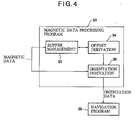
- FIG. 4 is a block diagram of a magnetic data processing program 90.
- the magnetic data processing program 90 is stored in the ROM 42 to provide orientation data to a navigation program 98.
- the orientation data is 2D vector data representing the orientation of the Earth's magnetic field.
- 3D vector data for attitude detection of, for example, a moving body the orientation data may be provided to other applications.
- the magnetic data processing program 90 is constructed as a group of modules such as a buffer management module 92, an offset derivation module 94, and an orientation derivation module 96.
- the buffer management module 92 is a program part that receives a plurality of magnetic data (or magnetic data samples) sequentially output from the magnetic sensor 4 and stores the received magnetic data in a buffer in order to use the magnetic data in offset update.
- the buffer management module 92 allows the CPU 40, the RAM 44, and the ROM 42 to function as input part and storage part.
- This buffer may be embodied not only in hardware but also in software. A plurality of magnetic data stored in this buffer will hereinafter be referred to as a "statistical population".
- the offset derivation module 94 is a program part that derives a new offset based on a statistical population held by the buffer management module 92 and an old offset held by the offset derivation module 94, and updates the old offset with the new offset.
- the offset derivation module 94 allows the CPU 40, the RAM 44, and the ROM 42 to function as offset derivation part. Since updating the old offset with the new offset causes the new offset to become an old offset, the "old offset” will be referred to simply as an "offset" in contexts in which it causes no misunderstanding.
- an offset used for orientation data correction is set in one variable and the new offset is derived as a different variable from that variable. When the new offset is derived, it is set in the variable used for orientation data correction. Therefore, the variable used for orientation data correction is that in which the old offset is stored.
- the orientation derivation module 96 is a program part that corrects the magnetic data sequentially output from the magnetic sensor using the offset held by the offset derivation module 94 and creates orientation data based on the corrected magnetic data.
- the orientation derivation module 96 allows the CPU 40, the RAM 44, and the ROM 42 to function as orientation derivation part. Specifically, the orientation derivation module 96 outputs, as orientation data, all or two of the 3 components obtained by subtracting the components of the offset from the components of the magnetic data which is 3D vector data.
- the navigation program 98 is a known program that searches for a route to a destination and displays the route on a map.
- the map is displayed such that the orientation thereof matches the real-world orientation. Accordingly, for example, when the mobile phone 3 is rotated, the map displayed on the display 2 is rotated relative to the display 2 such that the map is not rotated relative to the earth.
- the orientation data is used in this map display processing. Of course, the orientation data may be used only to display north, south, east and west by characters or arrows.
- FIG. 5 is a flow chart illustrating a new offset derivation procedure.
- the CPU 40 performs the procedure of FIG. 5 by executing the offset derivation module 94 when an offset update request has been made.
- step S100 all magnetic data stored in the buffer, in which a plurality of magnetic data (statistical population) used for deriving a new offset is stored, is deleted. That is, in this process, a plurality of magnetic data (statistical population) used for deriving the old offset is deleted.
- step S102 magnetic data used for deriving a new offset is input and stored in the buffer. When a plurality of magnetic data are sequentially input from the magnetic sensor 4 with almost no change in the attitude of the mobile phone 3, the distance between two sequentially input magnetic data (elements) is small. Storing a plurality of near magnetic data (elements) in a buffer with a limited capacity wastes memory resources and causes unnecessary buffer update processes.
- Whether or not it is necessary to update the buffer may be determined in the following manner. For example, if the distance between the last input magnetic data and magnetic data stored in the buffer immediately before the last input magnetic data is less than a given threshold, it is determined that it is unnecessary to update the buffer and the last input magnetic data is discarded without being stored in the buffer.
- step S104 it is determined whether or not a specified number of magnetic data sufficient to derive an accurate new offset has been stored in the buffer. That is, the number of elements of the statistical population is predetermined. Setting a small number of elements of the statistical population improves response to the offset update request. The processes of steps S102 and S104 are repeated until the specified number of magnetic data is stored in the buffer.
- the distribution of the statistical population is estimated (steps S106 and S108).
- the distribution is estimated based on principal values of the distribution.
- a magnetic data set is expressed by the following Equation (1).
- the principal values of the distribution are eigenvalue of a symmetric matrix A' defined by Equations (2), (3), (4), and (5) using vectors starting from a center (average) of the statistical population and ending with the respective magnetic data samples.
- the probability distribution ⁇ is a normal distribution whose average is 0 and whose variance - covariance matrix is expressed by "V".
- ⁇ 1 , ⁇ 2 , and ⁇ 3 be the eigenvalue of the matrix A' in descending order.
- Let u 1 , u 2 , and u 3 be mutually orthogonal eigenvectors that correspond to ⁇ 1 , ⁇ 2 , and ⁇ 3 and have been normalized to 1.
- two or more eigenvalues of the matrix A' are zero, i.e., when the rank of the matrix A' is one or less, there is no need to consider it since the number of elements of the statistical population is one or the distribution is a perfectly straight line.
- the distribution of the statistical population is estimated based both on the minimum eigenvalue ⁇ 3 and on the intermediate eigenvalue ⁇ 2 .
- step S106 it is determined whether or not the distribution of the statistical population is sufficiently three-dimensional, Specifically, this determination is affirmative when the following condition (7) is satisfied, and otherwise the determination is negative when it is not satisfied.
- “t 1 " and "t 2 " are predetermined constants. How the values t 1 and t 2 are set is a design option and the values t 1 and t 2 can optionally be set based on how the derivation characteristics of the offset is determined.
- the condition (7) is satisfied, the statistical population is distributed isotropically from the center of the statistical population. The isotropic distribution of the statistical population about the center indicates that the statistical population is distributed evenly or uniformly near a specific sphere.
- step S108 it is determined whether or not the distribution of the statistical population is sufficiently two-dimensional. Specifically, the determination is affirmative when the following condition (8) is satisfied, and otherwise the determination is negative when it is not satisfied. ⁇ 3 ⁇ t 1 and ⁇ 2 > t 2 When the condition (8) is satisfied, the statistical population is distributed isotropically from the center of then statistical population in a range restricted near a specific plane. The isotropic distribution of the statistical population about the center in a range restricted near a specific plane indicates that the statistical population is unevenly distributed near the circumference of a sectional circle of a specific sphere.
- the distribution of the statistical population is substantially one-dimensional (i.e., linear).
- the substantially linear distribution of the statistical population indicates that the statistical population is unevenly distributed on a short arc of a sectional circle of a specific sphere or on both ends of a diameter of the sectional circle.
- Equation (12) which minimizes a function f v (c) of the following Equation (13), which is an index of variance of d i , can be considered the most probable new offset.
- d i and d ⁇ are expressed as follows.
- Equation (21) q , v , X v , R v , and j v are defined as follows.
- Equation (21) A - (n-1)V as described above.
- Equation (22) is derived by obtaining an expected value of the Equation (21) following the probability distribution ⁇ , and by replacing each term containing the random variable v 1 which is time-independent among terms of the expected value of the Equation (21) with an expected value corresponding to the probability distribution ⁇ .
- a new offset is derived without restricting directions in which the old offset is corrected (step S114).
- the distribution is three-dimensional, i.e., if the statistical population is distributed in all directions to a certain extent as seen from the center of the statistical population, the statistical population is sufficiently reliable in all directions. Accordingly, in this case, to derive the new offset, it is unnecessary to use the old offset and thus the new offset can be derived based on the statistical population without using the old offset.
- An algorithm for deriving a new offset based on the statistical population without using the old offset may be an algorithm that uses one of a variety of statistical techniques that have been suggested and may also be an algorithm that uses no statistical technique as described in Japanese Patent Application Publication Nos. 2005-337412 and 2006-44289 filed by the present applicant.
- a new offset is derived using a probabilistic method. That is, at step S114, the new offset "c" is derived as a solution to the mathematical programming problem for minimizing the objective function of Equation (22) Without any constraint condition.
- A' positive definite
- A' is not positive definite
- "c” which minimizes the objective function f(c) expressed by Equation (22) does not exist or is not uniquely determined.
- a new offset is derived by restricting directions in which the old offset is corrected to two orthogonal directions (step S112).
- the distribution of the statistical population in a direction parallel to the plane is sufficiently reliable while the distribution of the statistical population in the direction normal to the plane is unreliable.
- the old offset is not corrected in the direction normal to the plane, thereby preventing the offset from being updated based on unreliable information.
- Equation (30) When the statistical population is distributed near a specific plane and the population is scattered when viewed from a direction normal to the plane, the direction normal to the plane is coincident with the direction of an eigenvector u 3 corresponding to the minimum eigenvalue ⁇ 3 and orthogonal directions parallel to the plane are coincident with the directions of eigenvectors u 1 and u 2 corresponding respectively to the maximum eigenvalue ⁇ 1 and the intermediate eigenvalue ⁇ 2 . Accordingly, in order to derive a new offset without correcting the old offset in the direction normal to the plane, a new offset c which minimizes the objective function of Equation (22) is found under a constraint condition expressed by the following Equation (30).
- Equation (30) is equivalent to the following Equation (31).
- u 3 T ⁇ c - c 0 0
- Equation (22) The equation for solving the mathematical programming problem of Equation (22) under the constraint condition of Equation (30) can be modified to its equivalent simultaneous equations using the method of Lagrange multipliers.
- Equation (32) simultaneous linear Equations (33) of "x" are identical to the above simultaneous equations.
- the new offset may be derived at step S112 by solving the simultaneous linear Equations (33).
- the solution "x" must be uniquely determined since the rank of the matrix B 4 must be 4.
- the new offset c may also be derived by solving Equation (38) using a solution to the following simultaneous Equations (37) for c' and an unknown constant multiplier p', where b ' 4 is given as follows.
- b 4 ⁇ X T ⁇ j ⁇ u 3 T ⁇ c 0
- a new offset is derived by restricting directions in which the old offset is corrected to one principle direction of the distribution (step S110).
- the distribution of the statistical population in the direction of the straight line is sufficiently reliable while the distribution of the statistical population in other directions is unreliable.
- the old offset is not corrected in directions other than the direction of the line, thereby preventing the offset from being updated based on unreliable information.
- Equation (39) is equivalent to simultaneous satisfaction of the following Equations (40) and (41).
- Equation (22) The equation for solving the mathematical programming problem of Equation (22) under the constraint condition of Equation (39) can be modified to its equivalent simultaneous equations using the method of Lagrange multipliers.
- the new offset may be derived at step S110 by solving the simultaneous linear Equations (43).
- the solution "x" must be uniquely determined since the rank of the matrix B 5 must be 5.
- the finally derived value c is also uniquely determined.
- the new offset c may also be derived by solving Equation (48) using a solution to the following simultaneous Equations (47) for c' and unknown constant multipliers p 1 ' and p 2 ' where b' 5 is given as follows.
- the new offset c is defined by the following Equation (49) by considering the new offset c as the sum of the old offset c 0 and a position vector g of the center of a sphere, derived from only the statistical population, relative to the old offset c 0 .
- Equation (49) by considering the new offset c as the sum of the old offset c 0 and a position vector g of the center of a sphere, derived from only the statistical population, relative to the old offset c 0 .
- c c 0 + g
- the position vector g derived as a solution to the mathematical programming problem for minimizing the objective function of Equation (21) without any constraint condition is a linear combination of fundamental vectors in the same directions as the eigenvectors u 1 , u 2 , and u 3 of the distribution. Therefore a correction vector "f", which corresponds to a vector corrected from the position vector "g" according to the respective degrees of reliability of the components of the position vector "g", can be obtained by weighting coefficients g a , g B , and g Y of the position vector "g" according to the respective degrees of reliability of the statistical population in the corresponding principal axis directions (see FIG. 1 ).
- step S112 which is performed when the distribution of the (statistical population is two-dimensional as shown in FIG. 6 , the following constraint condition is imposed when deriving a new offset based on the old offset c 0 and the statistical population.
- the constraint condition is that the new offset c be obtained as the sum of the old offset c 0 and a correction vector "f" that is obtained by weighting both a coefficient g a of the position vector "g" in a principal axis direction of the distribution corresponding to the maximum principal value of the distribution (i.e., corresponding to the maximum eigenvalue ⁇ 1 ) and a coefficient g B in a principal axis direction of the distribution corresponding to the intermediate principal value of the distribution (i.e., corresponding to the intermediate eigenvalue ⁇ 2 ) by a weighting factor of "1" of the position vector "g” and weighting a coefficient g ⁇ in a principal axis direction of the distribution corresponding to the minimum principal value of the distribution (i.e., corresponding to the minimum eigenvalue ⁇ 3 ) by a weighting factor of "0" of the position vector "g".
- step S110 which is performed when the distribution of the statistical population is substantially one-dimensional as shown in FIG. 7 , the following constraint condition is imposed when deriving a new offset based on the old offset c 0 and the statistical population.
- the constraint condition is that the new offset c be obtained as the sum of the old offset c 0 and a correction vector "f" that is obtained by weighting a coefficient g a of the position vector "g" in a principal axis direction (or a principle direction) of the distribution corresponding to the maximum principal value of the distribution (i.e., corresponding to the maximum eigenvalue ⁇ 1 ) by a weighting factor of "1" of the position vector "g" and weighting both a coefficient g B in a principal axis direction of the distribution corresponding to the intermediate principal value of the distribution (i.e., corresponding to the intermediate eigenvalue ⁇ 2 ) and a coefficient g ⁇ in a principal axis direction of the distribution corresponding to the minimum principal value
- step S114 In the process of step S114 which is performed when the distribution of the statistical population is three-dimensional, no specific constraint condition is imposed. That is, at step S114, the new offset c is obtained as the sum of the old offset c 0 and the position vector "g" that is obtained as a solution to the mathematical programming problem for minimizing the objective function of Equation (22) without any constraint condition. As a result, the new offset is derived without using the old offset c 0 .
- the distribution of the statistical population is estimated discretely and, when the distribution is two-dimensional, the new offset "c" is derived by setting the component of the correction vector "f" in the principal axis direction, in which the principal value is the minimum value, to zero and, when the distribution is one-dimensional, the new offset "c” is derived by setting the components of the correction vector "f" in the two principal axis directions, in which the principal values are the intermediate and minimum values, to zero.
- the second embodiment a description will be given of a simple, highly accurate algorithm that can eliminate the need to perform different processes according to estimations of the distribution as in the first embodiment and can also derive a more probable new offset by efficiently using the statistical population.
- FIG. 8 is a flow chart illustrating a new offset derivation process.
- the CPU 40 performs the procedure of FIG. 8 by executing the offset derivation module 94 when an offset update request has been made.
- the process of step S200 is the same as that of the process of step S100 described above in the first embodiment.
- the process of step S202 is the same as that of the process of step S102 described above in the first embodiment.
- the process of step S204 is the same as that of the process of step S104 described above in the first embodiment.
- distribution indices of the statistical population are derived.
- the distribution of the statistical population is estimated by deriving distribution indices m 2 and m 3 defined by the following equations (50) and (51).
- m 2 ⁇ 1 ⁇ 2 + 1 k 2 ⁇ 2 ⁇ 0 1 ⁇ 2 ⁇ 0
- m 3 ⁇ 1 ⁇ 3 + 1 k 3 ⁇ 3 ⁇ 0 1 ⁇ 3 ⁇ 0
- k 2 " and “k 3 " are predetermined positive constants.
- the values of k 2 and k 3 determine the association between principal values and the degrees of reliability of corresponding principal axis directions of the statistical population.
- distribution indices "m 2 " and “m 3 " satisfy the following conditions.
- the distribution indices "m 2 " and “m 3 " may be determined to have any value as long as the following conditions are satisfied.
- this embodiment realizes a process for deriving a new offset c as the sum of the old offset c 0 and a correction vector f that is obtained by weighting the coefficients g a , g B , and g ⁇ of the position vector g (see FIG. 1 ) described above by weighting factors corresponding to the principal values of the distribution of the statistical population. The following are details of this process.
- Equation (57) a matrix "B” is defined by Equations (56) and a vector “b” is defined by Equation (57).
- the process for deriving a new offset at step S208 is to find a solution to the following simultaneous equations (58).
- the vector x is uniquely determined since the matrix B must be nonsingular.
- Bx b
- the new offset c may also be derived by solving Equation (61) using a solution to the following simultaneous Equations (60) for c' and unknown constant multipliers ⁇ ' 1 and ⁇ ' 2 where b' is given as the following Equation (59).
- the second embodiment it is easy to develop or improve the offset derivation module 94 and the data size of the offset derivation module 94 is also decreased since there is no need to branch the new offset derivation process according to the distribution of the statistical population as described above.
- the second embodiment allows the offset derivation module 94 to more efficiently use the statistical population and also allows the orientation derivation module to correct magnetic data using the most probable offset since the old offset can be corrected in the principal axis directions of the distribution by distances corresponding to the principal values of the statistical population unless one or more of the principal values is zero or negative.
- the invention is not limited to the above embodiments and various embodiments are possible without departing from the spirit of the invention.
- the invention can also be applied to a magnetic sensor that is mounted on a PDA or a magnetic sensor that is mounted on a vehicle.
- the invention is applicable not only to a 3D magnetic sensor but also to a 2D magnetic sensor.
- the probability distribution ⁇ which allows the objective function in the probabilistic programming problem which is a stochastic model to be replaced with the objective function which is a deterministic model using the expected value, is not limited to the normal distribution and may also be a binomial distribution, a uniform distribution, or a Poisson distribution.
- a term, including an error which is a random variable, in the objective function may be substituted with an expected value corresponding to a probability distribution which best matches the distribution of magnetic data errors among such probability distributions.
- the probability distribution ⁇ may be treated as the normal distribution, and the offset may be derived using the expected value corresponding to the normal distribution.
- the offset may be derived according to any probabilistic method, provided that the offset is derived using an expected value corresponding to a probability distribution assuming that an error ⁇ p i included in magnetic data is a random variable v 1 following the probability distribution ⁇ .
- the invention can be practiced by introducing an expected value of an error in a probabilistic method described in publications such as International Patent Publication No. 2006-009247 and Japanese Patent Application Publication Nos. 2007-225325 , 2007-225329 , and 2007-225332 .
Landscapes
- Physics & Mathematics (AREA)
- General Physics & Mathematics (AREA)
- Engineering & Computer Science (AREA)
- Radar, Positioning & Navigation (AREA)
- Remote Sensing (AREA)
- Condensed Matter Physics & Semiconductors (AREA)
- Measuring Magnetic Variables (AREA)
Applications Claiming Priority (2)
| Application Number | Priority Date | Filing Date | Title |
|---|---|---|---|
| JP2010045113 | 2010-03-02 | ||
| JP2011036782A JP2011203243A (ja) | 2010-03-02 | 2011-02-23 | 磁気データ処理装置、方法及びプログラム |
Publications (2)
| Publication Number | Publication Date |
|---|---|
| EP2363688A2 true EP2363688A2 (de) | 2011-09-07 |
| EP2363688A3 EP2363688A3 (de) | 2014-02-26 |
Family
ID=43982468
Family Applications (1)
| Application Number | Title | Priority Date | Filing Date |
|---|---|---|---|
| EP11001746.4A Withdrawn EP2363688A3 (de) | 2010-03-02 | 2011-03-02 | Magnetische Datenverarbeitungsvorrichtung, -verfahren und -programm |
Country Status (5)
| Country | Link |
|---|---|
| US (1) | US20110218769A1 (de) |
| EP (1) | EP2363688A3 (de) |
| JP (1) | JP2011203243A (de) |
| KR (1) | KR101152095B1 (de) |
| CN (1) | CN102193073B (de) |
Families Citing this family (10)
| Publication number | Priority date | Publication date | Assignee | Title |
|---|---|---|---|---|
| US8786279B2 (en) | 2011-02-25 | 2014-07-22 | Allegro Microsystems, Llc | Circuit and method for processing signals generated by a plurality of sensors |
| US8860410B2 (en) | 2011-05-23 | 2014-10-14 | Allegro Microsystems, Llc | Circuits and methods for processing a signal generated by a plurality of measuring devices |
| US9285438B2 (en) | 2011-09-28 | 2016-03-15 | Allegro Microsystems, Llc | Circuits and methods for processing signals generated by a plurality of magnetic field sensing elements |
| US9160687B2 (en) * | 2012-02-15 | 2015-10-13 | Massachusetts Institute Of Technology | Method and apparatus for performing finite memory network coding in an arbitrary network |
| US9547048B2 (en) | 2014-01-14 | 2017-01-17 | Allegro Micosystems, LLC | Circuit and method for reducing an offset component of a plurality of vertical hall elements arranged in a circle |
| US10072956B2 (en) * | 2014-07-11 | 2018-09-11 | Invensense, Inc. | Systems and methods for detecting and handling a magnetic anomaly |
| US10852143B2 (en) * | 2018-06-27 | 2020-12-01 | Rohit Seth | Motion sensor with drift correction |
| WO2020146028A1 (en) * | 2019-01-07 | 2020-07-16 | Google Llc | Identifying and correcting label bias in machine learning |
| CN111175829B (zh) * | 2020-01-11 | 2023-03-28 | 长江大学 | 一种多元正态分布正交变换数据处理方法及系统 |
| US11802922B2 (en) | 2021-01-13 | 2023-10-31 | Allegro Microsystems, Llc | Circuit for reducing an offset component of a plurality of vertical hall elements arranged in one or more circles |
Citations (7)
| Publication number | Priority date | Publication date | Assignee | Title |
|---|---|---|---|---|
| JP2005337412A (ja) | 2004-05-28 | 2005-12-08 | Hitachi Ltd | 減速機構付きねじ機構 |
| JP2006009247A (ja) | 2004-06-22 | 2006-01-12 | Chiba Yohgyoh Co Ltd | 水路用プレキャストコンクリートブロック |
| JP2006044289A (ja) | 2004-07-30 | 2006-02-16 | Toyoda Gosei Co Ltd | 歩行者用エアバッグ装置 |
| JP2007225329A (ja) | 2006-02-21 | 2007-09-06 | Yamaha Corp | 磁気センサ制御装置、磁気測定装置、並びにオフセット設定方法及びプログラム |
| JP2007225332A (ja) | 2006-02-21 | 2007-09-06 | Yamaha Corp | 磁気センサ制御装置、磁気測定装置、並びにオフセット設定方法及びプログラム |
| JP2007225325A (ja) | 2006-02-21 | 2007-09-06 | Yamaha Corp | 磁気センサ制御装置、磁気測定装置、並びにオフセット設定方法及びプログラム。 |
| JP2007240270A (ja) | 2006-03-07 | 2007-09-20 | Yamaha Corp | 磁気データ処理装置、方法及びプログラム |
Family Cites Families (9)
| Publication number | Priority date | Publication date | Assignee | Title |
|---|---|---|---|---|
| JPH0278907A (ja) * | 1988-09-16 | 1990-03-19 | Hitachi Ltd | 地図データを用いたナビゲーシヨンシステム及び移動体のロケーションシステム |
| US6029250A (en) * | 1998-09-09 | 2000-02-22 | Micron Technology, Inc. | Method and apparatus for adaptively adjusting the timing offset between a clock signal and digital signals transmitted coincident with that clock signal, and memory device and system using same |
| US7177779B2 (en) * | 2002-07-01 | 2007-02-13 | Asahi Kasei Emd Corporation | Azimuth measuring device and azimuth measuring method |
| CN1254770C (zh) * | 2004-05-13 | 2006-05-03 | 上海交通大学 | 基于期望值最大与离散小波框架的图像融合方法 |
| US7275008B2 (en) * | 2005-09-02 | 2007-09-25 | Nokia Corporation | Calibration of 3D field sensors |
| US7532991B2 (en) * | 2006-03-07 | 2009-05-12 | Yamaha Corporation | Magnetic data processing device |
| JP5012252B2 (ja) * | 2007-06-25 | 2012-08-29 | ヤマハ株式会社 | 磁気データ処理装置、方法およびプログラム |
| JP5067155B2 (ja) * | 2007-12-28 | 2012-11-07 | ヤマハ株式会社 | 磁気データ処理装置、ナビゲーション装置、磁気データ処理方法および磁気データ処理プログラム |
| JP5266754B2 (ja) * | 2007-12-28 | 2013-08-21 | ヤマハ株式会社 | 磁気データ処理装置、磁気データ処理方法および磁気データ処理プログラム |
-
2011
- 2011-02-23 JP JP2011036782A patent/JP2011203243A/ja not_active Withdrawn
- 2011-02-28 US US13/037,282 patent/US20110218769A1/en not_active Abandoned
- 2011-03-01 CN CN2011100492159A patent/CN102193073B/zh not_active Expired - Fee Related
- 2011-03-02 EP EP11001746.4A patent/EP2363688A3/de not_active Withdrawn
- 2011-03-02 KR KR1020110018444A patent/KR101152095B1/ko not_active Expired - Fee Related
Patent Citations (7)
| Publication number | Priority date | Publication date | Assignee | Title |
|---|---|---|---|---|
| JP2005337412A (ja) | 2004-05-28 | 2005-12-08 | Hitachi Ltd | 減速機構付きねじ機構 |
| JP2006009247A (ja) | 2004-06-22 | 2006-01-12 | Chiba Yohgyoh Co Ltd | 水路用プレキャストコンクリートブロック |
| JP2006044289A (ja) | 2004-07-30 | 2006-02-16 | Toyoda Gosei Co Ltd | 歩行者用エアバッグ装置 |
| JP2007225329A (ja) | 2006-02-21 | 2007-09-06 | Yamaha Corp | 磁気センサ制御装置、磁気測定装置、並びにオフセット設定方法及びプログラム |
| JP2007225332A (ja) | 2006-02-21 | 2007-09-06 | Yamaha Corp | 磁気センサ制御装置、磁気測定装置、並びにオフセット設定方法及びプログラム |
| JP2007225325A (ja) | 2006-02-21 | 2007-09-06 | Yamaha Corp | 磁気センサ制御装置、磁気測定装置、並びにオフセット設定方法及びプログラム。 |
| JP2007240270A (ja) | 2006-03-07 | 2007-09-20 | Yamaha Corp | 磁気データ処理装置、方法及びプログラム |
Also Published As
| Publication number | Publication date |
|---|---|
| CN102193073B (zh) | 2013-12-18 |
| KR101152095B1 (ko) | 2012-07-03 |
| US20110218769A1 (en) | 2011-09-08 |
| JP2011203243A (ja) | 2011-10-13 |
| KR20110099652A (ko) | 2011-09-08 |
| CN102193073A (zh) | 2011-09-21 |
| EP2363688A3 (de) | 2014-02-26 |
Similar Documents
| Publication | Publication Date | Title |
|---|---|---|
| EP1832889B1 (de) | Magnetische Datenverarbeitungsvorrichtung | |
| EP2363688A2 (de) | Magnetische Datenverarbeitungsvorrichtung, -verfahren und -programm | |
| US9645202B2 (en) | Geomagnetic sensor calibration apparatus and method thereof | |
| CN108426571B (zh) | 一种电子罗盘本地实时校准方法及装置 | |
| JP6191145B2 (ja) | オフセット推定装置及びプログラム | |
| JP5899726B2 (ja) | 地磁気測定装置、地磁気測定方法、及び地磁気測定プログラム | |
| CN104204734B (zh) | 物理量数据校正装置以及物理量数据校正方法 | |
| US8862418B2 (en) | Magnetic data processing device, magnetic data processing method, and magnetic data processing program | |
| JP4844179B2 (ja) | 磁気データ処理装置、方法及びプログラム | |
| JP6019585B2 (ja) | 端末装置 | |
| JP5772265B2 (ja) | 地磁気測定装置、オフセット決定方法、及びオフセット決定プログラム | |
| JP5375394B2 (ja) | 磁気データ処理装置、磁気データ処理方法および磁気データ処理プログラム | |
| JP2012189323A (ja) | 磁気データ処理装置、磁気データ処理方法及び磁気データ処理プログラム。 | |
| US8413034B2 (en) | Magnetic data processing device, magnetic data processing method, and magnetic data processing program | |
| US20110015895A1 (en) | Magnetic data processing device, magnetic data processing method, and magnetic data processing program | |
| JP5375791B2 (ja) | 磁気データ処理装置、方法及びプログラム | |
| JP2007327934A (ja) | 磁気データ処理装置、方法およびプログラム | |
| JP5453969B2 (ja) | 磁気データ処理装置、磁気データ処理方法および磁気データ処理プログラム | |
| JP2011089912A (ja) | 磁気データ処理装置、方法及びプログラム | |
| JP5621181B2 (ja) | 磁気データ処理装置、磁気データ処理方法および磁気データ処理プログラム | |
| TWI320854B (en) | Magnetic data processing device, magnetic data processing method, magnetic data processing program product, and magnetic measurement apparatus |
Legal Events
| Date | Code | Title | Description |
|---|---|---|---|
| PUAI | Public reference made under article 153(3) epc to a published international application that has entered the european phase |
Free format text: ORIGINAL CODE: 0009012 |
|
| AK | Designated contracting states |
Kind code of ref document: A2 Designated state(s): AL AT BE BG CH CY CZ DE DK EE ES FI FR GB GR HR HU IE IS IT LI LT LU LV MC MK MT NL NO PL PT RO RS SE SI SK SM TR |
|
| AX | Request for extension of the european patent |
Extension state: BA ME |
|
| PUAL | Search report despatched |
Free format text: ORIGINAL CODE: 0009013 |
|
| AK | Designated contracting states |
Kind code of ref document: A3 Designated state(s): AL AT BE BG CH CY CZ DE DK EE ES FI FR GB GR HR HU IE IS IT LI LT LU LV MC MK MT NL NO PL PT RO RS SE SI SK SM TR |
|
| AX | Request for extension of the european patent |
Extension state: BA ME |
|
| RIC1 | Information provided on ipc code assigned before grant |
Ipc: G01R 33/025 20060101ALI20140122BHEP Ipc: G01C 17/38 20060101AFI20140122BHEP |
|
| STAA | Information on the status of an ep patent application or granted ep patent |
Free format text: STATUS: THE APPLICATION IS DEEMED TO BE WITHDRAWN |
|
| 18D | Application deemed to be withdrawn |
Effective date: 20140827 |