EP2363840A2 - Appareil de gestion de médicaments et procédé, poubelle pour l'appareil et chariot pour l'appareil - Google Patents
Appareil de gestion de médicaments et procédé, poubelle pour l'appareil et chariot pour l'appareil Download PDFInfo
- Publication number
- EP2363840A2 EP2363840A2 EP11000158A EP11000158A EP2363840A2 EP 2363840 A2 EP2363840 A2 EP 2363840A2 EP 11000158 A EP11000158 A EP 11000158A EP 11000158 A EP11000158 A EP 11000158A EP 2363840 A2 EP2363840 A2 EP 2363840A2
- Authority
- EP
- European Patent Office
- Prior art keywords
- medicine
- medicines
- bin
- shelf
- shelves
- Prior art date
- Legal status (The legal status is an assumption and is not a legal conclusion. Google has not performed a legal analysis and makes no representation as to the accuracy of the status listed.)
- Withdrawn
Links
- 239000003814 drug Substances 0.000 title claims abstract description 486
- 229940079593 drug Drugs 0.000 title claims abstract description 195
- 238000000034 method Methods 0.000 title description 35
- 238000007726 management method Methods 0.000 claims description 85
- 238000007599 discharging Methods 0.000 claims description 3
- 238000002360 preparation method Methods 0.000 abstract description 6
- 238000005192 partition Methods 0.000 description 27
- 230000008569 process Effects 0.000 description 17
- 238000003780 insertion Methods 0.000 description 11
- 230000037431 insertion Effects 0.000 description 11
- 230000004308 accommodation Effects 0.000 description 10
- 238000004891 communication Methods 0.000 description 9
- 230000008878 coupling Effects 0.000 description 8
- 238000010168 coupling process Methods 0.000 description 8
- 238000005859 coupling reaction Methods 0.000 description 8
- 238000003860 storage Methods 0.000 description 8
- 238000009434 installation Methods 0.000 description 7
- 230000001965 increasing effect Effects 0.000 description 5
- 238000012546 transfer Methods 0.000 description 5
- 230000000994 depressogenic effect Effects 0.000 description 4
- 238000007689 inspection Methods 0.000 description 4
- 239000007788 liquid Substances 0.000 description 4
- 238000000926 separation method Methods 0.000 description 4
- 208000027418 Wounds and injury Diseases 0.000 description 3
- 230000005540 biological transmission Effects 0.000 description 3
- 230000006378 damage Effects 0.000 description 3
- 230000005484 gravity Effects 0.000 description 3
- 238000012986 modification Methods 0.000 description 3
- 230000004048 modification Effects 0.000 description 3
- 238000005057 refrigeration Methods 0.000 description 3
- 230000001105 regulatory effect Effects 0.000 description 3
- XEEYBQQBJWHFJM-UHFFFAOYSA-N Iron Chemical compound [Fe] XEEYBQQBJWHFJM-UHFFFAOYSA-N 0.000 description 2
- 238000013459 approach Methods 0.000 description 2
- 230000008901 benefit Effects 0.000 description 2
- 230000033228 biological regulation Effects 0.000 description 2
- 208000014674 injury Diseases 0.000 description 2
- 238000004519 manufacturing process Methods 0.000 description 2
- 238000004806 packaging method and process Methods 0.000 description 2
- 230000002265 prevention Effects 0.000 description 2
- 239000012780 transparent material Substances 0.000 description 2
- BQCADISMDOOEFD-UHFFFAOYSA-N Silver Chemical compound [Ag] BQCADISMDOOEFD-UHFFFAOYSA-N 0.000 description 1
- 238000012733 comparative method Methods 0.000 description 1
- 230000001276 controlling effect Effects 0.000 description 1
- 238000013523 data management Methods 0.000 description 1
- 238000001514 detection method Methods 0.000 description 1
- 238000011161 development Methods 0.000 description 1
- 230000002708 enhancing effect Effects 0.000 description 1
- 230000006870 function Effects 0.000 description 1
- 229910052742 iron Inorganic materials 0.000 description 1
- 239000000463 material Substances 0.000 description 1
- 239000004081 narcotic agent Substances 0.000 description 1
- 239000002547 new drug Substances 0.000 description 1
- 239000006187 pill Substances 0.000 description 1
- 238000012545 processing Methods 0.000 description 1
- 230000009467 reduction Effects 0.000 description 1
- 230000001932 seasonal effect Effects 0.000 description 1
- 229910052709 silver Inorganic materials 0.000 description 1
- 239000004332 silver Substances 0.000 description 1
- 238000012384 transportation and delivery Methods 0.000 description 1
- 238000002604 ultrasonography Methods 0.000 description 1
Images













Classifications
-
- G—PHYSICS
- G07—CHECKING-DEVICES
- G07F—COIN-FREED OR LIKE APPARATUS
- G07F11/00—Coin-freed apparatus for dispensing, or the like, discrete articles
- G07F11/46—Coin-freed apparatus for dispensing, or the like, discrete articles from movable storage containers or supports
- G07F11/50—Coin-freed apparatus for dispensing, or the like, discrete articles from movable storage containers or supports the storage containers or supports being rotatably mounted
-
- G—PHYSICS
- G07—CHECKING-DEVICES
- G07F—COIN-FREED OR LIKE APPARATUS
- G07F17/00—Coin-freed apparatus for hiring articles; Coin-freed facilities or services
- G07F17/0092—Coin-freed apparatus for hiring articles; Coin-freed facilities or services for assembling and dispensing of pharmaceutical articles
-
- A—HUMAN NECESSITIES
- A61—MEDICAL OR VETERINARY SCIENCE; HYGIENE
- A61G—TRANSPORT, PERSONAL CONVEYANCES, OR ACCOMMODATION SPECIALLY ADAPTED FOR PATIENTS OR DISABLED PERSONS; OPERATING TABLES OR CHAIRS; CHAIRS FOR DENTISTRY; FUNERAL DEVICES
- A61G12/00—Accommodation for nursing, e.g. in hospitals, not covered by groups A61G1/00 - A61G11/00, e.g. trolleys for transport of medicaments or food; Prescription lists
- A61G12/001—Trolleys for transport of medicaments, food, linen, nursing supplies
Definitions
- the present disclosure relates to a medicine management method and apparatus that stores various kinds of medicines and permits the stored medicines to be dispensed according to prescriptions. More particularly, the present disclosure relates to a medicine management method and apparatus that ensures stable medicine management and security while providing efficiency in stock management and preparation of medicines. The present disclosure also relates to a bin for the apparatus and a cart for the apparatus.
- an integrated preparation apparatus For preparation of a combination of tablets or pills, an integrated preparation apparatus has been developed and used in the art to automatically prepare a dose of medicine according to a prescription.
- some medicines are difficult to package due to the size or shape thereof.
- Such medicines are generally packed in rectangular parallelepiped shaped paper bags or are provided as a solution in a bottle or plastic bag, so that the medicine packages have various shapes according to a packaging method.
- a conventional automatic dispensing system employs a robotic system for recognition, holding, and transportation of the packaged medicines, thereby requiring high installation costs.
- US Patent No. 4,643,495 entitled “Mechanical Storage Cabinet with Container Conveyor” describes a cabinet which comprises two endless chains disposed at opposite sides of the cabinet and rotated by a drive motor, and a plurality of shelves disposed inside the chains to face each other to achieve effective use of a space for stacking articles.
- the bottoms of the shelves are always directed downwards by a hinge structure coupled to the chains when the shelves are rotated, thereby preventing medicines from falling off of the shelves.
- the supporting structure for the chains and shelves is obtained by modifying US Patent No. 4,643,495 , entitled “Vertical Excursion Accommodation Apparatus”, and allows the shelves to be stably secured to the chains by support arms and to be moved along an ellipsoidal trajectory extending in a vertical direction.
- US Patent No. 5,438,523 entitled “Apparatus for storing and delivering sale units”, describes a plurality of bins, which are boxes for sorting and storing articles in a shelf.
- US Patent No. 6,814,255 entitled “Method for controlling a drug dispensing system”, describes a management program for storing and dispensing medicines.
- the bin for receiving medicine in a shelf has a predetermined storage capacity, it is difficult to efficiently cope with the case where the medicine has a large volume or when the number of medicines is increased. Accordingly, it is necessary for the bin to have a variable storage capacity according to the volume or number of medicines to be stored therein. Further, in the case where the bin is partially occupied by a small volume and small number of medicines, it is desirable that an inner space of the bin be divided such that two or more types of medicine can be stored therein.
- the present disclosure is directed to solving the problems of the related art as described above, and an embodiment of the present disclosure provides a medicine management apparatus that ensures stability and security in medicine management through classification according to levels of regulatory control.
- FIG. 1 is a diagrammatic representation of an exemplary medicine system.
- Still other embodiments of the present disclosure provide a medicine management apparatus and method.
- the medicine management apparatus enables more rapid and easier management of medicines by allowing medicines prepared according to prescriptions to be dispensed according to the kind of medicine rather than according to patients and sorting the dispensed medicines in a cart having a plurality of compartments.
- Still other embodiments of the present disclosure provide a cart and a medicine management method using the same.
- medicines prepared according to prescriptions are dispensed according to the kind of medicine rather than according to patients and are then sorted in the cart having a plurality of compartments, so that the medicines dispensed from a medicine depository are prevented from being mixed with other medicines and can be accurately delivered to a patient.
- a medicine management apparatus includes a plurality of shelves movably coupled to a vertically disposed rotatable circular carousel and a plurality of bins seated on the shelves and accommodating medicines.
- the apparatus further includes a main door that opens or closes an inlet/outlet port at a front side of a housing of the medicine management apparatus; and a shelf assistant door that opens or closes a front part of each of the shelves exposed through the inlet/outlet port and is provided with a lock.
- a bin for a medicine management apparatus for placing and managing medicines on a plurality of shelves includes a box-shaped body open at an upper side thereof; and an elongated case detachably coupled to an upper end of the body to increase the height of the bin.
- a medicine management apparatus for placing and managing medicines on a plurality of shelves includes the plurality of shelves movably coupled to a vertically disposed rotatable circular carousel, and a plurality of bins seated on the shelves and having a box-shaped body open at an upper side thereof to accommodate medicines therein, each of the bins including an elongated case detachably coupled to an upper end of a box-shaped body open at an upper side thereof to increase the height of the bin.
- a medicine management method for dispensing medicine from a medicine management apparatus for placing and managing medicines on a plurality of shelves includes: resorting medicine information of prescription data having information of medicines to be dispensed, according to the kind of medicine; dispensing the medicines from corresponding shelves according to the re-sorted medicine information, and sorting and dispensing the dispensed medicines according to patients.
- a medicine management apparatus that places and manages medicines on a plurality of shelves.
- the apparatus includes a cart having a plurality of compartments partitioned from each other to sort and discharge medicines, which have been dispensed according to the kind of medicine from the shelves, according to patients.
- a medicine management method for dispensing and delivering medicines from a medicine depository to patients includes: aligning medicine information of prescription data having information of medicines to be dispensed, according to the kind of medicine and patients; dispensing the medicines of the medicine information aligned according to the kind of medicine from the medicine depository; and inputting the dispensed medicines into a cart having a plurality of compartments.
- a cart for dispensing and delivering medicines from a medicine depository to patients includes a plurality of compartments that accommodate medicines, which are managed to be delivered to patients by the medicine management method, according to the patients.
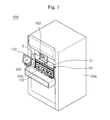
- a medicine management apparatus 100 includes a plurality of shelves 200 movably coupled to a vertically disposed rotatable circular carousel 1 and a plurality of bins 300 receiving medicines and seated on the shelves.
- the rotatable circular carousel 1 is disposed inside a housing 100a and includes a drive unit for moving the shelves 200 upwards or downwards.
- the rotatable circular carousel 1 may be provided only to one side of the medicine management apparatus 100.
- the rotatable circular carousel 1 may be provided to either side inside the housing 100a in consideration of the weight of the shelves 200 which store the medicines.
- the rotatable circular carousel 1 includes a lower stage gear 13, a lower drive gear 14 integrally connected to and rotated by the lower stage gear 13, an upper drive gear 15 disposed at an upper side inside the housing 100a, a chain 16 wound around outer circumferential surfaces of the upper and lower drive gears, and a plurality of height adjustors 4 separated at regular intervals from each other and secured to the chain 16 while being coupled to side surfaces of the shelves 200.
- the lower stage gear 13 receives a rotational force from a drive motor 11, direction and speed of which are controlled by a controller (not shown), through a power transmission means 12 such as chains.
- the lower stage gear 13 and the lower drive gear 14 are integrally rotated to move the height adjustors 4 secured to the chain 16, so that the shelves 200 are endlessly rotated.
- the height adjustor 4 may be provided with a link arm 41 for track restriction to allow stable movement of the shelf 200 such that a distal end of the link arm 41 can be caught by an ellipsoidal movement track groove 45 formed on a side surface of the housing 100a.
- a link arm 41 for track restriction to allow stable movement of the shelf 200 such that a distal end of the link arm 41 can be caught by an ellipsoidal movement track groove 45 formed on a side surface of the housing 100a.
- Operation of the rotatable circular carousel 1 is primarily controlled by the controller.
- the controller operates the rotatable circular carousel 1 to allow a user to recognize a position of a certain bin while allowing the bin to remain flush with an inlet/outlet port 101 formed on a front side of the housing 100a.
- the apparatus further includes an operation panel (not shown) to allow a user to directly operate the rotatable circular carousel independently of the operation of the rotatable circular carousel by the controller.
- the operation panel can operate the rotatable circular carousel and ensures operation of the medicine management apparatus 100 in the case of accidents, such as failure of the controller.
- Figure 3 illustrates one of height adjustors shown in Figure 2 .
- the height adjustors 4 are separated at regular intervals from each other and secured to the chain 16. A distance between adjacent shelves is adjusted for effective storage of medicines according to the size of medicine package. In this case, the distance between the shelves secured to a pair of rotatable circular carousels facing each other may be adjusted by the height adjustors 4.
- the height of the adjacent shelf can be lowered to enable the tall medicine package to be received on the certain shelf.
- the certain shelf is raised to reduce the space, thereby improving space utilization.
- the height adjustor 4 includes a pair of support arms 42 forming a triangular support structure on the chain 16 of the rotatable circular carousel 1, and support members 43 extending from distal ends of the support arms 42 to face each other. Further, the height adjustor includes a hinge receptor 44 that is disposed at either sidewall of the shelf 200 to be adjustable in height and receives the support member 43 while allowing rotation of the support member 43.
- the pair of support arms 42 constitutes a triangular shape to reduce transfer of vibration of the chain 16 to the shelf 200 while stably transferring a place of the shelf 200 to the chain 16.
- the support arms 42 meet each other at the distal ends thereof, from which the support members 43 extend towards the shelf 200 and are inserted into the hinge receptor 44 formed on the shelf 200, so that the shelf 200 is caught by the height adjustor 4 to swing forwards or rearwards.
- the hinge receptor 44 is bolted to the sidewall of the shelf 200 and may be adjusted in height. For this purpose, a plurality of holes is formed at different heights through the opposite sidewalls of the shelf 200 such that a user can select an installation height of the hinge receptor 44.
- Figure 5 illustrates a height adjustor according to another embodiment.
- the height adjustor includes a rotary connector 46 that is supported on the distal ends of the support arms 42 through a bearing to rotate freely thereon and includes a disc 461, to which the side surface of the shelf 200 is secured at various positions of the disc 461 by bolts.
- the secured position of the hinge receptor 44 on the side surface of the shelf 200 or the position of the side surface of the shelf bolted to the rotary connector 46 may be on a vertical line passing through the center of gravity of the shelf 200 to allow the shelf 200 to remain horizontal without being slanted.
- the hinge receptor 44 may be positioned above the center of gravity on the vertical line passing through the center of gravity to prevent the shelf from being turned downwards. Accordingly, the adjustable range of the height of the shelf is half the total height of the shelf.
- the rotatable circular carousel 1 and the shelves 200 are mounted inside the housing 100a and medicines received in the shelves 200 are received into or dispensed from the housing 100a through the inlet/outlet port 101 formed on the front side of the housing 100a.
- a rack 102 is disposed at the bottom of the inlet/outlet port 101 and input/output units 103 are located at one side of the rack 102 and an upper end of the inlet/outlet port 101 to input various pieces of information related to stocking or dispensing the medicines.
- the apparatus is provided with databases for storing receipt/dispense history of medicines, processing stored information, and making suggestions to the user based upon the processed information, as well as the controller.
- the inlet/outlet port 101 is provided with a main door 2 to open or close the inlet/outlet port 101 to prevent unauthorized access to medicine.
- the main door 2 is a sliding door which is slid in the vertical direction, and is provided with a lock 21 that locks the main door 2 when closing the inlet/outlet port 2.
- the lock 21 may be an electronic lock configured to unlock the main door 2 upon receiving an ID and password of a user through the input/output units or may be a mechanical lock composed of a key and padlock.
- the main door may be realized in various ways including a hinged door.
- the main door 2 completely prevents unauthorized access to any medicine received in the medicine management apparatus. As a result, the main door 2 prevents unauthorized persons from rearranging medicine, thereby preventing medicine from being incorrectly dispensed.
- the apparatus may further include a shelf assistant door as an individual lock for a shelf that stores a medicine subject to special regulations.
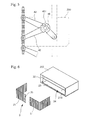
- the shelf assistant door 3 may be composed of a pair of crease screens 31, which can be received in receiving slits 32 formed at both sides of the shelf 200 to open a front part 34 of the shelf and can be moved along a transfer groove 33 formed on the bottom or ceiling at the front part of the shelf 200 to close the front part 34 of the shelf 200.
- the shelf 200 for storing a particular medicine has a box shape and is closed at all sides thereof except for the front part 34.
- the crease screens 31 are spread out along the transfer groove 33 to close the front part 34.
- the receiving slits 32 are formed at both sides of the shelf such that the pair of crease screens 31 can be slidably received in the receiving slits 32 to open or close the front part 34 of the shelf.
- the transfer groove 33 is formed along an edge of the shelf 200 to extend along the bottom or ceiling of the front part 34 and the receiving slits 32 such that the crease screens 31 can completely open the front part 34 of the shelf when a user opens the crease screens 31.
- the shelf assistant door 3 can be locked using a door lock 35 disposed at a portion where the crease screens 31 meet each other.
- the door lock 35 may be realized in various ways such as an electronic lock or a mechanical lock.
- the shelf assistant door 3 is configured to permit only a qualified user to release the lock and close the shelf assistant door after dispensing a particular medicine from the associated shelf, thereby preventing unqualified persons from gaining access to the particular medicine.
- surveillance sensors 9 are disposed inside the inlet/outlet port 101 to detect an obstacle present in the inlet/outlet port and the controller prevents operation of the rotatable circular carousel 1 or a closing operation of the main door 2 when the surveillance sensors 9 detect the obstacle.
- the surveillance sensors 9 are disposed to face each other inside the inlet/outlet port 101, specifically, immediately inside slits along which main door 2 is raised or lowered.
- Each of the surveillance sensors 9 may be a laser sensor that includes a laser emitter and a laser receiver to detect an article located between the laser emitter and the laser receiver through emission and detection of laser beams.
- the controller Upon receiving a signal from the surveillance sensors indicating that an obstacle is present at the inlet/outlet port, the controller interrupts power supply to the drive motor and locks the door despite instructions for operation of the rotatable circular carousel, thereby preventing injury to a user or damage to the bin due to operation of the rotatable circular carousel or the main door. Furthermore, after receiving the signal indicating the presence of an obstacle from the surveillance sensors, the controller outputs an alarm message or sound to the input/output units to inform a user of the presence of the obstacle upon receiving instructions for operation of the rotatable circular carousel or the main door from the user.
- the apparatus may further include a display unit 5 that displays a position of a medicine stocked into a certain bin or a position of the bin through the input/output units 103 (see Figure 1 ).
- the display device 5 may be configured to display an approximate position of a bin, which is searched for by a user, using a serial number of a shelf receiving the bin and a front image of the shelf through monitors of the input/output units 103.
- the display device 5 may be longitudinally disposed on the inlet/outlet port 101 to display an image directly indicating the position of the bin 300.
- Figure 8 also illustrates a dot display monitor 51 longitudinally disposed along the inlet/outlet port 101 on the rack 102 located on the bottom of the inlet/outlet port 101.
- the dot-type display monitor 51 is configured to display brief information relating to a serial number of the bin searched for by a user, an acronym of a medicine searched for by a user, and the number of medicines to be dispensed while displaying the position of the bin using an arrow 52 according to a method described below.
- the controller Upon receiving information indicating a certain bin or the name of a certain medicine searched for by a user through the input/output units 103, the controller rotates the rotatable circular carousel to move a shelf storing the certain bin to the inlet/outlet port and the display unit 5 displays the position of the bin using an arrow, whereby the user can conveniently find the desired medicine or bin.
- the housing 100a may be provided with a temperature/humidity regulator 6 for regulating the temperature and humidity therein.
- the temperature/humidity regulator 6 has a well-known structure that includes a temperature controller with an air conditioner and a humidity controller with a dehumidifier, and a detailed description thereof will be omitted herein.
- the temperature/humidity regulator may be, for example, a blower for discharging hot air to the outside of the housing.
- the temperature/humidity regulator 6 is controlled by the controller and regulates the temperature and humidity of the interior of the housing. Frequent use of the rotatable circular carousel 1 causes an increase in the inner temperature of the housing 100a, and temperature and humidity at which medicine is stored may deviate from ideal temperatures as indicated by a manufacturer due to seasonal climate variation or the installation location of the management apparatus. In particular, since liquid medicine can be spoiled according to temperatures even in an expiration date thereof, it is necessary for the liquid medicine to be stored at a suitable temperature. The temperature/humidity regulator 6 ensures that medicine remains good up to an expiration date thereof.
- the temperature/humidity regulator 6 may be provided with a temperature recorder which records variation in the internal temperature of the housing.
- the temperature recorder records variation in the internal temperature of the housing during an operating period, identifies a time zone where the internal temperature of the housing deviates from a preset range, and informs a user of the variation in the internal temperature through the input/output units.
- one of the shelves may be provided with a refrigerating unit 8, which receives power from the housing 100a via a wireless power supply unit 7, to store such special medicines at lower temperatures.
- the refrigerating unit 8 may be a typical refrigerating apparatus which is operated by electric power. More advantageously, the refrigerating unit 8 is composed of a thermoelectric element which has a simple and small structure and requires little power.
- the wireless power supply unit 7 uses a magnetic field to supply power to the refrigerating unit, and may include a wireless power supply 71, which is composed of a coil disposed at one sidewall of the housing, and a wireless power receiver 72, which is disposed on an inner wall of the shelf 200 facing the one sidewall of the housing and moving parallel to the sidewall of the housing.
- a wireless power supply 71 which is composed of a coil disposed at one sidewall of the housing
- a wireless power receiver 72 which is disposed on an inner wall of the shelf 200 facing the one sidewall of the housing and moving parallel to the sidewall of the housing.
- the shelf 200 including the refrigerating unit 8 is provided with a lagging material and a door 81 capable of opening or closing a front side of the shelf 200.
- the refrigerating unit 8 is composed of the thermoelectric element which requires little power, it is possible to provide a simple structure and reduce installation costs using a battery.
- the medicine management apparatus is capable of storing special medicines such as injectables, which require refrigeration, thereby diversifying the variety of medicines that can be stored in the medicine management apparatus.
- the temperature/humidity regulator may prevent heat generated from the refrigerating unit from affecting other medicines stored in other shelves.
- the shelf 200 may be further provided with a horizontal intermediate plate 210 which divides the inner space of the shelf 200.
- the horizontal intermediate plate 210 is provided to the shelf 200 and divides the inner space of the shelf 200 into upper and lower compartments such that the bins can be stacked in the upper and lower compartments.
- the shelf 200 may further include a vertical intermediate plate 210 which vertically divides the interior thereof to store large bins and small bins at the same time.
- the rotatable circular carousel 1 is controlled in consideration of the height of the intermediate plate 210. Specifically, when the controller controls the rotatable circular carousel 1 to provide a bin 300 located on the intermediate plate 210 to a user, the rotatable circular carousel 1 is controlled to allow the bottom of the intermediate plate 210 to be located on the bottom of the inlet/outlet port.
- a user when dispensing prepared medicines, a user can collectively dispose the medicines in a single shelf or in a small number of adjacent shelves, so that the medicines can be rapidly dispensed through minimized operation of the carousel.
- Figure 11 is a perspective view of a bin according to an embodiment of the present disclosure and Figure 12 is a bottom view of the bin of Figure 11 .
- the bin 300 has a box shape open at an upper side thereof and stores a number of the same kind medicine in an accommodation space 320 defined in the bin 300.
- the bin 300 may have a size selected from several standardized sizes corresponding to the sizes of medicine packages.
- the medicine management apparatus is provided with a plurality of bins, a user cannot search for desired medicine based on memory of a position of a certain bin storing the medicine.
- Each of the bins placed on the shelf is provided with an identification unit 370 which includes identification information for distinguishing one bin from another, such that the controller identifies the respective bins and information of medicines in the respective bins with reference to a database. Accordingly, when a user requests a certain medicine through the input/output units, the controller provides the user with information of a current stock of the medicine and a position of the medicine, that is, an accurate position of a bin on a shelf which stores the medicine, through the input/output units. Further, the controller upgrades and stores history of stocking and dispense of medicines, and allows the bin receiving the corresponding medicine to be indicated through operation of the rotatable circular carousel and the display device.
- the identification unit 370 of each of the bins contains identification information composed of the serial number of each of the bins and the name of the medicine stored in each of the bins, and preferably, preset positions of the bins.
- the identification unit 370 may be a barcode 371 as shown in Figure 11 .
- the barcodes 371 are serially generated by a barcode generator (not show) and printed on silver stickers, which in turn are attached to front sides of the bins 300.
- a user may specify a medicine to be stored in the certain bin by registering information of the barcode 371 attached to a certain bin 300, a serial number of a shelf, on which the bin will be placed, and a position of the bin (for example, a point separated by 30 cm from the right in a shelf on the second floor) with the controller through an input unit (for example, a portable barcode reader or the like) to generate position information of the bin.
- an input unit for example, a portable barcode reader or the like
- the controller controls the rotatable circular carousel to place the corresponding shelf at the inlet/outlet port, and the display device then indicates the corresponding position of the medicine with an arrow or the like.
- a user can determined a proper position of the bin in the corresponding shelf by scanning the barcode of the bin when returning the bin to the shelf.
- a user can determine a proper bin by scanning a barcode of the bin to be re-stocked with medicine. The barcode is cheaper than any of the other identification means described below.
- the barcode 371 is formed at an upper portion on the front side of the bin 300, for example, on an upper surface of a grip 320 of the bin 300.
- the apparatus allows a user to easily search for a desired bin by reading the barcode of the bin using a barcode reader at the inlet/outlet port without withdrawing the bin from the shelf, thereby enabling convenient inquiry of the bin.
- the identification unit may include a radio frequency identification (RFID) tag (not shown) and an RFID reader (not shown) disposed in the housing to recognize the RFID tags provided to the respective bins longitudinally disposed on the shelf.
- RFID radio frequency identification
- the RFID tag of a certain bin receives and stores position information and medicine information related to the bin in registration of the certain bin with the controller by a user. Accordingly, when a user inputs the name of a certain medicine, the controller controls the rotatable circular carousel and the display device based on the position information and the medicine information stored in the RFID tag to provide the corresponding bin to a user. Further, a certain bin removed from the shelf by another user can be returned to a proper position in the corresponding shelf by reading the RFID tag on the bin using a separate RFID reader.
- the RFID tag allows a user to easily determine whether a desired bin is present in the medicine management apparatus.
- the controller recognizes that the RFID tag of the bin is not detected by the reader in the housing, and informs the user of the absence of the bin in the corresponding shelf through the input/output units.
- the identification unit may include a memory chip which contains identification information therein, a transmitter which transmits the identification information of the memory chip, and a receiver which is disposed on the bottom of the shelf and receives the identification information from the transmitter.
- a user When registering a certain memory chip having identification information composed of a serial number of the corresponding bin with the controller, a user inputs the name of a medicine to be stored in the bin to generate and store medicine information in the controller.
- the receivers are disposed at regular intervals on the bottom of the shelf.
- the interval is determined according to the sizes of the bins having standardized sizes. For example, when three types of bins having widths of 10 cm, 20 cm and 40cm are provided to a certain shelf, the size of the smallest bin is 10 cm and an increased width between the other bins is 20 cm. Thus, the interval is set to 10 cm, which is the least common denominator among the size of the smallest bin and the increased width between the other bins.
- the receivers are disposed at an interval of 10 cm on the bottom of the shelf in the longitudinal direction, thereby receiving identification information of each bin regardless of the size of the bins.
- the transmitter and the receivers may communicate with each other via wired communication, with the bins secured to a certain position on the bottom of the shelf, or may communicate with each other via wireless communication, irrespective of whether or not the bin is secured on the bottom of the shelf.
- any receiver may receive identification information together with other identification information transmitted from the transmitters of a bin directly disposed above the receiver and bins adjacent the receiver.
- ultrasound wireless communication capable of providing distance information of the transmitter based on time-of-fight, the receiver select only identification information of the bin directly disposed above the receiver, thereby solving congestion resulting from wireless communication.
- the wireless power supply described above or a battery provided to each of the shelves and bins may serve as a power source for the identification unit and the transmitter.
- position information and identification information of the bin obtained by the receivers, and inherent identification information of the receivers are sent to and collected by the controller via other wireless communication methods, and the controller can specify positions of bins on each shelf based on the inherent identification information of the receivers, the identification information, the medicine information, and the position information of the bins.
- position information of the bin can be determined by the corresponding receiver, thereby further improving user convenience.
- Figure 13 is a perspective view of a bin according to another embodiment.
- partitions 330 may be provided to divide the accommodation space 310 of the bin 300.
- the identification unit 370 may be provided to each of the partitions 330.
- the bin 300 To stock or dispense medicine to or from the bin 300 on the shelf 200, the bin 300 must be inserted into or pulled from the shelf 200 through the inlet/outlet port 101. In this case, the entirety of the bin 300 can be inadvertently removed from the shelf 200.
- the bin 300 may be provided with a latch portion 340 configured to be caught by a threshold 211 formed at a front bottom edge of the shelf 200.
- the threshold 211 protrudes upwards from the front bottom edge of the shelf 200, and the bin 300 is depressed at a rear portion thereof such that a latch plate 341 can be formed on a rear bottom edge of the bin 300 to be caught by the threshold 211.
- the bottom of the inlet/outlet port 101 is convexly formed corresponding to the depressed shape of the rear portion of the bin 300.
- a user can pull the bin 300 from the shelf 200 by lifting the bin 300 so as to prevent the latch plate 341 from being caught by the threshold 211.
- the apparatus is configured to prevent the entirety of the bin from being inadvertently separated from the shelf, thereby reducing the possibility of erroneous placement of the separated bin to an undesired position.
- Figure 15 is a perspective view of the bin according to the other embodiment in use.
- vibration is generated from the shelf, causing the bin seated on the bottom of the shelf to move from side to side.
- the position of the bin indicated by the display unit can differ from the actual position of the bin, it is desirable to prevent such movement of the bin on the shelf.
- the shelf 200 is formed with a plurality of elongated grooves 212 that are formed on the bottom of the shelf 200 in the transverse direction of the shelf 200 to prevent the bin 300 from moving from side to side. Further, the bin 300 has protrusions 350 formed on the bottom of the bin 300 to be inserted between the elongated grooves 212.
- the protrusion 350 is longitudinally formed on the bottom of the bin 300 in the transverse direction and has a substantially circular cross-section to be inserted between the elongated grooves 212. With this configuration, the protrusions 350 of the bin 300 prevent the bin from moving from side to side in the longitudinal direction while allowing the bin to be smoothly slid in the transverse direction between the elongated grooves 212.
- the bin 300 may be provided with a magnet plate 360 as shown in Figure 12 .
- the magnet plate 360 is formed on a lower surface of the bin, which is made of an iron plate, to secure the bin with magnetic force.
- the magnet plate 360 may be formed on the overall lower surface of the bin 300.
- the magnet plate 360 may be formed only on a front part of the lower surface of the bin 300 to reduce force exerted by a user to lift the front part of the bin.
- the magnet plate 360 suppresses the longitudinal movement of the bin to hold the bin at a position where a user places the bin, so that the position of the bin can be accurately specified later by the display unit, thereby improving user convenience.
- a sliding assistor 380 may be provided to the bottom surface of the bin 300 to facilitate forward or backward sliding of the bin when separating or inserting the bin from or into the shelf.
- the sliding assistor 380 allows the bin to be moved with low force by reducing friction between the bottom of the shelf and the bin 300 when a user lifts or pulls the bin 300 in the front direction or pushes the bin 300 into the shelf.
- the sliding assistor 380 may comprise rollers 381 coupled to a rear end of the bin 300.
- the roller 381 may be provided to the latch plate 341, which is brought into contact with the bottom of the shelf when the bin 300 is lifted.
- the roller 381 may have thin thickness to be received in the elongated groove described above or may have a convex circumferential surface.
- the sliding assistor allows the bin to be pulled from or inserted into the shelf by a user with a lower force, thereby reducing user fatigue.
- the shelf 200 may further include an assistant roller 213, which is disposed on the bottom of the shelf 200 inside the threshold 211 of the shelf 200 and rotates on the bottom of the bin 300 upon separation or insertion of the bin 300 from the shelf or into the shelf.
- an assistant roller 213 which is disposed on the bottom of the shelf 200 inside the threshold 211 of the shelf 200 and rotates on the bottom of the bin 300 upon separation or insertion of the bin 300 from the shelf or into the shelf.
- the assistant roller 213 is disposed in the depressed portion at the rear side of the bin 300 and the latch plate 341 of the bin is caught by the assistant roller 213, thereby preventing the bin from being completely separated from the shelf in the front direction.
- the bin 300 may be made of a transparent material so as to allow medicine stored in the accommodation space of the bin to be identified from the outside.
- the shelf can be easily visually identified based on a trademark or color of the shelf, so that a user can directly identify the corresponding bin without referring to information of the bin specified by the display device or the input/output units.
- a user releases the lock to open the main door by inputting an ID and password or using a key in S1.
- a user When stocking medicine initially in a certain bin, a user stores identification information of the bin, position information of the bin, and information of the medicine to be stored in the bin in a database through a barcode reader. Further, the number of medicines to be stocked in the bin, historical data of the medicine such as a date on which the medicine was stocked, expiration date of the medicine, or the like, can also be input to the database, as needed.
- the aforementioned information is stored in the database through the controller in S2.
- the controller operates the rotatable circular carousel based on the input position information to allow a corresponding shelf to move to the inlet/outlet port, and controls the display unit to display a position of the bin on the shelf in S3.
- a user places the bin receiving the medicines at a position indicated by the display unit and inputs the number of medicines to the controller.
- the controller stores the number of medicines in a database in S6.
- a user selects a stock status menu of the medicine on the input/output unit to activate a stock status table and input information of the medicine to be stored in Sa.
- the controller determines in Sb whether the database has the same information as the input information of the medicine, and if the database has the same information, the controller operates the rotatable circular carousel and the display device to allow a proper shelf and a proper bin to be provided to a user such that the user additionally stores the medicine in Sc. If the input information of the medicine is new information, the user is guided to store the medicine according to the procedure described above (S1 to S3, S6).
- the bin suggested by the controller is at full capacity
- a user inputs this information to the controller, which in turn suggests empty bins to the user. Then, the user selects one of the bins and the controller controls the rotatable circular carousel and the display unit to provide the selected bin such that the user continues to perform the stocking operation.
- a user scans a barcode of the bin in S4 to confirm whether the bin indicated by the display unit is correct, and the controller informs the user through the input/output unit as to whether the scanned bin is the proper bin in Sd. If the bin is not the proper bin, the bin may be subjected to additional certification for rescanning the bin in S5, se.
- the controller receives data of the number of medicines input by a user and stores the data in the database in S6 and Sf. Further, when historical data of medicines is added to the database, the controller stores the historical data of the medicines in the sequence of expiration dates of the medicines or in the sequence of stocked dates of the medicines such that the medicines can be provided to a user when requested.
- user certification is first performed by unlocking the key, as described above in S10, and the controller retrieves the medicines from a database using the names of the medicines input by a user or a list of medicines delivered from a separate apparatus in S20.
- the controller determines based on the names of the medicines whether a certain medicine is present on any shelf of the apparatus in S30. If the medicine is not present on any shelf, the controller informs the user of the absence of the medicine through the input/output unit and retrieves the next medicine according to user selection in S40. If the next medicine is present in a certain bin, the process proceeds directly to the operation of dispensing the medicine in S60. Alternatively, the controller may determine a sequence of dispensing the medicine with reference to historical data of the medicine in s50 to.
- the controller controls the rotatable circular carousel to allow a shelf receiving an associated bin to move to the inlet/outlet port and controls the display unit to display or indicate the associated bin in S60.
- the controller When a user scans the bin, the controller receives information of the bin and determines whether the bin is a proper bin storing the medicine in S70. If it is determined that the indicated bin is not the proper bin, the controller informs the user of this determination through the input/output units and requests the user to rescan another bin in S80. If the indicated bin is the bin storing the medicine, the user pulls the bin from the shelf to remove a desired amount of medicine and inputs the removed number of medicines through the input/output unit.
- the controller After the medicine is removed from the bin, the controller updates the number of medicines in the database in S90. If the same kind of medicine is present in other bins or shelves and medicine to be dispensed remains, the other shelves or bins storing the medicine to be dispensed in the next sequence can be provided to the user in S100.
- the controller When all amounts of desired medicine are completely dispensed and the user inputs completion of the medicine dispensing operation, the controller notifies the user of changes made to the database through the input/output units.
- the apparatus may directly inform a user of stock circumstance and allows the user to recognize and remove a medicine ending an expiration date thereof.
- the apparatus requests an additional ID and password for the medicines to ensure security.
- Figures 20 to 23 illustrate a bin according to a second embodiment of the present disclosure.
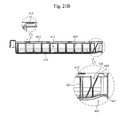
- Figure 20 is a perspective view of a bin for a medicine management apparatus according to a second embodiment of the present disclosure
- Figure 21 A is a plan view of a body of the bin of Figure 20
- Figure 21 B is a side sectional view of the body of the bin of Figure 20
- Figure 22A is a plan view of an elongated case of the bin of Figure 20
- Figure 22B is a side sectional view of the elongated case of the bin of Figure 20
- Figure 22C is a side view of the elongated case of the bin of Figure 20
- Figure 22D is a bottom view of the elongated case of the bin of Figure 20
- Figure 23 is a view of a partition of the bin of Figure 20 .
- the bin 400 according to the second embodiment includes a box-shaped body 410 open at an upper side thereof and an elongated case 430 coupled to an upper end of the body 410 to increase the height of the bin 400.
- the bin 400 according to the second embodiment is substantially the same as the bin 300 according to the first embodiment except for the elongated case 430 for increasing the height of the bin 400. Accordingly, the following description of the bin according to the second embodiment will focus on different components from the first embodiment and the same or similar components will be denoted by the same reference numerals as those of the first embodiment.
- the body 410 and the elongated case 430 may be detachably coupled to each other by sliding a lower end of the elongated case 430 into an upper end of the body 410.
- the body 310 has a plurality of first coupling protrusions 412 and a plurality of first resilient protrusions 413 formed on an outer upper circumference of the body 410, more specifically, along outer right and left upper sides of the body 410 in the longitudinal direction
- the elongated case 430 has a plurality of second coupling protrusions 432 and a plurality of second resilient protrusions 433 formed on an outer lower circumference of the elongated case 430, more specifically, along outer right and left lower sides of the elongated case 430 in the longitudinal direction.
- the first coupling protrusion 412 has a clamp shape protruding towards the interior of the body 410, that is, an accommodation space 411, and the first resilient protrusion 413 is protruded towards the outside of the body 410, that is, an opposite side of the accommodation space 411.
- the second coupling protrusions 432 protrude towards the outside of the elongated case 430, that is, an opposite side of the accommodation space 411, and have a shape corresponding to the first coupling protrusion 412, and the second resilient protrusions 432 protrude towards the interior of the elongated case 430, that is, the accommodation space 411.
- the number of each of the first and second coupling protrusions 412, 432 on the right and left sides is four and the number of each of the first and second resilient protrusions 413, 433 on the right and left sides is three.
- the numbers of these components can be changed as needed.
- the elongated case 430 may further include third coupling protrusions 435 and third resilient protrusions 436 formed on the outer upper circumference thereof and having the same shapes as those of the protrusions formed on the outer upper circumference of the body 410, thereby allowing other elongated cases 430 to be continuously stacked one above another.
- the body 410 is formed therein with insertion grooves 421 separated at regular intervals from each other such that partitions 450 can be inserted into the grooves 421, and the elongated case 430 is also formed therein with insertion grooves 423 separated at the same intervals as those of the insertion grooves 421. Accordingly, it is possible to insert or remove the partitions 450 when the body 410 is coupled to the elongated case 430.
- the bin 400 is provided with a latch part 440 including a latch plate 441, which is configured to be caught by the threshold 211 of the shelf 200. Further, the body 411 may be formed with a partition receiving groove 425 for temporarily storing a remaining partition 450.
- the body 410 is formed at a rear upper end thereof with a slanted protrusion 442 and the elongated case 430 is formed at a rear lower end thereof with a step 443. Accordingly, the step 443 is moved over the slanted protrusion 442 simply by pushing the elongated case 430 towards the rear of the body 410 to separate the elongated case 430 from the body 410, thereby allowing easy separation of the elongated case 430 from the body 410.
- FIG. 23 (a) illustrates a front view of the partition 450, (b) illustrates a side-sectional view of the partition 450, and (c) illustrates a rear view of the partition 450.
- the partition 450 When the body 410 is not coupled to the elongated case, the partition 450 may be inserted into the insertion groove 421 of the body 410.
- the partition 450 When the body 410 is coupled to the elongated case 430, the partition 450 may be inserted into the insertion grooves 421, 423 of the body and the elongated case.
- the partition 450 is formed at opposite sides thereof with opposite insertion portions 451, 452 having a proper thickness to be inserted into the insertion grooves 421, 423, and at a lower end thereof with a bottom insertion portion 453 having a proper thickness to be inserted into a bottom groove 422 of the partition 450, which is aligned with the insertion groove 421 and concavely formed on the bottom of the body 410.
- the partition 450 is formed at an upper end thereof with a partition groove 454, which allows two or more partitions 450 to be coupled to each other in the vertical direction.
- the bottom insertion portion 452 may be at least partially inserted into the partition groove 454, or preferably completely inserted into the partition groove 454.
- a barcode, a memory chip or the like may be attached to such a partition 450 or received therein to show information regarding a medicine received in the bin.
- the partition may be made of a transparent material for easy identification with the naked eye.
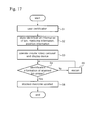
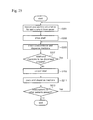
- the medicine management apparatus 100 When receiving prescription data from corresponding database servers of drugstores or hospitals, the medicine management apparatus 100 resorts the prescription data according to shelves 200 in the apparatus 100, which stores medicines to be dispensed according to the prescription data for patients in S101.
- the circular carousel 1 is operated to move an associated shelf 200 having bins 300, which store the medicines to be dispensed according to the resorted prescription data, to the inlet/outlet port 101 of the apparatus in S103.
- the management apparatus may display information of medicines, such as such as positions and amounts of the medicines, to be dispensed to the patients, through the display device 5.
- barcodes of the bins 300 are scanned to dispense the medicines from the bins 300 on the shelf 200 positioned at the inlet/outlet port 101 in S105.
- a user may verify that the prescription data and the medicines match, and then store the dispensed amount of medicines through the input/output unit 103.
- a user outputs a label printed with information regarding the dispensed medicines in S107 and attaches the label to a container such as a zipper bag or to a cart 500 having a plurality of compartments, which will accommodate the medicines.
- the medicines are sorted and accommodated in the container or the corresponding compartment 501 of the cart 500, to which the label is attached, in S109.
- the label attached to the container or the corresponding compartment 501 is scanned using a barcode reader or the like. According to this scanned information, if additional medicine is to be dispensed, the process returns to S103, and if there is no medicine to be dispensed, the process is ended in S111.
- the container or the cart may be configured such that information of the medicines to be received in the corresponding compartment of the cart can be identified or confirmed using a PDA or a PC in the apparatus, instead of outputting and attaching the label printed with information of the medicines to the corresponding compartment of the cart.
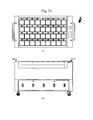
- the medicine management apparatus may further include the cart 500, in which the plurality of compartments are divided from each other by partitions.
- the apparatus 100 (specifically, the controller in the housing 100a) and the cart 500 may be configured to send or receive information through wired or wireless communication.
- each of the compartments 501 in the cart 500 may be provided with a display device 502 to display information of a medicine received in each of the compartments 501 through exchange of the information with the medicine management apparatus 100 or by direct input of the information by a user.
- a target compartment in the cart 500 for receiving a medicine dispensed from a bin 300 of a certain shelf 200, and an amount of medicine to be received in the target compartment can be automatically displayed on the display device 502, thereby improving user convenience.
- each of the compartments 501 is provided with an inspection tester such as a scanner to allow an operator to confirm whether the medicines displayed on the display device 502 are placed in the correct compartments 501, thereby preventing mistakes when stocking the cart 500.
- the inspection tester compares information of the medicine actually placed in the compartment with information of a desired medicine to be placed in the corresponding compartment, thereby preventing erroneous placement of the medicine.
- the cart 500 may include a termination button to allow a subsequent operation to be continued through reception and transmission of subsequent prescription data (according to patients or medicines) after completing placement of medicines in the respective compartments according to certain prescription data (according to patients or medicines).
- the termination button is pushed, the controller of the apparatus 100 recognizes termination of the operation of placing the medicines according to the certain prescription data and drives a shelf for dispensing other medicines according to the subsequent prescription data.
- Figure 25 is a flowchart of a management method for comparison with the medicine management method of Figure 24 .
- the comparative method dispenses the medicines according to patients.
- the medicine management apparatus 100 receives prescription data from corresponding databases of drugstores or hospitals, and resorts medicines for patients according to the patients in S201.
- the circular carousel 1 is operated to move the shelves 200 having bins 300, in which the medicines are stored, according to the resorted data to an inlet/outlet port 101 of the apparatus in S203.
- barcodes of the bins 300 are scanned to dispense the medicines from the bins 300 on the shelf 200 positioned at the inlet/outlet port 101 in S205.
- a user may check concordance between the prescription data and the medicines, and then store the dispensed amount of medicines through the input/output units 103.
- the process returns to S203, in which the circular carousel 1 is operated to move the shelf 200 having a bin 300, which stores the medicine, to the inlet/outlet port 101 of the apparatus, and the dispensing operation is repeated until no more medicine to be dispensed to the patient is present.
- a user When all of the medicines prescribed to the corresponding patient are dispensed, a user outputs a label printed with information of the dispensed medicines in S209 and attaches the label to a container such as a zipper bag or the like, which will accommodate the medicines.
- the dispensed medicine is packed in a labeled container, which in turn is discharged, in S211.
- the label attached to the container is scanned using a barcode reader or the like. According to this scanned information, if additional medicine needs to be dispensed to another patient, the process returns to S201, and if no additional medicine needs to be dispensed, the process ends in S213.
- the carousel When the medicine management apparatus receives the three types of prescription data shown in Figure 26 from corresponding databases of drugstores or hospitals to dispense medicines according to patients, the carousel is driven three times to move corresponding shelves for each of Patients A, B and C. That is, the carousel is driven 9 times.
- the carousel is driven once to move Shelf 1 for dispensing medicines for Patient A, twice to move Shelf 2 for dispensing a medicine for Patient A, three times to move Shelf 3 for dispensing medicines for Patients A and B, four times to move Shelf 4 for dispensing medicines for Patients B and C, five times to move Shelf 5 for dispensing medicines for Patients B and C, and six times to move Shelf 6 for dispensing medicines for Patient C.
- the carousel is driven 6 times for dispensing the medicines.
- the process of dispensing medicines according to the kind of medicine may reduce the total number of driving times of the carousel to move the shelves, thereby reducing time for dispensing medicines.
- Embodiments of the present disclosure may provide a cart 500 having a space partitioned by a plurality of compartments 501 for delivering medicines dispensed from a medicine depository 100, such as a storehouse, a drugstore shelf, an automatic medicine storage and dispensing apparatus, and the like, to a patient, and a medicine management method using such a medicine cart.
- a medicine depository 100 such as a storehouse, a drugstore shelf, an automatic medicine storage and dispensing apparatus, and the like
- the automatic medicine storage and dispensing apparatus includes a plurality of shelves coupled to a vertically disposed rotatable circular carousel, and a plurality of containers storing medicines and disposed inside the shelves.
- the medicine depository 100 and the cart 500 may be configured to exchange information with each other via wired or wireless communication. Further, each of the compartments 501 in the cart 500 may be provided with a display device 502 to display information of a medicine received in each of the compartments 501 through information exchange of the medicine depository 100 or by direct input of the information by a user.
- a target compartment in the cart 500 for receiving a medicine dispensed from a certain place of the medicine depository 100, and an amount of medicine to be received in the target compartment can be automatically displayed on the display device 502, thereby improving user convenience.
- each of the compartments 501 is provided with an inspection tester such as a scanner to allow an operator to confirm whether the medicines displayed on the display device 502 are placed in the correct compartments 501, thereby preventing mistakes when stocking the medicine cart 500.
- the inspection tester compares information of the medicine actually placed in the compartment with information of a desired medicine to be placed in the corresponding compartment, thereby preventing erroneous placement of the medicine.
- the cart 500 may include a termination button to allow a subsequent operation to be continued through reception and transmission of subsequent prescription data (according to patients or medicines) after completing placement of medicines in the respective compartments according to certain prescription data (according to patients or medicines).
- a termination button When the termination button is pushed, a controller of the medicine depository 100 recognizes termination of the operation of placing the medicines according to the certain prescription data and drives a shelf for dispensing other medicines according to the subsequent prescription data.
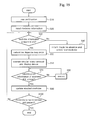
- a server PC for the medicine depository collects the information of the medicines to be dispensed from the depository and aligns the medicine information according to the kind of medicine or patients, in S213.
- the server PC may be located inside the medicine depository or outside the medicine depository.
- the server PC transfers the aligned medicine information to one of a printer 510, a PDA 520 and an embedded PC 530.
- the printer 510 When the printer 510 is used, the printer 510 outputs a barcode or the like, which has the medicine data printed thereon, and a user attaches the barcode to a certain compartment 501 of the cart or to a portion near the compartment 501, in order to confirm whether the medicines are properly placed in the compartment 501.
- the cart 500 is provide with a barcode scanner as a data input/output unit, and an LCD as a display device for displaying the data recognized by the barcode scanner.
- the method using the printer 510 reduces costs for system installation and provides improved software compatibility with other products.
- the cart can eliminate the need for the barcode scanner as a data input/output unit and the LCD as a display device, and data management can be easily performed. That is, since the PDA may function as the data input/output unit and as the display device, it is possible to read the medicine data and to display a target compartment for receiving a certain medicine when using the PDA in association with the cart.
- the cart When the embedded PC is used, the cart may be provided with the embedded PC, the barcode scanner as a data input/output unit, the LCD as a display device, and the like. In this case, an operator may conveniently use both hands, as compared with the case of using the PDA, and the embedded PC may be used to implement various application programs.
- a user confirms an item selection list according to the kind of medicine in S215 and selects one of the items, that is, one type of medicine, in S217.
- the corresponding compartment for receiving the item may be displayed by lighting a lamp of the corresponding compartment in S219.
- the lamps may be lit in order of patients.
- a user confirms information of the selected item through the barcode of the item and places the selected item, that is, the corresponding medicine, into a cell, that is, the compartment in S223.
- the barcodes of the items are preferably individually scanned for accurately counting the number of items.
- the process returns from S223 to S217 to repeat the aforementioned procedures corresponding to the number of the same kind of items to be placed in the compartment.
- a lamp of a compartment for another patient requiring the selected item is lit.
- the process returns to S219 so as to allow placement of the selected item in the compartment for the other patient to be continued after the placement of the selected item in the compartment for the previous patient.
- the server PC checks whether the operations according to the item selection list are properly completed, based on an item selection list according to the patients, in S229.
- the medicine cart Upon confirming that all of the items, that is, all of the medicines, are properly placed in the compartments for all of patients, the medicine cart is delivered by an operator to a hospital.
- the medicine data or the like is illustrated as being recognized using the barcodes.
- an RFID or the like may also be used to recognize the medicine data.
- the cart including the compartments allows medicines individually prescribed to patients to be sorted and supplied according to hospital wards, thereby simplifying a medicine supply operation carried out by nurses while ensuring the prevention of pharmaceutical accidents.
- FIG. 29 to 36 illustrate various modifications of the cart.
- modified carts are illustrated as including bag-type compartments
- modified carts are illustrated as including tray-type compartments.
- the bags may have large, middle, and small sizes as indicated by L, M, and S in the figures.
- each of the modified carts may include the compartments and display devices capable of displaying information of medicines received in the corresponding compartments.
- the display device may include a lamp provided to each of the compartments, and an LCD window for displaying information of the certain medicine obtained by scanning with the barcode scanner or the like.
- the cart may be provided with a single device such as the barcode scanner for recognition and input of information, which is secured to a predetermined position of the cart, for example, to a position near the LCD window (see Figures 30 to 32 and Figures 34 to 36 ), or which is linearly movably disposed at the center of the cart (see Figure 33 ).
- the cart may include a plurality of devices such as the barcode scanner for recognition and input of information on an upper surface thereof (see Figure 29 ).
- the cart may be provided with a wheel and a grip for movement convenience.
- the present disclosure provides a medicine management apparatus that differentiates accessibility to a certain medicine requiring secure handling to prevent unauthorized persons from accessing the medicine, thereby increasing a security level in semi-automated medicine management.
- the present disclosure also provides a bin and a medicine management apparatus including the same.
- the bin receives corresponding medicines in a shelf of the medicine management apparatus and includes an elongated case at an outer upper side thereof or partitions therein. With this configuration, the bin permits easy adjustment of the sizes of spaces for receiving the medicines, thereby enabling efficient use of compartments in the medicine management apparatus.
- the present disclosure provides a medicine management apparatus and method, which enable more rapid and easier management of medicines by allowing medicines prepared according to prescriptions to be dispensed according to the kind of medicine rather than according to patients and sorting the dispensed medicines in a cart having a plurality of compartments. Accordingly, the medicines can be dispensed from a medicine depository according to the kind of medicine rather than according to patients, thereby reducing time and effort for dispensing the medicines through a decrease in drive times of a rotary carousel to move shelves.
- the present disclosure provides a cart and a medicine management method using the same, by which medicines prepared according to prescriptions are dispensed according to the kind of medicine rather than according to patients and are then sorted in the cart having a plurality of compartments, so that the medicines dispensed from a medicine depository are prevented from being mixed with other medicines and can be accurately delivered to patients. Accordingly, medicines individually prescribed to patients can be sorted and supplied using the cart according to hospital wards or the like, thereby simplifying a medicine supply operation of nurses while ensuring prevention of pharmaceutical accidents.
Landscapes
- Physics & Mathematics (AREA)
- General Physics & Mathematics (AREA)
- Medical Preparation Storing Or Oral Administration Devices (AREA)
- Warehouses Or Storage Devices (AREA)
Applications Claiming Priority (4)
| Application Number | Priority Date | Filing Date | Title |
|---|---|---|---|
| KR1020100002353A KR101177180B1 (ko) | 2010-01-11 | 2010-01-11 | 약품 보관 및 관리장치 |
| KR1020100068340A KR101186101B1 (ko) | 2010-07-15 | 2010-07-15 | 약품 관리 장치의 약품 수납용 빈 및 상기 빈을 구비하는 상기 약품 관리 장치 |
| KR1020100072299A KR101243095B1 (ko) | 2010-07-27 | 2010-07-27 | 약품 관리 장치 및 방법 |
| KR1020100086050A KR101760645B1 (ko) | 2010-09-02 | 2010-09-02 | 약품 카트 및 상기 약품 카트를 이용한 약품 관리방법 |
Publications (2)
| Publication Number | Publication Date |
|---|---|
| EP2363840A2 true EP2363840A2 (fr) | 2011-09-07 |
| EP2363840A3 EP2363840A3 (fr) | 2012-04-25 |
Family
ID=43795030
Family Applications (1)
| Application Number | Title | Priority Date | Filing Date |
|---|---|---|---|
| EP11000158A Withdrawn EP2363840A3 (fr) | 2010-01-11 | 2011-01-11 | Appareil de gestion de médicaments et procédé, poubelle pour l'appareil et chariot pour l'appareil |
Country Status (2)
| Country | Link |
|---|---|
| US (1) | US20110172815A1 (fr) |
| EP (1) | EP2363840A3 (fr) |
Cited By (4)
| Publication number | Priority date | Publication date | Assignee | Title |
|---|---|---|---|---|
| CN108887930A (zh) * | 2018-07-10 | 2018-11-27 | 佳木斯大学 | 一种防潮医用储药柜 |
| US10188477B1 (en) | 2017-10-10 | 2019-01-29 | Neonatal Product Group, Inc. | Mobile medical cart |
| CN109349823A (zh) * | 2018-10-11 | 2019-02-19 | 马鞍山沐及信息科技有限公司 | 一种药房专用医药柜 |
| CN110980009A (zh) * | 2019-11-30 | 2020-04-10 | 漯河医学高等专科学校 | 一种医疗患者护理用药管理装置及其使用方法 |
Families Citing this family (47)
| Publication number | Priority date | Publication date | Assignee | Title |
|---|---|---|---|---|
| US20110170247A1 (en) * | 2009-11-30 | 2011-07-14 | Stephen Fried | Digital utility apparatus and method |
| US8749356B2 (en) * | 2009-12-07 | 2014-06-10 | Meps Real-Time, Inc. | RFID enabled drawer refrigeration system |
| US20120012606A1 (en) * | 2010-07-14 | 2012-01-19 | Mark Longley | Automated pharmacy system for dispensing unit doses of pharmaceuticals and the like |
| WO2012016031A1 (fr) * | 2010-07-28 | 2012-02-02 | Par Systems, Inc. | Systèmes de stockage et de récupération robotiques |
| US8922981B2 (en) * | 2010-10-04 | 2014-12-30 | Hewlett-Packard Development Company, L.P. | Rack mounted UI device |
| US9208468B2 (en) * | 2011-02-07 | 2015-12-08 | Intermetro Industries Corporation | Inventory management system |
| US9520012B2 (en) | 2011-05-25 | 2016-12-13 | Bby Solutions, Inc. | Retail location robotic wall system and mobile retail sales vehicle |
| US9230387B2 (en) | 2011-05-25 | 2016-01-05 | Bby Solutions, Inc. | Retail location robotic wall system |
| US20130079925A1 (en) * | 2011-09-26 | 2013-03-28 | Aeed Saad S. Alaklabi | Medication Management Device |
| ES2389533B1 (es) * | 2012-04-18 | 2013-09-02 | Serhs Food Area S L | Sistema de control y gestión para la restauración colectiva y procedimiento asociado |
| US20130282171A1 (en) * | 2012-04-18 | 2013-10-24 | Jvm Co., Ltd. | Medicine storage apparatus |
| CN103144889A (zh) * | 2012-10-08 | 2013-06-12 | 苏州艾隆科技股份有限公司 | 药品存放位置的指示方法及系统 |
| KR102019706B1 (ko) | 2012-11-01 | 2019-09-09 | (주)제이브이엠 | 상호 결합구조를 갖는 약제 불출박스 및 카트리지 |
| JP6316199B2 (ja) * | 2012-11-01 | 2018-04-25 | Phcホールディングス株式会社 | 薬剤収納カセットと、それを装着する薬剤払出装置 |
| US9887562B2 (en) | 2012-12-03 | 2018-02-06 | Covidien Lp | Smart cart |
| SG11201508757UA (en) | 2013-04-23 | 2015-11-27 | Minibar Systems | Controlled inventory refrigerated dispensing system |
| US9472966B2 (en) | 2014-06-19 | 2016-10-18 | Covidien Lp | Surgical tray assemblies for storing, charging, powering, and/or communicating with surgical instruments |
| CN105476290B (zh) * | 2015-12-26 | 2018-01-09 | 重庆市康泽科技开发有限责任公司 | 中药材保藏柜 |
| CN105559436A (zh) * | 2016-03-15 | 2016-05-11 | 南京工程学院 | 一种大型超市用智能货架 |
| CN105828553B (zh) * | 2016-05-14 | 2018-11-13 | 绍兴上虞天羽佳城电器配件有限公司 | 一种自定贩卖生活用品的电器元件使用箱 |
| IT201600072397A1 (it) * | 2016-07-12 | 2018-01-12 | Cyber S R L | Apparecchiatura per la distribuzione automatica di prodotti, in particolare farmaceutici e/o parafarmaceutici |
| CN106073222A (zh) * | 2016-08-16 | 2016-11-09 | 周峰 | 一种新型中药存放柜 |
| WO2018107035A1 (fr) * | 2016-12-08 | 2018-06-14 | Health Research, Inc. | Chariot d'instruments médicaux |
| US20190003733A1 (en) * | 2016-12-30 | 2019-01-03 | Medidor Group Llc | Climate controlled safe system |
| CN106724132A (zh) * | 2017-01-19 | 2017-05-31 | 李震 | 多功能恒温储药柜 |
| WO2018237130A1 (fr) * | 2017-06-22 | 2018-12-27 | Minibar North America, Inc. | Système de distribution de stock réfrigéré contrôlé |
| GB2564672B (en) * | 2017-07-18 | 2020-02-19 | Rdp Group Uk Ltd | A medical dispensing cart |
| CN107834529B (zh) * | 2017-11-20 | 2019-03-29 | 安徽晓星能源科技有限公司 | 一种过电压监控抑制柜的保护装置 |
| CN107883639B (zh) * | 2017-12-11 | 2023-10-20 | 河南科技大学第一附属医院 | 一种可避免试剂或药品存放混乱的医用冰箱 |
| KR102075415B1 (ko) * | 2018-01-29 | 2020-02-11 | 엘에스산전 주식회사 | 전동기 구동장치 |
| CN108813996B (zh) * | 2018-06-04 | 2021-07-06 | 山东交通职业学院 | 一种具有精确定位功能的教育资料储存装置 |
| CN109124094B (zh) * | 2018-08-10 | 2021-02-05 | 西安交通大学第一附属医院 | 一种恒温中药存储智能药柜 |
| JP7240621B2 (ja) * | 2018-09-28 | 2023-03-16 | 大日本印刷株式会社 | 容器及びラックの組合せ |
| US20200160891A1 (en) * | 2018-11-20 | 2020-05-21 | Jiangsu Fine Storage Information Technology Co., Ltd. | Cd driver array cabinet |
| CN109662854B (zh) * | 2019-01-02 | 2021-03-12 | 佳木斯大学 | 一种用于医院的医疗药品手推车存放装置 |
| CN112101855B (zh) * | 2019-08-14 | 2023-10-24 | 重庆华森制药股份有限公司 | 智能制造中药的中药提取系统及方法、计算机可读存储介质 |
| AU2020368301A1 (en) * | 2019-10-18 | 2022-06-02 | Eqalis Group New Zealand Limited | Systems, devices and methods of storing, selling, accessing and dispensing of medicines |
| CN111402507B (zh) * | 2020-03-20 | 2021-09-07 | 重庆化工职业学院 | 一种药品自动贩卖的方法 |
| CN115349131A (zh) * | 2020-04-06 | 2022-11-15 | 普和希控股公司 | 药品管理系统 |
| US11230237B1 (en) * | 2020-04-07 | 2022-01-25 | Darrell Sanderson | Vehicle toolbox |
| CN111792270B (zh) * | 2020-08-05 | 2025-07-04 | 太仓市第一人民医院 | 一种用于药房的智能化供药、取药设备及其工作方法 |
| CN112603066A (zh) * | 2021-01-31 | 2021-04-06 | 葛金凤 | 一种自动封盖的中药斗柜 |
| IT202100003341A1 (it) * | 2021-02-15 | 2022-08-15 | Antares Vision S P A | Carrello per la distribuzione di medicinali |
| US12544289B2 (en) | 2021-02-15 | 2026-02-10 | Antares Vision S.P.A. | Trolley for the dispensing of medicines |
| EP4292066B1 (fr) * | 2021-02-15 | 2026-04-01 | Antares Vision S.p.A. | Système pour le stockage et le déplacement automatiques de médicaments |
| CN113520066B (zh) * | 2021-07-20 | 2023-04-07 | 深圳诺博医疗科技有限公司 | 药柜及药品管理方法 |
| CN113955295B (zh) * | 2021-09-27 | 2023-03-28 | 浙江大学台州研究院 | 一种多功能药盒 |
Citations (6)
| Publication number | Priority date | Publication date | Assignee | Title |
|---|---|---|---|---|
| US4643495A (en) | 1983-01-21 | 1987-02-17 | Electrolux Constructor Gmbh | Mechanical storage cabinet with container conveyor |
| US4877121A (en) | 1986-10-30 | 1989-10-31 | Okamura Corporation | Vertical excursion accommodation apparatus |
| US5438523A (en) | 1990-12-07 | 1995-08-01 | Adolf Wurth Gmbh & Co. Kg | Apparatus for storing and delivering sale units |
| US20030105552A1 (en) * | 2001-11-30 | 2003-06-05 | Richard Lunak | Carousel product for use in integrated restocking and dispensing system |
| US6814255B2 (en) | 1995-10-18 | 2004-11-09 | Telepharmacy Solutions, Inc. | Method for controlling a drug dispensing system |
| EP1477403A1 (fr) * | 2002-02-20 | 2004-11-17 | Sanyo Electric Co., Ltd. | Distributeur de medicament |
Family Cites Families (12)
| Publication number | Priority date | Publication date | Assignee | Title |
|---|---|---|---|---|
| US5431299A (en) * | 1994-01-26 | 1995-07-11 | Andrew E. Brewer | Medication dispensing and storing system with dispensing modules |
| US6219587B1 (en) * | 1998-05-27 | 2001-04-17 | Nextrx Corporation | Automated pharmaceutical management and dispensing system |
| US6170929B1 (en) * | 1998-12-02 | 2001-01-09 | Ronald H. Wilson | Automated medication-dispensing cart |
| US6354783B1 (en) * | 1999-06-03 | 2002-03-12 | Nextrx Corporation | Medication-handling system for use in loading medication carts |
| DE19927248C2 (de) * | 1999-06-15 | 2001-06-21 | Haenel & Co Altstaetten | Lagerregal |
| US6636780B1 (en) * | 2000-11-07 | 2003-10-21 | Mdg Medical Inc. | Medication dispensing system including medicine cabinet and tray therefor |
| US8065160B1 (en) * | 2002-04-29 | 2011-11-22 | Millennium Pharmacy Systems, Inc. | Centralized pharmacy business method |
| US7194333B2 (en) * | 2004-11-24 | 2007-03-20 | S & S X-Ray Products, Inc. | Pharmacy envelope dispensing arrangement |
| US8131397B2 (en) * | 2007-06-19 | 2012-03-06 | Omnicell, Inc. | Identifying items for restocking of a dispensing device systems and methods |
| US8914148B2 (en) * | 2007-11-26 | 2014-12-16 | Micro Datastat, Ltd. | Pharmacy medication verification system |
| ITPR20080019A1 (it) * | 2008-03-19 | 2009-09-20 | Ingegneria Biomedica Santa Lucia Spa | Metodo e dispositivo per lo stoccaggio e la distrubuzione di articoli farmaceutici suddivisi in dosi unitarie o unita' posologiche. |
| WO2010124137A1 (fr) * | 2009-04-22 | 2010-10-28 | Millennium Pharmacy Systems, Inc. | Gestion et administration de pharmacie incluant la collecte de données d'événements médicaux en temps réel, au chevet du lit |
-
2011
- 2011-01-10 US US12/987,899 patent/US20110172815A1/en not_active Abandoned
- 2011-01-11 EP EP11000158A patent/EP2363840A3/fr not_active Withdrawn
Patent Citations (6)
| Publication number | Priority date | Publication date | Assignee | Title |
|---|---|---|---|---|
| US4643495A (en) | 1983-01-21 | 1987-02-17 | Electrolux Constructor Gmbh | Mechanical storage cabinet with container conveyor |
| US4877121A (en) | 1986-10-30 | 1989-10-31 | Okamura Corporation | Vertical excursion accommodation apparatus |
| US5438523A (en) | 1990-12-07 | 1995-08-01 | Adolf Wurth Gmbh & Co. Kg | Apparatus for storing and delivering sale units |
| US6814255B2 (en) | 1995-10-18 | 2004-11-09 | Telepharmacy Solutions, Inc. | Method for controlling a drug dispensing system |
| US20030105552A1 (en) * | 2001-11-30 | 2003-06-05 | Richard Lunak | Carousel product for use in integrated restocking and dispensing system |
| EP1477403A1 (fr) * | 2002-02-20 | 2004-11-17 | Sanyo Electric Co., Ltd. | Distributeur de medicament |
Cited By (4)
| Publication number | Priority date | Publication date | Assignee | Title |
|---|---|---|---|---|
| US10188477B1 (en) | 2017-10-10 | 2019-01-29 | Neonatal Product Group, Inc. | Mobile medical cart |
| CN108887930A (zh) * | 2018-07-10 | 2018-11-27 | 佳木斯大学 | 一种防潮医用储药柜 |
| CN109349823A (zh) * | 2018-10-11 | 2019-02-19 | 马鞍山沐及信息科技有限公司 | 一种药房专用医药柜 |
| CN110980009A (zh) * | 2019-11-30 | 2020-04-10 | 漯河医学高等专科学校 | 一种医疗患者护理用药管理装置及其使用方法 |
Also Published As
| Publication number | Publication date |
|---|---|
| US20110172815A1 (en) | 2011-07-14 |
| EP2363840A3 (fr) | 2012-04-25 |
Similar Documents
| Publication | Publication Date | Title |
|---|---|---|
| EP2363840A2 (fr) | Appareil de gestion de médicaments et procédé, poubelle pour l'appareil et chariot pour l'appareil | |
| EP1644250B1 (fr) | Unite de distribution a acces aleatoire et a charge aleatoire | |
| AU768321B2 (en) | Automated pharmaceutical management and dispensing system | |
| US10957144B2 (en) | Storing cabinet | |
| US7194333B2 (en) | Pharmacy envelope dispensing arrangement | |
| EP2398000A1 (fr) | Unité d'administration de charge aléatoire et d'accès aléatoire | |
| EP1817249B1 (fr) | Unite de distribution a acces et a charge aleatoires | |
| KR101177180B1 (ko) | 약품 보관 및 관리장치 | |
| US20020103573A1 (en) | Article dispensing system | |
| JP2003509084A (ja) | 自動薬剤配分カート | |
| WO2004015639A9 (fr) | Dispositif de distribution possedant une chambre de stockage, une chambre de distribution et un doseur place entre ces deux chambres | |
| US20230365334A1 (en) | Inventory system and methods of using the same | |
| US20060272976A1 (en) | Container for use in a random access and random load dispensing unit | |
| KR101243095B1 (ko) | 약품 관리 장치 및 방법 | |
| KR101186101B1 (ko) | 약품 관리 장치의 약품 수납용 빈 및 상기 빈을 구비하는 상기 약품 관리 장치 | |
| KR20120034694A (ko) | 약품 관리 장치 및 방법 | |
| KR101760645B1 (ko) | 약품 카트 및 상기 약품 카트를 이용한 약품 관리방법 |
Legal Events
| Date | Code | Title | Description |
|---|---|---|---|
| PUAI | Public reference made under article 153(3) epc to a published international application that has entered the european phase |
Free format text: ORIGINAL CODE: 0009012 |
|
| AK | Designated contracting states |
Kind code of ref document: A2 Designated state(s): AL AT BE BG CH CY CZ DE DK EE ES FI FR GB GR HR HU IE IS IT LI LT LU LV MC MK MT NL NO PL PT RO RS SE SI SK SM TR |
|
| AX | Request for extension of the european patent |
Extension state: BA ME |
|
| PUAL | Search report despatched |
Free format text: ORIGINAL CODE: 0009013 |
|
| AK | Designated contracting states |
Kind code of ref document: A3 Designated state(s): AL AT BE BG CH CY CZ DE DK EE ES FI FR GB GR HR HU IE IS IT LI LT LU LV MC MK MT NL NO PL PT RO RS SE SI SK SM TR |
|
| AX | Request for extension of the european patent |
Extension state: BA ME |
|
| RIC1 | Information provided on ipc code assigned before grant |
Ipc: G07F 11/50 20060101ALI20120321BHEP Ipc: G07F 11/00 20060101AFI20120321BHEP |
|
| 17P | Request for examination filed |
Effective date: 20121025 |
|
| 17Q | First examination report despatched |
Effective date: 20160224 |
|
| STAA | Information on the status of an ep patent application or granted ep patent |
Free format text: STATUS: THE APPLICATION IS DEEMED TO BE WITHDRAWN |
|
| 18D | Application deemed to be withdrawn |
Effective date: 20160706 |