EP2363971A2 - Procédé et appareil pour améliorer la transmission de liaison montante d'un regroupement d'intervalle temporel de transmission dans un système de communication sans fil - Google Patents
Procédé et appareil pour améliorer la transmission de liaison montante d'un regroupement d'intervalle temporel de transmission dans un système de communication sans fil Download PDFInfo
- Publication number
- EP2363971A2 EP2363971A2 EP11004463A EP11004463A EP2363971A2 EP 2363971 A2 EP2363971 A2 EP 2363971A2 EP 11004463 A EP11004463 A EP 11004463A EP 11004463 A EP11004463 A EP 11004463A EP 2363971 A2 EP2363971 A2 EP 2363971A2
- Authority
- EP
- European Patent Office
- Prior art keywords
- transmission
- bundled
- harq
- tti
- adaptive
- Prior art date
- Legal status (The legal status is an assumption and is not a legal conclusion. Google has not performed a legal analysis and makes no representation as to the accuracy of the status listed.)
- Ceased
Links
- 230000005540 biological transmission Effects 0.000 title claims abstract description 114
- 238000000034 method Methods 0.000 title claims abstract description 56
- 238000004891 communication Methods 0.000 title claims abstract description 25
- 230000003044 adaptive effect Effects 0.000 description 38
- 238000010586 diagram Methods 0.000 description 11
- 230000009849 deactivation Effects 0.000 description 7
- 230000001960 triggered effect Effects 0.000 description 7
- 230000011664 signaling Effects 0.000 description 5
- 208000037918 transfusion-transmitted disease Diseases 0.000 description 5
- 230000004913 activation Effects 0.000 description 3
- 238000013500 data storage Methods 0.000 description 2
- 230000007774 longterm Effects 0.000 description 2
- 101000741965 Homo sapiens Inactive tyrosine-protein kinase PRAG1 Proteins 0.000 description 1
- 102100038659 Inactive tyrosine-protein kinase PRAG1 Human genes 0.000 description 1
- XUIMIQQOPSSXEZ-UHFFFAOYSA-N Silicon Chemical compound [Si] XUIMIQQOPSSXEZ-UHFFFAOYSA-N 0.000 description 1
- 230000007423 decrease Effects 0.000 description 1
- 230000001419 dependent effect Effects 0.000 description 1
- 238000011161 development Methods 0.000 description 1
- 230000018109 developmental process Effects 0.000 description 1
- 238000010295 mobile communication Methods 0.000 description 1
- 230000003287 optical effect Effects 0.000 description 1
- 238000005457 optimization Methods 0.000 description 1
- 230000002085 persistent effect Effects 0.000 description 1
- 229910052710 silicon Inorganic materials 0.000 description 1
- 239000010703 silicon Substances 0.000 description 1
- 230000003595 spectral effect Effects 0.000 description 1
- 230000001360 synchronised effect Effects 0.000 description 1
Images



Classifications
-
- H—ELECTRICITY
- H04—ELECTRIC COMMUNICATION TECHNIQUE
- H04L—TRANSMISSION OF DIGITAL INFORMATION, e.g. TELEGRAPHIC COMMUNICATION
- H04L1/00—Arrangements for detecting or preventing errors in the information received
- H04L1/12—Arrangements for detecting or preventing errors in the information received by using return channel
- H04L1/16—Arrangements for detecting or preventing errors in the information received by using return channel in which the return channel carries supervisory signals, e.g. repetition request signals
- H04L1/18—Automatic repetition systems, e.g. Van Duuren systems
- H04L1/1867—Arrangements specially adapted for the transmitter end
- H04L1/1887—Scheduling and prioritising arrangements
-
- H—ELECTRICITY
- H04—ELECTRIC COMMUNICATION TECHNIQUE
- H04L—TRANSMISSION OF DIGITAL INFORMATION, e.g. TELEGRAPHIC COMMUNICATION
- H04L1/00—Arrangements for detecting or preventing errors in the information received
- H04L1/12—Arrangements for detecting or preventing errors in the information received by using return channel
- H04L1/16—Arrangements for detecting or preventing errors in the information received by using return channel in which the return channel carries supervisory signals, e.g. repetition request signals
- H04L1/18—Automatic repetition systems, e.g. Van Duuren systems
- H04L1/1867—Arrangements specially adapted for the transmitter end
- H04L1/189—Transmission or retransmission of more than one copy of a message
-
- H—ELECTRICITY
- H04—ELECTRIC COMMUNICATION TECHNIQUE
- H04L—TRANSMISSION OF DIGITAL INFORMATION, e.g. TELEGRAPHIC COMMUNICATION
- H04L1/00—Arrangements for detecting or preventing errors in the information received
- H04L1/12—Arrangements for detecting or preventing errors in the information received by using return channel
- H04L1/16—Arrangements for detecting or preventing errors in the information received by using return channel in which the return channel carries supervisory signals, e.g. repetition request signals
- H04L1/18—Automatic repetition systems, e.g. Van Duuren systems
- H04L1/1812—Hybrid protocols; Hybrid automatic repeat request [HARQ]
-
- H—ELECTRICITY
- H04—ELECTRIC COMMUNICATION TECHNIQUE
- H04L—TRANSMISSION OF DIGITAL INFORMATION, e.g. TELEGRAPHIC COMMUNICATION
- H04L1/00—Arrangements for detecting or preventing errors in the information received
- H04L1/12—Arrangements for detecting or preventing errors in the information received by using return channel
- H04L1/16—Arrangements for detecting or preventing errors in the information received by using return channel in which the return channel carries supervisory signals, e.g. repetition request signals
- H04L1/18—Automatic repetition systems, e.g. Van Duuren systems
- H04L1/1822—Automatic repetition systems, e.g. Van Duuren systems involving configuration of automatic repeat request [ARQ] with parallel processes
Definitions
- the present invention relates to a method and related communication device in a wireless communication system for improving uplink transmission, and more particularly, to a method and related communication device for improving uplink transmission of transmission time interval bundling.
- an evolved universal terrestrial radio access network includes a plurality of evolved Node-Bs (eNBs) and communicates with a plurality of mobile stations, also referred as user equipments (UEs).
- the radio protocol stacks of the E-UTRAN is given including a radio resource control layer (RRC), a packet data convergence protocol layer (PDCP), a radio link control layer (RLC), a media access control layer (MAC), and a physical layer (PHY).
- RRC radio resource control layer
- PDCP packet data convergence protocol layer
- RLC radio link control layer
- MAC media access control layer
- PHY physical layer
- TTI bundling In order to improve uplink (UL) coverage of LTE at cell edge, transmission time interval (TTI) bundling is introduced. Activation or deactivation of TTI bundling is controlled by an RRC command and a parameter TTI_BUNDLE_SIZE, which provides the number of TTIs of a TTI bundle, is 4.
- TTI_BUNDLE_SIZE which provides the number of TTIs of a TTI bundle
- HARQ hybrid automatic repeat request
- a HARQ feedback e.g. positive-acknowledgement (ACK)/negative-acknowledgement (NACK) information
- ACK positive-acknowledgement
- NACK negative-acknowledgement
- a retransmission of a TTI bundle is also a TTI bundle.
- C-RNTI cell radio network temporary identifier
- SDU service data unit
- a HARQ entity at a UE maintains a number of parallel HARQ processes allowing transmissions to take place continuously while waiting for the HARQ feedback on the successful or unsuccessful receptions of previous transmissions, and also carries new transmission parameters, e.g. a new data indicator (NDI) and spectral resources including a physical resource block (PRB) and a modulation and coding scheme (MCS), etc., for each HARQ process.
- new transmission parameters e.g. a new data indicator (NDI) and spectral resources including a physical resource block (PRB) and a modulation and coding scheme (MCS), etc.
- the HARQ entity Based on a physical downlink control channel (PDCCH), the HARQ entity also determines whether a retransmission is adaptive or non-adaptive and provides transmission parameters for adaptive retransmission. When an ACK for a HARQ process is received, the HARQ entity considers the HARQ process suspended and stops generating non-adaptive retransmission for the HARQ process.
- PDCCH physical downlink control channel
- an adaptive transmission which is a new transmission or an adaptive retransmission, is performed on the resource including PRB and MCS indicated on the PDCCH, and a non-adaptive retransmission is performed on the same resource with the same MCS which is used for the last transmission attempt.
- Whether an adaptive transmission is a new transmission or an adaptive retransmission is recognized by the NDI provided in the HARQ entity.
- a transmission in which the NDI is toggled compared to the value in the previous transmission of this HARQ process is a new transmission, while a transmission in which the NDI is not toggled is an adaptive retransmission.
- the UE cannot act on TTI bundling activation or TTI bundling deactivation immediately when receiving an RRC command of bundling activation/deactivation because there is an indefinite processing delay between when the UE receives the RRC command and when the UE decodes the RRC command. Due to the uncertainty of the timing of TTI bundling deactivation, a non-bundled transmission (whether it is a new transmission or a non-adaptive retransmission) may collide with a bundled transmission (whether it is an adaptive transmission or a non-adaptive retransmission).
- FIG. 1 and FIG. 2 are timing diagrams illustrating a transmission collision between a non-bundled transmission and a bundled transmission according to the prior art.
- FIG. 3 to FIG. 5 are a timing diagram illustrating transmission collisions between bundled transmissions according to the prior art.
- FIG. 1 and FIG. 2 are timing diagrams illustrating a transmission collision between a non-bundled transmission and a bundled transmission according to the prior art.
- the earlier PDCCH UL grant is received during the processing delay of TTI bundling deactivation, so that a transmission corresponding to the earlier PDCCH UL grant is still a bundled transmission, which takes place at 4 TTIs after the earlier PDCCH UL grant is received.
- the later PDCCH UL grant is received after the processing delay, and a corresponding non-bundled transmission takes place at 4 TTIs after the later PDCCH UL grant is received.
- the non-bundled transmission collides with the bundled transmission.
- a non-bundled retransmission triggered by a NACK collides with a bundled transmission requested by a PDCCH UL grant.
- the eNB may assign colliding UL grants, which result in the transmission collision, carelessly, or report HARQ feedbacks successively and is not aware of the transmission collision.
- the eNB may have no way to avoid colliding UL grants in time even though it is aware of the collision. For this reason, a bundled transmission (whether it is an adaptive transmission or a non-adaptive retransmission) may collide with another bundled transmission (whether it is an adaptive transmission or a non-adaptive retransmission), which is illustrated in detail as follows.
- FIG. 3 is a timing diagram illustrating transmission collisions between bundled transmissions according to the prior art.
- a transmission before TTI bundling is activated is transmitted unsuccessfully and thus the UE receives a NACK.
- the bundled non-adaptive retransmission is triggered by the NACK and takes places at 8 TTIs after the previous transmission.
- the eNB assigns PDCCH UL grants frequently without considering the possible transmission collision.
- these bundled transmissions denoted as AAAA, BBBB,..., and FFFF in FIG. 3 collide with the non-adaptive retransmission triggered by the NACK.
- these bundled transmissions requested by the PDCCH UL grants also overlap with each other.
- FIG. 4 and FIG. 5 are timing diagrams illustrating a transmission collision between bundled transmissions according to the prior art.
- two colliding PDCCH UL grants cause a transmission collision.
- a bundled adaptive transmission requested by an earlier PDCCH UL grant overlaps another bundled adaptive transmission requested by a later PDCCH UL grant at the last two TTIs.
- a transmission collision is caused by two NACKs.
- a bundled non-adaptive retransmission triggered by an earlier NACK overlaps another bundled non-adaptive transmission requested by a later NACK at the last TTI.
- the transmission collision on TTI bundling is resulted from the indefinite timing of TTI bundling deactivation and the uncertainty that the eNB may not deal with the timing of other bundled non-adaptive retransmission triggered by a later NACK at the 1 PDCCH UL grant assignment and HARQ feedback carefully.
- the transmission requested by a persistent UL grant e.g. a semi-persistent scheduling (SPS) resource, may also collide with another transmission.
- SPS semi-persistent scheduling
- Uplink transmission collisions include three types as (1) a non-adaptive retransmission triggered by a HARQ feedback collides with an adaptive transmission request by a PDCCH UL grant, called type 1 collision, (2) two non-adaptive retransmissions triggered by HARQ feedbacks collide, called type 2 collision, and (3) two adaptive transmissions requested by PDCCH UL grants collide, called type 3 collision.
- the present invention considers these types of collisions carefully and handles them for improving uplink transmission.
- the present invention aims at providing a method and related communication device of improving uplink transmission of TTI bundling in a wireless communication system, for handling uplink transmission collisions due to TTI bundling, especially the uplink transmission collisions caused by two non-adaptive retransmissions.
- the claimed method of improving uplink transmission of TTI bundling in a wireless communication system comprises performing the first bundled transmission when TTI bundling is activated; and suspending any HARQ process after the first bundled transmission.
- FIG. 6 is a schematic diagram of a wireless communication system 10.
- the wireless communication system 10 can be a long-term evolution (LTE) system or other mobile communication systems, and is briefly composed of a network and a plurality of UEs, as the structure illustrated in FIG. 6 .
- LTE long-term evolution
- the network is referred as an evolved universal terrestrial radio access network (E-UTRAN) comprising a plurality of evolved base stations (eNBs).
- E-UTRAN evolved universal terrestrial radio access network
- eNBs evolved base stations
- the UEs can be devices such as mobile phones, computer systems, etc.
- the network and the UE can be seen as a transmitter or receiver according to transmission direction, e.g., for uplink (UL), the UE is the transmitter and the network is the receiver, and for downlink (DL), the network is the transmitter and the UE is the receiver.
- UL uplink
- DL downlink
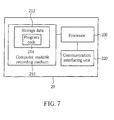
- FIG. 7 is a schematic diagram of a communication device 20 according to an example of the present invention.
- the communication device 20 can be the UE or the network shown in FIG 6 and includes a processor 200, a computer readable recording medium 210, and a communication interfacing unit 220.
- the computer readable recording medium 210 is any data storage device that stores storage data 212, including program code 214, thereafter read and processed by the processor 200. Examples of the computer readable recording medium 210 include a subscriber identity module (SIM), read-only memory (ROM), random-access memory (RAM), CD-ROMs, magnetic tapes, floppy disks, optical data storage devices, and carrier waves (such as data transmission through the Internet).
- SIM subscriber identity module
- ROM read-only memory
- RAM random-access memory
- CD-ROMs compact discs
- magnetic tapes magnetic tapes
- floppy disks optical data storage devices
- optical data storage devices optical data storage devices
- carrier waves such as data transmission through the Internet
- FIG. 8 is a flowchart of a process 30 according to an example of the present invention.
- the process 30 is utilized for improving UL transmission of TTI bundling for a medium access control (MAC) layer of a UE in the wireless communication system 10 and can be compiled into the program code 214.
- the process 30 includes the following steps:
- Step 304 of suspending any HARQ process is to set a last received HARQ feedback to an ACK for any HARQ process, after TTI bundling is activated.
- the process 30 is preferably used for a simple collision condition (as illustrated in FIG. 5 ) and decreases the complexity for the eNB to handle the retransmission. Note that, the process 30 gets rid of the collision between non-adaptive retransmissions by suspending any HARQ process after the first bundled transmission, however, collisions among new transmissions or adaptive retransmissions are still to be resolved.
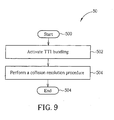
- the process 30 for resolving the transmission collision is performed by the scheduler in the UE. Furthermore, the present invention considers that the serving eNB has to know how the UE acts on the transmission collision, for synchronizing the HARQ process. Please refer to FIG. 9 , which is a flowchart of a process 40 according to an example of the present invention.
- the process 40 is utilized for improving UL transmission of TTI bundling for a network in the wireless communication system 10 and can be compiled into the program code 214.
- the process 40 includes the following steps:
- the collision resolution procedure used in the network is the same as that used in the UE, which can be can be the process 40 that performs the first bundled transmission and then suspends any HARQ process after the first bundled transmission.
- the HARQ entity at the network eNB follows the collision resolution procedure, that is, the HARQ process of the UE is synchronized with the HARQ process of the eNB. Therefore, the HARQ entity at the eNB can identify the correct HARQ process and can receive transport blocks successfully.
- steps in the process 30 and the process 40 and detailed steps related to each process can be realized by means that could be hardware, firmware known as a combination of a hardware device and computer instructions and data that reside as read-only software on the hardware device, or an electronic system.
- hardware can include analog, digital and mixed circuits known as microcircuit, microchip, or silicon chip.
- the electronic system can include system on chip (SOC), system in package (SIP), or computer on module (COM).
- the UE In the prior art, there are several reasons for a transmission collision, including the uncertainty of the timing of TTI bundling deactivation and the careless signaling assigned by the eNB when TTI bundling is activated, and the UE does not handle the collisions.
- the UE when a transmission collision happens, the UE carefully considers types of received signalings bringing the collision and a time order of the received signalings, and uses the concatenate solution or the non-concatenate solution to remove the collision according to the concern of complexity or transmission efficiency. Therefore, uplink transmission of TTI bundling is improved.
Landscapes
- Engineering & Computer Science (AREA)
- Computer Networks & Wireless Communication (AREA)
- Signal Processing (AREA)
- Mobile Radio Communication Systems (AREA)
Applications Claiming Priority (2)
| Application Number | Priority Date | Filing Date | Title |
|---|---|---|---|
| US11215308P | 2008-11-06 | 2008-11-06 | |
| EP09013967A EP2184883B1 (fr) | 2008-11-06 | 2009-11-06 | Procédé pour améliorer la transmission de liaison montante d'un regroupement d'intervalle temporel de transmission dans un système de communication sans fil |
Related Parent Applications (1)
| Application Number | Title | Priority Date | Filing Date |
|---|---|---|---|
| EP09013967.6 Division | 2009-11-06 |
Publications (2)
| Publication Number | Publication Date |
|---|---|
| EP2363971A2 true EP2363971A2 (fr) | 2011-09-07 |
| EP2363971A3 EP2363971A3 (fr) | 2011-09-28 |
Family
ID=41698073
Family Applications (2)
| Application Number | Title | Priority Date | Filing Date |
|---|---|---|---|
| EP11004463A Ceased EP2363971A3 (fr) | 2008-11-06 | 2009-11-06 | Procédé et appareil pour améliorer la transmission de liaison montante d'un regroupement d'intervalle temporel de transmission dans un système de communication sans fil |
| EP09013967A Active EP2184883B1 (fr) | 2008-11-06 | 2009-11-06 | Procédé pour améliorer la transmission de liaison montante d'un regroupement d'intervalle temporel de transmission dans un système de communication sans fil |
Family Applications After (1)
| Application Number | Title | Priority Date | Filing Date |
|---|---|---|---|
| EP09013967A Active EP2184883B1 (fr) | 2008-11-06 | 2009-11-06 | Procédé pour améliorer la transmission de liaison montante d'un regroupement d'intervalle temporel de transmission dans un système de communication sans fil |
Country Status (4)
| Country | Link |
|---|---|
| US (1) | US8370695B2 (fr) |
| EP (2) | EP2363971A3 (fr) |
| CN (1) | CN101741530B (fr) |
| TW (1) | TWI415502B (fr) |
Families Citing this family (36)
| Publication number | Priority date | Publication date | Assignee | Title |
|---|---|---|---|---|
| JP5066606B2 (ja) * | 2007-06-18 | 2012-11-07 | テレフオンアクチーボラゲット エル エム エリクソン(パブル) | Ttiバンドリングによるアップリンク送信の強化 |
| JP5199223B2 (ja) * | 2008-12-30 | 2013-05-15 | 創新音▲速▼股▲ふん▼有限公司 | Ack/nackバンドリングを改善する方法及び通信装置 |
| KR101675367B1 (ko) * | 2009-01-21 | 2016-11-11 | 삼성전자주식회사 | 무선 통신 네트워크의 전송 모드 전환 방법 및 이를 위한 무선 통신 시스템 |
| JP5023123B2 (ja) * | 2009-09-08 | 2012-09-12 | 株式会社エヌ・ティ・ティ・ドコモ | 無線基地局及び移動通信方法 |
| US8665810B2 (en) * | 2010-06-04 | 2014-03-04 | Htc Corporation | Method of performing uplink transmission and related communication device |
| EP2601755B1 (fr) * | 2010-08-05 | 2019-12-18 | Samsung Electronics Co., Ltd | Multiplexage d'informations de commande et de données provenant d'un équipement utilisateur |
| US9363804B2 (en) * | 2010-10-21 | 2016-06-07 | Lg Electronics Inc. | Method for transmitting uplink signal and apparatus therefor |
| CN102594532A (zh) * | 2011-01-17 | 2012-07-18 | 宏达国际电子股份有限公司 | 处理延迟混合自动重传请求及回传的影响的方法及装置 |
| JP5578273B2 (ja) * | 2011-03-18 | 2014-08-27 | 富士通株式会社 | 基地局、移動局、制御方法および通信システム |
| KR102087608B1 (ko) * | 2011-08-11 | 2020-03-13 | 삼성전자주식회사 | 통신 시스템에서 물리 하향링크 제어 채널들의 확장을 위한 장치 및 방법 |
| US20130083746A1 (en) | 2011-09-30 | 2013-04-04 | Interdigital Patent Holdings, Inc. | Method and apparatus for allocating resources for an enhanced physical hybrid automatic repeat request indicator channel |
| US9270409B2 (en) * | 2012-03-09 | 2016-02-23 | Blackberry Limited | System and method for handling of an uplink transmission collision with an ACK/NACK signal |
| US8792462B2 (en) | 2012-06-11 | 2014-07-29 | Telefonaktiebolaget L M Ericsson (Publ) | Radio base station and method for switching TTI bundling |
| US9380466B2 (en) | 2013-02-07 | 2016-06-28 | Commscope Technologies Llc | Radio access networks |
| US9936470B2 (en) | 2013-02-07 | 2018-04-03 | Commscope Technologies Llc | Radio access networks |
| US9414399B2 (en) | 2013-02-07 | 2016-08-09 | Commscope Technologies Llc | Radio access networks |
| US9451631B2 (en) * | 2013-08-14 | 2016-09-20 | Lg Electronics Inc. | Method and apparatus for transmitting signal in device-to-device communication |
| US20160242176A1 (en) * | 2013-09-27 | 2016-08-18 | Telefonaktiebolaget Lm Ericsson (Publ) | Methods and devices for scheduling |
| EP3094031A4 (fr) * | 2014-01-28 | 2017-01-11 | Huawei Technologies Co., Ltd. | Équipement utilisateur, station de base et procédé d'ordonnancement de données de liaison montante |
| CA3167284A1 (fr) | 2014-06-09 | 2015-12-17 | Airvana Lp | Reseaux d'acces radio |
| CN107949998A (zh) * | 2015-09-03 | 2018-04-20 | 瑞典爱立信有限公司 | 用于harq反馈优先化的无线设备、网络节点及其中的方法 |
| US10785791B1 (en) * | 2015-12-07 | 2020-09-22 | Commscope Technologies Llc | Controlling data transmission in radio access networks |
| CN108886433A (zh) * | 2016-01-19 | 2018-11-23 | 华为技术有限公司 | 一种针对上行信道的反馈方法及装置 |
| CN107396394B (zh) * | 2016-05-12 | 2020-04-07 | 华硕电脑股份有限公司 | 短传输时间间隔的上行链路传输的方法 |
| CN109075909B (zh) * | 2016-05-12 | 2021-08-31 | 苹果公司 | 使用半持续调度资源进行非自适应重新发送的系统、方法、和设备 |
| JP2020107918A (ja) * | 2017-04-21 | 2020-07-09 | シャープ株式会社 | 端末装置、基地局装置、通信方法、および、集積回路 |
| US10506468B2 (en) | 2017-09-08 | 2019-12-10 | At&T Intellectual Property I, L.P. | Reporting hybrid automatic repeat request-acknowledgements in wireless communication systems |
| US11678358B2 (en) | 2017-10-03 | 2023-06-13 | Commscope Technologies Llc | Dynamic downlink reuse in a C-RAN |
| US11102816B2 (en) | 2018-02-16 | 2021-08-24 | Qualcomm Incorporated | Collision avoidance for transmissions in coinciding transmission time intervals |
| EP3794889B1 (fr) | 2018-05-16 | 2023-07-05 | CommScope Technologies LLC | Multidiffusion de liaison descendante pour une utilisation de liaison avant efficace dans un réseau c-ran |
| EP3794888B1 (fr) | 2018-05-16 | 2025-12-17 | Outdoor Wireless Networks LLC | Réutilisation de liaison montante dynamique dans un c-ran |
| CN112075105A (zh) | 2018-06-08 | 2020-12-11 | 康普技术有限责任公司 | 针对主要为位于场所的事件区域中的用户提供无线服务的集中式无线电访问网络的无线电点的自动发送功率控制 |
| US12219510B2 (en) | 2018-08-29 | 2025-02-04 | Commscope Technologies Llc | Clock synchronization in a centralized radio access network having multiple controllers |
| US11627497B2 (en) | 2018-09-04 | 2023-04-11 | Commscope Technologies Llc | Front-haul rate reduction for use in a centralized radio access network |
| BR112021005261A2 (pt) * | 2018-09-21 | 2021-06-22 | Zte Corporation | métodos, aparelhos e sistemas para melhorar a flexibilidade de programação em uma comunicação sem fio |
| US11191092B2 (en) * | 2019-04-05 | 2021-11-30 | Qualcomm Incorporated | Timeline considerations for intra-UE multiplexing |
Family Cites Families (7)
| Publication number | Priority date | Publication date | Assignee | Title |
|---|---|---|---|---|
| US5517504A (en) * | 1994-07-29 | 1996-05-14 | Motorola, Inc. | Method and system for providing uplink/downlink collision avoidance in a wireless communication system |
| US7613157B2 (en) * | 2005-08-30 | 2009-11-03 | Interdigital Technology Corporation | Wireless communication method and apparatus for processing enhanced uplink scheduling grants |
| CN101119184A (zh) * | 2006-08-02 | 2008-02-06 | 华为技术有限公司 | 混合自适应重传请求方法及其实体 |
| TW200947939A (en) * | 2008-04-25 | 2009-11-16 | Interdigital Patent Holdings | Method and apparatus for performing a bundled transmission |
| TWI414199B (zh) * | 2008-08-07 | 2013-11-01 | Innovative Sonic Ltd | 處理上鏈路傳輸資源的方法及通訊裝置 |
| US20110141952A1 (en) * | 2008-08-11 | 2011-06-16 | Nokia Corporation | Method and apparatus for providing bundled transmissions |
| TWI405445B (zh) * | 2008-08-15 | 2013-08-11 | Innovative Sonic Ltd | 處理一傳輸時間間隔集束模式的方法及通訊裝置 |
-
2009
- 2009-11-06 EP EP11004463A patent/EP2363971A3/fr not_active Ceased
- 2009-11-06 CN CN2009102221332A patent/CN101741530B/zh active Active
- 2009-11-06 EP EP09013967A patent/EP2184883B1/fr active Active
- 2009-11-06 TW TW098137690A patent/TWI415502B/zh active
- 2009-11-06 US US12/613,538 patent/US8370695B2/en active Active
Non-Patent Citations (1)
| Title |
|---|
| None |
Also Published As
| Publication number | Publication date |
|---|---|
| US20100115367A1 (en) | 2010-05-06 |
| TW201019773A (en) | 2010-05-16 |
| EP2184883B1 (fr) | 2013-01-16 |
| EP2184883A2 (fr) | 2010-05-12 |
| CN101741530A (zh) | 2010-06-16 |
| US8370695B2 (en) | 2013-02-05 |
| EP2363971A3 (fr) | 2011-09-28 |
| EP2184883A3 (fr) | 2010-11-17 |
| TWI415502B (zh) | 2013-11-11 |
| CN101741530B (zh) | 2013-11-13 |
Similar Documents
| Publication | Publication Date | Title |
|---|---|---|
| US8370695B2 (en) | Method and apparatus for improving uplink transmission of transmission time interval bundling in a wireless communication system | |
| US8824423B2 (en) | Method and apparatus for improving a hybrid automatic repeat request procedure in the transition of transmission time interval bundling in a wireless communication system | |
| US8296616B2 (en) | Method of distinguishing hybrid automatic repeat request processes and related communication device | |
| KR101721015B1 (ko) | 이동 통신 시스템에서 블라인드 스케쥴링 장치 및 방법 | |
| US9667400B2 (en) | Method and apparatus for TTI bundling transmission in a wireless communications system | |
| JP5001462B2 (ja) | 通信システムにおける方法及び構成 | |
| US8300663B2 (en) | Dedicated acknowledgement and delivery of management messages in wireless communication systems | |
| CN103297207B (zh) | 对随机接入响应消息进行混合自动请求重传的方法 | |
| EP2207394B1 (fr) | Procédé et appareil pour améliorer un processus de libération de ressource de planification semi-persistante dans un système de communication sans fil | |
| CN108633036B (zh) | 一种控制信息传输方法及装置 | |
| US9059848B2 (en) | Method and arrangement in a wireless communication system | |
| US8989132B2 (en) | Method of exchanging data between a base station and a mobile station | |
| US20100074201A1 (en) | Method for improving uplink signaling transmission for a wireless communications system and related communication device | |
| EP2403308A1 (fr) | Procédé pour effectuer une transmission de données correspondant à des ressources semi-constantes dans un système de communication sans fil | |
| CN111867138A (zh) | 随机接入方法以及用户设备 |
Legal Events
| Date | Code | Title | Description |
|---|---|---|---|
| PUAI | Public reference made under article 153(3) epc to a published international application that has entered the european phase |
Free format text: ORIGINAL CODE: 0009012 |
|
| PUAL | Search report despatched |
Free format text: ORIGINAL CODE: 0009013 |
|
| 17P | Request for examination filed |
Effective date: 20110531 |
|
| AC | Divisional application: reference to earlier application |
Ref document number: 2184883 Country of ref document: EP Kind code of ref document: P |
|
| AK | Designated contracting states |
Kind code of ref document: A2 Designated state(s): AT BE BG CH CY CZ DE DK EE ES FI FR GB GR HR HU IE IS IT LI LT LU LV MC MK MT NL NO PL PT RO SE SI SK SM TR |
|
| AX | Request for extension of the european patent |
Extension state: AL BA RS |
|
| AK | Designated contracting states |
Kind code of ref document: A3 Designated state(s): AT BE BG CH CY CZ DE DK EE ES FI FR GB GR HR HU IE IS IT LI LT LU LV MC MK MT NL NO PL PT RO SE SI SK SM TR |
|
| AX | Request for extension of the european patent |
Extension state: AL BA RS |
|
| RIC1 | Information provided on ipc code assigned before grant |
Ipc: H04L 1/18 20060101AFI20110822BHEP |
|
| 17Q | First examination report despatched |
Effective date: 20110923 |
|
| STAA | Information on the status of an ep patent application or granted ep patent |
Free format text: STATUS: THE APPLICATION HAS BEEN REFUSED |
|
| 18R | Application refused |
Effective date: 20131129 |