EP2364052A1 - Drahtloses Kommunikationssystem, Basisstation und Netzwerksteuerungsvorrichtung für MBMS Übertragung Koordination - Google Patents
Drahtloses Kommunikationssystem, Basisstation und Netzwerksteuerungsvorrichtung für MBMS Übertragung Koordination Download PDFInfo
- Publication number
- EP2364052A1 EP2364052A1 EP11152530A EP11152530A EP2364052A1 EP 2364052 A1 EP2364052 A1 EP 2364052A1 EP 11152530 A EP11152530 A EP 11152530A EP 11152530 A EP11152530 A EP 11152530A EP 2364052 A1 EP2364052 A1 EP 2364052A1
- Authority
- EP
- European Patent Office
- Prior art keywords
- base station
- time slot
- transmission
- information
- henb
- Prior art date
- Legal status (The legal status is an assumption and is not a legal conclusion. Google has not performed a legal analysis and makes no representation as to the accuracy of the status listed.)
- Withdrawn
Links
- 230000005540 biological transmission Effects 0.000 title claims abstract description 268
- 238000004891 communication Methods 0.000 title claims description 24
- 238000000034 method Methods 0.000 description 36
- 238000010586 diagram Methods 0.000 description 24
- 230000008569 process Effects 0.000 description 23
- 230000006870 function Effects 0.000 description 5
- 238000010276 construction Methods 0.000 description 4
- 101001134276 Homo sapiens S-methyl-5'-thioadenosine phosphorylase Proteins 0.000 description 3
- 102100022050 Protein canopy homolog 2 Human genes 0.000 description 3
- 230000004048 modification Effects 0.000 description 3
- 238000012986 modification Methods 0.000 description 3
- 230000003252 repetitive effect Effects 0.000 description 3
- 230000001413 cellular effect Effects 0.000 description 2
- 230000008520 organization Effects 0.000 description 2
- 230000004044 response Effects 0.000 description 2
- 230000000295 complement effect Effects 0.000 description 1
- 239000000284 extract Substances 0.000 description 1
- 238000005259 measurement Methods 0.000 description 1
- 238000012545 processing Methods 0.000 description 1
- 239000000725 suspension Substances 0.000 description 1
Images












Classifications
-
- H—ELECTRICITY
- H04—ELECTRIC COMMUNICATION TECHNIQUE
- H04W—WIRELESS COMMUNICATION NETWORKS
- H04W72/00—Local resource management
- H04W72/30—Resource management for broadcast services
-
- H—ELECTRICITY
- H04—ELECTRIC COMMUNICATION TECHNIQUE
- H04L—TRANSMISSION OF DIGITAL INFORMATION, e.g. TELEGRAPHIC COMMUNICATION
- H04L5/00—Arrangements affording multiple use of the transmission path
- H04L5/003—Arrangements for allocating sub-channels of the transmission path
- H04L5/0032—Distributed allocation, i.e. involving a plurality of allocating devices, each making partial allocation
-
- H—ELECTRICITY
- H04—ELECTRIC COMMUNICATION TECHNIQUE
- H04L—TRANSMISSION OF DIGITAL INFORMATION, e.g. TELEGRAPHIC COMMUNICATION
- H04L5/00—Arrangements affording multiple use of the transmission path
- H04L5/003—Arrangements for allocating sub-channels of the transmission path
- H04L5/0032—Distributed allocation, i.e. involving a plurality of allocating devices, each making partial allocation
- H04L5/0035—Resource allocation in a cooperative multipoint environment
-
- H—ELECTRICITY
- H04—ELECTRIC COMMUNICATION TECHNIQUE
- H04L—TRANSMISSION OF DIGITAL INFORMATION, e.g. TELEGRAPHIC COMMUNICATION
- H04L5/00—Arrangements affording multiple use of the transmission path
- H04L5/003—Arrangements for allocating sub-channels of the transmission path
- H04L5/0053—Allocation of signalling, i.e. of overhead other than pilot signals
-
- H—ELECTRICITY
- H04—ELECTRIC COMMUNICATION TECHNIQUE
- H04L—TRANSMISSION OF DIGITAL INFORMATION, e.g. TELEGRAPHIC COMMUNICATION
- H04L5/00—Arrangements affording multiple use of the transmission path
- H04L5/0091—Signalling for the administration of the divided path, e.g. signalling of configuration information
- H04L5/0096—Indication of changes in allocation
-
- H—ELECTRICITY
- H04—ELECTRIC COMMUNICATION TECHNIQUE
- H04L—TRANSMISSION OF DIGITAL INFORMATION, e.g. TELEGRAPHIC COMMUNICATION
- H04L5/00—Arrangements affording multiple use of the transmission path
- H04L5/003—Arrangements for allocating sub-channels of the transmission path
- H04L5/0048—Allocation of pilot signals, i.e. of signals known to the receiver
- H04L5/0051—Allocation of pilot signals, i.e. of signals known to the receiver of dedicated pilots, i.e. pilots destined for a single user or terminal
Definitions
- the invention relates to a wireless communication system and a radio base station apparatus and a network control apparatus constructing the wireless communication system,.
- a transmission of the multicast services is performed in the downlink, which is the direction from a base station to the terminal.
- a transmission of the multicast services is performed in the downlink, which is the direction from a base station to the terminal.
- the terminal since a plurality of terminals share the same radio resource, use efficiency of the radio resource is improved.
- the terminal uses the received signals from a plurality of base stations and can improve quality of the received signals.
- an SFN Single Frequency Network
- OFDM Orthogonal Frequency Division Multiplexing
- a small base station In the cellular wireless communication, a small base station has been examined in order to complement an area coverage. It is presumed that the small base station is disposed, particularly, in a home, an office, a commercial building, or the like and is connected to a dedicated network of a mobile network operator through an ISP (Internet Service Provider) line or the like.
- ISP Internet Service Provider
- the cover area of the ordinary base station is called a "macrocell”
- the cover area of the foregoing small base station is called a "femto-cell”.
- the femto-cell base station In the standardization organization 3GPP, in the E-UTRA and the E-UTRAN, the femto-cell base station has been standardized. In “3GPP TS 36.300 V9.1.0, 4.6 Support of HeNBs", a femto-cell base station has been disclosed as an HeNB (Home E-UTRAN Node B).
- JP-A-2009-182944 in the E-UTRA and the E-UTRAN, an environment where a base station which executes only the unicast transmission, a base station which executes only the MBMS transmission, and a base station which executes both of the unicast transmission and the MBMS transmission exist mixedly has been disclosed.
- a plurality of base stations disposed in the area of the multicast services transmit the same information.
- all of the base stations in the area of the multicast services do not always participate in the multicast transmission.
- a case where the femto-cell base station does not participate in the multicast transmission is possible.
- whether or not the multicast services are received is determined based on a judgment of the terminal.
- the cover area is narrower than that of the macrocell base station, the number of connected terminals is small. Therefore, a case where even if the femto-cell base station performed the multicast transmission, the terminals which receive the multicast services hardly exist or never exist in the femto-cell is possible. In such a case, there is a fear that communication resources of a line from a contents server of the multicast services to the femto-cell base station or radio resources between the femto-cell base station and the terminal are wasted in vain.
- the femto-cell base station and the network of the mobile network operator are connected through a line of a relatively low rate such as an ADSL (Asymmetric Digital Subscriber Line) or the like, there is a possibility that a congestion of the line due to a large amount of contents of the multicast services occurs. To avoid this, it may be better that only the macrocell base station executes the multicast transmission and the femto-cell base station does not perform the multicast transmission.
- ADSL Asymmetric Digital Subscriber Line
- the terminal which is connected to the femto-cell base station cannot use the multicast services.
- JP-A-2009-182944 a method whereby the terminal connected to the base station which executes only the unicast transmission performs the MBMS reception is not disclosed.
- a communication system comprising: a first base station for executing a multicast transmission; and a second base station for communicating with a terminal, wherein when the first base station executes the multicast transmission, the second base station controls the communication with the terminal in a time slot corresponding to a time slot in which the multicast transmission is executed.
- the second base station which does not execute the multicast transmission does not executes the unicast transmission in the time slot corresponding to the time slot in which the multicast transmission is executed.
- the time slot in which the first base station executes the multicast transmission is preferably notified to the second base station from a multicast control apparatus which schedules the multicast transmission for the first base station.
- information that is necessary for receiving the multicast transmission is preferably notified from the second base station to the terminal connected to the second base station.
- an opportunity to receive the multicast services is preferably provided to the terminal connected to the femto-cell base station which does not perform the multicast transmission.
- a communication system to which the embodiment is applied will be described in detail with reference to the drawings with respect to a case, as an example, where in a multicast transmission system (MBMS) in the E-UTRA and the E-UTRAN, a macrocell base station (MeNB: Macrocell eNB) which executes the MBMS transmission and a femto-cell base station ( HeNB ) which does not perform the MBMS transmission are disposed in an MBMS area.
- MeNB Macrocell eNB
- HeNB femto-cell base station
- Fig. 1 shows an example of a layout of an HeNB and an MeNB.
- An MeNB 101 constructs a macrocell 103 by its communication range and is connected to terminals 102.
- An HeNB 104 constructs a femto-cell 106 by its communication range and is connected to a terminal 105.
- the terminal 102 connected to the MeNB is called an MUE (Macrocell User Equipment).
- the terminal 105 connected to the HeNB is called an HUE (Home User Equipment).
- Fig. 2 shows an example of a logical architecture of a network.
- the network in Fig. 2 is constructed by: MeNBs 201; an HeNB 202; an MME/S-GW (Mobility Management Entity/Serving Gateway) 203 for performing a mobility management of terminals (UE: User Equipment), a routing of a packet, and the like; a P-GW (Packet Data Network Gateway) 204 for transmitting and receiving the packet to/from an IP service network; an MCE 205 for performing a scheduling and the like of an MBMS transmission; an MBMS GW (Gateway) 206 for distributing MBMS service data to the MeNB; a BMSC (Broadcast Multicast Service Center) 207 for making an authentication and the like of the terminal which receives MBMS services; and an HeNB GW 208 for connecting a network apparatus such as an MME/S-GW or the like.
- the MeNBs 201, HeNB 202, and MCE 205 are connected through wired networks
- An MUE 209 is connected to the MeNB 201 through a radio link.
- An HUE 210 is connected to the HeNB 202 through a radio link.
- the HeNB 202 is located in a macrocell of the MeNB 201 and the femto-cell 106 which can communicate with the HUE 210 is constructed.
- the BMSC 207 obtains the MBMS service data from an MBMS contents server 211 and distributes to a plurality of MeNBs 201 through the MBMS GW 206.
- the MeNB 201 wirelessly multicast-transmits the MBMS service data distributed from the MBMS GW 206 in accordance with MBMS scheduling information which is notified from the MCE 205.
- Fig. 3 shows a constructional example of the HeNB 202.
- the HeNB in Fig. 3 has a memory 301, a CPU 302, a radio interface (I/F) 303, a logic circuit 304, and a wired interface (I/F) 306 and they are connected through a bus 305, respectively.
- the following programs necessary for the HeNB 202 to transmit MBMS transmission timing to the HUE 210 are stored in the memory 301: that is, a program 312 for decision on availability of a unicast data transmission; a program 311 for decision on informing MBMS transmission information; and a program 313 for decision on a request for the MBMS transmission information.
- the following tables are stored in the memory 301: that is, an MCH subframe information table 321; an MBSFN subframe information table 322; an MCCH transmission information table 323; a Notification transmission information table 324; a Notification area information table 325; a Desired MBMS services information summary table 326; and a System information transmission information table 327. Detailed contents of each program and each table will be described hereinafter.
- the CPU 302 reads out a program for deciding a suspension of the unicast transmission at the MBMS transmission timing from the memory 301 and executes it.
- the HeNB is connected to a wired network by the wired interface 306 and communicates with the MCE 205 through the HeNB GW 208 or the MME/S-GW 203.
- the HeNB communicates with the HUE 210 by the radio interface 303 through an antenna. Further, the HeNB may communicate with the MeNB 201 by the radio interface 303 or the wired interface 306.
- the logic circuit 304 executes a process such as a turbo encoding and the like necessary for the wireless communication with the HUE 210 or the terminal 105.
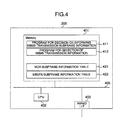
- Fig. 4 is a constructional example of the MCE 205.
- the MCE 205 has a memory 401, a CPU 402, and a wired interface (I/F) 403 and they are connected through a bus 405, respectively.
- the following programs and tables which are necessary to manage the MBMS transmission timing are stored in the memory 401: that is, a program 411 for decision on informing MBMS transmission subframe information; a program 412 for selection of the MBMS transmission information; an MCH subframe information table 421; and an MBSFN subframe information table 422. Detailed contents of each program and each table will be described hereinafter.
- the CPU 402 reads out the program such as scheduling of the MBMS transmission from the memory 401 and executes it.
- the MCE communicates with the HeNB 202 by the wired interface 403 through the NeNB GW 208.
- the MCE communicates with a network apparatus such as an MME/S-GW 203 or the like through the wired network as shown in Fig. 1 by the wired interface 403.
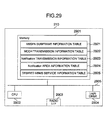
- Fig. 29 is a constructional example of the HUE 210.
- the HUE 210 has a CPU 2902, a memory 2901, a radio interface (I/F) 2903, and a logic circuit 2904 and they are connected through a bus 2905, respectively.
- the following information tables and programs which are necessary to transmit the MBMS transmission timing and the like are stored in the memory 2901: that is, an MBSFN subframe information table 2921; an MCCH transmission information table 2922; a Notification transmission information table 2923; a Notification area information table 2924; and a Desired MBMS service information table 2925.
- the CPU 2902 reads out the program such as an MBMS receiving process or the like from the memory 2901 and executes it.
- the HUE communicates with the HeNB 202 by the radio interface 2903 through an antenna.
- the logic circuit 2904 executes a process such as a turbo encoding or the like necessary for the wireless communication with the HeNB 202.
- Figs. 5 and 6 Timing when the transmission is suspended in the HeNB 202 will now be described with reference to Figs. 5 and 6 .
- Figs. 5 and 6 it is assumed that the scheduling is executed on a unit basis of a time slot called a subframe.
- Fig. 5 is a diagram showing unicast transmission timing 510 and MBMS transmission timing 520 in the MeNB 201 and the HeNB 202 in the case where the HeNB 202 executes the unicast transmission irrespective of the MBMS transmission timing.
- Transmission timing for a plurality of subframes of the MeNB 201 which are allocated along a time base 501 is shown.
- Transmission timing for a plurality of subframes of the HeNB 202 which are allocated along a time base 502 is shown.
- the MeNB 201 performs the MBMS transmission in a subframe 530 indicated by the MCE 205 and other subframes are available for the unicast data transmission.
- the HeNB 202 can use an arbitrary subframe for the unicast transmission irrespective of whether or not the MeNB 201 is executing the MBMS transmission. Therefore, even at the MBMS transmission timing 520, when the HeNB 202 performs the unicast data transmission, the HUE 210 serving as a destination of the data receives the unicast data. Even if the HUE 210 which is not the destination of the data tries to receive the MBMS data which is transmitted from the adjacent MeNB 201, the unicast data transmission of the HeNB 202 interferes. Therefore, reception quality of the MBMS data deteriorates largely and there is a risk that the data decoding becomes impossible.
- Fig. 6 is a diagram showing the unicast transmission timing 510, the MBMS transmission timing 520, and timing 610 when the transmission is suspended in the MeNB 201 and the HeNB 202 in the case where the MBMS transmission timing is considered.
- Transmission timing for a plurality of subframes of the MeNB 201 which are allocated along a time base 601 are shown.
- Transmission timing for a plurality of subframes of the HeNB 202 which are allocated along a time base 602 are shown.
- the MeNB 201 performs the MBMS transmission in the subframe indicated by the MCE 205 and other subframes are available for the unicast data transmission.
- the HeNB suspends a transmission of a downlink in a subframe 630 in which the MeNB 201 performs the MBMS transmission.
- the HUE 210 does not need to receive the unicast data. Further, if the HUE tries to receive the MBMS data which is transmitted from the adjacent MeNB , the interference due to the unicast data transmission of the HeNB does not occur. Therefore, the reception quality of the MBMS data is improved as compared with the case of Fig. 5 .
- the subframe synchronization is obtained between the MeNB 201 and the HeNB 202.
- Such a subframe synchronization can be realized by making time synchronization by a GPS (Global Positioning System) or the like.
- the HeNB 202 since the HeNB suspends the transmission in the MBMS transmission subframe, the HeNB 202 does not perform the scheduling of the unicast data transmission to the MBMS transmission subframe.
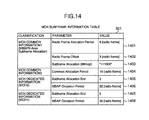
- the MCH subframe information table 321 stored in the memory 301 in Fig. 3 will be described with reference to Fig. 14 .
- the MCH subframe information table 321 in Fig. 14 is constructed by: a type of subframe; a type of parameter in the subframe; and a value of the parameter.
- Fig. 14 shows an example in the case where the number of MCHs is equal to 2 in an MBSFN area which is comprised of one or multiple MeNBs which perform the MBMS transmission.
- MCH common control information 1 is subframe allocation information to the MBSFN area.
- the MCH common control information 1 shows that a parameter 1401 includes a value of an allocation period of a radio frame, a parameter 1402 includes a value of a time offset of the radio frame, and a parameter 1403 includes a subframe allocation bitmap in the radio frame.
- MCH common control information 2 is different subframe allocation information to the MBSFN area.
- the MCH common control information 2 includes a parameter 1404 showing an interleave period (Common Allocation Period) between the MCHs corresponding to the MCH common control information 1 and 2.
- MCH dedicated information is subframe allocation information (MSAP: MCH Subframe Allocation Pattern) of each MCH.
- a parameter 1405 is a final subframe number of each MCH in the Common Allocation Period.
- a parameter 1406 is a time period of the MSAP of each MCH in the Common Allocation Period.
- the MCH subframe information table shown in Fig. 14 has been stored in the memory 401 of the MCE 205 as an MCH subframe information table 421.
- the information of Fig. 14 which is notified through an interface A serving as a wired network has been stored in the memory 301 as an MCH subframe information table 321.
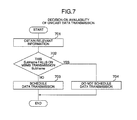
- Fig. 7 is a flowchart showing an example of a procedure (unicast data transmission availability decision process) for allowing the HeNB 202 to decide the availability of the scheduling of the unicast data transmission in each subframe.
- the process of Fig. 7 has been stored in the memory 301 as a program 312 for decision on availability of the unicast data transmission.
- the CPU 302 reads out the program 312 for decision on availability of the unicast data transmission and executes it.
- the HeNB 202 obtains the information such as MBMS transmission timing or the like with reference to the MCH subframe information table 321 or the MBSFN subframe information table 322 stored in the memory 301 (701).
- the HeNB 202 determines whether or not the relevant subframe is the MBMS transmission subframe from the information collected in step 701 (702). If the relevant subframe is not the MBMS transmission subframe, the HeNB 202 can perform the scheduling of the unicast data transmission (703). Specifically speaking, the HeNB 202 allocates the subframe, as a subframe for the unicast transmission, which is not the subframe that is used for the MBMS transmission.
- the HeNB 202 does not perform the scheduling of the unicast data transmission (704).
- the processing routine is returned to step 702 and the HeNB 202 also determines the availability of the scheduling of the unicast data transmission with respect to other subframes and sequentially performs the scheduling.
- the HeNB 202 does not transmit the unicast data and may suspend the transmission so that the MBMS data is not interfered. This implies that it is not always necessary that the HeNB 202 suspends the transmission of all physical channels. What physical channels the HeNB should suspend the transmission of will be described with reference to Figs. 8 , 9 , and 10 with respect to a reference signal (RS) which is used for a demodulation or the like of a radio signal by the terminal as an example.
- RS reference signal
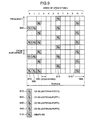
- FIGS. 8 , 9 , and 10 show layout examples of frequency/time regions of RS symbols in a resource block (RB) comprised of a plurality of OFDM subcarriers which are continuous in a frequency domain and a plurality of OFDM symbols which are continuous in a time domain.
- RB resource block
- a time length of the RB is equal to one subframe.
- RSs cell-specific reference signals
- CS RSs cell-specific reference signals
- MBSFN RS MBSFN reference signal
- Fig. 8 is the layout example of the frequency/time regions of the CS RS of the MeNB or the HeNB in the subframe that is available for the unicast transmission in Fig. 5 .
- the CS RSs 810, 820, 830, and 840 have been inserted.
- the CS RSs have also been inserted with respect to the symbols other than the OFDM symbols added with the reference numerals.
- Fig. 9 is the layout example of the frequency/time regions of the CS RS and the MBSFN RS of the MeNB 201 in the subframe that is used for the MBMS transmission in Fig. 5 .
- MBMS data 910 is inserted into the OFDM symbols with OFDM symbol index 2 and after the OFDM symbol index 2. Therefore, the MBSFN RS has been inserted in the OFDM symbols with OFDM symbol index 2 and after the OFDM symbol index 2.
- the CS RSs 810, 830, and the like are inserted. That is, a range of the symbols in which the MBMS data is inserted and a range of the symbols in which the cell-specific physical-layer control information such as CS RS or the like or the information for making the unicast communication is inserted are separately provided.
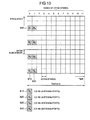
- Fig. 10 is the layout example of the frequency/time regions of the CS RS of the HeNB in the subframe 630 where the transmission is suspended as in Fig. 6 .
- the CS RSs 810, 820, and 830 are inserted in the OFDM symbol indices 0 and 1 in which the cell-specific physical-layer control information can be inserted.
- the CS RSs 810, 820, and 830 are inserted in the OFDM symbols with OFDM symbol index 2 and after the OFDM symbol index 2 in which the MeNB 201 transmits the MBMS data, in order to prevent the interference.
- the RS is not inserted in the symbols in which the MBMS data is inserted for the MeNB, and the CS RSs are inserted in the region in which the MBMS data is not inserted. Since the HeNB 202 does not transmit the MBMS data, there is no need to insert the MBSFN RS for HeNB 202.
- the layout of the CS RSs in Fig. 10 is used in the subframe which the HeNB has determined in step 704 in Fig. 7 that the scheduling of the data transmission is not performed because the relevant subframe corresponds to the MBMS transmission subframe.
- a channel MCH Multicast Channel
- MAC Media Access Control
- Fig. 11 shows a constructional example of an MBMS MAC packet.
- the MBMS MAC packet (PDU: Protocol Data Unit) includes an MAC header 1101, an MCCH (Multicast Control Channel) SDU (Service Data Unit) 1103, an MTCH (Multicast Traffic Channel) SDU 1104, and a DSI (Dynamic Scheduling Information) MAC CE (Control Element) 1102.
- the MAC packet does not always include all of the foregoing elements.
- the MCCH SDU 1103 includes data of the MBMS control channel such as MBMS service information and transmission subframe information of the MCH.
- the MTCH SDU 1104 includes data of the MBMS traffic channel, that is, the MBMS service data.
- the DSI MAC CE 1102 includes scheduling information of the MTCH in the MCH.
- the UE (for example, HUE 210 or MUE 209) which receives the MBMS receives the MCH in the subframe in which the MCCH SDU 1103 is transmitted and obtains the transmission subframe information of the MCH from the MCCH SDU 1103. Subsequently, the UE receives the MCH by using the MCH transmission subframe information.
- the subframe information to which the SDU 1104 of each MTCH is transmitted is included in the DSI MAC CE 1102 included in the MCH data.
- the UE obtains the MTCH SDU 1104 corresponding to a desired service with reference to the subframe information.
- the HUE 210 does not need to receive the unicast data in the subframe in which the MBMS transmission is executed. According to the foregoing embodiment, in the case where the HUE tries to receive the MBMS data which is transmitted from the adjacent MeNB, since the interference due to the unicast data transmission of the HeNB does not occur, reception quality of the MBMS data is improved.
- the MCE 205 notifies the HeNB 202 of time slot (subframe) information in which the MeNB 201 performs the MBMS transmission.
- the HeNB 202 suspends the transmission in accordance with the MBMS transmission subframe information notified by the MCE 205.
- Fig. 12 is a constructional example of a logical architecture of the network to realize the notification of the MBMS transmission subframe information from the MCE to the HeNB .
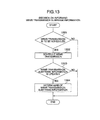
- Fig. 13 is a flowchart showing a procedure (MBMS transmission subframe information notification decision process) for deciding whether or not the MBMS subframe information is notified to the HeNB in the MCE 205.
- the process of Fig. 13 has been stored in the memory 401 in Fig. 4 as a program 411 for decision on informing the MBMS transmission subframe information and is executed by the CPU 402 in Fig. 4 .
- the MCE 205 performs the scheduling of the MBMS transmission by the CPU 402 and holds the formed MBMS transmission subframe information into the memory 401.
- the MCE 205 decides whether or not the MBMS scheduling is performed in accordance with a situation or the like of the MBMS services (1301). In the example of Fig. 13 , when the MBMS scheduling is not performed, the MBMS subframe information is not notified from the MCE 205 to the HeNB 202. If it is determined that the MBMS scheduling is performed, the MCE 205 performs the MBMS scheduling (1302) and stores a result of the scheduling into the memory 401. Subsequently, the MCE 205 determines whether or not the MBMS subframe information has been updated (1303). In the example of Fig.
- the MCE 205 extracts the MBMS subframe information from the memory 401 and notifies the HeNB of the MBMS subframe information through the interface A (1304).
- An example of the MBMS subframe information which is stored in the memory 401 is the foregoing MBMS subframe information table shown in Fig. 14 .
- whether or not the MBMS subframe information is notified from the MCE 205 to the HeNB 202 is determined in dependence on whether or not the MBMS scheduling is performed and whether or not the MBMS subframe information has been updated. However, it may be determined only by one of those two decision references or the MBMS subframe information may be notified from the MCE 205 to the HeNB 202 at a predetermined time period. Or, the MBMS subframe information may be notified from the MCE 205 to the HeNB 202 in response to a request from the HeNB 202.
- the HeNB 202 which received the MBMS subframe information stores it into the memory 301 and obtains the MBMS subframe information from the memory in step 701 in Fig. 7 as mentioned above.
- step 1304 it is not always necessary that the MCE 205 notifies the HeNB 202 of all information in the MCH subframe information table 321 shown in Fig. 14 .
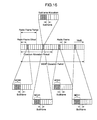
- Fig. 15 shows an example of an MBMS transmission suspending radio frame and the subframe in the HeNB 202 in the case where only the MCH common information 1 has been notified as MBMS subframe information from the MCE 205 to the HeNB 202.
- the subframe information which is notified by the MCH common information 1 includes all of the subframes allocated to the MBSFN area.
- the HeNB 202 can know a radio frame 1501 allocated to the MBSFN area and a subframe 1502 allocated to the MBSFN area in this radio frame as shown in Fig. 15 .
- step 702 in Fig. 7 it is sufficient that the HeNB 202 suspends the transmission in the subframe as shown in Fig. 15 with reference to the subframe information.
- Fig. 16 shows an example of the MBMS transmission suspending radio frame and the subframe in the HeNB in the case where all of the information in the MCH subframe information table shown in Fig. 14 has been notified as MBMS subframe information from the MCE to the HeNB.
- Fig. 16 shows an example of the MBMS transmission suspending radio frame and the subframe in the HeNB in the case where all of the information in the MCH subframe information table shown in Fig. 14 has been notified as MBMS subframe information from the MCE to the HeNB.
- the HeNB 202 can know the information of the subframe which is used for each MCH transmission in the subframe allocated to the MBSFN area, i.e. MSAP, as shown in Fig. 16 .
- the HeNB 202 can select every MCH whether or not the transmission is suspended every MCH in step 702. Owing to the embodiment, the HeNB 202 can obtain the information of the subframe in which t the transmission should be suspended.
- the MeNB 101 notifies the HeNB 104 of the time slot (subframe) information in which the MeNB performs the MBMS transmission.
- the HeNB 104 suspends the transmission in accordance with the MBMS transmission subframe information notified to the MeNB 101.
- Fig. 17 is a constructional example of a logical architecture of the network to realize the MBMS transmission subframe information notification from the MeNB 101 to the HeNB 104 in the second embodiment.
- an interface B for transferring the information from the MeNB 101 to the HeNB 104 through the radio network is provided.
- the interface B may be realized by providing the wired link or radio link between the MeNB and the HeNB or may be realized through a network apparatus such as MME/S-GW or HeNB GW.
- the constructional diagram of the HeNB 202 in Fig. 3 shows an example in which the interface B is realized by providing the radio link between the HeNB 202 and the MeNB 201.
- the HeNB 104 belonging to the macrocell 106 of the MeNB 101 as shown in Fig. 1 obtains the MBMS transmission subframe information from the MeNB 101.
- An eNB serving as a base station transmits cell-specific broadcast information SIB (System Information Block). Particularly, the MeNB 201 notifies the terminal 102, 209, or 210 of the MBSFN subframe information as MBMS transmission timing information by the SIB.
- the MBSFN subframe information is cell-specific information which is formed by the MeNB 201 on the basis of the MBMS scheduling information or the like which is notified from the MCE to the MeNB.
- the MBSFN subframe may be used not only for the MBMS transmission but also for another object such as an RS transmission for measuring the position or the like.
- Fig. 18 shows the MBSFN subframe information (MBSFN subframe information table) which is notified by the MeNB 201 by the SIB.
- a parameter 1801 denotes an allocation period of the radio frame.
- a parameter 1802 denotes a time offset of the radio frame.
- a parameter 1803 denotes a subframe allocation bitmap in the radio frame.
- the receiving function in the downlink is included in the interface 303 and, through the interface 303, the HeNB 202 receives the SIB which is transmitted by the MeNB 201.
- the MBSFN subframe information table as shown in Fig. 18 can be notified from the MeNB 201 to the HeNB 202.
- Fig. 19 shows an example of the MBMS transmission suspending radio frame and the subframe in the HeNB 202 in the case where only the MBSFN subframe information table of Fig. 18 has been notified as MBMS subframe information from the MeNB 201 to the HeNB 202.
- the HeNB 202 can know a radio frame 1901 including the MBSFN subframe and a subframe 1902 allocated as an MBSFN subframe in the radio frame as shown in Fig. 19 . It is sufficient that the HeNB suspends the transmission in the subframe 1902 as shown in Fig. 19 .
- the MBSFN subframe information is cell-specific information as already described and there is a case where it differs between the MeNBs 201.
- the HeNB 202 may synthesize a plurality of MBSFN subframe information and use the synthesized information. For example, it is sufficient that the HeNB 202 refers to the MBSFN subframe in step 702 in Fig. 7 and suspends the transmission in the subframe corresponding to the MBSFN subframe with respect to at least one MeNB. Owing to the embodiment, the HeNB can obtain the information of the subframe in which the transmission should be suspended.
- the HeNB 202 notifies the HUE 210 of the information for allowing the HUE 210 to perform the MBMS reception.
- the information for the MBMS reception which is notified to the HUE 210 by the HeNB 202 is the information regarding the MCCH transmission.
- the information regarding the MCCH transmission has been held in the memory 301 of the HeNB 202 and is notified to the HUE 210 from the radio I/F 303 in accordance with a judgment of the HeNB.
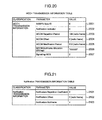
- Fig. 20 is an example of the MCCH transmission information table which is notified to the HUE 210 from the HeNB 202.
- the table of Fig. 20 includes the MCCH transmission information such as transmission timing of the MCCH and the like.
- a parameter 2001 denotes an MBSFN area ID and indicates a group of the MeNBs which synchronously perform the MBMS transmission.
- a parameter 2002 denotes an ID of MCCH updates information (Notification).
- a parameter 2003 denotes a repetitive transmission period of the MCCH.
- a parameter 2004 denotes an offset of the transmission timing of the MCCH.
- a parameter 2005 denotes an updating period of the MCCH.
- a parameter 2006 denotes a subframe in which the MCCH is transmitted in the radio frame that is indicated by the parameters 2003 and 2004.
- a parameter 2007 denotes an MCS (Modification and Coding Scheme) which is used for a modulation of the MCCH.
- the information of Fig. 20 has been stored in the memory 301 of the HeNB as an MCCH transmission information table 323.
- the information of Fig. 20 which is notified from the HeNB has been stored in the memory 2901 as an MCCH transmission information table 2922.
- the HUE 210 can know the transmission subframe of the MCH in which the MCCH is included and the MCS.
- the HUE 210 can obtain the MCCH SDU.
- Fig. 21 is an example of the transmission information (Notification transmission information table) of the MCCH updates information which is notified from the HeNB 202 to the HUE 210.
- the Notification transmission information table of Fig. 21 includes the transmission information of the MCCH updates information (Notification).
- the Notification is transmitted from the eNB in order to notify the UE of the presence or absence of the updating of the contents of the MCCH.
- a parameter 2101 denotes the number of repetitive transmission times of the Notification.
- a parameter 2102 denotes an offset of the transmission timing of the Notification.
- a parameter 2103 denotes a subframe in which the Notification can be transmitted in the radio frame that is indicated by the parameters 2101 and 2102.
- the information of Fig. 21 has been stored in the memory 301 of the HeNB as a Notification transmission information table 324.
- the information of Fig. 21 which is notified from the HeNB has been stored in the memory 2901 as a Notification transmission information table 2923.
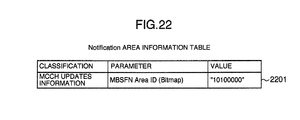
- Fig. 22 is an example of the MCCH updates information (Notification) (Notification area information table) which is notified from the HeNB 202 to the HUE 210.
- the Notification area information table of Fig. 22 includes the MCCH updates information.
- a parameter 2201 denotes an MBSFN area in which the MCCH has been updated.
- a correspondence relation between the parameter 2201 and the MBSFN area ID is indicated with the parameter 2002 in the MCCH transmission information table of Fig. 20 .
- the information of Fig. 22 has been stored in the memory 301 of the HeNB as a Notification area information table 325.
- the information of Fig. 22 which is notified from the HeNB has been stored in the memory 2901 as a Notification area information table 2924.
- the HUE 210 can know the transmission timing of the Notification by obtaining the notification transmission information table of Fig. 21 and can obtain the Notification area information table of Fig. 22 . Further, the HUE can obtain the MCCH SDU on the basis of the presence or absence of the updating of the MCCH by obtaining the Notification area information table of Fig. 22 .
- the information which is notified to the HUE 210 by the HeNB 202 as described above constructs the logical architecture as shown in Fig. 12 . It is sufficient that the HeNB 202 obtains it from the MCE 205.
- the information which is notified to the MCE from the HeNB may be, for example, the format of the table shown in Fig. 20, 21 , or 22 . Or, the HeNB may form the table shown in Fig. 20, 21 , or 22 on the basis of the table of Fig. 14 obtained from the MCE or the table of Fig. 18 obtained from the MeNB.
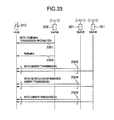
- Fig. 23 is a sequence diagram showing an example of a procedure for allowing the HUE 210 to obtain the MCCH transmission information and perform the MBMS reception.
- the HUE 210 obtains the MCCH transmission information which is transmitted by the HeNB 202 in the format shown in Fig. 20 and the Notification transmission information which is transmitted by the HeNB 202 in the format shown in Fig. 21 .
- the HUE 210 obtains the Notification with reference to the transmission timing of the Notification included in the Notification transmission information notified in the format shown in Fig. 21 .
- the HUE 210 obtains the MCCH SDU which is transmitted from the surrounding MeNB(s) 201 in accordance with the MCCH transmission information notified in the format in Fig. 20 . Further, the HUE 210 obtains the DSI in a sequence 2304. The HUE obtains the correspondence relation between the desired MBMS service to be obtained from the MCCH and the MTCH and obtains the scheduling information of the MTCH from the DSI. In a sequence 2305, the HUE 210 obtains the MTCH SDU corresponding to a desired MBMS service on the basis of them.
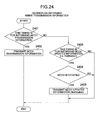
- Fig. 24 is a flowchart showing an example of a procedure (MBMS transmission information notification decision process) for allowing the HeNB 202 to decide whether or not the transmission of the sequences 2301 and 2302 in Fig. 23 is performed.
- the process of Fig. 24 has been stored in the memory 301 in Fig. 3 as a program 312 for the MBMS transmission information notification decision process and is executed by the CPU 302 in Fig. 3 .
- the HeNB 202 determines whether or not the relevant subframe is the transmission timing of the MCCH transmission information by referring to the System information transmission information table 327 (2401).
- the System information transmission information table 327 includes the information of the transmission subframe of the system information which is transmitted by the HeNB.
- the HeNB 202 transmits the MCCH transmission information to the HUE 210 (2402). If it is not the transmission timing of the MCCH transmission information, the HeNB determines whether or not the relevant subframe is the transmission timing of the Notification (2403). If it is the transmission timing of the Notification, the HeNB confirms the presence or absence of the updating of the MCCH (2404). If the MCCH has been updated, the HeNB transmits the Notification to the HUE (2405). If it is not the transmission timing of the Notification or the MCCH is not updated, the HeNB 202 does not transmit the Notification.
- the HUE 210 can obtain the information necessary to perform the MBMS reception from the HeNB 202 instead of the MeNB.
- the HUE 210 can receive the MBMS services which are transmitted from the MeNB.
- the HeNB 202 selects the information which is notified to the HUE 210 by the HeNB 202 in accordance with the information on MBMS support of the HUE 210 or desired MBMS service information of the HUE 210.
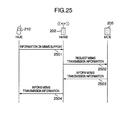
- Fig. 25 is a sequence diagram showing an example of a procedure for selecting the MBMS transmission information in accordance with the information on MBMS support of the HUE 210.
- the HUE. 210 in a sequence 2501, notifies the HeNB 202 of information about whether or not the HeNB itself supporting the MBMS function.
- the HeNB 202 collects the information on MBMS support from each HUE 210 (for example, 105 in Fig. 1 ) belonging into the cell (for example, 106 in Fig. 1 ) of the HeNB 202.
- the HeNB 202 determines whether or not it is necessary to notify the HUE of the MBMS transmission information on the basis of the collected information on MBMS support.
- the HeNB 202 requests the MBMS transmission information to the MCE 205.
- the MCE 205 notifies the HeNB of the MBMS transmission information in response to the request of the MBMS transmission information from the HeNB 202.
- the notification of the MBMS transmission information from the MCE 205 to the HeNB 202 is made, for example, in accordance with the first embodiment.
- the HeNB 202 to which the MBMS transmission information has been notified from the MCE 205 notifies the HUE 210 of the MBMS transmission information in a sequence 2504.
- the notification of the MBMS transmission information from the HeNB 202 to the HUE 210 is made, for example, in accordance with the third embodiment.
- Fig. 26 is a flowchart showing an example of a procedure (MBMS transmission information request decision process) for allowing the HeNB to decide whether or not the HeNB requests the MBMS transmission information in accordance with the information on MBMS support of the HUE.
- the process of Fig. 26 has been stored in the memory 301 in Fig. 3 as a program 311 for the MBMS transmission information request decision process and is executed in the CPU 302 in Fig. 3 .
- the HeNB 202 collects the information on MBMS support of the HUE which is transmitted from each HUE 210 in the sequence 2501 (2601).
- the HeNB 202 determines whether or not the HUE supporting the MBMS function exists in the coverage of the HeNB (2602). If the HUE supporting the MBMS function exists in the coverage of the HeNB, the HeNB 202 requests the MBMS transmission information to the MCE 205 (2603).
- the HeNB 202 has determined the necessity of the MBMS transmission information in the examples of Figs. 25 and 26 , such a decision may be made by the MCE 205. In such a case, the HeNB 202 transmits the information on MBMS support of the HUE collected from the HUE to the MCE 205.
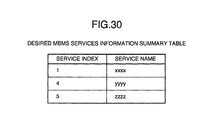
- Fig. 30 shows an example of the desired MBMS services information summary table.
- the desired MBMS services information summary table of Fig. 30 is a table including a service index and a service name of the MBMS services which one of the UEs existing in the coverage of the HeNB desires.
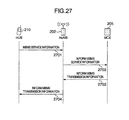
- Fig. 27 is a sequence diagram showing an example of a procedure for selecting the MBMS transmission information in accordance with the desired MBMS service information which the HUE desires.
- the HUE 210 notifies the HeNB 202 of its own desired MBMS service in a format of, for example, the service index from the memory in which the Desired MBMS service information table 2925 has been stored.
- the HeNB 202 collects the Desired MBMS service information from each UE belonging to the femto-cell 106 of the HeNB 202 and stores into the Desired MBMS services information summary table 326.
- the HeNB 202 notifies the MCE 205 of the information of the Desired MBMS services information summary table 326.
- the MCE 205 notifies the HeNB 202 of the MBMS transmission information corresponding to the desired MBMS service in accordance with the desired MBMS service information notified from the HeNB 202.
- the notification of the MBMS transmission information from the MCE to the HeNB in the sequence 2703 is made, for example, in accordance with the first embodiment.
- the HeNB 202 to which the MBMS transmission information corresponding to the desired MBMS service has been notified from the MCE 205 notifies the HUE 210 of the MBMS transmission information in a sequence 2704.
- the notification of the MBMS transmission information from the HeNB to the HUE is made, for example, in accordance with the third embodiment.
- Fig. 28 is a flowchart showing a procedure (MBMS transmission information selecting process) for deciding the MBMS transmission information which is notified to the HeNB 202 from the MCE 205 in accordance with the desired MBMS service information.
- the process of Fig. 28 has been stored in the memory 401 in Fig. 4 as an a program 412 for the MBMS transmission information selecting process.
- the CPU 402 in Fig. 4 reads out such a program and executes the flowchart shown in Fig. 28 .
- the MCE 205 obtains the desired MBMS service information from the HeNB 202 (2801).
- the MCE 205 determines whether or not the obtained desired MBMS service is included in each MCCH and each MCH (2802). If the desired MBMS service is included, the information regarding the relevant MCCH and the relevant MCH is allowed to be included in the MBMS transmission information which is notified to the HeNB 202 from the MCE 205 (MCCH: 2803, MCH: 2804). On the basis of results obtained by executing the processes of 2802 to 2804 with respect to each MCCH and each MCH, the MCE 205 notifies the HeNB 202 of the MBMS transmission information corresponding to the desired MBMS service (2805).
- the HeNB 202 may select the MBMS information which is transmitted.
- whether or not the MBMS transmission information is notified to the HeNB from the MCE may be selected in accordance with a situation of the HUE which is connected to the HeNB like a first embodiment. For example, if the HUE which desires the MBMS service reception does not exist, by stopping the notification of the MBMS transmission information from the MCE to the HeNB, an amount of data communication is reduced, thereby improving use efficiency of the network.
- whether or not the MBMS transmission information is notified to the HUE from the HeNB may be selected in accordance with a situation of the HUE which is connected to the HeNB like a third embodiment. For example, if the HUE which desires the MBMS service reception does not exist, by stopping the notification of the MBMS transmission information from the HeNB to the HUE, an amount of data communication is reduced, thereby improving use efficiency of the radio resources.
- whether or not the HeNB suspends the transmission in the MBMS transmission subframe can be selected in accordance with a situation of the HUE which is connected to the HeNB like a second embodiment. For example, if the HUE which desires the MBMS service reception does not exist, the HeNB does not suspend the transmission in the MBMS transmission subframe but executes the transmission of the unicast data, thereby improving the use efficiency of the radio resources.
Landscapes
- Engineering & Computer Science (AREA)
- Signal Processing (AREA)
- Computer Networks & Wireless Communication (AREA)
- Mobile Radio Communication Systems (AREA)
Applications Claiming Priority (1)
| Application Number | Priority Date | Filing Date | Title |
|---|---|---|---|
| JP2010041282A JP5386404B2 (ja) | 2010-02-26 | 2010-02-26 | 無線通信システム、基地局及びネットワーク制御装置 |
Publications (1)
| Publication Number | Publication Date |
|---|---|
| EP2364052A1 true EP2364052A1 (de) | 2011-09-07 |
Family
ID=43971340
Family Applications (1)
| Application Number | Title | Priority Date | Filing Date |
|---|---|---|---|
| EP11152530A Withdrawn EP2364052A1 (de) | 2010-02-26 | 2011-01-28 | Drahtloses Kommunikationssystem, Basisstation und Netzwerksteuerungsvorrichtung für MBMS Übertragung Koordination |
Country Status (4)
| Country | Link |
|---|---|
| US (1) | US8660049B2 (de) |
| EP (1) | EP2364052A1 (de) |
| JP (1) | JP5386404B2 (de) |
| CN (1) | CN102170612A (de) |
Cited By (1)
| Publication number | Priority date | Publication date | Assignee | Title |
|---|---|---|---|---|
| EP2763445A4 (de) * | 2011-09-30 | 2015-03-25 | Fujitsu Ltd | Verfahren zur implementierung eines multimedia-broadcast- multicast-service, heimbasisstation und benutzervorrichtung |
Families Citing this family (11)
| Publication number | Priority date | Publication date | Assignee | Title |
|---|---|---|---|---|
| KR101468148B1 (ko) * | 2009-10-13 | 2014-12-05 | 한국전자통신연구원 | Mbms 서비스를 위한 제어 정보 구성 장치 및 방법 |
| EP2925043B1 (de) * | 2011-05-03 | 2018-07-04 | Telefonaktiebolaget LM Ericsson (publ) | Knoten und verfahren zur ermöglichung von durch eine drahtlose vorrichtung durchgeführten messungen |
| JP5941924B2 (ja) | 2011-11-07 | 2016-06-29 | 京セラ株式会社 | 移動端末及びプロセッサ |
| CN103947144B (zh) * | 2011-11-23 | 2017-03-08 | Lg电子株式会社 | 在无线通信系统中发送/获得控制信息的方法和设备 |
| CN104094536B (zh) * | 2013-02-01 | 2017-05-31 | Lg电子株式会社 | 用于发送和接收mbsfn子帧的方法和装置 |
| CN105472569B (zh) * | 2014-08-14 | 2020-05-19 | 中兴通讯股份有限公司 | 子帧资源的分配、处理方法及装置 |
| EP3217723B1 (de) * | 2014-11-13 | 2019-04-10 | Huawei Technologies Co. Ltd. | Multimedia-broadcast-multicast-kommunikationsverfahren, vorrichtung und system |
| US9980272B2 (en) * | 2015-09-29 | 2018-05-22 | Verizon Patent And Licensing Inc. | Mitigating interference to eMBMS services in HetNet deployments |
| CN107734465B (zh) | 2016-08-12 | 2019-12-20 | 电信科学技术研究院 | 传输多播业务的方法、接收多播业务的方法及装置 |
| IT201600128328A1 (it) * | 2016-12-19 | 2018-06-19 | Inst Rundfunktechnik Gmbh | Sendernetzwerk versehen mit wenigstens zwei sendern, sender im sendernetzwerk und empfänger in diesem sendernetzwerk |
| CN112107289B (zh) * | 2019-06-19 | 2025-02-18 | 深圳迈瑞生物医疗电子股份有限公司 | 一种监护数据传输方法、监护系统及存储介质 |
Citations (2)
| Publication number | Priority date | Publication date | Assignee | Title |
|---|---|---|---|---|
| JP2009182944A (ja) | 2008-02-01 | 2009-08-13 | Mitsubishi Electric Corp | 移動体通信システム |
| US20090252077A1 (en) * | 2008-04-07 | 2009-10-08 | Qualcomm Incorporated | Method and apparatus for using mbsfn subframes to send unicast information |
Family Cites Families (15)
| Publication number | Priority date | Publication date | Assignee | Title |
|---|---|---|---|---|
| DE60131120T2 (de) * | 2000-02-02 | 2008-08-07 | Ntt Docomo Inc. | Funkbasisstation, Funkbasisstationsauswahlverfahren, Multicast-Signalübertragungsverfahren und Funkendgerät |
| JP3657839B2 (ja) * | 2000-02-02 | 2005-06-08 | 株式会社エヌ・ティ・ティ・ドコモ | 無線基地局 |
| KR100630093B1 (ko) * | 2003-02-25 | 2006-09-27 | 삼성전자주식회사 | 계층 셀 구조에서 신호대 잡음비를 이용한 멀티캐스트서비스 방법 |
| US8577299B2 (en) * | 2004-06-04 | 2013-11-05 | Qualcomm Incorporated | Wireless communication system with configurable cyclic prefix length |
| US8315240B2 (en) * | 2005-07-20 | 2012-11-20 | Qualcomm Incorporated | Enhanced uplink rate indicator |
| US7746839B2 (en) * | 2006-05-30 | 2010-06-29 | Wichorus Inc | Method and system for managing communication in an OFDMA system |
| GB2440984A (en) * | 2006-08-18 | 2008-02-20 | Fujitsu Ltd | Wireless multi-hop communication system |
| US8229423B2 (en) * | 2006-08-22 | 2012-07-24 | Qualcomm Incorporated | Broadcast and multicast services in wireless communication systems |
| US20110044223A1 (en) * | 2006-08-23 | 2011-02-24 | Electronics And Telecommunications Research Institute | Mbms data transmission and receiving in packet based on cellular system |
| JP4729587B2 (ja) * | 2007-01-23 | 2011-07-20 | 三星電子株式会社 | 広帯域無線アクセスシステムにおけるサービスガイドの伝達装置及び方法 |
| US8811198B2 (en) * | 2007-10-24 | 2014-08-19 | Qualcomm Incorporated | Pilot report based on interference indications in wireless communication systems |
| EP2131614B1 (de) * | 2008-05-30 | 2014-01-01 | Alcatel Lucent | Verfahren zur Übertragung von Rundfunkdiensten in einem zellularen Funkkommunikationsnetzwerk über eine Femto-Basisstation und entsprechende Femto-Basisstation |
| KR101174595B1 (ko) * | 2008-06-06 | 2012-08-16 | 노키아 지멘스 네트웍스 오와이 | 셀?선택적 네트워크 액세스 |
| US8428018B2 (en) * | 2008-09-26 | 2013-04-23 | Lg Electronics Inc. | Method of transmitting reference signals in a wireless communication having multiple antennas |
| US9084119B2 (en) * | 2009-01-07 | 2015-07-14 | Qualcomm Incorporated | Carrier reuse in a multicarrier wireless communication environment |
-
2010
- 2010-02-26 JP JP2010041282A patent/JP5386404B2/ja not_active Expired - Fee Related
-
2011
- 2011-01-28 EP EP11152530A patent/EP2364052A1/de not_active Withdrawn
- 2011-01-28 US US13/015,810 patent/US8660049B2/en not_active Expired - Fee Related
- 2011-01-31 CN CN201110034106XA patent/CN102170612A/zh active Pending
Patent Citations (2)
| Publication number | Priority date | Publication date | Assignee | Title |
|---|---|---|---|---|
| JP2009182944A (ja) | 2008-02-01 | 2009-08-13 | Mitsubishi Electric Corp | 移動体通信システム |
| US20090252077A1 (en) * | 2008-04-07 | 2009-10-08 | Qualcomm Incorporated | Method and apparatus for using mbsfn subframes to send unicast information |
Non-Patent Citations (3)
| Title |
|---|
| "LTE; Evolved Universal Terrestrial Radio Access (E-UTRA) and Evolved Universal Terrestrial Radio Access Network (E-UTRAN); Overall description; Stage 2 (3GPP TS 36.300 version 9.2.0 Release 9)", TECHNICAL SPECIFICATION, EUROPEAN TELECOMMUNICATIONS STANDARDS INSTITUTE (ETSI), 650, ROUTE DES LUCIOLES ; F-06921 SOPHIA-ANTIPOLIS ; FRANCE, vol. 3GPP RAN 2, no. V9.2.0, 1 February 2010 (2010-02-01), XP014046900 * |
| ALCATEL-LUCENT SHANGHAI BELL ET AL: "Service multiplexing and signalling for eMBMS", 3GPP DRAFT; R3-091301_SERVICEMUX, 3RD GENERATION PARTNERSHIP PROJECT (3GPP), MOBILE COMPETENCE CENTRE ; 650, ROUTE DES LUCIOLES ; F-06921 SOPHIA-ANTIPOLIS CEDEX ; FRANCE, no. San Francisco, USA; 20090429, 29 April 2009 (2009-04-29), XP050341653 * |
| ERICSSON: "MCCH Content for eMBMS Rel-9", 3GPP DRAFT; R2-093299 MCCH CONTENT, 3RD GENERATION PARTNERSHIP PROJECT (3GPP), MOBILE COMPETENCE CENTRE ; 650, ROUTE DES LUCIOLES ; F-06921 SOPHIA-ANTIPOLIS CEDEX ; FRANCE, no. San Francisco, USA; 20090429, 29 April 2009 (2009-04-29), XP050340968 * |
Cited By (2)
| Publication number | Priority date | Publication date | Assignee | Title |
|---|---|---|---|---|
| EP2763445A4 (de) * | 2011-09-30 | 2015-03-25 | Fujitsu Ltd | Verfahren zur implementierung eines multimedia-broadcast- multicast-service, heimbasisstation und benutzervorrichtung |
| US9699764B2 (en) | 2011-09-30 | 2017-07-04 | Fujitsu Limited | Method for carrying out multimedia broadcast multicast service, home base station and user equipment |
Also Published As
| Publication number | Publication date |
|---|---|
| JP5386404B2 (ja) | 2014-01-15 |
| JP2011181993A (ja) | 2011-09-15 |
| CN102170612A (zh) | 2011-08-31 |
| US8660049B2 (en) | 2014-02-25 |
| US20110211519A1 (en) | 2011-09-01 |
Similar Documents
| Publication | Publication Date | Title |
|---|---|---|
| US8660049B2 (en) | Wireless communication system, base station and network control apparatus | |
| JP7709419B2 (ja) | ワイヤレス通信システムにおけるエネルギー効率の良いユニキャット及びマルチキャスト伝送のための方法 | |
| CN113271553B (zh) | 用于处理组播/广播服务数据的方法及其设备 | |
| CN113301655B (zh) | 一种使用无线接口技术的方法以及装置和通信系统 | |
| KR101552363B1 (ko) | Mbms서비스를 지원하는 장치 | |
| US8532683B2 (en) | Simple distributed coordination among cells to achieve efficient dynamic single-frequency network (SFN) operation | |
| KR101700543B1 (ko) | 채널 추정을 위한 의사 동일 위치된 안테나 포트 | |
| WO2017097227A1 (en) | Systems and methods for determining air interface configuration | |
| US20170111885A1 (en) | Wireless communication system, communication control method, radio base station, radio terminal, and storage medium | |
| US8913539B2 (en) | Method and apparatus for updating multicast and broadcast service system information in a wireless access system | |
| KR20160086269A (ko) | 단일 셀 멀티전송 데이터를 송수신하는 방법 및 그 장치 | |
| EP2265047B1 (de) | Verfahren zur Verwaltung einer Multimedia-Broadcast/Multicast-Dienst-Übertragung und zugehörige Kommunikationsvorrichtung | |
| CN110557831B (zh) | 一种同播sc-ptm系统中控制面信息的传输方法和设备 | |
| WO2013102279A1 (en) | A method of selecting a transmission mode of a cell in an e_utran system | |
| CN111447565B (zh) | Mbms专用sib的发送方法、装置、系统及存储介质 |
Legal Events
| Date | Code | Title | Description |
|---|---|---|---|
| PUAI | Public reference made under article 153(3) epc to a published international application that has entered the european phase |
Free format text: ORIGINAL CODE: 0009012 |
|
| 17P | Request for examination filed |
Effective date: 20110527 |
|
| AK | Designated contracting states |
Kind code of ref document: A1 Designated state(s): AL AT BE BG CH CY CZ DE DK EE ES FI FR GB GR HR HU IE IS IT LI LT LU LV MC MK MT NL NO PL PT RO RS SE SI SK SM TR |
|
| AX | Request for extension of the european patent |
Extension state: BA ME |
|
| 17Q | First examination report despatched |
Effective date: 20130423 |
|
| STAA | Information on the status of an ep patent application or granted ep patent |
Free format text: STATUS: THE APPLICATION IS DEEMED TO BE WITHDRAWN |
|
| 18D | Application deemed to be withdrawn |
Effective date: 20150324 |