EP2364088B1 - Analogues de sphingosine 1-phosphate d aryle bicyclique - Google Patents
Analogues de sphingosine 1-phosphate d aryle bicyclique Download PDFInfo
- Publication number
- EP2364088B1 EP2364088B1 EP09823936.1A EP09823936A EP2364088B1 EP 2364088 B1 EP2364088 B1 EP 2364088B1 EP 09823936 A EP09823936 A EP 09823936A EP 2364088 B1 EP2364088 B1 EP 2364088B1
- Authority
- EP
- European Patent Office
- Prior art keywords
- naphthalen
- amino
- propan
- trans
- trifluoromethyl
- Prior art date
- Legal status (The legal status is an assumption and is not a legal conclusion. Google has not performed a legal analysis and makes no representation as to the accuracy of the status listed.)
- Active
Links
- 0 CC[C@](C*)(c(c(*)c1*)c(*)c(c(*)c2*)c1c(*)c2OC(*)*C(*)*I=C)N Chemical compound CC[C@](C*)(c(c(*)c1*)c(*)c(c(*)c2*)c1c(*)c2OC(*)*C(*)*I=C)N 0.000 description 3
Images


Classifications
-
- A—HUMAN NECESSITIES
- A61—MEDICAL OR VETERINARY SCIENCE; HYGIENE
- A61K—PREPARATIONS FOR MEDICAL, DENTAL OR TOILETRY PURPOSES
- A61K31/00—Medicinal preparations containing organic active ingredients
- A61K31/13—Amines
- A61K31/135—Amines having aromatic rings, e.g. ketamine, nortriptyline
-
- A—HUMAN NECESSITIES
- A61—MEDICAL OR VETERINARY SCIENCE; HYGIENE
- A61K—PREPARATIONS FOR MEDICAL, DENTAL OR TOILETRY PURPOSES
- A61K31/00—Medicinal preparations containing organic active ingredients
- A61K31/21—Esters, e.g. nitroglycerine, selenocyanates
- A61K31/27—Esters, e.g. nitroglycerine, selenocyanates of carbamic or thiocarbamic acids, meprobamate, carbachol, neostigmine
-
- A—HUMAN NECESSITIES
- A61—MEDICAL OR VETERINARY SCIENCE; HYGIENE
- A61P—SPECIFIC THERAPEUTIC ACTIVITY OF CHEMICAL COMPOUNDS OR MEDICINAL PREPARATIONS
- A61P1/00—Drugs for disorders of the alimentary tract or the digestive system
-
- A—HUMAN NECESSITIES
- A61—MEDICAL OR VETERINARY SCIENCE; HYGIENE
- A61P—SPECIFIC THERAPEUTIC ACTIVITY OF CHEMICAL COMPOUNDS OR MEDICINAL PREPARATIONS
- A61P11/00—Drugs for disorders of the respiratory system
- A61P11/06—Antiasthmatics
-
- A—HUMAN NECESSITIES
- A61—MEDICAL OR VETERINARY SCIENCE; HYGIENE
- A61P—SPECIFIC THERAPEUTIC ACTIVITY OF CHEMICAL COMPOUNDS OR MEDICINAL PREPARATIONS
- A61P17/00—Drugs for dermatological disorders
- A61P17/06—Antipsoriatics
-
- A—HUMAN NECESSITIES
- A61—MEDICAL OR VETERINARY SCIENCE; HYGIENE
- A61P—SPECIFIC THERAPEUTIC ACTIVITY OF CHEMICAL COMPOUNDS OR MEDICINAL PREPARATIONS
- A61P19/00—Drugs for skeletal disorders
- A61P19/02—Drugs for skeletal disorders for joint disorders, e.g. arthritis, arthrosis
-
- A—HUMAN NECESSITIES
- A61—MEDICAL OR VETERINARY SCIENCE; HYGIENE
- A61P—SPECIFIC THERAPEUTIC ACTIVITY OF CHEMICAL COMPOUNDS OR MEDICINAL PREPARATIONS
- A61P25/00—Drugs for disorders of the nervous system
-
- A—HUMAN NECESSITIES
- A61—MEDICAL OR VETERINARY SCIENCE; HYGIENE
- A61P—SPECIFIC THERAPEUTIC ACTIVITY OF CHEMICAL COMPOUNDS OR MEDICINAL PREPARATIONS
- A61P29/00—Non-central analgesic, antipyretic or antiinflammatory agents, e.g. antirheumatic agents; Non-steroidal antiinflammatory drugs [NSAID]
-
- A—HUMAN NECESSITIES
- A61—MEDICAL OR VETERINARY SCIENCE; HYGIENE
- A61P—SPECIFIC THERAPEUTIC ACTIVITY OF CHEMICAL COMPOUNDS OR MEDICINAL PREPARATIONS
- A61P3/00—Drugs for disorders of the metabolism
- A61P3/08—Drugs for disorders of the metabolism for glucose homeostasis
- A61P3/10—Drugs for disorders of the metabolism for glucose homeostasis for hyperglycaemia, e.g. antidiabetics
-
- A—HUMAN NECESSITIES
- A61—MEDICAL OR VETERINARY SCIENCE; HYGIENE
- A61P—SPECIFIC THERAPEUTIC ACTIVITY OF CHEMICAL COMPOUNDS OR MEDICINAL PREPARATIONS
- A61P37/00—Drugs for immunological or allergic disorders
-
- C—CHEMISTRY; METALLURGY
- C07—ORGANIC CHEMISTRY
- C07C—ACYCLIC OR CARBOCYCLIC COMPOUNDS
- C07C205/00—Compounds containing nitro groups bound to a carbon skeleton
- C07C205/13—Compounds containing nitro groups bound to a carbon skeleton the carbon skeleton being further substituted by hydroxy groups
- C07C205/26—Compounds containing nitro groups bound to a carbon skeleton the carbon skeleton being further substituted by hydroxy groups and being further substituted by halogen atoms
-
- C—CHEMISTRY; METALLURGY
- C07—ORGANIC CHEMISTRY
- C07C—ACYCLIC OR CARBOCYCLIC COMPOUNDS
- C07C205/00—Compounds containing nitro groups bound to a carbon skeleton
- C07C205/49—Compounds containing nitro groups bound to a carbon skeleton the carbon skeleton being further substituted by carboxyl groups
- C07C205/50—Compounds containing nitro groups bound to a carbon skeleton the carbon skeleton being further substituted by carboxyl groups having nitro groups and carboxyl groups bound to acyclic carbon atoms of the carbon skeleton
-
- C—CHEMISTRY; METALLURGY
- C07—ORGANIC CHEMISTRY
- C07C—ACYCLIC OR CARBOCYCLIC COMPOUNDS
- C07C217/00—Compounds containing amino and etherified hydroxy groups bound to the same carbon skeleton
- C07C217/52—Compounds containing amino and etherified hydroxy groups bound to the same carbon skeleton having etherified hydroxy groups or amino groups bound to carbon atoms of rings other than six-membered aromatic rings of the same carbon skeleton
-
- C—CHEMISTRY; METALLURGY
- C07—ORGANIC CHEMISTRY
- C07C—ACYCLIC OR CARBOCYCLIC COMPOUNDS
- C07C217/00—Compounds containing amino and etherified hydroxy groups bound to the same carbon skeleton
- C07C217/54—Compounds containing amino and etherified hydroxy groups bound to the same carbon skeleton having etherified hydroxy groups bound to carbon atoms of at least one six-membered aromatic ring and amino groups bound to acyclic carbon atoms or to carbon atoms of rings other than six-membered aromatic rings of the same carbon skeleton
- C07C217/56—Compounds containing amino and etherified hydroxy groups bound to the same carbon skeleton having etherified hydroxy groups bound to carbon atoms of at least one six-membered aromatic ring and amino groups bound to acyclic carbon atoms or to carbon atoms of rings other than six-membered aromatic rings of the same carbon skeleton with amino groups linked to the six-membered aromatic ring, or to the condensed ring system containing that ring, by carbon chains not further substituted by singly-bound oxygen atoms
- C07C217/60—Compounds containing amino and etherified hydroxy groups bound to the same carbon skeleton having etherified hydroxy groups bound to carbon atoms of at least one six-membered aromatic ring and amino groups bound to acyclic carbon atoms or to carbon atoms of rings other than six-membered aromatic rings of the same carbon skeleton with amino groups linked to the six-membered aromatic ring, or to the condensed ring system containing that ring, by carbon chains not further substituted by singly-bound oxygen atoms linked by carbon chains having two carbon atoms between the amino groups and the six-membered aromatic ring or the condensed ring system containing that ring
-
- C—CHEMISTRY; METALLURGY
- C07—ORGANIC CHEMISTRY
- C07C—ACYCLIC OR CARBOCYCLIC COMPOUNDS
- C07C229/00—Compounds containing amino and carboxyl groups bound to the same carbon skeleton
- C07C229/02—Compounds containing amino and carboxyl groups bound to the same carbon skeleton having amino and carboxyl groups bound to acyclic carbon atoms of the same carbon skeleton
- C07C229/32—Compounds containing amino and carboxyl groups bound to the same carbon skeleton having amino and carboxyl groups bound to acyclic carbon atoms of the same carbon skeleton the carbon skeleton being unsaturated and containing rings other than six-membered aromatic rings
-
- C—CHEMISTRY; METALLURGY
- C07—ORGANIC CHEMISTRY
- C07C—ACYCLIC OR CARBOCYCLIC COMPOUNDS
- C07C271/00—Derivatives of carbamic acids, i.e. compounds containing any of the groups, the nitrogen atom not being part of nitro or nitroso groups
- C07C271/06—Esters of carbamic acids
- C07C271/08—Esters of carbamic acids having oxygen atoms of carbamate groups bound to acyclic carbon atoms
- C07C271/10—Esters of carbamic acids having oxygen atoms of carbamate groups bound to acyclic carbon atoms with the nitrogen atoms of the carbamate groups bound to hydrogen atoms or to acyclic carbon atoms
- C07C271/16—Esters of carbamic acids having oxygen atoms of carbamate groups bound to acyclic carbon atoms with the nitrogen atoms of the carbamate groups bound to hydrogen atoms or to acyclic carbon atoms to carbon atoms of hydrocarbon radicals substituted by singly-bound oxygen atoms
-
- C—CHEMISTRY; METALLURGY
- C07—ORGANIC CHEMISTRY
- C07D—HETEROCYCLIC COMPOUNDS
- C07D263/00—Heterocyclic compounds containing 1,3-oxazole or hydrogenated 1,3-oxazole rings
- C07D263/02—Heterocyclic compounds containing 1,3-oxazole or hydrogenated 1,3-oxazole rings not condensed with other rings
- C07D263/30—Heterocyclic compounds containing 1,3-oxazole or hydrogenated 1,3-oxazole rings not condensed with other rings having two or three double bonds between ring members or between ring members and non-ring members
- C07D263/34—Heterocyclic compounds containing 1,3-oxazole or hydrogenated 1,3-oxazole rings not condensed with other rings having two or three double bonds between ring members or between ring members and non-ring members with hetero atoms or with carbon atoms having three bonds to hetero atoms with at the most one bond to halogen, e.g. ester or nitrile radicals, directly attached to ring carbon atoms
- C07D263/36—One oxygen atom
- C07D263/38—One oxygen atom attached in position 2
-
- C—CHEMISTRY; METALLURGY
- C07—ORGANIC CHEMISTRY
- C07F—ACYCLIC, CARBOCYCLIC OR HETEROCYCLIC COMPOUNDS CONTAINING ELEMENTS OTHER THAN CARBON, HYDROGEN, HALOGEN, OXYGEN, NITROGEN, SULFUR, SELENIUM OR TELLURIUM
- C07F9/00—Compounds containing elements of Groups 5 or 15 of the Periodic Table
- C07F9/02—Phosphorus compounds
- C07F9/06—Phosphorus compounds without P—C bonds
- C07F9/08—Esters of oxyacids of phosphorus
- C07F9/09—Esters of phosphoric acids
- C07F9/091—Esters of phosphoric acids with hydroxyalkyl compounds with further substituents on alkyl
-
- C—CHEMISTRY; METALLURGY
- C07—ORGANIC CHEMISTRY
- C07F—ACYCLIC, CARBOCYCLIC OR HETEROCYCLIC COMPOUNDS CONTAINING ELEMENTS OTHER THAN CARBON, HYDROGEN, HALOGEN, OXYGEN, NITROGEN, SULFUR, SELENIUM OR TELLURIUM
- C07F9/00—Compounds containing elements of Groups 5 or 15 of the Periodic Table
- C07F9/02—Phosphorus compounds
- C07F9/06—Phosphorus compounds without P—C bonds
- C07F9/08—Esters of oxyacids of phosphorus
- C07F9/09—Esters of phosphoric acids
- C07F9/093—Polyol derivatives esterified at least twice by phosphoric acid groups
-
- C—CHEMISTRY; METALLURGY
- C07—ORGANIC CHEMISTRY
- C07F—ACYCLIC, CARBOCYCLIC OR HETEROCYCLIC COMPOUNDS CONTAINING ELEMENTS OTHER THAN CARBON, HYDROGEN, HALOGEN, OXYGEN, NITROGEN, SULFUR, SELENIUM OR TELLURIUM
- C07F9/00—Compounds containing elements of Groups 5 or 15 of the Periodic Table
- C07F9/02—Phosphorus compounds
- C07F9/547—Heterocyclic compounds, e.g. containing phosphorus as a ring hetero atom
- C07F9/6527—Heterocyclic compounds, e.g. containing phosphorus as a ring hetero atom having nitrogen and oxygen atoms as the only ring hetero atoms
- C07F9/653—Five-membered rings
-
- C—CHEMISTRY; METALLURGY
- C07—ORGANIC CHEMISTRY
- C07F—ACYCLIC, CARBOCYCLIC OR HETEROCYCLIC COMPOUNDS CONTAINING ELEMENTS OTHER THAN CARBON, HYDROGEN, HALOGEN, OXYGEN, NITROGEN, SULFUR, SELENIUM OR TELLURIUM
- C07F9/00—Compounds containing elements of Groups 5 or 15 of the Periodic Table
- C07F9/02—Phosphorus compounds
- C07F9/547—Heterocyclic compounds, e.g. containing phosphorus as a ring hetero atom
- C07F9/6564—Heterocyclic compounds, e.g. containing phosphorus as a ring hetero atom having phosphorus atoms, with or without nitrogen, oxygen, sulfur, selenium or tellurium atoms, as ring hetero atoms
- C07F9/6571—Heterocyclic compounds, e.g. containing phosphorus as a ring hetero atom having phosphorus atoms, with or without nitrogen, oxygen, sulfur, selenium or tellurium atoms, as ring hetero atoms having phosphorus and oxygen atoms as the only ring hetero atoms
- C07F9/6574—Esters of oxyacids of phosphorus
- C07F9/65744—Esters of oxyacids of phosphorus condensed with carbocyclic or heterocyclic rings or ring systems
Definitions
- Sphingosine 1-phosphate is a lysophospholipid mediator that evokes a variety of cellular responses by stimulation of five members of the endothelial cell differentiation gene (EDG) receptor family.
- EDG endothelial cell differentiation gene
- the EDG receptors are G-protein coupled receptors (GPCRs) and on stimulation propagate second messenger signals via activation of heterotrimeric G-protein alpha (G ⁇ ) subunits and beta-gamma (G ⁇ ) dimers.
- GPCRs G-protein coupled receptors
- the immunomodulator FTY720 (2-amino-2-[2-(4-octylphenyl) ethyl] propane 1,3-diol), that following phosphorylation, is an agonist at 4 of 5 S1P receptors, revealed that enhancing S1P tone influences lymphocyte trafficking.
- S1P type 1 receptor (S1P 1 ) antagonists cause leakage of the lung capillary endothelium, which suggests that S1P may be involved in maintaining the integrity of the endothelial barrier in some tissue beds.
- S1P has been demonstrated to induce many cellular processes, including those that result in platelet aggregation, cell proliferation, cell morphology, tumor-cell invasion, endothelial cell chemotaxis and angiogenesis. For these reasons, S1P receptors are good targets for therapeutic applications such as wound healing and tumor growth inhibition.
- Sphingosine-1-phosphate signals cells in part via a set of G protein-coupled receptors named S1P 1 , S1P 2 , S1P 3 , S1P 4 , and S1P 5 (formerly EDG1, EDG5, EDG3, EDG6 and EDG8).
- the EDG receptors are G-protein coupled receptors (GPCRs) and on stimulation propagate second messenger signals via activation of heterotrimeric G-protein alpha (G ⁇ ) subunits and beta-gamma (G ⁇ ) dimers. These receptors share 50-55% amino acid sequence identity and cluster with three other receptors (LPA 1 , LPA 2 , and LPA 3 (formerly EDG2, EDG4 and EDG7) for the structurally related lysophosphatidic acid (LPA).
- GPCR G-Protein Coupled Receptor
- S1P receptors make good drug targets because individual receptors are both tissue and response specific. Tissue specificity of the S1P receptors is desirable because development of an agonist or antagonist selective for one receptor localizes the cellular response to tissues containing that receptor, limiting unwanted side effects. Response specificity of the S1P receptors is also of importance because it allows for the development of agonists or antagonists that initiate or suppress certain cellular responses without affecting other responses. For example, the response specificity of the S1P receptors could allow for an S1P mimetic that initiates platelet aggregation without affecting cell morphology.
- Sphingosine-1-phosphate is formed as a metabolite of sphingosine in its reaction with sphingosine kinase and is stored in abundance in the aggregates of platelets where high levels of sphingosine kinase exist and sphingosine lyase is lacking.
- S1P is released during platelet aggregation, accumulates in serum, and is also found in malignant ascites. Reversible biodegradation of S1P most likely proceeds via hydrolysis by ectophosphohydrolases, specifically the sphingosine 1- phosphate phosphohydrolases. Irreversible degradation of S1P is catalyzed by S1P lyase yielding ethanolamine phosphate and hexadecenal.
- a class of S1P agonist compounds are described in PCT/US2008/073378 (published as WO 2009/023854 ).
- each of X 1 , X 2 , X 3 , X 4 , X 5 , and X 6 can be hydrogen, halo, hydroxy, nitro, cyano, alkyl, haloalkyl, cycloalkyl, halocycloalkyl, alkoxy, haloalkoxy, cycloalkoxy, halocycloalkoxy, acyl, aminoacyl, -NR f R g , -N(R f )SO 2 R g , -SO 2 R f , -SO 2 NR f R g , -CO 2 R f trialkylamino, aryl, or heteroaryl.
- Y can be -OR f , -(CR f R g )OR f , -(CR f R g ) 2 OR f ; -O-P(O)(OR f )OR g , -OC(O)R c , -C(O)OR c .
- W can be -CR f R g -, -NR f -, -O-, -S-, -SO-, or -SO 2 -.
- Cy can be cycloalkyl, cycloalkenyl, heterocyclyl, aryl, or heteroaryl. Cy can be optionally substituted by 1-6 substituents selected from the group consisting of hydrogen, halo, hydroxy, nitro, cyano, -NR f R g , alkyl, haloalkyl, cycloalkyl, cycloalkenyl, cycloalkylalkyl, cycloalkenylalkyl, heterocyclylalkyl, arylalkyl, heteroarylalkyl, alkoxy, haloalkoxy, cycloalkylalkoxy, cycloalkenylalkoxy, heterocyclylalkoxy, aryloxy, arylalkoxy, heteroaryloxy, heteroarylalkoxy, acyl, cycloalkylacyl, cycloalkenylacyl, heterocyclylacyl, arylacyl, heteroarylacyl,
- L 1 can be -CH 2 -, -CHF-, or -CF 2 -.
- Z 4 can be hydrogen, halo, alkyl, haloalkyl, alkenyl, haloalkenyl, alkynyl, or -OR f .
- Z 4 can be -CH 2 - bound to the carbon atom to which Y is bound.
- L 1 , Z 4 , Y, and the atoms to which they are bound can form a 4-7 membered cycloalkyl group or a 4-7 membered heterocyclyl group having 1 or 2 heteroatoms selected from O and N.
- R a is hydrogen, alkyl, haloalkyl, alkenyl, alkynyl, cycloalkyl, cycloalkenyl, aryl, heteroaryl, or heterocyclyl; wherein each of alkyl, cycloalkyl, cycloalkenyl, aryl, heteroaryl and heterocycle are optionally substituted with 1 to 5 substituents independently selected from the group consisting of halo, oxo, -CN, -CHO, -CF 3 , -OH, -NO 2 , alkyl, -OCF 3 , alkoxy, cycloalkoxy, cycloalkenoxy, amino, alkylamino, dialkylamino, acylamino, aminoacyl, alkylsulfonyl, alkylaminosulfonyl, and dialkylaminosulfonyl.
- R b is hydrogen, alkyl, haloalkyl, alkenyl, alkynyl, cycloalkyl, cycloalkenyl, aryl, heteroaryl, or heterocyclyl; wherein each of alkyl, cycloalkyl, cycloalkenyl, aryl, heteroaryl and heterocycle are optionally substituted with 1 to 5 substituents independently selected from the group consisting of halo, oxo, -CN, -CHO, -CF 3 , -OH, -NO 2 , alkyl, -OCF 3 , alkoxy, cycloalkoxy, cycloalkenoxy, amino, alkylamino, dialkylamino, acylamino, aminoacyl, alkylsulfonyl, alkylaminosulfonyl, and dialkylaminosulfonyl.
- R c is alkyl, aryl, trifluoromethyl, methylsulfonyl, trifluoromethylsulfonyl, p-tolylsulfonyl, or a group selected such that -OCOR c is a leaving group.
- Each R f is hydrogen, alkyl, haloalkyl, alkenyl, alkynyl, cycloalkyl, cycloalkenyl, aryl, heteroaryl, or heterocyclyl; wherein each of alkyl, cycloalkyl, cycloalkenyl, aryl, heteroaryl and heterocycle are optionally substituted with 1 to 5 substituents independently selected from the group consisting of halo, oxo, -CN, -CHO, -CF 3 , -OH, -NO 2 , alkyl, -OCF 3 , alkoxy, cycloalkoxy, cycloalkenoxy, amino, alkylamino, dialkylamino, acylamino, aminoacyl, alkylsulfonyl, alkylaminosulfonyl, and dialkylaminosulfonyl.
- Each R g is hydrogen, alkyl, haloalkyl, alkenyl, alkynyl, cycloalkyl, cycloalkenyl, aryl, heteroaryl, or heterocyclyl; wherein each of alkyl, cycloalkyl, cycloalkenyl, aryl, heteroaryl and heterocycle are optionally substituted with 1 to 5 substituents independently selected from the group consisting of halo, oxo, -CN, -CHO, -CF 3 , -OH, -NO 2 , alkyl, -OCF 3 , alkoxy, cycloalkoxy, cycloalkenoxy, amino, alkylamino, dialkylamino, acylamino, aminoacyl, alkylsulfonyl, alkylaminosulfonyl, and dialkylaminosulfonyl.
- the compound can be in the form of a pharmaceutically acceptable salt or prodrug.
- W is -O-.
- R a and R b independently, can each be H or alkyl.
- Y can be -OR f .
- Y is -OH or -O-P(O)(OR f )OR g .
- X 6 can be H, halo, alkyl, cycloalkyl, or haloalkyl.
- Each R d can be H, halo, hydroxy, alkyl, haloalkyl, alkenyl, alkoxy, cycloalkyl, -C(O)NR f R g , -NR f R g , -NR f C(O)R g , or -SO 2 NR f R g .
- Each R e can be H, halo, hydroxy, alkyl, haloalkyl, alkenyl, alkoxy, cycloalkyl, -C(O)NR f R g , -NR f R g , -NR f C(O)R g , or -SO 2 NR f R g .
- R 1a and R 1b can be hydrogen, halo, hydroxy, nitro, cyano, -NR f R g , alkyl, haloalkyl, cycloalkyl, cycloalkenyl, cycloalkylalkyl, cycloalkenylalkyl, heterocyclylalkyl, arylalkyl, heteroarylalkyl, alkoxy, cycloalkylalkoxy, cycloalkenylalkoxy, heterocyclylalkoxy, arylalkoxy, heteroarylalkoxy, acyl, cycloalkylacyl, cycloalkenylacyl, heterocyclylacyl, arylacyl, heteroarylacyl, thioalkyl, alkenyl, alkynyl, cycloalkenyl, heterocyclyl, aryl, or heteroaryl.
- R 1a and R 1b when taken together, are C 2 -C 5 alkylene optionally terminated by or inturrepted by 1 or 2 oxygen atoms, or C 2 -C 5 alkenylene optionally terminated by or inturrepted by 1 or 2 oxygen atoms, thereby forming a bicyclic ring system.
- R 2a and R 2b can be hydrogen, halo, hydroxy, nitro, cyano, -NR f R g , alkyl, haloalkyl, cycloalkyl, cycloalkenyl, cycloalkylalkyl, cycloalkenylalkyl, heterocyclylalkyl, arylalkyl, heteroarylalkyl, alkoxy, cycloalkylalkoxy, cycloalkenylalkoxy, heterocyclylalkoxy, arylalkoxy, heteroarylalkoxy, acyl, cycloalkylacyl, cycloalkenylacyl, heterocyclylacyl, arylacyl, heteroarylacyl, thioalkyl, alkenyl, alkynyl, cycloalkenyl, heterocyclyl, aryl, or heteroaryl.
- R 1a and R 2a when taken together, are C 1 -C 5 alkylene optionally terminated by or inturrepted by 1 or 2 oxygen atoms, or C 2 -C 5 alkenylene optionally terminated by or inturrepted by 1 or 2 oxygen atoms, thereby forming a bicyclic ring structure.
- R 1a , R 1b , R 2a , and R 2b can each, independently, be substituted with 0-5 substituents selected from halo, hydroxy, nitro, cyano, -NR f R g , or -CO 2 R f .
- R 1a and R 2a are both hydrogen.
- Z 1 can be -CH 2 CH 2 -.
- Z 2 can be -CH 2 -.
- Z 3 can be a bond.
- R 1b can be fluoro, chloro, bromo, iodo, methyl, difluoromethyl, triflurormethyl, ethyl, 1,1-diflurorethyl, propyl, isopropyl, n-butyl, i-butyl, t-butyl, n-pentyl, isopentyl, 1,1-dimethylpropyl, neopentyl, cyclopentyl, n-hexyl, cyclohexyl, methoxy, trifluoromethoxy, ethoxy, n-propoxy, i-propoxy, n-butoxy, i-butoxy, t-butoxy, n-pentyloxy, i-pentyloxy, 1,1-dimethylpropoxy, neopentyloxy, cyclopentyloxy, n-hexyloxy, or cyclohexyloxy.
- R 1a can be hydrogen, halo, hydroxy, nitro, cyano, -NR f R g , alkyl, haloalkyl, cycloalkyl, cycloalkenyl, cycloalkylalkyl, cycloalkenylalkyl, heterocyclylalkyl, arylalkyl, heteroarylalkyl, alkoxy, cycloalkylalkoxy, cycloalkenylalkoxy, heterocyclylalkoxy, arylalkoxy, heteroarylalkoxy, acyl, cycloalkylacyl, cycloalkenylacyl, heterocyclylacyl, arylacyl, heteroarylacyl, thioalkyl, alkenyl, alkyl, haloalkyl, cycloalkenyl, cycloalkylalkyl, cycloalkenylalkyl, heterocyclylalkyl, arylacyl
- Each R d independently, is hydrogen, halo, hydroxy, alkyl, alkenyl, alkoxy, or cycloalkyl.
- Each R e independently, is hydrogen, halo, hydroxy, alkyl, alkenyl, alkoxy, or cycloalkyl.
- the compound of formula (II) can be in the form of a pharmaceutically acceptable salt or prodrug.
- Y can be -OR f . In some circumstances, Y can be -OH or -O-P(O)(OR f )OR g .
- X 6 can be H, halo, alkyl, cycloalkyl, or haloalkyl.
- Z 1 can be -CH 2 CH 2 -.
- Z 2 can be -CH 2 CH 2 -.
- R 1a can be hydrogen, halo, hydroxy, alkyl, haloalkyl, cycloalkyl, cycloalkylalkyl, arylalkyl, alkoxy, cycloalkylalkoxy, arylalkoxy, or aryl.
- Y is -OH or -OP(O)(OH) 2 ;
- Z 4 is H or -OH;
- X 1 , X 2 , X 3 , X 4 , and X 5 are each H; and
- X 6 is H, halo, alkyl, cycloalkyl, or haloalkyl.
- Z 1 can be -(CH 2 ) x - and
- Z 2 can be -(CH 2 ) y -.
- R 1a can be alkyl, haloalkyl, cycloalkyl, aryl, or arylalkoxy.
- the compound of formula (II) has the formula: i.e., where R 1a and the oxygen atom bound to the cyclohexyl ring are in the trans- orientation with respect to one another.
- Also disclosed herein is a compound selected from the group consisting of:
- composition which includes a pharmaceutically acceptable carrier and a compound of formula (I), as defined above.
- Also disclosed herein is a method of making a compound of formula (I) which includes contacting a compound of formula III: with a compound having the formula: Cy-OH.
- each of X 1 , X 2 , X 3 , X 4 , X 5 , X 6 , Y and Z 4 is as defined above for formula (I), and R 3 has the formula: in which Z 4 is H or -OR f (where R f is as defined in formula (I)), R a is as defined in formula (I), and Pg is an amino protecting group.
- Cy can be cycloalkyl, cycloalkenyl, heterocyclyl, aryl, or heteroaryl; in which Cy is optionally substituted by 1-6 substituents selected from the group consisting of hydrogen, halo, hydroxy, nitro, cyano, -NR f R g , alkyl, haloalkyl, cycloalkyl, cycloalkenyl, cycloalkylalkyl, cycloalkenylalkyl, heterocyclylalkyl, arylalkyl, heteroarylalkyl, alkoxy, haloalkoxy, cycloalkylalkoxy, cycloalkenylalkoxy, heterocyclylalkoxy, aryloxy, arylalkoxy, heteroaryloxy, heteroarylalkoxy, acyl, cycloalkylacyl, cycloalkenylacyl, heterocyclylacyl, aryl
- Also disclosed herein is a method for prevention or treatment of a pathological condition or symptom in a mammal, wherein the activity of sphingosine 1-phosphate receptors is implicated and agonism of such activity is desired, which includes administering to said mammal an effective amount of a compound of formula (I).
- the pathological condition can be neuropathic pain or an autoimmune disease.
- The can include adminstering to said mammal an effective amount of a drug selected from the group consisting of: corticosteroids, bronchodilators, antiasthmatics, antiinflammatories, antirheumatics, immunosuppressants, antimetabolites, immunomodulators, antipsoriatics, and antidiabetics.
- the autoimmune disease can be uveitis, type I diabetes, rheumatoid arthritis, inflammatory bowel diseases, lupus, asthma, psoriasis, or multiple sclerosis.
- the prevention or treatment of the pathological condition can include altering lymphocyte trafficking. Altering lymphocyte trafficking can provide prolonged allograft survival. The allograft can be for transplantation.
- Also disclosed herein is a method for prevention or treatment of a pathological condition or symptom in a mammal, wherein the activity S1P lyase implicated and inhibition of the S1P lyase is desired, which includes administering to said mammal an effective amount of a compound of formula (I).
- an assay which includes transfecting HEK293 cells with a plasmid encoding sphingosine kinase 2, obtaining a soluble cell lysate including sphingosine kinase 2, contacting the soluble cell lysate with ATP and a test compound, and determining whether the test compound is phosphorylated.
- SIP sphingosine-1-phosphate
- SIP 1-5 S1P receptor types GPCR, G-protein coupled receptor
- SAR structure-activity relationship
- EDG endothelial cell differentiation gene
- EAE experimental autoimmune encephalomyelitis
- NOD non-obese diabetic TNF ⁇ , tumor necrosis factor alpha
- HDL high density lipoprotein
- RT-PCR reverse transcriptase polymerase chain reaction.
- radicals, substituents, and ranges are for illustration only; they do not exclude other defined values or other values within defined ranges for the radicals and substituents.
- the disclosed compounds include compounds of formula I having any combination of the values, specific values, more specific values, and preferred values described herein.
- halogen or “halo” includes bromo, chloro, fluoro, and iodo.
- haloalkyl refers to an alkyl radical bearing at least one halogen substituent, non-limiting examples include, but are not limited to, chloromethyl, fluoroethyl, trichloromethyl, trifluoromethyl and the like.
- C 1 -C 20 alkyl refers to a branched or linear alkyl group having from one to twenty carbons.
- Non-limiting examples include, but are not limited to, methyl, ethyl, n-propyl, iso-propyl, butyl, iso-butyl, sec-butyl, tert-butyl, pentyl, hexyl, heptyl, octyl and the like.
- C 2 -C 20 alkenyl refers to an olefinically unsaturated branched or linear group having from two to twenty carbon atoms and at least one double bond.
- C 2 -C 20 alkenyl groups include, but are not limited to, 1-propenyl, 2-propenyl, 1,3-butadienyl, 1-butenyl, hexenyl, pentenyl, hexenyl, heptenyl, octenyl and the like.
- (C 2 -C 20 )alkynyl can be ethynyl, 1-propynyl, 2-propynyl, 1-butynyl, 2-butynyl, 3-butynyl, 1-pentynyl, 2-pentynyl, 3-pentynyl, 4-pentynyl, 1- hexynyl, 2-hexynyl, 3-hexynyl, 4-hexynyl, or 5-hexynyl, and the like.
- (C 1 -C 10 )alkoxy refers to an alkyl group attached through an oxygen atom.
- Examples of(C 1 -C 10 )alkoxy can be methoxy, ethoxy, propoxy, isopropoxy, butoxy, iso-butoxy, sec-butoxy, pentoxy, 3-pentoxy, or hexyloxy and the like.
- C 3 -C 12 cycloalkyl refers to a cyclic alkyl group, such as, for example, cyclopropyl, cyclobutyl, cyclopentyl, cyclohexyl, cycloheptyl, cyclooctyl and the like.
- Cyloalkyl groups include bicyclic groups such as decalinyl, bridged bicyclic groups such as norbornyl and bicyclo[2.2.2]octyl, tricyclic, bridged tricyclic such as adamantyl, and spiro-linked bicyclic or tricyclic groups.
- (C 6 -C 14 )aryl refers to a monocyclic, bicyclic, or tricyclic carbocyclic ring system having one or two aromatic rings including, but not limited to, phenyl, benzyl, naphthyl, tetrahydronaphthyl, indanyl, indenyl, anthracyl, and the like.
- aryl(C 1 -C 20 )alkyl or “arylalkyl” or “aralkyl” refers to an alkyl group substituted with a mono or bicyclic carbocyclic ring system having one or two aromatic rings including, a group such as phenyl, naphthyl, tetrahydronaphthyl, indanyl, indenyl, and the like.
- arylalkyl include benzyl, phenylethyl, and the like.
- (C 1 -C 14 )heterocyclic group refers to an optionally substituted mono- or bicyclic carbocyclic ring system containing one, two, three, or four heteroatoms (optionally in each ring) wherein the heteroatoms are oxygen, sulfur, and nitrogen.
- (C 4 -C 14 )heteroaryl refers to an optionally substituted mono- or bicyclic cyclic ring system containing one, two, or three heteroatoms (optionally in each ring) wherein the heteroatoms are oxygen, sulfur, and nitrogen.
- heteroaryl groups include furyl, thienyl, pyridyl, and the like.
- phosphate analog and phosphonate analog comprise analogs of phosphate and phosphonate wherein the phosphorous atom is in the +5 oxidation state and one or more of the oxygen atoms is replaced with a non-oxygen moiety, including for example, the phosphate analogs phosphorothioate, phosphorodithioate, phosphoroselenoate, phosphorodiselenoate, phosphoroanilothioate, phosphoranilidate, phosphoramidate, boronophosphates, and the like, including associated counterions, e.g., H + , NH 4 + , Na + , K + , and the like if such counterions are present.
- counterions e.g., H + , NH 4 + , Na + , K + , and the like if such counterions are present.
- pharmaceutically acceptable carrier includes any of the standard pharmaceutical carriers, such as a phosphate buffered saline solution, hydroxypropyl beta-cyclodextrins (HO-propyl beta cyclodextrins), water, emulsions such as an oil/water or water/oil emulsion, and various types of wetting agents.
- a phosphate buffered saline solution such as a phosphate buffered saline solution, hydroxypropyl beta-cyclodextrins (HO-propyl beta cyclodextrins), water, emulsions such as an oil/water or water/oil emulsion, and various types of wetting agents.
- emulsions such as an oil/water or water/oil emulsion
- various types of wetting agents such as an oil/water or water/oil emulsion
- the term also encompasses any of the agents approved by a regulatory agency of the U.S. Federal government or listed
- pharmaceutically acceptable salt or prodrug refers to salts which retain the biological effectiveness and properties of the disclosed compounds and which are not biologically or otherwise undesirable. In many cases, the disclosed compounds are capable of forming acid or base salts by virtue of the presence of amino or carboxyl groups or groups similar thereto.
- Prodrug refers to a compound that can hydrolyze, oxidize, be phosphorylated, or otherwise react under biological conditions (in vitro or in vivo) to provide a compound in pharmacologically active form.
- a compound of Formula (I) can be pharmacologically active (e.g., function as an S1P receptor agonist) when group Y includes, for example, a phosphate group.
- Suitable prodrugs can therefore include phosphate esters (hydrolyzed to the corresponding phosphate), alcohols (phosphorylated to the corresponding phosphate), esters (hydrolyzed to produce an alcohol, which is phosphorylated to the corresponding phosphate), oxetanes (e.g., where L 1 , Z 4 , Y, and the atoms to which they are bound form an oxetane ring; the oxetane can be hydrolyzed to produce an alcohol, which is phosphorylated to the corresponding phosphate) and other compounds that can be converted to a pharmacologically active form.
- phosphate esters hydrolyzed to the corresponding phosphate
- alcohols phosphorylated to the corresponding phosphate
- esters hydrolyzed to produce an alcohol, which is phosphorylated to the corresponding phosphate
- oxetanes e.g., where L 1 , Z 4 , Y, and
- an “effective amount” means an amount sufficient to produce a selected effect.
- an effective amount of an S1P receptor agonist is an amount that decreases the cell signaling activity of the S I P receptor.
- the disclosed compounds can contain one or more asymmetric centers in the molecule.
- any structure that does not designate the stereochemistry is to be understood as embracing all the various optical isomers, as well as racemic mixtures thereof.
- the disclosed compounds may exist in tautomeric forms and the invention includes both mixtures and separate individual tautomers.
- the following structure: is understood to represent a mixture of the structures:
- S1P modulating agent refers a compound or composition that is capable of inducing a detectable change in S1P receptor activity in vivo or in vitro (e.g., at least 10% increase or decrease in S1P activity as measured by a given assay such as the bioassay described in the examples and known in the art.
- S1P receptor refers to all of the S I P receptor subtypes (for example, the S1P receptors S1P 1 , S1P 2 , S1P 3 , S1P 4 , and S1P 5 ), unless the specific subtype is indicated.
- the disclosed compounds having chiral centers may exist in and be isolated in optically active and racemic forms. It is to be understood that the disclosed compounds encompass any racemic, optically active or stereoisomeric form, or mixtures thereof. It is well known in the art how to prepare such optically active forms (for example, resolution of the racemic form by recrystallization techniques, synthesis from optically-active starting materials, by chiral synthesis, or chromatographic separation using a chiral stationary phase) and how to determine S1P agonist activity using the standard tests described herein, or using other similar tests which are well known in the art. In addition, some compounds may exhibit polymorphism.
- the carbon atom labeled with a * in Formula (I) below can be a stereogenic center.
- S1P receptor agonist and S1P 1 receptor type selective agonists particularly, include, but are not limited to, altering lymphocyte trafficking as a method of treatment for neuropathic pain, inflammation-induced pain (e.g., where prostaglandins are involved) or treatment of autoimmune pathologies such as uveitis, type I diabetes, rheumatoid arthritis, inflammatory bowel diseases (e.g., Crohn's disease and ulcerative colitis), multiple sclerosis, lupus, asthma, psoriasis, and in drug-eluting stents. Additional uses can include treatment of brain degenerative diseases, heart diseases, cancers, or hepatitis C. See, for example, WO 2005/085295 , WO 2004/010987 , WO 03/097028 , and WO 2006/072562 .
- Treatment of multiple sclerosis includes treating various forms of the disease including relapsing-remitting, chronic progressive, and the S1P receptor agonists can be used alone or in conjunction with other agents to relieve signs and symptoms of the disease as well as prophylactically.
- the disclosed compounds can be used for altering lymphocyte trafficking as a method for prolonging allograft survival, for example solid organ transplants, treatment of graft vs. host disease, bone marrow transplantation, and the like.
- the disclosed compounds can be used to inhibit autotaxin.
- Autotaxin a plasma phosphodiesterase, has been demonstrated to undergo end product inhibition. Autotaxin hydrolyzes several substrates to yield lysophosphatidic acid and sphingosine 1-phosphate, and has been implicated in cancer progression and angiogenesis. Therefore, S1P receptor agonist pro-drugs of the disclosed compounds can be used to inhibit autotaxin. This activity may be combined with agonism at S1P receptors or may be independent of such activity.
- S1P lyase is an intracellular enzyme that irreversibly degrades S1P. Inhibition of S1P lyase disrupts lymphocyte trafficking with concomitant lymphopenia. Accordingly, S1P lyase inhibitors can be useful in modulating immune system function. Therefore, the disclosed compounds can be used to inhibit S1P lyase. This inhibition could be in concert with S1P receptor activity, or be independent of activity at any S1P receptor.
- CB 1 antagonism is associated with a decrease in body weight and an improvement in blood lipid profiles.
- the CB 1 antagonism could be in concert with S1P receptor activity, or be independent of activity at any S1P receptor.
- disclosed compounds can be useful for inhibition of group IVA cytosolic PLA 2 (cPLA 2 ).
- cPLA 2 catalyzes the release of eicosanoic acids (e.g. , arachidonic acid).
- the eicosanoic acids are transformed to pro-inflammatory eicosanoids such as prostaglandins and leukotrienes.
- disclosed compounds may be useful as antiinflammatory agents. This inhibition could be in concert with S1P receptor activity, or be independent of activity at any S1P receptor.
- lipid kinase MuLK
- MuLK multiple substrate lipid kinase
- compositions can include the compounds of formula I. More particularly, such compounds can be formulated as pharmaceutical compositions using standard pharmaceutically acceptable carriers, fillers, solubilizing agents and stabilizers known to those skilled in the art. For example, a pharmaceutical composition including a compound of formula I, or a salt, analog, derivative, or modification thereof, as described herein, is used to administer the appropriate compound to a subject.
- the compounds of formula I are useful for treating a disease or disorder including administering to a subject in need thereof of a therapeutically acceptable amount of a compound of formula I, or a pharmaceutical composition comprising a therapeutically effective amount of a compound of formula I, and a pharmaceutically-acceptable carrier.
- the disclosed compounds and method are directed to sphingosine 1-phosphate (S1P) analogs that have activity as receptor receptor agonists or antagonists at one or more S1P receptors, specifically the S1P 1 , S1P 4 and S1P 5 receptor types.
- S1P sphingosine 1-phosphate
- the disclosed compounds and method include both compounds that have a phosphate moiety as well as compounds with hydrolysis-resistant phosphate surrogates such as phosphonates, alpha -substituted phosphonates particularly where the alpha substitution is a halogen and phosphothionates.
- compositions of formula I are sufficiently basic or acidic to form stable nontoxic acid or base salts
- preparation and administration of the compounds as pharmaceutically acceptable salts may be appropriate.
- pharmaceutically acceptable salts are organic acid addition salts formed with acids which form a physiological acceptable anion, for example, tosylate, methanesulfonate, acetate, citrate, malonate, tartarate, succinate, benzoate, ascorbate, ⁇ -ketoglutarate, and ⁇ -glycerophosphate.
- Inorganic salts may also be formed, including hydrochloride, sulfate, nitrate, bicarbonate, and carbonate salts.
- salts may be obtained using standard procedures well known in the art, for example by reacting a sufficiently basic compound such as an amine with a suitable acid affording a physiologically acceptable anion.
- a sufficiently basic compound such as an amine
- a suitable acid affording a physiologically acceptable anion.
- Alkali metal (for example, sodium, potassium or lithium) or alkaline earth metal (for example calcium) salts of carboxylic acids can also be made.
- Salts from inorganic bases include but are not limited to, sodium, potassium, lithium, ammonium, calcium and magnesium salts.
- Salts derived from organic bases include, but are not limited to, salts of primary, secondary and tertiary amines, such as alkyl amines, dialkyl amines, trialkyl amines, substituted alkyl amines, di(substituted alkyl) amines, tri(substituted alkyl) amines, alkenyl amines, dialkenyl amines, trialkenyl amines, substituted alkenyl amines, di(substituted alkenyl) amines, tri(substituted alkenyl) amines, cycloalkyl amines, di(cycloalkyl) amines, tri(cycloalkyl) amines, substituted cycloalkyl amines, substituted cycloalkyl amines, substituted cyclo
- amines where the two or three substituents, together with the amino nitrogen, form a heterocyclic or heteroaryl group.
- Non-limiting examples of amines include, isopropylamine, trimethyl amine, diethyl amine, tri(iso-propyl) amine, tri(n-propyl) amine, ethanolamine, 2-dimethylaminoethanol, tromethamine, lysine, arginine, histidine, caffeine, procaine, hydrabamine, choline, betaine, ethylenediamine, glucosamine, N-alkylglucamines, theobromine, purines, piperazine, piperidine, morpholine, N-ethylpiperidine, and the like.
- carboxylic acid derivatives would be useful, for example, carboxylic acid amides, including carboxamides, lower alkyl carboxamides, dialkyl carboxamides, and the like.
- the compounds of formula I can be formulated as pharmaceutical compositions and administered to a mammalian host, such as a human patient in a variety of forms adapted to the chosen route of administration, e.g., orally or parenterally, as eyedrops, by intravenous, intramuscular, topical or subcutaneous routes.
- the present compounds may be systemically administered, e.g., orally, in combination with a pharmaceutically acceptable vehicle such as an inert diluent or an assimilable edible carrier. They may be enclosed in hard or soft shell gelatin capsules, may be compressed into tablets, or may be incorporated directly with the food of the patient's diet.
- a pharmaceutically acceptable vehicle such as an inert diluent or an assimilable edible carrier.
- the active compound may be combined with one or more excipients and used in the form of ingestible tablets, buccal tablets, troches, capsules, elixirs, suspensions, syrups, wafers, and the like.
- Such compositions and preparations should contain at least about 0.1 % of active compound.
- the percentage of the compositions and preparations may, of course, be varied and may conveniently be between about 2 to about 60% of the weight of a given unit dosage form.
- the amount of active compound in such therapeutically useful compositions is such that an effective dosage level will
- the tablets, troches, pills, capsules, and the like may also contain the following: binders such as gum tragacanth, acacia, corn starch or gelatin; excipients such as dicalcium phosphate; a disintegrating agent such as corn starch, potato starch, alginic acid and the like; a lubricant such as magnesium stearate; and a sweetening agent such as sucrose, fructose, lactose or aspartame or a flavoring agent such as peppermint, oil of wintergreen, or cherry flavoring may be added.
- a liquid carrier such as a vegetable oil or a polyethylene glycol.
- any material used in preparing any unit dosage form should be pharmaceutically acceptable and substantially non-toxic in the amounts employed.
- the active compound may be incorporated into sustained-release preparations and devices.
- the active compound may also be administered intravenously or intraperitoneally by infusion or injection.
- Solutions of the active compound or its salts can be prepared in water, optionally mixed with a nontoxic surfactant.
- Dispersions can also be prepared in glycerol, liquid polyethylene glycols, triacetin, and mixtures thereof and in oils. Under ordinary conditions of storage and use, these preparations contain a preservative to prevent the growth of microorganisms.
- Exemplary pharmaceutical dosage forms for injection or infusion can include sterile aqueous solutions or dispersions or sterile powders comprising the active ingredient which are adapted for the extemporaneous preparation of sterile injectable or infusible solutions or dispersions, optionally encapsulated in liposomes.
- the liquid carrier or vehicle can be a solvent or liquid dispersion medium comprising, for example, water, ethanol, a polyol (for example, glycerol, propylene glycol, liquid polyethylene glycols, and the like), vegetable oils, nontoxic glyceryl esters, and mixtures thereof.
- the proper fluidity can be maintained, for example, by the formation of liposomes, by the maintenance of the required particle size in the case of dispersions or by the use of surfactants.
- the prevention of the action of microorganisms can be brought about by various antibacterial and antifungal agents, for example, parabens, chlorobutanol, phenol, sorbic acid, thimerosal, and the like. In many cases, it will be preferable to include isotonic agents, for example, sugars, buffers or sodium chloride. Prolonged absorption of the injectable compositions can be brought about by the use in the compositions of agents delaying absorption, for example, aluminum monostearate and gelatin.
- Sterile injectable solutions are prepared by incorporating the active compound in the required amount in the appropriate solvent with various of the other ingredients enumerated above, as required, followed by filter sterilization.
- the preferred methods of preparation are vacuum drying and the freeze drying techniques, which yield a powder of the active ingredient plus any additional desired ingredient present in the previously sterile-filtered solutions.
- the present compounds may be applied in pure form, e.g., when they are liquids. However, it will generally be desirable to administer them to the skin as compositions or formulations, in combination with a dermatologically acceptable carrier, which may be a solid or a liquid.
- a dermatologically acceptable carrier which may be a solid or a liquid.
- Exemplary solid carriers include finely divided solids such as talc, clay, microcrystalline cellulose, silica, alumina and the like.
- Useful liquid carriers include water, alcohols or glycols or water-alcohol/glycol blends, in which the present compounds can be dissolved or dispersed at effective levels, optionally with the aid of non-toxic surfactants.
- Adjuvants such as fragrances and additional antimicrobial agents can be added to optimize the properties for a given use.
- the resultant liquid compositions can be applied from absorbent pads, used to impregnate bandages and other dressings, or sprayed onto the affected area using pump-type or aerosol sprayers.
- Thickeners such as synthetic polymers, fatty acids, fatty acid salts and esters, fatty alcohols, modified celluloses or modified mineral materials can also be employed with liquid carriers to form spreadable pastes, gels, ointments, soaps, and the like, for application directly to the skin of the user.
- Examples of useful dermatological compositions which can be used to deliver the compounds of formula I to the skin are known to the art; for example, see Jacquet et al. (U.S. Pat. No. 4,608,392 ), Geria (U.S. Pat. No. 4,992,478 ), Smith et al. (U.S. Pat. No. 4,559,157 ) and Wortzman (U.S. Pat. No. 4,820,508 ).
- Useful dosages of the compounds of formula I can be determined by comparing their in vitro activity, and in vivo activity in animal models. Methods for the extrapolation of effective dosages in mice, and other animals, to humans are known to the art; for example, see U.S. Pat. No. 4,938,949 .
- the concentration of the compound(s) of formula I in a liquid composition will be from about 0.1 to about 25 weight percent, preferably from about 0.5-10 weight percent.
- concentration in a semi-solid or solid composition such as a gel or a powder will be about 0.1-5 wt-%, preferably about 0.5-2.5 weight percent based on the total weight of the composition.
- the amount of the compound, or an active salt or derivative thereof, required for use in treatment will vary not only with the particular salt selected but also with the route of administration, the nature of the condition being treated and the age and condition of the patient and will be ultimately at the discretion of the attendant physician or clinician. In general, however, a dose will be in the range of from about 0.1 to about 10 mg/kg of body weight per day.
- the compound is conveniently administered in unit dosage form; for example, containing 0.01 to 10 mg, or 0.05 to 1 mg, of active ingredient per unit dosage form. In some embodiments, a dose of 5 mg/kg or less is suitable.
- the active ingredient should be administered to achieve peak plasma concentrations of the active compound of from about 1 nm to about 50 ⁇ M, preferably, about 10 nM to 5 ⁇ M, most preferably, about 10 nM to about 1 ⁇ M.
- peak plasma concentrations of the active compound of from about 1 nm to about 50 ⁇ M, preferably, about 10 nM to 5 ⁇ M, most preferably, about 10 nM to about 1 ⁇ M.
- This may be achieved, for example, by the intravenous injection of a 0.05 to 5% solution of the active ingredient, optionally in saline, or orally administered as a bolus containing about 0.01 to 10 ⁇ g of the active ingredient.
- Desirable blood levels may be maintained by continuous infusion to provide about 0.01-5.0 mg/kg/hr or by intermittent infusions containing about 0.4-15 mg/kg of the active ingredient(s).
- the desired dose may conveniently be presented in a single dose or as divided doses administered at appropriate intervals, for example, as two, three, four, or more sub-doses per day, or more infrequently, such as one to five times a week, or one to five times a month.
- the sub-dose itself may be further divided, e.g ., into a number of discrete loosely spaced administrations; such as multiple inhalations from an insufflator or by application of a plurality of drops into the eye.
- the disclosed method includes a kit comprising a compound of formula I and instructional material which describes administering the compound or a composition comprising the compound to a cell or a subject.
- a kit comprising a (preferably sterile) solvent for dissolving or suspending the compound or composition prior to administering the compound or composition to a cell or a subject.
- the subject is a human.
- the intermediate was dissolved in methylene chloride (50.0 mL, 0.780 mol). N,N-diisopropylethylamine (2.53 mL, 0.0145 mol) was added, followed by Di-tert-Butyldicarbonate (1.98 g, 0.00909 mol). The mixture was stirred at r.t. overnight. LCMS showed partial conversion. Di-tert-Butyldicarbonate (0.793 g, 0.00363 mol) was added and the mixture was continuously stirred at r.t. for one more day.
- Example 13 The title compound was prepared from cis -4-tertbutylcyclohexanol and [5-(6-hydroxynaphthalen-2-yl)-2,2-dimethyl-1,3-dioxinan-5-yl]-carbamic acid tert-butyl ester (Example 13) in 42% yield according to the method of Example 53.
- Example 58 The title compound was prepared from ⁇ 5-[6-( trans -4- tert -butylcyclohexyloxy)-naphthalen-2-yl]-2,2-dimethyl-1,3-dioxinan-5-yl ⁇ -carbamic acid tert -butyl ester (Example 58) in 79% yield according to the method of Example 54.
- Example 59 The title compound was prepared from ⁇ 5-[6-( trans -4- tert -butyl-cyclohexyloxy)-5-iodonaphthalen-2-yl]-2,2-dimethyl-1,3-dioxinan-5-yl ⁇ -carbamic acid tert -butyl ester (Example 59) in 67% yield according to the method of Example 55.
- Example 61 2-amino-2-[6-( trans -4- tert -butylcyclohexyloxy)-5-trifluoromethyl-naphthalen-2-yl]-propane-1,3-diol, hydrogen chloride salt
- Example 62 2-amino-2-[6-( trans -4- tert -butyl-cyclohexyloxy)-naphthalen-2-yl]-propane-1,3-diol, hydrogen chloride salt
- Example 63 2-amino-2-[6-( trans -4- tert -butyl-cydohexyloxy)-5-iodo-naphthalen-2-yl]-propane-1,3-diol, hydrogen chloride salt
- Example 65 2-amino-2-(6- trans -[3-(benzyloxymethyl)cyclobutoxy)]naphthalen-2-yl)propane-1,3-diol hydrochloride
- Example 66 2-amino-2-(6- cis -[3-(benzyloxymethyl)cyclobutoxy)]naphthalen-2-yl)propane-1,3-diol hydrochloride
- reaction mixture was then warmed up to at 23 °C and allowed to stir for 10 hours, additional di- tert -butyldicarbonate was added (same amounts), and the reaction mixture was then allowed to stir for additional for 20 hours.
- the reaction mixture was then quenched with K 2 CO 3 (saturated), and washed with water (100 mL) and brine, and then dried over MgSO 4 .
- the product was then purified via chromatography (SiO 2 , 40g, 0-50% ethyl acetate/hexanes) to give 1.25g pure product (68%). MS (ES, M-113): 418.20.
- Methyl fluorosulphonyldifluoroacetate (0.100 mL, 0.000786 mol) was added and the mixture was heated to 80 °C for 20 hours. The mixture was cooled to 23 °C, concentrated under vacuum, quenched with saturated NH 4 Cl, extracted with EtOAc (3X), washed with brine, dried over Na 2 SO 4 , filtered, evaporated to give a crude product. Chromatograph using EtOAC/hexane (0/100 to 50/50) gave a product (47.0 mg, 64%). MS (ES, M+H+): 486.0.
- Example 81 The title compound was prepared from ( R )-4-[6-(3- trans- benzyloxymethylcyclobutoxy)-5-trifluoromethylnaphthalen-2-yl]-4-methyloxazolidin-2-one (Example 81) according to the method of Example 76 (20 mg, 84%).
- Example 84 ⁇ 4-[6-(3- cis -benzyloxymethylcyclobutoxy)naphthalen-2-yl]-2-methyl-4,5-dihydrooxazol-4-yl ⁇ methyl di- tert -butyl phosphate (Example 84) was treated with 6 M of hydrogen chloride in water (1 mL) and MeOH, and heated at 80 °C for 3 hours. The final product was purified via HPLC to give the title compound. MS (ES, M+1): 488.30.
- the compound was prepared in a manner similar as to that described above using bicyclohexyl-4-ol (1.6 g, 0.0090 mol), triphenylphosphine (2.6 g, 0.0099 mol), tetrahydrofuran (45 mL, 0.55 mol), and diisopropyl azodicarboxylate (2.0 g, 0.0099 mol) to give 3.2g of the desired product (48%).
- Phenol, 4-cyclopentyl- (1 g, 0.007 mol) was dissolved in acetic acid (50 mL, 0.8 mol) and treated with platinum dioxide (0.3 g, 0.001 mol).
- the system was evacuated under reduced pressure, purged with nitrogen, evacuated, and the flask was charged with hydrogen (2 g, 1 mol).
- the reaction was allowed to stir at ambient temperature for 17 hours.
- the reaction was then filtered through a bed of Celite to remove solids and the solvent was removed under reduced pressure to give 991 mg of a 1 to 1 diaseromeric mixture of 4-cyclopentyl-cyclohexanol as a colorless oil (80%).
- the compound was prepared in a manner similar as to that described above using (R)-4-(6-hydroxynaphthalen-2-yl)-4-methyloxazolidin-2-one (Example 4), 4-cyclopentyl-cyclohexanol (Example 92, 1.5 g, 0.0090 mol), triphenylphosphine (2.6 g, 0.0099 mol), tetrahydrofuran (45 mL, 0.55 mol) and diisopropyl azodicarboxylate (2.0 g, 0.0099 mol) to give 895 mg of a 1.6 to 1 diasteromeric ratio of the desired compound as a yellow solid (27%).
- ESI-MS 368 (M+H) + .
- Phenol, 4-(1-methylpropyl)- (1 g, 0.007 mol) was dissolved in acetic acid (50 mL, 0.8 mol) and treated with platinum dioxide (0.3 g, 0.001 mol).
- the system was evacuated under reduced pressure, purged with nitrogen, evacuated, and the flask was charged with hydrogen (2 g, 1 mol). Reaction was allowed to stir at ambient temperature for 48 hours. The reaction was then filtered through a bed of Celite to remove solids and the solvent was removed under reduced pressure to give 980 mg of the 4-sec-butyl-cyclohexanol as a colorless oil (80%).
- 1 H NMR (400 MHz, CDCl 3 ) ⁇ 4.01 (br. s., 0.31 H), 3.65 - 3.40 (m, 0.55 H), 2.67 - 0.59 (m, 18 H)
- the compound was prepared in a manner similar as to that described above using (R)-4-(6-hydroxynaphthalen-2-yl)-4-methyloxazolidin-2-one (Example 4), cyclohexanol, 4-sec-butyl-(Example 95, 1.4 g, 0.0090 mol), triphenylphosphine (2.6 g, 0.0099 mol), tetrahydrofuran (45 mL, 0.55 mol), and diisopropyl azodicarboxylate (2.0 g, 0.0099 mol) to give 1.4 g of the desired compound as a brown amorphous solid (41%).
- ESI-MS 381 (M+H) + .
- Methyl fluorosulphonyldifluoroacetate (0.1 mL, 0.9 mmol) was then added dropwise at ambient temperature. The reaction mixture was then heated to 80 °C on a heating block for 3 hours. Reaction was then filtered and most of the DMF was removed under reduced pressure. The residue was then dissolved in ethyl ether/EtOAc (4:1) and washed with water three times. Organics were dried over MgSO 4 , filtered, and concentrated to dryness. Material was purified via column chromatography (0-40% EtOAc/Hexanes) to give 188 mg the desired product as a yellow solid (88%). ESI-MS: 462 (M+H) + .
- the compound was prepared in a manner similar as to that described above using (R)-4-[6-(trans-4-Cyclopentyl-cyclohexyloxy)-naphthalen-2-yl]-4-methyl-oxazolidin-2-one (89 mg, 0.00023 mol), N-iodosuccinimide (110 mg, 0.00050 mol), zirconium chloride (0.007 g, 0.00004 mol), and methylene chloride (3 mL, 0.04 mol).
- ESI-MS 519 (M+H).
- the compound was prepared in a manner similar as to that described above using (S)-4-(6-((1s,4s)-4-cyclopentylcyclohexyloxy)naphthalen-2-yl)-4-methyloxazolidin-2-one (39 mg, 0.000075 mol), copper(I) iodide (21 mg, 0.00011 mol), N,N-dimethylformamide (0.953 mL, 0.0123 mol), hexamethylphosphoramide (0.06 mL, 0.0004 mol) and methyl fluorosulphonyldifluoroacetate (0.05 mL, 0.0004 mol) to give 19 mg the desired product as a yellow solid (53%).
- the compound was prepared in a manner similar as to that described above using (R)-4-(6-hydroxynaphthalen-2-yl)-4-methyloxazolidin-2-one (Example 4), (1S,4R)-Bicyclo[2.2.1]heptan-2-ol (1.0 g, 0.0090 mol), triphenylphosphine (2.6 g, 0.0099 mol), h (45 mL, 0.55 mol), and diisopropyl azodicarboxylate (2.0 g, 0.0099 mol) to give 502 mg of the desired product as a white solid (40%).
- Example 108 Phosphoric acid mono- ⁇ (R)-2-amino-2-[6-(4-cyclopentyl-cyclohexyloxy)-5-trifluoromethyl-naphthalen-2-yl]-propyl ⁇ ester
- Example 116 phosphoric acid mono- ⁇ (R)-2-amino-2- ⁇ 6-[4-(1,1-dimethylpropyl)-cyclohexyloxy)-5-trifluoromethyl-naphthalen-2-yl]-propyl ⁇ ester
- Example 120 phosphoric acid mono- ⁇ (R)-2-amino-2-[6-(4-tert-butyl-cyclohexyloxy)-5-trifluoromethyl-naphthalen-2-yl]-propyl ⁇ ester
- Example 135 To the compound of Example 135 (37.4 mg, 0.0000575 mol) in methanol (1.6 mL, 0.039 mol) was added 10% palladium on carbon (1:9, palladium:carbon black, 6.1 mg). The mixture was stirred under hydrogen (0.3 L, 0.01 mol) for 2 h. After the crude was filtered through Celite and washed with MeOH.
- Example 141 20.5 mg, 0.0000286 mol
- methanol 0.79 mL, 0.020 mol
- the mixture was stirred under hydrogen (0.1 L, 0.006 mol) for 2 h. Filtrate through Celite and was washed with MeOH.
- Trifluoromethanesulfonic anhydride (0.144 mL, 0.000859 mol) was slowly added to a solution containing (R)-4-(6-hydroxynaphthalen-2-yl)-4-methyloxazolidin-2-one (Example 4, 190 mg, 0.00078 mol), pyridine (2 mL, 0.02 mol), and methylene chloride (2 mL, 0.03 mol) at 0 °C. After stirring overnight TLC showed complete reaction.
- the SiO 2 was then loaded onto a column (SiO 2 , 24 g, 0-10% ethyl acetate/hexanes (ran neat hexanes for first 9 minutes of a 30 min gradient)) to give the DP as a tan amorphous solid with 20% impurity (SM) by HNMR. Material was then triturated with methanol, filtered, and dried on filter to give 386 mg of the desired product as a white solid in (60%). ESI-MS: 488 (M+H) + .
- 6-bromo-2-(trans-4-tert-butylcyclohexyloxy)-1-iodonaphthalene (Example 148, 1.09 g, 2.24 mmol) and Copper(I) iodide (298 mg, 1.57 mmol) were combined in a 40 mL vial and purged with nitrogen. N,N-Dimethylformamide (13.2 mL, 1.70E2 mmol) was then added followed by hexamethylphosphoramide (0.778 mL, 4.47 mmol). Methyl fluorosulphonyldifluoroacetate (0.569 mL, 4.47 mmol) was then added dropwise at ambient temperature.
- reaction mixture was then heated to 80 °C on a heating block for 3 hours. Reaction was then filtered and most of the DMF was removed under reduced pressure. The residue was then dissolved in ethyl ether/hexanes (4:1) and washed with water three times. Organics were dried over MgSO 4 , filtered, and concentrated to dryness. Material was purified via column chromatography (0-40% EtOAc/Hexanes) to give 634 mg the desired product as a yellow solid (58%). ESI-MS: 430 (M+H) + .
- the reaction mixture was then heated to at 80 °C for for 3 hours. The reaction was completed and the desired product was formed. The reaction mixture was then cooled to 23 °C, and filtrated. Majority of the solvent was removed under vacuum, and water was added to the residue solution. Solid was collected, and washed with water (50 X5 mL) and then hexanes (20 x 3 mL) to give a pure product (35mg g, 93%).
- the compound was prepared from tert-butyl 2,2-dimethyl-5-(6-(trifluoromethylsulfonyloxy)naphthalen-2-yl)-1,3-dioxan-5-ylcarbamate and 3-benzyloxy-benzenethiol in reactions analogous to those described in Examples 154 and 191.
- the compound was prepared from 2-amino-2-(6-(3-(benzyloxy)phenylthio)naphthalen-2-yl)propane-1,3-diol (Example 192) in a 3-step process analogous to that described in Examples 83-85.
- Example 194 The compound was prepared from 2-amino-2-(6-(3-(benzyloxy)phenoxy)naphthalen-2-yl)propane-1,3-diol (Example 194) analogously to Example 193.
- the reaction vessel was capped with a rubber septum, evacuated, backfilled with argon three times and 1,2-dimethoxyethane (100 mL, 1000 mmol) and 4-nitro-butyric acid methyl ester (3.02 mL, 24.4 mmol) were added via syringe under argon. After the mixture was stirred vigorously for 2 min at room temperature, the flask was equipped with a condensor and heated at 50 °C overnight. The reaction was allowed to cool to ambient temperature and quenched with a solution of sat. aqueous ammonium chloride. The layers were separated and the aqueous phase was extracted with ethyl acetate.
- Zinc (0.194 g, 2.96 mmol) was added to a solution of 4-[6-(trans-4-tert-butyl-cyclohexyloxy)-5-trifluoromethyl-naphthalen-2-yl]-4-nitro-butyric acid (Example 202, 0.102 g, 0.212 mmol) in acetic acid (3.00 mL, 52.8 mmol). The mixture was stirred for 2 hours at room temperature. HPLC analysis showed that the reaction was complete. The mixture was filtered and the filtrate was concentrated to dryness under reduced pressure. The resulting crude product was dissolved in DMSO (4 mL) and purified by HPLC.
- the reaction vessel was capped, evacuated, and backfilled with argon three times then 1,2-dimethoxyethane (20.00 mL, 192.4 mmol) was added via syringe under argon. After the mixture was stirred vigorously for 2 min at room temperature, nitroethane (0.2795 mL, 3.891 mmol) was added and the reaction was heated overnight at 50 °C. The reaction was allowed to cool to ambient temperature. The mixture was quenched with a solution of sat. aqueous ammonium chloride. The layers were separated and the aqueous phase was extracted with ethyl acetate. The combined organic phase was washed with water then dried with magnesium sulfate, filtered and concentrated under reduced pressure. The residue was taken up in methylene chloride and silica gel was added. The solvent was removed and the residue was purified by flash column chromatography using 0-20% ethylacetate in hexanes to give the title compound in 58% yield.
- Example 207 4-amino-4-(6-(trans-4-tert-butylcyclohexyloxy) naphthalen-2-yl)pentanoic acid
- Example 211 4-amino-4-(6-(trans-4-tert-butylcyclohexyloxy)-5-(trifluoromethyl) naphthalen-2-yl) pentanoic acid
- 1,2-Dimethoxyethane (5.00 mL, 0.0481 mol) was added and the mixture was stirred for 5 minutes. Water (3.00 mL, 0.166 mol) was then added and the mixture was heated at 95 °C. After 3h, HPLC analysis showed that the reaction was complete. Ethylacetate (5mL) and water (5mL) were added and the layers were separated. The combined organic phase was then dried over MgSO 4 , filtered, concentrated and purified by flash chromatography (0-55% EtOAc in hexane) to give 204.1 mg of the title compound (83% yield).
- m-Chloroperbenzoic acid (570 mg, 0.00198 mol) was added to a cooled solution (ice bath) and the reaction was stirred at at room temperature for 1 hour.
- Sodium thiosulfate was added as a 10% solution in saturated sodium bicarbonate (10 mL) and the reaction stirred for 2h.
- the reaction was evaporated.
- the mixture was partitioned between methylene chloride and water/saturated sodium bicarbonate. The organic layer was further washed once with water and then dried with magnesium sulfate, filtered and evaporated.
- Racemic di-tert-butyl (4-(6-(trans-4-tert-butylcyclohexyloxy)-5-(trifluoromethyl)naphthalen-2-yl)-2-methyl-4,5-dihydrooxazol-4-yl)methyl phosphate (Example 253, 234 mg) was separated into the two enantiomers.
- Preparative method Chiralpak AD-H (2 x 15 cm), 15% ethanol (0.1% DEA)/CO2, 100 bar, 50 mL/min, 220 nm, 3 mL inj vol, 12 mg/mL methanol.
- N-Iodosuccinimide (803 mg, 0.00357 mol, Acros) and zirconium tetrachloride (128 mg, 0.000549 mol, Strem) were added to a solution of (R)-4-methyl-4-[6-(trans-4-trifluoromethyl-cyclohexyloxy)-naphthalen-2-yl]-oxazolidin-2-one (Example 258, 1080 mg, 0.00274 mol) in methylene chloride (40 mL, Acros) and were stirred at room temperature for 30 min. Only starting material visible by HPLC. Note that starting material contained DIAD-H2 impurity. The reaction was filtered and evaporated to dryness.
- N-Iodosuccinimide (588 mg, 0.00261 mol, Acros) and zirconium tetrachloride (98 mg, 0.00042 mol, Strem) was added to a solution of repurified (R)-4-methyl-4-[6-(trans-4-trifluoromethyl-cyclohexyloxy)-naphthalen-2-yl]-oxazolidin-2-one (786 mg, 0.00200 mol) in methylene chloride (30 mL, Acros) and were stirred at room temperature for 30 min. Silica gel was added and the reaction was evaporated to dryness.
- Example 269 Phosphoric acid mono- ⁇ (R)-2-amino-2-[5-trifluoromethyl-6-(trans-4-trifluoromethyl-cyclohexyloxy)-naphthalen-2-yl]-propyl ⁇ ester
- Phosphoric acid mono- ⁇ (R)-2-amino-2-[5-trifluoromethyl-6-(trans-4-trifluoromethyl- cyclohexyloxy)-naphthalen-2-yl]-propyl ⁇ ester was synthesized as per Phosphoric acid mono- ⁇ (R)-2-amino-2-[6-(trans-4-trifluoromethyl-cyclohexyloxy)-naphthalen-2-yl]-propyl ⁇ ester (Example 263) in 89 % yield as HCl salt, using ⁇ (R)-2-(Di-tert-butoxy-phosphoryloxy)-1-methyl-1-[5-trifluoromethyl-6-(trans-4-trifluoromethyl-cyclohexyloxy)-naphthalen-2-yl]-ethyl ⁇ -carbamic acid tert-butyl ester (Example 268) as starting material.
- (R)-2-Amino-2-[6-(4-pentyl-cyclohexyloxy)-naphthalen-2-yl]-propan-1-ol was synthesized as per (R)-2-Amino-2-[6-(cis-4-trifluoromethyl-cyclohexyloxy)-naphthalen-2-yl]-propan-1-ol (Example 259) in 35% yield (and 21% recovered starting material) using (R)-4-Methyl-4-[6-(4-pentyl-cyclohexyloxy)-naphthalen-2-yl]-oxazolidin-2-one (Example 270) as starting material. Note that the starting material contained 20% impurity (mixture of reduced DIAD, reduced DEAD).
- Example 272 (R)-2-Amino-2-[6-(cis-4-pentyl-cyclohexyloxy)-naphthalen-2-yl]-propan-1-ol and (R)-2-Amino-2-[6-(trans-4-pentyl-cyclohexyloxy)-naphthalen-2-yl]-propan-1-ol
- the reaction vessel was capped with a rubber septum, evacuated, and backfilled with argon three times, and 1,2-dimethoxyethane (10.0 mL, Aldrich) and nitroethane (150 ⁇ L, 2.1 mmol, Alfa Aesar) were added via syringe under argon. After the mixture was stirred vigorously for 10 min at room temperature, the capped vial was heated at 50 °C. After 16h, the reaction was allowed to cool to ambient temperature. The mixture was quenched with a solution of sat.
- 4-Nitro-4-[6-(cis-4-trifluoromethyl-cyclohexyloxy)-naphthalen-2-yl]-pentanoic acid was synthesized as per 4-Nitro-4-[6-(trans-4-trifluoromethyl-cyclohexyloxy)-naphthalen-2-yl]-pentanoic acid (Example 280) in 97 % yield, using 4-Nitro-4-[6-(cis-4-trifluoromethyl-cyclohexyloxy)-naphthalen-2-yl]-pentanoic acid methyl ester as (Example 279) as starting material.
- N-Iodosuccinimide (118 mg, 0.000524 mol, Aldrich) and zirconium tetrachloride (24 mg, 0.00010 mol, Aldrich) were added to a solution of 4-nitro-4-[6-(trans-4-trifluoromethyl-cyclohexyloxy)-naphthalen-2-yl]-pentanoic acid methyl ester (Example 278, 160 mg, 0.000353 mol) in methylene chloride (5.0 mL, Acros) and were stirred at room temperature. After 3h, the reaction was filtered through a PTFE filter. Silica gel was added and the solvent was then evaporated.
- 4-Amino-4-[5-trifluoromethyl-6-(trans-4-trifluoromethyl-cyclohexyloxy)-naphthalen-2-yl]-pentanoic acid was synthesized as per 4-amino-4-[6-(trans-4-trifluoromethyl-cyclohexyloxy)-naphthalen-2-yl]-pentanoic acid (Example 282) in 56 % yield (as TFA salt), using 4-nitro-4-[5-trifluoromethyl-6-(trans-4-trifluoromethyl-cyclohexyloxy)-naphthalen-2-yl]-pentanoic acid (Example 288) as starting material.
- Cis-4-hydroxycyclohexanecarboxylic acid (6 g, 0.042 mol) and EDCI (9.6 g, 0.05 mol, 1.2 eq.) were dissolved in DCM (100 mL) at 0 °C and stirred for 10 min.
- DIPEA (16 mL, 0.126 mol, 3.0 eq.)
- N,O-dimethylhydroxylamine hydrochloride (4.44 g, 0.046 mol, 1.1 eq.) were added to the mixture at 0 °C. The mixture was warmed to room temperature and stirred for 15 h., water was added and the mixture was extracted with DCM.
- Cis-4-(benzyloxy)-N-methoxy-N-methylcyclohexanecarboxamide (Example 293, 1.3 g, 4.7 mmol) was dissolved in THF (10 mL).
- CH 3 Li (3.0 M solution in diethoxymethane, 8.0 mL, 14.1 mmol, 3.0 eq.) was added to the solution dropwise at -70 °C.
Landscapes
- Chemical & Material Sciences (AREA)
- Organic Chemistry (AREA)
- Health & Medical Sciences (AREA)
- General Health & Medical Sciences (AREA)
- Life Sciences & Earth Sciences (AREA)
- Medicinal Chemistry (AREA)
- Veterinary Medicine (AREA)
- Public Health (AREA)
- Animal Behavior & Ethology (AREA)
- Pharmacology & Pharmacy (AREA)
- Chemical Kinetics & Catalysis (AREA)
- Biochemistry (AREA)
- Nuclear Medicine, Radiotherapy & Molecular Imaging (AREA)
- General Chemical & Material Sciences (AREA)
- Molecular Biology (AREA)
- Bioinformatics & Cheminformatics (AREA)
- Engineering & Computer Science (AREA)
- Epidemiology (AREA)
- Emergency Medicine (AREA)
- Diabetes (AREA)
- Pulmonology (AREA)
- Immunology (AREA)
- Rheumatology (AREA)
- Endocrinology (AREA)
- Dermatology (AREA)
- Neurosurgery (AREA)
- Biomedical Technology (AREA)
- Pain & Pain Management (AREA)
- Hematology (AREA)
- Obesity (AREA)
- Neurology (AREA)
- Orthopedic Medicine & Surgery (AREA)
- Physical Education & Sports Medicine (AREA)
- Pharmaceuticals Containing Other Organic And Inorganic Compounds (AREA)
- Organic Low-Molecular-Weight Compounds And Preparation Thereof (AREA)
- Heterocyclic Carbon Compounds Containing A Hetero Ring Having Nitrogen And Oxygen As The Only Ring Hetero Atoms (AREA)
- Acyclic And Carbocyclic Compounds In Medicinal Compositions (AREA)
Claims (16)
- Composé de formule (I) :
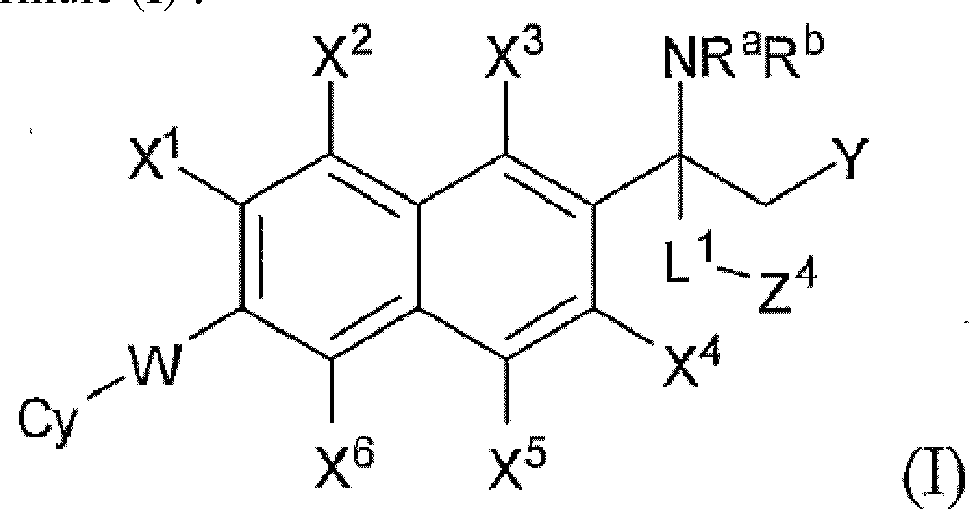 X1 représente un atome d'hydrogène, d'halogène, un groupe hydroxy, nitro, cyano, alkyle, halogénoalkyle, cycloalkyle, halogénocycloalkyle, alcoxyle, halogénoalcoxyle, cycloalcoxyle, halogénocycloalcoxyle, acyle, aminoacyle, -NRfRg, -N(Rf)SO2Rg, -SO2Rf,-SO2NRfRg, -CO2Rf, trialkylamino, aryle ou hétéroaryle ;X2 représente un atome d'hydrogène, d'halogène, un groupe hydroxy, nitro, cyano, alkyle, halogénoalkyle, cycloalkyle, halogénocycloalkyle, alcoxyle, halogénoalcoxyle, cycloalcoxyle, halogénocycloalcoxyle, acyle, aminoacyle, -NRfRg, -N(Rf)SO2Rg, -SO2Rf,-SO2NRfRg, -CO2Rf, trialkylamino, aryle ou hétéroaryle ;X3 représente un atome d'hydrogène, d'halogène, un groupe hydroxy, nitro, cyano, alkyle, halogénoalkyle, cycloalkyle, halogénocycloalkyle, alcoxyle, halogénoalcoxyle, cycloalcoxyle, halogénocycloalcoxyle, acyle, aminoacyle, -NRfRg, -N(Rf)SO2Rg, -SO2Rf,-SO2NRfRg, -CO2Rf, trialkylamino, aryle ou hétéroaryle ;X4 représente un atome d'hydrogène, d'halogène, un groupe hydroxy, nitro, cyano, alkyle, halogénoalkyle, cycloalkyle, halogénocycloalkyle, alcoxyle, halogénocycloalcoxyle, cycloalcoxyle, halogénocycloalcoxyle, acyle, aminoacyle, -NRfRg, -N(Rf)SO2Rg, -SO2Rf,-SO2NRfRg, -CO2Rf, trialkylamino, aryle ou hétéroaryle ;X5 représente un atome d'hydrogène, d'halogène, un groupe hydroxy, nitro, cyano, alkyle, halogénoalkyle, cycloalkyle, halogénocycloalkyle, alcoxyle, halogénoalcoxyle, cycloalcoxyle, halogénocycloalcoxyle, acyle, aminoacyle, -NRfRg, -N(Rf)SO2Rg, -SO2Rf,-SO2NRfRg, -CO2Rf, trialkylamino, aryle ou hétéroaryle ;X6 représente un atome d'hydrogène, d'halogène, un groupe hydroxy, nitro, cyano, alkyle, halogénoalkyle, cycloalkyle, halogénocycloalkyle, alcoxyle, halogénoalcoxyle, cycloalcoxyle, halogénocycloalcoxyle, acyle, aminoacyle, -NRfRg, -N(Rf)SO2Rg, -SO2Rf,-SO2NRfRg, -CO2Rf, trialkylamino, aryle ou hétéroaryle ;Y représente -ORf, -(CRfRg)ORf, -(CRfRg)2ORf, -O-P(O)(ORf)ORg, -OC(O)Rc,-C(O)ORc, -(CRfRg)-P(O)(ORf)ORg, -(C(OH)Rf)-P(O)(ORf)ORg, -S-P(O)(ORf)ORg, le tétrazole, -SO2NHRf, -SO3, -CONHRf, -Si(OH)2 ou -B(OH)2 ;W représente -NRf-, -O-, -S-, -SO- ou -SO2- ;Cy répond à la formule :ou un sel pharmaceutiquement acceptable de celui-ci.
 Z1 représente -CH2CH2- ;Z2 représente -CH2-Z3 représente une liaison, -[C(RdRe)]Z-, -CRd=CRe-, -O-, -NRf- ;Z vaut de 1 à 3 ;chaque Rd représente indépendamment un atome H, d'halogène, un groupe hydroxy, alkyle, halogénoalkyle, alcényle, alcoxyle, cycloalkyle, -C(O)NRfRg, -NRfRg, -NRfC(O)Rg ou-SO2NRfRg ;chaque Re représente indépendamment un atome H, d'halogène, un groupe hydroxy, alkyle, halogénoalkyle, alcényle, alcoxyle, cycloalkyle, -C(O)NRfRg, -NRfRg, -NRfC(O)Rg ou -SO2NRfRg ;R1a et R1b représentent indépendamment un atome d'hydrogène, d'halogène, un groupe hydroxy, nitro, cyano, -NRfRg, alkyle, halogénoalkyle, cycloalkyle, cycloalcényle, cycloalkylalkyle, cycloalcénylalkyle, hétérocyclylalkyle, arylalkyle, hétéroarylalkyle, alcoxyle, cycloalkylacoxyle, cycloalcénylalcoxyle, hétérocyclylalcoxyle, arylalcoxyle, hétéroarylalcoxyle, acyle, cycloalkylacyle, cycloalcénylacyle, hétérocyclylacyle, arylacyle, hétéroarylacyle, thioalkyle, alcényle, alcynyle, cycloalcényle, hétérocyclyle, aryle ou hétéroaryle ;ou R1a et R1b, pris ensemble, représentent un alkylène en C2-5 éventuellement terminé par 1 ou 2 atomes d'oxygène ou interrompu par ceux-ci, ou un alcénylène en C2-5 éventuellement terminé par 1 ou 2 atomes d'oxygène ou interrompu par ceux-ci ;R1a et R1b représentent indépendamment un atome d'hydrogène, d'halogène, un groupe hydroxy, nitro, cyano, -NRfRg, alkyle, halogénoalkyle, cycloalkyle, cycloalcényle, cycloalkylalkyle, cycloalcénylalkyle, hétérocyclylalkyle, arylalkyle, hétéroarylalkyle, alcoxyle, cycloalkylacoxyle, cycloalcénylalcoxyle, hétérocyclylalcoxyle, arylalcoxyle, hétéroarylalcoxyle, acyle, cycloalkylacyle, cycloalcénylacyle, hétérocyclylacyle, arylacyle, hétéroarylacyle, thioalkyle, alcényle, alcynyle, cycloalcényle, hétérocyclyle, aryle ou hétéroaryle ;ou R1a et R2a, pris ensemble, représentent un alkylène en C1-5 éventuellement terminé par 1 ou 2 atomes d'oxygène ou interrompu par ceux-ci, ou un alcénylène en C2-5 éventuellement terminé par 1 ou 2 atomes d'oxygène ou interrompu par ceux-ci ;où R1a, R1b, R2a et R2b sont chacun indépendamment des substitués par 0 à 5 substituants choisis parmi halogéno, hydroxy, nitro, cyano, -NRfRg ou -CO2Rf ;L1 représente -CH2-, -CHF- ou -CF2- ;Z4 représente un atome d'hydrogène, d'halogène, un groupe alkyle, halogénoalkyle, alcényle, halogénoalcényle, alcynyle ou -ORf ;ou bien Z4 représente une liaison -CH2- à l'atome de carbone auquel Y est lié ;ou L1, Z4, Y et les atomes auxquels ils sont liés forment un groupe cycloalkyle à 4 à 7 membres ou un groupe hétérocyclyle à 4 à 7 membres comptant 1 ou 2 hétéroatomes choisis parmi O et N ;Ra représente un atome d'hydrogène, un groupe alkyle, halogénoalkyle, alcényle, alcynyle, cycloalkyle, cycloalcényle, aryle, hétéroaryle ou hétérocyclyle ; dans lequel chacun des groupes alkyle, cycloalkyle, cycloalcényle, aryle, hétéroaryle et hétérocycle sont éventuellement substitués par 1 à 5 substituants indépendamment choisis dans l'ensemble constitué d'halogéno, oxo, -CN, -CHO, CF3, -OH, -NO2, alkyle, -OCF3, alcoxyle, cycloalcoxyle, cycloalkénoxyle, amino, alkylamino, dialkylamino, acylamino, aminoacyle, alkylsulfonyle, alkylaminosulfonyle et dialylaminosulfonyle ;Rb représente un atome d'hydrogène, un groupe alkyle, halogénoalkyle, alcényle, alcynyle, cycloalkyle, cycloalcényle, aryle, hétéroaryle ou hétérocyclyle ; dans lequel chacun des groupes alkyle, cycloalkyle, cycloalcényle, aryle, hétéroaryle et hétérocycle sont éventuellement substitués par 1 à 5 substituants indépendamment choisis dans l'ensemble constitué d'halogéno, oxo, -CN, -CHO, CF3, -OH, -NO2, alkyle, -OCF3, alcoxyle, cycloalcoxyle, cycloalkénoxyle, amino, alkylamino, dialkylamino, acylamino, aminoacyle, alkylsulfonyle, alkylaminosulfonyle et dialylaminosulfonyle ;ou Rb et Z4 sont pris ensemble pour former -C(O)O- ou =C(Rf)O- ;Rc représente un groupe aryle, trifluorométhyle, méthylsulfonyle, trifluorométhylsulfonyle ou para-tolylsulfonyle ;chaque Rf représente indépendamment un atome d'hydrogène, un groupe alkyle, halogénoalkyle, alcényle, alcynyle, cycloalkyle, cycloalcényle, aryle, hétéroaryle ou hétérocyclyle ; dans lequel chacun des groupes alkyle, cycloalkyle, cycloalcényle, aryle, hétéroaryle et hétérocycle sont éventuellement substitués par 1 à 5 substituants choisis indépendamment dans l'ensemble constitué d'un atome d'halogène, du groupe oxo, -CN, - CHO, -CF3, -OH, -NO2, alkyle, -OCF3, alcoxyle, cycloalcoxyle, cycloalcénoxyle, amino, alkylamino, dialkylamino, acylamino, aminoacyle, alkylsulfonyle, alkylaminosulfonyle et disalkylaminosulfonyle ;chaque Rg représente indépendamment un atome d'hydrogène, un groupe alkyle, halogénoalkyle, alcényle, alcynyle, cycloalkyle, cycloalcényle, aryle, hétéroaryle ou hétérocyclyle ; dans lequel chacun des groupes alkyle, cycloalkyle, cycloalcényle, aryle, hétéroaryle et hétérocycle sont éventuellement substitués par 1 à 5 substituants choisis indépendamment dans l'ensemble constitué d'un atome d'halogène, du groupe oxo, -CN, - CHO, -CF3, -OH, -NO2, alkyle, -OCF3, alcoxyle, cycloalcoxyle, cycloalcénoxyle, amino, alkylamino, dialkylamino, acylamino, aminoacyle, alkylsulfonyle, alkylaminosulfonyle et disalkylaminosulfonyle ;
 - Composé selon la revendication 1, dans lequel W représente -O-.
- Composé selon l'une quelconque des revendications 1 ou 2, dans lequel Y représente -ORf, -OH ou -O-P(O)(ORf)ORg.
- Composé selon l'une quelconque des revendications 1 à 3, dans lequel X6 représente un atome d'hydrogène, d'halogène, un groupe alkyle, cycloalkyle ou halogénoalkyle.
- Composé selon l'une quelconque des revendications 1 à 4, dans lequel R1b représente un atome de fluor, de chlore, de brome, d'iode, un groupe méthyle, difluorométhyle, trifluorométhyle, éthyle, 1,1-difluoroéthyle, propyle, isopropyle, n-butyle, isobutyle, tert-butyle, n-pentyle, isopentyle, 1,1-diméthylpropyle, néopentyle, cyclopentyle, n-hexyle, cyclohexyle, méthoxy, trifluorométhoxy, éthoxy, n-propoxy, iso-propoxy, n-butoxy, iso-butoxy, tert-butoxy, n-pentoxy, iso-pentyloxy, 1,1-diméthylpropoxy, néopentyloxy, cyclopentyloxy, n-hexyloxy ou cyclohexyloxy.
- Composé de formule (II) :
 X1 représente un atome d'hydrogène, d'halogène, un groupe hydroxy, nitro, cyano, alkyle, halogénoalkyle, cycloalkyle, halogénocycloalkyle, alcoxyle, halogénoalcoxyle, cyclalcoxyle, halogénocycloalcoxyle, acyle, aminoacyle, -NRfRg, -N(Rf)SO2Rg, -SO2Rf,-SO2NRfRg, -CO2Rf, trialkylamino, aryle ou hétéroaryle ;X2 représente un atome d'hydrogène, d'halogène, un groupe hydroxy, nitro, cyano, alkyle, halogénoalkyle, cycloalkyle, halogénocycloalkyle, alcoxyle, halogénoalcoxyle, cyclalcoxyle, halogénocycloalcoxyle, acyle, aminoacyle, -NRfRg, -N(Rf)SO2Rg, -SO2Rf,-SO2NRfRg, -CO2Rf, trialkylamino, aryle ou hétéroaryle ;X3 représente un atome d'hydrogène, d'halogène, un groupe hydroxy, nitro, cyano, alkyle, halogénoalkyle, cycloalkyle, halogénocycloalkyle, alcoxyle, halogénoalcoxyle, cyclalcoxyle, halogénocycloalcoxyle, acyle, aminoacyle, -NRfRg, -N(Rf)SO2Rg, -SO2Rf, - SO2NRfRg, -CO2Rf, trialkylamino, aryle ou hétéroaryle ;X4 représente un atome d'hydrogène, d'halogène, un groupe hydroxy, nitro, cyano, alkyle, halogénoalkyle, cycloalkyle, halogénocycloalkyle, alcoxyle, halogénoalcoxyle, cyclalcoxyle, halogénocycloalcoxyle, acyle, aminoacyle, -NRfRg, -N(Rf)SO2Rg, -SO2Rf,-SO2NRfRg, -CO2Rf, trialkylamino, aryle ou hétéroaryle ;X5 représente un atome d'hydrogène, d'halogène, un groupe hydroxy, nitro, cyano, alkyle, halogénoalkyle, cycloalkyle, halogénocycloalkyle, alcoxyle, halogénoalcoxyle, cyclalcoxyle, halogénocycloalcoxyle, acyle, aminoacyle, -NRfRg, -N(Rf)SO2Rg, -SO2Rf,-SO2NRfRg, -CO2Rf, trialkylamino, aryle ou hétéroaryle ;X6 représente un atome d'hydrogène, d'halogène, un groupe hydroxy, nitro, cyano, alkyle, halogénoalkyle, cycloalkyle, halogénocycloalkyle, alcoxyle, halogénoalcoxyle, cyclalcoxyle, halogénocycloalcoxyle, acyle, aminoacyle, -NRfRg, -N(Rf)SO2Rg, -SO2Rf,-SO2NRfRg, -CO2Rf, trialkylamino, aryle ou hétéroaryle ;Y représente -ORf, -(CRfRg)ORf, -(CRfRg)2ORf, -O-P(O)(ORf)ORg, -OC(O)Rc,-C(O)ORc, -(CRfRg)-P(O)(ORf)ORg, -(C(OH)Rf)-P(O)(ORf)ORg, -S-P(O)(ORf)ORg, le tétrazole, -SO2NHRf, -SO3, -CONHRf, -Si(OH)2 ou -B(OH)2 ;Z4 représente un atome d'hydrogène, d'halogène, un groupe alkyle, halogénoalkyle, alcényle, halogénoalcényle, alcynyle ou -ORf ;ou bien Z4 représente une liaison -CH2- à l'atome de carbone auquel Y est lié ;ou Z4, Y et les atomes auxquels ils sont liés forment un groupe cycloalkyle à 4 à 7 membres ou un groupe hétérocyclyle à 4 à 7 membres comptant 1 ou 2 hétéroatomes choisis parmi O et N ;Rc représente un groupe alkyle, aryle, trifluorométhyle, méthylsulfonyle, trifluorométhylsulfonyle ou para-tolylsulfonyle ;chaque Rf représente indépendamment un atome d'hydrogène, un groupe alkyle, halogénoalkyle, alcényle, alcynyle, cycloalkyle, cycloalcényle, aryle, hétéroaryle ou hétérocyclyle ; dans lequel chacun des groupes alkyle, cycloalkyle, cycloalcényle, aryle, hétéroaryle et hétérocycle sont éventuellement substitués par 1 à 5 substituants choisis indépendamment dans l'ensemble constitué d'un atome d'halogène, du groupe oxo, -CN, - CHO, -CF3, -OH, -NO2, alkyle, -OCF3, alcoxyle, cycloalcoxyle, cycloalcénoxyle, amino, alkylamino, dialkylamino, acylamino, aminoacyle, alkylsulfonyle, alkylaminosulfonyle et disalkylaminosulfonyle ;chaque Rg représente indépendamment un atome d'hydrogène, un groupe alkyle, halogénoalkyle, alcényle, alcynyle, cycloalkyle, cycloalcényle, aryle, hétéroaryle ou hétérocyclyle ; dans lequel chacun des groupes alkyle, cycloalkyle, cycloalcényle, aryle, hétéroaryle et hétérocycle sont éventuellement substitués par 1 à 5 substituants choisis indépendamment dans l'ensemble constitué d'un atome d'halogène, du groupe oxo, -CN, - CHO, -CF3, -OH, -NO2, alkyle, -OCF3, alcoxyle, cycloalcoxyle, cycloalcénoxyle, amino, alkylamino, dialkylamino, acylamino, aminoacyle, alkylsulfonyle, alkylaminosulfonyle et disalkylaminosulfonyle ;R1a représente un atome d'hydrogène, d'halogène, un groupe hydroxy, nitro, cyano, - NRfRg, alkyle, halogénoalkyle, cycloalkyle, cycloalcényle, cycloalkylalkyle, cycloalcénylalkyle, hétérocyclylalkyle, arylalkyle, hétéroarylalkyle, alcoxyle, cycloalkylacoxyle, cycloalcénylalcoxyle, hétérocyclylalcoxyle, arylalcoxyle, hétéroarylalcoxyle, acyle, cycloalkylacyle, cycloalcénylacyle, hétérocyclylacyle, arylacyle, hétéroarylacyle, thioalkyle, alcényle, alcynyle, cycloalcényle, hétérocyclyle, aryle ou hétéroaryle ;Z1 représente -(CH2)x- ;Z2 représente -(CH2)y- ; etchacun de x et de y représente indépendamment 1 à 3 ;ou un sel pharmaceutiquement acceptable de celui-ci.
 - Composé selon la revendication 6, dans lequel Y représente -ORf, -OH ou -O-P(O)(ORf)ORg.
- Composé selon la revendication 6 ou 7, dans lequel X6 représente un atome d'hydrogène, d'halogène, un groupe alkyle, cycloalkyle ou halogénoalkyle.
- Composé selon l'une quelconque des revendications 6 à 8, dans lequel R1a représente un atome d'hydrogène, d'halogène, un groupe hydroxy, alkyle, halogénoalkyle, cycloalkyle ou cycloalkylalkyle, arylalkyle, alcoxyle, cycloalkylalcoxyle, arylalcoxyle ou aryle.
- Composé selon l'une quelconque des revendications 6 à 9, dans lequel Y représente -OH ou -OP(O)(OH)2 ; Z4 représente H ou -OH ; X1, X2, X3, X4 et X5 représentent chacun H ; et X6 représente H, un halogène, un alkyle, un cycloalkyle ou un halogénoalkyle.
- Composé selon les revendications 1 à 10, choisi dans l'ensemble constitué de :(R)-2-amino-2-(6-(cis-4-butylcyclohexyloxy)naphtalèn-2-yl)propan-1-ol ; (R)-2-amino-2-(6-(4-butylcyclohexyloxy)naphtalèn-2-yl)propan-1-ol ; (R)-2-amino-2-(6-(trans-4-butylcyclohexyloxy)naphtalèn-2-yl)propan-1-ol ; 2-amino-2-(6-(cis-4-butylcyclohexyloxy)naphtalène-2-yl)propane-1,3-diol ; (R)-2-amino-2-(6-(cis-4-butylcyclohexyloxy)-5-(trifluorométhyl)naphtalèn-2-yl)propan-1-ol ; acide (R)-2-amino-2-(6-(cis-4-butylcyclohexyloxy)-5-(trifluorométhyl)naphtalène-2-yl)propan-1-phosphorique ; phosphate de (R)-2-amino-2-(6-(cis-4-butylcyclohexyloxy)naphtalèn-2-yl)propyl dihydrogène ; phosphate de (R)-2-amino-2-(6-(trans-4-butylcyclohexyloxy)naphtalèn-2-yl)propyl dihydrogène ; (R)-2-amino-2-(6-(trans-4-tert-butylcyclohexyloxy)naphtalèn-2-yl)propan-1-ol ; phosphate de (R)-2-amino-2-(6-(trans-4-tert-butylcyclohexyloxy)naphtalèn-2-yl)propyl dihydrogène ; (R)-2-amino-2-(6-(cis-4-(4-(pentan-3-yloxy)phényl)cyclohexyloxy)naphtalèn-2-yl)propan-1-ol ; (R)-2-amino-2-(6-(cis-4-isopropoxyphényl)cyclohexyloxy)naphtalèn-2-yl)propan-1-ol ; (R)-2-amino-2-(6-(cis-4-(4-méthoxyphényl)cyclohexyloxy)naphtalèn-2-yl)propan-1-ol ; (R)-2-amino-2-(6-(cis-4-phénylcyclohexyloxy)naphtalèn-2-yl)propan-1-ol ; (R)-2-amino-2-(6-(cis-4-phénylcyclohexyloxy)-5-(trifluorométhyl)naphtalèn-2-yl)propan-1-ol ; (R)-2-amino-2-{6-[trans-4-(1,1-diméthyl-propyl)-cyclohexyloxy)-5-trifluorométhyl-naphtalèn-2-yl}-propan-1-ol ; (R)-2-amino-2-(6-(4-pentylcyclohexyloxy)naphtalèn-2-yl)propan-1-ol ; (R)-2-amino-2-(6-(4-propylcyclohexyloxy)naphtalèn-2-yl)propan-1-ol ; (R)-2-amino-2-(6-(cis-4-méthylcyclohexyloxy)naphtalèn-2-yl)propan-1-ol ; (R)-2-amino-2-(6-(cis-4-éthylcyclohexyloxy)naphtalèn-2-yl)propan-1-ol ; (R)-2-amino-2-(6-(4-(trifluorométhyl)cyclohexyloxy)naphtalèn-2-yl)propan-1-ol ; (R)-2-amino-2-(6-(4,4-diméthylcyclohexyloxy)naphtalèn-2-yl)propan-1-ol ; (R)-2-amino-2-(6-(trans-4-tert-butylcyclohexyloxy)-5-(trifluorométhyl)naphtalèn-2-yl)propan-1-ol ; 2-amino-2-(6-(cis-4-butylcyclohexyloxy)-5-(trifluorométhyl)naphtalèn-2-yl)propan-1,3-diol ; 2-amino-2-[6-(cis-4-butylcyclohexyloxy)-5-iodo-naphtalèn-2-yl]propan-1,3-diol ; 2-amino-2-[(6-(trans-4-tert-butylcyclohexyloxy)-5-trifluorométhyl-naphtalèn-2-yl]-propan-1,3-diol ; 2-amino-2-[6-(trans-4-tert-butylcyclohexyloxy)-naphtalèn-2-yl]-propan-1,3-diol ; 2-amino-2-[6-(trans-4-tert-butylcyclohexyloxy)-5-iodo-naphtalèn-2-yl]-propan-1,3-diol ; 2-amino-2-(6-trans-[3-(benzyloxyméthyl)cyclobutyloxy]-naphtalèn-2-yl]-propan-1,3-diol ; 2-amino-2-(6-cis-[3-(benzyloxyméthyl)cyclobutyloxy]-naphtalèn-2-yl]-propan-1,3-diol ; 2-amino-2-[6-(3-trans-benzyloxyméthyl)cyclobutyloxy)-5-(trifluorométhyl)naphtalèn-2-yl]-propan-1,3-diol ; 2-amino-2-[6-(3-cis-benzyloxyméthylcyclobutyloxy)-5-(trifluorométhyl)naphtalèn-2-yl]-propan-1,3-diol ; (R)-2-amino-2-[6-(3-trans-benzyloxyméthylcyclobutyloxy)-naphtalèn-2-yl]-propan-1-ol ; (R)-2-amino-2-[6-(3-cis-benzyloxyméthylcyclobutyloxy)-naphtalèn-2-yl]-propan-1-ol ; (R)-2-amino-2-[6-(4-trans-tert-pentylcyclohexyloxy)-naphtalèn-2-yl]-propan-1-ol ; (R)-2-amino-2-[6-(4-cis-tert-pentylcyclohexyloxy)-naphtalèn-2-yl]-propan-1-ol ; (R)-2-amino-2-[6-(3-cis-benzyloxyméthylcyclobutyloxy)-5-trifluorométhylnaphtalèn-2-yl]-propan-1-ol ; phosphate de 2-amino-2-[6-(3-cis-(benzyloxyméthylcyclobutyloxy)-naphtalèn-2-yl]-3-hydroxypropyl dihydrogène ; (R)-2-amino-2-{6-[trans-4-(1,1-diméthyl-propyl)-cyclohexyloxy]-naphtalèn-2-yl}-propan-1-ol ; (R)-2-amino-2-(6-(trans-4-tert-butylcyclobutyloxy)-5-méthoxynaphtalèn-2-yl)-propan-1-ol ; (R)-2-amino-2-(6-(trans-4-butyl-cyclohexyloxy)-5-trifluorométhylnaphtalèn-2-yl]-propan-1-ol ; (R)-2-amino-2-(6-trans-4-butyl-cyclohexyloxy)naphtalèn-2-yl)-propan-1-ol ; (R)-2-amino-2-(6-trans-4-trifluorométhylcyclohexyloxy)-5-fluoronaphtalèn-2-yl)-propan-1-ol ; (R)-2-amino-2-[6-(décahydro-naphtalèn-2-yloxy)-naphtalèn-2-yl]-propan-1-ol ; (R)-2-amino-2-[6-bicyclohexyl-4-yloxy)naphtalèn-2-yl]-propan-1-ol ; (R)-2-amino-2-[6-(4-isopropyl-cyclohexyloxy)-naphtalèn-2-yl]-propan-l-ol ; (R)-2-amino-2-[6-(4-cyclopentyl-cyclohexyloxy)-naphtalèn-2-yl]-propan-l-ol ; (R)-2-amino-2-[6-(4-sec-butyl-cyclohexyloxy)-naphtalèn-2-yl]-propan-l-ol ; (R)-2-amino-2-[6-(cis-4-cyclopentyl-cyclohexyloxy)-5-trifluorométhyl-naphtalèn-2-yl]-propan-1-ol ; (R)-2-amino-2-[6-(trans-4-cyclopentyl-cyclohexyloxy)-5-trifluorométhyl-naphtalèn-2-yl]-propan-1-ol ; ester d'acide mono-{(R)-2-amino-2-[6-(4-cyclopentyl-cyclohexyloxy)-5-trifluorométhyl-naphtalèn-2-yl]-propyl} phosphorique ; 2-amino-2-[5-trifluorométhyl-6-(4-trifluorométhyl-cyclohexyloxy)-naphtalèn-2-yl]-propan-1,3-diol ; (R)-2-[6-(4-tert-butyl-cyclohexyloxy)-naphtalèn-2-yl]-2-méthylamino-propan-1-ol ; ester d'acide mono-{(R)-2-amino-2-{6-[(4-(1,1-diméthylpropyl)-cyclohexyloxy)-5-trifluorométhyl-naphtalèn-2-yl]-propyl} phosphorique ; ester d'acide mono-{(R)-2-amino-2-[6-(4-tert-butyl-cyclohexyloxy)-5-trifluorométhyl-naphtalèn-2-yl]-propyl} phosphorique ; (S)-2-amino-2-[6-(4-tert-butyl-cyclohexyloxy)-5-trifluorométhyl-naphtalèn-2-yl]-propan-1-ol ; (S)-2-amino-2-[6-(4-cis-tert-butyl-cyclohexyloxy)-5-trifluorométhyl-naphtalèn-2-yl]-propan-1-ol ; (R)-4-(6-(hydroxy-5-(trifluorométhyl)naphtalèn-2-yl)-4-méthyloxazolidin-2-one ; (R)-4-(6-(trans-4-tert-butylcyclohexyloxy-5-(trifluorométhyl)naphtalèn-2-yl)-4-méthyloxazolidin-2-one ; 3-(6-(trans-4-tert-butylcyclohexyloxy)naphtalèn-2-yl)oxetan-3-amine ; 3-(6-(trans-4-tert-butylcyclohexyloxy)-5-(trifluorométhyl)naphtalèn-2-yl)oxetan-3-amine ; (R)-2-amino-2-[6-(cis-4-cyclohexylcyclohexyloxy)-5-trifluorométhyl)naphtalèn-2-yl]-propan-1-ol ; (R)-2-amino-2-(6-(trans-4-cyclohexylcyclohexyloxy)-5-trifluorométhyl)naphtalèn-2-yl)-propan-1-ol ; phosphate de (R)-2-amino-2-(6-(trans-4-cyclohexylcyclohexyloxy)-5-trifluorométhyl)naphtalèn-2-yl)propyl dihydrogène ; (R)-2-amino-2-(6-(cis-4-isopropyl-cyclohexyloxy)-5-(trifluorométhyl)naphtalèn-2-yl]-propan-1-ol ; (R)-2-amino-2-(6-(trans-4-isopropylcyclohexyloxy)-5-trifluorométhyl)naphtalèn-2-yl)-propan-1-ol ; phosphate de (R)-2-amino-2-(6-(trans-4-(1,1-difluoroéthyl)cyclohexyloxy)-5-trifluorométhyl)naphtalèn-2-yl)propyl dihydrogène ; acide 4-amino-4-(6-(trans-4-tert-butylcyclohexyloxy)-5-(trifluorométhyl)naphtalèn-2-yl) pentanoïque ; (R)-2-amino-2-(6-(trans-4-tert-butylcyclohexyloxy)-5-cyclopropylnaphtalèn-2-yl)-propan- l-ol ; (R)-2-amino-2-(6-(trans-4-tert-butylcyclohexyloxy)-5-méthylnaphtalèn-2-yl)-propan-1-ol ; (R)-2-amino-2-(6-(trans-4-tert-butylcyclohexyloxy)-5-vinylnaphtalèn-2-yl)-propan-1-ol ; (R)-2-amino-2-(6-(trans-4-tert-butylcyclohexyloxy)-5-(4-(trifluorométhoxy)phényl)naphtalèn-2-yl)-propan-1-ol ; (R)-2-amino-2-(6-(trans-4-tert-butylcyclohexyloxy)-5-(4-(méthylsulfonyl)phényl)naphtalèn-2-yl)-propan-1-ol ; (R)-2-amino-2-(6-(trans-4-tert-butylcyclohexyloxy)-5-(pyrimidin-5-yl) naphtalèn-2-yl)-propan-1-ol ; (R)-2-amino-2-(6-(trans-4-tert-butylcyclohexyloxy)-5-(4-éthoxyphényl)naphtalèn-2-yl)-propan-1-ol ; (R)-2-amino-2-(6-(trans-4-tert-butylcyclohexyloxy)-5-phénylnaphtalèn-2-yl)-propan-1-ol ; (R)-2-amino-2-(6-(trans-4-tert-butylcyclohexyloxy)-5-(3-chlorophényl)naphtalèn-2-yl)-propan-1-ol ; (R)-2-amino-2-(6-(trans-4-tert-butylcyclohexyloxy)-5-(4-chlorophényl)naphtalèn-2-yl)-propan-1-ol ; (R)-2-amino-2-(6-(trans-4-tert-butylcyclohexyloxy)-5-chloronaphtalèn-2-yl)-propan-1-ol ; (R)-2-amino-2-(5-bromo-6-(trans-4-tert-butylcyclohexyloxy)naphtalèn-2-yl)-propan-1-ol ; (R)-2-amino-2-(6-trans-4-tert-butylcyclohexyloxy)-5,7,8-trichloronaphtalèn-2-yl)-propan-1-ol ; (R)-2-amino-2-(6-(trans-4-tert-butylcyclohexyloxy)-5-fluoronaphtalèn-2-yl)-propan-1-ol ; phosphate de (+)2-amino-2-(6-trans-4-tert-butylcyclohexyloxy)-5-(trifluorométhyl) naphtalèn-2-yl)-3-hydroxypropyl dihydrogène phosphate ; (-)2-amino-2-(6-trans-4-tert-butylcyclohexyloxy)-5-(trifluorométhyl)naphtalèn-2-yl)-3-hydroxypropyl dihydrogène ; (R)-2-amino-2-[6-cis-4-trifluorométhyl-cyclohexyloxy)-naphtalèn-2-yl]-propan-1-ol ; (R)-2-amino-2-[6-trans-4-trifluorométhyl-cyclohexyloxy)-naphtalèn-2-yl]-propan-1-ol ; ester d'acide mono-{(R)-2-amino-2-[6-(trans-4-trifluorométhyl-cyclohexyloxy)-naphtalèn-2-yl]-propyl} phosphorique ; (R)-2-amino-2-[5-trifluorométhyl-6-(trans-4-trifluorométhyl-cyclohexyloxy)-naphtalèn-2-yl]-propan-1-ol ; ester d'acide mono-{(R)-2-amino-2-[5-trifluorométhyl-6-(trans-4-trifluorométhyl-cyclohexyloxy)-naphtalèn-2-yl]-propyl} phosphorique ; (R)-2-amino-2-[6-(4-pentyl-cyclohexyloxy)-naphtalèn-2-yl]-propan-1-ol ; (R)-2-amino-2-[6-(cis-4-pentyl-cyclohexyloxy)-naphtalèn-2-yl]-propan-1-ol ; (R)-2-amino-2-[6-(trans-4-pentyl-cyclohexyloxy)-naphtalèn-2-yl)-propan-1-ol ; 2-[6-(trans-4-tert-butyl-cyclohexyloxy)-5-trifluorométhyl-naphtalèn-2-yl)-propan-1-ol ; 2-amino-2-[6-(trans-4-tert-butyl-cyclohexyloxy)-5-trifluorométhyl-naphtalèn-2-yl]-propan-1-ol ; acide 4-amino-4-[6-(trans-4-trifluorométhyl-cyclohexyloxy)-naphtalèn-2-yl]-pentanoïque ; acide 4-amino-4-[6-(cis-4-trifluorométhyl-cyclohexyloxy)-naphtalèn-2-yl]-pentanoïque ; acide 4-amino-4-[5-trifluorométhyl-6-(trans-4-trifluorométhyl-cyclohexyloxy)-naphtalèn-2-yl]-pentanoïque ; acide 4-amino-4-[5-trifluorométhyl-6-(cis-4-trifluorométhyl-cyclohexyloxy)-naphtalèn-2-yl)-pentanoïque ; (R)-2-amino-2-(6-(trans-4-(1,1-difluoroéthyl)cyclohexyloxy)naphtalèn-2-yl)-propan-1-ol ; (R)-2-amino-2-(6-(trans-4-(1,1-difluoropropyl)cyclohexyloxy)naphtalèn-2-yl)-propan-1-ol ; (R)-2-amino-2-(6-(trans-4-(1,1-difluorobutyl)cyclohexyloxy)naphtalèn-2-yl)-propan-1-ol ; (R)-2-amino-2-(6-(cis-4-(1,1-difluoroéthyl)cyclohexyloxy)naphtalèn-2-yl)-propan-1-ol ; (R)-2-amino-2-(6-(cis-4-(1,1-difluoropropyl)cyclohexyloxy)naphtalèn-2-yl)-propan-1-ol ; (R)-2-amino-2-(6-(cis-4-(1,1-difluorobutyl)cyclohexyloxy)naphtalèn-2-yl)-propan-1-ol ; (R)-2-amino-2-(6-(trans-4-(1,1-difluoroéthyl)cyclohexyloxy)-5-(trifluorométhyl)naphtalèn-2-yl)-propan-1-ol ; (R)-2-amino-2-(6-(trans-4-(1,1-difluoropropyl)cyclohexyloxy)-5-(trifluorométhyl)naphtalèn-2-yl)-propan-1-ol ; (R)-2-amino-2-(6-(cis-4-tert-butylcyclohexyloxy)naphtalèn-2-yl)propan-1-ol ;ou un sel pharmaceutiquement acceptable de ceux-ci.
- Composition pharmaceutique comprenant un véhicule pharmaceutiquement acceptable et un composé selon l'une quelconque des revendications 1 à 11.
- Utilisation d'un composé selon l'une quelconque des revendications 1 à 11 pour la fabrication d'un médicament destiné au traitement d'un état physiologique ou d'un symptôme de cet état chez un mammifère, dans lequel l'état pathologique est une douleur neuropathique ou une maladie auto-immune.
- Utilisation selon la revendication 13, le traitement comprenant en outre l'administration audit mammifère d'une quantité efficace d'un médicament choisi dans l'ensemble constitué des : corticostéroïdes, bronchodilatateurs, antiasthmatiques, anti-inflammatoires, antirhumatismaux, immunodépresseurs, antimétabolites, immunomodulateurs, antipsoriatiques et antidiabétiques.
- Utilisation selon la revendication 13 ou 14, la maladie auto-immune étant une uvéite, un diabète de type I, une polyarthrite rhumatoïde, une maladie intestinale inflammatoire, le lupus, l'asthme, le psoriasis ou la sclérose en plaques.
- Composé selon l'une quelconque des revendications 1 à 11, utile dans un procédé de traitement d'un état pathologique ou d'un symptôme de cet état chez un mammifère, l'état pathologique étant une douleur neuropathique ou une maladie auto-immune.
Applications Claiming Priority (2)
| Application Number | Priority Date | Filing Date | Title |
|---|---|---|---|
| US10971808P | 2008-10-30 | 2008-10-30 | |
| PCT/US2009/005897 WO2010051030A1 (fr) | 2008-10-30 | 2009-10-30 | Analogues de sphingosine 1-phosphate d’aryle bicyclique |
Publications (3)
| Publication Number | Publication Date |
|---|---|
| EP2364088A1 EP2364088A1 (fr) | 2011-09-14 |
| EP2364088A4 EP2364088A4 (fr) | 2012-05-30 |
| EP2364088B1 true EP2364088B1 (fr) | 2014-04-16 |
Family
ID=42129164
Family Applications (1)
| Application Number | Title | Priority Date | Filing Date |
|---|---|---|---|
| EP09823936.1A Active EP2364088B1 (fr) | 2008-10-30 | 2009-10-30 | Analogues de sphingosine 1-phosphate d aryle bicyclique |
Country Status (5)
| Country | Link |
|---|---|
| US (2) | US8269043B2 (fr) |
| EP (1) | EP2364088B1 (fr) |
| ES (1) | ES2466695T3 (fr) |
| TW (1) | TW201029649A (fr) |
| WO (1) | WO2010051030A1 (fr) |
Families Citing this family (19)
| Publication number | Priority date | Publication date | Assignee | Title |
|---|---|---|---|---|
| US9181191B2 (en) | 2008-10-30 | 2015-11-10 | Biogen Ma Inc. | Heterobicyclic sphingosine 1-phosphate analogs |
| ES2613739T3 (es) * | 2008-10-30 | 2017-05-25 | Biogen Ma Inc. | Análogos heterobicíclicos de 1-fosfato de esfingosina |
| UA107360C2 (en) | 2009-08-05 | 2014-12-25 | Biogen Idec Inc | Bicyclic aryl sphingosine 1-phosphate analogs |
| UA113507C2 (xx) * | 2011-02-07 | 2017-02-10 | Модулятори s1p | |
| CN102731324B (zh) * | 2012-07-13 | 2014-06-04 | 江西东邦药业有限公司 | 一种常压催化还原制备丝氨醇的方法 |
| MX363388B (es) | 2012-07-27 | 2019-03-20 | Biogen Ma Inc | Agentes moduladores de autotaxina. |
| US9555050B2 (en) * | 2012-07-27 | 2017-01-31 | Biogen Ma Inc. | ATX modulating agents |
| WO2014025709A1 (fr) | 2012-08-06 | 2014-02-13 | Biogen Idec Ma Inc. | Composés étant des agents de modulation de s1p et/ou des agents de modulation d'atx |
| WO2014025708A1 (fr) | 2012-08-06 | 2014-02-13 | Biogen Idec Ma Inc. | Composés étant des agents de modulation de s1p et/ou des agents de modulation d'atx |
| KR20150100766A (ko) * | 2012-12-17 | 2015-09-02 | 메르크 파텐트 게엠베하 | 호메오트로픽 정렬을 갖는 액정 디스플레이 및 액정 매질 |
| CA2899322A1 (fr) * | 2013-01-29 | 2014-08-07 | Biogen Ma Inc. | Agents modulateurs de s1p |
| US8962660B2 (en) | 2013-03-14 | 2015-02-24 | Bristol-Myers Squibb Company | Oxabicyclo [2.2.2] acid GPR120 modulators |
| AU2016270373A1 (en) | 2015-06-05 | 2018-01-04 | Vertex Pharmaceuticals Incorporated | Triazoles for the treatment of demyelinating diseases |
| US9677774B2 (en) * | 2015-06-08 | 2017-06-13 | Alto-Shaam, Inc. | Multi-zone oven with variable cavity sizes |
| WO2018106641A1 (fr) | 2016-12-06 | 2018-06-14 | Vertex Pharmaceuticals Incorporated | Pyrazoles pour le traitement de maladies démyélinisantes |
| WO2018106643A1 (fr) | 2016-12-06 | 2018-06-14 | Vertex Pharmaceuticals Incorporated | Azoles hétérocycliques pour le traitement de maladies de démyélinisation |
| WO2018106646A1 (fr) | 2016-12-06 | 2018-06-14 | Vertex Pharmaceuticals Incorporated | Aminotriazoles pour traiter des maladies démyélinisantes |
| CN109970520B (zh) * | 2019-04-08 | 2022-02-11 | 衢州学院 | 一种热敏纸增感剂苄基-2-萘基醚的制备方法 |
| US11058695B2 (en) * | 2019-11-08 | 2021-07-13 | Myongji University Industry And Academia Cooperation Foundation | Inhibitor of carbapenem-hydrolyzing class D beta-lactamases |
Family Cites Families (12)
| Publication number | Priority date | Publication date | Assignee | Title |
|---|---|---|---|---|
| FR2555571B1 (fr) * | 1983-11-28 | 1986-11-28 | Interna Rech Dermatolo Centre | Derives du naphtalene, leur procede de preparation et leur application dans le domaine therapeutique |
| US7064217B2 (en) | 2001-01-30 | 2006-06-20 | University Of Virginia Patent Foundation | Agonists and antagonists of sphingosine-1-phosphate receptors |
| CA2533587A1 (fr) | 2002-07-30 | 2004-02-05 | University Of Virginia Patent Foundation | Composes actifs dans la signalisation de sphingosine 1-phosphate |
| WO2005041899A2 (fr) | 2003-11-03 | 2005-05-12 | University Of Virginia Patent Foundation | Agonistes et antagonistes du recepteur de la sphingosine-1-phosphate pouvant etre pris par voie orale |
| US7919519B2 (en) * | 2005-11-23 | 2011-04-05 | Epix Pharmaceuticals Inc. | S1P receptor modulating compounds and use thereof |
| TWI389683B (zh) * | 2006-02-06 | 2013-03-21 | Kyorin Seiyaku Kk | A therapeutic agent for an inflammatory bowel disease or an inflammatory bowel disease treatment using a 2-amino-1,3-propanediol derivative as an active ingredient |
| AU2007212193A1 (en) * | 2006-02-09 | 2007-08-16 | University Of Virginia Patent Foundation | Bicyclic sphingosine 1-phosphate analogs |
| CA2669104A1 (fr) | 2006-11-21 | 2008-05-29 | University Of Virginia Patent Foundation | Analogues d'hydrindane ayant une activite agoniste de recepteur de sphingosine-1-phosphate |
| CA2669102A1 (fr) | 2006-11-21 | 2008-05-29 | University Of Virginia Patent Foundation | Analogues de tetraline ayant une activite agoniste de recepteur de sphingosine-1-phosphate |
| AU2007323557A1 (en) | 2006-11-21 | 2008-05-29 | University Of Virginia Patent Foundation | Benzocycloheptyl analogs having sphingosine 1-phosphate receptor activity |
| JP2010536791A (ja) * | 2007-08-15 | 2010-12-02 | ユニバーシティ オブ バージニア パテント ファンデーション | 二環式スフィンゴシン1−リン酸アナログ |
| UA107360C2 (en) | 2009-08-05 | 2014-12-25 | Biogen Idec Inc | Bicyclic aryl sphingosine 1-phosphate analogs |
-
2009
- 2009-10-30 US US12/588,883 patent/US8269043B2/en active Active
- 2009-10-30 ES ES09823936.1T patent/ES2466695T3/es active Active
- 2009-10-30 EP EP09823936.1A patent/EP2364088B1/fr active Active
- 2009-10-30 TW TW098137053A patent/TW201029649A/zh unknown
- 2009-10-30 WO PCT/US2009/005897 patent/WO2010051030A1/fr not_active Ceased
-
2012
- 2012-09-10 US US13/608,227 patent/US8546359B2/en not_active Expired - Fee Related
Also Published As
| Publication number | Publication date |
|---|---|
| US8546359B2 (en) | 2013-10-01 |
| US20100160258A1 (en) | 2010-06-24 |
| EP2364088A4 (fr) | 2012-05-30 |
| EP2364088A1 (fr) | 2011-09-14 |
| TW201029649A (en) | 2010-08-16 |
| ES2466695T3 (es) | 2014-06-11 |
| US20130059821A1 (en) | 2013-03-07 |
| WO2010051030A1 (fr) | 2010-05-06 |
| US8269043B2 (en) | 2012-09-18 |
Similar Documents
| Publication | Publication Date | Title |
|---|---|---|
| EP2364088B1 (fr) | Analogues de sphingosine 1-phosphate d aryle bicyclique | |
| EP2364089B1 (fr) | Analogues hétérobicycliques de la sphingosine 1-phosphate | |
| US10166250B2 (en) | Bicyclic aryl sphingosine 1-phosphate analogs | |
| US10081646B2 (en) | Heterobicyclic sphingosine 1-phosphate analogs | |
| HK1165214B (en) | Bicyclic aryl sphingosine 1-phosphate analogs |
Legal Events
| Date | Code | Title | Description |
|---|---|---|---|
| PUAI | Public reference made under article 153(3) epc to a published international application that has entered the european phase |
Free format text: ORIGINAL CODE: 0009012 |
|
| 17P | Request for examination filed |
Effective date: 20110524 |
|
| AK | Designated contracting states |
Kind code of ref document: A1 Designated state(s): AT BE BG CH CY CZ DE DK EE ES FI FR GB GR HR HU IE IS IT LI LT LU LV MC MK MT NL NO PL PT RO SE SI SK SM TR |
|
| DAX | Request for extension of the european patent (deleted) | ||
| RIC1 | Information provided on ipc code assigned before grant |
Ipc: C07C 215/10 20060101ALI20120420BHEP Ipc: C07D 263/38 20060101ALI20120420BHEP Ipc: A61P 19/02 20060101ALI20120420BHEP Ipc: C07F 9/09 20060101ALI20120420BHEP Ipc: A61P 29/00 20060101ALI20120420BHEP Ipc: C07C 215/08 20060101ALI20120420BHEP Ipc: A61K 31/27 20060101ALI20120420BHEP Ipc: A61P 11/06 20060101ALI20120420BHEP Ipc: A01N 47/10 20060101AFI20120420BHEP Ipc: A61K 31/135 20060101ALI20120420BHEP Ipc: A61P 17/06 20060101ALI20120420BHEP |
|
| A4 | Supplementary search report drawn up and despatched |
Effective date: 20120425 |
|
| 17Q | First examination report despatched |
Effective date: 20130123 |
|
| REG | Reference to a national code |
Ref country code: DE Ref legal event code: R079 Ref document number: 602009023356 Country of ref document: DE Free format text: PREVIOUS MAIN CLASS: A01N0047100000 Ipc: C07C0271160000 |
|
| RIC1 | Information provided on ipc code assigned before grant |
Ipc: A61P 17/06 20060101ALI20130926BHEP Ipc: A61P 29/00 20060101ALI20130926BHEP Ipc: C07C 205/26 20060101ALI20130926BHEP Ipc: C07F 9/09 20060101ALI20130926BHEP Ipc: C07F 9/653 20060101ALI20130926BHEP Ipc: C07C 215/08 20060101ALI20130926BHEP Ipc: A61K 31/135 20060101ALI20130926BHEP Ipc: A61K 31/27 20060101ALI20130926BHEP Ipc: C07C 229/32 20060101ALI20130926BHEP Ipc: C07C 205/50 20060101ALI20130926BHEP Ipc: A61P 11/06 20060101ALI20130926BHEP Ipc: A01N 47/10 20060101ALI20130926BHEP Ipc: C07C 217/60 20060101ALI20130926BHEP Ipc: C07C 217/52 20060101ALI20130926BHEP Ipc: C07D 263/38 20060101ALI20130926BHEP Ipc: C07C 271/16 20060101AFI20130926BHEP Ipc: A61P 19/02 20060101ALI20130926BHEP Ipc: C07C 215/10 20060101ALI20130926BHEP |
|
| GRAP | Despatch of communication of intention to grant a patent |
Free format text: ORIGINAL CODE: EPIDOSNIGR1 |
|
| INTG | Intention to grant announced |
Effective date: 20131107 |
|
| GRAS | Grant fee paid |
Free format text: ORIGINAL CODE: EPIDOSNIGR3 |
|
| GRAA | (expected) grant |
Free format text: ORIGINAL CODE: 0009210 |
|
| AK | Designated contracting states |
Kind code of ref document: B1 Designated state(s): AT BE BG CH CY CZ DE DK EE ES FI FR GB GR HR HU IE IS IT LI LT LU LV MC MK MT NL NO PL PT RO SE SI SK SM TR |
|
| REG | Reference to a national code |
Ref country code: GB Ref legal event code: FG4D |
|
| REG | Reference to a national code |
Ref country code: CH Ref legal event code: EP |
|
| REG | Reference to a national code |
Ref country code: AT Ref legal event code: REF Ref document number: 662450 Country of ref document: AT Kind code of ref document: T Effective date: 20140515 |
|
| REG | Reference to a national code |
Ref country code: IE Ref legal event code: FG4D |
|
| REG | Reference to a national code |
Ref country code: DE Ref legal event code: R096 Ref document number: 602009023356 Country of ref document: DE Effective date: 20140528 |
|
| REG | Reference to a national code |
Ref country code: ES Ref legal event code: FG2A Ref document number: 2466695 Country of ref document: ES Kind code of ref document: T3 Effective date: 20140611 |
|
| REG | Reference to a national code |
Ref country code: AT Ref legal event code: MK05 Ref document number: 662450 Country of ref document: AT Kind code of ref document: T Effective date: 20140416 |
|
| REG | Reference to a national code |
Ref country code: NL Ref legal event code: VDEP Effective date: 20140416 |
|
| REG | Reference to a national code |
Ref country code: LT Ref legal event code: MG4D |
|
| PG25 | Lapsed in a contracting state [announced via postgrant information from national office to epo] |
Ref country code: LT Free format text: LAPSE BECAUSE OF FAILURE TO SUBMIT A TRANSLATION OF THE DESCRIPTION OR TO PAY THE FEE WITHIN THE PRESCRIBED TIME-LIMIT Effective date: 20140416 Ref country code: BG Free format text: LAPSE BECAUSE OF FAILURE TO SUBMIT A TRANSLATION OF THE DESCRIPTION OR TO PAY THE FEE WITHIN THE PRESCRIBED TIME-LIMIT Effective date: 20140716 Ref country code: NL Free format text: LAPSE BECAUSE OF FAILURE TO SUBMIT A TRANSLATION OF THE DESCRIPTION OR TO PAY THE FEE WITHIN THE PRESCRIBED TIME-LIMIT Effective date: 20140416 Ref country code: CY Free format text: LAPSE BECAUSE OF FAILURE TO SUBMIT A TRANSLATION OF THE DESCRIPTION OR TO PAY THE FEE WITHIN THE PRESCRIBED TIME-LIMIT Effective date: 20140416 Ref country code: FI Free format text: LAPSE BECAUSE OF FAILURE TO SUBMIT A TRANSLATION OF THE DESCRIPTION OR TO PAY THE FEE WITHIN THE PRESCRIBED TIME-LIMIT Effective date: 20140416 Ref country code: NO Free format text: LAPSE BECAUSE OF FAILURE TO SUBMIT A TRANSLATION OF THE DESCRIPTION OR TO PAY THE FEE WITHIN THE PRESCRIBED TIME-LIMIT Effective date: 20140716 Ref country code: GR Free format text: LAPSE BECAUSE OF FAILURE TO SUBMIT A TRANSLATION OF THE DESCRIPTION OR TO PAY THE FEE WITHIN THE PRESCRIBED TIME-LIMIT Effective date: 20140717 Ref country code: IS Free format text: LAPSE BECAUSE OF FAILURE TO SUBMIT A TRANSLATION OF THE DESCRIPTION OR TO PAY THE FEE WITHIN THE PRESCRIBED TIME-LIMIT Effective date: 20140816 |
|
| PG25 | Lapsed in a contracting state [announced via postgrant information from national office to epo] |
Ref country code: SE Free format text: LAPSE BECAUSE OF FAILURE TO SUBMIT A TRANSLATION OF THE DESCRIPTION OR TO PAY THE FEE WITHIN THE PRESCRIBED TIME-LIMIT Effective date: 20140416 Ref country code: LV Free format text: LAPSE BECAUSE OF FAILURE TO SUBMIT A TRANSLATION OF THE DESCRIPTION OR TO PAY THE FEE WITHIN THE PRESCRIBED TIME-LIMIT Effective date: 20140416 Ref country code: AT Free format text: LAPSE BECAUSE OF FAILURE TO SUBMIT A TRANSLATION OF THE DESCRIPTION OR TO PAY THE FEE WITHIN THE PRESCRIBED TIME-LIMIT Effective date: 20140416 Ref country code: HR Free format text: LAPSE BECAUSE OF FAILURE TO SUBMIT A TRANSLATION OF THE DESCRIPTION OR TO PAY THE FEE WITHIN THE PRESCRIBED TIME-LIMIT Effective date: 20140416 Ref country code: PL Free format text: LAPSE BECAUSE OF FAILURE TO SUBMIT A TRANSLATION OF THE DESCRIPTION OR TO PAY THE FEE WITHIN THE PRESCRIBED TIME-LIMIT Effective date: 20140416 |
|
| PG25 | Lapsed in a contracting state [announced via postgrant information from national office to epo] |
Ref country code: PT Free format text: LAPSE BECAUSE OF FAILURE TO SUBMIT A TRANSLATION OF THE DESCRIPTION OR TO PAY THE FEE WITHIN THE PRESCRIBED TIME-LIMIT Effective date: 20140818 |
|
| REG | Reference to a national code |
Ref country code: DE Ref legal event code: R097 Ref document number: 602009023356 Country of ref document: DE |
|
| PG25 | Lapsed in a contracting state [announced via postgrant information from national office to epo] |
Ref country code: DK Free format text: LAPSE BECAUSE OF FAILURE TO SUBMIT A TRANSLATION OF THE DESCRIPTION OR TO PAY THE FEE WITHIN THE PRESCRIBED TIME-LIMIT Effective date: 20140416 Ref country code: SK Free format text: LAPSE BECAUSE OF FAILURE TO SUBMIT A TRANSLATION OF THE DESCRIPTION OR TO PAY THE FEE WITHIN THE PRESCRIBED TIME-LIMIT Effective date: 20140416 Ref country code: RO Free format text: LAPSE BECAUSE OF FAILURE TO SUBMIT A TRANSLATION OF THE DESCRIPTION OR TO PAY THE FEE WITHIN THE PRESCRIBED TIME-LIMIT Effective date: 20140416 Ref country code: EE Free format text: LAPSE BECAUSE OF FAILURE TO SUBMIT A TRANSLATION OF THE DESCRIPTION OR TO PAY THE FEE WITHIN THE PRESCRIBED TIME-LIMIT Effective date: 20140416 Ref country code: CZ Free format text: LAPSE BECAUSE OF FAILURE TO SUBMIT A TRANSLATION OF THE DESCRIPTION OR TO PAY THE FEE WITHIN THE PRESCRIBED TIME-LIMIT Effective date: 20140416 Ref country code: BE Free format text: LAPSE BECAUSE OF FAILURE TO SUBMIT A TRANSLATION OF THE DESCRIPTION OR TO PAY THE FEE WITHIN THE PRESCRIBED TIME-LIMIT Effective date: 20140416 |
|
| PLBE | No opposition filed within time limit |
Free format text: ORIGINAL CODE: 0009261 |
|
| STAA | Information on the status of an ep patent application or granted ep patent |
Free format text: STATUS: NO OPPOSITION FILED WITHIN TIME LIMIT |
|
| 26N | No opposition filed |
Effective date: 20150119 |
|
| REG | Reference to a national code |
Ref country code: DE Ref legal event code: R097 Ref document number: 602009023356 Country of ref document: DE Effective date: 20150119 |
|
| PG25 | Lapsed in a contracting state [announced via postgrant information from national office to epo] |
Ref country code: LU Free format text: LAPSE BECAUSE OF FAILURE TO SUBMIT A TRANSLATION OF THE DESCRIPTION OR TO PAY THE FEE WITHIN THE PRESCRIBED TIME-LIMIT Effective date: 20141030 Ref country code: MC Free format text: LAPSE BECAUSE OF FAILURE TO SUBMIT A TRANSLATION OF THE DESCRIPTION OR TO PAY THE FEE WITHIN THE PRESCRIBED TIME-LIMIT Effective date: 20140416 |
|
| REG | Reference to a national code |
Ref country code: CH Ref legal event code: PL |
|
| REG | Reference to a national code |
Ref country code: DE Ref legal event code: R082 Ref document number: 602009023356 Country of ref document: DE Representative=s name: ZACCO DR. PETERS UND PARTNER, DE Ref country code: DE Ref legal event code: R081 Ref document number: 602009023356 Country of ref document: DE Owner name: BIOGEN MA INC., CAMBRIDGE, US Free format text: FORMER OWNER: BIOGEN IDEC MA INC., CAMBRIDGE, MASS., US Ref country code: DE Ref legal event code: R082 Ref document number: 602009023356 Country of ref document: DE Representative=s name: ZACCO PATENTANWALTS- UND RECHTSANWALTSGESELLSC, DE |
|
| REG | Reference to a national code |
Ref country code: IE Ref legal event code: MM4A |
|
| PG25 | Lapsed in a contracting state [announced via postgrant information from national office to epo] |
Ref country code: LI Free format text: LAPSE BECAUSE OF NON-PAYMENT OF DUE FEES Effective date: 20141031 Ref country code: CH Free format text: LAPSE BECAUSE OF NON-PAYMENT OF DUE FEES Effective date: 20141031 Ref country code: SI Free format text: LAPSE BECAUSE OF FAILURE TO SUBMIT A TRANSLATION OF THE DESCRIPTION OR TO PAY THE FEE WITHIN THE PRESCRIBED TIME-LIMIT Effective date: 20140416 |
|
| REG | Reference to a national code |
Ref country code: FR Ref legal event code: CD Owner name: BIOGEN MA INC., US Effective date: 20150819 Ref country code: FR Ref legal event code: CA Effective date: 20150819 |
|
| REG | Reference to a national code |
Ref country code: FR Ref legal event code: PLFP Year of fee payment: 7 |
|
| PG25 | Lapsed in a contracting state [announced via postgrant information from national office to epo] |
Ref country code: IE Free format text: LAPSE BECAUSE OF NON-PAYMENT OF DUE FEES Effective date: 20141030 |
|
| REG | Reference to a national code |
Ref country code: ES Ref legal event code: PC2A Owner name: BIOGEN MA INC Effective date: 20151209 |
|
| PG25 | Lapsed in a contracting state [announced via postgrant information from national office to epo] |
Ref country code: SM Free format text: LAPSE BECAUSE OF FAILURE TO SUBMIT A TRANSLATION OF THE DESCRIPTION OR TO PAY THE FEE WITHIN THE PRESCRIBED TIME-LIMIT Effective date: 20140416 |
|
| PG25 | Lapsed in a contracting state [announced via postgrant information from national office to epo] |
Ref country code: MT Free format text: LAPSE BECAUSE OF FAILURE TO SUBMIT A TRANSLATION OF THE DESCRIPTION OR TO PAY THE FEE WITHIN THE PRESCRIBED TIME-LIMIT Effective date: 20140416 Ref country code: TR Free format text: LAPSE BECAUSE OF FAILURE TO SUBMIT A TRANSLATION OF THE DESCRIPTION OR TO PAY THE FEE WITHIN THE PRESCRIBED TIME-LIMIT Effective date: 20140416 Ref country code: HU Free format text: LAPSE BECAUSE OF FAILURE TO SUBMIT A TRANSLATION OF THE DESCRIPTION OR TO PAY THE FEE WITHIN THE PRESCRIBED TIME-LIMIT; INVALID AB INITIO Effective date: 20091030 |
|
| REG | Reference to a national code |
Ref country code: FR Ref legal event code: PLFP Year of fee payment: 8 |
|
| REG | Reference to a national code |
Ref country code: FR Ref legal event code: PLFP Year of fee payment: 9 |
|
| PG25 | Lapsed in a contracting state [announced via postgrant information from national office to epo] |
Ref country code: MK Free format text: LAPSE BECAUSE OF FAILURE TO SUBMIT A TRANSLATION OF THE DESCRIPTION OR TO PAY THE FEE WITHIN THE PRESCRIBED TIME-LIMIT Effective date: 20140416 |
|
| REG | Reference to a national code |
Ref country code: FR Ref legal event code: PLFP Year of fee payment: 10 |
|
| REG | Reference to a national code |
Ref country code: DE Ref legal event code: R082 Ref document number: 602009023356 Country of ref document: DE Representative=s name: ZACCO LEGAL RECHTSANWALTSGESELLSCHAFT MBH, DE |
|
| P01 | Opt-out of the competence of the unified patent court (upc) registered |
Effective date: 20230526 |
|
| REG | Reference to a national code |
Ref country code: DE Ref legal event code: R082 Ref document number: 602009023356 Country of ref document: DE |
|
| PGFP | Annual fee paid to national office [announced via postgrant information from national office to epo] |
Ref country code: IT Payment date: 20250923 Year of fee payment: 17 |
|
| PGFP | Annual fee paid to national office [announced via postgrant information from national office to epo] |
Ref country code: GB Payment date: 20250923 Year of fee payment: 17 |
|
| PGFP | Annual fee paid to national office [announced via postgrant information from national office to epo] |
Ref country code: FR Payment date: 20250924 Year of fee payment: 17 |
|
| PGFP | Annual fee paid to national office [announced via postgrant information from national office to epo] |
Ref country code: DE Payment date: 20250923 Year of fee payment: 17 |
|
| PGFP | Annual fee paid to national office [announced via postgrant information from national office to epo] |
Ref country code: ES Payment date: 20251103 Year of fee payment: 17 |