EP2366801A1 - Procédés pour le diagnostic d'anomalies foetales - Google Patents
Procédés pour le diagnostic d'anomalies foetales Download PDFInfo
- Publication number
- EP2366801A1 EP2366801A1 EP20110159371 EP11159371A EP2366801A1 EP 2366801 A1 EP2366801 A1 EP 2366801A1 EP 20110159371 EP20110159371 EP 20110159371 EP 11159371 A EP11159371 A EP 11159371A EP 2366801 A1 EP2366801 A1 EP 2366801A1
- Authority
- EP
- European Patent Office
- Prior art keywords
- cells
- sample
- dna
- fetal
- amplification
- Prior art date
- Legal status (The legal status is an assumption and is not a legal conclusion. Google has not performed a legal analysis and makes no representation as to the accuracy of the status listed.)
- Granted
Links
Images




Classifications
-
- C—CHEMISTRY; METALLURGY
- C12—BIOCHEMISTRY; BEER; SPIRITS; WINE; VINEGAR; MICROBIOLOGY; ENZYMOLOGY; MUTATION OR GENETIC ENGINEERING
- C12Q—MEASURING OR TESTING PROCESSES INVOLVING ENZYMES, NUCLEIC ACIDS OR MICROORGANISMS; COMPOSITIONS OR TEST PAPERS THEREFOR; PROCESSES OF PREPARING SUCH COMPOSITIONS; CONDITION-RESPONSIVE CONTROL IN MICROBIOLOGICAL OR ENZYMOLOGICAL PROCESSES
- C12Q1/00—Measuring or testing processes involving enzymes, nucleic acids or microorganisms; Compositions therefor; Processes of preparing such compositions
- C12Q1/68—Measuring or testing processes involving enzymes, nucleic acids or microorganisms; Compositions therefor; Processes of preparing such compositions involving nucleic acids
- C12Q1/6806—Preparing nucleic acids for analysis, e.g. for polymerase chain reaction [PCR] assay
-
- C—CHEMISTRY; METALLURGY
- C12—BIOCHEMISTRY; BEER; SPIRITS; WINE; VINEGAR; MICROBIOLOGY; ENZYMOLOGY; MUTATION OR GENETIC ENGINEERING
- C12Q—MEASURING OR TESTING PROCESSES INVOLVING ENZYMES, NUCLEIC ACIDS OR MICROORGANISMS; COMPOSITIONS OR TEST PAPERS THEREFOR; PROCESSES OF PREPARING SUCH COMPOSITIONS; CONDITION-RESPONSIVE CONTROL IN MICROBIOLOGICAL OR ENZYMOLOGICAL PROCESSES
- C12Q1/00—Measuring or testing processes involving enzymes, nucleic acids or microorganisms; Compositions therefor; Processes of preparing such compositions
- C12Q1/68—Measuring or testing processes involving enzymes, nucleic acids or microorganisms; Compositions therefor; Processes of preparing such compositions involving nucleic acids
- C12Q1/6876—Nucleic acid products used in the analysis of nucleic acids, e.g. primers or probes
- C12Q1/6883—Nucleic acid products used in the analysis of nucleic acids, e.g. primers or probes for diseases caused by alterations of genetic material
-
- C—CHEMISTRY; METALLURGY
- C12—BIOCHEMISTRY; BEER; SPIRITS; WINE; VINEGAR; MICROBIOLOGY; ENZYMOLOGY; MUTATION OR GENETIC ENGINEERING
- C12Q—MEASURING OR TESTING PROCESSES INVOLVING ENZYMES, NUCLEIC ACIDS OR MICROORGANISMS; COMPOSITIONS OR TEST PAPERS THEREFOR; PROCESSES OF PREPARING SUCH COMPOSITIONS; CONDITION-RESPONSIVE CONTROL IN MICROBIOLOGICAL OR ENZYMOLOGICAL PROCESSES
- C12Q2600/00—Oligonucleotides characterized by their use
- C12Q2600/156—Polymorphic or mutational markers
-
- C—CHEMISTRY; METALLURGY
- C12—BIOCHEMISTRY; BEER; SPIRITS; WINE; VINEGAR; MICROBIOLOGY; ENZYMOLOGY; MUTATION OR GENETIC ENGINEERING
- C12Q—MEASURING OR TESTING PROCESSES INVOLVING ENZYMES, NUCLEIC ACIDS OR MICROORGANISMS; COMPOSITIONS OR TEST PAPERS THEREFOR; PROCESSES OF PREPARING SUCH COMPOSITIONS; CONDITION-RESPONSIVE CONTROL IN MICROBIOLOGICAL OR ENZYMOLOGICAL PROCESSES
- C12Q2600/00—Oligonucleotides characterized by their use
- C12Q2600/158—Expression markers
-
- C—CHEMISTRY; METALLURGY
- C12—BIOCHEMISTRY; BEER; SPIRITS; WINE; VINEGAR; MICROBIOLOGY; ENZYMOLOGY; MUTATION OR GENETIC ENGINEERING
- C12Q—MEASURING OR TESTING PROCESSES INVOLVING ENZYMES, NUCLEIC ACIDS OR MICROORGANISMS; COMPOSITIONS OR TEST PAPERS THEREFOR; PROCESSES OF PREPARING SUCH COMPOSITIONS; CONDITION-RESPONSIVE CONTROL IN MICROBIOLOGICAL OR ENZYMOLOGICAL PROCESSES
- C12Q2600/00—Oligonucleotides characterized by their use
- C12Q2600/16—Primer sets for multiplex assays
-
- G—PHYSICS
- G01—MEASURING; TESTING
- G01N—INVESTIGATING OR ANALYSING MATERIALS BY DETERMINING THEIR CHEMICAL OR PHYSICAL PROPERTIES
- G01N15/00—Investigating characteristics of particles; Investigating permeability, pore-volume or surface-area of porous materials
- G01N15/10—Investigating individual particles
- G01N2015/1006—Investigating individual particles for cytology
-
- G—PHYSICS
- G01—MEASURING; TESTING
- G01N—INVESTIGATING OR ANALYSING MATERIALS BY DETERMINING THEIR CHEMICAL OR PHYSICAL PROPERTIES
- G01N15/00—Investigating characteristics of particles; Investigating permeability, pore-volume or surface-area of porous materials
- G01N15/10—Investigating individual particles
- G01N2015/1029—Particle size
Definitions
- the methods of the present invention allow for enrichment of rare cell populations, particularly fetal cells or cancer cells, from peripheral blood samples which enrichment yields cell populations sufficient for reliable and accurate clinical diagnosis.
- the methods of the present invention also provide analysis of said enriched rare cell populations whereby said methods allow for detection, diagnosis and prognosis of conditions or diseases, in particular fetal abnormalities or cancer.
- samples are enriched in fetal cells, and the condition that can be determined by the methods of the invention can be a genetic or pathologic condition.
- genetic conditions that can be determined in one or more fetal cells include trisomy 13, trisomy 18, trisomy 21, Klinefelter Syndrome, dup(17)(p11.2p11.2) syndrome, Down syndrome, Pre-eclampsia, Pre-term labor, Edometriosis, Pelizaeus-Merzbacher disease, dup(22)(q11.2q1 1.2) syndrome, Cat eye syndrome, Cri-du-chat syndrome, Wolf-Hirschhorn syndrome, Williams-Beuren syndrome, Charcot-Marie-Tooth disease, neuropathy with liability to pressure palsies, Smith-Magenis syndrome, neurofibromatosis, Alagille syndrome, Velocardiofacial syndrome, DiGeorge syndrome, steroid sulfatase deficiency, Kallmann syndrome, microphthalmia with linear skin defects, Adrenal hypoplasi
- the fetal abnormality can be determined from a sample that is obtained from a pregnant female and enriched for fetal cells by subjecting the sample to the enrichment procedure that includes separating cells according size, and flowing it through a magnetic field.
- the size-based separation involves flowing the sample through an array of obstacles that directs cells of a size smaller than a predetermined size to a first outlet, and cells that are larger than a predetermined size to a second outlet.
- the enriched sample is also subjected to one or more magnetic fields and hyperbaric or hypobaric pressure, and in some embodiments it is used for genetic analyses including SNP detection, RNA expression detection and sequence detection.
- the method for determining a fetal abnormality can be performed using a blood sample obtained form a pregnant female.
- the sample can be enriched for fetal cells by flowing the sample through an array of obstacles that directs cells of a size smaller than a predetermined size to a first outlet, and cells that are larger than a predetermined size to a second outlet, and performing a genetic analysis e.g. SNP detection, RNA expression detection and sequence detection, on the enriched sample.
- the enriched sample can comprise one or more fetal cells and one or more nonfetal cells.
- Figures 14A-14D illustrate one embodiment of a device used to separate cells according to their size.
- Figure 21 illustrates epithelial cells bound to obstacles and floor in a separation / enrichment module.
- Figure 26A illustrates BCKDK expressed in leukocytes and H1650 cells.
- Figure 27 illustrates the detection of single copies of a fetal cell genome by qPCR.
- a blood sample can be combined with an agent that selectively lyses one or more cells or components in a blood sample.
- fetal cells can be selectively lysed releasing their nuclei when a blood sample including fetal cells is combined with deionized water.
- Such selective lysis allows for the subsequent enrichment of fetal nuclei using, e.g., size or affmity based separation.
- platelets and/or enucleated red blood cells are selectively lysed to generate a sample enriched in nucleated cells, such as fetal nucleated red blood cells (fnRBC's), maternal nucleated blood cells (mnBC), epithelial cells and circulating tumor cells.
- fnRBC's can be subsequently separated from mnBC's using, e.g., antigen-i affinity or differences in hemoglobin
- the predetermined size of an array of obstacles can be get at between 4-10 ⁇ m or 6-8 ⁇ m.
- the flow of sample into the array of obstacles can be aligned at a small angle (flow angle) with respect to a line-of-sight of the array.
- the array is coupled to an infusion pump to perfuse the sample through the obstacles.
- the flow conditions of the size-based separation module described herein are such that cells are sorted by the array with minimal damage. This allows for downstream analysis of intact cells and intact nuclei to be more efficient and reliable.
- a capture module utilizes a magnetic field to separate and/or enrich one or more analytes (cells) based on a magnetic property or magnetic potential in such analyte of interest or an analyte not of interest.
- analytes cells
- red blood cells which are slightly diamagnetic (repelled by magnetic field) in physiological conditions can be made paramagnetic (attributed by magnetic field) by deoxygenation of the hemoglobin into methemoglobin. This magnetic property can be achieved through physical or chemical treatment of the red blood cells.
- a sample containing one or more red blood cells and one or more white blood cells can be enriched for the red blood cells by first inducing a magnetic property in the red blood cells and then separating the red blood cells from the white blood cells by flowing the sample through a magnetic field (uniform or non-uniform).
- the mRBC's can be enriched from mnRBC's in the second enriched product by subjecting the second enriched product to hyperbaric or hypobaric pressure or other stimulus that selectively causes the fetal cells to begin apoptosis and condense / eject their nuclei.
- Such condensed nuclei are then identified/isolated using e.g. laser capture microdissection or a size based separation module that separates components smaller than 3, 4, 5 or 6 microns from a sample.
- Such fetal nuclei can then by analyzed using any method known in the art or described herein.
- the magnetic particles or magnetic antibodies herein may be coupled to any one or more of the devices herein prior to contact with a sample or may be mixed with the sample prior to delivery of the sample to the device(s). Magnetic particles can also be used to decorate one or more analytes (cells of interest or not of interest) to increase the size prior to performing size-based separation.
- a fluid sample such as a blood sample is first flowed through one or more size-base separation module.
- Such modules may be fluidly connected in series and/or in parallel.
- Figure 4 illustrates one embodiment of three size-based enrichment modules that are fluidly coupled in parallel.
- the waste e.g., cells having hydrodynamic size less than 4 microns
- the product e.g., cells having hydrodynamic size greater than 4 microns
- the product is subsequently enriched using the inherent magentic property of hemoglobin.
- the product is modified (e.g., by addition of one or more reagents) such that the hemoglobin in the red blood cells becomes paramagentic.
- the product is flowed through one or more magentic fields.
- the cells that are trapped by the magentic field are subsequently analyzed using the one or more methods herein.
- Binning may be preceded by positive selection for target cells including, but not limited to affinity binding (e.g. using anti-CD71 antibodies). Alternately, negative selection of non-target cells may precede binning.
- output from the size-based separation module may be passed through a magnetic hemoglobin enrichment module (MHEM) which selectively removes WBCs from the enriched sample.
- MHEM magnetic hemoglobin enrichment module
- fnRBCs In the late-first trimester, the earliest time that fetal cells may be sampled by CVS, fnRBCs contain, in addition to ⁇ globin, primarily ⁇ and ⁇ globin. In the early to mid second trimester, when amniocentesis is typically performed, fnRBCs contain primarily ⁇ globin with some adult ⁇ globin. Maternal cells contain almost exclusively ⁇ and ⁇ globin, with traces of ⁇ detectable in some samples. Therefore, by measuring the relative expression of the ⁇ , ⁇ and ⁇ genes in RBCs purified from maternal blood samples, the presence of fetal cells in the sample can be determined. Furthermore, positive controls can be utilized to assess failure of the FISH analysis itself.
- identification of fnRBCs can be achieved by measuring the levels of at least two hemoglobins in the cytoplasm or nucleus of a cell.
- identification and assay is from 1, 2, 3, 4, 5, 6, 7, 8, 9, 10, 15 or 20 fetal nuclei.
- total nuclei arrayed on one or more slides can number from about 100, 200, 300, 400, 500, 700, 800, 5000, 10,000, 100,000, 1,000,000, 2,000,000 to about 3,000,000.
- a ratio for ⁇ / ⁇ or ⁇ / ⁇ is used to determine the presence of fetal cells, where a number less than one indicates that a fnRBC(s) is not present.
- the relative expression of ⁇ / ⁇ or ⁇ / ⁇ provides a fnRBC index ("FNI"), as measured by ⁇ or ⁇ relative to ⁇ .
- FNI fnRBC index
- a FNI for ⁇ / ⁇ greater than 5, 10, 15, 20, 25, 30, 35, 40, 45, 90, 180, 360, 720, 975, 1020, 1024, 1250 to about 1250 indicate that a fnRBC(s) is present.
- a FNI for ⁇ / ⁇ of less than about 1 indicates that a fnRBC(s) is not present.
- the above FNI is determined from a sample obtained during a first trimester. However, similar ratios can be used during second trimester and third trimester.
- Conditions in a patient that can be detected using the systems and methods herein include, infection (e.g., bacterial, viral, or fungal infection), neoplastic or cancer conditions (e.g., acute lymphoblastic leukemia, acute or chronic lymphocyctic or granulocytic tumor, acute myeloid leukemia, acute promyelocytic leukemia, adenocarcinoma, adenoma, adrenal cancer, basal cell carcinoma, bone cancer, brain cancer, breast cancer, bronchi cancer, cervical dysplasia, chronic myelogenous leukemia, colon cancer, epidermoid carcinoma, Ewing's sarcoma, gallbladder cancer, gallstone tumor, giant cell tumor, glioblastoma multiforma, hairy-cell tumor, head cancer, hyperplasia, hyperplastic comeal nerve tumor, in situ carcinoma, intestinal ganglioneuroma, islet cell tumor, Kaposi's sarcoma, kidney cancer, larynx cancer, leiomyo
- PCR techniques include, but are not limited to, quantitative PCR, quantitative fluorescent PCR (QF-PCR), multiplex fluorescent PCR (MF-PCR), real time PCR (RT-PCR), single cell PCR, restriction fragment length polymorphism PCR (PCR-RFLP), PCR-RFLP/RT-PCR-RFLP, hot start PCR, nested PCR, in situ polonony PCR, in situ rolling circle amplification (RCA), bridge PCR, picotiter PCR and emulsion PCR.
- QF-PCR quantitative fluorescent PCR
- MF-PCR multiplex fluorescent PCR
- RT-PCR real time PCR
- PCR-RFLP restriction fragment length polymorphism PCR
- PCR-RFLP PCR-RFLP/RT-PCR-RFLP
- hot start PCR nested PCR
- in situ polonony PCR in situ rolling circle amplification
- RCA in situ rolling circle amplification
- bridge PCR picotiter PCR and emulsion PCR.
- amplification of target nucleic acids may occur on a bead.
- target nucleic acids may be obtained from a single cell.
- analysis involves detecting one or more mutations or SNPs in DNA from e.g., enriched rare cells or enriched rare DNA.
- detection can be performed using, for example, DNA microarrays.
- DNA microarrays include those commercially available from Affymetrix, Inc. (Santa Clara, California), including the GeneChipTM Mapping Arrays including Mapping 100K Set, Mapping 10K 2.0 Array, Mapping 10K Array, Mapping 500K Array Set, and GeneChipTM Human Mitochondrial Resequencing Array 2.0.
- the Mapping 10K array, Mapping 100K array set, and Mapping 500K array set analyze more than 10,000, 100,000 and 500,000 different human SNPs, respectively.
- genomic DNA is obtained from the rare cell(s) or nuclei and optionally one or more non-rare cells remaining in the enriched mixture.
- the genomic DNA obtained from the enriched sample is digested with a restriction enzyme, such as Xbal or Hind III.
- a restriction enzyme such as Xbal or Hind III.
- Other DNA microarrays may be designed for use with other restriction enzymes, e.g., Sty I or Nspl.
- all fragments resulting from the digestion are ligated on both ends with an adapter sequence that recognizes the overhangs from the restriction digest.
- the DNA fragments are diluted. Subsequently, in step 606 fragments having the adapter sequence at both ends are amplified using a generic primer that recognizes the adapter sequence.
- Universal tag arrays and reagent kits for performing such locus specific genotyping using panels of custom MIPs are available from Affymetrix and ParAllele.
- ZIP technology involves the use enzymological reactions that can score up to 10,000; 20,000, 50,000; 100,000; 200,000; 500,000; 1,000,000; 2,000,000 or 5,000,000 SNPs (target nucleic acids) in a single assay.
- the enzymological reactions are insensitive to cross-reactivity among multiple probe molecules and there is no need for pre-amplification prior to hybridization of the probe with the genomic DNA.
- the target nucleic acid(s) or SNPs are obtained from a single cell.
- a hybridization complex forms with a precircle probe and a gap at a SNP position region.
- ligase is used to "fill in” the gap or complete the circle.
- the enzymatic "gap fill” process occurs in an allele-specific manner.
- the nucleotide added to the probe to fill the gap is complementary to the nucleotide base at the SNP position.
- the assay oligonucleotides hybridize to the genomic DNA sample bound to paramagnetic particles. Because hybridization occurs prior to any amplification steps, no amplification bias is introduced into the assay.
- analysis involves detecting levels of expression of one or more genes or exons in e.g., enriched rare cells or enriched rare mRNA- Such detection can be performed using, for example, expression microarrays.
- the present invention contemplates a method comprising the steps of: enriching rare cells from a sample as described herein, isolating nucleic acids from the rare cells, contacting a microarray under conditions such that the nucleic acids specifically hybridize to the genetic probes on the microarray, and determining the binding specificity (and amount of binding) of the nucleic acid from the enriched sample to the probes.
- the results from these steps can be used to obtain a binding pattern that would reflect the nucleic acid abundance and establish a gene expression profile.
- the gene expression or copy number results from the enriched cell population is compared with gene expression or copy number of a non-rare cell population to diagnose a disease or a condition.
- RNA or poly-A mRNA is obtained from enriched cell(s) (e.g., fetal, epithelial or CTC's) using purification techniques known in the art. Generally, about 1 ⁇ g - 2 ⁇ g of total RNA is sufficient.
- a first-strand complementary DNA (CDNA) is synthesized using reverse transcriptase and a single T7-oligo(dT) primer.
- a second-strand cDNA is synthesized using DNA ligase, DNA polymerase, and RNase enzyme.
- the double stranded cDNA ds-cDNA is purified.
- step 807 biotinylated cRNAs are cleaned up, and subsequently in step 808, they are fragmented randomly.
- step 809 the expression microarray (e.g., Human Genome U133 Set) is washed with the fragmented, biotin-labeled cRNAs and subsequently stained with streptavidin phycoerythrin (SAPE).
- step 810 after final washing, the micrarray is scanned to detect hybridization of cRNA to probe pairs.
- SAPE streptavidin phycoerythrin
- SMSS for analysis of enriched cells/nucleic acids (e.g., fetal cells, epithelial cells, CTC's) is outlined in Figure 10 .
- enriched cells/nucleic acids e.g., fetal cells, epithelial cells, CTC's
- SMSS can be used, e.g., to sequence DNA from enriched CTC's to identify genetic mutations (e.g., SNPs) in DNA, or to profile gene expression of mRNA transcrips of such cells or other cells (fetal cells). SMSS can also be used to identify genes in CTC's that are methylated ("turned off') and develop cancer diagnostics based on such methylation. Finally, enriched cells/DNA can be analyzed using SMSS to detect minute levels of DNA from pathogens such as viruses, bacteria or fungi. Such DNA analysis can further be used for serotyping to detect, e.g., drug resistance or susceptibility to disease. Furthermore, enriched stem cells can be analyzed using SMSS to determine if various expression profiles and differentiation pathways are turned “on” or “off”. This allows for a determination to be made of the enriched stem cells are prior to or post differentiation.
- genetic mutations e.g., SNPs
- mRNA transcrips e.g., SNPs
- step 1114 only gDNA fragments that include both Adaptor A and B are selected using avidin-blotting purification.
- the sstDNA library is assessed for its quality and the optimal amount (DNA copies per bead) needed for subsequent amplification is determined by titration.
- step 1115 the sstDNA library is annealed and immobilized onto an excess of capture beads (e.g., streptavidin coated beads). The latter occurs under conditions that favor each bead to carry only a single sstDNA molecule.
- each bead is captured in its own microreactor, such as a well, which may optionally be addressable, or a picolitre-sized well.
- a fiber optic plate such as the PicoTiterPlate device.
- the fiber optic plate is centrifuged to deposit the beads into wells ( ⁇ up to 50 or 45 microns in diameter).
- the layer of enzyme beads ensures that the DNA beads remain positioned in the wells during the sequencing reaction.
- the bead-deposition process maximizes the number of wells that contain a single amplified library bead (avoiding more than one sstDNA library bead per well).
- each well contains a single amplified library bead.
- the loaded fiber optic plate e.g., PicoTiterPlate device
- a sequencing apparatus e.g., the Genome Sequencer 20 Instrument.
- This sequencing-by-synthesis (SBS) method utilizes four fluorescently labeled modified nucleotides that are especially created to posses a reversible termination property, which allow each cycle of the sequencing reaction to occur simultaneously in the presence of all four nucleotides (A, C, T, G).
- the polymerase is able to select the correct base to incorporate, with the natural competition between all four alternatives leading to higher accuracy than methods where only one nucleotide is present in the reaction mix at a time which require the enzyme to reject an incorrect nucleotide.
- step 1227 all unincorporated labeled terminators are then washed off.
- laser is applied to the flow cell.
- step 1334 unbound DNA fragments are removed from the substrate; and in step 1336, a solution containing polymerase and labeled nucleotide analogs having a reversible terminator that limits extension to a single base, such as AnyBase.nucleotides are applied to the substrate.
- a solution containing polymerase and labeled nucleotide analogs having a reversible terminator that limits extension to a single base such as AnyBase.nucleotides are applied to the substrate.
- nucleotide analogs When incorporated into the primer-DNA hybrid, such nucleotide analogs cause a reversible stop of the primer-extension (terminating property of nucleotides).
- This step represents a single-base extension. During the stop, incorporated bases, which include a fluorescence label, can be detected on the surface of the substrate.
- step 1338 fluorescent dots are detected by a single-molecule fluorescence detection system (e.g., fluorescent microscope).
- a single fluorescence signal 300 nm in diameter
- the terminating property and fluorescent label of the incorporated nucleotide analogs are removed.
- the nucleotides are now extendable similarly to native nucleotides.
- steps 1336-1340 are thus repeated, e.g., at least 2, 10, 20, 100, 200, 1,000, 2,000 times.
- Sequence can then be deduced by identifying which base is being incorporated into the growing complementary strand of the target nucleic acid by the catalytic activity of the nucleic acid polymerizing enzyme at each step in the sequence of base additions.
- a polymerase on the target nucleic acid molecule complex is provided in a position suitable to move along the target nucleic acid molecule and extend the oligonucleotide primer at an active site.
- a plurality of labeled types of nucleotide analogs are provided proximate to the active site, with each distinguishable type of nucleotide analog being complementary to a different nucleotide in the target nucleic acid sequence.
- Figures 14A-14D shows a schematic of the device used to separate nucleated cells from fetal cord blood.
- the arrays and channels were fabricated in silicon using standard photolithography and deep silicon reactive etching techniques. The etch depth is 140 ⁇ m. Through holes for fluid access are made using KOH wet etching. The silicon substrate was sealed on the etched face to form enclosed fluidic channels using a blood compatible pressure sensitive adhesive (9795, 3M, St Paul, MN).
- An external pressure source was used to apply a pressure of 2.0 PSI to the buffer and blood reservoirs to modulate fluidic delivery and extraction from the packaged device.
- Measurement techniques Spotted slides were stained using fluorescence in situ hybridization (FISH) techniques according to the manufacturer's specifications using Vysis probes (Abbott Laboratories, Downer's Grove, IL). Samples were stained from the presence of X and Y chromosomes. In one case, a sample prepared from a known Trisomy 21 pregnancy was also stained for chromosome 21.
- FISH fluorescence in situ hybridization
- the samples are run and analysis is performed on an ABI 7300: 2 minutes at 50°C, 10 minutes 95°C followed by 40 cycles of 95°C (15 seconds) and 60°C (1 minute). Following confirmation of the presence of male fetal cells, further analysis of bins containing fnRBC is performed. Positive bins may be pooled prior to further analysis.
- Figure 27 shows the results expected from such an experiment.
- the data in Figure 27 was collected by the following protocol. Nucleated red blood cells were enriched from cord cell blood of a male fetus by sucrose gradient two Heme Extractions (HE). The cells were fixed in 2% paraformaldehyde and stored at 4°C. Approximately 10 x 1000 cells were pelleted and resuspended each in 5 ⁇ l PBS plus 1 ⁇ l 20 mg/ml Proteinase K (Sigma #P-2308). Cells were lysed by incubation at 65°C for 60 minutes followed by a inactivation of the Proteinase K by 1 minute at 95°C.
- HE Heme Extractions
- Dye labeled primers are then chosen from Table 3 based on STR loci on chromosomes of interest, such as 13,18, 21 or X.
- the primers are designed so that one primer of each pair contains a fluorescent dye, such as ROX, HEX, JOE, NED, FAM, TAMARA or LIZ.
- the primers are placed into multiplex mixes based on expected product size, fluorescent tag compatibility and melting temperature. This allows multiple STR loci to be assayed at once and yet still conserves the amount of initial starting material required. All primers are initially diluted to a working dilution of 10pM. The primers are then combined in a cocktail that has a final volume of 40ul. Final primer concentration is determined by reaction optimization.
- the reaction mix is amplified in a DNA thermocyler, (PTC-200; MJ Research) using an amplification cycle optimized for the melting temperature of the primers and the amount of sample DNA.
- Fetal cells or nuclei can be isolated as describe in the Enrichment section or as described in example I and 2.
- DNA from the fetal cells or isolated nuclei from fetal cells can be obtained using any methods known in the art.
- the presence of mutations of DNA or RNA from the genes listed in Figure 4 can then be analyzed.
- DNA or RNA of any of the genes listed in table 3 can then be amplified according the methods described in the amplification section.
- primer set M13(+)/M12(-) is internal to primer set M1 1(+)/M14(-).
- primers M13(+) and M12(-) may be used in the nested round of amplification, if primers M11(+) and M14(-) were used in the first round of expansion.
- primer set M11(+)/M14(-) is internal to primer set M15(+)/M16(-)
- primer set M23(+)/M24(-) is internal to primer set M21(+)/M22(-).
- Hot start protocols begin with a 10-15 minute incubation at 95°C, followed by 40 cycles of94°C for one minute (denaturation), 52°C for one minute (annealing), and 72°C for one minute (extension). A 10 minute terminal extension at 72°C is performed before samples are stored at 4°C until they are either used as template in the second (nested) round of PCRs, or purified using QiaQuick Spin Columns (Qiagen) prior to sequencing. If a hot-start protocol is not used, the initial incubation at 95°C is omitted.
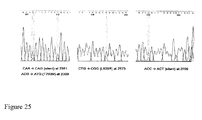
- RNAs of approximately 9 ⁇ 10 6 leukocytes isolated using a cell enrichment device of the invention (cutoff size 4 ⁇ m) and 5 ⁇ 10 6 H1650 cells were isolated by using RNeasy mini kit (Qiagen). Two micrograms of total RNAs from leukocytes and H1650 cells were reverse transcribed to obtain first strand cDNAs using 100 pmol random hexamer (Roche) and 200 U Superscript II (Invitrogen) in a 20 ⁇ l reaction. The subsequent PCR was carried out using 0.5 ⁇ l of the first strand cDNA reaction and 10 pmol of forward and reverse primers in total 25 ⁇ l of mixture.
Landscapes
- Chemical & Material Sciences (AREA)
- Life Sciences & Earth Sciences (AREA)
- Organic Chemistry (AREA)
- Proteomics, Peptides & Aminoacids (AREA)
- Health & Medical Sciences (AREA)
- Analytical Chemistry (AREA)
- Zoology (AREA)
- Wood Science & Technology (AREA)
- Engineering & Computer Science (AREA)
- Genetics & Genomics (AREA)
- Molecular Biology (AREA)
- Bioinformatics & Cheminformatics (AREA)
- Immunology (AREA)
- Biotechnology (AREA)
- Biophysics (AREA)
- Physics & Mathematics (AREA)
- Biochemistry (AREA)
- Microbiology (AREA)
- General Engineering & Computer Science (AREA)
- General Health & Medical Sciences (AREA)
- Chemical Kinetics & Catalysis (AREA)
- Pathology (AREA)
- Measuring Or Testing Involving Enzymes Or Micro-Organisms (AREA)
- Investigating Or Analysing Biological Materials (AREA)
Priority Applications (3)
| Application Number | Priority Date | Filing Date | Title |
|---|---|---|---|
| EP18167847.5A EP3406736B1 (fr) | 2006-06-14 | 2007-06-14 | Procédés pour le diagnostic d'anomalies fétales |
| EP12175907A EP2548972A1 (fr) | 2006-06-14 | 2007-06-14 | Procédés pour le diagnostic dýanomalies fýtales |
| EP22194250.1A EP4170042A1 (fr) | 2006-06-14 | 2007-06-14 | Procédés pour le diagnostic d'anomalies f tales |
Applications Claiming Priority (3)
| Application Number | Priority Date | Filing Date | Title |
|---|---|---|---|
| US80481706P | 2006-06-14 | 2006-06-14 | |
| US82077806P | 2006-07-28 | 2006-07-28 | |
| EP07784442A EP2024512A4 (fr) | 2006-06-14 | 2007-06-14 | Méthodes pour le diagnostic de caractères anormaux f taux |
Related Parent Applications (2)
| Application Number | Title | Priority Date | Filing Date |
|---|---|---|---|
| EP07784442A Division EP2024512A4 (fr) | 2006-06-14 | 2007-06-14 | Méthodes pour le diagnostic de caractères anormaux f taux |
| EP07784442.1 Division | 2007-06-14 |
Related Child Applications (3)
| Application Number | Title | Priority Date | Filing Date |
|---|---|---|---|
| EP18167847.5A Division EP3406736B1 (fr) | 2006-06-14 | 2007-06-14 | Procédés pour le diagnostic d'anomalies fétales |
| EP22194250.1A Division EP4170042A1 (fr) | 2006-06-14 | 2007-06-14 | Procédés pour le diagnostic d'anomalies f tales |
| EP12175907A Division-Into EP2548972A1 (fr) | 2006-06-14 | 2007-06-14 | Procédés pour le diagnostic dýanomalies fýtales |
Publications (2)
| Publication Number | Publication Date |
|---|---|
| EP2366801A1 true EP2366801A1 (fr) | 2011-09-21 |
| EP2366801B1 EP2366801B1 (fr) | 2016-10-19 |
Family
ID=38832875
Family Applications (5)
| Application Number | Title | Priority Date | Filing Date |
|---|---|---|---|
| EP12175907A Withdrawn EP2548972A1 (fr) | 2006-06-14 | 2007-06-14 | Procédés pour le diagnostic dýanomalies fýtales |
| EP18167847.5A Active EP3406736B1 (fr) | 2006-06-14 | 2007-06-14 | Procédés pour le diagnostic d'anomalies fétales |
| EP07784442A Withdrawn EP2024512A4 (fr) | 2006-06-14 | 2007-06-14 | Méthodes pour le diagnostic de caractères anormaux f taux |
| EP22194250.1A Pending EP4170042A1 (fr) | 2006-06-14 | 2007-06-14 | Procédés pour le diagnostic d'anomalies f tales |
| EP11159371.1A Active EP2366801B1 (fr) | 2006-06-14 | 2007-06-14 | Procédés pour le diagnostic d'anomalies foetales |
Family Applications Before (4)
| Application Number | Title | Priority Date | Filing Date |
|---|---|---|---|
| EP12175907A Withdrawn EP2548972A1 (fr) | 2006-06-14 | 2007-06-14 | Procédés pour le diagnostic dýanomalies fýtales |
| EP18167847.5A Active EP3406736B1 (fr) | 2006-06-14 | 2007-06-14 | Procédés pour le diagnostic d'anomalies fétales |
| EP07784442A Withdrawn EP2024512A4 (fr) | 2006-06-14 | 2007-06-14 | Méthodes pour le diagnostic de caractères anormaux f taux |
| EP22194250.1A Pending EP4170042A1 (fr) | 2006-06-14 | 2007-06-14 | Procédés pour le diagnostic d'anomalies f tales |
Country Status (2)
| Country | Link |
|---|---|
| EP (5) | EP2548972A1 (fr) |
| WO (1) | WO2007147076A2 (fr) |
Cited By (4)
| Publication number | Priority date | Publication date | Assignee | Title |
|---|---|---|---|---|
| WO2014078739A1 (fr) * | 2012-11-15 | 2014-05-22 | The General Hospital Corporation | Procédés et systèmes permettant de diagnostiquer des anomalies prénatales |
| US9493831B2 (en) | 2010-01-23 | 2016-11-15 | Verinata Health, Inc. | Methods of fetal abnormality detection |
| US10591391B2 (en) | 2006-06-14 | 2020-03-17 | Verinata Health, Inc. | Diagnosis of fetal abnormalities using polymorphisms including short tandem repeats |
| US10704090B2 (en) | 2006-06-14 | 2020-07-07 | Verinata Health, Inc. | Fetal aneuploidy detection by sequencing |
Families Citing this family (68)
| Publication number | Priority date | Publication date | Assignee | Title |
|---|---|---|---|---|
| ITBO20050481A1 (it) | 2005-07-19 | 2007-01-20 | Silicon Biosystems S R L | Metodo ed apparato per la manipolazione e/o l'individuazione di particelle |
| US10081839B2 (en) | 2005-07-29 | 2018-09-25 | Natera, Inc | System and method for cleaning noisy genetic data and determining chromosome copy number |
| US11111544B2 (en) | 2005-07-29 | 2021-09-07 | Natera, Inc. | System and method for cleaning noisy genetic data and determining chromosome copy number |
| US11111543B2 (en) | 2005-07-29 | 2021-09-07 | Natera, Inc. | System and method for cleaning noisy genetic data and determining chromosome copy number |
| US9424392B2 (en) | 2005-11-26 | 2016-08-23 | Natera, Inc. | System and method for cleaning noisy genetic data from target individuals using genetic data from genetically related individuals |
| ITBO20050646A1 (it) | 2005-10-26 | 2007-04-27 | Silicon Biosystem S R L | Metodo ed apparato per la caratterizzazione ed il conteggio di particelle |
| ITTO20060226A1 (it) | 2006-03-27 | 2007-09-28 | Silicon Biosystem S P A | Metodo ed apparato per il processamento e o l'analisi e o la selezione di particelle, in particolare particelle biologiche |
| WO2009035447A1 (fr) * | 2006-06-14 | 2009-03-19 | Living Microsystems, Inc. | Diagnostic d'anomalies fœtales par une analyse par hybridation génomique comparative |
| US12180549B2 (en) | 2007-07-23 | 2024-12-31 | The Chinese University Of Hong Kong | Diagnosing fetal chromosomal aneuploidy using genomic sequencing |
| US12054776B2 (en) | 2007-07-23 | 2024-08-06 | The Chinese University Of Hong Kong | Diagnosing fetal chromosomal aneuploidy using massively parallel genomic sequencing |
| ITTO20070771A1 (it) | 2007-10-29 | 2009-04-30 | Silicon Biosystems Spa | Metodo e apparato per la identificazione e manipolazione di particelle |
| US10895575B2 (en) | 2008-11-04 | 2021-01-19 | Menarini Silicon Biosystems S.P.A. | Method for identification, selection and analysis of tumour cells |
| IT1391619B1 (it) * | 2008-11-04 | 2012-01-11 | Silicon Biosystems Spa | Metodo per l'individuazione, selezione e analisi di cellule tumorali |
| US9192943B2 (en) | 2009-03-17 | 2015-11-24 | Silicon Biosystems S.P.A. | Microfluidic device for isolation of cells |
| AU2010239131A1 (en) | 2009-04-21 | 2011-11-17 | Genetic Technologies Limited | Methods for obtaining fetal genetic material |
| ES2640776T3 (es) | 2009-09-30 | 2017-11-06 | Natera, Inc. | Métodos para denominar de forma no invasiva ploidía prenatal |
| AU2010336017B2 (en) | 2009-12-23 | 2016-04-28 | Genetic Technologies Limited | Methods of enriching and detecting fetal nucleic acids |
| US20240158855A1 (en) | 2010-05-18 | 2024-05-16 | Natera, Inc. | Methods for simultaneous amplification of target loci |
| US12221653B2 (en) | 2010-05-18 | 2025-02-11 | Natera, Inc. | Methods for simultaneous amplification of target loci |
| US11408031B2 (en) | 2010-05-18 | 2022-08-09 | Natera, Inc. | Methods for non-invasive prenatal paternity testing |
| US11939634B2 (en) | 2010-05-18 | 2024-03-26 | Natera, Inc. | Methods for simultaneous amplification of target loci |
| EP2854058A3 (fr) | 2010-05-18 | 2015-10-28 | Natera, Inc. | Procédés pour une classification de ploïdie prénatale non invasive |
| US11326208B2 (en) | 2010-05-18 | 2022-05-10 | Natera, Inc. | Methods for nested PCR amplification of cell-free DNA |
| US12545960B2 (en) | 2010-05-18 | 2026-02-10 | Natera, Inc. | Methods for simultaneous amplification of target loci |
| US20190010543A1 (en) | 2010-05-18 | 2019-01-10 | Natera, Inc. | Methods for simultaneous amplification of target loci |
| US10316362B2 (en) | 2010-05-18 | 2019-06-11 | Natera, Inc. | Methods for simultaneous amplification of target loci |
| US11332785B2 (en) | 2010-05-18 | 2022-05-17 | Natera, Inc. | Methods for non-invasive prenatal ploidy calling |
| US11322224B2 (en) | 2010-05-18 | 2022-05-03 | Natera, Inc. | Methods for non-invasive prenatal ploidy calling |
| US12152275B2 (en) | 2010-05-18 | 2024-11-26 | Natera, Inc. | Methods for non-invasive prenatal ploidy calling |
| US9677118B2 (en) | 2014-04-21 | 2017-06-13 | Natera, Inc. | Methods for simultaneous amplification of target loci |
| US11339429B2 (en) | 2010-05-18 | 2022-05-24 | Natera, Inc. | Methods for non-invasive prenatal ploidy calling |
| US12655483B2 (en) | 2010-05-18 | 2026-06-16 | Natera, Inc. | Methods for simultaneous amplification of target loci |
| US11332793B2 (en) | 2010-05-18 | 2022-05-17 | Natera, Inc. | Methods for simultaneous amplification of target loci |
| IT1403518B1 (it) | 2010-12-22 | 2013-10-31 | Silicon Biosystems Spa | Dispositivo microfluidico per la manipolazione di particelle |
| AU2011348100B2 (en) | 2010-12-22 | 2016-08-25 | Natera, Inc. | Methods for non-invasive prenatal paternity testing |
| EP3483285B1 (fr) | 2011-02-09 | 2021-07-14 | Bio-Rad Laboratories, Inc. | Analyse d'acides nucléiques |
| JP6153874B2 (ja) | 2011-02-09 | 2017-06-28 | ナテラ, インコーポレイテッド | 非侵襲的出生前倍数性呼び出しのための方法 |
| ITTO20110990A1 (it) | 2011-10-28 | 2013-04-29 | Silicon Biosystems Spa | Metodo ed apparato per l'analisi ottica di particelle a basse temperature |
| ITBO20110766A1 (it) | 2011-12-28 | 2013-06-29 | Silicon Biosystems Spa | Dispositivi, apparato, kit e metodo per il trattamento di un campione biologico |
| US20140100126A1 (en) | 2012-08-17 | 2014-04-10 | Natera, Inc. | Method for Non-Invasive Prenatal Testing Using Parental Mosaicism Data |
| US11493428B2 (en) | 2013-03-15 | 2022-11-08 | Gpb Scientific, Inc. | On-chip microfluidic processing of particles |
| US20150064153A1 (en) | 2013-03-15 | 2015-03-05 | The Trustees Of Princeton University | High efficiency microfluidic purification of stem cells to improve transplants |
| US12590955B2 (en) | 2013-03-15 | 2026-03-31 | Zeon Corporation | Methods and systems for processing particles |
| CN113512522A (zh) | 2013-03-15 | 2021-10-19 | 普林斯顿大学理事会 | 用于高通量纯化的方法和设备 |
| US10577655B2 (en) | 2013-09-27 | 2020-03-03 | Natera, Inc. | Cell free DNA diagnostic testing standards |
| US10262755B2 (en) | 2014-04-21 | 2019-04-16 | Natera, Inc. | Detecting cancer mutations and aneuploidy in chromosomal segments |
| RU2717641C2 (ru) | 2014-04-21 | 2020-03-24 | Натера, Инк. | Обнаружение мутаций и плоидности в хромосомных сегментах |
| US12492429B2 (en) | 2014-04-21 | 2025-12-09 | Natera, Inc. | Detecting mutations and ploidy in chromosomal segments |
| US20180173845A1 (en) | 2014-06-05 | 2018-06-21 | Natera, Inc. | Systems and Methods for Detection of Aneuploidy |
| US10364467B2 (en) | 2015-01-13 | 2019-07-30 | The Chinese University Of Hong Kong | Using size and number aberrations in plasma DNA for detecting cancer |
| EP4428863A3 (fr) | 2015-05-11 | 2024-12-11 | Natera, Inc. | Procédés et compositions pour déterminer la ploïdie |
| CN108350500A (zh) * | 2015-07-29 | 2018-07-31 | 普罗格尼迪公司 | 用于检测染色体异常的核酸和方法 |
| WO2017132909A1 (fr) * | 2016-02-03 | 2017-08-10 | 深圳华大基因研究院 | Procédé pour séparer une cellule cible à partir d'un échantillon de sang et utilisation correspondante |
| JP7280044B2 (ja) | 2016-04-15 | 2023-05-23 | ナテラ, インコーポレイテッド | 肺癌の検出方法 |
| WO2018067517A1 (fr) | 2016-10-04 | 2018-04-12 | Natera, Inc. | Procédés pour caractériser une variation de nombre de copies à l'aide d'un séquençage de ligature de proximité |
| GB201618485D0 (en) | 2016-11-02 | 2016-12-14 | Ucl Business Plc | Method of detecting tumour recurrence |
| US10011870B2 (en) | 2016-12-07 | 2018-07-03 | Natera, Inc. | Compositions and methods for identifying nucleic acid molecules |
| CA3049139A1 (fr) | 2017-02-21 | 2018-08-30 | Natera, Inc. | Compositions, procedes, et kits d'isolement d'acides nucleiques |
| WO2019118926A1 (fr) | 2017-12-14 | 2019-06-20 | Tai Diagnostics, Inc. | Évaluation de la compatibilité d'une greffe pour la transplantation |
| EP3737773B1 (fr) | 2018-01-12 | 2023-04-12 | Natera, Inc. | Nouvelles amorces et utilisations correspondantes |
| WO2019161244A1 (fr) | 2018-02-15 | 2019-08-22 | Natera, Inc. | Procédés pour isoler des acides nucléiques avec sélection de taille |
| CN108118094A (zh) * | 2018-03-06 | 2018-06-05 | 杨祚璋 | 骨肉瘤转移相关标志物ensg00000267886及其应用 |
| DK3781714T3 (da) | 2018-04-14 | 2026-03-30 | Natera Inc | Fremgangsmåder til cancerpåvisning og -overvågning ved personlig påvisning af cirkulerende tumor-dna |
| US12234509B2 (en) | 2018-07-03 | 2025-02-25 | Natera, Inc. | Methods for detection of donor-derived cell-free DNA |
| WO2020206170A1 (fr) | 2019-04-02 | 2020-10-08 | Progenity, Inc. | Procédés, systèmes et compositions de comptage de molécules d'acide nucléique |
| US12305235B2 (en) | 2019-06-06 | 2025-05-20 | Natera, Inc. | Methods for detecting immune cell DNA and monitoring immune system |
| CN114728256A (zh) * | 2019-11-14 | 2022-07-08 | 生物辐射实验室股份有限公司 | 通过非终点扩增进行的单细胞的靶标拷贝数的分区型确定 |
| WO2026151701A1 (fr) * | 2025-01-07 | 2026-07-16 | Gateway Genomics, Llc | Procédés et dosages pour la détection sans extraction d'acides nucléiques dans un échantillon biologique |
Citations (85)
| Publication number | Priority date | Publication date | Assignee | Title |
|---|---|---|---|---|
| EP0323203A2 (fr) | 1987-12-28 | 1989-07-05 | Isuzu Motors Limited | Système de commande de moteur à combustion interne à turbocompresseur |
| EP0373203A1 (fr) | 1988-05-03 | 1990-06-20 | Isis Innovation | Méthode et dispositif pour l'analyse de séquences de polynucléotides. |
| US4988617A (en) | 1988-03-25 | 1991-01-29 | California Institute Of Technology | Method of detecting a nucleotide change in nucleic acids |
| US5242794A (en) | 1984-12-13 | 1993-09-07 | Applied Biosystems, Inc. | Detection of specific sequences in nucleic acids |
| US5302509A (en) * | 1989-08-14 | 1994-04-12 | Beckman Instruments, Inc. | Method for sequencing polynucleotides |
| EP0619321A1 (fr) | 1989-06-07 | 1994-10-12 | Affymax Technologies N.V. | Synthèse à grande échelle de peptides immobilisés |
| US5494810A (en) | 1990-05-03 | 1996-02-27 | Cornell Research Foundation, Inc. | Thermostable ligase-mediated DNA amplifications system for the detection of genetic disease |
| US5641628A (en) * | 1989-11-13 | 1997-06-24 | Children's Medical Center Corporation | Non-invasive method for isolation and detection of fetal DNA |
| US5700637A (en) | 1988-05-03 | 1997-12-23 | Isis Innovation Limited | Apparatus and method for analyzing polynucleotide sequences and method of generating oligonucleotide arrays |
| US5733729A (en) | 1995-09-14 | 1998-03-31 | Affymetrix, Inc. | Computer-aided probability base calling for arrays of nucleic acid probes on chips |
| US5744305A (en) | 1989-06-07 | 1998-04-28 | Affymetrix, Inc. | Arrays of materials attached to a substrate |
| US5799637A (en) | 1996-05-01 | 1998-09-01 | Cifuni; Charles G. | Rocket effect sparking plug |
| US5837115A (en) | 1993-06-08 | 1998-11-17 | British Technology Group Usa Inc. | Microlithographic array for macromolecule and cell fractionation |
| US5945334A (en) | 1994-06-08 | 1999-08-31 | Affymetrix, Inc. | Apparatus for packaging a chip |
| US6054270A (en) | 1988-05-03 | 2000-04-25 | Oxford Gene Technology Limited | Analying polynucleotide sequences |
| US20020012930A1 (en) | 1999-09-16 | 2002-01-31 | Rothberg Jonathan M. | Method of sequencing a nucleic acid |
| US6346413B1 (en) | 1989-06-07 | 2002-02-12 | Affymetrix, Inc. | Polymer arrays |
| US6355431B1 (en) | 1999-04-20 | 2002-03-12 | Illumina, Inc. | Detection of nucleic acid amplification reactions using bead arrays |
| US6396995B1 (en) | 1999-05-20 | 2002-05-28 | Illumina, Inc. | Method and apparatus for retaining and presenting at least one microsphere array to solutions and/or to optical imaging systems |
| US6399365B2 (en) | 1994-06-08 | 2002-06-04 | Affymetrix, Inc. | Bioarray chip reaction apparatus and its manufacture |
| US6420169B1 (en) | 1989-06-07 | 2002-07-16 | Affymetrix, Inc. | Apparatus for forming polynucleotides or polypeptides |
| US6429027B1 (en) | 1998-12-28 | 2002-08-06 | Illumina, Inc. | Composite arrays utilizing microspheres |
| WO2002088382A2 (fr) | 2001-04-27 | 2002-11-07 | Genovoxx Gmbh | Procede d'analyse de chaines d'acide nucleique |
| US20030003490A1 (en) | 2000-02-07 | 2003-01-02 | Illumina, Inc. | Nucleic acid detection methods using universal priming |
| US6505125B1 (en) | 1999-09-28 | 2003-01-07 | Affymetrix, Inc. | Methods and computer software products for multiple probe gene expression analysis |
| US20030022207A1 (en) | 1998-10-16 | 2003-01-30 | Solexa, Ltd. | Arrayed polynucleotides and their use in genome analysis |
| US20030044781A1 (en) | 1999-05-19 | 2003-03-06 | Jonas Korlach | Method for sequencing nucleic acid molecules |
| WO2003020968A2 (fr) | 2001-08-29 | 2003-03-13 | Genovoxx Gmbh | Procede d'analyse de sequences d'acides nucleiques et de l'expression de genes |
| US20030064398A1 (en) | 2000-02-02 | 2003-04-03 | Solexa, Ltd. | Synthesis of spatially addressed molecular arrays |
| US6544732B1 (en) | 1999-05-20 | 2003-04-08 | Illumina, Inc. | Encoding and decoding of array sensors utilizing nanocrystals |
| WO2003031947A2 (fr) | 2001-10-04 | 2003-04-17 | Genovoxx Gmbh | Appareil de sequençage de molecules d'acides nucleiques |
| US6582938B1 (en) | 2001-05-11 | 2003-06-24 | Affymetrix, Inc. | Amplification of nucleic acids |
| DE10149786A1 (de) | 2001-10-09 | 2003-07-03 | Dmitri Tcherkassov | Oberfläche für Untersuchungen aus Populationen von Einzelmolekülen |
| US6610482B1 (en) | 1989-06-07 | 2003-08-26 | Affymetrix, Inc. | Support bound probes and methods of analysis using the same |
| US6620584B1 (en) | 1999-05-20 | 2003-09-16 | Illumina | Combinatorial decoding of random nucleic acid arrays |
| US6632655B1 (en) * | 1999-02-23 | 2003-10-14 | Caliper Technologies Corp. | Manipulation of microparticles in microfluidic systems |
| DE10214395A1 (de) | 2002-03-30 | 2003-10-23 | Dmitri Tcherkassov | Verfahren zur Analyse von Einzelnukleotidpolymorphismen |
| US20030198573A1 (en) | 2002-01-25 | 2003-10-23 | Illumina, Inc. | Sensor arrays for detecting analytes in fluids |
| US6663832B2 (en) | 1999-12-13 | 2003-12-16 | Illumina, Inc. | Oligonucleotide synthesizer |
| US6692952B1 (en) | 1999-11-10 | 2004-02-17 | Massachusetts Institute Of Technology | Cell analysis and sorting apparatus for manipulation of cells |
| WO2004014465A1 (fr) | 2002-08-08 | 2004-02-19 | Nemoto Kyorindo Co., Ltd. | Dispositif d'injection d'un liquide medicinal pour injecter plusieurs sortes de liquides medicinaux sans les melanger |
| WO2004029221A2 (fr) | 2002-09-27 | 2004-04-08 | The General Hospital Corporation | Dispositif microfluidique pour la separation de cellules et utilisations de ce dispositif |
| US20040106110A1 (en) | 1998-07-30 | 2004-06-03 | Solexa, Ltd. | Preparation of polynucleotide arrays |
| US6770441B2 (en) | 2000-02-10 | 2004-08-03 | Illumina, Inc. | Array compositions and methods of making same |
| US20040157243A1 (en) | 2002-11-11 | 2004-08-12 | Affymetrix, Inc. | Methods for identifying DNA copy number changes |
| US6787308B2 (en) | 1998-07-30 | 2004-09-07 | Solexa Ltd. | Arrayed biomolecules and their use in sequencing |
| US20040185482A1 (en) | 1998-12-28 | 2004-09-23 | Illumina, Inc. | Composite arrays utilizing microspheres with a hybridization chamber |
| US6812005B2 (en) | 2000-02-07 | 2004-11-02 | The Regents Of The University Of California | Nucleic acid detection methods using universal priming |
| US20040248161A1 (en) | 1999-09-16 | 2004-12-09 | Rothberg Jonathan M. | Method of sequencing a nucleic acid |
| US6833246B2 (en) | 1999-09-29 | 2004-12-21 | Solexa, Ltd. | Polynucleotide sequencing |
| WO2004113877A1 (fr) | 2003-06-13 | 2004-12-29 | The General Hospital Corporation | Systemes microfluidiques d'elimination basee sur la taille de globules rouges et de plaquettes du sang |
| US6846460B1 (en) | 1999-01-29 | 2005-01-25 | Illumina, Inc. | Apparatus and method for separation of liquid phases of different density and for fluorous phase organic syntheses |
| US6858412B2 (en) | 2000-10-24 | 2005-02-22 | The Board Of Trustees Of The Leland Stanford Junior University | Direct multiplex characterization of genomic DNA |
| US20050049793A1 (en) * | 2001-04-30 | 2005-03-03 | Patrizia Paterlini-Brechot | Prenatal diagnosis method on isolated foetal cell of maternal blood |
| US20050079510A1 (en) | 2003-01-29 | 2005-04-14 | Jan Berka | Bead emulsion nucleic acid amplification |
| US20050100932A1 (en) | 2003-11-12 | 2005-05-12 | Helicos Biosciences Corporation | Short cycle methods for sequencing polynucleotides |
| WO2005044836A2 (fr) | 2003-11-05 | 2005-05-19 | Genovoxx Gmbh | Composes nucleotidiques macromoleculaires et leurs procedes d'utilisation |
| US6897023B2 (en) | 2000-09-27 | 2005-05-24 | The Molecular Sciences Institute, Inc. | Method for determining relative abundance of nucleic acid sequences |
| US6902921B2 (en) | 2001-10-30 | 2005-06-07 | 454 Corporation | Sulfurylase-luciferase fusion proteins and thermostable sulfurylase |
| US20050124022A1 (en) | 2001-10-30 | 2005-06-09 | Maithreyan Srinivasan | Novel sulfurylase-luciferase fusion proteins and thermostable sulfurylase |
| DE10356837A1 (de) | 2003-12-05 | 2005-06-30 | Dmitry Cherkasov | Modifizierte Nukleotide und Nukleoside |
| US6913884B2 (en) | 2001-08-16 | 2005-07-05 | Illumina, Inc. | Compositions and methods for repetitive use of genomic DNA |
| US20050164246A1 (en) | 2003-05-15 | 2005-07-28 | Illumina, Inc. | Methods and compositions for diagnosing lung cancer with specific DNA methylation patterns |
| US20050181394A1 (en) | 2003-06-20 | 2005-08-18 | Illumina, Inc. | Methods and compositions for whole genome amplification and genotyping |
| US6942968B1 (en) | 1999-08-30 | 2005-09-13 | Illumina, Inc. | Array compositions for improved signal detection |
| DE102004009704A1 (de) | 2004-02-27 | 2005-09-15 | Dmitry Cherkasov | Makromolekulare Nukleotidverbindungen und Methoden zu deren Anwendung |
| US20050216207A1 (en) | 2004-03-24 | 2005-09-29 | Illumina, Inc. | Artificial intelligence and global normalization methods for genotyping |
| US6956114B2 (en) | 2001-10-30 | 2005-10-18 | '454 Corporation | Sulfurylase-luciferase fusion proteins and thermostable sulfurylase |
| US20050244870A1 (en) | 1999-04-20 | 2005-11-03 | Illumina, Inc. | Nucleic acid sequencing using microsphere arrays |
| US6969488B2 (en) | 1998-05-22 | 2005-11-29 | Solexa, Inc. | System and apparatus for sequential processing of analytes |
| US20050266432A1 (en) | 2004-02-26 | 2005-12-01 | Illumina, Inc. | Haplotype markers for diagnosing susceptibility to immunological conditions |
| DE102004025745A1 (de) | 2004-05-26 | 2005-12-15 | Cherkasov, Dmitry | Oberfläche für die Analysen an einzelnen Molekülen |
| DE102004025746A1 (de) | 2004-05-26 | 2005-12-15 | Dmitry Cherkasov | Verfahren, Oberfläche und Substrate zur hochparallelen Sequenzierung von Nukleinsäureketten |
| DE102004025744A1 (de) | 2004-05-26 | 2005-12-29 | Dmitry Cherkasov | Oberfläche für die Analysen an einzelnen Nukleinsäuremolekülen |
| US20060012784A1 (en) | 2004-07-19 | 2006-01-19 | Helicos Biosciences Corporation | Apparatus and methods for analyzing samples |
| US20060012793A1 (en) | 2004-07-19 | 2006-01-19 | Helicos Biosciences Corporation | Apparatus and methods for analyzing samples |
| US20060019258A1 (en) | 2004-07-20 | 2006-01-26 | Illumina, Inc. | Methods and compositions for detection of small interfering RNA and micro-RNA |
| US20060024678A1 (en) | 2004-07-28 | 2006-02-02 | Helicos Biosciences Corporation | Use of single-stranded nucleic acid binding proteins in sequencing |
| US20060024711A1 (en) | 2004-07-02 | 2006-02-02 | Helicos Biosciences Corporation | Methods for nucleic acid amplification and sequence determination |
| DE102004025695A1 (de) | 2004-05-26 | 2006-02-23 | Dmitry Cherkasov | Verfahren und Oberfläche zur parallelen Sequenzierung von Nukleinsäureketten |
| DE102004025696A1 (de) | 2004-05-26 | 2006-02-23 | Dmitry Cherkasov | Verfahren, Oberfläche und Substrate zu hochparallelen Analysen von Nukleinsäureketten |
| DE102004025694A1 (de) | 2004-05-26 | 2006-02-23 | Dmitry Cherkasov | Verfahren und Oberfläche zu hochparallelen Analysen von Nukleinsäureketten |
| US7025935B2 (en) | 2003-04-11 | 2006-04-11 | Illumina, Inc. | Apparatus and methods for reformatting liquid samples |
| US7033754B2 (en) | 1998-06-24 | 2006-04-25 | Illumina, Inc. | Decoding of array sensors with microspheres |
| US7040959B1 (en) | 2004-01-20 | 2006-05-09 | Illumina, Inc. | Variable rate dispensing system for abrasive material and method thereof |
Family Cites Families (11)
| Publication number | Priority date | Publication date | Assignee | Title |
|---|---|---|---|---|
| US6120985A (en) * | 1997-10-31 | 2000-09-19 | Bbi Bioseq, Inc. | Pressure-enhanced extraction and purification |
| GB9828785D0 (en) * | 1998-12-30 | 1999-02-17 | Amersham Pharm Biotech Ab | Sequencing systems |
| GB0016742D0 (en) * | 2000-07-10 | 2000-08-30 | Simeg Limited | Diagnostic method |
| CA2428757A1 (fr) * | 2000-11-15 | 2002-07-18 | Roche Diagnostics Corporation | Methodes et reactifs permettant d'identifier des cellules embryonnaires rares dans le systeme circulatoire maternel |
| US7078168B2 (en) * | 2001-02-27 | 2006-07-18 | Biotage Ab | Method for determining allele frequencies |
| US20050244843A1 (en) * | 2001-11-16 | 2005-11-03 | Wen-Tien Chen | Blood test prototypes and methods for the detection of circulating tumor and endothelial cells |
| US7727720B2 (en) * | 2002-05-08 | 2010-06-01 | Ravgen, Inc. | Methods for detection of genetic disorders |
| DE60332046D1 (de) * | 2002-10-23 | 2010-05-20 | Univ Princeton | Verfahren zur kontinuierlichen teilchentrennung unter verwendungvon zu feldern asymmetrisch ausgerichteten hindernisarrays |
| AU2003291477A1 (en) | 2002-11-13 | 2004-06-03 | Molecular Imprints, Inc. | A chucking system and method for modulating shapes of substrates |
| EP1689884A4 (fr) * | 2003-10-08 | 2007-04-04 | Univ Boston | Methodes de diagnostic prenatal d'anomalies chromosomiques |
| EP1776449A4 (fr) * | 2004-03-03 | 2009-08-12 | Gen Hospital Corp | Dispositif magnetique destine a l'isolation de cellules et de biomolecules dans un environnement microfluidique |
-
2007
- 2007-06-14 WO PCT/US2007/071250 patent/WO2007147076A2/fr not_active Ceased
- 2007-06-14 EP EP12175907A patent/EP2548972A1/fr not_active Withdrawn
- 2007-06-14 EP EP18167847.5A patent/EP3406736B1/fr active Active
- 2007-06-14 EP EP07784442A patent/EP2024512A4/fr not_active Withdrawn
- 2007-06-14 EP EP22194250.1A patent/EP4170042A1/fr active Pending
- 2007-06-14 EP EP11159371.1A patent/EP2366801B1/fr active Active
Patent Citations (107)
| Publication number | Priority date | Publication date | Assignee | Title |
|---|---|---|---|---|
| US5242794A (en) | 1984-12-13 | 1993-09-07 | Applied Biosystems, Inc. | Detection of specific sequences in nucleic acids |
| EP0323203A2 (fr) | 1987-12-28 | 1989-07-05 | Isuzu Motors Limited | Système de commande de moteur à combustion interne à turbocompresseur |
| US4988617A (en) | 1988-03-25 | 1991-01-29 | California Institute Of Technology | Method of detecting a nucleotide change in nucleic acids |
| US5700637A (en) | 1988-05-03 | 1997-12-23 | Isis Innovation Limited | Apparatus and method for analyzing polynucleotide sequences and method of generating oligonucleotide arrays |
| EP0373203A1 (fr) | 1988-05-03 | 1990-06-20 | Isis Innovation | Méthode et dispositif pour l'analyse de séquences de polynucléotides. |
| US6054270A (en) | 1988-05-03 | 2000-04-25 | Oxford Gene Technology Limited | Analying polynucleotide sequences |
| US6291183B1 (en) | 1989-06-07 | 2001-09-18 | Affymetrix, Inc. | Very large scale immobilized polymer synthesis |
| EP0619321A1 (fr) | 1989-06-07 | 1994-10-12 | Affymax Technologies N.V. | Synthèse à grande échelle de peptides immobilisés |
| US5445934A (en) | 1989-06-07 | 1995-08-29 | Affymax Technologies N.V. | Array of oligonucleotides on a solid substrate |
| US6261776B1 (en) | 1989-06-07 | 2001-07-17 | Affymetrix, Inc. | Nucleic acid arrays |
| US6346413B1 (en) | 1989-06-07 | 2002-02-12 | Affymetrix, Inc. | Polymer arrays |
| US6420169B1 (en) | 1989-06-07 | 2002-07-16 | Affymetrix, Inc. | Apparatus for forming polynucleotides or polypeptides |
| US6610482B1 (en) | 1989-06-07 | 2003-08-26 | Affymetrix, Inc. | Support bound probes and methods of analysis using the same |
| US5744305A (en) | 1989-06-07 | 1998-04-28 | Affymetrix, Inc. | Arrays of materials attached to a substrate |
| US5302509A (en) * | 1989-08-14 | 1994-04-12 | Beckman Instruments, Inc. | Method for sequencing polynucleotides |
| US5641628A (en) * | 1989-11-13 | 1997-06-24 | Children's Medical Center Corporation | Non-invasive method for isolation and detection of fetal DNA |
| US5494810A (en) | 1990-05-03 | 1996-02-27 | Cornell Research Foundation, Inc. | Thermostable ligase-mediated DNA amplifications system for the detection of genetic disease |
| US5837115A (en) | 1993-06-08 | 1998-11-17 | British Technology Group Usa Inc. | Microlithographic array for macromolecule and cell fractionation |
| US5945334A (en) | 1994-06-08 | 1999-08-31 | Affymetrix, Inc. | Apparatus for packaging a chip |
| US6140044A (en) | 1994-06-08 | 2000-10-31 | Affymetrix, Inc. | Method and apparatus for packaging a probe array |
| US6399365B2 (en) | 1994-06-08 | 2002-06-04 | Affymetrix, Inc. | Bioarray chip reaction apparatus and its manufacture |
| US6733977B2 (en) | 1994-06-08 | 2004-05-11 | Affymetrix, Inc. | Hybridization device and method |
| US6551817B2 (en) | 1994-06-08 | 2003-04-22 | Affymetrix, Inc. | Method and apparatus for hybridization |
| US5733729A (en) | 1995-09-14 | 1998-03-31 | Affymetrix, Inc. | Computer-aided probability base calling for arrays of nucleic acid probes on chips |
| US5799637A (en) | 1996-05-01 | 1998-09-01 | Cifuni; Charles G. | Rocket effect sparking plug |
| US6969488B2 (en) | 1998-05-22 | 2005-11-29 | Solexa, Inc. | System and apparatus for sequential processing of analytes |
| US7033754B2 (en) | 1998-06-24 | 2006-04-25 | Illumina, Inc. | Decoding of array sensors with microspheres |
| US6787308B2 (en) | 1998-07-30 | 2004-09-07 | Solexa Ltd. | Arrayed biomolecules and their use in sequencing |
| US20040106110A1 (en) | 1998-07-30 | 2004-06-03 | Solexa, Ltd. | Preparation of polynucleotide arrays |
| US20030022207A1 (en) | 1998-10-16 | 2003-01-30 | Solexa, Ltd. | Arrayed polynucleotides and their use in genome analysis |
| US20040185482A1 (en) | 1998-12-28 | 2004-09-23 | Illumina, Inc. | Composite arrays utilizing microspheres with a hybridization chamber |
| US20020187515A1 (en) | 1998-12-28 | 2002-12-12 | Illumina, Inc. | Composite arrays utilizing microspheres |
| US6998274B2 (en) | 1998-12-28 | 2006-02-14 | Illumina, Inc. | Composite arrays utilizing microspheres |
| US6858394B1 (en) | 1998-12-28 | 2005-02-22 | Illumina, Inc. | Composite arrays utilizing microspheres |
| US6429027B1 (en) | 1998-12-28 | 2002-08-06 | Illumina, Inc. | Composite arrays utilizing microspheres |
| US6846460B1 (en) | 1999-01-29 | 2005-01-25 | Illumina, Inc. | Apparatus and method for separation of liquid phases of different density and for fluorous phase organic syntheses |
| US6632655B1 (en) * | 1999-02-23 | 2003-10-14 | Caliper Technologies Corp. | Manipulation of microparticles in microfluidic systems |
| US6355431B1 (en) | 1999-04-20 | 2002-03-12 | Illumina, Inc. | Detection of nucleic acid amplification reactions using bead arrays |
| US20020177141A1 (en) | 1999-04-20 | 2002-11-28 | Illumina, Inc. | Detection of nucleic acid amplification reactions using bead arrays |
| US20050244870A1 (en) | 1999-04-20 | 2005-11-03 | Illumina, Inc. | Nucleic acid sequencing using microsphere arrays |
| US20030044781A1 (en) | 1999-05-19 | 2003-03-06 | Jonas Korlach | Method for sequencing nucleic acid molecules |
| US20060078937A1 (en) | 1999-05-19 | 2006-04-13 | Jonas Korlach | Sequencing nucleic acid using tagged polymerase and/or tagged nucleotide |
| US20030175773A1 (en) | 1999-05-20 | 2003-09-18 | Illumina, Inc. | Encoding and decoding of array sensors utilizing nanocrystals |
| US6620584B1 (en) | 1999-05-20 | 2003-09-16 | Illumina | Combinatorial decoding of random nucleic acid arrays |
| US6544732B1 (en) | 1999-05-20 | 2003-04-08 | Illumina, Inc. | Encoding and decoding of array sensors utilizing nanocrystals |
| US6890764B2 (en) | 1999-05-20 | 2005-05-10 | Illumina, Inc. | Encoding and decoding of array sensors utilizing nanocrystals |
| US6396995B1 (en) | 1999-05-20 | 2002-05-28 | Illumina, Inc. | Method and apparatus for retaining and presenting at least one microsphere array to solutions and/or to optical imaging systems |
| US6942968B1 (en) | 1999-08-30 | 2005-09-13 | Illumina, Inc. | Array compositions for improved signal detection |
| US20040248161A1 (en) | 1999-09-16 | 2004-12-09 | Rothberg Jonathan M. | Method of sequencing a nucleic acid |
| US20030148344A1 (en) | 1999-09-16 | 2003-08-07 | Rothberg Jonathan M. | Method of sequencing a nucleic acid |
| US20020012930A1 (en) | 1999-09-16 | 2002-01-31 | Rothberg Jonathan M. | Method of sequencing a nucleic acid |
| US20030100102A1 (en) | 1999-09-16 | 2003-05-29 | Rothberg Jonathan M. | Apparatus and method for sequencing a nucleic acid |
| US6505125B1 (en) | 1999-09-28 | 2003-01-07 | Affymetrix, Inc. | Methods and computer software products for multiple probe gene expression analysis |
| US6833246B2 (en) | 1999-09-29 | 2004-12-21 | Solexa, Ltd. | Polynucleotide sequencing |
| US6692952B1 (en) | 1999-11-10 | 2004-02-17 | Massachusetts Institute Of Technology | Cell analysis and sorting apparatus for manipulation of cells |
| US6663832B2 (en) | 1999-12-13 | 2003-12-16 | Illumina, Inc. | Oligonucleotide synthesizer |
| US20030064398A1 (en) | 2000-02-02 | 2003-04-03 | Solexa, Ltd. | Synthesis of spatially addressed molecular arrays |
| US20030003490A1 (en) | 2000-02-07 | 2003-01-02 | Illumina, Inc. | Nucleic acid detection methods using universal priming |
| US6812005B2 (en) | 2000-02-07 | 2004-11-02 | The Regents Of The University Of California | Nucleic acid detection methods using universal priming |
| US20040224353A1 (en) | 2000-02-07 | 2004-11-11 | Illumina, Inc. | Nucleic acid detection methods using universal priming |
| US6890741B2 (en) | 2000-02-07 | 2005-05-10 | Illumina, Inc. | Multiplexed detection of analytes |
| US6770441B2 (en) | 2000-02-10 | 2004-08-03 | Illumina, Inc. | Array compositions and methods of making same |
| US6897023B2 (en) | 2000-09-27 | 2005-05-24 | The Molecular Sciences Institute, Inc. | Method for determining relative abundance of nucleic acid sequences |
| US6858412B2 (en) | 2000-10-24 | 2005-02-22 | The Board Of Trustees Of The Leland Stanford Junior University | Direct multiplex characterization of genomic DNA |
| US20030068629A1 (en) | 2001-03-21 | 2003-04-10 | Rothberg Jonathan M. | Apparatus and method for sequencing a nucleic acid |
| WO2002088382A2 (fr) | 2001-04-27 | 2002-11-07 | Genovoxx Gmbh | Procede d'analyse de chaines d'acide nucleique |
| US20050049793A1 (en) * | 2001-04-30 | 2005-03-03 | Patrizia Paterlini-Brechot | Prenatal diagnosis method on isolated foetal cell of maternal blood |
| US6582938B1 (en) | 2001-05-11 | 2003-06-24 | Affymetrix, Inc. | Amplification of nucleic acids |
| US6913884B2 (en) | 2001-08-16 | 2005-07-05 | Illumina, Inc. | Compositions and methods for repetitive use of genomic DNA |
| WO2003020968A2 (fr) | 2001-08-29 | 2003-03-13 | Genovoxx Gmbh | Procede d'analyse de sequences d'acides nucleiques et de l'expression de genes |
| WO2003031947A2 (fr) | 2001-10-04 | 2003-04-17 | Genovoxx Gmbh | Appareil de sequençage de molecules d'acides nucleiques |
| DE10149786A1 (de) | 2001-10-09 | 2003-07-03 | Dmitri Tcherkassov | Oberfläche für Untersuchungen aus Populationen von Einzelmolekülen |
| US20060078909A1 (en) | 2001-10-30 | 2006-04-13 | Maithreyan Srinivasan | Novel sulfurylase-luciferase fusion proteins and thermostable sulfurylase |
| US6956114B2 (en) | 2001-10-30 | 2005-10-18 | '454 Corporation | Sulfurylase-luciferase fusion proteins and thermostable sulfurylase |
| US6902921B2 (en) | 2001-10-30 | 2005-06-07 | 454 Corporation | Sulfurylase-luciferase fusion proteins and thermostable sulfurylase |
| US20050124022A1 (en) | 2001-10-30 | 2005-06-09 | Maithreyan Srinivasan | Novel sulfurylase-luciferase fusion proteins and thermostable sulfurylase |
| US20030198573A1 (en) | 2002-01-25 | 2003-10-23 | Illumina, Inc. | Sensor arrays for detecting analytes in fluids |
| DE10214395A1 (de) | 2002-03-30 | 2003-10-23 | Dmitri Tcherkassov | Verfahren zur Analyse von Einzelnukleotidpolymorphismen |
| WO2004014465A1 (fr) | 2002-08-08 | 2004-02-19 | Nemoto Kyorindo Co., Ltd. | Dispositif d'injection d'un liquide medicinal pour injecter plusieurs sortes de liquides medicinaux sans les melanger |
| WO2004029221A2 (fr) | 2002-09-27 | 2004-04-08 | The General Hospital Corporation | Dispositif microfluidique pour la separation de cellules et utilisations de ce dispositif |
| US20050130217A1 (en) | 2002-11-11 | 2005-06-16 | Affymetrix, Inc. | Methods for identifying DNA copy number changes |
| US20050064476A1 (en) | 2002-11-11 | 2005-03-24 | Affymetrix, Inc. | Methods for identifying DNA copy number changes |
| US20040157243A1 (en) | 2002-11-11 | 2004-08-12 | Affymetrix, Inc. | Methods for identifying DNA copy number changes |
| US20050079510A1 (en) | 2003-01-29 | 2005-04-14 | Jan Berka | Bead emulsion nucleic acid amplification |
| US7025935B2 (en) | 2003-04-11 | 2006-04-11 | Illumina, Inc. | Apparatus and methods for reformatting liquid samples |
| US20050164246A1 (en) | 2003-05-15 | 2005-07-28 | Illumina, Inc. | Methods and compositions for diagnosing lung cancer with specific DNA methylation patterns |
| WO2004113877A1 (fr) | 2003-06-13 | 2004-12-29 | The General Hospital Corporation | Systemes microfluidiques d'elimination basee sur la taille de globules rouges et de plaquettes du sang |
| US20050181394A1 (en) | 2003-06-20 | 2005-08-18 | Illumina, Inc. | Methods and compositions for whole genome amplification and genotyping |
| WO2005044836A2 (fr) | 2003-11-05 | 2005-05-19 | Genovoxx Gmbh | Composes nucleotidiques macromoleculaires et leurs procedes d'utilisation |
| US20050100932A1 (en) | 2003-11-12 | 2005-05-12 | Helicos Biosciences Corporation | Short cycle methods for sequencing polynucleotides |
| DE10356837A1 (de) | 2003-12-05 | 2005-06-30 | Dmitry Cherkasov | Modifizierte Nukleotide und Nukleoside |
| US7040959B1 (en) | 2004-01-20 | 2006-05-09 | Illumina, Inc. | Variable rate dispensing system for abrasive material and method thereof |
| US20050266432A1 (en) | 2004-02-26 | 2005-12-01 | Illumina, Inc. | Haplotype markers for diagnosing susceptibility to immunological conditions |
| DE102004009704A1 (de) | 2004-02-27 | 2005-09-15 | Dmitry Cherkasov | Makromolekulare Nukleotidverbindungen und Methoden zu deren Anwendung |
| US7035740B2 (en) | 2004-03-24 | 2006-04-25 | Illumina, Inc. | Artificial intelligence and global normalization methods for genotyping |
| US20050216207A1 (en) | 2004-03-24 | 2005-09-29 | Illumina, Inc. | Artificial intelligence and global normalization methods for genotyping |
| DE102004025694A1 (de) | 2004-05-26 | 2006-02-23 | Dmitry Cherkasov | Verfahren und Oberfläche zu hochparallelen Analysen von Nukleinsäureketten |
| DE102004025695A1 (de) | 2004-05-26 | 2006-02-23 | Dmitry Cherkasov | Verfahren und Oberfläche zur parallelen Sequenzierung von Nukleinsäureketten |
| DE102004025696A1 (de) | 2004-05-26 | 2006-02-23 | Dmitry Cherkasov | Verfahren, Oberfläche und Substrate zu hochparallelen Analysen von Nukleinsäureketten |
| DE102004025744A1 (de) | 2004-05-26 | 2005-12-29 | Dmitry Cherkasov | Oberfläche für die Analysen an einzelnen Nukleinsäuremolekülen |
| DE102004025746A1 (de) | 2004-05-26 | 2005-12-15 | Dmitry Cherkasov | Verfahren, Oberfläche und Substrate zur hochparallelen Sequenzierung von Nukleinsäureketten |
| DE102004025745A1 (de) | 2004-05-26 | 2005-12-15 | Cherkasov, Dmitry | Oberfläche für die Analysen an einzelnen Molekülen |
| US20060024711A1 (en) | 2004-07-02 | 2006-02-02 | Helicos Biosciences Corporation | Methods for nucleic acid amplification and sequence determination |
| US20060012793A1 (en) | 2004-07-19 | 2006-01-19 | Helicos Biosciences Corporation | Apparatus and methods for analyzing samples |
| US20060012784A1 (en) | 2004-07-19 | 2006-01-19 | Helicos Biosciences Corporation | Apparatus and methods for analyzing samples |
| US20060019258A1 (en) | 2004-07-20 | 2006-01-26 | Illumina, Inc. | Methods and compositions for detection of small interfering RNA and micro-RNA |
| US20060024678A1 (en) | 2004-07-28 | 2006-02-02 | Helicos Biosciences Corporation | Use of single-stranded nucleic acid binding proteins in sequencing |
Non-Patent Citations (45)
| Title |
|---|
| ADAMS, M. ET AL., SCIENCE, 24 March 2000 (2000-03-24) |
| B. E. STRANGER ET AL., PUBLIC LIBRARY OF SCIENCE- GENETICS, vol. 1, no. 6, December 2005 (2005-12-01) |
| BARNES, M., J. ET AL., NUCLEIC ACIDS RESEARCH, vol. 33, no. 18, October 2005 (2005-10-01), pages 5914 - 5923 |
| BECKER, M. ET AL., MOL. CANCER THER., vol. 4, no. 1, 2005, pages 151 - 170 |
| BIBIKOVA M ET AL., CLINICAL CHEMISTRY, vol. 50, no. 12, December 2004 (2004-12-01), pages 2384 - 2386 |
| BIGNELL ET AL., GENOME RES., vol. 14, 2004, pages 287 - 95 |
| BUSTAMANTE-ARAGONES ANA ET AL: "Detection of a paternally inherited fetal mutation in maternal plasma by the use of automated sequencing", ANNALS OF THE NEW YORK ACADEMY OF SCIENCES BLACKWELL PUBLISHING, 9600 GARSINGTON RD, OXFORD OX4 2DQ, OXEN, UK SERIES : ANNALS OF THE NEW YORK ACADEMY OF SCIENCES (ISSN 0077-8923(PRINT)), 4 September 2005 (2005-09-04), & 4TH INTERNATIONAL SYMPOSIUM ON CIRCULATING NUCLEIC ACIDS IN PLASMA/SERUM; LONDON, UK; SEPTEMBER 04 -06, 2005, pages 108 - 117, XP002652985 * |
| C.M. SCHWARTZ ET AL., STEM CELLS AND DEVELOPMENT, vol. 14, 2005, pages 517 - 534 |
| CONSTANS, A., THE SCIENTIST, vol. 17, no. 13, 2003, pages 36 |
| DI ET AL., BIOINFBRMATICS, vol. 21, 2005, pages 1958 - 63 |
| DIDENKO V. ET AL., J. CELL BIOL., vol. 135, 1996, pages 1369 - 76 |
| FAHAM M ET AL., HUMMOL GENET., vol. 10, no. 16, 1 August 2001 (2001-08-01), pages 1657 - 64 |
| FAKHRAI-RAD H ET AL., GENOME RES., vol. 14, no. 7, July 2004 (2004-07-01), pages 1404 - 12 |
| FLECHNER, SM ET AL., AM J TRANSPLANT, vol. 4, no. 9, 2004, pages 1475 - 89 |
| GARDIAN ET AL., J. BIOL. CHEM., vol. 280, no. 1, 2005, pages 556 - 563 |
| GAVRIELI, Y. ET AL., J. CELL BIOL., vol. 119, 1992, pages 493 - 501 |
| GUETTA, EM ET AL., STEM CELLS DEV, vol. 13, no. 1, 2004, pages 93 - 9 |
| HARDENBOL ET AL., GENOME RES., vol. 15, no. 2, 2005, pages 269 - 275 |
| HARDENBOL, P. ET AL., NATURE BIOTECHNOLOGY, vol. 21, no. 6, 2003, pages 673 - 8 |
| ISHIKAWA ET AL., BIOCHEM. AND BIOPHYS. RES. COMM., vol. 333, 2005, pages 1309 - 1314 |
| JINGLI CAI ET AL., STEM CELLS, 17 November 2005 (2005-11-17) |
| KACHARRNINA JE, METHODS ENZYMOL, vol. 303, 1999, pages 3 - 18 |
| KARTALOV EMIL P ET AL: "Microfluidic device reads up to four consecutive base pairs in DNA sequencing-by-synthesis.", NUCLEIC ACIDS RESEARCH 2004 LNKD- PUBMED:15155856, vol. 32, no. 9, 2004, pages 2873 - 2879, XP002652987, ISSN: 1362-4962 * |
| KENNEDY, G.C. ET AL., NATURE BIOTECHNOLOGY, vol. 21, 2003, pages 1233 - 1237 |
| LEYKIN ET AL., BMC GENET., vol. 6, 2005, pages 7 |
| LIEBERFARB ET AL., CANCER RES., vol. 63, 2003, pages 4781 - 4785 |
| LIU ET AL., BIOINFORMATICS, vol. 19, 2003, pages 2397 - 2403 |
| LIU, W.M., BIOINFORMATICS, vol. 19, 2003, pages 2397 - 2403 |
| M. J. LEVENE ET AL., SCIENCE, vol. 299, January 2003 (2003-01-01), pages 682 - 686 |
| MANEESH JAIN, PH.D., GENETIC ENGINEERING NEWS, vol. 24, no. 18, 2004 |
| MATSUZAKI, H., GENOME RESEARCH, vol. 3, 2004, pages 414 - 25 |
| MATSUZAKI, H., NATURE METHODS, vol. 1, 2004, pages 109 - 111 |
| MENG Q ET AL: "Design and synthesis of a photocleavable fluorescent nucleotide 3'-O-allyl-dGTP-PC-Bodipy-FL-510 as a reversible terminator for DNA sequencing by synthesis", JOURNAL OF ORGANIC CHEMISTRY 20060414 AMERICAN CHEMICAL SOCIETY US, vol. 71, no. 8, 14 April 2006 (2006-04-14), pages 3248 - 3252, XP002652986, DOI: 10.1021/JO060300K * |
| MODLICH, O. ET AL., CLINICAL CANCER RESEARCH, vol. 10, no. 10, 2004, pages 3410 - 21 |
| MURRAY, SS, BMC GENETICS, vol. 6, no. I, 2005, pages S85 |
| NANNYA ET AL., CANCER RES., vol. 65, 2005, pages 6071 - 6079 |
| ONKEN, MICHAEL D. ET AL., CANCER RES., vol. 64, no. 20, 2004, pages 7205 - 7209 |
| PABON C ET AL., BIOTECHNIQUES, vol. 31, no. 4, 2001, pages 874 - 9 |
| PAEZ ET AL., SCIENCE, vol. 304, 2004, pages 1497 - 1500 |
| RUSCHENDORF, NURNBERG, BIOINFORMATICS, vol. 21, 2005, pages 2123 - 5 |
| SHEN, R. ET AL., MUTATION RESEARCH, vol. 573, 2005, pages 70 - 82 |
| VALK, P. J. ET AL., NEW ENGLAND JOURNAL OF MEDICINE, vol. 350, no. 16, 2004, pages 1617 - 28 |
| VAN GELDER RN ET AL., PROC NATL ACAD SCI USA, vol. 87, 1990, pages 1663 - 7 |
| VENTER, J. ET AL., SCIENCE, 16 February 2001 (2001-02-16) |
| ZHAO ET AL., CANCER RES., vol. 64, 2004, pages 3060 - 71 |
Cited By (6)
| Publication number | Priority date | Publication date | Assignee | Title |
|---|---|---|---|---|
| US10591391B2 (en) | 2006-06-14 | 2020-03-17 | Verinata Health, Inc. | Diagnosis of fetal abnormalities using polymorphisms including short tandem repeats |
| US10704090B2 (en) | 2006-06-14 | 2020-07-07 | Verinata Health, Inc. | Fetal aneuploidy detection by sequencing |
| US11674176B2 (en) | 2006-06-14 | 2023-06-13 | Verinata Health, Inc | Fetal aneuploidy detection by sequencing |
| US9493831B2 (en) | 2010-01-23 | 2016-11-15 | Verinata Health, Inc. | Methods of fetal abnormality detection |
| US10718020B2 (en) | 2010-01-23 | 2020-07-21 | Verinata Health, Inc. | Methods of fetal abnormality detection |
| WO2014078739A1 (fr) * | 2012-11-15 | 2014-05-22 | The General Hospital Corporation | Procédés et systèmes permettant de diagnostiquer des anomalies prénatales |
Also Published As
| Publication number | Publication date |
|---|---|
| EP2024512A4 (fr) | 2009-12-09 |
| EP2548972A1 (fr) | 2013-01-23 |
| HK1162610A1 (en) | 2012-08-31 |
| WO2007147076A2 (fr) | 2007-12-21 |
| EP2366801B1 (fr) | 2016-10-19 |
| EP3406736A1 (fr) | 2018-11-28 |
| WO2007147076A3 (fr) | 2008-04-03 |
| EP3406736B1 (fr) | 2022-09-07 |
| EP4170042A1 (fr) | 2023-04-26 |
| EP2024512A2 (fr) | 2009-02-18 |
Similar Documents
| Publication | Publication Date | Title |
|---|---|---|
| US20230021752A1 (en) | Methods For The Diagnosis Of Fetal Abnormalities | |
| EP3406736B1 (fr) | Procédés pour le diagnostic d'anomalies fétales | |
| US11781187B2 (en) | Rare cell analysis using sample splitting and DNA tags | |
| US20160002737A1 (en) | Analysis of Rare Cell-Enriched Samples | |
| EP3424598B1 (fr) | Analyse de cellules rares utilisant la division d'échantillons et les marqueurs d'adn | |
| CN1452665A (zh) | 在母体样品中鉴定胎儿dna的诊断方法 | |
| AU2013204127B2 (en) | Rare cell analysis using sample splitting and DNA tags | |
| HK40000842A (en) | Methods for the diagnosis of fetal abnormalities | |
| HK40000842B (en) | Methods for the diagnosis of fetal abnormalities | |
| HK40078675A (en) | Rare cell analysis using sample splitting and dna tags | |
| HK1180017A (en) | Methods for the diagnosis of fetal abnormalities | |
| HK1162610B (en) | Methods for the diagnosis of fetal abnormalities | |
| HK40002766A (en) | Rare cell analysis using sample splitting and dna tags | |
| HK40002766B (en) | Rare cell analysis using sample splitting and dna tags |
Legal Events
| Date | Code | Title | Description |
|---|---|---|---|
| PUAI | Public reference made under article 153(3) epc to a published international application that has entered the european phase |
Free format text: ORIGINAL CODE: 0009012 |
|
| 17P | Request for examination filed |
Effective date: 20110323 |
|
| AC | Divisional application: reference to earlier application |
Ref document number: 2024512 Country of ref document: EP Kind code of ref document: P |
|
| AK | Designated contracting states |
Kind code of ref document: A1 Designated state(s): AT BE BG CH CY CZ DE DK EE ES FI FR GB GR HU IE IS IT LI LT LU LV MC MT NL PL PT RO SE SI SK TR |
|
| RAP1 | Party data changed (applicant data changed or rights of an application transferred) |
Owner name: THE GENERAL HOSPITAL CORPORATION Owner name: VERINATA HEALTH, INC Owner name: CELLECTIVE DX CORPORATION |
|
| 17Q | First examination report despatched |
Effective date: 20120626 |
|
| REG | Reference to a national code |
Ref country code: HK Ref legal event code: DE Ref document number: 1162610 Country of ref document: HK |
|
| TPAC | Observations filed by third parties |
Free format text: ORIGINAL CODE: EPIDOSNTIPA |
|
| GRAP | Despatch of communication of intention to grant a patent |
Free format text: ORIGINAL CODE: EPIDOSNIGR1 |
|
| INTG | Intention to grant announced |
Effective date: 20141216 |
|
| INTG | Intention to grant announced |
Effective date: 20141222 |
|
| RIN1 | Information on inventor provided before grant (corrected) |
Inventor name: SHOEMAKER, DANIEL Inventor name: DAVIS, RONALD W. Inventor name: STOUGHTON, ROLAND Inventor name: KAPUR, RAVI Inventor name: TONER, MEHMET |
|
| GRAS | Grant fee paid |
Free format text: ORIGINAL CODE: EPIDOSNIGR3 |
|
| GRAA | (expected) grant |
Free format text: ORIGINAL CODE: 0009210 |
|
| RAP1 | Party data changed (applicant data changed or rights of an application transferred) |
Owner name: THE GENERAL HOSPITAL CORPORATION Owner name: GPB SCIENTIFIC, LLC Owner name: VERINATA HEALTH, INC. |
|
| AC | Divisional application: reference to earlier application |
Ref document number: 2024512 Country of ref document: EP Kind code of ref document: P |
|
| AK | Designated contracting states |
Kind code of ref document: B1 Designated state(s): AT BE BG CH CY CZ DE DK EE ES FI FR GB GR HU IE IS IT LI LT LU LV MC MT NL PL PT RO SE SI SK TR |
|
| REG | Reference to a national code |
Ref country code: GB Ref legal event code: FG4D |
|
| REG | Reference to a national code |
Ref country code: CH Ref legal event code: EP |
|
| REG | Reference to a national code |
Ref country code: AT Ref legal event code: REF Ref document number: 838392 Country of ref document: AT Kind code of ref document: T Effective date: 20161115 |
|
| REG | Reference to a national code |
Ref country code: IE Ref legal event code: FG4D |
|
| REG | Reference to a national code |
Ref country code: DE Ref legal event code: R096 Ref document number: 602007048425 Country of ref document: DE |
|
| REG | Reference to a national code |
Ref country code: NL Ref legal event code: MP Effective date: 20161019 |
|
| REG | Reference to a national code |
Ref country code: LT Ref legal event code: MG4D |
|
| PG25 | Lapsed in a contracting state [announced via postgrant information from national office to epo] |
Ref country code: LV Free format text: LAPSE BECAUSE OF FAILURE TO SUBMIT A TRANSLATION OF THE DESCRIPTION OR TO PAY THE FEE WITHIN THE PRESCRIBED TIME-LIMIT Effective date: 20161019 |
|
| REG | Reference to a national code |
Ref country code: AT Ref legal event code: MK05 Ref document number: 838392 Country of ref document: AT Kind code of ref document: T Effective date: 20161019 |
|
| PG25 | Lapsed in a contracting state [announced via postgrant information from national office to epo] |
Ref country code: GR Free format text: LAPSE BECAUSE OF FAILURE TO SUBMIT A TRANSLATION OF THE DESCRIPTION OR TO PAY THE FEE WITHIN THE PRESCRIBED TIME-LIMIT Effective date: 20170120 Ref country code: SE Free format text: LAPSE BECAUSE OF FAILURE TO SUBMIT A TRANSLATION OF THE DESCRIPTION OR TO PAY THE FEE WITHIN THE PRESCRIBED TIME-LIMIT Effective date: 20161019 Ref country code: LT Free format text: LAPSE BECAUSE OF FAILURE TO SUBMIT A TRANSLATION OF THE DESCRIPTION OR TO PAY THE FEE WITHIN THE PRESCRIBED TIME-LIMIT Effective date: 20161019 |
|
| REG | Reference to a national code |
Ref country code: FR Ref legal event code: PLFP Year of fee payment: 11 |
|
| PG25 | Lapsed in a contracting state [announced via postgrant information from national office to epo] |
Ref country code: IS Free format text: LAPSE BECAUSE OF FAILURE TO SUBMIT A TRANSLATION OF THE DESCRIPTION OR TO PAY THE FEE WITHIN THE PRESCRIBED TIME-LIMIT Effective date: 20170219 Ref country code: BE Free format text: LAPSE BECAUSE OF FAILURE TO SUBMIT A TRANSLATION OF THE DESCRIPTION OR TO PAY THE FEE WITHIN THE PRESCRIBED TIME-LIMIT Effective date: 20161019 Ref country code: AT Free format text: LAPSE BECAUSE OF FAILURE TO SUBMIT A TRANSLATION OF THE DESCRIPTION OR TO PAY THE FEE WITHIN THE PRESCRIBED TIME-LIMIT Effective date: 20161019 Ref country code: PT Free format text: LAPSE BECAUSE OF FAILURE TO SUBMIT A TRANSLATION OF THE DESCRIPTION OR TO PAY THE FEE WITHIN THE PRESCRIBED TIME-LIMIT Effective date: 20170220 Ref country code: FI Free format text: LAPSE BECAUSE OF FAILURE TO SUBMIT A TRANSLATION OF THE DESCRIPTION OR TO PAY THE FEE WITHIN THE PRESCRIBED TIME-LIMIT Effective date: 20161019 Ref country code: NL Free format text: LAPSE BECAUSE OF FAILURE TO SUBMIT A TRANSLATION OF THE DESCRIPTION OR TO PAY THE FEE WITHIN THE PRESCRIBED TIME-LIMIT Effective date: 20161019 Ref country code: ES Free format text: LAPSE BECAUSE OF FAILURE TO SUBMIT A TRANSLATION OF THE DESCRIPTION OR TO PAY THE FEE WITHIN THE PRESCRIBED TIME-LIMIT Effective date: 20161019 Ref country code: PL Free format text: LAPSE BECAUSE OF FAILURE TO SUBMIT A TRANSLATION OF THE DESCRIPTION OR TO PAY THE FEE WITHIN THE PRESCRIBED TIME-LIMIT Effective date: 20161019 |
|
| REG | Reference to a national code |
Ref country code: DE Ref legal event code: R097 Ref document number: 602007048425 Country of ref document: DE |
|
| PG25 | Lapsed in a contracting state [announced via postgrant information from national office to epo] |
Ref country code: EE Free format text: LAPSE BECAUSE OF FAILURE TO SUBMIT A TRANSLATION OF THE DESCRIPTION OR TO PAY THE FEE WITHIN THE PRESCRIBED TIME-LIMIT Effective date: 20161019 Ref country code: CZ Free format text: LAPSE BECAUSE OF FAILURE TO SUBMIT A TRANSLATION OF THE DESCRIPTION OR TO PAY THE FEE WITHIN THE PRESCRIBED TIME-LIMIT Effective date: 20161019 Ref country code: SK Free format text: LAPSE BECAUSE OF FAILURE TO SUBMIT A TRANSLATION OF THE DESCRIPTION OR TO PAY THE FEE WITHIN THE PRESCRIBED TIME-LIMIT Effective date: 20161019 Ref country code: RO Free format text: LAPSE BECAUSE OF FAILURE TO SUBMIT A TRANSLATION OF THE DESCRIPTION OR TO PAY THE FEE WITHIN THE PRESCRIBED TIME-LIMIT Effective date: 20161019 Ref country code: DK Free format text: LAPSE BECAUSE OF FAILURE TO SUBMIT A TRANSLATION OF THE DESCRIPTION OR TO PAY THE FEE WITHIN THE PRESCRIBED TIME-LIMIT Effective date: 20161019 |
|
| REG | Reference to a national code |
Ref country code: HK Ref legal event code: GR Ref document number: 1162610 Country of ref document: HK |
|
| PLBE | No opposition filed within time limit |
Free format text: ORIGINAL CODE: 0009261 |
|
| STAA | Information on the status of an ep patent application or granted ep patent |
Free format text: STATUS: NO OPPOSITION FILED WITHIN TIME LIMIT |
|
| PG25 | Lapsed in a contracting state [announced via postgrant information from national office to epo] |
Ref country code: IT Free format text: LAPSE BECAUSE OF FAILURE TO SUBMIT A TRANSLATION OF THE DESCRIPTION OR TO PAY THE FEE WITHIN THE PRESCRIBED TIME-LIMIT Effective date: 20161019 Ref country code: BG Free format text: LAPSE BECAUSE OF FAILURE TO SUBMIT A TRANSLATION OF THE DESCRIPTION OR TO PAY THE FEE WITHIN THE PRESCRIBED TIME-LIMIT Effective date: 20170119 |
|
| 26N | No opposition filed |
Effective date: 20170720 |
|
| PG25 | Lapsed in a contracting state [announced via postgrant information from national office to epo] |
Ref country code: SI Free format text: LAPSE BECAUSE OF FAILURE TO SUBMIT A TRANSLATION OF THE DESCRIPTION OR TO PAY THE FEE WITHIN THE PRESCRIBED TIME-LIMIT Effective date: 20161019 |
|
| PG25 | Lapsed in a contracting state [announced via postgrant information from national office to epo] |
Ref country code: MC Free format text: LAPSE BECAUSE OF FAILURE TO SUBMIT A TRANSLATION OF THE DESCRIPTION OR TO PAY THE FEE WITHIN THE PRESCRIBED TIME-LIMIT Effective date: 20161019 |
|
| REG | Reference to a national code |
Ref country code: CH Ref legal event code: PL |
|
| REG | Reference to a national code |
Ref country code: IE Ref legal event code: MM4A |
|
| PG25 | Lapsed in a contracting state [announced via postgrant information from national office to epo] |
Ref country code: CH Free format text: LAPSE BECAUSE OF NON-PAYMENT OF DUE FEES Effective date: 20170630 Ref country code: IE Free format text: LAPSE BECAUSE OF NON-PAYMENT OF DUE FEES Effective date: 20170614 Ref country code: LU Free format text: LAPSE BECAUSE OF NON-PAYMENT OF DUE FEES Effective date: 20170614 Ref country code: LI Free format text: LAPSE BECAUSE OF NON-PAYMENT OF DUE FEES Effective date: 20170630 |
|
| REG | Reference to a national code |
Ref country code: FR Ref legal event code: PLFP Year of fee payment: 12 |
|
| PG25 | Lapsed in a contracting state [announced via postgrant information from national office to epo] |
Ref country code: MT Free format text: LAPSE BECAUSE OF NON-PAYMENT OF DUE FEES Effective date: 20170614 |
|
| PG25 | Lapsed in a contracting state [announced via postgrant information from national office to epo] |
Ref country code: HU Free format text: LAPSE BECAUSE OF FAILURE TO SUBMIT A TRANSLATION OF THE DESCRIPTION OR TO PAY THE FEE WITHIN THE PRESCRIBED TIME-LIMIT; INVALID AB INITIO Effective date: 20070614 |
|
| PG25 | Lapsed in a contracting state [announced via postgrant information from national office to epo] |
Ref country code: CY Free format text: LAPSE BECAUSE OF NON-PAYMENT OF DUE FEES Effective date: 20161019 |
|
| PG25 | Lapsed in a contracting state [announced via postgrant information from national office to epo] |
Ref country code: TR Free format text: LAPSE BECAUSE OF FAILURE TO SUBMIT A TRANSLATION OF THE DESCRIPTION OR TO PAY THE FEE WITHIN THE PRESCRIBED TIME-LIMIT Effective date: 20161019 |
|
| REG | Reference to a national code |
Ref country code: DE Ref legal event code: R082 Ref document number: 602007048425 Country of ref document: DE Representative=s name: KILBURN & STRODE LLP, NL |
|
| REG | Reference to a national code |
Ref country code: FR Ref legal event code: PLFP Year of fee payment: 17 |
|
| P01 | Opt-out of the competence of the unified patent court (upc) registered |
Effective date: 20230529 |
|
| REG | Reference to a national code |
Ref country code: DE Ref legal event code: R081 Ref document number: 602007048425 Country of ref document: DE Owner name: ZEON CORP., JP Free format text: FORMER OWNERS: GPB SCIENTIFIC, LLC, RICHMOND, VA., US; THE GENERAL HOSPITAL CORPORATION, BOSTON, MASS., US; VERINATA HEALTH, INC., REDWOOD CITY, CALIF., US Ref country code: DE Ref legal event code: R081 Ref document number: 602007048425 Country of ref document: DE Owner name: VERINATA HEALTH, INC., SAN DIEGO, US Free format text: FORMER OWNERS: GPB SCIENTIFIC, LLC, RICHMOND, VA., US; THE GENERAL HOSPITAL CORPORATION, BOSTON, MASS., US; VERINATA HEALTH, INC., REDWOOD CITY, CALIF., US Ref country code: DE Ref legal event code: R081 Ref document number: 602007048425 Country of ref document: DE Owner name: THE GENERAL HOSPITAL CORPORATION, BOSTON, US Free format text: FORMER OWNERS: GPB SCIENTIFIC, LLC, RICHMOND, VA., US; THE GENERAL HOSPITAL CORPORATION, BOSTON, MASS., US; VERINATA HEALTH, INC., REDWOOD CITY, CALIF., US |
|
| PGFP | Annual fee paid to national office [announced via postgrant information from national office to epo] |
Ref country code: GB Payment date: 20260622 Year of fee payment: 20 |
|
| PGFP | Annual fee paid to national office [announced via postgrant information from national office to epo] |
Ref country code: DE Payment date: 20260623 Year of fee payment: 20 |
|
| PGFP | Annual fee paid to national office [announced via postgrant information from national office to epo] |
Ref country code: FR Payment date: 20260622 Year of fee payment: 20 |