EP2367263B1 - Système d'alimentation sans fil, récepteur de puissance sans fil et système de transmission de puissance sans fil - Google Patents
Système d'alimentation sans fil, récepteur de puissance sans fil et système de transmission de puissance sans fil Download PDFInfo
- Publication number
- EP2367263B1 EP2367263B1 EP11158840.6A EP11158840A EP2367263B1 EP 2367263 B1 EP2367263 B1 EP 2367263B1 EP 11158840 A EP11158840 A EP 11158840A EP 2367263 B1 EP2367263 B1 EP 2367263B1
- Authority
- EP
- European Patent Office
- Prior art keywords
- signal
- power
- coil
- voltage
- circuit
- Prior art date
- Legal status (The legal status is an assumption and is not a legal conclusion. Google has not performed a legal analysis and makes no representation as to the accuracy of the status listed.)
- Active
Links
Images











Classifications
-
- H—ELECTRICITY
- H02—GENERATION; CONVERSION OR DISTRIBUTION OF ELECTRIC POWER
- H02J—ELECTRIC POWER NETWORKS; CIRCUIT ARRANGEMENTS OR SYSTEMS FOR SUPPLYING OR DISTRIBUTING ELECTRIC POWER; SYSTEMS FOR STORING ELECTRIC ENERGY
- H02J50/00—Circuit arrangements or systems for wireless supply or distribution of electric power
- H02J50/10—Circuit arrangements or systems for wireless supply or distribution of electric power using inductive coupling
- H02J50/12—Circuit arrangements or systems for wireless supply or distribution of electric power using inductive coupling of the resonant type
-
- H—ELECTRICITY
- H02—GENERATION; CONVERSION OR DISTRIBUTION OF ELECTRIC POWER
- H02J—ELECTRIC POWER NETWORKS; CIRCUIT ARRANGEMENTS OR SYSTEMS FOR SUPPLYING OR DISTRIBUTING ELECTRIC POWER; SYSTEMS FOR STORING ELECTRIC ENERGY
- H02J50/00—Circuit arrangements or systems for wireless supply or distribution of electric power
- H02J50/80—Circuit arrangements or systems for wireless supply or distribution of electric power involving the exchange of data, concerning supply or distribution of electric power, between transmitting devices and receiving devices
-
- H—ELECTRICITY
- H04—ELECTRIC COMMUNICATION TECHNIQUE
- H04B—TRANSMISSION
- H04B5/00—Near-field transmission systems, e.g. inductive or capacitive transmission systems
- H04B5/20—Near-field transmission systems, e.g. inductive or capacitive transmission systems characterised by the transmission technique; characterised by the transmission medium
- H04B5/24—Inductive coupling
- H04B5/26—Inductive coupling using coils
-
- H—ELECTRICITY
- H04—ELECTRIC COMMUNICATION TECHNIQUE
- H04B—TRANSMISSION
- H04B5/00—Near-field transmission systems, e.g. inductive or capacitive transmission systems
- H04B5/70—Near-field transmission systems, e.g. inductive or capacitive transmission systems specially adapted for specific purposes
- H04B5/79—Near-field transmission systems, e.g. inductive or capacitive transmission systems specially adapted for specific purposes for data transfer in combination with power transfer
Definitions
- a wireless power feeding technique of feeding power without a power cord is now attracting attention.
- the current wireless power feeding technique is roughly divided into three: (A) type utilizing electromagnetic induction (for short range); (B) type utilizing radio wave (for long range); and (C) type utilizing resonance phenomenon of magnetic field (for intermediate range) .
- Patent Document 7 In the case of the magnetic resonance type, a strong electromagnetic field generated between the feeding coil and receiving coil exerts significant influence on a signal. Thus, the mechanism disclosed in Patent Document 6 cannot directly be applied to the magnetic field resonance type.
- Patent Document 7 a figure-eight-shape coil or a double hoop coil is proposed in order to reduce influence of the power magnetic field on a signal magnetic field.
- manufacturing of the coil becomes difficult due to its complicated shape. Further, it is necessary to combine a plurality of coils in order to improve communication sensitivity, which makes the manufacturing process more difficult (refer to e.g., paragraph [0028] of Patent Document 6).
- a main object of the present invention is to effectively control feeding power in wireless power feeding of a magnetic field resonance type.
- a wireless power feeder feeds power from a power feeding coil to a power receiving coil by wireless using a magnetic field resonance phenomenon between the power feeding coil and power receiving coil.
- the wireless power feeder includes: a power feeding coil; a power transmission control circuit that feeds AC power to the power feeding coil at a drive frequency; a phase detection circuit that detects a phase difference between voltage and current phases of the AC power; a signal receiving coil that receives, from the AC power receiving side, an output signal indicating an output level by a duty ratio; and a signal adjustment circuit that DC-converts the output signal in accordance with the duty ratio.
- the power transmission control circuit adjusts the drive frequency so as to reduce the phase difference.
- the phase detection circuit performs ex-post adjustment of the detected value of both or one of the voltage and current phases in accordance with the signal level of the DC-converted output signal.
- a wireless power transmission system is a system for feeding power by wireless from a power feeding coil to a power receiving coil using a magnetic field resonance phenomenon between the power feeding coil and power receiving coil.
- the system includes a power transmission control circuit that supplies AC power to the power feeding coil at a drive frequency; a loading circuit that includes a loading coil that is magnetically coupled to the power receiving coil to receive the AC power from the power receiving coil and a load circuit that receives power from the loading coil; a signal generation circuit that generates an output signal indicating an output voltage applied to a part of the loading circuit by a duty ratio; a signal transmitting coil that transmits the generated output signal to the power feeding side; a signal receiving coil that receives the transmitted output signal; a signal adjustment circuit that DC-converts the received output signal in accordance with the duty ratio; and a phase detection circuit that detects a phase difference between voltage and current phases of the AC power.
- the power transmission control circuit adjusts the drive frequency so as to reduce the phase difference.
- the phase detection circuit performs ex-post adjustment
- the current phase and voltage phase of the AC power are compared to detect the phase difference between the current and voltage phases. Adjusting the drive frequency so as to reduce the detected phase difference allows the drive frequency to track the resonance frequency. As a result, even if the resonance frequency changes, the power transmission efficiency is easily kept constant. Further, ex-post adjustment of the voltage phase or current phase in accordance with the change amount of the output voltage, even if it occurs, causes the drive frequency to change in accordance with the adjusted phase difference. Thus, the feeding power can be feedback-controlled using the drive frequency as a parameter, making it easy to stabilize the output.
- the power transmission control circuit may make the power feeding coil that does not substantially resonate with circuit elements on the power feeding side feed the AC power to the power receiving coil.
- the "substantially does not resonate” mentioned here means that the resonance of the power feeding coil is not essential for the wireless power feeding, but does not mean that even an accidental resonance of the power feeding coil with some circuit element is eliminated.
- a configuration may be possible in which the power feeding coil does not form, together with power feeding side circuit elements, a resonance circuit that resonates with at a resonance point corresponding to the resonance frequency of the power receiving coil. Further, a configuration may be possible in which no capacitor is inserted in series or in parallel to the power feeding coil.
- the comparator 132 amplifies a difference (hereinafter, referred to as "correction voltage") between measurement potential and reference potential and outputs the amplified value as a T0 signal.
- the T0 signal is a DC voltage signal and indicates the magnitude of the correction voltage.
- the T0 signal indicates a change amount of the load voltage V5.
- the reference potential is set to 2.5 (V).
- the resistors R1 and R2 are set such that the measurement potential is 2.5 (V) and correction voltage is 0 (V) when the load voltage V5 is 24 (V).
- the control power supply VS is a variable DC voltage supply, and the voltage thereof can arbitrarily be adjusted.
- FIG. 3 is a view illustrating structures of the coils.
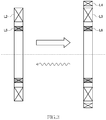
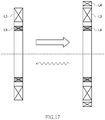
- the signal receiving coil L5 is actually provided inside the power feeding coil L2.
- the power feeding coil L2 is a coil for feeding power to the power receiving coil L3
- the signal receiving coil L5 is a coil for receiving the T11 signal from the signal transmitting coil L6.
- the number of windings of the signal receiving coil L5 is 1, diameter of a conductive wire thereof is 5 mm, and shape of the signal receiving coil L5 itself is a square of 260 mm ⁇ 260 mm.
- the wireless power transmission system 100 in the first embodiment achieves the voltage-distance characteristic represented by an adjustment characteristic 148. That is, the T8 signal is adjusted based on the correction voltage to change the power transmission efficiency, whereby the load voltage V5 is stabilized.
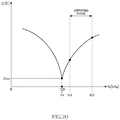
- the impedance Z becomes minimum and the capacitor C2 and power feeding coil L2 are put in a resonance state.
- capacitive reactance prevails, so that the impedance Z increases and, accordingly, the current phase advances with respect to the voltage phase.
- inductive reactance prevails, so that the impedance Z increases and, accordingly, the current phase delays with respect to the voltage phase.
- the drive frequency fo is higher than the resonance frequency fr1
- an inductance reactance component appears in the impedance Z of the feeding coil circuit 120 (LC resonance circuit), and the current phase of the current IS delays with respect to the voltage phase.
- the S1 signal indicating the current phase rises at time t18 which is later than time t10.
- a timing represented by, e.g., time t18
- current phase value a timing at which the S1 signal rises.
- a value obtained by t10-t18 represents the phase difference.
- t10-t18 ⁇ 0 is established, so that the current phase delays with respect to the voltage phase.
- the T6 signal is a DC voltage signal whose level changes depending on the magnitude of the correction voltage.
- the correction voltage is detected, that is, the load voltage V5 deviates from a desired value.
- the load current I5 decreases, while the load voltage V5 increases (refer to FIG. 4 ) .
- the load voltage V5 increases, the measurement potential increases, while the voltage level of the T0 signal (DC voltage signal) decreases.
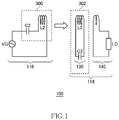
- a distance (hereinafter, referred to as "inter-coil distance") of about 0.2 m to 1.0 m is provided between a power feeding coil L2 of the feeding coil circuit 120 and a power receiving coil L3 of the receiving coil circuit 130.
- the wireless power transmission system 100 mainly aims to feed power from the power feeding coil L2 to power receiving coil L3 by wireless.
- resonance frequency fr is 100 kHz.
- the wireless power transmission system of the present embodiment may be made to operate in a high-frequency band like ISM (Industry-Science-Medical) frequency band.
- a low frequency band is advantageous over a high frequency band in reduction of cost of a switching transistor (to be described later) and reduction of switching loss.
- the low frequency band is less constrained by Radio Act.
- the number of windings of the power feeding coil L2 is 7, diameter of a conductive wire thereof is 5 mm, and shape of the power feeding coil L2 itself is a square of 280 mm ⁇ 280 mm.
- the values of the power feeding coil L2 and capacitor C2 are set such that the resonance frequency fr1 of the power feeding coil circuit 120 is 100 kHz.
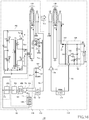
- the power feeding coil L2 is represented by a circle for descriptive purpose. Other coils are also represented by circles for the same reason. All the coils illustrated in FIG. 16 are made of copper.
- AC current I2 flows in the feeding coil circuit 120.
- the loading circuit 140 is a circuit in which a loading coil L4 is connected to the load LD through a rectification circuit 124 and a measurement circuit 126.
- the power receiving coil L3 and loading coil L4 face each other.
- the coil plane of the power receiving coil L3 and that of the loading coil L4 are substantially the same.
- the power receiving coil L3 and loading coil L4 are electromagnetically strongly coupled to each other.
- the number of windings of the loading coil L4 is 1, diameter of a conductive wire thereof is 5 mm, and shape of the loading coil L4 itself is a square of 300 mm ⁇ 300 mm.
- the AC power fed from the power feeding coil L2 of the wireless power feeder 116 is received by the power receiving coil L3 of the wireless power receiver 118 and then extracted from the load LD as DC power. Voltage applied to the load LD is referred to as "load voltage V5".
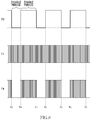
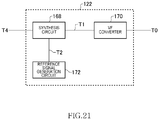
- the signal generation circuit 122 converts the T0 signal as the DC voltage signal into the T4 signal as the AC voltage signal.
- the T4 signal is an "output signal" indicating the magnitude of the output voltage, which is amplified by the operational amplifier 110 and transmitted from the signal transmitting coil L6 to the signal receiving coil L5 as the T11 signal. By this T11 signal, the power feeding side can recognize the magnitude of the correction voltage.
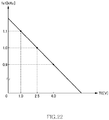
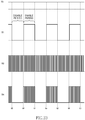
- a circuit configuration and processing content of the signal generation circuit 122 will be described later using FIGS. 21 , 22 , and 23 .
- a configuration of the power transmission control circuit 200 will be described.
- a VCO (Voltage Controlled Oscillator) 202 is connected to the primary side of the gate-drive transformer T1.
- the VCO 202 functions as an "oscillator" that generates AC voltage VO at the drive frequency fo.
- the waveform of the AC voltage VO may be a sine wave, it is assumed here that the voltage waveform is a rectangular wave (digital wave).
- the AC voltage VO causes current to flow in a transformer T1 primary coil Lh alternately in both positive and negative directions.
- a transformer T1 primary coil Lh, a transformer T1 secondary coil Lf, and a transformer T1 secondary coil Lg constitute a gate-drive coupling transformer T1. Electromagnetic induction causes current to flow also in the transformer T1 secondary coil Lf and transformer T1 secondary coil Lg alternately in both positive and negative directions.
- Capacitors CA and CB charged by a DC power supply VDD each serve as a power supply for the power transmission control circuit 200.
- the capacitor CA is provided between points C and E of FIG. 16
- capacitor CB is provided between points E and D.
- the voltage (voltage between points C and E) of the capacitor CA is VA
- voltage (voltage between points E and D) of the capacitor CB is VB
- VA+VB voltage between points C and D
- the capacitors CA and CB each function as a DC voltage supply.
- the drain of the switching transistor Q1 is connected to the positive electrode of the capacitor CA.
- the negative electrode of the capacitor CA is connected to the source of the switching transistor Q1 through the transformer T2 primary coil Lb.
- the source of the switching transistor Q2 is connected to the negative electrode of the capacitor CB.
- the positive electrode of the capacitor CB is connected to the drain of the switching transistor Q2 through the transformer T2 primary coil Lb.
- first current path A main current path (hereinafter, referred to as "first current path") at this time extends from the positive electrode of the capacitor CA, passes through the point C, switching transistor Q1, transformer T2 primary coil Lb, and point E in this order, and returns to the negative electrode of the capacitor CA.
- the switching transistor Q1 functions as a switch for controlling conduction/non-conduction of the first current path.
- a main current path (hereinafter, referred to as "second current path") at this time extends from the positive electrode of the capacitor CB, passes through the point E, transformer T2 primary coil Lb, switching transistor Q2, and point D in this order, and returns to the negative electrode of the capacitor CB.
- the switching transistor Q2 functions as a switch for controlling conduction/non-conduction of the second current path.
- the resonance frequency fr1 is not included in the operating range of the drive frequency fo, so that the power transmission efficiency does not reach the maximum value. This is because priority is given to the stability of the load voltage V5 over the maximization of the power transmission efficiency. A change in the load voltage V5 can be detected from the correction voltage, so that the wireless power feeder 116 automatically adjusts the drive frequency fo so as to make the correction voltage be zero. The details will be described later.
- a detection coil LSS is provided at the feeding coil circuit 120.
- the detection coil LSS is a coil wounded around a core 154 (toroidal core) having a penetration hole NS times.
- the core 154 is formed of a known material such as ferrite, silicon steel, or permalloy.
- the number of windings NS of the detection coil LSS in the present embodiment is 100.
- Potential VSS is digitized by the operational amplifier 142 and diode D2 to be an S1 signal.
- the operational amplifier 142 outputs a saturated voltage of 3.0 (V) when the potential VSS exceeds a first threshold value, e.g., 0.1 (V) and outputs a saturated voltage of -3.0 (V) when the potential VSS falls below a second threshold value, e.g., -0.1 (V).
- a negative component is cut by the diode D2 and thereby the potential VSS is converted into the S1 signal of a digital waveform.
- the current I2 and inductive current ISS have the same phase, and the inductive current ISS and potential VSS have the same phase. Further, the AC current IS flowing in the power transmission control circuit 200 and current I2 have the same phase. Therefore, by observing the waveform of the S1 signal, the current phase of the AC current IS can be measured.
- the phase detection circuit 114 includes a voltage shaping circuit 144, a phase comparison circuit 150, and a low-pass filter 152.
- the low-pass filter 152 is a known circuit and inserted so as to cut a high-frequency component of the phase difference indicating voltage SC.
- As the phase comparison circuit 150 in the present embodiment a built-in unit (Phase Comparator) (product serial number MC14046B) manufactured by Motorola is used, as in the case of the VCO 202.
- Phase Comparator phase Comparator
- the phase comparison circuit 150 and VCO 202 can be implemented in one chip.
- a T7 signal (voltage phase) which is an output of the voltage shaping circuit 144 is input to the positive terminal of the comparator 128, and T6 signal (signal indicating correction voltage) which is an output of the signal adjustment circuit 112 is input to the negative terminal of the comparator 128.
- the comparator 128 adjusts the phase of the T7 signal using the T6 signal and outputs a T8 signal (AC voltage signal) as a correction voltage phase.
- the phase comparison circuit 150 detects the phase difference between the voltage phase and current phase of the AC power based on the S1 and T8 signals and outputs the phase difference indicating voltage SC.
- the phase of the T8 signal further delays.
- the phase of the T8 signal advances.
- the T8 signal is a signal obtained by adjusting the phase of the T7 signal based on the T6 signal, it does not indicate the actual voltage phase.
- the adjustment logic based on the correction voltage will be described later using FIG. 29 .
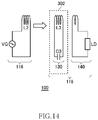
- the signal transmitting coil L6 is provided inside the power receiving coil L3. Further, the loading coil L4 is provided outside the power receiving coil L3. In other words, the coil plane of the power receiving coil L3, that of the loading coil L4, and that of the signal transmitting coil L6 coincide with each other.
- the power receiving coil L3 is a coil for receiving power
- the signal transmitting coil L6 is a coil for transmitting the T11 signal.
- the number of windings of the signal transmitting coil L6 is 1, diameter of a conductive wire thereof is 5 mm, and shape of the signal transmitting coil L6 itself is a square of 260 mm ⁇ 260 mm.
- the load voltage V5 may increase up to about 60 (V) and, in some cases, may exceed the rated value of the load LD.
- the wireless power transmission system 100 in the present embodiment achieves the current-voltage characteristic represented by an adjustment characteristic 136.
- the S1 signal is adjusted based on the correction voltage to change the power transmission efficiency, whereby the load voltage V5 is stabilized.
- FIG. 20 is a graph illustrating a relationship between the impedance Z of the power feeding coil circuit 120 and drive frequency fo.
- the vertical axis represents the impedance Z of the feeding coil circuit 120 (a circuit in which the capacitor C2 and the power feeding coil L2 are connected in series) .
- the horizontal axis represents the drive frequency fo.
- the band-pass filter 158 is a ceramic filter that utilizes mechanical resonance.
- the load current I5 decreases, while the load voltage V5 increases (refer to FIG. 18 ).
- the load voltage V5 increases, the measurement potential increases, while the voltage level of the T0 signal (DC voltage signal) decreases.
- the correction voltage becomes 2.5 (V).
- the voltage phase value after correction delays with respect to the actual voltage phase value.
- the magnitude of the phase delay increases/decreases with an increase/decrease in the correction voltage.
- the signal receiving coil L5 receives not only the T11 signal, which is an output signal, but also a part of feeding power (refer to FIGS. 9 and 23 ).
- the signal adjustment circuit 112 uses the band-pass filter 158 to extract only a signal component from the AC voltage received by the signal receiving coil L5.
- the signal receiving coil L5 or signal transmitting coil L6 may be formed as a simple circular or rectangular single-winding coil.
- the power transmission control circuit 200 may be formed as a half-bridge type circuit, the power transmission control circuit 200 may be formed as a full-bridge type circuit in which four MOS-FETs are used or a push-pull type circuit.
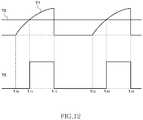
- the T7 signal generated by the voltage shaping circuit 144 or T1 signal generated by the control signal generation circuit 170 may be an AC signal having not only a saw-tooth waveform but also a triangle wave or a sine wave in which a voltage value is gradually increased or decreased within a predetermined time period.
- the voltage phase is set as an adjustment target in the above embodiments, the current phase may be adjusted based on the T0 signal. Further, the feedback control may be effected based not only on the output voltage but on the current or power.
Landscapes
- Engineering & Computer Science (AREA)
- Computer Networks & Wireless Communication (AREA)
- Power Engineering (AREA)
- Signal Processing (AREA)
- Charge And Discharge Circuits For Batteries Or The Like (AREA)
- Near-Field Transmission Systems (AREA)
- Inverter Devices (AREA)
Claims (12)
- Système d'alimentation sans fil (116) qui fournit une alimentation issue d'une bobine de fourniture d'alimentation (L2) située sur un côté de fourniture d'alimentation à une bobine de réception d'alimentation (L3) située sur un côté de réception d'alimentation, la fourniture s'effectuant par transmission sans fil au moyen d'un phénomène de résonance de champ magnétique entre la bobine de fourniture d'alimentation (L2) et la bobine de réception d'alimentation (L3), ledit système d'alimentation comprenant :
la bobine de fourniture d'alimentation (L2) ;
un circuit de commande de transmission d'alimentation (200) agencé pour fournir un alimentation CA à la bobine de fourniture d'alimentation (L2) à un fréquence de pilotage (f0) afin d'amener la bobine de fourniture d'alimentation (L2) à fournir l'alimentation CA à la bobine de réception d'alimentation (L3) ;
un circuit de détection de phase (114) agencé pour détecter une différence de phase entre les phases de tension et de courant de l'alimentation CA ;
une bobine de réception de signal (L5) ; et
un circuit de réglage de signal (112) agencé pour convertir en CC un signal de sortie selon un facteur de marche, le circuit de commande de transmission d'alimentation (200) étant agencé pour régler la fréquence de pilotage (f0) afin de réduire la différence de phase ;
le circuit de détection de phase (114) étant agencé pour effectuer un réglage a posteriori de la valeur détectée des phases de tension et de courant ou de l'une de ces phases en fonction d'un niveau de signal du signal de sortie converti en CC ; et
le plan de bobine de la bobine de réception de signal (L5) et celui de la bobine de fourniture d'alimentation (L2) étant sensiblement identiques,
caractérisé en ce que
la bobine de réception de signal (L5) est disposée à l'intérieur de la bobine de fourniture d'alimentation (L2) ; une fréquence de référence (fs) indiquant une fréquence du signal de sortie est supérieure à une fréquence de résonance (fr1) de la bobine de fourniture d'alimentation (L2) et de la bobine de réception d'alimentation (L3) ;
la bobine de réception de signal est agencée pour recevoir, en provenance du côté de réception d'alimentation, le signal de sortie indiquant un niveau de sortie selon le facteur de marche ; et
le circuit de détection de phase (114) est agencé pour comparer une première valeur de phase indiquant l'instant auquel le niveau de tension de l'alimentation CA devient une première valeur de référence à une deuxième valeur de phase indiquant l'instant auquel le niveau de courant de l'alimentation CA devient une deuxième valeur de référence pour détecter la différence de phase, et est agencé pour modifier les première et deuxième valeurs de référence ou l'une des deux valeurs en fonction du niveau de signal pour effectuer un réglage a posteriori des première et deuxième valeurs de phase ou de l'une des deux valeurs. - Système d'alimentation sans fil selon la revendication 1, dans lequel
la bobine de réception de signal (L5) est une bobine à un seul enroulement. - Système d'alimentation sans fil selon l'une quelconque des revendications 1 et 2, dans lequel
le circuit de réglage de signal (112) est agencé pour extraire la composante de signal de sortie de la tension CA détectée dans la bobine de réception de signal (L5) par l'intermédiaire d'un filtre passe-bande (158). - Système d'alimentation sans fil selon l'une quelconque des revendications 1 à 3, dans lequel
le circuit de commande de transmission d'alimentation (200) est agencé pour amener la bobine de fourniture d'alimentation (L2) qui ne résonne pas sensiblement avec les éléments de circuit du côté de fourniture d'alimentation à fournir l'alimentation CA à la bobine de réception d'alimentation (L3) . - Système d'alimentation sans fil selon l'une quelconque des revendications 1 à 3, dans lequel
la bobine de fourniture d'alimentation (L2) ne forme pas, avec les éléments de circuit du côté de fourniture d'alimentation, un circuit de résonance ayant un point de résonance correspondant à la fréquence de résonance de la bobine de réception d'alimentation (L3). - Système d'alimentation sans fil selon l'une quelconque des revendications 1 à 3, dans lequel
aucun condensateur n'est inséré en série ou en parallèle avec la bobine de fourniture d'alimentation (L2). - Récepteur d'alimentation sans fil (118) agencé pour recevoir, au niveau d'une bobine de réception d'alimentation (L3) située sur un côté de réception d'alimentation, une alimentation CA fournie par une bobine de fourniture d'alimentation (L2) d'un système d'alimentation sans fil (116) selon l'une quelconque des revendications 1 à 6 par transmission sans fil, comprenant :un circuit de bobine de réception (130) qui contient la bobine de réception d'alimentation (L3) et un condensateur (C3) ;un circuit de charge (140) qui contient une bobine de charge (L4) qui est couplée magnétiquement à la bobine de réception d'alimentation (L3) pour recevoir l'alimentation CA de la bobine de réception d'alimentation (L3) et une charge (LD) à laquelle une alimentation est fournie par la bobine de charge (L4) ;un circuit de génération de signal agencé pour générer un signal de sortie indiquant, par un facteur de marche, une tension de sortie appliquée à une partie du circuit de charge (140) ; etune bobine de transmission de signal (L6) agencée pour envoyer le signal de sortie au système d'alimentation sans fil (116), le plan de bobine de la bobine de transmission de signal (L6) et celui de la bobine de réception d'alimentation (L3) étant sensiblement identiques, le récepteur étant caractérisé en ce quela bobine de transmission de signal (L6) est disposée à l'intérieur de la bobine de réception d'alimentation (L3) ; etune fréquence de référence (fs) indiquant une fréquence du signal de sortie est supérieure à une fréquence de résonance (fr1) de la bobine de fourniture d'alimentation (L2) et de la bobine de réception d'alimentation (L3).
- Récepteur d'alimentation sans fil selon la revendication 7, dans lequel
le circuit de génération de signal est agencé pour émettre le signal de sortie sous la forme d'un signal indiquant une valeur de différence entre la tension de sortie et une tension de référence selon le facteur de marche. - Récepteur d'alimentation sans fil selon la revendication 7 ou 8, dans lequel
le circuit de génération de signal comprend :
un circuit de génération de signal de commande (1/0) agencé pour générer un signal de commande à une fréquence de commande ; et
un circuit de comparaison (174) agencé pour générer un signal d'activation lorsqu'une relation de grandeur prédéterminée est établie entre le niveau de signal du signal de commande et la tension de sortie, et
le facteur de marche du signal de sortie est déterminé en fonction du facteur de marche du signal d'activation. - Récepteur d'alimentation sans fil selon la revendication 9, dans lequel
le circuit de génération de signal contient également un circuit de génération de signal de référence (172) agencé pour générer un signal de référence ayant une fréquence de référence supérieure à la fréquence de commande, et
le circuit de génération de signal est agencé pour envoyer le signal de référence sous forme de signal de sortie pendant que le signal d'activation est généré. - Récepteur d'alimentation sans fil selon l'une quelconque des revendications 7 à 10, dans lequel
la bobine de transmission de signal (L6) est une bobine à un seul enroulement. - Système de transmission d'alimentation sans fil (100) agencé pour fournir une alimentation par transmission sans fil entre une bobine de fourniture d'alimentation (L2) située sur un côté de fourniture d'alimentation et une bobine de réception d'alimentation (L3) située sur un côté de réception d'alimentation, la fourniture s'effectuant au moyen d'un phénomène de résonance de champ magnétique entre la bobine de fourniture d'alimentation (L2) et la bobine de réception d'alimentation (L3), ledit système comprenant :un système d'alimentation sans fil selon l'une quelconque des revendications 1 à 6 ; etun récepteur d'alimentation sans fil selon l'une quelconque des revendications 7 à 11.
Applications Claiming Priority (4)
| Application Number | Priority Date | Filing Date | Title |
|---|---|---|---|
| JP2010064379 | 2010-03-19 | ||
| JP2010071901 | 2010-03-26 | ||
| JP2011021953A JP5640783B2 (ja) | 2010-03-26 | 2011-02-03 | ワイヤレス給電装置、ワイヤレス受電装置およびワイヤレス電力伝送システム |
| JP2011021952A JP5640782B2 (ja) | 2010-03-19 | 2011-02-03 | ワイヤレス給電装置、ワイヤレス受電装置およびワイヤレス電力伝送システム |
Publications (3)
| Publication Number | Publication Date |
|---|---|
| EP2367263A2 EP2367263A2 (fr) | 2011-09-21 |
| EP2367263A3 EP2367263A3 (fr) | 2014-03-26 |
| EP2367263B1 true EP2367263B1 (fr) | 2019-05-01 |
Family
ID=44260847
Family Applications (1)
| Application Number | Title | Priority Date | Filing Date |
|---|---|---|---|
| EP11158840.6A Active EP2367263B1 (fr) | 2010-03-19 | 2011-03-18 | Système d'alimentation sans fil, récepteur de puissance sans fil et système de transmission de puissance sans fil |
Country Status (3)
| Country | Link |
|---|---|
| US (1) | US8829725B2 (fr) |
| EP (1) | EP2367263B1 (fr) |
| CN (1) | CN102195366B (fr) |
Families Citing this family (48)
| Publication number | Priority date | Publication date | Assignee | Title |
|---|---|---|---|---|
| EP2293411B1 (fr) * | 2009-09-03 | 2021-12-15 | TDK Corporation | Alimentation électrique sans fil et système de transmission d'énergie électrique sans fil |
| JP5736991B2 (ja) * | 2010-07-22 | 2015-06-17 | Tdk株式会社 | ワイヤレス給電装置およびワイヤレス電力伝送システム |
| US9356474B2 (en) * | 2011-09-28 | 2016-05-31 | Tdk Corporation | Wireless power feeder and wireless power transmission system |
| CN103843228B (zh) * | 2011-10-12 | 2016-07-06 | 株式会社村田制作所 | 无线电力传输系统 |
| KR101327081B1 (ko) | 2011-11-04 | 2013-11-07 | 엘지이노텍 주식회사 | 무선전력 수신장치 및 그 제어 방법 |
| JP5885074B2 (ja) * | 2012-03-26 | 2016-03-15 | 株式会社Ihi | 非接触電力伝送装置及び方法 |
| US9093215B2 (en) | 2012-05-07 | 2015-07-28 | Qualcomm Incorporated | Push-pull driver for generating a signal for wireless power transfer |
| TWI618369B (zh) * | 2012-05-10 | 2018-03-11 | 通路實業集團國際公司 | 測量無線感測器中之可變阻抗元件的系統與方法 |
| US9142999B2 (en) | 2012-07-13 | 2015-09-22 | Qualcomm Incorporated | Systems, methods, and apparatus for small device wireless charging modes |
| JP6076355B2 (ja) * | 2012-09-05 | 2017-02-08 | 富士機械製造株式会社 | 非接触給電装置 |
| JP5990436B2 (ja) * | 2012-09-07 | 2016-09-14 | ルネサスエレクトロニクス株式会社 | 無線通信システムおよび無線通信装置 |
| TWI473382B (zh) | 2012-09-28 | 2015-02-11 | Au Optronics Corp | 無線電力傳輸裝置 |
| JP5888468B2 (ja) | 2013-03-18 | 2016-03-22 | 株式会社Ihi | 給電装置及び非接触給電システム |
| CN104124779B (zh) * | 2013-04-28 | 2018-02-16 | 海尔集团技术研发中心 | 动态负载切换的控制方法及系统 |
| JP5616496B1 (ja) | 2013-07-08 | 2014-10-29 | 日東電工株式会社 | 受給電装置及び携帯機器 |
| JP5622901B1 (ja) | 2013-07-29 | 2014-11-12 | 日東電工株式会社 | 無線電力伝送装置及び無線電力伝送装置の供給電力制御方法 |
| KR101789457B1 (ko) * | 2013-09-30 | 2017-10-23 | 후지쯔 가부시끼가이샤 | 송전 장치 |
| CN103516354B (zh) * | 2013-10-23 | 2016-02-10 | 江南大学 | 电磁共振式无线电能传输锁相频率跟踪电路 |
| JP6258816B2 (ja) | 2013-10-29 | 2018-01-10 | パナソニック株式会社 | 無線送電装置及び無線電力伝送システム |
| US9819395B2 (en) | 2014-05-05 | 2017-11-14 | Nxp B.V. | Apparatus and method for wireless body communication |
| US9812788B2 (en) | 2014-11-24 | 2017-11-07 | Nxp B.V. | Electromagnetic field induction for inter-body and transverse body communication |
| US10009069B2 (en) * | 2014-05-05 | 2018-06-26 | Nxp B.V. | Wireless power delivery and data link |
| US10014578B2 (en) | 2014-05-05 | 2018-07-03 | Nxp B.V. | Body antenna system |
| US9819075B2 (en) | 2014-05-05 | 2017-11-14 | Nxp B.V. | Body communication antenna |
| US10015604B2 (en) | 2014-05-05 | 2018-07-03 | Nxp B.V. | Electromagnetic induction field communication |
| DE102014209501A1 (de) | 2014-05-20 | 2015-11-26 | Siemens Aktiengesellschaft | Anordnung, System und Verfahren zum induktiven Übertragen von Energie für das Laden mindestens eines Energiespeichers eines Schienenfahrzeugs |
| KR102134430B1 (ko) * | 2014-05-21 | 2020-07-15 | 삼성전자주식회사 | 스위칭에 기초한 무선 전력 수신 장치 및 무선 전력 수신 방법 |
| KR102449510B1 (ko) * | 2014-10-10 | 2022-09-29 | 제네럴 일렉트릭 컴퍼니 | 비접촉식 전력 전달을 위한 시스템 및 방법 |
| KR20160051497A (ko) * | 2014-11-03 | 2016-05-11 | 주식회사 한림포스텍 | 무선 전력 전송 네트워크의 전력 전송 커버리지 제어 장치 및 방법 |
| JP6732779B2 (ja) * | 2015-03-04 | 2020-07-29 | アップル インコーポレイテッドApple Inc. | 誘導電力送信器 |
| CN104779672B (zh) * | 2015-04-21 | 2016-10-12 | 东南大学 | 一种适用于电池性负载的无线充电系统 |
| US9819097B2 (en) | 2015-08-26 | 2017-11-14 | Nxp B.V. | Antenna system |
| US10714942B2 (en) | 2015-09-17 | 2020-07-14 | Ihi Corporation | Power transmitter and wireless power transfer system |
| CN105471021A (zh) * | 2015-11-18 | 2016-04-06 | 无锡华润矽科微电子有限公司 | 无线充电系统中能量发送端装置 |
| US10218187B1 (en) * | 2016-03-18 | 2019-02-26 | Jonathan Greenlee | Signal modulator and method of use |
| US10320086B2 (en) | 2016-05-04 | 2019-06-11 | Nxp B.V. | Near-field electromagnetic induction (NFEMI) antenna |
| US20170353056A1 (en) * | 2016-06-02 | 2017-12-07 | Panasonic Corporation | Electromagnetic resonant coupler including input line, first resonance line, second resonance line, output line, and coupling line, and transmission apparatus including the electromagnetic resonant coupler |
| JP7061837B2 (ja) * | 2016-11-22 | 2022-05-02 | ラピスセミコンダクタ株式会社 | 無線給電装置、無線受電装置、無線電力伝送システム、及び無線給電装置の電流測定方法 |
| US10910887B2 (en) * | 2017-03-31 | 2021-02-02 | Tdk Corporation | Wireless power receiving device and wireless power transmission system |
| US20190267845A1 (en) * | 2018-02-27 | 2019-08-29 | Chargedge, Inc. | Systems and methods for high-power wireless power transfer with dual-qi compatability |
| JP6977654B2 (ja) * | 2018-03-30 | 2021-12-08 | Tdk株式会社 | ワイヤレス受電装置、及びワイヤレス電力伝送システム |
| CN113056858B (zh) * | 2018-11-02 | 2024-08-06 | 尼吉康株式会社 | 无线供电装置 |
| CN109450032B (zh) * | 2018-12-04 | 2021-08-24 | 北京小米移动软件有限公司 | 无线充电的处理方法、装置及设备 |
| EP3952002A4 (fr) * | 2019-03-28 | 2023-04-19 | Aoi Japan Co., Ltd. | Système d'alimentation en énergie sans fil incluant un dispositif monté sur batterie en prise avec un dispositif de réception d'énergie incluant une unité lumineuse montée |
| WO2020256282A1 (fr) * | 2019-06-21 | 2020-12-24 | 울산과학기술원 | Ensemble résonateur pour détection biométrique et biocapteur utilisant des ondes électromagnétiques |
| US20210021156A1 (en) * | 2019-07-15 | 2021-01-21 | Chargedge, Inc. | True optimizable wireless power systems |
| JP7408952B2 (ja) * | 2019-08-28 | 2024-01-09 | オムロン株式会社 | 非接触給電装置 |
| FR3107791B1 (fr) * | 2020-03-02 | 2023-03-24 | Radiall Sa | Ensemble de transfert d’énergie électrique sans fil et sans contact comprenant un système amélioré de régulation de l’énergie transférée. |
Citations (1)
| Publication number | Priority date | Publication date | Assignee | Title |
|---|---|---|---|---|
| EP0923182A2 (fr) * | 1997-12-09 | 1999-06-16 | Matsushita Electric Works, Ltd. | Dispositif de transmission de puissance sans contact |
Family Cites Families (67)
| Publication number | Priority date | Publication date | Assignee | Title |
|---|---|---|---|---|
| US6208135B1 (en) * | 1994-07-22 | 2001-03-27 | Steve J. Shattil | Inductive noise cancellation circuit for electromagnetic pickups |
| JPH10225129A (ja) | 1997-02-13 | 1998-08-21 | Ishikawajima Harima Heavy Ind Co Ltd | 非接触給電設備 |
| JP4140208B2 (ja) | 2001-05-22 | 2008-08-27 | 神鋼電機株式会社 | 非接触給電装置 |
| JP2002354712A (ja) | 2001-05-22 | 2002-12-06 | Shinko Electric Co Ltd | 非接触給電装置 |
| JPWO2006022365A1 (ja) | 2004-08-27 | 2008-05-08 | 北伸電機株式会社 | 非接触電力伝送装置 |
| JP2006074848A (ja) | 2004-08-31 | 2006-03-16 | Hokushin Denki Kk | 非接触電力伝送装置 |
| JP4774217B2 (ja) | 2005-02-15 | 2011-09-14 | 高石 好 | 電力伝送装置、電力伝送方法 |
| US7825543B2 (en) * | 2005-07-12 | 2010-11-02 | Massachusetts Institute Of Technology | Wireless energy transfer |
| KR101136889B1 (ko) * | 2005-07-12 | 2012-04-20 | 메사추세츠 인스티튜트 오브 테크놀로지 | 무선 비-방사성 에너지 전달 |
| US20070042729A1 (en) * | 2005-08-16 | 2007-02-22 | Baaman David W | Inductive power supply, remote device powered by inductive power supply and method for operating same |
| US8169185B2 (en) * | 2006-01-31 | 2012-05-01 | Mojo Mobility, Inc. | System and method for inductive charging of portable devices |
| US9774086B2 (en) | 2007-03-02 | 2017-09-26 | Qualcomm Incorporated | Wireless power apparatus and methods |
| US8378522B2 (en) | 2007-03-02 | 2013-02-19 | Qualcomm, Incorporated | Maximizing power yield from wireless power magnetic resonators |
| JP4772744B2 (ja) | 2007-05-17 | 2011-09-14 | 昭和飛行機工業株式会社 | 非接触給電装置用の信号伝送コイル通信装置 |
| US9124120B2 (en) | 2007-06-11 | 2015-09-01 | Qualcomm Incorporated | Wireless power system and proximity effects |
| US9634730B2 (en) * | 2007-07-09 | 2017-04-25 | Qualcomm Incorporated | Wireless energy transfer using coupled antennas |
| JP5697979B2 (ja) | 2007-08-09 | 2015-04-08 | クゥアルコム・インコーポレイテッドQualcomm Incorporated | ワイヤレスに電力供給および充電するためのシステムおよび方法 |
| KR101159565B1 (ko) | 2007-08-13 | 2012-06-26 | 퀄컴 인코포레이티드 | 장거리 저주파 공진기 및 재료 |
| JP5414981B2 (ja) | 2007-09-11 | 2014-02-12 | 昭和飛行機工業株式会社 | 移動式の非接触給電装置 |
| EP2188867A4 (fr) | 2007-09-13 | 2014-12-10 | Qualcomm Inc | Antenne pour applications d'électricité sans fil |
| JP2010539857A (ja) | 2007-09-17 | 2010-12-16 | クゥアルコム・インコーポレイテッド | ワイヤレスエネルギー伝送のための送信機および受信機 |
| KR101540193B1 (ko) | 2007-09-17 | 2015-07-28 | 퀄컴 인코포레이티드 | 무선 전력 자기 공진기에서의 고효율 및 고전력 전송 |
| CN101803110A (zh) | 2007-09-19 | 2010-08-11 | 高通股份有限公司 | 使来自无线功率磁谐振器的功率产量最大化 |
| EP2208279A4 (fr) | 2007-10-11 | 2016-11-30 | Qualcomm Inc | Transfert de puissance sans fil utilisant des systèmes magnéto-mécaniques |
| JP4453741B2 (ja) | 2007-10-25 | 2010-04-21 | トヨタ自動車株式会社 | 電動車両および車両用給電装置 |
| JP4869209B2 (ja) * | 2007-11-16 | 2012-02-08 | 三菱電機株式会社 | 入出力装置、入出力装置の制御方法並びに誘導加熱調理器、加熱調理器、冷蔵庫、洗濯機及びジャー炊飯器 |
| KR101261686B1 (ko) * | 2007-11-28 | 2013-05-06 | 퀄컴 인코포레이티드 | 무급전 안테나를 사용한 무선 전력 범위 증가 |
| WO2009089253A1 (fr) * | 2008-01-07 | 2009-07-16 | Access Business Group International Llc | Alimentation électrique inductrice avec commande de cycle de marche |
| US9128687B2 (en) * | 2008-01-10 | 2015-09-08 | Qualcomm Incorporated | Wireless desktop IT environment |
| US8294300B2 (en) | 2008-01-14 | 2012-10-23 | Qualcomm Incorporated | Wireless powering and charging station |
| US8487479B2 (en) | 2008-02-24 | 2013-07-16 | Qualcomm Incorporated | Ferrite antennas for wireless power transfer |
| US8344552B2 (en) | 2008-02-27 | 2013-01-01 | Qualcomm Incorporated | Antennas and their coupling characteristics for wireless power transfer via magnetic coupling |
| US8855554B2 (en) | 2008-03-05 | 2014-10-07 | Qualcomm Incorporated | Packaging and details of a wireless power device |
| US8421267B2 (en) | 2008-03-10 | 2013-04-16 | Qualcomm, Incorporated | Packaging and details of a wireless power device |
| JP4665991B2 (ja) | 2008-04-15 | 2011-04-06 | トヨタ自動車株式会社 | 無線エネルギ伝送装置及び無線エネルギ伝送方法 |
| JP4609519B2 (ja) | 2008-04-15 | 2011-01-12 | トヨタ自動車株式会社 | 無線エネルギ伝送装置及び無線エネルギ伝送方法 |
| KR20130010089A (ko) | 2008-04-21 | 2013-01-25 | 퀄컴 인코포레이티드 | 근거리 효율적인 무선 전력 송신 |
| US20090273242A1 (en) | 2008-05-05 | 2009-11-05 | Nigelpower, Llc | Wireless Delivery of power to a Fixed-Geometry power part |
| JP4557045B2 (ja) | 2008-05-12 | 2010-10-06 | ソニー株式会社 | 送電装置、送電方法、プログラム、および電力伝送システム |
| AU2009246310B9 (en) * | 2008-05-14 | 2015-04-02 | Massachusetts Institute Of Technology | Wireless energy transfer, including interference enhancement |
| JP4911148B2 (ja) | 2008-09-02 | 2012-04-04 | ソニー株式会社 | 非接触給電装置 |
| JP5238420B2 (ja) * | 2008-09-11 | 2013-07-17 | 矢崎総業株式会社 | 車両用ワイヤレス充電システム |
| US8234509B2 (en) * | 2008-09-26 | 2012-07-31 | Hewlett-Packard Development Company, L.P. | Portable power supply device for mobile computing devices |
| US8461719B2 (en) * | 2008-09-27 | 2013-06-11 | Witricity Corporation | Wireless energy transfer systems |
| EP2345100B1 (fr) * | 2008-10-01 | 2018-12-05 | Massachusetts Institute of Technology | Transfert d'énergie sans fil en champ proche efficace utilisant des variations de système adiabatique |
| JP2010104159A (ja) | 2008-10-24 | 2010-05-06 | Murata Mfg Co Ltd | 受電端末、および無接点電力伝送システム |
| JP4759610B2 (ja) | 2008-12-01 | 2011-08-31 | 株式会社豊田自動織機 | 非接触電力伝送装置 |
| JP5135204B2 (ja) * | 2008-12-26 | 2013-02-06 | 株式会社日立製作所 | 非接触電力伝送システム、および該非接触電力伝送システムにおける負荷装置 |
| JP5369693B2 (ja) | 2009-01-15 | 2013-12-18 | 日産自動車株式会社 | 非接触給電装置 |
| JP5437650B2 (ja) | 2009-01-30 | 2014-03-12 | 昭和飛行機工業株式会社 | 非接触給電装置 |
| JP5585098B2 (ja) | 2009-03-06 | 2014-09-10 | 日産自動車株式会社 | 非接触電力供給装置及び方法 |
| JP5365276B2 (ja) | 2009-03-17 | 2013-12-11 | ソニー株式会社 | 電力伝送システムおよび電力出力装置 |
| JP5621203B2 (ja) | 2009-03-30 | 2014-11-12 | 富士通株式会社 | 無線電力供給システム、無線電力供給方法 |
| JP5689587B2 (ja) | 2009-03-31 | 2015-03-25 | 富士通株式会社 | 電力伝送装置 |
| JP5417941B2 (ja) | 2009-03-31 | 2014-02-19 | 富士通株式会社 | 送電装置 |
| JP5365306B2 (ja) | 2009-03-31 | 2013-12-11 | 富士通株式会社 | 無線電力供給システム |
| JP5515368B2 (ja) | 2009-03-31 | 2014-06-11 | 富士通株式会社 | 無線電力供給方法及び無線電力供給システム |
| JP5353376B2 (ja) | 2009-03-31 | 2013-11-27 | 富士通株式会社 | 無線電力装置、無線電力受信方法 |
| JP5417942B2 (ja) | 2009-03-31 | 2014-02-19 | 富士通株式会社 | 送電装置、送受電装置および送電方法 |
| JP4865001B2 (ja) | 2009-04-13 | 2012-02-01 | 株式会社日本自動車部品総合研究所 | 非接触給電設備、非接触受電装置および非接触給電システム |
| JP5510032B2 (ja) | 2009-05-14 | 2014-06-04 | 日産自動車株式会社 | 非接触給電装置 |
| JP5347708B2 (ja) | 2009-05-18 | 2013-11-20 | トヨタ自動車株式会社 | コイルユニット、非接触電力伝送装置、非接触給電システムおよび車両 |
| JP5625263B2 (ja) | 2009-05-18 | 2014-11-19 | トヨタ自動車株式会社 | コイルユニット、非接触電力伝送装置、非接触給電システムおよび電動車両 |
| JP5375325B2 (ja) | 2009-05-18 | 2013-12-25 | トヨタ自動車株式会社 | 車両および非接触給電システム |
| JP2010272412A (ja) | 2009-05-22 | 2010-12-02 | Toyota Motor Corp | ケーブル収納装置およびそれを備える車両 |
| JP2011003947A (ja) | 2009-06-16 | 2011-01-06 | Showa Aircraft Ind Co Ltd | コイル通信装置 |
| US8729735B2 (en) * | 2009-11-30 | 2014-05-20 | Tdk Corporation | Wireless power feeder, wireless power receiver, and wireless power transmission system |
-
2011
- 2011-03-18 US US13/051,184 patent/US8829725B2/en active Active
- 2011-03-18 EP EP11158840.6A patent/EP2367263B1/fr active Active
- 2011-03-18 CN CN201110066312.9A patent/CN102195366B/zh not_active Expired - Fee Related
Patent Citations (1)
| Publication number | Priority date | Publication date | Assignee | Title |
|---|---|---|---|---|
| EP0923182A2 (fr) * | 1997-12-09 | 1999-06-16 | Matsushita Electric Works, Ltd. | Dispositif de transmission de puissance sans contact |
Also Published As
| Publication number | Publication date |
|---|---|
| US8829725B2 (en) | 2014-09-09 |
| CN102195366A (zh) | 2011-09-21 |
| EP2367263A2 (fr) | 2011-09-21 |
| EP2367263A3 (fr) | 2014-03-26 |
| CN102195366B (zh) | 2014-03-12 |
| US20110227420A1 (en) | 2011-09-22 |
Similar Documents
| Publication | Publication Date | Title |
|---|---|---|
| US8829725B2 (en) | Wireless power feeder, wireless power receiver, and wireless power transmission system | |
| EP2328252B1 (fr) | Transmetteur d'énergie sans fil, récepteur d'énergie sans fil et système de transmission d'énergie sans fil | |
| US8829729B2 (en) | Wireless power feeder, wireless power receiver, and wireless power transmission system | |
| US8829727B2 (en) | Wireless power feeder, wireless power transmission system, and table and table lamp using the same | |
| EP2312722B1 (fr) | Dispositif de transmission d'énergie sans fil et système de transmission d'énergie sans fil | |
| EP2293411B1 (fr) | Alimentation électrique sans fil et système de transmission d'énergie électrique sans fil | |
| US8742627B2 (en) | Wireless power feeder | |
| JP5640782B2 (ja) | ワイヤレス給電装置、ワイヤレス受電装置およびワイヤレス電力伝送システム | |
| US8581444B2 (en) | Wireless power feeder, wireless power transmission system, and table and table lamp using the same | |
| US20120146424A1 (en) | Wireless power feeder and wireless power transmission system | |
| US9058928B2 (en) | Wireless power feeder and wireless power transmission system | |
| JP5640783B2 (ja) | ワイヤレス給電装置、ワイヤレス受電装置およびワイヤレス電力伝送システム | |
| US8829726B2 (en) | Wireless power feeder and wireless power transmission system | |
| JP5672844B2 (ja) | ワイヤレス電力伝送システム | |
| JP2011135760A (ja) | ワイヤレス給電装置、ワイヤレス受電装置およびワイヤレス電力伝送システム | |
| JP5609317B2 (ja) | ワイヤレス給電装置およびワイヤレス電力伝送システム | |
| US20210021156A1 (en) | True optimizable wireless power systems |
Legal Events
| Date | Code | Title | Description |
|---|---|---|---|
| PUAI | Public reference made under article 153(3) epc to a published international application that has entered the european phase |
Free format text: ORIGINAL CODE: 0009012 |
|
| 17P | Request for examination filed |
Effective date: 20110318 |
|
| AK | Designated contracting states |
Kind code of ref document: A2 Designated state(s): AL AT BE BG CH CY CZ DE DK EE ES FI FR GB GR HR HU IE IS IT LI LT LU LV MC MK MT NL NO PL PT RO RS SE SI SK SM TR |
|
| AX | Request for extension of the european patent |
Extension state: BA ME |
|
| RAP1 | Party data changed (applicant data changed or rights of an application transferred) |
Owner name: TDK CORPORATION |
|
| PUAL | Search report despatched |
Free format text: ORIGINAL CODE: 0009013 |
|
| AK | Designated contracting states |
Kind code of ref document: A3 Designated state(s): AL AT BE BG CH CY CZ DE DK EE ES FI FR GB GR HR HU IE IS IT LI LT LU LV MC MK MT NL NO PL PT RO RS SE SI SK SM TR |
|
| AX | Request for extension of the european patent |
Extension state: BA ME |
|
| RIC1 | Information provided on ipc code assigned before grant |
Ipc: G08C 19/12 20060101ALI20140220BHEP Ipc: H02J 5/00 20060101ALI20140220BHEP Ipc: G08C 17/04 20060101ALI20140220BHEP Ipc: G08C 25/02 20060101ALI20140220BHEP Ipc: H04B 5/00 20060101ALI20140220BHEP Ipc: G01R 25/04 20060101ALI20140220BHEP Ipc: G08C 19/16 20060101ALI20140220BHEP Ipc: H02J 17/00 20060101AFI20140220BHEP |
|
| RBV | Designated contracting states (corrected) |
Designated state(s): AL AT BE BG CH CY CZ DE DK EE ES FI FR GB GR HR HU IE IS IT LI LT LU LV MC MK MT NL NO PL PT RO RS SE SI SK SM TR |
|
| STAA | Information on the status of an ep patent application or granted ep patent |
Free format text: STATUS: EXAMINATION IS IN PROGRESS |
|
| 17Q | First examination report despatched |
Effective date: 20171120 |
|
| REG | Reference to a national code |
Ref country code: DE Ref legal event code: R079 Ref document number: 602011058448 Country of ref document: DE Free format text: PREVIOUS MAIN CLASS: H02J0017000000 Ipc: H02J0050120000 |
|
| GRAP | Despatch of communication of intention to grant a patent |
Free format text: ORIGINAL CODE: EPIDOSNIGR1 |
|
| STAA | Information on the status of an ep patent application or granted ep patent |
Free format text: STATUS: GRANT OF PATENT IS INTENDED |
|
| RIC1 | Information provided on ipc code assigned before grant |
Ipc: H04B 5/00 20060101ALI20180813BHEP Ipc: H02J 50/12 20160101AFI20180813BHEP Ipc: H02J 50/80 20160101ALI20180813BHEP |
|
| INTG | Intention to grant announced |
Effective date: 20180907 |
|
| GRAJ | Information related to disapproval of communication of intention to grant by the applicant or resumption of examination proceedings by the epo deleted |
Free format text: ORIGINAL CODE: EPIDOSDIGR1 |
|
| STAA | Information on the status of an ep patent application or granted ep patent |
Free format text: STATUS: EXAMINATION IS IN PROGRESS |
|
| GRAP | Despatch of communication of intention to grant a patent |
Free format text: ORIGINAL CODE: EPIDOSNIGR1 |
|
| STAA | Information on the status of an ep patent application or granted ep patent |
Free format text: STATUS: GRANT OF PATENT IS INTENDED |
|
| INTC | Intention to grant announced (deleted) | ||
| INTG | Intention to grant announced |
Effective date: 20181128 |
|
| RIC1 | Information provided on ipc code assigned before grant |
Ipc: H02J 50/12 20160101AFI20180813BHEP Ipc: H02J 50/80 20160101ALI20180813BHEP Ipc: H04B 5/00 20060101ALI20180813BHEP |
|
| GRAS | Grant fee paid |
Free format text: ORIGINAL CODE: EPIDOSNIGR3 |
|
| GRAA | (expected) grant |
Free format text: ORIGINAL CODE: 0009210 |
|
| STAA | Information on the status of an ep patent application or granted ep patent |
Free format text: STATUS: THE PATENT HAS BEEN GRANTED |
|
| AK | Designated contracting states |
Kind code of ref document: B1 Designated state(s): AL AT BE BG CH CY CZ DE DK EE ES FI FR GB GR HR HU IE IS IT LI LT LU LV MC MK MT NL NO PL PT RO RS SE SI SK SM TR |
|
| REG | Reference to a national code |
Ref country code: GB Ref legal event code: FG4D |
|
| REG | Reference to a national code |
Ref country code: CH Ref legal event code: EP Ref country code: AT Ref legal event code: REF Ref document number: 1128220 Country of ref document: AT Kind code of ref document: T Effective date: 20190515 |
|
| REG | Reference to a national code |
Ref country code: DE Ref legal event code: R096 Ref document number: 602011058448 Country of ref document: DE |
|
| REG | Reference to a national code |
Ref country code: IE Ref legal event code: FG4D |
|
| REG | Reference to a national code |
Ref country code: NL Ref legal event code: MP Effective date: 20190501 |
|
| REG | Reference to a national code |
Ref country code: LT Ref legal event code: MG4D |
|
| PG25 | Lapsed in a contracting state [announced via postgrant information from national office to epo] |
Ref country code: FI Free format text: LAPSE BECAUSE OF FAILURE TO SUBMIT A TRANSLATION OF THE DESCRIPTION OR TO PAY THE FEE WITHIN THE PRESCRIBED TIME-LIMIT Effective date: 20190501 Ref country code: NO Free format text: LAPSE BECAUSE OF FAILURE TO SUBMIT A TRANSLATION OF THE DESCRIPTION OR TO PAY THE FEE WITHIN THE PRESCRIBED TIME-LIMIT Effective date: 20190801 Ref country code: ES Free format text: LAPSE BECAUSE OF FAILURE TO SUBMIT A TRANSLATION OF THE DESCRIPTION OR TO PAY THE FEE WITHIN THE PRESCRIBED TIME-LIMIT Effective date: 20190501 Ref country code: PT Free format text: LAPSE BECAUSE OF FAILURE TO SUBMIT A TRANSLATION OF THE DESCRIPTION OR TO PAY THE FEE WITHIN THE PRESCRIBED TIME-LIMIT Effective date: 20190901 Ref country code: SE Free format text: LAPSE BECAUSE OF FAILURE TO SUBMIT A TRANSLATION OF THE DESCRIPTION OR TO PAY THE FEE WITHIN THE PRESCRIBED TIME-LIMIT Effective date: 20190501 Ref country code: AL Free format text: LAPSE BECAUSE OF FAILURE TO SUBMIT A TRANSLATION OF THE DESCRIPTION OR TO PAY THE FEE WITHIN THE PRESCRIBED TIME-LIMIT Effective date: 20190501 Ref country code: NL Free format text: LAPSE BECAUSE OF FAILURE TO SUBMIT A TRANSLATION OF THE DESCRIPTION OR TO PAY THE FEE WITHIN THE PRESCRIBED TIME-LIMIT Effective date: 20190501 Ref country code: HR Free format text: LAPSE BECAUSE OF FAILURE TO SUBMIT A TRANSLATION OF THE DESCRIPTION OR TO PAY THE FEE WITHIN THE PRESCRIBED TIME-LIMIT Effective date: 20190501 Ref country code: LT Free format text: LAPSE BECAUSE OF FAILURE TO SUBMIT A TRANSLATION OF THE DESCRIPTION OR TO PAY THE FEE WITHIN THE PRESCRIBED TIME-LIMIT Effective date: 20190501 |
|
| PG25 | Lapsed in a contracting state [announced via postgrant information from national office to epo] |
Ref country code: RS Free format text: LAPSE BECAUSE OF FAILURE TO SUBMIT A TRANSLATION OF THE DESCRIPTION OR TO PAY THE FEE WITHIN THE PRESCRIBED TIME-LIMIT Effective date: 20190501 Ref country code: GR Free format text: LAPSE BECAUSE OF FAILURE TO SUBMIT A TRANSLATION OF THE DESCRIPTION OR TO PAY THE FEE WITHIN THE PRESCRIBED TIME-LIMIT Effective date: 20190802 Ref country code: LV Free format text: LAPSE BECAUSE OF FAILURE TO SUBMIT A TRANSLATION OF THE DESCRIPTION OR TO PAY THE FEE WITHIN THE PRESCRIBED TIME-LIMIT Effective date: 20190501 Ref country code: BG Free format text: LAPSE BECAUSE OF FAILURE TO SUBMIT A TRANSLATION OF THE DESCRIPTION OR TO PAY THE FEE WITHIN THE PRESCRIBED TIME-LIMIT Effective date: 20190801 |
|
| REG | Reference to a national code |
Ref country code: AT Ref legal event code: MK05 Ref document number: 1128220 Country of ref document: AT Kind code of ref document: T Effective date: 20190501 |
|
| PG25 | Lapsed in a contracting state [announced via postgrant information from national office to epo] |
Ref country code: IS Free format text: LAPSE BECAUSE OF FAILURE TO SUBMIT A TRANSLATION OF THE DESCRIPTION OR TO PAY THE FEE WITHIN THE PRESCRIBED TIME-LIMIT Effective date: 20190901 |
|
| PG25 | Lapsed in a contracting state [announced via postgrant information from national office to epo] |
Ref country code: EE Free format text: LAPSE BECAUSE OF FAILURE TO SUBMIT A TRANSLATION OF THE DESCRIPTION OR TO PAY THE FEE WITHIN THE PRESCRIBED TIME-LIMIT Effective date: 20190501 Ref country code: CZ Free format text: LAPSE BECAUSE OF FAILURE TO SUBMIT A TRANSLATION OF THE DESCRIPTION OR TO PAY THE FEE WITHIN THE PRESCRIBED TIME-LIMIT Effective date: 20190501 Ref country code: RO Free format text: LAPSE BECAUSE OF FAILURE TO SUBMIT A TRANSLATION OF THE DESCRIPTION OR TO PAY THE FEE WITHIN THE PRESCRIBED TIME-LIMIT Effective date: 20190501 Ref country code: AT Free format text: LAPSE BECAUSE OF FAILURE TO SUBMIT A TRANSLATION OF THE DESCRIPTION OR TO PAY THE FEE WITHIN THE PRESCRIBED TIME-LIMIT Effective date: 20190501 Ref country code: DK Free format text: LAPSE BECAUSE OF FAILURE TO SUBMIT A TRANSLATION OF THE DESCRIPTION OR TO PAY THE FEE WITHIN THE PRESCRIBED TIME-LIMIT Effective date: 20190501 Ref country code: SK Free format text: LAPSE BECAUSE OF FAILURE TO SUBMIT A TRANSLATION OF THE DESCRIPTION OR TO PAY THE FEE WITHIN THE PRESCRIBED TIME-LIMIT Effective date: 20190501 |
|
| REG | Reference to a national code |
Ref country code: DE Ref legal event code: R097 Ref document number: 602011058448 Country of ref document: DE |
|
| PG25 | Lapsed in a contracting state [announced via postgrant information from national office to epo] |
Ref country code: SM Free format text: LAPSE BECAUSE OF FAILURE TO SUBMIT A TRANSLATION OF THE DESCRIPTION OR TO PAY THE FEE WITHIN THE PRESCRIBED TIME-LIMIT Effective date: 20190501 Ref country code: IT Free format text: LAPSE BECAUSE OF FAILURE TO SUBMIT A TRANSLATION OF THE DESCRIPTION OR TO PAY THE FEE WITHIN THE PRESCRIBED TIME-LIMIT Effective date: 20190501 |
|
| PLBE | No opposition filed within time limit |
Free format text: ORIGINAL CODE: 0009261 |
|
| STAA | Information on the status of an ep patent application or granted ep patent |
Free format text: STATUS: NO OPPOSITION FILED WITHIN TIME LIMIT |
|
| PG25 | Lapsed in a contracting state [announced via postgrant information from national office to epo] |
Ref country code: TR Free format text: LAPSE BECAUSE OF FAILURE TO SUBMIT A TRANSLATION OF THE DESCRIPTION OR TO PAY THE FEE WITHIN THE PRESCRIBED TIME-LIMIT Effective date: 20190501 |
|
| 26N | No opposition filed |
Effective date: 20200204 |
|
| PG25 | Lapsed in a contracting state [announced via postgrant information from national office to epo] |
Ref country code: PL Free format text: LAPSE BECAUSE OF FAILURE TO SUBMIT A TRANSLATION OF THE DESCRIPTION OR TO PAY THE FEE WITHIN THE PRESCRIBED TIME-LIMIT Effective date: 20190501 |
|
| PG25 | Lapsed in a contracting state [announced via postgrant information from national office to epo] |
Ref country code: SI Free format text: LAPSE BECAUSE OF FAILURE TO SUBMIT A TRANSLATION OF THE DESCRIPTION OR TO PAY THE FEE WITHIN THE PRESCRIBED TIME-LIMIT Effective date: 20190501 |
|
| PG25 | Lapsed in a contracting state [announced via postgrant information from national office to epo] |
Ref country code: MC Free format text: LAPSE BECAUSE OF FAILURE TO SUBMIT A TRANSLATION OF THE DESCRIPTION OR TO PAY THE FEE WITHIN THE PRESCRIBED TIME-LIMIT Effective date: 20190501 |
|
| REG | Reference to a national code |
Ref country code: CH Ref legal event code: PL |
|
| REG | Reference to a national code |
Ref country code: BE Ref legal event code: MM Effective date: 20200331 |
|
| PG25 | Lapsed in a contracting state [announced via postgrant information from national office to epo] |
Ref country code: LU Free format text: LAPSE BECAUSE OF NON-PAYMENT OF DUE FEES Effective date: 20200318 |
|
| PG25 | Lapsed in a contracting state [announced via postgrant information from national office to epo] |
Ref country code: FR Free format text: LAPSE BECAUSE OF NON-PAYMENT OF DUE FEES Effective date: 20200331 Ref country code: IE Free format text: LAPSE BECAUSE OF NON-PAYMENT OF DUE FEES Effective date: 20200318 Ref country code: LI Free format text: LAPSE BECAUSE OF NON-PAYMENT OF DUE FEES Effective date: 20200331 Ref country code: CH Free format text: LAPSE BECAUSE OF NON-PAYMENT OF DUE FEES Effective date: 20200331 |
|
| PG25 | Lapsed in a contracting state [announced via postgrant information from national office to epo] |
Ref country code: BE Free format text: LAPSE BECAUSE OF NON-PAYMENT OF DUE FEES Effective date: 20200331 |
|
| GBPC | Gb: european patent ceased through non-payment of renewal fee |
Effective date: 20200318 |
|
| PG25 | Lapsed in a contracting state [announced via postgrant information from national office to epo] |
Ref country code: GB Free format text: LAPSE BECAUSE OF NON-PAYMENT OF DUE FEES Effective date: 20200318 |
|
| PG25 | Lapsed in a contracting state [announced via postgrant information from national office to epo] |
Ref country code: MT Free format text: LAPSE BECAUSE OF FAILURE TO SUBMIT A TRANSLATION OF THE DESCRIPTION OR TO PAY THE FEE WITHIN THE PRESCRIBED TIME-LIMIT Effective date: 20190501 Ref country code: CY Free format text: LAPSE BECAUSE OF FAILURE TO SUBMIT A TRANSLATION OF THE DESCRIPTION OR TO PAY THE FEE WITHIN THE PRESCRIBED TIME-LIMIT Effective date: 20190501 |
|
| PG25 | Lapsed in a contracting state [announced via postgrant information from national office to epo] |
Ref country code: MK Free format text: LAPSE BECAUSE OF FAILURE TO SUBMIT A TRANSLATION OF THE DESCRIPTION OR TO PAY THE FEE WITHIN THE PRESCRIBED TIME-LIMIT Effective date: 20190501 |
|
| PGFP | Annual fee paid to national office [announced via postgrant information from national office to epo] |
Ref country code: DE Payment date: 20260128 Year of fee payment: 16 |