EP2367379A2 - Legacy- und erweitertes Internet-Zugriffsdienstnetzwerk - Google Patents
Legacy- und erweitertes Internet-Zugriffsdienstnetzwerk Download PDFInfo
- Publication number
- EP2367379A2 EP2367379A2 EP11157079A EP11157079A EP2367379A2 EP 2367379 A2 EP2367379 A2 EP 2367379A2 EP 11157079 A EP11157079 A EP 11157079A EP 11157079 A EP11157079 A EP 11157079A EP 2367379 A2 EP2367379 A2 EP 2367379A2
- Authority
- EP
- European Patent Office
- Prior art keywords
- cluster
- asn
- base station
- legacy
- connection context
- Prior art date
- Legal status (The legal status is an assumption and is not a legal conclusion. Google has not performed a legal analysis and makes no representation as to the accuracy of the status listed.)
- Withdrawn
Links
Images



Classifications
-
- H—ELECTRICITY
- H04—ELECTRIC COMMUNICATION TECHNIQUE
- H04W—WIRELESS COMMUNICATION NETWORKS
- H04W36/00—Hand-off or reselection arrangements
- H04W36/14—Reselecting a network or an air interface
- H04W36/142—Reselecting a network or an air interface over the same radio air interface technology
-
- H—ELECTRICITY
- H04—ELECTRIC COMMUNICATION TECHNIQUE
- H04W—WIRELESS COMMUNICATION NETWORKS
- H04W36/00—Hand-off or reselection arrangements
- H04W36/0005—Control or signalling for completing the hand-off
- H04W36/0011—Control or signalling for completing the hand-off for data sessions of end-to-end connection
- H04W36/0033—Control or signalling for completing the hand-off for data sessions of end-to-end connection with transfer of context information
-
- H—ELECTRICITY
- H04—ELECTRIC COMMUNICATION TECHNIQUE
- H04W—WIRELESS COMMUNICATION NETWORKS
- H04W36/00—Hand-off or reselection arrangements
- H04W36/0005—Control or signalling for completing the hand-off
- H04W36/0055—Transmission or use of information for re-establishing the radio link
- H04W36/0064—Transmission or use of information for re-establishing the radio link of control information between different access points
-
- H—ELECTRICITY
- H04—ELECTRIC COMMUNICATION TECHNIQUE
- H04W—WIRELESS COMMUNICATION NETWORKS
- H04W36/00—Hand-off or reselection arrangements
- H04W36/34—Reselection control
- H04W36/38—Reselection control by fixed network equipment
Definitions
- Embodiments of the present disclosure generally relate to the field of wireless communication systems, and more particularly, to legacy and advanced access service network internetworking.
- BWA broadband wireless access
- WiMAX Worldwide Interoperability for Microwave Access
- IEEE 802.16 Institute for Electrical and Electronic Engineers
- phrase “A and/or B” means (A), (B), or (A and B).
- phrase “A, B, and/or C” means (A), (B), (C), (A and B), (A and C), (B and C), or (A, B and C).
- module may refer to, be part of, or include an Application Specific Integrated Circuit (ASIC), an electronic circuit, a processor (shared, dedicated, or group) and/or memory (shared, dedicated, or group) that execute one or more software or firmware programs, a combinational logic circuit, and/or other suitable components that provide the described functionality.
- ASIC Application Specific Integrated Circuit
- processor shared, dedicated, or group
- memory shared, dedicated, or group
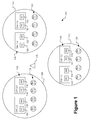
- FIG. 1 schematically illustrates an example broadband wireless access (BWA) network 100 in accordance with some embodiments.
- the BWA network 100 may be a network having access service network (ASN) clusters, such as ASN cluster 104, ASN cluster 108, and ASN cluster 112.
- ASN clusters may include one or more base stations (BSs) communicatively coupled to gateways (GWs).
- the gateways provide the base stations with communicative access to a core network, while the base stations may establish a wireless connection with a mobile station, for example, mobile station 116.
- Any gateway of an ASN cluster can connect to any base station in the ASN cluster using an R6-flex interface.
- the gateways and the base stations may be subject to certain connection rules that govern their interconnections and instruct the availability of advanced and legacy functions as discussed hereinafter.
- Each of the gateways may include modules such as a paging controller (PC) and an authentication module (AM), although the paging controller and/or the authentication module, or some components thereof, may be shared among more than one gateway in some embodiments and/or may be located external to the gateway, e.g., in the core network.
- the authentication modules may be used to authenticate the identity of a mobile station during the establishment of the initial connection or anytime thereafter. In various embodiments the authentication module may also perform other functions such as accounting and authorization.
- the paging controllers may be used to control traffic flow and location updates when the mobile station is in idle state.
- FIG. 2 illustrates a base station 200 in accordance with various embodiments.
- the base station 200 may include a number of modules designed to perform the operations described herein with respect to either legacy or advanced base stations.
- the base station 200 may include a paging agent 204 to perform paging operations on behalf of the base station and/or an ASN cluster. Some of these paging operations will be discussed below with respect to Figure 5 .
- the base station 200 may also include a handover manager 208 to perform handover operations on behalf of the base station and/or the ASN cluster. Some of these handover operations may be discussed below with respect to Figures 3-5 .
- the base station 200 may also include an authentication agent 212 to perform authentication operations on behalf of the base station and/or the ASN cluster.
- the base station 200 may also include a communication interface 216 coupled to the paging agent 204, handover manager 208, and authentication agent 212.
- the communication interface 216 may transmit/receive messages from other network components as described herein.
- the BWA network 100 of Figure 1 may include network components that are configured to operate in accordance with different releases of a communication standard/protocol. This may be the result of a staged deployment of the network components.
- some of the network components may be configured to operate in accordance with the WiMAX Forum Network Architecture, Release 1.0 Version 4, published February 03, 2009 (hereinafter WiMAX Release 1.0), which is based on IEEE 802.16(e)-2005 (hereinafter 802.16(e)).
- WiMAX Release 1.0 WiMAX Forum Network Architecture, Release 1.0 Version 4, published February 03, 2009
- 802.16(e) Such network components may be referred to as legacy components and/or be designated with a 1.0.
- WiMAX Release 2.0 may be configured to operate in accordance with the WiMAX Release 2.0, which will be based on IEEE 802.16(m), which may be similar to the present draft 802.16m/D8, published August 25, 2010.
- the WiMAX Release 2.0 provides an advanced air interface that improves security, power saving, and other performance aspects with respect to the WiMAX Release 1.0.
- Network components configured to operate in accordance with the WiMAX Release 2.0 may also be referred to as advanced components and/or be designated with a 2.0.
- the ASN cluster 104 may include legacy base stations, for example, BSs 1.0 120, and legacy gateways, for example, GWs 1.0 124.
- the gateways 1.0 124 may each have an authentication module 122 and paging controller 126.
- the connection rules of ASN cluster 104 may provide that connections between BSs 1.0 120 and GWs 1.0 124 have a reduced set of functionalities as compared to an ASN cluster 2.0.
- the ASN cluster 104 may be referred to as an ASN cluster 1.0.
- the ASN cluster 108 may include advanced base stations, for example, BSs 2.0 128, and advanced gateways, for example, GWs 2.0 132.
- the gateways 2.0 132 may each have an authentication module 130 and paging controller 134.
- the connection rules of the ASN cluster 108 may provide that connections between the BSs 2.0 128 and the GWs 2.0 132 have full 802.16(m) functionality.
- the ASN cluster 108 may be referred to as ASN cluster 2.0.
- the ASN cluster 112 may include advanced base stations, for example, BSs 1.x 136, and legacy gateways, for example, GWs 1.0 140.
- the gateways 1.0 140 may each have an authentication module 138 and paging controller 142.
- the 1.x designation of BSs 1.x 136 indicates that the advanced base station has a reduced set of 802.16m functionalities given the connection with the legacy GWs 1.0 140.
- the connection rules of the ASN cluster 112 may provide that connections between the BSs 1.x 136 and GWs 1.0 140 have a set of functionalities that is greater than a set of functionalities of an ASN cluster 1.0, but less than a set of functionalities of an ASN cluster 2.0.
- the ASN cluster 112 may be referred to as an ASN cluster 1.x.
- Figure 1 reflects a connection rule in which each ASN cluster only includes one type of base station, for example, base station 1.0 or base station 2.0 (base station 1.x being an advanced base station coupled with a legacy gateway). Providing this connection rule facilitates migration of mobile station connections among the different base stations of an ASN cluster. However, other embodiments may include a mix of different types of base stations.
- the advanced air interface functionality and wireless connection which may be active or idle, may be managed as described below with respect to Figures 3-5 .
- FIG. 3 illustrates a flow diagram for a base station 2.0 handing over an active wireless connection of a mobile station to a base station 1.0 in accordance with some embodiments.
- a handover manager of a base station 2.0 that is serving a mobile station detects a handover event related to the mobile station.
- a handover may be initiated by the mobile station, in which case a handover event may be the base station 2.0 receiving a handover request (HO-REQ) from the mobile station.
- HO-REQ handover request
- a handover may also be initiated by the handover manager of the base station 2.0, in which case a handover event may be a detected occurrence of one or more predefined trigger conditions relating to, e.g., carrier to interference plus noise ratio (CINR), received signal strength indicator (RSSI), round trip delay (RTD), number of consecutive primary-superframe headers (P-SFHs) missed, relative delay (RD), etc.
- CINR carrier to interference plus noise ratio
- RSSI received signal strength indicator
- RTD round trip delay
- P-SFHs primary-superframe headers
- RD relative delay
- the handover event may be associated with service of a mobile station's wireless connection being handed off from the serving base station 2.0 to a target base station 1.0.
- Connection contexts may be associated with a wireless connection of a mobile station and may include information relating to the wireless connection, e.g., security keys, service flows, etc.
- Parameters of a connection context 1.0 e.g., tolerable delay, bits per second, etc., may differ from parameters of a connection context 2.0. While a base station 2.0 may be capable of translating parameters of a connection context 1.0 to parameters of a connection context 2.0; a base station 1.0 may not. Accordingly, at block 308 , the handover manager of the serving base station 2.0, upon detection of the handover target being a base station 1.0, may translate parameters of a connection context 2.0 to parameters of a connection context 1.0.
- the serving base station 2.0 may transmit the connection context 1.0 to the target base station 1.0.
- the connection context 1.0 may be transmitted to the target base station 1.0 over an R8 interface, which may be used for transferring control plane packets and, optionally, data packets between base stations to facilitate fast and seamless handovers.
- R8 interface may be used for transferring control plane packets and, optionally, data packets between base stations to facilitate fast and seamless handovers.
- the mobile station may need to perform a full network entry exchange with the target base station 1.0 rather than a network re-entry exchange.
- a connection context 1.0 may be established during the network entry protocol exchange and the connection context translation need not be performed by the handover manager of the serving base station 2.0.
- the serving base station 2.0 may complete handover of the active connection to the target base station 1.0.
- the handover manager of the serving base station 2.0 may retain the connection context 2.0 in anticipation of a possibility of a reassociation of the wireless connection from the mobile station at a later time. If no reassociation occurs within a predetermined time interval, the connection context may be deleted.
- Figure 4 illustrates a message flow between various network components of a handover from a serving base station 1.0 to a target base station 2.0 in accordance with various embodiments.
- the serving base station 1.0 may detect a handover event. Detection of the handover event may be similar to detection described above with respect to block 304 .
- the serving base station 1.0 and the target base station 2.0 may engage in a context transfer exchange 408 , in which the serving base station 1.0 provides a connection context 1.0 to a target base station 2.0.
- the target base station 2.0 upon receiving the connection context 1.0, may translate the connection context 1.0 to a connection context 2.0 at block 410 .
- connection context 1.0 may be provided over an R8 interface between the two base stations as part of a network re-entry exchange.
- the mobile station may perform a full network entry exchange with the target base station 2.0.
- a connection context 2.0 may be established during the network entry protocol exchange and a translation of the connection context 1.0 need not be performed by the target base station 2.0.
- the security and authentication protocols may differ between ASN cluster 1.0 and ASN cluster 2.0.
- an authentication module acting as an anchor authenticator, may receive a mobile station identifier (MSID) as part of an initial key derivation process that derives security keys such as an Authentication Key (AK) and other derivative keys.
- MSID mobile station identifier
- AK Authentication Key
- the MSID includes a media access control (MAC) address that uniquely identifies the mobile station.
- MAC media access control
- an authentication module acting as an anchor authenticator, may implement privacy protection functions. These privacy protection functions provide that a secured hash of the MSID is used in the initial key derivation process. Only after a security association has been established, will the mobile station identify itself by sending its real MSID in an encrypted message. Thus, the mobile station's real MSID is not sent over the air interface in an unencrypted manner, thereby providing privacy protection.
- anchor authenticator relocation will be performed whenever a mobile station crosses a cluster boundary that results in a wireless connection being handed over from a base station 1.0 to a base station 2.0.
- anchor authenticator relocation 412 may take place between the serving gateway 1.0 and the target gateway 2.0 to relocate the anchor authenticator from an authentication module 1.0 associated with the serving ASN cluster 1.0 to an authentication module 2.0 associated with the target ASN cluster 2.0.
- anchor authenticator relocation many not be required when a mobile station crosses a cluster boundary that results in a wireless connection being handed over from a base station 2.0 to a base station 1.0, as the authenticator 2.0 may also be capable of implementing 1.0 authentication protocols.
- the serving base station 1.0 may transmit a handover command (HO-CMD) 416 to the mobile station.
- the HO-CMD may include instructions for the mobile station to proceed with handover to target ASN cluster.
- the HO-CMD may include, e.g., an indication of one or more available target base stations, handover procedures, ranging information, expected level of service information, etc.
- Block 404 , exchange 408 , block 410 , relocation 412 , and HO-CMD 416 may be considered a handover trigger and execution phase 420 .
- the mobile station may enter a network re-entry phase 424 , which may include a ranging sequence 432 and may result in the establishment of a data path 428 with the target base station 2.0 to transfer the wireless connection and maintain session continuity.
- DCR deregistration content retention
- coverage-loss mechanisms Some advanced air interface functionalities may include, for example, deregistration content retention (DCR) mode and coverage-loss mechanisms.
- DCR mode the mobile station may deregister from the ASN cluster 2.0 and the ASN cluster 2.0 may retain content, e.g., connection context, for a period of time, determined by a context retention timer. If the mobile station reregisters while the content is still retained by the ASN 2.0 then reregistration will be accelerated.
- CRID context retention identifier
- a CRID may be assigned in the ranging sequence 432 of the network re-entry phase 424 .
- the ranging sequence 432 may include a ranging request (RNG-REQ) 436 sent from the mobile station to the target base station 2.0, and a ranging response (RNG-RSP) 440 sent from the target base station 2.0 to the mobile station.
- RNG-RSP 440 may include a CRID that is assigned to the mobile station.
- the mobile station may subsequently initiate a DCR mode by transmitting a deregistration request (DREG-REQ), if mobile station is initiating DCR mode from connected state, or RNG-REQ, if mobile station is initiating DCR mode from idle state, to the target base station 2.0 that includes the CRID.
- DREG-REQ deregistration request
- RNG-REQ mobile station is initiating DCR mode from idle state
- a paging controller When a mobile station is in an idle state, a paging controller stores a connection context of the mobile station and may store downlink messages for the mobile station. During a predefined listening interval, the paging controller may direct a paging agent of the base station to transmit a paging message to alert the mobile station to the presence of stored downlink messages. The mobile station may then exit the idle state and receive the downlink messages. It may be noted that the paging controller may page the mobile station for purposes other than traffic delivery as well.
- a connection context 1.0 may differ from a connection context 2.0.
- a mobile station exiting an idle state in an ASN cluster of a different release number than the ASN cluster in which the mobile station entered the idle state may have difficulty maintaining its wireless connection. This may be especially true if the mobile station has moved from an ASN cluster 2.0 to an ASN cluster 1.0.
- embodiments of the present invention provide that a paging group does not include a mix of 1.0 and 2.0 components.
- Figure 5 describes an idle state transition in light of such provisions.
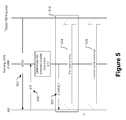
- Figure 5 illustrates a message flow between various network components when a mobile station crosses a cluster boundary in accordance with some embodiments.
- the mobile station may be in an idle state when it crosses the cluster boundary.
- the mobile station may receive a message (MSG) 504 , from a target ASN cluster, that includes a paging ID.
- the MSG 504 may be a downlink channel descriptor (DCD) message, a paging message, etc. If the message is a paging message, it may be from a paging controller acting through a paging agent of a base station of the target ASN cluster. It may be understood that actions described as performed by a paging controller may be implemented, at least in part, by a paging agent directed by the paging controller.
- the mobile station may determine that the paging ID in the MSG 504 is different from a paging ID of a paging group to which the mobile station is associated.
- the mobile station may then send a location update (LU) 508 to the serving paging controller.
- the serving paging controller may then determine that the mobile station has crossed a cluster boundary, which may also be a paging group boundary, at block 512 , at which point the serving paging controller may perform one of two alternatives.
- the serving paging controller may send the mobile station a location update rejection (LU-RJCT) 520 .
- This may prompt the mobile station to perform a full network entry 524 , including a full network entry protocol exchange, with the target ASN cluster. If the target ASN cluster happens to be an ASN cluster 2.0, then the mobile station will be assigned a CRID upon network entry. Once the network entry is completed, the mobile station may go into an idle state and, at this time, a connection context (either 1.0 or 2.0 depending on the release of the ASN cluster) will be stored in the paging controller of the target ASN cluster.
- a connection context either 1.0 or 2.0 depending on the release of the ASN cluster
- the mobile station may also be assigned a deregistration identifier (DID) during the idle state entry.
- DID may uniquely identify the mobile station with a paging group ID, a paging cycle, and a paging offset.
- the serving paging controller, the target paging controller, and the mobile station may participate in a location update exchange 528 that includes a paging controller relocation, which relocates a serving PC to a PC of the target ASN cluster.
- the location update exchange 528 may only include ranging messages and may omit many of the steps involved in a full network entry protocol exchange, e.g., capability exchange between the MS and BS, registration, authentication, IP address assignment, service flow establishment etc. If the target ASN cluster is an ASN cluster 2.0, the CRID and DID may be assigned to the mobile station as part of the location update exchange 528 .
- FIG. 6 illustrates, for one embodiment, an example system 600 comprising one or more processor(s) 604, system control logic 608 coupled to at least one of the processor(s) 604, system memory 612 coupled to system control logic 608, non-volatile memory (NVM)/storage 616 coupled to system control logic 608 , and one or more communications interface(s) 620 coupled to system control logic 608 .
- processor(s) 604 the processor(s) 604
- system memory 612 coupled to system control logic 608
- NVM non-volatile memory
- communications interface(s) 620 coupled to system control logic 608 .
- System control logic 608 may include any suitable interface controllers to provide for any suitable interface to at least one of the processor(s) 604 and/or to any suitable device or component in communication with system control logic 608.
- System control logic 608 may include one or more memory controller(s) to provide an interface to system memory 612.
- System memory 612 may be used to load and store data and/or instructions, for example, for system 600.
- System memory 612 for one embodiment may include any suitable volatile memory, such as suitable dynamic random access memory (DRAM), for example.
- DRAM dynamic random access memory
- System control logic 608 may include one or more input/output (I/O) controller(s) to provide an interface to NVM/storage 616 and communications interface(s) 620.
- I/O input/output
- NVM/storage 616 may be used to store data and/or instructions, for example.
- NVM/storage 616 may include any suitable non-volatile memory, such as flash memory, for example, and/or may include any suitable non-volatile storage device(s), such as one or more hard disk drive(s) (HDD(s)), one or more compact disc (CD) drive(s), and/or one or more digital versatile disc (DVD) drive(s) for example.
- HDD hard disk drive
- CD compact disc
- DVD digital versatile disc
- the NVM/storage 616 may include a storage resource physically part of a device on which the system 600 is installed or it may be accessible by, but not necessarily a part of, the device.
- the NVM/storage 616 may be accessed over a network via the communications interface(s) 620.
- System memory 612 and NVM/storage 616 may include, in particular, temporal and persistent copies of transfer logic 624, respectively.
- the transfer logic 624 may include instructions that when executed by at least one of the processor(s) 604 result in the system 600 performing transfer operations that occur as a result of a wireless connection of a mobile station being transferred to a different ASN cluster as described above with respect to a gateway, a base station, or mobile station.
- the transfer logic 624 may additionally/alternatively be located in the system control logic 608.
- Communications interface(s) 620 which may represent communication interface 216, may provide an interface for system 600 to communicate over one or more network(s) and/or with any other suitable device.
- Communications interface(s) 620 may include any suitable hardware and/or firmware.
- Communications interface(s) 620 for one embodiment may include, for example, a network adapter, a wireless network adapter, a telephone modem, and/or a wireless modem.
- communications interface(s) 620 for one embodiment may use one or more antennae.
- At least one of the processor(s) 604 may be packaged together with logic for one or more controller(s) of system control logic 608.
- at least one of the processor(s) 604 may be packaged together with logic for one or more controllers of system control logic 608 to form a System in Package (SiP).
- SiP System in Package
- at least one of the processor(s) 604 may be integrated on the same die with logic for one or more controller(s) of system control logic 608 .
- at least one of the processor(s) 604 may be integrated on the same die with logic for one or more controller(s) of system control logic 608 to form a System on Chip (SoC).
- SoC System on Chip
- system 600 may have more or less components, and/or different architectures.
Landscapes
- Engineering & Computer Science (AREA)
- Computer Networks & Wireless Communication (AREA)
- Signal Processing (AREA)
- Mobile Radio Communication Systems (AREA)
Applications Claiming Priority (2)
| Application Number | Priority Date | Filing Date | Title |
|---|---|---|---|
| US31117410P | 2010-03-05 | 2010-03-05 | |
| US12/889,285 US20110216735A1 (en) | 2010-03-05 | 2010-09-23 | Legacy and advanced access service network internetworking |
Publications (2)
| Publication Number | Publication Date |
|---|---|
| EP2367379A2 true EP2367379A2 (de) | 2011-09-21 |
| EP2367379A3 EP2367379A3 (de) | 2011-11-02 |
Family
ID=44007221
Family Applications (1)
| Application Number | Title | Priority Date | Filing Date |
|---|---|---|---|
| EP11157079A Withdrawn EP2367379A3 (de) | 2010-03-05 | 2011-03-04 | Legacy- und erweitertes Internet-Zugriffsdienstnetzwerk |
Country Status (5)
| Country | Link |
|---|---|
| US (1) | US20110216735A1 (de) |
| EP (1) | EP2367379A3 (de) |
| KR (1) | KR101240158B1 (de) |
| CN (1) | CN102196520B (de) |
| BR (1) | BRPI1101283A2 (de) |
Cited By (1)
| Publication number | Priority date | Publication date | Assignee | Title |
|---|---|---|---|---|
| EP2763473A1 (de) * | 2013-01-31 | 2014-08-06 | Industrial Technology Research Institute | Verfahren zur Handhabung von einem Netzwerkeintrag in einem Zelle-Cluster und verwandtes Kommunikationsgerät |
Families Citing this family (10)
| Publication number | Priority date | Publication date | Assignee | Title |
|---|---|---|---|---|
| WO2008152681A1 (ja) * | 2007-06-15 | 2008-12-18 | Fujitsu Limited | 通信システム、通信システムにおける移動端末の位置検索方法、及びプログラム |
| US9769713B2 (en) * | 2010-03-25 | 2017-09-19 | Alcatel Lucent | Method of relocating access service network functional entities during mobility events in WiMAX networks |
| KR102100208B1 (ko) * | 2010-06-25 | 2020-04-13 | 삼성전자주식회사 | 무선 통신 시스템에서 핸드오버 방법 및 그 장치 |
| US8649326B2 (en) * | 2010-07-06 | 2014-02-11 | Htc Corporation | Method of handling capability information of a mobile device and related communication device |
| CN102572990B (zh) * | 2012-02-28 | 2016-08-03 | 华为终端有限公司 | 多模切换的方法及多模终端 |
| CN114449603B (zh) * | 2012-12-24 | 2024-06-07 | 北京三星通信技术研究有限公司 | 无线通信系统中的基站及由其执行的方法 |
| CN104284376B (zh) * | 2013-07-05 | 2018-09-11 | 电信科学技术研究院 | 一种承载切换的方法、系统及设备 |
| US10117219B2 (en) * | 2014-08-22 | 2018-10-30 | Qualcomm Incorporated | Wireless network page transmission and response |
| CN107241718B (zh) * | 2017-06-13 | 2020-12-22 | 台州智奥通信设备有限公司 | 一种成对主密匙的丢弃方法及系统 |
| CN112512087B (zh) | 2020-04-26 | 2025-11-25 | 中兴通讯股份有限公司 | 网络切换方法、装置、设备及存储介质 |
Family Cites Families (17)
| Publication number | Priority date | Publication date | Assignee | Title |
|---|---|---|---|---|
| CN1980466B (zh) * | 2005-12-07 | 2010-11-10 | 华为技术有限公司 | 一种寻呼组网络及终端位置更新方法 |
| US8140077B2 (en) * | 2006-04-19 | 2012-03-20 | Nokia Corporation | Handover or location update for optimization for relay stations in a wireless network |
| US8045525B1 (en) * | 2007-10-02 | 2011-10-25 | Nortel Networks, Limited | Handover data integrity in a wireless data network |
| KR101593411B1 (ko) * | 2008-07-07 | 2016-02-12 | 삼성전자주식회사 | 혼합 배치에서 연결모드 동안에 단말의 핸드오프를 위한 방법 |
| US8432870B2 (en) * | 2008-07-11 | 2013-04-30 | Nokia Siemens Networks Oy | Handover techniques between legacy and updated wireless networks |
| US20100069073A1 (en) * | 2008-09-12 | 2010-03-18 | Industrial Technology Research Institute | System and method for system switch and handover between wireless communication systems |
| US8804658B2 (en) * | 2008-10-22 | 2014-08-12 | Mediatek Inc. | Method and apparatus for handover between IEEE 802.16e and 802.16m systems |
| KR101595025B1 (ko) * | 2009-01-07 | 2016-02-26 | 엘지전자 주식회사 | 광대역 무선접속 시스템에서의 영역 변경 방법 |
| KR101588745B1 (ko) * | 2009-02-26 | 2016-02-12 | 엘지전자 주식회사 | 광대역 무선 접속 시스템에서 단말의 상태에 따른 레인징 수행 방법 |
| US8218466B2 (en) * | 2009-03-17 | 2012-07-10 | Qualcomm Incorporated | Methods and apparatus for changing paging parameters in a communication system |
| KR101599855B1 (ko) * | 2009-05-24 | 2016-03-04 | 엘지전자 주식회사 | 광대역 무선 접속 시스템에서의 컨텐트 보존 등록해제 모드 동작 방법 |
| KR101666899B1 (ko) * | 2009-05-24 | 2016-10-17 | 엘지전자 주식회사 | 광대역 무선 접속 시스템에서의 컨텐트 보존 등록해제 모드 동작 방법 |
| KR101718164B1 (ko) * | 2009-12-17 | 2017-03-20 | 엘지전자 주식회사 | 인증 절차를 고려한 핸드오버 수행 방법 및 장치 |
| US9155059B2 (en) * | 2010-01-07 | 2015-10-06 | Lg Electronics Inc. | Method for performing deregistration with content retention mode in broadband wireless access system |
| KR20110092201A (ko) * | 2010-02-08 | 2011-08-17 | 엘지전자 주식회사 | 광대역 무선 접속 시스템에서 망 재진입 수행 방법 |
| US8478258B2 (en) * | 2010-03-05 | 2013-07-02 | Intel Corporation | Techniques to reduce false detection of control channel messages in a wireless network |
| US8849317B2 (en) * | 2010-06-21 | 2014-09-30 | Alcatel Lucent | Method for paging legacy and advanced access terminals |
-
2010
- 2010-09-23 US US12/889,285 patent/US20110216735A1/en not_active Abandoned
-
2011
- 2011-03-03 KR KR1020110019078A patent/KR101240158B1/ko not_active Expired - Fee Related
- 2011-03-04 EP EP11157079A patent/EP2367379A3/de not_active Withdrawn
- 2011-03-04 CN CN201110058701.7A patent/CN102196520B/zh not_active Expired - Fee Related
- 2011-03-04 BR BRPI1101283-8A patent/BRPI1101283A2/pt not_active IP Right Cessation
Non-Patent Citations (1)
| Title |
|---|
| None |
Cited By (3)
| Publication number | Priority date | Publication date | Assignee | Title |
|---|---|---|---|---|
| EP2763473A1 (de) * | 2013-01-31 | 2014-08-06 | Industrial Technology Research Institute | Verfahren zur Handhabung von einem Netzwerkeintrag in einem Zelle-Cluster und verwandtes Kommunikationsgerät |
| EP3133879A1 (de) * | 2013-01-31 | 2017-02-22 | Industrial Technology Research Institute | Verfahren zur handhabung von netzwerkeinträgen in einem zelle-cluster und verwandtes kommunikationsgerät |
| US10542474B2 (en) | 2013-01-31 | 2020-01-21 | Industrial Technology Research Institute | Method of handling network entry in a cell cluster and related communication device |
Also Published As
| Publication number | Publication date |
|---|---|
| KR101240158B1 (ko) | 2013-03-12 |
| CN102196520B (zh) | 2015-08-05 |
| CN102196520A (zh) | 2011-09-21 |
| US20110216735A1 (en) | 2011-09-08 |
| EP2367379A3 (de) | 2011-11-02 |
| KR20110101071A (ko) | 2011-09-15 |
| BRPI1101283A2 (pt) | 2012-08-07 |
Similar Documents
| Publication | Publication Date | Title |
|---|---|---|
| US20110216735A1 (en) | Legacy and advanced access service network internetworking | |
| US20230345312A1 (en) | User mobility method and device | |
| US10893574B2 (en) | Packet data unit session release method and network entity performing the same | |
| US20140355564A1 (en) | Reducing signaling during ap to ap handoff in dense networks | |
| US12267872B2 (en) | Data transmission method and apparatus, and computer-readable storage medium | |
| US20150017976A1 (en) | Method and apparatus for enhanced connection control | |
| CN102948209B (zh) | 唯一识别目标毫微微小区以促进毫微微辅助的活动切入 | |
| US20120157102A1 (en) | Handover Method and Handover Device | |
| US8391871B2 (en) | Method of handling proximity information transmission and related communication device | |
| WO2007137519A1 (fr) | Procédé et système pour un ue en mode réserve fermant une session réseau | |
| KR100952801B1 (ko) | 통신 네트워크에서 핸드오버를 지원하는 방법 및 장치 | |
| WO2019184788A1 (zh) | 用于小区变换的方法和设备 | |
| US10827557B2 (en) | Network access control method and apparatus | |
| CN114079908B (zh) | 通信网络中的通信方法、设备、装置和存储介质 | |
| JP2018527838A (ja) | ネットワーク指示の処理装置、方法及び通信システム | |
| KR101337177B1 (ko) | 네트워크 프로세스들을 용이하게 하는 방법 및 장치 | |
| US11252622B2 (en) | Network congestion management service | |
| EP3796743A1 (de) | Verfahren und vorrichtung zur verbesserung der zuverlässigkeit von funkruf und computerspeichermedium | |
| US8538382B2 (en) | Method, device, and system for network exit or de-registration of femto base station | |
| EP2858414A1 (de) | Verfahren und vorrichtung zur durchführung vom sprachdienst-fallback | |
| EP3735031B1 (de) | Übergabeverarbeitungsverfahren, netzwerkvorrichtung, endgerät und computerspeichermedium | |
| US20250133452A1 (en) | Managing multi-connectivity coordination information for conditional secondary node procedures | |
| CN110062427A (zh) | 支持无线网络切换的可信服务管理方法以及装置 | |
| US20130070727A1 (en) | Mechanism to improve handover speed in small cells | |
| JP7088230B2 (ja) | ネットワーク指示の処理装置、方法及び通信システム |
Legal Events
| Date | Code | Title | Description |
|---|---|---|---|
| PUAI | Public reference made under article 153(3) epc to a published international application that has entered the european phase |
Free format text: ORIGINAL CODE: 0009012 |
|
| AK | Designated contracting states |
Kind code of ref document: A2 Designated state(s): AL AT BE BG CH CY CZ DE DK EE ES FI FR GB GR HR HU IE IS IT LI LT LU LV MC MK MT NL NO PL PT RO RS SE SI SK SM TR |
|
| AX | Request for extension of the european patent |
Extension state: BA ME |
|
| PUAL | Search report despatched |
Free format text: ORIGINAL CODE: 0009013 |
|
| AK | Designated contracting states |
Kind code of ref document: A3 Designated state(s): AL AT BE BG CH CY CZ DE DK EE ES FI FR GB GR HR HU IE IS IT LI LT LU LV MC MK MT NL NO PL PT RO RS SE SI SK SM TR |
|
| AX | Request for extension of the european patent |
Extension state: BA ME |
|
| RIC1 | Information provided on ipc code assigned before grant |
Ipc: H04W 36/00 20090101AFI20110926BHEP |
|
| 17P | Request for examination filed |
Effective date: 20120430 |
|
| 17Q | First examination report despatched |
Effective date: 20170619 |
|
| STAA | Information on the status of an ep patent application or granted ep patent |
Free format text: STATUS: THE APPLICATION IS DEEMED TO BE WITHDRAWN |
|
| 18D | Application deemed to be withdrawn |
Effective date: 20171031 |