EP2368603B1 - Verfahren und Vorrichtung zur Verteilung eines Feuerunterdrückungsmittels - Google Patents
Verfahren und Vorrichtung zur Verteilung eines Feuerunterdrückungsmittels Download PDFInfo
- Publication number
- EP2368603B1 EP2368603B1 EP11171159.4A EP11171159A EP2368603B1 EP 2368603 B1 EP2368603 B1 EP 2368603B1 EP 11171159 A EP11171159 A EP 11171159A EP 2368603 B1 EP2368603 B1 EP 2368603B1
- Authority
- EP
- European Patent Office
- Prior art keywords
- suppressant
- valves
- communication
- apertures
- control valve
- Prior art date
- Legal status (The legal status is an assumption and is not a legal conclusion. Google has not performed a legal analysis and makes no representation as to the accuracy of the status listed.)
- Expired - Lifetime
Links
- 238000000034 method Methods 0.000 title description 4
- 238000004891 communication Methods 0.000 claims abstract description 62
- XPDWGBQVDMORPB-UHFFFAOYSA-N Fluoroform Chemical compound FC(F)F XPDWGBQVDMORPB-UHFFFAOYSA-N 0.000 claims description 4
- 239000000126 substance Substances 0.000 claims description 4
- YFMFNYKEUDLDTL-UHFFFAOYSA-N 1,1,1,2,3,3,3-heptafluoropropane Chemical compound FC(F)(F)C(F)C(F)(F)F YFMFNYKEUDLDTL-UHFFFAOYSA-N 0.000 claims description 2
- CURLTUGMZLYLDI-UHFFFAOYSA-N Carbon dioxide Chemical compound O=C=O CURLTUGMZLYLDI-UHFFFAOYSA-N 0.000 claims description 2
- 125000006342 heptafluoro i-propyl group Chemical group FC(F)(F)C(F)(*)C(F)(F)F 0.000 claims description 2
- 238000009826 distribution Methods 0.000 description 14
- 239000000463 material Substances 0.000 description 8
- 230000001629 suppression Effects 0.000 description 7
- 238000004880 explosion Methods 0.000 description 6
- 239000003795 chemical substances by application Substances 0.000 description 5
- 239000007789 gas Substances 0.000 description 5
- 230000009471 action Effects 0.000 description 3
- IJGRMHOSHXDMSA-UHFFFAOYSA-N Atomic nitrogen Chemical compound N#N IJGRMHOSHXDMSA-UHFFFAOYSA-N 0.000 description 2
- 229920006362 Teflon® Polymers 0.000 description 2
- 230000004913 activation Effects 0.000 description 2
- 230000000903 blocking effect Effects 0.000 description 2
- 229910052799 carbon Inorganic materials 0.000 description 2
- 239000006260 foam Substances 0.000 description 2
- 239000007788 liquid Substances 0.000 description 2
- 238000000926 separation method Methods 0.000 description 2
- 229910000906 Bronze Inorganic materials 0.000 description 1
- OKTJSMMVPCPJKN-UHFFFAOYSA-N Carbon Chemical compound [C] OKTJSMMVPCPJKN-UHFFFAOYSA-N 0.000 description 1
- 229910000975 Carbon steel Inorganic materials 0.000 description 1
- 229920004943 Delrin® Polymers 0.000 description 1
- 229920002449 FKM Polymers 0.000 description 1
- 230000003213 activating effect Effects 0.000 description 1
- 230000003466 anti-cipated effect Effects 0.000 description 1
- 238000013459 approach Methods 0.000 description 1
- 238000003491 array Methods 0.000 description 1
- 230000015572 biosynthetic process Effects 0.000 description 1
- 239000010974 bronze Substances 0.000 description 1
- 239000010962 carbon steel Substances 0.000 description 1
- 230000008859 change Effects 0.000 description 1
- 238000010276 construction Methods 0.000 description 1
- KUNSUQLRTQLHQQ-UHFFFAOYSA-N copper tin Chemical compound [Cu].[Sn] KUNSUQLRTQLHQQ-UHFFFAOYSA-N 0.000 description 1
- 238000007599 discharging Methods 0.000 description 1
- 230000009977 dual effect Effects 0.000 description 1
- 230000000694 effects Effects 0.000 description 1
- 239000012530 fluid Substances 0.000 description 1
- 239000000446 fuel Substances 0.000 description 1
- 239000011521 glass Substances 0.000 description 1
- 238000004519 manufacturing process Methods 0.000 description 1
- 238000005259 measurement Methods 0.000 description 1
- 239000000203 mixture Substances 0.000 description 1
- 230000007935 neutral effect Effects 0.000 description 1
- 229910052757 nitrogen Inorganic materials 0.000 description 1
- 238000003908 quality control method Methods 0.000 description 1
- 230000002787 reinforcement Effects 0.000 description 1
- 238000009877 rendering Methods 0.000 description 1
- 230000004044 response Effects 0.000 description 1
- 239000007787 solid Substances 0.000 description 1
- 239000010935 stainless steel Substances 0.000 description 1
- 229910001220 stainless steel Inorganic materials 0.000 description 1
Images




Classifications
-
- A—HUMAN NECESSITIES
- A62—LIFE-SAVING; FIRE-FIGHTING
- A62C—FIRE-FIGHTING
- A62C35/00—Permanently-installed equipment
- A62C35/58—Pipe-line systems
- A62C35/68—Details, e.g. of pipes or valve systems
-
- Y—GENERAL TAGGING OF NEW TECHNOLOGICAL DEVELOPMENTS; GENERAL TAGGING OF CROSS-SECTIONAL TECHNOLOGIES SPANNING OVER SEVERAL SECTIONS OF THE IPC; TECHNICAL SUBJECTS COVERED BY FORMER USPC CROSS-REFERENCE ART COLLECTIONS [XRACs] AND DIGESTS
- Y10—TECHNICAL SUBJECTS COVERED BY FORMER USPC
- Y10T—TECHNICAL SUBJECTS COVERED BY FORMER US CLASSIFICATION
- Y10T137/00—Fluid handling
- Y10T137/8593—Systems
- Y10T137/86493—Multi-way valve unit
- Y10T137/86863—Rotary valve unit
Definitions
- the invention relates to an apparatus and method for distributing fire suppressant.
- the invention relates more particularly to an apparatus and method for delivering a fire suppressant selected from among one or more available suppressants to any combination of one or more suppressant distributors.
- a single suppressant source may be connected to a single control valve, which is then connected to a distributor that is in the area where suppressant is to be distributed.
- the control valve is opened, whereupon suppressant flows from the suppressant source to the distributor, and thus to the fire (see e.g. US 4 002 148 ).
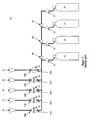
- the system 10 includes four suppressant sources 20, 22, 24, and 26.
- the suppressant sources are all in communication (i.e. via a line, pipe, or tube) with a series of control valves 30, 32, 34, 36, and 38.
- Each of the control valves connects to a suppressant distributor 40, 42, 44, 46, and 48 (not shown).
- the arrangement of control valves and connecting lines is sometimes referred to collectively as a discharge manifold.
- Each of the control valves in this conventional arrangement defines two apertures therein: 30A and 30B; 32A and 32B; 34A and 34B; 36A and 36B; and 38A and 38B.
- Each control valve is movable between two positions, closed and open. In the closed position, the two apertures of the control valves are not in communication with one another. In the open position, the two apertures are in communication. Consequently, for the configuration shown, in the closed position the control valves 30, 32, 34, 36, and 38 do. not pass suppressant, while in the open position, they do.
- Figure 1 shows all of the control valves 30, 32, 34, 36, and 38 in their closed positions, as might be typical when the system is inactive.
- Figure 2 shows control valve 38 in the open position. Given the positions of the control valves in Figure 2 , apertures 38A and 38B are in communication, thus suppressant from one or more of the sources 20, 22, 24, and 26 (depending on which was open) would pass through control valve 38 to distributor 48.
- dead space diverts suppressant from the location where it is actually needed.
- the quantity of suppressant that is discharged from each distributor be predictable to within established tolerances of the desired discharge quantity and discharge time.
- portions of the manifold may be unnecessarily filled with suppressant.
- the dead space in a system may be vented or discharged, in some cases the agent will not immediately discharge within a proscribed time period (i.e. 10 seconds). This affects the operation of the system; the effects must either be ignored and accepted, or compensated for in other ways.
- the amount of dead space is large (i.e. in a large manifold, with long lines between the suppressant sources 20 , 22 , 24 , and 26 and the most distant of the control valves 30 , 32 , 34 , 36 , and 38 ), this may substantially increase the amount of suppressant that must be used when the system is activated.
- the volume of the dead space may be large enough to require an increased pressure at the sources 20 , 22 , 24 , and 26 when activating the system, so as to maintain adequate distribution pressure at the open distributor 38.
- An exemplary embodiment of an apparatus in accordance with the principles of the claimed invention includes at least one suppressant source, at least one control valve in communication with the suppressant source, and at least one distributor, each distributor being in communication with at least one control valve.
- the control valves each define first, second, and third apertures therein.
- the control valves are each movable between first, second, and third positions.
- the first and third apertures of each valve are in communication with one another.
- the first, second, and third apertures of each valve are in communication with one another.
- control valves may be movable to a fourth position, as well. In the fourth position, the first and second apertures of each valve are in communication with one another.
- This feature enables not only discharge of suppressant through each control valve, but also direction of suppressant both through each control valve, without actually discharging through a distributor connected thereto. As a result, it is possible to discharge suppressant from any one or more of the distributors, in any combination.
- each of the control valves passes suppressant therethrough, but does not pass suppressant to its distributor.
- each of the control valves does not pass suppressant therethrough, but passes suppressant to its distributor.
- each of the control valves passes suppressant therethrough, and passes suppressant to its distributor.
- a suppressing system in accordance with the principles of the claimed invention may be made to direct suppressant from the suppressant source (or from any one of several suppressant sources) to any combination of the distributors.
- control valves maybe movable to a fourth position, as well.
- each of the control valves in the fourth position does not pass suppressant therethrough, and does not pass suppressant to its distributor.
- T control valve such as a three-way through T directional disk valve, or a three-way through T directional ball valve.
- T control valve such as a three-way through T directional disk valve, or a three-way through T directional ball valve.
- this is exemplary only, and other valves may be equally suitable.
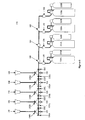
- an apparatus 110 for fire suppression in accordance with the principles of the claimed invention includes at least one fire suppressant source. As shown in Figures 3 and 5-7 , the apparatus has four fire suppressant sources 120 , 122 , 124 , and 126. However, this is exemplary only.
- the sources 120 , 122 , 124 , and 126 may be single tanks, such as might be used for a superpressurized agent system.
- the sources 120 , 122 , 124 , and 126 may be double tanks, such as might be used with a piston-flow system.
- tanks 120A , 122A , 124A , and 126A contain the suppressant proper, while tanks 120B , 122B , 124B , and 126B contain a pressurizing fluid, such as compressed nitrogen.
- suppressants include, but are not limited to, gasses, liquids, granular solids, and foams.
- suitable fire suppressants include, but are not limited to, liquefied compressed gas chemical extinguishing agents, such as HFC-227ea, HFC-23, CO 2 , and CF 3 CF 2 C(O)CF(CF 3 ) 2 .
- liquefied compressed gas chemical extinguishing agents such as HFC-227ea, HFC-23, CO 2 , and CF 3 CF 2 C(O)CF(CF 3 ) 2 .
- liquefied compressed gas chemical extinguishing agents such as HFC-227ea, HFC-23, CO 2 , and CF 3 CF 2 C(O)CF(CF 3 ) 2 .
- liquefied compressed gas chemical extinguishing agents such as HFC-227ea, HFC-23, CO 2 , and CF 3 CF 2 C(O)CF(CF 3 ) 2 .
- the specific suppressants identified herein are exemplary only. Suppressants other than those named may be equally suitable.
- Each suppressant source may supply a different suppressant.
- some or all of the suppressant sources may supply identical suppressants.
- Fire suppressants are well known, and are not described further herein.
- fire suppression is used broadly. Firstly, “fire” encompasses both slow-burning conventional fires and explosions. Furthermore, “suppression” encompasses not only actions to extinguish or diminish a fire or explosion once it begins, but also actions to counteract a fire or explosion that is imminent, as well as to prevent fires and explosions under conditions wherein their formation is likely but not certain.
- fire suppression may include the distribution of fire suppressant to a location wherein a combustible gas is detected, even if no fire or explosion has yet occurred. This preemptive action is sometimes referred to as "inerting", as it is done to render an area inert with respect to fire and explosion.
- the suppressant sources 120 , 122 , 124 , and 126 are in communication with at least one control valve.
- Each of the control valves defines first, second, and third apertures therein: 130A , 130B , and 130C ; 132A , 132B , and 132C ; 134A , 134B , and 134C ; 136A , 136B, and 136C ; and 138A , 138B , and 138C.
- Each of the control valves 130 , 132 , 134 , 136 , and 138 is movable between at least three of first, second, third, and fourth positions.
- the first and third apertures of each valve are in communication with one another.
- the first, second, and third apertures of each valve are in communication with one another.
- control valves may be movable to all four of these positions.
- control valves that are not movable to all four positions, which three of the four above positions the control valves are movable may vary based on the particulars of the embodiments in question, and the arrangement of the control valves therein. Generally, the three positions are determined by the specific desired function of each individual control valve, i.e. in what direction(s) suppressant is to be passed by the control valve in question.
- control valves in a given embodiment will necessarily be movable to the same three positions. Likewise, not all control valves will pass suppressant in the same direction(s).
- control valves may be described based on their functionality, i.e. in what directions suppressant is passed.
- each control valve in the first position, passes suppressant therethrough (i.e., to the next control valve "downstream"), but does not pass suppressant to a distributor (see below) in communication with the control valve.
- each control valve does not pass suppressant therethrough, but passes suppressant to a distributor in communication therewith.
- each control valve passes suppressant therethrough, and passes suppressant to a distributor in communication with the control valve.
- each control valve does not pass suppressant therethrough, and does not pass suppressant to a distributor in communication with the control valve.
- control valves that produces the above-identified functional results is exemplary only.
- the control valves may be arranged otherwise, so that different positions may result in different distributions of suppressant.
- valves shown herein are illustrated in schematic form. Actual valves may include various internal components, i.e. a valve body, a rotor, o-rings, seals, port connectors, etc. Valves are known per se, and the mechanical structure of valves in general is not described in detail herein.
- control valves 130 , 132 , 134 , 136 , and 138 are in the first position.
- this may be considered a neutral or standby position.
- the control valves may remain in this position when not otherwise specifically moved to other positions.
- this is exemplary only.
- Each control valve 130 , 132 , 134 , 136 , and 138 is in communication with at least one distributor 140 , 142 , 144 , 146 , and 148. More particularly, one of the apertures of each control valve is in communication with the distributors. As illustrated, the second apertures 130B , 132B , 134B , 136B , and 138B are in communication with distributors 140, 142, 144, 146, and 148. However, this is exemplary only, and other arrangements may be equally suitable.
- each control valve 130,132, 134, 136, and 138 is in communication with exactly one distributor, 140,142,144, 146, and 148, in certain embodiments a control valve may be in communication with multiple distributors.
- distributors may be suitable for use with the claimed invention.
- the precise structure and arrangement of the distributors will depend on both the type of suppressant that is used, and the type of fire (i.e. anticipated location, size, fuel type, etc.) that is to be suppressed.
- Suitable distributors include, but are not limited to, gas discharge vents, liquid atomizers, foam sprayers, and granular distribution heads.
- Suitable connectors include, but are not limited to, rigid pipe, flexible hose, tubing, and conduits. Not all connectors need be the same. For example, some of the connectors in a particular embodiment may be flexible hose, while others are rigid pipe.
- control valves 130, 132, 134, 136, and 138 may include additional valves, which may be connected differently from control valves 130,132, 134,136, and 138, and which may also function differently.
- valves 150,152,154, and 156 that separate each of the suppressant sources 120, 122, 124, and 126 from the remainder of the manifold.
- Such valves may serve to prevent back flow, that is, the flow of a suppressant from one suppressant source into another source. Back flow is a particular concern when some, but not all, of the suppressant sources discharge.
- Valves 150, 152, 154, and 156 may also serve to reduce dead space, by blocking off portions of the manifold that are not in use when some, but not all, of the suppressant sources discharge.
- such valves may also serve to lock off the suppressant sources, so as to prevent accidental discharge of suppressant.
- valves including but not limited to El-check valves, may be suitable for this application. However, this is exemplary only.
- valves 162, 164, and 166 may also be valves 162, 164, and 166 that separate the individual suppressant sources 120, 122, 124, and 126 from one another. Such valves may also serve to prevent back flow. Valves 162, 164, and 166 may also serve to reduce dead space, by blocking off portions of the manifold that are not in use when some, but not all, of the suppressant sources discharge.
- valves including but not limited to swing check and check valves, may be suitable for this application. However, this is exemplary only.
- Swing check and check valves and other suitable valves are well known, and are not described further herein.
- additional valves are exemplary only. Embodiments with other arrangements of such additional valves, or without additional valves at all, may be equally suitable.
- valves 150, 152, 154, and 156 and valves 162, 164, and 166 are known per se.
- Figures 1 and 2 similarly show valves 50, 52, 54, and 56 and valves 62, 64, and 66 in prior art devices.
- each of the control valves 130, 132, 134, 136, and 138 is movable between at least first, second, and third positions, and may be movable to a fourth position as well.
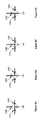
- Figures 8A-D show a single valve, 130, in each of the first, second, third, and fourth positions, respectively.
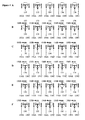
- Figure 4 shows a schematic representation of control valves 130, 132, 134, 136, and 138 in various positions, and the results of each arrangement for the embodiment illustrated in Figure 3 .
- suppressant reaching the valve may not actually go anywhere.
- control valve 130 is in the first position, so that the first and third apertures 130A and 130C are in communication, there is nowhere for suppressant to go after passing through control valve 130.
- the positions of the valve but also the configuration of the apparatus 10 as a whole, influences the particular manner in which suppressant can be distributed.
- control valve 130 is in the second position, while control valves 132, 134, 136, and 138 are in the first position. Control valves 132, 134, 136, and 138 pass suppressant therethrough, but do not pass it to their distributors 142, 144, 146, and 148. However, control valve 130 still passes suppressant to distributor 140.
- control valve 132 is in the second position, while control valves 130, 134, 136, and 138 are in the first position. Control valves 134, 136, and 138 pass suppressant therethrough, but do not pass it to their distributors 144, 146, and 148. Control valve 132 passes suppressant to distributor 142. However, control valve 132 does not pass suppressant therethrough, so no suppressant reaches control valve 130. Thus, suppressant is delivered only to distributor 142, and there is no dead space, i.e. no space beyond valves 132 that is unnecessarily filled with unused suppressant.
- Figure 4D is similar to arrangements B and C, in that one control valve is in the second position, while the other control valves are in the first position.
- control valve 136 is in the second position, while control valves 130, 132, 134, and 138 are in the first position.
- Control valve 138 passes suppressant therethrough, but does not pass it to distributor 148.
- Control valve 136 passes suppressant to distributor 146.
- control valve 136 does not pass suppressant therethrough, so no suppressant reaches control valves 130, 132, or 134.
- suppressant is delivered only to distributor 146, and there is no dead space beyond control valve 136.
- control valve 138 is in the third position, so as to pass suppressant both through itself and to distributor 148.
- Control valves 134 and 136 are in the first position, so as to pass suppressant therethrough.
- suppressant is passed to control valve 132.
- Control valve 132 is in the second position, passing suppressant to distributor 142.
- suppressant is delivered to both distributors 142 and 148, but not to any of the other distributors. Furthermore, there is no dead space beyond control valve 132.
- case E may be generalized to other arrangements, wherein suppressant is to be delivered to any two or more of the distributors 140,142,144,146, and 148.
- control valve 134 is in the fourth position.
- Control valve 134 does not pass suppressant either to other control valves downstream, or to distributor 144.
- suppressant will not reach distributors 130 and 132.
- Such a configuration may be useful during servicing, in cases wherein some portion of the system 110 is malfunctioning, or where it is desired to override the distribution of suppressant to some or all of the distributors 140, 142, 144, 146, and 148.
- the use of a fourth position is exemplary only, and embodiments wherein some or all of the control valves 130, 132, 134, 136, and 138 are not movable to a fourth position may be equally suitable.
- suppressant may be sent to any one or more of the distributors 140, 142, 144, 146, and 148, without any dead space.
- any one or more of the suppressants may be directed to any one or more of the distributors, without any dead space.
- valves may be suitable for use in an apparatus according to the principles of the claimed invention.
- One exemplary valve that is suitable for use as a control valve in the claimed invention is a so-called "T control valve", such as a three-way through T directional disk valve.
- a disk with three passages that connect to form a T is rotatably set into a housing having at least three openings. As the disk is rotated, the three passages are brought into alignment with various of the openings in the housing. As a result, with the proper arrangement of disk passages and housing openings, three-way through T directional disk valves may be made to pass material straight through, or to divert it in different directions, or to do both simultaneously.
- A.A refers to a measurement of the valve size.
- 3 indicates a 3-aperture valve.
- B and C indicate the material of the valve body and the rotor therein respectively, typically bronze, stainless steel, or carbon steel.
- D indicates the material of the o-ring seals, typically TEFLON®, VITON®, and/or Bune-N.
- T indicates a T-type configuration of apertures in the rotor.
- E indicates the material of the seal material, typically TEFLON® (with or without glass reinforcement), DELRIN®, or carbon-filled TFE.
- FF indicates the type of end connections, typically female national pipe thread, 150# flange, TRI-CLAMP®, CHERRY-BURRELL I-LINE® (female), socket weld, butt weld sch #10 or #40 pipe, or male acme bevel seat.
- G indicates special ordering features, and HH represents a bill of materials number.
- valves in a particular embodiment of an apparatus for fire suppression in accordance with the principles of the claimed invention will depend on (among other things) the intended application of that embodiment, i.e. the local environment, the type of fires to be suppressed, the type of suppressant used, etc. Thus, citing one or even several actual specific valve part numbers may not be useful or even meaningful, even for exemplary purposes.
- part numbers are indicative of the broad range of actual valve structures, materials, etc. that may be suitable for use with the present invention, and likewise is indicative of the broad range of potential embodiments and applications for the present invention overall.
- valves presented above are exemplary only, and that the present invention is not limited thereto.
- a wide variety of other valves including but not limited to other three-way through T directional disk valves, may be equally suitable.
- Three-way through T directional disk valves are known per se, and are not described further herein.
- control valves 130, 132, 134, 136, and 138 in Figures 3-8 are illustrated as schematic renderings of three-way through T directional disk valves.
- the three-way through T directional disk valves in Figures 3-5 are arranged with 90 degree separations between the three passages, and likewise with 90 degree separations between three openings in the housing.
- this is exemplary only, and other arrangements may be equally suitable.
- T directional disk valves As previously noted, the use of three-way through T directional disk valves is itself exemplary, and other valves may be equally suitable.
- valves include, but are not limited to, three way through T directional ball valves.
- Three-way through T directional ball valves are schematically similar to three-way through T directional disk valves, except that a ball is used in place of a disk. Many of the comments made above with regard to ball valves apply equally to disk valves.
- T directional disk valves Three-way through T directional disk valves are known per se, and are not described further herein.
- control valves are arranged in a single line, this is exemplary only. More complex arrangements are possible, including but not limited to multiple independent lines of valves, and interconnecting parallel lines or arrays of valves.
- Figure 6 shows an embodiment of an apparatus 110 for fire suppression in accordance with the principles of the claimed invention with a dual arrangement of control valves and distributors.
- the embodiment of Figure 6 includes control valves 131,133,135,137, and 139 and distributors 141, 143, 145, 147, and 149.
- the two groups of control valves and distributors are connected to the suppressant sources 120, 122, 124, and 126 in two lines, in an arrangement somewhat analogous to that of a parallel electrical circuit.
- control valves 131, 133,135,137, and 139 determine which of the distributors 141, 143, 145, 147, and 149 receivers suppressant.
- Suppressant may be supplied to any one or more of the distributors.
- control valve 170 disposed between the two lines of control valves and the suppressant sources.
- This valve is similar in structure and function to control valves 130, 131, 132, 133, 134, 135, 136, 137, 138, and 139 that are in communication with the distributors.
- control valve 170 defines first, second, and third apertures 170A, 170B, and 170C therein, and is movable between at least three of first, second, third, and fourth positions.
- first and third apertures of each valve are in communication with one another.
- second position the second and third apertures of each valve are in communication with one another.
- third position the first, second, and third apertures of each valve are in communication with one another.
- fourth position the first and second apertures of each valve are in communication with one another.
- control valve 170 may be movable to all four of the positions described above.
- control valve 170 is in communication with the suppressant sources and with other control valves.
- control valve 170 can direct suppressant to control valves 130,132,134,136, and 138, or to control valves 131, 133, 135, 137, and 139, or to both groups of control valves, or to none, depending on its position.
- control valve 170 which result is produced in which position depends at least in part upon the arrangement of control valve 170 in the particular embodiment under consideration.
- the first and third apertures 170A and 170C are in communication, and no suppressant will flow from the suppressant sources to the other control valves.
- the second and third apertures 170A and 170C are communication, and suppressant may flow only to control valves 131, 133, 135, 137, and 139.
- the first, second, and third apertures are in communication, and suppressant may flow to both sets of control valves.
- the first and second apertures 170A and 170C are communication, and suppressant may flow only to control valves 130, 132, 134, 136, and 138.
- Control valve 170 may serve functions similar to the other control valves. For example, it can limit dead space within the manifold, and can help to control which (if any) distributors receive suppressant.
- control valve 170 it is emphasized, with reference to the example of further control valve 170, that the claimed invention is not limited to using control valves as described herein solely for direct control of distributors. Rather, as with control valve 170, similar control valves may be disposed at any T-junction in the apparatus 110.
- each of the control valves 130, 131, 132, 133, 134, 135, 136, 137, 138, and 139 also is located at a T-junction, where a line for carrying suppressant branches into three directions.
- control valve 170 is not necessarily in direct communication with either distributors or suppressant sources.
- control valve 170 is in communication with suppressant sources 120, 122, 124, and 126.
- this is exemplary only. Indeed, in certain embodiments, it may be advantageous to include further control valves that are only in communication with other control valves.
- control valves at T-junctions within the apparatus 110 is exemplary only. Embodiments having one or more T-junctions that do not include control valves may be equally suitable.
- Figure 7 shows an exemplary embodiment of an apparatus in accordance with the principles of the claimed invention. The embodiment illustrated in Figure 7 is similar to that in Figure 3 , except that control valve 130 is omitted.
- the apparatus 110 of Figure 7 retains the functionality of that shown in Figure 3 . Namely, it is still possible to distribute suppressant to any one or more of the distributors 140, 142, 144, 146, and 148. In particular, depending on the position of control valve 132, suppressant may be directed to either, both, or neither of distributors 140 and 142.
- Figure 6 shows control valves and distributors arranged symmetrically, in a mirror image arrangement, this is exemplary only.
- a single control valve may control the operation of more than one distributor.
- embodiments wherein multiple control valves are used to control a single distributor may also be advantageous.
- the suppressant sources are arranged together in a single line, this also is exemplary only. Embodiments wherein the suppressant sources are arranged differently, in particular where they are arranged in two or more separate groups or where they are distributed in a more complex arrangement than that of a single line, may be equally suitable.
Landscapes
- Health & Medical Sciences (AREA)
- Public Health (AREA)
- Business, Economics & Management (AREA)
- Emergency Management (AREA)
- Fire-Extinguishing By Fire Departments, And Fire-Extinguishing Equipment And Control Thereof (AREA)
- Multiple-Way Valves (AREA)
- Respiratory Apparatuses And Protective Means (AREA)
Claims (6)
- Feuerunterdrückendes System, das Folgendes umfasst:wenigstens eine Unterdrückungsmittelquelle (120); wenigstens einen Verteiler (140), wobei jeder des wenigstens einen Verteilers mit wenigstens einer der wenigstens einen Unterdrückungsmittelquelle in Kommunikation steht;wenigstens ein Steuerungsventil (130), das an einer zwischen der wenigstens einen Unterdrückungsmittelquelle und dem wenigstens einen Verteiler angeordneten T-Verbindung angeordnet ist,wobei das wenigstens eine Steuerungsventil in sich eine erste (130A), zweite (130B) und dritte (130C) Öffnung definiert und zwischen wenigstens drei von einer ersten, zweiten, dritten und vierten Position beweglich ist, sodass
in der ersten Position die erste und dritte Öffnung in Kommunikation stehen;
in der zweiten Position die zweite und dritte Öffnung in Kommunikation stehen;
in der dritten Position die erste, zweite und dritte Öffnung in Kommunikation stehen;
in der vierten Position die erste und zweite Öffnung in Kommunikation stehen. - Feuerunterdrückendes System nach Anspruch 1, wobei:wenigstens eins der Steuerungsventile zwischen allen der ersten, zweiten, dritten und vierten Position beweglich ist.
- Feuerunterdrückendes System nach Anspruch 1, wobei:die Steuerungsventile T-direktionale Dreiwegetellerventile sind.
- Feuerunterdrückendes System nach Anspruch 1, wobei:die Steuerungsventile T-direktionale Dreiwegekugelventile sind.
- Feuerunterdrückendes System nach Anspruch 1, wobei:das Unterdrückungsmittel ein chemisches Löschmittel in Form eines verflüssigten, komprimierten Gases ist.
- Feuerunterdrückendes System nach Anspruch 1, wobei:das Unterdrückungsmittel eins umfasst aus der Gruppe bestehend aus: HFC-227ea, HFC-23, CO2 und CF3CF2C(O)CF(CF3)2.
Applications Claiming Priority (2)
| Application Number | Priority Date | Filing Date | Title |
|---|---|---|---|
| US10/253,297 US6896067B2 (en) | 2002-09-23 | 2002-09-23 | Method and apparatus for distributing fire suppressant |
| EP20030797930 EP1542773B1 (de) | 2002-09-23 | 2003-09-18 | Verfahren und gerät zur verteilung von brandbekämpfungsmitteln |
Related Parent Applications (1)
| Application Number | Title | Priority Date | Filing Date |
|---|---|---|---|
| EP03797930.9 Division | 2003-09-18 |
Publications (2)
| Publication Number | Publication Date |
|---|---|
| EP2368603A1 EP2368603A1 (de) | 2011-09-28 |
| EP2368603B1 true EP2368603B1 (de) | 2013-07-17 |
Family
ID=31993144
Family Applications (2)
| Application Number | Title | Priority Date | Filing Date |
|---|---|---|---|
| EP20030797930 Expired - Lifetime EP1542773B1 (de) | 2002-09-23 | 2003-09-18 | Verfahren und gerät zur verteilung von brandbekämpfungsmitteln |
| EP11171159.4A Expired - Lifetime EP2368603B1 (de) | 2002-09-23 | 2003-09-18 | Verfahren und Vorrichtung zur Verteilung eines Feuerunterdrückungsmittels |
Family Applications Before (1)
| Application Number | Title | Priority Date | Filing Date |
|---|---|---|---|
| EP20030797930 Expired - Lifetime EP1542773B1 (de) | 2002-09-23 | 2003-09-18 | Verfahren und gerät zur verteilung von brandbekämpfungsmitteln |
Country Status (6)
| Country | Link |
|---|---|
| US (1) | US6896067B2 (de) |
| EP (2) | EP1542773B1 (de) |
| CN (1) | CN100591397C (de) |
| AT (1) | ATE536206T1 (de) |
| AU (1) | AU2003276931B8 (de) |
| WO (1) | WO2004026409A1 (de) |
Families Citing this family (9)
| Publication number | Priority date | Publication date | Assignee | Title |
|---|---|---|---|---|
| US6896067B2 (en) * | 2002-09-23 | 2005-05-24 | James Bowyer | Method and apparatus for distributing fire suppressant |
| DE102005014275B4 (de) * | 2005-03-24 | 2008-06-19 | Fogtec Brandschutz Gmbh & Co. Kg | Servicefreundliches Ventil für Brandbekämpfungssysteme |
| US9033061B2 (en) * | 2009-03-23 | 2015-05-19 | Kidde Technologies, Inc. | Fire suppression system and method |
| CN101507869B (zh) * | 2009-03-30 | 2011-12-28 | 浙江信达可恩消防实业有限责任公司 | 一种电控选择阀及使用该阀的一个主动瓶控制分配方法 |
| US9044628B2 (en) | 2010-06-16 | 2015-06-02 | Kidde Technologies, Inc. | Fire suppression system |
| GB2486267B (en) | 2010-12-09 | 2014-12-17 | Kidde Tech Inc | Combined fire extinguishing system |
| CN110087742A (zh) | 2016-12-20 | 2019-08-02 | 开利公司 | 用于封闭体的防火系统以及用于封闭体的防火方法 |
| DE102017130587A1 (de) | 2017-12-19 | 2019-06-19 | Minimax Gmbh & Co. Kg | Pneumatisches Steuergerät für Mehrbereichs-Feuerlöschanlagen, sowie Mehrbereichs-Feuerlöschanlage mit selbigem |
| CN116850510A (zh) * | 2023-07-04 | 2023-10-10 | 上海采日能源科技有限公司 | 一种电池储能系统 |
Family Cites Families (13)
| Publication number | Priority date | Publication date | Assignee | Title |
|---|---|---|---|---|
| US4082148A (en) * | 1976-07-26 | 1978-04-04 | A-T-O Inc. | Fire protection system |
| US4305469A (en) * | 1980-07-07 | 1981-12-15 | Walter Kidde And Company, Inc. | Fire extinguishing system having a discharge valve and a distribution valve actuated by a pneumatic actuator |
| CA1152857A (en) * | 1982-11-01 | 1983-08-30 | Walter G. Miller | Fire extinguishing system |
| DE3923935A1 (de) | 1989-07-19 | 1991-01-24 | Hekatron Gmbh | Feuerloeschanlage fuer gasfoermige loeschmittel |
| US5273073A (en) * | 1992-02-14 | 1993-12-28 | Fuller Company | Control valve for a particulate blender |
| ATE167072T1 (de) * | 1992-10-20 | 1998-06-15 | Goeran Sundholm | Verfahren und vorrichtung zur brandbekämpfung |
| FI925836L (fi) * | 1992-12-22 | 1994-06-23 | Goeran Sundholm | Tulensammutuslaite |
| JPH09280390A (ja) * | 1996-04-12 | 1997-10-28 | Asahi Organic Chem Ind Co Ltd | 三方ボールバルブ |
| US6135153A (en) * | 1998-01-02 | 2000-10-24 | Cleland, Sr. John | Anesthesia delivery systems and methods |
| CN2511336Y (zh) * | 2001-09-11 | 2002-09-18 | 孙新兴 | 干粉灭火器的干粉装填/回收装置 |
| US6647934B2 (en) * | 2001-10-01 | 2003-11-18 | General Electric Company | Unified rotary flow control valve for internal combustion engine cooling system |
| US6672336B2 (en) * | 2001-11-28 | 2004-01-06 | Rheodyne, Lp | Dual random access, three-way rotary valve apparatus |
| US6896067B2 (en) * | 2002-09-23 | 2005-05-24 | James Bowyer | Method and apparatus for distributing fire suppressant |
-
2002
- 2002-09-23 US US10/253,297 patent/US6896067B2/en not_active Expired - Lifetime
-
2003
- 2003-09-18 WO PCT/US2003/030148 patent/WO2004026409A1/en not_active Ceased
- 2003-09-18 AT AT03797930T patent/ATE536206T1/de active
- 2003-09-18 AU AU2003276931A patent/AU2003276931B8/en not_active Ceased
- 2003-09-18 CN CN03825332A patent/CN100591397C/zh not_active Expired - Fee Related
- 2003-09-18 EP EP20030797930 patent/EP1542773B1/de not_active Expired - Lifetime
- 2003-09-18 EP EP11171159.4A patent/EP2368603B1/de not_active Expired - Lifetime
Also Published As
| Publication number | Publication date |
|---|---|
| AU2003276931B8 (en) | 2009-09-17 |
| CN1700939A (zh) | 2005-11-23 |
| AU2003276931A1 (en) | 2004-04-08 |
| US20040055764A1 (en) | 2004-03-25 |
| AU2003276931B2 (en) | 2009-08-13 |
| EP1542773A1 (de) | 2005-06-22 |
| CN100591397C (zh) | 2010-02-24 |
| EP1542773B1 (de) | 2011-12-07 |
| HK1084904A1 (zh) | 2006-08-11 |
| EP2368603A1 (de) | 2011-09-28 |
| US6896067B2 (en) | 2005-05-24 |
| WO2004026409A1 (en) | 2004-04-01 |
| ATE536206T1 (de) | 2011-12-15 |
Similar Documents
| Publication | Publication Date | Title |
|---|---|---|
| EP2368603B1 (de) | Verfahren und Vorrichtung zur Verteilung eines Feuerunterdrückungsmittels | |
| US7415995B2 (en) | Method and system for independently filling multiple canisters from cascaded storage stations | |
| US11215491B2 (en) | Single-valve bypass meter bar and metering system | |
| US8360162B2 (en) | Hybrid inert gas fire suppression system | |
| WO2015066710A2 (en) | Integrated fluid control valve and valve actuator assembly | |
| US20050199293A1 (en) | Manifold for selectively dispersing multiple fluid streams | |
| WO2024075021A1 (en) | Fire suppression system with regulator | |
| EP3065834B1 (de) | Integriertes flusssteuerungsventil und ventilaktuatoranordnung | |
| JP3436369B2 (ja) | 消防用設備 | |
| KR20220055456A (ko) | 스프링클러 환상배관 시스템 | |
| HK1084904B (en) | Method and apparatus for distributing fire suppressant | |
| KR102450380B1 (ko) | 일제개방형 소방밸브 | |
| JP2020054658A (ja) | ガス系消火設備 | |
| JP7444411B2 (ja) | 送水システム | |
| CN116474301B (zh) | 喷淋系统及船舶 | |
| WO2026072146A1 (en) | Fire suppression system with reconfigurable manifold | |
| JPH11244406A (ja) | 制振水槽を利用する自動消火設備 | |
| JP2024020826A (ja) | 消火設備 | |
| JP2022071642A (ja) | 三方弁、配管装置、及び、給水装置 | |
| GB2159921A (en) | Fluid control valve | |
| JP2002291922A (ja) | 泡消火設備及び水道直結型泡消火設備 | |
| NZ720536B2 (en) | Integrated fluid control valve and valve actuator assembly | |
| HK1228827B (en) | Integrated fluid control valve and valve actuator assembly |
Legal Events
| Date | Code | Title | Description |
|---|---|---|---|
| PUAI | Public reference made under article 153(3) epc to a published international application that has entered the european phase |
Free format text: ORIGINAL CODE: 0009012 |
|
| AC | Divisional application: reference to earlier application |
Ref document number: 1542773 Country of ref document: EP Kind code of ref document: P |
|
| AK | Designated contracting states |
Kind code of ref document: A1 Designated state(s): AT BE BG CH CY CZ DE DK EE ES FI FR GB GR HU IE IT LI LU MC NL PT RO SE SI SK TR |
|
| 17P | Request for examination filed |
Effective date: 20120321 |
|
| GRAP | Despatch of communication of intention to grant a patent |
Free format text: ORIGINAL CODE: EPIDOSNIGR1 |
|
| GRAS | Grant fee paid |
Free format text: ORIGINAL CODE: EPIDOSNIGR3 |
|
| GRAA | (expected) grant |
Free format text: ORIGINAL CODE: 0009210 |
|
| AC | Divisional application: reference to earlier application |
Ref document number: 1542773 Country of ref document: EP Kind code of ref document: P |
|
| AK | Designated contracting states |
Kind code of ref document: B1 Designated state(s): AT BE BG CH CY CZ DE DK EE ES FI FR GB GR HU IE IT LI LU MC NL PT RO SE SI SK TR |
|
| REG | Reference to a national code |
Ref country code: GB Ref legal event code: FG4D |
|
| REG | Reference to a national code |
Ref country code: CH Ref legal event code: EP |
|
| REG | Reference to a national code |
Ref country code: IE Ref legal event code: FG4D |
|
| REG | Reference to a national code |
Ref country code: AT Ref legal event code: REF Ref document number: 621791 Country of ref document: AT Kind code of ref document: T Effective date: 20130815 |
|
| REG | Reference to a national code |
Ref country code: DE Ref legal event code: R096 Ref document number: 60344551 Country of ref document: DE Effective date: 20130912 |
|
| REG | Reference to a national code |
Ref country code: AT Ref legal event code: MK05 Ref document number: 621791 Country of ref document: AT Kind code of ref document: T Effective date: 20130717 |
|
| REG | Reference to a national code |
Ref country code: NL Ref legal event code: VDEP Effective date: 20130717 |
|
| PG25 | Lapsed in a contracting state [announced via postgrant information from national office to epo] |
Ref country code: BE Free format text: LAPSE BECAUSE OF FAILURE TO SUBMIT A TRANSLATION OF THE DESCRIPTION OR TO PAY THE FEE WITHIN THE PRESCRIBED TIME-LIMIT Effective date: 20130717 Ref country code: PT Free format text: LAPSE BECAUSE OF FAILURE TO SUBMIT A TRANSLATION OF THE DESCRIPTION OR TO PAY THE FEE WITHIN THE PRESCRIBED TIME-LIMIT Effective date: 20131118 Ref country code: AT Free format text: LAPSE BECAUSE OF FAILURE TO SUBMIT A TRANSLATION OF THE DESCRIPTION OR TO PAY THE FEE WITHIN THE PRESCRIBED TIME-LIMIT Effective date: 20130717 Ref country code: CY Free format text: LAPSE BECAUSE OF FAILURE TO SUBMIT A TRANSLATION OF THE DESCRIPTION OR TO PAY THE FEE WITHIN THE PRESCRIBED TIME-LIMIT Effective date: 20130619 Ref country code: SE Free format text: LAPSE BECAUSE OF FAILURE TO SUBMIT A TRANSLATION OF THE DESCRIPTION OR TO PAY THE FEE WITHIN THE PRESCRIBED TIME-LIMIT Effective date: 20130717 |
|
| PG25 | Lapsed in a contracting state [announced via postgrant information from national office to epo] |
Ref country code: ES Free format text: LAPSE BECAUSE OF FAILURE TO SUBMIT A TRANSLATION OF THE DESCRIPTION OR TO PAY THE FEE WITHIN THE PRESCRIBED TIME-LIMIT Effective date: 20131028 Ref country code: SI Free format text: LAPSE BECAUSE OF FAILURE TO SUBMIT A TRANSLATION OF THE DESCRIPTION OR TO PAY THE FEE WITHIN THE PRESCRIBED TIME-LIMIT Effective date: 20130717 Ref country code: GR Free format text: LAPSE BECAUSE OF FAILURE TO SUBMIT A TRANSLATION OF THE DESCRIPTION OR TO PAY THE FEE WITHIN THE PRESCRIBED TIME-LIMIT Effective date: 20131018 Ref country code: NL Free format text: LAPSE BECAUSE OF FAILURE TO SUBMIT A TRANSLATION OF THE DESCRIPTION OR TO PAY THE FEE WITHIN THE PRESCRIBED TIME-LIMIT Effective date: 20130717 Ref country code: FI Free format text: LAPSE BECAUSE OF FAILURE TO SUBMIT A TRANSLATION OF THE DESCRIPTION OR TO PAY THE FEE WITHIN THE PRESCRIBED TIME-LIMIT Effective date: 20130717 |
|
| PG25 | Lapsed in a contracting state [announced via postgrant information from national office to epo] |
Ref country code: CY Free format text: LAPSE BECAUSE OF FAILURE TO SUBMIT A TRANSLATION OF THE DESCRIPTION OR TO PAY THE FEE WITHIN THE PRESCRIBED TIME-LIMIT Effective date: 20130717 |
|
| PG25 | Lapsed in a contracting state [announced via postgrant information from national office to epo] |
Ref country code: DK Free format text: LAPSE BECAUSE OF FAILURE TO SUBMIT A TRANSLATION OF THE DESCRIPTION OR TO PAY THE FEE WITHIN THE PRESCRIBED TIME-LIMIT Effective date: 20130717 Ref country code: MC Free format text: LAPSE BECAUSE OF FAILURE TO SUBMIT A TRANSLATION OF THE DESCRIPTION OR TO PAY THE FEE WITHIN THE PRESCRIBED TIME-LIMIT Effective date: 20130717 Ref country code: CZ Free format text: LAPSE BECAUSE OF FAILURE TO SUBMIT A TRANSLATION OF THE DESCRIPTION OR TO PAY THE FEE WITHIN THE PRESCRIBED TIME-LIMIT Effective date: 20130717 Ref country code: SK Free format text: LAPSE BECAUSE OF FAILURE TO SUBMIT A TRANSLATION OF THE DESCRIPTION OR TO PAY THE FEE WITHIN THE PRESCRIBED TIME-LIMIT Effective date: 20130717 Ref country code: RO Free format text: LAPSE BECAUSE OF FAILURE TO SUBMIT A TRANSLATION OF THE DESCRIPTION OR TO PAY THE FEE WITHIN THE PRESCRIBED TIME-LIMIT Effective date: 20130717 Ref country code: EE Free format text: LAPSE BECAUSE OF FAILURE TO SUBMIT A TRANSLATION OF THE DESCRIPTION OR TO PAY THE FEE WITHIN THE PRESCRIBED TIME-LIMIT Effective date: 20130717 |
|
| REG | Reference to a national code |
Ref country code: CH Ref legal event code: PL |
|
| PLBE | No opposition filed within time limit |
Free format text: ORIGINAL CODE: 0009261 |
|
| STAA | Information on the status of an ep patent application or granted ep patent |
Free format text: STATUS: NO OPPOSITION FILED WITHIN TIME LIMIT |
|
| PG25 | Lapsed in a contracting state [announced via postgrant information from national office to epo] |
Ref country code: IT Free format text: LAPSE BECAUSE OF FAILURE TO SUBMIT A TRANSLATION OF THE DESCRIPTION OR TO PAY THE FEE WITHIN THE PRESCRIBED TIME-LIMIT Effective date: 20130717 |
|
| 26N | No opposition filed |
Effective date: 20140422 |
|
| REG | Reference to a national code |
Ref country code: FR Ref legal event code: ST Effective date: 20140530 |
|
| REG | Reference to a national code |
Ref country code: IE Ref legal event code: MM4A |
|
| PG25 | Lapsed in a contracting state [announced via postgrant information from national office to epo] |
Ref country code: CH Free format text: LAPSE BECAUSE OF NON-PAYMENT OF DUE FEES Effective date: 20130930 Ref country code: IE Free format text: LAPSE BECAUSE OF NON-PAYMENT OF DUE FEES Effective date: 20130918 Ref country code: LI Free format text: LAPSE BECAUSE OF NON-PAYMENT OF DUE FEES Effective date: 20130930 |
|
| REG | Reference to a national code |
Ref country code: DE Ref legal event code: R097 Ref document number: 60344551 Country of ref document: DE Effective date: 20140422 |
|
| PG25 | Lapsed in a contracting state [announced via postgrant information from national office to epo] |
Ref country code: FR Free format text: LAPSE BECAUSE OF NON-PAYMENT OF DUE FEES Effective date: 20130930 |
|
| PG25 | Lapsed in a contracting state [announced via postgrant information from national office to epo] |
Ref country code: TR Free format text: LAPSE BECAUSE OF FAILURE TO SUBMIT A TRANSLATION OF THE DESCRIPTION OR TO PAY THE FEE WITHIN THE PRESCRIBED TIME-LIMIT Effective date: 20130717 |
|
| PG25 | Lapsed in a contracting state [announced via postgrant information from national office to epo] |
Ref country code: HU Free format text: LAPSE BECAUSE OF FAILURE TO SUBMIT A TRANSLATION OF THE DESCRIPTION OR TO PAY THE FEE WITHIN THE PRESCRIBED TIME-LIMIT; INVALID AB INITIO Effective date: 20030918 Ref country code: BG Free format text: LAPSE BECAUSE OF FAILURE TO SUBMIT A TRANSLATION OF THE DESCRIPTION OR TO PAY THE FEE WITHIN THE PRESCRIBED TIME-LIMIT Effective date: 20130717 Ref country code: LU Free format text: LAPSE BECAUSE OF NON-PAYMENT OF DUE FEES Effective date: 20130918 |
|
| REG | Reference to a national code |
Ref country code: DE Ref legal event code: R082 Ref document number: 60344551 Country of ref document: DE Representative=s name: SCHMITT-NILSON SCHRAUD WAIBEL WOHLFROM PATENTA, DE |
|
| PGFP | Annual fee paid to national office [announced via postgrant information from national office to epo] |
Ref country code: GB Payment date: 20220819 Year of fee payment: 20 Ref country code: DE Payment date: 20220818 Year of fee payment: 20 |
|
| P01 | Opt-out of the competence of the unified patent court (upc) registered |
Effective date: 20230527 |
|
| REG | Reference to a national code |
Ref country code: DE Ref legal event code: R071 Ref document number: 60344551 Country of ref document: DE |
|
| REG | Reference to a national code |
Ref country code: GB Ref legal event code: PE20 Expiry date: 20230917 |
|
| PG25 | Lapsed in a contracting state [announced via postgrant information from national office to epo] |
Ref country code: GB Free format text: LAPSE BECAUSE OF EXPIRATION OF PROTECTION Effective date: 20230917 |