EP2369662A1 - Particules en forme de plaque pour matériau actif d'électrode positive de batteries secondaires au lithium, films de ce matériau, et batteries secondaires au lithium - Google Patents
Particules en forme de plaque pour matériau actif d'électrode positive de batteries secondaires au lithium, films de ce matériau, et batteries secondaires au lithium Download PDFInfo
- Publication number
- EP2369662A1 EP2369662A1 EP09835092A EP09835092A EP2369662A1 EP 2369662 A1 EP2369662 A1 EP 2369662A1 EP 09835092 A EP09835092 A EP 09835092A EP 09835092 A EP09835092 A EP 09835092A EP 2369662 A1 EP2369662 A1 EP 2369662A1
- Authority
- EP
- European Patent Office
- Prior art keywords
- active material
- cathode active
- plate
- plane
- particle
- Prior art date
- Legal status (The legal status is an assumption and is not a legal conclusion. Google has not performed a legal analysis and makes no representation as to the accuracy of the status listed.)
- Withdrawn
Links
- 239000002245 particle Substances 0.000 title claims abstract description 262
- 229910052744 lithium Inorganic materials 0.000 title claims abstract description 106
- WHXSMMKQMYFTQS-UHFFFAOYSA-N Lithium Chemical compound [Li] WHXSMMKQMYFTQS-UHFFFAOYSA-N 0.000 title claims abstract description 103
- 239000000463 material Substances 0.000 title claims description 35
- 239000007774 positive electrode material Substances 0.000 title description 4
- 239000006182 cathode active material Substances 0.000 claims abstract description 222
- FAPWRFPIFSIZLT-UHFFFAOYSA-M Sodium chloride Chemical group [Na+].[Cl-] FAPWRFPIFSIZLT-UHFFFAOYSA-M 0.000 claims abstract description 24
- 239000003792 electrolyte Substances 0.000 claims abstract description 23
- 238000002441 X-ray diffraction Methods 0.000 claims description 16
- 239000006183 anode active material Substances 0.000 claims description 12
- 239000003575 carbonaceous material Substances 0.000 claims description 5
- 239000013078 crystal Substances 0.000 abstract description 57
- 229910001416 lithium ion Inorganic materials 0.000 abstract description 39
- HBBGRARXTFLTSG-UHFFFAOYSA-N Lithium ion Chemical compound [Li+] HBBGRARXTFLTSG-UHFFFAOYSA-N 0.000 abstract description 38
- 239000010410 layer Substances 0.000 description 123
- 229910032387 LiCoO2 Inorganic materials 0.000 description 34
- PXHVJJICTQNCMI-UHFFFAOYSA-N nickel Substances [Ni] PXHVJJICTQNCMI-UHFFFAOYSA-N 0.000 description 34
- UBEWDCMIDFGDOO-UHFFFAOYSA-N cobalt(II,III) oxide Inorganic materials [O-2].[O-2].[O-2].[O-2].[Co+2].[Co+3].[Co+3] UBEWDCMIDFGDOO-UHFFFAOYSA-N 0.000 description 33
- 238000000034 method Methods 0.000 description 32
- 238000005245 sintering Methods 0.000 description 29
- 229910052748 manganese Inorganic materials 0.000 description 24
- 239000011572 manganese Substances 0.000 description 24
- 239000000919 ceramic Substances 0.000 description 23
- 239000000843 powder Substances 0.000 description 22
- 230000015572 biosynthetic process Effects 0.000 description 18
- IIPYXGDZVMZOAP-UHFFFAOYSA-N lithium nitrate Chemical compound [Li+].[O-][N+]([O-])=O IIPYXGDZVMZOAP-UHFFFAOYSA-N 0.000 description 18
- 230000000052 comparative effect Effects 0.000 description 17
- OKTJSMMVPCPJKN-UHFFFAOYSA-N Carbon Chemical compound [C] OKTJSMMVPCPJKN-UHFFFAOYSA-N 0.000 description 14
- 239000002002 slurry Substances 0.000 description 14
- 230000004048 modification Effects 0.000 description 13
- 238000012986 modification Methods 0.000 description 13
- 238000009831 deintercalation Methods 0.000 description 12
- 230000008569 process Effects 0.000 description 12
- 239000000758 substrate Substances 0.000 description 12
- 239000011521 glass Substances 0.000 description 11
- 238000009830 intercalation Methods 0.000 description 11
- 230000002687 intercalation Effects 0.000 description 11
- 239000000203 mixture Substances 0.000 description 11
- XGZVUEUWXADBQD-UHFFFAOYSA-L lithium carbonate Chemical group [Li+].[Li+].[O-]C([O-])=O XGZVUEUWXADBQD-UHFFFAOYSA-L 0.000 description 10
- 229910052808 lithium carbonate Inorganic materials 0.000 description 10
- 238000004519 manufacturing process Methods 0.000 description 10
- 229910052759 nickel Inorganic materials 0.000 description 10
- 229910013191 LiMO2 Inorganic materials 0.000 description 9
- 239000011149 active material Substances 0.000 description 9
- 239000007788 liquid Substances 0.000 description 9
- LFQSCWFLJHTTHZ-UHFFFAOYSA-N Ethanol Chemical compound CCO LFQSCWFLJHTTHZ-UHFFFAOYSA-N 0.000 description 8
- WMWLMWRWZQELOS-UHFFFAOYSA-N bismuth(iii) oxide Chemical compound O=[Bi]O[Bi]=O WMWLMWRWZQELOS-UHFFFAOYSA-N 0.000 description 8
- 230000006866 deterioration Effects 0.000 description 8
- 238000011049 filling Methods 0.000 description 8
- 150000002642 lithium compounds Chemical class 0.000 description 8
- 239000006230 acetylene black Substances 0.000 description 7
- 239000011230 binding agent Substances 0.000 description 7
- 239000008151 electrolyte solution Substances 0.000 description 7
- 238000002156 mixing Methods 0.000 description 7
- 238000005498 polishing Methods 0.000 description 7
- 235000002639 sodium chloride Nutrition 0.000 description 7
- 239000007784 solid electrolyte Substances 0.000 description 7
- 239000002904 solvent Substances 0.000 description 7
- 229910052596 spinel Inorganic materials 0.000 description 7
- 239000011029 spinel Substances 0.000 description 7
- 229910052782 aluminium Inorganic materials 0.000 description 6
- QVGXLLKOCUKJST-UHFFFAOYSA-N atomic oxygen Chemical compound [O] QVGXLLKOCUKJST-UHFFFAOYSA-N 0.000 description 6
- 229910017052 cobalt Inorganic materials 0.000 description 6
- 239000010941 cobalt Substances 0.000 description 6
- GUTLYIVDDKVIGB-UHFFFAOYSA-N cobalt atom Chemical compound [Co] GUTLYIVDDKVIGB-UHFFFAOYSA-N 0.000 description 6
- 238000005336 cracking Methods 0.000 description 6
- -1 cyclic ester Chemical class 0.000 description 6
- 230000000694 effects Effects 0.000 description 6
- 238000010438 heat treatment Methods 0.000 description 6
- 238000005259 measurement Methods 0.000 description 6
- 229910052760 oxygen Inorganic materials 0.000 description 6
- 239000001301 oxygen Substances 0.000 description 6
- 229920002799 BoPET Polymers 0.000 description 5
- 229910004499 Li(Ni1/3Mn1/3Co1/3)O2 Inorganic materials 0.000 description 5
- 238000004458 analytical method Methods 0.000 description 5
- 238000000354 decomposition reaction Methods 0.000 description 5
- 239000006185 dispersion Substances 0.000 description 5
- 230000014759 maintenance of location Effects 0.000 description 5
- 239000011369 resultant mixture Substances 0.000 description 5
- 238000001878 scanning electron micrograph Methods 0.000 description 5
- 238000005406 washing Methods 0.000 description 5
- MCMNRKCIXSYSNV-UHFFFAOYSA-N Zirconium dioxide Chemical compound O=[Zr]=O MCMNRKCIXSYSNV-UHFFFAOYSA-N 0.000 description 4
- 239000000654 additive Substances 0.000 description 4
- 150000001875 compounds Chemical class 0.000 description 4
- 229910003460 diamond Inorganic materials 0.000 description 4
- 239000010432 diamond Substances 0.000 description 4
- 238000011156 evaluation Methods 0.000 description 4
- 229910002804 graphite Inorganic materials 0.000 description 4
- 239000010439 graphite Substances 0.000 description 4
- 229910003002 lithium salt Inorganic materials 0.000 description 4
- 159000000002 lithium salts Chemical class 0.000 description 4
- 230000003647 oxidation Effects 0.000 description 4
- 238000007254 oxidation reaction Methods 0.000 description 4
- 230000009467 reduction Effects 0.000 description 4
- 150000003839 salts Chemical class 0.000 description 4
- 239000007787 solid Substances 0.000 description 4
- OIFBSDVPJOWBCH-UHFFFAOYSA-N Diethyl carbonate Chemical compound CCOC(=O)OCC OIFBSDVPJOWBCH-UHFFFAOYSA-N 0.000 description 3
- KMTRUDSVKNLOMY-UHFFFAOYSA-N Ethylene carbonate Chemical compound O=C1OCCO1 KMTRUDSVKNLOMY-UHFFFAOYSA-N 0.000 description 3
- YXFVVABEGXRONW-UHFFFAOYSA-N Toluene Chemical compound CC1=CC=CC=C1 YXFVVABEGXRONW-UHFFFAOYSA-N 0.000 description 3
- BJQHLKABXJIVAM-UHFFFAOYSA-N bis(2-ethylhexyl) phthalate Chemical compound CCCCC(CC)COC(=O)C1=CC=CC=C1C(=O)OCC(CC)CCCC BJQHLKABXJIVAM-UHFFFAOYSA-N 0.000 description 3
- NVIVJPRCKQTWLY-UHFFFAOYSA-N cobalt nickel Chemical compound [Co][Ni][Co] NVIVJPRCKQTWLY-UHFFFAOYSA-N 0.000 description 3
- 150000002148 esters Chemical class 0.000 description 3
- 238000009616 inductively coupled plasma Methods 0.000 description 3
- 238000003780 insertion Methods 0.000 description 3
- 230000037431 insertion Effects 0.000 description 3
- 238000010030 laminating Methods 0.000 description 3
- LBSANEJBGMCTBH-UHFFFAOYSA-N manganate Chemical compound [O-][Mn]([O-])(=O)=O LBSANEJBGMCTBH-UHFFFAOYSA-N 0.000 description 3
- 238000002844 melting Methods 0.000 description 3
- 230000008018 melting Effects 0.000 description 3
- 229920000620 organic polymer Polymers 0.000 description 3
- 239000003960 organic solvent Substances 0.000 description 3
- 125000004430 oxygen atom Chemical group O* 0.000 description 3
- 230000036961 partial effect Effects 0.000 description 3
- 229920000642 polymer Polymers 0.000 description 3
- 239000005518 polymer electrolyte Substances 0.000 description 3
- 229910052710 silicon Inorganic materials 0.000 description 3
- 239000011780 sodium chloride Substances 0.000 description 3
- 239000006104 solid solution Substances 0.000 description 3
- 239000007858 starting material Substances 0.000 description 3
- 239000002344 surface layer Substances 0.000 description 3
- 229910052718 tin Inorganic materials 0.000 description 3
- 229910020647 Co-O Inorganic materials 0.000 description 2
- 229910020704 Co—O Inorganic materials 0.000 description 2
- YCKRFDGAMUMZLT-UHFFFAOYSA-N Fluorine atom Chemical compound [F] YCKRFDGAMUMZLT-UHFFFAOYSA-N 0.000 description 2
- KFZMGEQAYNKOFK-UHFFFAOYSA-N Isopropanol Chemical compound CC(C)O KFZMGEQAYNKOFK-UHFFFAOYSA-N 0.000 description 2
- 229910001290 LiPF6 Inorganic materials 0.000 description 2
- 229910003286 Ni-Mn Inorganic materials 0.000 description 2
- 239000002033 PVDF binder Substances 0.000 description 2
- WCUXLLCKKVVCTQ-UHFFFAOYSA-M Potassium chloride Chemical compound [Cl-].[K+] WCUXLLCKKVVCTQ-UHFFFAOYSA-M 0.000 description 2
- ATJFFYVFTNAWJD-UHFFFAOYSA-N Tin Chemical compound [Sn] ATJFFYVFTNAWJD-UHFFFAOYSA-N 0.000 description 2
- 230000000996 additive effect Effects 0.000 description 2
- 230000002411 adverse Effects 0.000 description 2
- 230000005540 biological transmission Effects 0.000 description 2
- 229910052797 bismuth Inorganic materials 0.000 description 2
- 230000008859 change Effects 0.000 description 2
- 238000006243 chemical reaction Methods 0.000 description 2
- 239000002131 composite material Substances 0.000 description 2
- 230000007423 decrease Effects 0.000 description 2
- 239000002612 dispersion medium Substances 0.000 description 2
- 238000001035 drying Methods 0.000 description 2
- 239000011737 fluorine Substances 0.000 description 2
- 229910052731 fluorine Inorganic materials 0.000 description 2
- 230000006872 improvement Effects 0.000 description 2
- 229910003480 inorganic solid Inorganic materials 0.000 description 2
- 150000002500 ions Chemical class 0.000 description 2
- KWGKDLIKAYFUFQ-UHFFFAOYSA-M lithium chloride Chemical compound [Li+].[Cl-] KWGKDLIKAYFUFQ-UHFFFAOYSA-M 0.000 description 2
- NUJOXMJBOLGQSY-UHFFFAOYSA-N manganese dioxide Chemical compound O=[Mn]=O NUJOXMJBOLGQSY-UHFFFAOYSA-N 0.000 description 2
- 239000012046 mixed solvent Substances 0.000 description 2
- 239000004014 plasticizer Substances 0.000 description 2
- 229920002981 polyvinylidene fluoride Polymers 0.000 description 2
- 238000002360 preparation method Methods 0.000 description 2
- 230000002829 reductive effect Effects 0.000 description 2
- 230000000452 restraining effect Effects 0.000 description 2
- 239000010703 silicon Substances 0.000 description 2
- 239000007921 spray Substances 0.000 description 2
- 239000000126 substance Substances 0.000 description 2
- 229910052723 transition metal Inorganic materials 0.000 description 2
- 150000003624 transition metals Chemical class 0.000 description 2
- 229910006525 α-NaFeO2 Inorganic materials 0.000 description 2
- 229910006596 α−NaFeO2 Inorganic materials 0.000 description 2
- ZZXUZKXVROWEIF-UHFFFAOYSA-N 1,2-butylene carbonate Chemical compound CCC1COC(=O)O1 ZZXUZKXVROWEIF-UHFFFAOYSA-N 0.000 description 1
- VAYTZRYEBVHVLE-UHFFFAOYSA-N 1,3-dioxol-2-one Chemical compound O=C1OC=CO1 VAYTZRYEBVHVLE-UHFFFAOYSA-N 0.000 description 1
- 229920000049 Carbon (fiber) Polymers 0.000 description 1
- 229910011939 Li2.6 Co0.4 N Inorganic materials 0.000 description 1
- 229910011140 Li2C2 Inorganic materials 0.000 description 1
- 229910001559 LiC4F9SO3 Inorganic materials 0.000 description 1
- 229910000552 LiCF3SO3 Inorganic materials 0.000 description 1
- 229910052493 LiFePO4 Inorganic materials 0.000 description 1
- 229910018663 Mn O Inorganic materials 0.000 description 1
- 229910003176 Mn-O Inorganic materials 0.000 description 1
- 241000161982 Mogera robusta Species 0.000 description 1
- 229910006020 NiCoAl Inorganic materials 0.000 description 1
- 229910018553 Ni—O Inorganic materials 0.000 description 1
- VYPSYNLAJGMNEJ-UHFFFAOYSA-N Silicium dioxide Chemical compound O=[Si]=O VYPSYNLAJGMNEJ-UHFFFAOYSA-N 0.000 description 1
- XUIMIQQOPSSXEZ-UHFFFAOYSA-N Silicon Chemical compound [Si] XUIMIQQOPSSXEZ-UHFFFAOYSA-N 0.000 description 1
- KFDQGLPGKXUTMZ-UHFFFAOYSA-N [Mn].[Co].[Ni] Chemical compound [Mn].[Co].[Ni] KFDQGLPGKXUTMZ-UHFFFAOYSA-N 0.000 description 1
- 239000002390 adhesive tape Substances 0.000 description 1
- 229910045601 alloy Inorganic materials 0.000 description 1
- 239000000956 alloy Substances 0.000 description 1
- XAGFODPZIPBFFR-UHFFFAOYSA-N aluminium Chemical group [Al] XAGFODPZIPBFFR-UHFFFAOYSA-N 0.000 description 1
- PNEYBMLMFCGWSK-UHFFFAOYSA-N aluminium oxide Inorganic materials [O-2].[O-2].[O-2].[Al+3].[Al+3] PNEYBMLMFCGWSK-UHFFFAOYSA-N 0.000 description 1
- 125000000129 anionic group Chemical group 0.000 description 1
- 229910052787 antimony Inorganic materials 0.000 description 1
- 125000004429 atom Chemical group 0.000 description 1
- 238000005452 bending Methods 0.000 description 1
- JCXGWMGPZLAOME-UHFFFAOYSA-N bismuth atom Chemical compound [Bi] JCXGWMGPZLAOME-UHFFFAOYSA-N 0.000 description 1
- 229910000416 bismuth oxide Inorganic materials 0.000 description 1
- 239000005388 borosilicate glass Substances 0.000 description 1
- 229910052791 calcium Inorganic materials 0.000 description 1
- 229910052799 carbon Inorganic materials 0.000 description 1
- 239000004917 carbon fiber Substances 0.000 description 1
- WTXAAHSIMVZJJT-UHFFFAOYSA-N carbonic acid;hexan-3-one Chemical compound OC(O)=O.CCCC(=O)CC WTXAAHSIMVZJJT-UHFFFAOYSA-N 0.000 description 1
- 229910052804 chromium Inorganic materials 0.000 description 1
- 239000000571 coke Substances 0.000 description 1
- 239000008119 colloidal silica Substances 0.000 description 1
- 239000004020 conductor Substances 0.000 description 1
- 238000007796 conventional method Methods 0.000 description 1
- 229910052802 copper Inorganic materials 0.000 description 1
- 229910052593 corundum Inorganic materials 0.000 description 1
- 125000004122 cyclic group Chemical group 0.000 description 1
- 230000007547 defect Effects 0.000 description 1
- 238000000280 densification Methods 0.000 description 1
- TYIXMATWDRGMPF-UHFFFAOYSA-N dibismuth;oxygen(2-) Chemical compound [O-2].[O-2].[O-2].[Bi+3].[Bi+3] TYIXMATWDRGMPF-UHFFFAOYSA-N 0.000 description 1
- 238000009792 diffusion process Methods 0.000 description 1
- QHGJSLXSVXVKHZ-UHFFFAOYSA-N dilithium;dioxido(dioxo)manganese Chemical compound [Li+].[Li+].[O-][Mn]([O-])(=O)=O QHGJSLXSVXVKHZ-UHFFFAOYSA-N 0.000 description 1
- YNQRWVCLAIUHHI-UHFFFAOYSA-L dilithium;oxalate Chemical compound [Li+].[Li+].[O-]C(=O)C([O-])=O YNQRWVCLAIUHHI-UHFFFAOYSA-L 0.000 description 1
- IEJIGPNLZYLLBP-UHFFFAOYSA-N dimethyl carbonate Chemical compound COC(=O)OC IEJIGPNLZYLLBP-UHFFFAOYSA-N 0.000 description 1
- 238000007599 discharging Methods 0.000 description 1
- 239000002270 dispersing agent Substances 0.000 description 1
- 238000005265 energy consumption Methods 0.000 description 1
- JBTWLSYIZRCDFO-UHFFFAOYSA-N ethyl methyl carbonate Chemical compound CCOC(=O)OC JBTWLSYIZRCDFO-UHFFFAOYSA-N 0.000 description 1
- 239000010419 fine particle Substances 0.000 description 1
- 238000010304 firing Methods 0.000 description 1
- 125000003709 fluoroalkyl group Chemical group 0.000 description 1
- 230000004907 flux Effects 0.000 description 1
- 229910052733 gallium Inorganic materials 0.000 description 1
- 239000011245 gel electrolyte Substances 0.000 description 1
- 229910052732 germanium Inorganic materials 0.000 description 1
- 229910021397 glassy carbon Inorganic materials 0.000 description 1
- 230000005484 gravity Effects 0.000 description 1
- 229910052738 indium Inorganic materials 0.000 description 1
- APFVFJFRJDLVQX-UHFFFAOYSA-N indium atom Chemical compound [In] APFVFJFRJDLVQX-UHFFFAOYSA-N 0.000 description 1
- 230000002401 inhibitory effect Effects 0.000 description 1
- 239000010954 inorganic particle Substances 0.000 description 1
- 238000010884 ion-beam technique Methods 0.000 description 1
- 229910052742 iron Inorganic materials 0.000 description 1
- 238000003475 lamination Methods 0.000 description 1
- 230000000670 limiting effect Effects 0.000 description 1
- 239000011244 liquid electrolyte Substances 0.000 description 1
- XIXADJRWDQXREU-UHFFFAOYSA-M lithium acetate Chemical compound [Li+].CC([O-])=O XIXADJRWDQXREU-UHFFFAOYSA-M 0.000 description 1
- 229940071264 lithium citrate Drugs 0.000 description 1
- WJSIUCDMWSDDCE-UHFFFAOYSA-K lithium citrate (anhydrous) Chemical compound [Li+].[Li+].[Li+].[O-]C(=O)CC(O)(CC([O-])=O)C([O-])=O WJSIUCDMWSDDCE-UHFFFAOYSA-K 0.000 description 1
- 229910001547 lithium hexafluoroantimonate(V) Inorganic materials 0.000 description 1
- 229910001540 lithium hexafluoroarsenate(V) Inorganic materials 0.000 description 1
- JILPJDVXYVTZDQ-UHFFFAOYSA-N lithium methoxide Chemical compound [Li+].[O-]C JILPJDVXYVTZDQ-UHFFFAOYSA-N 0.000 description 1
- MHCFAGZWMAWTNR-UHFFFAOYSA-M lithium perchlorate Chemical compound [Li+].[O-]Cl(=O)(=O)=O MHCFAGZWMAWTNR-UHFFFAOYSA-M 0.000 description 1
- 229910001486 lithium perchlorate Inorganic materials 0.000 description 1
- 229910001496 lithium tetrafluoroborate Inorganic materials 0.000 description 1
- HSFDLPWPRRSVSM-UHFFFAOYSA-M lithium;2,2,2-trifluoroacetate Chemical compound [Li+].[O-]C(=O)C(F)(F)F HSFDLPWPRRSVSM-UHFFFAOYSA-M 0.000 description 1
- AZVCGYPLLBEUNV-UHFFFAOYSA-N lithium;ethanolate Chemical compound [Li+].CC[O-] AZVCGYPLLBEUNV-UHFFFAOYSA-N 0.000 description 1
- 238000009766 low-temperature sintering Methods 0.000 description 1
- 229910052749 magnesium Inorganic materials 0.000 description 1
- 239000011656 manganese carbonate Substances 0.000 description 1
- AMWRITDGCCNYAT-UHFFFAOYSA-L manganese oxide Inorganic materials [Mn].O[Mn]=O.O[Mn]=O AMWRITDGCCNYAT-UHFFFAOYSA-L 0.000 description 1
- WPBNNNQJVZRUHP-UHFFFAOYSA-L manganese(2+);methyl n-[[2-(methoxycarbonylcarbamothioylamino)phenyl]carbamothioyl]carbamate;n-[2-(sulfidocarbothioylamino)ethyl]carbamodithioate Chemical compound [Mn+2].[S-]C(=S)NCCNC([S-])=S.COC(=O)NC(=S)NC1=CC=CC=C1NC(=S)NC(=O)OC WPBNNNQJVZRUHP-UHFFFAOYSA-L 0.000 description 1
- 229910000016 manganese(II) carbonate Inorganic materials 0.000 description 1
- 239000012528 membrane Substances 0.000 description 1
- 239000002931 mesocarbon microbead Substances 0.000 description 1
- 229910052751 metal Inorganic materials 0.000 description 1
- 239000002184 metal Substances 0.000 description 1
- VNWKTOKETHGBQD-UHFFFAOYSA-N methane Chemical compound C VNWKTOKETHGBQD-UHFFFAOYSA-N 0.000 description 1
- 229910052750 molybdenum Inorganic materials 0.000 description 1
- 229910052758 niobium Inorganic materials 0.000 description 1
- 150000004767 nitrides Chemical class 0.000 description 1
- 239000010450 olivine Substances 0.000 description 1
- 229910052609 olivine Inorganic materials 0.000 description 1
- 230000001590 oxidative effect Effects 0.000 description 1
- 229920002037 poly(vinyl butyral) polymer Polymers 0.000 description 1
- 229920000728 polyester Polymers 0.000 description 1
- 239000001103 potassium chloride Substances 0.000 description 1
- 235000011164 potassium chloride Nutrition 0.000 description 1
- 239000011164 primary particle Substances 0.000 description 1
- 238000012545 processing Methods 0.000 description 1
- RUOJZAUFBMNUDX-UHFFFAOYSA-N propylene carbonate Chemical compound CC1COC(=O)O1 RUOJZAUFBMNUDX-UHFFFAOYSA-N 0.000 description 1
- 239000002296 pyrolytic carbon Substances 0.000 description 1
- 230000036647 reaction Effects 0.000 description 1
- 230000009257 reactivity Effects 0.000 description 1
- 229920005989 resin Polymers 0.000 description 1
- 239000011347 resin Substances 0.000 description 1
- 230000000717 retained effect Effects 0.000 description 1
- 238000004098 selected area electron diffraction Methods 0.000 description 1
- 229910052709 silver Inorganic materials 0.000 description 1
- 239000002356 single layer Substances 0.000 description 1
- 241000894007 species Species 0.000 description 1
- 238000004544 sputter deposition Methods 0.000 description 1
- 239000010935 stainless steel Substances 0.000 description 1
- 229910001220 stainless steel Inorganic materials 0.000 description 1
- 229910052712 strontium Inorganic materials 0.000 description 1
- 238000003786 synthesis reaction Methods 0.000 description 1
- 230000002194 synthesizing effect Effects 0.000 description 1
- 229910052719 titanium Inorganic materials 0.000 description 1
- 229910001428 transition metal ion Inorganic materials 0.000 description 1
- 238000004627 transmission electron microscopy Methods 0.000 description 1
- 229910052720 vanadium Inorganic materials 0.000 description 1
- 238000007740 vapor deposition Methods 0.000 description 1
- 229910001845 yogo sapphire Inorganic materials 0.000 description 1
- 229910052727 yttrium Inorganic materials 0.000 description 1
- 229910052725 zinc Inorganic materials 0.000 description 1
- 229910052726 zirconium Inorganic materials 0.000 description 1
Images





Classifications
-
- H—ELECTRICITY
- H01—ELECTRIC ELEMENTS
- H01M—PROCESSES OR MEANS, e.g. BATTERIES, FOR THE DIRECT CONVERSION OF CHEMICAL ENERGY INTO ELECTRICAL ENERGY
- H01M4/00—Electrodes
- H01M4/02—Electrodes composed of, or comprising, active material
- H01M4/36—Selection of substances as active materials, active masses, active liquids
- H01M4/48—Selection of substances as active materials, active masses, active liquids of inorganic oxides or hydroxides
- H01M4/485—Selection of substances as active materials, active masses, active liquids of inorganic oxides or hydroxides of mixed oxides or hydroxides for inserting or intercalating light metals, e.g. LiTi2O4 or LiTi2OxFy
-
- H—ELECTRICITY
- H01—ELECTRIC ELEMENTS
- H01M—PROCESSES OR MEANS, e.g. BATTERIES, FOR THE DIRECT CONVERSION OF CHEMICAL ENERGY INTO ELECTRICAL ENERGY
- H01M10/00—Secondary cells; Manufacture thereof
- H01M10/05—Accumulators with non-aqueous electrolyte
- H01M10/052—Li-accumulators
- H01M10/0525—Rocking-chair batteries, i.e. batteries with lithium insertion or intercalation in both electrodes; Lithium-ion batteries
-
- H—ELECTRICITY
- H01—ELECTRIC ELEMENTS
- H01M—PROCESSES OR MEANS, e.g. BATTERIES, FOR THE DIRECT CONVERSION OF CHEMICAL ENERGY INTO ELECTRICAL ENERGY
- H01M4/00—Electrodes
- H01M4/02—Electrodes composed of, or comprising, active material
- H01M4/13—Electrodes for accumulators with non-aqueous electrolyte, e.g. for lithium-accumulators; Processes of manufacture thereof
- H01M4/131—Electrodes based on mixed oxides or hydroxides, or on mixtures of oxides or hydroxides, e.g. LiCoOx
-
- H—ELECTRICITY
- H01—ELECTRIC ELEMENTS
- H01M—PROCESSES OR MEANS, e.g. BATTERIES, FOR THE DIRECT CONVERSION OF CHEMICAL ENERGY INTO ELECTRICAL ENERGY
- H01M4/00—Electrodes
- H01M4/02—Electrodes composed of, or comprising, active material
- H01M2004/021—Physical characteristics, e.g. porosity, surface area
-
- Y—GENERAL TAGGING OF NEW TECHNOLOGICAL DEVELOPMENTS; GENERAL TAGGING OF CROSS-SECTIONAL TECHNOLOGIES SPANNING OVER SEVERAL SECTIONS OF THE IPC; TECHNICAL SUBJECTS COVERED BY FORMER USPC CROSS-REFERENCE ART COLLECTIONS [XRACs] AND DIGESTS
- Y02—TECHNOLOGIES OR APPLICATIONS FOR MITIGATION OR ADAPTATION AGAINST CLIMATE CHANGE
- Y02E—REDUCTION OF GREENHOUSE GAS [GHG] EMISSIONS, RELATED TO ENERGY GENERATION, TRANSMISSION OR DISTRIBUTION
- Y02E60/00—Enabling technologies; Technologies with a potential or indirect contribution to GHG emissions mitigation
- Y02E60/10—Energy storage using batteries
-
- Y—GENERAL TAGGING OF NEW TECHNOLOGICAL DEVELOPMENTS; GENERAL TAGGING OF CROSS-SECTIONAL TECHNOLOGIES SPANNING OVER SEVERAL SECTIONS OF THE IPC; TECHNICAL SUBJECTS COVERED BY FORMER USPC CROSS-REFERENCE ART COLLECTIONS [XRACs] AND DIGESTS
- Y10—TECHNICAL SUBJECTS COVERED BY FORMER USPC
- Y10T—TECHNICAL SUBJECTS COVERED BY FORMER US CLASSIFICATION
- Y10T428/00—Stock material or miscellaneous articles
- Y10T428/25—Web or sheet containing structurally defined element or component and including a second component containing structurally defined particles
-
- Y—GENERAL TAGGING OF NEW TECHNOLOGICAL DEVELOPMENTS; GENERAL TAGGING OF CROSS-SECTIONAL TECHNOLOGIES SPANNING OVER SEVERAL SECTIONS OF THE IPC; TECHNICAL SUBJECTS COVERED BY FORMER USPC CROSS-REFERENCE ART COLLECTIONS [XRACs] AND DIGESTS
- Y10—TECHNICAL SUBJECTS COVERED BY FORMER USPC
- Y10T—TECHNICAL SUBJECTS COVERED BY FORMER US CLASSIFICATION
- Y10T428/00—Stock material or miscellaneous articles
- Y10T428/29—Coated or structually defined flake, particle, cell, strand, strand portion, rod, filament, macroscopic fiber or mass thereof
- Y10T428/2982—Particulate matter [e.g., sphere, flake, etc.]
Definitions
- the present invention relates to a plate-like particle for cathode active material having a layered rock salt structure for a lithium secondary battery and a cathode active material film (the distinction between a film and particles will be described later). Further, the present invention relates to a lithium secondary battery having a positive electrode which includes the above-mentioned plate-like particle or film.
- a cobalt-based cathode active material is widely used as a material for producing a positive electrode of a lithium secondary battery (may be referred to as a lithium ion secondary cell).
- the cobalt-based cathode active material (typically, LiCoO 2 ) has a so-called ⁇ -NaFeO 2 type layered rock salt structure.
- intercalation and deintercalation of lithium ions occur through a crystal plane other than the (003) plane (e.g., the (101) plane or the (104) plane). Through such intercalation and deintercalation of lithium ions, charge and discharge are carried out.
- a cathode active material of this kind for a cell brings about improvement in characteristics such as cell capacity by means of exposure of the crystal plane through which lithium ions are favorably intercalated and deintercalated (the plane other than the (003) plane; for example, the (101) plane or the (104) plane) as much extent as possible to an electrolyte.
- the present invention has been conceived to solve such a problem.
- the plate-like particle for cathode active material for a lithium secondary battery according to the present invention has a layered rock salt structure, and the (003) plane is oriented so as to intersect the plate surface of the particle (the definition of the plate surface will be described later). That is, the particle is formed such that a plane other than the (003) plane (e.g., the (104) plane) is oriented in parallel with the plate surface.
- the particle can be formed to a thickness of 100 ⁇ m or less (e.g., 20 ⁇ m or less).
- “Layered rock salt structure” refers to a crystal structure in which lithium layers and layers of a transition metal other than lithium are arranged in alternating layers with an oxygen layer therebetween; i.e., a crystal structure in which transition metal ion layers and lithium layers are arranged in alternating layers via oxide ions (typically, ⁇ -NaFeO 2 type structure: structure in which a transition metal and lithium are arrayed orderly in the direction of the [111] axis of cubic rock salt type structure).
- oxide ions typically, ⁇ -NaFeO 2 type structure: structure in which a transition metal and lithium are arrayed orderly in the direction of the [111] axis of cubic rock salt type structure.
- the above-mentioned characteristic can be rephrased as: in the plate-like particle for a lithium secondary battery cathode active material of the present invention, the [003] axis in the layered rock salt structure is in a direction which intersects the normal to the plate surface of the particle. That is, the particle is formed such that a crystal axis (e.g., the [104] axis) which intersects the [003] axis is in a direction orthogonal to the plate surface.
- a crystal axis e.g., the [104] axis
- Plate-like particle refers to a particle whose external shape is plate-like.
- the concept of “plate-like” is apparent under social convention without need of particular description thereof in the present specification. However, if the description were to be added, “plate-like” would be defined, for example, as follows.
- plate-like refers to a state in which, when a particle which is placed on a horizontal surface (a surface orthogonal to the vertical direction, along which gravity acts) stably (in a manner as not to further fall down even upon subjection to an external impact (excluding such a strong impact as to cause the particle to fly away from the horizontal surface)) is cut by a first plane and a second plane which are orthogonal to the horizontal surface (the first plane and the second plane intersect each other, typically at right angles), and the sections of the particle are observed, a dimension along the width direction (the dimension is referred to as the "width" of the particle), which is along the horizontal surface (in parallel with the horizontal surface or at an angle of ⁇ degrees (0 ⁇ ⁇ ⁇ 45) with respect to the horizontal surface), is greater than a dimension along the thickness direction (the dimension is referred to as the "thickness" of the particle), which is orthogonal to the width direction.
- the above-mentioned "thickness” does not include a gap between the horizontal plane (
- the plate-like particle of the present invention is usually formed in a flat plate-like form.
- "Flat plate-like form” refers to a state in which, when a particle is placed stably on a horizontal surface, the height of a gap formed between the horizontal surface and the particle is less than the thickness of the particle. Since a plate-like particle of this kind is not usually curved to an extent greater than the state, the above-mentioned definition is appropriate for the plate-like particle of the present invention.
- the thickness direction is not necessarily parallel with the vertical direction. This will be discussed under the assumption that the sectional shape of particle placed stably on a horizontal surface, as cut by the first plane or the second plane, should be classified into the closest one among (1) rectangular shape, (2) diamond shape, and (3) elliptic shape.
- the sectional shape of the particle is close to (1) rectangular shape, the width direction is parallel with the horizontal surface in the above-mentioned state, and the thickness direction is parallel with the vertical direction in the above-mentioned state.
- the width direction may form some angle (45 degrees or less; typically, about a few degrees to about 20 degrees) with respect to the horizontal surface.
- the width direction is a direction which connects the two most distant points on the outline of the section (this definition is not appropriate for the case of (1) rectangular shape, since the direction according thereto is along a diagonal of the rectangular shape).
- the "plate surface" of a particle refers to a surface which faces, in a state in which the particle is placed stably on a horizontal surface, the horizontal surface, or a surface which faces an imaginary plane located above the particle as viewed from the horizontal surface and being parallel with the horizontal surface.
- the "plate surface” of a particle is the widest surface on the plate-like particle, the “plate surface” may be referred to as the "principal surface.”
- the plate-like particle for a lithium secondary battery cathode active material of the present invention is formed such that the sectional shape of the particle is close to (1) rectangular shape.
- the thickness direction may be said to be parallel with the vertical direction in a state in which the particle is placed stably on a horizontal surface.
- the "plate surface" of the particle may be said to be a surface orthogonal to the thickness direction.
- the lithium secondary battery of the present invention includes a positive electrode which contains, as a cathode active material, the plate-like particles for a cathode active material of the present invention; a negative electrode which contains, as an anode active material, a carbonaceous material or a lithium-occluding material; and an electrolyte provided so as to intervene between the positive electrode and the negative electrode.
- the plate-like particles for a cathode active material are dispersed in a binder so as to form a cathode active material layer.
- a laminate of the cathode active material layer and a predetermined cathode collector serves as the positive electrode. That is, in this case, the positive electrode is formed by stacking the cathode active material layer, which contains the plate-like particles, on the cathode collector.
- the cathode active material film for a lithium secondary battery according to the present invention has a layered rock salt structure, and a plane other than the (003) plane (e.g., the (104) plane) is oriented in parallel with the plate surface of the film (the definition of the plate surface of the film will be described later).
- the film may be formed to a thickness of 100 ⁇ m or less (e.g., 20 ⁇ m or less).
- the above-mentioned characteristic can be rephrased as: in the cathode active material film for a lithium secondary battery of the present invention, the [003] axis in the layered rock salt structure is oriented in a direction which intersects the normal to the plate surface of the film. That is, the particle is formed such that a crystal axis (e.g., the [104] axis) which intersects the [003] axis is oriented in a direction orthogonal to the plate surface.
- a crystal axis e.g., the [104] axis
- the "thickness direction” of a film refers to a direction parallel with the vertical direction in a state in which the film is placed stably on a horizontal surface (a dimension of the film along the direction is referred to as “thickness”).
- the “plate surface” of a film refers to a surface orthogonal to the thickness direction of the film.
- the "plate surface” of the film is the widest surface on the film, the “plate surface” may be referred to as the "principal surface.”
- the above-mentioned "thickness" does not include a gap between the horizontal surface and the particle.
- the cathode active material film of the present invention is usually formed flat.
- "Flat” refers to a state in which, when a film is placed stably on a horizontal surface, the height of a gap formed between the horizontal surface and the film is less than the thickness of the film. Since a cathode active material film of this kind is not usually curved to an extent greater than the state, the above-mentioned definition is appropriate for the cathode active material film of the present invention.
- the lithium secondary battery of the present invention includes a positive electrode which includes the cathode active material film of the present invention; a negative electrode which contains a carbonaceous material or a lithium-occluding material as an anode active material; and an electrolyte provided so as to intervene between the positive electrode and the negative electrode.
- the cathode collector may be provided on at least one of the two plate surfaces of the cathode active material film. That is, the cathode collector may be provided on only one of the two plate surfaces of the cathode active material film. Alternatively, the cathode collector may be provided on both surfaces (both of the two plate surfaces) of the cathode active material film.
- the cathode collector When the cathode collector is provided on each of both surfaces of the cathode active material film, one of them may be formed thicker than the other in order to support the cathode active material film, and the other may be formed so as to have a structure (mesh-like, porous or the like) such that it does not inhibit the intercalation and deintercalation of lithium ions in the cathode active material film.
- the present invention is characterized in that the above-mentioned plate-like particle for cathode active material and cathode active material film have step-like structures formed two-dimensionally along the plate surface. That is, on the plate surface of the plate-like particle for cathode active material and the cathode active material film according to the present invention, a large number of microscopic step-like structures are formed in a plurality of directions as viewed in plane.
- the step-like structure may be preferably formed with a step height of 0.5 to 2 ⁇ m.
- the "plate-like particles for cathode active material” in the present invention can be dispersed in the cathode active material layer.
- the "cathode active material film” in the present invention is a self-standing film (a film which can be handled by itself after formation) which can form the positive electrode through lamination to the cathode collector.
- the film may be crushed into fine particles (the resultant particles correspond to the "plate-like particles for cathode active material” in the present invention), followed by dispersion in the cathode active material layer.
- the distinction between “particles” and “film” is apparent to those skilled in the art in association with modes of application to formation of the positive electrode.
- the ratio of intensity of diffraction by the (003) plane to intensity of diffraction by the (104) plane, [003]/[104], as obtained by X-ray diffraction is 1 or less.
- the deintercalation of lithium ions is facilitated, resulting in a remarkable improvement in charge-discharge characteristics.
- the cycle characteristic deteriorates.
- the degree of orientation is excessively high (i.e., crystals are oriented to an excessively high degree)
- a change in the volume of crystal associated with intercalation and deintercalation of lithium ions causes the particles and the film to be apt to break (the specifics of the reason for the deterioration in cycle characteristic are not clear).
- the plate-like particle for a lithium secondary battery cathode active material or the cathode active material film for a lithium secondary battery of the present invention can be formed such that so-called "uniaxial orientation" is attained.
- the plate-like particle or the cathode active material film can be formed such that the (h'k'l') planes different from a (hkl) plane oriented in parallel with the plate surface are oriented in a plurality of directions.
- the [hkl] and [h'k'l'] axes are present such that, while the [hkl] axis (e.g., the [104] axis) is oriented in a fixed direction (in the thickness direction) at all times, the [h'k'l'] axes (e.g., the [003] axes) are oriented in such a manner as to revolve about the [hkl] axis.
- the plate-like particle or the cathode active material film has the same crystal axis [hkl] in the plate surface.
- the [h'k'l'] axes are oriented in a plurality of (various; i.e., random) directions.
- the plate-like particle or the cathode active material film is in a state in which, as viewed in plane, a large number of regions are arrayed two-dimensionally, the [h'k'l'] axis is oriented in the same direction in each region, and the adjacent regions differ in direction in which the [h'k'l'] axes are oriented.
- a cathode active material having a layered rock salt structure has different coefficients of volume expansion-contraction for crystal orientations in intercalation and deintercalation of lithium ions.
- the plate-like particle or the cathode active material film by means of two-dimensionally dividing the plate-like particle or the cathode active material film into a plurality of regions with different in-plane orientations while exposing the same crystal plane (e.g., the (104) plane) at the plate surface, stress stemming from volume expansion can be absorbed at boundary portions, and the individual regions can be expanded or contracted so as to reduce stress.
- the occurrence of cracking in the particle and the film can be restrained.
- Such a structure can be confirmed by means of an X-ray diffractometer, a transmission electron microscope, or the like.
- a structure can be confirmed by means of X-ray diffraction as follows: a diffraction pattern appearing on a pole figure is not spot-like, but ring-like.
- the size of the individual regions is such that a length along an in-plane direction is 0.5 ⁇ m to 20 ⁇ m.
- a length along an in-plane direction is 0.5 ⁇ m to 20 ⁇ m.
- the length is in excess of 20 ⁇ m, cracking is apt to occur in the region.
- the length is less than 0.5 ⁇ m, boundary portions of the regions, at which boundary portions lithium ions encounter difficulty in moving, increase, resulting in deterioration in output characteristics.
- the plate-like particle or the cathode active material film can assume a multilayered structure (a structure in which a plurality of layers are stacked together in the thickness direction).
- each of the layers may have the above-mentioned state of orientation, or at least the surface layer (a layer having the plate surface) may have the above-mentioned state of orientation.
- the plate-like particle for cathode active material and the cathode active material film according to the present invention may be formed to be dense (e.g., with a porosity of 10% or less).
- the (003) plane is oriented so as to intersect the plate surface, which is a surface orthogonal to a thickness direction of the plate-like particle for cathode active material and the cathode active material film, and, along the plate surface, a large number of microscopic step-like structures are formed in a plurality of directions as viewed in plane.
- a crystal plane (a plane other than the (003) plane: e.g., (101) plane and (104) plane), through which lithium ions are favorably intercalated and deintercalated, exposes more to an electrolyte. Accordingly, the present invention can improve the characteristics such as cell capacity.
- FIG. 1A is a sectional view of the schematic configuration of a lithium secondary battery 10 according to an embodiment of the present invention.
- the lithium secondary battery 10 of the present embodiment is of a so-called liquid type and includes a cell casing 11, a separator 12, an electrolyte 13, a negative electrode 14, and a positive electrode 15.
- the separator 12 is provided so as to halve the interior of the cell casing 11.
- the cell casing 11 accommodates the liquid electrolyte 13.
- the negative electrode 14 and the positive electrode 15 are provided within the cell casing 11 in such a manner as to face each other with the separator 12 located therebetween.
- a nonaqueous-solvent-based electrolytic solution prepared by dissolving an electrolyte salt, such as a lithium salt, in a nonaqueous solvent, such as an organic solvent, is preferably used as the electrolyte 13, in view of electrical characteristics and easy handlability.
- a polymer electrolyte, a gel electrolyte, an organic solid electrolyte, or an inorganic solid electrolyte can also be used as the electrolyte 13 without problems.
- a solvent for a nonaqueous electrolytic solution examples include chain esters, such as dimethyl carbonate, diethyl carbonate, ethyl methyl carbonate, and methyl propione carbonate; cyclic esters having high dielectric constant, such as ethylene carbonate, propylene carbonate, butylene carbonate, and vinylene carbonate; and mixed solvents of a chain ester and a cyclic ester.
- a mixed solvent containing a chain ester serving as a main solvent with a cyclic ester is particularly suitable.
- examples of an electrolyte salt to be dissolved in the above-mentioned solvent include LiClO 4 , LiPF 6 , LiBF 4 , LiAsF 6 , LiSbF 6 , LiCF 3 SO 3 , LiC 4 F 9 SO 3 , LiCF 3 CO 2 , Li 2 C 2 F 4 (SO 3 ) 2 , LiN(RfSO 2 )(RfSO 2 ), LiC(RfSO 2 ) 3 , LiC n F 2n+1 SO 3 (n ⁇ 2), and LiN(RfOSO 2 ) 2 [Rf and Rf are fluoroalkyl groups]. They may be used singly or in combination of two or more species.
- a fluorine-containing organic lithium salt having a carbon number of 2 or greater is particularly preferred. This is because the fluorine-containing organic lithium salt is high in anionic property and readily undergoes ionization, and is thus readily dissolvable in the above-mentioned solvent.
- concentration of electrolyte salt in a nonaqueous electrolytic solution is preferably 0.3 mol/L to 1.7 mol/L, more preferably 0.4 mol/L to 1.5 mol/L.
- any anode active material may be used for the negative electrode 14, so long as the material can occlude and release lithium ions.
- carbonaceous materials such as graphite, pyrolytic carbon, coke, glassy carbon, a sintered body of organic high polymer compound, mesocarbon microbeads, carbon fiber, and activated carbon.
- metallic lithium or a lithium-occluding material such as an alloy which contains silicon, tin, indium, or the like; an oxide of silicon, tin, or the like which can perform charge and discharge at low electric potential near that at which lithium does; a nitride of lithium and cobalt such as Li 2.6 CO 0.4 N can be used as the anode active material.
- graphite can be replaced with a metal which can be alloyed with lithium, or with an oxide.
- voltage at full charge can be considered to be about 0.1 V (vs. lithium); thus, the electric potential of the positive electrode 15 can be conveniently calculated as a cell voltage plus 0.1 V. Therefore, since the electric potential of charge of the positive electrode 15 is readily controlled, graphite is preferred.
- FIG. 1B is an enlarged sectional view of the positive electrode 15 shown in FIG. 1A .
- the positive electrode 15 includes a cathode collector 15a and a cathode active material layer 15b.
- the cathode active material layer 15b is composed of a binder 15b1 and plate-like particles 15b2 for cathode active material.
- the plate-like particle 15b2 for cathode active material is a particle which contains cobalt and lithium and has a layered rock salt structure; more particularly, a LiCoO 2 particle, and is formed into a plate-like form having a thickness of about 2 ⁇ m to 100 ⁇ m.
- FIG. 2 is a sectional view of the schematic configuration of a lithium secondary battery 20 of another embodiment of the present invention.
- the lithium secondary battery 20 is of a so-called full solid type and includes a cathode collector 21, a cathode active material layer 22, a solid electrolyte layer 23, an anode active material layer 24, and an anode collector 25.
- the lithium secondary battery 20 is formed by laminating, on the cathode collector 21, the cathode active material layer 22, the solid electrolyte layer 23, the anode active material layer 24, and the anode collector 25 in this order.
- the cathode active material layer 22, which serves as the cathode active material film of the present invention, is formed to be film-like.
- the basic configuration of the lithium secondary battery 20 (including materials used to form the cathode collector 21, the solid electrolyte layer 23, the anode active material layer 24, and the anode collector 25) shown in FIG. 2 is well known, detailed description thereof is omitted herein.
- FIG. 3 is a sectional view of the schematic configuration of a lithium secondary battery 30 of further another embodiment of the present invention.
- the lithium secondary battery 30 is of a so-called polymer type and includes a cathode collector 31, a cathode active material layer 32, a polymer electrolyte layer 33, an anode active material layer 34, and an anode collector 35.
- the lithium secondary battery 30 is formed by laminating, on the cathode collector 31, the cathode active material layer 32, the polymer electrolyte layer 33, the anode active material layer 34, and the anode collector 35 in this order.
- the cathode active material layer 32 which serves as the cathode active material film of the present invention, is formed to be film-like, similarly to the above-described cathode active material layer 22 (see FIG. 2 ).
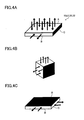
- FIG. 4A is an enlarged perspective view of the plate-like particle 15b2 for cathode active material shown in FIG. 1 , the cathode active material layer 22 shown in FIG. 2 or the cathode active material layer 32 shown in FIG. 3 .
- FIG. 4B and FIG. 4C are enlarged perspective views of a cathode active material particle and a cathode active material layer according to comparative examples.
- the plate-like particle 15b2 for cathode active material, the cathode active material layer 22 and the cathode active material layer 32 are formed such that the (003) plane is oriented so as to intersect the plate surfaces (upper surface A and lower surface B: hereinafter, the "upper surface A” and the “lower surface B” are referred to as the “plate surface A” and “plate surface B,” respectively) , which is a surface normal to the thickness direction (the vertical direction in the drawings).
- the plate-like particle 15b2 for cathode active material, the cathode active material layer 22 and the cathode active material layer 32 are formed such that the plane other than the (003) plane (e.g., the (104) plane) is oriented in parallel with the plate surfaces A or B of the particle.
- the plane other than the (003) plane e.g., the (104) plane
- the plate-like particle 15b2 for cathode active material, the cathode active material layer 22 and the cathode active material layer 32 are formed such that a plane other than the (003) plane (e.g., the (101) or (104) plane is exposed at both of the plate surfaces A and B.
- the plate-like particle 15b2 for cathode active material, the cathode active material layer 22 and the cathode active material layer 32 are formed such that the ratio of intensity of diffraction by the (003) plane to intensity of diffraction by the (104) plane, [003]/[104], as obtained by X-ray diffraction, is 0.005 or more and 1.0 or less.
- the (003) plane (colored black in the drawing) may be exposed at the end surfaces C, which intersects the plate surface direction (in-plane direction).
- the particle of a comparative (conventional) example shown in FIG. 4B is formed into an isotropic shape rather than a thin plate.
- the thin plate-like particle or active material film of a comparative (conventional) example shown in FIG. 4C is formed such that the (003) planes are exposed at both surfaces (plate surfaces A and B) located in the thickness direction of the particle.
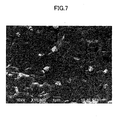
- FIG. 5A is a SEM photograph showing a plate surface of the plate-like particle 15b2 for cathode active material, the cathode active material layer 22 or the cathode active material layer 32 shown in FIG. 4A .
- FIG. 5B is a SEM Photograph showing a cross section (polished) of the plate-like particle 15b2 for cathode active material, the cathode active material layer 22 or the cathode active material layer 32 shown in FIG. 4A .
- the plate-like particle 15b2 for cathode active material, the cathode active material layer 22 and the cathode active material layer 32 according to the present embodiment as shown in FIG. 5A , a large number of microscopic step-like structures are two-dimensionally (in a plurality of directions as viewed in plane) formed along the plate surface.
- This step-like structure is generally formed in a size of 1 to several ⁇ m in a plane view and 0.5 to 2 ⁇ m in a cross section view.
- the plate-like particle 15b2 for cathode active material, the cathode active material layer 22 and the cathode active material layer 32 according to the present embodiment have a very dense structure (a porosity of less than 10%).
- FIG. 5C For reference, a SEM photograph of a plate surface of a conventional (003)-oriented cathode active material particle is shown in FIG. 5C .
- This particle is commercially available lithium cobaltate powder (product of Nippon Chemical Industrial Co., Ltd., Cellseed C-10, average particle size: 10 ⁇ m)
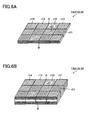
- FIG. 6A and FIG. 6B are enlarged perspective views of the plate-like particle 15b2 for cathode active material, the cathode active material layer 22 and the cathode active material layer 32.
- the plate-like particle 15b2 for cathode active material, the cathode active material layer 22 and the cathode active material layer 32 according to the present embodiment are formed such that so-called "uniaxial orientation" is attained.
- the plate-like particle 15b2 for cathode active material, the cathode active material layer 22 and the cathode active material layer 32 according to the present embodiment are formed such that the particular plane (e.g., the (104) plane) other than the (003) plane, through which lithium ions are favorably intercalated and deintercalated, is oriented in parallel with the plate surfaces A and B of the particle at all times and such that the other planes face random directions.
- the particular plane e.g., the (104) plane
- the (003) plane through which lithium ions are favorably intercalated and deintercalated
- the plate-like particle 15b2 for cathode active material, the cathode active material layer 22 and the cathode active material layer 32 have a structure divided into a plurality of regions r11, r12, r13, r14, ..., r21, r22, ...in which, while the above-mentioned particular plane is exposed at the plate surfaces A and B, the other planes face different directions.
- Each of the regions r11, r12, r13, r14, ..., r21, r22 corresponds to one step in the above-mentioned step-like structure.
- the plate-like particle 15b2 for cathode active material, the cathode active material layer 22 and the cathode active material layer 32 shown in FIG. 2A may, in some cases, have a multilayered structure (stacked structure) as shown in FIG. 6B instead of a monolayer structure as shown in FIG. 6A .
- at least a surface layer (top layer in the drawing) having the plate surface (upper surface) A and a surface layer (bottom layer in the drawing) having the plate surface (lower surface) B have the above-mentioned structure divided into the regions r11, r12, r13, r14, ..., r21, r22, ... (an intermediate layer between the top layer and the bottom layer in the drawing may be configured similarly; however, in this case, the layers differ in the above-mentioned [hkl] axis).
- particles of compounds of Li, Co, Ni, Mn, etc. are appropriately used as particle-form starting materials.
- a particle-form starting material having a composition of LiMO 2 may also be used.
- the sintered compact and a lithium compound are reacted with each other, thereby yielding LiMO 2 (details will be described hereinbelow).
- a lithium compound may be added in an excess amount of 0.5 mol% to 30 mol%.
- a low-melting-point oxide such as bismuth oxide, or low-melting-point glass, such as borosilicate glass, may be added in an amount of 0.001 wt% to 30 wt%.
- Self-standing in “self-standing compact” is synonymous with “independent” in “independent sheet” to be mentioned later.
- the "self-standing compact” is typically a compact which can maintain the form of a sheet-like compact by itself.
- the “self-standing compact” also encompasses a compact which is formed by affixing or film-forming material particles on a substrate and then separating the resultant compact from the substrate before or after sintering, even though the compact fails to maintain the form of a sheet-like compact by itself.
- An employable method for forming a compact is, for example, a doctor blade process using a slurry which contains material particles.
- a drum drier can be used for formation of a compact; specifically, slurry which contains material is applied onto a heated drum, and then the dried material is scraped off with a scraper.
- a disk drier can also be used; specifically, slurry is applied onto a heated disk surface, and then the dried material is scraped off with a scraper.
- hollow granular bodies obtained by appropriately setting conditions of a spray drier can be considered a sheet-like compact having curvature and thus can be preferably used as a compact.
- an extruding process using a body which contains material particles can be used as a forming method for a compact.
- the procedure may be as follows: slurry is applied onto a flexible plate (e.g., an organic polymer plate, such as a PET film); the applied slurry is dried and solidified into a compact; and the compact is separated from the plate, thereby yielding a green compact of plate-like polycrystalline particles.
- Slurry and body before forming may be prepared as follows: inorganic particles are dispersed in an appropriate dispersion medium, and then binder and plasticizer are added as appropriate.
- slurry is prepared so as to have a viscosity of 500 cP to 4,000 cP and is defoamed under reduced pressure.
- the thickness of a compact is preferably 50 ⁇ m or less, more preferably 20 ⁇ m or less.
- the thickness of the compact is 2 ⁇ m or greater.
- the thickness of the sheet-like compact is substantially equal to the thickness of a plate-like particle, the thickness of the sheet-like compact is set as appropriate according to applications of the plate-like particles.
- a compact yielded in the forming step is placed on a setter, for example, as is (in a sheet state), followed by sintering.
- the sintering step may be performed as follows: the sheet-like compact is cut up or fragmentized as appropriate, and the resultant pieces are placed in a sheath, followed by sintering.
- the (101) and (104) planes which are crystal faces through which lithium ions are favorably intercalated and deintercalated, can be oriented so as to be exposed at the sheet surface (plate surface).
- the (h00) planes which will become the (104) planes when reacting with a lithium compound to thereby yield LiMO 2 , can be oriented so as to be exposed at the sheet surface (plate surface).
- the sintering temperature is 800°C to 1,350°C.
- the temperature is lower than 800°C, grain growth becomes insufficient; thus, the degree of orientation becomes low.
- the temperature is in excess of 1,350°C, decomposition and volatilization progress.
- the sintering time falls within a range of 1 hour to 50 hours. When the time is shorter than one hour, the degree of orientation becomes low. When the time is longer than 50 hours, energy consumption becomes excessively large.
- the atmosphere of sintering is set as appropriate such that decomposition during sintering does not progress.
- a lithium atmosphere is established through disposition of lithium carbonate or the like within the same sheath.
- sintering is carried out in an atmosphere having high partial pressure of oxygen.
- Plate-like particles are yielded as follows: the sintered sheet-like compact is placed on a mesh having a predetermined mesh size, and then a spatula is pressed against the sheet from above, whereby the sheet is crushed into a large number of plate-like particles.
- the crushing step may be performed after the lithium introduction step.
- a sheet is formed from starting material particles which do not contain a lithium compound, and is then sintered for orientation, or plate-like particles are yielded through crushing of the sheet, the sheet or the plate-like particles are reacted with a lithium compound (lithium nitrate, lithium carbonate, etc.), thereby yielding a cathode active material film in which a crystal face of good intercalation and deintercalation is oriented so as to be exposed at the plate surface.
- a lithium compound lithium nitrate, lithium carbonate, etc.
- lithium is introduced by sprinkling lithium nitrate over the oriented sheet or particles such that the mole ratio between Li and M, Li/M, is 1 or higher, followed by heat treatment.
- the heat treatment temperature is 600°C to 800°C. When the temperature is lower than 600°C, the reaction does not progress sufficiently. When the temperature is higher than 800°C, orientation deteriorates.
- the plate-like particles 15b2 for cathode active material, the cathode active material layer 22 and the cathode active material layer 32 having the above-mentioned structure are readily and reliably manufactured by the following manufacturing method.
- a green sheet which contains Co 3 O 4 and Bi 2 O 3 and has a thickness of 20 ⁇ m or less is formed.
- the green sheet is sintered at a temperature falling within a range of 900°C to 1,300°C for a predetermined time, thereby yielding an independent film-like sheet ("independent sheet” is synonymous with the aforementioned "self-standing film") in which the (h00) planes are oriented in parallel with the plate surface (the orientation may be referred to merely as "(h00) orientation”) and which is composed of a large number of plate-like Co 3 O 4 particles.
- bismuth is removed from the sheet through volatilization, and Co 3 O 4 is phase-transformed to CoO through reduction.
- the “independent” sheet refers to a sheet which, after sintering, can be handled by itself independent of the other support member. That is, the "independent” sheet does not include a sheet which is fixedly attached to another support member (substrate or the like) through sintering and is thus integral with the support member (unseparable or difficult to be separated).
- the amount of material present in the thickness direction is very small as compared with that in a particle plate surface direction; i.e., in an in-plane direction (a direction orthogonal to the thickness direction).
- grain growth progresses in random directions.
- the direction of grain growth is limited to two-dimensional directions within the plane. Accordingly, grain growth in planar directions is reliably accelerated.
- the green sheet by means of forming the green sheet to the smallest possible thickness (e.g., several ⁇ m or less) or accelerating grain growth to the greatest possible extent despite a relatively large thickness of about 100 ⁇ m (e.g., about 20 ⁇ m), grain growth in planar directions is more reliably accelerated.
- the smallest possible thickness e.g., several ⁇ m or less
- accelerating grain growth to the greatest possible extent despite a relatively large thickness of about 100 ⁇ m (e.g., about 20 ⁇ m)
- grain growth in planar directions is more reliably accelerated.
- CoO is oxidized into Co 3 O 4 .
- the orientation of CoO is transferred, thereby yielding plate-like crystal grains of Co 3 O 4 in which particular crystal faces (herein, the (h00) planes) are oriented in parallel with the plate surfaces of the grains.
- the degree of orientation is apt to deteriorate for the following reason: since CoO and Co 3 O 4 differ greatly in crystal structure and Co-O interatomic distance, oxidation; i.e., insertion of oxygen atoms, is apt to be accompanied by a disturbance of crystal structure.
- conditions are selected as appropriate so as to avoid deterioration in the degree of orientation to the greatest possible extent. For example, reducing the temperature-lowering rate, holding at a predetermined temperature, and reducing the partial pressure of oxygen are preferred.
- sintering such a green sheet yields a self-standing film formed as follows: a large number of thin plate-like grains in which particular crystal faces are oriented in parallel with the plate surfaces of the grains are joined together at grain boundaries in planar directions (refer to Japanese Patent Application No. 2007-283184 filed by the applicant of the present invention). That is, there is formed a self-standing film in which the number of crystal grains in the thickness direction is substantially one.
- the meaning of "the number of crystal grains in the thickness direction is substantially one" does not exclude a state in which portions (e.g., end portions) of in-plane adjacent crystal grains overlie each other in the thickness direction.
- the self-standing film can become a dense ceramic sheet in which a large number of thin plate-like grains as mentioned above are joined together without clearance therebetween.
- the film-like sheet (self-standing sheet) yielded in the above-mentioned sheet formation step is in such a state that the sheet is apt to break at grain boundaries.
- the film-like sheet yielded in the above-mentioned sheet formation step is placed on a mesh having a predetermined mesh size, and then a spatula is pressed against the sheet from above, whereby the sheet is crushed into a large number of Co 3 O 4 particles.
- the crushing step may be carried out after the lithium introduction step.
- lithium carbonate there can be used as a lithium source for lithium introduction, for example, various lithium salts, such as lithium nitrate, lithium acetate, lithium chloride, lithium oxalate, and lithium citrate; and lithium alkoxides, such as lithium methoxide and lithium ethoxide.
- various lithium salts such as lithium nitrate, lithium acetate, lithium chloride, lithium oxalate, and lithium citrate
- lithium alkoxides such as lithium methoxide and lithium ethoxide.
- conditions in lithium introduction specifically, mixing ratio, heating temperature, heating time, atmosphere, etc., must be set as appropriate in consideration of melting point, decomposition temperature, reactivity, etc. of a material to be used as a lithium source.
- the active state means, for example, the following state: the lithium source becomes excessive in amount and becomes a liquid state, and not only are intercalated lithium ions into crystals of Co 3 O 4 particles, but also Co 3 O 4 particles are dissolved and re-precipitated in the liquid of the lithium source.
- the cathode active material layer 22 and the cathode active material layer 32 which are (104)-oriented LiCoO 2 membrane, can be obtained.
- BM-2 product of Sekisui Chemical Co. Ltd.
- a plasticizer DOP: Di (2-ethylhexyl) phthalate; product of Kurogane Kasei Co., Ltd.
- a dispersant product name RHEODOL SP-O30, product of Kao Corp. (2 parts by weight) were mixed.
- the resultant mixture was stirred under reduced pressure for defoaming and was prepared to a viscosity of 4,000 cP.
- the viscosity was measured by means of an LVT-type viscometer, a product of Brookfield Co., Ltd.
- the thus-prepared slurry was formed into a sheet on a PET film by the doctor blade process such that the thickness of the sheet was 10 ⁇ m as measured after drying.
- a 70 mm square piece was cut out from the sheet-like compact separated from the PET film by means of a cutter; the piece was placed at the center of a setter (dimensions: 90 mm square x 1 mm high) made of zirconia and embossed in such a manner as to have a protrusion size of 300 ⁇ m; sintering was performed at 1,200°C for 5 hours; temperature was lowered at a rate of 50°C/h; and a portion of the piece which was not fused to the setter was taken out.
- a setter dimensions: 90 mm square x 1 mm high
- a LiNO 3 powder (product of Kanto Chemical Co., Inc.) was sprinkled over the thus-yielded Co 3 O 4 ceramic sheet such that the ratio Li/Co became 1.0.
- the thus-prepared ceramic sheet was thermally treated within a crucible at 750°C for 3 hours, thereby yielding an LiCoO 2 ceramic sheet (self-standing film: corresponding to the cathode active material layer 22 or 32) having a thickness of 10 ⁇ m.
- the LiCoO 2 ceramic sheet was placed on a polyester mesh having an average opening diameter of 100 ⁇ m, and then a spatula was lightly pressed against the ceramic sheet so as to cause the ceramic sheet to pass through the mesh, thereby crushing the ceramic sheet into powdery LiCoO 2 of Experimental Example 1 (corresponding to the plate-like particles 15b2 for cathode active material).
- the LiCoO 2 ceramic sheet obtained by the process in the above-described Example 1 was placed on a piece of SiC polishing paper (#2000), and reciprocated for a distance of about 10 mm 5 times while being lightly pushed by a finger. This procedure was performed on both surfaces of the sheet. Thereafter, by washing in ethanol using an ultrasonic washing machine, crushing through a sieve, and further heat-treating in the air at 600 °C for one hour in order to recover the disorder of crystallinity due to polishing, the powder according to Experimental Example 2 was obtained.
- the LiCoO 2 ceramic sheet obtained by the process in the above-described Example 1 was placed on a piece of polishing paper coated with a diamond slurry (manufactured by Marumoto Struers K.K., product name : "DP-Spray", particle size: 3 ⁇ m), and reciprocated for a distance of about 10 mm 10 times while being lightly pushed by a finger. This procedure was performed on both surfaces of the sheet. Thereafter, by washing in ethanol using an ultrasonic washing machine, crushing through a sieve, and further heat-treating in the air at 600 °C for one hour in order to recover the disorder of crystallinity due to polishing, the powder according to Experimental Example 3 was obtained.
- a diamond slurry manufactured by Marumoto Struers K.K., product name : "DP-Spray”, particle size: 3 ⁇ m
- FIG. 5A and FIG. 5B are photographs showing the result of observation of the LiCoO 2 particle of the above-mentioned Example 1 (Experimental Example 1) by means of a scanning electron microscope.
- the orientations thereof were evaluated by means of an X-ray diffraction (XRD).
- XRD X-ray diffraction
- the surfaces of the plate-like particles were irradiated with X-ray so as to measure an XRD profile, thereby obtaining the ratio of intensity (peak height) of diffraction by the (003) plane to intensity (peak height) of diffraction by the (104) plane, [003]/[104].
- the plate surface of the plate-like particles are in surface contact with the glass substrate surface, so that the particle plate surface is in parallel with the glass substrate surface.
- the cross-section of the particle was chemically polished by means of a cross-section sample preparing apparatus (SM-09010 manufactured by JOEL Ltd.), and the resulting cross-section sample was observed using a scanning electron microscope and the maximum vertical interval between adjacent steps was evaluated in a viewing field where 20 or more steps (bump) can be observed along the plate surface of the particle.
- SM-09010 manufactured by JOEL Ltd.
- the maximum vertical interval between adjacent steps was evaluated in a viewing field where 20 or more steps (bump) can be observed along the plate surface of the particle.
- the evaluated interval was less than 0.5 ⁇ m, it was considered not to have any step-like structure.
- cell characteristics (capacity retention percentage) was evaluated in the following manner.
- the LiCoO 2 particles, acetylene black, and polyvinylidene fluoride (PVDF) were mixed at a mass ratio of 75 : 20 : 5, thereby preparing a positive-electrode material.
- the prepared positive-electrode material (0.02 g) was compacted to a disk having a diameter of 20 mm under a pressure of 300 kg/cm 2 , thereby yielding a positive electrode.
- the yielded positive electrode, a negative electrode formed from a lithium metal plate, stainless steel collector plates, and a separator were arranged in the order of collector plate-positive electrode-separator-negative electrode-collector plate.
- the resultant laminate was filled with an electrolytic solution, thereby yielding a coin cell.
- the electrolytic solution was prepared as follows: ethylene carbonate (EC) and diethyl carbonate (DEC) were mixed at a volume ratio of 1:1 so as to prepare an organic solvent, and LiPF 6 was dissolved in the organic solvent at a concentration of 1 mol/L.
- One cycle consists of the following charge and discharge operations: constant-current charge is carried out at 0.1C rate of current until the cell voltage becomes 4.2 V; subsequently, constant-voltage charge is carried out under a current condition of maintaining the cell voltage at 4.2 V, until the current drops to 1/20, followed by 10 minutes rest; and then, constant-current discharge is carried out at 1C rate of current until the cell voltage becomes 3.0 V, followed by 10 minutes rest. A total of three cycles were repeated under a condition of 25°C. The measured value of the discharge capacity in the third cycle was considered to be as a discharge capacity at 1 Crate.
- one cycle consists of the following charge and discharge operations: constant-current charge is carried out at 0.1C rate of current until the cell voltage becomes 4.2 V; subsequently, constant-voltage charge is carried out under a current condition of maintaining the cell voltage at 4.2 V, until the current drops to 1/20, followed by 10 minutes rest; and then, constant-current discharge is carried out at 0.1C rate of current until the cell voltage becomes 3.0 V, followed by 10 minutes rest. A total of three cycles were repeated under a condition of 25°C. The measured value of the discharge capacity in the third cycle was considered to be as a discharge capacity at 0.1 Crate.
- the capacity retention percentage (%) was defined as a value obtained by dividing the discharge capacity at 1C rate by the discharge capacity at 0.1C rate.
- Table 1 collectively shows the results of the scanning electron microscopic observations (see FIG. 5A to FIG. 5C ), the XRD measurements, and the measurements of the capacity retention percentage on Example 1 (Experimental Examples 1 to 3) and Comparative Example 1 (the above-mentioned commercially available lithium cobaltate powder) and Comparative Example 2 (identical to Experimental Example 3 except that the particle size of the diamond slurry was 1 ⁇ m and the ceramic sheet reciprocated on the polishing paper 50 times).
- Table 1 [003]/[104] Step-like structure Capacity retention percentage [%] Comparative Example 1 1.6 None 89 Experimental Example 1 0.3 2 ⁇ m 98 Experimental Example 2 0.3 1 ⁇ m 95 Experimental Example 3 0.3 0.5 ⁇ m 95 Comparative Example 2 0.3 None 91
- LiCoO 2 particles according to Example 1 on the plate surfaces (plate surfaces A and B in FIG. 4A ), a large number of microscopic step-like structures with a size of 1 to several ⁇ m as viewed in plane and a step height of 0.5 to 2 ⁇ m are formed in a plurality of directions as viewed in plane (specifically, in two directions, i.e. a direction slanting at angles of about 10 degrees with the vertical direction in FIG. 5A and a direction orthogonal thereto).
- LiCoO 2 particle such a microscopic step-like structure is not observed.
- LiCoO 2 particles of Example 1 were highly (104)-oriented, and the exposure of the (104) plane, though which lithium ions are readily released, at the plate surfaces increased (see the result of XRD measurements in Table 1). As mentioned above, such a structure can be readily and reliably obtained by carrying out the lithium introduction step on the Co 3 O 4 film or particle which is (h00)-oriented, not (111)-oriented.
- LiCoO 2 particles the exposure of the (003) plane increased (see the result of XRD measurements in Table 1).
- a plurality of regions are numerously arrayed two-dimensionally as viewed in plane.
- the particle is in the above-mentioned "uniaxial orientation.” That is, in the plate-like particle shown in FIG. 3B , a plurality of regions in which, while those planes from which lithium ions are readily released are exposed at the plate surface, other planes face different directions, are numerously arrayed two-dimensionally as viewed in plane.
- Such a state can be confirmed by means of any one of the following two methods.
- One or two of opposite plate surfaces of the plate-like particle of Example 1 were sliced off by means of FIB (focused ion beam) to obtain a piece(s) having a thickness of about 80 nm.
- the plate surface of the piece(s) was observed through a transmission electron microscope.
- 10 or more portions having the [104] axis oriented perpendicular to the plate surface were observed, and it was confirmed that, at these portions, orientation within the plate surface was randomized.
- the plate-like particles of Example 1 were placed on a slide glass substrate in such a manner as to not overlap one another and such that the particle plate surfaces were in surface contact with the plate surface of the glass substrate.
- a mixture prepared by adding plate-like particles (0.1 g) to ethanol (2 g) was subjected to dispersion for 30 minutes by means of an ultrasonic dispersing device (ultrasonic cleaner); and the resultant dispersion liquid was spin-coated at 2,000 rpm onto the glass substrate measuring 25 mm x 50 mm so as to place the plate-like particles on the glass substrate. Then, the particles placed on the glass substrate were transferred to an adhesive tape.
- the resultant tape was embedded in resin, followed by polishing for enabling observation of the polished cross-sectional surface of a plate-like particle. Finish polishing was carried out by means of a vibrating rotary polisher using colloidal silica (0.05 ⁇ m) as abrasive.
- the thus-prepared sample was subjected to crystal orientation analysis of the cross section of a single particle by an electron backscattered diffraction image process (EBSD).
- EBSD electron backscattered diffraction image process
- the particle plate surface was divided into a plurality of regions in which the [104] axes are perpendicular to the plate surface (i.e., the (104) planes are oriented along the plate surface), whereas crystal axes other than the [104] axes (crystal axes intersecting with the [104] axes) are oriented in random directions.
- such particles have a very dense structure. Porosity as measured from the results of image processing of images obtained through a scanning electron microscope was less than 10%.
- LiCoO 2 particles of Example 1 very good cell capacity characteristics (capacity retention percentage of high rate to low rate) were exhibited.
- good characteristics were exhibited in the order of the size of the step-like structures. This is believed to due to the following reasons.
- acetylene black added as electron conductive auxiliary has been adhered.
- acetylene black exhibits a structure wherein the primary particles, which are spherical nanosized particles with a diameter of dozens to about 100 nm, are botryoidally aggregated.
- the substantial contact area with an electrolyte decreases.
- step-like structures are formed on the surface of the film or particles of the active material, and thus the acetylene black aggregates adhere the ridge line of the steps so as to contact with the same, and the valley portions of the steps contact with the electrolyte (pools of liquid are formed). Therefore, the substantial contact area of the surface of the film or particles of the active material with an electrolyte can be maintained to be large.
- step-like structures are randomly and two-dimensionally formed, and thus the substantial contact area of the surface of the film or particles of the active material with an electrolyte can be retained larger (by contrast, when the step-like structures are one dimensional as shown in FIG. 6 in Japanese Patent Application Laid-Open ( kokai ) No. 2003-132887 , the acetylene black aggregates are arranged densely along the longitudinal direction of the step, and thus the substantial contact area with an electrolyte decreases).
- a slurry having a viscosity of 500 to 700 cP was prepared from a material and through a method similar to the above-mentioned Example 1.
- the thus-prepared slurry was formed into a sheet on a PET film by the doctor blade process such that the thickness of the sheet was 2 ⁇ m as measured after drying.
- a 70 mm square piece was cut out from the sheet-like compact separated from the PET film by means of a cutter; the piece was placed at the center of a setter (dimensions: 90 mm square x 1 mm high) made of zirconia and embossed in such a manner as to have a protrusion size of 300 ⁇ m; sintering was performed at 1,150°C for 5 hours; temperature was lowered at a rate of 50°C/h; and a portion of the piece which was not fused to the setter was taken out.
- a setter dimensions: 90 mm square x 1 mm high
- the ceramic sheet which was yielded through sintering was placed on a mesh having an opening diameter of 100 ⁇ m, and then a spatula was lightly pressed against the ceramic sheet so as to cause the ceramic sheet to pass through the mesh, thereby crushing the ceramic sheet.
- a Co 3 O 4 powder yielded through crushing of the ceramic sheet and an Li 2 CO 3 powder (product of Kanto Chemical Co., Inc.) were mixed at a ratio Li/Co of 1.0.
- the resultant mixture was thermally treated within a crucible at 750°C for 3 hours, thereby yielding powdery LiCoO 2 .
- Example 2 unlike Example 1 where lithium was introduced into Co 3 O 4 sheet, before the introduction of lithium, Co 3 O 4 sheet was crushed to powder, and thereafter lithium was introduced into the powdery Co 3 O 4 .
- FIG. 7 is a scanning electron micrograph the plate surface of the LiCoO 2 plate-like particle for cathode active material according to Example 2 by means of an electron microscope.
- the (003) plane is oriented so as to intersect the plate surface and, along the plate surface, a large number of microscopic step-like structures are formed in a plurality of directions as viewed in plane.
- a crystal plane (a plane other than the (003) plane: e.g., (101) plane and (104) plane), through which lithium ions are favorably intercalated and deintercalated, exposes more to an electrolyte. Accordingly, the present invention can improve the characteristics such as cell capacity.
- the plate-like particles for cathode active material of the present embodiment when durability and capacity are enhanced through an increase in particle size, the total area of those planes through which lithium ions are readily released also increases, so that high rate characteristic is obtained.
- capacity, durability, and rate characteristic can be enhanced as compared with conventional counterparts.
- a lithium ion secondary cell for use in mobile equipment such as cellphones and notebook-style PCs, is required to provide high capacity for long hours of use.
- increasing the filling rate of an active material powder is effective, and the use of large particles having a particle size of 10 ⁇ m or greater is preferred in view of good filling performance.
- an attempt to increase the particle size to 10 ⁇ m or greater leads to a plate-like particle in which the (003) planes, through which lithium ions and electrons cannot be intercalated and deintercalated, are exposed at a wide portion of the plate surface of the plate-like particle (see FIG. 2C ) for the reason of crystal structure, potentially having an adverse effect on output characteristics.
- the present embodiment can provide a positive-electrode material sheet having high capacity and a filling rate higher than that of a conventional counterpart.
- the plate-like particle 15b2 for cathode active material, a cathode active material layer 22, and a cathode active material layer 32 have a thickness of preferably 2 ⁇ m to 100 ⁇ m, more preferably 5 ⁇ m to 50 ⁇ m, further preferably 5 ⁇ m to 20 ⁇ m. A thickness in excess of 100 ⁇ m is unpreferable in view of deterioration in rate characteristic, and sheet formability.
- the thickness of the plate-like particle 15b2 for cathode active material is desirably 2 ⁇ m or greater. A thickness less than 2 ⁇ m is unpreferable in view of the effect of increasing the filling rate being small.
- the aspect ratio of the plate-like particle 15b2 for cathode active material is desirably 4 to 20. At an aspect ratio less than 4, the effect of expanding a lithium ion intercalation/deintercalation surface through orientation becomes small. At an aspect ratio in excess of 20, when the plate-like particles 15b2 for cathode active material are filled into the cathode active material layer 15b such that the plate surfaces of the plate-like particles 15b2 for cathode active material are in parallel with an in-plane direction of the cathode active material layer 15b, a lithium ion diffusion path in the thickness direction of the cathode active material layer 15b becomes long, resulting in a deterioration in rate characteristic; thus, the aspect ratio is unpreferable.
- the proportion of the exposure (contact) of the (003) plane, through which lithium ions cannot be intercalated and deintercalated, to the solid electrolyte layer 23 becomes extremely low.
- almost entire surface (plate surface) of the cathode active material layer 22 opposing (contacting) the solid electrolyte layer 23 correspond to the plane (for example (104) plane) through which lithium ions are favorably intercalated and deintercalated.
- the crushing step in the above-mentioned embodiment is not carried out. Namely, lithium is introduced into the Co 3 O 4 ceramic sheet obtained by firing the green sheet without crushing the same.
- the polymer-type lithium secondary battery 30 is characterized in that a thin cell configuration is possible.
- the film-like cathode active material layer 32 of the present embodiment achieves substantially a filling rate of 100% while planes through which lithium ions are intercalated and deintercalated are arrayed over the entire film surface. That is, as compared with conventional practices, the positive electrode portion can be rendered very thin, and a thinner cell can be implemented.
- the present invention is not limited to the structure which is specifically disclosed in the description of the above embodiment.
- the cathode active material layer 15b shown in FIG. 1 B may be a film-like LiCoO 2 ceramic sheet (cathode active material film) as the cathode active material layer 22 shown in FIG. 2 or the cathode active material layer 32 shown in FIG. 3 .
- the cathode active material layer 22 shown in FIG. 2 and the cathode active material layer 32 shown in FIG. 3 may be divided into a plurality of regions. That is, the cathode active material layer 22 shown in FIG. 2 and the cathode active material layer 32 shown in FIG. 3 may be configured by arraying thin film-like LiCoO 2 ceramic sheet as well.
- an electrolyte an inorganic solid, an organic polymer, or a gel formed by impregnating an organic polymer with an electrolytic solution can be used.
- the cathode active material layer 22 was applied to a full-solid-type cell.
- the present invention can also be applied to a liquid-type cell.
- material for a positive electrode of a liquid-type cell is filled with an active material at a filling rate of about 60%.
- the active material film of the present invention achieves substantially a filling rate of 100% while the planes through which lithium ions are intercalated and deintercalated are arrayed over the entire film surface. That is, while the sacrifice of rate characteristic is minimized, a very high capacity is attained.
- the cathode active material layer 22 and the cathode collector 21 may be merely in contact with each other at the interface therebetween or may be bonded together by means of a thin layer of an electrically conductive binder, such as acetylene black. In the latter case, bending of the cathode collector 21 may cause cracking in the cathode active material layer 22. Nevertheless, such a crack is in parallel with the direction of conduction of electrons and ions. Thus, the occurrence of cracking does not raise any problem with respect to characteristics.
- an electrically conductive binder such as acetylene black
- Plate-like particles of a plurality of sizes and shapes may be blended as appropriate in the cathode active material layer 15b.
- the plate-like particles 15b2 for cathode active material of the present invention and conventional isometric particles 15b3 may be combined at an appropriate mixing ratio.
- isometric conventional particles 15b3 and the plate-like particles 15b2 for cathode active material having a thickness substantially equivalent to the particle size of the isometric particle the particles can be efficiently arrayed, whereby the filling rate can be raised.
- the cathode collector 15a may be provided on only one of both plate surfaces of the cathode active material layer 15b as shown in FIG. 9A , and may be provided on both plate surfaces of the cathode active material layer 15b as shown in FIG. 9B .
- one of the cathode current collectors i.e. the cathode collector 15a1
- the cathode collector 15a2 may be formed thicker than the other cathode collector 15a2 in order to support the self-standing film-like cathode active material layer 15b.
- the other positive electrode collector 15a2 is formed as to have a structure (mesh-like, porous or the like) not to inhibit the intercalation and deintercalation of lithium ions in the self-standing film-like cathode active material layer 15b.
- the cathode collector 15a2 is applicable to the positive electrode 15 shown in FIG. 1B as well.
- the cathode collector 15a When the cathode collector 15a is provided on only one of both plate surfaces of the cathode active material layer 15b as shown in FIG. 9A , during the cell reactions in the positive electrode 15 on charging and discharging, the direction of the movement of lithium ions and that of electrons become converse, and thus an electric potential gradient occurs within the cathode active material layer 15b. When the electric potential gradient increases, lithium ions become difficult to diffuse.
- Material used to form the plate-like particle for cathode active material and the cathode active material film of the present invention is not limited to lithium cobaltate, so long as the material has a layered rock salt structure.
- the plate-like particle for cathode active material and the cathode active material film of the present invention can be formed from a solid solution which contains nickel, manganese, etc., in addition to cobalt.
- Specific examples of such a solid solution include lithium nickelate, lithium manganate, lithium nickelate manganate, lithium nickelate cobaltate, lithium cobaltate nickelate manganate, and lithium cobaltate manganate.
- These materials may contain one or more elements of Mg, Al, Si, Ca, Ti, V, Cr, Fe, Cu, Zn, Ga, Ge, Sr, Y, Zr, Nb, Mo, Ag, Sn, Sb, Te, Ba, Bi, etc.
- an oxide of Co is phase-transformed from a spinel structure represented by Co 3 O 4 at room temperature to a rock salt structure represented by CoO.
- Mn and Ni assume a spinel structure represented by Mn 3 O 4 and a rock salt structure represented by NiO, respectively, over a wide range of temperature.
- a solid solution which contains at least two of Co, Ni, and Mn can be phase-transformed from a spinel structure at low temperature to a rock salt structure at high temperature through control of composition, temperature, atmosphere, pressure, etc.
- M includes at least one selected from among Co, Ni, and Mn
- Ni-Mn composite oxide which does not contain Co
- the Ni-Mn composite oxide can be used to form an oriented sheet in a manner similar to that mentioned above.
- a favorably oriented cathode active material represented by Li(Ni,Mn)O 2 .
- M includes at least one selected from among Co, Ni, and Mn
- an LiMO 2 sheet or plate-like particles for cathode active material in which the crystal face, such as (104) and (101), through which lithium ions are favorably intercalated and deintercalated, is oriented in parallel with the plate surface can be yielded directly by means of controlling composition, temperature, atmosphere, pressure, additive, etc. when a film-like sheet composed of LiMO 2 (M includes at least one selected from among Co, Ni, and Mn) particles is sintered.
- LiMO 2 includes at least one selected from among Co, Ni, and Mn
- b-axis direction ([010] direction) is regarded as the direction of lithium ion conduction.
- ac plane e.g., the (010) plane
- a green sheet which has a thickness of 20 ⁇ m or less and contains an NiO powder, a Co 3 O 4 powder, and Al 2 O 3 powder.
- the green sheet is atmospherically-sintered at a temperature which falls within a range of 1,000°C to 1,400°C for a predetermined time, thereby yielding an independent film-like sheet composed of a large number of (h00)-oriented plate-like (Ni,Co,Al)O grains.
- additives such as MnO 2 and ZnO, grain growth is accelerated, resulting in enhancement of (h00) orientation of plate-like crystal grains.
- LiNO 3 lithium nitrate
- a portion of nickel in a cobalt-nickel system is substituted with aluminum.
- the present invention is not limited thereto. Needless to say, the present invention can also be favorably applied to Li(Ni,Co)O 2 .
- an independent film-like sheet composed of grains oriented such that the (101) or (104) planes are in parallel with the plate surface of grain: a green sheet having a thickness of 100 ⁇ m or less is formed by use of an Li(Ni 1/3 Mn 1/3 Co 1/3 )O 2 powder, and the green sheet is sintered at a temperature falling within a range of 900°C to 1,200°C for a predetermined time.
- the strain energy refers to internal stress in the course of grain growth and stress associated with defect or the like.
- a layer compound is generally known to have high strain energy.
- strain energy and surface energy contribute to selective grain growth (preferred orientation) of grains oriented in a particular direction.
- the (003) plane is most stable with respect to surface energy, whereas the (101) and (104) planes are stable with respect to strain energy.
- the ratio of surface to sheet volume is high; thus, selective growth is subjected to surface energy, thereby yielding (003)-plane-oriented grains.
- the ratio of surface to sheet volume lowers; thus, selective growth is subjected to strain energy, thereby yielding (101)-plane- and (104)-plane-oriented grains.
- a sheet having a film thickness of 100 ⁇ m or greater encounters difficulty in densification. Thus, internal stress is not accumulated in the course of grain growth, so that selective orientation is not confirmed.
- the present material suffers volatilization of lithium and decomposition due to structural instability.
- it is important for example, to excessively increase the lithium content of material for making compensation for volatilizing lithium, to control atmosphere (for example, in sintering within a closed container which contains a lithium compound, such as lithium carbonate) for restraining decomposition, and to perform low-temperature sintering through addition of additives, such as Bi 2 O 3 and low-melting-point glass.
- the film-like sheet yielded in the above-mentioned sheet formation step is in such a state that the sheet is apt to break at grain boundaries.
- the film-like sheet yielded in the above-mentioned sheet formation step is placed on a mesh having a predetermined mesh size, and then a spatula is pressed against the sheet from above, whereby the sheet is crushed into a large number of Li(Ni 1/3 Mn 1/3 Co 1/3 )O 2 particles.
- plate-like crystal grains of Li(Ni 1/3 Mn 1/3 Co 1/3 )O 2 can also be yielded by the following manufacturing method.
- a green sheet which has a thickness of 20 ⁇ m or less and contains an NiO powder, an MnCO 3 powder, and a Co 3 O 4 powder.
- the green sheet is sintered in an Ar atmosphere at a temperature which falls within a range of 900°C to 1,300°C for a predetermined time, thereby yielding an independent film-like sheet composed of a large number of (h00)-oriented plate-like (Ni,Mn,Co) 3 O 4 grains.
- (Ni,Mn,Co) 3 O 4 having a spinel structure is phase-transformed to (Ni,Mn,Co)O having a rock salt structure through reduction.
- conditions are selected as appropriate so as to avoid deterioration in the degree of orientation to the greatest possible extent. For example, reducing the temperature-lowering rate, holding at a predetermined temperature, and reducing the partial pressure of oxygen are preferred.
- the film-like sheet yielded in the above-mentioned sheet formation step is in such a state that the sheet is apt to break at grain boundaries.
- the film-like sheet yielded in the above-mentioned sheet formation step is placed on a mesh having a predetermined mesh size, and then a spatula is pressed against the sheet from above, whereby the sheet is crushed into a large number of (Ni,Mn,Co) 3 O 4 particles.
- the (h00)-oriented (Ni,Mn,Co) 3 O 4 particles yielded in the above-mentioned crushing step and Li 2 CO 3 are mixed.
- the resultant mixture is heated for a predetermined time, whereby lithium is intercalated into the (Ni,Mn,Co) 3 O 4 particles.
- the ratio Li/Co is not limited to 1.0, it falls preferably within a range of 0.9 to 1.2, more preferably within a range of 1.0 to 1.1. Thus, good charge-discharge characteristics can be realized.
- Li 2 CO 3 powder or LiNO 3 powder at Li/Co of more than 1.0 (e.g., 1.2) in the above-described Example 1 and Example 2, or by mixing (Ni,Co,Al)O ceramic sheet with LiNO 3 powder at a large mole fraction Li/(NiCoAl) (e.g., 2.0) in the above-described cobalt-nickel system compositional example, plate-like particles or film of cathode active material having lithium-excess composition can be obtained.
- the Li/Co value in the particles or film of cathode active material having lithium-excess composition can be determined by componential analysis using an ICP (Inductively Coupled Plasma) emission spectrophotometer (product name: ULTIMA2, product of HORIBA, Ltd.).
- ICP Inductively Coupled Plasma
- ULTIMA2 product of HORIBA, Ltd.
- the present invention is not limited to the manufacturing methods disclosed specifically in the description of the above-described embodiment.
- the sintering temperature for the green sheet may be a temperature falling within a range of 900°C to 1,300°C.
- the additive used in the sheet formation step is not limited to Bi 2 O 3 .
- material particles of CoO can be used.
- sintering a slurry yields, in a temperature range of 900°C or higher, a (h00)-oriented CoO sheet having a rock salt structure.
- Oxidizing the CoO sheet for example, at about 800°C or lower yields a sheet composed of (h00)-oriented Co 3 O 4 particles having a spinel structure, the array of Co atoms and O atoms in CoO being partially transferred to the Co 3 O 4 particles.
- the (h00)-oriented Co 3 O 4 particles and Li 2 CO 3 may be mixed and heated in flux, such as sodium chloride (melting point: 800°C) or potassium chloride (melting point: 770°C).
Landscapes
- Chemical & Material Sciences (AREA)
- Chemical Kinetics & Catalysis (AREA)
- Electrochemistry (AREA)
- General Chemical & Material Sciences (AREA)
- Engineering & Computer Science (AREA)
- Materials Engineering (AREA)
- Inorganic Chemistry (AREA)
- Manufacturing & Machinery (AREA)
- Battery Electrode And Active Subsutance (AREA)
- Secondary Cells (AREA)
- Inorganic Compounds Of Heavy Metals (AREA)
Applications Claiming Priority (6)
| Application Number | Priority Date | Filing Date | Title |
|---|---|---|---|
| JP2008326997 | 2008-12-24 | ||
| JP2009064862 | 2009-03-17 | ||
| JP2009138984 | 2009-06-10 | ||
| JP2009191674 | 2009-08-21 | ||
| JP2009235010 | 2009-10-09 | ||
| PCT/JP2009/071836 WO2010074302A1 (fr) | 2008-12-24 | 2009-12-22 | Particules en forme de plaque pour matériau actif d'électrode positive de batteries secondaires au lithium, films de ce matériau, et batteries secondaires au lithium |
Publications (1)
| Publication Number | Publication Date |
|---|---|
| EP2369662A1 true EP2369662A1 (fr) | 2011-09-28 |
Family
ID=42266610
Family Applications (1)
| Application Number | Title | Priority Date | Filing Date |
|---|---|---|---|
| EP09835092A Withdrawn EP2369662A1 (fr) | 2008-12-24 | 2009-12-22 | Particules en forme de plaque pour matériau actif d'électrode positive de batteries secondaires au lithium, films de ce matériau, et batteries secondaires au lithium |
Country Status (5)
| Country | Link |
|---|---|
| US (1) | US20100159329A1 (fr) |
| EP (1) | EP2369662A1 (fr) |
| JP (1) | JP4755727B2 (fr) |
| CN (1) | CN102171866A (fr) |
| WO (1) | WO2010074302A1 (fr) |
Cited By (2)
| Publication number | Priority date | Publication date | Assignee | Title |
|---|---|---|---|---|
| US9577261B2 (en) | 2011-03-18 | 2017-02-21 | Semiconductor Energy Laboratory Co., Ltd. | Lithium ion secondary battery and method for manufacturing the same |
| US11101460B2 (en) | 2011-03-25 | 2021-08-24 | Semiconductor Energy Laboratory Co., Ltd. | Method of manufacturing electrode comprising graphene layer on current collector |
Families Citing this family (10)
| Publication number | Priority date | Publication date | Assignee | Title |
|---|---|---|---|---|
| JP5631993B2 (ja) | 2010-06-23 | 2014-11-26 | 日本碍子株式会社 | リチウム二次電池の正極活物質用の板状粒子、リチウム二次電池の正極、及びリチウム二次電池 |
| US9236601B2 (en) | 2010-06-23 | 2016-01-12 | Ngk Insulators, Ltd. | Plate-like particle of cathode active material for lithium secondary battery, cathode of the lithium secondary battery and lithium secondary battery |
| WO2012137391A1 (fr) * | 2011-04-07 | 2012-10-11 | 日本碍子株式会社 | Matériau actif de cathode pour batterie rechargeable au lithium et batterie rechargeable au lithium |
| WO2012137535A1 (fr) * | 2011-04-07 | 2012-10-11 | 日本碍子株式会社 | Particules précurseurs de matériau actif de cathode, particules précurseurs de matériau actif de cathode pour batterie secondaire au lithium et batterie secondaire au lithium |
| JP6472384B2 (ja) * | 2013-11-19 | 2019-02-20 | 日本碍子株式会社 | 断熱膜、および断熱膜構造 |
| JP6448558B2 (ja) * | 2014-02-10 | 2019-01-09 | 日本碍子株式会社 | 多孔質板状フィラー集合体及びその製造方法、並びに多孔質板状フィラー集合体を含む断熱膜 |
| WO2015163249A1 (fr) * | 2014-04-23 | 2015-10-29 | 日本碍子株式会社 | Charge en forme de plaque poreuse, son procédé de fabrication et film d'isolation thermique |
| US10193152B2 (en) * | 2015-09-09 | 2019-01-29 | Samsung Electronics Co., Ltd. | Cathode active material particles, lithium ion battery prepared by using the cathode active material particles, and method of preparing the cathode active material particles |
| KR102643570B1 (ko) * | 2016-02-24 | 2024-03-04 | 엔지케이 인슐레이터 엘티디 | 판형 리튬 복합 산화물 |
| JPWO2024157131A1 (fr) * | 2023-01-26 | 2024-08-02 |
Family Cites Families (17)
| Publication number | Priority date | Publication date | Assignee | Title |
|---|---|---|---|---|
| US5503930A (en) * | 1994-03-07 | 1996-04-02 | Tdk Corporation | Layer structure oxide |
| JP2000281354A (ja) * | 1999-03-31 | 2000-10-10 | Toda Kogyo Corp | 層状岩塩型酸化物粒子粉末及びその製造方法 |
| JP2001052703A (ja) * | 1999-08-10 | 2001-02-23 | Nikko Materials Co Ltd | リチウム二次電池用正極材料及びその製造方法 |
| CN1156928C (zh) * | 1999-08-16 | 2004-07-07 | 复旦大学 | 用于锂离子二次电池的正极活性材料及其制造方法和用途 |
| JP4986098B2 (ja) * | 2001-03-15 | 2012-07-25 | 日立金属株式会社 | 非水系リチウム二次電池用正極およびそれを用いた非水系リチウム二次電池 |
| JP3971911B2 (ja) | 2001-10-29 | 2007-09-05 | 松下電器産業株式会社 | 固体リチウム二次電池およびその製造方法 |
| WO2003088382A1 (fr) * | 2002-04-18 | 2003-10-23 | Japan Storage Battery Co., Ltd. | Pile secondaire non aqueuse |
| JP4803486B2 (ja) * | 2003-05-15 | 2011-10-26 | 株式会社Gsユアサ | 非水電解質電池 |
| CN100438144C (zh) * | 2003-05-26 | 2008-11-26 | 日本电气株式会社 | 二次电池用正极活性材料,二次电池用正极,二次电池及制备二次电池用正极活性材料的方法 |
| KR100560540B1 (ko) * | 2003-07-18 | 2006-03-15 | 삼성에스디아이 주식회사 | 리튬 이차 전지용 양극 활물질, 그의 제조 방법 및 그를포함하는 리튬 이차 전지 |
| JP4100341B2 (ja) * | 2003-12-26 | 2008-06-11 | 新神戸電機株式会社 | リチウム二次電池用正極材料及びそれを用いたリチウム二次電池 |
| JP2006012576A (ja) * | 2004-06-25 | 2006-01-12 | Shin Etsu Chem Co Ltd | 非水電解質二次電池用電極及びその作製方法 |
| KR101127370B1 (ko) * | 2004-12-08 | 2012-03-29 | 인피니트 파워 솔루션스, 인크. | LiCoO2의 증착 |
| JP4439456B2 (ja) * | 2005-03-24 | 2010-03-24 | 株式会社東芝 | 電池パック及び自動車 |
| JP2007283184A (ja) | 2006-04-14 | 2007-11-01 | Tokyo Univ Of Agriculture & Technology | 水素分離薄膜及びその製造方法。 |
| EP2071650A4 (fr) * | 2007-03-30 | 2013-04-03 | Panasonic Corp | Matériau actif pour batteries d'accumulateurs à électrolyte non aqueux et son procédé de production |
| JP5195049B2 (ja) * | 2008-06-06 | 2013-05-08 | トヨタ自動車株式会社 | リチウムイオン二次電池およびその製造方法 |
-
2009
- 2009-12-22 EP EP09835092A patent/EP2369662A1/fr not_active Withdrawn
- 2009-12-22 JP JP2010544203A patent/JP4755727B2/ja not_active Expired - Fee Related
- 2009-12-22 US US12/644,369 patent/US20100159329A1/en not_active Abandoned
- 2009-12-22 CN CN2009801396107A patent/CN102171866A/zh active Pending
- 2009-12-22 WO PCT/JP2009/071836 patent/WO2010074302A1/fr not_active Ceased
Non-Patent Citations (1)
| Title |
|---|
| See references of WO2010074302A1 * |
Cited By (6)
| Publication number | Priority date | Publication date | Assignee | Title |
|---|---|---|---|---|
| US9577261B2 (en) | 2011-03-18 | 2017-02-21 | Semiconductor Energy Laboratory Co., Ltd. | Lithium ion secondary battery and method for manufacturing the same |
| US9673451B2 (en) | 2011-03-18 | 2017-06-06 | Semiconductor Energy Laboratory Co., Ltd. | Lithium ion secondary battery and method for manufacturing the same |
| US10566649B2 (en) | 2011-03-18 | 2020-02-18 | Semiconductor Energy Laboratory Co., Ltd. | Lithium ion secondary battery and method for manufacturing the same |
| US11335945B2 (en) | 2011-03-18 | 2022-05-17 | Semiconductor Energy Laboratory Co., Ltd. | Lithium ion secondary battery and method for manufacturing the same |
| US12074272B2 (en) | 2011-03-18 | 2024-08-27 | Semiconductor Energy Laboratory Co., Ltd. | Lithium ion secondary battery and method for manufacturing the same |
| US11101460B2 (en) | 2011-03-25 | 2021-08-24 | Semiconductor Energy Laboratory Co., Ltd. | Method of manufacturing electrode comprising graphene layer on current collector |
Also Published As
| Publication number | Publication date |
|---|---|
| JP4755727B2 (ja) | 2011-08-24 |
| US20100159329A1 (en) | 2010-06-24 |
| WO2010074302A1 (fr) | 2010-07-01 |
| JPWO2010074302A1 (ja) | 2012-06-21 |
| CN102171866A (zh) | 2011-08-31 |
Similar Documents
| Publication | Publication Date | Title |
|---|---|---|
| US8795898B2 (en) | Plate-like particle for cathode active material of a lithium secondary battery, a cathode active material film of a lithium secondary battery, and a lithium secondary battery | |
| EP2369666B1 (fr) | Particules en forme de plaque pour matériau actif d'électrode positive de batteries auxiliaires au lithium, films de matériau actif d'électrode positive de batteries auxiliaires au lithium, procédé de fabrication de ceux-ci, procédé de fabrication de matériau actif d'électrode positive de batteries auxiliaires au lithium et batteries auxiliaires au lithium | |
| EP2369664B1 (fr) | Particules en forme de plaque pour matériau actif d'électrode positive de batteries auxiliaires au lithium, films de matériau actif d'électrode positive de batteries auxiliaires au lithium, procédé de fabrication de ceux-ci, procédé de fabrication de matériau actif d'électrode positive de batteries auxiliaires au lithium et batteries auxiliaires au lithium | |
| EP2369661A1 (fr) | Particules en forme de plaque pour matériau actif d'électrode positive de batteries secondaires au lithium, et batteries secondaires au lithium | |
| EP2369662A1 (fr) | Particules en forme de plaque pour matériau actif d'électrode positive de batteries secondaires au lithium, films de ce matériau, et batteries secondaires au lithium | |
| JP4745463B2 (ja) | リチウム二次電池の正極活物質用の板状粒子、及び同物質膜、並びにリチウム二次電池 | |
| JP4745464B2 (ja) | リチウム二次電池の正極活物質用の板状粒子、及び同物質膜、並びにリチウム二次電池 | |
| US20130045424A1 (en) | Plate-like particle for cathode active material for lithium secondary battery, cathode active material film for lithium secondary battery, methods for manufacturing the particle and film, method for manufacturing cathode active material for lithium secondary battery, and lithium secondary battery | |
| JP5457947B2 (ja) | リチウム二次電池の正極活物質用の板状粒子、及び同物質膜、並びにリチウム二次電池 | |
| JPWO2009139397A1 (ja) | 板状結晶粒子及びその製造方法、並びにリチウム二次電池 | |
| EP2584632A1 (fr) | Procédé de production d'une matière active d'électrode positive destinée à une batterie rechargeable au lithium | |
| JP2012003880A (ja) | リチウム二次電池の正極活物質用の板状粒子、及び同物質膜、並びにリチウム二次電池 |
Legal Events
| Date | Code | Title | Description |
|---|---|---|---|
| PUAI | Public reference made under article 153(3) epc to a published international application that has entered the european phase |
Free format text: ORIGINAL CODE: 0009012 |
|
| 17P | Request for examination filed |
Effective date: 20101223 |
|
| AK | Designated contracting states |
Kind code of ref document: A1 Designated state(s): AT BE BG CH CY CZ DE DK EE ES FI FR GB GR HR HU IE IS IT LI LT LU LV MC MK MT NL NO PL PT RO SE SI SK SM TR |
|
| STAA | Information on the status of an ep patent application or granted ep patent |
Free format text: STATUS: THE APPLICATION HAS BEEN WITHDRAWN |
|
| 18W | Application withdrawn |
Effective date: 20120202 |