EP2369760B1 - Procédé et dispositif pour déterminer si une information transférée par au moins une source doit être relayée - Google Patents
Procédé et dispositif pour déterminer si une information transférée par au moins une source doit être relayée Download PDFInfo
- Publication number
- EP2369760B1 EP2369760B1 EP10157454A EP10157454A EP2369760B1 EP 2369760 B1 EP2369760 B1 EP 2369760B1 EP 10157454 A EP10157454 A EP 10157454A EP 10157454 A EP10157454 A EP 10157454A EP 2369760 B1 EP2369760 B1 EP 2369760B1
- Authority
- EP
- European Patent Office
- Prior art keywords
- information word
- successful decoding
- transferred
- complex symbols
- telecommunication device
- Prior art date
- Legal status (The legal status is an assumption and is not a legal conclusion. Google has not performed a legal analysis and makes no representation as to the accuracy of the status listed.)
- Not-in-force
Links
Images

Classifications
-
- H—ELECTRICITY
- H04—ELECTRIC COMMUNICATION TECHNIQUE
- H04B—TRANSMISSION
- H04B7/00—Radio transmission systems, i.e. using radiation field
- H04B7/14—Relay systems
- H04B7/15—Active relay systems
- H04B7/155—Ground-based stations
Definitions
- the present invention relates generally to a method and a device for determining if an information word transferred by at least a source in a wireless cellular telecommunication network has to be relayed by a telecommunication device.
- Future wireless cellular telecommunication networks will use higher frequency bands than the ones used by current wireless cellular telecommunication networks.
- the access to the wireless cellular telecommunication network might not be possible for a mobile terminal located in a dead zone, if the signals radiated by the base stations are too attenuated.
- a destination station may receive a direct signal from a source station and at least one relay signal from at least one relay station.
- the destination station may select at least one signal to process from among the direct and relay signals based on metrics for the source and relay stations.
- the present invention aims at enhancing the signals received by the destination by using a relay.
- the present invention concerns a method for determining if an information word transferred by a source in a wireless cellular telecommunication network has to be relayed by a telecommunication device, the signals transferred by the source being composed of complex symbols obtained from the information word, characterized in that the method comprises the steps executed by the telecommunication device of :
- the present invention concerns also a device for determining if an information word transferred by at least a source in a wireless cellular telecommunication network has to be relayed by a telecommunication device, the signals transferred by the source being composed of complex symbols obtained from the information word, characterized in that the device for determining if the information word has to be relayed is included in the telecommunication device and comprises :
- the telecommunication device relays information word efficiently.
- the signal to noise ratio of the data link between the telecommunication device and the source is low.
- the telecommunication device has some chances not to correctly decode the message after the transmission of the whole vectors of complex modulation symbols obtained from the information word.
- the neighboring telecommunication devices of the telecommunication device will have low signal to noise ratio conditions and bad chances of correct decoding.
- the probability of early decoding is low but non-null. If that telecommunication device turns into relaying mode, its contribution is very positive for its neighboring telecommunication devices, even if it transmits signals with a low transmission power. In this situation, relaying combined with the high density of telecommunication devices is really helpful, as the probability of not having an early decoding for at least one telecommunication device is low.
- the source When the source is far from the destination telecommunication device, for example when the source is a mobile terminal and the destination telecommunication device is a base station, the signal to noise ratio of the data link between the destination telecommunication device and the source is low. This means that the destination telecommunication device has some chances not to correctly decode the message after the transmission of the whole vectors of complex modulation symbols obtained from the information word.
- the other telecommunication devices like mobile terminals or relays which are also far from the source and close to the destination will have also low signal to noise ratio conditions and bad chances of correct decoding. However, the probability of early decoding is low but non-null. If another telecommunication device turns into relaying mode, its contribution is very positive for its neighboring telecommunication devices like the base station for example, even if it transmits signals with a low transmission power.
- signals transferred by the source are representative of vectors of complex symbols
- plural vectors of complex symbols derived from the same information word are transferred successively and the check if the successful decoding is performed prior to an expected successful decoding time of the information word is executed by comparing if the vector of complex symbols from which the information word is successfully decoded is transferred prior to the vector of complex symbols from which the information word is the expected to be decoded.
- the expected successful decoding time is determined from statistics executed on prior successful decoding of other information words.
- statistics are performed taking into account if signals are relayed by at least another telecommunication device.
- each transferred vector of complex symbols derived from the same information word has an index and statistics are performed for each index.
- the transmission power of at least one obtained signal transferred by the telecommunication device is dependent on the index of the vector of complex symbols from which information word is successfully decoded.
- the telecommunication device can adjust the power budget dedicated to signal transfer, and give more strength to selected retransmission indexes.
- statistics are performed for each vector of complex symbols on the amount of coded bits received from the beginning of the reception transmission of the information word and after the reception of each vector of complex symbols.
- statistics are performed on an equivalent coding rate after the reception of one vector of complex symbols, the equivalent coding rate being defined as the ratio between the number of transferred information bits of the information word in the received vector of complex symbols and the total amount of bits received from the beginning of the transmission of the information word.
- the prior successful decoding of other information words is executed by the telecommunication device.
- the prior successful decoding of other information words is executed by other telecommunication devices and the telecommunication device detects the successful decoding of other information words by other telecommunication devices by monitoring acknowledgment and/or non acknowledgment messages transferred by the other telecommunication devices.
- a telecommunication device knows the expected successful decoding time of its neighbors.
- the at least one signal composed of complex symbols transferred by at least the source is transferred to plural telecommunication devices.
- each telecommunication device can, as soon as it has correctly decoded the message, decide to transfer additional signal corresponding to the same message to other telecommunication devices.
- the present invention concerns a computer program which can be directly loadable into a programmable device, comprising instructions or portions of code for implementing the steps of the method according to the invention, when said computer program is executed on a programmable device.
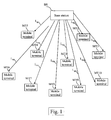
- Fig. 1 represents an example of a topology of a wireless cellular telecommunication network and of the transfer of signals in the wireless cellular telecommunication network.
- a source like a base station BS, transfers signals to at least two telecommunication devices like mobile terminals MT.
- the base station BS transfers signals to ten telecommunication devices MT1 to MT10.
- the base station is also named an access node or a node B or an enhanced node B or a home base station or a pico or femto base station.
- the base station BS may be in a variant a broadcasting device like, for example, a satellite.
- the telecommunication devices MT are for example, mobile terminals or relays or femto base stations.
- the telecommunication devices MT1 to MT 10 operate, when they are in a relaying mode, according to a Dynamic Decode and Forward (DDF) protocol.
- DDF Dynamic Decode and Forward
- DDF protocol includes a smart processing at the telecommunication device MT which is in relay mode.
- the telecommunication device MT receives and tries to decode the information transmitted from the base station BS and may shift to a relaying mode after that the decoding leads to no error.
- the telecommunication device MT when a telecommunication device MT is in relaying mode, transfers signals on the same frequency/time resource as the base station BS.
- Ten telecommunication devices MT1 to MT10 are shown but we can understand that the present invention works when a different, e.g., more important, number of telecommunication devices MT exist in the wireless cellular telecommunication network.
- the base station BS transmits K information bits of an information word with redundancy which are encoded by an encoder, output of which is interleaved to produce a vector of coded bits.
- the vector of coded bits is given to the discrete modulation input which may be a Quadrature Phase Shift Keying modulation or a 16, 32 or 64 Quadrature Amplitude Modulation in order to obtain complex modulation symbols.
- the complex modulation symbols are grouped into vectors of complex modulation symbols which encompass several blocks of complex modulation symbols.
- Encoding and interleaving is done more generally by a rate matching algorithm, such as the one used in the 3GPP-LTE standard (Third Generation Partnership Project-Long Term Evolution), that allows to generate any size of vector of coded bits from the information words, or in other words any possible coding rate.
- a rate matching algorithm such as the one used in the 3GPP-LTE standard (Third Generation Partnership Project-Long Term Evolution), that allows to generate any size of vector of coded bits from the information words, or in other words any possible coding rate.
- the present invention is applicable in open-loop transmissions like broadcasting where a codeword is segmented into several vectors of coded bits or equivalently to several vectors of complex modulation symbols.
- the present invention is also applicable in a wireless cellular telecommunication network wherein a Hybrid-ARQ (HARQ) feedback scheme is provided from the destination (the telecommunication device or devices) to the base station BS in order to acknowledge or not the success of former blocks transmissions.
- HARQ Hybrid-ARQ
- Hybrid-ARQ a retransmission of additional redundancy is executed when the destination is not able to successfully decode symbols, i.e. when the cyclic redundancy check embedded in the sent information word (CRC) fails.
- CRC sent information word
- the telecommunication device MT can decode the message correctly and the transmission is stopped.
- the telecommunication device MT stores the concatenation of vectors of complex modulation symbols or of soft estimates of the coded bits received from the beginning of one information word transmission and applies a joint decoding on the concatenated vectors.
- An acknowledgment is performed after a vector of complex modulation symbols reception and decoding if the CRC check for the vector of complex modulation symbols is correct.
- each new vector of complex modulation symbols comprises additional redundancy taken from the output of the rate matching algorithm and of the error correcting code.
- L B1 to L B10 represent the wireless link between the base station BS and the respective telecommunication devices MT1 to MT10.
- the telecommunication device MT decides to switch in a relaying mode according to a given criteria.
- the given criteria is, for example, the successful decoding time of an information word in comparison with successful decoding times of previously received information word or words.
- the telecommunication device MT When the telecommunication device MT is in relaying mode, the telecommunication device MT transfers at least one vector of complex symbols derived from the same information word of which the vector or vectors of complex symbols transferred by the base station BS are derived from. Each new vector of complex modulation symbols transferred by the telecommunication device MT comprises additional redundancy taken from the output of the same rate matching algorithm and of the same error correcting code as the one used by the base station BS.
- the vector or vectors of complex symbols are, for example, transferred at the same time as the base station BS also transfers other vector or vectors of complex symbols that have not previously been transferred by the base station BS.
- the telecommunication device MT monitors the acknowledgments and non acknowledgments transferred by the neighboring telecommunication devices MT in order to determine the successful decoding time of previously received information word or words by neighboring terminals.
- the telecommunication devices MT and the base station BS may have plural antennas not shown in Fig. 1 .
- the source may be also a mobile terminal which transfers signals to at least a base station and wherein the present invention is executed by at least one telecommunication like a relay.
- the relay decides or not if it relays signals in order to save its electric power source of energy in order to efficiently manage the wireless resources allocated to it.
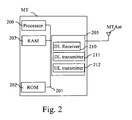
- Fig. 2 is a diagram representing the architecture of a telecommunication device in which the present invention is implemented.
- the telecommunication device is for example a mobile terminal MT.
- the telecommunication device MT has, for example, an architecture based on components connected together by a bus 201 and a processor 200 controlled by the program as disclosed in the Fig. 3 .
- the bus 201 links the processor 200 to a read only memory ROM 202, a random access memory RAM 203 and a wireless interface 205.
- the memory 203 contains registers intended to receive variables and the instructions of the program as disclosed in the Fig. 3 .
- the processor 200 controls the operation of the wireless interface 205.
- the read only memory 202 contains instructions of the program as disclosed in the Fig. 3 , which are transferred, when the telecommunication device MT is powered on, to the random access memory 203.
- the wireless interface 205 enables the telecommunication device MT to transfer and/or receive signals or messages to/from a base station BS.
- the wireless interface 205 comprises a downlink reception module 210 which receives signals transferred by at least one base station BS, comprises a downlink transmission module 211 which transfers signals to at least one telecommunication device and comprises an uplink transmission module 212 which transfers signals to at least one base station BS.
- the telecommunication device MT may further comprise an uplink receiver which receives signals transferred by mobile terminals to the base station BS.
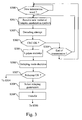
- Fig. 3 discloses an example of an algorithm executed by the telecommunication device according to the present invention.
- the present algorithm will be disclosed in an example wherein the telecommunication device MT is a mobile terminal MT.
- the present algorithm may be also executed by relays.
- the present algorithm is executed by the processor 200 of each telecommunication device MT.
- the processor 200 checks if signals representative of the transmission of a new information word start.
- the processor 200 waits at step S300.
- step S301 If signals representative of a new information word are received, the processor 200 moves to step S301.
- the processor 200 detects the reception of at least one signal composed of complex modulation symbols obtained from information bits of the new information word and received through the wireless interface 205.
- the at least one signal of complex modulation symbols obtained from information bits is received by the downlink receiver 210 and is concatenated, if there are some, to the complex modulation symbols which have been previously received from the beginning of the transmission of the information word.
- the processor 200 commands the wireless interface 205 to execute a decoding attempt on at least the received signal composed of complex modulation symbols obtained from information bits and may include other complex modulation symbols previously received by the telecommunication device MT.
- the complex modulation symbols are demodulated into soft-estimates of coded bits, de-interleaved and decoded into the information bits estimates.
- the processor 200 checks if the cyclic redundancy check (CRC) determined after the decoding of the at least one received signal composed of complex modulation symbols is correct.
- CRC cyclic redundancy check
- step S305 If the CRC is correct, it means that the decoding is successful and the processor 200 moves to step S305. Otherwise, the processor 200 moves to step S304.
- the processor 200 checks if the transmission of complex modulation symbols ends for the information word from which previous signal composed of complex modulation symbols obtained from information word have been received.
- step S300 If the transmission of complex modulation symbols ends for the information word, the processor 200 returns to step S300. Otherwise, the processor 200 moves to step S301.
- the processor 200 updates statistics related to the successful decoding time of signals composed of complex modulation symbols obtained from information words.
- each telecommunication device MT can compute the probability of successful decoding of an information word after the decoding of a given vector of complex modulation symbols.
- the histograms for each telecommunication device MT are shown and exhibit lower average value (i.e., earlier successful decoding) when the link quality between the base station BS and the telecommunication device is better.
- the histograms are evaluated through several transmissions and updated.
- a forgetting factor may be used in the update rule for taking into account the mobility of the telecommunication device MT. Indeed, the histogram of a moving telecommunication device MT changes through time as the link quality between the telecommunication device and the base station BS changes.
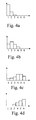
- Fig. 4a discloses an example of statistics made by the telecommunication device MT1 on the successful decoding of an information word after the decoding of vectors of complex modulation symbols transmitted at least by a base station according to the present invention.
- the horizontal axis shows index of the different vectors of complex modulation symbols obtained from a same information word.
- the vertical axis shows information representative of the probability of successful decoding of information words after the reception of vectors of complex modulation symbols sharing the same index.
- an information word can be successfully decoded, i.e. a CRC check is correct, generally from the decoding of the first transferred vector of complex modulation symbols obtained from an information word.
- the first telecommunication device MT1 it is rarely needed, for the first telecommunication device MT1 to decode the second or the third transferred vector of complex modulation symbols obtained from an information word as the successful decoding often occurs after the first transferred vector of complex modulation symbols.
- the first telecommunication device MT1 decodes the fourth, fifth and sixth transferred vectors of complex modulation symbols obtained from an information word as the successful decoding already occurs after the first or second or third transferred vectors of complex modulation symbols.
- Fig. 4b discloses an example of statistics made by the telecommunication device MT4 on the successful decoding of an information word after the decoding of vectors of complex modulation symbols transmitted at least by a base station according to the present invention.
- the horizontal axis shows indexes of the different vectors of complex modulation symbols obtained from a same information word.
- An index is representative of an order of transmission of a vector of complex modulation symbols obtained from a same information word.
- the vertical axis shows information representative of the probability of successful decoding of information words after the reception of vectors of complex modulation symbols sharing the same index or in other words, the probability that a vector of complex modulation symbols having a given index is successfully decoded.
- the telecommunication device MT4 is more distant than the telecommunication device MT1 from the base station BS, as shown in Fig. 1 , it takes more redundancy to successfully decode an information word, i.e. more vectors of complex modulation symbols need to be obtained from a same information word.
- the second vector of complex modulation symbols obtained from a same information word has the first highest probability of successful decoding of the information word by the telecommunication device MT4.
- the first and third vectors of complex modulation symbols obtained from a same information word have the second highest probability of successful decoding of the information word by the telecommunication device MT4.
- the fourth vector of complex modulation symbols obtained from a same information word has a lower probability than the three first vectors of successful decoding of the information word by the telecommunication device MT4.
- the probability to successfully decode the information word after the decoding of the first vector of complex modulation symbols has a low probability because the quantity of redundancy is often not sufficient with respect to the link quality.
- the probability to successfully decode the information word after the decoding of the third vector of complex modulation symbols has a low probability because the message is usually successfully decoded after the reception of the second vector of complex modulation symbols.
- the first telecommunication device MT4 decodes the fifth and sixth transferred vectors of complex modulation symbols obtained from an information word as the successful decoding already occurs after the first or second or third or fourth transferred vectors of complex modulation symbols.
- Fig. 4c discloses an example of statistics made by the telecommunication device MT5 on the successful decoding of an information word after the decoding of vectors of complex modulation symbols transmitted at least by a base station according to the present invention.
- the horizontal axis shows index of the different vectors of complex modulation symbols obtained from a same information word.
- the vertical axis shows information representative of the probability of successful decoding of information words after the reception of vectors of complex modulation symbols sharing the same index or in other words, the probability that a vector of complex modulation symbols having a given index is successfully decoded.
- the telecommunication device MT5 is more distant than the telecommunication device MT4 from the base station BS, as shown in Fig. 1 , it takes more redundancy to successfully decode an information word, i.e. more vectors of complex modulation symbols need to be obtained from a same information word.
- the fourth and fifth vectors of complex modulation symbols obtained from a same information word have the first higher probability of successful decoding of the information word by the telecommunication device MT5.
- the sixth vector of complex modulation symbols obtained from a same information word has the second higher probability of successful decoding of the information word by the telecommunication device MT5.
- the third vector of complex modulation symbols obtained from a same information word has the third higher probability of successful decoding of the information by the telecommunication device MT5.
- the second vector of complex modulation symbols obtained from a same information word has the fourth higher probability of successful decoding of the information word by the telecommunication device MT5.
- the first vector of complex modulation symbols obtained from a same information word has the lower probability of successful decoding of the information word after the decoding by the telecommunication device MT.
- the probability to successfully decode the information word after the decoding of the first, second and third vectors of complex modulation symbols has a low probability because the quantity of redundancy is often not sufficient with respect to the link quality.
- the probability to successfully decode the information word after the decoding of the sixth vector of complex modulation symbols has a low probability because the message is usually successfully decoded after the reception of the fourth or fifth vector of complex modulation symbols.
- Fig. 4d discloses an example of statistics made by the telecommunication device MT8 on the successful decoding of an information word after the decoding of vectors of complex modulation symbols transmitted at least by a base station according to the present invention.
- the horizontal axis shows index of the different vectors of complex modulation symbols obtained from a same information word.
- the vertical axis shows information representative of the probability of successful decoding of information words after the reception of vectors of complex modulation symbols sharing the same index or in other words, the probability that a vector of complex modulation symbols having a given index is successfully decoded.
- the telecommunication device MT8 is more distant than the telecommunication device MT5 from the base station BS, as shown in Fig. 1 , it takes more redundancy to successfully decode an information word, i.e. more vectors of complex modulation symbols need to be obtained from a same information word.
- the sixth vector of complex modulation symbols obtained from a same information word has the first higher probability of successful decoding of the information word by the telecommunication device MT8.
- the fifth vector of complex modulation symbols obtained from a same information word has the second higher probability of successful decoding of the information word by the telecommunication device MT8.
- the fourth vector of complex modulation symbols obtained from a same information word has the third higher probability of successful decoding of the information word by the telecommunication device MT8.
- the third vector of complex modulation symbols obtained from a same information word has the fourth higher probability of successful decoding of the information word by the telecommunication device MT8.
- the first and second vectors of complex modulation symbols obtained from a same information word have the lower probability of successful decoding of the information word by the telecommunication device MT8.
- the probability to successfully decode the information word after the decoding of the first and second vectors of complex modulation symbols has a low probability because the quantity of redundancy is often not sufficient with respect to the link quality.
- statistics shown in Figs. 4a to 4d may also be further updated by a given telecommunication device MT according to acknowledgment and/or non acknowledgment messages transferred by neighboring telecommunication devices of said terminal.
- statistics shown in Figs. 4a to 4d may also be further updated by taking into account the detection of telecommunication devices MT which are in relaying mode, for example by monitoring sudden increase of the power reception of signals. For example, the probability density is updated only if no neighboring telecommunication device is in relaying mode during the transmission of the information word.
- the statistics shown in Figs. 4a to 4d may, instead of being executed on index of vectors, be executed on the amount of coded bits received from the beginning of the transmission of the information word and after the reception of each vector of complex symbols. This allows for applying the present invention to cases where the number of information bits in one information message does not change through time, but where the segmentation of the information word into vectors of complex symbols might vary from one transmission to another.
- the statistics shown in Figs. 4a to 4d may, instead of being executed on index of vectors, be executed on the equivalent coding rate after the reception of one vector of complex symbols.
- the equivalent coding rate is defined after each reception of a vector of complex symbols as the ratio between the number of transferred information bits in the received vector of complex symbols and the total amount of coded bits received from the beginning of the transmission of the information word. This allows for applying the present invention to cases where the number of information bits in one information message and the segmentation of the coded word into vector of complex symbols might vary from one message transmission to another.
- the processor 200 decides whether or not the telecommunication device MT switches to a relaying mode.
- the processor 200 decides to switch in a relaying mode according to a given criteria.
- the given criteria is for example, the decoding time of an information word in comparison with previously received information word or words.
- the processor 200 decides to switch in a relaying mode when a vector of complex modulation symbols obtained from an information word has an index for which the probability of decoding is low and which is lower than the index of the vector of complex modulation symbols having the higher probability of successful decoding.
- the signal to noise ratio (SNR) of the data link between the telecommunication device MT1 and the base station BS is high. This means that the telecommunication device MT1 has good chances to be able to correctly decode the information word after the transmission of the first vector of complex modulation symbols obtained from said information word. Equivalently, the neighboring telecommunication devices MT of the telecommunication device MT1 have good SNR conditions and good chances to early decode the information word as well. In this situation, relaying is not helpful for neighboring telecommunication devices MT.
- the telecommunication devices MT needing link quality improvement lie far from the base station BS and the telecommunication device MT1.
- the signal transferred by the telecommunication device MT1 which acts in relaying mode must have a high transmit power in order to be received efficiently by the telecommunication devices MT which are far from the telecommunication device MT1.
- turning the telecommunication device MT1 into relaying mode after correct decoding might be a waste of energy for the telecommunication device MT 1.
- the signal to noise ratio (SNR) of the data link between the telecommunication device MT8 and the base station BS is low. This means that the telecommunication device MT8 has some chances not to correctly decode the message after the transmission of the whole vectors of complex modulation symbols obtained from the information word. Equivalently, the neighboring telecommunication devices of the telecommunication device MT8 will have low SNR conditions and bad chances of correct decoding.
- the probability of early decoding is low but non-null. If the telecommunication device MT8 turns into relaying mode, its contribution is very positive for its neighboring telecommunication devices, even if it transmits signals with a low transmission power. In this situation, relaying combined with the high density of telecommunication devices is really helpful, as the probability of not having an early decoding for at least one telecommunication device MT is low.
- relaying mode appears as random on a long-term observation, which means that a telecommunication device MT more often takes benefit from other neighboring telecommunication devices in relaying mode than it actually turns into the relaying mode and consume power.
- the processor 200 decides to switch in a relaying mode.
- the processor 200 checks if it has been decided that the telecommunication device MT switches into relaying mode.
- step S308 If it has been decided that the telecommunication device MT switches into relaying mode, the processor 200 moves to step S308. Otherwise, the processor 200 moves to step S304.
- the processor 200 selects the parameters used for relaying signals.
- the telecommunication device MT transfers at least one vector of complex symbols derived from the same information word of which the vector or vectors of complex symbols transferred by the base station BS are derived.
- the transmit power is one parameter used for relaying signals.
- the transmit power is adjusted according to the probability of successful decoding or to the index of successful decoding which corresponds to the vector of complex symbols which has been successfully decoded.
- the coverage area of the telecommunication device MT which switches in relaying mode is increased by a boosted transmit power, which is profitable to more telecommunication devices than with an average transmit power.
- the telecommunication device MT relaying transmit power is set to low or null.
- Fig. 5 discloses an example of parameter values derived from statistics made by a telecommunication device on the successful decoding of an information word after the decoding of vectors of complex modulation symbols transmitted at least by a base station according to the present invention.
- the T i values are preferably chosen as decreasing and might be obtained by optimization tools and by using some propagation models between telecommunication devices.
- a parameter probability a i is further introduced.
- the processor 200 determines also the duration of the relaying mode as a function of the successful decoding time of the information word. For example, a telecommunication device MT which performs a successful decoding of the information word after the decoding of the first vector of complex symbols may decide to transmit with a high power only during the second vector of complex symbols transmission and not for the remaining vector of complex symbols.
- the processor 200 commands the transfer of the relayed information word.
- the vectors of complex symbols are, for example, transferred at the same time as the base station BS also transfers other vectors of complex symbols that have not previously been transferred by the base station BS.
- the telecommunication device transfers at most the number of vectors of complex symbols which is equal to the total number of complex vectors of complex symbols that are derived from one information word minus the index of the received vector of complex symbols after which the successful decoding is performed.
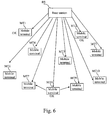
- Fig. 6 represents an example of the transfer of signals in the wireless cellular telecommunication network according to the present invention.
- the telecommunication devices MT1, MT2 and MT8 successfully decode the information word after the decoding of the first vector of complex symbols derived from an information word.
- the telecommunication devices MT1 and MT2 decide not to switch in relaying mode.
- the telecommunication device MT8 decides to switch in relaying mode.
Landscapes
- Engineering & Computer Science (AREA)
- Computer Networks & Wireless Communication (AREA)
- Signal Processing (AREA)
- Mobile Radio Communication Systems (AREA)
- Detection And Prevention Of Errors In Transmission (AREA)
- Radio Relay Systems (AREA)
Claims (14)
- Procédé pour déterminer si un mot d'information transféré par une source dans un réseau de télécommunication cellulaire sans-fil doit être relayé par un dispositif de télécommunication, les signaux transférés par la source étant composés de symboles complexes obtenus à partir du mot d'information, caractérisé en ce que le procédé comprend les étapes exécutées par le dispositif de télécommunication de :- recevoir au moins un signal composé de symboles complexes transférés par au moins la source ;- décoder avec succès le mot d'information à partir du au moins un signal composé de symboles complexes reçu ;- vérifier si le décodage avec succès est effectué avant un temps espéré de décodage avec succès du mot d'information, le temps espéré de décodage avec succès étant obtenu à partir de décodages précédents et avec succès d'autres mots d'informations ;
et si le décodage avec succès est effectué avant le temps espéré de décodage avec succès du mot d'information :- obtenir au moins un signal composé de symboles complexes obtenus à partir du mot d'information ;- transférer le au moins un signal obtenu. - Procédé selon la revendication 1, caractérisé en ce que des signaux transférés par la source sont représentatifs de vecteurs de symboles complexes, plusieurs vecteurs de symboles complexes dérivés du même mot d'information sont transférés successivement and en ce que la vérification si le décodage avec succès est effectué avant un temps espéré de décodage avec succès du mot d'information est effectué en comparant si le vecteur de symboles complexes à partir duquel le mot d'information est décodé avec succès est transféré avant le vecteur de symboles complexes à partir duquel le mot d'information est espéré être décodé.
- Procédé selon la revendication 2, caractérisé en ce que le temps espéré de décodage avec succès est déterminé à partir de statistiques réalisées sur des décodages précédents et avec succès d'autres mots d'informations.
- Procédé selon la revendication 3, caractérisé en ce que des statistiques sont réalisées en prenant en compte si des signaux sont relayés par au moins un autre dispositif de télécommunication.
- Procédé selon la revendication 3 ou 4, caractérisé en ce que chaque vecteur de symboles complexes transféré et dérivé du même mot d'information a un indice et en ce que des statistiques sont réalisées pour chaque indice.
- Procédé selon la revendication 5, caractérisé en ce que la puissance de transmission d'au moins un signal transféré par le dispositif de télécommunication est dépendante de l'indice du vecteur de symboles complexes à partir duquel le mot d'information est décodé avec succès.
- Procédé selon la revendication 3 ou 4, caractérisé en ce que des statistiques sont réalisées pour chaque vecteur de symboles complexes sur la quantité de bits codés reçus à partir du début de la réception de la transmission du mot d'information et après la réception de chaque vecteur de symboles complexes.
- Procédé selon la revendication 3 ou 4, caractérisé en ce que des statistiques sont réalisées sur un taux de codage équivalent après la réception d'un vecteur de symboles complexes, le taux de codage équivalent étant défini comme le rapport entre le nombre de bits du mot d'information transférés dans le vecteur de symboles complexes reçu et la quantité totale de bits reçus depuis le début de la transmission du mot d'information.
- Procédé selon l'une quelconque des revendications 3 à 8, caractérisé en ce que le décodage avec succès d'autres mots d'information est effectué par le dispositif de télécommunication.
- Procédé selon l'une quelconque des revendications 3 à 8, caractérisé en ce que le décodage avec succès d'autres mots d'information est effectué par d'autres dispositifs de télécommunication et en ce que le dispositif de télécommunication détecte le décodage avec succès d'autres mots d'information par d'autres dispositifs de télécommunication en surveillant des messages d'acquittement et/ou de non acquittement transférés par les autres dispositifs de télécommunication.
- Procédé selon l'une quelconque des revendications 1 à 10, caractérisé en ce que le au moins un signal composé de symboles complexes transféré par au moins la source est transféré à plusieurs dispositifs de télécommunication.
- Dispositif pour déterminer si un mot d'information transféré par une source dans un réseau de télécommunication cellulaire sans-fil doit être relayé par un dispositif de télécommunication, les signaux transférés par la source étant composés de symboles complexes obtenus à partir du mot d'information, caractérisé en ce que le dispositif pour déterminer si un mot d'information doit être relayé est destiné à être inclus dans le dispositif de télécommunication et comprend :- des moyens pour recevoir au moins un signal composé de symboles complexes transférés par au moins la source ;- des moyens pour décoder avec succès le mot d'information à partir du au moins un signal composé de symboles complexes reçu ;- des moyens pour vérifier si le décodage avec succès est effectué avant un temps espéré de décodage avec succès du mot d'information, le temps espéré de décodage avec succès étant obtenu à partir de décodages précédents et avec succès d'autres mots d'informations ;- des moyens pour obtenir au moins un signal composé de symboles complexes obtenus à partir du mot d'information si le décodage avec succès est effectué avant le temps espéré de décodage avec succès du mot d'information ;- des moyens pour transférer le au moins un signal obtenu si le décodage avec succès est effectué avant le temps espéré de décodage avec succès du mot d'information.
- Station de base d'un réseau de télécommunication cellulaire sans-fil, caractérisé en ce que la station de base comprend le dispositif pour déterminer si un mot d'information doit être relayé selon la revendication 12.
- Terminal mobile d'un réseau de télécommunication cellulaire sans-fil, caractérisé en ce que le terminal mobile comprend le dispositif pour déterminer si un mot d'information doit être relayé selon la revendication 12.
Priority Applications (4)
| Application Number | Priority Date | Filing Date | Title |
|---|---|---|---|
| EP10157454A EP2369760B1 (fr) | 2010-03-24 | 2010-03-24 | Procédé et dispositif pour déterminer si une information transférée par au moins une source doit être relayée |
| US13/048,356 US8509357B2 (en) | 2010-03-24 | 2011-03-15 | Method and a device for determining if an information word transferred by at least a source has to be relayed |
| JP2011056368A JP5823711B2 (ja) | 2010-03-24 | 2011-03-15 | 無線セルラー電気通信ネットワークにおいて送信元により転送される情報ワードを電気通信デバイスが中継しなければならないか否かを判断する方法及びデバイス、並びに該デバイスを備える基地局及び移動端末 |
| CN201110080274.2A CN102255646B (zh) | 2010-03-24 | 2011-03-23 | 用于确定至少源传输的信息字是否要被中继的装置和方法 |
Applications Claiming Priority (1)
| Application Number | Priority Date | Filing Date | Title |
|---|---|---|---|
| EP10157454A EP2369760B1 (fr) | 2010-03-24 | 2010-03-24 | Procédé et dispositif pour déterminer si une information transférée par au moins une source doit être relayée |
Publications (2)
| Publication Number | Publication Date |
|---|---|
| EP2369760A1 EP2369760A1 (fr) | 2011-09-28 |
| EP2369760B1 true EP2369760B1 (fr) | 2012-12-19 |
Family
ID=43719457
Family Applications (1)
| Application Number | Title | Priority Date | Filing Date |
|---|---|---|---|
| EP10157454A Not-in-force EP2369760B1 (fr) | 2010-03-24 | 2010-03-24 | Procédé et dispositif pour déterminer si une information transférée par au moins une source doit être relayée |
Country Status (4)
| Country | Link |
|---|---|
| US (1) | US8509357B2 (fr) |
| EP (1) | EP2369760B1 (fr) |
| JP (1) | JP5823711B2 (fr) |
| CN (1) | CN102255646B (fr) |
Family Cites Families (8)
| Publication number | Priority date | Publication date | Assignee | Title |
|---|---|---|---|---|
| JP2003229954A (ja) * | 2002-01-31 | 2003-08-15 | Ntt Docomo Inc | 通信システム、通信端末装置及びその通信方法 |
| CN101366197B (zh) * | 2005-09-28 | 2013-02-06 | Lg电子株式会社 | 在蜂窝网络中为广播多播服务协作地中继数据的方法 |
| CN101064911B (zh) * | 2006-04-28 | 2012-08-22 | 上海贝尔阿尔卡特股份有限公司 | 无线接入系统的切换控制方法、中继站和基站 |
| CN101123804B (zh) * | 2006-08-11 | 2011-04-06 | 华为技术有限公司 | 一种基于中继的网络接入方法及系统及一种中继站 |
| JP5038924B2 (ja) * | 2008-01-25 | 2012-10-03 | 株式会社エヌ・ティ・ティ・ドコモ | リレー伝送システム、基地局、中継局及び方法 |
| US8798526B2 (en) * | 2008-06-27 | 2014-08-05 | Qualcomm Incorporated | Method and apparatus for selecting and processing signals from a source station and relay stations |
| US8611273B2 (en) * | 2008-07-11 | 2013-12-17 | Interdigital Patent Holdings, Inc. | System level architectures for relayed uplink communication |
| US8089916B2 (en) * | 2009-04-07 | 2012-01-03 | Indian Institute Of Science | Leveraging coherent distributed space-time codes for noncoherent communication in relay networks via training |
-
2010
- 2010-03-24 EP EP10157454A patent/EP2369760B1/fr not_active Not-in-force
-
2011
- 2011-03-15 US US13/048,356 patent/US8509357B2/en not_active Expired - Fee Related
- 2011-03-15 JP JP2011056368A patent/JP5823711B2/ja not_active Expired - Fee Related
- 2011-03-23 CN CN201110080274.2A patent/CN102255646B/zh not_active Expired - Fee Related
Also Published As
| Publication number | Publication date |
|---|---|
| JP5823711B2 (ja) | 2015-11-25 |
| JP2011223560A (ja) | 2011-11-04 |
| EP2369760A1 (fr) | 2011-09-28 |
| CN102255646A (zh) | 2011-11-23 |
| CN102255646B (zh) | 2015-04-22 |
| US20110235754A1 (en) | 2011-09-29 |
| US8509357B2 (en) | 2013-08-13 |
Similar Documents
| Publication | Publication Date | Title |
|---|---|---|
| EP3430748B1 (fr) | Transmission de nouvelles données dans une retransmission de requête automatique de répétition hybride (harq) avec des transmissions à codage polaire | |
| EP3430744B1 (fr) | Requête automatique de répétition hybride (harq) avec des transmissions à codage polaire | |
| EP2383924B1 (fr) | Transmission dans un système de communication sans fil de type noeud de relais | |
| CN102422554B (zh) | 来自用户终端的数据的上行链路传输方法、基站、协作设备及其通信网络 | |
| EP1437873B1 (fr) | Emetteur et procede de commande de transmission | |
| US11824661B2 (en) | HARQ-ack handling with multiple PUCCH in multi-TRP transmission in NR | |
| EP2369760B1 (fr) | Procédé et dispositif pour déterminer si une information transférée par au moins une source doit être relayée | |
| CN110431779A (zh) | 用于检测由于数据打孔而损坏的数据的传输的网络节点、ue及其中的方法 | |
| US9025642B2 (en) | Method and a device for relaying symbols transferred by a source to a destination | |
| JP6800198B2 (ja) | 無線通信装置、無線通信システム、無線通信方法及びプログラム |
Legal Events
| Date | Code | Title | Description |
|---|---|---|---|
| PUAI | Public reference made under article 153(3) epc to a published international application that has entered the european phase |
Free format text: ORIGINAL CODE: 0009012 |
|
| AK | Designated contracting states |
Kind code of ref document: A1 Designated state(s): AT BE BG CH CY CZ DE DK EE ES FI FR GB GR HR HU IE IS IT LI LT LU LV MC MK MT NL NO PL PT RO SE SI SK SM TR |
|
| AX | Request for extension of the european patent |
Extension state: AL BA ME RS |
|
| 17P | Request for examination filed |
Effective date: 20120314 |
|
| RIC1 | Information provided on ipc code assigned before grant |
Ipc: H04B 7/155 20060101AFI20120521BHEP |
|
| GRAP | Despatch of communication of intention to grant a patent |
Free format text: ORIGINAL CODE: EPIDOSNIGR1 |
|
| GRAS | Grant fee paid |
Free format text: ORIGINAL CODE: EPIDOSNIGR3 |
|
| GRAA | (expected) grant |
Free format text: ORIGINAL CODE: 0009210 |
|
| AK | Designated contracting states |
Kind code of ref document: B1 Designated state(s): AT BE BG CH CY CZ DE DK EE ES FI FR GB GR HR HU IE IS IT LI LT LU LV MC MK MT NL NO PL PT RO SE SI SK SM TR |
|
| REG | Reference to a national code |
Ref country code: GB Ref legal event code: FG4D |
|
| REG | Reference to a national code |
Ref country code: CH Ref legal event code: EP |
|
| REG | Reference to a national code |
Ref country code: AT Ref legal event code: REF Ref document number: 589842 Country of ref document: AT Kind code of ref document: T Effective date: 20130115 |
|
| REG | Reference to a national code |
Ref country code: DE Ref legal event code: R096 Ref document number: 602010004140 Country of ref document: DE Effective date: 20130214 |
|
| PG25 | Lapsed in a contracting state [announced via postgrant information from national office to epo] |
Ref country code: HR Free format text: LAPSE BECAUSE OF FAILURE TO SUBMIT A TRANSLATION OF THE DESCRIPTION OR TO PAY THE FEE WITHIN THE PRESCRIBED TIME-LIMIT Effective date: 20121219 Ref country code: ES Free format text: LAPSE BECAUSE OF FAILURE TO SUBMIT A TRANSLATION OF THE DESCRIPTION OR TO PAY THE FEE WITHIN THE PRESCRIBED TIME-LIMIT Effective date: 20130330 Ref country code: FI Free format text: LAPSE BECAUSE OF FAILURE TO SUBMIT A TRANSLATION OF THE DESCRIPTION OR TO PAY THE FEE WITHIN THE PRESCRIBED TIME-LIMIT Effective date: 20121219 Ref country code: NO Free format text: LAPSE BECAUSE OF FAILURE TO SUBMIT A TRANSLATION OF THE DESCRIPTION OR TO PAY THE FEE WITHIN THE PRESCRIBED TIME-LIMIT Effective date: 20130319 Ref country code: SE Free format text: LAPSE BECAUSE OF FAILURE TO SUBMIT A TRANSLATION OF THE DESCRIPTION OR TO PAY THE FEE WITHIN THE PRESCRIBED TIME-LIMIT Effective date: 20121219 Ref country code: LT Free format text: LAPSE BECAUSE OF FAILURE TO SUBMIT A TRANSLATION OF THE DESCRIPTION OR TO PAY THE FEE WITHIN THE PRESCRIBED TIME-LIMIT Effective date: 20121219 |
|
| REG | Reference to a national code |
Ref country code: NL Ref legal event code: VDEP Effective date: 20121219 Ref country code: AT Ref legal event code: MK05 Ref document number: 589842 Country of ref document: AT Kind code of ref document: T Effective date: 20121219 |
|
| REG | Reference to a national code |
Ref country code: LT Ref legal event code: MG4D |
|
| PG25 | Lapsed in a contracting state [announced via postgrant information from national office to epo] |
Ref country code: LV Free format text: LAPSE BECAUSE OF FAILURE TO SUBMIT A TRANSLATION OF THE DESCRIPTION OR TO PAY THE FEE WITHIN THE PRESCRIBED TIME-LIMIT Effective date: 20121219 Ref country code: GR Free format text: LAPSE BECAUSE OF FAILURE TO SUBMIT A TRANSLATION OF THE DESCRIPTION OR TO PAY THE FEE WITHIN THE PRESCRIBED TIME-LIMIT Effective date: 20130320 Ref country code: SI Free format text: LAPSE BECAUSE OF FAILURE TO SUBMIT A TRANSLATION OF THE DESCRIPTION OR TO PAY THE FEE WITHIN THE PRESCRIBED TIME-LIMIT Effective date: 20121219 |
|
| PG25 | Lapsed in a contracting state [announced via postgrant information from national office to epo] |
Ref country code: EE Free format text: LAPSE BECAUSE OF FAILURE TO SUBMIT A TRANSLATION OF THE DESCRIPTION OR TO PAY THE FEE WITHIN THE PRESCRIBED TIME-LIMIT Effective date: 20121219 Ref country code: IS Free format text: LAPSE BECAUSE OF FAILURE TO SUBMIT A TRANSLATION OF THE DESCRIPTION OR TO PAY THE FEE WITHIN THE PRESCRIBED TIME-LIMIT Effective date: 20130419 Ref country code: BE Free format text: LAPSE BECAUSE OF FAILURE TO SUBMIT A TRANSLATION OF THE DESCRIPTION OR TO PAY THE FEE WITHIN THE PRESCRIBED TIME-LIMIT Effective date: 20121219 Ref country code: CZ Free format text: LAPSE BECAUSE OF FAILURE TO SUBMIT A TRANSLATION OF THE DESCRIPTION OR TO PAY THE FEE WITHIN THE PRESCRIBED TIME-LIMIT Effective date: 20121219 Ref country code: SK Free format text: LAPSE BECAUSE OF FAILURE TO SUBMIT A TRANSLATION OF THE DESCRIPTION OR TO PAY THE FEE WITHIN THE PRESCRIBED TIME-LIMIT Effective date: 20121219 Ref country code: AT Free format text: LAPSE BECAUSE OF FAILURE TO SUBMIT A TRANSLATION OF THE DESCRIPTION OR TO PAY THE FEE WITHIN THE PRESCRIBED TIME-LIMIT Effective date: 20121219 Ref country code: BG Free format text: LAPSE BECAUSE OF FAILURE TO SUBMIT A TRANSLATION OF THE DESCRIPTION OR TO PAY THE FEE WITHIN THE PRESCRIBED TIME-LIMIT Effective date: 20130319 |
|
| PG25 | Lapsed in a contracting state [announced via postgrant information from national office to epo] |
Ref country code: PL Free format text: LAPSE BECAUSE OF FAILURE TO SUBMIT A TRANSLATION OF THE DESCRIPTION OR TO PAY THE FEE WITHIN THE PRESCRIBED TIME-LIMIT Effective date: 20121219 Ref country code: NL Free format text: LAPSE BECAUSE OF FAILURE TO SUBMIT A TRANSLATION OF THE DESCRIPTION OR TO PAY THE FEE WITHIN THE PRESCRIBED TIME-LIMIT Effective date: 20121219 Ref country code: PT Free format text: LAPSE BECAUSE OF FAILURE TO SUBMIT A TRANSLATION OF THE DESCRIPTION OR TO PAY THE FEE WITHIN THE PRESCRIBED TIME-LIMIT Effective date: 20130419 Ref country code: RO Free format text: LAPSE BECAUSE OF FAILURE TO SUBMIT A TRANSLATION OF THE DESCRIPTION OR TO PAY THE FEE WITHIN THE PRESCRIBED TIME-LIMIT Effective date: 20121219 |
|
| PLBE | No opposition filed within time limit |
Free format text: ORIGINAL CODE: 0009261 |
|
| STAA | Information on the status of an ep patent application or granted ep patent |
Free format text: STATUS: NO OPPOSITION FILED WITHIN TIME LIMIT |
|
| PG25 | Lapsed in a contracting state [announced via postgrant information from national office to epo] |
Ref country code: DK Free format text: LAPSE BECAUSE OF FAILURE TO SUBMIT A TRANSLATION OF THE DESCRIPTION OR TO PAY THE FEE WITHIN THE PRESCRIBED TIME-LIMIT Effective date: 20121219 Ref country code: MC Free format text: LAPSE BECAUSE OF NON-PAYMENT OF DUE FEES Effective date: 20130331 |
|
| 26N | No opposition filed |
Effective date: 20130920 |
|
| PG25 | Lapsed in a contracting state [announced via postgrant information from national office to epo] |
Ref country code: CY Free format text: LAPSE BECAUSE OF FAILURE TO SUBMIT A TRANSLATION OF THE DESCRIPTION OR TO PAY THE FEE WITHIN THE PRESCRIBED TIME-LIMIT Effective date: 20121219 |
|
| PG25 | Lapsed in a contracting state [announced via postgrant information from national office to epo] |
Ref country code: IT Free format text: LAPSE BECAUSE OF FAILURE TO SUBMIT A TRANSLATION OF THE DESCRIPTION OR TO PAY THE FEE WITHIN THE PRESCRIBED TIME-LIMIT Effective date: 20121219 |
|
| REG | Reference to a national code |
Ref country code: IE Ref legal event code: MM4A |
|
| REG | Reference to a national code |
Ref country code: DE Ref legal event code: R097 Ref document number: 602010004140 Country of ref document: DE Effective date: 20130920 |
|
| PG25 | Lapsed in a contracting state [announced via postgrant information from national office to epo] |
Ref country code: IE Free format text: LAPSE BECAUSE OF NON-PAYMENT OF DUE FEES Effective date: 20130324 |
|
| PG25 | Lapsed in a contracting state [announced via postgrant information from national office to epo] |
Ref country code: MT Free format text: LAPSE BECAUSE OF FAILURE TO SUBMIT A TRANSLATION OF THE DESCRIPTION OR TO PAY THE FEE WITHIN THE PRESCRIBED TIME-LIMIT Effective date: 20121219 |
|
| REG | Reference to a national code |
Ref country code: CH Ref legal event code: PL |
|
| PG25 | Lapsed in a contracting state [announced via postgrant information from national office to epo] |
Ref country code: CH Free format text: LAPSE BECAUSE OF NON-PAYMENT OF DUE FEES Effective date: 20140331 Ref country code: LI Free format text: LAPSE BECAUSE OF NON-PAYMENT OF DUE FEES Effective date: 20140331 |
|
| PG25 | Lapsed in a contracting state [announced via postgrant information from national office to epo] |
Ref country code: SM Free format text: LAPSE BECAUSE OF FAILURE TO SUBMIT A TRANSLATION OF THE DESCRIPTION OR TO PAY THE FEE WITHIN THE PRESCRIBED TIME-LIMIT Effective date: 20121219 |
|
| PG25 | Lapsed in a contracting state [announced via postgrant information from national office to epo] |
Ref country code: TR Free format text: LAPSE BECAUSE OF FAILURE TO SUBMIT A TRANSLATION OF THE DESCRIPTION OR TO PAY THE FEE WITHIN THE PRESCRIBED TIME-LIMIT Effective date: 20121219 |
|
| PG25 | Lapsed in a contracting state [announced via postgrant information from national office to epo] |
Ref country code: LU Free format text: LAPSE BECAUSE OF NON-PAYMENT OF DUE FEES Effective date: 20130324 Ref country code: HU Free format text: LAPSE BECAUSE OF FAILURE TO SUBMIT A TRANSLATION OF THE DESCRIPTION OR TO PAY THE FEE WITHIN THE PRESCRIBED TIME-LIMIT; INVALID AB INITIO Effective date: 20100324 Ref country code: MK Free format text: LAPSE BECAUSE OF FAILURE TO SUBMIT A TRANSLATION OF THE DESCRIPTION OR TO PAY THE FEE WITHIN THE PRESCRIBED TIME-LIMIT Effective date: 20121219 |
|
| REG | Reference to a national code |
Ref country code: FR Ref legal event code: PLFP Year of fee payment: 7 |
|
| REG | Reference to a national code |
Ref country code: FR Ref legal event code: PLFP Year of fee payment: 8 |
|
| REG | Reference to a national code |
Ref country code: FR Ref legal event code: PLFP Year of fee payment: 9 |
|
| PGFP | Annual fee paid to national office [announced via postgrant information from national office to epo] |
Ref country code: GB Payment date: 20200323 Year of fee payment: 11 Ref country code: DE Payment date: 20200320 Year of fee payment: 11 |
|
| PGFP | Annual fee paid to national office [announced via postgrant information from national office to epo] |
Ref country code: FR Payment date: 20200325 Year of fee payment: 11 |
|
| REG | Reference to a national code |
Ref country code: DE Ref legal event code: R119 Ref document number: 602010004140 Country of ref document: DE |
|
| GBPC | Gb: european patent ceased through non-payment of renewal fee |
Effective date: 20210324 |
|
| PG25 | Lapsed in a contracting state [announced via postgrant information from national office to epo] |
Ref country code: DE Free format text: LAPSE BECAUSE OF NON-PAYMENT OF DUE FEES Effective date: 20211001 Ref country code: GB Free format text: LAPSE BECAUSE OF NON-PAYMENT OF DUE FEES Effective date: 20210324 Ref country code: FR Free format text: LAPSE BECAUSE OF NON-PAYMENT OF DUE FEES Effective date: 20210331 |