EP2369940B1 - Lait à l'état solide et procédé de fabrication associé - Google Patents
Lait à l'état solide et procédé de fabrication associé Download PDFInfo
- Publication number
- EP2369940B1 EP2369940B1 EP09834521.8A EP09834521A EP2369940B1 EP 2369940 B1 EP2369940 B1 EP 2369940B1 EP 09834521 A EP09834521 A EP 09834521A EP 2369940 B1 EP2369940 B1 EP 2369940B1
- Authority
- EP
- European Patent Office
- Prior art keywords
- milk
- powdered milk
- powdered
- compaction
- gas
- Prior art date
- Legal status (The legal status is an assumption and is not a legal conclusion. Google has not performed a legal analysis and makes no representation as to the accuracy of the status listed.)
- Active
Links
Images


Classifications
-
- A—HUMAN NECESSITIES
- A23—FOODS OR FOODSTUFFS; TREATMENT THEREOF, NOT COVERED BY OTHER CLASSES
- A23C—DAIRY PRODUCTS, e.g. MILK, BUTTER OR CHEESE; MILK OR CHEESE SUBSTITUTES; PREPARATION THEREOF
- A23C9/00—Milk preparations; Milk powder or milk powder preparations
- A23C9/18—Milk in dried and compressed or semi-solid form
Definitions
- the present invention relates to a method for the manufacturing of solid milk with suitable strength and solubility which can maintain the shape of solid milk at the time of manufacturing of the compaction molded body of powdered milk by using powdered milk which is manufactured by dispersing a prescribed gas.
- Powdered milk is a powdered product (solid) which is manufactured by removing water from milk.
- the powdered milk is easily scattered so that it takes time to weigh the powdered milk (that is a low measurement). Accordingly, it is suggested that solid milk made of solidified powdered milk by compaction molding the powdered milk is manufactured to enhance the measurement (for example, see a following Patent Document 1 (Japanese Patent Publication No. 4062357 )).
- the problem is that the solid milk is inferior to the powdered milk in solubility due to a small surface area and a low porosity.
- a compaction pressure is low at the time of compaction molding the powdered milk, hardness of the manufactured solid milk decreases and the solid milk is easily destroyed. Therefore, the problem is that it is difficult to enhance the solubility of the solid milk and still keep the hardness of the solid milk within the range of the utility.
- Patent Document 1 a method of manufacturing solid milk which has both suitable hardness and suitable solubility under various controls or regulations in a step of manufacturing the solid milk from powdered milk is disclosed.
- it is not easy to control or regulate various things in the step of manufacturing the solid milk. So, it is considered that it is because necessity for various controls or regulations in a step of manufacturing the solid milk from powdered milk would be decreased if suitable powdered milk for manufacturing solid milk can be produced (specifically, a product which has good compaction moldability, namely a product for manufacturing solid milk having both suitable hardness and porosity).
- WO2007/077970 discloses a method of making solid milk comprising a compression step for compressing powdered milk to obtain a solid form of compressed powdered milk; a humidifying step for humidifying the compressed powdered milk obtained by the compression step; and a drying step for drying the compressed powdered milk humidified by the humidifying step.
- EP1769682 discloses a method of making solid milk comprising a compacting process for compacting powdered milk and obtaining a solid compacted body of powdered milk; a humidifying process for wetting the compacted body of powdered milk obtained in said compacting process; and a drying process for drying the compacted body of powdered milk humidified in said humidification process.
- the invention provides a method for manufacturing solid milk, comprising; a gas dispersal process (S112) for dispersing a prescribed gas into liquid milk; a spray drying process (S114) for obtaining powdered milk by spraying the liquid milk after the gas dispersal process (S 112), and drying the sprayed liquid milk; and a compaction molding process (S130) for obtaining a solidified compaction molded body of powdered milk produced by compacting powdered milk after the gas dispersal process (S112) and the spray drying process (S114), wherein the prescribed gas is one or more gases selected from the group comprising carbon dioxide, air, nitrogen, oxygen and rare gas.
- the present invention basically, disperses the prescribed gas in liquid milk before spray drying the liquid milk. Powdered milk obtained in this way is bulky (the volume grows) compared with powdered milk without dispersing the gas. And, the present invention is based on the knowledge that solid milk with a certain level of hardness is easily produced by simply compaction molding this powdered milk.
- powdered milk which can be solidified at a low compaction pressure is suitable for reproducing solid milk with both suitable degree of hardness and solubility for practical use.
- solid milk as a final product can also keep good silhouette since hardness of compaction molded body of powdered milk is increased.
- the volume of gas to be dispersed is 1x 10 -2 times to 7 times the volume of liquid milk, and then powdered milk having abovementioned characteristics was effectively obtained.
- the gas is dried after ingredients such as lactose are crystallised.
- the prescribed gas is dispersed in liquid milk at gas dispersal process (S112), and the liquid milk with small filling density is sprayed, then powdered milk having abovementioned characteristics was effectively obtained.
- powdered milk having bigger particle diameter than prescribed particle diameter is obtained by classifying powdered milk, and average of particle diameter of this powdered milk becomes bigger, then powdered milk becomes suitable for manufacturing solid milk (especially, good solubility).
- the present invention basically relates to a method of manufacturing solid milk based on the abovementioned knowledge.
- the present invention of manufacturing method of solid milk includes a gas dispersal (gas mix) process (S112) and a spray drying process (S114).
- the gas dispersal process (S112) serves to disperse the prescribed gas in liquid milk which is a raw material of powdered milk.
- the spray drying process (S 114) serves to spray and dry the liquid milk to obtain powdered milk.
- the compaction molding process (S130) serves to compact powdered milk which is produced after the gas dispersal process (S112) and the spray dry process (S114), and to obtain a compaction molded body of powdered milk which forms solid.
- liquid milk in which the prescribed gas is dispersed (mixed), namely liquid milk with low density but increased apparent volume is preferably sprayed and dried.
- the compaction molded body of powdered milk with high hardness after compaction molding is obtained.
- the present invention of a desirable manufacturing method of solid milk includes a humidification process (S140) and a drying process (S160).
- the humidification process (S140) serves to humidify the compaction molded body of powdered milk obtained at the compaction molding process (S130).
- the drying process (S160) serves to dry the compaction molded body of powdered milk which is humidified at the humidification process (S140).
- a manufacturing process of solid milk is generally performed in a factory as a set of operation.
- a solidified compaction molded body of powdered milk on some level is transported to a humidification room (where the humidification process is performed), and then transported to a drying room (where the drying process is performed).
- a transporting apparatus such as a conveyer belt is used.
- the compaction molded body of powdered milk easily loses its shape when transporting during production.
- the above mentioned gas dispersal process S112 is performed, then the compaction molded body of powdered milk can keep its sufficient shape at the transporting process in a factory.
- the prescribed gas is dispersed in concentrated liquid milk (concentrated milk) at the gas dispersal process (S112).
- concentration milk concentrated liquid milk
- spray drying process (S114) viscosity of the liquid milk is increased, as a result, powdered milk having big average particle diameter which is suitable for manufacturing solid milk can be easily obtained.
- the function or the effect of the gas dispersal process (S112) becomes remarkable by increasing viscosity of the liquid milk.
- the prescribed gas is pressured and the prescribed gas is dispersed in liquid milk by mixing the gas into the liquid milk. In this way, the prescribed gas can be easily and certainly dispersed in liquid milk.
- the prescribed gas for dispersing into liquid milk is one or two or more gas which is selected from a group comprising carbon dioxide (carbon dioxide gas), air, nitrogen, oxygen and rare gas.
- carbon dioxide carbon dioxide gas
- air nitrogen
- oxygen rare gas
- various gases can be options. Therefore, the gas dispersal process can be easily performed by using a gas easily available.
- carbon dioxide is not limited to a gas, can be dry ice or a mixture of dry ice and a gas.
- solid or liquid evaporating easily can be used as the prescribed gas.
- the method includes a process for pouring liquid milk having dispersing gas at a specific volume flow along flow path in order to spray liquid milk having abovementioned dispersing gas in the spray drying process (S114).
- prescribed gas is mixed (in-line mixing) into the liquid milk while pouring liquid milk along the flow path in such a way that a ratio of a specific volume flow of prescribed gas to volume flow of solid milk is within the range of 1 x 10 -2 times to 7 times the volume of liquid milk.
- This can control for flow volume of prescribed gas to become constant to the total volume flow, and enhance homogeneousness of real manufacturing powdered milk.
- mixing continuously a gas and liquid milk in seal-up system is preferable because it prevents from being contaminated by bacteria and enhances the aspect of good hygiene of powdered milk.
- the method includes a classification process (S120) before the compaction molding process (S130).
- This classification process (S120) is a process for classifying powdered milk obtained by the spray drying process (S114). At this process, powdered milk which has bigger particle diameter than prescribed particle diameter can be obtained. Thus, average particle diameter of powdered milk becomes big by extracting (selecting) powdered milk having big particle diameter. In this way, porosity of the compaction molded body of powdered milk or solid milk can be enhanced, as a result, the compaction molded body of powdered milk or solid milk with suitable hardness for practical use in manufacturing can be produced.
- a manufacturing method of solid milk includes both the gas dispersal process (S112) and the classification process (S120).
- the method for example, the compaction molded body of powdered milk, which hardness after compaction molding is within a range of 6N to 22N and porosity is within a range of 44 percents to 55 percents, is produced.
- This compaction molded body of powdered milk has suitable hardness for keeping good silhouette during manufacturing processes, superior solubility, and practical utility in manufacturing.
- porosity means the ratio of air gap volume in the bulk volume of powdered milk (a powder) (for example, see Miyajima Koichiro, Ed., Development of Drugs (Vol. 15), published by Hirogawa Shoten (1989), p. 240 ), more specifically a value calculated by using a value of filling density of measuring solid milk in the below-described examples.
- solid milk means milk (milk or modified milk) modified to be in a solid state (a block or a tablet etc) at normal temperature. More specifically solid milk means milk obtained by molding powdered milk to the prescribed size (dimentions) and mass, when it dissolves to solvent such as water, it becomes the same thing as dissolving powdered milk.
- suitable powdered milk for manufacturing solid milk can be easily produced by simply dispersing a prescribed gas in liquid milk by a prescribed way. Additionally, the powdered milk produced in this way has superior compaction moldability. By compaction molding this powdered milk, solid milk with suitable hardness for practical use can be produced. Furthermore, hardness of solid milk can be enhanced by performing the humidification process and the drying process.
- FIG. 1 is a flowchart for describing an example of the present invention of a method for manufacturing solid milk.
- [S] in each figure means a manufacturing process (step).
- the method of manufacturing solid milk produces schematically solid milk from powdered milk in the form of a solid which is produced from milk or modified milk in the form of liquid including water (liquid milk).
- a method for manufacturing solid milk includes a powdered milk manufacturing process (S100), a classification process (S120), a compaction molding process (S130), a humidification process (S140), and a drying process (S160). Therefore, the method for manufacturing solid milk includes a method for manufacturing powdered milk.
- powdered milk is produced from liquid milk.
- Liquid milk as an ingredient of powdered milk includes at least milk constituent (for example, nutrient component of milk), and, for instance, water content rate of liquid milk is 40 mass percents - 95 mass percents.
- water content rate of powdered milk is 1 mass percent - 4 mass percent. Namely, because if powdered milk contains a lot of water, preservative quality becomes worse and it is easy for deterioration in the flavour and the discoloration of externals to progress. Details of this process will be described below by using Fig. 2 .
- the classification process (S120) is a process for extracting (selecting) powdered milk having in range of necessary particle diameter by classifying powdered milk obtained by the powdered milk manufacturing process (S100) by each particle diameter.
- all powdered milk is passed through or set on plural sieves having different sieve mesh size (sieving). Specifically, by setting all powdered milk on a sieve having big sieve mesh size, powdered milk having smaller particle diameter than the mesh size of the sieve is passed through the sieve, and powdered milk having bigger particle diameter than the mesh size of the sieve is remained on the sieve.
- powdered milk having too big particle diameter (massed powder, coagula, etc) which is remained on the sieve can be removed from all powdered milk.
- powdered milk passed through a sieve having big mesh size is set on a sieve having small mesh size, and then it is performed in the same way.
- powdered milk having unnecessary small particle diameter that passed through the sieve is removed. Therefore, powdered milk having in range of necessary particle diameter is remained on the sieve having small mesh size. Namely, in the present process powdered milk obtained at the spray drying process is selected by particle size. In addition, this process can be skipped if necessary facilities for the classification cannot be prepared.
- the compaction molding process (S130) is a process for obtaining a solidified compaction molded body of powdered milk by compaction molding (for example, tableting) powdered milk under relatively low compaction pressure.
- compaction molding for example, tableting
- this porosity of the compaction molded body of powdered milk is defined by many air gaps, and closely relates to porosity of solid milk.
- powdered milk produced by the powdered milk manufacturing process (S100) can be used.
- powdered milk without adding substantial additive can be used.
- the additive means an adhesive, a disintegrant, a lubricant, an expansion agent and so on, and nutrient component is excluded from the additive.
- the additive may be used as an ingredient of powdered milk if additive amount is for example 0.5 mass percent like additive amount that does not influence nutrient component of solid milk.
- powdered milk having for example 0.5 mass percent - 4 mass percent of free fat can be desirably used. This leads that free fat in powdered milk can be performed as a lubricant or an adhesive.
- fat content rate of powdered milk being subject to the compaction molding is for example 5 mass percent - 70 mass percent.
- a compaction means In the compaction molding process, in order to obtain a solidified compaction molded body of powdered milk from powdered milk, a compaction means is used.
- a pressured molding machine such as a tableting machine or a compression testing machine is an example of the compaction means.
- the tableting machine comprises a die as a mold for powdered milk (powder) and a punch for hitting to the die. Further, powdered milk is introduced into the die (mold) and is hit by the punch, and then a compaction molded body of powdered milk can be obtained by the added compaction pressure.
- the compaction molding process it is desirable to compact powdered milk continuously.
- ambient temperature is not specifically regulated.
- this process can be carried out at room temperature.
- ambient temperature in the compaction molding process can be 10 degrees C to 30 degrees C.
- ambient humidity can be, for example, 30 percents RH to 50 percents RH.
- the compacting force is for example 1 MPa to 30 MPa (preferably 1 MPa to 20 MPa).
- porosity is controlled within a range of 30 percents to 60 percents
- hardness of the compaction molded body of powdered milk is controlled within a range of 6N to 22N by adjusting within a range of 1 MPa to 30 MPa of compacting pressure.
- hardness of the compaction molded body of powdered milk should be at least a certain degree for keeping good silhouette (not losing shape) at the subsequent humidification process and drying process (for example 4 N).
- the humidification process (S140) is a process for humidifying the compaction molded body of powdered milk obtained by the compaction molding process (S130).
- tackiness is generated on a surface of the compaction molded body of powdered milk.
- Wetting the compaction molded body of powdered milk partially dissolves and bridges together the particles located close to the surface of the compaction molded body of powdered milk.
- the strength close to the surface of the compaction molded body of powdered milk solid milk
- the strength close to the surface of the compaction molded body of powdered milk solid milk is increased compared to the strength of the inner of the compaction molded body of powdered milk.
- a degree of bridges (a degree of broadening) is adjusted by adjusting time putting under high humid environment (humidification time).
- hardness of the compaction molded body of powdered milk (uncured solid milk) before humidification process (for example, 6 N to 22 N) can be enhanced to the necessary purposed hardness for solid milk (for example, 40 N).
- a range (broadness) of the possible enhanced hardness by adjusting humidification time is limited. Namely, when transporting the compaction molded body of powdered milk by a conveyer belt to humidify after compaction molding, shape of the solid milk can not be kept in case of insufficient hardness of the compaction molded body of powdered milk.
- solid milk with small porosity and poor solubility is obtained if hardness of the compaction molding body of the powdered milk is too enough at the time of compaction molding. Therefore, preferably it is compaction molded for having enough hardness of the compaction molded body of powdered milk (uncured solid milk) before humidification process and keeping enough solubility of solid milk.
- a humidification method of the compaction molded body of powdered milk is not specifically regulated.
- a method of placing in a high-humidity environment a method of directly spraying water with a sprayer, and a method of blowing steam can be employed.
- humidification means to humidify the compaction molded body of powdered milk include a high-humidity chamber, a sprayer, and steam.
- Humidity of the high-humidity environment is, for example, 60 percents RH to 100 percents RH.
- the temperature in the method of placing under high-humidity environment is, for example, 30 degrees C to 100 degrees C.
- Humidification time is, for instance, 5 seconds to 1 hour.
- the amount of moisture (also referred to herein below as humidification amount) added to the compacted body of powdered milk in the humidification process may be appropriately adjusted.
- Preferably humidification amount is set to 0.5 mass percent to 3 mass percent of the mass of the compaction molded body of powdered milk after the compaction molding process. If the humidification amount is set to less than 0.5 mass percent, hardness (tablet hardness) of solid milk is not enough. On the other hand, if the humidification amount is set to more than 3 mass percent, the compaction molded body of powdered milk is excessively melted into liquid state or gelled state, further compaction molded shape is changed or it adheres to a machine such as a conveyer belt during transporting.
- the drying process (S160) is a process for drying the compaction molded body of powdered milk humidified at the humidification process (S140). Because the compacted molded body of powdered milk that was humidified in the humidification process is dried in the drying process, surface tackiness is eliminated and the solid milk can be handled as a product. Thus, the humidification process and the drying process correspond to a process for adjusting to be necessary quality of solid milk as a product by enhancing the hardness of the compaction molded body of powdered milk after the compaction molding (solid milk).
- Well-known methods capable of drying the compacted molded body of powdered milk that was humidified in the humidification process can be employed as drying methods in the drying process that is not specifically limited. Examples of suitable methods include a method of placing under a low-humidity and high-temperature atmosphere and a method of bringing into contact with dry air or high-temperature dry air.
- Humidity in the method involving placing under a low-humidity and high- temperature atmosphere is for example 0 percent RH to 30 percents RH. It is thus preferred that humidity is set to as a low level as possible.
- Temperature in the method involving placing under a low-humidity and a high-temperature atmosphere is for example 20 degrees C to 150 degrees C.
- Drying time in the method involving placing under a low-humidity and a high-temperature atmosphere is for example 0.2 min to 2h.
- the moisture content ratio of the solid milk is preferably controlled (adjusted) to be no more than 1 percent higher or lower than the moisture content ratio of the powdered milk used as the ingredient by controlling the conditions of the temperature or the time to dry.
- the solid milk made in accordance with the method of the present invention is generally dissolved in warm water and drunk. More specifically, warm water is poured into a container provided with a lid and then the necessary number of pieces of the solid milk is placed therein, or the water is poured after the pieces of the milk are placed. And, it is preferred that the solid milk be rapidly dissolved by lightly shaking the container and drunk in a state with an appropriate temperature. Further, when one or more than two pieces of the solid milk (more preferably, one piece of solid milk) is dissolved in warm water, a volume of solid milk can be adjusted to be necessary amount of liquid milk for one drinking. For example the volume of solid milk is 1 cm 3 to 50 cm 3 . Moreover, the volume of the solid milk can be adjusted by changing amount of powdered milk which is used at the compaction molding process.
- solid milk Details of solid milk are described following.
- the components of solid milk are basically identical to those of powdered milk serving as an ingredient.
- solid milk components include fats, proteins, glucide, minerals, vitamins, and water.
- air gaps for example, pores
- These plural pores are preferably dispersed uniformly (distributed) in the solid milk. Because the pores are almost uniformly distributed in the solid milk, the solid milk is uniformly dissolved and a higher solubility can be obtained. In this case, since the larger (wider) the pores are, the easier water as a solvent penetrates therein, a high solubility can be obtained.
- the pore size is too large, strength decreases or the surface of solid milk becomes rough.
- the pore size is for example 10 micrometers to 500 micrometers. Further, such pore size or dispersal of many air gaps can be measured by well-known means, for example, by observing the surface and cross section of solid milk with a scanning electron microscope. By these measurements porosity of solid milk can be defined.
- the solid milk made in accordance with the method of the present invention is solid milk with a porosity of for example 30 percents to 60 percents.
- the porosity is mainly controlled by adjusting the compacting force in the compacting molding process. Specifically, the lower the compaction pressure is, the higher the porosity is, while the higher the pressure is, the lower the porosity is.
- the porosity of the solid milk thus can be controlled, therefore it is not limited within a range of 30 percents to 60 percents, and then the porosity is appropriately adjusted as usage.
- the shape of the solid milk is defined by the shape of the die (mold) for compaction molding, but it is not specifically limited if it has a certain size (dimensions).
- the solid milk may have the shape of round rods, elliptical rods, rectangular parallelepipeds, cubes, plate, balls, polygonal rods, polygonal cones, polygonal pyramids, and polyhedrons. From the standpoint of convenience of molding and transporting, the shape of round rods, elliptical rods, or rectangular parallelepipeds is preferred.
- the corner portions be rounded.
- the solid milk has to have a certain solubility in a solvent such as water.
- the solubility can be evaluated by the time of dissolving solid milk perfectly or remaining amount (dissolution residue of mass as described below in Examples) in the prescribed time for example when solid milk as a solute and water as a solvent are prepared for a specified concentrated level.
- the solid milk also has to have a certain hardness (strength) to prevent it from fracturing during transportation.
- the solid milk preferably has a hardness of 31 N or higher, more preferably 40 N or higher in this case.
- the maximum hardness of solid milk is for example 300 N, preferably 60 N.
- the hardness of solid milk can be further measured by well-known methods.
- Fig. 2 is a flowchart for explaining in detail the powdered milk manufacturing process described in S100 of Fig. 1 .
- the modified milk is simply one example of the powdered milk to be produced, if the powdered milk is suitable for manufacturing solid milk, it can be all powdered milk, powdered skimmed milk, or creamy powder. This powdered milk can be produced by the same process as described in Fig.2 .
- powdered milk for the above mentioned compaction molding process is produced.
- the example of the powdered milk manufacturing process includes an ingredient milk adjusting process (S102), a clearing process (S104), a sterilization process (S106), a homogenization process (S108), a concentration process (S110), a gas dispersal process (S112), and a spray drying process (S114) as illustrated in Fig. 2 .
- the ingredient milk adjusting process (S102) is a process for adjusting the kinds of milk in a liquid state (liquid milk) as an ingredient of powdered milk. Therefore, liquid milk as an ingredient of powdered milk includes at least milk constituent (for example milk component), and for example water content rate of the liquid milk is 40 mass percent to 95 mass percent.
- milk constituent for example milk component
- water content rate of the liquid milk is 40 mass percent to 95 mass percent.
- nutrient component described below as an ingredient of powdered milk is added into the abovementioned liquid milk.
- Ingredients of powdered milk further may comprise only milk constituent, such as raw milk (whole fat milk), defatted milk, and cream. In this case, the ingredient milk adjusting process can be omitted as the need arises.
- Milk is used as an ingredient for the said powdered milk.
- Fresh milk can be used as the milk. More specifically, milk from cows (Holstein cows, Jersey cows, and the like), goats, sheep, and buffalos can be used. Fat is contained in their milk. Then, the content ratio of fat in the milk can be adjusted by removing part of the fat by centrifugal separation or the like. Thus the fat content rate of the ingredient milk (liquid milk) can be adjusted.
- Nutritional components for ingredients of the said powdered milk are fats, proteins, carbonhydrate, mineral, vitamin etc. More than one nutritional component, preferably more than two, more preferably all are used out of the components.
- the suitable powdered milk or solid milk for nutritional support or enhancement can be produced.
- the protein as ingredients of powdered milk is peptides or amino acids of various chain length obtained by decomposing milk proteins, milk protein fractions, animal proteins or plant proteins with enzymes. More than one from those proteins is used.
- Milk proteins are for example casein, whey proteins (alpha-lactoalbumin, beta- lactoalbumin, and the like), whey protein concentrate (WPC), and whey protein isolate (WPI).
- Animal proteins are for example egg protein.
- Plant proteins are for instance soybean protein and wheat protein.
- Amino acids are for example taurine, cystine, cysteine, arginine, and glutamine.
- Animal oils and fats, vegetable oils, fractionated oils, hydrogenated oils, and transesterified oils thereof can be used individually or in mixtures as oils and fats serving as ingredients for powdered milk.
- Animal oils and fats are for example milk fat, lard, beef tallow and fish oil.
- Vegetable oils are for instance soybean oil, rapeseed oil, corn oil, coconut oil, palm oil, palm kernel oil, safflower oil, cotton seed oil, linseed oil, and MCT.
- Oligosaccharides, monomeric sugar, polysaccharides, and artificial sweeteners can be used individually or in mixtures as carbohydrate serving as ingredients for powdered milk.
- Oligosaccharides are for example milk sugar, cane sugar, malt sugar, galacto-oligosaccharide, fructo-oligosaccharide, and lactulose.
- Monomeric sugars are for example grape sugar, fructose and galactose.
- Polysaccharides are for instance starch, soluble polysaccharides, and dextrin.
- the clearing process (S104) serves to remove fine foreign matter contained in the liquid milk.
- means such as a centrifugal separator or a filter can be used.
- the sterilization process (S106) serves to kill micro-organisms such as bacteria that are contained in water of the liquid milk or milk constituent.
- Conditions of sterilization are appropriately set corresponding to micro-organisms because kinds of the micro-organisms supposed to be actually contained depend on type of liquid milk.
- the homogenization process is any process for homogenizing liquid milk. Specifically, particle diameter of solid components such as fat globules contained in the liquid milk is changed smaller, and then solid components are uniformly dispersed in the cow milk. To reduce the particle diameter of solid components, they are passed through a narrow gap for example under a high applied pressure.
- the concentration process (S110) is any process for concentrating the liquid milk prior to the below-described spray drying process.
- a vacuum evaporator can or an evaporator can be used for concentrating liquid milk.
- the concentration conditions are appropriately set within the range of not widely metamorphosing liquid milk components.
- a gas is dispersed and spray dried into the concentrated liquid milk (concentrated milk).
- water content rate of the concentrated milk is for example 35 mass percent to 60 mass percent, preferably 40 mass percent to 60 mass percent, more preferably 40 mass percent to 55 mass percent.
- density of the liquid milk (concentrated milk) is declined and the milk becomes bulky.
- powdered milk having suitable character for producing solid milk can be obtained.
- this process can be skipped.
- the gas dispersal process (S112) is a process for dispersing a prescribed gas into the liquid milk (concentrated milk).
- the volume of the dispersed gas is for example 1x10 -2 times to 7 times the volume of the liquid milk.
- it is 1x10 -2 times to 5 times, more preferably, 1x10 -2 times to 4 times, and most preferably, it is 5x10 -2 times to 3 times.
- the prescribed gas is preferably pressured in order to disperse the prescribed gas into the liquid milk.
- the pressure for pressuring the gas is not especially regulated if it is within a range enabling the gas to disperse into the liquid milk effectively. However, for example it is 1.5 atm to 10 atm, preferably 2 atm to 5 atm or less. Because Liquid milk is sprayed in the following spray drying process (S 114), liquid milk is flowed along a prescribed flow path. In this gas dispersal process, the said gas is dispersed (mixed) into the liquid milk by running the prescribed gas pressured into the flow path. Thus, the prescribed gas can be easily and securely dispersed into the liquid milk.
- density of the liquid milk (concentrated milk) is decreased, and appearance volume (bulk) is increased.
- Filling density of the liquid milk can be further calculated by the weight of the liquid milk dividing by the total volume of liquid milk at liquid and bubble state. It can be also measured by an apparatus for measuring filling density by bulk density measurement based on JIS (pigment: JIS K5101 compliant) or like.
- liquid milk where the prescribed gas is dispersed is flowed at the abovementioned flow path.
- volume flow of the liquid milk is preferably controlled to be constant.
- carbon dioxide carbon dioxide gas
- CO 2 mix ratio percentage of it as CO 2 mix ratio [percent]
- volume flow of carbon dioxide is controlled to be constant to the volume flow of the liquid milk, homogeneousness of the powdered milk from this manufacture method can be enhanced.
- the CO 2 mix ratio is too big, efficiency of powdered milk manufacture becomes worse since percentage of flowing powdered milk at the flow path is low.
- maximum of the CO 2 mix ratio is preferably 700 percents.
- the pressure for pressuring carbon dioxide is not especially regulated when the pressure is within a range enabling the carbon dioxide to disperse into the liquid milk effectively.
- the atmosphere pressure is 1.5 atm or more and 10 atm or less, preferably 2 atm or more and 5 atm or less.
- Mixing continuously (in-line mixing) a gas and liquid milk in seal-up system is preferable because it securely prevents from being contaminated by bacteria and enhances the aspect of good hygiene of powdered milk (or keeps the good clearness of the milk).
- the prescribed gas used in the gas dispersal process (S 112) was carbon dioxide gas.
- one or more than two gas selected from a group comprising air, nitrogen (N 2 ), and oxygen (O 2 ) can be used, and rare gas (for example, argon (Ar), helium (He)) can be used.
- rare gas for example, argon (Ar), helium (He)
- Nitrogen gas can be further used instead of carbon dioxide gas. Therefore, since various gases can be options, the gas dispersal process can be easily performed by using a gas easily available.
- an inert gas such as nitrogen or rare gas is used, there is no possibility to react with nutrient component of the liquid milk.
- the ratio of volume flow of the said gas to volume flow of liquid milk is for example 1 percent to 700 percents, preferably 1 percent to 500 percents, more preferably 1 percent to 400 percents, most preferably 1 percent to 300 percents.
- the ratio of volume flow of the said gas to volume flow of liquid milk is for example 1 percent to 700 percents, preferably 1 percent to 500 percents, more preferably 1 percent to 400 percents, most preferably 1 percent to 300 percents.
- the gas is preferably dispersed within the abovementioned range for the powdered milk having suitable character for producing the solid milk.
- a gas which is easily dispersed or is easily dissolved into liquid milk is preferably used. Therefore, a gas having high water solubility is preferably used, specifically, solubility of a gas is preferably 0.1 cm 3 or more per water 1 cm 3 at 20 degrees C.
- Carbon dioxide is not limited to a gas, can be dry ice, or a mixture of a gas and dry ice.
- the gas dispersal process if a prescribed gas can be dispersed into the liquid milk, solid can be used.
- carbon dioxide can be dispersed rapidly into the liquid milk in cooling state by using dry ice, as a result, powdered milk having suitable character for producing solid milk can be obtained.
- the spray drying process (S114) serves to obtain powdered milk (a powder) by evaporating moisture in the liquid milk.
- the powdered milk obtained at the spray drying process (S 114) is the powdered milk obtained by performing the gas dispersal process (S112) and the spray drying process (S114).
- This powdered milk is bulky compared to powdered milk obtained by not having the gas dispersal process (S112).
- Volume of the former is preferably 1.01 times to 10 times volume of the latter, or can be 1.02 times to 10 times, or can be 1.03 times to 9 times.
- liquid milk having prescribed dispersed gas and keeping small density since the gas dispersal process (S112) is spray dried is preferably 1.05 times to 3 times, more preferably 1.1 times to 2 times compared to the volume of liquid milk before dispersing a gas.
- the spray drying process (S114) may be performed just after finishing the gas dispersal process (S 112).
- the spray drying process (S 114) is preferably performed after 0.1 seconds to 5 seconds, more preferably after 0.5 seconds to 3 seconds after finishing the gas dispersing process (S 112).
- the gas dispersal process (S112) and the spray drying process (S114) may be continuous.
- liquid milk is poured in a gas dispersal machine continuously and a gas is dispersed, then liquid milk dispersed the gas is supplied to a spray drying machine, and is spray dried continuously.
- a spray dryer can be used.
- the spray dryer comprises a flow path for flowing liquid milk, a pressure pump for pressuring liquid milk for flowing liquid milk along the flow path, a dry chamber for having wider room than the flow path connecting an opening section of the flow path, a spraying machine (a nozzle, an atomizer, and so on) set at the opening section of the flow path.
- the spray dryer transfers the liquid milk by the pressure pump to be abovementioned volume flow along the flow path towards the dry chamber.
- the concentrated milk is diffused by the spraying machine at close to the opening section of the flow path, and liquid milk at liquid drop (atomization) state is dried inside the drying chamber at high temperature (for example, hot wind). Namely, moisture is removed by drying liquid milk at the drying chamber, as a result, concentrated milk becomes solid of powder state, namely powdered milk.
- moisture amount in powdered milk is adjusted by setting the drying condition in the drying chamber appropriately, so that it makes powdered milk less likely to cohere.
- surface area per unit volume of liquid drop is increased so that drying efficiency is enhanced and at the same time particle diameter of powdered milk is adjusted.
- suitable powdered milk for manufacturing solid milk can be manufactured.
- compaction moldability of powdered milk is enhanced because the powdered manufacturing process includes the air dispersal process.
- compaction pressure is adjusted by using this better compaction moldability, and then porosity of solid milk manufactured from this is controlled and hardness is adjusted.
- solid milk having good hardness for practical use in manufacturing processes can be obtained although solid milk has high porosity.
- Solid milk having high porosity has good solubility because a solvent is easily entered.
- a compaction pressure at compaction molding is controlled for a compaction molded body of powdered milk (uncured solid milk) having enough hardness (for example, 6N-22N) for practical use. Consequently hardness for practical use in manufacturing processes can be obtained like keeping good silhouette from the compaction molding process through the humidification process.
- the compaction molded body of powdered milk can be obtained practically enough hardness as well for handling and transporting by the humidification process and the drying process.
- average particle diameter of powdered milk can be bigger by the method for manufacturing solid milk including the classification process (S120). Because of this, suitable powdered milk for manufacturing solid milk can be produced certainly. Therefore, in the present embodiment, preferably the powdered milk manufacturing process includes the classification process.
- a filling process can be performed after the spray drying process (S114) or the aforementioned classification process (S120) as needed.
- powdered milk is filled in a package or a can. This helps to transport powdered milk easily.
- the solid milk disclosed herein includes not only solid milk after the drying process (S160), but also uncured solid milk (compaction molded body of powdered milk) after the compaction molding process (S130).
- the present invention is specifically described by the following Examples. However, the present invention is not regulated by the Examples.
- prescribed gas is carbon dioxide gas
- an effect of differences (changes) of liquid milk density was also researched by changing the proportion of dispersed gas to liquid milk (Example 1-3).
- powdered milk was manufactured. Specifically, liquid milk as an ingredient of powdered milk was obtained by adding milk component, proteins, carbohydrate, minerals and vitamins to water and mixing, further adding and mixing fats (S102). Then, by performing each process such as the clearing, the sterilization, the homogenization, and the concentration, (S104-S110), concentrated milk was obtained from adjusted liquid milk having relatively low concentration.
- a prescribed pressured gas was passed through the said concentrated milk (S112). Specifically, the carbon dioxide which was used as the prescribed gas was poured into the flow path of a spray drier so that the gas could have a constant volume flow, and the gas was mixed continuously with the concentrated milk in seal-up system. As a result, carbon dioxide was being dispersed into the concentrated milk.
- the said concentrated milk was flowed at prescribed volume flow by using a pressured pump of a spray dryer along the flow path towards a drying chamber of the spray dryer (let liquid through). In this case, during flowing at the flow path, the concentrated milk maintained a prescribed gas dispersed state.
- mix ratio Ratio of volume flow of prescribed gas just before being dispersed into the concentrated milk (Nm 3 /h) to volume flow of the concentrated milk where a prescribed gas will be dispersed just after (m 3 /h) is called mix ratio.
- Mix rate of carbon dioxide is hereinafter, referred as CO 2 mix ratio [percent]. It was 15 percents in this Example.
- the said concentrated milk keeping low density was sprayed from the opening section of the flow path to the drying chamber.
- the concentrated milk became powdered milk by being dried at the drying chamber (S114).
- the powdered milk obtained thus was more bulky than the powdered milk in Comparison Examples discussed later.
- the component of the obtained powdered milk 100 g comprised fats 18g, proteins 15g, carbohydrate 60g, and others 7g.
- average particle diameter of the powdered milk was 295 micrometers.
- Weight of each compartment of sieves was measured by a classification method, and then average particle diameter of powdered milk [micrometer] was calculated based on the proportion of each compartment weight of a sieve to total weight.
- the obtained powdered milk was classified (S120) so that the powdered milk on a sieve of 355 micrometers mesh size was collected.
- the average particle diameter of the collected powdered milk was 584 micrometers, and its yield constant (ratio of each compartment weight of sieves to total weight) was 28 percents.
- Solid milk was manufactured from the powdered milk remained on the sieve of 355 micrometers mesh size. Specifically, the powdered milk was compaction molded first to make a rectangular parallelepiped of width 2.4 cm and depth 3.1 cm as an outward form by a single-punch tableting machine (manufactured by Okada Seiko Co., N-30E) (S130). In this case, amount of usage of powdered milk was adjusted to be 5.6 g of solid milk after the humidification process and the drying process. The pressure at the time of compaction molding was 1.8MPa. By this, a compaction molded body of powdered milk in Example 1 (uncured solid milk) was obtained. Secondly, the combination oven (Combi oven, manufactured by Fujimach Co.
- Example 6 FCCM6 was used as a humidifier.
- the room temperature and humidity in the humidifier was kept 65 degrees C and 100 percents RH respectively.
- the compaction molded body was left for 45 seconds (humidification time) to humidify the compaction molded body of powdered milk (S140).
- Air thermostatic oven manufactured by Yamato Scientific Co., Ltd, DK600 was used as a drying chamber.
- the compaction molded body of powdered milk was dried under 95 for 5 minutes. Solid milk (solid milk after hardening) in Example 1 was manufactured by this method.
- Example 1 Mass of the solid milk in this Example 1 was 5.6g per piece. This solid milk maintained the width and depth of a rectangular parallelepiped at the time of compaction molding. The thickness was 1.33 cm measured by a micrometer.
- W means weight [g] of solid milk
- P means density [g/cm 3 ] of measured solid milk by the Beckman pneumatic density meter
- V means volume [cm 3 ] of calculated solid milk or compaction molded body of powdered milk from thickness measured by the micrometer and mold (die) shape (width and depth).
- hardness of the solid milk in the embodiment 1 was measured by a later described method, and it was 44 N. Hardness of the compaction molded body of powdered milk in the Example 1 (uncured solid milk which was compaction molded, but did not perform both the humidification process and the drying process) was 4 N.
- the hardness of solid milk or the compaction molded body of powdered milk was measured by a load cell tablet hardness meter manufactured by Okada Seiko co., ltd. Specifically, solid milk or the compaction molded body of powdered milk was pushed by a fracture terminal of this hardness meter (width 1mm) towards short axis of solid milk or the compaction molded body of powdered milk of a rectangular parallelepiped at a constant speed of 0.5mm/s.
- the hardness was measured by calculating a loading [N] when fracturing the solid milk or the compaction molded body of powdered milk. Namely, the loading calculated by the abovementioned method means the hardness (tablet hardness) [N] of the solid milk or the compaction molded body of powdered milk.
- the solubility of solid milk in the Example 1 was evaluated comprehensively based on the results of the following two test methods, the first test method and the second method.
- the first test method is a method for checking visually solubility of solid milk. Specifically one or more than two of solid milk which was 5.6g per piece was put into a bottle, and then a prescribed amount of hot water of 50 degrees C (test liquid) was poured to the bottle, and left it for a prescribed period (10 seconds). By adjusting a number of the solid milk and weight of the hot water, concentration of solid milk (hereinafter, also referred to it as solute concentration) in the contents of the bottle was adjusted.
- solubility of solid milk was evaluated by the plural test methods (specifically the 4 methods of Test A, Test B, Test C and Test D of Table 1 described below), such as changing the solute concentration, or changing a number of pieces of solid milk or weight of hot water but keeping solute concentration.
- the lid of the bottle was closed and the bottle was shaked for the prescribed period (15 seconds). Just after shaking, all contents of the bottle were poured to a rectangular tray. Continuously, it was conducted with eye whether there was an insolubilised lump in the contents on the tray. If there were insolubilised lumps, a number of pieces of the lumps and size (the longest size) were measured, and further each lump was cut and it was conducted with eye whether the lump absorbed water.
- the insolumilized lump further means a part of the solid milk for the test which is insoluble in the test liquid (a part remained insoluble).
- the results of the first test method were divided into the following 6 categories. Each category was allocated a score 0 to 5 respectively. In this case the score means an index for indicating the degree of solubility of solid milk. Small score means better solubility of solid milk.
- Table 1 is a table for indicating a relationship among number of solid milk, mass of hot water, solute concentration and shaking time in the solubility of solid milk in the abovementioned first test method.
- Table 1 Number of solid milk [piece] Mass of hot water [g] Solute concentration [mass%] Shaking time [sec] Test A 2 (11.2g) 80 12.3 15 Test B 3 (16.8g) 120 12.3 15 Test C 4 (22.4g) 160 12.3 15 Test D 5 (28.0g) 120 18.9 15
- the second test method is a method for evaluating the solubility of the solid milk quantitatively like a degree of solubility. Specifically, two pieces of solid milk (11.2g) was put into the bottle, and then 80g (80mL) of 50 degrees C of hot water (test liquid) was poured into the bottle, so that the solute concentration was 12.3 mass percent. It was left for 10 seconds.
- the bottle was rotated relatively gently like describing a circle by hand (specifically 4 times per second) and was shaked for the 5 seconds. Just after 5 seconds, all contents of the bottle was provided into a sieve which weight was known. The sieve was 0.50mm (32 mesh). Mass [g] of undissolved residue on the sieve was measured. Specifically, after having wiped off the residue and the surface of the sieve to avoid dropping out the residue on the sieve, gross mass of the sieve and the residue was measured. The mass of the residue on the sieve was calculated based on the differences between the gross mass and mass of the sieve. Additionally, in this second test method it is indicated that the less the mass of residue is, the better solubility of the solid milk is.
- Example 2 powdered milk was manufactured as the same as Example 1 except for having set CO 2 mix rate as 30 percents in the gas dispersal process.
- the powdered milk obtained from this method was bulkier than powdered milk in the Comparison Example as described below.
- the result of component of the manufactured powdered milk was perfectly the same as Example 1. Namely, the component of the obtained powdered milk 100 g comprised fats 18g, proteins 15g, carbohydrate 60g, and others 7g.
- an average particle diameter of powdered milk was 308 micrometers.
- Example 2 solid milk was manufactured as the same as Example 1.
- the powdered milk was prepared to make a rectangular parallelepiped as an outward form by the abovementioned single-punch tableting machine. Amount of usage of powdered milk was adjusted to be 5.6 g per solid milk after the compaction molding process. The pressure at the time of compaction molding was 1.8MPa. The thickness of this solid milk was 1.40cm.
- the porosity of the solid milk in Example 2 was 51 percents, and the hardness was 42 N.
- the hardness of the compaction molded body of powdered milk (uncured powdered milk without having both the humidification process and the drying process which was made by compaction molding classified powdered milk) was 4 N.
- Example 3 powdered milk was manufactured as the same as Example 1 except for having set CO 2 mix rate as 45 percents in the gas dispersal process.
- the powdered milk obtained from this method was bulkier than powdered milk in the Comparison Example as described below.
- the result of component of the manufactured powdered milk was perfectly the same as Example 1. Namely, the component of the obtained powdered milk 100 g comprised fats 18g, proteins 15g, carbohydrate 60g, and others 7g.
- an average particle diameter of powdered milk (no classification state) was 321 micrometers. And then, the powdered milk remained on the sieve of 355 micrometers mesh size was collected.
- the average particle size of this collected powdered milk was 561 micrometers, and its yield constant (the rate of collected mass to total mass) was 39 percents.
- Example 3 solid milk was manufactured as the same as Example 1.
- the powdered milk was prepared to make a rectangular parallelepiped as an outward form by the abovementioned single-punch tableting machine. Amount of usage of powdered milk was adjusted to 5.6 g per solid milk after the compaction molding process. The pressure at the time of compaction molding was 1.5MPa. The thickness of this solid milk was 1.48cm.
- the porosity of the solid milk in Example 3 was 54 percents, and the hardness was 40 N.
- the hardness of the compaction molded body of powdered milk (uncured powdered milk without having both the humidification process and the drying process which was made by compaction molding classified powdered milk) was 4 N.
- powdered milk was manufactured as the same as Example 1 except for having set CO 2 mix rate as 0 percent in the gas dispersal process (in other words, the gas dispersal process was skipped).
- the result of component of the manufactured powdered milk was perfectly the same as Example 1.
- the component of the obtained powdered milk 100 g comprised fats 18g, proteins 15g, carbohydrate 60g, and others 7g.
- an average particle diameter of powdered milk (no classification state) was 263 micrometers.
- the powdered milk remained on the sieve of 355 micrometers mesh size was collected.
- the average particle size of this collected powdered milk was 524 micrometers, and its yield constant (the rate of collected mass to total mass) was 23 percents.
- solid milk was manufactured as the same as Example 1.
- the powdered milk was prepared to make a rectangular parallelepiped as an outward form by the abovementioned single -punch tableting machine. Amount of usage of powdered milk was adjusted to 5.6 g per solid milk after the compaction molding process. The pressure at the time of compaction molding was 2.3MPa. The thickness of this solid milk was 1.24cm.
- the porosity of the solid milk in comparison Example 1 was 44 percents, and the hardness was 50 N.
- the hardness of the compaction molded body of powdered milk (uncured powdered milk without having both the humidification process and the drying process which was made by compaction molding classified powdered milk) was 3 N.
- solubility of the solid milk in Comparison Example 1 was evaluated, all scores in all of the test A-D in the first test method were 2 or less, and in the second test method mass of the residue was 3.2g (more than 3.0g), that was far better than 3.0g as the evaluation standard value. Therefore, the solid milk in Example 1 was evaluated as relatively poor solubility (circle).
- Table 2 shows the average particle diameter of the powdered milk in Example 1-3 and Comparison Example 1 and the average particle diameter after the classification.
- Table 3 shows each measurement value of solid milk in Example 1-3 and Comparison Example 1 and the evaluation results of solubility.
- Table 4 shows in detail the results of solubility test as the basics of overall judgement of solubility illustrated in Table 3.
- Figure 3 shows a relationship between CO 2 mix rate [percent] at manufacturing powdered milk and mass of residue [g] in the second test method in solid milk of Example 1-3 and Comparison
- the solid milk of Example 1-3 had high porosity compared to Comparison Example 1. This is also demonstrated that solid milk of Example 1-3 had high solubility compared to Comparison Example 1. Furthermore, the solid milk of Example 1-3 had not only high porosity, with lowering the compaction pressure, but also high hardness such as 40N-44N after humidification and drying (which was enough hardness for practical use) although the solid milk was compaction molded under lower compaction pressure (1.5-1.8MPa compared to 2.3MPa) than Comparison Example 1. Furthermore, the hardness of the compaction molded body (uncured solid milk) in Example 1-3 was higher than Comparison Example 1 which was 3N.
- Example 1-3 the compaction molded body of powdered milk or solid milk having high hardness could be obtained in spite of high porosity. This is considered that the compaction moldablity was enhanced due to high porosity of the powdered milk. Therefore, solid milk in Example 1-3 had excellent solubility by high porosity and grew easier to care with less fragility because of high hardness. As a result, it was found that solid milk in Example 1-3 was very suitable for practical use. Furthermore, according to Example 1-3, it was found that the higher the CO 2 mix ratio was, the higher the porosity of solid milk was, and then the higher the solubility was.
- Table 5 shows a relationship between porosity and hardness in a compaction molded body of powdered milk manufactured by changing compaction pressure at the time of compaction molding regarding to the powdered milk of Example 1-3 and Comparison Example 1.
- Fig.4 shows a relationship between porosity (44 percents-56 percents) and hardness in a compaction molded body of powdered milk produced by changing the pressure regarding to the powdered milk of Example 1-3 and Comparison Example 1.
- various compactions molded bodies of powdered milk having different combination of the values of porosity and hardness could be manufactured by changing compaction pressure. Specifically, by increasing the compaction pressure, the compaction molded body of powdered milk having better hardness could be produced, while by decreasing the pressure, the compaction molded body of powdered milk having higher porosity could be produced. Furthermore, the compaction molded body of powdered milk having both suitable porosity and hardness, by adjusting middle between high compaction pressure and low compaction pressure, was found out capable of producing.
- the hardness shown in Table 5 and Fig.4 indicates the compaction molded body of powdered milk without having processes for enhancing hardness, so that hardness of the compaction molded body is further enhanced by performing the humidification process and the drying process.
- Comparison Example 1 (CO 2 mix ratio is 0 percent) porosity of the compaction molded body of powdered milk being subject to manufacturing remained around 34 percents, thus a range of option (latitude) was narrow, although compaction pressure was adjusted.
- Example 1-3 Compared Example 1-3 to Comparison Example 1, the main difference is whether the gas dispersal process in powdered milk manufacturing or not.
- the gas dispersal process was skipped like Comparison Example 1, compared to the gas dispersal process performed like Example 1-3, the average particle diameter of powdered milk became reduced in size, and porosity of solid milk was declined.
- solid milk of Comparison Example 1 was inferior to Example 1-3, the solid milk of Comparison Example 1 had enough hardness and porosity for practical use. This reason was considered that it was because powdered milk having big average particle diameter was extracted (selected) at the classification process. Thus, inventors researched about the presence of classification process.
- Example 4-6 cases of performing the classification process were compared to cases of skipping the classification process (Example 4-6 and Comparison Example 2).
- Methods of manufacturing powdered milk or solid milk in Example 4-6 and Comparison Example 2 are the same except for skipping the classification process. Thus, these explanations are omitted.
- Table 6 and Fig. 5 are illustrated by organising the evaluation results of Example 4-6 and Comparison Example 2 abovementioned.
- Table 6 shows each measurement value of the solid milk in Example 4-6 and Comparison Example 2 and evaluation results of solubility. Further, average particle diameter of powdered milk in Example 4-6 and Comparison Example 2 indicated in Table 6 is corresponding to average particle diameter of powdered milk before the classification indicated in Table 2.
- Table 7 shows detail that results of solubility test are basic of overall judgement of solubility illustrated in Table 6.
- Figure 5 shows a relationship between CO 2 mix rate [percent] at manufacturing powdered milk and mass of the residue [g] in the second test method in solid milk of Example 4-6 and Comparison Example 2.
- Fig.5 also shows that the relationship in Example 1-3 and Comparison Example 1 ( Fig.3 ) for comparison.
- Table 8 indicates a relationship between hardness and porosity of compaction molded body of powdered milk manufactured by changing compaction pressure regarding to the powdered milk in Example 4-6 and Comparison Example 2.
- Fig. 6 is a graph for indicating a relationship between porosity (44 percents-56 percents) and hardness of compaction molded body of powdered milk manufactured by changing compaction pressure regarding to Example 4-6 and Comparison Example 2.
- the relationship in Example 1-3 and Comparison Example 1 is indicated by dot line for comparison.
- Example 1-3 and Example 4-6 by performing the gas dispersal process, suitable powdered milk for manufacturing solid milk could be obtained more certainly. Furthermore, according to Comparison Example 1 and Comparison Example 2, even if the classification process was only performed, solid milk having high solubility could be produced. Therefore, powdered milk which is obtained by spray drying and performing the gas dispersal process is suitable for manufacturing solid milk. Furthermore, solid milk having higher solubility can be manufactured by classifying and compaction molding the powdered milk, and by performing the humidification process and the drying process.
- Nitrogen gas was used as a gas dispersed into concentrated gas at the gas dispersal process (S112) to compare the characteristics of the processes having the gas dispersal process (Example 7, 8) to the one of a process without the gas dispersal process (Comparison Example 3). Furthermore, in the gas dispersal process, an effect of differences (changes) of liquid milk density (bulk of powdered milk) was also researched by changing the proportion of the prescribed dispersed gas to liquid milk as the same as Example 1-3(Example 7, 8).
- Example 7 powdererd milk was manufactured as the same as Example 1 except for using nitrogen gas in the gas dispersal process.
- mix ratio of nitrogen gas hereinafter, referred to it as N 2 mix ratio [percent]
- the powdered milk obtained from this method was bulkier than powdered milk in the comparison example as described below.
- the component of the obtained powdered milk 100 g comprised fats 18g, proteins 15g, carbohydrate 60g, and other 7g.
- Example 8 powdered milk was manufactured as the same as Example 7 except for 450 percents of N 2 mix ratio.
- the powdered milk obtained from this method was bulkier than powdered milk in the comparison example as described below.
- An analysis of manufactured powdered milk component carried out found that the component of the obtained powdered milk 100 g comprised fats 18g, proteins 15g, carbohydrate 60g, and other 7g.
- powdered milk was manufactured as the same as Example 7 except for 0 percents of N 2 mix rate in the gas dispersal process (in other words, the process was skipped).
- the result of component of the manufactured powdered milk was perfectly the same as the one in Example 7.
- the component of the obtained powdered milk 100 g comprised fats 18g, proteins 15g, carbohydrate 60g, and other 7g.
- Example 7 solid milk was manufactured as the same as Example 1.
- the powdered milk was prepared to make a rectangular parallelepiped as an outward form by the abovementioned single-punch tableting machine. Amount of usage of powdered milk was adjusted to be 5.6 g of solid milk per piece after the compaction molding process.
- inventors In order to verify whether solid milk could have the required hardness as well by changing compaction pressure in compaction molding, inventors substantially produced various kinds of solid milk from powdered milk and measured porosity and hardness of the solid milk. However, only the compaction molding process was performed for manufacturing the solid milk here. In other words, processes for enhancing hardness of the solid milk after compaction molding (the humidification process and the drying process) were skipped in solid milk manufacture.
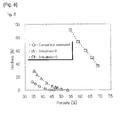
- Table 9 shows a relationship between porosity and hardness in a compaction molded body of powdered milk manufactured by changing compaction pressure at the time of compaction molding regarding to the powdered milk of Example 7, 8 and Comparison Example 3.
- Fig.7 shows a relationship between porosity (30 percents-75 percents) and hardness in a compaction molded body of powdered milk produced by changing compaction pressure at the time of compaction molding regarding to the solid milk of Example 7, 8 and Comparison Example 3.
- Example 1-3 and Comparison Example 1 to Example 7, 8 and Comparison Example 3 it was not changed that the more hardness and porosity could be widely selected by changing the compaction pressure, the higher the gas mix rate was if the gas to disperse in the gas dispersal process differed.
- powdered milk having the same components was used. Therefore, inventors researched by using powdered milk having different components.
- powdered milk having different components from Example 7, 8 and Comparison Example 3 which comprised fats 26g, proteins 12g, carbohydrate 57g, and other 5g per powdered milk 100 g (hereinafter referred it as powdered milk B).
- powdered milk B which comprised fats 26g, proteins 12g, carbohydrate 57g, and other 5g per powdered milk 100 g
- powdered milk A in case of using powdered milk at Example 7, 8 and Comparison Example 3
- Example 9, 10 and Comparison Example 4 Example 9, 10 and Comparison Example 4
- Methods of manufacturing powdered milk and solid milk in Example 9, 10 and Comparison Example 4 are the same as Example 7, 8 and Comparison Example 3 except for using different component powdered milk. Thus, these explanations are omitted.
- Example 9 powdered milk was manufactured as the same as Example 7. In this case N 2 mix ratio was 6 percents.
- the powdered milk obtained from this method was bulkier than powdered milk in the comparison example as described below.
- An analysis of manufactured powdered milk component carried out found that the component of the obtained powdered milk was the same as the powdered milk B.
- Example 10 powdererd milk was manufactured as the same as Example 9 except for 270 percents of N 2 mix ratio.
- the powdered milk obtained from this method was bulkier than powdered milk in the comparison example as described below.
- An analysis of manufactured powdered milk component carried out found that the component of the obtained powdered milk was the same as the powdered milk B.
- powdered milk was manufactured as the same as Example 9 except for 0 percent of N 2 mix rate in the gas dispersal process (in other words, the process was skipped).
- the result of component of the manufactured powdered milk was perfectly the same as the powdered milk B.
- the component of the obtained powdered milk 100 g comprised fats 26g, proteins 12g, carbohydrate 57g, and other 5g.
- Example 9 solid milk was also manufactured as the same as Example 7.
- the powdered milk was prepared to make a rectangular parallelepiped as an outward form by the abovementioned single-punch tableting machine. Amount of usage of powdered milk was adjusted to 5.4 g of solid milk per piece after the compaction molding process.
- inventors In order to verify whether solid milk could have the required hardness as well by changing compaction pressure in compaction molding, inventors actually produced individual solid milk from powdered milk of Example 9, 10 and Comparison Example 4, and they measured porosity and hardness of the solid milk. However, only the compaction molding process was performed here for manufacturing the solid milk.
- Table 10 shows a relationship between porosity and hardness in a compaction molded body of powdered milk manufactured by changing compaction pressure at the time of compaction molding regarding to the powdered milk of Example 9, 10 and Comparison Example 4.
- Fig.8 shows a relationship between porosity (30 percents-75 percents) and hardness in a compaction molded body of powdered milk produced by changing compaction pressure at the time of compaction molding regarding to the powdered milk of Example 9, 10 and Comparison Example 4.
- the present invention can be applied to the dairy industry, the dairy farming, powder manufacturing industry or solid manufacturing industry since the invention refers to the method for manufacturing solid milk from powdered milk.
Landscapes
- Life Sciences & Earth Sciences (AREA)
- Chemical & Material Sciences (AREA)
- Engineering & Computer Science (AREA)
- Food Science & Technology (AREA)
- Polymers & Plastics (AREA)
- Dairy Products (AREA)
Claims (8)
- Procédé de fabrication de lait à l'état solide, comprenant :un processus de dispersion gazeuse (S112) destiné à disperser un gaz prescrit dans du lait liquide ;un processus de séchage par atomisation (S114) destiné à obtenir du lait en poudre en atomisant le lait liquide après le processus de dispersion gazeuse (S112), et séchage du lait liquide atomisé ; etun processus de moulage par compactage (S130) destiné à obtenir un corps solidifié moulé par compactage de lait en poudre produit en compactant le lait en poudre après le processus de dispersion gazeuse (S112) et le processus de séchage par atomisation (S114), dans lequel le gaz prescrit est un ou plusieurs gaz choisis dans le groupe comprenant du dioxyde de carbone, de l'air, de l'azote, de l'oxygène et un gaz rare.
- Procédé de fabrication de lait à l'état solide selon la revendication 1 , dans lequel le volume de gaz à disperser représente 1x10⁻² fois à 7 fois le volume du lait liquide.
- Procédé de fabrication de lait à l'état solide selon la revendication 1 , dans lequel le lait liquide où le gaz prescrit est dispersé dans le processus de dispersion gazeuse (S112) est du lait liquide concentré.
- Procédé de fabrication de lait à l'état solide selon la revendication 1 , dans lequel le processus de dispersion gazeuse (S112) comprend un processus destiné à mélanger le gaz prescrit, qui est sous pression, dans le lait liquide.
- Procédé de fabrication de lait à l'état solide selon la revendication 1 , dans lequel le processus de dispersion gazeuse (S112) comprend un processus destiné à verser le lait liquide le long d'une trajectoire, dans lequel le rapport du flux volumique du gaz prescrit par rapport au lait liquide est de 1 x10⁻² fois à 7 fois.
- Procédé de fabrication de lait à l'état solide selon la revendication 1 , dans lequel le processus de séchage par atomisation (S114) est un processus destiné à atomiser du lait liquide ayant le gaz prescrit dispersé, dans lequel la densité de remplissage du lait liquide est faible dans le processus de dispersion gazeuse (S112).
- Procédé de fabrication de lait à l'état solide selon la revendication 1 , comprenant en outre, avant le processus de moulage par compactage (S130) : un processus de classification (S120) destiné à obtenir un lait en poudre ayant un diamètre des particules supérieur au diamètre des particules prescrit par la classification du lait en poudre obtenu lors du processus de séchage par atomisation (S114).
- Procédé de fabrication de lait à l'état solide selon la revendication 1 , comprenant en outre, après le processus de moulage par compactage (S130) : un processus d'humidification (S140) destiné à humidifier le corps de compactage moulé du lait en poudre obtenu lors du processus de moulage par compactage (S130) ; un processus de séchage (S160) destiné à sécher le corps de compactage moulé du lait en poudre humidifié lors du processus d'humidification (S140).
Priority Applications (3)
| Application Number | Priority Date | Filing Date | Title |
|---|---|---|---|
| EP18155297.7A EP3342292B8 (fr) | 2008-12-26 | 2009-12-25 | Lait solide et son procédé de fabrication |
| DK15167757.2T DK2926666T3 (en) | 2008-12-26 | 2009-12-25 | Milk in solid form and process for its preparation |
| EP15167757.2A EP2926666B1 (fr) | 2008-12-26 | 2009-12-25 | Lait à l'état solide et procédé de fabrication associé |
Applications Claiming Priority (2)
| Application Number | Priority Date | Filing Date | Title |
|---|---|---|---|
| JP2008335154 | 2008-12-26 | ||
| PCT/JP2009/007289 WO2010073715A1 (fr) | 2008-12-26 | 2009-12-25 | Lait à l'état solide et procédé de fabrication associé |
Related Child Applications (3)
| Application Number | Title | Priority Date | Filing Date |
|---|---|---|---|
| EP18155297.7A Division EP3342292B8 (fr) | 2008-12-26 | 2009-12-25 | Lait solide et son procédé de fabrication |
| EP15167757.2A Division EP2926666B1 (fr) | 2008-12-26 | 2009-12-25 | Lait à l'état solide et procédé de fabrication associé |
| EP15167757.2A Division-Into EP2926666B1 (fr) | 2008-12-26 | 2009-12-25 | Lait à l'état solide et procédé de fabrication associé |
Publications (3)
| Publication Number | Publication Date |
|---|---|
| EP2369940A1 EP2369940A1 (fr) | 2011-10-05 |
| EP2369940A4 EP2369940A4 (fr) | 2012-11-21 |
| EP2369940B1 true EP2369940B1 (fr) | 2015-07-08 |
Family
ID=42287348
Family Applications (3)
| Application Number | Title | Priority Date | Filing Date |
|---|---|---|---|
| EP18155297.7A Active EP3342292B8 (fr) | 2008-12-26 | 2009-12-25 | Lait solide et son procédé de fabrication |
| EP09834521.8A Active EP2369940B1 (fr) | 2008-12-26 | 2009-12-25 | Lait à l'état solide et procédé de fabrication associé |
| EP15167757.2A Active EP2926666B1 (fr) | 2008-12-26 | 2009-12-25 | Lait à l'état solide et procédé de fabrication associé |
Family Applications Before (1)
| Application Number | Title | Priority Date | Filing Date |
|---|---|---|---|
| EP18155297.7A Active EP3342292B8 (fr) | 2008-12-26 | 2009-12-25 | Lait solide et son procédé de fabrication |
Family Applications After (1)
| Application Number | Title | Priority Date | Filing Date |
|---|---|---|---|
| EP15167757.2A Active EP2926666B1 (fr) | 2008-12-26 | 2009-12-25 | Lait à l'état solide et procédé de fabrication associé |
Country Status (12)
| Country | Link |
|---|---|
| US (2) | US20110236555A1 (fr) |
| EP (3) | EP3342292B8 (fr) |
| JP (4) | JP5688020B2 (fr) |
| CN (2) | CN104663903B (fr) |
| AU (1) | AU2009332212B2 (fr) |
| CA (2) | CA2956641C (fr) |
| DK (3) | DK2926666T3 (fr) |
| ES (3) | ES2668466T3 (fr) |
| NZ (1) | NZ593253A (fr) |
| SG (1) | SG172103A1 (fr) |
| TW (1) | TWI574625B (fr) |
| WO (1) | WO2010073715A1 (fr) |
Families Citing this family (12)
| Publication number | Priority date | Publication date | Assignee | Title |
|---|---|---|---|---|
| ES2668466T3 (es) | 2008-12-26 | 2018-05-18 | Meiji Co., Ltd. | Leche en estado sólido y método de fabricación de la misma |
| WO2016032320A1 (fr) * | 2014-08-29 | 2016-03-03 | N.V. Nutricia | Tablettes de lait solide comprimées et leur procédé de fabrication |
| US9907323B2 (en) | 2015-09-25 | 2018-03-06 | Mead Johnson Nutrition Co. | Infant formula tablets |
| WO2019023250A1 (fr) * | 2017-07-26 | 2019-01-31 | Abbott Laboratories | Comprimés nutritionnels et leurs procédés de fabrication |
| WO2021049201A1 (fr) | 2019-09-13 | 2021-03-18 | 株式会社明治 | Procédé de production d'un produit alimentaire solide et procédé de production de lait solide |
| CN114375162B (zh) | 2019-09-13 | 2025-01-24 | 株式会社明治 | 固体食品和固体奶 |
| AU2020347662A1 (en) * | 2019-09-13 | 2022-03-31 | Meiji Co., Ltd. | Solid food and solid milk |
| JP7732988B2 (ja) * | 2020-07-31 | 2025-09-02 | 株式会社明治 | 固形乳 |
| US12478073B2 (en) | 2020-07-31 | 2025-11-25 | Meiji Co., Ltd. | Solid food and solid milk |
| CN116056582A (zh) * | 2020-07-31 | 2023-05-02 | 株式会社明治 | 固体奶 |
| WO2022024442A1 (fr) * | 2020-07-31 | 2022-02-03 | 株式会社明治 | Aliment solide et lait solide |
| JP7732989B2 (ja) * | 2020-07-31 | 2025-09-02 | 株式会社明治 | 固形乳 |
Citations (5)
| Publication number | Priority date | Publication date | Assignee | Title |
|---|---|---|---|---|
| US3072486A (en) | 1959-06-30 | 1963-01-08 | Et Oakes Corp | Preparation for soluble milk powder |
| US3185580A (en) | 1962-07-09 | 1965-05-25 | Francis P Hanrahan | Process for making puff spray dried nonfat dry milk and related products |
| WO2002062152A1 (fr) | 2001-02-02 | 2002-08-15 | Societe Des Produits Nestle S.A. | Poudres et comprimes solubles dans l'eau |
| EP1769682A1 (fr) | 2004-07-02 | 2007-04-04 | Meiji Dairies Corporation | Lait solide et procédé de production de celui-ci |
| WO2007077970A1 (fr) | 2005-12-28 | 2007-07-12 | Meiji Dairies Corporation | Lait solide et son procede de fabrication |
Family Cites Families (15)
| Publication number | Priority date | Publication date | Assignee | Title |
|---|---|---|---|---|
| US1406381A (en) * | 1920-04-12 | 1922-02-14 | Heath Wilfrid Paul | Process of manufacturing powdered milk and other food products |
| GB637795A (en) * | 1945-11-01 | 1950-05-24 | Svenska Mjoelkprodukter Ab | Improvements in spray drying processes |
| US2788276A (en) * | 1953-04-01 | 1957-04-09 | Standard Brands Inc | Spray drying foamed material |
| JPS494948B1 (fr) * | 1970-12-26 | 1974-02-04 | ||
| US4438147A (en) * | 1982-06-25 | 1984-03-20 | Societe D'assistance Technique Pour Produits Nestle S.A. | Foaming creamer and method of making same |
| US4767308A (en) | 1986-01-21 | 1988-08-30 | Group Lotus Plc | Mould for moulding an article |
| JP2808016B2 (ja) * | 1989-07-31 | 1998-10-08 | 森永乳業株式会社 | 泡沫噴霧乾燥法、その装置および粉末クリームの製造法 |
| JPH06245698A (ja) * | 1993-02-22 | 1994-09-06 | Morinaga Milk Ind Co Ltd | 保存性が改善された含脂粉乳の製造方法 |
| DK0885566T3 (da) * | 1997-06-19 | 2002-11-04 | Nestle Sa | Opløseligt middel med flødelignende egenskaber til drikkevarer |
| GB2381731A (en) * | 2001-11-12 | 2003-05-14 | Mars Inc | Beverage whitener formulations |
| JP4603028B2 (ja) * | 2004-07-02 | 2010-12-22 | 明治乳業株式会社 | 固形乳,及びその製造方法 |
| JP4618813B2 (ja) * | 2004-07-02 | 2011-01-26 | 明治乳業株式会社 | 固形乳,及びその製造方法 |
| JP4691925B2 (ja) * | 2004-08-05 | 2011-06-01 | 田辺三菱製薬株式会社 | 圧縮成型製剤の製造方法 |
| KR20050012209A (ko) * | 2004-12-29 | 2005-01-31 | 박주환 | 고체 상태의 알약 식 우유 |
| ES2668466T3 (es) | 2008-12-26 | 2018-05-18 | Meiji Co., Ltd. | Leche en estado sólido y método de fabricación de la misma |
-
2009
- 2009-12-25 ES ES15167757.2T patent/ES2668466T3/es active Active
- 2009-12-25 CN CN201510032719.8A patent/CN104663903B/zh active Active
- 2009-12-25 DK DK15167757.2T patent/DK2926666T3/en active
- 2009-12-25 DK DK18155297T patent/DK3342292T3/da active
- 2009-12-25 ES ES09834521.8T patent/ES2548456T3/es active Active
- 2009-12-25 EP EP18155297.7A patent/EP3342292B8/fr active Active
- 2009-12-25 CA CA2956641A patent/CA2956641C/fr active Active
- 2009-12-25 AU AU2009332212A patent/AU2009332212B2/en active Active
- 2009-12-25 DK DK09834521.8T patent/DK2369940T3/en active
- 2009-12-25 JP JP2011526342A patent/JP5688020B2/ja active Active
- 2009-12-25 EP EP09834521.8A patent/EP2369940B1/fr active Active
- 2009-12-25 CN CN2009801528712A patent/CN102264236A/zh active Pending
- 2009-12-25 WO PCT/JP2009/007289 patent/WO2010073715A1/fr not_active Ceased
- 2009-12-25 NZ NZ593253A patent/NZ593253A/en unknown
- 2009-12-25 EP EP15167757.2A patent/EP2926666B1/fr active Active
- 2009-12-25 SG SG2011042827A patent/SG172103A1/en unknown
- 2009-12-25 TW TW098145103A patent/TWI574625B/zh active
- 2009-12-25 CA CA2763672A patent/CA2763672C/fr active Active
- 2009-12-25 ES ES18155297T patent/ES2750827T3/es active Active
- 2009-12-25 US US13/133,974 patent/US20110236555A1/en not_active Abandoned
-
2015
- 2015-01-21 JP JP2015009864A patent/JP2015070859A/ja active Pending
-
2016
- 2016-08-03 JP JP2016153242A patent/JP6301407B2/ja active Active
-
2018
- 2018-02-28 JP JP2018034393A patent/JP6639543B2/ja active Active
-
2019
- 2019-09-05 US US16/562,010 patent/US11096398B2/en active Active
Patent Citations (5)
| Publication number | Priority date | Publication date | Assignee | Title |
|---|---|---|---|---|
| US3072486A (en) | 1959-06-30 | 1963-01-08 | Et Oakes Corp | Preparation for soluble milk powder |
| US3185580A (en) | 1962-07-09 | 1965-05-25 | Francis P Hanrahan | Process for making puff spray dried nonfat dry milk and related products |
| WO2002062152A1 (fr) | 2001-02-02 | 2002-08-15 | Societe Des Produits Nestle S.A. | Poudres et comprimes solubles dans l'eau |
| EP1769682A1 (fr) | 2004-07-02 | 2007-04-04 | Meiji Dairies Corporation | Lait solide et procédé de production de celui-ci |
| WO2007077970A1 (fr) | 2005-12-28 | 2007-07-12 | Meiji Dairies Corporation | Lait solide et son procede de fabrication |
Non-Patent Citations (3)
| Title |
|---|
| BELL ET AL.: "foam spray drying methods of making readily dispersible nonfat dry milk", JOURNAL OF DAIRY SCIENCE, vol. 46, no. 12, 1963, pages 1352 - 1356, XP009163680 |
| HANRAHAN ET AL.: "production and properties of spray dried whole milk foam", JOURNAL OF DAIRY SCIENCE, vol. 45, no. 1, 1962, pages 27 - 31, XP009163681 |
| TAMSMA ET AL.: "reconstitutability of spray dried milk products containing 26 or 13 fat", JOURNAL OF DAIRY SCIENCE, vol. 58, no. 10, 1975, pages 1433 - 1436, XP055270157 |
Also Published As
Similar Documents
| Publication | Publication Date | Title |
|---|---|---|
| EP2369940B1 (fr) | Lait à l'état solide et procédé de fabrication associé | |
| EP2369941B1 (fr) | Procédé de fabrication de lait à l'état solide | |
| EP1769682B1 (fr) | Lait solide et procédé de production de celui-ci | |
| KR101106659B1 (ko) | 고형유 및 이의 제조방법 | |
| HK1213437B (en) | Solid milk and method for manufacture thereof | |
| HK1159952A (en) | Solid milk and method for manufacture thereof |
Legal Events
| Date | Code | Title | Description |
|---|---|---|---|
| PUAI | Public reference made under article 153(3) epc to a published international application that has entered the european phase |
Free format text: ORIGINAL CODE: 0009012 |
|
| 17P | Request for examination filed |
Effective date: 20110527 |
|
| AK | Designated contracting states |
Kind code of ref document: A1 Designated state(s): AT BE BG CH CY CZ DE DK EE ES FI FR GB GR HR HU IE IS IT LI LT LU LV MC MK MT NL NO PL PT RO SE SI SK SM TR |
|
| DAX | Request for extension of the european patent (deleted) | ||
| A4 | Supplementary search report drawn up and despatched |
Effective date: 20121024 |
|
| RIC1 | Information provided on ipc code assigned before grant |
Ipc: A23C 1/04 20060101ALI20121019BHEP Ipc: A23C 9/18 20060101AFI20121019BHEP |
|
| 17Q | First examination report despatched |
Effective date: 20130813 |
|
| GRAP | Despatch of communication of intention to grant a patent |
Free format text: ORIGINAL CODE: EPIDOSNIGR1 |
|
| INTG | Intention to grant announced |
Effective date: 20150205 |
|
| GRAS | Grant fee paid |
Free format text: ORIGINAL CODE: EPIDOSNIGR3 |
|
| GRAA | (expected) grant |
Free format text: ORIGINAL CODE: 0009210 |
|
| AK | Designated contracting states |
Kind code of ref document: B1 Designated state(s): AT BE BG CH CY CZ DE DK EE ES FI FR GB GR HR HU IE IS IT LI LT LU LV MC MK MT NL NO PL PT RO SE SI SK SM TR |
|
| REG | Reference to a national code |
Ref country code: GB Ref legal event code: FG4D |
|
| REG | Reference to a national code |
Ref country code: AT Ref legal event code: REF Ref document number: 734653 Country of ref document: AT Kind code of ref document: T Effective date: 20150715 Ref country code: CH Ref legal event code: EP |
|
| REG | Reference to a national code |
Ref country code: CH Ref legal event code: NV Representative=s name: FIAMMENGHI-FIAMMENGHI, CH |
|
| REG | Reference to a national code |
Ref country code: IE Ref legal event code: FG4D |
|
| REG | Reference to a national code |
Ref country code: DE Ref legal event code: R096 Ref document number: 602009032161 Country of ref document: DE |
|
| REG | Reference to a national code |
Ref country code: DK Ref legal event code: T3 Effective date: 20150911 |
|
| REG | Reference to a national code |
Ref country code: SE Ref legal event code: TRGR |
|
| REG | Reference to a national code |
Ref country code: ES Ref legal event code: FG2A Ref document number: 2548456 Country of ref document: ES Kind code of ref document: T3 Effective date: 20151016 |
|
| REG | Reference to a national code |
Ref country code: AT Ref legal event code: MK05 Ref document number: 734653 Country of ref document: AT Kind code of ref document: T Effective date: 20150708 |
|
| REG | Reference to a national code |
Ref country code: NL Ref legal event code: FP |
|
| REG | Reference to a national code |
Ref country code: FR Ref legal event code: PLFP Year of fee payment: 7 |
|
| REG | Reference to a national code |
Ref country code: LT Ref legal event code: MG4D |
|
| PG25 | Lapsed in a contracting state [announced via postgrant information from national office to epo] |
Ref country code: NO Free format text: LAPSE BECAUSE OF FAILURE TO SUBMIT A TRANSLATION OF THE DESCRIPTION OR TO PAY THE FEE WITHIN THE PRESCRIBED TIME-LIMIT Effective date: 20151008 Ref country code: GR Free format text: LAPSE BECAUSE OF FAILURE TO SUBMIT A TRANSLATION OF THE DESCRIPTION OR TO PAY THE FEE WITHIN THE PRESCRIBED TIME-LIMIT Effective date: 20151009 Ref country code: LV Free format text: LAPSE BECAUSE OF FAILURE TO SUBMIT A TRANSLATION OF THE DESCRIPTION OR TO PAY THE FEE WITHIN THE PRESCRIBED TIME-LIMIT Effective date: 20150708 Ref country code: FI Free format text: LAPSE BECAUSE OF FAILURE TO SUBMIT A TRANSLATION OF THE DESCRIPTION OR TO PAY THE FEE WITHIN THE PRESCRIBED TIME-LIMIT Effective date: 20150708 Ref country code: LT Free format text: LAPSE BECAUSE OF FAILURE TO SUBMIT A TRANSLATION OF THE DESCRIPTION OR TO PAY THE FEE WITHIN THE PRESCRIBED TIME-LIMIT Effective date: 20150708 |
|
| PG25 | Lapsed in a contracting state [announced via postgrant information from national office to epo] |
Ref country code: HR Free format text: LAPSE BECAUSE OF FAILURE TO SUBMIT A TRANSLATION OF THE DESCRIPTION OR TO PAY THE FEE WITHIN THE PRESCRIBED TIME-LIMIT Effective date: 20150708 Ref country code: PT Free format text: LAPSE BECAUSE OF FAILURE TO SUBMIT A TRANSLATION OF THE DESCRIPTION OR TO PAY THE FEE WITHIN THE PRESCRIBED TIME-LIMIT Effective date: 20151109 Ref country code: PL Free format text: LAPSE BECAUSE OF FAILURE TO SUBMIT A TRANSLATION OF THE DESCRIPTION OR TO PAY THE FEE WITHIN THE PRESCRIBED TIME-LIMIT Effective date: 20150708 Ref country code: AT Free format text: LAPSE BECAUSE OF FAILURE TO SUBMIT A TRANSLATION OF THE DESCRIPTION OR TO PAY THE FEE WITHIN THE PRESCRIBED TIME-LIMIT Effective date: 20150708 Ref country code: IS Free format text: LAPSE BECAUSE OF FAILURE TO SUBMIT A TRANSLATION OF THE DESCRIPTION OR TO PAY THE FEE WITHIN THE PRESCRIBED TIME-LIMIT Effective date: 20151108 |
|
| REG | Reference to a national code |
Ref country code: DE Ref legal event code: R026 Ref document number: 602009032161 Country of ref document: DE |
|
| PLBI | Opposition filed |
Free format text: ORIGINAL CODE: 0009260 |
|
| PG25 | Lapsed in a contracting state [announced via postgrant information from national office to epo] |
Ref country code: SK Free format text: LAPSE BECAUSE OF FAILURE TO SUBMIT A TRANSLATION OF THE DESCRIPTION OR TO PAY THE FEE WITHIN THE PRESCRIBED TIME-LIMIT Effective date: 20150708 Ref country code: CZ Free format text: LAPSE BECAUSE OF FAILURE TO SUBMIT A TRANSLATION OF THE DESCRIPTION OR TO PAY THE FEE WITHIN THE PRESCRIBED TIME-LIMIT Effective date: 20150708 Ref country code: EE Free format text: LAPSE BECAUSE OF FAILURE TO SUBMIT A TRANSLATION OF THE DESCRIPTION OR TO PAY THE FEE WITHIN THE PRESCRIBED TIME-LIMIT Effective date: 20150708 |
|
| PLAX | Notice of opposition and request to file observation + time limit sent |
Free format text: ORIGINAL CODE: EPIDOSNOBS2 |
|
| 26 | Opposition filed |
Opponent name: N.V. NUTRICIA Effective date: 20160407 |
|
| PG25 | Lapsed in a contracting state [announced via postgrant information from national office to epo] |
Ref country code: RO Free format text: LAPSE BECAUSE OF FAILURE TO SUBMIT A TRANSLATION OF THE DESCRIPTION OR TO PAY THE FEE WITHIN THE PRESCRIBED TIME-LIMIT Effective date: 20150708 |
|
| PG25 | Lapsed in a contracting state [announced via postgrant information from national office to epo] |
Ref country code: LU Free format text: LAPSE BECAUSE OF FAILURE TO SUBMIT A TRANSLATION OF THE DESCRIPTION OR TO PAY THE FEE WITHIN THE PRESCRIBED TIME-LIMIT Effective date: 20151225 Ref country code: MC Free format text: LAPSE BECAUSE OF FAILURE TO SUBMIT A TRANSLATION OF THE DESCRIPTION OR TO PAY THE FEE WITHIN THE PRESCRIBED TIME-LIMIT Effective date: 20150708 |
|
| PG25 | Lapsed in a contracting state [announced via postgrant information from national office to epo] |
Ref country code: SI Free format text: LAPSE BECAUSE OF FAILURE TO SUBMIT A TRANSLATION OF THE DESCRIPTION OR TO PAY THE FEE WITHIN THE PRESCRIBED TIME-LIMIT Effective date: 20150708 |
|
| PLBB | Reply of patent proprietor to notice(s) of opposition received |
Free format text: ORIGINAL CODE: EPIDOSNOBS3 |
|
| REG | Reference to a national code |
Ref country code: FR Ref legal event code: PLFP Year of fee payment: 8 |
|
| RAP2 | Party data changed (patent owner data changed or rights of a patent transferred) |
Owner name: MEIJI CO., LTD. |
|
| PG25 | Lapsed in a contracting state [announced via postgrant information from national office to epo] |
Ref country code: SM Free format text: LAPSE BECAUSE OF FAILURE TO SUBMIT A TRANSLATION OF THE DESCRIPTION OR TO PAY THE FEE WITHIN THE PRESCRIBED TIME-LIMIT Effective date: 20150708 Ref country code: HU Free format text: LAPSE BECAUSE OF FAILURE TO SUBMIT A TRANSLATION OF THE DESCRIPTION OR TO PAY THE FEE WITHIN THE PRESCRIBED TIME-LIMIT; INVALID AB INITIO Effective date: 20091225 |
|
| PG25 | Lapsed in a contracting state [announced via postgrant information from national office to epo] |
Ref country code: CY Free format text: LAPSE BECAUSE OF FAILURE TO SUBMIT A TRANSLATION OF THE DESCRIPTION OR TO PAY THE FEE WITHIN THE PRESCRIBED TIME-LIMIT Effective date: 20150708 |
|
| PG25 | Lapsed in a contracting state [announced via postgrant information from national office to epo] |
Ref country code: TR Free format text: LAPSE BECAUSE OF FAILURE TO SUBMIT A TRANSLATION OF THE DESCRIPTION OR TO PAY THE FEE WITHIN THE PRESCRIBED TIME-LIMIT Effective date: 20150708 Ref country code: MT Free format text: LAPSE BECAUSE OF FAILURE TO SUBMIT A TRANSLATION OF THE DESCRIPTION OR TO PAY THE FEE WITHIN THE PRESCRIBED TIME-LIMIT Effective date: 20150708 |
|
| REG | Reference to a national code |
Ref country code: DE Ref legal event code: R100 Ref document number: 602009032161 Country of ref document: DE |
|
| PLCK | Communication despatched that opposition was rejected |
Free format text: ORIGINAL CODE: EPIDOSNREJ1 |
|
| REG | Reference to a national code |
Ref country code: FR Ref legal event code: PLFP Year of fee payment: 9 |
|
| PLBN | Opposition rejected |
Free format text: ORIGINAL CODE: 0009273 |
|
| STAA | Information on the status of an ep patent application or granted ep patent |
Free format text: STATUS: OPPOSITION REJECTED |
|
| 27O | Opposition rejected |
Effective date: 20170912 |
|
| REG | Reference to a national code |
Ref country code: BE Ref legal event code: FP Effective date: 20151001 |
|
| PG25 | Lapsed in a contracting state [announced via postgrant information from national office to epo] |
Ref country code: MK Free format text: LAPSE BECAUSE OF FAILURE TO SUBMIT A TRANSLATION OF THE DESCRIPTION OR TO PAY THE FEE WITHIN THE PRESCRIBED TIME-LIMIT Effective date: 20150708 |
|
| P01 | Opt-out of the competence of the unified patent court (upc) registered |
Effective date: 20230516 |
|
| PGFP | Annual fee paid to national office [announced via postgrant information from national office to epo] |
Ref country code: NL Payment date: 20251112 Year of fee payment: 17 |
|
| REG | Reference to a national code |
Ref country code: CH Ref legal event code: U11 Free format text: ST27 STATUS EVENT CODE: U-0-0-U10-U11 (AS PROVIDED BY THE NATIONAL OFFICE) Effective date: 20260101 |
|
| PGFP | Annual fee paid to national office [announced via postgrant information from national office to epo] |
Ref country code: DE Payment date: 20251028 Year of fee payment: 17 |
|
| PGFP | Annual fee paid to national office [announced via postgrant information from national office to epo] |
Ref country code: GB Payment date: 20251114 Year of fee payment: 17 |
|
| PGFP | Annual fee paid to national office [announced via postgrant information from national office to epo] |
Ref country code: IT Payment date: 20251121 Year of fee payment: 17 Ref country code: DK Payment date: 20251212 Year of fee payment: 17 |
|
| PGFP | Annual fee paid to national office [announced via postgrant information from national office to epo] |
Ref country code: FR Payment date: 20251110 Year of fee payment: 17 |
|
| PGFP | Annual fee paid to national office [announced via postgrant information from national office to epo] |
Ref country code: BE Payment date: 20251117 Year of fee payment: 17 |
|
| PGFP | Annual fee paid to national office [announced via postgrant information from national office to epo] |
Ref country code: SE Payment date: 20251112 Year of fee payment: 17 |
|
| PGFP | Annual fee paid to national office [announced via postgrant information from national office to epo] |
Ref country code: IE Payment date: 20251111 Year of fee payment: 17 |
|
| PGFP | Annual fee paid to national office [announced via postgrant information from national office to epo] |
Ref country code: BG Payment date: 20251031 Year of fee payment: 17 |
|
| PGFP | Annual fee paid to national office [announced via postgrant information from national office to epo] |
Ref country code: ES Payment date: 20260108 Year of fee payment: 17 |
|
| PGFP | Annual fee paid to national office [announced via postgrant information from national office to epo] |
Ref country code: CH Payment date: 20260101 Year of fee payment: 17 |