EP2370809B1 - Détecteur électrochimique de gaz avec un système électrolytique ionique liquide comprenant au moins un cation monoalkylammonium, dialkylammonium ou trialkylammonium - Google Patents
Détecteur électrochimique de gaz avec un système électrolytique ionique liquide comprenant au moins un cation monoalkylammonium, dialkylammonium ou trialkylammonium Download PDFInfo
- Publication number
- EP2370809B1 EP2370809B1 EP09760851.7A EP09760851A EP2370809B1 EP 2370809 B1 EP2370809 B1 EP 2370809B1 EP 09760851 A EP09760851 A EP 09760851A EP 2370809 B1 EP2370809 B1 EP 2370809B1
- Authority
- EP
- European Patent Office
- Prior art keywords
- electrolyte
- gas sensor
- additive
- electrochemical gas
- anion
- Prior art date
- Legal status (The legal status is an assumption and is not a legal conclusion. Google has not performed a legal analysis and makes no representation as to the accuracy of the status listed.)
- Revoked
Links
- 239000003792 electrolyte Substances 0.000 title claims description 101
- 239000002608 ionic liquid Substances 0.000 title claims description 68
- -1 trialkylammonium cation Chemical class 0.000 title claims description 42
- 125000005131 dialkylammonium group Chemical group 0.000 title description 2
- 239000000654 additive Substances 0.000 claims description 90
- 230000000996 additive effect Effects 0.000 claims description 61
- VYPSYNLAJGMNEJ-UHFFFAOYSA-N Silicium dioxide Chemical compound O=[Si]=O VYPSYNLAJGMNEJ-UHFFFAOYSA-N 0.000 claims description 32
- 150000001768 cations Chemical class 0.000 claims description 20
- 229910052751 metal Inorganic materials 0.000 claims description 18
- 239000002184 metal Substances 0.000 claims description 18
- 239000011343 solid material Substances 0.000 claims description 17
- 239000000203 mixture Substances 0.000 claims description 16
- 239000006259 organic additive Substances 0.000 claims description 15
- 239000000377 silicon dioxide Substances 0.000 claims description 15
- 239000007787 solid Substances 0.000 claims description 15
- 125000000217 alkyl group Chemical group 0.000 claims description 14
- 150000001450 anions Chemical class 0.000 claims description 14
- AHRQMWOXLCFNAV-UHFFFAOYSA-O ethylammonium nitrate Chemical compound CC[NH3+].[O-][N+]([O-])=O AHRQMWOXLCFNAV-UHFFFAOYSA-O 0.000 claims description 14
- 229910052681 coesite Inorganic materials 0.000 claims description 13
- 229910052906 cristobalite Inorganic materials 0.000 claims description 13
- RAXXELZNTBOGNW-UHFFFAOYSA-N imidazole Natural products C1=CNC=N1 RAXXELZNTBOGNW-UHFFFAOYSA-N 0.000 claims description 13
- 229910052682 stishovite Inorganic materials 0.000 claims description 13
- 229910052905 tridymite Inorganic materials 0.000 claims description 13
- QGZKDVFQNNGYKY-UHFFFAOYSA-N Ammonia Chemical compound N QGZKDVFQNNGYKY-UHFFFAOYSA-N 0.000 claims description 12
- 125000002524 organometallic group Chemical group 0.000 claims description 12
- BPQQTUXANYXVAA-UHFFFAOYSA-N Orthosilicate Chemical compound [O-][Si]([O-])([O-])[O-] BPQQTUXANYXVAA-UHFFFAOYSA-N 0.000 claims description 10
- JUJWROOIHBZHMG-UHFFFAOYSA-N Pyridine Chemical compound C1=CC=NC=C1 JUJWROOIHBZHMG-UHFFFAOYSA-N 0.000 claims description 9
- RAHZWNYVWXNFOC-UHFFFAOYSA-N Sulphur dioxide Chemical compound O=S=O RAHZWNYVWXNFOC-UHFFFAOYSA-N 0.000 claims description 9
- 150000003839 salts Chemical class 0.000 claims description 9
- OKTJSMMVPCPJKN-UHFFFAOYSA-N Carbon Chemical compound [C] OKTJSMMVPCPJKN-UHFFFAOYSA-N 0.000 claims description 8
- KAESVJOAVNADME-UHFFFAOYSA-N Pyrrole Chemical compound C=1C=CNC=1 KAESVJOAVNADME-UHFFFAOYSA-N 0.000 claims description 8
- 239000003513 alkali Substances 0.000 claims description 8
- UYTPUPDQBNUYGX-UHFFFAOYSA-N guanine Chemical compound O=C1NC(N)=NC2=C1N=CN2 UYTPUPDQBNUYGX-UHFFFAOYSA-N 0.000 claims description 8
- 239000002253 acid Substances 0.000 claims description 7
- 239000003365 glass fiber Substances 0.000 claims description 7
- 229910052697 platinum Inorganic materials 0.000 claims description 7
- WPYMKLBDIGXBTP-UHFFFAOYSA-N benzoic acid Chemical compound OC(=O)C1=CC=CC=C1 WPYMKLBDIGXBTP-UHFFFAOYSA-N 0.000 claims description 6
- 229910052799 carbon Inorganic materials 0.000 claims description 6
- 125000004432 carbon atom Chemical group C* 0.000 claims description 6
- 238000001514 detection method Methods 0.000 claims description 6
- 229910052737 gold Inorganic materials 0.000 claims description 6
- 229910052736 halogen Inorganic materials 0.000 claims description 6
- 150000002367 halogens Chemical class 0.000 claims description 6
- 229910052741 iridium Inorganic materials 0.000 claims description 6
- RBTARNINKXHZNM-UHFFFAOYSA-K iron trichloride Chemical compound Cl[Fe](Cl)Cl RBTARNINKXHZNM-UHFFFAOYSA-K 0.000 claims description 6
- RLJMLMKIBZAXJO-UHFFFAOYSA-N lead nitrate Chemical compound [O-][N+](=O)O[Pb]O[N+]([O-])=O RLJMLMKIBZAXJO-UHFFFAOYSA-N 0.000 claims description 6
- AMXOYNBUYSYVKV-UHFFFAOYSA-M lithium bromide Chemical compound [Li+].[Br-] AMXOYNBUYSYVKV-UHFFFAOYSA-M 0.000 claims description 6
- HSZCZNFXUDYRKD-UHFFFAOYSA-M lithium iodide Chemical compound [Li+].[I-] HSZCZNFXUDYRKD-UHFFFAOYSA-M 0.000 claims description 6
- MIVBAHRSNUNMPP-UHFFFAOYSA-N manganese(2+);dinitrate Chemical compound [Mn+2].[O-][N+]([O-])=O.[O-][N+]([O-])=O MIVBAHRSNUNMPP-UHFFFAOYSA-N 0.000 claims description 6
- DPKBAXPHAYBPRL-UHFFFAOYSA-M tetrabutylazanium;iodide Chemical compound [I-].CCCC[N+](CCCC)(CCCC)CCCC DPKBAXPHAYBPRL-UHFFFAOYSA-M 0.000 claims description 6
- RWSOTUBLDIXVET-UHFFFAOYSA-N Dihydrogen sulfide Chemical compound S RWSOTUBLDIXVET-UHFFFAOYSA-N 0.000 claims description 5
- 229910052802 copper Inorganic materials 0.000 claims description 5
- 150000004820 halides Chemical class 0.000 claims description 5
- 238000005259 measurement Methods 0.000 claims description 5
- 230000007935 neutral effect Effects 0.000 claims description 5
- 229910052759 nickel Inorganic materials 0.000 claims description 5
- 229910052763 palladium Inorganic materials 0.000 claims description 5
- UMJSCPRVCHMLSP-UHFFFAOYSA-N pyridine Natural products COC1=CC=CN=C1 UMJSCPRVCHMLSP-UHFFFAOYSA-N 0.000 claims description 5
- 229910052703 rhodium Inorganic materials 0.000 claims description 5
- 229910052719 titanium Inorganic materials 0.000 claims description 5
- 229910015148 B2H6 Inorganic materials 0.000 claims description 4
- BLRPTPMANUNPDV-UHFFFAOYSA-N Silane Chemical compound [SiH4] BLRPTPMANUNPDV-UHFFFAOYSA-N 0.000 claims description 4
- RBFQJDQYXXHULB-UHFFFAOYSA-N arsane Chemical compound [AsH3] RBFQJDQYXXHULB-UHFFFAOYSA-N 0.000 claims description 4
- 229910000070 arsenic hydride Inorganic materials 0.000 claims description 4
- OSVXSBDYLRYLIG-UHFFFAOYSA-N chlorine dioxide Inorganic materials O=Cl=O OSVXSBDYLRYLIG-UHFFFAOYSA-N 0.000 claims description 4
- QBWCMBCROVPCKQ-UHFFFAOYSA-N chlorous acid Chemical compound OCl=O QBWCMBCROVPCKQ-UHFFFAOYSA-N 0.000 claims description 4
- QUZPNFFHZPRKJD-UHFFFAOYSA-N germane Chemical compound [GeH4] QUZPNFFHZPRKJD-UHFFFAOYSA-N 0.000 claims description 4
- 229910052986 germanium hydride Inorganic materials 0.000 claims description 4
- 230000001590 oxidative effect Effects 0.000 claims description 4
- 239000002245 particle Substances 0.000 claims description 4
- 229910000073 phosphorus hydride Inorganic materials 0.000 claims description 4
- XZXYQEHISUMZAT-UHFFFAOYSA-N 2-[(2-hydroxy-5-methylphenyl)methyl]-4-methylphenol Chemical compound CC1=CC=C(O)C(CC=2C(=CC=C(C)C=2)O)=C1 XZXYQEHISUMZAT-UHFFFAOYSA-N 0.000 claims description 3
- QTBSBXVTEAMEQO-UHFFFAOYSA-M Acetate Chemical compound CC([O-])=O QTBSBXVTEAMEQO-UHFFFAOYSA-M 0.000 claims description 3
- 239000005711 Benzoic acid Substances 0.000 claims description 3
- 229910021556 Chromium(III) chloride Inorganic materials 0.000 claims description 3
- 229910021577 Iron(II) chloride Inorganic materials 0.000 claims description 3
- 229910021578 Iron(III) chloride Inorganic materials 0.000 claims description 3
- 229910021380 Manganese Chloride Inorganic materials 0.000 claims description 3
- GLFNIEUTAYBVOC-UHFFFAOYSA-L Manganese chloride Chemical compound Cl[Mn]Cl GLFNIEUTAYBVOC-UHFFFAOYSA-L 0.000 claims description 3
- NHNBFGGVMKEFGY-UHFFFAOYSA-N Nitrate Chemical compound [O-][N+]([O-])=O NHNBFGGVMKEFGY-UHFFFAOYSA-N 0.000 claims description 3
- IOVCWXUNBOPUCH-UHFFFAOYSA-M Nitrite anion Chemical compound [O-]N=O IOVCWXUNBOPUCH-UHFFFAOYSA-M 0.000 claims description 3
- WTKZEGDFNFYCGP-UHFFFAOYSA-N Pyrazole Chemical compound C=1C=NNC=1 WTKZEGDFNFYCGP-UHFFFAOYSA-N 0.000 claims description 3
- CZPWVGJYEJSRLH-UHFFFAOYSA-N Pyrimidine Chemical compound C1=CN=CN=C1 CZPWVGJYEJSRLH-UHFFFAOYSA-N 0.000 claims description 3
- LEHOTFFKMJEONL-UHFFFAOYSA-N Uric Acid Chemical compound N1C(=O)NC(=O)C2=C1NC(=O)N2 LEHOTFFKMJEONL-UHFFFAOYSA-N 0.000 claims description 3
- TVWHNULVHGKJHS-UHFFFAOYSA-N Uric acid Natural products N1C(=O)NC(=O)C2NC(=O)NC21 TVWHNULVHGKJHS-UHFFFAOYSA-N 0.000 claims description 3
- 150000008051 alkyl sulfates Chemical class 0.000 claims description 3
- 229940107816 ammonium iodide Drugs 0.000 claims description 3
- 235000010233 benzoic acid Nutrition 0.000 claims description 3
- ZCDOYSPFYFSLEW-UHFFFAOYSA-N chromate(2-) Chemical class [O-][Cr]([O-])(=O)=O ZCDOYSPFYFSLEW-UHFFFAOYSA-N 0.000 claims description 3
- QSWDMMVNRMROPK-UHFFFAOYSA-K chromium(3+) trichloride Chemical compound [Cl-].[Cl-].[Cl-].[Cr+3] QSWDMMVNRMROPK-UHFFFAOYSA-K 0.000 claims description 3
- 235000007831 chromium(III) chloride Nutrition 0.000 claims description 3
- 239000011636 chromium(III) chloride Substances 0.000 claims description 3
- NMCUIPGRVMDVDB-UHFFFAOYSA-L iron dichloride Chemical compound Cl[Fe]Cl NMCUIPGRVMDVDB-UHFFFAOYSA-L 0.000 claims description 3
- 235000002867 manganese chloride Nutrition 0.000 claims description 3
- 239000011565 manganese chloride Substances 0.000 claims description 3
- SQQMAOCOWKFBNP-UHFFFAOYSA-L manganese(II) sulfate Chemical compound [Mn+2].[O-]S([O-])(=O)=O SQQMAOCOWKFBNP-UHFFFAOYSA-L 0.000 claims description 3
- JRMUNVKIHCOMHV-UHFFFAOYSA-M tetrabutylammonium bromide Chemical compound [Br-].CCCC[N+](CCCC)(CCCC)CCCC JRMUNVKIHCOMHV-UHFFFAOYSA-M 0.000 claims description 3
- UQFSVBXCNGCBBW-UHFFFAOYSA-M tetraethylammonium iodide Chemical compound [I-].CC[N+](CC)(CC)CC UQFSVBXCNGCBBW-UHFFFAOYSA-M 0.000 claims description 3
- RXMRGBVLCSYIBO-UHFFFAOYSA-M tetramethylazanium;iodide Chemical compound [I-].C[N+](C)(C)C RXMRGBVLCSYIBO-UHFFFAOYSA-M 0.000 claims description 3
- GKXDJYKZFZVASJ-UHFFFAOYSA-M tetrapropylazanium;iodide Chemical compound [I-].CCC[N+](CCC)(CCC)CCC GKXDJYKZFZVASJ-UHFFFAOYSA-M 0.000 claims description 3
- 229940116269 uric acid Drugs 0.000 claims description 3
- 239000011572 manganese Substances 0.000 claims 1
- 239000007789 gas Substances 0.000 description 69
- KWGKDLIKAYFUFQ-UHFFFAOYSA-M lithium chloride Chemical compound [Li+].[Cl-] KWGKDLIKAYFUFQ-UHFFFAOYSA-M 0.000 description 14
- 239000007784 solid electrolyte Substances 0.000 description 14
- 239000012491 analyte Substances 0.000 description 10
- 238000013461 design Methods 0.000 description 9
- 239000000463 material Substances 0.000 description 8
- BASFCYQUMIYNBI-UHFFFAOYSA-N platinum Substances [Pt] BASFCYQUMIYNBI-UHFFFAOYSA-N 0.000 description 8
- 238000006243 chemical reaction Methods 0.000 description 7
- 239000012528 membrane Substances 0.000 description 7
- 230000035945 sensitivity Effects 0.000 description 7
- XLYOFNOQVPJJNP-UHFFFAOYSA-N water Substances O XLYOFNOQVPJJNP-UHFFFAOYSA-N 0.000 description 7
- 230000004044 response Effects 0.000 description 6
- 230000008901 benefit Effects 0.000 description 5
- 239000000499 gel Substances 0.000 description 5
- 239000011244 liquid electrolyte Substances 0.000 description 5
- QAOWNCQODCNURD-UHFFFAOYSA-N Sulfuric acid Chemical compound OS(O)(=O)=O QAOWNCQODCNURD-UHFFFAOYSA-N 0.000 description 4
- 238000010521 absorption reaction Methods 0.000 description 4
- 238000007792 addition Methods 0.000 description 4
- 239000007772 electrode material Substances 0.000 description 4
- 239000010931 gold Substances 0.000 description 4
- 238000000034 method Methods 0.000 description 4
- 239000003054 catalyst Substances 0.000 description 3
- 239000012530 fluid Substances 0.000 description 3
- 229910052739 hydrogen Inorganic materials 0.000 description 3
- 239000001257 hydrogen Substances 0.000 description 3
- 229910000037 hydrogen sulfide Inorganic materials 0.000 description 3
- 239000010416 ion conductor Substances 0.000 description 3
- 239000007788 liquid Substances 0.000 description 3
- 150000002739 metals Chemical class 0.000 description 3
- PTIUDKQYXMFYAI-UHFFFAOYSA-N methylammonium nitrate Chemical compound NC.O[N+]([O-])=O PTIUDKQYXMFYAI-UHFFFAOYSA-N 0.000 description 3
- 229910000069 nitrogen hydride Inorganic materials 0.000 description 3
- 239000008188 pellet Substances 0.000 description 3
- 239000000843 powder Substances 0.000 description 3
- 229920006395 saturated elastomer Polymers 0.000 description 3
- UGFAIRIUMAVXCW-UHFFFAOYSA-N Carbon monoxide Chemical compound [O+]#[C-] UGFAIRIUMAVXCW-UHFFFAOYSA-N 0.000 description 2
- RAXXELZNTBOGNW-UHFFFAOYSA-O Imidazolium Chemical compound C1=C[NH+]=CN1 RAXXELZNTBOGNW-UHFFFAOYSA-O 0.000 description 2
- 125000005210 alkyl ammonium group Chemical group 0.000 description 2
- 229910002091 carbon monoxide Inorganic materials 0.000 description 2
- 238000001311 chemical methods and process Methods 0.000 description 2
- 230000006835 compression Effects 0.000 description 2
- 238000007906 compression Methods 0.000 description 2
- 238000005516 engineering process Methods 0.000 description 2
- QUSNBJAOOMFDIB-UHFFFAOYSA-O ethylaminium Chemical compound CC[NH3+] QUSNBJAOOMFDIB-UHFFFAOYSA-O 0.000 description 2
- 239000002360 explosive Substances 0.000 description 2
- 150000002484 inorganic compounds Chemical class 0.000 description 2
- 229910010272 inorganic material Inorganic materials 0.000 description 2
- 230000003993 interaction Effects 0.000 description 2
- 229910000357 manganese(II) sulfate Inorganic materials 0.000 description 2
- 238000002844 melting Methods 0.000 description 2
- 230000008018 melting Effects 0.000 description 2
- 229910044991 metal oxide Inorganic materials 0.000 description 2
- 150000004706 metal oxides Chemical class 0.000 description 2
- 229910000510 noble metal Inorganic materials 0.000 description 2
- 150000002894 organic compounds Chemical class 0.000 description 2
- 150000002902 organometallic compounds Chemical class 0.000 description 2
- IEQIEDJGQAUEQZ-UHFFFAOYSA-N phthalocyanine Chemical class N1C(N=C2C3=CC=CC=C3C(N=C3C4=CC=CC=C4C(=N4)N3)=N2)=C(C=CC=C2)C2=C1N=C1C2=CC=CC=C2C4=N1 IEQIEDJGQAUEQZ-UHFFFAOYSA-N 0.000 description 2
- 239000004810 polytetrafluoroethylene Substances 0.000 description 2
- 229920001343 polytetrafluoroethylene Polymers 0.000 description 2
- 239000002243 precursor Substances 0.000 description 2
- 238000010517 secondary reaction Methods 0.000 description 2
- 239000004065 semiconductor Substances 0.000 description 2
- 239000000243 solution Substances 0.000 description 2
- 230000006641 stabilisation Effects 0.000 description 2
- 238000011105 stabilization Methods 0.000 description 2
- 229910052723 transition metal Inorganic materials 0.000 description 2
- UFHFLCQGNIYNRP-UHFFFAOYSA-N Hydrogen Chemical compound [H][H] UFHFLCQGNIYNRP-UHFFFAOYSA-N 0.000 description 1
- 229910002651 NO3 Inorganic materials 0.000 description 1
- DTQVDTLACAAQTR-UHFFFAOYSA-M Trifluoroacetate Chemical compound [O-]C(=O)C(F)(F)F DTQVDTLACAAQTR-UHFFFAOYSA-M 0.000 description 1
- 239000002250 absorbent Substances 0.000 description 1
- 230000002745 absorbent Effects 0.000 description 1
- 239000007864 aqueous solution Substances 0.000 description 1
- 208000006673 asthma Diseases 0.000 description 1
- 125000000484 butyl group Chemical group [H]C([*])([H])C([H])([H])C([H])([H])C([H])([H])[H] 0.000 description 1
- 235000012241 calcium silicate Nutrition 0.000 description 1
- 230000003197 catalytic effect Effects 0.000 description 1
- 230000008859 change Effects 0.000 description 1
- 230000009920 chelation Effects 0.000 description 1
- 150000005829 chemical entities Chemical class 0.000 description 1
- 239000007795 chemical reaction product Substances 0.000 description 1
- 150000001875 compounds Chemical class 0.000 description 1
- 238000010276 construction Methods 0.000 description 1
- 238000005260 corrosion Methods 0.000 description 1
- 230000007797 corrosion Effects 0.000 description 1
- 125000004122 cyclic group Chemical group 0.000 description 1
- 238000002484 cyclic voltammetry Methods 0.000 description 1
- 230000001419 dependent effect Effects 0.000 description 1
- 238000003745 diagnosis Methods 0.000 description 1
- 238000009792 diffusion process Methods 0.000 description 1
- 238000001035 drying Methods 0.000 description 1
- 230000000694 effects Effects 0.000 description 1
- 230000007613 environmental effect Effects 0.000 description 1
- 125000001495 ethyl group Chemical group [H]C([H])([H])C([H])([H])* 0.000 description 1
- 239000004744 fabric Substances 0.000 description 1
- 238000011049 filling Methods 0.000 description 1
- PCHJSUWPFVWCPO-UHFFFAOYSA-N gold Chemical compound [Au] PCHJSUWPFVWCPO-UHFFFAOYSA-N 0.000 description 1
- 229910002804 graphite Inorganic materials 0.000 description 1
- 239000010439 graphite Substances 0.000 description 1
- 229930195733 hydrocarbon Natural products 0.000 description 1
- 150000002430 hydrocarbons Chemical class 0.000 description 1
- 150000002431 hydrogen Chemical class 0.000 description 1
- 125000002883 imidazolyl group Chemical group 0.000 description 1
- 230000003100 immobilizing effect Effects 0.000 description 1
- 229910017053 inorganic salt Inorganic materials 0.000 description 1
- GKOZUEZYRPOHIO-UHFFFAOYSA-N iridium atom Chemical compound [Ir] GKOZUEZYRPOHIO-UHFFFAOYSA-N 0.000 description 1
- 238000002386 leaching Methods 0.000 description 1
- 229910003002 lithium salt Inorganic materials 0.000 description 1
- 159000000002 lithium salts Chemical class 0.000 description 1
- 238000004519 manufacturing process Methods 0.000 description 1
- 239000011159 matrix material Substances 0.000 description 1
- 125000002496 methyl group Chemical group [H]C([H])([H])* 0.000 description 1
- 238000012986 modification Methods 0.000 description 1
- 230000004048 modification Effects 0.000 description 1
- KTAFYYQZWVSKCK-UHFFFAOYSA-N n-methylmethanamine;nitric acid Chemical compound CNC.O[N+]([O-])=O KTAFYYQZWVSKCK-UHFFFAOYSA-N 0.000 description 1
- 239000004033 plastic Substances 0.000 description 1
- 229920003023 plastic Polymers 0.000 description 1
- 229920000642 polymer Polymers 0.000 description 1
- 230000008569 process Effects 0.000 description 1
- 230000001681 protective effect Effects 0.000 description 1
- JUJWROOIHBZHMG-UHFFFAOYSA-O pyridinium Chemical compound C1=CC=[NH+]C=C1 JUJWROOIHBZHMG-UHFFFAOYSA-O 0.000 description 1
- 150000004760 silicates Chemical class 0.000 description 1
- 239000002904 solvent Substances 0.000 description 1
- 238000001179 sorption measurement Methods 0.000 description 1
- 239000000126 substance Substances 0.000 description 1
- 238000012360 testing method Methods 0.000 description 1
- 125000005207 tetraalkylammonium group Chemical group 0.000 description 1
- 125000005208 trialkylammonium group Chemical group 0.000 description 1
Images


Classifications
-
- G—PHYSICS
- G01—MEASURING; TESTING
- G01N—INVESTIGATING OR ANALYSING MATERIALS BY DETERMINING THEIR CHEMICAL OR PHYSICAL PROPERTIES
- G01N27/00—Investigating or analysing materials by the use of electric, electrochemical, or magnetic means
- G01N27/26—Investigating or analysing materials by the use of electric, electrochemical, or magnetic means by investigating electrochemical variables; by using electrolysis or electrophoresis
- G01N27/416—Systems
- G01N27/49—Systems involving the determination of the current at a single specific value, or small range of values, of applied voltage for producing selective measurement of one or more particular ionic species
-
- G—PHYSICS
- G01—MEASURING; TESTING
- G01N—INVESTIGATING OR ANALYSING MATERIALS BY DETERMINING THEIR CHEMICAL OR PHYSICAL PROPERTIES
- G01N27/00—Investigating or analysing materials by the use of electric, electrochemical, or magnetic means
- G01N27/26—Investigating or analysing materials by the use of electric, electrochemical, or magnetic means by investigating electrochemical variables; by using electrolysis or electrophoresis
- G01N27/403—Cells and electrode assemblies
- G01N27/404—Cells with anode, cathode and cell electrolyte on the same side of a permeable membrane which separates them from the sample fluid, e.g. Clark-type oxygen sensors
- G01N27/4045—Cells with anode, cathode and cell electrolyte on the same side of a permeable membrane which separates them from the sample fluid, e.g. Clark-type oxygen sensors for gases other than oxygen
-
- G—PHYSICS
- G01—MEASURING; TESTING
- G01N—INVESTIGATING OR ANALYSING MATERIALS BY DETERMINING THEIR CHEMICAL OR PHYSICAL PROPERTIES
- G01N27/00—Investigating or analysing materials by the use of electric, electrochemical, or magnetic means
- G01N27/26—Investigating or analysing materials by the use of electric, electrochemical, or magnetic means by investigating electrochemical variables; by using electrolysis or electrophoresis
- G01N27/403—Cells and electrode assemblies
- G01N27/413—Concentration cells using liquid electrolytes measuring currents or voltages in voltaic cells
Definitions
- the basic measuring component of a gas sensor is an electrochemical cell, which includes at least two electrodes in contact with one another via an electrolyte (that is, an ionic conductor).
- an electrolyte that is, an ionic conductor.
- gas can flow to one of the electrodes (the working or sensing electrode), at which it is electrochemically converted.
- the current generated by the conversion is proportional to the quantity of gas present.
- a signal which can, for example, be used to provide an alarm, is generated from the current.
- electrolyte systems are described in the literature. Sulfuric acid is one of the most commonly used electrolytes, and is used in sensors for common gases, such as, for example, CO, H 2 S, or O 2 . See, for example, US Patent No. 3,328,277 .
- aqueous electrolytes including a neutral or a basic inorganic salt as a conducting salt have also been described. See, for example, US Patent No. 4,474,648 and German Patent No DE 4238337 .
- the electrolytes described therein are hygroscopic (that is, they can absorb water from the surround environment).
- a hydroscopic electrolyte can be desirable for use in dry or low-humidity environments to delay drying of the cell.
- a hydroscopic electrolyte can absorb so much water that electrolyte leaks from the cell.
- a sensor cell typically includes an extra or reserve volume of approximately five times to seven times its electrolyte filling volume. Inclusion of such a substantial reserve volume cuts against a general aim of reducing the overall size of sensor cells.
- organic liquids which include conducting salts admixed therein to ensure ionic conductivity, are used as electrolytes to limit water absorption in high-humidity environments. See, for example, US Patent No. 4,169,779 .
- the advantage at high relative humidity becomes a disadvantage at low humidity and/or high ambient temperatures, as vaporized solvent cannot be reabsorbed from the atmosphere and is thus irrecoverably lost from the sensor cell.
- Ionic liquids have also been used as electrolytes.
- Ionic liquids are defined as liquid salts with a melting point below 100°C.
- the salt-like structure of certain ionic liquids results in the absence of a measurable vapor pressure.
- the properties of ionic liquids vary substantially and are dependent, for example, upon the type and the number of organic side chains present in the ionic liquid, as well as the anions and cations thereof.
- Ionic liquids are available having melting points below -40°C.
- Many ionic liquids are both chemically and electrochemically stable and exhibit high ionic conductivity. A number of ionic liquids are not measurably hygroscopic. Such properties make ionic liquids good electrolytes in electrochemical gas sensors.
- ionic liquids are used in a number of gas sensors as a replacement for classic (aqueous) electrolytes
- the chemical processes in ionic liquids differ fundamentally from those in aqueous and organic systems, and the chemical processes in ionic liquids are not well characterized. See, for example, P. Wasserscheid, Angew. Chem. 2000, 112, 3926-3945 and K.R. Seddon, Pure Appl. Chem. Vol. 72, No. 7, pp. 1391-1398, 2000 .
- an electrochemical gas sensor includes an ionic liquid as electrolyte.
- the ionic liquid includes at least one cation selected from the group of a monoalkylammonium cation, a dialkylammonium cation, and a trialkylammonium cation.
- the individual alkyl groups of the cation can be branched or unbranched and can have 1 to 4 carbon atoms.
- the individual alkyl groups of the cation can be the same or different in case of the dialkylammonium cation and the trialkylammonium cation. In a number of embodiments, the individual alkyl groups have 2 to 4 carbon atoms.
- the electrolyte of the electrochemical gas sensor can, for example, be absorbed to an extent of at least 90% in a solid material or the electrolyte can be present absorbent-free.
- the electrochemical gas sensor includes at least two electrodes, which are in ionic contact with the ionic liquid and which are electrically insulated from one another by at least one separator or by space.
- Each electrode can for example, include (independently, the same or different) at least one metal from the group of Cu, Ni, Ti, Pt, Ir, Au, Pd, Ag, Ru, Rh, at least one oxide of a metal from the group of Cu, Ni, Ti, Pt, Ir, Au, Pd, Ag, Ru, Rh, a mixture of metals and/or metal oxides, or carbon.
- the at least one cation is ethylammonium.
- the ionic liquid can, for example, include at least one anion from the group of a nitrate anion, a nitrite anion, a tetrafluoroborate anion, a hexafluorophosphates, a polyfluoroalkanesulfonate anion, a bis(trifluoromethylsulfonyl)imide anion, an alkyl sulfate anion, a alkanesulfonate anion, an acetate anion, and an anion of a fluoroalkanoic acid.
- the ionic liquid is ethylammonium nitrate.
- the electrolyte is absorbed in a powdered solid material which is a silicate having an average particle size of at least 5 ⁇ m, a specific surface area of at least 50 m 2 /g,and a SiO 2 content of at least 95% by weight.
- the electrolyte is absorbed in a fibrous nonwoven solid material, which is a glass fiber.
- At least a part of the additive portion can, for example, be immobilized upon a solid support. At least a part of the additive portion can, for example, be immobilized upon the solid material. At least a part of the additive portion can, for example, be immobilized upon at least one of the electrodes.
- the electrolyte can, for example, include an additive portion including at least one of an organic additive, an organometallic additive and an inorganic additive.
- the additive portion can, for example, be included in the electrolyte in a quantity of 0.05 to 15% by weight.
- An organic additive, when present, can, for example, be included in a quantity of 0.05 to 5.0% by weight. More particularly, an organic additive, when present, can, for example, be included in a quantity of 0.05 to 1.5% by weight.
- An inorganic additive, when present, can, for example, be included in a quantity of 1 to 12% by weight.
- An organometallic additive, when present, can, for example, be included in a quantity of 0.05 to 5.0% by weight. More particularly, an organometallic additive, when present, can, for example, be included in a quantity of 0.05 to 1 % by weight.
- organic additives are, for example, be selected from the group of imidazole, a C1 to C4 alkyl imidazole, pyridine, a C1 to C4 alkyl pyridine, pyrrole, a C1 to C4 alkyl pyrrole, pyrazole, a C1 to C4 alkyl pyrazole, pyrimidine, a C1 to C4 alkyl pyrimidine, guanine, a C1 to C4 alkyl guanine, uric acid, benzoic acid, a porphyrine and a derivative of a porphyrine.
- organometallic additives are, for example, be selected from the group of metal phthalocyanines and derivatives thereof with Mn 2+ , Cu 2+ , Fe 2+/3+ , or Pb 2+ as a the metal cation.
- inorganic additives are, for example, be selected from the group of an alkali halide, an ammonium halide, an ammonium halide substituted with at least one C1 to C4 alkyl group, a transition metal salt of Mn 2+ , Mn 3+ , Cu 2+ , Ag + , Cr 3+ , Cr 6+ , Fe 2+ , or Fe 3+ , and a lead salt of Pb 2+ .
- the inorganic additive is selected from the group of lithium bromide, lithium iodide, ammonium iodide, tetramethylammonium iodide, tetraethylammonium iodide, tetrapropylammonium iodide, tetrabutylammonium iodide, tetrabutylammonium bromide, manganese(II)-chloride, manganese(II) sulfate, manganese(II) nitrate, chromium(III) chloride, alkali chromates, iron(II) chloride, iron(III) chloride, and lead(II) nitrate.
- an electrochemical gas sensor as described above is used for the detection/measurement of an acid gas, a basic gas, a neutral gas, an oxidizing gas, a reducing gas, a halogen gas, halogen vapors, or a hydridic gas.
- an electrochemical gas sensor as described above is used for the detection/measurement of F 2 , Cl 2 , Br 2 , I 2 , O 2 , O 3 , ClO 2 , NH 3 , SO 2 , H 2 S, CO, CO 2 , NO, NO 2 , H 2 , HCl, HBr, HF, HCN, PH 3 , AsH 3 , B 2 H 6 , GeH 4 , or SiH 4 .
- ionic liquids or mixtures thereof are used as electrolytes
- the performance of the gas sensors with regard to sensitivity, response time, selectivity, and robustness suffers as compared to analogous sensors using classic (aqueous) electrolyte system.
- many ionic liquid electrolytes exhibit relatively high viscosities and tend to form gels, for example, if one attempts to incorporate one or more additives.
- ionic liquids based on imidazole form gels when lithium salts are incorporated therein. Such gelling lowers the conductivity of the electrolyte and results in longer response times for the sensor.
- the sensor includes an ionic liquid as an electrolyte.
- the ionic liquid includes at least one cation selected from the group of a monoalkylammonium cation, a dialkylammonium cation, and a trialkylammonium cation.
- the individual alkyl groups of the cation can be branched or unbranched and can have 1 to 4 carbon atoms.
- the individual alkyl groups of the cation are independently, the same or different, in case of a dialkylammonium cation and a trialkylammonium cation.
- the individual alkyl groups have 2 to 4 carbon atoms.
- the at least one cation is ethylammonium.
- alkylammonium compounds are known as ionic liquids, a number of such compounds are also known to exhibit properties undesirable in electrolytes.
- alkylammonium compounds including lower alkyl groups such as methylammonium nitrate, are known to be oxidizing substances.
- Methylammonium nitrate is used in combination with hydrocarbons as a military explosive.
- dimethylammonium nitrate has been used as a substitute explosive for TNT. See, for example, R. Haas, J.
- monoalkylammonium, dialkylammonium, and trialkylammonium ionic liquids do not exhibit those negative properties.
- methylammonium nitrate incorporated in a sensor as an electrolyte does not react with the components of the sensor (for example, with highly catalytic platinum black), and can be handled without danger.
- the ionic liquids have good fluidity, and do not gel (or gel very little) even if additives are added thereto.
- the ionic liquid of the electrolyte includes at least one anion from the group of a nitrate anion, a nitrite anion, a tetrafluoroborate anion, a hexafluorophosphate anion, a polyfluoroalkanesulfonate anion, a bis(trifluoromethylsulfonyl)imide anion, an alkyl sulfate anion, an alkanesulfonate anion, an acetate anion, and an anion of a fluoroalkanoic acid (for example trifluoroacetate).
- the ionic liquid is ethylammonium nitrate.
- the electrolyte includes a mixture of different ionic liquids.
- a mixture of different ionic liquids can, for example, be used to achieve different polarities in the electrolyte. Controlling or adjusting polarity can aid in dissolving certain additives, and can also be helpful in controlling hygroscopicity and water absorption by the electrolyte.
- the hygroscopicity of the electrolyte influences the three-phase boundary at the working electrode.
- the electrochemical gas sensor includes at least two electrodes, which are in contact with the ionic liquid electrolyte and which are electrically isolated from one another (for example, by separators or by space).
- Two-electrode, three-electrode, and multi-electrode sensor systems can be formed. In a number of representative embodiments, two- or three-electrode systems are formed. In a two-electrode system, there is one working electrode (WE) and one counter electrode (CE). In case of a three-electrode system, there is also a reference electrode (RE).
- WE working electrode
- CE counter electrode
- RE reference electrode
- the sensor may include a protective electrode or more than one working electrode.
- the electrodes can, for example, include a metal selected from the group of Cu, Ni, Ti, Pt, Ir, Au, Pd, Ag, Ru, Rh, oxides of such metals, mixtures of such metals and/or metal oxides, or carbon.
- the materials of the individual electrodes can be the same or different.
- the electrodes can have any suitable shape. In a number of representative studies, the potential of the working electrode was maintained to be generally constant. However, the potential of the working electrode can also be varied.
- the electrolytes are well suited for use in electrochemical gas sensors for gases such as F 2 , Cl 2 , Br 2 , I 2 , O 2 , O 3 , ClO 2 , NH 3 , SO 2 , H 2 S, CO, CO 2 , NO, NO 2 , H 2 , HCl, HBr, HF, HCN, PH 3 , AsH 3 , B 2 H 6 , GeH 4 , and SiH 4 .
- gases such as F 2 , Cl 2 , Br 2 , I 2 , O 2 , O 3 , ClO 2 , NH 3 , SO 2 , H 2 S, CO, CO 2 , NO, NO 2 , H 2 , HCl, HBr, HF, HCN, PH 3 , AsH 3 , B 2 H 6 , GeH 4 , and SiH 4 .
- the electrolyte or electrolyte system includes an additive portion including at least one of an organic additive (for example, an organic compound), an organometallic additive (for example, an organometallic compound) and/or an inorganic additive (for example, an inorganic compound).
- an organic additive for example, an organic compound
- an organometallic additive for example, an organometallic compound
- an inorganic additive for example, an inorganic compound.
- the additive(s) can, for example, improve the performance of the gas sensors with regard to sensitivity, response time, selectivity, and robustness.
- an additive or additives as described above is/are mixed with the ionic liquid electrolyte and can be at least partially solubilized therein and/or at least partially suspended therein.
- the additives can be immobilized upon a solid support or otherwise incorporated in, or form a part of, a solid support and placed in contact with the ionic liquid electrolyte.
- immobilized refers to entities that are attached to a separate solid support, as well as to entities that form a portion or all of a solid support.
- An additive can, for example, be immobilized upon a solid support by reacting the additive or a precursor thereof (for example, to form a covalent bond or an ionic bond) with a solid support such that the additive or an active residue of the additive is immobilized upon or within the solid support.
- An additive or a precursor thereof can also be immobilized upon a support by absorption, adsorption, chelation, hydrogen bonding, entrapment and/or other techniques known for immobilization of chemical entities. The method of immobilization should leave the immobilized additive or additives available for interaction with, for example, the electrolyte, the analyte and/or other entities.
- An immobilized additive can, for example, be placed in close proximity to a specific area (for example, an inlet of the sensor, the working electrode and/or other electrode) to improve the efficacy of the immobilized additive (for example, via interaction or reaction with the analyte gas or another entity).
- a plurality of solid supports can be used to immobilize an additive or additives.
- An additive or additive can be immobilized upon or within a porous matrix.
- an additive or additives is/are immobilized upon a solid material within or upon which the electrolyte is absorbed as described herein.
- An additive or additives can also or alternatively be immobilized upon the working electrode and/or other electrode.
- the additive portion (that is, the organic, organometallic and/or inorganic additive(s)) can, for example, be included in quantities of 0.05 to 15% by weight.
- an organic additive or additives are included in a quantity of 0.05 to 5.0% by weight. More particularly, in a number of embodiments, an organic additive or additives are included in a quantity of 0.05 to 1.5% by weight.
- an inorganic additive or additives are included in a quantity of 1 to 12% by weight.
- an organometallic additive or additives are included in a quantity of 0.05 to 5.0% by weight. More particularly, in a number of embodiments, an organometallic additive or additives are included in a quantity of 0.05 to 1% by weight.
- the at least one organic additive is selected from the group of imidazole, pyridine, pyrrole, pyrazole, pyrimidine, guanine (each of which can be unsubstituted or substituted with at least one C1 to C4 alkyl group), uric acid, benzoic acid, a porphyrine and a derivative of a porphyrine.
- the effect of organic additives may be based on a stabilization of the reference potential and/or the pH. Such stabilization provides advantages with, for example, acid gas analytes.
- the at least one organometallic additive is selected from the group of metal phthalocyanines and derivatives thereof with Mn 2+ , Cu 2+ , Fe 2+/3+ , or Pb 2+ as the metal cation.
- metal phthalocyanines Upon addition of metal phthalocyanines, the selectivity of the sensors to certain gases such as, for example, carbon monoxide can be substantially increased. Increased selectivity has been demonstrated in semiconductor gas sensors upon doping with phthalocyanine derivatives, resulting in increased conductivity at the working electrode. In the present case, the increase in sensitivity of the sensors cannot be explained by an increase in conductivity since graphite (carbon) or noble metal electrodes are used, not oxidic semiconductors.
- a known problem in the field of electrochemical gas sensors is the strong cross sensitivity of sensors including platinum electrodes to CO. Because hydrogen sensors include platinum electrodes in classical sensor technology, it is de facto impossible to measure hydrogen in the presence of carbon monoxide.
- the use of a metal phthalocyanine additive can aid in increasing the selectivity of a sensor by increasing the specific solubility of gases in the ionic liquid of the electrolyte.
- the at least one inorganic additive is selected from the group of an alkali halide, an ammonium halide, an ammonium halide substituted with at least one C1 to C4 alkyl group, a transition metal salt from the group of salts of Mn 2+ , Mn 3+ , Cu 2+ , Ag + , Cr 3+ , Cr 6+ , Fe 2+ , Fe 3+ , and a lead salt of Pb 2+ .
- the at least one inorganic additive is selected from the group of lithium bromide, lithium iodide, ammonium iodide, tetramethylammonium iodide, tetraethylammonium iodide, tetrapropylammonium iodide, tetrabutylammonium iodide, tetrabutylammonium bromide, manganese(II)-chloride, manganese(II) sulfate, manganese(II) nitrate, chromium(III) chloride, alkali chromates, iron(II) chloride, iron(III) chloride, and lead(II) nitrate.
- an alkali halide and/or an ammonium halide such as for example Lil or NR 4 I (wherein R is H, a methyl group, an ethyl group, a butyl group or mixtures thereof), in low percentages (for example, 0.05 to 15%) leads to a observable increase in the sensitivity of the sensors to halogen gases and vapors.
- Higher alkali halides can be oxidized, for example, by Cl 2 gas. The following sensor reaction is possible. Partial reaction of analyte
- additives such as inorganic additives provides the possibility to generate a specific test reaction for the target gas.
- cross-sensitivity patterns can be generated that are not possible in classical (non-ionic liquid) sensor systems or with the use of pure ionic liquids as the electrolyte.
- the additive mixture can be a mixture of additives of the same group (for example a mixture of different organic additives).
- the mixture of different additives can also include additives from different groups (for example, a mixture of organic and inorganic additives). Using mixtures of different additives, cross-sensitivity patterns of sensors can be adapted to specific requirements.
- Additives can be added to the ionic liquids in the form of an aqueous solution, fused together with the ionic liquids, or suspended therein.
- the manner of addition depends on the water solubility of the additive, the hygroscopicity of the ionic liquid, and any expected secondary reaction.
- Ionic liquids either alone or including one or more additives from the group of organic compounds, organometallic compounds and/or inorganic compounds, function as ionic conductors in gas sensors in the classical sense of a Clark cell.
- the working electrode (WE) and counter electrode (CE) surfaces can, for example, include noble metal catalysts or carbon as described above for a two-electrode system.
- the electrolytes likewise function as ionic conductors in the case of a sensor including a reference electrode (RE) (that is, in three-electrode operation), or in the case that the sensor includes additional electrodes.
- RE reference electrode
- an electrochemical gas sensor Two different embodiments of an electrochemical gas sensor were studied.
- a quasi-solid electrolyte was used.
- the liquid electrolyte was absorbed in a powdered and/or fibrous nonwoven solid material (for example, SiO 2 ).
- no absorbent was used.
- the electrolyte is present, for example, in liquid, solid, or glass-like form.
- the sensor can include a housing which includes at least one opening through which the gas to be detected enters the sensor.
- electrodes can be imprinted upon a circuit board or upon flexible materials such as, for example, fabrics.
- the electrolyte is substantially absorbed in a solid material (for example, SiO 2 ) as described above.
- a solid material for example, SiO 2
- the term "substantially” indicates that the ionic liquid is present and is absorbed to an extent of at least 90 %.
- the electrolyte can also be absorbed to an extend of at least 95 %, or even at least 99 %.
- the electrochemical gas sensor included a housing with at least one inlet as described above. The at least two electrodes were arranged in the housing and were ionically interconnected via the electrolyte system, which included, for example, the quasi-solid electrolyte.
- the electrode materials are applied to a membrane permeable to gases or are directly mixed in the form of a powder with the electrolyte (that is, with the powdered solid material including the absorbed the ionic liquid).
- the electrode materials are directly applied to the quasi-solid electrolyte, care must be taken that electrolyte powder separates the electrode materials to prevent a short circuit between the electrodes.
- the housing can be formed of metal or any other suitable material. Because ionic liquids, unlike conventional electrolytes such as sulfuric acid, are not highly corrosive, there are few if any problems with regard to corrosion of metallic housings. Polymers or plastics are also suitable as material for the housing.
- the powdered solid material used in forming the quasi-solid electrolyte is a silicate having an average particle size of at least 5 ⁇ m, at least 50 ⁇ m, or at least 75 ⁇ m; a specific surface area of at least 50 m 2 /g, at least 100 m 2 /g, or at least 150 m 2 /g; and a SiO 2 content of at least 95% by weight.
- silicate includes variants of SiO 2 such as silica gels and silicates (for example, SIPERNAT® silica particles and SIDENT® silica, available from Evonik Degussa GMBH of Essen, Germany).
- the silicate is pure SiO 2 or alumosilicates and calcium silicates.
- the specific surface area can vary widely. For example, a specific surface area in the range of 50 m 2 /g to 500 m 2 /g is suitable. In several embodiments, a silicate having an average particle size of 100 ⁇ m, a specific surface area of 190 m 2 /g, and a SiO 2 content of at least 98% by weight is used.
- the liquid electrolyte was absorbed upon a fibrous nonwoven solid material (for example, SiO 2 ) in the form of a glass fiber.
- a fibrous nonwoven solid material for example, SiO 2
- the solid material in which the liquid electrolyte is substantially absorbed can be present within the sensor as a bed, in a layered arrangement or in a compressed form.
- a bed or layered arrangement provides flexibility in the design of the sensors. Compression can take place in several steps. Compression to form as pellet provides advantages in production.
- the sensor can be assembled so that the pellet can be positioned between two electrodes. The entire assembly can be compressed by the sensor housing.
- Electrodes can be compressed together with the compressed SiO 2 before being placed within the sensor to reduce assembly steps.
- the ratio of electrolyte to the solid material can vary over a wide range.
- a ratio of electrolyte to solid SiO 2 material in the range of one to two parts to one to one part by weight is, for example, suitable. Even in the case of excess electrolyte, an almost dry powder is achieved (that is, the electrolyte is substantially absorbed to at least 90 %, to at least 95 %, and even to at least 99 %).
- the resultant pellet can, for example, have a weight of approximately 200 mg, in which 1/2 to 2/3 of the weight is electrolyte and 1/2 to 1/3 of the weight is the solid material.
- the electrochemical gas sensors can be operated in different measuring modes such as, for example, an amperometric measuring mode.
- Analyte gases that can be sensed include acid gases, basic gases, neutral gases, oxidizing gases, reducing gases, halogen gases and vapors, and hydridic gases.
- the sensors can both qualitatively detect that an analyte gas is present and quantify the amount of gas present.
- the sensors can, for example, be used for the detection and/or measurement of F 2 , Cl 2 , Br 2 , I 2 , O 2 , O 3 , ClO 2 , NH 3 , SO 2 , H 2 S, CO, CO 2 , NO, NO 2 , H 2 , HCl, HBr, HF, HCN, PH 3 , AsH 3 , B 2 H 6 , GeH 4 , or SiH 4 .
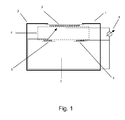
- Fig. 1 illustrates a representative gas sensor 1 including a sensor housing 2, in which a working electrode 3, a reference electrode 5, and a counter electrode 6 are positioned in such a way that working electrode 3 is in fluid connection with the ambient atmosphere via a gas permeable membrane.
- the electrodes are physically separated, but ionically interconnected via a separator 4 formed from glass fibers or silicate structures which are saturated with liquid electrolyte as described above.
- an additive or additives can be immobilized upon separator 4 or one or more other solid supports that can, for example, be positioned in the vicinity of the catalyst of working electrode 3a.
- An additive or additives can also or alternatively be immobilized upon working electrode 3a and/or upon another electrode.
- a compensating volume 7 provides volume for water to be absorbed in the case of a hygroscopic electrolyte.
- the sensor is connected to electronic measuring system 8, which can, for example, amplify the sensor current (resulting from the presence of analyte gas) to provide a measuring signal.
- Fig. 2 illustrates another gas sensor 11 including a sensor housing 12.
- a working electrode 13a, a reference electrode 15, and a counter electrode 16 are positioned within housing 12 so that working electrode 13a is in fluid connection with the ambient atmosphere via a gas permeable membrane 13.
- Working electrode 13a includes a layer of catalyst/electrode material and electrolyte (that is, an ionic liquid, either with or without additive), which is absorbed in a powdered, solid SiO 2 material.
- the electrodes are physically separated but ionically interconnected via a separator 14 formed from glass fibers or silicate structures, which are saturated with electrolyte.
- Reference electrode 15 and counter electrode 16 are disposed side-by-side on the side of separator 14 opposite working electrode 13a.
- a compensating volume 17 provides volume for water to be absorbed in case of atmospheric variations of the humidity.
- Sensor 11 is connected to electronic measuring system 18, which can maintain a potential difference between working electrode 13a and reference electrode 15 and amplify the sensor current (resulting from the presence of analyte gas) to provide a measuring signal.
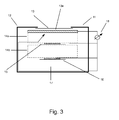
- Fig. 3 illustrates another embodiment of a gas sensor 11 including a sensor housing 12 in which working electrode 13a, reference electrode 15, and counter electrode 16 are positioned so that working electrode 13a is in fluid connection with the ambient atmosphere via a gas permeable membrane 13.
- Working electrode 13a and reference electrode 15 are physically separated but ionically interconnected via a first separator 14a formed from glass fibers or silicate structures as described above.
- a second separator 14b is positioned between reference electrode 15 and counter electrode 16.
- Separators 14a and 14b include absorbed electrolyte as described above.
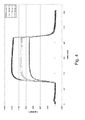
- Fig. 4 illustrates the performance of a family of four NH 3 sensors (sensors 1-4) including ethylammonium nitrate as an electrolyte. Sensors 1-4 were exposed to 50 ppm of NH 3 in air.
- Fig. 5 illustrates a comparison of the humidity dependence of NH 3 sensors including ethylammonium nitrate as the electrolyte and NH 3 sensors including aqueous lithium chloride (LiCl aqueous) as the electrolyte in the absence of analyte gas (that is, under "zero current" conditions).
- the sensors including the ionic liquid electrolyte exhibit a measurably lower response, while the sensors including the LiCl electrolyte system produce transients.
- Each of the curves in Fig. 5 set forth an average value (AV) of four sensors.
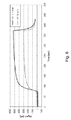
- Fig. 6 illustrates a comparison of performance of two groups of Cl 2 sensors (average values, AV, in each case), wherein one group of sensors included pure ethylammonium nitrate (IL pure) as the electrolyte and the other group of sensors included ethylammonium nitrate and tetrabutylammonium iodide (IL + Add) as the electrolyte.
- IL pure pure ethylammonium nitrate
- IL + Add tetrabutylammonium iodide
- the general design of the electrochemical sensor studied is set forth in the schematic illustration of Fig. 1 .
- Each of the electrodes was applied to a gas permeable PTFE membrane. Separators saturated with electrolyte were positioned between the electrodes to provide ionic electrical conductivity between the electrodes and to prevent short circuits between the electrodes.
- the sensors also function if the RE and the CE are not arranged side by side, but at different longitudinal positions within the sensors (see Fig. 3 ).
- the electrolyte was ethylammonium nitrate (EtNH 3 NO 3 ).
- the sensors were exposed to 50 ppm of NH 3 in air. Sensor signal (for four sensors) over time is represented graphically in Fig. 4 .
- the general design of the sensors was similar to that of Example 1.
- One group of sensors included an aqueous lithium chloride solution (LiCl aqueous) as the electrolyte, while the other group of sensors included ethylammonium nitrate (ionic liquid, IL) as the electrolyte.
- Both sensors were subjected to a rapid change of the ambient humidity. A significantly lower response (to changing humidity) of the sensor including the ionic liquid electrolyte was observed.
- the aqueous electrolyte system produced transients, which may trigger false alarms during use of the sensor.
- the results are represented graphically in Fig. 5 .
- the curves represent average values (AV) of groups of four sensors.
- the general design of the sensor was similar to that of Example 1.
- the WE, RE, and CE included a mixture of gold with carbon, which was applied to porous PTFE membranes.
- a pure ionic liquid (IL) - ethylammonium nitrate - was used as the electrolyte.
- the performance of that group of sensors was compared to a group of sensors having an electrolyte including ethylammonium nitrate with tetrabutylammonium iodide as an additive (IL + Add). Sensor performance was significantly improved upon including the additive.
- the results of the studies are represented graphically in Fig. 6 .
Landscapes
- Chemical & Material Sciences (AREA)
- Life Sciences & Earth Sciences (AREA)
- Health & Medical Sciences (AREA)
- Physics & Mathematics (AREA)
- Chemical Kinetics & Catalysis (AREA)
- Electrochemistry (AREA)
- Molecular Biology (AREA)
- Analytical Chemistry (AREA)
- Biochemistry (AREA)
- General Health & Medical Sciences (AREA)
- General Physics & Mathematics (AREA)
- Immunology (AREA)
- Pathology (AREA)
- Measuring Oxygen Concentration In Cells (AREA)
Claims (15)
- Capteur électrochimique (1) de gaz, comprenant un liquide ionique comme électrolyte,
caractérisé en ce que
le liquide ionique comprend au moins un cation sélectionné dans l'ensemble constitué des cations monoalkylammonium, des cations dialkylammonium et des cations trialkylammonium, les groupes alkyle individuels du cation étant ramifiés ou non ramifiés et comptant de 1 à 4 atomes de carbone, les groupes alkyle individuels du cation étant identiques ou différents dans le cas d'un cation de dialkylammonium et d'un cation de trialkylammonium. - Capteur électrochimique de gaz selon la revendication 1, caractérisé en ce que les différents groupes alkyle comptent de 2 à 4 atomes de carbone.
- Capteur électrochimique de gaz selon la revendication 1 ou 2, caractérisé en ce que l'électrolyte du capteur électrochimique de gaz est absorbé à raison d'au moins 90 % dans un matériau solide ou en ce que l'électrolyte est présent sans absorbant.
- Capteur électrochimique de gaz selon l'une quelconque des revendications 1 à 3, caractérisé en ce que le capteur électrochimique de gaz comprend au moins deux électrodes en contact ionique avec le liquide ionique et isolées électriquement l'une de l'autre par au moins un séparateur ou par un espace, chaque électrode comprenant de manière indépendante , le même ou différents, au moins un ou plusieurs métaux de l'ensemble constitué de Cu, Ni, Ti, Pt, Ir, Au, Pd, Ag, Ru, Rh, au moins un oxyde d'un métal de l'ensemble constitué de Cu, Ni, Ti, Pt, Ir, Au, Pd, Ag, Ru, Rh, leurs mélanges ou du carbone.
- Capteur électrochimique de gaz selon l'une quelconque des revendications 1 à 4, caractérisé en ce que le liquide ionique comprend au moins un anion sélectionné dans l'ensemble constitué de l'anion nitrate, de l'anion nitrite, de l'anion tétrafluoroborate, de l'anion hexafluorophosphate, de l'anion polyfluoroalcanesulfonate, de l'anion bis(trifluorométhylsulfonyl)imide, de l'anion alkylsulfate, de l'anion alcanesulfonate, de l'anion acétate et de l'anion d'un acide fluoroalcanoïque.
- Capteur électrochimique de gaz selon l'une quelconque des revendications 1 à 5, caractérisé en ce que le liquide ionique est le nitrate d'éthylammonium.
- Capteur électrochimique de gaz selon l'une quelconque des revendications 1 à 6, caractérisé en ce qu'un matériau solide poudreux dans lequel l'électrolyte est absorbé est un silicate dont les particules ont une taille moyenne d'au moins 5 µm, une surface spécifique d'au moins 50 m2/g et une teneur en SiO2 d'au moins 95 % en poids.
- Capteur électrochimique de gaz selon l'une quelconque des revendications 1 à 7, caractérisé en ce qu'un matériau solide fibreux mais non tissé dans lequel l'électrolyte est absorbé est une fibre de verre.
- Capteur électrochimique de gaz selon l'une quelconque des revendications 1 à 8, caractérisé en ce que l'électrolyte comprend une partie d'addition comprenant au moins un de l'ensemble constitué d'un additif organique, un additif organométallique et un additif minéral.
- Capteur électrochimique de gaz selon l'une quelconque des revendications 1 à 9, caractérisé en ce que la partie d'addition est incluse dans l'électrolyte à raison de 0,05 à 15 % en poids.
- Capteur électrochimique de gaz selon l'une quelconque des revendications 1 à 10, caractérisé en ce qu'un additif organique éventuellement présent est inclus à raison de 0,05 à 5,0 % en poids, un additif minéral éventuellement présent est inclus à raison de 1 à 12 % en poids et un additif organométallique éventuellement présent est inclus à raison de 0,05 à 5,0 % en poids.
- Capteur électrochimique de gaz selon l'une quelconque des revendications 1 à 11, caractérisé en ce que l'additif organique est sélectionné dans l'ensemble constitué de l'imidazole, des (alkyle en C1 à C4) imidazoles, de la pyridine, des (alkyle en C1 à C4) pyridines, du pyrrole, des (alkyle en C1 à C4)pyrroles, du pyrazole, des (alkyle en C1 à C4)pyrazoles, de la pyrimidine, des (alkyle en C1 à C4)pyrimidines, de la guanine, des (alkyle en C1 à C4)guanines, de l'acide urique, de l'acide benzoïque, de la porphyrine et des dérivés de porphyrine, l'additif organométallique étant sélectionné dans l'ensemble constitué des phtalocyanines de métal et de leurs dérivés avec Mn2+, Cu2+, Fe2+/3+ ou Pb2+, entant que cation métallique, l'additif minéral étant sélectionné dans l'ensemble constitué des halogénures d'alkali, des halogénures d'ammonium, des halogénures d'ammonium substitué avec au moins un groupe alkyle en C1 à C4, d'un sel de métal de transition de Mn2+, Mn3+, Cu2+, Ag+, Cr3+, Cr6+, Fe2+ ou Fe3+ et d'un sel de plomb de Pb2+, sélectionné en particulier dans l'ensemble constitué du bromure de lithium, de l'iodure de lithium, de l'iodure d'ammonium, de l'iodure de tétraméthylammonium, de l'iodure de tétraéthylammonium, de l'iodure de tétrapropylammonium, de l'iodure de tétrabutylammonium, du bromure de tétrabutylammonium, du chlorure de manganèse (II), du sulfate de manganèse (II), du nitrate de manganèse (II), du chlorure de chrome (III), des chromates d'alcali, du chlorure de fer (II), du chlorure de fer (III) et du nitrate de plomb (II).
- Capteur électrochimique de gaz selon les revendications 9 à 12, caractérisé en ce qu'au moins une partie de la partie d'addition est immobilisée sur un support solide, un matériau solide ou sur au moins l'une des électrodes.
- Utilisation d'un capteur électrochimique de gaz selon l'une quelconque des revendications 1 à 12 pour la détection et/ou la mesure d'un gaz acide, d'un gaz basique, d'un gaz neutre, d'un gaz oxydant, d'un gaz réducteur, d'un gaz halogène, de vapeurs d'halogène ou d'un gaz d'hydrure.
- Utilisation d'un capteur électrochimique de gaz selon la revendication 13, dans lequel la partie d'addition est immobilisée sur un support solide pour la détection et/ou la mesure de F2, Cl2, Br2, I2, O2, O3, ClO2, NH3, SO2, H2S, CO, CO2, NO, NO2, H2, HCl, HBr, HF, HCN, PH3, AsH3, B2H6, GeH4 ou SiH4.
Applications Claiming Priority (2)
| Application Number | Priority Date | Filing Date | Title |
|---|---|---|---|
| DE102008044240A DE102008044240B4 (de) | 2008-12-01 | 2008-12-01 | Elektrochemischer Gassensor mit einer ionischen Flüssigkeit als Elektrolyt, welche mindestens ein Mono-, Di- oder Trialkylammonium-Kation enthält |
| PCT/EP2009/065819 WO2010063626A1 (fr) | 2008-12-01 | 2009-11-25 | Détecteur électrochimique de gaz avec un système électrolytique ionique liquide comprenant au moins un cation monoalkylammonium, dialkylammonium ou trialkylammonium |
Publications (2)
| Publication Number | Publication Date |
|---|---|
| EP2370809A1 EP2370809A1 (fr) | 2011-10-05 |
| EP2370809B1 true EP2370809B1 (fr) | 2015-11-04 |
Family
ID=41580964
Family Applications (1)
| Application Number | Title | Priority Date | Filing Date |
|---|---|---|---|
| EP09760851.7A Revoked EP2370809B1 (fr) | 2008-12-01 | 2009-11-25 | Détecteur électrochimique de gaz avec un système électrolytique ionique liquide comprenant au moins un cation monoalkylammonium, dialkylammonium ou trialkylammonium |
Country Status (10)
| Country | Link |
|---|---|
| US (1) | US8623189B2 (fr) |
| EP (1) | EP2370809B1 (fr) |
| JP (1) | JP5524231B2 (fr) |
| KR (1) | KR101671407B1 (fr) |
| CN (1) | CN102227630B (fr) |
| AU (1) | AU2009321617B2 (fr) |
| CA (1) | CA2745237C (fr) |
| DE (1) | DE102008044240B4 (fr) |
| RU (1) | RU2512675C2 (fr) |
| WO (1) | WO2010063626A1 (fr) |
Families Citing this family (44)
| Publication number | Priority date | Publication date | Assignee | Title |
|---|---|---|---|---|
| DE102008044240B4 (de) | 2008-12-01 | 2013-12-05 | Msa Auer Gmbh | Elektrochemischer Gassensor mit einer ionischen Flüssigkeit als Elektrolyt, welche mindestens ein Mono-, Di- oder Trialkylammonium-Kation enthält |
| US9012345B2 (en) | 2010-03-26 | 2015-04-21 | Dioxide Materials, Inc. | Electrocatalysts for carbon dioxide conversion |
| US20110237830A1 (en) | 2010-03-26 | 2011-09-29 | Dioxide Materials Inc | Novel catalyst mixtures |
| US10173169B2 (en) | 2010-03-26 | 2019-01-08 | Dioxide Materials, Inc | Devices for electrocatalytic conversion of carbon dioxide |
| US9790161B2 (en) | 2010-03-26 | 2017-10-17 | Dioxide Materials, Inc | Process for the sustainable production of acrylic acid |
| US8956990B2 (en) | 2010-03-26 | 2015-02-17 | Dioxide Materials, Inc. | Catalyst mixtures |
| US20130015064A1 (en) * | 2011-06-29 | 2013-01-17 | Masel Richard I | Sensors For Carbon Dioxide And Other End Uses |
| US9957624B2 (en) | 2010-03-26 | 2018-05-01 | Dioxide Materials, Inc. | Electrochemical devices comprising novel catalyst mixtures |
| US9815021B2 (en) | 2010-03-26 | 2017-11-14 | Dioxide Materials, Inc. | Electrocatalytic process for carbon dioxide conversion |
| EP2506001B1 (fr) * | 2011-03-28 | 2013-11-20 | Stichting IMEC Nederland | Capteur d'éthylène électrochimique et procédé de surveillance d'éthylène |
| DE102011087592A1 (de) | 2011-12-01 | 2013-06-06 | Msa Auer Gmbh | Elektrochemischer Gassensor mit einer ionischen Flüssigkeit als Elektrolyt zum Nachweis von Ammoniak und Aminen |
| US9395323B2 (en) | 2011-10-25 | 2016-07-19 | Msa Europe Gmbh | Electrochemical gas sensor with an ionic liquid as electrolyte for the detection of ammonia and amines |
| DE102011085174A1 (de) * | 2011-10-25 | 2013-04-25 | Msa Auer Gmbh | Elektrochemischer Gassensor mit einer ionischen Flüssigkeitals Elektrolyt zum Nachweis von Ammoniak und Aminen |
| CN102645472A (zh) * | 2012-03-31 | 2012-08-22 | 无锡百灵传感技术有限公司 | 一种用于选择性检测NOx无膜电流气体传感器的制备方法 |
| JP6194443B2 (ja) * | 2012-12-28 | 2017-09-13 | 理研計器株式会社 | 電気化学式ガスセンサ用作用極、及びその製造方法 |
| EP2759832B1 (fr) | 2013-01-23 | 2020-11-11 | Sciosense B.V. | Dispositif de capteur électrochimique |
| US10647652B2 (en) | 2013-02-24 | 2020-05-12 | Dioxide Materials, Inc. | Process for the sustainable production of acrylic acid |
| DE102013007872B4 (de) * | 2013-05-08 | 2015-01-22 | Fraunhofer-Gesellschaft zur Förderung der angewandten Forschung e.V. | Elektrochemischer Gassensor, Verfahren zu dessen Herstellung und dessen Verwendung |
| US20150027906A1 (en) * | 2013-07-24 | 2015-01-29 | Hamilton Sundstrand Corporation | Solid polymer electrolyte ammonia sensor |
| DE202013103647U1 (de) | 2013-08-12 | 2013-09-02 | Aspect Imaging Ltd. | Ein System zum Online-Messen und Steuern von O2-Fraktion, CO-Fraktion und CO2-Fraktion |
| DE102013014995A1 (de) * | 2013-09-09 | 2015-03-26 | Dräger Safety AG & Co. KGaA | Flüssiger Elektrolyt für einen elektrochemischen Gassensor |
| DE102013014994A1 (de) * | 2013-09-09 | 2015-03-12 | Dräger Safety AG & Co. KGaA | Elektrochemischer Gassensor, flüssiger Elektrolyt und Verwendung eines flüssigen Elektrolyten in einem elektrochemischen Gassensor |
| JP6330213B2 (ja) * | 2013-10-25 | 2018-05-30 | 理研計器株式会社 | 定電位電解式酸素ガスセンサ |
| JP6426336B2 (ja) * | 2013-10-25 | 2018-11-21 | 理研計器株式会社 | 定電位電解式ガスセンサ |
| WO2015060328A1 (fr) * | 2013-10-25 | 2015-04-30 | 理研計器株式会社 | Capteur de gaz électrolytique potentiostatique |
| US9765196B2 (en) | 2014-02-20 | 2017-09-19 | Rutgers, The State University Of New Jersey | Inorganic ionomers made from minerals |
| DE102014002500A1 (de) * | 2014-02-21 | 2015-08-27 | Dräger Safety AG & Co. KGaA | Elektrochemischer Gassensor |
| US9513247B2 (en) | 2014-02-27 | 2016-12-06 | Ams International Ag | Electrochemical sensor |
| GB2525393A (en) * | 2014-04-22 | 2015-10-28 | Sprue Safety Products Ltd | Electrochemical cell |
| DE102014007137A1 (de) * | 2014-05-16 | 2015-11-19 | Dräger Safety AG & Co. KGaA | Elektrode für einen elektronischen Gassensor, Herstellungsverfahren für eine Elektrode und Verwendung einer Elektrode |
| US9851327B2 (en) * | 2014-06-02 | 2017-12-26 | Maxim Integrated Products, Inc. | Photopatternable glass micro electrochemical cell and method |
| US20160097641A1 (en) * | 2014-10-03 | 2016-04-07 | Lenore L. Dai | Sensors Including Ionic Liquids and Methods of Making and Using the Same |
| US10774431B2 (en) | 2014-10-21 | 2020-09-15 | Dioxide Materials, Inc. | Ion-conducting membranes |
| US10775339B2 (en) | 2014-11-26 | 2020-09-15 | Gentex Corporation | Membranes for use in electrochemical sensors and associated devices |
| US10975480B2 (en) | 2015-02-03 | 2021-04-13 | Dioxide Materials, Inc. | Electrocatalytic process for carbon dioxide conversion |
| US11268927B2 (en) | 2016-08-30 | 2022-03-08 | Analog Devices International Unlimited Company | Electrochemical sensor, and a method of forming an electrochemical sensor |
| US10620151B2 (en) | 2016-08-30 | 2020-04-14 | Analog Devices Global | Electrochemical sensor, and a method of forming an electrochemical sensor |
| US12188893B2 (en) | 2016-08-30 | 2025-01-07 | Analog Devices International Unlimited Company | Electrochemical sensor, and a method of forming an electrochemical sensor |
| DE102017115421A1 (de) * | 2017-07-10 | 2019-01-10 | Endress+Hauser Conducta Gmbh+Co. Kg | Amperometrischer Chlordioxid-Sensor |
| US11022579B2 (en) | 2018-02-05 | 2021-06-01 | Analog Devices International Unlimited Company | Retaining cap |
| BR112022003627A2 (pt) | 2019-09-18 | 2022-05-24 | Degesch America Inc | Dispositivo e método de monitoramento de gás |
| DE102020114281A1 (de) | 2020-05-28 | 2021-12-02 | Dräger Safety AG & Co. KGaA | Ausgleichsmodul für einen Gassensor |
| EP4155723A1 (fr) | 2021-09-23 | 2023-03-29 | Dräger Safety AG & Co. KGaA | Capteur électrochimique de gaz et électrolyte pour un capteur électrochimique de gaz |
| CN118561722A (zh) * | 2024-04-23 | 2024-08-30 | 中国科学院上海微系统与信息技术研究所 | 一种含质子化胍基结构分子材料、复合物及其制备和应用 |
Citations (7)
| Publication number | Priority date | Publication date | Assignee | Title |
|---|---|---|---|---|
| WO2000015594A1 (fr) | 1998-09-10 | 2000-03-23 | Exxon Chemical Patents Inc. | Procede de fabrication d'aldehydes aromatiques a partir de liquides ioniques |
| WO2000016902A1 (fr) | 1998-09-24 | 2000-03-30 | Bp Chemicals Limited | Liquides ioniques |
| WO2004017443A2 (fr) | 2002-08-14 | 2004-02-26 | Advanced Technology Materials, Inc. | Cellules electrochimiques, detecteur de gaz et piles a combustible les comportant |
| GB2395564A (en) | 2002-09-27 | 2004-05-26 | Bosch Gmbh Robert | An electrochemical gas sensor with a liquid organic salt electrolyte |
| US20070026295A1 (en) | 2003-05-01 | 2007-02-01 | Angell C A | Ionic liquids & ionic liquid acids with high temperature stability for fuel cell and other high temperature applications, method of making and cell employing same |
| WO2008110830A1 (fr) | 2007-03-15 | 2008-09-18 | Anaxsys Technology Ltd | Capteur électrochimique |
| DE102008044240A1 (de) | 2008-12-01 | 2010-06-17 | Msa Auer Gmbh | Elektrochemischer Gassensor mit einer ionischen Flüssigkeit als Elektrolyt, welche mindestens ein Mono-, Di- oder Trialky-lammonium-Kation enthält |
Family Cites Families (25)
| Publication number | Priority date | Publication date | Assignee | Title |
|---|---|---|---|---|
| US3328277A (en) | 1964-04-03 | 1967-06-27 | Honeywell Inc | Oxygen sensor with a scavenger electrode |
| US4169779A (en) | 1978-12-26 | 1979-10-02 | Catalyst Research Corporation | Electrochemical cell for the detection of hydrogen sulfide |
| US4474648A (en) | 1980-04-30 | 1984-10-02 | City Technology Limited | Gas sensor |
| US5228974A (en) | 1989-04-29 | 1993-07-20 | Dragerwerk Aktiengesellschaft | Electrochemical measuring cell for determining ammonia or hydrazine in a measuring sample |
| GB2239705B (en) * | 1989-11-08 | 1993-05-12 | Nat Res Dev | Gas sensors and compounds suitable therefor |
| EP0546291A1 (fr) | 1991-12-11 | 1993-06-16 | Drägerwerk Aktiengesellschaft | Cellule de mesure électrochimique pour la détermination de l'ammoniaque ou de l'hydrazine dans un échantillon |
| GB9422334D0 (en) * | 1994-11-04 | 1994-12-21 | Central Research Lab Ltd | Gas sensor |
| US5565075A (en) | 1995-06-06 | 1996-10-15 | Mine Safety Appliances Company | Electrochemical gas sensor for the detection of nitric oxide |
| US5855809A (en) * | 1995-11-13 | 1999-01-05 | Arizona Board Of Regents | Electrochemically stable electrolytes |
| US5667653A (en) | 1996-03-15 | 1997-09-16 | Mine Safety Appliances Company | Electrochemical sensor |
| DE10121262A1 (de) | 2001-04-30 | 2002-11-14 | Siemens Ag | Vorrichtung zur quantitativen Messung von Stickoxiden in der Ausatemluft und Verwendung |
| US7147761B2 (en) | 2001-08-13 | 2006-12-12 | Mine Safety Appliances Company | Electrochemical sensor |
| JP3824526B2 (ja) | 2001-12-07 | 2006-09-20 | 新コスモス電機株式会社 | 電気化学式二酸化炭素センサ |
| AU2002257460A1 (en) * | 2002-05-21 | 2003-12-02 | Rhocraft Research And Development Ltd. | Ion exchange membranes and dissolved gas sensors |
| US7217354B2 (en) | 2003-08-29 | 2007-05-15 | Ut-Battelle, Llc | Method and apparatus for detection of chemical vapors |
| GB0407908D0 (en) * | 2004-04-07 | 2004-05-12 | Univ York | Ionic liquids |
| DE102004037312B4 (de) | 2004-07-31 | 2015-02-05 | Dräger Safety AG & Co. KGaA | Elektrochemischer Gassensor und Verfahren zu seiner Herstellung |
| US7419623B2 (en) * | 2004-08-03 | 2008-09-02 | Air Products And Chemicals, Inc. | Proton conducting mediums for electrochemical devices and electrochemical devices comprising the same |
| JP4597622B2 (ja) | 2004-09-27 | 2010-12-15 | 根本特殊化学株式会社 | 電気化学式ガスセンサ |
| JP4248475B2 (ja) * | 2004-09-30 | 2009-04-02 | フィガロ技研株式会社 | イオン性液体電解質ガスセンサ |
| JP4140911B2 (ja) * | 2005-03-04 | 2008-08-27 | フィガロ技研株式会社 | 液体電気化学ガスセンサ |
| DE102005020719B3 (de) * | 2005-05-04 | 2006-09-14 | Drägerwerk AG | Offner elektrochemischer Sensor |
| US20060278536A1 (en) * | 2005-06-10 | 2006-12-14 | The Regents Of The University Of California | Sensor comprising supported aprotic ionic liquid |
| WO2007115801A1 (fr) * | 2006-04-06 | 2007-10-18 | Mst Technology Gmbh | Capteur d'oxygène |
| JP2008064578A (ja) | 2006-09-06 | 2008-03-21 | Horiba Ltd | イオン液体特性測定方法 |
-
2008
- 2008-12-01 DE DE102008044240A patent/DE102008044240B4/de not_active Revoked
-
2009
- 2009-11-25 AU AU2009321617A patent/AU2009321617B2/en active Active
- 2009-11-25 KR KR1020117012566A patent/KR101671407B1/ko active Active
- 2009-11-25 CN CN200980147885.5A patent/CN102227630B/zh active Active
- 2009-11-25 US US13/131,391 patent/US8623189B2/en active Active
- 2009-11-25 CA CA2745237A patent/CA2745237C/fr active Active
- 2009-11-25 RU RU2011121754/28A patent/RU2512675C2/ru active
- 2009-11-25 JP JP2011537965A patent/JP5524231B2/ja active Active
- 2009-11-25 EP EP09760851.7A patent/EP2370809B1/fr not_active Revoked
- 2009-11-25 WO PCT/EP2009/065819 patent/WO2010063626A1/fr not_active Ceased
Patent Citations (7)
| Publication number | Priority date | Publication date | Assignee | Title |
|---|---|---|---|---|
| WO2000015594A1 (fr) | 1998-09-10 | 2000-03-23 | Exxon Chemical Patents Inc. | Procede de fabrication d'aldehydes aromatiques a partir de liquides ioniques |
| WO2000016902A1 (fr) | 1998-09-24 | 2000-03-30 | Bp Chemicals Limited | Liquides ioniques |
| WO2004017443A2 (fr) | 2002-08-14 | 2004-02-26 | Advanced Technology Materials, Inc. | Cellules electrochimiques, detecteur de gaz et piles a combustible les comportant |
| GB2395564A (en) | 2002-09-27 | 2004-05-26 | Bosch Gmbh Robert | An electrochemical gas sensor with a liquid organic salt electrolyte |
| US20070026295A1 (en) | 2003-05-01 | 2007-02-01 | Angell C A | Ionic liquids & ionic liquid acids with high temperature stability for fuel cell and other high temperature applications, method of making and cell employing same |
| WO2008110830A1 (fr) | 2007-03-15 | 2008-09-18 | Anaxsys Technology Ltd | Capteur électrochimique |
| DE102008044240A1 (de) | 2008-12-01 | 2010-06-17 | Msa Auer Gmbh | Elektrochemischer Gassensor mit einer ionischen Flüssigkeit als Elektrolyt, welche mindestens ein Mono-, Di- oder Trialky-lammonium-Kation enthält |
Non-Patent Citations (1)
| Title |
|---|
| BHATT ET AL.: "A critical assessment of electrocehmistry in a distillable room temperature ionic liquid, DIMCARB", GREEN CHEMISTRY, vol. 8, 2006, pages 161 - 171, XP055303923 |
Also Published As
| Publication number | Publication date |
|---|---|
| KR20110094296A (ko) | 2011-08-23 |
| KR101671407B1 (ko) | 2016-11-01 |
| CN102227630B (zh) | 2014-06-18 |
| EP2370809A1 (fr) | 2011-10-05 |
| AU2009321617B2 (en) | 2014-07-17 |
| CA2745237C (fr) | 2018-05-15 |
| JP2012510613A (ja) | 2012-05-10 |
| RU2011121754A (ru) | 2013-01-10 |
| DE102008044240A1 (de) | 2010-06-17 |
| CA2745237A1 (fr) | 2010-06-10 |
| DE102008044240B4 (de) | 2013-12-05 |
| JP5524231B2 (ja) | 2014-06-18 |
| AU2009321617A1 (en) | 2010-06-10 |
| US20110253534A1 (en) | 2011-10-20 |
| US8623189B2 (en) | 2014-01-07 |
| CN102227630A (zh) | 2011-10-26 |
| RU2512675C2 (ru) | 2014-04-10 |
| WO2010063626A1 (fr) | 2010-06-10 |
Similar Documents
| Publication | Publication Date | Title |
|---|---|---|
| EP2370809B1 (fr) | Détecteur électrochimique de gaz avec un système électrolytique ionique liquide comprenant au moins un cation monoalkylammonium, dialkylammonium ou trialkylammonium | |
| EP3015857B1 (fr) | Capteurs de gaz électrochimiques à systèmes d'électrolyte liquide ionique | |
| RU2617845C2 (ru) | Электрохимический газовый датчик с ионной жидкостью в качестве электролита для обнаружения аммиака и аминов |
Legal Events
| Date | Code | Title | Description |
|---|---|---|---|
| PUAI | Public reference made under article 153(3) epc to a published international application that has entered the european phase |
Free format text: ORIGINAL CODE: 0009012 |
|
| 17P | Request for examination filed |
Effective date: 20110627 |
|
| AK | Designated contracting states |
Kind code of ref document: A1 Designated state(s): AT BE BG CH CY CZ DE DK EE ES FI FR GB GR HR HU IE IS IT LI LT LU LV MC MK MT NL NO PL PT RO SE SI SK SM TR |
|
| DAX | Request for extension of the european patent (deleted) | ||
| REG | Reference to a national code |
Ref country code: DE Ref legal event code: R079 Ref document number: 602009034643 Country of ref document: DE Free format text: PREVIOUS MAIN CLASS: G01N0027490000 Ipc: G01N0027404000 |
|
| GRAP | Despatch of communication of intention to grant a patent |
Free format text: ORIGINAL CODE: EPIDOSNIGR1 |
|
| RIC1 | Information provided on ipc code assigned before grant |
Ipc: G01N 27/404 20060101AFI20150401BHEP |
|
| RAP1 | Party data changed (applicant data changed or rights of an application transferred) |
Owner name: MSA EUROPE GMBH |
|
| INTG | Intention to grant announced |
Effective date: 20150507 |
|
| GRAS | Grant fee paid |
Free format text: ORIGINAL CODE: EPIDOSNIGR3 |
|
| GRAR | Information related to intention to grant a patent recorded |
Free format text: ORIGINAL CODE: EPIDOSNIGR71 |
|
| GRAA | (expected) grant |
Free format text: ORIGINAL CODE: 0009210 |
|
| AK | Designated contracting states |
Kind code of ref document: B1 Designated state(s): AT BE BG CH CY CZ DE DK EE ES FI FR GB GR HR HU IE IS IT LI LT LU LV MC MK MT NL NO PL PT RO SE SI SK SM TR |
|
| INTG | Intention to grant announced |
Effective date: 20150929 |
|
| REG | Reference to a national code |
Ref country code: GB Ref legal event code: FG4D |
|
| REG | Reference to a national code |
Ref country code: CH Ref legal event code: EP |
|
| REG | Reference to a national code |
Ref country code: AT Ref legal event code: REF Ref document number: 759549 Country of ref document: AT Kind code of ref document: T Effective date: 20151115 |
|
| REG | Reference to a national code |
Ref country code: IE Ref legal event code: FG4D |
|
| REG | Reference to a national code |
Ref country code: FR Ref legal event code: PLFP Year of fee payment: 7 |
|
| REG | Reference to a national code |
Ref country code: DE Ref legal event code: R096 Ref document number: 602009034643 Country of ref document: DE |
|
| REG | Reference to a national code |
Ref country code: NL Ref legal event code: MP Effective date: 20151104 |
|
| REG | Reference to a national code |
Ref country code: LT Ref legal event code: MG4D |
|
| REG | Reference to a national code |
Ref country code: AT Ref legal event code: MK05 Ref document number: 759549 Country of ref document: AT Kind code of ref document: T Effective date: 20151104 |
|
| PG25 | Lapsed in a contracting state [announced via postgrant information from national office to epo] |
Ref country code: LT Free format text: LAPSE BECAUSE OF FAILURE TO SUBMIT A TRANSLATION OF THE DESCRIPTION OR TO PAY THE FEE WITHIN THE PRESCRIBED TIME-LIMIT Effective date: 20151104 Ref country code: IS Free format text: LAPSE BECAUSE OF FAILURE TO SUBMIT A TRANSLATION OF THE DESCRIPTION OR TO PAY THE FEE WITHIN THE PRESCRIBED TIME-LIMIT Effective date: 20160304 Ref country code: ES Free format text: LAPSE BECAUSE OF FAILURE TO SUBMIT A TRANSLATION OF THE DESCRIPTION OR TO PAY THE FEE WITHIN THE PRESCRIBED TIME-LIMIT Effective date: 20151104 Ref country code: NO Free format text: LAPSE BECAUSE OF FAILURE TO SUBMIT A TRANSLATION OF THE DESCRIPTION OR TO PAY THE FEE WITHIN THE PRESCRIBED TIME-LIMIT Effective date: 20160204 Ref country code: NL Free format text: LAPSE BECAUSE OF FAILURE TO SUBMIT A TRANSLATION OF THE DESCRIPTION OR TO PAY THE FEE WITHIN THE PRESCRIBED TIME-LIMIT Effective date: 20151104 Ref country code: IT Free format text: LAPSE BECAUSE OF FAILURE TO SUBMIT A TRANSLATION OF THE DESCRIPTION OR TO PAY THE FEE WITHIN THE PRESCRIBED TIME-LIMIT Effective date: 20151104 Ref country code: HR Free format text: LAPSE BECAUSE OF FAILURE TO SUBMIT A TRANSLATION OF THE DESCRIPTION OR TO PAY THE FEE WITHIN THE PRESCRIBED TIME-LIMIT Effective date: 20151104 |
|
| PG25 | Lapsed in a contracting state [announced via postgrant information from national office to epo] |
Ref country code: PT Free format text: LAPSE BECAUSE OF FAILURE TO SUBMIT A TRANSLATION OF THE DESCRIPTION OR TO PAY THE FEE WITHIN THE PRESCRIBED TIME-LIMIT Effective date: 20160304 Ref country code: AT Free format text: LAPSE BECAUSE OF FAILURE TO SUBMIT A TRANSLATION OF THE DESCRIPTION OR TO PAY THE FEE WITHIN THE PRESCRIBED TIME-LIMIT Effective date: 20151104 Ref country code: FI Free format text: LAPSE BECAUSE OF FAILURE TO SUBMIT A TRANSLATION OF THE DESCRIPTION OR TO PAY THE FEE WITHIN THE PRESCRIBED TIME-LIMIT Effective date: 20151104 Ref country code: SE Free format text: LAPSE BECAUSE OF FAILURE TO SUBMIT A TRANSLATION OF THE DESCRIPTION OR TO PAY THE FEE WITHIN THE PRESCRIBED TIME-LIMIT Effective date: 20151104 Ref country code: PL Free format text: LAPSE BECAUSE OF FAILURE TO SUBMIT A TRANSLATION OF THE DESCRIPTION OR TO PAY THE FEE WITHIN THE PRESCRIBED TIME-LIMIT Effective date: 20151104 Ref country code: LV Free format text: LAPSE BECAUSE OF FAILURE TO SUBMIT A TRANSLATION OF THE DESCRIPTION OR TO PAY THE FEE WITHIN THE PRESCRIBED TIME-LIMIT Effective date: 20151104 Ref country code: BE Free format text: LAPSE BECAUSE OF NON-PAYMENT OF DUE FEES Effective date: 20151130 Ref country code: GR Free format text: LAPSE BECAUSE OF FAILURE TO SUBMIT A TRANSLATION OF THE DESCRIPTION OR TO PAY THE FEE WITHIN THE PRESCRIBED TIME-LIMIT Effective date: 20160205 |
|
| REG | Reference to a national code |
Ref country code: CH Ref legal event code: PL |
|
| PG25 | Lapsed in a contracting state [announced via postgrant information from national office to epo] |
Ref country code: CZ Free format text: LAPSE BECAUSE OF FAILURE TO SUBMIT A TRANSLATION OF THE DESCRIPTION OR TO PAY THE FEE WITHIN THE PRESCRIBED TIME-LIMIT Effective date: 20151104 Ref country code: CH Free format text: LAPSE BECAUSE OF NON-PAYMENT OF DUE FEES Effective date: 20151130 Ref country code: LI Free format text: LAPSE BECAUSE OF NON-PAYMENT OF DUE FEES Effective date: 20151130 |
|
| REG | Reference to a national code |
Ref country code: DE Ref legal event code: R026 Ref document number: 602009034643 Country of ref document: DE |
|
| PLBI | Opposition filed |
Free format text: ORIGINAL CODE: 0009260 |
|
| REG | Reference to a national code |
Ref country code: IE Ref legal event code: MM4A |
|
| PG25 | Lapsed in a contracting state [announced via postgrant information from national office to epo] |
Ref country code: DK Free format text: LAPSE BECAUSE OF FAILURE TO SUBMIT A TRANSLATION OF THE DESCRIPTION OR TO PAY THE FEE WITHIN THE PRESCRIBED TIME-LIMIT Effective date: 20151104 Ref country code: RO Free format text: LAPSE BECAUSE OF FAILURE TO SUBMIT A TRANSLATION OF THE DESCRIPTION OR TO PAY THE FEE WITHIN THE PRESCRIBED TIME-LIMIT Effective date: 20151104 Ref country code: EE Free format text: LAPSE BECAUSE OF FAILURE TO SUBMIT A TRANSLATION OF THE DESCRIPTION OR TO PAY THE FEE WITHIN THE PRESCRIBED TIME-LIMIT Effective date: 20151104 Ref country code: SK Free format text: LAPSE BECAUSE OF FAILURE TO SUBMIT A TRANSLATION OF THE DESCRIPTION OR TO PAY THE FEE WITHIN THE PRESCRIBED TIME-LIMIT Effective date: 20151104 Ref country code: SM Free format text: LAPSE BECAUSE OF FAILURE TO SUBMIT A TRANSLATION OF THE DESCRIPTION OR TO PAY THE FEE WITHIN THE PRESCRIBED TIME-LIMIT Effective date: 20151104 |
|
| 26 | Opposition filed |
Opponent name: LIFE SAFETY GERMANY GMBH Effective date: 20160804 |
|
| PLAX | Notice of opposition and request to file observation + time limit sent |
Free format text: ORIGINAL CODE: EPIDOSNOBS2 |
|
| PG25 | Lapsed in a contracting state [announced via postgrant information from national office to epo] |
Ref country code: MC Free format text: LAPSE BECAUSE OF FAILURE TO SUBMIT A TRANSLATION OF THE DESCRIPTION OR TO PAY THE FEE WITHIN THE PRESCRIBED TIME-LIMIT Effective date: 20151104 |
|
| REG | Reference to a national code |
Ref country code: FR Ref legal event code: PLFP Year of fee payment: 8 |
|
| PG25 | Lapsed in a contracting state [announced via postgrant information from national office to epo] |
Ref country code: IE Free format text: LAPSE BECAUSE OF NON-PAYMENT OF DUE FEES Effective date: 20151125 |
|
| PG25 | Lapsed in a contracting state [announced via postgrant information from national office to epo] |
Ref country code: SI Free format text: LAPSE BECAUSE OF FAILURE TO SUBMIT A TRANSLATION OF THE DESCRIPTION OR TO PAY THE FEE WITHIN THE PRESCRIBED TIME-LIMIT Effective date: 20151104 |
|
| PG25 | Lapsed in a contracting state [announced via postgrant information from national office to epo] |
Ref country code: BE Free format text: LAPSE BECAUSE OF FAILURE TO SUBMIT A TRANSLATION OF THE DESCRIPTION OR TO PAY THE FEE WITHIN THE PRESCRIBED TIME-LIMIT Effective date: 20151104 |
|
| PLBB | Reply of patent proprietor to notice(s) of opposition received |
Free format text: ORIGINAL CODE: EPIDOSNOBS3 |
|
| PG25 | Lapsed in a contracting state [announced via postgrant information from national office to epo] |
Ref country code: HU Free format text: LAPSE BECAUSE OF FAILURE TO SUBMIT A TRANSLATION OF THE DESCRIPTION OR TO PAY THE FEE WITHIN THE PRESCRIBED TIME-LIMIT; INVALID AB INITIO Effective date: 20091125 Ref country code: BG Free format text: LAPSE BECAUSE OF FAILURE TO SUBMIT A TRANSLATION OF THE DESCRIPTION OR TO PAY THE FEE WITHIN THE PRESCRIBED TIME-LIMIT Effective date: 20151104 |
|
| PG25 | Lapsed in a contracting state [announced via postgrant information from national office to epo] |
Ref country code: CY Free format text: LAPSE BECAUSE OF FAILURE TO SUBMIT A TRANSLATION OF THE DESCRIPTION OR TO PAY THE FEE WITHIN THE PRESCRIBED TIME-LIMIT Effective date: 20151104 |
|
| PG25 | Lapsed in a contracting state [announced via postgrant information from national office to epo] |
Ref country code: TR Free format text: LAPSE BECAUSE OF FAILURE TO SUBMIT A TRANSLATION OF THE DESCRIPTION OR TO PAY THE FEE WITHIN THE PRESCRIBED TIME-LIMIT Effective date: 20151104 Ref country code: MT Free format text: LAPSE BECAUSE OF FAILURE TO SUBMIT A TRANSLATION OF THE DESCRIPTION OR TO PAY THE FEE WITHIN THE PRESCRIBED TIME-LIMIT Effective date: 20151104 |
|
| REG | Reference to a national code |
Ref country code: FR Ref legal event code: PLFP Year of fee payment: 9 |
|
| REG | Reference to a national code |
Ref country code: DE Ref legal event code: R064 Ref document number: 602009034643 Country of ref document: DE Ref country code: DE Ref legal event code: R103 Ref document number: 602009034643 Country of ref document: DE |
|
| PG25 | Lapsed in a contracting state [announced via postgrant information from national office to epo] |
Ref country code: LU Free format text: LAPSE BECAUSE OF NON-PAYMENT OF DUE FEES Effective date: 20151125 |
|
| RDAF | Communication despatched that patent is revoked |
Free format text: ORIGINAL CODE: EPIDOSNREV1 |
|
| PGFP | Annual fee paid to national office [announced via postgrant information from national office to epo] |
Ref country code: DE Payment date: 20171121 Year of fee payment: 9 Ref country code: FR Payment date: 20171012 Year of fee payment: 9 |
|
| PGFP | Annual fee paid to national office [announced via postgrant information from national office to epo] |
Ref country code: GB Payment date: 20171122 Year of fee payment: 9 |
|
| RDAG | Patent revoked |
Free format text: ORIGINAL CODE: 0009271 |
|
| STAA | Information on the status of an ep patent application or granted ep patent |
Free format text: STATUS: PATENT REVOKED |
|
| 27W | Patent revoked |
Effective date: 20171120 |
|
| GBPR | Gb: patent revoked under art. 102 of the ep convention designating the uk as contracting state |
Effective date: 20171120 |
|
| PG25 | Lapsed in a contracting state [announced via postgrant information from national office to epo] |
Ref country code: MK Free format text: LAPSE BECAUSE OF FAILURE TO SUBMIT A TRANSLATION OF THE DESCRIPTION OR TO PAY THE FEE WITHIN THE PRESCRIBED TIME-LIMIT Effective date: 20151104 |