EP2371233B1 - Statikaufnehmende Pflegevorrichtung zum Pflegen von Haar - Google Patents
Statikaufnehmende Pflegevorrichtung zum Pflegen von Haar Download PDFInfo
- Publication number
- EP2371233B1 EP2371233B1 EP11160867.5A EP11160867A EP2371233B1 EP 2371233 B1 EP2371233 B1 EP 2371233B1 EP 11160867 A EP11160867 A EP 11160867A EP 2371233 B1 EP2371233 B1 EP 2371233B1
- Authority
- EP
- European Patent Office
- Prior art keywords
- coating
- hair
- static dissipative
- ohms
- square
- Prior art date
- Legal status (The legal status is an assumption and is not a legal conclusion. Google has not performed a legal analysis and makes no representation as to the accuracy of the status listed.)
- Active
Links
Images



Classifications
-
- A—HUMAN NECESSITIES
- A45—HAND OR TRAVELLING ARTICLES
- A45D—HAIRDRESSING OR SHAVING EQUIPMENT; EQUIPMENT FOR COSMETICS OR COSMETIC TREATMENTS, e.g. FOR MANICURING OR PEDICURING
- A45D1/00—Curling-tongs, i.e. tongs for use when hot; Curling-irons, i.e. irons for use when hot; Accessories therefor
-
- A—HUMAN NECESSITIES
- A45—HAND OR TRAVELLING ARTICLES
- A45D—HAIRDRESSING OR SHAVING EQUIPMENT; EQUIPMENT FOR COSMETICS OR COSMETIC TREATMENTS, e.g. FOR MANICURING OR PEDICURING
- A45D1/00—Curling-tongs, i.e. tongs for use when hot; Curling-irons, i.e. irons for use when hot; Accessories therefor
- A45D1/02—Curling-tongs, i.e. tongs for use when hot; Curling-irons, i.e. irons for use when hot; Accessories therefor with means for internal heating, e.g. by liquid fuel
- A45D1/04—Curling-tongs, i.e. tongs for use when hot; Curling-irons, i.e. irons for use when hot; Accessories therefor with means for internal heating, e.g. by liquid fuel by electricity
-
- A—HUMAN NECESSITIES
- A45—HAND OR TRAVELLING ARTICLES
- A45D—HAIRDRESSING OR SHAVING EQUIPMENT; EQUIPMENT FOR COSMETICS OR COSMETIC TREATMENTS, e.g. FOR MANICURING OR PEDICURING
- A45D2/00—Hair-curling or hair-waving appliances ; Appliances for hair dressing treatment not otherwise provided for
-
- A—HUMAN NECESSITIES
- A45—HAND OR TRAVELLING ARTICLES
- A45D—HAIRDRESSING OR SHAVING EQUIPMENT; EQUIPMENT FOR COSMETICS OR COSMETIC TREATMENTS, e.g. FOR MANICURING OR PEDICURING
- A45D2/00—Hair-curling or hair-waving appliances ; Appliances for hair dressing treatment not otherwise provided for
- A45D2/001—Hair straightening appliances
-
- A—HUMAN NECESSITIES
- A45—HAND OR TRAVELLING ARTICLES
- A45D—HAIRDRESSING OR SHAVING EQUIPMENT; EQUIPMENT FOR COSMETICS OR COSMETIC TREATMENTS, e.g. FOR MANICURING OR PEDICURING
- A45D20/00—Hair drying devices; Accessories therefor
-
- A—HUMAN NECESSITIES
- A45—HAND OR TRAVELLING ARTICLES
- A45D—HAIRDRESSING OR SHAVING EQUIPMENT; EQUIPMENT FOR COSMETICS OR COSMETIC TREATMENTS, e.g. FOR MANICURING OR PEDICURING
- A45D24/00—Hair combs for care of the hair; Accessories therefor
-
- A—HUMAN NECESSITIES
- A45—HAND OR TRAVELLING ARTICLES
- A45D—HAIRDRESSING OR SHAVING EQUIPMENT; EQUIPMENT FOR COSMETICS OR COSMETIC TREATMENTS, e.g. FOR MANICURING OR PEDICURING
- A45D26/00—Hair-singeing apparatus; Apparatus for removing superfluous hair, e.g. tweezers
-
- A—HUMAN NECESSITIES
- A46—BRUSHWARE
- A46B—BRUSHES
- A46B15/00—Other brushes; Brushes with additional arrangements
- A46B15/0002—Arrangements for enhancing monitoring or controlling the brushing process
- A46B15/0016—Arrangements for enhancing monitoring or controlling the brushing process with enhancing means
- A46B15/0018—Arrangements for enhancing monitoring or controlling the brushing process with enhancing means with antistatic properties
-
- A—HUMAN NECESSITIES
- A46—BRUSHWARE
- A46B—BRUSHES
- A46B15/00—Other brushes; Brushes with additional arrangements
- A46B15/0002—Arrangements for enhancing monitoring or controlling the brushing process
- A46B15/0016—Arrangements for enhancing monitoring or controlling the brushing process with enhancing means
- A46B15/002—Arrangements for enhancing monitoring or controlling the brushing process with enhancing means with a means for removing or creating static electricity
-
- B—PERFORMING OPERATIONS; TRANSPORTING
- B32—LAYERED PRODUCTS
- B32B—LAYERED PRODUCTS, i.e. PRODUCTS BUILT-UP OF STRATA OF FLAT OR NON-FLAT, e.g. CELLULAR OR HONEYCOMB, FORM
- B32B9/00—Layered products comprising a layer of a particular substance not covered by groups B32B11/00 - B32B29/00
- B32B9/005—Layered products comprising a layer of a particular substance not covered by groups B32B11/00 - B32B29/00 comprising one layer of ceramic material, e.g. porcelain, ceramic tile
-
- B—PERFORMING OPERATIONS; TRANSPORTING
- B32—LAYERED PRODUCTS
- B32B—LAYERED PRODUCTS, i.e. PRODUCTS BUILT-UP OF STRATA OF FLAT OR NON-FLAT, e.g. CELLULAR OR HONEYCOMB, FORM
- B32B9/00—Layered products comprising a layer of a particular substance not covered by groups B32B11/00 - B32B29/00
- B32B9/005—Layered products comprising a layer of a particular substance not covered by groups B32B11/00 - B32B29/00 comprising one layer of ceramic material, e.g. porcelain, ceramic tile
- B32B9/007—Layered products comprising a layer of a particular substance not covered by groups B32B11/00 - B32B29/00 comprising one layer of ceramic material, e.g. porcelain, ceramic tile comprising carbon, e.g. graphite, composite carbon
-
- Y—GENERAL TAGGING OF NEW TECHNOLOGICAL DEVELOPMENTS; GENERAL TAGGING OF CROSS-SECTIONAL TECHNOLOGIES SPANNING OVER SEVERAL SECTIONS OF THE IPC; TECHNICAL SUBJECTS COVERED BY FORMER USPC CROSS-REFERENCE ART COLLECTIONS [XRACs] AND DIGESTS
- Y10—TECHNICAL SUBJECTS COVERED BY FORMER USPC
- Y10T—TECHNICAL SUBJECTS COVERED BY FORMER US CLASSIFICATION
- Y10T428/00—Stock material or miscellaneous articles
- Y10T428/25—Web or sheet containing structurally defined element or component and including a second component containing structurally defined particles
-
- Y—GENERAL TAGGING OF NEW TECHNOLOGICAL DEVELOPMENTS; GENERAL TAGGING OF CROSS-SECTIONAL TECHNOLOGIES SPANNING OVER SEVERAL SECTIONS OF THE IPC; TECHNICAL SUBJECTS COVERED BY FORMER USPC CROSS-REFERENCE ART COLLECTIONS [XRACs] AND DIGESTS
- Y10—TECHNICAL SUBJECTS COVERED BY FORMER USPC
- Y10T—TECHNICAL SUBJECTS COVERED BY FORMER US CLASSIFICATION
- Y10T428/00—Stock material or miscellaneous articles
- Y10T428/25—Web or sheet containing structurally defined element or component and including a second component containing structurally defined particles
- Y10T428/256—Heavy metal or aluminum or compound thereof
-
- Y—GENERAL TAGGING OF NEW TECHNOLOGICAL DEVELOPMENTS; GENERAL TAGGING OF CROSS-SECTIONAL TECHNOLOGIES SPANNING OVER SEVERAL SECTIONS OF THE IPC; TECHNICAL SUBJECTS COVERED BY FORMER USPC CROSS-REFERENCE ART COLLECTIONS [XRACs] AND DIGESTS
- Y10—TECHNICAL SUBJECTS COVERED BY FORMER USPC
- Y10T—TECHNICAL SUBJECTS COVERED BY FORMER US CLASSIFICATION
- Y10T428/00—Stock material or miscellaneous articles
- Y10T428/31504—Composite [nonstructural laminate]
- Y10T428/3154—Of fluorinated addition polymer from unsaturated monomers
-
- Y—GENERAL TAGGING OF NEW TECHNOLOGICAL DEVELOPMENTS; GENERAL TAGGING OF CROSS-SECTIONAL TECHNOLOGIES SPANNING OVER SEVERAL SECTIONS OF THE IPC; TECHNICAL SUBJECTS COVERED BY FORMER USPC CROSS-REFERENCE ART COLLECTIONS [XRACs] AND DIGESTS
- Y10—TECHNICAL SUBJECTS COVERED BY FORMER USPC
- Y10T—TECHNICAL SUBJECTS COVERED BY FORMER US CLASSIFICATION
- Y10T428/00—Stock material or miscellaneous articles
- Y10T428/31504—Composite [nonstructural laminate]
- Y10T428/3154—Of fluorinated addition polymer from unsaturated monomers
- Y10T428/31544—Addition polymer is perhalogenated
-
- Y—GENERAL TAGGING OF NEW TECHNOLOGICAL DEVELOPMENTS; GENERAL TAGGING OF CROSS-SECTIONAL TECHNOLOGIES SPANNING OVER SEVERAL SECTIONS OF THE IPC; TECHNICAL SUBJECTS COVERED BY FORMER USPC CROSS-REFERENCE ART COLLECTIONS [XRACs] AND DIGESTS
- Y10—TECHNICAL SUBJECTS COVERED BY FORMER USPC
- Y10T—TECHNICAL SUBJECTS COVERED BY FORMER US CLASSIFICATION
- Y10T428/00—Stock material or miscellaneous articles
- Y10T428/31504—Composite [nonstructural laminate]
- Y10T428/31652—Of asbestos
- Y10T428/31663—As siloxane, silicone or silane
Definitions
- the field of this disclosure relates to personal grooming apparatus, such as hair straighteners and curling irons.
- the apparatus include coatings on the surface thereof that incorporate static dissipative additives that reduce the static build-up in the hair during use as compared to conventional apparatus.
- Other aspects of the present disclosure relate to methods for producing such apparatus, and methods for grooming the hair of an individual.
- the hair When hair is groomed, the hair gives up surface electrons to the grooming device and develops a positive electrostatic charge.
- the positive charge of the individual hairs causes the hairs to repel one another resulting in a "static flyaway” condition (e.g., "frizzy" hair).
- the ability of the hair to give up electrons is partially dependent on the amount of moisture in the hair, with increasing amounts of moisture resulting in decreased electron conductivity.
- the static flyaway condition of hair is exaggerated when the hair is relative dry, such as in the winter months.
- Hair may be exposed to high temperatures for styling purposes.
- the high temperatures drive out moisture and allow the hair to be "locked” into a temporary style that persists until water is reabsorbed.
- the hair readily gives up electrons which can lead to the static flyaway condition.
- a prior art grooming apparatus having the features of the preamble of claim 1, is disclosed in US-2010/0078038 .
- Another grooming apparatus is disclosed in JP 2007098064 and WO-2007/014035 .
- materials that may be characterized as being static dissipative are incorporated into coatings that are formed on apparatus for grooming hair.
- the materials reduce the amount of static charge that builds up in the hair as compared to conventional personal care apparatus.
- a grooming apparatus as claimed in claim 1, a method for enhancing the static dissipative effect of a substrate of a personal grooming apparatus as claimed in claim 7 and a method for grooming the hair of an individual as claimed in claim 11.
- a personal grooming apparatus includes a coating on a surface thereof that incorporates one or more static dissipative additives.
- personal grooming apparatus or “personal care apparatus” includes any item that is used to groom the hair of a user without limitation. Suitable apparatus that groom the hair include, for example, hair straighteners, hair curlers, curling irons, hot rollers (synonymously “hot curlers”), shavers, brushes, combs, hair clippers and hair razors.
- the substrates to which the coating compositions of the present disclosure are applied are a surface which contacts the hair during use.
- the substrate may be the plates (e.g., aluminum or ceramic) of a hair straightener, the barrel of a curling iron, or the teeth or bristles of a comb or brush.
- the static dissipative coatings of the present disclosure are capable of coating essentially any type of surface commonly used for a personal grooming apparatus, including substrates that are composed of metal (e.g., aluminum, low carbon or stainless steel alloys), ceramics (e.g., silica, alumina or silicon carbide) or thermoplastics (e.g., polymer materials).
- substrates that are composed of metal (e.g., aluminum, low carbon or stainless steel alloys), ceramics (e.g., silica, alumina or silicon carbide) or thermoplastics (e.g., polymer materials).
- the coatings may also be applied directly to the surface or substrate of the apparatus, or to a base coating that has previously been formed or deposited on the substrate material.
- a hair straightener 30 which is an exemplary personal care apparatus is shown.
- the straightener 30 contains a beating plate 20 with a static dissipative coating 25 of the present disclosure disposed thereon.
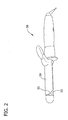
- Another example of a personal grooming apparatus is a hair curling iron 50 which is shown in Figure 2 .
- the curling iron 50 includes a barrel 53.
- a static dissipative coating 55 of the present disclosure may be disposed on the barrel 53.
- a static dissipative coating (not shown) may also be applied to the underside of the hair securing clip 59.
- the hot roller 80 includes a central tubular portion 83.
- the central tubular portion 83 includes a static dissipative coating 85 of the present disclosure thereon.
- the personal care apparatus of the present disclosure are generally prepared by applying a coating composition to a targeted surface of the apparatus.
- coating compositions or simply “compositions” refer to the composition that is applied to the substrate of the apparatus and not the coating itself which forms after additional processing steps (e.g., vaporization of solvent, heating, curing, sintering and the like).
- coating refers to the material on the surface of the substrate after all processing steps are complete and is not meant to include any solvent and/or carrier that evaporates from the coating composition.
- the coating composition contains a volatile carrier or solvent such as an alcohol that may be evaporated from the composition to form the "coating.”
- a volatile carrier or solvent such as an alcohol that may be evaporated from the composition to form the "coating.”
- percent inclusion of components of the "coating composition” as described below refer to the material applied to the substrate of the personal grooming apparatus; whereas, percent inclusion of the components of the "coating” (described below under the section entitled “Static Dissipative Coatings”) refer to the solid material covering a portion of the substrate after all processing steps are complete. Unless described otherwise, listed percentages are given as the percentage of the entire composition or entire coating, including the component or components being described.
- the coating compositions of the present disclosure incorporate one or more static dissipative additives to reduce the static build-up of the groomed material, as compared to conventionally used coatings that do no contain such static dissipative additives.
- the static dissipative additive is selected and added in a concentration sufficient to reduce the surface resistivity of the coating to less than about 1 x 10 13 ohms/square and, in embodiments, to less than about 1 x 10 12 ohms/square, less than about 5 x 10 11 ohms/square, less than about 1 x 10 11 ohms/square, less than about 5 x 10 10 ohms/square, less than about 1x ohms/square, less than about 5 x 10 9 ohms/square or even less than about 1x10 5 ohms/square.
- Suitable static dissipative additives include carbon particles and static dissipative metals, such as aluminum. Other metals that dissipat
- the static dissipative additive is included in the coating composition in a "static dissipative amount" which, for purposes of the present disclosure, is an amount that causes the coating (after all coating composition processing steps such as, for example, curing are complete) to have a surface resistivity of less than about 1x10 13 ohms/square.
- the static dissipative additive may be added in an amount which causes the static dissipative coating to have a surface resistivity within the ranges listed above (e.g., less than about 1x10 12 ohms/square, less than about 5 x 10 11 ohms/square, less than about 1 x 10 11 ohms/square, less than about 5x10 10 ohms/square, less than about 1x10 10 ohms/square, less than about 5x10 9 ohms/square or even less than about 1x10 5 ohms/square).
- Suitable carbon particles that may be used in the coating composition include carbon black, graphite and carbon nanotubes.
- Graphite that is used may be natural or synthetic, as well as their derivatives (including graphene, graphite nano platelets or expanded graphite).
- Non-graphitic forms of carbon, such as coke, charcoal or activated carbon, may also be used as static dissipative additives.
- the coating composition contains at least about 0.1 wt% carbon particles. In other embodiments, the coating composition contains at least about 0.5 wt%, at least about 1 wt%, at least about 4 wt% or at least about 10 wt% (e.g., from about 0.1 wt % to about 14 wt%, from about 1 wt% to about 14 wt% or from about 2 wt% to about 8 wt%).
- aluminum may be added to the coating composition as a static dissipative additive.
- Aluminum may be added to the coating composition as a powder or in the form of a paste.
- the paste may contain functional components (such as, for example, corn starch or petroleum jelly) that affect the flowability of the paste, and/or components that act as a preservative (such as zinc oxide).
- the amount of aluminum metal (i.e., aluminum metal itself rather than the total amount of paste when pastes are used) in the coating composition may be at least about 1 wt% and, in other embodiments, is at least about 4 wt%, at least about 10 wt%, at least about 20 wt% (e.g., from about 1 wt% to about 35 wt%, from about 4 wt% to about 25 wt% or from about 8 wt% to about 18 wt%).
- amounts of carbon and/or aluminum other than as listed above may be used in the coating composition and the listed amounts should not be considered in a limiting sense.
- Steel alloy metal may be included in the coating composition with or without aluminum and/or carbon particles.
- the amount of steel alloy that may be included in the composition corresponds to the amounts of aluminum recited above (e.g., at least about 1 wt%, at least about 4 wt%, at least about 10 wt%, at least about 20 wt%, from about 1 wt% to about 35 wt%, from about 4 wt% to about 25 wt% or from about 8 wt% to about 18 wt%).
- both aluminum and carbon are included in the coating composition.
- the amount of each additive may be within the ranges described above.
- the weight ratio of aluminum to carbon may be from about 1:5 to about 20:1 and, in other embodiments, from about 1:1 to about 10:1 (e.g., from about 2:1 to about 5:1).
- the particle size of the static dissipative additive is not critical; however, the size of the static dissipative additive (as well as any other material in the coating composition) should be less than the largest particle size that passes through any coating composition filtering operation (e.g., particles less than about 30 ⁇ m or less than about 75 ⁇ m in size).
- the coating compositions of the present also contains a structural component (e.g., polymer resin and/or ceramic material) through which the static dissipative additive is dispersed.
- a structural component e.g., polymer resin and/or ceramic material
- the static dissipative additive need not be uniformly dispersed throughout the structural component and there may be localized concentrations that are higher or lower than the average concentration in the coating composition and use of the term "dispersed" should not be considered in a limiting sense.
- the static dissipative additive is dispersed throughout a fluoropolymer such as, for example, polytetrafluoroethylene, perfluoroalkoxy, fluorinated ethylene propylene and mixtures thereof.
- the fluoropolymers act to reduce the friction of the coating of the personal care apparatus such that the personal grooming apparatus is suitable for use in hair grooming.
- the fluoropolymers aree silicone modified (i.e., a co-polymer with silicone functionality is incorporated into the fluoropolymer) which allows the coating to be more durable and to better withstand temperature extremes.
- the amount of fluoropolymer resin that is used in the coating composition may be at least about 20 wt%, at least about 40 wt % or at least about 50 wt% (e.g., from about 20 wt% to about 85 wt%, from about 40 wt% to about 85 wt% or from about 50 wt% to about 70 wt%).
- the coating composition may also optionally contain one or more ceramics (e.g., silica, alumina, titania or silicon carbide).
- the ceramic materials allow the coating to be sufficiently hard after processing (e.g., curing).
- the coating composition contains ceramics, the ceramics are combined with the fluoropolymer resin.
- the amount of ceramics in the composition may be at least about 1 wt% and, in other embodiments, at least about 3 wt% or at least about 5 wt% (e.g., from about 1 wt% to about 15 wt% or from about 1 wt% to about 10 wt%).
- the amount of ceramic material in the coating composition may be at least about 30 wt%, at least about 50 wt% or even at least about 70 wt% (e.g., from about 30 wt% to about 90 wt%, from about 40 wt% to about 80 wt% or from about 50 wt% to about 80 wt%). In some embodiments, the coating composition does not contain ceramic material.
- the coating compositions of the present disclosure may also contain an amount of tourmaline (e.g., from about 0.01 wt% to about 10 wt%). It is believed that tourmaline produces negative ions when heated which reduces hair static.
- Other functional components may be included in the coating composition without departing from the scope of the present disclosure.
- the coating composition may optionally include one or more additives such as colorants, binders, dispersants, sintering aids, plasticizers, antimicrobials (e.g., nano silver or nano titanium dioxide), hardeners (e.g., nanodiamond) and the like.
- the coating composition may include one or more coloring agents (i.e., "colorants") that modify the appearance of the coating.
- colorants include mica powder and various color pigments.
- the amount of colorants in the coating composition may range from about 0.01 wt% to about 20 wt% (e.g., from about 0.5 wt% to about 15 wt% or from about 3 wt% to about 15 wt%).
- the binder alters the rhcology of the coating composition and maintains the distribution of particles in the solution throughout application and curing.
- Suitable binders for use in the coating composition include polyvinyl butyral which may be present in an amount of at least about 0.5 wt% (e.g., 0.5 wt% to about 20 wt% or from about 1 wt% to about 10 wt%).
- the coating composition may optionally include a dispersant that acts to prevent any particulate (e.g., ceramics) from settling prior to application of the coating composition to the substrate.
- the dispersant may be present in an amount of at least about 0.05 wt% (e.g., from about 0.05 wt% to about 10 wt%, from about 0.1 wt% to about 7.5 wt% or from 0.5 wt% to about 5 wt%).
- One suitable dispersant for use in the composition is a methyloxirane polymer.
- a plasticizer may also be included in the composition.
- the plasticizer may be chosen to allow the coating composition to dry without cracking.
- the plasticizer may be present in an amount of at least about 0.5 wt% (e.g., 0.5 wt% to about 20 wt% or from about 1 wt% to about 10 wt%).
- One suitable plasticizer is polyethylene glycol.
- the coating composition generally includes a "medium” or “carrier” in which the coating components are applied to the substrate.
- the medium may be a solvent in which one or more coating composition components at least partially dissolves.
- solvent may also be referred to as a "diluent” in which the particulate components are suspended.
- the terms “medium,” “carrier,” “diluent,” and “solvent” may be used interchangeably and are not meant to limit embodiments of the present disclosure to compositions wherein one or more components do or do not dissolve.
- Suitable solvents include organic compounds such as, for example, C1 to C10 alcohols, methyl ethyl ketone, acetone, petroleum distillates and combinations of these compounds.
- the amount of solvent may vary according to the desired flowability of the coating composition.
- the coating composition contains at least about 5 wt% solvent (or solvents when more than one solvent is used) and, in other embodiments, at least about 10 wt% or even about 20 wt% solvent (e.g., from about 5 wt% to about 40 wt% or from about 5 wt% to about 30 wt% solvent).
- the solvent vaporizes readily during any drying steps.
- the composition may include more than one solvent with the total weight fraction of solvents in the composition being as described above.
- Water is generally not used as a solvent with fluoropolymer resins as water in some instances may be immiscible with fluoropolymers.
- the coating composition containing static dissipative material is applied to a base coating that is disposed on the substrate.
- the base coating may contain fluoropolymers and ceramics (e.g., silica, titania, zirconia, and chromic (III) oxide).
- the base coating may also contain other additives such as barium sulfate that improve the rheological properties of the coating and, optionally, binders, dispersants, sintering aids, plasticizers and the like. These components may be included in the base composition in the same amounts as described above for the static dissipative coating.
- the base coating optionally does not contain static dissipative additives as the static dissipative coating is disposed on its surface; however, the base coating may contain such additives without departing from the scope of the present disclosure.
- the base coating may contain such additives without departing from the scope of the present disclosure.
- other arrangements of coating layers may be used including arrangements in which more than two layers are used or in which the static dissipative coating is not disposed on the surface of the substrate without departing from the scope of the present disclosure.
- the substrate materials to which the static dissipative coating compositions of the present disclosure are applied may be subjected to one or more surface preparation procedures before the coating composition is applied.
- the surface may be cleaned by rinsing in water or in a dilute cleaning solution that is compatible with the substrate (e.g., a solution of trichloroethylene or other degreasing solution).
- the surface of the substrate may also be smoothed by conventional surface roughness reduction techniques (e.g., sand or alumina blasting) to remove any surface roughness that may extend through the coating. Sand or alumina-blasting may also be performed to assist in adhesion of the coating composition to the substrate.
- the coating composition may be subjected to a filtering operation (e.g., screening) before application of the coating composition so as to remove undesirable larger particles (e.g., particles greater than about 30 ⁇ m or greater than about 75 ⁇ m in size).
- the coating composition may generally be applied to the substrate by any of the methods known to those of ordinary skill in the art. Suitable methods include spray coating, immersion, brushing and powder coating techniques. Conventional spray coating methods may be used including air, air-assisted, airless and electrostatic atomization. Air Atomization may be performed under high-volume, low pressure conditions, such as pressures below about 35 MPa. It should be noted that when powder coating techniques are used, the coating composition does not contain solvents and no curing step is performed. Generally, the coating composition is a powder that has the same chemical composition of the coating itself. Powder coating techniques known to those of skill in the art may be used in accordance with the present disclosure.
- the coating composition is generally cured to evaporate liquid solvents and diluents and to form and harden the coating.
- the coating composition is heated to a temperature of at least about 140°C and, in other embodiments, to a temperature of at least about 200°C, at least about 300°C, at least about 400°C (e.g., from about 140°C to about 500°C or from about 180°C to about 300°C).
- Other temperatures may be used without departing from the scope of the present disclosure such as room temperature air drying and temperatures at which the coating is sintered (e.g., above about 1000°C). Curing typically may be completed in from about ten minutes to about two hours, depending on the amount of solvent and the temperatures used to cure.
- the static dissipative coating may be applied to the surface of a base coating that is disposed on the surface of the substrate.
- the base coating may be formed by the methods described above relating to application of the static dissipative coating.
- the base coating is formed by spraying a base coating composition to the substrate and curing the composition (e.g., to at least about 140°C).
- the base coating may be cured before application; however, in some embodiments of the present disclosure, the top coating is applied to the base coating before any curing operations and the base coating and top coating compositions are cured at once (i.e., wet-on-wet coating).
- the coating composition may be applied such that the coating as cured has a thickness of at least about 1 ⁇ m, at least about 5 ⁇ m, at least about 25 ⁇ m, at least about 50 ⁇ m or at least about 150 ⁇ m (e.g., from about 5 ⁇ m to about 500 ⁇ m, from about 8 ⁇ m to about 60 ⁇ m or from about 15 ⁇ m to about 30 ⁇ m).
- the total thickness of the coatings applied to the substrate are generally within the ranges described above.
- the static dissipative coating (which is typically the surface coating) may have a thickness of less than about 100 ⁇ m, less than about 50 ⁇ m, or less than about 20 ⁇ m (e.g., from about 3 ⁇ m to about 100 ⁇ m, from about 3 ⁇ m to about 20 ⁇ m or from about 10 ⁇ m to about 20 ⁇ m).
- the base coating is thicker than the static dissipative coating (e.g., from about 5 ⁇ m to about 50 ⁇ m thicker).
- the thickness of the base coating may be less than about 150 ⁇ m, less than about 75 ⁇ m, less than about 40 ⁇ m or less than about 30 ⁇ m (e.g., from about 10 ⁇ m to about 150 ⁇ m, from about 3 ⁇ m to about 30 ⁇ m or from about 15 ⁇ m to about 30 ⁇ m).
- other thicknesses may be used without departing from the scope of the present disclosure and the recited ranges should not be viewed in a limiting sense.
- the coatings of the personal care apparatus of the present disclosure generally include the components of the coating composition described above excluding any amount of material that was removed during processing (e.g., evaporated solvent).
- the coating contains static dissipative additives (e.g., aluminum or carbon particles), one or more fluoropolymers and one or more ceramic materials.
- the static dissipative additive may be included in the coating in a "static dissipative amount" as described above or in amount that causes the static dissipative coating to have a surface resistance in the ranges described below.
- the coating as applied contains at least about 0.1 wt% carbon particles and, in other embodiments, the coating composition contains at least about 0.5 wt% carbon particles, at least about 1 wt%, at least about 4 wt% or at least about 10 wt% carbon particles (e.g., from about 0.1 wt % to about 20 wt%, from about 1 wt% to about 15 wt% or from about 2 wt% to about 10 wt%).
- the amount of aluminum metal in the coating after processing may be at least about 1 wt% and, in other embodiments, is at least about 4 wt%, at least about 10 wt%, at least about 20 wt% (e.g., from about 1 wt% to about 45 wt%, from about 4 wt% to about 35 wt% or from about 10 wt% to about 25 wt%).
- the amount of each additive may be within the ranges described above.
- the percent inclusions recited above for carbon particles and aluminum are expressed as a percentage weight of the static dissipative coating and material from any other base coatings and/or top coatings are excluded in the calculation of the percent inclusion.
- the coating includes fluoropolymers and optionally ceramics after processing.
- the amount of fluoropolymers may be at least about 20 wt%, at least about 40 wt % or at least about 50 wt% (e.g., from about 20 wt% to about 90 wt%, from about 40 wt% to about 90 wt% or from about 50 wt% to about 85 wt%).
- the amount of ceramic material may be at least about 1 wt% and, in other embodiments, at least about 3 wt% or at least about 5 wt% (e.g., from about 1 wt% to about 20 wt% or from about 1 wt% to about 15 wt%).
- the coating does not contain an amount of ceramics.
- the coating may also contain residual colorants, binders, dispersants, plasticizers, and sintering agents that were not removed during processing (e.g., curing).
- the coatings disposed on the personal care apparatus are generally "static dissipative" in that the coatings reduce the amount of static charge that builds up in the material which is groomed (e.g., hair) as compared to conventional personal care apparatus.
- the carbon particles and/or aluminum may increase the surface conductivity of the coating (or, stated differently, reduce the surface resistivity of the coating) compared to coatings which do not include such materials.
- the coatings described herein generally allow electrons that are transferred from the groomed material to the personal care apparatus during use to be more readily transferred back to the groomed material and, conversely, allows electrons that are transferred from the personal care apparatus to the groomed material during use to be more readily transferred back to the personal care apparatus.
- Such coatings are said to be “static dissipative” in that they reduce the static build-up of the groomed material as compared to conventionally used coatings.
- the coatings described herein may be "antistatic" in that the coatings resist triboelectric charging when used relative to conventional coating materials.
- materials that resist triboelectric charging generally are positioned in the triboelectric series relatively close to the material with which they are contacted.
- the static dissipative coating is closer to the groomed material (e.g., hair) in the triboelectric series as compared to conventional coatings.
- hair has an affinity for positive charging (e.g., loss of electrons) of about 45 nC/J (i.e., nanocoulombs of transferred charge per joule of friction energy applied between the surfaces).
- Conventional fluoropolymer-based coatings may have an affinity for positive electrons of less than about -100 nC/J or even less than about -150 nC/J (e.g., about 175 nC/J).
- Incorporation of static dissipative additives into the fluoropolymer resins increases the affinity for positive charging of the coating (such as, for example, to at least about -100 nC/J or even to at least about -50 nC/J), thereby decreasing the difference in positive charging affinity between hair and the coating.
- the coating has a surface resistivity of less than about 1 x 10 13 ohms/square, less than about 1x10 12 ohms/square, less than about 5 x 10 11 ohms/square, less than about 1 x 10 11 ohms/square, less than about 5 x 10 10 ohms/square, less than about 1x10 10 ohms/square, less than about 5 x 10 9 ohms/square or even less than about 1x10 5 .
- the surface resistivity may range from about 1x10 3 ohms/square to about 1 x 10 14 ohms/square, from about 1 x 10 3 ohms/square to about 1 x 10 12 ohms/square, or from about 1x10 3 ohms/square to about 1 x 10 10 ohms/square.
- the coatings of the personal care apparatus of the present disclosure may meet one or more industry standards for static dissipative materials.
- the coating materials may have a surface resistivity of less than about 1x10 12 ohms/square and at least about 1x10 5 ohms/square as set forth in the definition of "static dissipative" materials as established by the Electrostatic Discharge Association (Rome, New York) in ESD ADV1.0-2004, which is incorporated herein for all relevant and consistent purposes.
- Surface resistivity may be measured according to any of the methods available to those of skill in the art.
- surface resistivity of the coating compositions of the present disclosure may be measured by first measuring the surface resistance of the coating and then calculating surface resistivity by use of the geometric dimensions of the tested sample and of the electrodes.
- ASTM International West Conshohocken, Pennsylvania
- ASTM D257-07 the measurement methodology and calculations set forth by ASTM International (West Conshohocken, Pennsylvania) in ASTM D257-07 may be used.
- the measurement standards set forth by the Electrostatic Discharge Association in ANSI/ESD STM11.11-2006 may be used.
- surface resistivity or “surface conductivity” as used herein should be distinguished from “surface resistance” or “surface conductance” which do not take into account the geometric arrangement of the sample and electrodes. While both surface resistivity and surface resistance (and surface conductivity and surface conductance) may both be expressed in ohms, surface resistivity is listed as “ohms/square” to differentiate surface resistance which is typically expressed in the art only as “ohms.” Further, as used herein, the recited resistivities and/or conductivities are surface measurements (e.g., surface resistivity or surface conductivity) and are not volume measurements.
- Example 1 Comparison of Static Build-up during use of a Hair Straightener with Plates having a Static Dissipative Modified Coating and a Standard Coating Disposed thereon
- Static build-up was tested on blended Caucasian hair tresses supplied from International Hair Importers (Glendale, New York). The tresses were 1 inch (2.54 cm) wide and eight inches (20.32 cm) long and weighed 3 grams. Prior to testing, the tresses were equilibrated over-night at 30% relative humidity.
- a hair straightener with a static dissipative coating disposed on the plates thereof and a straightener with a conventional coating (i.e., that does not contain a static dissipative agent such as aluminum or carbon) disposed on the plates were tested.
- the composition of the static dissipative coating is shown in Table I below and the composition of the standard coating is shown in Table 2 below.
- Table 1 Components of the coating composition containing static dissipative aluminum and their percent inclusion in the composition Component Inclusion (wt%) Polymer Resin (Silicon Modified) 62 wt% Aluminum Paste 10 wt% Ethanol 20 wt% Ceramics 8 wt%
- Table 2 Components of the standard coating composition and their percent inclusion in the composition Component Inclusion (wt%) Polymer Resin (Silicon Modified) 65.6 wt% Mica Powder 4 wt% Red Pigment 0.8 wt% White Pigment 7 wt% Isopropyl Alcohol 17 wt% Ceramics 5.5 wt% Tourmaline Powder 0.1 wt%
- Both coatings were prepared by spray coating the coating composition and curing.
- the straighteners were a Remington model S-4880 available from Spectrum Brands (Madison, Wisconsin).
- the static dissipative coating had a surface resistivity of 1x10 9 ohms/square and the conventional coating had a surface resistivity of 1x10 14 ohms/square.
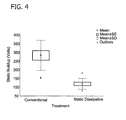
- each straightener was heated to its maximum temperature. After heating, the plates of each straightener were passed 10 times over ten tresses at 30% humidity with the speed and pressure of each pass being controlled. Immediately after straightening, each tress was mounted on a holder and the amount of static was read using the detector. The results are shown in Figure 4 .
- the straighteners that contained the static-dissipative coating caused about 60% less static build-up in the hair compared to the straightener with the conventional coating.
- a coating was prepared from a composition having the components shown in Table 3 below.
- Table 3 Components of the coating composition containing static dissipative carbon and their percent inclusion in the composition
- Component Inclusion wt%)
- Polymer Resin Silicon Modified
- Mica Powder 8 wt%
- Ethanol 18 wt%
- Yellow Pigment 1 wt% Carbon Black 2 wt%
- Ceramics 5.5 wt%
- Table 4 Surface resistivity measurements of samples of the coating containing static dissipative carbon Sample Surface Resistivity 1 1 x 10 10 2 1 x 10 10 3 1 x 10 11 4 1 x 10 10 5 1 x 10 9 6 1 x 10 10 7 1 x 10 10 8 1 x 10 10 9 1 x 10 10 10 1 x 10 10 11 1 x 10 10 12 1 x 10 9 13 1 x 10 10 14 1 x 10 10 15 1 x 10 9 16 1 x 10 11 17 1 x 10 10 18 1 x 10 10 19 1 x 10 10 20 1 x 10 10 10
- the average surface resistivity of the coating was about 1.77 x 10 10 ohms/square. Incorporation of higher amounts of carbon black would result in lower surface resistivity measurements.
Landscapes
- Paints Or Removers (AREA)
Claims (11)
- Pflegevorrichtung (30; 50; 80) für die Pflege des Haars eines Benutzers, wobei die Vorrichtung ausgewählt ist aus der Gruppe, bestehend aus einem Haarglätter (30), Lockenwickler (50), Lockenstab, Thermo-Lockenbürste (80), Rasierer, Clipper, Rasiermesser, Bürste und Kamm, die ein Substrat (20; 53; 83) enthält, und eine Beschichtung (25; 55; 85) auf dem Substrat (20; 53; 83) angeordnet ist, wobei die Beschichtung (25; 55; 85) eine Oberfläche zum Inkontakttreten mit dem Haar während der Pflege aufweist, und einen statikaufnehmenden Zusatzstoff umfasst, der in der Strukturkomponente dispergiert ist, um den Oberflächenwiderstand der Beschichtung (25; 55; 85) zu reduzieren, wobei die Beschichtung (25; 55; 85) einen Oberflächenwiderstand von weniger als etwa 1 x 10¹³ Ohm pro Quadrat aufweist; dadurch gekennzeichnet, dass
die Beschichtung (25; 55; 85) eine Strukturkomponente umfasst, die ausgewählt ist aus einem silikonmodifizierten Fluorpolymergrundharz oder einer Mischung aus einem silikonmodifizierten Fluorpolymergrundharz und einem keramischen Material. - Pflegevorrichtung (30; 50; 80) nach Anspruch 1, wobei der statikaufnehmende Zusatzstoff ausgewählt ist aus der Gruppe, bestehend aus Aluminium, Kohlestoffteilchen und Mischungen davon.
- Pflegevorrichtung (30; 50; 80) nach Anspruch 1, wobei der statikaufnehmende Zusatzstoff Kohlestoffteilchen ist und die Kohlestoffteilchen ausgewählt sind aus der Gruppe, bestehend aus Ruß, Kohlestoffnanoröhrchen und Grafit.
- Pflegevorrichtung (30; 50; 80) nach Anspruch 1, 2 oder 3, wobei die Beschichtung (25; 55; 85) ein keramisches Material umfasst und das keramische Material ausgewählt ist aus der Gruppe, bestehend aus Kieselerde, Aluminiumoxid, Zirconium, Siliziumcarbid und Mischungen davon.
- Pflegevorrichtung (30; 50; 80) nach einem der vorhergehenden Ansprüche, wobei die Beschichtung (25; 55; 85) einen Oberflächenwiderstand von weniger als etwa 1 x 10¹⁰ Ohm pro Quadrat aufweist.
- Pflegevorrichtung (30; 50; 80) nach Anspruch 5, wobei die Beschichtung einen Oberflächenwiderstand von weniger als etwa 1 x 10³ Ohm pro Quadrat aufweist.
- Verfahren zur Verbesserung der statikaufnehmenden Wirkung eines Substrats einer Pflegevorrichtung (30; 50; 80), die zur Pflege von Haar verwendet wird, wobei das Verfahren das Auftragen einer Beschichtungszusammensetzung auf das Substrat einer Vorrichtung umfasst, die ausgewählt ist aus der Gruppe, bestehend aus einem Haarglätter (30), Lockenwickler (50), Lockenstab, Thermo-Lockenbürste (80), Rasierer, Clipper, Rasiermesser, Bürste und Kamm, wobei die Beschichtungszusammensetzung einen statikaufnehmenden Zusatzstoff umfasst, der über die gesamte Strukturkomponente dispergiert ist, dadurch gekennzeichnet, dass:die Beschichtungszusammensetzung eine Strukturkomponente umfasst, die ausgewählt ist aus einem silikonmodifizierten Fluorpolymergrundharz oder einer Mischung aus einem silikonmodifizierten Fluorpolymergrundharz und einem keramischen Material undwobei das Verfahren ferner das Erwärmen des beschichteten Substrats umfasst, um das Lösungsmittel zu verdampfen und eine Beschichtung (25; 55; 85) zu bilden, wobei die Beschichtung (25; 55; 85) einen Oberflächenwiderstand von weniger als etwa 1 x 10¹³ Ohm pro Quadrat aufweist.
- Verfahren nach Anspruch 7, wobei der statikaufnehmende Zusatzstoff ausgewählt ist aus der Gruppe, bestehend aus Aluminium, Kohlestoffteilchen und Mischungen davon.
- Verfahren nach Anspruch 7 oder 8, wobei die Beschichtungszusammensetzung durch Sprühen, Eintauchen, Bürsten oder durch eine Pulverbeschichtungstechnik aufgetragen wird.
- Verfahren nach einem der Ansprüche 7 bis 9, wobei der statikaufnehmende Zusatzstoff Kohlestoffteilchen ist und die Kohlestoffteilchen ausgewählt sind aus der Gruppe, bestehend aus Ruß, Kohlestoffnanoröhrchen und Grafit.
- Verfahren zur Pflege des Haars eines Individuums, wobei das Verfahren das Inkontakttreten des Haars mit einer Pflegevorrichtung (30; 50; 80) umfasst, die ausgewählt aus der Gruppe, bestehend aus einem Haarglätter (30), Lockenwickler (50), Lockenstab, Thermo-Lockenbürste (80), Rasierer, Clipper, Rasiermesser, Bürste und Kamm, wobei die Vorrichtung ein Substrat (20; 53; 83) und eine Beschichtung (25; 55; 85), die auf dem Substrat (20; 53; 83) angeordnet ist, aufweist, wobei die Beschichtung (25; 55; 85) eine Strukturkomponente umfasst, die ausgewählt ist aus einem Grundharz oder Keramikmaterial oder Mischungen davon; und
ein statikaufnehmender Zusatzstoff über die gesamte Strukturkomponente dispergiert ist, um den Oberflächenwiderstand der Beschichtung (25; 55; 85) zu reduzieren; dadurch gekennzeichnet, dass:die Beschichtung (25; 55; 85) eine Oberfläche zum Inkontakttreten mit dem Haar während der Pflege aufweist und einen Oberflächenwiderstand von weniger als etwa 1 x 10¹³ Ohm pro Quadrat aufweist; unddie Strukturkomponente ausgewählt ist aus einem silikonmodifizierten Fluorpolymergrundharz oder einer Mischung aus einem silikonmodifizierten Fluorpolymergrundharz und einem keramischen Material.
Priority Applications (1)
| Application Number | Priority Date | Filing Date | Title |
|---|---|---|---|
| PL11160867T PL2371233T3 (pl) | 2010-04-05 | 2011-04-01 | Urządzenie antystatyczne do osobistej pielęgnacji włosów |
Applications Claiming Priority (1)
| Application Number | Priority Date | Filing Date | Title |
|---|---|---|---|
| US12/754,065 US8875717B2 (en) | 2010-04-05 | 2010-04-05 | Static dissipative personal care apparatus for grooming hair |
Publications (2)
| Publication Number | Publication Date |
|---|---|
| EP2371233A1 EP2371233A1 (de) | 2011-10-05 |
| EP2371233B1 true EP2371233B1 (de) | 2015-06-03 |
Family
ID=44115726
Family Applications (1)
| Application Number | Title | Priority Date | Filing Date |
|---|---|---|---|
| EP11160867.5A Active EP2371233B1 (de) | 2010-04-05 | 2011-04-01 | Statikaufnehmende Pflegevorrichtung zum Pflegen von Haar |
Country Status (3)
| Country | Link |
|---|---|
| US (1) | US8875717B2 (de) |
| EP (1) | EP2371233B1 (de) |
| PL (1) | PL2371233T3 (de) |
Families Citing this family (12)
| Publication number | Priority date | Publication date | Assignee | Title |
|---|---|---|---|---|
| KR101439933B1 (ko) * | 2010-09-06 | 2014-09-15 | 이대범 | 시술약품이 도포된 모발 열처리방법 및 이를 이용한 모발시술방법 |
| US20130220360A1 (en) * | 2012-02-29 | 2013-08-29 | Nir Sharon | Hair Styling Apparatus and Method of Making Same |
| WO2013190492A1 (en) * | 2012-06-20 | 2013-12-27 | Braun Gmbh | Personal appliance with sensor |
| US10609843B2 (en) * | 2012-10-04 | 2020-03-31 | Compass Datacenters, Llc | Magnetic blocking tiles for a datacenter facility |
| DE102013201105A1 (de) * | 2013-01-24 | 2014-08-07 | BSH Bosch und Siemens Hausgeräte GmbH | Haarglätter |
| EP3228240A1 (de) * | 2016-04-08 | 2017-10-11 | Koninklijke Philips N.V. | Faserqualitätssensor |
| CN206043785U (zh) * | 2016-06-30 | 2017-03-29 | 徐家才 | 防静电保健梳子 |
| USD829989S1 (en) * | 2016-09-21 | 2018-10-02 | Shenzhen Lady Merry Technology Co., Ltd. | Hairdressing apparatus |
| USD837448S1 (en) * | 2017-06-13 | 2019-01-01 | Wenzhou Shi Labo Electrics Co., Ltd. | Hair iron |
| US10925367B2 (en) * | 2017-08-10 | 2021-02-23 | Joe Loose | Hair styling device and method of forming the same |
| US11653750B2 (en) * | 2017-08-21 | 2023-05-23 | Joe Loose | Graphene polymer composites for hair styling tools and appliances |
| USD907848S1 (en) * | 2019-04-16 | 2021-01-12 | Babyliss Faco Sprl | Hair straightening iron |
Citations (5)
| Publication number | Priority date | Publication date | Assignee | Title |
|---|---|---|---|---|
| GB1015373A (en) * | 1961-11-21 | 1965-12-31 | Degussa | Process for the production of coated substrates |
| EP0416741A1 (de) * | 1989-08-24 | 1991-03-13 | Minnesota Mining And Manufacturing Company | Antistatische Beschichtung für Bürstenelemente |
| US20040053552A1 (en) * | 2002-09-16 | 2004-03-18 | Child Andrew D. | Static dissipative textile and method for producing the same |
| JP2007098064A (ja) * | 2005-09-30 | 2007-04-19 | Taiga Kawada | 毛髪をカールにしたり、ウェーブにしたり、癖毛や縮れ毛やタメージ毛やハイダメージ毛やカール毛を真直にする方法とその器具 |
| EP1922952A2 (de) * | 2006-11-15 | 2008-05-21 | Goody Products, Inc. | Endbearbeitungskamm |
Family Cites Families (49)
| Publication number | Priority date | Publication date | Assignee | Title |
|---|---|---|---|---|
| US2426315A (en) * | 1943-09-25 | 1947-08-26 | Us Rubber Co | Static free brush |
| US3832226A (en) * | 1968-05-21 | 1974-08-27 | Kansai Paint Co Ltd | Method for dry electrostatic coating |
| US3760495A (en) * | 1970-01-27 | 1973-09-25 | Texas Instruments Inc | Process for making conductive polymers |
| US3976600A (en) * | 1970-01-27 | 1976-08-24 | Texas Instruments Incorporated | Process for making conductive polymers |
| US3973100A (en) | 1972-12-27 | 1976-08-03 | Texas Instruments Incorporated | Self-limiting electric hair curler heater |
| US3999040A (en) * | 1974-02-01 | 1976-12-21 | Delphic Research Laboratories, Inc. | Heating device containing electrically conductive composition |
| JPS604557B2 (ja) * | 1975-09-03 | 1985-02-05 | 日本碍子株式会社 | 多数の貫通孔を有するチタン酸バリウム系正特性磁器発熱体 |
| US4415626A (en) * | 1982-01-08 | 1983-11-15 | Eastman Kodak Company | Antistatic composition and elements and processes utilizing same |
| FR2525445B1 (fr) * | 1982-04-22 | 1986-02-14 | Oreal | Moyen de peignage a proprietes antistatiques |
| US4610925A (en) * | 1984-05-04 | 1986-09-09 | E. I. Du Pont De Nemours And Company | Antistatic hairbrush filament |
| GB8432488D0 (en) * | 1984-12-21 | 1985-02-06 | Ici Plc | Antistatic polymeric articles |
| GB2205487A (en) * | 1987-06-02 | 1988-12-14 | Tong Fong Brush Factory Co Ltd | Anti electrostatic hair brush |
| JPH01113078A (ja) | 1987-10-28 | 1989-05-01 | Sukairaito Kogyo Kk | 遠赤外線照射エレメント |
| US5066422A (en) * | 1988-06-03 | 1991-11-19 | Armstrong World Industries, Inc. | Static dissipative vinyl surface covering materials, methods for them, and composition for static dissipation |
| JPH0440501Y2 (de) * | 1989-05-25 | 1992-09-22 | ||
| US5213887A (en) * | 1991-09-03 | 1993-05-25 | Minnesota Mining And Manufacturing Company | Antistatic coatings |
| JP3567281B2 (ja) * | 1993-04-08 | 2004-09-22 | ジャパンゴアテックス株式会社 | 定着用弾性ロール及びその製造方法 |
| US5747150A (en) * | 1993-12-21 | 1998-05-05 | Nippon Paint Co., Ltd. | Electrostatic powder coating method |
| US5631311A (en) * | 1994-08-18 | 1997-05-20 | E. I. Du Pont De Nemours And Company | Transparent static dissipative formulations for coatings |
| SG60007A1 (en) * | 1995-06-26 | 1999-02-22 | Tokuyama Corp | Fluorine-contained resin moulded articles |
| US5849399A (en) * | 1996-04-19 | 1998-12-15 | Xerox Corporation | Bias transfer members with fluorinated carbon filled fluoroelastomer outer layer |
| US5968871A (en) * | 1996-08-26 | 1999-10-19 | Dai Nippon Printing Co., Ltd. | Antistatic coat, thermal transfer sheet having antistatic property and antistatic agent |
| DE19648186C2 (de) | 1996-11-21 | 2000-11-16 | Juenemann Gmbh | Lockenwickler zum Aufwickeln menschlichen Haares |
| US6146753A (en) * | 1997-05-26 | 2000-11-14 | Dai Nippon Printing Co., Ltd. | Antistatic hard coat film |
| US6001749A (en) * | 1997-07-30 | 1999-12-14 | Milliken & Company | Patterned conductive textiles |
| US6319594B1 (en) * | 1998-03-17 | 2001-11-20 | Dai Nippon Printing Co., Ltd. | Low reflective antistatic hardcoat film |
| US5967150A (en) * | 1998-09-04 | 1999-10-19 | Wright; Darla Jo | Reciprocating comb with anti-static means |
| DE19845924C1 (de) | 1998-10-06 | 2000-04-20 | Friederike Juenemann | Lockenwickler zum Aufwickeln menschlichen Haares |
| US6663956B2 (en) * | 2001-04-26 | 2003-12-16 | Mitsubishi Polyerster Film, Llc | Antistatic coating and coated film |
| US6740410B2 (en) * | 2001-05-16 | 2004-05-25 | Noveon Ip Holdings Corp. | Electrostatic dissipating polymeric multi-layer article or laminate |
| US7171970B2 (en) * | 2002-01-18 | 2007-02-06 | Matsushita Electric Works Ltd. | Hair setting device |
| US20030209252A1 (en) * | 2002-05-09 | 2003-11-13 | Choy Wymond K. | Antistatic grooming device for dissipation of electrostatic charges that may exist in the hair |
| US20070003754A1 (en) | 2003-03-06 | 2007-01-04 | Yukihisa Okada | Antistatic composition and part holder |
| WO2005006914A2 (en) * | 2003-07-18 | 2005-01-27 | Conair Corporation | Hair-styling device having ion-emitting ceramic material components |
| JP2005075880A (ja) * | 2003-08-29 | 2005-03-24 | Du Pont Mitsui Fluorochem Co Ltd | 低帯電性熱溶融性フッ素樹脂組成物 |
| US20050051188A1 (en) | 2003-09-08 | 2005-03-10 | Conair Corporation | Hair styling appliance |
| ES2265286B1 (es) * | 2005-07-18 | 2007-12-01 | Dols Industrial De Peluqueria, S.A. | "cepillo para el cabello". |
| US20070029302A1 (en) | 2005-07-21 | 2007-02-08 | Russo Kenneth C | Ceramic and tourmaline hair appliances |
| US8092904B2 (en) * | 2006-03-31 | 2012-01-10 | 3M Innovative Properties Company | Optical article having an antistatic layer |
| US20070292679A1 (en) * | 2006-06-14 | 2007-12-20 | 3M Innovative Properties Company | Optical article having an antistatic fluorochemical surface layer |
| US7476339B2 (en) * | 2006-08-18 | 2009-01-13 | Saint-Gobain Ceramics & Plastics, Inc. | Highly filled thermoplastic composites |
| US20080070030A1 (en) * | 2006-09-15 | 2008-03-20 | 3M Innovative Properties Company | Static dissipative articles |
| US7544742B2 (en) * | 2006-11-30 | 2009-06-09 | E.I. Du Pont De Nemours And Company | Antistatic polyamide composition and articles therewith |
| US20080127989A1 (en) * | 2006-12-01 | 2008-06-05 | Goody Products | Comb for use with a flat iron |
| KR100869163B1 (ko) * | 2007-05-18 | 2008-11-19 | 한국전기연구원 | 탄소나노튜브와 바인더를 함유하는 투명전도성 필름의제조방법 및 이에 의해 제조된 투명전도성 필름 |
| JP5239448B2 (ja) * | 2007-06-04 | 2013-07-17 | 東レ株式会社 | 帯電防止性白色ポリエステルフィルム |
| DE102007035247A1 (de) * | 2007-07-27 | 2009-02-19 | Braun Gmbh | Haarpflegegerät |
| CA2676561C (en) | 2008-08-23 | 2012-10-16 | Farouk Systems, Inc. | Hair iron |
| KR20110006013A (ko) * | 2009-07-13 | 2011-01-20 | 주식회사 씨엠인터내셔널아이엔씨 | 핫 컬링용 헤어 브러쉬 |
-
2010
- 2010-04-05 US US12/754,065 patent/US8875717B2/en active Active
-
2011
- 2011-04-01 PL PL11160867T patent/PL2371233T3/pl unknown
- 2011-04-01 EP EP11160867.5A patent/EP2371233B1/de active Active
Patent Citations (5)
| Publication number | Priority date | Publication date | Assignee | Title |
|---|---|---|---|---|
| GB1015373A (en) * | 1961-11-21 | 1965-12-31 | Degussa | Process for the production of coated substrates |
| EP0416741A1 (de) * | 1989-08-24 | 1991-03-13 | Minnesota Mining And Manufacturing Company | Antistatische Beschichtung für Bürstenelemente |
| US20040053552A1 (en) * | 2002-09-16 | 2004-03-18 | Child Andrew D. | Static dissipative textile and method for producing the same |
| JP2007098064A (ja) * | 2005-09-30 | 2007-04-19 | Taiga Kawada | 毛髪をカールにしたり、ウェーブにしたり、癖毛や縮れ毛やタメージ毛やハイダメージ毛やカール毛を真直にする方法とその器具 |
| EP1922952A2 (de) * | 2006-11-15 | 2008-05-21 | Goody Products, Inc. | Endbearbeitungskamm |
Also Published As
| Publication number | Publication date |
|---|---|
| US20110240053A1 (en) | 2011-10-06 |
| EP2371233A1 (de) | 2011-10-05 |
| US8875717B2 (en) | 2014-11-04 |
| PL2371233T3 (pl) | 2015-11-30 |
Similar Documents
| Publication | Publication Date | Title |
|---|---|---|
| EP2371233B1 (de) | Statikaufnehmende Pflegevorrichtung zum Pflegen von Haar | |
| US10925367B2 (en) | Hair styling device and method of forming the same | |
| RU2507063C2 (ru) | Формирование тонких однородных покрытий на кромках бритвенных лезвий с использованием изостатического прессования | |
| EP3270730A1 (de) | Körperpflegevorrichtung mit uv-gehärteter beschichtung | |
| RU2510802C2 (ru) | Формирование тонких равномерных покрытий на кромках лезвий с использованием изостатического прессования | |
| CN101415763B (zh) | 不粘涂饰层 | |
| US8205623B2 (en) | Coatings for personal grooming apparatus containing calcium carbonate derived from mollusk shells or pearls | |
| WO2005069765A8 (en) | Carbon nanotube pastes and methods of use | |
| CN110198761A (zh) | 指甲的金属化 | |
| US20220295895A1 (en) | Susceptor used in aerosol generating device and the aerosol generating device | |
| FR3014014A1 (fr) | Procede de decoration par flexographie d'un article comprenant un revetement thermostable | |
| CN112334286A (zh) | 剃刀刀片涂层的变薄 | |
| WO2019040391A1 (en) | GRAPHENE POLYMER COMPOSITES FOR TOOLS AND HAIRSTYLING DEVICES | |
| US20070124944A1 (en) | Razor blade and method of making it | |
| WO1981002161A1 (fr) | Composition de revetement de fluore plastique | |
| US20240051167A1 (en) | Method of treating razor blade cutting edges | |
| CN104774510A (zh) | 抗静电热控涂料组合物及其制备方法、用途 | |
| JP7115807B2 (ja) | プラズモン粒子表面コーティングを有する可撓性基材、及びその製造方法 | |
| JPH0311602A (ja) | 電気抵抗層を造るのに適する抵抗ペーストおよびそれから製造される抵抗層 | |
| CN119730967A (zh) | 处理剃刀片刀刃的方法 | |
| JP2022121497A (ja) | 鉛筆芯 | |
| KR101981556B1 (ko) | 피펫 팁 및 이를 제조하는 방법 | |
| CN102108242B (zh) | 一种填充银纳米材料粉末涂料及其制备方法 | |
| US20070003754A1 (en) | Antistatic composition and part holder | |
| Budinski | Fluorocarbon coatings for wear applications |
Legal Events
| Date | Code | Title | Description |
|---|---|---|---|
| PUAI | Public reference made under article 153(3) epc to a published international application that has entered the european phase |
Free format text: ORIGINAL CODE: 0009012 |
|
| AK | Designated contracting states |
Kind code of ref document: A1 Designated state(s): AL AT BE BG CH CY CZ DE DK EE ES FI FR GB GR HR HU IE IS IT LI LT LU LV MC MK MT NL NO PL PT RO RS SE SI SK SM TR |
|
| AX | Request for extension of the european patent |
Extension state: BA ME |
|
| 17P | Request for examination filed |
Effective date: 20120322 |
|
| 17Q | First examination report despatched |
Effective date: 20120618 |
|
| REG | Reference to a national code |
Ref country code: DE Ref legal event code: R079 Ref document number: 602011016870 Country of ref document: DE Free format text: PREVIOUS MAIN CLASS: A45D0001000000 Ipc: A45D0001040000 |
|
| GRAP | Despatch of communication of intention to grant a patent |
Free format text: ORIGINAL CODE: EPIDOSNIGR1 |
|
| RIC1 | Information provided on ipc code assigned before grant |
Ipc: A45D 2/00 20060101ALI20140618BHEP Ipc: A45D 1/04 20060101AFI20140618BHEP |
|
| INTG | Intention to grant announced |
Effective date: 20140708 |
|
| RAP1 | Party data changed (applicant data changed or rights of an application transferred) |
Owner name: SPECTRUM BRANDS, INC. |
|
| GRAS | Grant fee paid |
Free format text: ORIGINAL CODE: EPIDOSNIGR3 |
|
| RAP1 | Party data changed (applicant data changed or rights of an application transferred) |
Owner name: SPECTRUM BRANDS, INC. |
|
| GRAA | (expected) grant |
Free format text: ORIGINAL CODE: 0009210 |
|
| AK | Designated contracting states |
Kind code of ref document: B1 Designated state(s): AL AT BE BG CH CY CZ DE DK EE ES FI FR GB GR HR HU IE IS IT LI LT LU LV MC MK MT NL NO PL PT RO RS SE SI SK SM TR |
|
| REG | Reference to a national code |
Ref country code: GB Ref legal event code: FG4D |
|
| REG | Reference to a national code |
Ref country code: CH Ref legal event code: EP |
|
| REG | Reference to a national code |
Ref country code: AT Ref legal event code: REF Ref document number: 729473 Country of ref document: AT Kind code of ref document: T Effective date: 20150715 Ref country code: IE Ref legal event code: FG4D |
|
| REG | Reference to a national code |
Ref country code: DE Ref legal event code: R096 Ref document number: 602011016870 Country of ref document: DE |
|
| REG | Reference to a national code |
Ref country code: AT Ref legal event code: MK05 Ref document number: 729473 Country of ref document: AT Kind code of ref document: T Effective date: 20150603 |
|
| PG25 | Lapsed in a contracting state [announced via postgrant information from national office to epo] |
Ref country code: LT Free format text: LAPSE BECAUSE OF FAILURE TO SUBMIT A TRANSLATION OF THE DESCRIPTION OR TO PAY THE FEE WITHIN THE PRESCRIBED TIME-LIMIT Effective date: 20150603 Ref country code: ES Free format text: LAPSE BECAUSE OF FAILURE TO SUBMIT A TRANSLATION OF THE DESCRIPTION OR TO PAY THE FEE WITHIN THE PRESCRIBED TIME-LIMIT Effective date: 20150603 Ref country code: FI Free format text: LAPSE BECAUSE OF FAILURE TO SUBMIT A TRANSLATION OF THE DESCRIPTION OR TO PAY THE FEE WITHIN THE PRESCRIBED TIME-LIMIT Effective date: 20150603 Ref country code: HR Free format text: LAPSE BECAUSE OF FAILURE TO SUBMIT A TRANSLATION OF THE DESCRIPTION OR TO PAY THE FEE WITHIN THE PRESCRIBED TIME-LIMIT Effective date: 20150603 Ref country code: NO Free format text: LAPSE BECAUSE OF FAILURE TO SUBMIT A TRANSLATION OF THE DESCRIPTION OR TO PAY THE FEE WITHIN THE PRESCRIBED TIME-LIMIT Effective date: 20150903 |
|
| REG | Reference to a national code |
Ref country code: NL Ref legal event code: MP Effective date: 20150603 |
|
| REG | Reference to a national code |
Ref country code: LT Ref legal event code: MG4D |
|
| PG25 | Lapsed in a contracting state [announced via postgrant information from national office to epo] |
Ref country code: BG Free format text: LAPSE BECAUSE OF FAILURE TO SUBMIT A TRANSLATION OF THE DESCRIPTION OR TO PAY THE FEE WITHIN THE PRESCRIBED TIME-LIMIT Effective date: 20150903 Ref country code: GR Free format text: LAPSE BECAUSE OF FAILURE TO SUBMIT A TRANSLATION OF THE DESCRIPTION OR TO PAY THE FEE WITHIN THE PRESCRIBED TIME-LIMIT Effective date: 20150904 Ref country code: AT Free format text: LAPSE BECAUSE OF FAILURE TO SUBMIT A TRANSLATION OF THE DESCRIPTION OR TO PAY THE FEE WITHIN THE PRESCRIBED TIME-LIMIT Effective date: 20150603 Ref country code: RS Free format text: LAPSE BECAUSE OF FAILURE TO SUBMIT A TRANSLATION OF THE DESCRIPTION OR TO PAY THE FEE WITHIN THE PRESCRIBED TIME-LIMIT Effective date: 20150603 Ref country code: LV Free format text: LAPSE BECAUSE OF FAILURE TO SUBMIT A TRANSLATION OF THE DESCRIPTION OR TO PAY THE FEE WITHIN THE PRESCRIBED TIME-LIMIT Effective date: 20150603 |
|
| REG | Reference to a national code |
Ref country code: PL Ref legal event code: T3 |
|
| PG25 | Lapsed in a contracting state [announced via postgrant information from national office to epo] |
Ref country code: EE Free format text: LAPSE BECAUSE OF FAILURE TO SUBMIT A TRANSLATION OF THE DESCRIPTION OR TO PAY THE FEE WITHIN THE PRESCRIBED TIME-LIMIT Effective date: 20150603 |
|
| PG25 | Lapsed in a contracting state [announced via postgrant information from national office to epo] |
Ref country code: SK Free format text: LAPSE BECAUSE OF FAILURE TO SUBMIT A TRANSLATION OF THE DESCRIPTION OR TO PAY THE FEE WITHIN THE PRESCRIBED TIME-LIMIT Effective date: 20150603 Ref country code: CZ Free format text: LAPSE BECAUSE OF FAILURE TO SUBMIT A TRANSLATION OF THE DESCRIPTION OR TO PAY THE FEE WITHIN THE PRESCRIBED TIME-LIMIT Effective date: 20150603 Ref country code: RO Free format text: LAPSE BECAUSE OF NON-PAYMENT OF DUE FEES Effective date: 20150603 Ref country code: PT Free format text: LAPSE BECAUSE OF FAILURE TO SUBMIT A TRANSLATION OF THE DESCRIPTION OR TO PAY THE FEE WITHIN THE PRESCRIBED TIME-LIMIT Effective date: 20151006 Ref country code: IS Free format text: LAPSE BECAUSE OF FAILURE TO SUBMIT A TRANSLATION OF THE DESCRIPTION OR TO PAY THE FEE WITHIN THE PRESCRIBED TIME-LIMIT Effective date: 20151003 |
|
| REG | Reference to a national code |
Ref country code: DE Ref legal event code: R097 Ref document number: 602011016870 Country of ref document: DE |
|
| PLBE | No opposition filed within time limit |
Free format text: ORIGINAL CODE: 0009261 |
|
| STAA | Information on the status of an ep patent application or granted ep patent |
Free format text: STATUS: NO OPPOSITION FILED WITHIN TIME LIMIT |
|
| REG | Reference to a national code |
Ref country code: FR Ref legal event code: PLFP Year of fee payment: 6 |
|
| PG25 | Lapsed in a contracting state [announced via postgrant information from national office to epo] |
Ref country code: DK Free format text: LAPSE BECAUSE OF FAILURE TO SUBMIT A TRANSLATION OF THE DESCRIPTION OR TO PAY THE FEE WITHIN THE PRESCRIBED TIME-LIMIT Effective date: 20150603 |
|
| 26N | No opposition filed |
Effective date: 20160304 |
|
| PG25 | Lapsed in a contracting state [announced via postgrant information from national office to epo] |
Ref country code: SI Free format text: LAPSE BECAUSE OF FAILURE TO SUBMIT A TRANSLATION OF THE DESCRIPTION OR TO PAY THE FEE WITHIN THE PRESCRIBED TIME-LIMIT Effective date: 20150603 |
|
| PG25 | Lapsed in a contracting state [announced via postgrant information from national office to epo] |
Ref country code: BE Free format text: LAPSE BECAUSE OF NON-PAYMENT OF DUE FEES Effective date: 20160430 |
|
| REG | Reference to a national code |
Ref country code: CH Ref legal event code: PL |
|
| PG25 | Lapsed in a contracting state [announced via postgrant information from national office to epo] |
Ref country code: LU Free format text: LAPSE BECAUSE OF FAILURE TO SUBMIT A TRANSLATION OF THE DESCRIPTION OR TO PAY THE FEE WITHIN THE PRESCRIBED TIME-LIMIT Effective date: 20160401 Ref country code: BE Free format text: LAPSE BECAUSE OF FAILURE TO SUBMIT A TRANSLATION OF THE DESCRIPTION OR TO PAY THE FEE WITHIN THE PRESCRIBED TIME-LIMIT Effective date: 20150603 |
|
| REG | Reference to a national code |
Ref country code: IE Ref legal event code: MM4A |
|
| PG25 | Lapsed in a contracting state [announced via postgrant information from national office to epo] |
Ref country code: CH Free format text: LAPSE BECAUSE OF NON-PAYMENT OF DUE FEES Effective date: 20160430 Ref country code: LI Free format text: LAPSE BECAUSE OF NON-PAYMENT OF DUE FEES Effective date: 20160430 |
|
| REG | Reference to a national code |
Ref country code: FR Ref legal event code: PLFP Year of fee payment: 7 |
|
| PG25 | Lapsed in a contracting state [announced via postgrant information from national office to epo] |
Ref country code: IE Free format text: LAPSE BECAUSE OF NON-PAYMENT OF DUE FEES Effective date: 20160401 |
|
| PG25 | Lapsed in a contracting state [announced via postgrant information from national office to epo] |
Ref country code: SE Free format text: LAPSE BECAUSE OF FAILURE TO SUBMIT A TRANSLATION OF THE DESCRIPTION OR TO PAY THE FEE WITHIN THE PRESCRIBED TIME-LIMIT Effective date: 20150603 Ref country code: NL Free format text: LAPSE BECAUSE OF FAILURE TO SUBMIT A TRANSLATION OF THE DESCRIPTION OR TO PAY THE FEE WITHIN THE PRESCRIBED TIME-LIMIT Effective date: 20150603 |
|
| REG | Reference to a national code |
Ref country code: FR Ref legal event code: PLFP Year of fee payment: 8 |
|
| PG25 | Lapsed in a contracting state [announced via postgrant information from national office to epo] |
Ref country code: HU Free format text: LAPSE BECAUSE OF FAILURE TO SUBMIT A TRANSLATION OF THE DESCRIPTION OR TO PAY THE FEE WITHIN THE PRESCRIBED TIME-LIMIT; INVALID AB INITIO Effective date: 20110401 Ref country code: SM Free format text: LAPSE BECAUSE OF FAILURE TO SUBMIT A TRANSLATION OF THE DESCRIPTION OR TO PAY THE FEE WITHIN THE PRESCRIBED TIME-LIMIT Effective date: 20150603 Ref country code: CY Free format text: LAPSE BECAUSE OF FAILURE TO SUBMIT A TRANSLATION OF THE DESCRIPTION OR TO PAY THE FEE WITHIN THE PRESCRIBED TIME-LIMIT Effective date: 20150603 |
|
| PG25 | Lapsed in a contracting state [announced via postgrant information from national office to epo] |
Ref country code: MT Free format text: LAPSE BECAUSE OF NON-PAYMENT OF DUE FEES Effective date: 20160430 Ref country code: MC Free format text: LAPSE BECAUSE OF FAILURE TO SUBMIT A TRANSLATION OF THE DESCRIPTION OR TO PAY THE FEE WITHIN THE PRESCRIBED TIME-LIMIT Effective date: 20150603 Ref country code: MK Free format text: LAPSE BECAUSE OF FAILURE TO SUBMIT A TRANSLATION OF THE DESCRIPTION OR TO PAY THE FEE WITHIN THE PRESCRIBED TIME-LIMIT Effective date: 20150603 Ref country code: TR Free format text: LAPSE BECAUSE OF FAILURE TO SUBMIT A TRANSLATION OF THE DESCRIPTION OR TO PAY THE FEE WITHIN THE PRESCRIBED TIME-LIMIT Effective date: 20150603 |
|
| PG25 | Lapsed in a contracting state [announced via postgrant information from national office to epo] |
Ref country code: AL Free format text: LAPSE BECAUSE OF FAILURE TO SUBMIT A TRANSLATION OF THE DESCRIPTION OR TO PAY THE FEE WITHIN THE PRESCRIBED TIME-LIMIT Effective date: 20150603 |
|
| PGFP | Annual fee paid to national office [announced via postgrant information from national office to epo] |
Ref country code: PL Payment date: 20220331 Year of fee payment: 12 |
|
| PGFP | Annual fee paid to national office [announced via postgrant information from national office to epo] |
Ref country code: IT Payment date: 20220421 Year of fee payment: 12 |
|
| PG25 | Lapsed in a contracting state [announced via postgrant information from national office to epo] |
Ref country code: IT Free format text: LAPSE BECAUSE OF NON-PAYMENT OF DUE FEES Effective date: 20230401 |
|
| PG25 | Lapsed in a contracting state [announced via postgrant information from national office to epo] |
Ref country code: PL Free format text: LAPSE BECAUSE OF NON-PAYMENT OF DUE FEES Effective date: 20230401 |
|
| PG25 | Lapsed in a contracting state [announced via postgrant information from national office to epo] |
Ref country code: PL Free format text: LAPSE BECAUSE OF NON-PAYMENT OF DUE FEES Effective date: 20230401 |
|
| PGFP | Annual fee paid to national office [announced via postgrant information from national office to epo] |
Ref country code: DE Payment date: 20250429 Year of fee payment: 15 |
|
| PGFP | Annual fee paid to national office [announced via postgrant information from national office to epo] |
Ref country code: GB Payment date: 20250428 Year of fee payment: 15 |
|
| PGFP | Annual fee paid to national office [announced via postgrant information from national office to epo] |
Ref country code: FR Payment date: 20250425 Year of fee payment: 15 |