EP2371403A2 - Fil-guide - Google Patents
Fil-guide Download PDFInfo
- Publication number
- EP2371403A2 EP2371403A2 EP11158657A EP11158657A EP2371403A2 EP 2371403 A2 EP2371403 A2 EP 2371403A2 EP 11158657 A EP11158657 A EP 11158657A EP 11158657 A EP11158657 A EP 11158657A EP 2371403 A2 EP2371403 A2 EP 2371403A2
- Authority
- EP
- European Patent Office
- Prior art keywords
- coating agent
- strand
- hydrophilic coating
- coiled body
- coils
- Prior art date
- Legal status (The legal status is an assumption and is not a legal conclusion. Google has not performed a legal analysis and makes no representation as to the accuracy of the status listed.)
- Withdrawn
Links
- 239000011248 coating agent Substances 0.000 claims abstract description 117
- 210000003092 coiled body Anatomy 0.000 claims abstract description 72
- 238000000576 coating method Methods 0.000 claims abstract description 16
- 229920001477 hydrophilic polymer Polymers 0.000 description 22
- 239000000463 material Substances 0.000 description 14
- 238000000034 method Methods 0.000 description 14
- 229920000642 polymer Polymers 0.000 description 8
- 229910052751 metal Inorganic materials 0.000 description 5
- 239000002184 metal Substances 0.000 description 5
- 239000000178 monomer Substances 0.000 description 5
- 229910045601 alloy Inorganic materials 0.000 description 4
- 239000000956 alloy Substances 0.000 description 4
- 229920001600 hydrophobic polymer Polymers 0.000 description 4
- WEVYAHXRMPXWCK-UHFFFAOYSA-N Acetonitrile Chemical compound CC#N WEVYAHXRMPXWCK-UHFFFAOYSA-N 0.000 description 3
- KFZMGEQAYNKOFK-UHFFFAOYSA-N Isopropanol Chemical compound CC(C)O KFZMGEQAYNKOFK-UHFFFAOYSA-N 0.000 description 3
- OKKJLVBELUTLKV-UHFFFAOYSA-N Methanol Chemical compound OC OKKJLVBELUTLKV-UHFFFAOYSA-N 0.000 description 3
- ZMXDDKWLCZADIW-UHFFFAOYSA-N N,N-Dimethylformamide Chemical compound CN(C)C=O ZMXDDKWLCZADIW-UHFFFAOYSA-N 0.000 description 3
- 230000004913 activation Effects 0.000 description 3
- 238000005219 brazing Methods 0.000 description 3
- 230000007423 decrease Effects 0.000 description 3
- 239000012530 fluid Substances 0.000 description 3
- 125000000524 functional group Chemical group 0.000 description 3
- 230000004048 modification Effects 0.000 description 3
- 238000012986 modification Methods 0.000 description 3
- 238000010526 radical polymerization reaction Methods 0.000 description 3
- XLYOFNOQVPJJNP-UHFFFAOYSA-N water Substances O XLYOFNOQVPJJNP-UHFFFAOYSA-N 0.000 description 3
- 229910000531 Co alloy Inorganic materials 0.000 description 2
- IAZDPXIOMUYVGZ-UHFFFAOYSA-N Dimethylsulphoxide Chemical compound CS(C)=O IAZDPXIOMUYVGZ-UHFFFAOYSA-N 0.000 description 2
- LFQSCWFLJHTTHZ-UHFFFAOYSA-N Ethanol Chemical compound CCO LFQSCWFLJHTTHZ-UHFFFAOYSA-N 0.000 description 2
- SECXISVLQFMRJM-UHFFFAOYSA-N N-Methylpyrrolidone Chemical compound CN1CCCC1=O SECXISVLQFMRJM-UHFFFAOYSA-N 0.000 description 2
- 125000000129 anionic group Chemical group 0.000 description 2
- 239000008280 blood Substances 0.000 description 2
- 210000004369 blood Anatomy 0.000 description 2
- 210000001124 body fluid Anatomy 0.000 description 2
- 239000010839 body fluid Substances 0.000 description 2
- 125000002091 cationic group Chemical group 0.000 description 2
- 229920001577 copolymer Polymers 0.000 description 2
- 239000000412 dendrimer Substances 0.000 description 2
- 229920000736 dendritic polymer Polymers 0.000 description 2
- PCHJSUWPFVWCPO-UHFFFAOYSA-N gold Chemical compound [Au] PCHJSUWPFVWCPO-UHFFFAOYSA-N 0.000 description 2
- 229910052737 gold Inorganic materials 0.000 description 2
- 239000010931 gold Substances 0.000 description 2
- 229920000831 ionic polymer Polymers 0.000 description 2
- 230000001050 lubricating effect Effects 0.000 description 2
- 150000002739 metals Chemical class 0.000 description 2
- 239000000203 mixture Substances 0.000 description 2
- BASFCYQUMIYNBI-UHFFFAOYSA-N platinum Chemical compound [Pt] BASFCYQUMIYNBI-UHFFFAOYSA-N 0.000 description 2
- 238000006116 polymerization reaction Methods 0.000 description 2
- 239000002904 solvent Substances 0.000 description 2
- 229910001256 stainless steel alloy Inorganic materials 0.000 description 2
- 210000001519 tissue Anatomy 0.000 description 2
- WFKWXMTUELFFGS-UHFFFAOYSA-N tungsten Chemical compound [W] WFKWXMTUELFFGS-UHFFFAOYSA-N 0.000 description 2
- 229910052721 tungsten Inorganic materials 0.000 description 2
- 239000010937 tungsten Substances 0.000 description 2
- KIUKXJAPPMFGSW-DNGZLQJQSA-N (2S,3S,4S,5R,6R)-6-[(2S,3R,4R,5S,6R)-3-Acetamido-2-[(2S,3S,4R,5R,6R)-6-[(2R,3R,4R,5S,6R)-3-acetamido-2,5-dihydroxy-6-(hydroxymethyl)oxan-4-yl]oxy-2-carboxy-4,5-dihydroxyoxan-3-yl]oxy-5-hydroxy-6-(hydroxymethyl)oxan-4-yl]oxy-3,4,5-trihydroxyoxane-2-carboxylic acid Chemical compound CC(=O)N[C@H]1[C@H](O)O[C@H](CO)[C@@H](O)[C@@H]1O[C@H]1[C@H](O)[C@@H](O)[C@H](O[C@H]2[C@@H]([C@@H](O[C@H]3[C@@H]([C@@H](O)[C@H](O)[C@H](O3)C(O)=O)O)[C@H](O)[C@@H](CO)O2)NC(C)=O)[C@@H](C(O)=O)O1 KIUKXJAPPMFGSW-DNGZLQJQSA-N 0.000 description 1
- DZSVIVLGBJKQAP-UHFFFAOYSA-N 1-(2-methyl-5-propan-2-ylcyclohex-2-en-1-yl)propan-1-one Chemical compound CCC(=O)C1CC(C(C)C)CC=C1C DZSVIVLGBJKQAP-UHFFFAOYSA-N 0.000 description 1
- 229910001316 Ag alloy Inorganic materials 0.000 description 1
- 229910000838 Al alloy Inorganic materials 0.000 description 1
- 229920002134 Carboxymethyl cellulose Polymers 0.000 description 1
- IAYPIBMASNFSPL-UHFFFAOYSA-N Ethylene oxide Chemical compound C1CO1 IAYPIBMASNFSPL-UHFFFAOYSA-N 0.000 description 1
- FXHOOIRPVKKKFG-UHFFFAOYSA-N N,N-Dimethylacetamide Chemical compound CN(C)C(C)=O FXHOOIRPVKKKFG-UHFFFAOYSA-N 0.000 description 1
- 229920002845 Poly(methacrylic acid) Polymers 0.000 description 1
- 239000002202 Polyethylene glycol Substances 0.000 description 1
- 229920002873 Polyethylenimine Polymers 0.000 description 1
- 239000004372 Polyvinyl alcohol Substances 0.000 description 1
- BQCADISMDOOEFD-UHFFFAOYSA-N Silver Chemical compound [Ag] BQCADISMDOOEFD-UHFFFAOYSA-N 0.000 description 1
- 229910020816 Sn Pb Inorganic materials 0.000 description 1
- 229910020836 Sn-Ag Inorganic materials 0.000 description 1
- 229910020922 Sn-Pb Inorganic materials 0.000 description 1
- 229910020988 Sn—Ag Inorganic materials 0.000 description 1
- 229910008783 Sn—Pb Inorganic materials 0.000 description 1
- 229920002125 Sokalan® Polymers 0.000 description 1
- HCHKCACWOHOZIP-UHFFFAOYSA-N Zinc Chemical compound [Zn] HCHKCACWOHOZIP-UHFFFAOYSA-N 0.000 description 1
- 150000001450 anions Chemical class 0.000 description 1
- 238000010560 atom transfer radical polymerization reaction Methods 0.000 description 1
- 238000005452 bending Methods 0.000 description 1
- 239000001768 carboxy methyl cellulose Substances 0.000 description 1
- 235000010948 carboxy methyl cellulose Nutrition 0.000 description 1
- 239000008112 carboxymethyl-cellulose Substances 0.000 description 1
- 150000001768 cations Chemical class 0.000 description 1
- 230000001419 dependent effect Effects 0.000 description 1
- 229940113088 dimethylacetamide Drugs 0.000 description 1
- 210000001035 gastrointestinal tract Anatomy 0.000 description 1
- 229920002674 hyaluronan Polymers 0.000 description 1
- 229960003160 hyaluronic acid Drugs 0.000 description 1
- 230000002209 hydrophobic effect Effects 0.000 description 1
- 230000001771 impaired effect Effects 0.000 description 1
- 238000003780 insertion Methods 0.000 description 1
- 230000037431 insertion Effects 0.000 description 1
- 150000002500 ions Chemical class 0.000 description 1
- 230000001678 irradiating effect Effects 0.000 description 1
- 239000007788 liquid Substances 0.000 description 1
- UUORTJUPDJJXST-UHFFFAOYSA-N n-(2-hydroxyethyl)prop-2-enamide Chemical compound OCCNC(=O)C=C UUORTJUPDJJXST-UHFFFAOYSA-N 0.000 description 1
- ODUCDPQEXGNKDN-UHFFFAOYSA-N nitroxyl Chemical compound O=N ODUCDPQEXGNKDN-UHFFFAOYSA-N 0.000 description 1
- 210000000056 organ Anatomy 0.000 description 1
- 229910052697 platinum Inorganic materials 0.000 description 1
- 239000002798 polar solvent Substances 0.000 description 1
- 229920000083 poly(allylamine) Polymers 0.000 description 1
- 229920002401 polyacrylamide Polymers 0.000 description 1
- 239000004584 polyacrylic acid Substances 0.000 description 1
- 229920001223 polyethylene glycol Polymers 0.000 description 1
- 229920002338 polyhydroxyethylmethacrylate Polymers 0.000 description 1
- 229920001444 polymaleic acid Polymers 0.000 description 1
- -1 polymethylacrylamide Polymers 0.000 description 1
- 229920002451 polyvinyl alcohol Polymers 0.000 description 1
- 229920000036 polyvinylpyrrolidone Polymers 0.000 description 1
- 239000001267 polyvinylpyrrolidone Substances 0.000 description 1
- 235000013855 polyvinylpyrrolidone Nutrition 0.000 description 1
- BDERNNFJNOPAEC-UHFFFAOYSA-N propan-1-ol Chemical compound CCCO BDERNNFJNOPAEC-UHFFFAOYSA-N 0.000 description 1
- 239000011347 resin Substances 0.000 description 1
- 229920005989 resin Polymers 0.000 description 1
- 238000012712 reversible addition−fragmentation chain-transfer polymerization Methods 0.000 description 1
- 229910052709 silver Inorganic materials 0.000 description 1
- 239000004332 silver Substances 0.000 description 1
- 238000005507 spraying Methods 0.000 description 1
- 230000001954 sterilising effect Effects 0.000 description 1
- 238000004659 sterilization and disinfection Methods 0.000 description 1
- 210000000626 ureter Anatomy 0.000 description 1
- 238000004804 winding Methods 0.000 description 1
- 239000011701 zinc Substances 0.000 description 1
- 229910052725 zinc Inorganic materials 0.000 description 1
Images



Classifications
-
- A—HUMAN NECESSITIES
- A61—MEDICAL OR VETERINARY SCIENCE; HYGIENE
- A61L—METHODS OR APPARATUS FOR STERILISING MATERIALS OR OBJECTS IN GENERAL; DISINFECTION, STERILISATION OR DEODORISATION OF AIR; CHEMICAL ASPECTS OF BANDAGES, DRESSINGS, ABSORBENT PADS OR SURGICAL ARTICLES; MATERIALS FOR BANDAGES, DRESSINGS, ABSORBENT PADS OR SURGICAL ARTICLES
- A61L31/00—Materials for other surgical articles, e.g. stents, stent-grafts, shunts, surgical drapes, guide wires, materials for adhesion prevention, occluding devices, surgical gloves, tissue fixation devices
- A61L31/08—Materials for coatings
- A61L31/10—Macromolecular materials
-
- A—HUMAN NECESSITIES
- A61—MEDICAL OR VETERINARY SCIENCE; HYGIENE
- A61L—METHODS OR APPARATUS FOR STERILISING MATERIALS OR OBJECTS IN GENERAL; DISINFECTION, STERILISATION OR DEODORISATION OF AIR; CHEMICAL ASPECTS OF BANDAGES, DRESSINGS, ABSORBENT PADS OR SURGICAL ARTICLES; MATERIALS FOR BANDAGES, DRESSINGS, ABSORBENT PADS OR SURGICAL ARTICLES
- A61L31/00—Materials for other surgical articles, e.g. stents, stent-grafts, shunts, surgical drapes, guide wires, materials for adhesion prevention, occluding devices, surgical gloves, tissue fixation devices
- A61L31/14—Materials characterised by their function or physical properties, e.g. injectable or lubricating compositions, shape-memory materials, surface modified materials
-
- A—HUMAN NECESSITIES
- A61—MEDICAL OR VETERINARY SCIENCE; HYGIENE
- A61M—DEVICES FOR INTRODUCING MEDIA INTO, OR ONTO, THE BODY; DEVICES FOR TRANSDUCING BODY MEDIA OR FOR TAKING MEDIA FROM THE BODY; DEVICES FOR PRODUCING OR ENDING SLEEP OR STUPOR
- A61M25/00—Catheters; Hollow probes
- A61M25/01—Introducing, guiding, advancing, emplacing or holding catheters
- A61M25/09—Guide wires
-
- A—HUMAN NECESSITIES
- A61—MEDICAL OR VETERINARY SCIENCE; HYGIENE
- A61L—METHODS OR APPARATUS FOR STERILISING MATERIALS OR OBJECTS IN GENERAL; DISINFECTION, STERILISATION OR DEODORISATION OF AIR; CHEMICAL ASPECTS OF BANDAGES, DRESSINGS, ABSORBENT PADS OR SURGICAL ARTICLES; MATERIALS FOR BANDAGES, DRESSINGS, ABSORBENT PADS OR SURGICAL ARTICLES
- A61L2400/00—Materials characterised by their function or physical properties
- A61L2400/10—Materials for lubricating medical devices
-
- A—HUMAN NECESSITIES
- A61—MEDICAL OR VETERINARY SCIENCE; HYGIENE
- A61M—DEVICES FOR INTRODUCING MEDIA INTO, OR ONTO, THE BODY; DEVICES FOR TRANSDUCING BODY MEDIA OR FOR TAKING MEDIA FROM THE BODY; DEVICES FOR PRODUCING OR ENDING SLEEP OR STUPOR
- A61M25/00—Catheters; Hollow probes
- A61M25/01—Introducing, guiding, advancing, emplacing or holding catheters
- A61M25/09—Guide wires
- A61M2025/09058—Basic structures of guide wires
- A61M2025/09083—Basic structures of guide wires having a coil around a core
-
- A—HUMAN NECESSITIES
- A61—MEDICAL OR VETERINARY SCIENCE; HYGIENE
- A61M—DEVICES FOR INTRODUCING MEDIA INTO, OR ONTO, THE BODY; DEVICES FOR TRANSDUCING BODY MEDIA OR FOR TAKING MEDIA FROM THE BODY; DEVICES FOR PRODUCING OR ENDING SLEEP OR STUPOR
- A61M25/00—Catheters; Hollow probes
- A61M25/01—Introducing, guiding, advancing, emplacing or holding catheters
- A61M25/09—Guide wires
- A61M2025/09133—Guide wires having specific material compositions or coatings; Materials with specific mechanical behaviours, e.g. stiffness, strength to transmit torque
Definitions
- the present invention relates to a guidewire forming a lubricating surface.
- a guidewire that guides a catheter or the like used by being inserted in a tubular organ such as a vessel, a digestive tract, or a ureter or an intracorporeal tissue for treatment or examination several kinds each provided on its surface with a hydrophilic coating agent to reduce a friction with the intracorporeal tissue are proposed.
- a lubricating coat 7 (a hydrophilic coating agent) is provided at the outer circumference of the entire instrument including a metal-made core wire 4 and coils (a first coil 5 and a second coil 6) provided at the end portion of the core wire 4.
- a hydrophilic polymer layer 3B (a hydrophilic coating agent) is provided on the surface of metal coils 2 wound around a tip portion of a wire main body 4 to be closely attached to each other.
- the hydrophilic coating agent may flow between coils of strand forming the coil, which may inhibit the movement of the coils of strand. Also, a part provided with the hydrophilic coating agent may be hardened. In this case, flexibility of the tip portion of the guidewire is impaired, and thus the guidewire may perforate a vessel or the like at the time of operating the guidewire.
- the present invention has been made to solve the foregoing technical problems, and an object of the present invention is to provide a guidewire in which the movement of coils of strand is not inhibited, and flexibility of a coiled body is secured even in a case of being coated with a hydrophilic coating agent.
- a guidewire according to the invention includes a core shaft, a coiled body including coils of strand wound around an outer circumference of the core shaft, and a hydrophilic coating agent coating at least a part of the coiled body, wherein at least the part of the coiled body is coated with the hydrophilic coating agent so that adjacent coils of strand coated with the hydrophilic coating agent are spaced apart from each other by a gap which prevents a contact of the coated surfaces of the adjacent coils of strand.
- each coil of strand of the coils of strand forming the coiled body means a 360° turn or winding of the strand.
- the coils of strand forming the coiled body may be wound around the outer circumference of the core shaft with a defined pitch assuring that adjacent coils of strand are spaced apart by a gap even after having been coated with the hydrophilic coating agent.
- Fig. 1 is a vertical cross-sectional view showing a guidewire according to an embodiment of the present invention.
- Fig. 2 is a partially enlarged view of the part A shown in Fig. 1 .
- a proximal side the left side is referred to as "a proximal side”
- the right side is referred to as "a front side” for convenience of explanation.
- the guidewire is shortened in the longitudinal direction to show the entirety schematically for ease of understanding. Accordingly, the scale ratio of the entire guidewire differs from the actual one.
- a guidewire 1 has a core shaft 2 tapered toward the front end and a coiled body 3 covering the tip portion of the core shaft 2.
- the front end of the core shaft 2 and the front end of the coiled body 3 are fixed at a most distal portion 4.
- the core shaft 2 and the coiled body 3 are fixed at brazed portions 9 (two locations) at positions on the proximal side from the most distal portion 4.
- a material constituting the core shaft 2 is not particularly limited.
- the material constituting the core shaft 2 can be selected from a stainless steel alloy, a super elastic alloy, a cobalt alloy, a piano wire, and tungsten, for example.
- a material constituting the coiled body 3 fixed at the tip portion of the core shaft 2 can be selected from radiopaque metals such as platinum, gold, and tungsten and radiolucent metals such as a stainless steel alloy, a super elastic alloy, a cobalt alloy, and a piano wire, for example.
- radiopaque metals such as platinum, gold, and tungsten
- radiolucent metals such as a stainless steel alloy, a super elastic alloy, a cobalt alloy, and a piano wire, for example.
- Examples of a material constituting the most distal portion 4 fixing the front end of the core shaft 2 and the front end of the coiled body 3 and the brazed portions 9 include an aluminum alloy brazing material, a silver brazing material, a gold brazing material, zinc, an Sn-Pb alloy, a Pb-Ag alloy, and an Sn-Ag alloy.
- the surfaces of coils of strand 31 forming the coiled body 3 are coated with a hydrophilic coating agent 5.
- the surfaces of the coils of strand 31 are coated with the hydrophilic coating agent 5 so that a gap 32 may be formed between the coils of strand 31.
- the coils of strand 31 forming the coiled body 3 and coated with the hydrophilic coating agent 5 may be wound around the outer circumference of the core shaft 2 with a defined pitch so that adjacent coils of strand 31 are spaced apart by the gap 32.
- the coil of strand 31 coated with the hydrophilic coating agent 5 will be described in detail with reference to Fig. 2 .
- the coil of strand 31 has an outward surface portion 311 corresponding to a surface directing outward, an inward surface portion 313 corresponding to a surface directing inward, and side surface portions 312 corresponding to side surfaces between the outward surface portion 311 and the inward surface portion 313.
- the surface portions 311 and 313 and the side surface portions 312 are defined as follows. That is, an intersecting point of two virtual lines made by tilting a line parallel to the central axis of the core shaft 2 45° clockwise and counterclockwise is overlapped on the center of the cross-section of the coil of strand.
- the cross-section of the coil of strand is partitioned into four areas by the two virtual lines.
- an area most distant from the core shaft 2 is defined as the outward surface portion 311.
- an area closest to the core shaft 2 is defined as the inward surface portion 313.
- two areas other than the outward surface portion 311 and the inward surface portion 313 are defined as the side surface portions 312.
- the coils of strand 31 are coated with the hydrophilic coating agent 5 so that the gap 32 may be formed between the side surface portions 312 of the adjacent coils of strand 31,
- the outward surface portion 311, the side surface portions 312, and the inward surface portion 313 are coated with the hydrophilic coating agent 5.
- the hydrophilic coating agent 5 coating the outward surface portion 311, the side surface portions 312, and the inward surface portion 313 is even in thickness.
- the coils of strand 31 are coated with the hydrophilic coating agent 5 so that the gap 32 may be formed between the side surface portions 312 of the adjacent coils of strand 31. Accordingly, the movement of the coils of strand 31 is not inhibited, and flexibility of the coiled body 3 is secured although the coils of strand 31 are coated with the hydrophilic coating agent 5.
- the coils of strand 31 are coated with the hydrophilic coating agent 5 so that the gap 32 may be formed.
- gas such as ethylene oxide
- the gas flows into the coil from the gaps 32 of the coiled body 3. Consequently, the inside of the coiled body 3 can be sterilized effectively.
- the gas can be exhausted easily after the sterilization.
- the coils of strand 31 can be coated with the hydrophilic coating agent 5 so that the gap 32 may be formed between the coils of strand 31.
- the gaps 32 are formed at the distal portion 35 of the coiled body 3.
- the distal portion 35 of the coiled body 3 can obtain lubricity due to hydrophilicity and can secure flexibility.
- the gaps 32 may be formed over the entire length of the coiled body 3.
- the entire length of the coiled body 3 becomes flexible.
- flexibility of the entire coiled body 3 can be secured more reliably.
- Examples of the material for the hydrophilic coating agent 5 coating the surfaces of the coils of strand 31 include nonionic hydrophilic polymers such as polyvinyl alcohol, polyvinyl pyrrolidone, polyethylene glycol, polyacrylamide, polymethylacrylamide, poly (2-hydroxyethyl methacrylate), and poly (N-hydroxyethyl acrylamide), anionic hydrophilic polymers such as polyacrylic acid, polymethacrylic acid, polymaleic acid, carboxymethyl cellulose, hyaluronic acid, and poly (2-acrylamide-2-methylpropanesulfonic acid), and cationic hydrophilic polymers such as polyethyleneimine, polyallylamine, and polyvinylamine.
- nonionic hydrophilic polymers such as polyvinyl alcohol, polyvinyl pyrrolidone, polyethylene glycol, polyacrylamide, polymethylacrylamide, poly (2-hydroxyethyl methacrylate), and poly (N-hydroxyethyl acrylamide
- hydrophilic polymers may be used as the materials for the hydrophilic coating agent 5. It is to be noted that, in a case of using plural kinds of ionic functional groups as the materials for the hydrophilic coating agent 5, it is preferable to prevent an ion complex from being formed. Thus, in the case of using ionic functional groups, it is preferable to use only either anionic or cationic functional groups.
- a polymer obtained by conducting radical polymerization of a monomer constituting the aforementioned polymer may be used as the material for the hydrophilic coating agent 5.
- the polymerization of a monomer facilitates control of the film thickness. Further, combination of several kinds of monomers enables control of hydrophilicity of the copolymer.
- a preferred polymerization when conducted is a living radical polymerization in which the molecular weight distribution is easily controlled such as a nitroxyl method, an atom transfer radical polymerization, or a reversible addition-fragmentation chain transfer polymerization.
- a mixture of a hydrophilic polymer and a hydrophobic polymer may be used as the material for the hydrophilic coating agent 5.
- the hydrophilic coating agent 5 comes into contact with a fluid or a body fluid such as blood, the liquid is removed from the hydrophobic polymer and is collected to the hydrophilic polymer by the action of the hydrophobic polymer. Accordingly, lubricity of the hydrophilic coating agent 5 can be maintained.
- hydrophilic coating agent 5 by using a copolymer of a hydrophilic monomer and a hydrophobic monomer as the hydrophilic polymer for the hydrophilic coating agent 5, lubricity of the hydrophilic coating agent 5 can be maintained for the same reason as that in the case of using the mixture of the hydrophilic polymer and the hydrophobic polymer.
- a hydrophilic polymer including an ionic polymer made of either anions or cations may be used as the material for the hydrophilic coating agent 5.
- the hydrophilic coating agent 5 comes into contact with a fluid or a body fluid such as blood, the hydrophilic polymers are to be dispersed by electrostatic repulsion of the ionic polymers themselves. Accordingly, flexibility of the hydrophilic coating agent 5 is improved, and flexibility of the coiled body 3 coated with the hydrophilic coating agent 5 can be secured more reliably.
- a narrow space is generated between the hydrophilic polymers that are to be dispersed, and water molecules flow into this space. Accordingly, water retentivity of the hydrophilic coating agent 5 is improved, and lubricity of the hydrophilic coating agent 5 can be maintained.
- cross-linked hydrophilic polymer gel can be used as the material for the hydrophilic coating agent 5.
- a fluid By gelling of the hydrophilic polymer, a fluid can be stored inside the gel. Accordingly, lubricity of the hydrophilic coating agent 5 can be maintained. Also, the gelling contributes to increase in mechanical strength of the hydrophilic coating agent 5. Accordingly, the hydrophilic coating agent 5 can be prevented from being peeled.
- a state of the hydrophilic polymer in the hydrophilic coating agent 5 used in the present invention can be selected from a state in which the straight-chain, branched, or spherical (including dendrimer) hydrophilic polymers are fixed on the coiled body 3 and such a state as a polymer brush in which one end of each hydrophilic polymer is fixed on the metal surface of the coiled body 3, for example.
- the especially preferable state of the hydrophilic polymer is the polymer brush state.
- the hydrophilic polymer in the polymer brush state the molecular weight is easily controlled. Accordingly, the gaps 32 of the coiled body 3 can be formed effectively, and thus flexibility of the coiled body 3 can be secured reliably.
- Examples of a method for fixing the straight-chain, branched, or spherical (including dendrimer) hydrophilic polymers on the coiled body 3 are known methods such as a method for immersing the coiled body 3 in a solution in which the aforementioned hydrophilic polymers are dissolved, a method for coating the coiled body with the solution with use of a brush, and a method by spray coating.
- a solvent used to prepare the solution in which the aforementioned hydrophilic polymers are dissolved only needs to be a highly polar solvent.
- the solvent can be selected from water, methanol, ethanol, N-propanol, acetonitrile, isopropyl alcohol, dimethyl sulfoxide, dimethyl acetamide, dimethyl formamide, and N-methyl-2-pyrrolidone, for example.
- examples of a method for forming the aforementioned polymer brush are known techniques referred to as a grafting-from method and a grafting-to method.
- the method for forming the polymer brush is not particularly limited. At the time of forming the polymer brush, the aforementioned methods can be selectively used in accordance with their respective functional characteristics.
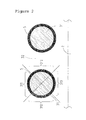
- Fig. 3 is a partially enlarged view of the coils of strand 31 coated with a hydrophilic coating agent 15.
- the coils of strand 31 are coated with the hydrophilic coating agent 15 so that the gap 32 may be formed between the side surface portions 312 of the adjacent coils of strand 31.
- the hydrophilic coating agent 15 coats the outer circumference of the coil of strand 31 so that a center 15a of a cross-section formed by the coil of strand 31 and the hydrophilic coating agent 15 may be displaced further in a direction of the outward surface portion 311 than a center 31a of a cross-section of the coil of strand 31.
- the thickness of the hydrophilic coating agent 15 becomes smaller in the order of the outward surface portion 311, the side surface portions 312, and the inward surface portion 313.
- the hydrophilic coating agent 15 is protruded in the direction of the outward surface portion 311.
- the coating thickness of the hydrophilic coating agent 15 is increased at the outward surface portion 311. Accordingly, since hydrophilicity is given to the guidewire for a long period, durability of lubricity of the guidewire 1 can be improved.
- the thickness of the hydrophilic coating agent 15 coating the inward surface portion 313 is small, a space between the core shaft and the coiled body 3 can be secured sufficiently. Accordingly, flexibility of the coiled body 3 can be further improved.
- Such a shape of the hydrophilic coating agent 15 can be formed by the following method, for example.
- the hydrophilic coating agent 15 Before coating the coils of strand 31 with the hydrophilic coating agent 15, to heighten affinity of the coils of strand 31 for the hydrophilic coating agent 15, it is preferable to irradiate the outer circumference of the coiled body 3 with ultraviolet to activate the surfaces of the coils of strand 31.
- the outward surface portion 311 of the coil of strand 31 is most activated, and the side surface portions 312 are second most activated.
- the amount of ultraviolet to be irradiated to each side surface portion 312 is less than that to be irradiated to the outward surface portion 311.
- the activation level of the side surface portion 312 is lower than that of the outward surface portion 311.
- the inward surface portion 313 is not activated since the irradiated light does not reach it. Due to such differences in activation, the activation level of the side surface portion 312 decreases from the side of the outward surface portion 311 toward the side of the inward surface portion 313.
- the larger amount of the hydrophilic coating agent 15 is attached to a more activated portion.
- the density of the hydrophilic coating agent 15 becomes lower in the order of the outward surface portion 311, the side surface portions 312, and the inward surface portion 313.
- the thickness of the hydrophilic coating agent 15 also changes in accordance with the differences in density.
- the density of the hydrophilic coating agent 15 at the side surface portion 312 gradually decreases from the side of the outward surface portion 311 toward the side of the inward surface portion 313.
- the film thickness of the hydrophilic coating agent 15 there also decreases in a similar manner.
- lubricity of the hydrophilic coating agent 15 at the outward surface portion 311 is greater than those of the side surface portions 312 and the inward surface portion 313. Also, lubricity of the hydrophilic coating agent 15 at the outward surface portion 311 can be maintained for a long period.
- the side surface portions 312 of the coil of strand 31 may be shielded by a shielding member made of a resin or a metal before irradiation of ultraviolet.
- a shielding member made of a resin or a metal before irradiation of ultraviolet.
- the entire coils of strand 31 extending in the direction of the long axis of the guidewire 1 may be coated with the hydrophilic coating agent 5 or 15.
Landscapes
- Health & Medical Sciences (AREA)
- Life Sciences & Earth Sciences (AREA)
- General Health & Medical Sciences (AREA)
- Heart & Thoracic Surgery (AREA)
- Veterinary Medicine (AREA)
- Public Health (AREA)
- Animal Behavior & Ethology (AREA)
- Epidemiology (AREA)
- Vascular Medicine (AREA)
- Surgery (AREA)
- Biophysics (AREA)
- Pulmonology (AREA)
- Engineering & Computer Science (AREA)
- Anesthesiology (AREA)
- Biomedical Technology (AREA)
- Hematology (AREA)
- Media Introduction/Drainage Providing Device (AREA)
- Materials For Medical Uses (AREA)
Applications Claiming Priority (1)
| Application Number | Priority Date | Filing Date | Title |
|---|---|---|---|
| JP2010080081A JP4905740B2 (ja) | 2010-03-31 | 2010-03-31 | ガイドワイヤ |
Publications (2)
| Publication Number | Publication Date |
|---|---|
| EP2371403A2 true EP2371403A2 (fr) | 2011-10-05 |
| EP2371403A3 EP2371403A3 (fr) | 2013-07-17 |
Family
ID=44484240
Family Applications (1)
| Application Number | Title | Priority Date | Filing Date |
|---|---|---|---|
| EP11158657.4A Withdrawn EP2371403A3 (fr) | 2010-03-31 | 2011-03-17 | Fil-guide |
Country Status (4)
| Country | Link |
|---|---|
| US (1) | US20110245729A1 (fr) |
| EP (1) | EP2371403A3 (fr) |
| JP (1) | JP4905740B2 (fr) |
| CN (1) | CN102205164A (fr) |
Families Citing this family (5)
| Publication number | Priority date | Publication date | Assignee | Title |
|---|---|---|---|---|
| JP5952562B2 (ja) * | 2012-01-05 | 2016-07-13 | 株式会社グッドマン | カテーテル及びカテーテルの製造方法 |
| JP5904672B2 (ja) | 2013-09-25 | 2016-04-20 | 朝日インテック株式会社 | ガイドワイヤ |
| JP5896479B2 (ja) * | 2013-09-25 | 2016-03-30 | 朝日インテック株式会社 | ガイドワイヤ |
| JP6275008B2 (ja) * | 2014-09-16 | 2018-02-07 | 朝日インテック株式会社 | ガイドワイヤ |
| US20170065750A1 (en) * | 2015-09-03 | 2017-03-09 | Becton, Dickinson And Company | Iv anticoagulant treatment systems and methods |
Citations (3)
| Publication number | Priority date | Publication date | Assignee | Title |
|---|---|---|---|---|
| JP2004215710A (ja) | 2003-01-09 | 2004-08-05 | Nippon Cable Syst Inc | 潤滑性被膜剤および吸湿時に潤滑性を発現する医療用具 |
| JP2008237621A (ja) | 2007-03-27 | 2008-10-09 | Japan Lifeline Co Ltd | 医療用挿通器具およびその製造方法 |
| JP2010080081A (ja) | 2008-09-24 | 2010-04-08 | Panasonic Corp | 二次電池 |
Family Cites Families (6)
| Publication number | Priority date | Publication date | Assignee | Title |
|---|---|---|---|---|
| US4534363A (en) * | 1982-04-29 | 1985-08-13 | Cordis Corporation | Coating for angiographic guidewire |
| US6203505B1 (en) * | 1998-06-05 | 2001-03-20 | Advanced Cardiovascular Systems, Inc. | Guidewires having a vapor deposited primer coat |
| US6494894B2 (en) * | 2000-03-16 | 2002-12-17 | Scimed Life Systems, Inc. | Coated wire |
| US7141024B2 (en) * | 2002-11-06 | 2006-11-28 | Benny Gaber | Maneuverable-coiled guidewire |
| US7182735B2 (en) * | 2003-02-26 | 2007-02-27 | Scimed Life Systems, Inc. | Elongated intracorporal medical device |
| JP5248932B2 (ja) * | 2008-06-20 | 2013-07-31 | 株式会社パイオラックスメディカルデバイス | ガイドワイヤ及びその製造方法 |
-
2010
- 2010-03-31 JP JP2010080081A patent/JP4905740B2/ja active Active
-
2011
- 2011-02-11 CN CN2011100365952A patent/CN102205164A/zh active Pending
- 2011-02-25 US US13/035,215 patent/US20110245729A1/en not_active Abandoned
- 2011-03-17 EP EP11158657.4A patent/EP2371403A3/fr not_active Withdrawn
Patent Citations (3)
| Publication number | Priority date | Publication date | Assignee | Title |
|---|---|---|---|---|
| JP2004215710A (ja) | 2003-01-09 | 2004-08-05 | Nippon Cable Syst Inc | 潤滑性被膜剤および吸湿時に潤滑性を発現する医療用具 |
| JP2008237621A (ja) | 2007-03-27 | 2008-10-09 | Japan Lifeline Co Ltd | 医療用挿通器具およびその製造方法 |
| JP2010080081A (ja) | 2008-09-24 | 2010-04-08 | Panasonic Corp | 二次電池 |
Also Published As
| Publication number | Publication date |
|---|---|
| JP4905740B2 (ja) | 2012-03-28 |
| US20110245729A1 (en) | 2011-10-06 |
| EP2371403A3 (fr) | 2013-07-17 |
| JP2011212034A (ja) | 2011-10-27 |
| CN102205164A (zh) | 2011-10-05 |
Similar Documents
| Publication | Publication Date | Title |
|---|---|---|
| EP2371402B1 (fr) | Revêtement de fil-guide présentant un gradient de réticulation | |
| JP2992251B2 (ja) | 微小編み組みガイドワイヤ | |
| JP3645107B2 (ja) | 医療用チューブ | |
| US20160008585A1 (en) | Guide wire | |
| JP3830945B2 (ja) | 複合型編み組みガイドワイヤ | |
| EP2371403A2 (fr) | Fil-guide | |
| JP6426613B2 (ja) | カテーテル | |
| US20120245488A1 (en) | Guidewire | |
| US10850074B2 (en) | Guide wire | |
| US20190262588A1 (en) | Guide wire | |
| TWI517869B (zh) | 醫療用導線 | |
| JP2012070979A (ja) | ガイドワイヤ | |
| JP2025129291A (ja) | ガイドワイヤおよびガイドワイヤの製造方法 | |
| JP7689981B2 (ja) | ガイドワイヤおよびガイドワイヤの製造方法 | |
| JP2009233200A (ja) | ガイドワイヤ | |
| JP2006516454A (ja) | アイオノマーポリマースリーブを備えた体内器具 | |
| JP7474775B2 (ja) | ガイドワイヤ | |
| WO2021117657A1 (fr) | Fil-guide | |
| JP2006129935A (ja) | 医療用ガイドワイヤ | |
| JP2004215709A (ja) | 異なる高分子化合物からなる医療用ハイドロゲル | |
| WO2024166629A1 (fr) | Fil-guide et son procédé de fabrication | |
| WO2025075126A1 (fr) | Dispositif médical | |
| JP2024040728A (ja) | カテーテル | |
| JP2024157712A (ja) | ガイドワイヤ | |
| WO2025062987A1 (fr) | Fil-guide |
Legal Events
| Date | Code | Title | Description |
|---|---|---|---|
| PUAI | Public reference made under article 153(3) epc to a published international application that has entered the european phase |
Free format text: ORIGINAL CODE: 0009012 |
|
| AK | Designated contracting states |
Kind code of ref document: A2 Designated state(s): AL AT BE BG CH CY CZ DE DK EE ES FI FR GB GR HR HU IE IS IT LI LT LU LV MC MK MT NL NO PL PT RO RS SE SI SK SM TR |
|
| AX | Request for extension of the european patent |
Extension state: BA ME |
|
| PUAL | Search report despatched |
Free format text: ORIGINAL CODE: 0009013 |
|
| AK | Designated contracting states |
Kind code of ref document: A3 Designated state(s): AL AT BE BG CH CY CZ DE DK EE ES FI FR GB GR HR HU IE IS IT LI LT LU LV MC MK MT NL NO PL PT RO RS SE SI SK SM TR |
|
| AX | Request for extension of the european patent |
Extension state: BA ME |
|
| RIC1 | Information provided on ipc code assigned before grant |
Ipc: A61M 25/09 20060101ALI20130613BHEP Ipc: A61L 31/10 20060101AFI20130613BHEP Ipc: A61L 31/14 20060101ALI20130613BHEP |
|
| STAA | Information on the status of an ep patent application or granted ep patent |
Free format text: STATUS: THE APPLICATION IS DEEMED TO BE WITHDRAWN |
|
| 18D | Application deemed to be withdrawn |
Effective date: 20140118 |