EP2371500A2 - Système d'estampillage de pièces découpées - Google Patents
Système d'estampillage de pièces découpées Download PDFInfo
- Publication number
- EP2371500A2 EP2371500A2 EP11005084A EP11005084A EP2371500A2 EP 2371500 A2 EP2371500 A2 EP 2371500A2 EP 11005084 A EP11005084 A EP 11005084A EP 11005084 A EP11005084 A EP 11005084A EP 2371500 A2 EP2371500 A2 EP 2371500A2
- Authority
- EP
- European Patent Office
- Prior art keywords
- punching
- iron
- computer
- information
- transponder
- Prior art date
- Legal status (The legal status is an assumption and is not a legal conclusion. Google has not performed a legal analysis and makes no representation as to the accuracy of the status listed.)
- Granted
Links
Images


Classifications
-
- B—PERFORMING OPERATIONS; TRANSPORTING
- B23—MACHINE TOOLS; METAL-WORKING NOT OTHERWISE PROVIDED FOR
- B23D—PLANING; SLOTTING; SHEARING; BROACHING; SAWING; FILING; SCRAPING; LIKE OPERATIONS FOR WORKING METAL BY REMOVING MATERIAL, NOT OTHERWISE PROVIDED FOR
- B23D25/00—Machines or arrangements for shearing stock while the latter is travelling otherwise than in the direction of the cut
- B23D25/12—Shearing machines with blades on coacting rotating drums
-
- B—PERFORMING OPERATIONS; TRANSPORTING
- B23—MACHINE TOOLS; METAL-WORKING NOT OTHERWISE PROVIDED FOR
- B23D—PLANING; SLOTTING; SHEARING; BROACHING; SAWING; FILING; SCRAPING; LIKE OPERATIONS FOR WORKING METAL BY REMOVING MATERIAL, NOT OTHERWISE PROVIDED FOR
- B23D36/00—Control arrangements specially adapted for machines for shearing or similar cutting, or for sawing, stock which the latter is travelling otherwise than in the direction of the cut
- B23D36/0008—Control arrangements specially adapted for machines for shearing or similar cutting, or for sawing, stock which the latter is travelling otherwise than in the direction of the cut for machines with only one cutting, sawing, or shearing devices
- B23D36/0033—Control arrangements specially adapted for machines for shearing or similar cutting, or for sawing, stock which the latter is travelling otherwise than in the direction of the cut for machines with only one cutting, sawing, or shearing devices for obtaining pieces of a predetermined length
- B23D36/0041—Control arrangements specially adapted for machines for shearing or similar cutting, or for sawing, stock which the latter is travelling otherwise than in the direction of the cut for machines with only one cutting, sawing, or shearing devices for obtaining pieces of a predetermined length the tool moving continuously
- B23D36/005—Control arrangements specially adapted for machines for shearing or similar cutting, or for sawing, stock which the latter is travelling otherwise than in the direction of the cut for machines with only one cutting, sawing, or shearing devices for obtaining pieces of a predetermined length the tool moving continuously and taking account of marks, e.g. on the stock
-
- B—PERFORMING OPERATIONS; TRANSPORTING
- B26—HAND CUTTING TOOLS; CUTTING; SEVERING
- B26D—CUTTING; DETAILS COMMON TO MACHINES FOR PERFORATING, PUNCHING, CUTTING-OUT, STAMPING-OUT OR SEVERING
- B26D5/00—Arrangements for operating and controlling machines or devices for cutting, cutting-out, stamping-out, punching, perforating, or severing by means other than cutting
-
- B—PERFORMING OPERATIONS; TRANSPORTING
- B26—HAND CUTTING TOOLS; CUTTING; SEVERING
- B26D—CUTTING; DETAILS COMMON TO MACHINES FOR PERFORATING, PUNCHING, CUTTING-OUT, STAMPING-OUT OR SEVERING
- B26D5/00—Arrangements for operating and controlling machines or devices for cutting, cutting-out, stamping-out, punching, perforating, or severing by means other than cutting
- B26D5/20—Arrangements for operating and controlling machines or devices for cutting, cutting-out, stamping-out, punching, perforating, or severing by means other than cutting with interrelated action between the cutting member and work feed
- B26D5/30—Arrangements for operating and controlling machines or devices for cutting, cutting-out, stamping-out, punching, perforating, or severing by means other than cutting with interrelated action between the cutting member and work feed having the cutting member controlled by scanning a record carrier
- B26D5/34—Arrangements for operating and controlling machines or devices for cutting, cutting-out, stamping-out, punching, perforating, or severing by means other than cutting with interrelated action between the cutting member and work feed having the cutting member controlled by scanning a record carrier scanning being effected by a photosensitive device
-
- B—PERFORMING OPERATIONS; TRANSPORTING
- B26—HAND CUTTING TOOLS; CUTTING; SEVERING
- B26D—CUTTING; DETAILS COMMON TO MACHINES FOR PERFORATING, PUNCHING, CUTTING-OUT, STAMPING-OUT OR SEVERING
- B26D7/00—Details of apparatus for cutting, cutting-out, stamping-out, punching, perforating, or severing by means other than cutting
- B26D7/27—Means for performing other operations combined with cutting
- B26D7/28—Means for performing other operations combined with cutting for counting the number of cuts or measuring cut lenghts
-
- B—PERFORMING OPERATIONS; TRANSPORTING
- B26—HAND CUTTING TOOLS; CUTTING; SEVERING
- B26F—PERFORATING; PUNCHING; CUTTING-OUT; STAMPING-OUT; SEVERING BY MEANS OTHER THAN CUTTING
- B26F1/00—Perforating; Punching; Cutting-out; Stamping-out; Apparatus therefor
- B26F1/38—Cutting-out; Stamping-out
- B26F1/40—Cutting-out; Stamping-out using a press, e.g. of the ram type
-
- B—PERFORMING OPERATIONS; TRANSPORTING
- B26—HAND CUTTING TOOLS; CUTTING; SEVERING
- B26F—PERFORATING; PUNCHING; CUTTING-OUT; STAMPING-OUT; SEVERING BY MEANS OTHER THAN CUTTING
- B26F1/00—Perforating; Punching; Cutting-out; Stamping-out; Apparatus therefor
- B26F1/38—Cutting-out; Stamping-out
- B26F1/44—Cutters therefor; Dies therefor
- B26F1/46—Loose press knives
-
- C—CHEMISTRY; METALLURGY
- C14—SKINS; HIDES; PELTS; LEATHER
- C14B—MECHANICAL TREATMENT OR PROCESSING OF SKINS, HIDES OR LEATHER IN GENERAL; PELT-SHEARING MACHINES; INTESTINE-SPLITTING MACHINES
- C14B5/00—Clicking, perforating, or cutting leather
-
- C—CHEMISTRY; METALLURGY
- C14—SKINS; HIDES; PELTS; LEATHER
- C14B—MECHANICAL TREATMENT OR PROCESSING OF SKINS, HIDES OR LEATHER IN GENERAL; PELT-SHEARING MACHINES; INTESTINE-SPLITTING MACHINES
- C14B5/00—Clicking, perforating, or cutting leather
- C14B5/02—Stamps or dies for leather articles
-
- B—PERFORMING OPERATIONS; TRANSPORTING
- B26—HAND CUTTING TOOLS; CUTTING; SEVERING
- B26D—CUTTING; DETAILS COMMON TO MACHINES FOR PERFORATING, PUNCHING, CUTTING-OUT, STAMPING-OUT OR SEVERING
- B26D7/00—Details of apparatus for cutting, cutting-out, stamping-out, punching, perforating, or severing by means other than cutting
Definitions
- the invention firstly relates to a system for punching blank parts from planar bodies according to the preamble of claim 1.
- the cut pieces are positioned around the individual flaws that are different for each animal skin.
- the corresponding punching irons which with respect to their geometric shape and area correspond to the shape and area of the blank to be punched out, on a machining table, in particular on a contact surface of a machining table, in an optimized manner manually around the faults be positioned around.
- the user must be aware of the fact that it is avoided that the defects in the animal skin occur at the visible points of the blank parts or that undesired error levels extend into certain blank parts.
- the user the operator, applies the punches to the body in accordance with the criteria set forth above. Subsequently, the body is subjected to a punching operation in a punching device.
- the punching iron is subjected to a separation process. After the separation process, the blank parts are separated from the other components of the animal skin and can be removed manually.
- the object is therefore the invention of further developing the known system according to the preamble of claim 1 in such a way that it allows a simplified or improved processing of the body.
- the invention solves this problem with the features of claim 1, in particular with those of the characterizing part, and is accordingly characterized in that the punching iron is assigned in each case a transponder and that a device for detecting information of the transponder is provided which comprises a computer or is connected to a computer of the system, wherein the computer is connected to a display unit of the system, which can display information to a user, and wherein the computer in knowledge of the required quantities of the blank parts and in knowledge of the already applied punch iron causes the display unit the Indicates the type or the number of cut parts still to be processed.
- the principle of the invention consists essentially in assigning to each punching iron a mechanically, in particular contactless and electronically, readable identification element.
- a transponder in the sense of the invention is understood in particular to be an RFID (radio frequency identification) chip.
- RFID radio frequency identification
- the transponder is an RFID chip in the data or information are stored on the appropriate punching iron.
- the type of punching iron for example by specifying a particular shape or contour, or a number of the punching iron may be stored.
- information about the size, ie area, of the punching iron can be stored in the transponder.
- a conclusion may be possible, which type is the punching iron and / or which size has the corresponding punching iron.
- the detection unit can be arranged, for example, above a processing table which provides the support surface.
- the detection device may be mounted on the ceiling side. Each time the operator places a punching iron on the support surface or on the body, the detection device can detect the corresponding punched punching iron.
- the detection unit has a computer or is connected to a computer.
- the computer may further be connected to a display unit and cause the display unit to display information that is observable or recognizable by the operator.
- the operator may have the task of positioning 20 blank pieces of a first type and 15 blank pieces of a second type in an optimized manner on the animal skin or on several animal hides.
- the detection unit can detect this and, for example, indicate the number of already laid punching iron of the first type and possibly also the quantity of the already laid punching iron of the second type. Alternatively or additionally, the remaining remainder of the still to be placed punching iron first and second type can be displayed.
- the computer generates warning signals, such as an audible warning signal when an operator hangs up a false, that is not required for example for a corresponding order punching iron or superfluous, because for a particular order already processed and not required further punching iron , Again, this can make the operator's job easier.
- warning signals such as an audible warning signal when an operator hangs up a false, that is not required for example for a corresponding order punching iron or superfluous, because for a particular order already processed and not required further punching iron , Again, this can make the operator's job easier.
- the computer is assigned an input unit with which the operator, either manually or with the aid of automated read-in mechanisms, gives the computer information about how large the area of the is to be placed or applied animal skin. This information is due to a previous processing step for area detection, for example, handwritten on the back of the animal skin and can be entered manually accordingly with the aid of the input unit in the computer.
- the attached to the respective punch iron transponder either directly itself already contains information about the size and type of punching iron or transmits only an identification number or identification number, which can assign the computer a punching iron type and a size of the punching iron.
- the computer can determine the respective degree of utilization in real time and display it to the user on the display unit. The user recognizes in this way independently early, whether a desired high utilization can be achieved, or whether the achievable at a certain constellation and positioning of punches iron utilization is still too low. In this case, it is possible for the user to change the positioning of the punching iron in order to achieve a higher degree of utilization.
- the computer could generate a warning signal, e.g. also emit an audible or visual warning signal if a minimum degree of utilization has not been reached.
- a warning signal e.g. also emit an audible or visual warning signal if a minimum degree of utilization has not been reached.
- the punching process may only be performed when a minimum degree of utilization has been achieved.
- the system according to the invention is used for punching cut parts from planar bodies, in particular from Animal skins, such as cowhides or goat hides, but also from plastic films, papers, cardboard, fabrics, textiles and technical textiles or other flat, especially limp goods and webs.
- the bodies may be discrete bodies such as animal skins, but alternatively may be supplied endlessly, eg from a roll supply such as cloth or cardboard sheets.
- planar bodies have no individual flaws, but repeating patterns or patternless body are provided, under certain circumstances, several bodies can be superimposed and punched out.
- a punching device e.g. a surface punching device or a roller punching device may be provided.
- the surface punching device performs with a punch a movement substantially perpendicular to the plane of the support surface and acted essentially all launched on the body puncture iron at the same time.
- a roller punching device a relative movement of the support surface and thus also of the body to the punching device takes place during the punching process.
- a punching device is associated with a plurality of bearing surfaces.
- the arrangement of a punching device can satisfy up to eight bearing surfaces.
- Each support surface can be assigned to a processing table, on which, for example, one of eight operators works. In each case, when the operator has placed the punch iron final, the support surface can be moved to the punching device and drive back to the original position after the punching operation.
- a punching device is preferably associated with an endlessly circulating support surface.
- a positioning of the punching iron can be done in manual, that is in a manual manner, around the fault locations. The error detection is then left to the operator.
- the placement of the punching iron can also be done in an automated, that is machine manner, or at least machine-supported. Even with a machine-supported placement of the punching iron on the body, the arrangement of a transponder on the respective punching iron allows a check which punching iron has been placed.
- the system according to the invention allows the electronic detection of information which punching iron is placed on the body. This information can subsequently be processed electronically by the computer.
- the transponder also allows a location of the placed body relative to the skin.
- This can also be a position control or position control of the punching iron done. This is particularly advantageous if the position of the punching iron has already been precalculated in a previous nesting optimization process, for example by means of a projection device the position of the punching iron to be placed is displayed.
- the positions of the puncture irons can also be projected onto the animal skin after a previously carried out computer-assisted optimization.
- the operator places the punching iron in accordance with the computer-calculated specification and positions the punching iron along the projection lines of a projector unit.
- the attachment of a transponder according to the invention on the punching iron is advantageous because the operator can manually check whether a corresponding blank part can actually be brought close to a fault in the manner calculated by the computer or not. The operator may, if necessary, intervene manually and reposition, e.g. determines that a permissible error rate is exceeded as a result of a visual inspection of the fault location.
- any template-like element which has a cutting or punching or cutting edge, which is under the action of the punching iron in the punching device in a position to penetrate the body or separate.
- the punching iron is conventionally formed by a circumferential profile frame having a cutting edge.
- the frame can surround an opening. Connecting struts may be arranged along the opening.
- the opening can also be completely filled with a stiffening element, for example made of wood.
- punching iron in the context of the invention is preferably a metallic element into consideration.
- the term "punching iron” is not limited to such materials. Also conceivable are punching iron made of sufficiently hard materials, such as special plastics or material combinations.
- the replaceable support plate is associated with a transponder.
- This transponder can contain data for the identification of the punching tools and be read by a reading device, so that it can be ensured that a carrier plate is used with the appropriate punching tools.
- the punching tools is not each assigned a transponder, and a computer that can calculate and display the type or number of punching iron still to be placed in knowledge of the required quantities of blank parts and in knowledge of the already applied punching iron, has the system described there also not on ,
- the transponder is an RFID chip. This gives you the opportunity to use conventional elements.
- an RFID chip is used, which is suitable even when mounted directly on metal objects to send sufficient field strengths.
- the punching iron each have a closed frame, which is formed by a profile element with a cutting edge.
- This offers the possibility to use conventional punching iron.
- This also makes it possible to retrofit existing, conventional punching iron by attaching a transponder.
- the frame surrounds an opening.
- the tan ponder can be arranged inside this opening. This makes it possible to accommodate such that the transponder arranged on the punching iron does not disturb the positioning process of the punching iron on the body and no collision with adjacent punching iron occurs.
- the transponder preferably mounted in such a way that it is arranged in each case slightly distanced from the end faces of the punching iron.
- reinforcing or stiffening elements are arranged within the opening. These serve to permanently ensure the selected shape of the punching iron.
- the transponder can advantageously be arranged on the reinforcing or stiffening elements. This allows a particularly simple placement of the transponder.
- the attachment is advantageous because the field strength attenuation can be reduced.
- a device for detecting information of the transponder may be a conventional device that cooperates with conventional transponders, in particular with conventional RFID chips.
- the device for detecting information of the transponder is a transceiver unit. It is able to send information, e.g. as a result of excitation of the circuit contained in the transponder to receive signals from the transponder.
- the device for detection is designed and / or arranged in such a way that it can determine that a specific punching iron with a specific transponder is arranged on a specific support surface. Preferably, it can process this information in real time and supply it to a display device.
- the device for acquiring information comprises a computer or is connected to a computer.
- the computer may be a conventional computer, for example a personal computer.
- the computer preferably further comprises at least one interface for the transmission of information a display device on the types and sizes, possibly also the shapes of the punching iron and the jobs to be processed, that is, the number and type of certain blank parts for a particular order, eg for a seating group no. 1 or a seating group no.
- the computer can further advantageously be connected to an input device with which a user manually or with the aid of automatically readable information data about the body to be processed, such as the size of the surface of a skin to be processed and / or information about the species and / or you can enter the number of cut parts to be punched out.
- the input device thus enables the operator to communicate with the computer.
- the required data can be entered manually by the operator, for example via a keyboard.
- the required data may be entered automatically, for example using a bar code reader connected to the computer.
- the latter is particularly advantageous if there is a bar code on the skin containing information about the size of the respective skin.
- a display unit is connected to the computer, which can display information to the user.
- the display unit serves e.g. to provide the user with information on which degree of utilization is achieved at a certain time and / or how many blank parts of which type are still to be punched out for a particular job, or how many punching dies (one also speaks of stencils) to hang onto the body are.
- a stamping device is associated with a plurality of bearing surfaces. This is particularly advantageous when the bearing surfaces are displaceable relative to the punching device. For example, one can Punching device eight bearing surfaces to be assigned to eight different editing tables.
- each support surface is associated with a device for detecting information of the transponder.
- each support surface has its own means for detecting information of the transponder.
- a corresponding number of means for collecting information is provided. These can be connected, for example, to a common computer. Alternatively, of course, several computers can be provided.
- the device for acquiring information can communicate with all transponders or detects all transponders associated with puncture iron placed on the body. So it does not capture the punching iron or transponder, which are not yet placed on the body, but are stored, for example, in an adjacent the support surface arranged accommodation chamber.
- the device may detect that a particular transponder, and thus a particular punching iron, has been placed on the body or is being hung up.
- a plurality of contact surfaces is assigned a common device for detecting information of the transponder or transponder.
- the device can distinguish which punching iron and which transponder associated with which support surface.
- a common device for detection can also be arranged adjacent to the punching device or associated with the punching device.
- the invention proposes, however, a detection of all transponder information and a display of the received or edited information, always in real time, ie when the puncture iron have just been placed on the support surfaces or just placed.
- the system must ensure that on the one hand there is an allocation of the numerous punching iron and equally numerous transponders to the different contact surfaces and on the other hand It can be made a distinction as to which dies are laid on a particular body and which dies are not laid. This distinction can be made, for example, by measuring a distance between the detection unit and the support surface. This can be done for example by measuring signal strengths or field strengths.
- the placement of the punching iron adjacent a support surface could, however, also take place in a storage space that is shielded from the detection unit in a particular way. In this way, it can be ensured that the transponders located in the accommodation chamber are not recognized by the detection unit, but are then recognized when they are taken out of the accommodation chamber and placed on the support surface.
- the invention relates to a method for punching parts of sheet-like bodies according to claim 6.
- the invention has for its object to improve a back to the applicant, known by public prior art method of the prior art for punching parts of sheet-like bodies.
- the method according to the invention accordingly provides that first a body, in particular an animal skin, is placed on a support surface. Then a punching iron is positioned on the body. Finally, signals with information about the punching iron, e.g. an identification number transmitted to a device for acquiring information. This is done with the aid of a transponder attached to the punching iron.
- the transmission of the signals takes place only when the appropriate punching iron is placed on the body or has just been placed on the body.
- the means for detecting may discriminate whether the punching iron is laid on the body or not. Only after the transmission of the signal information, the parts are punched out.
- the steps b) and c) are numerous repeated until the flat body, in particular the animal skin, is covered with so many punching iron that a high degree of utilization is achieved.
- an indication of a number of punching iron can be made each time after the signals have been transmitted to the detection device.
- the display can be made on a display unit which is connected to a computer which Part of the device for collecting information is, or is associated with.
- the number of puncture iron applied to the body is advantageously displayed.
- the quantities of the punching iron that is still to be placed or that has already been placed in its entirety are displayed.
- the numbers are listed for different punching iron, that is for punching iron of different types.
- the user can be conveyed so the information how many punching iron of any kind still need to be launched.
- information about the area of the body is transmitted to the device for acquiring information, or transmitted to a computer connected to this device. Also comes to the computer information about the size of the corresponding punching iron. In this way, the computer can determine the degree of utilization, in particular in real time.
- the invention advantageously relates to a punching iron, comprising a closed or substantially closed profile frame surrounding an opening, with a cutting edge, for cutting planar bodies, wherein a transponder is arranged on the punch iron, which contains or can emit information that identifies a allow certain punching iron or a die type and / or allow a conclusion on the type and / or size of the respective punching iron.
- Fig. 1 shows a block diagram representation of a first embodiment of the system 10 according to the invention.
- This system comprises four processing tables 11a, 11b, 11c, 11d, each processing table having its own support surface 12a, 12b, 12c, 12d.
- Only on the supporting surface 12a of the working table 11a is a body 15, for example an animal skin, placed. Of course, corresponding animal skins can also be placed on the remaining bearing surfaces 12b, 12c, 12d.
- At each processing table 11 a, 11 b, 11 c, 11 d is z.
- the processing table serves to bring the respective support surface 12 in a comfortable working height. While the processing table, for example fixed, that can be arranged stationary, at least the support surface 12 is displaced and can be fed to a stationary punching device 14 or this approximated. For example, by using rail systems or the like, not shown, it can be achieved that the support surface 12a with the body 15 thereon is initially moved along the arrow P 1 into a position shown in dashed lines, and then along the arrow P 2 into the punching device 14 is retracted. After performing the punching operation, the corresponding support surface 12a is moved back along the direction of the arrow P 3 and, after a further displacement movement along the arrow P 4, is returned to the initial situation. Subsequently, for example, what is in Fig. 1 is not shown, the support surface 12b to the punching device 14 towards.
- the punching device 14 are more or less Assigned to work tables and / or support surfaces.
- each support surface 12 may be associated with its own punching device 14.
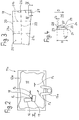
- Fig. 2 shows in an enlarged view the work table 11 a of Fig. 1 , It should be noted at this point that it does not matter whether the corresponding bearing surface 12a is square or rectangular or has a different contour. When working with animal skins, it is preferable to use support surfaces of the size 3x3 m.
- Fig. 2 shows a cow skin, which has four different fault locations F 1 , F 2 , F 3 , F 4 , for example.
- the fault F 1 may be, for example, a hole in the animal skin, for example due to a mosquito bite, the fault F 2, for example, a crease, the fault F 3, for example, a body with a changed skin condition and the fault F 4, for example, a deep crease or furrow ,
- the operator 13a has the task of laying punching iron 16, 17, 18, 19 of a certain type in a certain number of pieces on the cowhide 15, and to position around the fault locations F 1 to F 4 , so that the flaws do not occur at specific locations the cut parts and later eg on the upholstered furniture occur.
- Fig. 2 shows by way of example a first, rectangular stamped part 16, a second, substantially rectangular stamped part 17 and a third, substantially circular stamped part 18. These three stamped parts make it clear that positioning around the defect F 1 should take place in such a way that the defect is outside the contours of the blank parts lies.
- the blank part to be cut out has a contour which corresponds to the contour of the stamped part.
- Fig. 3 shows in plan view a stamped part 19 of a quadrangular, substantially irregular contour.
- the stamped part 19 has a closed, circumferential frame, which is apparent from the sectional view of Fig. 4 results.
- the frame has a height H and extends from a cutting edge 24 to a pressure side 23.
- the cutting edge 24 rests on the body 15 in the state applied to the body 25 of the punching iron 19.
- the pressure side 23 cooperates with the punching device 14 and is acted upon, essentially along the direction of the arrow D, that is, along a direction of the pressurization.
- the frame 20 of the punching iron 19 surrounds an opening 25.
- the opening 25 can in Fig. 2 As a vertical struts indicated stiffening ribs 21a and 21b or extending substantially horizontally extending struts 22 in any number.
- the opening 25 may be substantially filled, for example, with a stiffening element made of wood, not shown.
- a transponder 27 is attached on the inside 26 of the frame 20.
- the attachment can be made for example by gluing, but also by any other suitable fastening such as screws, rivets or the like.
- the transponder 27 has a height that is significantly less than the height H of the frame 20.
- the top side 28 of the transponder 27 is spaced at a distance T 1 from the top 23 of the frame.
- the underside 29 of the transponder is spaced a distance T 2 from the cutting edge 24.
- the distances T 1 and T 2 serve to avoid an impairment of the transponder due to the pressurization.
- the transponder is fixed on the inside 26 of the frame, so that collisions can be excluded with adjacent to be arranged punching iron.
- a transponder 27a may also be attached to a stiffening rib or strut 22a disposed within the opening 25, as well Fig. 3 indicated in dashed lines, or be attached to a stiffening element, not shown, disposed within the opening 25.
- a punch iron for example, a plurality of transponders may be assigned, for example, to achieve better detectability.
- Fig. 5 shows a side view of a processing table 11 with a support surface 12.
- an applied body 15 which is currently owned by the operator.
- Fig. 5 shows the sake of clarity, only a single, exaggerated illustrated punching iron 19 with an attached transponder 27.
- D the direction of the pressure drop during punching.
- a separate body for example a flat plate 30, can be placed on all punching iron. This serves in the punching device 14, for example, a homogenization of the punching pressure.
- Fig. 5 shows a device 31 for detecting information of the transponder 27.
- the device 31 Via a connecting cable 32, the device 31 is connected to a computer 33.
- the computer 33 may alternatively be part of the device 31.
- the computer 33 Via a second cable 34, the computer 33 is connected to an input device 35.
- the computer 33 is connected via a further cable 36 with a display device 37.
- Both the input device 35 and the display device 37 are preferably arranged stationary. While the input device 35 can preferably be arranged in the immediate vicinity of the table 11, for example also directly on the table 11, in order to allow the operator 13 to handle it conveniently, it is of primary importance to the display device 37 that the operator selects it 13 is clearly visible and recognizable. Of course, the input device 35 and the display device 37 may also be combined and connected to the computer 33 with only a single cable.
- the operator 13 places a specific punching iron, for example the punching iron 19, on the animal skin 15 with a specific transponder 27. She pays attention, as in Fig. 2 indicated that the punches are positioned around faults.
- Each punch iron 16, 17, 18, 19 has its own transponder or a specific type of transponder.
- information about the type of punching iron is contained in each transponder. The information can also be a specific frequency under which the Transponder can emit signals. Identical types of punching iron may also contain the same identification numbers or the same frequencies.
- the transponder is identifiable, so that the computer 33 and / or the detection unit 31 permits detection of the transponder and can relate the transponder to information about the corresponding punching iron, for example the type of punching iron or the size of the punching iron.
- the user has, for example, to process a job which, in the simplest case, provides that as many identical punching iron 19 as possible should be positioned on the animal skin 15.
- the punching iron 19 is the Fig. 5 shown exaggeratedly big. This order is therefore about as many small punching iron identical size and type on the skin to accommodate and thereby the individual contour of the skin, ie its outline, and to consider the individual distribution and the degree of flaws.
- the detecting means 31 can detect this. It knows the size of the punching iron used, either from a previously stored in the computer table or as a result of an individual transmission of information of the operator 13 to the computer 33. Furthermore, the detection unit 31, the area size of the respective skin 15, located on the support surface 12 is located. This information may have previously been transmitted to the computer 33 manually or, for example, with the aid of a bar code reader.
- the animal skin 15 on the support surface 12 has an area of 100 cm 2 .
- Fig. 5 show a situation in which the user 13 has just placed the tenth punching iron 19 on the animal skin 15 and previously nine punching iron 19 have already been placed on the same skin and are still on the skin.
- the detection unit 31 can determine that the tenth punching iron 19 is located on the animal skin 15 and transmit this information to the computer 33.
- This information is transmitted clearly visible so that he can make a decision as to whether he can be satisfied with the selected positioning of the individual punching iron or make a change in the positioning of the punching iron, for example, to achieve a greater degree of utilization.
- the device 31 for detecting the information of the transponder can also take into account if a once placed on an animal skin or other body 15 punching iron is removed again from the table or from the support surface. Accordingly, the computer 33 can take this information into account and correct the degree of utilization accordingly or change a number of pieces or a piece number display accordingly.
- a subsequent order may be required, for example, that the same operator 13 executes an order on a same processing table 12, which requires four different blank parts and, for example, four different punching iron.
- the information can be transmitted to the computer 33, for example by a specific combination of digits via the input device 35.
- the Enter operator 13 that for a particular car manufacturer, for a particular vehicle model and for a particular trim level, a seat trim in a particular leather color is desired to punch.
- This information can be entered by the operator 13 via the input device 35 either directly or coded, for example by specifying a key number.
- the computer knows due to a stored table then that a certain number of parts 1, parts 2, 3 parts and parts 4 is required to process the order with the specific key number.
- the display unit 37 also allows, for example, an illustration of how many pieces of particular blank parts have already been laid up or are yet to be hung up.
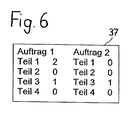
- Fig. 6 shows in a snapshot for two different orders 1 and 2 that a part 1 of a first order is still to punch in a number of two, whereas the required number of pieces 2 has already been reached.
- the second column under order 1 of the Fig. 6 indicates the remaining, to be processed quantities of the respective blank parts of the order 1.
- the display device 37 may in a representation of Fig. 6 and in a representation of Fig. 5 both information, so both information on the degree of utilization currently achieved as well as information about the numbers of already launched or the still to be laid punches, taking into account the types of cut parts also combined, in an easily recognizable form represent. This representation is calculated by the running on the computer 33 software.
- the device 31 for acquiring the information and / or the computer 33 is assigned a counter.
Landscapes
- Engineering & Computer Science (AREA)
- Mechanical Engineering (AREA)
- Life Sciences & Earth Sciences (AREA)
- Forests & Forestry (AREA)
- Chemical & Material Sciences (AREA)
- Organic Chemistry (AREA)
- General Factory Administration (AREA)
- Management, Administration, Business Operations System, And Electronic Commerce (AREA)
- Radar Systems Or Details Thereof (AREA)
Applications Claiming Priority (2)
| Application Number | Priority Date | Filing Date | Title |
|---|---|---|---|
| DE200710050270 DE102007050270A1 (de) | 2007-10-18 | 2007-10-18 | System zum Stanzen von Zuschnittteilen |
| EP08014904.0A EP2050546B1 (fr) | 2007-10-18 | 2008-08-22 | Système d'estampillage d'éléments de coupe |
Related Parent Applications (1)
| Application Number | Title | Priority Date | Filing Date |
|---|---|---|---|
| EP08014904.0 Division | 2008-08-22 |
Publications (3)
| Publication Number | Publication Date |
|---|---|
| EP2371500A2 true EP2371500A2 (fr) | 2011-10-05 |
| EP2371500A3 EP2371500A3 (fr) | 2012-04-18 |
| EP2371500B1 EP2371500B1 (fr) | 2013-06-05 |
Family
ID=39952338
Family Applications (2)
| Application Number | Title | Priority Date | Filing Date |
|---|---|---|---|
| EP11005084.6A Not-in-force EP2371500B1 (fr) | 2007-10-18 | 2008-08-22 | Système d'estampillage de pièces découpées |
| EP08014904.0A Not-in-force EP2050546B1 (fr) | 2007-10-18 | 2008-08-22 | Système d'estampillage d'éléments de coupe |
Family Applications After (1)
| Application Number | Title | Priority Date | Filing Date |
|---|---|---|---|
| EP08014904.0A Not-in-force EP2050546B1 (fr) | 2007-10-18 | 2008-08-22 | Système d'estampillage d'éléments de coupe |
Country Status (2)
| Country | Link |
|---|---|
| EP (2) | EP2371500B1 (fr) |
| DE (1) | DE102007050270A1 (fr) |
Families Citing this family (8)
| Publication number | Priority date | Publication date | Assignee | Title |
|---|---|---|---|---|
| WO2009105893A1 (fr) * | 2008-02-28 | 2009-09-03 | Ontario Die International Inc. | Systèmes et procédés pour un contrôle en temps réel de l'utilisation ou du rendement d'un outil |
| SK500502012A3 (sk) * | 2012-11-05 | 2014-05-06 | Peter Ondruš | Systém automatickej identifikácie nástrojov a identifikovaný nástroj |
| ES2859898T3 (es) * | 2013-01-29 | 2021-10-04 | Gerber Tech Llc | Automatización de procedimiento de tratamiento de cuero para operaciones de troquelado |
| ITBO20130143A1 (it) * | 2013-04-02 | 2014-10-03 | Teseo Spa | Metodo per il taglio di pellami |
| DE102015106776A1 (de) * | 2015-04-30 | 2016-11-03 | Veit Gmbh | Verfahren zum Betreiben einer Fixiermaschine sowie Fixiermaschine |
| DE102015107437A1 (de) * | 2015-05-12 | 2016-11-17 | Fortuna Spezialmaschinen Gmbh | Vorrichtung und Verfahren zum Spalten von Zuschnitten aus biegeschlaffem Material |
| DE102015107438A1 (de) * | 2015-05-12 | 2016-11-17 | Fortuna Spezialmaschinen Gmbh | Vorrichtung und Verfahren zum Schärfen von Zuschnitten aus biegeschlaffem Material |
| DE102018001175A1 (de) * | 2018-02-15 | 2019-08-22 | Capex Invest GmbH | Verfahren und Vorrichtung zur Unterstützung oder Durchführung eines Schneidprozesses |
Citations (1)
| Publication number | Priority date | Publication date | Assignee | Title |
|---|---|---|---|---|
| DE19944581C1 (de) | 1999-09-17 | 2000-12-14 | Woschnik & Partner Maschb Gmbh | Flachbett-Bogenstanze, insbesondere zur Herstellung von Papier- oder Kartonzuschnitten |
Family Cites Families (8)
| Publication number | Priority date | Publication date | Assignee | Title |
|---|---|---|---|---|
| DE19522717C1 (de) * | 1995-06-22 | 1996-12-12 | Duerkopp Adler Ag | Verfahren zum Schneiden oder Stanzen einzelner Teile aus einer Tierhaut |
| IT1290507B1 (it) * | 1997-03-28 | 1998-12-04 | Atom Spa | Dispositivo per la programmazione di taglio mediante fustelle |
| DE19941862C2 (de) * | 1998-09-03 | 2003-02-06 | Seton Company Valley Forge Cor | Verfahren und Vorrichtung zur Ausbeutesteuerung in Echtzeit für nutzbare Teile aus einem Rohmaterial |
| DE20309394U1 (de) * | 2003-06-16 | 2003-11-13 | Johann Krumm GmbH & Co., 42853 Remscheid | Schneidwerkzeug für eine Schneidemaschine |
| DE202004018151U1 (de) * | 2004-11-23 | 2005-01-20 | Karl Marbach Gmbh & Co. Kg | Verarbeitungsanlage zum Stanzen von Zuschnitten aus einem Bogen |
| EP1746530B1 (fr) * | 2005-07-20 | 2008-12-03 | Homag Holzbearbeitungssysteme AG | Dispositif pour l'identification des outils |
| DE102005049436A1 (de) * | 2005-10-15 | 2007-04-19 | Saurer Gmbh & Co. Kg | Verfahren zum Betreiben einer Textilmaschine |
| US8193937B2 (en) * | 2006-08-29 | 2012-06-05 | Ontario Die International Inc. | Systems or method for tracking die use or yield |
-
2007
- 2007-10-18 DE DE200710050270 patent/DE102007050270A1/de not_active Ceased
-
2008
- 2008-08-22 EP EP11005084.6A patent/EP2371500B1/fr not_active Not-in-force
- 2008-08-22 EP EP08014904.0A patent/EP2050546B1/fr not_active Not-in-force
Patent Citations (1)
| Publication number | Priority date | Publication date | Assignee | Title |
|---|---|---|---|---|
| DE19944581C1 (de) | 1999-09-17 | 2000-12-14 | Woschnik & Partner Maschb Gmbh | Flachbett-Bogenstanze, insbesondere zur Herstellung von Papier- oder Kartonzuschnitten |
Also Published As
| Publication number | Publication date |
|---|---|
| EP2050546A1 (fr) | 2009-04-22 |
| EP2371500A3 (fr) | 2012-04-18 |
| EP2371500B1 (fr) | 2013-06-05 |
| DE102007050270A1 (de) | 2009-04-23 |
| EP2050546B1 (fr) | 2013-05-22 |
Similar Documents
| Publication | Publication Date | Title |
|---|---|---|
| EP2371500B1 (fr) | Système d'estampillage de pièces découpées | |
| DE19514363C2 (de) | Verfahren und Vorrichtung zum Zuschneiden eines Schneidegutes wie Textilien, Leder, technische Geräte oder dgl. | |
| DE3709373C2 (fr) | ||
| DE102019130154B4 (de) | Verfahren zum visuellen Unterstützen eines Handhabungsvorgangs und Flachbettwerkzeugmaschine | |
| EP0799898A2 (fr) | Procédé pour découper des pièces d'une matière plate, irrégulière, en particulier le cuir | |
| EP3689537B1 (fr) | Machine à découper avec changement d'outil | |
| EP0750048A2 (fr) | Procédé pour la coupe ou le poinçonnage de pièces dans les peaux d'animaux | |
| WO2020078683A1 (fr) | Procédé de visualisation d'informations de processus lors de la production de composants en tôle | |
| EP3596564B1 (fr) | Procédé de sélection d'étape de cintrage mis en oeuvre sur un système de commande d'une machine à cintrer | |
| CH626543A5 (en) | Process for separating out parts from pieces of a flat starting material | |
| EP3867717A1 (fr) | Procédé d'affichage, assisté par une opération de tri, de représentations de pièces à usiner | |
| DE10236580A1 (de) | Verfahren zum Ausrichten einer räumlichen Anordnung von Schnittteilen, das ein Markierungssystem umfaßt | |
| DE3938663A1 (de) | Verfahren zum rechnergesteuerten heraustrennen von teilstuecken aus einem flachbahnstueck, insbesondere lederstueck | |
| EP2857161A1 (fr) | Installation et procédé de analyse optique et de coupe de matériau en bande plate | |
| DE2735918A1 (de) | Computergesteuertes geraet zur anzeige der schnittlage bei tierkoerpern | |
| DE19941862C2 (de) | Verfahren und Vorrichtung zur Ausbeutesteuerung in Echtzeit für nutzbare Teile aus einem Rohmaterial | |
| DE202007014727U1 (de) | System zum Stanzen von Zuschnittteilen | |
| DE202017101710U1 (de) | Ablagesteuerung für Sägemaschinen | |
| DE10212284A1 (de) | Vorrichtung zum Ausschneiden von Zuschnitten | |
| DE19717679C1 (de) | Verfahren zum Schneiden von Einzelteilen aus mindestens einer Tierhaut | |
| EP3256921A2 (fr) | Système et procédé d'usinage, dispositif de commande et produit-programme informatique pour la commande d'un système d'usinage comportant une machine-outil | |
| EP4429854B1 (fr) | Positionnement d'un moyen de butée à position variable d'un dispositif de découpe pour la découpe de produits alimentaires | |
| DE60111266T2 (de) | Verfahren in einem blechbearbeitungszentrum und blechbearbeitungszentrum | |
| DE102024125292A1 (de) | Verfahren zum Absortieren einer Vielzahl von Werkstücken von einem Ablagetisch einer Werkzeugmaschine | |
| DE2118527A1 (en) | Cloth cutter for suits |
Legal Events
| Date | Code | Title | Description |
|---|---|---|---|
| PUAI | Public reference made under article 153(3) epc to a published international application that has entered the european phase |
Free format text: ORIGINAL CODE: 0009012 |
|
| AC | Divisional application: reference to earlier application |
Ref document number: 2050546 Country of ref document: EP Kind code of ref document: P |
|
| AK | Designated contracting states |
Kind code of ref document: A2 Designated state(s): AT BE BG CH CY CZ DE DK EE ES FI FR GB GR HR HU IE IS IT LI LT LU LV MC MT NL NO PL PT RO SE SI SK TR |
|
| PUAL | Search report despatched |
Free format text: ORIGINAL CODE: 0009013 |
|
| AK | Designated contracting states |
Kind code of ref document: A3 Designated state(s): AT BE BG CH CY CZ DE DK EE ES FI FR GB GR HR HU IE IS IT LI LT LU LV MC MT NL NO PL PT RO SE SI SK TR |
|
| RIC1 | Information provided on ipc code assigned before grant |
Ipc: B26F 1/46 20060101ALI20120309BHEP Ipc: C14B 5/00 20060101ALI20120309BHEP Ipc: B26F 1/40 20060101ALI20120309BHEP Ipc: B26D 7/28 20060101ALI20120309BHEP Ipc: C14B 5/02 20060101ALI20120309BHEP Ipc: B26D 5/00 20060101AFI20120309BHEP |
|
| 17P | Request for examination filed |
Effective date: 20120628 |
|
| GRAP | Despatch of communication of intention to grant a patent |
Free format text: ORIGINAL CODE: EPIDOSNIGR1 |
|
| RIC1 | Information provided on ipc code assigned before grant |
Ipc: B26F 1/40 20060101ALI20121121BHEP Ipc: C14B 5/00 20060101ALI20121121BHEP Ipc: B26D 7/28 20060101ALI20121121BHEP Ipc: B26F 1/46 20060101ALI20121121BHEP Ipc: C14B 5/02 20060101ALI20121121BHEP Ipc: B23D 36/00 20060101ALI20121121BHEP Ipc: B26D 5/34 20060101ALI20121121BHEP Ipc: B23D 25/12 20060101ALI20121121BHEP Ipc: B26D 5/00 20060101AFI20121121BHEP |
|
| GRAS | Grant fee paid |
Free format text: ORIGINAL CODE: EPIDOSNIGR3 |
|
| GRAP | Despatch of communication of intention to grant a patent |
Free format text: ORIGINAL CODE: EPIDOSNIGR1 |
|
| GRAA | (expected) grant |
Free format text: ORIGINAL CODE: 0009210 |
|
| INTG | Intention to grant announced |
Effective date: 20130417 |
|
| AC | Divisional application: reference to earlier application |
Ref document number: 2050546 Country of ref document: EP Kind code of ref document: P |
|
| AK | Designated contracting states |
Kind code of ref document: B1 Designated state(s): AT BE BG CH CY CZ DE DK EE ES FI FR GB GR HR HU IE IS IT LI LT LU LV MC MT NL NO PL PT RO SE SI SK TR |
|
| REG | Reference to a national code |
Ref country code: GB Ref legal event code: FG4D Free format text: NOT ENGLISH |
|
| REG | Reference to a national code |
Ref country code: CH Ref legal event code: EP |
|
| REG | Reference to a national code |
Ref country code: AT Ref legal event code: REF Ref document number: 615372 Country of ref document: AT Kind code of ref document: T Effective date: 20130615 |
|
| REG | Reference to a national code |
Ref country code: IE Ref legal event code: FG4D Free format text: LANGUAGE OF EP DOCUMENT: GERMAN |
|
| REG | Reference to a national code |
Ref country code: DE Ref legal event code: R096 Ref document number: 502008010091 Country of ref document: DE Effective date: 20130725 |
|
| PG25 | Lapsed in a contracting state [announced via postgrant information from national office to epo] |
Ref country code: ES Free format text: LAPSE BECAUSE OF FAILURE TO SUBMIT A TRANSLATION OF THE DESCRIPTION OR TO PAY THE FEE WITHIN THE PRESCRIBED TIME-LIMIT Effective date: 20130916 Ref country code: SI Free format text: LAPSE BECAUSE OF FAILURE TO SUBMIT A TRANSLATION OF THE DESCRIPTION OR TO PAY THE FEE WITHIN THE PRESCRIBED TIME-LIMIT Effective date: 20130605 Ref country code: GR Free format text: LAPSE BECAUSE OF FAILURE TO SUBMIT A TRANSLATION OF THE DESCRIPTION OR TO PAY THE FEE WITHIN THE PRESCRIBED TIME-LIMIT Effective date: 20130906 Ref country code: SE Free format text: LAPSE BECAUSE OF FAILURE TO SUBMIT A TRANSLATION OF THE DESCRIPTION OR TO PAY THE FEE WITHIN THE PRESCRIBED TIME-LIMIT Effective date: 20130605 Ref country code: FI Free format text: LAPSE BECAUSE OF FAILURE TO SUBMIT A TRANSLATION OF THE DESCRIPTION OR TO PAY THE FEE WITHIN THE PRESCRIBED TIME-LIMIT Effective date: 20130605 Ref country code: NO Free format text: LAPSE BECAUSE OF FAILURE TO SUBMIT A TRANSLATION OF THE DESCRIPTION OR TO PAY THE FEE WITHIN THE PRESCRIBED TIME-LIMIT Effective date: 20130905 Ref country code: LT Free format text: LAPSE BECAUSE OF FAILURE TO SUBMIT A TRANSLATION OF THE DESCRIPTION OR TO PAY THE FEE WITHIN THE PRESCRIBED TIME-LIMIT Effective date: 20130605 |
|
| REG | Reference to a national code |
Ref country code: NL Ref legal event code: VDEP Effective date: 20130605 |
|
| REG | Reference to a national code |
Ref country code: LT Ref legal event code: MG4D |
|
| PG25 | Lapsed in a contracting state [announced via postgrant information from national office to epo] |
Ref country code: BG Free format text: LAPSE BECAUSE OF FAILURE TO SUBMIT A TRANSLATION OF THE DESCRIPTION OR TO PAY THE FEE WITHIN THE PRESCRIBED TIME-LIMIT Effective date: 20130905 Ref country code: HR Free format text: LAPSE BECAUSE OF FAILURE TO SUBMIT A TRANSLATION OF THE DESCRIPTION OR TO PAY THE FEE WITHIN THE PRESCRIBED TIME-LIMIT Effective date: 20130605 |
|
| PG25 | Lapsed in a contracting state [announced via postgrant information from national office to epo] |
Ref country code: LV Free format text: LAPSE BECAUSE OF FAILURE TO SUBMIT A TRANSLATION OF THE DESCRIPTION OR TO PAY THE FEE WITHIN THE PRESCRIBED TIME-LIMIT Effective date: 20130605 |
|
| PG25 | Lapsed in a contracting state [announced via postgrant information from national office to epo] |
Ref country code: SK Free format text: LAPSE BECAUSE OF FAILURE TO SUBMIT A TRANSLATION OF THE DESCRIPTION OR TO PAY THE FEE WITHIN THE PRESCRIBED TIME-LIMIT Effective date: 20130605 Ref country code: IS Free format text: LAPSE BECAUSE OF FAILURE TO SUBMIT A TRANSLATION OF THE DESCRIPTION OR TO PAY THE FEE WITHIN THE PRESCRIBED TIME-LIMIT Effective date: 20131005 Ref country code: CZ Free format text: LAPSE BECAUSE OF FAILURE TO SUBMIT A TRANSLATION OF THE DESCRIPTION OR TO PAY THE FEE WITHIN THE PRESCRIBED TIME-LIMIT Effective date: 20130605 Ref country code: EE Free format text: LAPSE BECAUSE OF FAILURE TO SUBMIT A TRANSLATION OF THE DESCRIPTION OR TO PAY THE FEE WITHIN THE PRESCRIBED TIME-LIMIT Effective date: 20130605 Ref country code: PT Free format text: LAPSE BECAUSE OF FAILURE TO SUBMIT A TRANSLATION OF THE DESCRIPTION OR TO PAY THE FEE WITHIN THE PRESCRIBED TIME-LIMIT Effective date: 20131007 |
|
| BERE | Be: lapsed |
Owner name: BRUDER, WOLFGANG, DIPL.-ING. Effective date: 20130831 |
|
| PG25 | Lapsed in a contracting state [announced via postgrant information from national office to epo] |
Ref country code: NL Free format text: LAPSE BECAUSE OF FAILURE TO SUBMIT A TRANSLATION OF THE DESCRIPTION OR TO PAY THE FEE WITHIN THE PRESCRIBED TIME-LIMIT Effective date: 20130605 Ref country code: PL Free format text: LAPSE BECAUSE OF FAILURE TO SUBMIT A TRANSLATION OF THE DESCRIPTION OR TO PAY THE FEE WITHIN THE PRESCRIBED TIME-LIMIT Effective date: 20130605 Ref country code: RO Free format text: LAPSE BECAUSE OF FAILURE TO SUBMIT A TRANSLATION OF THE DESCRIPTION OR TO PAY THE FEE WITHIN THE PRESCRIBED TIME-LIMIT Effective date: 20130605 |
|
| REG | Reference to a national code |
Ref country code: CH Ref legal event code: PL |
|
| PLBE | No opposition filed within time limit |
Free format text: ORIGINAL CODE: 0009261 |
|
| STAA | Information on the status of an ep patent application or granted ep patent |
Free format text: STATUS: NO OPPOSITION FILED WITHIN TIME LIMIT |
|
| PG25 | Lapsed in a contracting state [announced via postgrant information from national office to epo] |
Ref country code: LI Free format text: LAPSE BECAUSE OF NON-PAYMENT OF DUE FEES Effective date: 20130831 Ref country code: DK Free format text: LAPSE BECAUSE OF FAILURE TO SUBMIT A TRANSLATION OF THE DESCRIPTION OR TO PAY THE FEE WITHIN THE PRESCRIBED TIME-LIMIT Effective date: 20130605 Ref country code: MC Free format text: LAPSE BECAUSE OF FAILURE TO SUBMIT A TRANSLATION OF THE DESCRIPTION OR TO PAY THE FEE WITHIN THE PRESCRIBED TIME-LIMIT Effective date: 20130605 Ref country code: CH Free format text: LAPSE BECAUSE OF NON-PAYMENT OF DUE FEES Effective date: 20130831 |
|
| 26N | No opposition filed |
Effective date: 20140306 |
|
| REG | Reference to a national code |
Ref country code: IE Ref legal event code: MM4A |
|
| REG | Reference to a national code |
Ref country code: FR Ref legal event code: ST Effective date: 20140430 |
|
| GBPC | Gb: european patent ceased through non-payment of renewal fee |
Effective date: 20130905 |
|
| PG25 | Lapsed in a contracting state [announced via postgrant information from national office to epo] |
Ref country code: BE Free format text: LAPSE BECAUSE OF NON-PAYMENT OF DUE FEES Effective date: 20130831 Ref country code: IT Free format text: LAPSE BECAUSE OF FAILURE TO SUBMIT A TRANSLATION OF THE DESCRIPTION OR TO PAY THE FEE WITHIN THE PRESCRIBED TIME-LIMIT Effective date: 20130605 |
|
| REG | Reference to a national code |
Ref country code: DE Ref legal event code: R097 Ref document number: 502008010091 Country of ref document: DE Effective date: 20140306 |
|
| PG25 | Lapsed in a contracting state [announced via postgrant information from national office to epo] |
Ref country code: IE Free format text: LAPSE BECAUSE OF NON-PAYMENT OF DUE FEES Effective date: 20130822 Ref country code: GB Free format text: LAPSE BECAUSE OF NON-PAYMENT OF DUE FEES Effective date: 20130905 |
|
| PG25 | Lapsed in a contracting state [announced via postgrant information from national office to epo] |
Ref country code: FR Free format text: LAPSE BECAUSE OF NON-PAYMENT OF DUE FEES Effective date: 20130902 |
|
| REG | Reference to a national code |
Ref country code: AT Ref legal event code: MM01 Ref document number: 615372 Country of ref document: AT Kind code of ref document: T Effective date: 20130822 |
|
| PG25 | Lapsed in a contracting state [announced via postgrant information from national office to epo] |
Ref country code: AT Free format text: LAPSE BECAUSE OF NON-PAYMENT OF DUE FEES Effective date: 20130822 |
|
| PG25 | Lapsed in a contracting state [announced via postgrant information from national office to epo] |
Ref country code: MT Free format text: LAPSE BECAUSE OF FAILURE TO SUBMIT A TRANSLATION OF THE DESCRIPTION OR TO PAY THE FEE WITHIN THE PRESCRIBED TIME-LIMIT Effective date: 20130605 Ref country code: TR Free format text: LAPSE BECAUSE OF FAILURE TO SUBMIT A TRANSLATION OF THE DESCRIPTION OR TO PAY THE FEE WITHIN THE PRESCRIBED TIME-LIMIT Effective date: 20130605 Ref country code: CY Free format text: LAPSE BECAUSE OF FAILURE TO SUBMIT A TRANSLATION OF THE DESCRIPTION OR TO PAY THE FEE WITHIN THE PRESCRIBED TIME-LIMIT Effective date: 20130605 |
|
| PG25 | Lapsed in a contracting state [announced via postgrant information from national office to epo] |
Ref country code: HU Free format text: LAPSE BECAUSE OF FAILURE TO SUBMIT A TRANSLATION OF THE DESCRIPTION OR TO PAY THE FEE WITHIN THE PRESCRIBED TIME-LIMIT; INVALID AB INITIO Effective date: 20080822 Ref country code: LU Free format text: LAPSE BECAUSE OF NON-PAYMENT OF DUE FEES Effective date: 20130822 |
|
| PGFP | Annual fee paid to national office [announced via postgrant information from national office to epo] |
Ref country code: DE Payment date: 20230811 Year of fee payment: 16 |
|
| REG | Reference to a national code |
Ref country code: DE Ref legal event code: R119 Ref document number: 502008010091 Country of ref document: DE |
|
| PG25 | Lapsed in a contracting state [announced via postgrant information from national office to epo] |
Ref country code: DE Free format text: LAPSE BECAUSE OF NON-PAYMENT OF DUE FEES Effective date: 20250301 |