EP2371692B1 - elektrisches Fahrrad - Google Patents
elektrisches Fahrrad Download PDFInfo
- Publication number
- EP2371692B1 EP2371692B1 EP11159738.1A EP11159738A EP2371692B1 EP 2371692 B1 EP2371692 B1 EP 2371692B1 EP 11159738 A EP11159738 A EP 11159738A EP 2371692 B1 EP2371692 B1 EP 2371692B1
- Authority
- EP
- European Patent Office
- Prior art keywords
- frame element
- unit
- battery
- lower portion
- footboard unit
- Prior art date
- Legal status (The legal status is an assumption and is not a legal conclusion. Google has not performed a legal analysis and makes no representation as to the accuracy of the status listed.)
- Not-in-force
Links
- 238000005096 rolling process Methods 0.000 claims description 11
- 230000000295 complement effect Effects 0.000 description 6
- 239000007787 solid Substances 0.000 description 5
- 230000004224 protection Effects 0.000 description 4
- 230000009471 action Effects 0.000 description 3
- 230000035939 shock Effects 0.000 description 3
- 238000003466 welding Methods 0.000 description 3
- 230000008901 benefit Effects 0.000 description 2
- 230000005540 biological transmission Effects 0.000 description 2
- 230000010354 integration Effects 0.000 description 2
- 238000000034 method Methods 0.000 description 2
- 238000013519 translation Methods 0.000 description 2
- 230000004308 accommodation Effects 0.000 description 1
- 238000005452 bending Methods 0.000 description 1
- 230000008859 change Effects 0.000 description 1
- 238000013461 design Methods 0.000 description 1
- 230000005484 gravity Effects 0.000 description 1
- 238000007373 indentation Methods 0.000 description 1
- 239000002184 metal Substances 0.000 description 1
- 230000004048 modification Effects 0.000 description 1
- 238000012986 modification Methods 0.000 description 1
- 230000008569 process Effects 0.000 description 1
- 230000000717 retained effect Effects 0.000 description 1
- 230000035945 sensitivity Effects 0.000 description 1
- 229920002994 synthetic fiber Polymers 0.000 description 1
- 238000012360 testing method Methods 0.000 description 1
- 230000009466 transformation Effects 0.000 description 1
- 238000000844 transformation Methods 0.000 description 1
Images


Classifications
-
- B—PERFORMING OPERATIONS; TRANSPORTING
- B62—LAND VEHICLES FOR TRAVELLING OTHERWISE THAN ON RAILS
- B62M—RIDER PROPULSION OF WHEELED VEHICLES OR SLEDGES; POWERED PROPULSION OF SLEDGES OR SINGLE-TRACK CYCLES; TRANSMISSIONS SPECIALLY ADAPTED FOR SUCH VEHICLES
- B62M6/00—Rider propulsion of wheeled vehicles with additional source of power, e.g. combustion engine or electric motor
- B62M6/80—Accessories, e.g. power sources; Arrangements thereof
- B62M6/90—Batteries
-
- B—PERFORMING OPERATIONS; TRANSPORTING
- B60—VEHICLES IN GENERAL
- B60L—PROPULSION OF ELECTRICALLY-PROPELLED VEHICLES; SUPPLYING ELECTRIC POWER FOR AUXILIARY EQUIPMENT OF ELECTRICALLY-PROPELLED VEHICLES; ELECTRODYNAMIC BRAKE SYSTEMS FOR VEHICLES IN GENERAL; MAGNETIC SUSPENSION OR LEVITATION FOR VEHICLES; MONITORING OPERATING VARIABLES OF ELECTRICALLY-PROPELLED VEHICLES; ELECTRIC SAFETY DEVICES FOR ELECTRICALLY-PROPELLED VEHICLES
- B60L50/00—Electric propulsion with power supplied within the vehicle
- B60L50/20—Electric propulsion with power supplied within the vehicle using propulsion power generated by humans or animals
-
- B—PERFORMING OPERATIONS; TRANSPORTING
- B60—VEHICLES IN GENERAL
- B60L—PROPULSION OF ELECTRICALLY-PROPELLED VEHICLES; SUPPLYING ELECTRIC POWER FOR AUXILIARY EQUIPMENT OF ELECTRICALLY-PROPELLED VEHICLES; ELECTRODYNAMIC BRAKE SYSTEMS FOR VEHICLES IN GENERAL; MAGNETIC SUSPENSION OR LEVITATION FOR VEHICLES; MONITORING OPERATING VARIABLES OF ELECTRICALLY-PROPELLED VEHICLES; ELECTRIC SAFETY DEVICES FOR ELECTRICALLY-PROPELLED VEHICLES
- B60L50/00—Electric propulsion with power supplied within the vehicle
- B60L50/50—Electric propulsion with power supplied within the vehicle using propulsion power supplied by batteries or fuel cells
- B60L50/52—Electric propulsion with power supplied within the vehicle using propulsion power supplied by batteries or fuel cells characterised by DC-motors
-
- B—PERFORMING OPERATIONS; TRANSPORTING
- B60—VEHICLES IN GENERAL
- B60L—PROPULSION OF ELECTRICALLY-PROPELLED VEHICLES; SUPPLYING ELECTRIC POWER FOR AUXILIARY EQUIPMENT OF ELECTRICALLY-PROPELLED VEHICLES; ELECTRODYNAMIC BRAKE SYSTEMS FOR VEHICLES IN GENERAL; MAGNETIC SUSPENSION OR LEVITATION FOR VEHICLES; MONITORING OPERATING VARIABLES OF ELECTRICALLY-PROPELLED VEHICLES; ELECTRIC SAFETY DEVICES FOR ELECTRICALLY-PROPELLED VEHICLES
- B60L50/00—Electric propulsion with power supplied within the vehicle
- B60L50/50—Electric propulsion with power supplied within the vehicle using propulsion power supplied by batteries or fuel cells
- B60L50/60—Electric propulsion with power supplied within the vehicle using propulsion power supplied by batteries or fuel cells using power supplied by batteries
- B60L50/66—Arrangements of batteries
-
- B—PERFORMING OPERATIONS; TRANSPORTING
- B60—VEHICLES IN GENERAL
- B60L—PROPULSION OF ELECTRICALLY-PROPELLED VEHICLES; SUPPLYING ELECTRIC POWER FOR AUXILIARY EQUIPMENT OF ELECTRICALLY-PROPELLED VEHICLES; ELECTRODYNAMIC BRAKE SYSTEMS FOR VEHICLES IN GENERAL; MAGNETIC SUSPENSION OR LEVITATION FOR VEHICLES; MONITORING OPERATING VARIABLES OF ELECTRICALLY-PROPELLED VEHICLES; ELECTRIC SAFETY DEVICES FOR ELECTRICALLY-PROPELLED VEHICLES
- B60L53/00—Methods of charging batteries, specially adapted for electric vehicles; Charging stations or on-board charging equipment therefor; Exchange of energy storage elements in electric vehicles
- B60L53/80—Exchanging energy storage elements, e.g. removable batteries
-
- B—PERFORMING OPERATIONS; TRANSPORTING
- B60—VEHICLES IN GENERAL
- B60L—PROPULSION OF ELECTRICALLY-PROPELLED VEHICLES; SUPPLYING ELECTRIC POWER FOR AUXILIARY EQUIPMENT OF ELECTRICALLY-PROPELLED VEHICLES; ELECTRODYNAMIC BRAKE SYSTEMS FOR VEHICLES IN GENERAL; MAGNETIC SUSPENSION OR LEVITATION FOR VEHICLES; MONITORING OPERATING VARIABLES OF ELECTRICALLY-PROPELLED VEHICLES; ELECTRIC SAFETY DEVICES FOR ELECTRICALLY-PROPELLED VEHICLES
- B60L2200/00—Type of vehicles
- B60L2200/12—Bikes
-
- B—PERFORMING OPERATIONS; TRANSPORTING
- B60—VEHICLES IN GENERAL
- B60L—PROPULSION OF ELECTRICALLY-PROPELLED VEHICLES; SUPPLYING ELECTRIC POWER FOR AUXILIARY EQUIPMENT OF ELECTRICALLY-PROPELLED VEHICLES; ELECTRODYNAMIC BRAKE SYSTEMS FOR VEHICLES IN GENERAL; MAGNETIC SUSPENSION OR LEVITATION FOR VEHICLES; MONITORING OPERATING VARIABLES OF ELECTRICALLY-PROPELLED VEHICLES; ELECTRIC SAFETY DEVICES FOR ELECTRICALLY-PROPELLED VEHICLES
- B60L2240/00—Control parameters of input or output; Target parameters
- B60L2240/10—Vehicle control parameters
- B60L2240/12—Speed
-
- Y—GENERAL TAGGING OF NEW TECHNOLOGICAL DEVELOPMENTS; GENERAL TAGGING OF CROSS-SECTIONAL TECHNOLOGIES SPANNING OVER SEVERAL SECTIONS OF THE IPC; TECHNICAL SUBJECTS COVERED BY FORMER USPC CROSS-REFERENCE ART COLLECTIONS [XRACs] AND DIGESTS
- Y02—TECHNOLOGIES OR APPLICATIONS FOR MITIGATION OR ADAPTATION AGAINST CLIMATE CHANGE
- Y02T—CLIMATE CHANGE MITIGATION TECHNOLOGIES RELATED TO TRANSPORTATION
- Y02T10/00—Road transport of goods or passengers
- Y02T10/60—Other road transportation technologies with climate change mitigation effect
- Y02T10/70—Energy storage systems for electromobility, e.g. batteries
-
- Y—GENERAL TAGGING OF NEW TECHNOLOGICAL DEVELOPMENTS; GENERAL TAGGING OF CROSS-SECTIONAL TECHNOLOGIES SPANNING OVER SEVERAL SECTIONS OF THE IPC; TECHNICAL SUBJECTS COVERED BY FORMER USPC CROSS-REFERENCE ART COLLECTIONS [XRACs] AND DIGESTS
- Y02—TECHNOLOGIES OR APPLICATIONS FOR MITIGATION OR ADAPTATION AGAINST CLIMATE CHANGE
- Y02T—CLIMATE CHANGE MITIGATION TECHNOLOGIES RELATED TO TRANSPORTATION
- Y02T10/00—Road transport of goods or passengers
- Y02T10/60—Other road transportation technologies with climate change mitigation effect
- Y02T10/7072—Electromobility specific charging systems or methods for batteries, ultracapacitors, supercapacitors or double-layer capacitors
-
- Y—GENERAL TAGGING OF NEW TECHNOLOGICAL DEVELOPMENTS; GENERAL TAGGING OF CROSS-SECTIONAL TECHNOLOGIES SPANNING OVER SEVERAL SECTIONS OF THE IPC; TECHNICAL SUBJECTS COVERED BY FORMER USPC CROSS-REFERENCE ART COLLECTIONS [XRACs] AND DIGESTS
- Y02—TECHNOLOGIES OR APPLICATIONS FOR MITIGATION OR ADAPTATION AGAINST CLIMATE CHANGE
- Y02T—CLIMATE CHANGE MITIGATION TECHNOLOGIES RELATED TO TRANSPORTATION
- Y02T90/00—Enabling technologies or technologies with a potential or indirect contribution to GHG emissions mitigation
- Y02T90/10—Technologies relating to charging of electric vehicles
- Y02T90/12—Electric charging stations
-
- Y—GENERAL TAGGING OF NEW TECHNOLOGICAL DEVELOPMENTS; GENERAL TAGGING OF CROSS-SECTIONAL TECHNOLOGIES SPANNING OVER SEVERAL SECTIONS OF THE IPC; TECHNICAL SUBJECTS COVERED BY FORMER USPC CROSS-REFERENCE ART COLLECTIONS [XRACs] AND DIGESTS
- Y02—TECHNOLOGIES OR APPLICATIONS FOR MITIGATION OR ADAPTATION AGAINST CLIMATE CHANGE
- Y02T—CLIMATE CHANGE MITIGATION TECHNOLOGIES RELATED TO TRANSPORTATION
- Y02T90/00—Enabling technologies or technologies with a potential or indirect contribution to GHG emissions mitigation
- Y02T90/10—Technologies relating to charging of electric vehicles
- Y02T90/14—Plug-in electric vehicles
Definitions
- the present invention relates to an electric two-wheeled vehicle, in particular a two-wheel bicycle or pedal-assisted bicycle that has a growing success in urban use.
- first frame member corresponds to the down tube, or "down tube” in English
- second frame member corresponds to the seat tube
- rear wheel support members correspond to the bases. or “chain stays” according to the usual terminology.
- chain stays according to the usual terminology.
- it may be hollow tubes of constant section, but also solid elements or variable section, or more parts assembled together by welding or any other technique.
- Bicycle frames are the result of a long evolution that has resulted in relatively standard forms depending on the use, which offer a compromise satisfactory between many criteria. Among these criteria, one can quote in particular the rigidity of the frame, its lightness, its practicality for the use in question and its geometrical characteristics which have a notable influence on the dynamic behavior of the bicycle.
- Another solution is to house a battery in enlarged hub of one or two wheels.
- the behavior of the bike is then little changed and its structure almost identical to that of a conventional bike which guarantees a solidity and satisfactory behavior.
- this solution requires a design of batteries and their connections significantly more expensive.
- it is almost impossible to make a removable assembly allowing the user to remove and replace it easily.
- urban users often do not have power supply to recharge the bike in his place of garage. They are therefore forced to remove and replace the battery to recharge it in their homes.
- the document DE 198 48 602 presents a concept, wherein the battery is housed not far from a step of the frame in accordance with the preamble of claim 1.
- the present invention therefore aims to improve the integration of a battery in a two-wheel electric with the aim of improving the existing systems with respect to one or the other of the problems mentioned above.
- the subject of the present invention is a two-wheel vehicle of the aforementioned type, characterized in that the battery-receiving space is delimited at least in the vertical plane by a lower portion of the first frame element, a lower portion of the second frame member, and a step assembly, said lower portions having lower ends interconnected and upper ends between which the step assembly extends in a rolling configuration, and that the step assembly has at one end an articulation connecting said set of step pivotally to one of the lower portions.
- the battery is arranged in the lower part of the frame, which may be even lower than for conventional bicycle frames by adopting some of the preferred provisions below.
- the battery itself and its case are protected by the frame that passes underneath, while the step protects the upper side.
- the battery case remains accessible because it is not surrounded on either side by elements of the frame. It is possible to remove it laterally from the opposite side to the bottom plate by positioning the pedal correctly. Nevertheless side protections can be and accessibility can be further enhanced by some of the following provisions.
- the lower portion of the first frame member has an arcuate concavity shape substantially oriented toward the saddle assembly.
- the lower portion of the second frame member may also have an arcuate shape with a concavity oriented substantially forward. This is to increase the available space in the bottom of the frame.
- the step assembly extends substantially horizontally with an upper surface located at a height between the height of the wheel axis and 45 cm. It has been determined that with a step within this height range the use in the city was just as convenient as with a conventional open frame, and that the step provided even a comfort element at a standstill.
- the lower portion of the second frame member comprises a bottom bracket housing, said housing being located at a distance from the lower end of said lower portion.
- the step assembly has, at one end opposite the hinge, a locking device connecting said market assembly to the other lower portion in an unlockable manner.
- the step assembly has an external electrical connection member, said connecting member being arranged near the articulation of the step assembly.
- This arrangement has the advantage of allowing a simple electrical connection with a cable of short length.
- the battery case is removably attached to the hinged step assembly. It is possible to move the step away from the frame and then detach the battery box in a more convenient position.
- the articulation of the step assembly allows pivoting about a transverse horizontal axis allowing said step assembly to move from the rolling pattern to a substantially vertical configuration, referred to as "configuration. removal. " With this arrangement the user does not have to bend heavily to remove the battery case.
- the locking device is adapted to lock the step assembly in the removal configuration.
- the removal configuration is thus stable, which facilitates the operation of removing and replacing the battery case, which can even be done with one hand.
- the locking device comprises a movable member mounted on the step assembly and a first keeper member fixedly mounted on one of the frame members, and a second keeper member fixedly mounted on the other frame, said movable member being biased in the locked position and the first and second latch members being configured to automatically lock when the assembly of footboard reaches one of the running and removal configurations.
- the system is thus even more convenient and safe.
- the battery case and the step assembly are removably attached by a set of rails allowing disengagement in translational movement over a substantially parallel disengagement stroke to the step assembly and in a direction opposite to the hinge of it. A simple pull can then disengage the battery.
- FIG. 1 To the figure 1 , is shown a two-wheel 1 type city bike frame 2 open.
- the bicycle 1 comprises, in a well-known manner, a front wheel 3 carried by a fork 4 integral with a set of handlebar 5.
- the fork 4 is pivotally mounted through a pivoting housing 6, or steering box, secured to the frame 2.
- the bicycle 1 also comprises a rear wheel 7 carried by a rear fork 8 integral with the frame 2, and a saddle set 9.
- Bike 1 is an electric pedal assist bicycle. However, it will be understood from the rest of the description that it could be a type of two-wheeled somewhat different, for example type scooter or light motorcycle electric propulsion, as long as certain characteristics of the frame 2 are preserved .
- the frame 2 comprises a first frame member 10 extending from an upper end 10a secured to the pivoting housing 6, to a lower end 10b visible to the figure 4 .
- the first frame member 10 substantially corresponds to the part called "diagonal tube” in the field of bicycles. It is indeed formed from a tube, but it is subjected to transformations so that it has section variations and more or less curved portions. Additional elements are also reported by welding. This first frame element 10 could, however, be made from several assembled elements or comprise solid elements.
- first frame member 10 On the first frame member 10, there is considered a lower portion 12 extending between an upper end 13 and a lower end 14 indicated in FIGS. figures 2 and 4 by broken lines and whose position will be defined below.
- the first frame member 10 thus comprises an upper portion 15 between the upper end 13 and the upper end 10a.
- a complementary portion 18 extends between the lower end 14 and the lower end 10b. The lower ends 14 and lower 10b could however be confused and the complementary portion 18 absent.
- the frame 2 comprises a second frame member 20 extending from an upper end 20a on which is mounted the saddle assembly 9 comprising a seat tube, adjustment means and the saddle itself, to a lower end 20b secured to the first frame member 10.
- the second frame member 20 can be defined for the second frame member 20 a lower portion 22 extending from an upper end 23 to a low end coincides with the lower end 20b.
- the second frame member 20 thus has an upper portion 25 here formed by a rectilinear tube.
- the lower portion 22 is formed of two pieces (26, 27) relatively complex which form a rigid assembly indémontable with the rest of the frame 2.
- the rear fork 8 conventionally comprises a pair of base members 32 extending on either side of the rear wheel 7 from the lower end 10b of the first frame member to an axle support. Rear wheel.
- the rear fork 8 also includes a pair of stays 36 extending from the axle support to the second frame member 20, and more particularly near the upper end 20a thereof.
- the rear fork 8 thus forms a rigid and light assembly capable of holding the rear wheel 7 in a vertical plane aligned with the vertical plane of the frame 2.
- the rear portion of the bicycle also includes a fender 39 supported by a pair of additional shrouds 37 which are here integral with the frame, but which could of course be inserts.
- a bicycle it comprises a transmission assembly 40 comprising a pedal 41 carried by a housing 42 visible to the figure 2 , a transmission member, such as a chain or a belt, masked in the figures by a housing 43 and one or more rear gears.
- a transmission assembly 40 comprising a pedal 41 carried by a housing 42 visible to the figure 2 , a transmission member, such as a chain or a belt, masked in the figures by a housing 43 and one or more rear gears.
- the bike also includes an electric propulsion system.
- an electric propulsion system In the embodiment shown, it is a pedal assistance system, that is to say, which operates automatically, in particular according to the pedaling force exerted. However, it could be a system whose electric propulsion force is directly controlled by the user.
- the propulsion system comprises an electric motor 50 housed in the hub of the rear wheel 7, an electric battery housed in a battery box 52 and a cable connection 53 between the battery and the engine.
- a control module and display is also provided on the handlebar assembly 5 and is connected to the electric motor 50 and the battery box 52. It allows to put into operation the power assistance in different modes and to display operating parameters or the state of charge of the battery.
- the battery box 52 may comprise, in addition to the battery elements themselves, electronic circuits that can perform various functions such as, in particular, determine the state of charge of the battery, but also deliver a control signal to the motor 50 from signals received from sensors such as a speed sensor and a pedaling torque sensor.
- the housing 52 is in the form of a rigid outer shell which comprises an electrical connector for transmitting on the one hand an electrical power and on the other hand signals.
- the housing 52 also has a gripping member 54 which may be in the form of a recess as indicated by a broken line.
- the gripping member could of course be made in a different manner, such as for example a protruding part or a moving part protruding from the housing in a configuration of removal of the battery and being able to be folded on the surface of the housing for a configuration of rolling.
- the battery case 52 also includes attachment means advantageously formed by a rail 56.
- the battery case 52 may also have a key lock 58 for actuating a battery lock system.
- the battery case 52 may be a standard element. However, it has a main axis of elongation 59 and the hooking rail 56 is preferably oriented in a direction substantially parallel to the axis of elongation 59.
- a battery accommodating space 60 is defined in the frame 2 by the lower portion 12 of the first frame member 10, the lower portion 22 of the second frame member 20 and a step assembly 61 which extends between an area of the first frame member 10, and an area of the second frame member 20 which define the top ends 13 and 23 of the lower portions 12 and 22.
- the lower ends 14 and 20b of the With lower portions (12, 22) being adjacent, the battery accommodating space 60 is thus surrounded by a continuous loop in the plane of the frame 2, ie in the vertical plane.
- the lower portions (12, 22) forming part of the frame 2 are necessarily solid bodies that can withstand significant shocks.
- the housing of Battery 52 is protected against shocks with elements protruding from the ground such as a bollard of the bike or a sidewalk.
- the step assembly 61 is preferably also a solid assembly here formed of lateral metal tubes 62 and covered on the upper face by a plate 64 forming the step itself.
- the step set 61 being solid, it protects the battery case 52, but advantageously provides a support member for the attachment of the battery.
- This member is here produced by a rail 66 complementary to the rail 56 of the housing and connected to the lateral tubes 62, as can be seen in FIG. figure 5 .
- the battery housing space 60 may also be laterally delimited by fixed or movable protection elements.
- a side cover 67 in the form of a plastic plate which partially overlaps the side of the battery case 52. It is in fact preferred to replace the side cover 67 by a flexible bag permanently suspended to the step assembly 61 and provided with a zipper for enclosing the battery case 52 therein.
- a flexible bag for example made of synthetic fabric, makes it possible to keep the battery case 52 perfectly clean, even in the event of rain, and it is nevertheless perfectly conceivable to provide no lateral protection, especially if a removal is envisaged.
- the side of the battery on the opposite side of the pedal 41 Indeed, experience shows that the risk of side impact may damage the battery box remains limited.
- the battery housing space 60 is located in an area of the frame 2 that is not surrounded laterally by structural elements, such as the rear fork 8, the left pedal can easily be positioned adequately. An easy lateral access to the battery box 52 is therefore perfectly possible, particularly if a set of step 61 is permanently fixed, for example by welding, for reasons of cost.
- the step assembly 61 also supports an electrical connector 68 to which the power supply cable 54 of the motor 50 is connected.
- the pins of this connector are oriented along the axis of the rail 66 and arranged relative to the complementary connector of the battery box 52. whereby engagement of the track assembly (56,66) by translation guides the engagement of the connector 68 connected to the frame 2 with the complementary connector of the battery case.
- the lower portion 12 of the first frame member 10 is not straight as is usual for a diagonal tube, but has a curved shape with a cavity facing upwards and backwards, approximately in the direction of the 9. Indeed, the average radius of curvature between the upper and lower ends of this portion, indicated in FIG. figure 4 by dashed lines 13 and 14, has a center of rotation approximately located at the upper end 20a of the second frame member. More specifically, the lower portion 12 has a relatively pronounced curvature in its upper part and a lower rectilinear portion. Thus, the lower portion 12 is generally located further forward relative to the corresponding portion of a usual diagonal tube.
- the lower portion 22 of the second frame member 20 also has a curvature between its upper and lower ends (23, 24), so that this portion has a concavity oriented forward. These curvatures increase the battery accommodating space 60.
- the first frame member 10 it is preferable to make it in one piece and without pronounced angle, especially if it is an open frame 2 as in the embodiment shown.
- the bottom bracket 42 on the lower portion 22 of the second frame member 20, and not at the junction with the first frame member 10, allows lowering the lower portion 12 of the first frame member 10 and to further increase the space 60 to accommodate the battery case.
- the position of the bottom bracket 42 can be changed vertically only a few tens of millimeters around a height of about 27 cm which is considered as an optimum between the pedaling comfort and the risk that the pedals touch the ground turning.
- the crank axis 41 is located substantially in the middle portion of the lower portion 22 of the second frame member 20. A higher position relative to the lower end 20b of this element is possible.
- the first frame element 10 it is preferable for the first frame element 10 to have no area at a height less than 12 cm, to avoid contact with the usual obstacles encountered in the city.
- a height of about 35 cm is found to offer a very good comfort of use especially to pass a foot through the frame 2. It is possible to arrange the upper face 64 of the set of steps higher, but preferably without exceeding a height of 45 cm beyond which this comfort is degraded.
- the upper face 64 is wider horizontally than the frame members 10 and 20. This width which increases slightly forward, corresponds in fact to the width of a shoe and this upper face is configured to receive the foot of an user.
- the set of footboard 61 can comfortably rest a foot on it and can be very appreciated users. Indeed, during urban use, the user must perform many stops and footrest function of the set of step 61 must significantly improve comfort.
- the upper face 64 must not be substantially wider, at the risk of impeding the pedaling. Of course, it will be understood that this footrest function need not necessarily be fulfilled by the member 61 called "step set" to improve the arrangement of a battery in an electric bike.
- the step assembly 61 is movable relative to the frame 2 by means of a hinge 70.
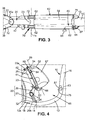
- the hinge 70 makes it possible to pass the step assembly 61 and the battery case 52 removably mounted. on it in the embodiment shown, a rolling configuration shown in FIG. figure 2 to a removal configuration represented in the figures 1 and 4 .
- This removal configuration is designed to further facilitate removal of the battery case 54 from the frame 2. Different joints are possible to perform this function.
- the hinge 70 is a pivot connection having an axis 71 horizontal and perpendicular to the longitudinal direction of the frame 2. It is located at the connection between the step assembly 61 and the second frame member 20
- the hinge 70 is formed by eyelets 72 integral with the rear end of the lateral tubes 62, and pivotally mounted on pins located at the upper end 24 at the lower portion 22.
- the front end of the lateral tubes 62 comes to rest on stops 75 welded to the first frame member 10 at the high end 13.
- a locking device 80 makes it possible to immobilize the step set 61 in this running configuration.
- the locking device 80 comprises a bolt 81 movable in translation in the right lateral tube 62 and biased in the projecting position, better visible on the figure 5 , spring 82 indicated in broken lines at the figure 3 .
- a handle 84 makes it possible to retract the bolt 81 by compressing the spring 82.
- the keeper member 87 has a smooth and rounded outer face against which the end of the bolt 81 can slide while being pushed by its retracted position.
- a second keeper member 88 is provided near the upper end 20a of the second frame member.
- the second keeper 88 is arranged so that the bolt 81 cooperates with it when the step assembly 61 is placed in the removal configuration.
- the second keeper member 88 has a rounded surface around the recess receiving the bolt, so that it can be pushed by this surface before coming to engage automatically with the hollow of this body under the action of the spring 82.
- the arrangement of the battery in the accommodation space 60 does not change the behavior of the bike by its low position.
- the removal and replacement of the battery case 52 is easy since it is located in a relatively accessible part.
- the removal operations of the battery box 52 are particularly easy and intuitive. From the driving configuration shown in figure 2 , the user pulls back on the handle 84, which releases the locking device 80. This action naturally continues with an upward movement, the user is generally located next to the saddle, and the step assembly 61 with the battery case 52 pivots upwardly. The bolt 81 is guided towards the second locking member 88 and automatically co-operates with the rounded outer surface thereof so that the locking device 80 engages automatically with this second latch member 88. The removal configuration thus reached and represented at the figure 4 , is then stable.
- the battery case 52 is in a substantially higher position and that the gripping member, or handle 54 arranged opposite the hinge 70, faces the user. If, however, the battery box 52 is not visible because enclosed in a flexible bag, and it is then advisable to place the opening system of this bag, such as the slider of a zipper, next to of the handle 54.
- the translational movement to disengage the rails may be a short distance, and not necessarily over their entire length, by providing tabs and indentations on the rails (56, 66).
- the connector 68 connected to the step set 61 is situated close to the hinge 70, so that it is not necessary to provide a very large free length of cable 54.
- the delimitation in the vertical plane of the accommodating space 60 may be substantially different depending on the shape given to the lower portions (12, 22) of the frame members (10, 20), and the shape of the set of step 61 which is not necessarily rectilinear. However, it is preferable that this shape corresponds substantially to the outer shape of the battery case 52.
- the hinged assembly of the step assembly 61 is only an option, the battery case 52 can be easily removed in a lateral movement.
Landscapes
- Engineering & Computer Science (AREA)
- Transportation (AREA)
- Mechanical Engineering (AREA)
- Power Engineering (AREA)
- Life Sciences & Earth Sciences (AREA)
- Sustainable Development (AREA)
- Sustainable Energy (AREA)
- Chemical & Material Sciences (AREA)
- Combustion & Propulsion (AREA)
- Automatic Cycles, And Cycles In General (AREA)
- Battery Mounting, Suspending (AREA)
Claims (12)
- Elektrisches Zweirad, umfassend:- ein erstes Rahmen-Element (10), das sich von einem oberen Ende, welches ein Schwenk-Gehäuse (6) für ein Vorderrad trägt, bis zu einem unteren Ende (10b) erstreckt,- ein zweites Rahmen-Element (20), das sich von einem oberen Ende, welches eine Sattel-Anordnung (9) aufnimmt, bis zu einem unteren Ende (20b) erstreckt, das fest mit dem ersten Rahmen-Element verbunden ist,- ein Batteriegehäuse (52), das in einer Fahrt-Konfiguration in einem Batterie-Aufnahmeraum (60) angeordnet ist, und- einen Elektromotor (50) zum Antrieb von einem der Räder,wobei der Batterie-Aufnahmeraum wenigstens in der vertikalen Ebene durch einen unteren Abschnitt (12) des ersten Rahmen-Elements (10), einen unteren Abschnitt (22) des zweiten Rahmen-Elements (20) und eine Trittbrett-Anordnung (61) begrenzt ist, wobei die unteren Abschnitte niedrige Enden (14, 20b) aufweisen, die untereinander verbunden sind, und hohe Enden (13, 23) aufweisen, zwischen denen sich die Trittbrett-Anordnung (61) in der Fahrt-Konfiguration erstreckt,
dadurch gekennzeichnet, dass die Trittbrett-Anordnung (61) an einem Ende ein Gelenk (70) aufweist, welches die Anordnung in schwenkbarer Weise mit einem der unteren Abschnitte (22; 12) verbindet. - Zweirad nach Anspruch 1, wobei der untere Abschnitt (12) des ersten Rahmen-Elements (10) eine gebogene Form mit einer Konkavität aufweist, die im Wesentlichen zu der Sattel-Anordnung (9) hin orientiert ist.
- Zweirad nach Anspruch 1 oder 2, wobei der untere Abschnitt (22) des zweiten Rahmen-Elements (20) eine gebogene Form mit einer Konkavität aufweist, die im Wesentlichen nach vorne orientiert ist.
- Zweirad nach einem der vorhergehenden Ansprüche, wobei die Trittbrett-Anordnung (61) sich im Wesentlichen horizontal erstreckt, mit einer oberen Fläche (64), die sich in einer Höhe befindet, welche zwischen der Höhe der Radachse und 45 cm liegt.
- Zweirad nach einem der vorhergehenden Ansprüche, wobei der untere Abschnitt (22) des zweiten Rahmen-Elements (20) ein Tretlager-Gehäuse (42) umfasst, wobei das Gehäuse von dem niedrigen Ende (20b) des unteren Abschnitts beabstandet angeordnet ist.
- Zweirad nach einem der vorhergehenden Ansprüche, wobei die Trittbrett-Anordnung (61) an einem dem Gelenk (70) gegenüberliegenden Ende eine Verriegelungseinrichtung (80) umfasst, welche die Trittbrett-Anordnung mit dem anderen unteren Abschnitt (12; 22) in entriegelbarer Weise verbindet.
- Zweirad nach einem der vorhergehenden Ansprüche, wobei die Trittbrett-Anordnung (61) ein äußeres elektrisches Anschluss-Element (68) umfasst, wobei das Anschluss-Element in der Nähe von dem Gelenk (70) angeordnet ist.
- Zweirad nach einem der vorhergehenden Ansprüche, wobei das Batterie-Gehäuse (52) in abnehmbarer Weise an der Trittbrett-Anordnung (61) angebracht ist.
- Zweirad nach einem der Ansprüche 6 bis 8, wobei das Gelenk (70) der Trittbrett-Anordnung (61), welches bevorzugt mit dem zweiten Rahmen-Element (20) verbunden ist, ein Schwenken um eine horizontale Querachse (71) erlaubt, was es ermöglicht, die Trittbrett-Anordnung von der Fahrt-Konfiguration zu einer im Wesentlichen vertikalen Konfiguration zu verstellen, welche "Abnahme-Konfiguration" genannt wird.
- Zweirad nach Anspruch 9, wobei die Verriegelungseinrichtung (80) dazu angepasst ist, die Trittbrett-Anordnung in der Abnahme-Konfiguration zu verriegeln.
- Zweirad nach Anspruch 10, wobei die Verriegelungseinrichtung (80) ein bewegliches Element (81) umfasst, welches an der Trittbrett-Anordnung (61) angebracht ist, und ein erstes Schließ-Element (87) umfasst, das fest an einem der Rahmen-Elemente (10; 20) montiert ist, und ein zweites Schließ-Element (88) umfasst, das fest an dem anderen Rahmen-Element (20; 10) montiert ist, wobei das bewegliche Element (81) in die verriegelte Position vorgespannt ist, und das erste und das zweite Schließ-Element (87, 88) dazu konfiguriert sind, die Verriegelung automatisch sicherzustellen, wenn die Trittbrett-Anordnung (61) die Fahrt-Konfiguration oder die Abnahme-Konfiguration erreicht.
- Zweirad nach einem der Ansprüche 8 bis 11, wobei das Batterie-Gehäuse (52) und die Trittbrett-Anordnung (61) in abnehmbarer Weise vermittels einer Schienen-Anordnung (56, 66) angebracht sind, was ein Lösen durch eine Translationsbewegung entlang einem Löse-Weg gestattet, der im Wesentlichen parallel zu der Trittbrett-Anordnung (61) und in einer Richtung entgegengesetzt zu dem Gelenk (70) von dieser verläuft.
Applications Claiming Priority (1)
| Application Number | Priority Date | Filing Date | Title |
|---|---|---|---|
| FR1052487A FR2958259B1 (fr) | 2010-04-01 | 2010-04-01 | Deux-roues electrique |
Publications (2)
| Publication Number | Publication Date |
|---|---|
| EP2371692A1 EP2371692A1 (de) | 2011-10-05 |
| EP2371692B1 true EP2371692B1 (de) | 2014-03-12 |
Family
ID=42937375
Family Applications (1)
| Application Number | Title | Priority Date | Filing Date |
|---|---|---|---|
| EP11159738.1A Not-in-force EP2371692B1 (de) | 2010-04-01 | 2011-03-25 | elektrisches Fahrrad |
Country Status (4)
| Country | Link |
|---|---|
| US (1) | US20110240391A1 (de) |
| EP (1) | EP2371692B1 (de) |
| JP (1) | JP2011213345A (de) |
| FR (1) | FR2958259B1 (de) |
Families Citing this family (27)
| Publication number | Priority date | Publication date | Assignee | Title |
|---|---|---|---|---|
| CN103889833B (zh) * | 2011-10-28 | 2016-11-23 | 川崎重工业株式会社 | 跨乘式电动车辆 |
| US9434445B1 (en) * | 2012-03-03 | 2016-09-06 | Dr. Nathan Jauvtis Engineering | Electronic bicycle |
| US9085342B2 (en) * | 2012-03-03 | 2015-07-21 | Dr. Nathan Jauvtis Engineering | Power assisted vehicle |
| CA147246S (en) * | 2012-05-21 | 2013-08-27 | Emo Bike Gmbh & Co Kg | Electrical bicycle |
| WO2014055566A1 (en) * | 2012-10-02 | 2014-04-10 | Bravo Sports | Scooter assemblies |
| US9592876B2 (en) | 2013-12-18 | 2017-03-14 | Bravo Sports | Three-wheeled electric scooter |
| US10189533B2 (en) | 2013-12-18 | 2019-01-29 | Bravo Sports | Electric scooter |
| CN104097723B (zh) * | 2014-06-23 | 2017-10-03 | 苏州达方电子有限公司 | 适用于电动脚踏车的车架 |
| TWI606953B (zh) * | 2014-06-23 | 2017-12-01 | 達方電子股份有限公司 | 適用於電動腳踏車之車架 |
| USD774972S1 (en) * | 2014-10-31 | 2016-12-27 | Piaggio & C. S.P.A. | Electric bicycle |
| US9580141B2 (en) * | 2015-06-26 | 2017-02-28 | Specialized Bicycle Components, Inc. | Bicycle frame with improved battery mount |
| USD797003S1 (en) * | 2015-10-10 | 2017-09-12 | Hangzhou Innomake Technology Co., Ltd. | Electrically assisted bicycle |
| WO2017130040A1 (en) * | 2016-01-29 | 2017-08-03 | Ather Energy Pvt. Ltd | A vehicle with an integrated battery casing |
| USD811275S1 (en) * | 2016-04-06 | 2018-02-27 | Matthew Hendey | Combination frame for an electric bicycle and housing for a motor and batteries |
| DE102016119570A1 (de) * | 2016-10-13 | 2018-04-19 | ABUS August Bremicker Söhne KG | Fahrzeug mit einem elektrisch betriebenen Antriebsmotor |
| USD828232S1 (en) * | 2016-11-14 | 2018-09-11 | Olimpia Kerekpar Kft | Cargo bicycle frame |
| US11535331B2 (en) * | 2017-08-30 | 2022-12-27 | Dongguan Hong Lin Industrial Co., Ltd | Bicycle mounting mechanism and battery box assembly |
| GB2566693B (en) * | 2017-09-20 | 2022-08-17 | Swytch Tech Ltd | A power unit and electric drive system for a bike |
| WO2020005052A1 (es) * | 2018-06-28 | 2020-01-02 | Garayoa Guajardo Javier Rafael | Dispositivo para montaje de unidad de electrónica y fuente de alimentación de una bicicleta eléctrica |
| DE102018215745A1 (de) * | 2018-09-17 | 2020-03-19 | Robert Bosch Gmbh | Batteriefach |
| USD932378S1 (en) * | 2019-03-14 | 2021-10-05 | Beijing Niu Information Technology Co., Ltd. | Electric bicycle |
| USD932377S1 (en) * | 2019-03-15 | 2021-10-05 | Beijing Niu Information Technology Co., Ltd. | Electric bicycle |
| US12030391B2 (en) * | 2019-12-11 | 2024-07-09 | Lyft, Inc. | Modular bicycle designs |
| USD949058S1 (en) * | 2020-02-27 | 2022-04-19 | Beijing Niu Information Technology Co., Ltd. | Electric bicycle |
| USD948383S1 (en) * | 2020-04-21 | 2022-04-12 | Beijing Niu Information Technology Co., Ltd. | Electric bicycle |
| USD966947S1 (en) * | 2021-09-13 | 2022-10-18 | Hagen Bikes OÜ | Bicycle |
| US12116085B1 (en) * | 2023-10-20 | 2024-10-15 | Shimano Inc. | Component for human-powered vehicle |
Family Cites Families (18)
| Publication number | Priority date | Publication date | Assignee | Title |
|---|---|---|---|---|
| US2768005A (en) * | 1952-12-10 | 1956-10-23 | App Control Equip Moteurs | Footrests for pedal cycles fitted with an auxiliary engine |
| ES356171A1 (es) * | 1968-07-09 | 1970-01-01 | Talleres Sanglas S A | Bastidor plegable para motocicletas. |
| US4401315A (en) * | 1981-08-10 | 1983-08-30 | Ivan Pavincic | Footrest for two-wheeled engine driven vehicles and bicycles |
| IT208259Z2 (it) * | 1986-10-24 | 1988-04-29 | Gaddi Bruno | Ciclomotore a telaio perfezionato. |
| US4771651A (en) * | 1987-05-20 | 1988-09-20 | Medalist Industries, Inc. | Footstep for freestyle bicycles |
| JPH08295282A (ja) * | 1995-04-28 | 1996-11-12 | Tec Corp | 自転車用補助動力装置および補助動力装置付自転車 |
| JPH09219908A (ja) * | 1996-02-13 | 1997-08-19 | Yamaha Motor Co Ltd | 電動車両のモータ制御装置 |
| JP3617729B2 (ja) * | 1996-07-04 | 2005-02-09 | ヤマハ発動機株式会社 | 電動補助車両 |
| JP3622020B2 (ja) * | 1996-07-31 | 2005-02-23 | ヤマハ発動機株式会社 | 電動自転車のバッテリボックス脱着構造 |
| US6120044A (en) * | 1997-05-27 | 2000-09-19 | Tsai; Suei Der | Foldable rollerboard |
| JPH11124071A (ja) * | 1997-10-22 | 1999-05-11 | Suzuki Motor Corp | 電動補助自転車 |
| US6227324B1 (en) * | 2000-04-27 | 2001-05-08 | Dennis N. Sauve | Electrically powered scooter |
| US6832660B2 (en) * | 2000-10-12 | 2004-12-21 | Leonard Allan Dodd | Retrofit kit for motorizing a collapsible mini scooter |
| CA2376787A1 (en) * | 2002-02-28 | 2003-08-28 | Michael Stuart Trerice Retallack | Motorization of a bicycle with a simple replacement of the bottom bracket |
| US7040443B1 (en) * | 2003-08-04 | 2006-05-09 | Go Sporting Goods, Llc | Motorized scooter |
| US7967095B2 (en) * | 2003-10-08 | 2011-06-28 | Pride Mobility Products Corporation | Collapsible vehicle |
| US7114739B2 (en) * | 2005-02-15 | 2006-10-03 | Colano Richard V | Adjustable passenger floorboards |
| CA2651699A1 (en) * | 2006-05-08 | 2007-11-15 | Lakehead University | Powered foldable scooter |
-
2010
- 2010-04-01 FR FR1052487A patent/FR2958259B1/fr not_active Expired - Fee Related
-
2011
- 2011-03-25 US US13/072,501 patent/US20110240391A1/en not_active Abandoned
- 2011-03-25 EP EP11159738.1A patent/EP2371692B1/de not_active Not-in-force
- 2011-03-31 JP JP2011078168A patent/JP2011213345A/ja not_active Withdrawn
Also Published As
| Publication number | Publication date |
|---|---|
| US20110240391A1 (en) | 2011-10-06 |
| JP2011213345A (ja) | 2011-10-27 |
| FR2958259B1 (fr) | 2014-04-11 |
| FR2958259A1 (fr) | 2011-10-07 |
| EP2371692A1 (de) | 2011-10-05 |
Similar Documents
| Publication | Publication Date | Title |
|---|---|---|
| EP2371692A1 (de) | Elektrisches Fahrrad | |
| EP2367714B1 (de) | Zusammenklappbare motorradstruktur mit schnellverriegelung | |
| EP2174860B1 (de) | Klappbarer Roller | |
| FR2791623A1 (fr) | Dispositif de rangement d'articles pour motocyclette | |
| FR3046401A1 (fr) | Cadre de bicyclette a assistance electrique | |
| FR2829095A1 (fr) | Structure de montage pour monter un vehicule pliant a deux roues sur un vehicule a quatre roues | |
| WO2008125786A2 (fr) | Vehicule a deux roues a encombrement variable | |
| WO2014053713A1 (fr) | Vehicule electrique individuel | |
| FR2738539A1 (fr) | Systeme de montage d'une batterie dans un vehicule deux-roues motorise du type scooter | |
| FR2722756A1 (fr) | Structure de carrosserie pour scooter a moteur | |
| WO2011036424A1 (fr) | Cycle pliable transformable en chariot a provisions | |
| EP1801004B1 (de) | Klapprad | |
| FR2958260A1 (fr) | Velo a transmission par courroie et son cadre | |
| FR2928338A1 (fr) | Velo pliant et habillage pour ce velo | |
| FR2599702A1 (fr) | Vehicule du type scooter, a systeme perfectionne de rangement d'un casque integral | |
| FR2987815A1 (fr) | Vehicule a deux roues dont la longueur est reductible pour son rangement par deplacement des deux roues | |
| FR2722755A1 (fr) | Structure de montage de l'equipement electrique d'un deux-roues motorise ou type scooter | |
| EP0466624B1 (de) | Dreirad mit klappbaren lenkbaren Rädern | |
| WO2020193586A1 (fr) | Trottinette pliable | |
| OA11808A (en) | Two-wheel transportation vehicle, in particular transportation motorcycle. | |
| WO2021001073A1 (fr) | Station de recharge d'un véhicule électrique | |
| FR2722754A1 (fr) | Structure de carrosserie de vehicule | |
| FR2821050A1 (fr) | Cadre pour tricycle et tricycle | |
| FR2883546A1 (fr) | Vehicule de type scooter | |
| EP4175868A1 (de) | Anhänger für ein fahrrad |
Legal Events
| Date | Code | Title | Description |
|---|---|---|---|
| PUAI | Public reference made under article 153(3) epc to a published international application that has entered the european phase |
Free format text: ORIGINAL CODE: 0009012 |
|
| AK | Designated contracting states |
Kind code of ref document: A1 Designated state(s): AL AT BE BG CH CY CZ DE DK EE ES FI FR GB GR HR HU IE IS IT LI LT LU LV MC MK MT NL NO PL PT RO RS SE SI SK SM TR |
|
| AX | Request for extension of the european patent |
Extension state: BA ME |
|
| 17P | Request for examination filed |
Effective date: 20120312 |
|
| REG | Reference to a national code |
Ref country code: DE Ref legal event code: R079 Ref document number: 602011005327 Country of ref document: DE Free format text: PREVIOUS MAIN CLASS: B62K0011020000 Ipc: B62M0001100000 |
|
| GRAP | Despatch of communication of intention to grant a patent |
Free format text: ORIGINAL CODE: EPIDOSNIGR1 |
|
| RIC1 | Information provided on ipc code assigned before grant |
Ipc: B62M 1/10 20100101AFI20131016BHEP |
|
| INTG | Intention to grant announced |
Effective date: 20131111 |
|
| GRAS | Grant fee paid |
Free format text: ORIGINAL CODE: EPIDOSNIGR3 |
|
| GRAA | (expected) grant |
Free format text: ORIGINAL CODE: 0009210 |
|
| AK | Designated contracting states |
Kind code of ref document: B1 Designated state(s): AL AT BE BG CH CY CZ DE DK EE ES FI FR GB GR HR HU IE IS IT LI LT LU LV MC MK MT NL NO PL PT RO RS SE SI SK SM TR |
|
| REG | Reference to a national code |
Ref country code: GB Ref legal event code: FG4D Free format text: NOT ENGLISH |
|
| REG | Reference to a national code |
Ref country code: CH Ref legal event code: EP |
|
| REG | Reference to a national code |
Ref country code: AT Ref legal event code: REF Ref document number: 656088 Country of ref document: AT Kind code of ref document: T Effective date: 20140315 |
|
| REG | Reference to a national code |
Ref country code: IE Ref legal event code: FG4D Free format text: LANGUAGE OF EP DOCUMENT: FRENCH |
|
| REG | Reference to a national code |
Ref country code: DE Ref legal event code: R096 Ref document number: 602011005327 Country of ref document: DE Effective date: 20140424 |
|
| REG | Reference to a national code |
Ref country code: NL Ref legal event code: T3 |
|
| PG25 | Lapsed in a contracting state [announced via postgrant information from national office to epo] |
Ref country code: LT Free format text: LAPSE BECAUSE OF FAILURE TO SUBMIT A TRANSLATION OF THE DESCRIPTION OR TO PAY THE FEE WITHIN THE PRESCRIBED TIME-LIMIT Effective date: 20140312 Ref country code: NO Free format text: LAPSE BECAUSE OF FAILURE TO SUBMIT A TRANSLATION OF THE DESCRIPTION OR TO PAY THE FEE WITHIN THE PRESCRIBED TIME-LIMIT Effective date: 20140612 |
|
| REG | Reference to a national code |
Ref country code: AT Ref legal event code: MK05 Ref document number: 656088 Country of ref document: AT Kind code of ref document: T Effective date: 20140312 |
|
| REG | Reference to a national code |
Ref country code: LT Ref legal event code: MG4D |
|
| PG25 | Lapsed in a contracting state [announced via postgrant information from national office to epo] |
Ref country code: FI Free format text: LAPSE BECAUSE OF FAILURE TO SUBMIT A TRANSLATION OF THE DESCRIPTION OR TO PAY THE FEE WITHIN THE PRESCRIBED TIME-LIMIT Effective date: 20140312 Ref country code: SE Free format text: LAPSE BECAUSE OF FAILURE TO SUBMIT A TRANSLATION OF THE DESCRIPTION OR TO PAY THE FEE WITHIN THE PRESCRIBED TIME-LIMIT Effective date: 20140312 Ref country code: CY Free format text: LAPSE BECAUSE OF FAILURE TO SUBMIT A TRANSLATION OF THE DESCRIPTION OR TO PAY THE FEE WITHIN THE PRESCRIBED TIME-LIMIT Effective date: 20140312 |
|
| PG25 | Lapsed in a contracting state [announced via postgrant information from national office to epo] |
Ref country code: HR Free format text: LAPSE BECAUSE OF FAILURE TO SUBMIT A TRANSLATION OF THE DESCRIPTION OR TO PAY THE FEE WITHIN THE PRESCRIBED TIME-LIMIT Effective date: 20140312 Ref country code: RS Free format text: LAPSE BECAUSE OF FAILURE TO SUBMIT A TRANSLATION OF THE DESCRIPTION OR TO PAY THE FEE WITHIN THE PRESCRIBED TIME-LIMIT Effective date: 20140312 Ref country code: LV Free format text: LAPSE BECAUSE OF FAILURE TO SUBMIT A TRANSLATION OF THE DESCRIPTION OR TO PAY THE FEE WITHIN THE PRESCRIBED TIME-LIMIT Effective date: 20140312 |
|
| PG25 | Lapsed in a contracting state [announced via postgrant information from national office to epo] |
Ref country code: RO Free format text: LAPSE BECAUSE OF FAILURE TO SUBMIT A TRANSLATION OF THE DESCRIPTION OR TO PAY THE FEE WITHIN THE PRESCRIBED TIME-LIMIT Effective date: 20140312 Ref country code: IS Free format text: LAPSE BECAUSE OF FAILURE TO SUBMIT A TRANSLATION OF THE DESCRIPTION OR TO PAY THE FEE WITHIN THE PRESCRIBED TIME-LIMIT Effective date: 20140712 Ref country code: CZ Free format text: LAPSE BECAUSE OF FAILURE TO SUBMIT A TRANSLATION OF THE DESCRIPTION OR TO PAY THE FEE WITHIN THE PRESCRIBED TIME-LIMIT Effective date: 20140312 Ref country code: EE Free format text: LAPSE BECAUSE OF FAILURE TO SUBMIT A TRANSLATION OF THE DESCRIPTION OR TO PAY THE FEE WITHIN THE PRESCRIBED TIME-LIMIT Effective date: 20140312 Ref country code: BG Free format text: LAPSE BECAUSE OF FAILURE TO SUBMIT A TRANSLATION OF THE DESCRIPTION OR TO PAY THE FEE WITHIN THE PRESCRIBED TIME-LIMIT Effective date: 20140612 |
|
| REG | Reference to a national code |
Ref country code: CH Ref legal event code: PL |
|
| PG25 | Lapsed in a contracting state [announced via postgrant information from national office to epo] |
Ref country code: PL Free format text: LAPSE BECAUSE OF FAILURE TO SUBMIT A TRANSLATION OF THE DESCRIPTION OR TO PAY THE FEE WITHIN THE PRESCRIBED TIME-LIMIT Effective date: 20140312 Ref country code: AT Free format text: LAPSE BECAUSE OF FAILURE TO SUBMIT A TRANSLATION OF THE DESCRIPTION OR TO PAY THE FEE WITHIN THE PRESCRIBED TIME-LIMIT Effective date: 20140312 Ref country code: SK Free format text: LAPSE BECAUSE OF FAILURE TO SUBMIT A TRANSLATION OF THE DESCRIPTION OR TO PAY THE FEE WITHIN THE PRESCRIBED TIME-LIMIT Effective date: 20140312 Ref country code: ES Free format text: LAPSE BECAUSE OF FAILURE TO SUBMIT A TRANSLATION OF THE DESCRIPTION OR TO PAY THE FEE WITHIN THE PRESCRIBED TIME-LIMIT Effective date: 20140312 |
|
| REG | Reference to a national code |
Ref country code: DE Ref legal event code: R097 Ref document number: 602011005327 Country of ref document: DE |
|
| PG25 | Lapsed in a contracting state [announced via postgrant information from national office to epo] |
Ref country code: PT Free format text: LAPSE BECAUSE OF FAILURE TO SUBMIT A TRANSLATION OF THE DESCRIPTION OR TO PAY THE FEE WITHIN THE PRESCRIBED TIME-LIMIT Effective date: 20140714 |
|
| REG | Reference to a national code |
Ref country code: IE Ref legal event code: MM4A |
|
| PLBE | No opposition filed within time limit |
Free format text: ORIGINAL CODE: 0009261 |
|
| STAA | Information on the status of an ep patent application or granted ep patent |
Free format text: STATUS: NO OPPOSITION FILED WITHIN TIME LIMIT |
|
| PG25 | Lapsed in a contracting state [announced via postgrant information from national office to epo] |
Ref country code: IE Free format text: LAPSE BECAUSE OF NON-PAYMENT OF DUE FEES Effective date: 20140325 Ref country code: MC Free format text: LAPSE BECAUSE OF FAILURE TO SUBMIT A TRANSLATION OF THE DESCRIPTION OR TO PAY THE FEE WITHIN THE PRESCRIBED TIME-LIMIT Effective date: 20140312 Ref country code: CH Free format text: LAPSE BECAUSE OF NON-PAYMENT OF DUE FEES Effective date: 20140331 Ref country code: DK Free format text: LAPSE BECAUSE OF FAILURE TO SUBMIT A TRANSLATION OF THE DESCRIPTION OR TO PAY THE FEE WITHIN THE PRESCRIBED TIME-LIMIT Effective date: 20140312 Ref country code: LI Free format text: LAPSE BECAUSE OF NON-PAYMENT OF DUE FEES Effective date: 20140331 |
|
| 26N | No opposition filed |
Effective date: 20141215 |
|
| PG25 | Lapsed in a contracting state [announced via postgrant information from national office to epo] |
Ref country code: RS Free format text: LAPSE BECAUSE OF FAILURE TO SUBMIT A TRANSLATION OF THE DESCRIPTION OR TO PAY THE FEE WITHIN THE PRESCRIBED TIME-LIMIT Effective date: 20140903 |
|
| REG | Reference to a national code |
Ref country code: DE Ref legal event code: R097 Ref document number: 602011005327 Country of ref document: DE Effective date: 20141215 |
|
| REG | Reference to a national code |
Ref country code: FR Ref legal event code: PLFP Year of fee payment: 5 |
|
| PG25 | Lapsed in a contracting state [announced via postgrant information from national office to epo] |
Ref country code: IT Free format text: LAPSE BECAUSE OF FAILURE TO SUBMIT A TRANSLATION OF THE DESCRIPTION OR TO PAY THE FEE WITHIN THE PRESCRIBED TIME-LIMIT Effective date: 20140312 |
|
| PGFP | Annual fee paid to national office [announced via postgrant information from national office to epo] |
Ref country code: NL Payment date: 20150330 Year of fee payment: 5 |
|
| PG25 | Lapsed in a contracting state [announced via postgrant information from national office to epo] |
Ref country code: SI Free format text: LAPSE BECAUSE OF FAILURE TO SUBMIT A TRANSLATION OF THE DESCRIPTION OR TO PAY THE FEE WITHIN THE PRESCRIBED TIME-LIMIT Effective date: 20140312 |
|
| PGFP | Annual fee paid to national office [announced via postgrant information from national office to epo] |
Ref country code: DE Payment date: 20150409 Year of fee payment: 5 |
|
| PGFP | Annual fee paid to national office [announced via postgrant information from national office to epo] |
Ref country code: FR Payment date: 20150330 Year of fee payment: 5 |
|
| GBPC | Gb: european patent ceased through non-payment of renewal fee |
Effective date: 20150325 |
|
| PG25 | Lapsed in a contracting state [announced via postgrant information from national office to epo] |
Ref country code: GB Free format text: LAPSE BECAUSE OF NON-PAYMENT OF DUE FEES Effective date: 20150325 |
|
| PG25 | Lapsed in a contracting state [announced via postgrant information from national office to epo] |
Ref country code: MT Free format text: LAPSE BECAUSE OF FAILURE TO SUBMIT A TRANSLATION OF THE DESCRIPTION OR TO PAY THE FEE WITHIN THE PRESCRIBED TIME-LIMIT Effective date: 20140312 |
|
| PG25 | Lapsed in a contracting state [announced via postgrant information from national office to epo] |
Ref country code: SM Free format text: LAPSE BECAUSE OF FAILURE TO SUBMIT A TRANSLATION OF THE DESCRIPTION OR TO PAY THE FEE WITHIN THE PRESCRIBED TIME-LIMIT Effective date: 20140312 |
|
| PG25 | Lapsed in a contracting state [announced via postgrant information from national office to epo] |
Ref country code: GR Free format text: LAPSE BECAUSE OF FAILURE TO SUBMIT A TRANSLATION OF THE DESCRIPTION OR TO PAY THE FEE WITHIN THE PRESCRIBED TIME-LIMIT Effective date: 20140613 |
|
| PG25 | Lapsed in a contracting state [announced via postgrant information from national office to epo] |
Ref country code: LU Free format text: LAPSE BECAUSE OF NON-PAYMENT OF DUE FEES Effective date: 20140325 Ref country code: BE Free format text: LAPSE BECAUSE OF FAILURE TO SUBMIT A TRANSLATION OF THE DESCRIPTION OR TO PAY THE FEE WITHIN THE PRESCRIBED TIME-LIMIT Effective date: 20140331 Ref country code: HU Free format text: LAPSE BECAUSE OF FAILURE TO SUBMIT A TRANSLATION OF THE DESCRIPTION OR TO PAY THE FEE WITHIN THE PRESCRIBED TIME-LIMIT; INVALID AB INITIO Effective date: 20110325 Ref country code: TR Free format text: LAPSE BECAUSE OF FAILURE TO SUBMIT A TRANSLATION OF THE DESCRIPTION OR TO PAY THE FEE WITHIN THE PRESCRIBED TIME-LIMIT Effective date: 20140312 |
|
| REG | Reference to a national code |
Ref country code: DE Ref legal event code: R119 Ref document number: 602011005327 Country of ref document: DE |
|
| REG | Reference to a national code |
Ref country code: NL Ref legal event code: MM Effective date: 20160401 |
|
| REG | Reference to a national code |
Ref country code: FR Ref legal event code: ST Effective date: 20161130 |
|
| PG25 | Lapsed in a contracting state [announced via postgrant information from national office to epo] |
Ref country code: NL Free format text: LAPSE BECAUSE OF NON-PAYMENT OF DUE FEES Effective date: 20160401 Ref country code: DE Free format text: LAPSE BECAUSE OF NON-PAYMENT OF DUE FEES Effective date: 20161001 Ref country code: FR Free format text: LAPSE BECAUSE OF NON-PAYMENT OF DUE FEES Effective date: 20160331 |
|
| PG25 | Lapsed in a contracting state [announced via postgrant information from national office to epo] |
Ref country code: MK Free format text: LAPSE BECAUSE OF FAILURE TO SUBMIT A TRANSLATION OF THE DESCRIPTION OR TO PAY THE FEE WITHIN THE PRESCRIBED TIME-LIMIT Effective date: 20140312 |
|
| PG25 | Lapsed in a contracting state [announced via postgrant information from national office to epo] |
Ref country code: AL Free format text: LAPSE BECAUSE OF FAILURE TO SUBMIT A TRANSLATION OF THE DESCRIPTION OR TO PAY THE FEE WITHIN THE PRESCRIBED TIME-LIMIT Effective date: 20140312 |