EP2372111A1 - Turbine à basse pression avec deux systèmes de condensation indépendants - Google Patents
Turbine à basse pression avec deux systèmes de condensation indépendants Download PDFInfo
- Publication number
- EP2372111A1 EP2372111A1 EP20100003311 EP10003311A EP2372111A1 EP 2372111 A1 EP2372111 A1 EP 2372111A1 EP 20100003311 EP20100003311 EP 20100003311 EP 10003311 A EP10003311 A EP 10003311A EP 2372111 A1 EP2372111 A1 EP 2372111A1
- Authority
- EP
- European Patent Office
- Prior art keywords
- steam
- condensing system
- low
- pressure turbine
- exhaust
- Prior art date
- Legal status (The legal status is an assumption and is not a legal conclusion. Google has not performed a legal analysis and makes no representation as to the accuracy of the status listed.)
- Withdrawn
Links
Images



Classifications
-
- F—MECHANICAL ENGINEERING; LIGHTING; HEATING; WEAPONS; BLASTING
- F01—MACHINES OR ENGINES IN GENERAL; ENGINE PLANTS IN GENERAL; STEAM ENGINES
- F01D—NON-POSITIVE DISPLACEMENT MACHINES OR ENGINES, e.g. STEAM TURBINES
- F01D1/00—Non-positive-displacement machines or engines, e.g. steam turbines
- F01D1/02—Non-positive-displacement machines or engines, e.g. steam turbines with stationary working-fluid guiding means and bladed or like rotor, e.g. multi-bladed impulse steam turbines
-
- F—MECHANICAL ENGINEERING; LIGHTING; HEATING; WEAPONS; BLASTING
- F01—MACHINES OR ENGINES IN GENERAL; ENGINE PLANTS IN GENERAL; STEAM ENGINES
- F01D—NON-POSITIVE DISPLACEMENT MACHINES OR ENGINES, e.g. STEAM TURBINES
- F01D25/00—Component parts, details, or accessories, not provided for in, or of interest apart from, other groups
- F01D25/24—Casings; Casing parts, e.g. diaphragms, casing fastenings
- F01D25/26—Double casings; Measures against temperature strain in casings
-
- F—MECHANICAL ENGINEERING; LIGHTING; HEATING; WEAPONS; BLASTING
- F01—MACHINES OR ENGINES IN GENERAL; ENGINE PLANTS IN GENERAL; STEAM ENGINES
- F01D—NON-POSITIVE DISPLACEMENT MACHINES OR ENGINES, e.g. STEAM TURBINES
- F01D25/00—Component parts, details, or accessories, not provided for in, or of interest apart from, other groups
- F01D25/30—Exhaust heads, chambers, or the like
-
- F—MECHANICAL ENGINEERING; LIGHTING; HEATING; WEAPONS; BLASTING
- F01—MACHINES OR ENGINES IN GENERAL; ENGINE PLANTS IN GENERAL; STEAM ENGINES
- F01K—STEAM ENGINE PLANTS; STEAM ACCUMULATORS; ENGINE PLANTS NOT OTHERWISE PROVIDED FOR; ENGINES USING SPECIAL WORKING FLUIDS OR CYCLES
- F01K11/00—Plants characterised by the engines being structurally combined with boilers or condensers
- F01K11/02—Plants characterised by the engines being structurally combined with boilers or condensers the engines being turbines
-
- F—MECHANICAL ENGINEERING; LIGHTING; HEATING; WEAPONS; BLASTING
- F05—INDEXING SCHEMES RELATING TO ENGINES OR PUMPS IN VARIOUS SUBCLASSES OF CLASSES F01-F04
- F05D—INDEXING SCHEME FOR ASPECTS RELATING TO NON-POSITIVE-DISPLACEMENT MACHINES OR ENGINES, GAS-TURBINES OR JET-PROPULSION PLANTS
- F05D2220/00—Application
- F05D2220/30—Application in turbines
- F05D2220/31—Application in turbines in steam turbines
Definitions
- the claimed invention is related to a low-pressure steam turbine and a steam power plant comprising a low-pressure steam turbine that is connected to a condensing system.
- a steam power plant comprising a low-pressure steam turbine that is connected to a condensing system.
- US 2005/0063821 A1 an example for such a steam power plant is known.
- Figure 1 of this publication and its description explain in detail the process of a steam power plant. For this reason, the explanation of the process of producing electricity by means of a steam power plant is incorporated by reference into this application.
- the additional cooling system could be installed either into the existing cooling water cycle or could directly be connected to the water steam cycle.
- a further object of the invention is to reduce the cooling water consumption of the first condensing system.
- a low-pressure turbine of a steam power plant comprising an inner casing and an exhaust hood, wherein the exhaust hood is connected to a condenser, by providing at least one further steam outlet allowing to supply the expanded steam from inside the exhaust hood to a second condensing system, thereby reducing the cooling load of the first condenser.
- the claimed low-pressure turbine is connected to two condensing systems.
- One of them is the "regular" or main condensing system that is more or less directly connected to the exhaust hood of the low-pressure turbine.
- the second or additional condensing system is almost certainly a dry cooling system.
- This arrangement improves the operation flexibility of the steam power plant, since for example in summer, when the ambient temperature is high and only a small amount of cooling water is available, the second condensing system can be activated and consequently the electricity output of the steam power plant is not reduced, although only a small amount of cooling water is available. As soon as sufficient make-up water for the condensing system is available, the additional condensing system can be taken out of service and the plant can return to its original operating parameters.
- a main advantage of the low-pressure turbine according to claim 1 is that, since the exhaust hood normally is a welded construction, the retrofit of an already installed low-pressure turbine is possible.
- This retrofit comprises adding a further exhaust steam opening for example in the upper shell of the exhaust hood and connect this further exhaust steam opening with the additional condensing system.
- a further advantageous embodiment of this low-pressure turbine is characterized in that the inner casing of the low-pressure turbine comprises at least one extraction point for steam.
- the claimed low-pressure turbine may be used as a bleeding turbine, a tapped turbine or an extraction turbine.
- a low-pressure turbine of a steam power plant comprising an inner casing and an exhaust hood, wherein the inner casing comprises at least one extraction point for steam, characterized in that at least one extraction point is connected to a second condensing system.
- This arrangement allows the use of at least one steam extraction point of the low-pressure turbine to extract some of the partially expanded steam at a pressure of approximately 200 mbar to 1000 mbar and condense this extracted steam in the additional condensing system. Consequently, the main condensing system is relieved and the cooling water demand of the main condenser is reduced.
- a control valve and/or a non-return valve is installed.
- a further main advantage of the low-pressure turbine according to claim 3 consists in the fact that an existing extraction point can alternatively be used for extracting steam for heating purposes or to reduce the cooling load of the main condensing system - for example in summer when no heat requirements exist - by exhausting steam and having this extracted steam condensed in a second condensing system.
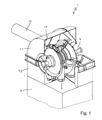
- Figure 1 shows a first embodiment of a claimed low-pressure steam turbine 1, comprising an inner casing 3 that is often made of cast iron. Inside the partially cut away inner casing 3 is a rotor 5 can be seen.
- the exhaust hood 7 may comprise an upper shell assembly 7.1 and a lower-base shell assembly 7.2.
- the lower-base shell assembly 7.2 is open at its bottom and connected to a low-pressure (LP) exhaust 9. Since the main condensing system is not part of the claimed invention, no details of the main condensing system are shown in figure 1 .
- LP low-pressure
- the exhaust hood 7 with its upper shell assembly 7.1 and its lower-base shell assembly 7.2 is a welded construction.
- the claimed low-pressure steam turbine has at least one exhaust steam opening 11 for example in the upper shell assembly 7.1.
- This exhaust steam opening 11 is connected with a radial exhaust steam duct line 13.
- This radial exhaust steam duct connection 13 is connected to an additional or second condensing system (not shown in figure 1 ). Consequently, it is possible to condense the LP- steam from the turbine either in the main condensing system or in the additional condensing system.
- This flexibility is very advantageous, in case the main condensing system 9 has to be operated under certain restrictions for example a reduced cooling water supply.
- the exhaust hood 7 is a welded construction, it is possible to install the exhaust steam duct 13 at existing exhaust hoods by opening the exhaust hood 7 for a further exhaust steam opening 11 and to weld the additional exhaust steam duct connection 13 onto for example the upper shell assembly 7.1.
- the claimed invention can be realized not only in new designs and constructions of low-pressure steam turbines, but is a retrofit-solution for existing steam power plants, that may lead to an equal or improved electricity output, even if the capacity of the main condensing system is reduced due to cooling water restrictions.
- Figure 2 shows a rather similar embodiment of the claimed invention.
- the main difference between the embodiments of figures 1 and 2 is that the exhaust steam duct is not radial, but axial compared to the axis of rotation of the rotor 5.
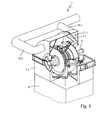
- the third embodiment of the claimed invention shown in figure 3 comprises a double-line axial exhaust steam duct connection 30.
- the third embodiment shows a double-line' axial exhaust steam duct connection 13. Consequently, the exhaust hood 7 comprises two exhaust steam openings, from which only one (cf. reference no. 11.1) can be seen.
- the exhaust steam openings 11 and the exhaust steam ducts 13 can be arranged in several positions, depending on the space that is available and the amount of low-pressure steam that has to be extracted via the exhaust steam openings 11 and the capacity of the additional condenser. This means that the embodiments shown in figures 1 to 3 are suitable for retrofit of existing low-pressure turbines.
- a comparable effect can be achieved by using the extracting points at the inner casing 3 of a low-pressure steam turbine and leading the steam extracted from this extraction point to an additional condensing system.
- This embodiment does not need any alterations concerning the low-pressure steam turbine, if such an extraction point is already existing. For this reason, no embodiment of this type of low-pressure turbine is shown.
- the airtight interface 11, 13, 27 and 29 between the existing turbine 1 and the retrofitted additional condensing system 25, may be operated at the same or a different pressure level than the existing main condensing system 17.
- FIG 4 is a schematic illustration of an embodiment of the claimed invention configured to supply energy to a power grid.
- the power plant is a multi-pressure single-shaft power plant and includes a steam turbine assembly and a generator.
- the generator is not shown in figure 4 as well as the high-pressure and the intermediate-pressure turbines of the steam turbine assembly.
- the low-pressure steam turbine 1 is shown. It is supplied with low-pressure steam by an overflow pipe 15. This overflow pipe 15 connects the intermediate pressure turbine (not shown) with the low-pressure steam turbine 1.
- the low-pressure steam turbine consists of an inner casing 3 and exhaust hood 7 that is connected via the low-pressure exhaust 9 with a main condensing system 17.
- the main condensing system 17 may be of the surface condenser-type that is connected to the cooling water pipes 18 with a cooling system, preferably a wet cooling system, for example a cooling tower. Downstream of the main condensing system 17 are several condensate pumps 21 that deliver the condensed steam to a condensate pipe 23.
- the turbine is supplied with steam by the overflow pipe 15 that is connected to the inner casing 3.
- the steam with a pressure of approximately 0,03 bar to 0,06 bar enters the exhaust hood 7 and under normal ambient and operating conditions leaves the exhaust 7 hood via the low-pressure exhaust 9 into the main condensing system 17.
- an additional condensing system 25 is provided.
- the jet condenser of the additional condensing system 25 is connected to the exhaust hood 7 by means of the exhaust steam duct 13.
- the control valve 27 may be of the butterfly valve-type and is airtight, if closed.
- the jet condenser of the additional condensing system 25 is preferably connected to a dry cooling system, because the main reason for installing the additional condensing system 25 is the shortage of cooling water for the wet cooling system of the main condensing system 17. Therefore, in most cases it does not make sense to connect the additional condensing system 25 with a second wet cooling system. This may make sense, if there is a second heat sink with different temperature and pressure levels and/or different purity of the cooling water and therefore under some operating conditions this heat sink cannot be used for the main condensing system 17.
- the jet condenser 25 is connected to condensate pumps 31 and cooling water pumps 33.
- the condensate pumps 31 deliver the condensed water into the second condensate pipe 35, which is connected to the first condensate pipe 33. This connection is not shown in figure 4 .
- the additional condensing system 25 is supplied with cold cooling water via cooling water pipe 37.1.
- the warm cooling water is delivered to the (dry) cooling system (not shown) of the additional condensing system 25 via cooling water pipe 37.2.
- FIG 5 a slightly different embodiment of the claimed invention is shown.
- the reference numbers are similar, if similar components are concerned.
- the inner casing 3 of the low-pressure turbine 1 has two extraction points 39 for steam that is not expanded completely.
- This being embodiment requires modifications of the inner casing and the outer casing/the exhaust hood 7.
- the completely expanded steam will be delivered to the main condensing system 17 via the low-pressure exhaust 9.
- a part of the steam that enters the turbine via the overflow pipe 15 can be extracted from the low-pressure turbine 1 via the extracting points 39 and fed into the exhaust steam duct 13.
- this steam is condensed in the additional condensing system 25 and fed via the second condensate pipe 35 into water/steam circuit of the steam power plant.
- the pressure of the steam that flows through the exhaust steam duct 13 is higher than the pressure of the completely expanded steam that flows through the low-pressure exhaust 9 into the main condensing system 17.
- the condensing temperature in the additional condensing system 25 is higher than in the main condensing system 17.
- the inner casing 3 and the outer casing 7 have to be modified by installing extraction points 39 and one or more openings 11 for the steam duct 13.
- the pressure stage, to which the additional heat sink shall be connected, will be chosen considering requirements of the individual power station.
- the additional cooling system connected to at least one LP cylinder will be of non-evaporating type.
- the main benefit in this context would be, that an additional condensing system would allow to override existing load restrictions for a certain cooling water consumption.
- the described solution maintains, or even improves the operation flexibility of the plant.
- the additional condensing system 25 can be taken out of service without compromising the plant performance compared to the status prior to the modification. E.g. when sufficient make-up water for the main condensing system is available, the additional condensing system could be taken out of service and the plant would return to its original operating parameters.
- the pressure stage, to which the additional heat sink is connected could be chosen freely which allows optimizing the cost-benefit ratio, since the required heat exchanger surface is reduced with higher extraction pressure.
- the connected exhaust steam duct 13 can be designed according to the environmental requirements taking into consideration pressure loss minimization.
- the additional condensing system 25 may be connected with one or more LP -turbines 1.
- the condenser technology of the additional condensing system 25 can follow all possible functional principles but will almost certainly have to have a non-evaporative heat sink, when the purpose is to reduce the cooling water consumption.
- the additional condensing system 25 could be placed in any location, but preferably close to the LP-turbine 1 to keep pressure losses in the steam ducts low.
- the condensate as it is produced in the additional condensing system 25, will be fed back into the existing water steam cycle at the appropriate tapping point.
- the interconnection of the LP-turbine and the new heat sink can be carried out in multiple ways and will depend on the space situation of the individual site as well as on the pressure level, where steam shall be extracted.
- the steam duct can be optimized and designed to the best economic and thermodynamic parameters with the boundary conditions of the individual project.
- the described system consists of the following main components:
- the claim includes the installation of any kind of additional heat sink to the low-pressure turbine (exhaust or extraction)., , e.g. evaporative -, non-evaporative cooling, once through cooling, etc. with the appropriate condenser, e.g. surface tube condenser, jet condenser, air cooled condenser, etc..
- the appropriate condenser e.g. surface tube condenser, jet condenser, air cooled condenser, etc.
Landscapes
- Engineering & Computer Science (AREA)
- Mechanical Engineering (AREA)
- General Engineering & Computer Science (AREA)
- Chemical & Material Sciences (AREA)
- Combustion & Propulsion (AREA)
- Engine Equipment That Uses Special Cycles (AREA)
Priority Applications (4)
| Application Number | Priority Date | Filing Date | Title |
|---|---|---|---|
| EP20100003311 EP2372111A1 (fr) | 2010-03-27 | 2010-03-27 | Turbine à basse pression avec deux systèmes de condensation indépendants |
| PCT/EP2011/053782 WO2011120786A2 (fr) | 2010-03-27 | 2011-03-14 | Turbine basse pression dotée de deux systèmes de condensation indépendants |
| AU2011234758A AU2011234758A1 (en) | 2010-03-27 | 2011-03-14 | Low pressure turbine with two independent condensing systems |
| US13/637,831 US20130213042A1 (en) | 2010-03-27 | 2011-03-14 | Low pressure turbine with two independent condensing systems |
Applications Claiming Priority (1)
| Application Number | Priority Date | Filing Date | Title |
|---|---|---|---|
| EP20100003311 EP2372111A1 (fr) | 2010-03-27 | 2010-03-27 | Turbine à basse pression avec deux systèmes de condensation indépendants |
Publications (1)
| Publication Number | Publication Date |
|---|---|
| EP2372111A1 true EP2372111A1 (fr) | 2011-10-05 |
Family
ID=43034152
Family Applications (1)
| Application Number | Title | Priority Date | Filing Date |
|---|---|---|---|
| EP20100003311 Withdrawn EP2372111A1 (fr) | 2010-03-27 | 2010-03-27 | Turbine à basse pression avec deux systèmes de condensation indépendants |
Country Status (4)
| Country | Link |
|---|---|
| US (1) | US20130213042A1 (fr) |
| EP (1) | EP2372111A1 (fr) |
| AU (1) | AU2011234758A1 (fr) |
| WO (1) | WO2011120786A2 (fr) |
Cited By (1)
| Publication number | Priority date | Publication date | Assignee | Title |
|---|---|---|---|---|
| US9752461B2 (en) | 2013-02-05 | 2017-09-05 | General Electric Technology Gmbh | Steam power plant with a second low-pressure turbine and an additional condensing system |
Families Citing this family (5)
| Publication number | Priority date | Publication date | Assignee | Title |
|---|---|---|---|---|
| JP6087803B2 (ja) * | 2013-12-25 | 2017-03-01 | 三菱重工業株式会社 | 蒸気タービン |
| DE102015213257A1 (de) * | 2015-07-15 | 2017-01-19 | Siemens Aktiengesellschaft | Abdampfgehäuse für eine Turbine, Turbinengestell, Turbinengehäuse und Montagesystem |
| EP3301263B1 (fr) * | 2016-10-03 | 2019-11-27 | General Electric Technology GmbH | Structure d'échappement de particulière conception |
| JP6884660B2 (ja) * | 2017-07-13 | 2021-06-09 | 三菱パワー株式会社 | 蒸気タービンシステム |
| SE547323C2 (en) * | 2023-02-10 | 2025-07-01 | Climeon Ab | Thermodynamic system comprising a pump assembly |
Citations (4)
| Publication number | Priority date | Publication date | Assignee | Title |
|---|---|---|---|---|
| GB105933A (en) * | 1916-02-04 | 1917-05-04 | Karl Baumann | Improvements in or relating to Steam Turbines. |
| US3973404A (en) * | 1974-01-23 | 1976-08-10 | Hitachi, Ltd. | Low pressure turbine installation |
| US5779435A (en) * | 1995-06-30 | 1998-07-14 | Asea Brown Boveri Ag | Low-pressure steam turbine |
| US6244035B1 (en) * | 1997-10-15 | 2001-06-12 | Siemens Aktiengesellschaft | Gas and steam-turbine plant and method of operating the plant |
Family Cites Families (11)
| Publication number | Priority date | Publication date | Assignee | Title |
|---|---|---|---|---|
| US1551569A (en) * | 1925-09-01 | Sylvania | ||
| NL81859C (fr) * | 1952-11-20 | |||
| GB754580A (en) * | 1953-05-20 | 1956-08-08 | Westinghouse Electric Int Co | Improvements in or relating to elastic fluid turbines such as steam turbines |
| GB1024844A (en) * | 1962-02-12 | 1966-04-06 | Pametrada | Improvements in or relating to steam turbines |
| US3820334A (en) * | 1972-07-28 | 1974-06-28 | Transelektro Magyar Villamossa | Heating power plants |
| SE464773B (sv) * | 1989-10-04 | 1991-06-10 | Abb Stal Ab | Isolering av turbinutrustning i miljoe av vattenaanga |
| EP0683847B1 (fr) * | 1993-12-10 | 1998-08-12 | Cabot Corporation | Centrale a cycles combines amelioree, alimentee par gaz naturel liquefie |
| JP2000291403A (ja) * | 1999-04-02 | 2000-10-17 | Toshiba Corp | 蒸気タービン |
| US6971842B2 (en) | 2003-09-22 | 2005-12-06 | General Electric Company | Low pressure steam turbine exhaust hood |
| DE102006027237A1 (de) * | 2005-06-14 | 2006-12-28 | Alstom Technology Ltd. | Dampfturbine |
| JP5180652B2 (ja) * | 2008-03-31 | 2013-04-10 | 三菱重工業株式会社 | 蒸気タービンの車室構造 |
-
2010
- 2010-03-27 EP EP20100003311 patent/EP2372111A1/fr not_active Withdrawn
-
2011
- 2011-03-14 AU AU2011234758A patent/AU2011234758A1/en not_active Abandoned
- 2011-03-14 WO PCT/EP2011/053782 patent/WO2011120786A2/fr not_active Ceased
- 2011-03-14 US US13/637,831 patent/US20130213042A1/en not_active Abandoned
Patent Citations (4)
| Publication number | Priority date | Publication date | Assignee | Title |
|---|---|---|---|---|
| GB105933A (en) * | 1916-02-04 | 1917-05-04 | Karl Baumann | Improvements in or relating to Steam Turbines. |
| US3973404A (en) * | 1974-01-23 | 1976-08-10 | Hitachi, Ltd. | Low pressure turbine installation |
| US5779435A (en) * | 1995-06-30 | 1998-07-14 | Asea Brown Boveri Ag | Low-pressure steam turbine |
| US6244035B1 (en) * | 1997-10-15 | 2001-06-12 | Siemens Aktiengesellschaft | Gas and steam-turbine plant and method of operating the plant |
Cited By (1)
| Publication number | Priority date | Publication date | Assignee | Title |
|---|---|---|---|---|
| US9752461B2 (en) | 2013-02-05 | 2017-09-05 | General Electric Technology Gmbh | Steam power plant with a second low-pressure turbine and an additional condensing system |
Also Published As
| Publication number | Publication date |
|---|---|
| US20130213042A1 (en) | 2013-08-22 |
| WO2011120786A2 (fr) | 2011-10-06 |
| WO2011120786A3 (fr) | 2011-11-24 |
| AU2011234758A1 (en) | 2012-11-22 |
Similar Documents
| Publication | Publication Date | Title |
|---|---|---|
| US6968696B2 (en) | Part load blade tip clearance control | |
| US8387388B2 (en) | Turbine blade | |
| US12104506B2 (en) | Plant and operation method therefor | |
| WO2011120786A2 (fr) | Turbine basse pression dotée de deux systèmes de condensation indépendants | |
| EP3011146B1 (fr) | Turbine de centrale d'énergie à vapeur et procédé de commande pour un fonctionnement sous une faible charge | |
| US20080304954A1 (en) | Highly Supercharged Gas Turbine Generating System | |
| US8172521B2 (en) | Compressor clearance control system using turbine exhaust | |
| US8152457B2 (en) | Compressor clearance control system using bearing oil waste heat | |
| US8387356B2 (en) | Method of increasing power output of a combined cycle power plant during select operating periods | |
| US11408339B2 (en) | Steam turbine system and combined cycle plant | |
| US20090136337A1 (en) | Method and Apparatus for Improved Reduced Load Operation of Steam Turbines | |
| JP5916053B2 (ja) | 低圧蒸気タービンから熱を抽出する給水加熱器を備えたシステム | |
| CN106460545B (zh) | 燃气轮机发电机冷却 | |
| US9752461B2 (en) | Steam power plant with a second low-pressure turbine and an additional condensing system | |
| US11300011B1 (en) | Gas turbine heat recovery system and method | |
| CA2828449C (fr) | Centrale electrique a cycle combine | |
| US20160146060A1 (en) | Method for operating a combined cycle power plant | |
| JP2002129907A (ja) | 蒸気タービンのグランド蒸気系統 | |
| EP3040525B1 (fr) | Turbine à vapeur à plusieurs étages pour la production d'énergie | |
| Kloss-Grote et al. | Advanced Steam Turbine Technology for Unique Double Reheat Steam Power Plant Layout | |
| Barinberg et al. | Steam turbines of the Ural Turbine Works for advanced projects of combined-cycle plants | |
| Simoyu et al. | Effect of Operating Conditions of a T-250/300-240 Turbine on the Level of Wetness in the Stages of the Low-Pressure Cylinder | |
| Ermolenko et al. | Construction of power-generating gas turbine units with the use of efficient thermal schemes | |
| Radin et al. | Specific features relating to development and operation of steam turbines for combined-cycle plants |
Legal Events
| Date | Code | Title | Description |
|---|---|---|---|
| PUAI | Public reference made under article 153(3) epc to a published international application that has entered the european phase |
Free format text: ORIGINAL CODE: 0009012 |
|
| AK | Designated contracting states |
Kind code of ref document: A1 Designated state(s): AT BE BG CH CY CZ DE DK EE ES FI FR GB GR HR HU IE IS IT LI LT LU LV MC MK MT NL NO PL PT RO SE SI SK SM TR |
|
| AX | Request for extension of the european patent |
Extension state: AL BA ME RS |
|
| 17P | Request for examination filed |
Effective date: 20120216 |
|
| 17Q | First examination report despatched |
Effective date: 20150427 |
|
| STAA | Information on the status of an ep patent application or granted ep patent |
Free format text: STATUS: THE APPLICATION IS DEEMED TO BE WITHDRAWN |
|
| 18D | Application deemed to be withdrawn |
Effective date: 20150908 |