EP2372324A2 - Appareil, procédé et support de stockage lisible sur ordinateur pour le traitement d'un signal dans un système spectrométrique - Google Patents
Appareil, procédé et support de stockage lisible sur ordinateur pour le traitement d'un signal dans un système spectrométrique Download PDFInfo
- Publication number
- EP2372324A2 EP2372324A2 EP11250222A EP11250222A EP2372324A2 EP 2372324 A2 EP2372324 A2 EP 2372324A2 EP 11250222 A EP11250222 A EP 11250222A EP 11250222 A EP11250222 A EP 11250222A EP 2372324 A2 EP2372324 A2 EP 2372324A2
- Authority
- EP
- European Patent Office
- Prior art keywords
- signal scan
- sample
- sample signal
- eigenvectors
- scan
- Prior art date
- Legal status (The legal status is an assumption and is not a legal conclusion. Google has not performed a legal analysis and makes no representation as to the accuracy of the status listed.)
- Withdrawn
Links
- 238000000034 method Methods 0.000 title claims abstract description 70
- 238000012545 processing Methods 0.000 title claims abstract description 61
- 238000005259 measurement Methods 0.000 claims abstract description 73
- 238000000354 decomposition reaction Methods 0.000 claims abstract description 10
- 230000008569 process Effects 0.000 claims description 18
- 238000010521 absorption reaction Methods 0.000 claims description 14
- 238000010586 diagram Methods 0.000 description 16
- 238000001228 spectrum Methods 0.000 description 16
- 230000005540 biological transmission Effects 0.000 description 10
- 230000005684 electric field Effects 0.000 description 10
- 230000006870 function Effects 0.000 description 9
- 230000005855 radiation Effects 0.000 description 9
- 230000008901 benefit Effects 0.000 description 6
- 238000005070 sampling Methods 0.000 description 6
- 230000003287 optical effect Effects 0.000 description 5
- 230000003595 spectral effect Effects 0.000 description 5
- 238000005086 pumping Methods 0.000 description 4
- 239000012080 ambient air Substances 0.000 description 3
- 238000004519 manufacturing process Methods 0.000 description 3
- 230000035945 sensitivity Effects 0.000 description 3
- 239000000443 aerosol Substances 0.000 description 2
- 230000008859 change Effects 0.000 description 2
- 238000004590 computer program Methods 0.000 description 2
- 230000003750 conditioning effect Effects 0.000 description 2
- 238000012937 correction Methods 0.000 description 2
- 238000012986 modification Methods 0.000 description 2
- 230000004048 modification Effects 0.000 description 2
- 239000013307 optical fiber Substances 0.000 description 2
- 230000001902 propagating effect Effects 0.000 description 2
- 230000001360 synchronised effect Effects 0.000 description 2
- 239000011149 active material Substances 0.000 description 1
- 238000004364 calculation method Methods 0.000 description 1
- 230000001427 coherent effect Effects 0.000 description 1
- 238000001514 detection method Methods 0.000 description 1
- 239000006185 dispersion Substances 0.000 description 1
- 230000000694 effects Effects 0.000 description 1
- 238000005516 engineering process Methods 0.000 description 1
- 239000007789 gas Substances 0.000 description 1
- 230000014509 gene expression Effects 0.000 description 1
- 239000007788 liquid Substances 0.000 description 1
- 239000011159 matrix material Substances 0.000 description 1
- 230000004044 response Effects 0.000 description 1
- 239000007787 solid Substances 0.000 description 1
- 238000004611 spectroscopical analysis Methods 0.000 description 1
- 230000001629 suppression Effects 0.000 description 1
- 238000010408 sweeping Methods 0.000 description 1
- 230000002123 temporal effect Effects 0.000 description 1
- 238000012360 testing method Methods 0.000 description 1
- 230000009466 transformation Effects 0.000 description 1
Images


Classifications
-
- G—PHYSICS
- G01—MEASURING; TESTING
- G01J—MEASUREMENT OF INTENSITY, VELOCITY, SPECTRAL CONTENT, POLARISATION, PHASE OR PULSE CHARACTERISTICS OF INFRARED, VISIBLE OR ULTRAVIOLET LIGHT; COLORIMETRY; RADIATION PYROMETRY
- G01J3/00—Spectrometry; Spectrophotometry; Monochromators; Measuring colours
- G01J3/28—Investigating the spectrum
- G01J3/42—Absorption spectrometry; Double beam spectrometry; Flicker spectrometry; Reflection spectrometry
-
- G—PHYSICS
- G01—MEASURING; TESTING
- G01J—MEASUREMENT OF INTENSITY, VELOCITY, SPECTRAL CONTENT, POLARISATION, PHASE OR PULSE CHARACTERISTICS OF INFRARED, VISIBLE OR ULTRAVIOLET LIGHT; COLORIMETRY; RADIATION PYROMETRY
- G01J3/00—Spectrometry; Spectrophotometry; Monochromators; Measuring colours
- G01J3/28—Investigating the spectrum
-
- G—PHYSICS
- G01—MEASURING; TESTING
- G01N—INVESTIGATING OR ANALYSING MATERIALS BY DETERMINING THEIR CHEMICAL OR PHYSICAL PROPERTIES
- G01N21/00—Investigating or analysing materials by the use of optical means, i.e. using sub-millimetre waves, infrared, visible or ultraviolet light
- G01N21/17—Systems in which incident light is modified in accordance with the properties of the material investigated
- G01N21/25—Colour; Spectral properties, i.e. comparison of effect of material on the light at two or more different wavelengths or wavelength bands
- G01N21/27—Colour; Spectral properties, i.e. comparison of effect of material on the light at two or more different wavelengths or wavelength bands using photo-electric detection ; circuits for computing concentration
- G01N21/274—Calibration, base line adjustment, drift correction
-
- G—PHYSICS
- G01—MEASURING; TESTING
- G01N—INVESTIGATING OR ANALYSING MATERIALS BY DETERMINING THEIR CHEMICAL OR PHYSICAL PROPERTIES
- G01N21/00—Investigating or analysing materials by the use of optical means, i.e. using sub-millimetre waves, infrared, visible or ultraviolet light
- G01N21/17—Systems in which incident light is modified in accordance with the properties of the material investigated
- G01N21/25—Colour; Spectral properties, i.e. comparison of effect of material on the light at two or more different wavelengths or wavelength bands
- G01N21/31—Investigating relative effect of material at wavelengths characteristic of specific elements or molecules, e.g. atomic absorption spectrometry
- G01N21/35—Investigating relative effect of material at wavelengths characteristic of specific elements or molecules, e.g. atomic absorption spectrometry using infrared light
- G01N21/3581—Investigating relative effect of material at wavelengths characteristic of specific elements or molecules, e.g. atomic absorption spectrometry using infrared light using far infrared light; using Terahertz radiation
Definitions
- Exemplary embodiments of present invention generally relate to spectrometer systems and methods of propagating electromagnetic signals and, more particularly, an apparatus, method and computer-readable storage medium for processing a signal in a spectrometer system.
- Spectrometry using continuous wave (CW) tunable sources with narrow spectral linewidth and long coherence lengths has well-known advantages associated with high spectral contrast, frequency selectivity and excellent sensitivity.
- Scanning CW terahertz (THz) spectrometers are a prime example of this technology.
- phase stability in the transmitter-to-receiver demodulation processing may be required to obtain an accurate measurement of the transmitted electric-field intensity and to characterize any resulting absorption losses from samples in the spectrometer.
- the signal generated by a THz spectrometer may contain a strong background signature created by superimposed standing wave patterns within the spectrometer cavity or sample cell.
- the variation in amplitude as a function of measurement wavelength may also increase in frequency.
- a spectrometer acquiring data at a discrete set of THz frequencies then may under sample the background pattern.
- the resulting background signature may be an aliasing of the actual standing wave structure within the instrument, and change shape and amplitude as the measurement frequency sampling is altered.
- the sensitivity of the background structure to frequency sampling may cause changes in that structure over multiple measurements. This variation in the background between scans may reduce the effectiveness of a simple ratio technique — dividing a measurement by a reference taken with no sample present — to accurately determine the spectral features of a sample being tested.
- a method includes receiving and processing a sample signal scan. Processing the sample signal scan includes applying an inner-product operation on the sample signal scan and each of a plurality of eigenvectors to generate a plurality of corresponding coefficients, and subtracting the sample signal scan from a linear combination of the eigenvectors and corresponding coefficients to thereby produce a corrected sample signal scan.
- the eigenvectors have been generated by decomposing a plurality of background reference signal scans according to a singular value decomposition technique; and as such, the method may also include receiving and decomposing the plurality of background reference signal scans to generate the eigenvectors.
- the signal scans include a plurality of electromagnetic signal measurements at a discrete set of frequencies, where each measurement has been taken by a spectrometer system passing an electromagnetic signal through a sample cell including a base medium with (for the sample signal scan) or without (for the background reference signal scans) a sample medium.
- the method may also include segmenting the sample signal scan into a plurality of frequency segments, processing the sample signal scan segments to produce a respective plurality of corrected sample signal scan segments, and assembling the corrected sample signal scan segments.
- processing the sample signal scan segments may include applying an inner-product operation on the sample signal scan segment and a respective set of eigenvectors to generate a respective set of corresponding coefficients, and subtracting the sample signal scan segment from a linear combination of the respective set of eigenvectors and corresponding coefficients to thereby produce a respective corrected sample signal scan segment.
- the aforementioned sets of eigenvectors may have been generated by segmenting a plurality of background reference signal scans into a plurality of sets of background reference signal scan segments, and decomposing each set of the background reference signal scan segments according to a singular value decomposition technique.
- the method may also include receiving and segmenting the plurality of background reference signal scans into a plurality of sets of background reference signal scan segments, and decomposing each set of the background reference signal scan segments to generate the plurality of sets of eigenvectors.
- the method may further include identifying an electromagnetic signal measurement in the sample signal scan corresponding to an electromagnetic signal measurement in the corrected sample signal that exceeds a specified absorption threshold.
- the method may then include removing the identified electromagnetic signal measurement to produce a modified sample signal scan, and processing the modified sample signal scan.
- processing the modified sample signal scan may include applying an inner-product operation on the modified sample signal scan and each of a plurality of eigenvectors to generate a second plurality of corresponding coefficients, and subtracting the sample signal scan from a linear combination of the eigenvectors and second corresponding coefficients to thereby produce a further corrected sample signal scan.
- the method may include calculating a ratio of the sample signal scan to an average of the background reference signal scans, and adjusting the corrected sample signal scan based on the ratio.
- an apparatus and computer-readable storage medium for processing a signal in a spectrometer system are provided.
- Exemplary embodiments of the present invention therefore provide an improved apparatus, method and computer-readable storage medium for processing a signal in a spectrometer system.
- exemplary embodiments of the present invention may solve problems identified by prior techniques and provide additional advantages.
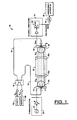
- FIGS. 1 and 2 illustrate a spectrometer system and method that may benefit from exemplary embodiments of the present invention
- exemplary as used herein referring to "serving as an example, instance or illustration”
- FIGS. 1 and 2 illustrate a spectrometer system and method that may benefit from exemplary embodiments of the present invention
- exemplary as used herein referring to "serving as an example, instance or illustration”
- FIGS. 1 and 2 illustrate a spectrometer system and method that may benefit from exemplary embodiments of the present invention.
- a spectrometer system 10 of one exemplary embodiment of the present invention includes a transmitter 12 configured to transmit a beam of coherent radiation (electromagnetic wave) at a given frequency
- the transmitter can comprise any of a number of different transmitters known to those skilled in the art.
- the transmitter comprises a photomixer transmitter.
- the transmitter includes a high-speed photoconductive diode (i.e., photomixer), which may be pumped with two laser sources 14a, 14b via a beam combiner/splitter 16 and an optically coupled first optical path 18 (e.g., optical fiber).
- the transmitter 12 may be coupled to a transmitter bias modulator 20 including a voltage source 22 configured to generate a sinusoidal modulated voltage with which the photomixer of the transmitter may be biased, although it should be understood that the system need not frequency modulate the signal.
- a transmitter bias modulator 20 including a voltage source 22 configured to generate a sinusoidal modulated voltage with which the photomixer of the transmitter may be biased, although it should be understood that the system need not frequency modulate the signal.
- the difference-frequency current is converted to difference-frequency photons.
- the result is a highly-tunable, continuous-wave (CW), highly-coherent source of radiation contained in a single (quasi-Gaussian) spatial mode, and having a transmitted electric field E TM .
- CW continuous-wave
- E TM transmitted electric field
- the method of one exemplary embodiment includes selecting a transmission frequency, thereafter transmitting a beam of radiation (i.e., source beam) at that frequency from the transmitter 12, as shown in blocks 42 and 48 of FIG. 2 .
- the transmission frequency can be selected in any of a number of different manners. To detect a sample based upon a measured absorption signature, however, the transmission frequency may be typically selected within a range of frequencies over which the absorption signature is defined.
- the photomixer can be pumped with tunable laser sources at a frequency ⁇ 2 , and a frequency ⁇ 1 that are selected to thereby select the difference, or transmission, frequency (i.e., ⁇ 2 ⁇ ⁇ 1 ).
- the beam of radiation from the transmitter 12 may pass through a collimating lens 24 to produce a collimated beam of radiation.
- the beam may then pass through a sample cell 26 that may be bounded by reflectors 26a and 26b through which the beam passes, and that may include a sample medium to be analyzed and a base medium, such as ambient air.
- a sample medium to be analyzed and a base medium, such as ambient air.
- the sample and base medium can have any of a number of different forms through which the beam of radiation is at least partially transmissive.
- the sample and base medium can comprise a solid, liquid, gas, plasma or aerosol. More particularly, in various advantageous embodiments, the base medium of ambient air may be in gas form, while a sample may be in gas or aerosol form.
- the sample and base medium in the sample cell absorb at least a portion of the beam, or more particularly at least a portion of the electric field of the beam.
- the remaining, unabsorbed portion of the beam of radiation i.e., received signal
- the sample signal then propagates to a focusing lens 28, from which the focused signal is picked up or otherwise received by a receiver 30 as a received signal E RP .
- the receiver obtains a measurement representative of the received electric field E R p, as shown in block 50 of FIG. 2 .
- the receiver may comprise an electric-field detector such as a photomixer receiver (homodyne receiver),
- the photomixer receiver may include an antenna configured to receive the electric field and generate a corresponding voltage in response thereto. which may be directed to a high-speed photoconductor.
- the photoconductor is also electrically coupled to a second optical path 32 for pumping the photoconductor with beams from the same two laser sources 14a, 14b pumping the photomixer transmitter 12.
- the beam combiner/splitter 16 may separate each of the signals from the laser sources into the aforementioned first optical path 18, as well as another, second optical path (e.g., optical fiber) for pumping the receiver photomixer. These signals, then, may modulate a conductance of the photomixer.
- second optical path e.g., optical fiber
- the voltage generated by the receiver antenna may be applied to the photomixer active material, and produce a current through the modulated conductance.
- the difference frequency result of the product is the down-converted signal current I Down , which may have a corresponding down-converted electric-field E R, either or both of which may constitute or otherwise represent a signal.
- the down-converted signal current I Down and/or electric-field E R may be applied to receiver signal conditioning circuitry 34 including, for example, an anti-aliasing filter 36.
- the output of the signal conditioning circuitry may then be input to a processing apparatus 38, such as for performing digital signal processing operations thereon,
- the processing apparatus can comprise any of a number of different devices capable of operating in accordance with exemplary embodiments of the present invention.
- the processing apparatus may comprise a computer (e.g., personal computer, laptop computer, server computer, workstation computer) or other computing apparatus
- the processing apparatus may include a processor and computer-readable storage medium.
- the processor may include, for example, one or more programmed or programmable general-purpose processors, microprocessors, coprocessors, controllers, specialized digital signal processors and/ or various other processing devices including one or more integrated circuits (e.g., ASICs, FPGAs), hardware accelerators, processing circuitry or the like.
- integrated circuits e.g., ASICs, FPGAs
- the computer-readable storage medium of the processing apparatus 38 may include volatile and/or non-volatile memory, which may be embedded and/or removable, and may include, for example, read-only memory, flash memory, magnetic storage devices (e.g., hard disks, floppy disk drives, magnetic tape, etc.), optical disc drives and/or media, non-volatile random access memory (NVRAM). and/or the like.
- the computer-readable storage medium may store any of a number of different data, content or the like, according to exemplary embodiments of the present invention.
- the computer-readable storage medium may be configured to store executable or other computer-readable instructions that may be executed or otherwise processed by the processor.
- the signal processing operations performed by the processor 38 may include recovering the amplitude of the down-converted signal E R such as by an analog-to-digital converter (A/D) 40 direct sampling of the signal at the modulating frequency, and the processor Discrete Fourier Transformation (DFT) processing of the sampled data.
- the spectrometer system may further include a synchronous demodulator such as a lock-in amplifier (not shown) for further processing the down-converted signal E R .
- a synchronous demodulator may include a local oscillator operating at the modulating frequency ⁇ m to thereby recover the amplitude of the down-converted signal.
- the system 10 scans through a number of transmission frequencies in a range of frequencies, such as by pumping the photomixers of the transmitter 12 and receiver 30 with tunable laser sources at frequency ⁇ 2, and frequency ⁇ 1 that are scanned through a number of frequencies, as shown in blocks 54 and 56 of FIG. 2 .
- the processor 38 may measure the amplitude and/or phase of the down-converted signal current I Down .
- the resulting collection of transmissions amplitudes and/or phases, and associated transmission frequencies may define a measured absorption or dispersion signature for the sample in the sample cell 26, from which the sample may be identified, as shown in block 58 of FIG. 2 .
- the signal generated by a spectrometer may contain a strong background signature created by superimposed standing wave patterns within a sample cell (e.g., sample cell 26 ).
- a sample cell e.g., sample cell 26
- the variation in amplitude as a function of measurement wavelength may also increase in frequency.
- the resulting background signature may be an aliasing of the actual standing wave structure within the instrument, and change shape and amplitude as the measurement frequency sampling is altered.
- the sensitivity of the background structure to frequency sampling may cause changes in that structure over multiple measurements. This variation in the background between scans may reduce the effectiveness of a simple ratio technique - dividing a measurement by a reference taken with no sample present - to accurately determine the spectral features of a sample being tested.
- the processing apparatus 38 of exemplary embodiments of the present invention may be configured to process acquired measurement according to an orthogonal background subtraction or suppression (OBS) technique to at least partially separate a complex and varying background structure from an acquired measurement, and thereby reveal the spectrum of a sample under test.
- OBS orthogonal background subtraction or suppression
- the acquired measurements may be in the form of the down-converted electric-field (or signal) E R measured at a discrete set of frequencies in a spectrum of interest but it should be understood that the measurements may equally be in the form of the down-converted signal current I Down measured over a similar discrete set of frequences.
- the processing OBS technique may but need not be implemented in logarithm space so that division of a reference measurement is equivalent to subtraction.
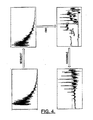
- FIGS. 3 and 4 illustrate block diagrams of operations that the processing apparatus 38 may be configured to perform according to exemplary embodiments of the present invention.
- the illustrated block diagrams include a number of scans to illustrate signals or measurements of signals received or calculated by the processing apparatus. It should be understood that references to a "signal” may be used interchangeably with references to a “measurement of a signal,” as may be received by the processing apparatus. It should also be understood that the illustrated scans arc presented merely for illustration, and that signals, measurements or other data may be received, calculated or presented in any of a number of different forms without departing from the spirit and scope of the present invention,
- the processing apparatus 38 may be configured to process a signal scans by a process that includes obtaining or otherwise retrieving N background reference signal scans 60.
- each a signal scan includes signal measurements at a discrete set of frequencies in a spectrum of interest.
- each measurement is taken of a transmitted signal passing through the sample cell 26 with the base medium (e.g,, ambient air) but without the sample medium.
- the processing apparatus may then be configured to decompose the background reference signal scans, such as in accordance with a singular value decomposition (SVD) technique 62, to generate a set of N orthogonal eigenvectors 64.
- SVD singular value decomposition
- the resulting eigenvectors may represent a set of basis functions as a function of frequency, whose linear combinations may reproduce each of the N background reference signal scans.
- the eigenvectors may then be utilized by the processing apparatus to process a subsequent sample signal scan.
- the background reference signal scans may be obtained and decomposed at any time prior to processing a sample signal. Consequently, the background reference signal scans or resulting eigenvectors may be stored in memory embodied within or otherwise associated with the processing apparatus, and retrieved at an appropriate time for use in generating the eigenvectors and/or processing a sample signal scan.
- a sample signal scan 66 may be obtained, where each measurement of the scan may be taken of a transmitted signal passing through the sample cell including the sample and base mediums.
- the processing apparatus 38 may be configured to receive and project the sample signal scan on each of the eigenvectors to generate corresponding coefficients 70. This projection may be accomplished, for example, by applying an inner-product (dot-product) operation 68 on the eigenvectors and sample signal scan, which itself may be accomplished by multiplying the transpose of the eigenvectors and sample signal scan.
- the eigenvectors may be linearly combined 72 with their corresponding coefficients to generate a correction value or values 74, which may be subtracted 76 from the sample signal scan to produce a corrected sample signal scan.
- the OBS technique implemented by the processing apparatus 38 may reveal the content of the sample signal scan that is orthogonal to the space of spectra spanned by the background reference eigenvectors.
- the technique implemented by the processing apparatus may be able to remove a background signature including superimposed standing waves of time-varying amplitudes.
- the gas spectra of interest may be spectral lines caused by the rotational characteristics of the molecule.
- the resolution of the spectrometer system of exemplary embodiments of the present invention may be sufficient to resolve many of these lines which may require sampling rich spectra with a large number of samples.
- performing SVD on a set ofN background reference signal scans 60, each with M measurement frequencies, may require the allocation and manipulation of an N x M matrix.
- a typical THz spectrum may include 10,000 to 100,000 measurement points (frequencies), and as many as 50 background reference signal scans may be acquired.
- the processing apparatus 38 of various example embodiments may be configured to segment, process and then stitch back together signal scans.
- the processing apparatus may be configured to segment the background reference signal scans and sample signal scan 66 into a plurality of overlapping frequency segments, each of which may be individually processed such as in accordance with the OBS technique explained above with respect to FIG. 3 .
- the overlapping spectra segments resulting from individually processing the segments may be assembled (or stitched together) and averaged, such as according to a least squares minimization of discrepancy technique with respect to spectra bias and tilt.
- the processing apparatus 38 may be configured to apply a bias correction to any OBS residual.
- the mean of the background may be represented as a linear combination of eigenvectors.
- the OBS technique implemented by the processing apparatus 38 may alter the mean of each segment.
- one segment may be held constant while the processing apparatus optimally recombines the others with respect to bias and tilt based on the segment being held constant. As a consequence, if not corrected, the absolute bias of the measured spectrum may be lost during this processing.
- the processing apparatus 38 of exemplary embodiments of the present invention may be configured to calculate the ratio between the sample and background signals, and then set the average signal of the final spectrum to match this ratio, thereby correcting the bias due to any OBS residual More particularly, for example, the processing apparatus may be configured to calculate the difference between the average sample signal and the average background signal -the averages performed over all frequencies. The processed final spectrum may then be adjusted so that its average over all frequencies matches the calculated difference. When these calculations are performed on the logarithms of the sample and background amplitudes, this has the effect of setting the average transmission of the processed data to the ratio of the sample signals to the background signals.
- the processing apparatus 38 of exemplary embodiments may employ the OBS technique in an iterative manner. For example, after initially processing a sample signal scan (see FIG. 3 ), data points in the sample signal scan corresponding to points in the corrected sample signal scan exceeding a specified absorption threshold may be identified and temporarily removed from the original sample signal scan.
- the modified raw sample signal scan may then be projected (e.g., applying the inner-product operation 68 ) a second time on to the eigenvectors to determine more-accurate coefficients.
- the resulting linear combination of eigenvectors with the more-accurate coefficients may then be subtracted from the original sample signal scan (including the high absorption points) to yield a further, more-accurate corrected sample signal scan.
- the operations performed by the processing apparatus 38 may be performed by various means. It will be understood that each block or operation of the block diagrams, and/or combinations of blocks or operations in the block diagrams, can be implemented by various means. Means for implementing the blocks or operations of the block diagrams, combinations of the blocks or operations in the block diagrams, or other functionality of example embodiments of the present invention described herein may include hardware, and/or a computer program product including a computer-readable storage medium having one or more computer program code instructions, program instructions, or executable computer-readable program code instructions stored therein. In this regard, program code instructions may be stored on a computer-readable storage medium and executed by a processor, such as those of the processing apparatus.
- program code instructions may be loaded onto a computer or other programmable apparatus (e.g., processor, memory, or the like) from a computer-readable storage medium to produce a particular machine, such that the particular machine becomes a means for implementing the operations specified in the block diagrams' block(s) or operation(s).
- program code instructions may also be stored in a computer-readable storage medium that can direct a computer, a processor, or other programmable apparatus to function in a particular manner to thereby generate a particular machine or particular article of manufacture.
- the instructions stored in the computer-readable storage medium may produce an article of manufacture, where the article of manufacture becomes a means for implementing the functions specified in the block diagrams' block(s) or operation(s).
- the program code instructions may be retrieved from a computer-readable storage medium and loaded into a computer, processor, or other programmable apparatus to configure the computer, processor, or other programmable apparatus to execute operations to be performed on or by the computer, processor, or other programmable apparatus.
- Retrieval, loading, and execution of the program code instructions may be performed sequentially such that one instruction is retrieved, loaded, and executed at a time.
- retrieval, loading and/or execution may be performed in parallel such that multiple instructions are retrieved, loaded, and/or executed together.
- Execution of the program code instructions may produce a computer-implemented process such that the instructions executed by the computer, processor, or other programmable apparatus provide operations for implementing the functions specified in the block diagrams' block(s) or operation(s).
- execution of instructions associated with the blocks or operations of the block diagrams by a processor, or storage of instructions associated with the blocks or operations of the block diagrams in a computer-readable storage medium supports combinations of operations for performing the specified functions. It will also be understood that one or more blocks or operations of the block diagrams, and combinations of blocks or operations in the block diagrams, may be implemented by special purpose hardware-based computer systems and/or processors which perform the specified functions, or combinations of special purpose hardware and program code instructions.
Landscapes
- Physics & Mathematics (AREA)
- Spectroscopy & Molecular Physics (AREA)
- General Physics & Mathematics (AREA)
- Health & Medical Sciences (AREA)
- Analytical Chemistry (AREA)
- Life Sciences & Earth Sciences (AREA)
- Chemical & Material Sciences (AREA)
- Biochemistry (AREA)
- General Health & Medical Sciences (AREA)
- Immunology (AREA)
- Pathology (AREA)
- Theoretical Computer Science (AREA)
- Mathematical Physics (AREA)
- Engineering & Computer Science (AREA)
- Toxicology (AREA)
- Investigating Or Analysing Materials By Optical Means (AREA)
- Other Investigation Or Analysis Of Materials By Electrical Means (AREA)
Applications Claiming Priority (1)
| Application Number | Priority Date | Filing Date | Title |
|---|---|---|---|
| US12/712,811 US8296106B2 (en) | 2010-02-25 | 2010-02-25 | Apparatus, method and computer-readable storage medium for processing a signal in a spectrometer system |
Publications (2)
| Publication Number | Publication Date |
|---|---|
| EP2372324A2 true EP2372324A2 (fr) | 2011-10-05 |
| EP2372324A3 EP2372324A3 (fr) | 2013-01-16 |
Family
ID=44064712
Family Applications (1)
| Application Number | Title | Priority Date | Filing Date |
|---|---|---|---|
| EP11250222A Withdrawn EP2372324A3 (fr) | 2010-02-25 | 2011-02-25 | Appareil, procédé et support de stockage lisible sur ordinateur pour le traitement d'un signal dans un système spectrométrique |
Country Status (7)
| Country | Link |
|---|---|
| US (1) | US8296106B2 (fr) |
| EP (1) | EP2372324A3 (fr) |
| JP (1) | JP2011174930A (fr) |
| AU (1) | AU2011200781A1 (fr) |
| CA (1) | CA2732665A1 (fr) |
| IL (1) | IL211414A0 (fr) |
| TW (1) | TW201140008A (fr) |
Families Citing this family (6)
| Publication number | Priority date | Publication date | Assignee | Title |
|---|---|---|---|---|
| US9325334B2 (en) * | 2013-06-12 | 2016-04-26 | Texas Instruments Incorporated | IC, process, device generating frequency reference from RF gas absorption |
| TWI493171B (zh) * | 2013-06-27 | 2015-07-21 | Univ China Medical | System and method for analyzing tissue cells by using hyperspectral image |
| GB201315195D0 (en) * | 2013-08-23 | 2013-10-09 | Perkinelmer Uk Ltd | Identifying presence of substances |
| US20160006954A1 (en) * | 2014-07-03 | 2016-01-07 | Snap Vision Technologies LLC | Multispectral Detection and Processing From a Moving Platform |
| WO2021201237A1 (fr) * | 2020-04-03 | 2021-10-07 | フェムトディプロイメンツ株式会社 | Gabarit de mesure, et procédé d'étalonnage et procédé de mesure d'onde térahertz l'utilisant |
| CN111982854B (zh) * | 2020-08-27 | 2023-06-27 | 中电科思仪科技股份有限公司 | 基于频分复用的物质太赫兹波谱分析装置及分析测试方法 |
Citations (1)
| Publication number | Priority date | Publication date | Assignee | Title |
|---|---|---|---|---|
| US6348683B1 (en) | 1998-05-04 | 2002-02-19 | Massachusetts Institute Of Technology | Quasi-optical transceiver having an antenna with time varying voltage |
Family Cites Families (23)
| Publication number | Priority date | Publication date | Assignee | Title |
|---|---|---|---|---|
| US2779230A (en) | 1951-07-20 | 1957-01-29 | John U White | Optical system providing a long optical path |
| US5121337A (en) * | 1990-10-15 | 1992-06-09 | Exxon Research And Engineering Company | Method for correcting spectral data for data due to the spectral measurement process itself and estimating unknown property and/or composition data of a sample using such method |
| US5267019A (en) | 1991-09-30 | 1993-11-30 | Consortium For Surface Processing, Inc. | Method and apparatus for reducing fringe interference in laser spectroscopy |
| DE69417899T2 (de) * | 1994-11-17 | 1999-11-04 | Chemunex, Maisons-Alfort | Vorrichtung und Verfahren zum Erkennen und Zählen von selten vorkommenden Säugerzellen |
| US5818578A (en) | 1995-10-10 | 1998-10-06 | American Air Liquide Inc. | Polygonal planar multipass cell, system and apparatus including same, and method of use |
| US5883518A (en) | 1996-04-24 | 1999-03-16 | Boxer Cross, Inc. | System and method for measuring the doping level and doping profile of a region in a semiconductor substrate |
| US5966019A (en) | 1996-04-24 | 1999-10-12 | Boxer Cross, Inc. | System and method for measuring properties of a semiconductor substrate in a fabrication line |
| US5903358A (en) | 1997-06-20 | 1999-05-11 | The Board Of Trustees Of The Leland Stanford Junior University | Spectroscopy using active diode laser stabilization by optical feedback |
| EP1060265A4 (fr) | 1998-02-02 | 2003-07-23 | Stevens Inst Technology | Procedes et appareil permettant de detecter des resonances induites par des lesions dans de l'acide desoxyribonucleique par spectroscopie d'ondes millimetriques ou sous-millimetriques |
| US6061134A (en) * | 1998-05-22 | 2000-05-09 | The United States Of America As Represented By The Administrator Of The National Aeronautics And Space Administration | Modulated Fourier Transform Raman fiber-optic spectroscopy |
| US6466322B1 (en) | 1998-12-31 | 2002-10-15 | The Board Of Trustees Of The Leland Stanford Junior University | Swept continuous wave cavity ring-down spectroscopy |
| WO2000079248A1 (fr) | 1999-06-21 | 2000-12-28 | Hamamatsu Photonics K.K. | Spectrometre a ondes terahertz |
| US6486474B1 (en) | 1999-08-13 | 2002-11-26 | Regents Of The University Of Minnesota | Infrared spectrometer for the measurement of isotopic ratios |
| GB2359716B (en) | 2000-02-28 | 2002-06-12 | Toshiba Res Europ Ltd | An imaging apparatus and method |
| US6804278B2 (en) | 2001-07-06 | 2004-10-12 | Intel Corporation | Evaluation and adjustment of laser losses according to voltage across gain medium |
| US7352463B2 (en) | 2002-09-06 | 2008-04-01 | Tdw Delaware, Inc. | Method and device for detecting gases by absorption spectroscopy |
| US6865198B2 (en) | 2002-09-27 | 2005-03-08 | Battelle Memorial Institute | Cavity ringdown spectroscopy system and method |
| US7460793B2 (en) | 2002-12-11 | 2008-12-02 | Michael George Taylor | Coherent optical detection and signal processing method and system |
| GB2399626B (en) | 2003-03-21 | 2006-04-05 | Teraview Ltd | Spectroscopy apparatus and associated technique |
| US7291839B1 (en) | 2004-05-03 | 2007-11-06 | Emcore Corporation | Subcentimeter radiation detection and frequency domain spectroscopy |
| US7251037B2 (en) * | 2005-03-07 | 2007-07-31 | Caleb Brett Usa, Inc. | Method to reduce background noise in a spectrum |
| US7271594B2 (en) | 2005-03-31 | 2007-09-18 | Goodrich Corporation | System and method for power ratio determination with common mode suppression through electric field differencing |
| US8027590B2 (en) * | 2008-09-19 | 2011-09-27 | Goodrich Corporation | System and method for signal extraction by path modulation |
-
2010
- 2010-02-25 US US12/712,811 patent/US8296106B2/en active Active
-
2011
- 2011-02-22 TW TW100105869A patent/TW201140008A/zh unknown
- 2011-02-24 IL IL211414A patent/IL211414A0/en unknown
- 2011-02-24 AU AU2011200781A patent/AU2011200781A1/en not_active Abandoned
- 2011-02-25 CA CA2732665A patent/CA2732665A1/fr not_active Abandoned
- 2011-02-25 EP EP11250222A patent/EP2372324A3/fr not_active Withdrawn
- 2011-02-25 JP JP2011039898A patent/JP2011174930A/ja not_active Withdrawn
Patent Citations (1)
| Publication number | Priority date | Publication date | Assignee | Title |
|---|---|---|---|---|
| US6348683B1 (en) | 1998-05-04 | 2002-02-19 | Massachusetts Institute Of Technology | Quasi-optical transceiver having an antenna with time varying voltage |
Also Published As
| Publication number | Publication date |
|---|---|
| EP2372324A3 (fr) | 2013-01-16 |
| US20110208480A1 (en) | 2011-08-25 |
| TW201140008A (en) | 2011-11-16 |
| US8296106B2 (en) | 2012-10-23 |
| JP2011174930A (ja) | 2011-09-08 |
| IL211414A0 (en) | 2011-06-30 |
| AU2011200781A1 (en) | 2011-09-08 |
| CA2732665A1 (fr) | 2011-08-25 |
Similar Documents
| Publication | Publication Date | Title |
|---|---|---|
| US8296106B2 (en) | Apparatus, method and computer-readable storage medium for processing a signal in a spectrometer system | |
| US11953427B2 (en) | Reconstruction of frequency registration for quantitative spectroscopy | |
| US8699029B2 (en) | Miniaturized laser heterodyne radiometer for carbon dioxide, methane and carbon monoxide measurements in the atmospheric column | |
| KR20130139222A (ko) | 시간 감쇠 신호들을 분석하기 위한, 광 신호 처리 방법 및 장치 | |
| US9025163B2 (en) | Chirp modulation-based detection of chirped laser molecular dispersion spectra | |
| US8144323B2 (en) | Apparatus, method and computer-readable storage medium for determining the ring-down time in a spectrometer system | |
| CN105683727A (zh) | 测量气体的气体组分的浓度的测量方法和气体分析仪 | |
| US8003947B1 (en) | System and method for magnitude and phase retrieval by path modulation | |
| US12339144B2 (en) | Optical fiber characteristic measurement device, optical fiber characteristic measurement program, and optical fiber characteristic measurement method for measuring characteristics of optical fiber based on Brillouin gain spectrum | |
| US10041878B2 (en) | Method for measuring and determining a terahertz spectrum of a sample | |
| EP2166325B1 (fr) | Système et procédé d'extraction de signal par modulation de piste | |
| JP2006284586A (ja) | 電界差分処理によるコモンモード抑圧を具えた電力比決定システムおよび方法 | |
| CN118896932A (zh) | 一种用于遥测场景下的tdlas系统气体浓度测量方法 | |
| CN114441477B (zh) | 基于宽吸收谱线气体的浓度检测方法及装置 | |
| EP2166324B1 (fr) | Système et procédé de suppression du bruit par un signal de superposition de fréquence | |
| US10866141B2 (en) | Device and method for spectral analysis | |
| Mølvig | Development of a Novel Terahertz Cross-Correlation Spectroscopy System | |
| JP7803972B2 (ja) | 遠赤外分光装置、及び遠赤外分光方法 | |
| Rozhentsov et al. | Resolving and Estimating Signal Parameters in Infrared, Raman, and Terahertz Spectrometers and Other Analytical Tools | |
| WO2025027275A1 (fr) | Spectromètre à dispersion laser | |
| Han et al. | Spectra extraction for wavelength-modulation spectroscopy of intra-cavity absorption gas sensor | |
| KR20180026339A (ko) | 대상물 측정 장치 및 방법 |
Legal Events
| Date | Code | Title | Description |
|---|---|---|---|
| PUAI | Public reference made under article 153(3) epc to a published international application that has entered the european phase |
Free format text: ORIGINAL CODE: 0009012 |
|
| 17P | Request for examination filed |
Effective date: 20110309 |
|
| AK | Designated contracting states |
Kind code of ref document: A2 Designated state(s): AL AT BE BG CH CY CZ DE DK EE ES FI FR GB GR HR HU IE IS IT LI LT LU LV MC MK MT NL NO PL PT RO RS SE SI SK SM TR |
|
| AX | Request for extension of the european patent |
Extension state: BA ME |
|
| PUAL | Search report despatched |
Free format text: ORIGINAL CODE: 0009013 |
|
| AK | Designated contracting states |
Kind code of ref document: A3 Designated state(s): AL AT BE BG CH CY CZ DE DK EE ES FI FR GB GR HR HU IE IS IT LI LT LU LV MC MK MT NL NO PL PT RO RS SE SI SK SM TR |
|
| AX | Request for extension of the european patent |
Extension state: BA ME |
|
| RIC1 | Information provided on ipc code assigned before grant |
Ipc: G01J 3/28 20060101AFI20121207BHEP Ipc: G01N 21/27 20060101ALI20121207BHEP Ipc: G01N 21/35 20060101ALI20121207BHEP Ipc: G01J 3/42 20060101ALI20121207BHEP |
|
| STAA | Information on the status of an ep patent application or granted ep patent |
Free format text: STATUS: THE APPLICATION IS DEEMED TO BE WITHDRAWN |
|
| 18D | Application deemed to be withdrawn |
Effective date: 20130717 |