EP2372635A2 - Vorrichtung und Verfahren zur Interpolation und Bildaufbereitung auf mobilen Geräten - Google Patents
Vorrichtung und Verfahren zur Interpolation und Bildaufbereitung auf mobilen Geräten Download PDFInfo
- Publication number
- EP2372635A2 EP2372635A2 EP11156873A EP11156873A EP2372635A2 EP 2372635 A2 EP2372635 A2 EP 2372635A2 EP 11156873 A EP11156873 A EP 11156873A EP 11156873 A EP11156873 A EP 11156873A EP 2372635 A2 EP2372635 A2 EP 2372635A2
- Authority
- EP
- European Patent Office
- Prior art keywords
- pixel
- super
- color
- determining
- original image
- Prior art date
- Legal status (The legal status is an assumption and is not a legal conclusion. Google has not performed a legal analysis and makes no representation as to the accuracy of the status listed.)
- Withdrawn
Links
Images


Classifications
-
- G—PHYSICS
- G06—COMPUTING OR CALCULATING; COUNTING
- G06T—IMAGE DATA PROCESSING OR GENERATION, IN GENERAL
- G06T3/00—Geometric image transformations in the plane of the image
- G06T3/40—Scaling of whole images or parts thereof, e.g. expanding or contracting
- G06T3/4007—Scaling of whole images or parts thereof, e.g. expanding or contracting based on interpolation, e.g. bilinear interpolation
Definitions
- the present invention relates to an apparatus and method for interpolating and rendering images on mobile devices. More particularly, the present invention relates to an apparatus and method for rendering a high quality interpolated image at a high speed on mobile devices.
- Mobile terminals were developed to provide wireless communication between users. As technology has advanced, mobile terminals now provide many additional features beyond simple voice communication. For example, mobile terminals are now able to provide additional functions such as Multimedia Message Service (MMS), E-mail, games, digital camera, multimedia function for providing audio and video content, and many more. With the plurality of features now provided, a mobile terminal has effectively become a necessity of daily life.
- MMS Multimedia Message Service
- E-mail E-mail
- games games
- digital camera digital camera
- multimedia function for providing audio and video content and many more.
- One aspect of the mobile terminal that has been particularly advanced is the ability to render and process high quality images, such as for a user interface and mobile applications.
- graphics content has become dramatically enriched, and with the fast development of the mobile Internet platform, the graphics functionality of mobile handsets has become an important issue for the handset industry.
- vector graphics images and animations have become very popular on mobile terminals and essential for smart phones.
- the rich content of a user interface and mobile applications demands efficient image and graphics rendering methods on the mobile terminals, especially because of their limited processing power.
- An important rendering method in the mobile graphics platform is image interpolation. Appropriate image interpolation methods apply a geometric transformation, such as rotation, scaling, skewing, and the like on the images to render a smooth output without aliasing.
- FIG. 1 illustrates an interpolation using the nearest neighbor technique according to the prior art.
- an image is comprised of a matrix of pixels 100, including a pixel 101.
- the new pixel matrix is mapped backward to the original image space that includes new pixel 103.
- the graphics engine on mobile terminal determines which pixel from the original matrix 100 is closest to the location of pixel 103. Having determined that pixel 101 is closest to pixel 103 and thus the nearest neighbor, the mobile terminal applies the characteristics of pixel 101 to new pixel 103.
- the nearest neighbor technique also called the point sampling technique, is a very fast method of transforming an image because the characteristics of the new pixel 103, such as its color value, are simply applied based on the characteristics of its nearest neighbor. In the example of FIG. 1 , the characteristics of nearest neighbor pixel 101 are directly applied to the new pixel 103. Accordingly, because its complexity is minimal, the nearest neighbor algorithm can be used to alter an image very quickly. However, despite the quick results, the image quality after a nearest neighbor interpolation is dramatically decreased, especially when the image is zoomed or undergoes a transformation such as rotation or skewing.
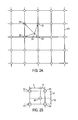
- FIGs. 2A and 2B illustrate an interpolation using the bilinear technique according to the prior art.
- an image is comprised of a matrix of pixels 200, including pixels 220, 221, 222 and 223.
- the image is transformed using bilinear interpolation, for example when the image is enlarged, rotated, and the like, a new pixel matrix is mapped backwards to the original image space that includes pixel 203.
- bilinear interpolation considers the closest 2 x 2 matrix of known pixel values surrounding the pixel to be interpolated.
- bilinear interpolation considers the 2 x 2 matrix including pixels 220, 221, 222 and 223.
- a weighted average of these values is used to arrive at a final interpolated value for pixel 203. More specifically, to determine the final interpolated value of pixel 203, the graphics engine performs calculations according to Equation (1).
- c i ⁇ A ⁇ ⁇ c i ⁇ 220 + 1 - ⁇ ⁇ c i ⁇ 221
- c i ⁇ B ⁇ ⁇ c i ⁇ 222 + 1 - ⁇ ⁇ c i ⁇ 223
- c i ⁇ 203 ⁇ c i ⁇ A + 1 - ⁇ ⁇ c i ⁇ B
- Equation (1) i denotes the color channel (i.e., red, green, blue and alpha), c i denotes the value of the channel, ⁇ denotes an interpolation factor according to the horizontal distance, and ⁇ denotes an interpolation factor according to the vertical distance.
- bilinear interpolation An advantage of bilinear interpolation is that the transformed image is much smoother than that achieved using the nearest neighbor technique.
- a disadvantage of bilinear interpolation is the amount of mathematical calculations required to determine a pixel color. The calculation is so expensive in terms of processing steps that it is much slower as compared with the nearest neighbor technique, especially in light of a mobile terminal's limited processing power.
- each pixel requires 12 bilinear interpolations including 3 sets of color calculations, wherein each set contains 4 bilinear interpolations for the red, green, blue and alpha channel, respectively.
- 24 multiplication instructions and 12 addition instructions plus 5 bitwise logical instructions for decomposing and composing color channels, or, in the alterative, 12 multiplication instructions and 24 addition instructions plus 5 bitwise logical instructions are necessary for each pixel.
- An aspect of the present invention is to address at least the above-mentioned problems and/or disadvantages and to provide at least the advantages described below. Accordingly, an aspect of the present invention is to provide an apparatus and method for efficiently interpolating and rendering an image on a mobile device.
- a method for providing a user interface in a mobile terminal having a software mode and a hardware mode includes obtaining a plurality of super pixels by virtually increasing a resolution of the original image, determining a sampling position of a target image pixel under transformation, selecting the nearest super pixel from the plurality of super pixels for the target image pixel, and determining a characteristic of the selected nearest super pixel for the target image pixel.
- an apparatus for providing a user interface in a mobile terminal having a software mode and a hardware mode includes a control unit for obtaining a plurality of super pixels by virtually increasing a resolution of the original image, for determining a sampling position of a target image pixel under transformation, for selecting the nearest super pixel from the plurality of super pixels for the target image pixel, and for determining a characteristic of the selected nearest super pixel for the target image pixel.
- FIG. 1 illustrates an interpolation using the nearest neighbor technique according to the prior art
- FIGs. 2A and 2B illustrate an interpolation using the bilinear technique according to the prior art
- FIG. 3 illustrates an image interpolation according to an exemplary embodiment of the present invention
- FIG. 4 illustrates a 4 x 4 matrix of super pixels according to an exemplary embodiment of the present invention.
- FIG. 5 illustrates a mobile terminal for interpolating an image according to an exemplary embodiment of the present invention.
- mobile terminal The following exemplary embodiments of the present invention are described as applied to a "mobile terminal.” However, it is to be understood that this is merely a generic term and that the invention is equally applicable to any of a mobile phone, a palm sized Personal Computer (PC), a Personal Digital Assistant (PDA), a Hand-held PC (HPC), a smart phone, an International Mobile Telecommunication 2000 (IMT-2000) terminal, a wireless Local Area Network (LAN) terminal, and the like. Accordingly, use of the term “mobile terminal” should not be used to limit application of the present inventive concepts to any certain type of apparatus or device.
- PC Personal Computer
- PDA Personal Digital Assistant
- HPC Hand-held PC
- smart phone an International Mobile Telecommunication 2000 (IMT-2000) terminal
- IMT-2000 International Mobile Telecommunication 2000
- LAN wireless Local Area Network
- Exemplary embodiments of the present invention include an apparatus and method for efficiently interpolating an image that is achieved more quickly than that with bilinear interpolation while providing an image that is smoother than that achieved with the nearest neighbor technique.
- a super sampling process is used to combine certain advantages of the nearest neighbor and bilinear interpolation techniques. The exemplary process lowers the calculation cost in terms of resources and time, while rendering an image having substantially the same quality as achieved with bilinear interpolation.
- exemplary embodiments of the present invention provide an apparatus and method for super sampling.
- super sampling includes dynamically increasing the virtual resolution of an original image on-demand by color interpolation to obtain new pixels.
- the new pixels are referred to as super pixels.
- a nearest neighbor technique can be used to select characteristic values for a pixel of a transformed image.
- a smoother transformed image can be achieved as compared to the nearest neighbor technique, while reducing the amount of necessary calculations as compared to the bilinear technique.
- FIG. 3 illustrates an image interpolation according to an exemplary embodiment of the present invention.
- an original image is comprised of a matrix of pixels 300, such as pixel 301.
- the resolution of the original image is conceptually and at least partially increased by color interpolation to obtain a matrix of super pixels such as super pixel 303 and super pixel 307.
- the characteristics of an interpolated pixel 305 can be determined using a nearest neighbor process.
- the nearest neighbor is super pixel 307. Accordingly, the characteristics of interpolated pixel 305 will be based on super pixel 307. More specifically, a matrix of super pixels, including, for this example, super pixel 307, is virtually determined.
- Virtual determination of the matrix of super pixels does not alter the actual resolution of the original image. Rather, the locations of the super pixels of the virtual matrix are used for a nearest neighbor process to determine aspects of interpolated pixel 305. Accordingly, in an exemplary implementation, the virtual matrix of super pixels need not be determined for the entire original image. For example, determination of the virtual matrix may include determination of super pixel 307, but not determination of super pixel 303, despite both being illustrated in FIG. 3 . After the virtual matrix is established and based on the nearest neighbor determination, the color of any given super pixel is calculated on-demand. For example, a virtual matrix of super pixels including super pixel 307 is determined.
- an exemplary process of image interpolation and rendering includes determining a super sampling pattern, determining the sampling position of each target image pixel, selecting the nearest super pixel in the original image space for each sampling position, and determining the color of the selected super pixel for each target pixel.
- the first step to interpolate and render an image is to choose a super sampling pattern.
- the super sampling pattern is chosen based on a 2 x x 2 x matrix.
- a 2 x x 2 x matrix allows for faster color calculation.
- x is set to 2 such that a 4 x 4 matrix is used.
- the 4 x 4 matrix will generally provide an acceptable image quality under at least 16 time zooming or any transformation in the same geometric scope, while not requiring excessive calculations.
- the value of "x" need not set to 2 and can be any integer greater than 0.
- the matrix need not be a 2 x x 2 x matrix but instead can be any square matrix, such as a 3 x x 3 x matrix, or a non-square matrix.
- the super sampling pattern is not applied to the entire original image. That is, super pixels are obtained based on application of the super sampling pattern to a selected subset of the original image. By selectively applying the super sampling pattern, the amount of resources necessary for determining the super pixels is reduced.
- the sampling position of a transformed target image pixel is determined using a backward 2-Dimensional (2D) linear affine transformation.
- the backward 2D linear affine transformation can be represented as 3 x 3 matrix M.
- the sampling position p' in the source image is given by Equation (2).
- Equation (2) The linear transformation using Equation (2) can be determined incrementally for pixel arrays in the target image.
- the nearest super pixel 307 is selected by sampling position. That is, using the nearest neighbor technique as discussed above, the nearest super pixel 307 is selected for the determined sampling position of the target image pixel 305.
- the color of the selected super pixel 307 is determined and used to assign characteristics of the target image pixel 305.
- a benefit of the super sampling process is the ability to quickly determine color for the fixed sampling pattern of the super pixels as opposed to the arbitrary sampling position as required in the bilinear technique. Furthermore, parallel calculation is much easier for color channels of pixels on fixed super sampling pattern using even simple integer instructions without Single Instruction Multiple Data (SIMD) extensions.
- SIMD Single Instruction Multiple Data
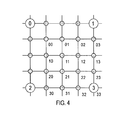
- FIG. 4 illustrates a 4 x 4 matrix of super pixels according to an exemplary embodiment of the present invention.
- an original image is comprised of a matrix of pixels including pixels 0, 1, 2 and 3.
- the 4 x 4 matrix of super pixels includes pixels 00, 01, 02, 03, 10, 11, 12, 13, 20, 21, 22, 23, 30, 31, 32, and 33.
- the color of any of super pixels 00-33 can be determined. That is, because each of super pixels 00-33 is adjacent to original image pixels 0-3 by a varying degree, the color of any of super pixel 00-33 can be determined based on its proximity to at least one of pixels 0-3.
- the individual color channel for each of the 16 super pixels 00 - 33 can be determined using Equation (3).
- Equation (3) ciMN represents the color value of super pixel, i represents the red (R), green (G), blue (B) and alpha (A) color channel, MN represents the super pixel index, ciP represents the corresponding R, G, B, and A color channel values of the original pixel, and P presents the pixel index.
- the multiplications/divisions of Equation (3) can be replaced by bit shifting. An example of such bit shifting is illustrated in Equation (4).
- exemplary embodiments of the present invention reduce computation costs. Furthermore, parallel calculations can be used to achieve a significant performance boost. In a case in which a processor with SIMD capability is available, such as an Intel XScale processor, parallel calculation for 4 channel colors becomes straightforward. Moreover, for many processors without SIMD capability, parallel calculation is also feasible using normal integer instructions with slight error in the resultant color value, which is acceptable especially on most mobile devices with 16 bit color LCD.
- Equation (5) As an example of parallel calculation using normal integer instructions, a 4 x 4 supper sampling pattern and 32 bit A8R8G8B8 color format are used to illustrate the simultaneous shifting and adding/subtracting of four color channels. An example of such simultaneous calculation to determine various values in Equation (3) is illustrated in Equation (5).
- Equation (5) C represents the 32 bit four channel color value.
- Eq. (5) four color channels are processed simultaneously. On average, such parallel calculation needs only 5 addition instructions and 3 bitwise logical instructions for each target pixel. Accordingly, it is much more efficient as compared to bilinear interpolation which needs 12 multiplication instructions, 24 addition instructions and 5 bitwise logical instructions for each target pixel.
- the shifting error is minimized by mixing the addition/subtraction formula rather than using an addition only formula, as in Equation (4). It is easy to analyze the resultant error by adding all possible shifting errors.
- the worst-case error caused by shifting byte c occurs when dropped bits are all '1's. For example, in the instance of shifting 4 bits, the worst case error occurs for c having a value of xxxx1111. In that case, c loses a value of 0.9375.
- the final worst case error for each value of c00 - c33 from Equation (3) is determined as the accumulated errors from single shifting.
- the worst case error is determined as illustrated in Equation (7).
- c ⁇ 00 c ⁇ 0 * 9 / 16 + c ⁇ 1 * 3 / 16 + c ⁇ 2 * 3 / 16 + c ⁇ 3 / 16 ⁇ c ⁇ 0 > > 4 + c ⁇ 0 > > 1 + c ⁇ 1 > > 2 - c ⁇ 1 > > 4 + c ⁇ 2 > > 2 - c ⁇ 2 > > 4 + c ⁇ 3 > > 4
- the worst case values for the remaining super pixels c01 - c33 can be determined in substantially the same way as illustrated in Equation (7) for c00.
- exemplary embodiments of the present invention were tested with the results showing that images were rendered 5 times faster than the bilinear interpolation technique. These results were obtained on several mobile handsets using different processors such as the ARM11, ARM9 and ARM7 processor. Furthermore, the results obtained provided very similar image quality as compared to the bilinear interpolation technique. This is due to the conceptually increased resolution of the original image and the overall calculation error in the exemplary algorithm being very small.
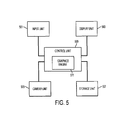
- FIG. 5 illustrates a mobile terminal for interpolating an image according to an exemplary embodiment of the present invention.
- the mobile terminal includes an input unit 501, a display unit 503, a camera unit 505, a storage unit 507, and a control unit 509.
- the input unit 501 includes a plurality of alphanumeric keys that allow a user to select various inputs for manipulation of the mobile terminal.
- the input unit 501 may further include any of various soft keys and function keys.
- the input unit 501 may include one or more touch sensors for providing user input.
- the input unit 501 provides input data corresponding, for example, to a key pressed by a user to the control unit 509.
- the display unit 503 displays user interface, graphics and multimedia content of applications on the mobile terminal. According to an exemplary embodiment of the present invention, the display unit 503 displays the user interface and graphics content utilizing the image interpolation and rendering method discussed above.
- the display unit 503 may include a color Liquid Crystal Display (LCD).
- the display unit 503 may include a controller for controlling the LCD, a video memory in which image data is stored and an LCD element. If the LCD is provided as a touch screen, the display unit 503 may perform a part or all of the functions of the input unit 501.
- the camera unit 505 is provided to capture images. Once captured, the images may be displayed on display unit 503 or saved in storage unit 507.
- the storage unit 507 may include a volatile as well as a non-volatile memory.
- the storage unit 507 may have stored therein various data associated with applications on the mobile terminal.
- the images stored in storage unit 507 may be captured by the camera unit 505, downloaded by a user from the Internet, or associated with applications on the mobile terminal.
- the control unit 509 including graphics engine 511, provides a platform service, image interpolation and rendering functionality, and executes the applications on mobile terminal.
- the graphics engine 511 interpolates and renders transformed images using the technique as described above with reference to FIGs. 3 and 4 , such as for an application's user interface and multimedia content.
- the graphics engine 511 processes to interpolate and render the image according to the above described method.
- the graphics engine 511 determines a super sampling pattern, determines a sampling position of each target image pixel, selects a nearest super pixel of in the original image space for each sampling position, and determines the color of the selected super pixel for each target pixel. Accordingly, the graphics engine 511 is able to render a transformed image having an appearance substantially the same as that obtained using a bilinear technique while saving significant cost.
- Certain aspects of the present invention can also be embodied as computer readable code on a computer readable recording medium.
- a computer readable recording medium is any data storage device that can store data that can be thereafter read by a computer system. Examples of the computer readable recording medium include Read-Only Memory (ROM), Random-Access Memory (RAM), CD-ROMs, magnetic tapes, floppy disks, and optical data storage devices.
- the computer readable recording medium can also be distributed over network coupled computer systems so that the computer readable code is stored and executed in a distributed fashion. Also, functional programs, code, and code segments for accomplishing the present invention can be easily construed by programmers skilled in the art to which the present invention pertains.
Landscapes
- Physics & Mathematics (AREA)
- General Physics & Mathematics (AREA)
- Engineering & Computer Science (AREA)
- Theoretical Computer Science (AREA)
- Image Processing (AREA)
- Editing Of Facsimile Originals (AREA)
Applications Claiming Priority (1)
| Application Number | Priority Date | Filing Date | Title |
|---|---|---|---|
| US12/725,866 US8577185B2 (en) | 2010-03-17 | 2010-03-17 | Apparatus and method for interpolating and rendering image on mobile devices |
Publications (2)
| Publication Number | Publication Date |
|---|---|
| EP2372635A2 true EP2372635A2 (de) | 2011-10-05 |
| EP2372635A3 EP2372635A3 (de) | 2014-11-12 |
Family
ID=43827310
Family Applications (1)
| Application Number | Title | Priority Date | Filing Date |
|---|---|---|---|
| EP11156873.9A Withdrawn EP2372635A3 (de) | 2010-03-17 | 2011-03-03 | Vorrichtung und Verfahren zur Interpolation und Bildaufbereitung auf mobilen Geräten |
Country Status (2)
| Country | Link |
|---|---|
| US (1) | US8577185B2 (de) |
| EP (1) | EP2372635A3 (de) |
Families Citing this family (4)
| Publication number | Priority date | Publication date | Assignee | Title |
|---|---|---|---|---|
| CN102542066B (zh) * | 2011-11-11 | 2014-04-09 | 冉阳 | 视频聚类方法、排序方法和视频搜索方法以及相应装置 |
| US9354631B2 (en) * | 2012-09-10 | 2016-05-31 | Honeywell International Inc. | Handheld device rendering of plant model portion based on task |
| US11620764B1 (en) | 2022-08-31 | 2023-04-04 | Illuscio, Inc. | Systems and methods for generating point-accurate three-dimensional models with point-accurate color information from a non-cosited capture |
| US12008728B2 (en) * | 2022-08-31 | 2024-06-11 | Qualcomm Incorporated | Apparatuses and methods for processing single instruction for image transformation from non-integral locations |
Family Cites Families (8)
| Publication number | Priority date | Publication date | Assignee | Title |
|---|---|---|---|---|
| US5719594A (en) * | 1995-10-06 | 1998-02-17 | International Business Machines Corporation | Method and system in a data processing system for improved video image resolution when enlarging a video sequence |
| WO1999055073A1 (fr) * | 1998-04-20 | 1999-10-28 | Seiko Epson Corporation | Support d'enregistrement de programmes de commande d'impression, controleur d'impression, et procede de commande de l'impression |
| US6236433B1 (en) * | 1998-09-29 | 2001-05-22 | Intel Corporation | Scaling algorithm for efficient color representation/recovery in video |
| JP4461937B2 (ja) * | 2003-09-30 | 2010-05-12 | セイコーエプソン株式会社 | 低解像度の複数の画像に基づく高解像度の画像の生成 |
| US7692670B2 (en) * | 2005-05-31 | 2010-04-06 | Lexmark International, Inc. | Methods and systems for scaling and rotating an image in a single operation |
| JP5128207B2 (ja) * | 2007-08-31 | 2013-01-23 | シリコン ヒフェ ベー.フェー. | 画像処理装置及び画像処理方法、画像処理プログラム |
| JP2010074732A (ja) * | 2008-09-22 | 2010-04-02 | Canon Inc | 画像処理装置及び画像処理方法ならびに画像処理方法を実行するプログラム |
| JP2010140460A (ja) * | 2008-11-13 | 2010-06-24 | Sony Corp | 画像処理装置および方法、並びにプログラム |
-
2010
- 2010-03-17 US US12/725,866 patent/US8577185B2/en not_active Expired - Fee Related
-
2011
- 2011-03-03 EP EP11156873.9A patent/EP2372635A3/de not_active Withdrawn
Non-Patent Citations (1)
| Title |
|---|
| None |
Also Published As
| Publication number | Publication date |
|---|---|
| US20110229021A1 (en) | 2011-09-22 |
| US8577185B2 (en) | 2013-11-05 |
| EP2372635A3 (de) | 2014-11-12 |
Similar Documents
| Publication | Publication Date | Title |
|---|---|---|
| US7643676B2 (en) | System and method for adaptive interpolation of images from patterned sensors | |
| CN101163252B (zh) | 一种多媒体视频图像的缩放方法 | |
| US20070188633A1 (en) | Distortion correction of images using hybrid interpolation technique | |
| CN100561517C (zh) | 用于查看与增强图像的方法和系统 | |
| US8675115B1 (en) | Forward interpolation approach for constructing a second version of an image from a first version of the image | |
| CN111402139A (zh) | 图像处理方法、装置、电子设备和计算机可读存储介质 | |
| CN101061502A (zh) | 2-维图像的放大和收缩 | |
| US9911177B2 (en) | Applying chroma suppression to image data in a scaler of an image processing pipeline | |
| TWI492187B (zh) | 超解析度影像處理方法及其裝置 | |
| CN110428382A (zh) | 一种用于移动终端的高效视频增强方法、装置和存储介质 | |
| EP2372635A2 (de) | Vorrichtung und Verfahren zur Interpolation und Bildaufbereitung auf mobilen Geräten | |
| JP4455364B2 (ja) | 解像度変換方法及び装置 | |
| US8577186B1 (en) | Forward interpolation approach using forward and backward mapping | |
| CN106373090B (zh) | 图片处理方法及装置 | |
| CN104853059B (zh) | 超分辨率图像处理方法及其装置 | |
| CN117768774A (zh) | 图像处理器、图像处理方法、拍摄装置和电子设备 | |
| KR101004972B1 (ko) | 이미지 스케일링 방법 및 장치 | |
| US11350068B2 (en) | Video tone mapping using a sequence of still images | |
| US7468733B2 (en) | Method and system for improving color reduction | |
| CN117635424B (zh) | 一种图像处理方法、装置、设备和存储介质 | |
| KR101028449B1 (ko) | 영상 크기 조정 장치 및 방법 | |
| CN112862673B (zh) | 自适应图像缩放方法及自适应图像缩放装置、存储装置 | |
| CN119540031A (zh) | 图像风格迁移模型的训练方法、风格迁移方法及相关装置 | |
| US7606443B2 (en) | Interpolation method for enlarging an image | |
| WO2009150795A1 (ja) | 画像再生装置 |
Legal Events
| Date | Code | Title | Description |
|---|---|---|---|
| PUAI | Public reference made under article 153(3) epc to a published international application that has entered the european phase |
Free format text: ORIGINAL CODE: 0009012 |
|
| AK | Designated contracting states |
Kind code of ref document: A2 Designated state(s): AL AT BE BG CH CY CZ DE DK EE ES FI FR GB GR HR HU IE IS IT LI LT LU LV MC MK MT NL NO PL PT RO RS SE SI SK SM TR |
|
| AX | Request for extension of the european patent |
Extension state: BA ME |
|
| RAP1 | Party data changed (applicant data changed or rights of an application transferred) |
Owner name: SAMSUNG ELECTRONICS CO., LTD. |
|
| PUAL | Search report despatched |
Free format text: ORIGINAL CODE: 0009013 |
|
| AK | Designated contracting states |
Kind code of ref document: A3 Designated state(s): AL AT BE BG CH CY CZ DE DK EE ES FI FR GB GR HR HU IE IS IT LI LT LU LV MC MK MT NL NO PL PT RO RS SE SI SK SM TR |
|
| AX | Request for extension of the european patent |
Extension state: BA ME |
|
| RIC1 | Information provided on ipc code assigned before grant |
Ipc: G06T 3/40 20060101AFI20141008BHEP |
|
| STAA | Information on the status of an ep patent application or granted ep patent |
Free format text: STATUS: THE APPLICATION IS DEEMED TO BE WITHDRAWN |
|
| 18D | Application deemed to be withdrawn |
Effective date: 20150513 |