EP2372920A2 - Paketcodierungsverfahren zur Bereitstellung eines ungleichen Fehlerschutzes an Benutzer und/oder Anwendungsdaten - Google Patents
Paketcodierungsverfahren zur Bereitstellung eines ungleichen Fehlerschutzes an Benutzer und/oder Anwendungsdaten Download PDFInfo
- Publication number
- EP2372920A2 EP2372920A2 EP11154618A EP11154618A EP2372920A2 EP 2372920 A2 EP2372920 A2 EP 2372920A2 EP 11154618 A EP11154618 A EP 11154618A EP 11154618 A EP11154618 A EP 11154618A EP 2372920 A2 EP2372920 A2 EP 2372920A2
- Authority
- EP
- European Patent Office
- Prior art keywords
- bits
- bit stream
- high priority
- low priority
- priority
- Prior art date
- Legal status (The legal status is an assumption and is not a legal conclusion. Google has not performed a legal analysis and makes no representation as to the accuracy of the status listed.)
- Withdrawn
Links
- 238000000034 method Methods 0.000 title claims abstract description 43
- 238000004891 communication Methods 0.000 claims description 23
- 238000013507 mapping Methods 0.000 claims description 10
- 238000001514 detection method Methods 0.000 claims description 7
- 238000012937 correction Methods 0.000 claims description 6
- 238000000926 separation method Methods 0.000 claims description 6
- 230000007423 decrease Effects 0.000 claims description 3
- 238000012545 processing Methods 0.000 description 8
- 230000005540 biological transmission Effects 0.000 description 6
- 238000010586 diagram Methods 0.000 description 6
- 230000015654 memory Effects 0.000 description 6
- 238000004590 computer program Methods 0.000 description 3
- 230000006978 adaptation Effects 0.000 description 1
- 238000013461 design Methods 0.000 description 1
- 230000006870 function Effects 0.000 description 1
- 230000010365 information processing Effects 0.000 description 1
- 239000000463 material Substances 0.000 description 1
- 230000003287 optical effect Effects 0.000 description 1
- 239000007787 solid Substances 0.000 description 1
Images



Classifications
-
- H—ELECTRICITY
- H03—ELECTRONIC CIRCUITRY
- H03M—CODING; DECODING; CODE CONVERSION IN GENERAL
- H03M13/00—Coding, decoding or code conversion, for error detection or error correction; Coding theory basic assumptions; Coding bounds; Error probability evaluation methods; Channel models; Simulation or testing of codes
- H03M13/35—Unequal or adaptive error protection, e.g. by providing a different level of protection according to significance of source information or by adapting the coding according to the change of transmission channel characteristics
- H03M13/356—Unequal error protection [UEP]
-
- H—ELECTRICITY
- H03—ELECTRONIC CIRCUITRY
- H03M—CODING; DECODING; CODE CONVERSION IN GENERAL
- H03M13/00—Coding, decoding or code conversion, for error detection or error correction; Coding theory basic assumptions; Coding bounds; Error probability evaluation methods; Channel models; Simulation or testing of codes
- H03M13/25—Error detection or forward error correction by signal space coding, i.e. adding redundancy in the signal constellation, e.g. Trellis Coded Modulation [TCM]
-
- H—ELECTRICITY
- H04—ELECTRIC COMMUNICATION TECHNIQUE
- H04L—TRANSMISSION OF DIGITAL INFORMATION, e.g. TELEGRAPHIC COMMUNICATION
- H04L27/00—Modulated-carrier systems
- H04L27/32—Carrier systems characterised by combinations of two or more of the types covered by groups H04L27/02, H04L27/10, H04L27/18 or H04L27/26
- H04L27/34—Amplitude- and phase-modulated carrier systems, e.g. quadrature-amplitude modulated carrier systems
- H04L27/3405—Modifications of the signal space to increase the efficiency of transmission, e.g. reduction of the bit error rate, bandwidth, or average power
- H04L27/3416—Modifications of the signal space to increase the efficiency of transmission, e.g. reduction of the bit error rate, bandwidth, or average power in which the information is carried by both the individual signal points and the subset to which the individual points belong, e.g. using coset coding, lattice coding, or related schemes
-
- H—ELECTRICITY
- H04—ELECTRIC COMMUNICATION TECHNIQUE
- H04L—TRANSMISSION OF DIGITAL INFORMATION, e.g. TELEGRAPHIC COMMUNICATION
- H04L1/00—Arrangements for detecting or preventing errors in the information received
- H04L1/0078—Avoidance of errors by organising the transmitted data in a format specifically designed to deal with errors, e.g. location
- H04L1/0086—Unequal error protection
-
- H—ELECTRICITY
- H04—ELECTRIC COMMUNICATION TECHNIQUE
- H04L—TRANSMISSION OF DIGITAL INFORMATION, e.g. TELEGRAPHIC COMMUNICATION
- H04L1/00—Arrangements for detecting or preventing errors in the information received
- H04L2001/0098—Unequal error protection
Definitions
- the present invention relates generally to communications systems and, more particularly, to a packet encoding scheme to provide unequal error protection for different bits.
- FEC forward-error-correction
- Embodiments of the invention provide a packet encoding scheme to ensure unequal error protection to different bits in a packet or in multiple packets.
- the structure of Gray encoding is used to ensure unequal error protection for different bits.
- the packet encoding scheme generates a symbol using a mix of high priority and low priority bits. The scheme has insignificant complexity and can provide a higher probability of detection of header bits in a packet. Also, it can provide a higher degree of protection against noise corruption to important frames such as control packets, I-frames in MPEG transmission, and the like.
- a method to process bits in a bit stream comprises scrambling the bit stream; separating the scrambled bit stream into separate high priority bits and low priority bits to form a high priority bit stream and a low priority bit stream, the high priority bit stream having an order of high priority bits from left to right and the low priority bit stream having an order of low priority bits from left to right; rearranging the bits by embedding the high priority bits from the high priority bit stream in the low priority bit stream to form a rearranged bit stream while preserving the order of the high priority bits and the order of the low priority bits in the rearranged bit stream, the rearranged bit stream including blocks of bits, each block including one or more adjacent high priority bits disposed left of corresponding one or more adjacent low priority bits in order to provide protection for the high priority bits against noise which is at least equal to protection for the low priority bits in the block; modulating the rearranged bit stream using Gray encoding method to produce an encoded bit stream; and transmitting the encoded bit stream to a communication medium
- bits-to-symbol mapping of the encoded bit stream provides a constellation map having edge symbols and non-edge symbols, each symbol including a plurality of bits; and probability of correction detection for the bits in each edge symbol is highest for the leftmost bit and decreases from left to right to lowest for the rightmost bit.
- At least one block of bits in the rearranged bit stream includes one or more adjacent high priority bits from most significant bits of the bit stream and corresponding one or more adjacent low priority bits from least significant bits of the bit stream.
- Rearranging the bits comprises generating blocks of M bits wherein M is constellation size representing bits per symbol, each block of M bits including the one or more adjacent high priority bits to the left of the corresponding one or more adjacent low priority bits.
- the bit stream may comprise a packet having header bits and payload bits, the header bits being high priority bits, the payload bits being low priority bits.
- the bit stream may comprise a high priority packet having the high priority bits and a low priority packet having the low priority bits.
- the method further comprises receiving an input encoded bit stream from the communication medium, the input encoded bit stream including a plurality of high priority encoded bits embedded in a plurality of low priority encoded bits, the high priority encoded bits having an input order of high priority bits from left to right, the a low priority encoded bits having an input order of low priority bits from left to right; demodulating the input encoded bit stream to produce a decoded bit stream; separating the decoded bit stream into separate high priority decoded bits and low priority decoded bits to form a high priority decoded bit stream and a low priority decoded bit stream while preserving the input order of the high priority bits in the high priority decoded bit stream and the input order of the low priority bits in the low priority decoded bit stream, generating a serial bit stream with the high priority decoded bit stream which is followed by the low priority decoded bit stream; and descrambling the serial bit stream.
- a system to process bits in a bit stream comprises a scrambler to scramble the bit stream; a transmitter separation module to separate the scrambled bit stream into separate high priority bits and low priority bits to form a high priority bit stream and a low priority bit stream, the high priority bit stream having an order of high priority bits from left to right and the low priority bit stream having an order of low priority bits from left to right; a transmitter rearranging module to rearrange the bits by embedding the high priority bits from the high priority bit stream in the low priority bit stream to form a rearranged bit stream while preserving the order of the high priority bits and the order of the low priority bits in the rearranged bit stream, the rearranged bit stream including blocks of bits, each block including one or more adjacent high priority bits disposed left of corresponding one or more adjacent low priority bits in order to provide protection for the high priority bits against noise which is at least equal to protection for the low priority bits in the block; a modulation mapper to modulate the rearranged bit stream using Gray
- the system further comprises a receiver to receive an input encoded bit stream from the communication medium, the input encoded bit stream including a plurality of high priority encoded bits embedded in a plurality of low priority encoded bits, the high priority encoded bits having an input order of high priority bits from left to right, the a low priority encoded bits having an input order of low priority bits from left to right; a demodulation module to demodulate the input encoded bit stream to produce a decoded bit stream; a receiver separation module to separate the decoded bit stream into separate high priority decoded bits and low priority decoded bits to form a high priority decoded bit stream and a low priority decoded bit stream while preserving the input order of the high priority bits in the high priority decoded bit stream and the input order of the low priority bits in the low priority decoded bit stream; a receiver rearranging module to generating a serial bit stream with the high priority decoded bit stream which is followed by the low priority decoded bit stream; and a descrambler to
- Another aspect of the invention is directed to a computer-readable storage medium storing a plurality of instructions for controlling a data processor to process bits in a bit stream.
- the plurality of instructions comprise instructions that cause the data processor to scramble the bit stream; instructions that cause the data processor to separate the scrambled bit stream into separate high priority bits and low priority bits to form a high priority bit stream and a low priority bit stream, the high priority bit stream having an order of high priority bits from left to right and the low priority bit stream having an order of low priority bits from left to right; instructions that cause the data processor to rearrange the bits by embedding the high priority bits from the high priority bit stream in the low priority bit stream to form a rearranged bit stream while preserving the order of the high priority bits and the order of the low priority bits in the rearranged bit stream, the rearranged bit stream including blocks of bits, each block including one or more adjacent high priority bits disposed left of corresponding one or more adjacent low priority bits in order to provide protection for the high priority bits against noise which is at least equal to protection for
- relative orientation and placement terminology such as the terms horizontal, vertical, left, right, top and bottom, is used. It will be appreciated that these terms refer to relative directions and placement in a two dimensional layout with respect to a given orientation of the layout. For a different orientation of the layout, different relative orientation and placement terms may be used to describe the same objects or operations.
- the present invention also relates to an apparatus for performing the operations herein.
- This apparatus may be specially constructed for the required purposes, or it may include one or more general-purpose computers selectively activated or reconfigured by one or more computer programs.
- Such computer programs may be stored in a computer-readable storage medium, such as, but not limited to optical disks, magnetic disks, read-only memories, random access memories, solid state devices and drives, or any other types of media suitable for storing electronic information.
- the algorithms and displays presented herein are not inherently related to any particular computer or other apparatus.
- Various general-purpose systems may be used with programs and modules in accordance with the teachings herein, or it may prove convenient to construct a more specialized apparatus to perform desired method steps.
- the present invention is not described with reference to any particular programming language.
- Exemplary embodiments of the invention provide apparatuses, methods and computer programs for a packet encoding scheme to ensure unequal error protection to different bits in a packet or in multiple packets.
- the structure of Gray encoding is used to ensure unequal error protection for different bits.
- the packet encoding scheme generates a symbol using a mix of high priority and low priority bits. This is achieved as follows: (a) Scramble an input bit stream (consisting of high priority bits followed by low priority bits). (b) Separate out high priority bits from low priority bits in the scrambled bit stream to produce a high priority bit stream and a low priority bit stream.
- (c) Process the bit stream (consisting of high priority bits followed by low priority bits) to generate a modified bit stream where each block of M bits (where M is constellation size representing bits/symbol) comprises high priority bits as MSBs (Most Significant Bits) and low priority bits as LSBs (Least Significant Bits). The fewer the number of high priority bits in the MSB, the higher is the error protection for them.
- (d) Encode the bits using Gray encoding and process the resulting symbols for transmission. At the receiving end, the above operations are performed in reverse to retrieve the transmitted bits.
- FIG. 1 shows an example of a typical communication system having a bit scrambler followed by a modulation mapper.
- the input bits from the bit scrambler are encoded in the modulation mapper using the Gray encoding method to minimize bit error probability in case a symbol is incorrectly detected as a neighboring one.
- the encoded bits are processed for transmission and then transmitted to the communication medium.
- the above operations are performed in reverse to retrieve the transmitted bits in an output bit stream. That is, the bits from the communication medium pass through receiver processing, are decoded in a demodulation unit, and then descrambled by a bit scrambler to generate the output bit stream.
- FIG. 2 illustrates an example of the packet encoding and, more specifically, bits-to-symbol mapping after scrambling process.
- the header bits are encoded together followed by the payload bits.
- the bits forming the MSB of encoded data are usually more robust to noise corruption as compared to LSB bits. This results in unequal error protection for different bits irrespective for the importance of their correction detection.
- the Gray encoding scheme ensures that the number of differing bits in neighboring symbols is always 1. This reduces the bit error rate in case a symbol is wrongly detected as a neighboring symbol.
- FIG. 3 illustrates an example of the packet encoding for bits-to-symbol mapping to provide unequal error protection in a communication system according to an embodiment of the present invention.
- the error probabilities for a bit in a given symbol depends on the relative location of that bit within the symbol (especially for a higher order constellation such as 16-QAM or 64-QAM).
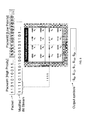
- FIG. 3 shows the QAM-16 constellation map with Gray encoded symbols. It is apparent that the probability of error for a MSB bit in a symbol lying on the edge of constellation (for example: s0, s1, s4, s5 and so on) is lower than that for a LSB bit.
- the probability of correction detection for different bits in an edge symbol follows the following order: Pr b 0 > Pr b 1 > Pr b 2 > Pr b 3
- the constellation points that are closest to a given constellation point are its neighbors. If all constellation points have an equal number of neighbors, the map is a lower order constellation map. If some constellation points (especially the ones located on the edges) have fewer number of neighbors than other constellation points on the map (e.g., those not on the edges), the map is a higher order constellation map.
- the unequal error protection benefits of the present packet encoding scheme are seen in higher order constellation such as 16-QAM or 64-QAM, but little or no obvious benefits are found when lower order constellation is used (e.g., BPSK, QPSK, QAM-4, and the like).
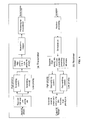
- FIG. 4 is a schematic diagram of a communication system illustrating an example of multi-level scrambling to facilitate appropriate bit-to-symbol mapping for unequal error protection.
- FIG. 4 "a" parts, shows a transmitter which includes a processor, a memory, and a plurality of modules for processing bits in a transmission path.
- the input bit stream is scrambled by a scrambler.
- a scrambler Different from the conventional communication system described in FIG. 1 , it is proposed to split up the bit stream in accordance with different priority levels in a transmitter separation module and rearrange them in a transmitter rearranging module as discussed in more detail below.
- the modified bit stream is then encoded by a modulation mapper and then processed for transmission.
- FIG. 1 shows a transmitter which includes a processor, a memory, and a plurality of modules for processing bits in a transmission path.
- the input bit stream is scrambled by a scrambler.
- it is proposed to split up the bit stream in accordance
- bit stream undergoes receiver processing and then demodulation in a demodulation module.
- the high priority bits in the demodulated/decoded bit stream are separated from the low priority bits in a receiver separation module while preserving respective bit orders.
- the next step is to generate a serial bit stream with low priority bits following high priority bits in a receiver rearranging module.
- the resulting bit stream is descrambled in a descrambler to produce the output bit stream.
- each block of M bits may have bits belonging to different priority levels.
- the MSB bits may be the ones belonging to the highest priority bit stream whereas lowest priority bits may form the LSB bits.
- FIG. 5 shows an example illustrating how to embed higher priority bits within a low priority bit stream. Two examples are presented and both preserve the respective bit orders in the "High priority” and “Low priority” bit streams. Example-2 provides a higher level of protection to the "High priority” bits as compared to Example-1.
- the resulting bit stream may be encoded using the Gray encoding method.
- Gray encoding method we provide several examples to illustrate different use cases.
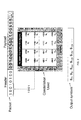
- FIG. 6 shows a first example of applying the present packet encoding scheme to provide more protection to the Header bits of the packet.
- Each block of 4 bits is formed using 2 bits from the header stream occupying first and second leftmost positions. The other two are formed from the payload bits. This ensures that the header bits are less prone to incorrect detection as compared to the payload bits. Once all header bits are used up, the payload bits are encoded as usual.
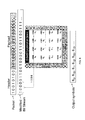
- FIG. 7 shows a second example of applying the present packet encoding scheme to provide more protection to the Header bits of the packet which has a higher level of error protection than that in the first example of FIG. 6 .
- FIG. 7 considers the same scenario as that in FIG. 6 but each block of 4 bits is formed using 1 bit from the header stream occupying the leftmost position and the remaining 3 bits are from the payload bit stream. This ensures that the header bits receive more protection than the example illustrated in FIG. 6 . Once all the header bits are used up, the payload bits are encoded as usual.
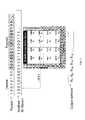
- FIG. 8 shows a third example of applying the present packet encoding scheme to provide more protection to the Header bits of the packet illustrating unequal error protection for different packets intended for the same use or different users.
- the high priority bits are from a high priority packet (number 1) and the low priority bits are from a low priority packet (number 2).
- Each block of 4 bits is formed using 2 bits from the high priority packet bit stream occupying the leftmost position and 2 bits from the low priority packet bit stream occupying the rightmost position. This ensures that the high priority packet bits receiver more protection than the low priority packet bits.
- the present packet encoding scheme can find application in both wired and wireless communication systems. It can provide unequal error protection at insignificant complexity. Some of the possible use-scenarios include higher protection to header of a packet, higher protection to I-frames of MPEG application, higher protection to control packets, and the like.
- the computers and storage systems implementing the invention can also have known I/O devices (e.g., CD and DVD drives, floppy disk drives, hard drives, etc.) which can store and read the modules, programs and data structures used to implement the above-described invention. These modules, programs and data structures can be encoded on such computer-readable media.
- the data structures of the invention can be stored on computer-readable media independently of one or more computer-readable media on which reside the programs used in the invention.
- the components of the system can be interconnected by any form or medium of digital data communication, e.g., a communication network. Examples of communication networks include local area networks, wide area networks, e.g., the Internet, wireless networks, storage area networks, and the like.
- the operations described above can be performed by hardware, software, or some combination of software and hardware.
- Various aspects of embodiments of the invention may be implemented using circuits and logic devices (hardware), while other aspects may be implemented using instructions stored on a machine-readable medium (software), which if executed by a processor, would cause the processor to perform a method to carry out embodiments of the invention.
- some embodiments of the invention may be performed solely in hardware, whereas other embodiments may be performed solely in software.
- the various functions described can be performed in a single unit, or can be spread across a number of components in any number of ways.
- the methods may be executed by a processor, such as a general purpose computer, based on instructions stored on a computer-readable medium. If desired, the instructions can be stored on the medium in a compressed and/or encrypted format.
Landscapes
- Engineering & Computer Science (AREA)
- Physics & Mathematics (AREA)
- Probability & Statistics with Applications (AREA)
- Theoretical Computer Science (AREA)
- Computer Networks & Wireless Communication (AREA)
- Signal Processing (AREA)
- Detection And Prevention Of Errors In Transmission (AREA)
- Compression Or Coding Systems Of Tv Signals (AREA)
- Error Detection And Correction (AREA)
- Digital Transmission Methods That Use Modulated Carrier Waves (AREA)
- Data Exchanges In Wide-Area Networks (AREA)
Applications Claiming Priority (1)
| Application Number | Priority Date | Filing Date | Title |
|---|---|---|---|
| US12/727,553 US8020065B1 (en) | 2010-03-19 | 2010-03-19 | Packet encoding method to provide unequal error protection to users and/or applications data |
Publications (2)
| Publication Number | Publication Date |
|---|---|
| EP2372920A2 true EP2372920A2 (de) | 2011-10-05 |
| EP2372920A3 EP2372920A3 (de) | 2012-01-25 |
Family
ID=44148479
Family Applications (1)
| Application Number | Title | Priority Date | Filing Date |
|---|---|---|---|
| EP11154618A Withdrawn EP2372920A3 (de) | 2010-03-19 | 2011-02-16 | Paketcodierungsverfahren zur Bereitstellung eines ungleichen Fehlerschutzes an Benutzer und/oder Anwendungsdaten |
Country Status (4)
| Country | Link |
|---|---|
| US (2) | US8020065B1 (de) |
| EP (1) | EP2372920A3 (de) |
| JP (1) | JP2011205626A (de) |
| CN (1) | CN102195751A (de) |
Cited By (3)
| Publication number | Priority date | Publication date | Assignee | Title |
|---|---|---|---|---|
| EP3253342B1 (de) | 2015-02-02 | 2018-11-28 | Coloplast A/S | Ostomievorrichtung |
| US11077224B2 (en) | 2015-02-02 | 2021-08-03 | Coloplast A/S | Ostomy device |
| US11160681B2 (en) | 2015-04-10 | 2021-11-02 | Coloplast A/S | Ostomy device |
Families Citing this family (13)
| Publication number | Priority date | Publication date | Assignee | Title |
|---|---|---|---|---|
| CN101325474B (zh) * | 2007-06-12 | 2012-05-09 | 中兴通讯股份有限公司 | Ldpc码的混合自动请求重传的信道编码及调制映射方法 |
| US8806288B2 (en) * | 2009-03-13 | 2014-08-12 | Sharp Laboratories Of America, Inc. | Systems and methods for providing unequal error protection code design from probabilistically fixed composition codes |
| DE102010031411B4 (de) * | 2010-07-15 | 2012-04-26 | Fraunhofer-Gesellschaft zur Förderung der angewandten Forschung e.V. | Konzept zur Kombination codierter Datenpakete |
| JP5736765B2 (ja) * | 2010-12-22 | 2015-06-17 | セイコーエプソン株式会社 | 記録装置、成形物の製造方法 |
| CN103138769B (zh) * | 2013-01-17 | 2015-12-23 | 中山大学 | 一种具有不等错误保护的编码方法 |
| WO2014127169A1 (en) | 2013-02-15 | 2014-08-21 | Cortina Systems, Inc. | Apparatus and method for communicating data over a communication channel |
| EP3084968A4 (de) * | 2013-12-16 | 2017-11-29 | McAfee, LLC | Prozesseffiziente vorverarbeitung für einen verschlüsselungsstandard |
| US9300463B2 (en) | 2014-04-04 | 2016-03-29 | Altera Corporation | Multi-rate transceiver circuitry |
| US20160316513A1 (en) * | 2015-04-23 | 2016-10-27 | Samsung Electronics Co., Ltd. | Communication device and method for controlling the same |
| CN106982462A (zh) * | 2016-01-18 | 2017-07-25 | 株式会社Ntt都科摩 | 比特到符号的映射方法和基站 |
| US10613676B2 (en) * | 2016-11-04 | 2020-04-07 | Microsoft Technology Licensing, Llc | Non-uniform code constellations in electrostatic communication |
| CN108933753B (zh) * | 2017-05-25 | 2019-07-19 | 深圳市中兴微电子技术有限公司 | 一种调制方法、装置及计算机存储介质 |
| CN109687851B (zh) * | 2018-12-05 | 2020-11-17 | 苏州博思得电气有限公司 | 一种高压脉冲发生器及用于其的通信方法 |
Family Cites Families (8)
| Publication number | Priority date | Publication date | Assignee | Title |
|---|---|---|---|---|
| US5812601A (en) * | 1996-11-15 | 1998-09-22 | Telefonaktiebolaget Lm Ericsson | Coding for higher-level modulation |
| US6405338B1 (en) * | 1998-02-11 | 2002-06-11 | Lucent Technologies Inc. | Unequal error protection for perceptual audio coders |
| JP4652856B2 (ja) * | 2005-03-16 | 2011-03-16 | パナソニック株式会社 | 無線送信装置、無線通信システム、無線送信方法及び送受信方法 |
| US8464120B2 (en) * | 2006-10-18 | 2013-06-11 | Panasonic Corporation | Method and system for data transmission in a multiple input multiple output (MIMO) system including unbalanced lifting of a parity check matrix prior to encoding input data streams |
| CN101325474B (zh) * | 2007-06-12 | 2012-05-09 | 中兴通讯股份有限公司 | Ldpc码的混合自动请求重传的信道编码及调制映射方法 |
| JP5058918B2 (ja) * | 2008-08-28 | 2012-10-24 | 京セラ株式会社 | 番組表表示装置 |
| TW201044833A (en) * | 2009-06-01 | 2010-12-16 | Ind Tech Res Inst | Hierarchical modulation system and transmitter and method thereof |
| JP4418522B2 (ja) * | 2009-08-27 | 2010-02-17 | パナソニック株式会社 | データ送信装置、データ送信方法および無線通信システム |
-
2010
- 2010-03-19 US US12/727,553 patent/US8020065B1/en not_active Expired - Fee Related
-
2011
- 2011-02-16 EP EP11154618A patent/EP2372920A3/de not_active Withdrawn
- 2011-02-18 CN CN2011100429507A patent/CN102195751A/zh active Pending
- 2011-02-28 JP JP2011041727A patent/JP2011205626A/ja active Pending
- 2011-08-18 US US13/212,757 patent/US8219875B2/en not_active Expired - Fee Related
Non-Patent Citations (1)
| Title |
|---|
| None |
Cited By (5)
| Publication number | Priority date | Publication date | Assignee | Title |
|---|---|---|---|---|
| EP3253342B1 (de) | 2015-02-02 | 2018-11-28 | Coloplast A/S | Ostomievorrichtung |
| US11077224B2 (en) | 2015-02-02 | 2021-08-03 | Coloplast A/S | Ostomy device |
| US11771798B2 (en) | 2015-02-02 | 2023-10-03 | Coloplast A/S | Ostomy device with a switchable adhesive layer located between a backing layer and an absorbent adhesive layer |
| US11160681B2 (en) | 2015-04-10 | 2021-11-02 | Coloplast A/S | Ostomy device |
| US11819444B2 (en) | 2015-04-10 | 2023-11-21 | Coloplast A/S | Ostomy device with a switchable adhesive composition adapted to be switched by moisture activation of a switch initiator |
Also Published As
| Publication number | Publication date |
|---|---|
| US8219875B2 (en) | 2012-07-10 |
| US20120011418A1 (en) | 2012-01-12 |
| EP2372920A3 (de) | 2012-01-25 |
| US20110231728A1 (en) | 2011-09-22 |
| CN102195751A (zh) | 2011-09-21 |
| US8020065B1 (en) | 2011-09-13 |
| JP2011205626A (ja) | 2011-10-13 |
Similar Documents
| Publication | Publication Date | Title |
|---|---|---|
| US8020065B1 (en) | Packet encoding method to provide unequal error protection to users and/or applications data | |
| US20240154850A1 (en) | Reception methods and apparatuses for non-uniform constellation modulated signals | |
| US5105442A (en) | Coded modulation with unequal error protection | |
| Wu et al. | Data hiding in image and video. I. Fundamental issues and solutions | |
| CN112671513B (zh) | 编码和调制设备及方法以及解调和解码设备及方法 | |
| TW201644245A (zh) | 重疊傳輸用的設備與方法、以及使用者裝備 | |
| CN101151866A (zh) | 带有非导频码元的自适应调制 | |
| US9008240B1 (en) | Near maximum likelihood spatial multiplexing receiver | |
| US20080253462A1 (en) | System and method for wireless communication of uncompressed video using mode changes based on channel feedback (cf) | |
| US20070291855A1 (en) | Method, device and system of error-protection of a wireless video transmission | |
| US10135649B2 (en) | Systems and methods for performing multi-level coding in a discrete multitone modulation communication system | |
| US11271685B2 (en) | Method of hybrid automatic repeat request implementation for data transmission with multilevel coding | |
| US20190190651A1 (en) | Communications with conditional chain decoding | |
| US20150188667A1 (en) | Decision feedback solution for channels with low signal to noise ratio | |
| JP4716048B2 (ja) | 変復調方法、並びに変調装置及び復調装置 | |
| US8705658B2 (en) | Method and apparatus of modulating signal in broadcasting and communication system | |
| Kader et al. | Image transmission over noisy wireless channels using HQAM and median filter | |
| EP2757753B1 (de) | Datenübertragung unter Verwendung hierarchischer Modulation mit einer Gruppierung von Konstellationspunkten | |
| WO2018030204A1 (ja) | 送信装置、受信装置、送信方法および受信方法 | |
| EP2757752B1 (de) | Verfahren und Vorrichtung zur Übertragung von Daten unter Verwendung einer hierarchischen Modulation mit gruppierten Konstellationspunkten | |
| US20110033011A1 (en) | Methods and apparatuses relating to multi-resolution transmissions with mimo scheme | |
| Yang et al. | Capacity-raising steganography using multi-pixel differencing and pixel-value shifting operations | |
| CN107277567B (zh) | 基于叠加编码的信令编码调制方法及解调译码方法 | |
| CN103051419B (zh) | 渐进广播传输方法及系统 | |
| Ghani et al. | Hierarchical quadrature amplitude modulation for image transmission over erroneous wireless channels |
Legal Events
| Date | Code | Title | Description |
|---|---|---|---|
| PUAI | Public reference made under article 153(3) epc to a published international application that has entered the european phase |
Free format text: ORIGINAL CODE: 0009012 |
|
| 17P | Request for examination filed |
Effective date: 20110610 |
|
| AK | Designated contracting states |
Kind code of ref document: A2 Designated state(s): AL AT BE BG CH CY CZ DE DK EE ES FI FR GB GR HR HU IE IS IT LI LT LU LV MC MK MT NL NO PL PT RO RS SE SI SK SM TR |
|
| AX | Request for extension of the european patent |
Extension state: BA ME |
|
| PUAL | Search report despatched |
Free format text: ORIGINAL CODE: 0009013 |
|
| AK | Designated contracting states |
Kind code of ref document: A3 Designated state(s): AL AT BE BG CH CY CZ DE DK EE ES FI FR GB GR HR HU IE IS IT LI LT LU LV MC MK MT NL NO PL PT RO RS SE SI SK SM TR |
|
| AX | Request for extension of the european patent |
Extension state: BA ME |
|
| RIC1 | Information provided on ipc code assigned before grant |
Ipc: H04L 27/34 20060101ALI20111216BHEP Ipc: H03M 13/35 20060101AFI20111216BHEP |
|
| STAA | Information on the status of an ep patent application or granted ep patent |
Free format text: STATUS: THE APPLICATION HAS BEEN WITHDRAWN |
|
| 18W | Application withdrawn |
Effective date: 20140108 |