EP2373009A2 - Fernsehsignalempfangsvorrichtung mit Tonsignaldetektion - Google Patents
Fernsehsignalempfangsvorrichtung mit Tonsignaldetektion Download PDFInfo
- Publication number
- EP2373009A2 EP2373009A2 EP11001997A EP11001997A EP2373009A2 EP 2373009 A2 EP2373009 A2 EP 2373009A2 EP 11001997 A EP11001997 A EP 11001997A EP 11001997 A EP11001997 A EP 11001997A EP 2373009 A2 EP2373009 A2 EP 2373009A2
- Authority
- EP
- European Patent Office
- Prior art keywords
- signal
- sound
- frequency
- television
- analyzing
- Prior art date
- Legal status (The legal status is an assumption and is not a legal conclusion. Google has not performed a legal analysis and makes no representation as to the accuracy of the status listed.)
- Withdrawn
Links
Images

Classifications
-
- H—ELECTRICITY
- H04—ELECTRIC COMMUNICATION TECHNIQUE
- H04N—PICTORIAL COMMUNICATION, e.g. TELEVISION
- H04N5/00—Details of television systems
- H04N5/44—Receiver circuitry for the reception of television signals according to analogue transmission standards
- H04N5/60—Receiver circuitry for the reception of television signals according to analogue transmission standards for the sound signals
-
- H—ELECTRICITY
- H04—ELECTRIC COMMUNICATION TECHNIQUE
- H04H—BROADCAST COMMUNICATION
- H04H40/00—Arrangements specially adapted for receiving broadcast information
- H04H40/18—Arrangements characterised by circuits or components specially adapted for receiving
-
- H—ELECTRICITY
- H04—ELECTRIC COMMUNICATION TECHNIQUE
- H04N—PICTORIAL COMMUNICATION, e.g. TELEVISION
- H04N21/00—Selective content distribution, e.g. interactive television or video on demand [VOD]
- H04N21/40—Client devices specifically adapted for the reception of or interaction with content, e.g. set-top-box [STB]; Operations thereof
- H04N21/43—Processing of content or additional data, e.g. demultiplexing additional data from a digital video stream; Elementary client operations, e.g. monitoring of home network or synchronising decoder's clock; Client middleware
- H04N21/438—Interfacing the downstream path of the transmission network originating from a server, e.g. retrieving encoded video stream packets from an IP network
- H04N21/4382—Demodulation or channel decoding, e.g. QPSK demodulation
Definitions
- Embodiments of the invention refer to a television signal receiver apparatus and an integrated circuit including a detector unit for detecting the presence of a sound signal carrier.
- Other embodiments refer to a method of detecting the presence of a sound signal carrier in an analogue broadcast television signal.
- TV sets support a plurality of analogue television standards differing with regard to the modulation of the broadcast television signal, which contains a composite video signal describing a picture content and a sound signal (audio signal) describing the audio content of a television channel.
- a plurality of video standards is defined for the video signal and a plurality of audio standards is defined for the sound signal.
- the television standards combine video and audio standards in various different ways, wherein an audio standard may accompany different video standards and a video standard may be combined with different audio standards.
- the object to be achieved with the embodiments of the present invention is to provide an integrated circuit, a universal television signal receiver apparatus and a method for processing television signals in a television signal receiver apparatus allowing the ubiquitous application of television signal receiver apparatus in a comfortable way.
- This object is achieved with the subject matters of the independent claims. Further embodiments are specified in the dependent claims respectively.
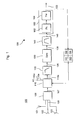
- Figure 1 refers to a television signal receiver apparatus 100 that receives an analogue broadcast television signal 105 for example via an RF (radio frequency) antenna 101, a cable connector 102 or a satellite reception equipment 103.
- the broadcast television signals 105 transmit a plurality of television channels using a plurality of carrier frequencies.
- Each broadcast television signal 105 includes one or more sound signals describing the audio contents and a composite video signal that contains information describing brightness and chrominance of pictures in a video stream transmitted in the TV channel.
- the television signal receiver apparatus 100 may be a television tuner or may be integrated in a TV set, a video recording system, a handheld communications unit equipped with TV functionality or a computer with TV functionality, for example a multi-media computer.
- the broadcast television signal 105 may be a signal in conformity with a television standard as defined by the CCIR (Comotti Consultatif International des Radiocommunications) letter code and using the NTSC (national television system committee) system, the PAL (phase alternating line) system, or the SECAM (séquentiel town a code) colour system, for example PAL-N, PAL-I, PAL-B, PAL-D, PAL-K, NTSC-M, SECAM-L, SECAM-B or SECAM-G.
- CCIR Commission International des Radiocommunications
- NTSC national television system committee
- PAL phase alternating line
- SECAM SECAM
- a receiver unit 106 tunes in to a video carrier frequency of a TV channel selected by a viewer or during an automatic channel scan and samples the received analogue broadcast television signal 105.
- a sound signal detection unit 199 includes a signal processing unit 110 that receives the sampled television signal 107 and that may derive therefrom, for example, a digital video signal 115a representing or containing the composite video signal and one or more sound signals 115c derived from one or more sound carriers related to that video carrier frequency to which the receiver unit 110 is tuned in.
- the signal processing unit 110 is not in each case capable of unambiguously deriving the sound signal carrier frequencies of the sound signals 115c from an analysis of the detected video carrier frequency or the digital video signal 115a. And even where the signal processing unit 110 were to reliably predict a main sound carrier, sub sound signal carrier frequencies often would remain ambiguous.
- some broadcast stations combine the variants 1, 2 and 3 of the video standards D and K with the A2 audio standard using two separate FM (frequency modulated) sound carriers, wherein one of them is defined at 6.5 MHz and the other one may be at 6.2578125, 6.7421875 or 5.7421875 MHz.
- the video standard N is used in combination with the A2, the EIA-J (Electronics Industries Association of Japan), and the BTSC (Broadcast Television System Committees] audio standards, wherein BTSC and EIA-J provide only one sound carrier, whereas A2 uses two sound carriers.
- the signal processing unit 110 is not capable of distinguishing the A2 standard from the BTSC and EIA-J standards during transmission of monaural contents.
- the signal processing unit 110 uses predefined analyzing frequencies for scanning the sampled television signal 107 for possible sound carriers.
- the signal processing unit 110 outputs a modulation information signal 115b that in substance corresponds to the television signal 107 frequency-shifted by the current analyzing frequency.
- the modulated information signal 115b contains a digital complex base-band version of the sound signal contained in that broadcast television signal 105 to which the receiver unit 106 is tuned in. Otherwise, the modulated information signal 115b does not contain a base-band version of a sound signal and in substance only contains frequency-shifted video signal components.
- the signal processing unit 110 outputs the digital, modulated information signal 115b that contains two orthogonal components to a low-pass pre-filter unit 120.
- the pre-filter unit 120 suppresses out-of-band portions that may be contained in the modulated information signal 115b, for example the frequency shifted video signal component.
- the upper cut-off frequency of the pre-filter unit 120 is sufficiently high for allowing a significant portion of the sideband energy of a base-band representation of a sound signal to pass. For example, the significant portion may be about 98 % and the upper cut-off frequency of the pre-filter unit 120 may correspond to the Carson bandwidth of the modulated information signal 115b.
- the upper cut-off frequency of the pre-filter unit 120 is sufficiently low to suppress out-of-band portions and to separate a base-band representation of the sound signal in the modulated information signal 115b from video signal components. According to an embodiment, the upper cut-off frequency of the pre-filter unit 120 is in the range of 50 kHz to 180 kHz, for example about 150 kHz.
- the digital signal 125 at the output of the pre-filter unit 120 represents the filtered modulated information signal. In case the analyzing frequency matches a sound signal carrier, the digital signal 125 may contain a stereophonic signal, one monaural signal or two different monaural signals modulated onto a main sound carrier or onto a main sound carrier and a sub sound carrier. Otherwise, the digital signal 125 contains no or only a weak signal.
- the pre-filter unit 120 outputs the digital signal 125 to a demodulator unit 130 that demodulates the digital signal 125 to obtain an output signal 135.
- the demodulator unit 130 includes an FM (frequency modulation) demodulator and may also include an AM (amplitude modulation) demodulator unit or may be a configurable unit whose mode of operation can be switched between AM and FM demodulation.
- the demodulator output signal 135 corresponds to a sound signal contained in that broadcast television signal 105 to which the receiver unit 106 is tuned in, Otherwise, the demodulator output signal 135 in substance contains broadband noise having a bandwidth substantially greater than a sound signal.
- the analyzing frequency corresponds to a sound carrier, when a deviation between the analyzing frequency and the sound carrier frequency contained in the modulated information signal 115b is not greater than half the minimum frequency distance between two sound carriers defined in the various standards.
- some broadcast stations use a combination of the B/G video standard and the Nicam (Near Instantaneous Companded Audio Multiplex) audio standard, wherein a digital information signal is modulated on a sub sound carrier at 5.85 MHz.
- Other broadcast stations use a combination of the B/G video standard and a variant of the A2 audio standard that uses a sub sound carrier at 5.7421875 MHz. Both combinations use the same main sound signal.
- the sound signal detection unit 199 is designed to be capable of separating these two sub sound carriers having a distance of approximately 110 kHz.
- the embodiments use the demodulator FM threshold effect, according to which above a certain input signal level the SNR in a demodulator output signal moderately increases with the input signal level, whereas below that certain input signal level, the SNR in the demodulator output signal falls steeply with decreasing input signal levels.
- the demodulator primarily outputs broadband noise.
- the demodulator unit 130 outputs a band-limited signal.
- a filter unit 140 filters the demodulator output signal 135, wherein the passband of the filter unit 140 is outside the bandwidth of a typical demodulated sound signal.
- the filter unit 140 attenuates the sound signal and no or only low signal power can be detected in the filtered signal 145 at the output of the filter unit 140. Otherwise, when the digital signal 125 does not contain a sound signal, the demodulator unit 130 generates broadband noise due to the FM threshold effect. A portion of that broadband noise falls within the passband of the filter unit 140 and a noise signal can be detected in the filtered signal.
- a detector unit 160 evaluates the filtered signal 145 and may output a detector signal 165 that indicates the presence of a sound signal carrier in the digital signal 125 when the filtered signal 145 contains no or only weak broadband noise. For example, the presence of a sound signal carrier may be indicated, when the signal power of the filtered signal 145 falls below a predefined threshold.
- the filter unit 140 attenuates predetermined frequency components that are typically contained in the demodulator output signal 135 when the digital signal 125 contains a sound signal and passes over frequency components that are typically notcontained in the demodulator output signal 135 when the digital signal 125 contains a sound signal.
- the filter unit 140 is a high-pass filter or a band-pass filter and has a lower cut-off frequency that is higher than the upper limiting frequency of a typical sound signal.
- the lower cut-off frequency of the filter unit 140 is derived from the upper cut-off frequency of the pre-filter unit 120.
- the lower cut-off frequency of the filter unit 140 is not lower or in the range of the upper cut-off frequency of the pre-filter unit 120.
- the sound signal contains sound information from 0 Hz to 15 kHz.
- the lower cut-off frequency of the filter unit 140 may be 15 kHz or higher, for example at least 10% above the upper limiting frequency of the sound signal.
- the filter unit 140 may be a band-pass filter whose upper cut-off frequency is determined such that expectable spurious disturbance or interference frequencies appear outside the passband. For example, interference frequencies typically appear at harmonics of the line frequencies or other repetitive signals in the video signals. Though attenuated in the sound signal branch, these signals may still occur in the demodulated signal 135.
- the filter unit 140 may be a band-pass filter whose upper cut-off frequency depends on the sample rate according to the Nyquist theorem.
- the detector unit 160 may comprise a peak detection unit 162 and a threshold decision unit 164.
- the peak detection unit 162 may detect a peak amplitude in the filtered signal 145.
- the threshold decision unit 164 switches a signal level of the detector signal 165 in response to the peak amplitude of the filtered signal 145 falling below or exceeding a predefined threshold value.
- the detector unit 160 may comprise an integrator unit integrating the filtered signal 145 during a predetermined time period, wherein the threshold decision unit 164 compares the integrated filtered signal with a predefined threshold value.
- the pre-filter unit 120, the demodulator unit 130, the filter unit 140 and the detection unit 160 form a sound signal carrier detection unit 199 and may be integrated in the same integrated circuit.
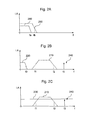
- Figures 2A to 2C illustrate the effects of the functional units of the television signal receiver apparatus 100 of Figure 1 .
- Figure 2A schematically shows the spectral range 280 of the modulated information signal having an upper limiting frequency fa.
- the cut-off frequency fb of the pre-filter unit 120 is selected to be greater than the limiting frequency fa and lower than a lower limiting frequency of out-of-band portions which may be contained in the digital complex base-band signal and which can result from the demodulation of the sampled television signal in the previous stages.
- Figure 2B shows the spectral range 220 of the demodulator output signal in the case the current analyzing frequency corresponds to a sound signal carrier frequency present in the sampled television signal 107 such that the modulated information signal 115b contains a base-band representation of a sound signal.
- the demodulator output signal has the spectral range of the respective baseband sound signal with a limiting frequency of f0, for example 15 kHz, wherein f0 is lower than the first limiting frequency fa of the modulated information signal 115b.
- the passband 210 of the filter unit 140 is selected such that it does not overlap with the spectral range of the baseband sound signal.
- the lower cut-off frequency f1 may be defined by the cut-off frequency fb of the pre-filter unit 120 of Figure 1 .
- the passband 210 may be selected such that predictable interference signals resulting from the processing in the previous stages and appearing at frequencies f3 may be suppressed.
- the passband 210 may have an upper cut-off frequency f2 between 200 and 400 kHz, for example about 300 kHz.
- Figure 2B refers to the functionality of the filter unit 140 of Figure 1 in the case the the current analyzing frequency is equal to or approximately equal to a sound signal carrier frequency present in the sampled television signal 107 such that the modulated information signal 115b contains a base-band representation of a sound signal.
- the signal power is concentrated in the spectral range 220 and no or only a weak signal is present within the passband 210.
- the detector unit 160 of Figure 1 detects no signal or only a low signal amplitude or signal power in the filtered signal at the output of the filter unit.
- Figure 2C refers to a situation where the current analyzing frequency is not equal to or approximately equal to a sound signal carrier frequency present in the sampled television signal 107 such that due to the FM threshold effect the demodulator unit generates broadband noise in the demodulator output signal.
- the noise spectrum 230 overlaps with the passband 210 such that noise is present within the filter passband 210.
- the detector unit 160 of Figure 1 detects high noise signal power or high noise signal amplitudes in the filtered signal at the output of the filter unit. Providing the filter unit as a band-pass filter with an upper cut-off frequency below predictable spurious frequencies such as harmonics of line frequencies increases the reliability of noise detection.
- the detector unit 160 detects the presence of noise in the filtered signal 145. When the noise level falls below a predetermined threshold, the detector unit 160 may generate the detector signal 165 for indicating that the signal processing unit 110 has tuned in to a sound carrier and that the analyzing frequency currently used by the signal processing unit 110 corresponds to a sound signal carrier. For determining more than one sound signal carrier frequency assigned to that video carrier to which the receiver unit 106 is tuned in, the same functional units may be used for successively determining main and sub sound carriers.
- a sound signal carrier information can be obtained that includes information on the number and the frequency of detected signal sound carriers for the television signal the television signal receiver apparatus 100 is tuned in.
- a first control unit 191 may use the detector signal 165 to control the signal processing unit 110.
- the first control unit 191 may control the signal processing unit 110 to continuously change the analyzing frequency as long as the signal processing unit 110 has not applied the matching analyzing frequency.
- the first control unit 191 may contain information on the eligible analyzing frequencies.
- the first control unit 191 may use information provided by other stages, for example, by the signal processing unit 110, for pre-selecting suitable analyzing frequencies. For example, when the video standard of the received broadcast television signal has been identified, scanning for sound signal carriers may be restricted to those frequencies actually used in combination with the identified video standard anywhere.
- the first control unit 191 may notify other instances in the television signal receiver apparatus 100 and may continue or stop the scan for sound signal carriers when all sound signal carriers have been identified.
- a second control unit 192 uses the sound signal carrier information to control the output of sound signals 115c from the signal processing unit 110 in another sound signal branch.
- the second control unit 192 may provide the demodulator frequencies for a sound signal processing sub-unit included in the signal processing unit 110.
- the second control unit 192 may suppress the output of sound signals to an amplifier stage as long as no or not all sound signal carriers have been detected.
- a third control unit 193 may control the receiver unit 106 and the signal processing unit 110 to perform an automatic video channel scan and to control the signal processing unit 110 to scan for sound signal carriers each time the receiver unit 106 has tuned in to a television broadcast carrier frequency.
- a fourth control unit 194 controls the signal processing unit 110 to scan for a sub sound signal carrier each time after a main sound carrier has been detected and up to a sub-sound signal carrier has been detected.
- the fourth control unit 194 allows capturing a sub sound signal carrier for a stereophonic sound signal as soon as the transmission switches to stereophonic transmission later.
- Each of the pre-filter unit 120, the demodulator unit 130, the filter unit 140 and the detection unit 160 may be realized in hardware, software or as a combination thereof. In accordance with an embodiment, they are realized as signal processing circuits integrated in an integrated circuit, for example an ASIC (application specific integrated circuit), which may also include the signal processing unit 110.
- ASIC application specific integrated circuit
- control units 191, 192, 193, 194 described in terms of their functions above may be may be realized in hardware, software or as a combination thereof. According to other embodiments two, three or all control units are integrated in the same physical entity.
- the embodiments of the invention provide a robust solution for determining the sound signal carriers in the broadcast television signal in to which the receiver unit 106 is currently tuned.
- Level changes caused by transmitter characteristics resulting in varying P/S (picture carrier/sound carrier) ratios, varying S1 /S2 (first stereophonic signal/second stereophonic signal) ratios, carrier offsets or by internal processing, for example a receiver AGC (automatic gain control), do not or only to a low degree effect the detector signal 165.
- a slight frequency offset between the analyzing frequency and a sound signal carrier results only in a DC component in the demodulator output signal 135. While level detectors tend to interpret noise as additional carrier level or as valid signal information, the embodiments are robust against the presence of noise in the received broadcast television signal.
- the embodiments allow manufacture and distribution of a television signal receiver apparatus for ubiquitous application, wherein the television signal apparatus is capable of receiving broadcast stations using different standards without the need of cumbersome pre-settings on the manufacturer's or the viewer's side.
- a television receiver may be used in regions where it receives broadcast television signals from a plurality of broadcast stations using different standards.
- the embodiments facilitate an automatic switch to the stereophonic rendering of audio contents even in cases, where the broadcast television signal contains only monaural contents at the time the apparatus tunes in to the broadcast signal.
- the embodiments improve the reliability of the detection and qualification of sound signals included in a broadcast television signal.
- Figure 3 refers to a method for processing an analogue broadcast television signal received at a television signal receiver apparatus.
- the method includes generating a detector signal.
- a television signal is analyzed using predefined analyzing frequencies, wherein a modulated information signal is derived that includes a baseband representation of a sound signal when the analyzing frequency matches a sound signal carrier in the television signal (302).
- the modulated information signal is filtered to attenuate frequency components not contained in the sound signal baseband representation (304).
- the filtered modulated information signal is FM demodulated, wherein a digital demodulator output signal is obtained (306).
- the demodulator output signal contains a sound signal included in the television signal when the analyzing frequency matches a sound signal carrier in the television signal; otherwise it in substance contains broadband noise.
- the demodulator output signal is filtered using a filter unit having a passband outside the bandwidth or frequency range of the sound signals, wherein filtered signals are obtained (308).
- a detector signal may be generated that indicates when a signal in the filtered signal falls below a predetermined threshold.
- sound signal carrier information can be obtained that can be used to control the generation of sound signals output by the television signal receiver apparatus.
- frequency components corresponding to predictable spurious frequencies resulting from a composite video signal contained in the television signal may be attenuated in order to increase the reliability of the sound signal carrier detection.
Landscapes
- Engineering & Computer Science (AREA)
- Signal Processing (AREA)
- Multimedia (AREA)
- Circuits Of Receivers In General (AREA)
- Two-Way Televisions, Distribution Of Moving Picture Or The Like (AREA)
- Television Receiver Circuits (AREA)
Priority Applications (1)
| Application Number | Priority Date | Filing Date | Title |
|---|---|---|---|
| EP11001997.3A EP2373009A3 (de) | 2010-03-31 | 2011-03-10 | Fernsehsignalempfangsvorrichtung mit Tonsignaldetektion |
Applications Claiming Priority (2)
| Application Number | Priority Date | Filing Date | Title |
|---|---|---|---|
| EP10003630 | 2010-03-31 | ||
| EP11001997.3A EP2373009A3 (de) | 2010-03-31 | 2011-03-10 | Fernsehsignalempfangsvorrichtung mit Tonsignaldetektion |
Publications (2)
| Publication Number | Publication Date |
|---|---|
| EP2373009A2 true EP2373009A2 (de) | 2011-10-05 |
| EP2373009A3 EP2373009A3 (de) | 2014-05-28 |
Family
ID=44340299
Family Applications (1)
| Application Number | Title | Priority Date | Filing Date |
|---|---|---|---|
| EP11001997.3A Withdrawn EP2373009A3 (de) | 2010-03-31 | 2011-03-10 | Fernsehsignalempfangsvorrichtung mit Tonsignaldetektion |
Country Status (3)
| Country | Link |
|---|---|
| EP (1) | EP2373009A3 (de) |
| CN (1) | CN102209255B (de) |
| BR (1) | BRPI1100933A2 (de) |
Families Citing this family (1)
| Publication number | Priority date | Publication date | Assignee | Title |
|---|---|---|---|---|
| CN110033788B (zh) * | 2019-04-02 | 2021-06-15 | 上海帆声图像科技有限公司 | 一种显示设备的声音检测方法、装置及系统 |
Family Cites Families (8)
| Publication number | Priority date | Publication date | Assignee | Title |
|---|---|---|---|---|
| US6147713A (en) * | 1998-03-09 | 2000-11-14 | General Instrument Corporation | Digital signal processor for multistandard television reception |
| DE10038616B4 (de) * | 2000-08-08 | 2012-07-12 | Atmel Automotive Gmbh | Verfahren und Anordnung zur Störunterdrückung in einer Empfängerschaltung |
| US7031886B1 (en) * | 2004-12-14 | 2006-04-18 | Synaptics Incorporated | Methods and systems for detecting noise in a position sensor using minor shifts in sensing frequency |
| GB2424326B (en) * | 2005-03-18 | 2008-01-16 | Motorola Inc | Receiver for receipt and demodulation of a frequency modulated RF signal and method of operation therein |
| JP4246222B2 (ja) * | 2006-07-18 | 2009-04-02 | シャープ株式会社 | キャリア検出回路、それを備えた赤外線信号処理回路、ならびにキャリア検出回路の制御方法 |
| KR20080088302A (ko) * | 2007-03-29 | 2008-10-02 | 삼성전자주식회사 | 이상 변조 신호 처리 방법 및 이상 변조 신호 보상 기능을가지는 수신기 |
| JP5309577B2 (ja) * | 2008-01-31 | 2013-10-09 | 日本電気株式会社 | 自動切替装置および自動切替方法 |
| US8212941B2 (en) * | 2008-04-30 | 2012-07-03 | Mediatek Inc. | Digitized analog TV signal processing system |
-
2011
- 2011-03-10 EP EP11001997.3A patent/EP2373009A3/de not_active Withdrawn
- 2011-03-24 BR BRPI1100933 patent/BRPI1100933A2/pt not_active IP Right Cessation
- 2011-03-31 CN CN201110084388.4A patent/CN102209255B/zh not_active Expired - Fee Related
Non-Patent Citations (1)
| Title |
|---|
| None |
Also Published As
| Publication number | Publication date |
|---|---|
| EP2373009A3 (de) | 2014-05-28 |
| CN102209255B (zh) | 2015-07-15 |
| CN102209255A (zh) | 2011-10-05 |
| BRPI1100933A2 (pt) | 2012-08-07 |
Similar Documents
| Publication | Publication Date | Title |
|---|---|---|
| CN101155159A (zh) | 检波电路、调制方式识别电路、集成电路、调谐器装置和多调制方式兼容的接收装置 | |
| CN1298605A (zh) | 多标准电视接收的数字信号处理器 | |
| US7733422B2 (en) | Rapid channel signal identification | |
| US8270928B2 (en) | Signal analysis for an improved detection of noise from an adjacent channel | |
| US6476878B1 (en) | Method and apparatus for audio signal processing | |
| US8218092B1 (en) | Apparatus for receiving both analog and digital TV signals | |
| US20080240300A1 (en) | Method of processing abnormal modulation signal, and receiver having abnormal modulation signal compensation function | |
| US7539469B2 (en) | Input control system for high frequency receiver | |
| US4956862A (en) | Method of providing sound privacy system compatible with mono and btsc stereo audio | |
| CN102209255B (zh) | 带有声音信号检测的电视信号接收机装置 | |
| US5978037A (en) | Circuit for decoding additional information in a composite signal | |
| US20060270340A1 (en) | Apparatus and method for distributing signals by down-converting to vacant channels | |
| US6166776A (en) | Multi-receiving demodulator for demodulating signals received from multiple broadcasting systems | |
| US8099067B2 (en) | Data signal system | |
| KR920004944Y1 (ko) | A2/NiCam공용의 음성 다중 복조회로 | |
| US6707917B1 (en) | Monaural and stereo audio signal control system | |
| CN102752566A (zh) | 提供高偏差模式的电路布置和操作广播信号接收机的方法 | |
| JP4440050B2 (ja) | 受信装置 | |
| KR101690788B1 (ko) | 크로마 신호 자동 제어 기능을 갖는 방송신호 수신장치 및 그를 이용한 방송신호 수신방법 | |
| JPH07212800A (ja) | 放送方式判別装置 | |
| US8090110B2 (en) | Method and apparatus for determining sound standard for input sound signal | |
| GB2237710A (en) | CATV terminal extracts digital stereo audio signal | |
| KR0139170B1 (ko) | 미국 음성다중 시스템에서의 텔레비젼용 스피커/헤드폰 스위치 전환장치(Speaker/Head Phone Switching System in the MTS/Stereo Receiver) | |
| JPH02180474A (ja) | テレビジョン信号処理装置 | |
| KR20040083694A (ko) | 방송 수신기 및 그의 채널 튜닝 방법 |
Legal Events
| Date | Code | Title | Description |
|---|---|---|---|
| PUAI | Public reference made under article 153(3) epc to a published international application that has entered the european phase |
Free format text: ORIGINAL CODE: 0009012 |
|
| 17P | Request for examination filed |
Effective date: 20110310 |
|
| AK | Designated contracting states |
Kind code of ref document: A2 Designated state(s): AL AT BE BG CH CY CZ DE DK EE ES FI FR GB GR HR HU IE IS IT LI LT LU LV MC MK MT NL NO PL PT RO RS SE SI SK SM TR |
|
| AX | Request for extension of the european patent |
Extension state: BA ME |
|
| PUAL | Search report despatched |
Free format text: ORIGINAL CODE: 0009013 |
|
| AK | Designated contracting states |
Kind code of ref document: A3 Designated state(s): AL AT BE BG CH CY CZ DE DK EE ES FI FR GB GR HR HU IE IS IT LI LT LU LV MC MK MT NL NO PL PT RO RS SE SI SK SM TR |
|
| AX | Request for extension of the european patent |
Extension state: BA ME |
|
| RIC1 | Information provided on ipc code assigned before grant |
Ipc: H04H 40/18 20080101ALI20140423BHEP Ipc: H04N 21/438 20110101AFI20140423BHEP Ipc: H04N 5/60 20060101ALI20140423BHEP |
|
| STAA | Information on the status of an ep patent application or granted ep patent |
Free format text: STATUS: THE APPLICATION HAS BEEN WITHDRAWN |
|
| 18W | Application withdrawn |
Effective date: 20150129 |